Inside the ‘suitably opaque’ response to a toxic sewage spill at Chalk River nuclear lab
Internal communications raise questions about transparency at nuclear organizations amid pollution incident
Brett Forester · CBC News ·Aug 20, 2024
When a nuclear research facility was directed to stop polluting the Ottawa River with toxic sewage earlier this year, at least one official seemed pleased with the non-transparency of the facility’s public messaging.
“This is suitably opaque,” wrote Jennifer Fry in an April 24 email to Jeremy Latta, director of communications and government reporting at Atomic Energy of Canada Ltd. (AECL), a Crown corporation.
The two AECL officials were discussing a planned public communiqué from Canadian Nuclear Laboratories (CNL) to be released that day. AECL owns the Chalk River nuclear research campus near Deep River, Ont., about 150 kilometres upstream from Ottawa, but outsources site management to private sector corporate consortium CNL.
Chalk River’s sewage plant began failing toxicity tests on Feb. 21, meaning the treated wastewater, or effluent, was confirmed toxic to fish. (One hundred per cent of the rainbow trout directly subjected to the effluent died over a four-day period, records show. A death rate over 50 per cent fails the test.)
And so on April 23, after two months of this toxic water going into the Ottawa River, Environment Canada stepped in, prompting both CNL’s communiqué and AECL’s assessment of it.
“Reads fine to me, not major risks,” Latta had written, “and who knows if it gets traction.”
Those emails are among more than 100 pages of internal communications released by AECL under access-to-information law, which are raising questions about transparency around the pollution incident.
CBC News requested an interview with an AECL spokesperson to discuss the corporation’s handling of the incident based on a review of the records, and Latta agreed to speak last week.
Latta defended the response, maintaining there was no deliberate effort to hide information. He brushed off Fry’s comment as one person’s opinion………………………………………………………………………
“We have absolutely no confidence in the fact that, if there is a major incident, they will disclose it to us,” said Haymond, a vocal opponent of CNL’s plan to build a radioactive waste dump at Chalk River.
“It just really speaks to the challenge in the relationship where they profess to want to have better communications, and said they would make the effort. Time and time again, there’s incidents which demonstrate that that’s not happening.”…………………………………….
CNL ultimately didn’t answer many of CBC’s questions directly at the time, including one explicitly asking whether the effluent was going into the Ottawa River……………………….. https://www.cbc.ca/news/indigenous/chalk-river-sewage-foi-documents-1.7299822
Nuclear power on the prairies is a green smokescreen.

By M. V. Ramana & Quinn Goranson, August 19th 2024, Canada’s National Observer https://www.nationalobserver.com/2024/08/19/opinion/nuclear-power-prairies-green-smokescree
On April 2, Alberta Premier Danielle Smith declared on X (formerly Twitter) “we are encouraged and optimistic about the role small modular reactors (SMRs) can play” in the province’s plans to “achieve carbon neutrality by 2050.”
SMRs, for those who haven’t heard this buzzword, are theoretical nuclear reactor designs that aim to produce smaller amounts of electricity compared to the current reactor fleet in Canada. The dream of using small reactors to produce nuclear power dates back to the 1950s — and so has their record of failing commercially.
That optimism about SMRs will be costing taxpayers at least $600,000, which will fund the company, X-Energy’s research “into the possibility of integrating small modular reactors (SMRs) into Alberta’s electric grid.” This is on top of the $7 million offered by Alberta’s government in September 2023 to oil and gas producer Cenovus Energy to study how SMRs could be used in the oil sands.
Last August, Saskatchewan’s Crown Investments Corporation provided $479,000 to prepare local companies to take part in developing SMRs. Alberta and Saskatchewan also have a Memorandum of Understanding to “advance the development of nuclear power generation in support of both provinces’ need for affordable, reliable and sustainable electricity grids by 2050”.
What is odd about Alberta and Saskatchewan’s talk about carbon neutrality and sustainability is that, after Nunavut, these two provinces are most reliant on fossil fuels for their electricity; as of 2022, Alberta derived 81 per cent of its power from these sources; Saskatchewan was at 79 percent. In both provinces, emissions have increased more than 50 per cent above 1990 levels.
It would appear neither province is particularly interested in addressing climate change, but that is not surprising given their commitment to the fossil fuel industry. Globally, that industry has long obstructed transitioning to low-carbon energy sources, so as to continue profiting from their polluting activities.
Canadian companies have played their part too. Cenovus Energy, the beneficiary of the $7 million from Alberta, is among the four largest Canadian oil and gas companies that “demonstrate negative climate policy engagement,” and advocate for provincial government investment in offshore oil and gas development. It is also a part of the Pathways Alliance that academic scholars charge with greenwashing, in part because of its plans to use a problematic technology, carbon capture and storage, to achieve “net-zero emissions from oilsands operations by 2050.”
Carbon capture and storage is just one of the unproven technologies that the fossil fuel industry and its supporters use as part of their “climate pledges and green advertising.” Nuclear energy is another — especially when it involves new designs such as SMRs that have never been deployed in North America, or have failed commercially.
X-energy, the company that is to receive $600,000, is using a technology that has been tried out in Germany and the United States with no success. The last high-temperature, gas-cooled reactor built in the United States was shut down within a decade, producing, on average, only 15 per cent of what it could theoretically produce.
Even if one were to ignore these past failures, building nuclear reactors is slow and usually delayed. In Finland, construction of the Olkiluoto-3 reactor started in 2005, but it was first connected to the grid in 2022, a thirteen-year delay from the anticipated 2009.
Construction of Argentina’s CAREM small modular reactor started in February 2014 but it is not expected to start operating till at least the “end of 2027,” and most likely later. Both Finland and Argentina have established nuclear industries. Neither Alberta nor Saskatchewan possess any legislative capacity to regulate a nuclear industry.
What Alberta and Saskatchewan are indulging in through all these announcements and funding for small modular nuclear reactors is an obstructionist tactic to slow down the transition away from fossil fuels. Discussing nuclear technology shifts attention from present and projected GHG emissions, while enabling a ramp-up of fossil fuel reliance in the medium-term and delaying climate action into the long-term.
Floating the idea of adding futuristic SMR technology into the energy mix is one way to publicly appear to be committed to climate action, without doing anything tangible. Even if SMRs were to be deployed to supply energy in the tar sands, that does not address downstream emissions from burning the extracted fossil fuels.
Relying on new nuclear for emission reductions prevents phasing out fossil fuels at a pace necessary for the scientific consensus in favour of rapid and immediate decarbonization. An obstructionist focus on unproven technologies will not help.
Quinn Goranson is a recent graduate from the University of British Columbia’s School of Public Policy and Global Affairs with a specialization in environment, resources and energy. Goranson has experience working in research for multiple renewable energy organizations, including the CEDAR project, in environmental policy in the public sector, and as an environmental policy consultant internationally.
M.V. Ramana is the Simons Chair in Disarmament, Global and Human Security and Professor at the School of Public Policy and Global Affairs, at the University of British Columbia in Vancouver. He is the author of The Power of Promise: Examining Nuclear Energy in India (Penguin Books, 2012) and “Nuclear is not the Solution: The Folly of Atomic Power in the Age of Climate Change” (Verso Books, 2024).
Black bears to be evicted for nuclear waste site

Matteo Cimellaro, Urban Indigenous Communities in Ottawa, August 13th 2024 https://www.nationalobserver.com/2024/08/13/news/black-bear-habitat-nuclear-waste-Canadian-Nuclear-Laboratories?utm_source=National+Observer&utm_campaign=13ad847627-EMAIL_CAMPAIGN_2024_08_16_11_38&utm_medium=email&utm_term=0_-13ad847627-%5BLIST_EMAIL_ID%5D#:~:text=As%20many%20as%20eight%20black,facility%20near%20the%20Ottawa%20River.
As many as eight black bears are facing eviction from their homes by Canadian Nuclear Laboratories, the company building a nuclear waste facility near the Ottawa River.
A letter sent to the Kebaowek First Nation and obtained by Canada’s National Observer says the company is taking action to block the bears from their dens. The letter was sent after representatives from the First Nation found evidence of at least three active bear dens during a tour of the area three weeks ago, Lance Haymond, chief of Kebaowek First Nation, said.
Evidence of those bear dens traces back to data collected for the Algonquin-led environmental assessment of the waste facility published in 2023.
The timing of CNL’s decision to evict the bears, with only a week’s notice, has left Kebaowek representatives wondering if the action over the bear dens is “retaliatory” after it challenged the decision to approve the site last month. It is also leaving Kebaowek “no choice” but to look towards a court injunction over the bear dens, Haymond said.
Canada’s National Observer contacted CNL to confirm the number of active dens in the region within and surrounding the waste facility’s pre-construction area, but did not hear back by time of publication.
The company plans to deter the bears from their dens using sensor-based noise emitting devices, as well as weighted plywood and tarps, the letter to Kebaowek states.
Land guardians from the Algonquins of Pikwakanagan, the only Algonquin First Nation within Ontario, will be present to monitor and observe the installation of the deterrents, according to the letter. Pikwakanagan and CNL have a long-term relationship agreement that provides funding for a guardian program to provide monitoring for the nuclear organization.
In an interview, Haymond criticized CNL for using Pikwakanagan to “justify” the construction of the waste facility and the environmental harms it poses. In particular, Haymond is concerned about black bear habitat and the precedent this poses for the eastern wolf. Last month, the wolf species, also known as the Algonquin wolf, was upgraded from a status of special concern to threatened species.
We should have been fully involved from the beginning,” Haymond said. Negotiations around Kebaowek involvement in monitoring is ongoing, but right now CNL is “just pushing us aside,” he added.
In the letter, CNL maintains the activities will not result in any irreparable harm to black bears. But Haymond is not buying it. The location of the forested slope is ideal for the dens given its natural protection from climate change events, according to the Algonquin-led assessment.
“If that’s the way they’re treating the black bear, can you imagine what they’re going to do or want to be doing with the eastern wolf?” Haymond asks.
It’s still unclear what regulations apply to the pre-construction activities. In Ontario, it is illegal to interfere with, damage or destroy black bear dens, but nuclear regulations fall under federal jurisdiction. Canada’s National Observer contacted Ontario and federal officials about jurisdiction, but did not hear back by time of publication.
Even before Kebaowek had heard about the bears, the First Nation filed a judicial review over the construction of the nuclear waste facility, citing it did not do enough to consult and consider Kebaowek’s inherent rights as Indigenous peoples.
“It’s just very presumptuous and ignorant of them to go ahead,” Haymond said. “They’re operating like they’re already going to win [the judicial review].”
Kebaowek has been actively campaigning against the Near Surface Disposal Facility, a nuclear waste site that was approved and licensed by Canada’s nuclear regulator last January. That led to the legal challenge, which brought the consortium before a judge last month.
The court action centres around the United Nations Declaration Act (UNDA), which enshrined the United Nations Declaration on the Rights of Indigenous Peoples (UNDRIP) into Canadian law. The declaration specifically references the need for free, prior and informed consent when hazardous waste will be stored in a nation’s territory.
The judge’s decision is not expected for another few months, Haymond told Canada’s National Observer.
— with files from Natasha Bulowski
Matteo Cimellaro / Canada’s National Observer / Local Journalism Initiative
NATO member gives Ukraine green light to use its weapons in Russia
Rt.com 16 Aug 24,
Kiev is free to use donated Leopard tanks and other combat vehicles during its incursion into Kursk Region, Canada has said
Ukraine has been given approval to use Canadian-donated tanks and armored vehicles on Russian soil, according to a statement by Canada’s Department of National Defense on Thursday. Kiev is currently waging a large-scale incursion into Russia’s Kursk Region.
Ottawa has donated to Kiev a total of eight German-made Leopard 2A4 tanks as well several dozen armored combat vehicles, hundreds of armored patrol vehicles, and several M-777 howitzers. Last month, the Canadian government also announced an additional $367 million military aid package for Kiev.
“Ukrainians know best how to defend their homeland, and we’re committed to supporting their capacity,” Canadian Defense Department spokesperson Andree-Anne Pulin told the media on Thursday…………………………………….
Russian officials have also repeatedly condemned the West for continuing to provide military support to Kiev, arguing that the Ukraine conflict is effectively a proxy war being waged by NATO against Russia, in which Ukrainians serve as ‘cannon fodder.’………………………….. more https://www.rt.com/russia/602685-ukraine-canada-wepons-russia/
Rebranded SNC-Lavalin seeks as much as $75M in taxpayer dollars to build more powerful Candu nuclear reactors.
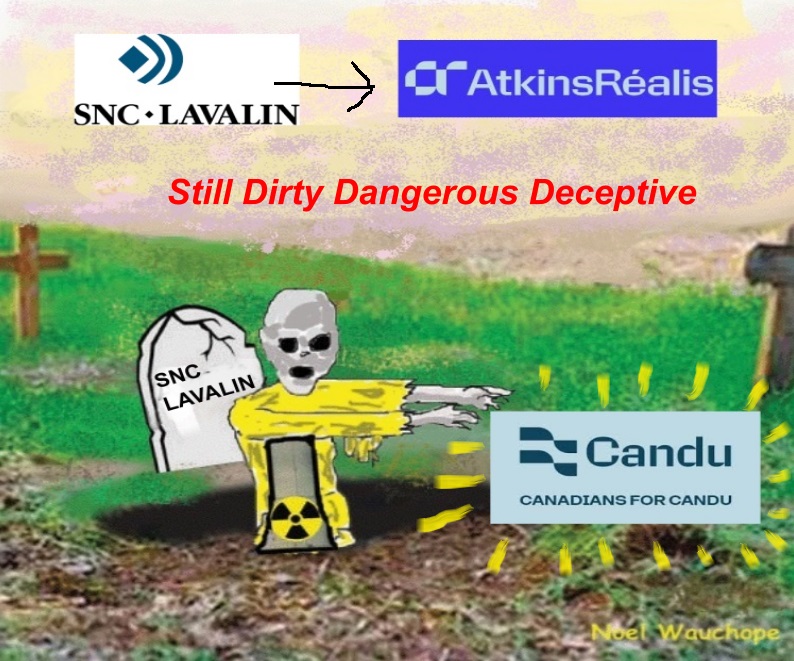
AtkinsRéalis wants to develop a new Candu reactor to sell around the world, but an industry insider says the company’s past could be a ‘big problem’ to getting funding
National Post Ryan Tumilty, Aug 15, 2024
OTTAWA – A company formerly at the centre of one of the biggest scandals of the Trudeau government is now looking for as much as $75 million in annual funding to update a nuclear reactor Canada has exported around the world.
AtkinsRéalis, formerly named SNC Lavalin, launched the Canadians for Candu campaign earlier this year. It’s a push to get both provincial governments and the federal government to back a new, more powerful Candu nuclear reactor that could be built both home and abroad.
The lobbying effort, started earlier this year, has recruited other engineering and construction firms, local unions and other groups to advocate for government support of the made in Canada reactor. The co-chairs of the campaign are former prime minister Jean Chrétien and Ontario premier Mike Harris.
Gary Rose, executive vice-president of nuclear, said the company wants Canadians to be aware of the potential.
“The campaign is really all about promoting Candu, the fact that Canada owns a world-class nuclear technology,” he said. “As provinces make decisions on which technologies that they wish to pursue, when it comes to large nuclear, we want that pursuance to be Candu technology because it’s a Canadian technology.”
AtkinsRéalis holds the license for Candu reactors which were first developed in the 1950’s by the Canadian government. All of Canada’s current nuclear reactors are Candu models ………….
In 2011, the Harper government sold the right to develop Candu reactors to what was then SNC-Lavalin for $15 million. The Crown corporation, Atomic Energy of Canada Limited, retained the intellectual property of the reactors.
With the license in place, AtkinsRéalis has worked on large refurbishment projects and last year signed a deal to build two new reactors in Romania with the help of export financing from the Canadian government.
The proposed Romanian reactors are Candu-6 models capable of producing 700 megawatts of power, but to attract more business, including here in Canada, AtkinsRéalis is working on a new reactor, the Candu Monark, which would be capable of 1,000 megawatts…..
That’s where the company is seeking federal cash. Rose said they are currently spending $50 to $75 million a year on engineering to complete the Monark design and expect to do the same over the next three years. They would like the government to match that spending, potentially adding up to a $300 million bill for taxpayers.
He said ultimately the government will win out in the end.
“We’re asking for it to be an investment. We’re not asking for a handout,” he said. “The IP that we develop as Monark will stay owned by the Canadian government.”
Minister of Natural Resources Jonathan Wilkinson’s office said only that they were aware of the Canadians for Candu campaign when the National Post reached out.
…………………………….AtkinsRéalis has at least one specific project in mind for the Monark, the proposed expansion of the Bruce Nuclear plant in southern Ontario. That project announced last year aims to add up to 4,800 megawatts of power to the Bruce plant, which is already the largest nuclear installation in the world.
Ontario’s then Minister of Energy Todd Smith, said last year, the province would need a lot more power………………….
The proposed site C project is in its infancy and the company has only just started consultations with local communities and planning for what the project would look like. It has only started to look at what reactor technology it might use, but has said it intends to conduct an open process with a “technology neutral” approach.
Rose said the Monark design work could be done in the next four years and be ready to build at the end of this decade.
“The Monark is an evolution of existing Candu technology so we are not starting from scratch,” he said. Most of the components, over 85 per cent, of a Monark reactor would come from Canadian suppliers.
Aaron Johnson, a vice president with AECON construction who worked on nuclear refurbishment projects with AtkinsRéalis and is part of the Canadians for Candu campaign, said new reactors would be a big boost to the local economy.
“That’s already an existing supply base, and that’s something that would only be furthered upon in a Candu new build application,” he said………………………………….
AtkinsRéalis’ request for more government funding comes as the company is shedding the SNC-Lavalin brand that was tarnished in a scandal.
In 2019, the company pleaded guilty to fraud and agreed to a $280 million fine for its actions in Libya between 2001 and 2011. In an agreed statement of facts at the time, the company admitted having paid nearly $48 million to the son of Libyan dictator Muammar Ghadafi to secure contracts.
Former attorney general Jody Wilson-Raybould resigned from cabinet earlier that year after she came under pressure from Prime Minister Justin Trudeau’s office to work out a deal with the company. The ethics commissioner ultimately found Trudeau had improperly pressured Wilson-Raybould.
Rose joined the company only last year and said he was assured he was making the right choice to come aboard because much more than the name of the company has changed.
“The entire management team, leadership team, programs that support it. I believe it’s a totally different company than it was,” he said.
Chris Keefer, president of the group Canadians for Nuclear Energy, acknowledges that AtkinsRéalis’ former name will be a political problem………………………..
Keefer’s group doesn’t receive funds from AtkinsRéalis and isn’t a member of Canadians for Candu, but he does believe the reactor should get government support. American company Westinghouse, which has the AP1000 reactor, received U.S. support for its design and Keefer argued it is not uncommon in the industry…………………………
At the COP 28 climate change conference last year, more than 20 countries including Canada, signed onto a pledge to triple nuclear power production by 2050.
Rose said he believes Candu reactors could easily be 10 per cent of the global market, but they need government support to do it.
“We’re building up front with the hopes of selling 25 in Canada, 75 to 100 globally, and having the federal government standing up and supporting us on that is really key.”https://nationalpost.com/news/politics/snc-lavalin-candu-nuclear-reactors?utm_source=Sailthru&utm_medium=email&utm_campaign=National%20Post%20-%20Posted%202024-08-15&utm_term=NP_HeadlineNews
The nuclear lobby wants new large nuclear reactors to be classed as “Small”

By magic, QUITE LARGE nuclear reactors are now SMALL.
And geewhiz – these new nuclear reactors no longer need much safety regulation

10 Aug 24, The Canadian Nuclear Association (CNA, the nuclear lobby) has written to all federal Members of Parliament in preparation for the 2025 budget. Their requests are in two sections: “investment tax credits” and “regulatory improvements.”
The investment tax credits allow companies to reduce their taxes owed if they spend money on nuclear development.
The CNA has numerous requirements , especially regarding SMRs
Small Modular Reactors (SMRs) – the numerous requirements include:
*Adjusting the definition to include projects up to 1400 megawatts thermal, or roughly 470 megawatts electrical.
*The CNA wants nuclear regulations to be reduced, particularly for Impact Assessments.
Streamline the Impact Assessment (IA) process:
Narrow the scope to factors of federal interest and indigenous rights and Remove the requirements for a Detailed Project Description
******************************************
From the International Atomic Energy Agency. Small modular reactors (SMRs) are advanced nuclear reactors that have a power capacity of up to 300 MW(e) per unit, which is about one-third of the generating capacity of traditional nuclear power reactors. https://www.iaea.org/newscenter/news/what-are-small-modular-reactors-smrs
From the International Atomic Energy Agency (For Small Modular Reactors) The main concepts underpinning the current safety approach — such as, for example, defence-in-depth, which assures prevention and mitigation of accidents at several engineering and procedural levels — are relevant for SMRs . A comprehensive safety assessment of all plant states — normal operation, anticipated operational occurrences and accident conditions — is required. https://www.iaea.org/newscenter/news/technology-neutral-safety-and-licensing-of-smrs
Analysis of Canadian Nuclear Association (CNA) recommendations for Budget 2025

The lack of new nuclear projects in Canada reflects investor decisions, not excess regulation. No nuclear project has been assessed since the Act came into force nearly five years ago.
Ole Hendrickson , 10 August 24
The House of Commons Standing Committee on Finance announced its annual pre-budget consultations process on June 24, 2024. It invited the submission of written briefs no later than August 2, 2024. The committee will table a report on these consultations in the House of Commons, with recommendations to be considered by the Deputy Prime Minister and Minister of Finance in their development of Budget 2025. On July 30, 2024, the Canadian Nuclear Association (CNA) submitted its recommendations.
Part 1 – “Clean Economy” Investment Tax Credit (ITC) Programs
The CNA brief refers to four “Clean Economy” investment tax creditprograms from Budget 2024. Three were passed into law in June 2024.
Nuclear projects should not be eligible for investment tax credits. Nuclear power is not clean. It produces vast amounts of pollutants and waste, ranging from toxic mine tailings to irradiated fuel rods. Providing tax credits for nuclear power represents poor economic and environmental policy.
The only apparent reason for providing investment tax credits for nuclear power is that the Minister of Natural Resources Canada, whose department provides “engineering and scientific guidance” for the ITC programs, has a mandate to promote nuclear power under the Nuclear Energy Act.
1. Clean Technology ITC
Small modular nuclear reactors (SMRs) are the only nuclear power projects eligible for the 15% refundable tax credit under this program. The accepted definition of an SMR is a reactor that has a power capacity of up to 300 megawatts electrical per unit, or roughly 900 megawatts thermal.
The CNA wants to expand the definition of an SMR to include reactors up to 1400 megawatts thermal, or roughly 470 megawatts electrical.
There is considerable evidence that SMRs would produce far more expensive electricity than other generating facilities, including larger nuclear reactors. Does the CNA anticipate that the 300-megawatt BWRX-300 reactors that Ontario Power Generation plans to build at the Darlington nuclear site will not be cost-competitive without additional subsidies?
2. Clean Hydrogen ITC
This ITC program provides refundable tax credits ranging from 15-40% depending on the carbon intensity of the hydrogen produced. Widespread use of hydrogen as an energy source would require expensive new infrastructure investments. Using expensive nuclear power to produce hydrogen would further increase costs. The CNA wants hydrogen produced by using nuclear power to hydrolyze water to be considered as a qualified clean hydrogen project. The Government of Canada has not provided details on eligible projects under this ITC program.
3. Clean Technology Manufacturing ITC
This ITC program provides refundable tax credits for “clean technology manufacturing and processing.” The CNA wants to see explicit mention of the extraction and processing of uranium as a “critical mineral”, of the manufacturing of nuclear energy equipment and nuclear fuels, and of the manufacturing of “equipment for lifecycle handling of uranium fuel,” as being eligible for tax credits.
All the activities in the nuclear fuel “lifecycle” generate waste that is hazardous to human health and difficult to manage. The use of robotic equipment to handle the highly radioactive spent nuclear fuel waste is one of the most expensive parts of this “lifecycle”. A “clean economy” program should not subsidize waste management for a particular industry, particularly when that industry has delayed its decommissioning and waste management activities for decades.
4. Clean Electricity ITC
Under this ITC program, which has not yet passed into law, the CNA wants to “include all components enabling clean electricity assets to continue operating in refurbishment expenditures.”
Ontario Power Generation and Bruce Power have active reactor refurbishment programs. The Ontario provincial government already provides a $7.3 billion taxpayer subsidy to hold down electricity rates and shield industrial and household ratepayers from reactor refurbishment costs. A new federal subsidy for refurbishment of Ontario’s reactors would further hide nuclear costs, and would provide no apparent benefit to Canadian taxpayers in other provinces.
Part 2 – Policies that “enhance the regulatory framework to expedite project approvals”
The CNA is seeking to restrict the public’s ability to participate in assessments of nuclear projects. This builds on proposals from a Ministerial Working Group on Regulatory Efficiency for Clean Growth Projects, and a review of the Physical Activities Regulations (the “Project List”) by the Impact Assessment Agency of Canada. Policy matters that go beyond the Committee’s request for views on 2025 Budget priorities should be debated by appropriate Parliamentary committees.
1. Exempting nuclear projects from impact assessment
Based on a plan (Building Canada’s Clean Future) created by a Ministerial Working Group on Regulatory Efficiency for Clean Growth Projects, the Impact Assessment Agency of Canada wishes to reduce the possibility that future nuclear projects will be assessed under the Impact Assessment Act. On July 30, 2024, the Agency released a Discussion paper on the review of the Physical Activities Regulations – the so-called “Project List” – with comments due September 27, 2024.
Proposals in the Agency’s discussion paper mirror those in the CNA’s submission to the Finance Committee, suggesting that the two may have been working together. The CNA wants to exempt nuclear reactors of any size that are built on “brownfield” sites (e.g., sites where coal- or gas-fired generating stations have been shut down), or on licensed nuclear sites, from assessment. At present, only reactors of up to 200 megawatts thermal on brownfield sites, or 900 megawatts thermal on licensed sites, are exempt. The CNA proposal would also limit technical assessments to “First of a Kind” reactors, with only site considerations for future reactors of a similar design.
The CNA also wants to exempt construction, expansion and decommissioning of uranium mines with an ore production capacity of up to 5,000 tons per day. This would double the current 2,500 tons/day exemption. And it wants to allow provincial assessments to replace federal assessments.
These are not constructive proposals. They would increase the likelihood that nuclear projects will generate conflicts and fail to gain social license. The Act improves the chances that a project will proceed by encouraging public participation in project planning stages, The ability of independent experts to examine technical details brings rigor to the assessment process.
The lack of new nuclear projects in Canada reflects investor decisions, not excess regulation. No nuclear project has been assessed since the Act came into force nearly five years ago.
2. Putting the Canadian Nuclear Safety Commission (CNSC) in charge of impact assessment
If a nuclear project is captured by the Physical Activities Regulations under the Impact Assessment Act, under Section 44 of the Act the Minister of the Environment must create a review panel, set the panel’s terms of reference, appoint the chairperson and at least two other members of the panel, and ensure that they are unbiased and free from any conflict of interest relative to the project.
The Minister also has the power to designate a project for assessment, even if it is not captured by the Project List. The CNA wants to remove the Minister’s powers and give them to the CNSC.
An expert panel report, Building Common Ground: A New Vision for Impact Assessment in Canada, noted the long-standing perception of a lack of independence and neutrality of the CNSC because of its close relationship with the industry it regulates, and its promotion of projects it is tasked with regulating. The panel found that the CNSC has eroded confidence in the assessment process, leading to widespread use of the term “regulatory capture” to describe this body.
Taking away the Ministers’ powers and reassigning them to the CNSC would be a regressive step, leading to further loss of social license for nuclear projects, as has been the case with the proposed Near Surface Disposal Facility at the federally owned Chalk River Laboratories.
3. Amending the Species at Risk Act
Under section 79 of the Species at Risk Act, the proponent of a project must “notify the competent minister or ministers in writing of the project if it is likely to affect a listed wildlife species or its critical habitat.”
The CNA recommends that section 79 be modified “to align with the Supreme Court of Canada opinion, focusing on federal jurisdiction.” The Court, in its reference decision on the Impact Assessment Act, considered the Species at Risk Act and found that the protection of migratory birds, fish, fish habitat, and aquatic species should be included in the definition of adverse federal effect in the Impact Assessment Act. The Court did not discuss amending the Species at Risk Act.
The Species at Risk Act applies to all wild species found in Canada and has provisions to promote cooperation with other governments and jurisdictions. The CNA recommendation to amend the Act in the context of Budget 2025 would represent an inappropriate use of budget legislation.
Canada’s future generations: affordable clean energy vs. legacy nuclear debt?
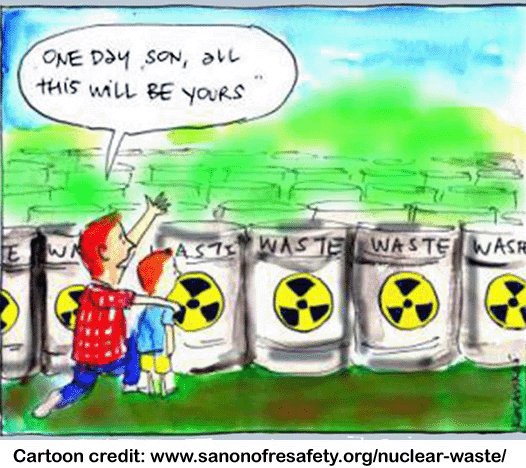
For the sake of today and tomorrow’s young, Canada needs to follow a ‘sustainable renewables path to net zero’ using all of our people and financial resources.
Our government must not saddle the generations to come with the debt for nuclear ‘white elephants’ when affordable, clean, renewable power can meet our needs now and theirs in future, writes Gail Wylie.
BY GAIL WYLIE | August 1, 2024, https://www.hilltimes.com/story/2024/08/01/canadas-future-generations-affordable-clean-energy-vs-legacy-nuclear-debt/429822/
Canadians concerned about climate change want Canada to meet its obligations to future generations by addressing climate change rapidly and responsibly. This requires us to implement current technologies for efficiency, renewable power, modern storage, and electrical grid options.
Instead, the federal government has placed inordinate bets on nuclear power expansion. This includes tens of millions of dollars in funding and loans for experimental small modular reactors, and $50-million in federal predevelopment funding to assess new generation opportunities for Bruce Power’s facility. Nuclear expansion, however, fails Canada’s decarbonization goals of speed and affordability, and takes limited resources away from lower cost, proven climate solutions.
On affordability, Ontario’s lowest cost decarbonized power sources are: efficiency 1.6 cents per kWh, solar plus storage 10 cents per kWh, onshore wind plus storage 10.5 cents per kWh and Quebec water power 5.2 cents per kWh. Nuclear falls among higher costs at 10.5 cents per kWh in 2024, rising to 13.7 cents projected with refurbishments for 2027, and future new nuclear reactors 24.4 cents per kWh.
Ontarians are still paying down the original $38.1-billion in debt and liabilities from Ontario Hydro in 1999 when its finances were over-extended during the period of expanded nuclear power facilities.
The lengthy approval and construction times and costs for new nuclear are a further caveat highlighted by the World Nuclear Industry Status Report. France renationalized Électricité de France in 2023 facing $70-billion in debt, including the Flamanville reactor at 19.1 billion euros and 17-year completion for 2024. The United Kindgom’s Hinkley Point C which began in 2018 is delayed to 2027 projecting costs of $44-billion. The first of two Vogtle U.S.A. reactors, going live in 2023, took 10 years at $35-billion in cost estimate for the pair. International banks have rebuffed plans by 22 countries at COP28 to “triple nuclear power by 2050,” indicating the lack of a business case for such investment.
The hope of faster, cheaper small modular reactors (SMRs) is fading as the lead developer, NuScale, lost its Utah Utilities investor as projections rose from $3-billion in 2015 to $9.3-billion in 2023. Two SMR designs in New Brunswick are also unlikely to be commercialized.
Future generations who will pay for the power capacity being built in this decade cannot afford these unnecessary financial risks and delays of expanding nuclear assets. The young urgently need affordable housing with energy prices ensuring ‘affordable to heat, cool, and cook-in housing.’
The federal government falsely claims “no path to net zero without nuclear.” The industry mantra of nuclear reliability over renewables “when the sun doesn’t shine and the wind doesn’t blow” has been debunked by science-based modelling studies. The Suzuki Foundation’s report, Shifting Power: Zero-Emissions Electricity Across Canada by 2035, and Mark Jacobson’s work at Stanford University, A Solution to Global Warming: Air Pollution, and Energy Insecurity for Canada, both outline the mix of solutions for reliable, affordable, rapid decarbonization across this country by 2035 without new nuclear. The International Renewable Energy Agency’s 2024 analysis confirms that affordable, worldwide transition is attainable with renewables.
Shrinking battery costs for power storage (kWh in 2022 costing US$159 down as low as $59 currently) and modern electrical grid technologies facilitate renewables’ reliability as reflected in energy strategist Michael Barnard’s analysis. Outages at New Brunswick’s Point Lepreau Nuclear Generating Station during peak winter periods in 2021 and 2022/23, and its 2024 extended maintenance, reflect nuclear’s vulnerability.
Dealing with nuclear waste is the other elephant in the room with financial and environmental impacts for generations in perpetuity. Phasing out nuclear power—not expanding it—reduces future costs.
So why is Canada not on a renewables path to net zero? Are we too balkanized to co-operate, leading Ontario to expand gas and nuclear power after rejecting Quebec’s 2019 20-year offer of five cents per kWh hydro power?
Or is this the ‘siren song’ of the nuclear lobby, funded with ratepayers’ money, seducing governments with the caché of ‘top tier’ status in the international nuclear club? Nuclear-armed club members—U.K., France, the United States, and Russia—need civil nuclear as a ‘nuclear supply chain.’ Canada does not!
The pictures worth a thousand words

Canada and the Atom Bomb Exhibition
Canada’s little-known role in atomic bombings on display
By Anton Wagner, 4 Aug 24, https://beyondnuclearinternational.org/2024/08/04/the-pictures-worth-a-thousand-words/
The Hiroshima Nagasaki Day Coalition launched a “Canada and the Atom Bomb” photo exhibition inside Toronto City Hall on August 2. The exhibition of 100 photographs reveals the Canadian government’s participation in the American Manhattan Project that developed the atom bombs that destroyed Hiroshima and Nagasaki in August 1945.
The exhibition can be viewed in its entirety online at the Toronto Metropolitan University website.
It documents how the Eldorado Mining and Refining Company extracted uranium ore at Great Bear Lake in the Northwest Territories in the late 1930s and shipped the ore to its refinery in Port Hope, Ontario, for sale to the Americans.
Images by the Montreal photographer Robert Del Tredici focus on the Dene hunters and trappers at Great Bear Lake who were hired by Eldorado to carry the sacks of radioactive ore on their backs for loading onto barges that transported the ore to Port Hope. Many of them subsequently died of cancer.
Before his death in 1940, the Dene spiritual leader Louis Ayah had prophesied that such an illness would befall the Dene because of white men mining on Dene territory. Ayah also prophesied a nuclear holocaust that would end human civilization.
Prime Minister Mackenzie King hosted President Roosevelt and Prime Minister Winston Churchill in Quebec City in 1943 where they agreed to have Canada participate in the production of the atom bomb.
The exhibition highlights this participation by the Canadian government, scientists, industry, and nuclear research laboratories. Posters from the Hiroshima Peace Museum show the death and destruction in the two bombed cities. The exhibition includes five images by Yoshito Matsushige, the only photographer who took pictures in Hiroshima the day the atom bomb exploded overhead.
“Canada and the Atom Bomb” concludes with photographs showing the efforts by peace activists to persuade Toronto City Council to participate in the world-wide movement to abolish nuclear weapons. In 2017, City Council reaffirmed Toronto as a Nuclear Weapons-Free Zone and called on Prime Minister Justin Trudeau to have Canada ratify the UN Treaty on the Prohibition of Nuclear Weapons.
Setsuko Thurlow accepted the Nobel Peace Prize on behalf of the International Campaign to Abolish Nuclear Weapons in Oslo, Norway, in December 2017. A Hiroshima survivor, Thurlow, now 92, attended the opening of the “Canada and the Atom Bomb” exhibition on August 2. She will also speak at the annual August 6 commemoration at the Toronto City Hall Peace Garden to urge that Canada sign the Treaty on the Prohibition of Nuclear Weapons.
Anton Wagner is with the Hiroshima Nagasaki Day Coalition.
Burying radioactive nuclear waste poses enormous risks
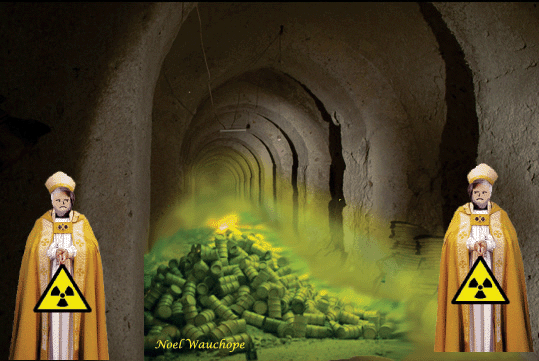
by David Suzuki, July 31, 2024, https://rabble.ca/environment/burying-radioactive-nuclear-waste-poses-enormous-risks/
The spent fuel will remain radioactive for hundreds of thousands of years, and contamination and leaks are possible during storage, containment, transportation and burial.
As the consequences of burning dirty, climate-altering fossil fuels hit harder by the day, many are seizing on nuclear power as a “clean” energy alternative. But how clean is it?
Although it may not produce the emissions that burning fossil fuels does, nuclear power presents many other problems. Mining, processing and transporting uranium to fuel reactors creates toxic pollution and destroys ecosystems, and reactors increase risks of nuclear weapons proliferation and radioactive contamination. Disposing of the highly radioactive waste is also challenging.
In this case, the NWMO has already paid Indigenous and municipal governments large sums to accept its plans — ignoring communities that will also be affected along transportation routes or downstream of burial sites.
According to Canadian Dimension, industry expects to ship the wastes “in two to three trucks per day for fifty years, in one of three potential containers.” None of the three containment methods has been subjected to rigorous testing.
Even without an accident, trucking the wastes will emit low levels of radiation, which industry claims will produce “acceptable” exposure. Transferring it from the facility to truck and then to repository also poses major risks.
Although industry claims storing high-level radioactive waste in deep geological repositories is safe, no such facility has been approved anywhere in the world, despite many years of industry effort.
Canadian Dimension says, “a growing number of First Nations have passed resolutions or issued statements opposing the transportation and/or disposal of nuclear waste in northwestern Ontario, including Lac Seul First Nation, Ojibway Nation of Saugeen, Grassy Narrows First Nation, Fort William First Nation, and Wabaseemoong Independent Nations.”
Five First Nations — including Grassy Narrows, which is still suffering from industrial mercury contamination after more than 60 years — have formed the First Nations Land Alliance, which wrote to the NWMO, stating, “Our Nations have not been consulted, we have not given our consent, and we stand together in saying ‘no’ to the proposed nuclear waste storage site near Ignace.”
Groups such as We the Nuclear Free North are also campaigning against the plan.
All have good reason to be worried. As Canadian Dimension reports, “All of Canada’s commercial reactors are the CANDU design, where 18 months in the reactor core turns simple uranium into an extremely complex and highly radioactive mix of over 200 different radioactive ingredients. Twenty seconds exposure to a single fuel bundle would be lethal.”
The spent fuel will remain radioactive for hundreds of thousands of years, and contamination and leaks are possible during storage, containment, transportation and burial. Industry, with its usual “out of sight, out of mind” approach, has no valid way to monitor the radioactive materials once they’re buried.
With 3.3 million bundles of spent fuels already waiting in wet or dry storage at power plants in Ontario, New Brunswick, Quebec and Manitoba, and many more to come, industry is desperate to find a place to put it all.
Even with the many risks and no site yet chosen for burial, industry and governments are looking to expand nuclear power, not just with conventional power plants but also with “small modular reactors,” meaning they could be spread more widely throughout the country.
Nuclear power is enormously expensive and projects always exceed budgets. It also takes a long time to build and put a reactor into operation. Disposing of the radioactive wastes creates numerous risks. Energy from wind, solar and geothermal with energy storage costs far less, with prices dropping every day, and comes with far fewer risks.
Industry must find ways to deal with the waste it’s already created, but it’s time to move away from nuclear and fossil fuels. As David Suzuki Foundation research confirms, renewable energy from sources such as wind and solar is a far more practical, affordable and cleaner choice.
David Suzuki is a scientist, broadcaster, author and co-founder of the David Suzuki Foundation. Written with David Suzuki Foundation Senior Writer and Editor Ian Hanington.
Is Manitoba willing to accept nuclear waste risks?
ANNE LINDSEY. 2 Aug 24.
ANYONE driving Highway 17 from Winnipeg to Thunder Bay will pass through Ignace a couple of hours east of Dryden.
A modest Canadian Shield town with about 1,300 inhabitants, Ignace was built on the forest industry, but like so many northern Ontario towns, today actively seeks other economic opportunities.
The alert traveller will also notice many roadside signs between Kenora and Thunder Bay, proclaiming “No Nuclear Waste in Northwest Ontario.” The issue has reached a critical juncture recently in this area.
Hosting Canada’s high-level nuclear waste repository is one of the economic development opportunities being explored by Ignace.
On July 10, Ignace Town Council voted in favour of being a “willing host” for this massive storage hole in the ground and the accompanying transfer facility for the highly radioactive and toxic “spent” fuel from existing and future reactors.
The taxpayer-funded Nuclear Waste Management Organization or NWMO (consisting of the owners of Canada’s nuclear waste and charged by the federal government to find a repository site) provided Ignace a half-million dollar signing bonus, in addition to NWMO’s many donations and monetary contributions to local initiatives leading up to the vote.
Problems abound with this “willingness” declaration, not the least of which is that the site in question is not even in Ignace or in the same watershed. The Revell batholith site, 45 kilometres west of Ignace, lies on the watersheds of both theRainy River which flows into Lake of the Woods, and thence to the Winnipeg River and Lake Winnipeg, and the English River which flows north through Lac Seul and into Lake Winnipeg.
The waste will remain dangerous for literally millennia. Burying irretrievable nuclear waste in an excavated rock cavern that is deep underground where groundwater flows through the rock and eventually links to surface bodies has never been tested in real life. The industry relies on computer models to persuade us that future generations will not be at risk.
The waste will have to be transported to Revell, mostly from southern Ontario and New Brunswick — several massive shipments daily for 40 years for the existing waste — along the often-treacherous route skirting Lake Superior. It must then be “repackaged” in a surface facility into burial canisters.
Little is publicly known about what this entails, but any accidents and even routine cleaning will result in radioactive pollution to the surrounding waters posing a more immediate risk.
First Nations along the downstream routes have expressed their opposition to this project. Chief Rudy Turtle of Asubpeeschoseewagong (Grassy Narrows) was clear in his letter to the CEO of NWMO: “The water from that site flows past our reserve and into the waters where we fish, drink, and swim. The material that you want to store there will be dangerous for longer than Canada has existed, longer than Europeans have been on Turtle Island, and longer than anything that human beings have ever built has lasted. How can you reliably claim that this extremely dangerous waste will safely be contained for hundreds of thousands of years?”
His views are echoed by neighbouring chiefs, and other Treaty 3 First Nations have rejected nuclear waste transportation and abandonment through and in their territories. Wabigoon First Nation, the closest to the Revell site, will hold its own community referendum on willingness to host the site this fall. It’s not known how much money or other inducements NWMO has offered for a signing bonus.
In 1986, a citizens group in the Eastern Townships of Quebec successfully lobbied politicians on both sides of the border to reject a U.S. proposal for a massive nuclear waste repository in Vermont, on a watershed flowing into Canada.
Around the same time, Manitoba citizens convinced our government to oppose another proposed U.S. nuclear waste site — with potential for drainage to the Red River. And eventually, the NDP government of Howard Pawley passed Manitoba’s High-Level Radioactive Waste Act, banning nuclear waste disposal in this province.
Where does Manitoba stand today? We don’t know, even though the Revell site is not far from Manitoba and the water is flowing this way.
No single town should be making decisions with such profound risks to all of our health and futures. People who depend on Manitoba rivers and lakes (including Winnipeggers, via our water supply from Shoal Lake) should be part of this decision. Now is the time for our elected officials on Broadway and Main Street to become active stakeholders and demand a voice in the nuclear waste “willingness” question.
Anne Lindsey is a longtime observer of the nuclear industry and a Canadian Centre for Policy Alternatives Manitoba Research Associate. This article was written in collaboration with the Manitoba Energy Justice Coalition.
Canada and the Atom Bomb: Remembering As an Act of Resistance

Anton Wagner, July 23, 2024, http://imagearts.ryerson.ca/hiroshima/remembering/
I met Setsuko Thurlow in 1995 when I produced Our Hiroshima for Vision TV for the 50th commemoration of the atomic bombings of Hiroshima and Nagasaki. In 1954, she had received death threats while studying at an American college in Virginia after criticizing the United States’ hydrogen bomb test in the Marshall Islands, one thousand times more powerful than the atom bomb dropped on Hiroshima. But when she settled in Canada with her husband, Jim Thurlow, the following year, she found “a very passive, almost indifferent world here. Maybe Canadians felt they had nothing to do with the nuclear age.”
In Our Hiroshima, Setsuko singled out the Eldorado uranium refinery in Port Hope, Ontario, that enriched all the uranium used by the American Manhattan Project to produce the Hiroshima and Nagasaki bombs. She found Canadians were not informed about their country’s involvement in the development of the atom bomb and failed to recognize that nuclear weapons were a universal, global phenomenon. “We all have to be concerned.”
The documentary showed her speaking to a huge peace rally at the University of Toronto Varsity Stadium in 1982. “Peoples around the world, with their deafening silence, have permitted their government to continue producing and accumulating ever more destructive weapons of genocide,” she told the rally. The hundreds of billions of dollars spent on armaments annually “diverted the resources that could feed the starving, heal the sick, and teach the illiterate.”
Setsuko began sharing the horrors she had witnessed as a survivor of Hiroshima with Canadians in “A Silent Flash of Light,” published in Saturday Night in August 1985. She would make these same very detailed, moving personal descriptions for international media for the next four decades. Nine members of her family and over three hundred of her schoolmates and teachers perished. Her family’s house was but ashes and broken tiles. Only an ornate clock in a cast-iron frame (seen in Jim Allen’s photograph above) could be salvaged as a reminder of life before the atomic bombing. “In the Peace Park in Hiroshima, there is a cenotaph with the inscription: ‘Rest in peace; the evil will not be repeated,’” she concluded her Saturday Night memoir. “This has become the vow of the survivors. Only then will our loved ones’ grotesque deaths not have been in vain. Only then will our own survival have meaning.
Thirty-two years later, in December 2017, Setsuko Thurlow accepted the Nobel Peace Prize, together with Beatrice Fihn, awarded to the International Campaign to Abolish Nuclear Weapons for bringing about the United Nations Treaty on the Prohibition of Nuclear Weapons. In her acceptance speech, she asked her audience in Oslo, “Today, I want you to feel in this hall the presence of all those who perished in Hiroshima and Nagasaki. I want you to feel, above and around us, a great cloud of a quarter million souls. Each person had a name. Each person was loved by someone. Let us ensure that their deaths were not in vain.”
With the approaching 75th anniversary of the atomic bombings in 2020, Thurlow wrote to all the world’s heads of state, including Canada’s Prime Minister Justin Trudeau, who had not yet ratified the Treaty on the Prohibition of Nuclear Weapons. In her personal appeal to the Prime Minister, she included my research document “Canada and the Atom Bomb” that provides the factual basis for this “Canada and the Atom Bomb” exhibition.
Setsuko referred to the delegation from Deline in the Northwest Territories representing Dene hunters and trappers employed by Eldorado to carry the sacks of radioactive uranium ore on their backs for transport to the Eldorado refinery in Port Hope. The delegation travelled to Hiroshima in August of 1998 and expressed their regret that uranium from their lands had been used in the development of the atom bomb. As seen in Robert Del Tredici’s photographs, Dene had themselves died of cancer because of their exposure to uranium ore, leaving Deline a village of widows. “Surely,” Thurlow wrote Trudeau, “the Canadian Government should make its own acknowledgement of Canada’s contribution to the creation of the atom bombs that destroyed Hiroshima and Nagasaki.”
She stated that an awareness by Canadians of our country’s direct participation in the atomic bombings of Hiroshima and Nagasaki had all but disappeared from our collective consciousness. Thurlow proposed to the Prime Minister that the 75th anniversary of the atomic bombings would be the appropriate moment to acknowledge Canada’s critical role in the creation of nuclear weapons, express a statement of regret for the deaths and suffering they caused in Hiroshima and Nagasaki, as well as announce that Canada would ratify the Treaty on the Prohibition of Nuclear Weapons. The Globe and Mail headlined her August 2020 op ed about her appeal to Trudeau, “Canada must acknowledge our key role in developing the deadly atomic bomb.”
Justin Trudeau never acknowledged receipt of Setsuko’s appeal, although Liberal MP Ali Ehsassi personally delivered a copy to the Prime Minister’s Office. With Trudeau’s refusal to meet or communicate with Thurlow, she turned her lobbying efforts to Toronto City Council. She had facilitated the creation of a large Peace Garden directly in front of City Hall as a memorial to the atomic bombings and the need for peace in 1984. As shown in the exhibition, City Council hosted Prime Minister Pierre Elliott Trudeau who turned the sod, beginning construction of the Peace Garden; Pope John Paul II kindled its eternal flame, and Queen Elizabeth II dedicated it as a lasting expression of Toronto’s commitment to peace.
Setsuko was a fierce defender of the Peace Garden when the $40 million revitalization of the City Hall Square resulted in its demolition. She was a leading figure among peace activists and community peace groups who convinced City Council to rebuild the Peace Garden on the civic square. Michael Chambers’ images capture this rededication of the Peace Garden in 2016.
The following year, Toronto City Council honoured Setsuko for her peace activism and reaffirmed Toronto as a nuclear weapons-free zone. The Toronto Board of Health held public hearings that resulted in its recommendation that City Council request that the Government of Canada sign the Treaty on the Prohibition of Nuclear Weapons. City Council passed such a motion and sent the text to Justin Trudeau, the Minister of Foreign Affairs, and the Minister of Health.
But nothing Canadian peace activists did changed the policies of the federal Canadian government. Setsuko Thurlow’s life-long commitment towards the abolition of nuclear weapons is a challenge to all concerned about the survival of human civilization. How can we transform our yearning for peace and justice into political action that will compel governments to prohibit and eliminate nuclear weapons? Setsuko donated her family’s precious ornate clock to the Canadian War Museum in Ottawa for a small peace exhibition in 2013. Will some survivors of a nuclear holocaust digging in the rubble of what once was Ottawa find a small, charred clock that once belonged to a survivor of the first atomic bombing but whose words of remembrance of that horror were buried by the silence of political leaders?
Point Lepreau nuclear station – a heavy financial burden that keeps getting heavier.
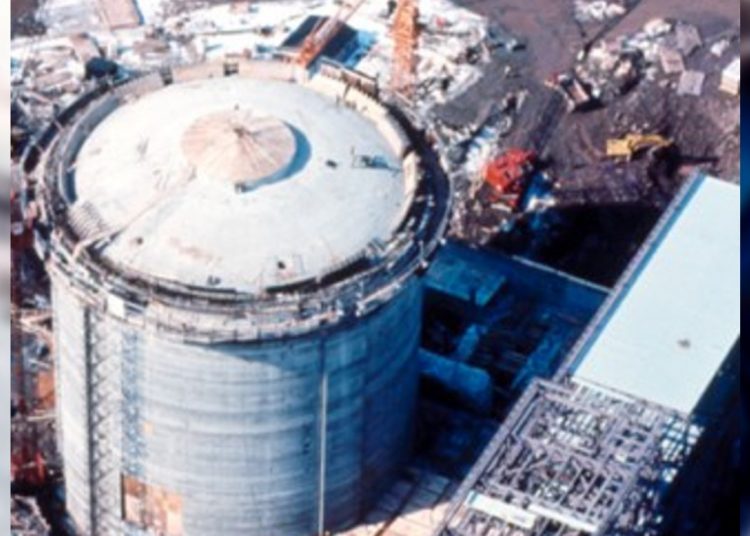
Point Lepreau has become a heavy financial burden
the station will remain at risk of unplanned outages because of aging equipment.
NB Power’s latest financial plan forecasts its debt will continue to grow. In the utility’s base case model, debt will keep rising for the rest of this decade, reaching nearly $6.3-billion by 2029. It keeps rising even in more optimistic scenarios.
Point Lepreau station is among North America’s worst-performing nuclear power plants. Can New Brunswick Power turn it around?
Globe and Mail, MATTHEW MCCLEARN , July 29, 2024
In the early hours of Dec. 14, 2022, New Brunswick’s Point Lepreau Nuclear Generating Station lost power after an electrical fault. Just hours later, at 4:40 a.m., an alarm sounded: The plant had suffered a small coolant leak and NB Power, the facility’s owner, detected radioactivity. The station was locked down to prevent that radioactivity from escaping, and an emergency response team was readied.
Somehow, two unrelated pieces of equipment had failed simultaneously, touching off a costly and time-consuming recovery. Workers needed to bring the reactor to a guaranteed shutdown state. They had to regain entry to the reactor building and decontaminate it. And they needed to find the leak and stop it. The station would remain out of service for 42 days.
This outage was just one of several in recent years that, in combination, point to severe reliability problems at Atlantic Canada’s only nuclear power plant. The latest, which was planned to end after 100 days on July 12 and cost more than $100-million, included installing a new 9,000-horsepower primary heat transport pump and motor, which moves heat generated by the reactor to the station’s steam generators.
But NB Power spokesperson Dominique Couture said workers discovered a problem with the station’s main generator, which provides electricity to the province’s grid. At a rate hearing before the New Brunswick Energy and Utilities Board, company officials said the plant is expected to remain offline until at least September. And the station will remain at risk of unplanned outages because of aging equipment.
It will be many years before we have put those risks behind us,” said Jason Nouwens, the station’s director of regulatory and external affairs.
Point Lepreau is one of North America’s worst-performing nuclear stations. Intending to keep it running until at least 2039, NB Power has struggled unsuccessfully for the past several years to rehabilitate the station and expects to spend hundreds of millions of dollars more on it in the next few years.
The utility is not too proud to ask for help: It wants Ontario Power Generation to effectively incorporate the plant into OPG’s large fleet of Candu reactors. Key senior leadership positions at the station are now held by OPG employees.
But there’s no guarantee OPG will agree to take over the stricken station on favourable terms, or at all. And it’s not clear NB Power can afford the steep repair bill.
New Brunswick’s dilemma points to challenges that other provinces, such as Alberta and Saskatchewan, should consider as they look to build new reactors………………………………………………………………………….
According to NB Power, Point Lepreau has roughly 115,000 components. The December, 2022, outage illustrated how the failure of just one of them, however inconsequential it may seem, can knock it out. The culprit for the water leak turned out to be a crack in a small instrument line near the reactor core, about the diameter of a finger. This line had been deemed necessary for the plant’s commissioning more than 40 years earlier, but was useless thereafter.
NB Power concluded that when the station lost power, other systems fired up that increased vibration throughout the plant. “This was essentially the final straw that propagated the crack to a failure point,” Mr. Nouwens explained to the federal safety regulator during a hearing after the incident. “It had been coming for some time.”
Outages are expensive. Point Lepreau’s 900 workers must be paid regardless of how much electricity the plant generates. Each day it’s out of service, NB Power also incurs hundreds of thousands of dollars in overtime costs.
NB Power must purchase energy to cover the shortfall as well, at an average cost of $900,000 a day.
Repeated outages have forced NB Power to divert capital to the station. This thwarted efforts to repay debts, most of which were incurred at Point Lepreau. This year’s extended outage also forced the utility to delay work at other power plants…………………………………………………………………..
NB Power’s latest financial plan forecasts its debt will continue to grow. In the utility’s base case model, debt will keep rising for the rest of this decade, reaching nearly $6.3-billion by 2029. It keeps rising even in more optimistic scenarios.
Heeding nuclear’s siren song
When Point Lepreau was still being planned, some experts doubted how suitable nuclear power was for a small province. Andrew Secord, an economics professor at St. Thomas University, found a March, 1972, memo by Myles Foster, an official at the federal Finance Department, that said that NB Power’s decision to go nuclear was “the equivalent of a Volkswagen family acquiring a Cadillac as a second car.”
Since then, Point Lepreau has become a heavy financial burden. At various times, the province has considered shuttering it or selling it. Ultimately, though, NB Power’s board of directors decided in 2005 to double down and extend the station’s life.
Refurbishments compel utilities to make crucial decisions about which equipment to replace, and what to keep. Pressure tubes, the Candu’s main life-limiting components, are a given, but many other components must be carefully assessed. Misjudgments can be costly.
Point Lepreau’s refurbishment began in March, 2008, and was scheduled to wrap up by October, 2009, at an expected cost of $845-million. According to a 2002 NB Power document, even if all two dozen of the worst disasters the utility could envision came to pass – everything from delays to strikes to unexpected additional work – it would add up to a combined maximum overrun of $623-million.
But things went worse – far worse – than NB Power imagined possible. It called in OPG to assist. The reactor finally returned to service in November, 2012, three years late and massively over budget.
Even this might have been salvageable had the plant operated reliably thereafter. NB Power was counting on Point Lepreau reaching a capacity factor of 89 per cent. Instead, NB Power found itself playing a game of Whac-A-Mole with recurring maintenance issues…………………………
NB Power has acknowledged that while the 2008-12 refurbishment focused on the reactor itself, equipment in the rest of the plant – sometimes referred to as the “conventional” side – typically was not replaced. Some of that equipment, such as the problematic generator that recently delayed the station’s return to service, is now breaking down. The utility made bad calls and is now paying a terrible price.
Recovery plan
NB Power is now drawing up a recovery plan for its ailing station, which features greatly increased maintenance spending: more than $87-million in 2025, tapering off thereafter.
But according to ScottMadden, this likely won’t suffice. Spending less than $80-million a year is “slightly more likely than not to result in performance declines,” whereas spending $100-million to $120-million is expected to deliver “the highest marginal returns in expected improvements.” Under current plans, ScottMadden warned, Point Lepreau’s performance will likely decline again beginning in 2030.
OPG sent a delegation to the stricken station last year to assess its condition, examine maintenance plans and interview NB Power employees. Last September, the utilities signed a three-year agreement under which OPG has seconded staff to the Point Lepreau station. NB Power says it has received support from OPG’s chief nuclear officer, a vice-president who’d supervised refurbishments and outages, and a chief nuclear projects officer.
OPG and NB Power are now in talks that might lead to Point Lepreau becoming part of OPG’s reactor fleet. At a hearing before the New Brunswick Energy and Utilities Board in June, Ms. Clark said OPG would likely assume majority ownership and would bring “some capital to the table to help with some of the investments that are required in the station over the longer term.”
She added, however, that given the difficulty of reaching “even general agreement on things,” a deal likely wouldn’t be reached before late 2025.
Even as NB Power officials struggle to fix Point Lepreau, they continue to offer their services to provinces such as Alberta and Saskatchewan, which possess little prior experience with nuclear technology. At an industry conference in Calgary in April, officials offered to help such provinces evaluate new reactor technologies and work with regulators…………..
They did not share any sense of the pitfalls of nuclear power – a topic for which NB Power has unfortunately gained formidable expertise. https://www.theglobeandmail.com/business/article-point-lepreau-station-is-among-north-americas-worst-performing-nuclear/
A New Brunswick reaction to the exorbitant costs of Point Lepreau nuclear power station.

When the Point Lepreau Nuclear Generating Station was refurbished over three years and re-opened in 2012, NB Power did not complete a number of associated repairs, despite the lengthy time and high cost of the refurbishment.
As a result, the nuclear plant has experienced many problems since the refurbishment and has been performing poorly. Since 2023, the NB nuclear plant has been managed by Ontario Power Generation, three managers costing $2 Million per year, under a three-year contract. I’m unsure if these people actually live in New Brunswick and pay taxes here or if New Brunswick is sending the money directly to Ontario.
At the start of April, the Lepreau nuclear plant was shut down for a scheduled 100 days to do the associated upgrades/repairs that NB Power hopes will improve the performance. The cost of the repairs was estimated at more than $300 million including the replacement power for this year’s repairs and another scheduled repair session in 2025. The first repairs were scheduled to end last week but instead of starting up again, the engineers noted a major problem with the main generator. Note that most of these engineers and workers doing this scheduled upgrade / repair are from Ontario, so it’s unclear how much of this cash is staying in the province.
Today we learned that the repair to the generator will cost an extra $70 million and the plant is down at least till September, which they say is a best case scenario.
So, when all this is over, what can New Brunswickers expect? At the end of the story below is this kicker: “Even by 2030, NB Power still thinks the plant will be mired in the basement, performance wise.”
What a F*** disaster. It’s absolutely nuts that our small province with a population of only 800,000 people has a nuclear reactor. In addition to the nuclear waste and other problems the reactor creates, we can’t afford it and we do not have the capacity in-province to look after it!
Point Lepreau nuclear station down till at least September, costing utility extra $71M.
All of this has been costly for the utility, which now carries more than $5 billion in debt, and to ratepayers, who are being asked to swallow the biggest increases to their bills in their lifetimes.
New target is a ‘best-case scenario,’ said expert of 27 years, who added it ‘wouldn’t be appropriate’ to give a worst-case scenario.
Telegraph Journal, John Chilibeck, Jul 22, 2024
The prolonged shutdown at the Point Lepreau nuclear plant is raising alarm, including over how it could affect power bills for residents and businesses.
At a rate hearing in Fredericton on Monday, NB Power officials said the longer-than-expected shutdown would likely last until at least September and cost an extra $71 million. That includes $51 million for buying replacement power and about $20 million for added repair and equipment costs.
Craig Church, a chief modeler for the public utility, said it would cost on average an extra $900,000 for each day Lepreau is shuttered given it is one of the cheapest in NB Power’s fleet of generators to run.
It normally provides one-third of the province’s electricity.
“The loss will have to be made up by future ratepayers?” asked public intervenor Allain Chiasson at the hearing.
After a pregnant pause, Church replied yes.
NB Power is already seeking the biggest hike in electrical bills in a lifetime. If the New Brunswick Energy and Utilities Board, an independent regulator, grants its request, households will have to pay 9.8 per cent more this year and 9.8 per cent more next year.
According to NB Power’s evidence, the average electrically heated residential customer is billed about $3,087 annually. Adding 9.8 per cent to that bill would be another $303, or a total of $3,390.
Big industry is facing a similar percentage hike, whereas small and medium-sized businesses would face slightly smaller increases.
But the evidence before the board does not take into account the prolonged shutdown of Lepreau, meaning those extra costs will only come into play in future years.
NB Power undertook a 100-day outage of Lepreau, west of Saint John along the Fundy coast, from mid-April to mid-July to overhaul parts of the non-nuclear side of the plant at a cost of $124 million.
It was part of a planned shutdown to renew the plant and make sure it was robust enough for the winter, when it supplies baseload power for the province. According to the plan, the upgrades were supposed to be completed last week.
But on Monday, an expert on the NB Power panel, Jason Nouwens, the director of regulatory and external affairs at Lepreau, said on June 29, the team discovered a problem with the main generator on the non-nuclear side of the plant.
Specifically, one of 144 stator bars in a giant rotor had failed, but NB Power isn’t sure why. To get to the failed equipment, workers must painstakingly take apart the generator piece by piece, a job that will take at least two weeks.
Then, Nouwens said, the troubleshooting team that includes outside experts from the Canadian nuclear industry will try to figure out why the stator bar broke and possible remedies to prevent such a failure from happening again.
The expert, who has been working at Lepreau 27 years, said the plant coming back online in September was a best-case scenario. When asked by one of the interveners, Nouwens said it “wouldn’t be appropriate” to give a worst-case scenario.
Besides the extra costs caused by the delayed re-start, questions have been raised about possible spillover.
On Friday at the same hearings at the Fredericton Convention Centre, a lawyer working on behalf of J.D. Irving, Limited asked NB Power officials repeatedly how the longer-than-expected outage at the nuclear generator would affect other important power plants in the electrical system.
The lawyer Glenn Zacher had before him Phil Landry, NB Power’s executive director of project management offices, who answered questions about other power plants in the system.
The other plants are also supposed to undergo regular outages for maintenance and repairs to ensure they are safe and reliable.
But some of the maintenance work has already been delayed because those plants need to be running when Lepreau is down, otherwise people’s lights and air conditioners wouldn’t work.
“When is it too late to do undertake maintenance elsewhere?” asked Zacher. “It seems to be an important question to be answered.”
Landry, however, didn’t have any firm answers and struggled to give any specific timelines, given the uncertainty at Lepreau
Landry explained to the board that NB Power has been running the Belledune Generating Station – which belches out emissions from high-polluting coal – and Coleson Cove, which burns similarly polluting heavy oil, to replace the energy lost at Lepreau.
Belledune was supposed to undergo maintenance and repairs right now, at a cost of $17.1 million, but its 46-day outage has been indefinitely delayed………………………………….
Pushing out the maintenance to later in the year, closer to the winter months, is not an ideal scenario, Landry said, because they need to be running smoothly when people heat their homes and electrical demand is greatest.
NB Power refurbished the nuclear side of the plant in 2012, at a cost of $2.5 billion, a project that was over-budget by $1 billion and took 37 months longer to complete than expected. But NB Power didn’t do similar work to other important parts of the plant, leading to frequent breakdowns.
All of this has been costly for the utility, which now carries more than $5 billion in debt, and to ratepayers, who are being asked to swallow the biggest increases to their bills in their lifetimes.
NB Power CEO Lori Clark has promised Lepreau will no longer be neglected in the hopes of improving its performance. The utility has partnered with Ontario Power Generation, which has more expertise with nuclear plants, to ensure the next phase of the overhaul is done right.
A benchmarking study showed Lepreau is one of the worst performers out of 38 similar nuclear power plants in the world, consistently in the bottom quarter.
On Monday, Nouwens said NB Power was committed to improving the plant’s performance but cautioned it would take years of extra spending and repair work to get to the average performance of most nuclear plants. He pointed out that Lepreau has 115,000 different components, many of which have to be replaced or repaired with age.
Even by 2030, NB Power still thinks the plant will be mired in the basement, performance wise.
“In the past, the work hasn’t been comprehensive and intrusive enough to reach the performance we need,” the executive said. “We’ve under-invested, causing unreliability.” https://tj.news/new-brunswick/long-shutdown-of-nuclear-plant-would-have-knock-on-effect-warns-lawyer
1 This Month
19 February – VIRTUAL EVENT-Decision Time: AI and Our Nuclear Arsenal
12:45 p.m. Central / 1:45 p.m. Eastern
To see nuclear-related stories in greater depth and intensity – go to https://nuclearinformation.wordpress.com

-
Archives
- February 2026 (141)
- January 2026 (308)
- December 2025 (358)
- November 2025 (359)
- October 2025 (376)
- September 2025 (258)
- August 2025 (319)
- July 2025 (230)
- June 2025 (348)
- May 2025 (261)
- April 2025 (305)
- March 2025 (319)
-
Categories
- 1
- 1 NUCLEAR ISSUES
- business and costs
- climate change
- culture and arts
- ENERGY
- environment
- health
- history
- indigenous issues
- Legal
- marketing of nuclear
- media
- opposition to nuclear
- PERSONAL STORIES
- politics
- politics international
- Religion and ethics
- safety
- secrets,lies and civil liberties
- spinbuster
- technology
- Uranium
- wastes
- weapons and war
- Women
- 2 WORLD
- ACTION
- AFRICA
- Atrocities
- AUSTRALIA
- Christina's notes
- Christina's themes
- culture and arts
- Events
- Fuk 2022
- Fuk 2023
- Fukushima 2017
- Fukushima 2018
- fukushima 2019
- Fukushima 2020
- Fukushima 2021
- general
- global warming
- Humour (God we need it)
- Nuclear
- RARE EARTHS
- Reference
- resources – print
- Resources -audiovicual
- Weekly Newsletter
- World
- World Nuclear
- YouTube
-
RSS
Entries RSS
Comments RSS
 nuclear-news