Concern in USA Congress over Saudi Arabia’s real aims in going for nuclear energy

 Congress skeptical of Saudi nuclear energy demands, AL-Monitor February 21, 2018
After years of informal negotiations, the United States is facing mounting pressure to reach a civilian nuclear agreement with Saudi Arabia or risk getting shut out of the Gulf kingdom’s lucrative energy market.
But Riyadh’s refusal to give up on certain capabilities that could be used in a nuclear weapons program has caused concern among lawmakers that the Donald Trump administration may be too keen to strike a deal.
Under Section 123 of the US Atomic Energy Act of 1954, Congress must review any agreement to supply a foreign state with US nuclear technology. While the Trump administration has yet to publicly rule out any concessions, Saudi insistence on retaining the right to enrich uranium and to reprocess plutonium faces significant roadblocks on Capitol Hill.
“I think we have made clear — not that it was necessary — that a 123 agreement that in any way contemplated an enrichment program is going to face a lot of opposition in Congress,” a congressional source familiar with the debate told Al-Monitor. “So I just don’t think that the executive branch is going to go there.”……….
Energy Secretary Rick Perry visited Saudi Arabia and discussed Riyadh’s solicitation for bids to build its first two nuclear reactors late last year. Soon after, Bloomberg reported that the administration was actively considering a 123 agreement that would grant the Saudis wide latitude to pursue uranium enrichment and plutonium reprocessing.
Nonproliferation champions in Congress have been pushing back since. The Wall Street Journal reported this week that Sen. Ed Markey, D-Mass., who sits on the Senate Foreign Relations Committee, told the Saudi ambassador last month that he would force a floor vote and debate on any proposed 123 agreement with Riyadh.
“It seems crazy to loosen important nonproliferation standards just to try to secure an uncertain commercial deal,” Markey told the Journal………
“Members of the Saudi royal family have suggested that they may have an interest in nuclear weapons at some point in the future,” Daryl Kimball, the executive director of the Arms Control Association, told Al-Monitor. “There is considerable concern in Congress about any nuclear cooperation with Saudi Arabia that does not somehow make it harder for the Saudis to acquire enrichment and reprocessing technology in the future.”
……….. http://www.al-monitor.com/pulse/originals/2018/02/congress-skeptical-saudi-nuclear-energy-demands.html#ixzz57rsqvui8
Saudi Arabia, Egypt wanted US to bomb Iran
Kerry: Saudi Arabia, Egypt wanted US to bomb Iran https://www.middleeastmonitor.com/20180219-kerry-saudi-arabia-egypt-wanted-us-to-bomb-iran/ February 19, 2018
Trump Might Bend Nuclear Security Rules To Help Saudi Arabia get nuclear power
For Saudi Arabia’s crown prince Mohammed bin Salman, the reactors are a matter of international prestige and power, a step toward matching the nuclear program of Shia rival Iran while quenching some of the kingdom’s domestic thirst for energy.
For the Trump administration, the contest poses a thorny choice between promoting U.S. companies and fighting nuclear proliferation. If the administration wants to boost the chances of a U.S. consortium led by Westinghouse, it might need to bend rules designed to limit nuclear proliferation in an unstable part of the world. That could heighten security risks and encourage other Middle Eastern countries to follow suit.
“If the Saudis were to get an agreement without restrictions, it would set a dangerous precedent in the region and [be] a significant break with American nuclear policy for the last 50 years,” said Jon Wolfsthal, a consultant on nuclear weapons who was a director for arms control and nonproliferation at the National Security Council under President Barack Obama.
The issue is a test of President Donald Trump’s foreign policy and his self-professed bargaining prowess. Trump, his son-in-law, Jared Kushner, and Energy Secretary Rick Perry have made pilgrimages to Riyadh to cozy up to the young crown prince and win big contracts for U.S. firms. Yet little has come to fruition.
The key rules governing nuclear sales to Saudi Arabia are spelled out in a document known as a 123 agreement, named after a section in the 1954 Atomic Energy Act.
The United States has 123 agreements with 23 countries, Taiwan and Euratom, a group of 27 nations. The 123 agreement for Saudi Arabia imposes limits on uranium enrichment and the reprocessing of spent fuel, both of which could be used to produce material for nuclear bombs.
Saudi Arabia has argued that it should be free to mine and enrich its own uranium deposits, as long as it abides by the international Non-Proliferation Treaty,which bars the diversion of materials to a weapons program. The China National Nuclear Corp. has signed preliminary agreements with the Saudis to explore nine potential uranium mining areas. Former intelligence chief Prince Turki al-Faisal told Reuters in December that Saudi Arabia would “have the same right as the other members of the NPT, including Iran.”
Mohammed, who harbors ambitions for an invigorated, more diverse Saudi economy, invited foreign firms to submit proposals last fall. In mid-November, executives from the world’s five leading nuclear reactor design and construction firms – including the Pennsylvania-based Westinghouse – made presentations to Saudi officials.
Khalid Al-Falih, Saudi Arabia’s energy and natural resources minister, told Reuters on Dec. 20 that he aims to sign contracts by year’s end.
Henry Sokolski, the executive director of the nonprofit Nonproliferation Policy Education Center who served in President George H.W. Bush’s Pentagon, asked, “How do we feel about the stability of the kingdom? The reactors are bolted to the ground for a minimum of 40 years and a maximum of 80 years. That’s enough for the whole world to change.”
But others say that if the United States doesn’t build the reactors, then Russia’s Rosatom or the China Nuclear Engineering and Construction Group will, providing fewer safeguards against proliferation and eroding U.S. diplomatic strength in the region.
“I would prefer to have America’s nuclear industry in Saudi Arabia than to have Russian or China’s, so I think it’s useful that we’re reengaging with the Saudis. We should try to get the best restraints on enrichment and reprocessing, including a ban for some significant length of time, say 20 or 25 years,” said Robert Einhorn, a senior fellow at the Brookings Institution and a former State Department adviser for nonproliferation and arms control. “We should show some flexibility.”
The need to build nuclear reactors in Saudi Arabia, which has the world’s largest petroleum reserves, isn’t obvious. The kingdom says it wants to curtail the burning of oil to generate electricity at home. Doing so would free up more oil for exports, the kingdom’s main source of revenue.
Saudi electricity consumption doubled between 2005 and 2015. During the peak summer months, when temperatures soar past 120 degrees Fahrenheit, the kingdom burns about 700,000 barrels of oil a day for air conditioning. Add industrial and transportation use, and Saudi Arabia’s domestic crude consumption has neared 3 million barrels a day, more than a quarter of its total output.
Prestige is another lure for Saudi Arabia. Its smaller oil-rich neighbor, the United Arab Emirates bought four South Korean-model nuclear reactors now under construction.
“If ever there was a place that could take care of own energy needs without nuclear, it’s the UAE,” said F. Gregory Gause, a professor of international affairs at Texas A&M University. “I think it becomes a prestige thing, like international airports.”
But the UAE also signed a 123 agreement in January 2009 that is called the gold standard. It agreed not to enrich or reprocess – although a passage says it could reconsider if others in the region start doing so. It plans to buy uranium from the United States and ship spent fuel to Britain or France for reprocessing.
For Saudi Arabia, the UAE’s gold standard set a high bar. “During the Obama administration, we were at an impasse,” said Gary Samore, a former White House arms control coordinator now at Harvard’s Kennedy School of Government. “We wanted them to make a commitment similar to what Abu Dhabi did. We never overcame that issue in our negotiations.”
Saudis want nuclear energy to ‘save oil’ (nothing to do with chance for nuclear weapons?)
The world’s largest oil exporter, Saudi Arabia, is exploring the use of nuclear energy for domestic energy consumption as part of its transition away from an oil-based system.
“We are looking at a number of countries that have nuclear technology for peaceful purposes… so that we can save the oil and export it in order to generate revenue,” Foreign Minister Adel Al-Jubeir said at the Munich Security Conference.
A new arms race – for the Middle East? Saudi Arabia’s nuclear power plan is not economic
How a Saudi nuclear reactor could accelerate an arms race. https://www.economist.com/news/middle-east-and-africa/21736575-kingdoms-nuclear-ambitions-make-little-economic-sense-how-saudi-nuclearThe kingdom’s nuclear ambitions make little economic sense, 8 Feb 18
IN THE desert 220km (137 miles) from Abu Dhabi, the capital of the United Arab Emirates (UAE), a South Korean firm is close to finishing the Arab world’s first operational nuclear-power reactor. The project started ten years ago in Washington, where the Emiratis negotiated a “123 agreement”. Such deals, named after a clause in America’s export-control laws, impose tough safeguards in return for American nuclear technology. When the UAE signed one in 2009, it also pledged not to enrich uranium or reprocess spent fuel into plutonium. Both can be used to make nuclear weapons. Arms-control wonks called it the gold standard of 123 deals.
Saudi Arabia only wants bronze. The kingdom has its own ambitious nuclear plans: 16 reactors, at a cost of up to $80bn. But, unlike the UAE, it wants to do its own enrichment. Iran, its regional rival, is already a step ahead. The most controversial provision of the nuclear deal it signed with world powers in 2015 allows it to enrich uranium. Iran did agree to mothball most of the centrifuges used for enrichment, and to process the stuff only to a level far below what is required for a bomb. Still, it kept the technology. The Saudis want to have it, too.
Lawmakers in Washington are worried. Granting the Saudis such a deal could prompt other countries, such as the UAE, to ask for similar terms. It may undermine global efforts at non-proliferation. Indeed, critics of the Iran deal fear that a Saudi enrichment programme would compromise their effort to impose tighter restrictions on Iran. But Donald Trump, America’s president, is less concerned. He has close ties with the Saudis. He has also pledged to revitalise America’s ailing nuclear industry. Among the five firms bidding for the Saudi project is Westinghouse, an American company that filed for bankruptcy last year. It would not be able to join the project without a 123 agreement.
Even some critics of the proposed deal concede that it may be the least bad option, because it would give America influence over the Saudi programme. The kingdom has other suitors. One is Rosatom, Russia’s state-owned nuclear-power company, which is pursuing a frenetic sort of nuclear diplomacy in the Middle East. In December it signed a $21.3bn contract to build Egypt’s first power reactor. Jordan inked a $10bn deal with the Russians in 2015. Despite their differences, particularly over Syria, the Saudis are keen to have closer ties with the region’s resurgent power. King Salman spent four days in Moscow in October, the first such visit by a Saudi ruler.
Yet nuclear energy does not make much economic sense for the kingdom. Saudi Arabia burns 465,000 barrels of oil per day for electricity, forgoing $11bn in annual revenue. But the last nuclear reactors will not go online until the 2030s. They will generate less than one-sixth of the 120 gigawatts needed during periods of peak demand. In a country with vast deserts, it would make more sense to use gas and invest in solar energy. Today the kingdom generates almost none: its largest solar farm, at the headquarters of the state oil company, powers an office building.
Negotiations continue, as USA keen to market nuclear technology to Saudi Arabia
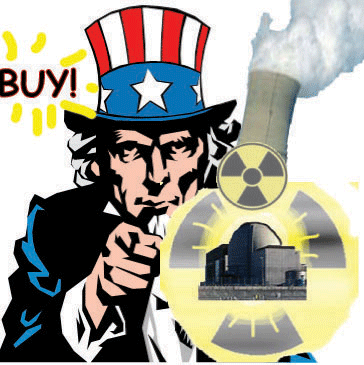 Bulletin of Atomic Scientists 12th Jan 2018, After a lengthy hiatus, negotiations will soon resume between the United
States and Saudi Arabia on an agreement for civil nuclear cooperation.
Concluding a bilateral civil nuclear agreement (often called a “123
agreement,” after the section of the Atomic Energy Act mandating such
agreements for nuclear cooperation with other countries) would enable US
companies to participate in the Saudi Kingdom’s ambitious plans to build a
fleet of nuclear power reactors to meet its growing electricity
requirements.
uranium enrichment, with the United States insisting that Saudi Arabia
accept a legally binding commitment not to engage in enrichment or
plutonium reprocessing and the Saudis refusing to foreclose what they
regard as their sovereign right to pursue nuclear technologies of their
choosing for peaceful purposes.
https://thebulletin.org/us-saudi-civil-nuclear-negotiations-finding-practical-compromise11426
A recipe for global catastrophe? Nuclear power for Saudi Arabia
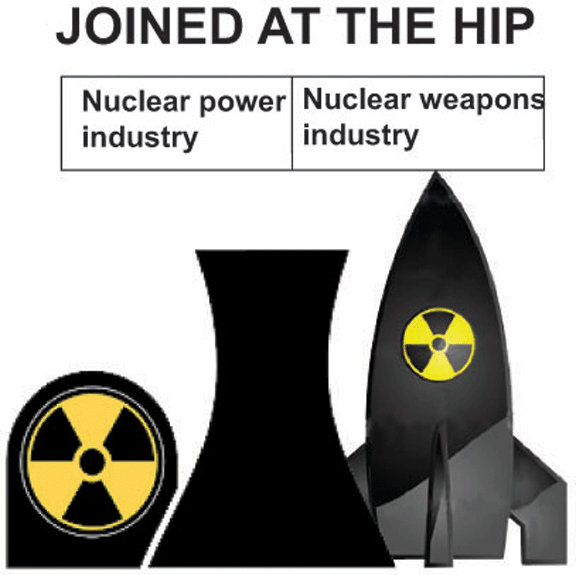 Financial Tribune (Iran) 26th Dec 2017 A lawmaker denounced the prospect of a US uranium enrichment deal with Saudi Arabia, predicting a “global catastrophe” should the oil kingdom mix
nuclear technology with its takfiri ideology.
In a recent talk with ICANA, Heshmatollah Falahatpisheh, a member of Majlis National Security and
Foreign Policy Commission, said, “Unfortunately, even human rights and international laws have not stopped the Saudi crimes in Yemen. Now, if Saudi Arabia is allowed the uranium technology, it would certainly use it in its military.” Takfiris are hardliners who accuse anyone, including Muslims, not following their extreme interpretation of Islam as infidels and apostates punishable by death.
https://financialtribune.com/articles/national/78650/us-nuclear-deal-with-saudis-could-lead-to-catastrophe
Saudi Arabi keen for nuclear power – and for nuclear weapons?
Saudi-US talks on civilian nuclear program to begin within ‘weeks’ 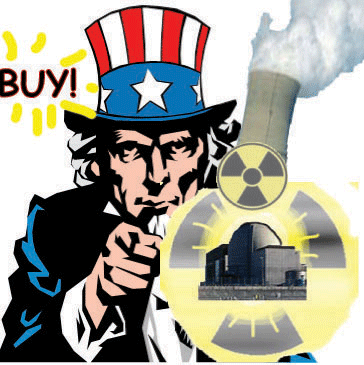 Riyadh’s energy minister insists kingdom seeks energy for peaceful purposes, but will not agree to American limitations on uranium enrichment
Trump’s disturbing willingness to sell nuclear technologies without the usual restrictions, to Saudi Arabia
U.S. To Boost Saudi Nuclear Power Development. Lobe Log., DECEMBER 14, 2017, Almost a decade has passed since President George W. Bush promised that the United States would help Saudi Arabia develop commercial nuclear energy plants. When he visited Riyadh in May 2008, he pledged to sign a “memorandum of understanding,” or MOU, committing the United States to “assist the Kingdom of Saudi Arabia to develop civilian nuclear power for use in medicine, industry and power generation” and “establish a comprehensive framework for cooperation in the development of environmentally sustainable, safe, and secure nuclear energy.”
In return, Saudi Arabia, a signatory to the Nuclear Nonproliferation Treaty, would also join the worldwide Proliferation Security Initiative, a U.S.-sponsored program to confront the threat of nuclear proliferation.
The text of that MOU has never been made public, and nothing much happened as a result of it until last week. Then, Energy Secretary Rick Perry, after meeting senior officials in the kingdom, urged the Saudis to choose a U.S.-based vendor, Westinghouse Electric Co., to participate in the nuclear energy program to which the Saudis have long been committed.
The Energy Department’s official statement about Perry’s talks with Khalid Al-Falih, Saudi Minister of Energy, Industry, and Mineral Resources, did not use the word “nuclear,” but numerous reports from the region said the Saudis heard Perry’s arguments for Westinghouse and were receptive to them.
“We heard that message that … ‘we want the United States to be our partner in this’,” Perry told the Reuters news agency. Westinghouse spokeswoman Sarah Casella said in a statement to Bloomberg News that “Westinghouse is pleased that Saudi Arabia has decided to pursue nuclear energy. We are fully participating in their request for information and are pleased to provide the AP1000 plant, the industry’s most advanced technology.” The Energy Department did not respond to several requests to go beyond its original statement or to confirm Perry’s reported remarks, but neither has it denied them.
There was a time when the words “nuclear” and “Saudi Arabia” in the same sentence would set off alarms all over Washington, because any such development in Saudi Arabia is bound to raise fears that the Saudis would use their program to develop nuclear weapons to counter what they fear is happening in Iran……….
Saudi Arabia has discussed nuclear development with China, Russia, and France, among other potential suppliers.
Under U.S. law, Westinghouse or any other U.S.-based vendor can sell material and technology to Saudi Arabia only after the two countries negotiate a nuclear cooperation agreement, known as a 123 Agreement for the section of the law setting the requirement. The U.S.-Abu Dhabi agreement is known in the industry as the “gold standard,” because the government of the United Arab Emirates agreed to forgo both ends of the nuclear fuel cycle–it will neither enrich its own uranium nor reprocess its spent fuel to extract the plutonium.
The Saudis have made clear that they do not want to accept the same restrictions because their country has extensive uranium resources, which they want to process domestically. In articles in the trade press in 2010, an executive of a Finnish firm that was consulting with the Saudis on their program said that it could eventually include enrichment of uranium.
That was a non-starter while Barack Obama was president, but reports of Perry’s commitment to expedite an agreement have ignited speculation that the United States is preparing to soften its terms to accommodate the Saudis on this point, especially because of the close ties that have developed between the Trump administration and Crown Prince Mohammed bin Salman, the kingdom’s de facto ruler…….
Daryl Kimball, executive director of the Arms Control Association, said in a statement that “The Trump administration’s willingness bend key rules and standards designed to restrict the spread of sensitive nuclear technologies that can be used to make nuclear weapons to in order to help U.S. companies profit from nuclear commerce with Saudi Arabia is disturbing and counterproductive.” He said Congress, “which will have to review any such agreement, should insist on the highest possible nonproliferation standards for nuclear commerce, especially in a troubled and unstable region.”……..https://lobelog.com/u-s-to-boost-saudi-nuclear-power-development/
Trump, ready to make it easy for Saudi Arabia to get ‘peaceful” nuclear, AND nuclear weapons
Trump Considers Easing Nuclear Rules for Saudi Project https://www.bloomberg.com/news/articles/2017-12-12/trump-is-said-to-consider-easing-nuclear-rules-for-saudi-project By Jennifer Jacobs, Ari Natter,and Jennifer A Dlouhy
-
Westinghouse is looking for new markets after bankruptcy
-
Past deals barred uranium enrichment for overseas projects
The Trump administration is encouraging Saudi Arabia to consider bids by Westinghouse Electric Co. and other U.S. companies to build nuclear reactors in that country and may allow the enrichment of uranium as part of that deal, according to three people familiar with the plans.
A meeting to hammer out details of the nuclear cooperation agreement, known as a 123 Agreement for the section of the U.S. Atomic Energy Act that requires it, will be held at the White House Wednesday, two administration officials said.
A successful U.S. bid would help deliver on President Donald Trump’s promise to revive and revitalize the domestic nuclear industry, helping American companies edge out Russian and Chinese competitors to build new fleets around the world. Saudi Arabia plans to construct 16 nuclear power reactors over the next 20 to 25 years at a cost of more than $80 billion, according to the World Nuclear Association.
Westinghouse, the nuclear technology pioneer that is part of Toshiba Corp., went bankrupt in March, after it hit delays with its AP1000 reactors at two U.S. plants. After it declared bankruptcy, Westinghouse — whose technology is used in more than half the world’s nuclear power plants — said it shifted its focus to expanding outside the U.S.
Winning contracts in Saudi Arabia could provide a new market that Westinghouse needs and provide at least a partial vindication for the investment in the AP1000 technology.
“Westinghouse is pleased that Saudi Arabia has decided to pursue nuclear energy,” Sarah Cassella, a spokeswoman, said in a emailed statement. “We are fully participating in their request for information and are pleased to provide the AP1000 plant, the industry’s most advanced technology.”
Daryl Kimball, executive director of the Washington-based Arms Control Association, said weakening the prohibition against enrichment and reprocessing, often referred to as “the gold standard,” is disturbing given what he said was Saudi Arabia’s “sub-par nuclear nonproliferation record.”
“We shouldn’t compromise our longstanding efforts to stop the spread of nuclear weapons in order to play favorites with certain companies or countries,” he said in an email, calling the idea “disturbing and counterproductive.”
— With assistance by Chris Martin
It looks as if Saudi Arabia wants uranium enrichment etc as prelude to nuclear weapons development
Beyond Nuclear 6th Dec 2017, Saudi Arabia’s Energy Minister Khalid al-Falih is extending invitations
to the U.S. nuclear industry to launch the Gulf Region’s most ambitious
nuclear power program. The Saudi atomic energy plan is to build as many as
17 nuclear power plants by 2032. The Saudi Arabia government has stated
that its atomic power program will be “self-sufficient” in the
production of nuclear fuel at 5% enriched uranium-235 and purely directed
for civilian power development.
The pronouncement comes as Saudi energy officials remain silent on their past refusal to not pursue high-grade
uranium enrichment and plutonium reprocessing technologies as military
weapons production facilities. In any case, the introduction of nuclear
materials will significantly increase instability and tensions in the
region. http://www.beyondnuclear.org/home/2017/12/6/us-nuclear-companies-invited-to-help-launch-saudi-arabias-da.html
Rick Perry to visit Saudi Arabia – a nation keen to have nuclear reactors AND to highly enrich uranium
U.S. Firms Courting Saudi Arabia to Build Nuclear Reactors; Rick Perry to Visit 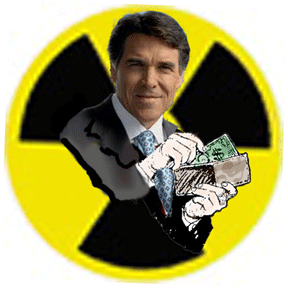 Riyadh, Haaretz, 3 Dec 17, One of the sources also said Riyadh had told Washington it does not want to forfeit the possibility of one day enriching uranium – a process that can have military uses.
USA nuclear industry keen to sell to ANYBODY – pushing for Saudi Arabia sales
U.S. firms push Washington to restart nuclear pact talks with Riyadh: sources https://www.reuters.com/article/us-saudi-nuclear-usa/u-s-firms-push-washington-to-restart-nuclear-pact-talks-with-riyadh-sources-idUSKBN1DV586?feedType=RSS&feedName=worldNews. Reem Shamseddine, Sylvia Westall RIYADH/DUBAI (Reuters) 1 Dec 17, – U.S. firms attracted by Saudi Arabia’s plans to build nuclear reactors are pushing Washington to restart talks with Riyadh on an agreement to help the kingdom develop atomic energy, three industry sources said.
Saudi Arabia has welcomed the lobbying, they said, though it is likely to worry regional rival Iran at a time when tensions are already high in the Middle East.
One of the sources also said Riyadh had told Washington it does not want to forfeit the possibility of one day enriching uranium – a process that can have military uses – though this is a standard condition of U.S. civil nuclear cooperation pacts.
“They want to secure enrichment if down the line they want to do it,” the source, who is in contact with Saudi and U.S. officials, said before U.S. Energy Secretary Rick Perry holds talks in Riyadh early next week.
Another of the industry sources said Saudi Arabia and the United States had already held initial talks about a nuclear cooperation pact.
U.S. officials and Saudi officials responsible for nuclear energy issues declined to comment for this article. The sources did not identify the U.S. firms involved in the lobbying.
Under Article 123 of the U.S. Atomic Energy Act, a peaceful cooperation agreement is required for the transfer of nuclear materials, technology and equipment.
In previous talks, Saudi Arabia has refused to sign up to any agreement with the United States that would deprive the kingdom of the possibility of one day enriching uranium.
Saudi Arabia, the world’s top oil producer, says it wants nuclear power solely for peaceful uses – to produce electricity at home so that it can export more crude. It has not yet acquired nuclear power or enrichment technology.
Riyadh sent a request for information to nuclear reactor suppliers in October in a first step towards opening a multi-billion-dollar tender for two nuclear power reactors, and plans to award the first construction contract in 2018.
Reuters has reported that Westinghouse is in talks with other U.S.-based companies to form a consortium for the bid. A downturn in the U.S. nuclear industry makes business abroad increasingly valuable for American firms.
Reactors need uranium enriched to around 5 percent purity but the same technology in this process can also be used to enrich the heavy metal to a higher, weapons-grade level. This has been at the heart of Western and regional concerns over the nuclear work of Iran, which enriches uranium domestically.
Riyadh’s main reason to leave the door open to enrichment in the future may be political – to ensure the Sunni Muslim kingdom has the same possibility of enriching uranium as Shi‘ite Muslim Iran, industry sources and analysts say.
POTENTIAL PROBLEM FOR WASHINGTON
Saudi Arabia’s position poses a potential problem for the United States, which has strengthened ties with the kingdom under President Donald Trump.
Washington usually requires a country to sign a nuclear cooperation pact – known as a 123 agreement – that forfeits steps in fuel production with potential bomb-making uses.
“Doing less than this would undermine U.S. credibility and risk the increased spread of nuclear weapons capabilities to Saudi Arabia and the region,” said David Albright, a former U.N. weapons inspector and president of the Washington-based Institute for Science and International Security (ISIS).
It is not clear whether Riyadh will raise the issue during Perry’s visit, which one of the industry sources said could include discussion of nuclear export controls.
Under a nuclear deal Iran signed in 2015 with world powers – but which Trump has said he might pull the United States out of – Tehran can enrich uranium to around the level needed for commercial power-generation.
It would be “a huge change of policy” for Washington to allow Saudi Arabia the right to enrich uranium, said Mark Fitzpatrick, executive director of the Americas office at the International Institute for Strategic Studies think tank.
“Applying the ‘golden standard’ of not allowing enrichment or preprocessing (of spent fuel) has held up a 123 agreement with Jordan for many years, and has been a key issue in U.S. nuclear cooperation with South Korea,” said Fitzpatrick, a nuclear policy expert.
The United States is likely to aim for restrictions, non-proliferation analysts say.
These could be based on those included in the 123 agreement Washington signed in 2009 with the United Arab Emirates, which is set to start up its first South Korean-built reactor in 2018 and has ruled out enrichment and reprocessing.
“Perhaps Saudi Arabia is testing the Trump administration and seeing if the administration would be amenable to fewer restrictions in a 123 agreement,” ISIS’s Albright said.
It would be “a huge change of policy” for Washington to allow Saudi Arabia the right to enrich uranium, said Mark Fitzpatrick, executive director of the Americas office at the International Institute for Strategic Studies think tank.
“Applying the ‘golden standard’ of not allowing enrichment or preprocessing (of spent fuel) has held up a 123 agreement with Jordan for many years, and has been a key issue in U.S. nuclear cooperation with South Korea,” said Fitzpatrick, a nuclear policy expert.
The United States is likely to aim for restrictions, non-proliferation analysts say.
These could be based on those included in the 123 agreement Washington signed in 2009 with the United Arab Emirates, which is set to start up its first South Korean-built reactor in 2018 and has ruled out enrichment and reprocessing.
“Perhaps Saudi Arabia is testing the Trump administration and seeing if the administration would be amenable to fewer restrictions in a 123 agreement,” ISIS’s Albright said.
A Terrorist State? Saudi Arabia? (and it might get nuclear weapons)
Is Saudi Arabia also amongst the terrorists? The News, Nigeria Dec 1 2017 By Owei Lakemfa.
Trump administration, Michael Flynn, and dodgy nuclear deals with Saudi Arabia
 White House May Share Nuclear Power Technology With Saudi Arabia, The overture follows an intense and secretive lobbying push involving Michael Flynn, Tom Barrack, Rick Gates and even Iran-Contra figure Robert McFarlane. Pro Publica by Isaac Arnsdorf, The Trump administration is holding talks on providing nuclear technology to Saudi Arabia — a move that critics say could upend decades of U.S. policy and lead to an arms race in the Middle East.
The Saudi government wants nuclear power to free up more oil for export, but current and former American officials suspect the country’s leaders also want to keep up with the enrichment capabilities of their rival, Iran.
Saudi Arabia needs approval from the U.S. in order to receive sensitive American technology. Past negotiations broke down because the Saudi government wouldn’t commit to certain safeguards against eventually using the technology for weapons.
Now the Trump administration has reopened those talks and might not insist on the same precautions. At a Senate hearing on Nov. 28, Christopher Ford, the National Security Council’s senior director for weapons of mass destruction and counterproliferation, disclosed that the U.S. is discussing the issue with the Saudi government. He called the safeguards a “desired outcome” but didn’t commit to them.
Abandoning the safeguards would set up a showdown with powerful skeptics in Congress. “It could be a hell of a fight,” one senior Democratic congressional aide said.
The idea of sharing nuclear technology with Saudi Arabia took an unlikely path to the highest levels of government. An eccentric inventor and a murky group of retired military brass — most of them with plenty of medals but no experience in commercial nuclear energy — have peddled various incarnations of the plan for years.
Many U.S. officials didn’t think the idea was serious, reputable or in the national interest. “It smelled so bad I said I never wanted to be anywhere close to that,” one former White House official said. But the proponents persisted, and finally found an opening in the chaotic early days of the Trump administration, when advisers Michael Flynn and Tom Barrack championed the idea……
In 2008, the Saudi government made a nonbinding commitment not to pursue enrichment and reprocessing. They then entered negotiations with the U.S. for a pact on peaceful nuclear cooperation, known as a 123 agreement, after a section of the Atomic Energy Act of 1954. A 123 agreement is a prerequisite for receiving American technology.
The talks stalled a few years later because the Saudi government backed away from its pledge not to pursue enrichment and reprocessing, according to current and former officials. “They wouldn’t commit, and it was a sticking point,” said Max Bergmann, a former special assistant to the undersecretary of state for arms control and international security at the time those negotiations occurred……..
The Obama administration held firm with the Saudis because it’s one thing to cap nuclear technology where it already exists, but it’s longstanding U.S. policy not to spread the technology to new countries. As Saudi Arabia and Iran — ideological and religious opponents — increasingly squared off in a battle for political sway in the Middle East, Republicans argued that the Obama administration had it backwards: It was enshrining hostile Iran’s ability to enrich uranium while denying the same to America’s ally Saudi Arabia.
One such critic of Obama’s Iran policy was Michael Flynn, a lieutenant general who was forced out as head of the Defense Intelligence Agency in 2014. Flynn quickly took up a variety of consulting assignments and joined some corporate boards. One of the former was an advisory position for a company called ACU Strategic Partners, which, according to a later financial disclosure, paid Flynn more than $5,000.
Flynn was one of many retired military officers whom ACU recruited. ACU’s chief was a man named Alex Copson, who is most often described in press accounts as a “colorful British-American dealmaker.” Copson reportedly made a fortune inventing a piece of diving equipment, may or may not have been a bass player in the band Iron Butterfly, and has been touting wildly ambitious nuclear-power plans since the 1980s. (He didn’t answer repeated requests for comment.)
By 2015, Copson was telling people he had a group of U.S., European, Arab and Russian companies that would build as many as 40 nuclear reactors in Egypt, Jordan and Saudi Arabia. Copson’s company pitched the Obama administration, but officials figured he didn’t really have the backers he claimed. “They would say ‘We have Rolls-Royce on board,’ and then someone would ask Rolls-Royce and they would say, ‘No, we took a meeting and nothing happened,’” recalled a then-White House official.
In his role with ACU, Flynn flew to Egypt to convince officials there to hold off on a Russian offer (this one unrelated to ACU) to build nuclear power plants. Flynn tried to persuade the Egyptian government to consider Copson’s proposal instead, according to documents released by Rep. Elijah Cummings, the ranking Democrat on the House Oversight and Government Reform Committee. Flynn also tried to persuade the Israeli government to support the plan and spoke at a conference in Saudi Arabia. (The trip would later present legal problems for Flynn because he didn’t report contacts with foreign officials on his application to renew his security clearance, according to Cummings. Cummings referred the information to Robert Mueller, the special counsel investigating Trump’s associates and Russia’s interference in the 2016 election. Flynn’s lawyer declined to comment.)
Copson’s outfit eventually splintered. A retired admiral named Michael Hewitt, who was to head up the security services part of the project, struck out on his own in mid-2016. Flynn went with him.
Hewitt’s new company is called IP3 International, which is short for “International Peace Power & Prosperity.” IP3 signed up other prominent national security alumni including Gens. Keith Alexander, Jack Keane and James Cartwright, former Middle East envoy Dennis Ross, Bush Homeland Security adviser Fran Townsend, and Reagan National Security adviser Robert “Bud” McFarlane.
IP3’s idea was a variation on ACU’s. Hewitt swapped out one notional foreign partner for another (Russia was out, China was in), then later shifted to an all-American approach. That idea resonated with the U.S. nuclear-construction industry, which never recovered from the Three Mile Island disaster in the 1970s and was looking to new markets overseas.
But nuclear exports are tightly controlled because the technology is potentially so dangerous. A 123 agreement is only the first step for a foreign country that wants to employ U.S. nuclear-power technology. In addition, the Energy Department has to approve the transfer of technology related to nuclear reactors and fuel. The Nuclear Regulatory Commission licenses reactor equipment, and the Commerce Department reviews exports for equipment throughout the rest of the power plant.
IP3 — whose sole project to date is the Saudi nuclear plan — never went through those normal channels. Instead, the company went straight to the top.
At the start of the Trump administration, IP3 found an ally in Tom Barrack, the new president’s close friend and informal adviser and an ultra-wealthy investor in his own right. During the campaign, Barrack wrote a series of white papers proposing a new approach to the Middle East in which economic cooperation would theoretically reduce the conditions for breeding terrorism and lead to improved relations.
Barrack wasn’t familiar with nuclear power as an option for the Middle East until he heard from Bud McFarlane. McFarlane, 80, is most remembered for his role in the defining scandal of the Reagan years: secretly selling arms to Iran and using the money to support Nicaraguan rebels. He pleaded guilty to withholding information from Congress but was pardoned by George H.W. Bush.
Nevertheless, Barrack was dazzled by McFarlane and his IP3 colleagues. “I was like a kid in a candy shop — these guys were all generals and admirals,” Barrack said in an interview. “They found an advocate in me in saying I was keen on trying to establish a realignment of U.S. business interests with the Gulf’s business interests.”
McFarlane followed up the meeting by emailing Flynn in late January, according to six people who read the message or were told about it. McFarlane attached two documents. One outlined IP3’s plan, describing it as consistent with Trump’s philosophy. The second was a draft memo for the president to sign that would officially endorse the plan and instruct his cabinet secretaries to implement it. Barrack would take charge of the project as the interagency coordinator. Barrack had discussions about becoming ambassador to Egypt or a special envoy to the Middle East but never committed to such a role. (McFarlane disputed that account but repeatedly declined to specify any inaccuracies. IP3 declined to comment on the memos.)
Flynn, now on the receiving end of IP3’s lobbying, told his staff to put together a formal proposal to present to Trump for his signature, according to current and former officials.
The seeming end run sparked alarm. National Security Council staff brought the proposal to the attention of the agency’s lawyers, five people said, because they were concerned about the plan and how it was being advanced. Ordinarily, before presenting such a sensitive proposal to the president, NSC staff would consult with experts throughout government about practical and legal concerns. Bypassing those procedures raised the risks that private interests might use the White House to their own advantage, former officials said. “Circumventing that process has the ability not only to invite decisions that aren’t fully vetted but that are potentially unwise and have the potential to put our interests and our people at risk,” said Ned Price, a former CIA analyst and NSC spokesman.
Even after those concerns were raised, Derek Harvey, then the NSC’s senior director for the Middle East, continued discussing the IP3 proposal with Barrack and his representative, Rick Gates, according to two people. Gates, a longtime associate of former Trump campaign chief Paul Manafort, worked for Barrack on Trump’s inaugural committee and then for Barrack’s investment company, Colony NorthStar.
By then, Barrack was no longer considering a government position. Instead, he and Gates were seeking investment ideas based on the administration’s Middle East policy. Barrack pondered the notion, for example, of buying a piece of Westinghouse, the bankrupt U.S. manufacturer of nuclear reactors. (Harvey, now on the staff of the House intelligence committee, declined to comment through a spokesman. In October, Mueller charged Manafort and Gates with 12 counts including conspiracy against the U.S., unregistered foreign lobbying, and money laundering. They both pleaded not guilty. Gates’ spokesman didn’t answer requests for comment.)
Ultimately, it wasn’t the NSC staff’s concerns that stalled IP3’s momentum. Rather, Jared Kushner, the president’s son-in-law and senior aide tasked with reviving a Middle East peace process, wanted to table the nuclear question in favor of simpler alliance-building measures with the Saudis, centered on Trump’s visit in May, according to a person familiar with the discussions. (A spokesperson for Kushner, asked for comment, had not provided one at the time this article was published; we’ll update the article if he provides one later.)
In recent months, the proposal has stirred back to life as the Saudi government kicked off a formal process to solicit bids for their first reactors. In October, the Saudis sent a request for information to the U.S., France, South Korea, Russia and China — the strongest signal yet that they’re serious about nuclear power.
The Saudi solicitation also gave IP3 the problem its solution was searching for. The company pivoted again, narrowing its pitch to organizing a consortium of U.S. companies to compete for the Saudi tender. IP3 won’t say which companies it has signed up. IP3 also won’t discuss the fees it hopes to receive if it were part of a Saudi nuclear plan, but it’s vying to supply cyber and physical site security for the plants. “IP3 has communicated its strategy to multiple government entities and policy makers in both the Obama and Trump administrations,” the company said in a statement. “We view these meetings and any documents relating to them as private, and we won’t discuss them.”
The Saudi steps lit a fire under administration officials. Leading the charge is Rick Perry, the energy secretary who famously proposed eliminating the department and then admitted he didn’t understand its function. (It includes dealing with nuclear power and weapons.) Perry had also heard IP3’s pitch, a person familiar with the situation said. In September, Perry met with Saudi delegates to an international atomic energy conference and discussed energy cooperation, according to a photo posted on his Facebook page. Perry’s spokeswoman didn’t answer requests for comment.
Other steps followed. Soon after, a senior State Department official flew to Riyadh to restart formal 123 negotiations, according to an industry source. (A State Department spokeswoman declined to comment.) In November, Energy and State Department officials joined a commercial delegation to Abu Dhabi led by the Nuclear Energy Institute, the industry’s main lobby in Washington. Assistant Secretary for Nuclear Energy Edward McGinnis said the administration wants to revitalize the U.S. nuclear energy industry, including by pursuing exports to Saudi Arabia. The Department of Commerce’s International Trade Administration and the Energy Department are organizing another industry visit in December to meet with Saudi officials, according to a notice obtained by ProPublica. And in the days before Thanksgiving, senior U.S. officials from several agencies met at the White House to discuss the policy, according to current and former officials.
The Trump administration hasn’t stated a position on whether it will let the Saudis have enrichment and reprocessing technology. An NSC spokesman declined to comment. But administration officials have begun sounding out advisers on how Congress might react to a deal that gives the Saudis enrichment and reprocessing, a person familiar with the discussions said.
Senators have started demanding answers. At the Nov. 28 hearing before the Senate Foreign Relations Committee, Ford, the NSC nonproliferation official who has been nominated to lead the State Department’s Bureau of International Security and Nonproliferation, testified that preliminary talks with the Saudis are underway but declined to discuss the details in public. As noted, Ford wouldn’t commit to barring the Saudi government from obtaining enrichment and reprocessing technology. “It remains U.S. policy, as it has been for some time, to seek the strongest possible nonproliferation protections in every instance,” he told the senators. “It is not a legal requirement. It is a desired outcome.” Ford added that the Iran deal makes it harder to insist on limiting other countries’ capabilities.
Sen. Ed Markey, the Massachusetts Democrat who led the questioning of Ford on this topic, seemed highly resistant to the idea of the U.S. helping Saudi Arabia get nuclear technology. “If we continue down this pathway,” he said, “then there’s a recipe for disaster which we are absolutely creating ourselves.” Markey also accused the administration of neglecting its statutory obligation to brief the committee on the negotiations. (The White House declined to comment.)
Any agreement, in this case with Saudi Arabia, would not require Senate approval. However, should an agreement be reached, Congress could kill the deal. The two houses would have 90 days to pass a joint resolution disapproving it. The committee’s ranking Democrat, Ben Cardin, suggested they wouldn’t accept a deal that lacked the same protections as the ones in the UAE’s agreement. “If we don’t draw a line in the Middle East, it’s going to be all-out proliferation,” he said. “We need to maintain the UAE’s standards in our 123 agreements. There’s just too many other countries that could start proliferating issues that could be against our national interest.”
Bob Corker, the committee’s chairman, has been a stickler on nonproliferation in the past; he criticized the Obama administration for not being tough enough. Corker isn’t running for reelection and has criticized Trump for being immature and reckless in foreign affairs, so he’s unlikely to shy away from a fight. (A spokesman declined to comment.) “The absence of a consistent policy weakens our nuclear nonproliferation efforts, and sends a mixed message to those nations we seek to prevent from gaining or enhancing such capability,” Corker said at a hearing in 2014. “Which standards can we expect the administration to reach for negotiating new agreements with Jordan or Saudi Arabia?” https://www.propublica.org/article/white-house-may-share-nuclear-power-technology-with-saudi-arabia
1 This Month

of the week – Shut Down Drone Warfare!


Tell the Ukrainian Government to Drop Prosecution of Peace Activist Yurii Sheliazhenko

Petition to revoke the licensing of the Near Surface Nuclear Disposal Facility (NSDF) at Chalk River. https://www.ourcommons.ca/petitions/en/Petition/Details?Petition=e-7247
To see nuclear-related stories in greater depth and intensity – go to https://nuclearinformation.wordpress.com
-
Archives
- March 2026 (244)
- February 2026 (268)
- January 2026 (308)
- December 2025 (358)
- November 2025 (359)
- October 2025 (376)
- September 2025 (257)
- August 2025 (319)
- July 2025 (230)
- June 2025 (348)
- May 2025 (261)
- April 2025 (305)
-
Categories
- 1
- 1 NUCLEAR ISSUES
- business and costs
- climate change
- culture and arts
- ENERGY
- environment
- health
- history
- indigenous issues
- Legal
- marketing of nuclear
- media
- opposition to nuclear
- PERSONAL STORIES
- politics
- politics international
- Religion and ethics
- safety
- secrets,lies and civil liberties
- spinbuster
- technology
- Uranium
- wastes
- weapons and war
- Women
- 2 WORLD
- ACTION
- AFRICA
- Atrocities
- AUSTRALIA
- Christina's notes
- Christina's themes
- culture and arts
- Events
- Fuk 2022
- Fuk 2023
- Fukushima 2017
- Fukushima 2018
- fukushima 2019
- Fukushima 2020
- Fukushima 2021
- general
- global warming
- Humour (God we need it)
- Nuclear
- RARE EARTHS
- Reference
- resources – print
- Resources -audiovicual
- Weekly Newsletter
- World
- World Nuclear
- YouTube
-
RSS
Entries RSS
Comments RSS
 nuclear-news