Saudi Arabia shows off nuclear-capable missiles
The DF-3 has a range of 2,650 km and carries a payload of 2,150 kg. It is equipped with a single nuclear warhead with a 1-3 MT yield.
Watched by a wide array of Saudi defense and military dignitaries, headed by Crown Prince and Deputy Prime Minister Salman bin Abdulaziz, the parade marked the end of the large-scale “Abdullah’s Sword” military war game.
Conspicuous on the saluting stand was the Pakistani Chief of Staff Gen. Raheel Sharif alongside eminent visitors, including King Hamad of Bahrain and Sheikh Muhammad bin Zayed, the crown prince of Abu Dhabi………
By showing off their ageing Chinese missiles, the Saudis intimated that they had acquired the more advanced generation of this weapon, which they are keeping under wraps. DEBKAfile’s intelligence sources report that in recent visits to Beijing, high-ranking Saudi officials negotiated the purchase of Dong-Feng 21 (DF-21), whose range is shorter, 1,700 km, but more precise and effective in view of its terminal radar guidance system. The West has no information about when the new Chinese missiles were delivered to Saudi Arabia.
5. The presence of the top Pakistani soldier at the parade of military and nuclear hardware was meant as corroboration of Islamabad’s active role as the source of the Saudi nuclear arsenal.
6. The Saudis no longer rely on the American nuclear umbrella. They are developing their own nuclear strike force with the help of China and Pakistan. http://www.debka.com/article/23878/Saudis-parade-nuclear-missiles-for-the-first-time-in-defiance-of-US-Iranian-nuclear-accord
Iranian public ready to back a fair nuclear deal
 Iran FM says people would support fair nuclear deal, The Daily Star, Lebanon News, Iran FM says people would support fair nuclear deal, The Daily Star, Lebanon News, |
| April 27, 2014 TEHRAN: Foreign Minister Mohammad Javad Zarif said Sunday that the majority of Iranians would support a comprehensive nuclear deal that “respects Iran’s rights and the demands of the people.”
“That would be the only agreement that myself and President (Hassan) Rouhani will agree (to),” Zarif said during a joint news conference in Tehran with his Austrian counterpart Sebastian Kurz. When asked whether hardliners could derail the nuclear talks, Zarif said: ” Iran is not a monolith … we will have those who will not favour an agreement, but at the end of the day what will count is the view of the majority of the Iranian people.” In November, Iran clinched a deal with world powers under which it froze some nuclear activities in return for limited relief from crippling international sanctions. Tehran has been engaged in negotiations with the P5+1 — Britain, China, France, Russia and the United States, plus Germany — aimed at reaching a lasting accord on its nuclear ambitions……. http://www.dailystar.com.lb/News/Middle-East/2014/Apr-27/254561-iran-fm-says-people-would-support-fair-nuclear-deal.ashx#ixzz30DTTdBDN |
Quiet optimism over deal between Iran and the West
 Iran nuclear talks: Quiet optimism over deal between Islamic State and the West on weapons programme The INdependent 24 April 14 All sides in the effort to resolve the stand-off between the West and Iran over its alleged nuclear weapons ambitions have agreed to hold a new round of expert-level negotiations in New York beginning 5 May amid tentative indications that so far, at least, positive progress is being made. Keeping its side of an interim bargain struck last November and implemented in January, the Joint Plan of Action, the White House has this month released $1bn-worth of Iranian assets in two instalments, the last on 15 April. And last week the International Atomic Energy Agency (IAEA) reported that Iran has so far fulfilled its part of what was agreed, dramatically reducing its stockpile of 20 per cent enriched uranium.
While significant hurdles remain before a final and comprehensive deal can be reached ahead of an informal deadline of 20 July, quiet optimism is gathering around the talks. That assessment stands in sharp contrast with almost every other foreign affairs dossier currently on President Barack Obama’s desk, be it concerning Syria, Russia, Ukraine or the faltering Middle East peace process.
The talks in New York, to be held at the UN on the fringes of a Non-Proliferation Treaty meeting, will be followed up by high-level talks between foreign ministers of Iran as well as the so-called P5+1 – China, France, Russia, the UK, and the US, plus Germany – in Vienna on 13 May.
If the negotiations are still on track it is in spite of loud opposition from hard-line critics of the putative deal both in Iran, on Capitol Hill and, as ever, from inside Israel. Yet those at the negotiating table, including the Iranians, have so far seemed determined to ignore those pressures.
“There is the political will to get an answer,” Iran’s Foreign Minister, Mohammad Javad Zarif, remarked during a visit to Abu Dhabi last week. “The domestic audience will be satisfied if we have a good deal. Of course some people will never be satisfied but that is fine because we have a pluralistic society.” He crucially has the support of the Iranian President, Hassan Rouhani, as well as the Supreme Leader Ayatollah Ali Khamenei……..
Meanwhile, in Washington the White House continues to resist calls from some in Congress to stall the release of Iranian assets that had been frozen by sanctions as well as Israeli exhortations to take a stronger line with Tehran. Further encouragement has been drawn by an Iranian concession announced last week radically to reduce the amount of plutonium that could be made at a new heavy-water reactor at Arak. There had been fears that its scientists could switch to plutonium from enriched uranium to build a bomb.
“I’m actually starting to believe that an agreement is possible,” David Petraeus, the former CIA director, told an audience at Harvard University this month. He went on: “It could be that it’s possible before this particular six-month deadline expires,” referring to the target of concluding an agreement by 20 July…….http://www.independent.co.uk/news/world/politics/iran-nuclear-talks-quiet-optimism-over-deal-between-islamic-state-and-the-west-on-weapons-programme-9275504.html
Time for Washington to disclose information on alleged Israeli nuclear theft

 Former Officials Seek U.S. Disclosure on Alleged Israeli Nuclear Theft National Journal 21 Apr 14 Two former atomic officials say revealing U.S. findings on a decades-old alleged nuclear theft by Israel may bolster Washington’s present-day diplomacy.
 Declassifying all investigative data on the 1960s-era disappearance of weapon-grade uranium from a Pennsylvania atomic plant could boost U.S. credibility in current nuclear negotiations, former Nuclear Regulatory Commission officials Victor Gilinsky and Roger Mattson argued in e-mail responses to questions from Global Security Newswire.
In an article published last week by the Bulletin of the Atomic Scientists, they said public details have already cast suspicion on Israel, which also is widely believed to possess an unacknowledged atomic arsenal.
“We’ve lost a great deal of respect around the world on the subject of nonproliferation,” Gilinsky told GSN. Citing one example, the former NRC commissioner said Washington’s reluctance to openly discuss Israel’s nuclear activities has hampered the U.S. ability to overtly press its Middle Eastern ally to participate in a plannedconference on eliminating weapons of mass destruction from the Middle East.
“The president doesn’t even acknowledge that Israel has nuclear weapons, which means no one in the government can, either,” he told GSN. “Leveling on [this] affair, painful as it might be in the short run, would be a step toward what you might call a reality-based policy in this area.”
For disclosure to be likely, though, President Obama must “see it in his political benefit to do so,” Gilinsky wrote. “If he wanted to, he could do it at any time, but I am not holding my breath.”……http://www.nationaljournal.com/global-security-newswire/former-officials-seek-u-s-disclosure-on-alleged-israeli-nuclear-theft-20140421
Iran reduces capacity at Arak nuclear recator
Arak nuclear reactor resolved says Iran http://www.skynews.com.au/world/article.aspx?id=969168 April 20, 2014 Iran and six world powers have resolved their differences over the country’s plutonium-producing Arak reactor, Iranian nuclear chief Ali Akbar Salehi says.
The reactor, which has yet to be completed, has been a main point of contention at the ongoing talks aimed at ending the stand-off over Tehran’s nuclear program.
The governments of Britain, China, France, Russia, the United States and Germany – the so-called P5+1 – have expressed concern that Iran could use the plutonium produced at the facility in the western city of Arak to build nuclear weapons.
‘We have suggested that we will produce only one-fifth of the originally planned plutonium, and this was welcomed by the P5+1,’ said Salehi.
The world powers have called for Arak’s closure or for technical changes so that it no longer turns out plutonium.
Salehi said Arak would not be shuttered because Iran needs it to produce medical isotopes for civilian use, but that reducing its plutonium production capacity alleviates negotiators’ concerns.
The heavy water reactor uses natural uranium as its fuel and will generate plutonium as a by-product.
Iran and the sextet agreed in an interim deal in November on a limited suspension of sanctions in return for some nuclear concessions from Tehran, including suspending construction of the Arak reactor and scaling back uranium enrichment.
Under the broader agreement that both sides are aiming to conclude by July, Iran is expected to accept additional nuclear curbs while the world powers have promised to permanently lift all sanctions and to help Iran build new reactors.
Tehran insists that it has no plans to build nuclear weapons.
Iran and the P5+1 will hold expert-level nuclear talks May 5-9 in New York, said Iran’s Deputy Foreign Minister Abbas Araqchi, according to Press TV.
An economic hazard to United Arab Emirates – nuclear power?
Nuclear Power: Boon Or Bane For The GCC?, Gulf Business,
As the UAE and Saudi race to build nuclear reactors to meet mounting energy needs, the inevitable question arises – is nuclear a viable option?, Gulf business By Aarti Nagra 18 April 14
Fuelled by rising energy demand and depleting oil and gas resources, nuclear energy has gained strong momentum in the GCC, particularly in countries like the UAE. The country has lofty ambitions to generate up to 25 per cent of its electricity needs – or 5.6GW – through nuclear means by 2020.
Abu Dhabi began construction of its first nuclear reactor, Barakah 1, in July 2012, and it is in the process of building three more plants.
Emirates Nuclear Energy Corporation, the body responsible for the project, announced in February that the first two plants are on schedule and are up to 35 per cent complete……..However, nuclear energy may not necessarily be the best option for the GCC region, states Mohammed Atif, area manager, Energy Advisory, Middle East at DNV GL – Energy.
“A reasonable diversification of fuels is always beneficial for a region in order to reduce risks and price volatility,” he says.
“The right composition of a generation portfolio is always a difficult question and has to take political, economic, technical and environmental aspects into consideration.
“We would suggest entering into a roadmap to achieve security of supply at a good price level even without nuclear energy.”……….An Oxford report on nuclear power production in the GCC published in December 2012 also pointed out that nuclear power generation could prove an expensive option for GCC states.
“The substantial initial investment costs, coupled with the high expected level of long run variable costs, is unlikely to render nuclear power cost effective vis-à-vis conventional oil and gas fired power plants in the region,” it says.
“The existing absence of cost-recovering power tariffs throughout the GCC already renders effective cost recovery for nuclear power unlikely, implying a substantial bill in the form of nuclear power subsidies to be picked up by GCC governments.”
There are also other hidden costs, such as national and regional security concerns and the future disposal of nuclear waste.
“And the acquisition of nuclear technology by GCC states, albeit for civilian purposes, provides fuel to those critics of nuclear power in the region who fear a nuclear arms race in the Gulf should Iran pursue a nuclear weapons programme in the future.
“All these concerns make nuclear power a potentially costly option for the GCC,” the report cautions………….http://gulfbusiness.com/2014/04/nuclear-power-boon-bane-gcc/#.U1WPalVdWik
Vital to carry through with diplomacy between Iran and the West
Why we must give Iran nuclear deal a chance, Global Public SquareBy Tyler Cullis and Jamal Abdi, Special to CNN 18 April 14 Editor’s note: Tyler Cullis is a policy associate at the National Iranian American Council. Jamal Abdi is policy director at NIAC. The views expressed are the authors’ own.
The United States could be on the verge of securing a historic agreement over Iran’s nuclear program, one that verifiably limits it and opens the door to further cooperation between the two countries. Yet with a diplomatic victory on the horizon, the rhetoric of those who have long opposed any diplomatic resolution is reaching dizzying heights of disingenuousness.
During a recent Senate hearing, Senate Foreign Relations Committee Chairman Robert Menendez (D-NJ) hit out at reports that negotiations with Iran may produce a deal that “only” extends Iran’s nuclear breakout timeline to 6 to 12 months.
“I don’t think we did everything that we’ve done to only get a six to twelve month lead time,” Menendez lamented as he grilled Secretary of State John Kerry over the progress of the talks………
The Israeli government appears to believe that threatening possible military strikes on Iran’s nuclear facilities is the solution. But here’s the kicker: some estimates suggest that an Israeli strike on Iran would delay Iran’s breakout timeline by…six to twelve months – the same as the negotiated approach. The problem, of course, is that unlike a diplomatic solution, which would trade sanctions relief for verifiable limits on Iran’s nuclear program, an Israeli (or U.S.) military strike would have the opposite effect, and could prompt Iran to kick out inspectors and make a dash for a nuclear deterrent.
All this suggests an understanding of the potential timelines under these scenarios points to one conclusion – the White House is taking the best approach, one that extends the breakout timeline and has the best potential for securing an intrusive inspections regime to ensure Iranian compliance.
Opponents of diplomacy would do well to reflect on the reality that as the United States has tried to leverage sanctions against Iran, Tehran has responded by ramping up the production of centrifuges. As a result, the U.S. has long been in need of a new direction in its policy toward Iran.
Tentatively, but unmistakably, the Obama Administration has pursued a new approach – one that has brought us the first freeze on Iran’s nuclear program in a decade and which reports suggests have led to significant concessions on Iran’s Arak reactor.
If such a deal is not good enough for some in Congress or Israel’s government, then they must be prepared to speak up and offer viable alternatives. In the meantime, they should avoid undermining one of the most promising prospects for limiting Iran’s nuclear program in years. http://globalpublicsquare.blogs.cnn.com/2014/04/18/why-we-must-give-iran-nuclear-deal-a-chance/
Time to reveal the truth on Israel’s theft of nuclear weapons fuel from USA
Nearly 50 years have passed since the events in question. It is time to level with the public. At this point it is up to the president himself to decide whether to declassify completely the NUMEC documents, all of which are over 30 years old. He should do so. We know that is asking a lot given the president’s sensitivity about anything involving Israel, and especially anything relating to Israeli nuclear weapons. But none of his political concerns outweigh his responsibility to tell the US public the historical truth it deserves to know.
Did Israel steal bomb-grade uranium from the United States? Bulletin of Atomic Scientists Victor GilinskyRoger J. Mattson 17 April 14 Last month the Interagency Security Classification Appeals Panel (ISCAP), the nation’s highest classification authority, released a number of top-level government memoranda that shed additional light on the so-called NUMEC affair, “the story that won’t go away—the possibility that in the 1960s, Israel stole bomb-grade uranium from a US nuclear fuel-processing plant.”
The evidence available for our 2010 Bulletin article persuaded us that Israel did steal uranium from the Apollo, Pennsylvania, plant of the Nuclear Materials and Equipment Corporation (NUMEC). We urged the US government to declassify CIA and FBI documents to settle the matter. In releasing the current batch—the release being largely due to the persistent appeals of researcher Grant Smith—the government has been careful to excise from all the released documents the CIA’s reasons for fingering Israel.
Despite this, the documents are significantly revealing. Continue reading
IAEA says Iran has made drastic cuts in its stock of highly enriched uranium
Iran slashes nuclear stock, says UN http://www.skynews.com.au/world/article.aspx?id=968784 April 18, 2014 Iran has cut its stock of highly-enriched uranium by 75 per cent, a new report by the UN’s nuclear watchdog has revealed.
The monthly update by the International Atomic Energy Agency (IAEA) showed Tehran remained in compliance with a November interim deal made with world powers, drawn up as part of efforts to find a lasting solution to Iran’s controversial nuclear drive.
Under the agreement, Iran pledged to ‘dilute’ half of its highly-enriched uranium by mid-April, with the rest to be converted by mid-July.
The IAEA report also said that progress on a plant in Tehran that will be used for the conversion of low-enriched uranium had been delayed, but that Iran had said this will not prevent it from fulfilling its part of the deal by the July 20 deadline.
Diplomats who saw the document told AFP everything was in order.
The international community was ‘keeping an eye’ on progress at the conversion plant in Tehran, one of the diplomats added.
Under the November deal, Iran agreed to freeze parts of its nuclear activities, including limiting enrichment. Enriching uranium can be part of a peaceful atomic drive but can also produce weapons-grade material for a bomb.
Tehran has consistently said its nuclear program is for civilian purposes only, while the West believes it has a military dimension.
Iran and six world powers – the US, Russia, China, Britain, France and Germany — will next meet on May 13 in a bid to draw up a lasting accord and end the decade-old standoff over Iran’s nuclear program.
The West arranges to allow Israel to take part in nuclear trade
 International nuclear body to curry favor with Israel: Exposed Press TV, 15 April 14 The US and some European allies seek deeper nuclear ties with Israel and other non-members of the Nuclear Non-Proliferation Treaty (NPT), a confidential paper reveals. Israel which by policy does not confirm its estimated stockpile of 80 or more nuclear warheads, is the first on the list, according to the report…….The paper also outlined different types of “possible benefits the NSG could consider granting” an entity that is even not in the 48-member group.
These could include sharing of information, access to NSG meetings and “facilitated export arrangements,” suggesting possible access to some nuclear trade with NSG members.
Israel, the only possessor of nuclear weapons in the Middle East, is widely known to have between 200 and 400 nuclear warheads.
The Israeli regime rejects all the regulatory international nuclear agreements — the NPT in particular — and refuses to allow its nuclear facilities to come under international regulatory inspections.http://www.presstv.ir/detail/2014/04/15/358676/nuclear-body-to-curry-favor-with-israel/
The danger of a nuclear Saudi Arabia
The risks of a nuclear Saudi Arabia April 7, 2014 by Nick Butler”……….The issue is set out in an excellent new paper for the Belfer Center at Harvard by Olli Heinonen and Simon Henderson. The Saudis’ explanation of their newfound interest in nuclear technology is that they want to use it to produce electric power and to converse oil supplies which can be exported. There is a core of truth in this of course – Saudi Arabia’s domestic oil consumption is rising inexorably and is now more than 3m barrels a day. But, of course, this is exactly the argument used by Iran for its own nuclear research.
Heinonen and Henderson believe the Saudis are preparing the way and giving themselves the option of being able to move beyond civil nuclear power to the point where they could within a matter of months produce some form of weapon. The country undoubtedly has the money to buy whatever is needed and they have close and dangerous allies within Pakistan, a country which is already a nuclear state. Scrutiny by the International Atomic Energy Agency is minimal (bizarrely the organisation spends more money monitoring Jordan) and the Saudis could go a long way down the path to nuclear capability without it becoming obvious until very late in the day.
The prospect of nuclear weapons in the hands of the fragile government of Saudi Arabia is bad enough. The country is fundamentally unstable – held together only by force and by the flow of oil money to an ever growing number of citizens who high expectations and low productivity. But equally concerning is that any further conflict in the region – even at a level below the nuclear threshold – could shake the global energy economy to its foundations……..” http://blogs.ft.com/nick-butler/2014/04/07/the-risks-of-a-nuclear-saudi-arabia/
Israel’s 300 nuclear warhead arsenal
Israel possesses at least 300 nuclear warheads: Carter, Tehran Times,13 April 14, Former U.S. President Jimmy Carter says that Israel has at least 300 nuclear warheads which is far more dangerous than estimates that are being hypothetically made about Iran’s potential access to nuclear weapons.
Iran’s Bushehr nuclear plant an earthquake-prone timebomb
Olivier Guitta: Iran’s other nuclear timebomb http://fullcomment.nationalpost.com/2014/03/31/olivier-guitta-irans-other-nuclear-timebomb/ Olivier Guitta, National Post | March 31, 2014 While the international community has been focusing on a potential Israeli strike against Iranian nuclear facilities, another much larger issue looms, and should be tackled very urgently. But interestingly, except for a few concerned neighbours in the Gulf, nobody is really looking at the possible implications of a potential earthquake in Bushehr, where Iran’s oldest and main nuclear plant is located.
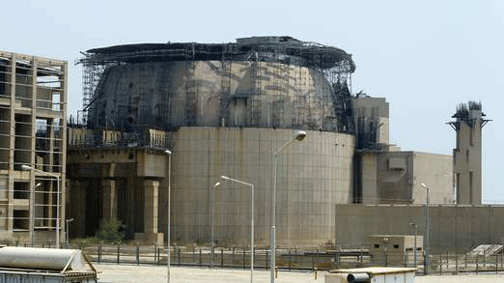
Bushehr, a city of over a million people in southeast Iran, sits in one of the most active seismic regions in the world, at the intersection of three tectonic plates. Building a nuclear plant in this area should have been a no-no, but construction started in 1975 with the help of Germany. It was stopped in 1979, right before the Revolution that unseated the Shah. It was resumed in 1996 with Russian assistance. The project took over 15 years to complete because of the very difficult technical issues of merging German and Russian technology. After Russia provided necessary nuclear fuel, the plant went operational in July 2013.
The safety issues concerning the plant are numerous: It is built with a 40-year-old design that has shown its limitations; the emergency coolant system is also 30 years old; it is running on two different technologies; according to the International Atomic Energy Agency, the staff is not properly trained to face any kind of accident. In February, 2011, a broken water pump caused small metallic pieces to infiltrate the reactor cooling system, forcing the unloading of the fuel rods.
The realities of nuclear diplomacy between Iran and the West
Iran and the Language of Nuclear Diplomacy http://guardianlv.com/2014/03/iran-and-the-language-of-nuclear-diplomacy/ by Christopher Spencer on March 30, 2014. The ongoing negotiations related to Iran and its nuclear program reflect the realities of the diplomacy of nuclear weapons. A current scholar of international relations observed that Iran learned a valuable lesson from the fate of Saddam Hussein in Iraq. That lesson is that a state cannot directly oppose the United States in a violent fashion without possessing nuclear weapons. It was the supposed presence of weapons of mass destruction in Iraq that formed the justification for the U.S. invasion of the country and the subsequent removal of Hussein’s regime. It is important to note that the U.S., as well as many other countries, categorizes weapons of mass destruction to include chemical, biological, and nuclear weapons. In terms of foreign policy or military application, the use of a chemical weapon is the same as a nuclear weapon to the U.S.
The mullahs in Iran were carefully watching the interaction between the U.S. and Iraq. It is true that aspects of the Iranian nuclear program pre-date the 2003 U.S. invasion of Iraq, but it can be argued that this event cemented the desire in the Iranian leadership to pursue a nuclear capacity of their own and to accelerate the process of acquiring it. Iran sees itself as a powerful player in the Middle East and seeks to expand that power further. They claim to represent the Shi’a sect of Islam and stand in opposition to Sunni regimes in states such as Saudi Arabia. The possession of nuclear weapons would offer Iran a valuable “shield” against possible aggression from the U.S.
Nuclear weapons have always been more valuable for the threat of their use rather than their actual deployment. The entire foreign policy of the Cold War confrontations between the U.S. and the Soviet Union was based on the fact that both states possessed a nuclear arsenal capable of destroying civilization several times over. This made direct confrontation between the two super powers almost impossible to fathom, and indeed the one time it did nearly occur during the Cuban Missile Crisis of 1962 is perhaps the closest the world has ever come to annihilation. This is another lesson in the language of nuclear diplomacy that Iran has learned during its pursuit of nuclear weapons.
Another more contemporary example would be that of North Korea. The belligerent state constantly flaunts its nuclear capacity and uses it as a negotiating tool in order to extract concessions from the international community. When they need additional food or energy imports, they will conduct a nuclear test or reopen a closed nuclear facility and then tell the world community to give them more goods in exchange for shutting down or scaling back the program. The fact that the North Korean regime possesses some functional nuclear devices forces more powerful actors like the U.S. to deal with them differently. The U.S. is vastly more powerful than North Korea, but it must acknowledge the North Korean nuclear capacity and the potential possibility of such weapons being used against local allies like South Korea or Japan.
It is this “latitude” that Iran is seeking by pursing a nuclear program of its own. Despite the rhetoric from Iranian leaders regarding the destruction of Israel, it is almost unthinkable that Iran would deploy a nuclear device against Israel, either directly or through the use of a terrorist organization as an intermediary. Such an action would almost assuredly result in retaliation from the world community that would destroy the current Iranian regime, if not the entire country itself. The question must then be asked about the stability of the Iranian regime. Would they essentially commit suicide by deploying a nuclear weapon against Israel, or do they seek the diplomatic and foreign policy protection that a nuclear capability provides?
This is not to say that a nuclear armed Iran would be a positive development for the Middle East or the world. An Iran with more diplomatic latitude would be a danger not only to the region but the rest of the world. Furthermore, other Middle East states like Saudi Arabia and Egypt have stated that if Iran develops a nuclear capability, they will seek nuclear weapons of their own. A nuclear arms race in the Middle East would not benefit the world at all. But this is the language of diplomacy for Iran and its pursuit of nuclear weapons.
Declassified information on suspected Israeli theft of nuclear weapons material
Secrets About Suspected Israeli Theft of U.S. Weapons-Grade Nuclear Material Declassified Global Research, 27 Mar 14, On March 18, 2014 ISCAP, the highest declassification authority in the U.S., released 84 pages (PDF) of formerly secret information about investigations into the illegal diversion of weapons-grade nuclear material from a Pennsylvania plant into the clandestine Israeli nuclear weapons program. Files now available to the public from IRmep’s ISCAP process include:…….http://www.globalresearch.ca/secrets-about-suspected-israeli-theft-of-u-s-weapons-grade-nuclear-material-declassified/5375720?utm_source=rss&utm_medium=rss&utm_campaign=secrets-about-suspected-israeli-theft-of-u-s-weapons-grade-nuclear-material-declassified
1 This Month




PLEASE OPPOSE HR 8255 AND S.3639 – bills would accelerate satellite deployment, with no environmental review or safeguards – https://ncstd5li.quorum.us/campaign/169331/
To see nuclear-related stories in greater depth and intensity – go to https://nuclearinformation.wordpress.com
-
Archives
- September 2026 (330)
- August 2026 (330)
- July 2026 (355)
- June 2026 (287)
- May 2026 (306)
- April 2026 (356)
- March 2026 (251)
- February 2026 (267)
- January 2026 (308)
- December 2025 (358)
- November 2025 (359)
- October 2025 (375)
-
Categories
- 1
- 1 NUCLEAR ISSUES
- business and costs
- climate change
- culture and arts
- ENERGY
- environment
- health
- history
- indigenous issues
- Legal
- marketing of nuclear
- media
- opposition to nuclear
- PERSONAL STORIES
- politics
- politics international
- Religion and ethics
- safety
- secrets,lies and civil liberties
- spinbuster
- technology
- Uranium
- wastes
- weapons and war
- Women
- 2 WORLD
- ACTION
- AFRICA
- Atrocities
- AUSTRALIA
- Christina's notes
- Christina's themes
- culture and arts
- Events
- Fuk 2022
- Fuk 2023
- Fukushima 2017
- Fukushima 2018
- fukushima 2019
- Fukushima 2020
- Fukushima 2021
- general
- global warming
- Humour (God we need it)
- Nuclear
- RARE EARTHS
- Reference
- resources – print
- Resources -audiovicual
- Weekly Newsletter
- World
- World Nuclear
- YouTube
-
RSS
Entries RSS
Comments RSS

