Birth deformities, cancers, in Libya as result of depleted uranium weapons

In Libya now being recorded by the WHO (world health organization), the highest deformation in fetuses inside Libya and reached 23% of newborns and also the high incidence of new forms of cancer that were not known among ordinary Libyans and now amounting to 18% of the total of cancers that have been diagnosed by the organization’s branch in Libya .
Despite this serious health disaster countries involved with NATO are now demanding that Libya pay them one billion seven hundred million dollars for their help in toppling the Gaddafi regime.
NATO War Crimes In Libya: Deformities of Newborns Because of Depleted Uranium Bombs http://libyanfreepress.wordpress.com/2014/02/28/nato-war-crimes-in-libya-deformities-of-newborns-because-of-depleted-uranium-bombs/ Libyans knew that depleted uranium was being used by NATO in their bombing raids and they were very concerned.
There is no doubt that NATO/US broke every agreement imposed by the Geneva Convention.
War crimes against humanity in Libya by NATO and its member countries is unmatched in the world. Continue reading
Renewable energy is the future for Jordan, not nuclear energy
The cost issues of renewable energy are developing in such a way that are much cheaper than nuclear energy and safer, he said, indicating that there are many expenses associated with nuclear energy that are not applicable when utilising renewable resources, such as risks, insurance and development costs.
“Our belief is that renewable energy is the most viable approach for the future and much more environmentally safe,” Amin stressed.
Jordan’s future lies in renewable energy http://www.albawaba.com/business/jordan-renewable-energy-549840
 January 26th, 2014 Renewable energy is the most viable approach for the future of Jordan and regional countries, according to International Renewable Energy Agency (IRENA) Director General Adnan Amin.
“Jordan is a very interesting market because it has a very developed institutional structure in terms of government agencies dealing with energy issues,” Amin said in a recent interview with The Jordan Times on the sidelines of the Abu Dhabi Sustainability Week.
“Jordan is looking very positively at the future of renewable energy,” he added. Continue reading
Egypt pursuing nuclear plans?
Egypt ramps up its nuclear options By Raymond Stock January 09, 2014 FoxNews.com “……..America’s slighted ally Egypt is now possibly pursuing its own nuclear option, amid fears of an atomic arms race between Tehran and its regional Sunni rivals in Cairo, Riyadh and beyond.
And no one seems to be paying attention.
Egypt’s traditionally close relations with the U.S. have been severely strained since Minister of Defense General Abdel-Fattah al-Sisi ousted the narrowly-elected President Mohamed Morsi after more than thirty million marched against him and the rule of the Muslim Brotherhood (MB), to which he belongs…….
Egypt’s 60-year-old nuclear program is already the third largest in the region, after those of Israel and Iran.
On November 26, the respected Middle East news site Al-Monitor reported that Egypt expects to generate $4 billion in grants from interested international companies to finance the project.
Morsi, whom al-Sisi appointed Mansour to replace pending new elections next year, had earlier approved a similar plan, even obtaining a pledge of Russian “research assistance” for Egypt’s nuclear expansion, as well as help in exploiting the nation’s previously unknown major deposits of uranium…….http://www.foxnews.com/opinion/2014/01/09/as-obama-dithers-egypt-ramps-up-its-nuclear-options/
Iran to seek direct nuclear talks with USA?

 Advisor to Iran supreme leader urges direct nuclear talks with U.S. LA Times, By Ramin Mostaghim and Carol J. Williams December 27, 2013, TEHRAN — The chief foreign policy advisor to Iran’s Ayatollah Ali Khamenei has called for direct talks with the United States on nuclear issues, a possible sign from the supreme leader that he is amenable to ending the animosity that has defined relations with Washington for 34 years.
Iranian President Hassan Rouhani has been the target of fierce criticism by political and religious hard-liners since he helped broker a deal with the United States and five other Western powers last month that will put Iranian high-level enrichment of uranium on hold for at least six months…….
The next round of talks between Iran and the six powers is to begin Monday in Geneva, and Velayati’s appeal for addressing each nation’s particular concerns individually could clear away obstacles to a permanent agreement imposed by some of the ideologically diverse P5-plus-1 members. http://www.latimes.com/world/worldnow/la-fg-wn-iran-us-nuclear-talks-20131227,0,592216.story#ixzz2onYWZ5xt
International silence on heroic nuclear whistleblower Mordechai Vanunu,
 Remember Mordechai Vanunu, Israel’s heroic nuclear whistleblower,Redress, Information and Analysis, 26 Dec 13, He should have received the Nobel Peace Prize. Instead, he spent 18 years in solitary confinement. He should be celebrated internationally as a man who has sacrificed his freedom for the truth and for the wellbeing of humanity. Instead, he has been stripped of his right to travel and prohibited from talking to foreigners.
Mordechai Vanunu: still fighting for his freedom, 27 years on Today, Mordechai Vanunu, the Israeli nuclear whistleblower, is almost forgotten. But he has not given up the fight for freedom.
Vanunu is appealing to the Israeli Supreme Court to set him free – free to leave Israel, theTimes of Israel reports……
Vanunu compared his past actions to those of US National Security Agency whistleblower Edward Snowden. “Snowden is the best example of what I did 25 years ago – when the government breaks the law and tramples on human rights, people talk. That’s what he did, he speaks for everyone, and that’s what I did – I spoke for everyone.”……
Vanunu is prohibited from visiting foreign territories, including the occupied West Bank and embassies within Israel, and can only meet with foreign nationals after securing permission from security forces.
In 1986 Vanunu leaked details of Israel’s military nuclear programme toThe Sunday Times, blowing the cover off Israel’s so-called “nuclear ambiguity”……
where are the international human rights warriors? We hear none speaking for Vanunu. Their silence is not just deafening. It is criminal. http://www.redressonline.com/2013/12/remember-mordechai-vanunu-israels-heroic-nuclear-whistleblower/
Iranians keen to continue nuclear talks, despite setback
The Treasury Department announced last week that it would freeze assets and ban transactions for companies and individuals that attempt to evade U.S. sanctions and continue doing business that helps Iran’s nuclear industry. The move prompted Iranian negotiators to leave ongoing talks in Geneva Thursday evening, saying it was against the “spirit” of the deal reached last month to freeze Iran’s nuclear program for six months in exchange for limited sanctions relief.
“That was a very wrong move,” Zarif told CBS News’ Elizabeth Palmer in an interview from Tehran. He said he was “saddened” by the move but that he is committed to the short-term deal meant to allow for a longer, six-month period of negotiations.
“We are committed to the plan of action and the implementation of Geneva – but we believe it takes two to tango,” Zarif said. “The process has been derailed, the process has not died,” he added later. “We are trying to put it back and to correct the path, and continue the negotiations because I believe there is a lot at stake for everybody.”
Many U.S. lawmakers are still eager for a fresh round of sanctions against Iran, even if they were only made operative in six months if the attempt to reach a long-term nuclear deal fails…….www.cbsnews.com/news/nuclear-talks-are-derailed-not-dead-iranian-official-says/
UN-Iran deal a modest, but positive, step forward
Iran Nuclear Accord Is a Good Deal, BU Today, Critics of agreement miss the lessons of history 12.09.2013 By Robert Loftis Strip away all the rhetoric, and the November 23 agreement with the Islamic Republic of Iran over its nuclear program emerges as an exercise in realism. It recognizes that three decades of enmity and distrust will not be erased overnight, nor can the knowledge of how to make a nuclear weapon be destroyed. This interim agreement represents a first step in verifiably ensuring that Iran’s nuclear program can be strictly limited to peaceful purposes. It is definitely a path worth pursuing.
The outlines of the agreement are simple: in return for a six-month halt to certain construction and enrichment activities, conversion and dilution of an existing 20 percent of enriched uranium stocks, and intrusive inspections by the International Atomic Energy Agency, the United States and other powers will offer limited relief from crippling sanctions on Iran’s economy.
In essence, it deprives Iran of the opportunity to readily further enrich uranium to levels of purity necessary for nuclear weapons. Over the course of this six-month agreement, the sides will explore the possibility of a comprehensive pact that will ensure Iran’s nuclear program is limited to civilian purposes and that treats Iran as any other signatory to the Non-Proliferation Treaty. If, during the next six months, it becomes clear that the Iranians are cheating or trying to hide a military program, then the sanctions can be reimposed immediately and further steps considered. It is worth highlighting that the Iranians made this agreement not just with the United States and its European allies, but also with the Russians and the Chinese. The Iranians would have to weigh the costs of crossing its most sympathetic global powers by failing to live up to the agreement.
Far from being the “historic mistake” that Israeli Prime Minister Benjamin Netanyahu contends, the accord is the first step toward a goal that we all claim to share: an Iran that does not pose a nuclear threat to our friends and allies. …………….http://www.bu.edu/today/2013/pov-iran-nuclear-accord-is-a-good-deal/
Israel puts pressure on Australia, to disrupt UN-Iran nuclear accord

 Israel wants Australia to use its influence in UN Security Council to amend nuclear deal with Iran SMH, December 11, 2013 Peter Hartcher, Israel has urged Australia to use its new found influence to force a much tougher deal on Iran over its nuclear program.
Israel’s Minister for the Economy, Naftali Bennett, told Prime Minister Tony Abbott that Israel ”badly wants a deal” to halt Iran’s nuclear progress, Mr Bennett said.
Israel is deeply unhappy with the terms of the interim deal negotiated by the five permanent members of the United Nations Security Council – the so-called P5 – plus Germany on November 24. ……..Australia can be an important factor in shaping the final deal, due in six months, Mr Bennett said, because it is a member of the UN Security Council next year and also the chairman of the council’s sanctions committee on Iran.
Iran has agreed to freeze parts of its nuclear program and dilute its most highly concentrated uranium in return for a partial easing of the international sanctions that have forced it into recession.
Israel’s essential demand is that Iran be forced to surrender its nuclear fuel-making machinery. Where the P5+1 deal has allowed Iran to keep its centrifuges for concentrating uranium into nuclear fuel, Israel wants them removed. : http://www.smh.com.au/federal-politics/political-news/israel-wants-australia-to-use-its-influence-in-un-security-council-to-amend-nuclear-deal-with-iran-20131210-2z42x.html#ixzz2nBQ2kJxj
Iran nuclear deal – “delicate” diplomacy needed
John Kerry defends Iran nuclear deal to Congress sceptics BBC News 10 Dec 13, US Secretary of State John Kerry has defended the six-month nuclear deal struck with Iran to a sceptical panel of congressmen.
Mr Kerry said if the US Congress imposed new sanctions against Iran, it would risk the “delicate” diplomatic effort needed for a larger deal.
The US and other world powers have promised no new sanctions in exchange for a curb of Iran’s nuclear programme.
But US critics of the deal say it gives Iran cover to expand the programme.
And they have called for even tougher sanctions now, saying they would strengthen the hand of the so-called P5+1 group of nations engaged in negotiations with Iran…………
“I would state to you unequivocally, the answer is yes, the national security of the United States is stronger under this first-step agreement than it was before,” Mr Kerry said…….
During the hearing in the House foreign affairs committee, Mr Kerry was accused of grovelling to the Iranian government and letting down allies, the BBC’s Jonny Dymond reports.
But our correspondent says Mr Kerry pushed back against every suggestion of weakness on Iran, stressing that without a deal, the country would be closer to developing nuclear weapons.
“We are asking you to give our negotiators and our experts the time and the space to do their jobs and that includes asking you while we negotiate that you hold off imposing new sanctions,” Mr Kerry told the panel……http://www.bbc.co.uk/news/world-us-canada-25326782
Libya’s uranium stockpile a cause of anxiety
Concerns Grow Over Libyan Uranium Stockpiles, VOA, Jamie Dettmar, 10 Dec 13, December 10, 2013 WASHINGTON — Inspectors from the United Nations nuclear agency will soon begin an assessment of the adequacy of security arrangements for thousands of barrels of yellowcake uranium stockpiled in Libya. The inspection comes amid rising anxiety among Western powers and Libya’s neighbors at the lawlessness disrupting the transition from dictatorship to democracy since the ouster two years ago of Moammar Gadhafi.
According to Mr. Mitri, 6,400 barrels of yellowcake uranium are stored in a facility near Sabha, a desert town in the south that has witnessed episodic clashes between Tubu and Abu Seif tribesmen. Libyan intelligence officials say Al Qaida-linked Tuareg fighters fleeing the French intervention in Mali have moved into Libya’s south to set up camps.
Distrust growing over secret Trans Pacific Partnership deal
 One of the most controversial provisions in the talks includes new corporate empowerment language insisted upon by the U.S. government, which would allow foreign companies to challenge laws or regulations in a privately run international court.
Previously leaked TPP documents have sparked alarm among global health experts, Internet freedom activists, environmentalists and organized labor, but are adamantly supported by American corporations and the U.S. Chamber of Commerce. The Obama administration has deemed negotiations to be classified information — banning members of Congress from discussing the American negotiating position with the press or the public. Congressional staffers have been restricted from viewing the documents
Obama Faces Backlash Over New Corporate Powers In Secret Trade Deal HUFFINGTON POST 12/09/2013 WASHINGTON –– The Obama administration appears to have almost no international support for controversial new trade standards that would grant radical new political powers to corporations, increase the cost of prescription medications and restrict bank regulation, according to two internal memos obtained by The Huffington Post. Continue reading
Allow Iran a modest uranium enrichment program – Obama
Obama says Iran could be allowed a modest nuclear enrichment program President Obama says that it isn’t realistic to try to force Iran to dismantle its entire nuclear complex, but that strong monitoring would be needed. LA Times, By Paul RichterDecember 7, 2013, WASHINGTON — President Obama signaled Saturday that he was prepared to allow Iran to enrich uranium on its own soil, saying that a final deal could be structured to prevent Tehran from developing a nuclear bomb.
Obama also put the odds of success for the upcoming international negotiations with Iran at not “more than 50-50.”…….
But Obama is struggling to sell the deal in the face of intense resistance from Congress, Israel, Saudi Arabia and others who fear it will leave Iran with the ability to secretly edge toward a nuclear weapons program. Congress may adopt new sanctions in the coming weeks that Obama fears could upset the fragile diplomacy before negotiations resume.
The comments marked the first time that Obama has acknowledged Iran could be granted international approval to enrich uranium to low levels, provided it satisfied world concerns about its nuclear program and agreed to intrusive monitoring. ……….http://www.latimes.com/world/la-fg-obama-us-mideast-20131208,0,2891554.story#axzz2mzg6eYug
Israel developing a new super computer worm against Iran’s nukes?
 ‘Saudis, Israelis developing new ‘super Stuxnet’ against Iran nuclear program’ Rt.com, 2 Dec 13 Saudi Arabia and Israel’s Mossad intelligence division are co-conspiring to produce a computer worm “more destructive” than the Stuxnet malware to sabotage Iran’s nuclear program, according to a report from the semi-official Iranian Fars news agency.
“Saudi spy chief Prince Bandar bin Sultan bin Abdulaziz Al Saud and director of Israel’s Mossad intelligence agency Tamir Bardo sent their representatives to a meeting in Vienna on November 24 to increase the two sides’ cooperation in intelligence and sabotage operations against Iran’s nuclear program,” an anonymous source close to the Saudi secret services told Fars over the weekend.
The source noted that one of the major methods discussed was “the production of a malware worse than…Stuxnet.”
Stuxnet, a computer worm discovered in 2010, formed the basis of a cyberattack that sabotaged Iran’s uranium enrichment program. Its complexity prompted researchers to claim that it could only have been developed by a nation state.
It was generally believed to have been developed by the US and Israel, with former NSA contractor and whistleblower Edward Snowden only confirming their covert roles in an interview this July.
The intention behind the development of the new malware would be “to spy on and destroy the software structure of Iran’s nuclear program.” The source expressed a desire to remain anonymous on account of the sensitivity of information being shared. The plan would need a great deal of time and funding, with a rough figure of US $1 million being given as an estimate. It was apparently welcomed by Saudi Arabia with open arms……http://rt.com/news/stuxnet-iran-nuclear-mossad-565/
Israel’s nuclear weapons-GOOD. Iran’s nuclear power- BAD. Why so?
“At some point, for its own security, Israel will have to take the bombs out of the basement and put them on the negotiating table.”.
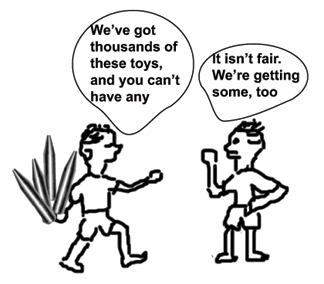 Why is the U.S. okay with Israel having nuclear weapons but not Iran? WP BY MAX FISHER December 2 Iranian officials sometimes respond to accusations that Tehran is seeking a nuclear weapons capability by replying that, not only do they not want a bomb, they’d actuallylike to see a nuclear-weapons-free Middle East. Yes, this is surely in part a deflection, meant to shift attention away from concerns about Iran’s nuclear activities by not-so-subtly nodding to the one country in the region that does have nuclear weapons: Israel.
But could Iran have a point? Is there something hypocritical about the world tolerating Israel’s nuclear arsenal, which the country does not officially acknowledge but has been publicly known for decades, and yet punishing Iran with severe economic sanctions just for its suspected steps toward a weapons program? Even Saudi Arabia, which sees Iran as its implacable enemy and made its accommodations with Israel long ago, often joins Tehran’s calls for a “nuclear-free region.” And anyone not closely versed in Middle East issues might naturally wonder why the United States would accept Israeli warheads but not an Iranian program.
- This issue comes up in every lecture I give,” Joe Cirincione, president of the nuclear nonproliferation-focused Ploughshares Fund, told me. The suspicions that Israel gets special treatment because it’s Israel, and that Western countries are unfairly hard on Israel’s neighbors, tend to inform how many in the Middle East see the ongoing nuclear disputes. “It is impossible to give a nuclear policy talk in the Middle East without having the questions focus almost entirely on Israel,” Cirincione said…….. Continue reading
Marketing nuclear power to Egypt – what a lovely, safe, idea!
Egypt moves ahead with nuclear plant to address electricity crisis ALMONITOR, Egypt Pulse Ayah Aman 29 Nov 13, CAIRO — The Egyptian government is taking new steps to implement its ambitious program to use nuclear energy for the generation of electricity. This comes after the project had been halted due to security, political and economic reasons as well as popular opposition…….
A source at the EAEA told Al-Monitor that the government expected to receive offers from 30 international companies for the execution of the project. The actual competition has been limited to 10 companies from six countries: Russia, China, Japan, South Korea, the United States and France…….

“The government will meet the $4 billion financing through grants from companies that it will pay back in installments,” the same source clarified. “However, the Egyptian government has yet to receive any offers for financing or assistance.” He brushed off criticism that external financing constituted a violation of sovereignty, “as it is the only option available to expedite the completion of the project.”
A delegation from the international consulting firm WorleyParsons visited Cairo in early November and met with experts on nuclear safety……… The Supreme Council of Energy is scheduled to hold a meeting next week, chaired by Mansour, to discuss the nuclear dossier and review the steps being considered to hold the tender to build nuclear power plants. Continue reading
1 This Month




PLEASE OPPOSE HR 8255 AND S.3639 – bills would accelerate satellite deployment, with no environmental review or safeguards – https://ncstd5li.quorum.us/campaign/169331/
To see nuclear-related stories in greater depth and intensity – go to https://nuclearinformation.wordpress.com
-
Archives
- September 2026 (330)
- August 2026 (330)
- July 2026 (355)
- June 2026 (287)
- May 2026 (306)
- April 2026 (356)
- March 2026 (251)
- February 2026 (267)
- January 2026 (308)
- December 2025 (358)
- November 2025 (359)
- October 2025 (375)
-
Categories
- 1
- 1 NUCLEAR ISSUES
- business and costs
- climate change
- culture and arts
- ENERGY
- environment
- health
- history
- indigenous issues
- Legal
- marketing of nuclear
- media
- opposition to nuclear
- PERSONAL STORIES
- politics
- politics international
- Religion and ethics
- safety
- secrets,lies and civil liberties
- spinbuster
- technology
- Uranium
- wastes
- weapons and war
- Women
- 2 WORLD
- ACTION
- AFRICA
- Atrocities
- AUSTRALIA
- Christina's notes
- Christina's themes
- culture and arts
- Events
- Fuk 2022
- Fuk 2023
- Fukushima 2017
- Fukushima 2018
- fukushima 2019
- Fukushima 2020
- Fukushima 2021
- general
- global warming
- Humour (God we need it)
- Nuclear
- RARE EARTHS
- Reference
- resources – print
- Resources -audiovicual
- Weekly Newsletter
- World
- World Nuclear
- YouTube
-
RSS
Entries RSS
Comments RSS

