Iran can build 2 nuclear reactors: not in violation of Joint Plan of Action
 State Dept: Iran’s New Nuclear Reactors Don’t Violate Joint Plan of Action by TheTower.org Staff | 01.15.15 Iran’s announced construction of two light-water reactors does not violate the Joint Plan of Action (JPOA) signed between Iran and the P5+1 nations in November 2013, a State Department official told the Washington Free Beacon today.
“We are aware of the announcement and are reviewing the details,” said the official, who was not authorized to speak on record. However, “in general, the construction of light water nuclear reactors is not prohibited by U.N. Security Council resolutions, nor does it violate the JPOA,” the official said. …
“We have been clear in saying that the purpose of the negotiations with Iran is to ensure that Iran’s nuclear program remains exclusively for civilian, peaceful purposes,” the official said. “The talks that we have been engaged in for months involve a specific set of issues relative to closing off all possible pathways to Iran acquiring a nuclear bomb. That remains our focus.”………http://www.thetower.org/1502-state-dept-irans-new-nuclear-reactors-dont-violate-joint-plan-of-action/
Pentagon secrecy on Israel’s Nuclear Program and Super Computers

 Pentagon Refuses to Release Unclassified 1987 Report about Israel’s Nuclear Program and Super Computers http://www.allgov.com/news/top-stories/pentagon-refuses-to-release-unclassified-1987-report-about-israels-nuclear-program-and-super-computers-150113?news=855360 Noel Brinkerhoff, Danny Biederman A think tank researcher has been fighting with the Pentagon to get a 1987 report on Israel’s nuclear program and supercomputers released despite the fact that the document in question is not classified.
Grant Smith, founder of the Institute for Research: Middle Eastern Policy, Inc., first asked theDepartment of Defense (DoD) to release the report (“Critical Technology Issues in Israel and NATO Countries”) three years ago through a Freedom of Information Act request.
Last fall, after numerous delays by the DoD, Smith went to court to force the report’s disclosure.
Defense lawyers contend it was necessary for officials to ask Israel to review the report before complying with Smith’s request—an unusual move on the part of a U.S. agency involving an American FOIA issue.
Meanwhile, the judge hearing the FOIA case, U.S. District Judge Tanya Chutkan, has wondered why it has taken three years without a decision by the Pentagon.
“I’d like to know what is taking so long for a 386-page document. The document was located some time ago,” Chutkan said in November, according to Courthouse News Service. “I’ve reviewed my share of documents in my career. It should not take that long to review that document and decide what needs to be redacted.”
The report may contain details about an internal debate nearly 30 years ago among U.S. officials about whether Washington should authorize the sale of a Cray supercomputer to a coalition of Israeli universities. “The United States approved the sale of powerful computers that could boost Israel’s well-known but officially secret A-bomb and missile programs,” wrote the author of a 1995 Risk Report article about the Cray controversy that cited the Pentagon document. “A 1987 Pentagon-sponsored study found that Technion University, one of the schools in the network, was helping design Israel’s nuclear re-entry vehicle. U.S. officials say Technion’s physicists also worked in Israel’s secret weapon complex at Dimona.”
Smith’s effort “to get hold of the Pentagon report is set against the backdrop of the Nuclear Non-Proliferation Treaty,” wrote Janet McMahon at Courthouse News Service. “Israel has not signed the treaty. Iran, on the other hand, has signed the treaty.”
The current negotiations with Iran over its nuclear program is part of that backdrop. “The reason this would be seen as controversial is you have this real concerted push for Iran to come clean on its nuclear program and to relinquish its infrastructure,” Foundation for Defense of Democracies VP Jonathan Schanzer told the Washington Examiner. He said he saw “no reason” why the U.S. government would authorize the report’s release, but adding that if it was released, it would probably not affect the Pentagon’s publicly ambiguous stance regarding Israeli nuclear capabilities.
Smith has grown frustrated over the government’s stalling on the issue, saying: “So what we’ve seen most recently is that the government is now coming up with novel ways to try and delay this by talking about mandatory disclosure reviews. We don’t think it’s meaningful that their captive think tank may have signed NDAs. Perhaps they even have a sock puppet in the Pentagon that signs NDAs on their behalf. It would be the same from our perspective.”
Report that Syria is developing a nuclear weapon.
Great news: Bashar al-Assad still developing nuclear weapons Hot Air JANUARY 12, 2015 BY NOAH ROTHMAN There is some troubling news out of the Levant this week, as if the West needed any more of that. According to a thorough report in Der Spiegel based on documents obtained from “Western intelligence agencies,” Bashar al-Assad’s Syria is busily developing a nuclear weapon.
“Analysts say that the Syrian atomic weapon program has continued in a secret, underground location,” Der Spiegel reported. “According to information they have obtained, approximately 8,000 fuel rods are stored there. Furthermore, a new reactor or an enrichment facility has very likely been built at the site — a development of incalculable geopolitical consequences.”
ccording to intelligence agency analysis, construction of the facility began back in 2009. The work, their findings suggest, was disguised from the very beginning, with excavated sand being disposed of at various sites, apparently to make it more difficult for observers from above to tell how deeply they were digging. Furthermore, the entrances to the facility were guarded by the military, which turned out to be a necessary precaution. In the spring of 2013, the region around Qusayr saw heavy fighting. But the area surrounding the project in the mines was held, despite heavy losses suffered by elite Hezbollah units stationed there.
The most recent satellite images show six structures: a guard house and five sheds, three of which conceal entrances to the facility below. The site also has special access to the power grid, connected to the nearby city of Blosah. A particularly suspicious detail is the deep well which connects the facility with Zaita Lake, four kilometers away. Such a connection is unnecessary for a conventional weapons cache, but it is essential for a nuclear facility.
But the clearest proof that it is a nuclear facility comes from radio traffic recently intercepted by a network of spies. A voice identified as belonging to a high-ranking Hezbollah functionary can be heard referring to the “atomic factory” and mentions Qusayr. The Hezbollah man is clearly familiar with the site. And he frequently provides telephone updates to a particularly important man: Ibrahim Othman, the head of the Syrian Atomic Energy Commission……….http://hotai
Nuclear Energy Programme in UAE
UAE Says Nuclear Energy Programme Progressing “On Schedule” Emirates Nuclear Energy Corporation (ENEC) completes the concrete dome for the Unit 1 Reactor Containment Building. Gulf Business, 13 Jan 15 By Aarti Nagraj The UAE’s nuclear energy programme is progressing on track to begin operations in 2017, the Emirates Nuclear Energy Corporation (ENEC) said on Tuesday.
The first unit of the $20 billion Barakah project – which includes four reactors in total – is now more than 60 per cent complete and on track to commence commercial operations in 2017, pending further regulatory approvals, ENEC said………
The dome, which measures 51.4 metres in diameter, 24 meters in height and weighs approximately 9000 metric tonnes, has been constructed over the past five months in nine stages……….http://gulfbusiness.com/2015/01/uae-says-nuclear-energy-programme-progressing-schedule/#.VLWGnNKUcnk
Rouhani’s and Obama’s difficult path to a nuclear compromise
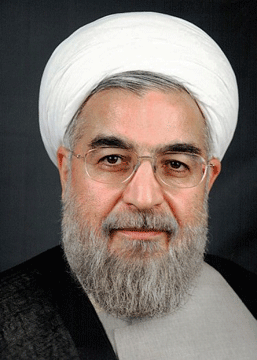 Saving the Nuclear Deal With Iran, NYT, By THE EDITORIAL BOARD JAN. 10, 2015 Twice recently, Iran’s president, Hassan Rouhani, has acted boldly in support of his biggest political gamble, pursuit of a nuclear agreement with the major powers. In a speech last Sunday on Iran’s troubled economy, he argued that Iran will never enjoy sustained growth if it is isolated from the rest of the world. Three weeks earlier, he made clear that he would confront Iran’s hard-liners in his efforts to clinch a deal in which Iran would agree never to produce a nuclear weapon in return for the lifting of crippling international sanctions.
But Mr. Rouhani is not the only leader trying to keep a potential agreement from being savaged by domestic opponents. President Obama has a similar problem in Congress, where Senators Robert Menendez, a Democrat from New Jersey, and Mark Kirk, a Republican from Illinois, are expected to introduce legislation that could torpedo any deal by imposing new sanctions on Iran, including tighter controls on its battered oil industry.
Negotiators for Iran and the major powers — the United States, Britain, France, China, Russia and Germany — resume their talks next week in Geneva. While they have made significant progress, they remain at odds over how large a nuclear program — geared for energy production and medical uses — Iran will be permitted to have.
Mr. Rouhani has shown his seriousness by openly challenging the Iranian hard-liners who are hostile to a deal and by appealing for support from intellectuals, academics, businesspeople and others who are open, even eager, for one. To rally political support, he has also hinted that he might bypass established power centers and submit the issue to a popularreferendum. “Our ideals are not bound to centrifuges,” Mr. Rouhani said in reference to the nuclear program.
Mr. Rouhani’s path to compromise is not easy. ……..http://www.nytimes.com/2015/01/11/opinion/sunday/saving-the-nuclear-deal-with-iran.html
Is Assad building a secret nuclear plant in Syria?
Report: Assad Building Secret Nuclear Plant, Arutz Sheva German magazine says Syrian President is building a secret underground plant with the aim of developing nuclear weapons. By Elad Benari, 9 Jan 15, Canada Intelligence suggests that Syrian President Bashar Al-Assad is building a secret underground plant with the aim of developing nuclear weapons, Germany’s Spiegel news magazine said Friday, according to AFP.
Citing information made available by unidentified intelligence sources,Spiegel said the plant was in an inaccessible mountain region in the westof the war-ravaged country, two kilometers (1.2 miles) from the Lebanese border.
It is deep underground, near the town of Qusayr and has access to electricity and water supplies, the magazine said in a pre-released version of the story released ahead of Saturday’s publication.
It said it had had access to “exclusive documents”, satellite photographsand intercepted conversations thanks to intelligence sources.
Western experts suspect, based on the documents, that a reactor or an enrichment plant could be the aim of the project, whose codename is “Zamzam”, Spiegel said.
The Syrian regime has transferred 8,000 fuel rods to the plant that had been planned for a facility at Al-Kibar, it added.
In 2007, a bombing raid on an undeclared Syrian nuclear facility at Al-Kibar was widely understood to have been an Israeli strike, but it was never acknowledged by the Jewish state.
Since then, Western intelligence agencies detected another nuclear plant in Syria, this time in a Damascus suburb……..http://www.israelnationalnews.com/News/News.aspx/189739#.VLGM9dLF8nk
Egypt’s New and Renewable Energy Authority (NREA) selects 67 companies to develop 4.3 GW project
 Huge interest in Egyptian renewable energy tender
05. JANUARY 2015 | GLOBAL PV MARKETS, APPLICATIONS & INSTALLATIONS | BY: JONATHAN GIFFORD
The chairman of Egypt’s New and Renewable Energy Authority (NREA) has revealed that 67 companies have been selected to take part in developing 4.3 GW of renewable energy projects in the country. The successful companies were chosen from 177 applicants. http://www.pv-magazine.com/news/details/beitrag/huge-interest-in-egyptian-renewable-energy-tender_100017661/#ixzz3OAPGU0b4
Middle East’s first GW-scale tender for solar power swamped with applicants
Solar twice oversubscribed in Middle East’s first GW-scale tender http://www.pv-tech.org/news/solar_twice_over_subscribed_in_middle_easts_first_gw_scale_tender 5 Jan 15 Egypt’s recent renewable energy tender was twice oversubscribed for solar projects, it has been revealed.
The Egyptian government is expected to reveal the full list of pre-approved projects in the region’s first gigawatt-scale tender later today.
The law firm Eversheds hosted an event in December with the chairman of Egypt’s New and Renewable Energy Authority and the managing director of the electricity regulator, EgyptERA. The subject of the country’s 4.3GW feed-in tariff programme was raised. The scheme includes 2GW of large-scale solar, 300MW of PV projects under 500kW and 2GW of wind.
Michelle T Davies, head of Eversheds’ clean energy and sustainability group, spoke to PV Tech after the event: “They explained more about the programme during that day. They had 178 projects apply for the FiT and they have pre-qualified 67. Forty of those are solar. The rest are wind.
“Solar was more than double subscribed and wind was 56% subscribed. So the wind tender will go out again,” she said, adding that the first power purchase agreements are likely to be awarded in the first half of 2015.
PV plants between 500kW and 20MW will receive a rate of US$0.136/kWh. Project between 20 and 50MW will be offered US$0.1434/kWh. Contracts will be offered for a 25-year term.
Attempts by Mossad to assassinate more nuclear scientists were foiled, Iran claims
Iran: We foiled Mossad attempt to assassinate nuclear scientist http://www.haaretz.com/news/diplomacy-defense/1.635269 Revolutionary Guards official says operation took place in last two years. By Haaretz | Jan. 4, 2015 An Iranian Revolutionary Guards official says the elite force foiled a Mossad attempt to assassinate one of the country’s nuclear scientists in the last two years, Iran’s Fars news agency reports.
“In the last two years, the Zionist enemy (Israel) was trying hard to assassinate an Iranian nuclear scientist, but the timely presence of the [Revolutionary Guards] security forces thwarted the terrorist operation,” Col. Ya’qoub Baqeri, deputy chief liaison officer of Flight Guards Corps, told Fars on Saturday.
The story noted that in June 2012, Iran announced it had arrested “all the elements” involved in the assasinations of five Iranian nuclear scientists that had taken place in the previous two years. Fars added that prior to those purported arrests, Iranian intelligence detected Mossad bases “within the territories of one of Iran’s Western neighbors” that trained and assisted the assassins.
Israel has never commented officially on these killings, but major Western media, quoting off-the-record Israeli intelligence sources, have attributed them to the Mossad. Last March, CBS News reported that the Obama administration was pressuring Jerusalem to halt such killings.
CBS national correspondent Dan Raviv, an expert on Israeli intelligence, reported that the Mossad “ran an assassination campaign for several years aimed at Iran’s top nuclear scientists. The purpose was to slow the progress made by Iran, which Israel feels certain is aimed at developing nuclear weapons; and to deter trained and educated Iranians from joining their country’s nuclear program.”
Raviv reported that at least five nuclear scientists had been killed, mostly by car bombs. “Remarkably, the Israeli assassins were never caught, obviously having long-established safe houses inside Iran – although several Iranians who may have helped the Mossad were arrested and executed,” the CBS report stated.
The CBS story added that even ahead of the pressure from the Obama administration, Prime Minister Benjamin Netanyahu had himself ordered the Mossad to stop the assassinations because he no longer wanted to run the risk of agents getting “captured and hanged.”
Tentative agreement between Iran and USA

 Iran and US tentatively agree on formula to reduce nuclear programme http://www.theguardian.com/world/2015/jan/02/iran-us-tentative-deal-nuclear-programme-uranium-russia Washington hopes Tehran will ship enriched uranium to Russia to reduce its weapon-making ability, diplomats say Iran and the United States have tentatively agreed on a formula that Washington hopes will reduce Tehran’s ability to make nuclear arms by committing it to ship to Russia much of the material needed for such weapons, diplomats say.
In another sign of progress, two diplomats told Associated Press that negotiators at the December round of nuclear talks drew up for the first time a catalogue outlining areas of potential accord and differing approaches to remaining disputes.The diplomats said differences still dominate ahead of the next round of Iran six-power talks on 15 January in Geneva. But they suggested that even agreement to create a to-do list would have been difficult previously because of wide gaps between the sides.
Iran denies it wants nuclear arms, but it is negotiating with the US, Russia, China, Britain, France and Germany on cuts to its atomic programme in the hope of ending crippling sanctions. The talks have been extended twice due to stubborn disagreements.
The main conflict is over uranium enrichment, which can create both reactor fuel and the fissile core of nuclear arms.In seeking to reduce Iran’s bomb-making ability, the US has proposed that Tehran export much of its stockpile of enriched uranium – something the Islamic Republic has long said it would not do.
The diplomats said both sides in the talks are still arguing about how much of an enriched uranium stockpile to leave Iran. . It now has enough for several bombs, and Washington wants substantial cuts below that level.
But the diplomats said the newly created catalogue lists shipping out much of the material as tentatively agreed upon.The diplomats, who are familiar with the talks, spoke to the AP recently and demanded anonymity because they are not authorised to comment on the closed negotiations.
Issues that still need agreement, they said, include the size of Iran’s future enrichment output. The US insists that it be cut in half, leaving Tehran with about 4,500 centrifuges used to enrich uranium, or fewer if it replaces them with advanced models. Tehran is ready for a reduction of only about 20%, according to the diplomats.
Two other unresolved issues are Iran’s Fordo underground enrichment site and the nearly built Arak nuclear reactor. The US and its five allies in the talks want to repurpose Fordo to a non-enrichment function because it is believed impervious to a military attack from the air. The six also seek to re-engineer Arak from a model that produces enough plutonium for several nuclear weapons a year to a less proliferation-prone model.
Negotiators hope to reach a rough deal by March and a final agreement by 30 June.
A diplomatic deal with Iran would be the most globally significant step forward
A nuclear deal with Iran would mean a less volatile world, Julian Borger Guardian, 1 jan 15 There will be no greater diplomatic prize in 2015 than a comprehensive nuclear deal with Iran. In its global significance, it would dwarf the US detente with Cuba, and not just because there are seven times more Iranians than Cubans. This deal will not be about cash machines in the Caribbean, but about nuclear proliferation in the most volatile region on Earth.
An agreement was supposed to have been reached by 24 November, but Iran and the west were too far apart to make the final leap. After nine months of bargaining, the intricate, multidimensional negotiation boiled down to two main obstacles: Iran’s long-term capacity to enrich uranium, and the speed and scale of sanctions relief.
Iran wants international recognition of its right not just to enrich, but to do so on an industrial scale. It wants to maintain its existing infrastructure of 10,000 centrifuges in operation and another 9,000 on standby, and it wants to be able to scale that capacity up many times.
The US and its allies say Tehran has no need for so much enriched uranium. Its one existing reactor is Russian-built, as are its planned reactors, so all of them come with Russian-supplied fuel as part of the contract. The fear is that industrial enrichment capacity would allow Iran to make a bomb’s-worth of weapons-grade uranium very quickly, if it decided it needed one – faster than the international community could react.
However, the west is currently not offering large-scale, immediate sanctions relief in return for such curbs on Iran’s activity. President Barack Obama can only temporarily suspend US congressional sanctions, and western states are prepared to reverse only some elements of UN security council sanctions. The best the west can offer upfront is a lifting of the EU oil embargo.
These gaps remain substantial, but none of the parties involved can walk away from the table. A collapse of talks would lead to a slide back to the edge of conflict between Iran and Israel; the latter has vowed to launch military strikes rather than allow the former to build a bomb. It could also trigger a wave of proliferation across the region and beyond as other countries hedge their bets.
Unfair and not sensible – USA hawks Try to Sabotage Nuclear Deal
 US Iran Hawks Try to Sabotage Nuclear Deal Iran hawks in Washington don’t want a nuclear agreement; they want Tehran to surrender its sovereignty and national rights. The National Interest Muhammad Sahimi December 24, 2014 As the prospects of a comprehensive nuclear agreement between Iran and the P5+1—the five permanent members of the United Nations Security Council plus Germany—brightens, Washington’s hawks seem to have gone into panic mode. They do not seem to want any agreement unless Iran says “uncle,” gives up its sovereignty and national rights within the Nuclear Non-Proliferation Treaty (NPT), and completely dismantles its nuclear infrastructure. They’re asking Iran to capitulate, not to negotiate. That’s an unrealistic goal—and in their dogged pursuit of it, they have overlooked serious steps Tehran’s taken that demonstrate a desire for compromise.
We see this unfortunate dynamic in an article this month by Mark Dubowitz, Executive Director of the Foundation for Defense of Democracies, published in the National Interest. Dubowitz’s main premise is that it was the economic sanctions imposed by the United States and its allies that brought Iran to the negotiation table, and only more economic sanctions will induce it to surrender. The premise is false. While the sanctions did play a role, they were not the most important reason, or even one of the primary ones. Iran is negotiating because that is what it has wanted—contrary to Dubowitz’s assertion that “Iran does not appear to be ready to compromise.”
President Hassan Rouhani, Foreign Minister Mohammad Javad Zarif, and their diplomatic team have always been interested in a compromise. …………….
What has the United States given in return for these major concessions by Iran? Very little. It has released a small amount of Iran’s own money, frozen in foreign banks as the result of the illegal sanctions. The U.S. has also lifted its (also illegal!) ban on the export of petrochemical products and a few other minor items. As President Obama stated, 95 percent of all the sanctions are still in place………….
The reality is that the Geneva Accord and its Joint Plan of Action permit Iran to continue its research on more advanced centrifuges. Iran’s obligation, which it has lived by, is not installing such centrifuges. After this was pointed out, Albright retreated, declaring that the test was in violation of the “spirit” of the Accord. Who is moving whose goalposts, again?
Washington’s hawks risk missing another chance at a sensible nuclear agreement or détente with Iran, one that would dramatically change the dynamics of the turbulent Middle East for the better. Instead, they seem to think they can drive a proud nation to surrender. They’ve been wrong before—and their latest salvo suggests they don’t realize they may be wrong again.
Muhammad Sahimi, Professor of Chemical Engineering & Materials Science and the NIOC Chair in Petroleum Engineering at the University of Southern California, is the editor and publisher of the website, Iran News and Middle East Reports, and has been analyzing Iran’s political developments and its nuclear program for two decades.
Criticism in Iran of Iran’s nuclear power programme
| Nuclear Program Has ‘Hurt Iran More Than Iraq War’, Payvand Iran News, 18 Dec 14 |
| By Golnaz Esfandiari, RFE/RL Iran’s nuclear activities and ambitions faced rare, blunt criticism at a roundtable at Tehran University, where one of the speakers said the damage done by the nuclear program was greater than that by the 1980-88 war with Iraq, which left tens of thousands dead and caused much devastation.
“The imposed war [with Iraq] did not damage us as much as the nuclear program has,” professor Sadegh Zibakalam said at the December 17 roundtable, according to reports by Iranian semiofficial news agencies. Zibakalam also criticized the lack of public debate about the nuclear issue. Other speakers were also critical of the nuclear program and its costs for Iranians, who have come under unprecedented U.S.-led sanctions that have made life more difficult. Speaking at the event, former reformist lawmaker Ahmad Shirzad said nothing had come out of the nuclear program, “not even a glass of water.”……. Shirzad said that he welcomed Iran’s official line, according to which the country is against building and acquiring nuclear weapons. The former lawmaker also seemed to suggest that Iran would be better off without a civil nuclear program. “Iran doesn’t have the primary resources and know-how for a nuclear program,” he was quoted as saying by ISNA. He said Iran could assert itself in areas such as petrochemistry and natural gas, where the country has the resources and the knowledge…………. Criticism of the nuclear issue has been a red line in Iran, where media face tough censorship rules in their news coverage. Shirzad said the nuclear issue has turned into a matter of “honor.” “When something becomes a matter of honor, discussing it is not possible anymore. And that has been our problem for the past 11 years,” he said. Zibakalam said that under Iran’s previous administration, criticism of the nuclear issue was impossible. “Unfortunately from 2003 to 2013, debate about the different aspects of the nuclear issue was not possible. I believe that whenever people and the press are prevented from expressing their opinions on different issues, the result is not good,” he was quoted as saying. He added that during those years whenever he would send a slightly critical piece to the press, “the editors would dump it in the closest trash can.”………http://www.payvand.com/news/14/dec/1098.html |
Russia keen to lock Jordan into long term contracts to buy nuclear reactors
 Russia approves draft deal to build nuclear plant in Jordan, Times of Israel 25 Dec 14 State-owned company Rosatom expected to finish construction of first 1,000-megawatt unit by 2024, second by 2026 Russian Prime Minister Dmitry Medvedev endorsed a draft Russia-Jordan agreement on the construction and operation of a nuclear plant in Jordan, the official website of the Kremlin said on Thursday…….
The state-owned company will form a joint venture with the Jordanian government, in which the Russian company will have 49.9 percent of the shares and Jordan will own 50.1%. The agreement will be financed by investments from both parties……
Iran meeting its commitments to nuclear deal with Western powers
Iran honoring nuclear deal with Western powers, IAEA report shows Jerusalem Post, 19 Dec 14, Iran has continued to meet commitments under an interim nuclear agreement with six world powers, a confidential UN agency report showed, though Tehran temporarily halted conversion work that makes higher-grade uranium less suitable for bombs.
The monthly update by the International Atomic Energy Agency (IAEA), seen by Reuters, said Iran was not enriching uranium above a fissile concentration of 5 percent, far below the 90 percent level needed for atomic arms. It also said Iran had not made “any further advances” to its activities at two enrichment facilities and an unfinished heavy water reactor.
Under last year’s accord between Iran and the United States, France, Germany, Russia, China and Britain, the Islamic Republic halted its most sensitive nuclear activity and took other steps in exchange for some easing of economic sanctions…………http://www.jpost.com/Middle-East/Iran-honoring-nuclear-deal-with-Western-powers-IAEA-report-shows-385206
1 This Month




PLEASE OPPOSE HR 8255 AND S.3639 – bills would accelerate satellite deployment, with no environmental review or safeguards – https://ncstd5li.quorum.us/campaign/169331/
To see nuclear-related stories in greater depth and intensity – go to https://nuclearinformation.wordpress.com
-
Archives
- September 2026 (323)
- August 2026 (330)
- July 2026 (355)
- June 2026 (287)
- May 2026 (306)
- April 2026 (356)
- March 2026 (251)
- February 2026 (267)
- January 2026 (308)
- December 2025 (358)
- November 2025 (359)
- October 2025 (375)
-
Categories
- 1
- 1 NUCLEAR ISSUES
- business and costs
- climate change
- culture and arts
- ENERGY
- environment
- health
- history
- indigenous issues
- Legal
- marketing of nuclear
- media
- opposition to nuclear
- PERSONAL STORIES
- politics
- politics international
- Religion and ethics
- safety
- secrets,lies and civil liberties
- spinbuster
- technology
- Uranium
- wastes
- weapons and war
- Women
- 2 WORLD
- ACTION
- AFRICA
- Atrocities
- AUSTRALIA
- Christina's notes
- Christina's themes
- culture and arts
- Events
- Fuk 2022
- Fuk 2023
- Fukushima 2017
- Fukushima 2018
- fukushima 2019
- Fukushima 2020
- Fukushima 2021
- general
- global warming
- Humour (God we need it)
- Nuclear
- RARE EARTHS
- Reference
- resources – print
- Resources -audiovicual
- Weekly Newsletter
- World
- World Nuclear
- YouTube
-
RSS
Entries RSS
Comments RSS

