IAEA says Iran has made drastic cuts in its stock of highly enriched uranium
 Iran slashes nuclear stock, says UN http://www.skynews.com.au/world/article.aspx?id=968784 April 18, 2014 Iran has cut its stock of highly-enriched uranium by 75 per cent, a new report by the UN’s nuclear watchdog has revealed.
The monthly update by the International Atomic Energy Agency (IAEA) showed Tehran remained in compliance with a November interim deal made with world powers, drawn up as part of efforts to find a lasting solution to Iran’s controversial nuclear drive.
Under the agreement, Iran pledged to ‘dilute’ half of its highly-enriched uranium by mid-April, with the rest to be converted by mid-July.
The IAEA report also said that progress on a plant in Tehran that will be used for the conversion of low-enriched uranium had been delayed, but that Iran had said this will not prevent it from fulfilling its part of the deal by the July 20 deadline.
Diplomats who saw the document told AFP everything was in order.
The international community was ‘keeping an eye’ on progress at the conversion plant in Tehran, one of the diplomats added.
Under the November deal, Iran agreed to freeze parts of its nuclear activities, including limiting enrichment. Enriching uranium can be part of a peaceful atomic drive but can also produce weapons-grade material for a bomb.
Tehran has consistently said its nuclear program is for civilian purposes only, while the West believes it has a military dimension.
Iran and six world powers – the US, Russia, China, Britain, France and Germany — will next meet on May 13 in a bid to draw up a lasting accord and end the decade-old standoff over Iran’s nuclear program.
The West arranges to allow Israel to take part in nuclear trade

 International nuclear body to curry favor with Israel: Exposed Press TV, 15 April 14 The US and some European allies seek deeper nuclear ties with Israel and other non-members of the Nuclear Non-Proliferation Treaty (NPT), a confidential paper reveals. Israel which by policy does not confirm its estimated stockpile of 80 or more nuclear warheads, is the first on the list, according to the report…….The paper also outlined different types of “possible benefits the NSG could consider granting” an entity that is even not in the 48-member group.
These could include sharing of information, access to NSG meetings and “facilitated export arrangements,” suggesting possible access to some nuclear trade with NSG members.
Israel, the only possessor of nuclear weapons in the Middle East, is widely known to have between 200 and 400 nuclear warheads.
The Israeli regime rejects all the regulatory international nuclear agreements — the NPT in particular — and refuses to allow its nuclear facilities to come under international regulatory inspections.http://www.presstv.ir/detail/2014/04/15/358676/nuclear-body-to-curry-favor-with-israel/
The danger of a nuclear Saudi Arabia
The risks of a nuclear Saudi Arabia April 7, 2014 by Nick Butler”……….The issue is set out in an excellent new paper for the Belfer Center at Harvard by Olli Heinonen and Simon Henderson. The Saudis’ explanation of their newfound interest in nuclear technology is that they want to use it to produce electric power and to converse oil supplies which can be exported. There is a core of truth in this of course – Saudi Arabia’s domestic oil consumption is rising inexorably and is now more than 3m barrels a day. But, of course, this is exactly the argument used by Iran for its own nuclear research.
Heinonen and Henderson believe the Saudis are preparing the way and giving themselves the option of being able to move beyond civil nuclear power to the point where they could within a matter of months produce some form of weapon. The country undoubtedly has the money to buy whatever is needed and they have close and dangerous allies within Pakistan, a country which is already a nuclear state. Scrutiny by the International Atomic Energy Agency is minimal (bizarrely the organisation spends more money monitoring Jordan) and the Saudis could go a long way down the path to nuclear capability without it becoming obvious until very late in the day.
The prospect of nuclear weapons in the hands of the fragile government of Saudi Arabia is bad enough. The country is fundamentally unstable – held together only by force and by the flow of oil money to an ever growing number of citizens who high expectations and low productivity. But equally concerning is that any further conflict in the region – even at a level below the nuclear threshold – could shake the global energy economy to its foundations……..” http://blogs.ft.com/nick-butler/2014/04/07/the-risks-of-a-nuclear-saudi-arabia/
Israel’s 300 nuclear warhead arsenal
Israel possesses at least 300 nuclear warheads: Carter, Tehran Times,13 April 14, Former U.S. President Jimmy Carter says that Israel has at least 300 nuclear warheads which is far more dangerous than estimates that are being hypothetically made about Iran’s potential access to nuclear weapons.
Iran’s Bushehr nuclear plant an earthquake-prone timebomb
Olivier Guitta: Iran’s other nuclear timebomb http://fullcomment.nationalpost.com/2014/03/31/olivier-guitta-irans-other-nuclear-timebomb/ Olivier Guitta, National Post | March 31, 2014 While the international community has been focusing on a potential Israeli strike against Iranian nuclear facilities, another much larger issue looms, and should be tackled very urgently. But interestingly, except for a few concerned neighbours in the Gulf, nobody is really looking at the possible implications of a potential earthquake in Bushehr, where Iran’s oldest and main nuclear plant is located.
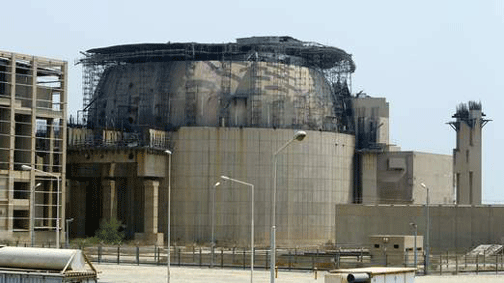
Bushehr, a city of over a million people in southeast Iran, sits in one of the most active seismic regions in the world, at the intersection of three tectonic plates. Building a nuclear plant in this area should have been a no-no, but construction started in 1975 with the help of Germany. It was stopped in 1979, right before the Revolution that unseated the Shah. It was resumed in 1996 with Russian assistance. The project took over 15 years to complete because of the very difficult technical issues of merging German and Russian technology. After Russia provided necessary nuclear fuel, the plant went operational in July 2013.
The safety issues concerning the plant are numerous: It is built with a 40-year-old design that has shown its limitations; the emergency coolant system is also 30 years old; it is running on two different technologies; according to the International Atomic Energy Agency, the staff is not properly trained to face any kind of accident. In February, 2011, a broken water pump caused small metallic pieces to infiltrate the reactor cooling system, forcing the unloading of the fuel rods.
The realities of nuclear diplomacy between Iran and the West
Iran and the Language of Nuclear Diplomacy http://guardianlv.com/2014/03/iran-and-the-language-of-nuclear-diplomacy/ by Christopher Spencer on March 30, 2014. The ongoing negotiations related to Iran and its nuclear program reflect the realities of the diplomacy of nuclear weapons. A current scholar of international relations observed that Iran learned a valuable lesson from the fate of Saddam Hussein in Iraq. That lesson is that a state cannot directly oppose the United States in a violent fashion without possessing nuclear weapons. It was the supposed presence of weapons of mass destruction in Iraq that formed the justification for the U.S. invasion of the country and the subsequent removal of Hussein’s regime. It is important to note that the U.S., as well as many other countries, categorizes weapons of mass destruction to include chemical, biological, and nuclear weapons. In terms of foreign policy or military application, the use of a chemical weapon is the same as a nuclear weapon to the U.S.
The mullahs in Iran were carefully watching the interaction between the U.S. and Iraq. It is true that aspects of the Iranian nuclear program pre-date the 2003 U.S. invasion of Iraq, but it can be argued that this event cemented the desire in the Iranian leadership to pursue a nuclear capacity of their own and to accelerate the process of acquiring it. Iran sees itself as a powerful player in the Middle East and seeks to expand that power further. They claim to represent the Shi’a sect of Islam and stand in opposition to Sunni regimes in states such as Saudi Arabia. The possession of nuclear weapons would offer Iran a valuable “shield” against possible aggression from the U.S.
Nuclear weapons have always been more valuable for the threat of their use rather than their actual deployment. The entire foreign policy of the Cold War confrontations between the U.S. and the Soviet Union was based on the fact that both states possessed a nuclear arsenal capable of destroying civilization several times over. This made direct confrontation between the two super powers almost impossible to fathom, and indeed the one time it did nearly occur during the Cuban Missile Crisis of 1962 is perhaps the closest the world has ever come to annihilation. This is another lesson in the language of nuclear diplomacy that Iran has learned during its pursuit of nuclear weapons.
Another more contemporary example would be that of North Korea. The belligerent state constantly flaunts its nuclear capacity and uses it as a negotiating tool in order to extract concessions from the international community. When they need additional food or energy imports, they will conduct a nuclear test or reopen a closed nuclear facility and then tell the world community to give them more goods in exchange for shutting down or scaling back the program. The fact that the North Korean regime possesses some functional nuclear devices forces more powerful actors like the U.S. to deal with them differently. The U.S. is vastly more powerful than North Korea, but it must acknowledge the North Korean nuclear capacity and the potential possibility of such weapons being used against local allies like South Korea or Japan.
It is this “latitude” that Iran is seeking by pursing a nuclear program of its own. Despite the rhetoric from Iranian leaders regarding the destruction of Israel, it is almost unthinkable that Iran would deploy a nuclear device against Israel, either directly or through the use of a terrorist organization as an intermediary. Such an action would almost assuredly result in retaliation from the world community that would destroy the current Iranian regime, if not the entire country itself. The question must then be asked about the stability of the Iranian regime. Would they essentially commit suicide by deploying a nuclear weapon against Israel, or do they seek the diplomatic and foreign policy protection that a nuclear capability provides?
This is not to say that a nuclear armed Iran would be a positive development for the Middle East or the world. An Iran with more diplomatic latitude would be a danger not only to the region but the rest of the world. Furthermore, other Middle East states like Saudi Arabia and Egypt have stated that if Iran develops a nuclear capability, they will seek nuclear weapons of their own. A nuclear arms race in the Middle East would not benefit the world at all. But this is the language of diplomacy for Iran and its pursuit of nuclear weapons.
Declassified information on suspected Israeli theft of nuclear weapons material
Secrets About Suspected Israeli Theft of U.S. Weapons-Grade Nuclear Material Declassified Global Research, 27 Mar 14, On March 18, 2014 ISCAP, the highest declassification authority in the U.S., released 84 pages (PDF) of formerly secret information about investigations into the illegal diversion of weapons-grade nuclear material from a Pennsylvania plant into the clandestine Israeli nuclear weapons program. Files now available to the public from IRmep’s ISCAP process include:…….http://www.globalresearch.ca/secrets-about-suspected-israeli-theft-of-u-s-weapons-grade-nuclear-material-declassified/5375720?utm_source=rss&utm_medium=rss&utm_campaign=secrets-about-suspected-israeli-theft-of-u-s-weapons-grade-nuclear-material-declassified
Birth deformities, cancers, in Libya as result of depleted uranium weapons

In Libya now being recorded by the WHO (world health organization), the highest deformation in fetuses inside Libya and reached 23% of newborns and also the high incidence of new forms of cancer that were not known among ordinary Libyans and now amounting to 18% of the total of cancers that have been diagnosed by the organization’s branch in Libya .
Despite this serious health disaster countries involved with NATO are now demanding that Libya pay them one billion seven hundred million dollars for their help in toppling the Gaddafi regime.
NATO War Crimes In Libya: Deformities of Newborns Because of Depleted Uranium Bombs http://libyanfreepress.wordpress.com/2014/02/28/nato-war-crimes-in-libya-deformities-of-newborns-because-of-depleted-uranium-bombs/ Libyans knew that depleted uranium was being used by NATO in their bombing raids and they were very concerned.
There is no doubt that NATO/US broke every agreement imposed by the Geneva Convention.
War crimes against humanity in Libya by NATO and its member countries is unmatched in the world. Continue reading
Renewable energy is the future for Jordan, not nuclear energy
The cost issues of renewable energy are developing in such a way that are much cheaper than nuclear energy and safer, he said, indicating that there are many expenses associated with nuclear energy that are not applicable when utilising renewable resources, such as risks, insurance and development costs.
“Our belief is that renewable energy is the most viable approach for the future and much more environmentally safe,” Amin stressed.
Jordan’s future lies in renewable energy http://www.albawaba.com/business/jordan-renewable-energy-549840
 January 26th, 2014 Renewable energy is the most viable approach for the future of Jordan and regional countries, according to International Renewable Energy Agency (IRENA) Director General Adnan Amin.
“Jordan is a very interesting market because it has a very developed institutional structure in terms of government agencies dealing with energy issues,” Amin said in a recent interview with The Jordan Times on the sidelines of the Abu Dhabi Sustainability Week.
“Jordan is looking very positively at the future of renewable energy,” he added. Continue reading
Egypt pursuing nuclear plans?
Egypt ramps up its nuclear options By Raymond Stock January 09, 2014 FoxNews.com “……..America’s slighted ally Egypt is now possibly pursuing its own nuclear option, amid fears of an atomic arms race between Tehran and its regional Sunni rivals in Cairo, Riyadh and beyond.
And no one seems to be paying attention.
Egypt’s traditionally close relations with the U.S. have been severely strained since Minister of Defense General Abdel-Fattah al-Sisi ousted the narrowly-elected President Mohamed Morsi after more than thirty million marched against him and the rule of the Muslim Brotherhood (MB), to which he belongs…….
Egypt’s 60-year-old nuclear program is already the third largest in the region, after those of Israel and Iran.
On November 26, the respected Middle East news site Al-Monitor reported that Egypt expects to generate $4 billion in grants from interested international companies to finance the project.
Morsi, whom al-Sisi appointed Mansour to replace pending new elections next year, had earlier approved a similar plan, even obtaining a pledge of Russian “research assistance” for Egypt’s nuclear expansion, as well as help in exploiting the nation’s previously unknown major deposits of uranium…….http://www.foxnews.com/opinion/2014/01/09/as-obama-dithers-egypt-ramps-up-its-nuclear-options/
Iran to seek direct nuclear talks with USA?
 Advisor to Iran supreme leader urges direct nuclear talks with U.S. LA Times, By Ramin Mostaghim and Carol J. Williams December 27, 2013, TEHRAN — The chief foreign policy advisor to Iran’s Ayatollah Ali Khamenei has called for direct talks with the United States on nuclear issues, a possible sign from the supreme leader that he is amenable to ending the animosity that has defined relations with Washington for 34 years.
Iranian President Hassan Rouhani has been the target of fierce criticism by political and religious hard-liners since he helped broker a deal with the United States and five other Western powers last month that will put Iranian high-level enrichment of uranium on hold for at least six months…….
The next round of talks between Iran and the six powers is to begin Monday in Geneva, and Velayati’s appeal for addressing each nation’s particular concerns individually could clear away obstacles to a permanent agreement imposed by some of the ideologically diverse P5-plus-1 members. http://www.latimes.com/world/worldnow/la-fg-wn-iran-us-nuclear-talks-20131227,0,592216.story#ixzz2onYWZ5xt
International silence on heroic nuclear whistleblower Mordechai Vanunu,
 Remember Mordechai Vanunu, Israel’s heroic nuclear whistleblower,Redress, Information and Analysis, 26 Dec 13, He should have received the Nobel Peace Prize. Instead, he spent 18 years in solitary confinement. He should be celebrated internationally as a man who has sacrificed his freedom for the truth and for the wellbeing of humanity. Instead, he has been stripped of his right to travel and prohibited from talking to foreigners.
Mordechai Vanunu: still fighting for his freedom, 27 years on Today, Mordechai Vanunu, the Israeli nuclear whistleblower, is almost forgotten. But he has not given up the fight for freedom.
Vanunu is appealing to the Israeli Supreme Court to set him free – free to leave Israel, theTimes of Israel reports……
Vanunu compared his past actions to those of US National Security Agency whistleblower Edward Snowden. “Snowden is the best example of what I did 25 years ago – when the government breaks the law and tramples on human rights, people talk. That’s what he did, he speaks for everyone, and that’s what I did – I spoke for everyone.”……
Vanunu is prohibited from visiting foreign territories, including the occupied West Bank and embassies within Israel, and can only meet with foreign nationals after securing permission from security forces.
In 1986 Vanunu leaked details of Israel’s military nuclear programme toThe Sunday Times, blowing the cover off Israel’s so-called “nuclear ambiguity”……
where are the international human rights warriors? We hear none speaking for Vanunu. Their silence is not just deafening. It is criminal. http://www.redressonline.com/2013/12/remember-mordechai-vanunu-israels-heroic-nuclear-whistleblower/
Iranians keen to continue nuclear talks, despite setback
The Treasury Department announced last week that it would freeze assets and ban transactions for companies and individuals that attempt to evade U.S. sanctions and continue doing business that helps Iran’s nuclear industry. The move prompted Iranian negotiators to leave ongoing talks in Geneva Thursday evening, saying it was against the “spirit” of the deal reached last month to freeze Iran’s nuclear program for six months in exchange for limited sanctions relief.
“That was a very wrong move,” Zarif told CBS News’ Elizabeth Palmer in an interview from Tehran. He said he was “saddened” by the move but that he is committed to the short-term deal meant to allow for a longer, six-month period of negotiations.
“We are committed to the plan of action and the implementation of Geneva – but we believe it takes two to tango,” Zarif said. “The process has been derailed, the process has not died,” he added later. “We are trying to put it back and to correct the path, and continue the negotiations because I believe there is a lot at stake for everybody.”
Many U.S. lawmakers are still eager for a fresh round of sanctions against Iran, even if they were only made operative in six months if the attempt to reach a long-term nuclear deal fails…….www.cbsnews.com/news/nuclear-talks-are-derailed-not-dead-iranian-official-says/
UN-Iran deal a modest, but positive, step forward
Iran Nuclear Accord Is a Good Deal, BU Today, Critics of agreement miss the lessons of history 12.09.2013 By Robert Loftis Strip away all the rhetoric, and the November 23 agreement with the Islamic Republic of Iran over its nuclear program emerges as an exercise in realism. It recognizes that three decades of enmity and distrust will not be erased overnight, nor can the knowledge of how to make a nuclear weapon be destroyed. This interim agreement represents a first step in verifiably ensuring that Iran’s nuclear program can be strictly limited to peaceful purposes. It is definitely a path worth pursuing.
The outlines of the agreement are simple: in return for a six-month halt to certain construction and enrichment activities, conversion and dilution of an existing 20 percent of enriched uranium stocks, and intrusive inspections by the International Atomic Energy Agency, the United States and other powers will offer limited relief from crippling sanctions on Iran’s economy.
In essence, it deprives Iran of the opportunity to readily further enrich uranium to levels of purity necessary for nuclear weapons. Over the course of this six-month agreement, the sides will explore the possibility of a comprehensive pact that will ensure Iran’s nuclear program is limited to civilian purposes and that treats Iran as any other signatory to the Non-Proliferation Treaty. If, during the next six months, it becomes clear that the Iranians are cheating or trying to hide a military program, then the sanctions can be reimposed immediately and further steps considered. It is worth highlighting that the Iranians made this agreement not just with the United States and its European allies, but also with the Russians and the Chinese. The Iranians would have to weigh the costs of crossing its most sympathetic global powers by failing to live up to the agreement.
Far from being the “historic mistake” that Israeli Prime Minister Benjamin Netanyahu contends, the accord is the first step toward a goal that we all claim to share: an Iran that does not pose a nuclear threat to our friends and allies. …………….http://www.bu.edu/today/2013/pov-iran-nuclear-accord-is-a-good-deal/
Israel puts pressure on Australia, to disrupt UN-Iran nuclear accord
 Israel wants Australia to use its influence in UN Security Council to amend nuclear deal with Iran SMH, December 11, 2013 Peter Hartcher, Israel has urged Australia to use its new found influence to force a much tougher deal on Iran over its nuclear program.
Israel’s Minister for the Economy, Naftali Bennett, told Prime Minister Tony Abbott that Israel ”badly wants a deal” to halt Iran’s nuclear progress, Mr Bennett said.
Israel is deeply unhappy with the terms of the interim deal negotiated by the five permanent members of the United Nations Security Council – the so-called P5 – plus Germany on November 24. ……..Australia can be an important factor in shaping the final deal, due in six months, Mr Bennett said, because it is a member of the UN Security Council next year and also the chairman of the council’s sanctions committee on Iran.
Iran has agreed to freeze parts of its nuclear program and dilute its most highly concentrated uranium in return for a partial easing of the international sanctions that have forced it into recession.
Israel’s essential demand is that Iran be forced to surrender its nuclear fuel-making machinery. Where the P5+1 deal has allowed Iran to keep its centrifuges for concentrating uranium into nuclear fuel, Israel wants them removed. : http://www.smh.com.au/federal-politics/political-news/israel-wants-australia-to-use-its-influence-in-un-security-council-to-amend-nuclear-deal-with-iran-20131210-2z42x.html#ixzz2nBQ2kJxj
1 This Month

of the week – THE ONENESS of HUMANITY

25 June- THE PUKE ON NUKES
Thursday, June 25, 2026
7pm Central Time (8pm ET, 6pm MT, 5pm PT) UTC – 5
From NRC & DOE Deregulation to Techno-Fascist Billionaires Going Nuclear, Plus a Few Songs from Atomic Cabaret REGISTER
26 June – Radiation Trainwreck at the NRC / Join the Protect Better Campaign – https://us02web.zoom.us/meeting/register/4ZlZ5_qLSHGiLSCg8FF6Bg#/registration

1st July – Webinar Waste of Space: The Environmental Harm of Military and Civil Space Activity st July, 7 pm

Report Launch Online: We are seeing an increasing exploitation of space for military and commercial purposes. This must change.

Protect Sazan Island from the Trump family! https://secure.avaaz.org/campaign/en/protect_sazan_island_from_the_trump_family_loc/?bqFCVab&v=174511&cl=22707147157&_checksum=5e9dde668860e8231c33699735e16a1fbf22ab2cb01da50c999fe8732b9775ef&utm_source=email&utm_medium=blast_email&utm_campaign=174511


Cuba Is Not a Failed State – It Is a Besieged State
PETITION: “Global Appeal to Endorse Palestinian Right of Return of Refugees”
To see nuclear-related stories in greater depth and intensity – go to https://nuclearinformation.wordpress.com
-
Archives
- June 2026 (251)
- May 2026 (306)
- April 2026 (356)
- March 2026 (251)
- February 2026 (268)
- January 2026 (308)
- December 2025 (358)
- November 2025 (359)
- October 2025 (376)
- September 2025 (257)
- August 2025 (319)
- July 2025 (230)
-
Categories
- 1
- 1 NUCLEAR ISSUES
- business and costs
- climate change
- culture and arts
- ENERGY
- environment
- health
- history
- indigenous issues
- Legal
- marketing of nuclear
- media
- opposition to nuclear
- PERSONAL STORIES
- politics
- politics international
- Religion and ethics
- safety
- secrets,lies and civil liberties
- spinbuster
- technology
- Uranium
- wastes
- weapons and war
- Women
- 2 WORLD
- ACTION
- AFRICA
- Atrocities
- AUSTRALIA
- Christina's notes
- Christina's themes
- culture and arts
- Events
- Fuk 2022
- Fuk 2023
- Fukushima 2017
- Fukushima 2018
- fukushima 2019
- Fukushima 2020
- Fukushima 2021
- general
- global warming
- Humour (God we need it)
- Nuclear
- RARE EARTHS
- Reference
- resources – print
- Resources -audiovicual
- Weekly Newsletter
- World
- World Nuclear
- YouTube
-
RSS
Entries RSS
Comments RSS
 nuclear-news