Long standing issues complicate nuclear negotiations with Iran
 The phantom at the Iran nuclear talks: weaponisation, Guardian, Julian Borger 15 May 14, How far should Iran go to resolve concerns over past weapons research to reach a comprehensive deal? ………. there is another issue waiting in the wings – the past. The general western intelligence consensus is that Iran had an organised weaponisation programme exploring how to build a warhead up to 2003, and that if research continued it was in a more dispersed manner………
even if Iran started working on weapons in the wake of the Iran-Iraq war (in which it saw the West as backing Saddam’s use of chemical weapons against Iran) but was now prepared to give up any such aspirations, it might still refuse to contemplate a confession. It would be a huge embarrassment in view of the Supreme Leader’s fatwa against nuclear weapons. Tehran could also see pressure for such a confession as a trick designed to justify a military attack. The question then for the West is whether to allow those fears stand in the way of deal that would constraint Iran’s future programme.
The mood music being put out by diplomats in Vienna suggests that the issue will not be a deal breaker for now. One solution, set out in a detailled report produced by the International Crisis Group, is for the problem to be kicked down the road. A comprehensive deal clinched in the next few months would commit Iran to resolving the issue satisfactorily with the IAEA. It would not let Iran off the hook but neither would it jeopardise non-proliferation gains that could be achievable now. http://www.theguardian.com/world/julian-borger-global-security-blog/2014/may/15/iran-nuclear-talks-weapons
Cause for optimism in Iran nuclear deal with the West
 Optimism Grows for a Comprehensive Iran Nuclear Deal Several Core Elements of Agreement Have Emerged WSJ, By JAY SOLOMON And
LAURENCE NORMAN May 12, 2014 WASHINGTON—Several core elements of agreement between Iran and the West have emerged in recent weeks, heightening optimism that a comprehensive deal can be reached by the July 20 deadline, according to U.S., Iranian and European officials involved in the diplomacy.
Still significant differences remain that could scuttle a deal or force negotiators to extend talks, officials briefed on the talks said.
“People are less pessimistic than they have been in the past—certainly,” one European official said. “There are certain areas where some kind of consensus” is emerging. “But in certain areas, there is still a huge gulf.” One of the key areas of agreement is the future of an Iranian plan to convert its heavy-water reactor in the city of Arak to produce significantly less weapons-grade plutonium, according to various officials.
Iran also has begun to more substantively address evidence presented in parallel talks with the U.N’s nuclear watchdog, the International Atomic Energy Agency, that it conducted research and testing to develop atomic bombs, the officials said.
However, the U.S. and Europe are demanding significant progress in accounting for past work as part of the agreement. Iran, which has denied it ever sought nuclear weapons, is being pressed to agree in coming days to provide answers on several other aspects of its past work.
Negotiators will begin drafting terms of a final agreement on the future of Tehran’s nuclear program this week in Vienna. A deal would end a decadelong standoff between Tehran and the West and put into place greater assurances that Iran won’t be able to build a bomb, in return for a major easing of Western sanctions……..
The meetings in Vienna will mark the fourth round of high-level talks between Iran and the five permanent members of the United Nations Security Council plus Germany—known as the P5+1—since the two sides reached an interim agreement last November.The interim deal resulted in Tehran freezing parts of its nuclear program in return for an easing of some Western sanctions. It will expire on July 20 but could be extended by six months if both sides agree they need more time.
The main area of disagreement continues to be the scope of Iran’s uranium-enrichment facilities, which could be used to produce weapons-grade fuel for a bomb, according to U.S. and European officials. Tehran currently has 19,000 centrifuges used to enrich uranium and has plans to build 30,000 more.
The Obama administration, conversely, is demanding Tehran scale back its capacity to as little as 5,000 operating machines to ensure Iran can’t quickly “break out” and rush to build a nuclear bomb in less than six months.
Iran and the P5+1 are seeking to develop a formula that limits both the number and quality of centrifuges as well as stockpiles of fissile materials to guard against the capability to quickly build a bomb.
But Iran’s theocratic leader, Ayatollah Ali Khamenei, has repeatedly stated in recent weeks that he won’t accept a significant scaling back of his country’s nuclear capabilities.
U.S. and European officials said they were unsure whether Mr. Khamenei’s position on the centrifuges is a tactical move ahead of the drafting sessions this week in Vienna, or if he has set a red line for his negotiators……..http://online.wsj.com/news/articles/SB10001424052702303851804579558162293087156
Former IAEA chief demands that Isrel come clean opn its nucl;ear weapons
 Israel possesses nuclear weapons: Former IAEA head http://www.presstv.ir/detail/2014/05/12/362349/israel-possesses-nuclear-weapons/ Former head of the International Atomic Energy Agency (IAEA) has said in an exclusive interview with Press TV that he is convinced Israel possesses nuclear weapons.
Hans Blix demanded that Israeli officials join the Non-Proliferation Treaty (NPT).
He underlined that Tel Aviv’s refusal to sign international nuclear treaties and its deliberate ambiguity policy with regards to its nuclear program are because of support from Washington.
The Israeli regime is widely believed to be the only possessor of nuclear arms in the Middle East. The regime reportedly maintains between 200 and 400 atomic warheads.
Furthermore, the Israeli regime has never allowed any inspection of its nuclear facilities and continues to defy international calls to join the NPT.
Blix cautioned that all countries in possession of nukes pose a threat to global security, adding that the world has enough bombs to wipe out the Earth several times.
He also accused the US of spying on him following his revelations that Iraq did not possess weapons of mass destruction.
Under the pretext that former Iraqi dictator, Saddam Hussein, possessed weapons of mass destruction, the US and its allies invaded Iraq in March 2003.
Iraq is currently witnessing a wave of attacks unprecedented in recent years. Based on official figures, over 1,000 people, mostly civilians, lost their lives in attacks across Iraq in April
Hawkish orders from Iran’s Supreme Leader Ayatollah Ali Khamenei
 Nuclear talks in jeopardy: Khamenei orders Rev Guards to mass-produce missiles – regardless DEBKAfile Special Report May 11, 2014, Iran’s Supreme Leader Ayatollah Ali Khamenei threw a large spanner in the works of nuclear diplomacy Sunday, May 11. Less than a week before the next round of talks with the six powers, he said: “The Revolutionary Guards should definitely… not be satisfied with the present level [of missile production]. They should mass produce.”
Referring to Western concerns that Iran is designing missiles able to carry nuclear warheads, Khamenei said: “They [the West] expect us to limit our missile program while they constantly threaten Iran with military action. So this is a stupid, idiotic expectation.”
Khamenei spoke during a visit to the aeronautics fair organized by the Revolutionary Guards (IRGC), which are responsible for Iran’s missile and nuclear programs………
President Rouhani calls for more clarity in the nuclear debate
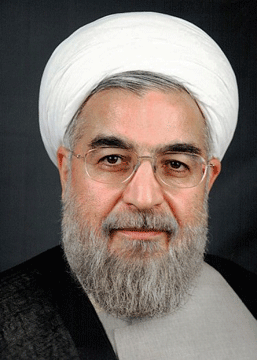 Iranian president calls for more open, better-informed nuclear debate https://au.news.yahoo.com/world/a/23426769/iranian-president-calls-for-more-open-better-informed-nuclear-debate/ May 11, 2014, By Michelle Moghtader and Mehrdad Balali DUBAI (Reuters) – President Hassan Rouhani said on Sunday he wanted Iran to do a better job of explaining its nuclear programme to prevent “evil-minded” people misleading world opinion, two days before Tehran resumes talks with world powers on its disputed atomic activity.
Iran and the United States, France, Germany, Britain, China and Russia will reconvene in Vienna to try to iron out differences over how to end a long standoff over suspicions that Tehran has sought the means to develop nuclear weapons.
Western powers have long demanded greater openness from Iran to address those concerns and head off the risk of a downward spiral towards a new Middle East war, with Israel threatening to attack its arch-foe if diplomacy does not rein it in.
“What we can offer the world is greater transparency,” Rouhani, a relative moderate who replaced a conservative hardliner who antagonised the West – said in a speech at a ceremony celebrating Iran’s scientific achievements.
In his remarks, Rouhani reiterated that Iran was not seeking nuclear weapons and would never halt its atomic programme, which was for peaceful purposes. He also repeated a denial of Western charges that Iran has carried out any secret nuclear bomb work.But along with achieving scientific progress, Rouhani added, Iran ought to develop its abilities in the legal, political and information realms to prevent “the enemy” making problems for its nuclear developments.
“If one engages in a technological endeavour but is not doing good legal and political work, then the enemy might come up with a fictional excuse to cause trouble for you,” he said.
The Islamic Republic’s leaders normally use the term “the enemy” to refer to the United States and Israel.
“If you don’t have good public relations and are not able to communicate well, then you might find other evil-minded people misleading world public opinion,” Rouhani said.
“So our effort today is to even out our efforts on multiple levels … We don’t want to retreat one step from our pursuit of technology, but we want to take a step forward on the political front.”
His comments appeared to be a criticism of hostile statements from within the hardline conservative establishment, including his predecessor Mahmoud Ahmadinejad, who called U.N. resolutions against Iran on the nuclear dispute a “worthless piece of paper”………..
“RIGHT DIRECTION”
Ahmadinejad’s strident rhetoric during his eight years in office on issues like the Holocaust and Israel served to shore up international resolve to curb Iran’s nuclear programme.
Iran in January halted its most sensitive nuclear operations under a preliminary deal with world powers, winning some relief from painful economic sanctions that have damaged its oil-dependent economy by forcing a sharp reduction in crude exports.
Rouhani said Iran if it so chose could resume enrichment of uranium gas to a fissile purity of 20 percent – its most sensitive nuclear activity because it is a relatively short technical step away from the level required for nuclear weapons.
“We wanted to tell the world that our activities are moving in the right direction: If we say we can enrich to 3.5 percent, we can do it. If necessary we will do (it to) 20 percent,” he said.
Iran agreed under its Nov. 24 deal to shelve enrichment to 20 percent. It has since diluted some of its 20 percent-enriched stockpile to a lower concentration and converted some into an oxide less suited to processing into bomb-grade material.
Iran has justified its 20 percent enrichment drive by saying it was meant to replenish the fuel supply of a Tehran medical research reactor. But Western officials are sceptical, saying Iran had refined far more than it required for such a purpose.
While Iran stopped 20 percent enrichment in January, it is allowed under the November pact to keep producing uranium refined to up to 5 percent, the level required for fuelling civilian nuclear power stations.
Explosion near Iran’s nuclear facility
 Huge blast reported near secret Iran nuclear site; City of Qazvin closed WorldTribune.com, 8 May 14, NICOSIA — Iran has been rocked by huge explosion near a nuclear facility.The Iranian media have reported an explosion in the northern Iranian city of Qazvin. The blast, reported on May 6, was said to have taken place near a secret nuclear enrichment facility in Abyek.
“The explosion took place in a storage facility,” Iran’s semi-official Fars News Agency, which reported at least 50 injured, said.
Officials said nobody was killed in the explosion. But they acknowledged a huge fire that was sweeping the industrial city, about 130 kilometers north of Teheran “Firefighters are trying to prevent the spread of the fire at a car oil storage facility,” Qazvin civil defense director Ali Ahani said.
Iranian opposition sources said scores of people were killed in the blast. They said Iranian Army and security forces closed much of Qazvin,
with a population of 1.1 million.
“It is not certain whether Abyek was the target,” an opposition source said. “But this incident will hamper access to the facility in the short-term.”
The opposition said Iran’s nuclear facilities have been repeatedly
targeted by Israel and the West……..http://www.worldtribune.com/2014/05/07/report-50-injured-blast-iran-nuke-site-storage-facility/
Iran’s President Rouhani up against hard-liners, over nuclear talks
Hassan Rouhani faces growing criticism in Iran over nuclear talks, Simon Tisdall in Tehran, theguardian.com, Sunday 4 May 2014
At a meeting at the former American embassy building in central Tehran on Saturday, a newly formed group of MPs and rightwing activists calling itself “We’re Worried” claimed Iran‘s negotiating team was ignoring national interests in the nuclear talks, which resume on 13 May in Vienna.
“The whole nation believes the main intention of the United States is to fully halt the Iranian nuclear programme,” said Fatemeh Alia, a central committee member of the hardline Islamic Revolution Resistance Front, previously allied to the former president Mahmoud Ahmadinejad…….
The US and Britain have expressed guarded confidence that a final nuclear deal with Iran can be reached by the deadline of 20 July, describing the talks as “very substantive”.
Rouhani and his chief negotiator, Mohammad Javad Zarif, have echoed those sentiments. “Iran is optimistic about the results of the talks and has taken great steps to reach a comprehensive deal and aims to achieve a win-win result,” Rouhani told Iranian television last week.
Rouhani hit back angrily at his critics. “Through lies and hype some people are trying to derail the government from its path, and this is against national interests and the leader’s order … Iran does not compromise on the people’s interests,” he said………http://www.theguardian.com/world/2014/may/04/hassan-rouhani-iran-nuclear-talks
Saudi Arabia shows off nuclear-capable missiles
The DF-3 has a range of 2,650 km and carries a payload of 2,150 kg. It is equipped with a single nuclear warhead with a 1-3 MT yield.
Watched by a wide array of Saudi defense and military dignitaries, headed by Crown Prince and Deputy Prime Minister Salman bin Abdulaziz, the parade marked the end of the large-scale “Abdullah’s Sword” military war game.
Conspicuous on the saluting stand was the Pakistani Chief of Staff Gen. Raheel Sharif alongside eminent visitors, including King Hamad of Bahrain and Sheikh Muhammad bin Zayed, the crown prince of Abu Dhabi………
By showing off their ageing Chinese missiles, the Saudis intimated that they had acquired the more advanced generation of this weapon, which they are keeping under wraps. DEBKAfile’s intelligence sources report that in recent visits to Beijing, high-ranking Saudi officials negotiated the purchase of Dong-Feng 21 (DF-21), whose range is shorter, 1,700 km, but more precise and effective in view of its terminal radar guidance system. The West has no information about when the new Chinese missiles were delivered to Saudi Arabia.
5. The presence of the top Pakistani soldier at the parade of military and nuclear hardware was meant as corroboration of Islamabad’s active role as the source of the Saudi nuclear arsenal.
6. The Saudis no longer rely on the American nuclear umbrella. They are developing their own nuclear strike force with the help of China and Pakistan. http://www.debka.com/article/23878/Saudis-parade-nuclear-missiles-for-the-first-time-in-defiance-of-US-Iranian-nuclear-accord
Iranian public ready to back a fair nuclear deal
| Iran FM says people would support fair nuclear deal, The Daily Star, Lebanon News, |
| April 27, 2014 TEHRAN: Foreign Minister Mohammad Javad Zarif said Sunday that the majority of Iranians would support a comprehensive nuclear deal that “respects Iran’s rights and the demands of the people.”
“That would be the only agreement that myself and President (Hassan) Rouhani will agree (to),” Zarif said during a joint news conference in Tehran with his Austrian counterpart Sebastian Kurz. When asked whether hardliners could derail the nuclear talks, Zarif said: ” Iran is not a monolith … we will have those who will not favour an agreement, but at the end of the day what will count is the view of the majority of the Iranian people.” In November, Iran clinched a deal with world powers under which it froze some nuclear activities in return for limited relief from crippling international sanctions. Tehran has been engaged in negotiations with the P5+1 — Britain, China, France, Russia and the United States, plus Germany — aimed at reaching a lasting accord on its nuclear ambitions……. http://www.dailystar.com.lb/News/Middle-East/2014/Apr-27/254561-iran-fm-says-people-would-support-fair-nuclear-deal.ashx#ixzz30DTTdBDN |
Quiet optimism over deal between Iran and the West
Iran nuclear talks: Quiet optimism over deal between Islamic State and the West on weapons programme The INdependent 24 April 14 All sides in the effort to resolve the stand-off between the West and Iran over its alleged nuclear weapons ambitions have agreed to hold a new round of expert-level negotiations in New York beginning 5 May amid tentative indications that so far, at least, positive progress is being made. Keeping its side of an interim bargain struck last November and implemented in January, the Joint Plan of Action, the White House has this month released $1bn-worth of Iranian assets in two instalments, the last on 15 April. And last week the International Atomic Energy Agency (IAEA) reported that Iran has so far fulfilled its part of what was agreed, dramatically reducing its stockpile of 20 per cent enriched uranium.
While significant hurdles remain before a final and comprehensive deal can be reached ahead of an informal deadline of 20 July, quiet optimism is gathering around the talks. That assessment stands in sharp contrast with almost every other foreign affairs dossier currently on President Barack Obama’s desk, be it concerning Syria, Russia, Ukraine or the faltering Middle East peace process.
The talks in New York, to be held at the UN on the fringes of a Non-Proliferation Treaty meeting, will be followed up by high-level talks between foreign ministers of Iran as well as the so-called P5+1 – China, France, Russia, the UK, and the US, plus Germany – in Vienna on 13 May.
If the negotiations are still on track it is in spite of loud opposition from hard-line critics of the putative deal both in Iran, on Capitol Hill and, as ever, from inside Israel. Yet those at the negotiating table, including the Iranians, have so far seemed determined to ignore those pressures.
“There is the political will to get an answer,” Iran’s Foreign Minister, Mohammad Javad Zarif, remarked during a visit to Abu Dhabi last week. “The domestic audience will be satisfied if we have a good deal. Of course some people will never be satisfied but that is fine because we have a pluralistic society.” He crucially has the support of the Iranian President, Hassan Rouhani, as well as the Supreme Leader Ayatollah Ali Khamenei……..
Meanwhile, in Washington the White House continues to resist calls from some in Congress to stall the release of Iranian assets that had been frozen by sanctions as well as Israeli exhortations to take a stronger line with Tehran. Further encouragement has been drawn by an Iranian concession announced last week radically to reduce the amount of plutonium that could be made at a new heavy-water reactor at Arak. There had been fears that its scientists could switch to plutonium from enriched uranium to build a bomb.
“I’m actually starting to believe that an agreement is possible,” David Petraeus, the former CIA director, told an audience at Harvard University this month. He went on: “It could be that it’s possible before this particular six-month deadline expires,” referring to the target of concluding an agreement by 20 July…….http://www.independent.co.uk/news/world/politics/iran-nuclear-talks-quiet-optimism-over-deal-between-islamic-state-and-the-west-on-weapons-programme-9275504.html
Time for Washington to disclose information on alleged Israeli nuclear theft

 Former Officials Seek U.S. Disclosure on Alleged Israeli Nuclear Theft National Journal 21 Apr 14 Two former atomic officials say revealing U.S. findings on a decades-old alleged nuclear theft by Israel may bolster Washington’s present-day diplomacy.
Declassifying all investigative data on the 1960s-era disappearance of weapon-grade uranium from a Pennsylvania atomic plant could boost U.S. credibility in current nuclear negotiations, former Nuclear Regulatory Commission officials Victor Gilinsky and Roger Mattson argued in e-mail responses to questions from Global Security Newswire.
In an article published last week by the Bulletin of the Atomic Scientists, they said public details have already cast suspicion on Israel, which also is widely believed to possess an unacknowledged atomic arsenal.
“We’ve lost a great deal of respect around the world on the subject of nonproliferation,” Gilinsky told GSN. Citing one example, the former NRC commissioner said Washington’s reluctance to openly discuss Israel’s nuclear activities has hampered the U.S. ability to overtly press its Middle Eastern ally to participate in a plannedconference on eliminating weapons of mass destruction from the Middle East.
“The president doesn’t even acknowledge that Israel has nuclear weapons, which means no one in the government can, either,” he told GSN. “Leveling on [this] affair, painful as it might be in the short run, would be a step toward what you might call a reality-based policy in this area.”
For disclosure to be likely, though, President Obama must “see it in his political benefit to do so,” Gilinsky wrote. “If he wanted to, he could do it at any time, but I am not holding my breath.”……http://www.nationaljournal.com/global-security-newswire/former-officials-seek-u-s-disclosure-on-alleged-israeli-nuclear-theft-20140421
Iran reduces capacity at Arak nuclear recator
Arak nuclear reactor resolved says Iran http://www.skynews.com.au/world/article.aspx?id=969168 April 20, 2014 Iran and six world powers have resolved their differences over the country’s plutonium-producing Arak reactor, Iranian nuclear chief Ali Akbar Salehi says.
The reactor, which has yet to be completed, has been a main point of contention at the ongoing talks aimed at ending the stand-off over Tehran’s nuclear program.
The governments of Britain, China, France, Russia, the United States and Germany – the so-called P5+1 – have expressed concern that Iran could use the plutonium produced at the facility in the western city of Arak to build nuclear weapons.
‘We have suggested that we will produce only one-fifth of the originally planned plutonium, and this was welcomed by the P5+1,’ said Salehi.
The world powers have called for Arak’s closure or for technical changes so that it no longer turns out plutonium.
Salehi said Arak would not be shuttered because Iran needs it to produce medical isotopes for civilian use, but that reducing its plutonium production capacity alleviates negotiators’ concerns.
The heavy water reactor uses natural uranium as its fuel and will generate plutonium as a by-product.
Iran and the sextet agreed in an interim deal in November on a limited suspension of sanctions in return for some nuclear concessions from Tehran, including suspending construction of the Arak reactor and scaling back uranium enrichment.
Under the broader agreement that both sides are aiming to conclude by July, Iran is expected to accept additional nuclear curbs while the world powers have promised to permanently lift all sanctions and to help Iran build new reactors.
Tehran insists that it has no plans to build nuclear weapons.
Iran and the P5+1 will hold expert-level nuclear talks May 5-9 in New York, said Iran’s Deputy Foreign Minister Abbas Araqchi, according to Press TV.
An economic hazard to United Arab Emirates – nuclear power?
Nuclear Power: Boon Or Bane For The GCC?, Gulf Business,
As the UAE and Saudi race to build nuclear reactors to meet mounting energy needs, the inevitable question arises – is nuclear a viable option?, Gulf business By Aarti Nagra 18 April 14
Fuelled by rising energy demand and depleting oil and gas resources, nuclear energy has gained strong momentum in the GCC, particularly in countries like the UAE. The country has lofty ambitions to generate up to 25 per cent of its electricity needs – or 5.6GW – through nuclear means by 2020.
Abu Dhabi began construction of its first nuclear reactor, Barakah 1, in July 2012, and it is in the process of building three more plants.
Emirates Nuclear Energy Corporation, the body responsible for the project, announced in February that the first two plants are on schedule and are up to 35 per cent complete……..However, nuclear energy may not necessarily be the best option for the GCC region, states Mohammed Atif, area manager, Energy Advisory, Middle East at DNV GL – Energy.
“A reasonable diversification of fuels is always beneficial for a region in order to reduce risks and price volatility,” he says.
“The right composition of a generation portfolio is always a difficult question and has to take political, economic, technical and environmental aspects into consideration.
“We would suggest entering into a roadmap to achieve security of supply at a good price level even without nuclear energy.”……….An Oxford report on nuclear power production in the GCC published in December 2012 also pointed out that nuclear power generation could prove an expensive option for GCC states.
“The substantial initial investment costs, coupled with the high expected level of long run variable costs, is unlikely to render nuclear power cost effective vis-à-vis conventional oil and gas fired power plants in the region,” it says.
“The existing absence of cost-recovering power tariffs throughout the GCC already renders effective cost recovery for nuclear power unlikely, implying a substantial bill in the form of nuclear power subsidies to be picked up by GCC governments.”
There are also other hidden costs, such as national and regional security concerns and the future disposal of nuclear waste.
“And the acquisition of nuclear technology by GCC states, albeit for civilian purposes, provides fuel to those critics of nuclear power in the region who fear a nuclear arms race in the Gulf should Iran pursue a nuclear weapons programme in the future.
“All these concerns make nuclear power a potentially costly option for the GCC,” the report cautions………….http://gulfbusiness.com/2014/04/nuclear-power-boon-bane-gcc/#.U1WPalVdWik
Vital to carry through with diplomacy between Iran and the West
Why we must give Iran nuclear deal a chance, Global Public SquareBy Tyler Cullis and Jamal Abdi, Special to CNN 18 April 14 Editor’s note: Tyler Cullis is a policy associate at the National Iranian American Council. Jamal Abdi is policy director at NIAC. The views expressed are the authors’ own.
The United States could be on the verge of securing a historic agreement over Iran’s nuclear program, one that verifiably limits it and opens the door to further cooperation between the two countries. Yet with a diplomatic victory on the horizon, the rhetoric of those who have long opposed any diplomatic resolution is reaching dizzying heights of disingenuousness.
During a recent Senate hearing, Senate Foreign Relations Committee Chairman Robert Menendez (D-NJ) hit out at reports that negotiations with Iran may produce a deal that “only” extends Iran’s nuclear breakout timeline to 6 to 12 months.
“I don’t think we did everything that we’ve done to only get a six to twelve month lead time,” Menendez lamented as he grilled Secretary of State John Kerry over the progress of the talks………
The Israeli government appears to believe that threatening possible military strikes on Iran’s nuclear facilities is the solution. But here’s the kicker: some estimates suggest that an Israeli strike on Iran would delay Iran’s breakout timeline by…six to twelve months – the same as the negotiated approach. The problem, of course, is that unlike a diplomatic solution, which would trade sanctions relief for verifiable limits on Iran’s nuclear program, an Israeli (or U.S.) military strike would have the opposite effect, and could prompt Iran to kick out inspectors and make a dash for a nuclear deterrent.
All this suggests an understanding of the potential timelines under these scenarios points to one conclusion – the White House is taking the best approach, one that extends the breakout timeline and has the best potential for securing an intrusive inspections regime to ensure Iranian compliance.
Opponents of diplomacy would do well to reflect on the reality that as the United States has tried to leverage sanctions against Iran, Tehran has responded by ramping up the production of centrifuges. As a result, the U.S. has long been in need of a new direction in its policy toward Iran.
Tentatively, but unmistakably, the Obama Administration has pursued a new approach – one that has brought us the first freeze on Iran’s nuclear program in a decade and which reports suggests have led to significant concessions on Iran’s Arak reactor.
If such a deal is not good enough for some in Congress or Israel’s government, then they must be prepared to speak up and offer viable alternatives. In the meantime, they should avoid undermining one of the most promising prospects for limiting Iran’s nuclear program in years. http://globalpublicsquare.blogs.cnn.com/2014/04/18/why-we-must-give-iran-nuclear-deal-a-chance/
Time to reveal the truth on Israel’s theft of nuclear weapons fuel from USA
Nearly 50 years have passed since the events in question. It is time to level with the public. At this point it is up to the president himself to decide whether to declassify completely the NUMEC documents, all of which are over 30 years old. He should do so. We know that is asking a lot given the president’s sensitivity about anything involving Israel, and especially anything relating to Israeli nuclear weapons. But none of his political concerns outweigh his responsibility to tell the US public the historical truth it deserves to know.
Did Israel steal bomb-grade uranium from the United States? Bulletin of Atomic Scientists Victor GilinskyRoger J. Mattson 17 April 14 Last month the Interagency Security Classification Appeals Panel (ISCAP), the nation’s highest classification authority, released a number of top-level government memoranda that shed additional light on the so-called NUMEC affair, “the story that won’t go away—the possibility that in the 1960s, Israel stole bomb-grade uranium from a US nuclear fuel-processing plant.”
The evidence available for our 2010 Bulletin article persuaded us that Israel did steal uranium from the Apollo, Pennsylvania, plant of the Nuclear Materials and Equipment Corporation (NUMEC). We urged the US government to declassify CIA and FBI documents to settle the matter. In releasing the current batch—the release being largely due to the persistent appeals of researcher Grant Smith—the government has been careful to excise from all the released documents the CIA’s reasons for fingering Israel.
Despite this, the documents are significantly revealing. Continue reading
1 This Month

of the week – THE ONENESS of HUMANITY
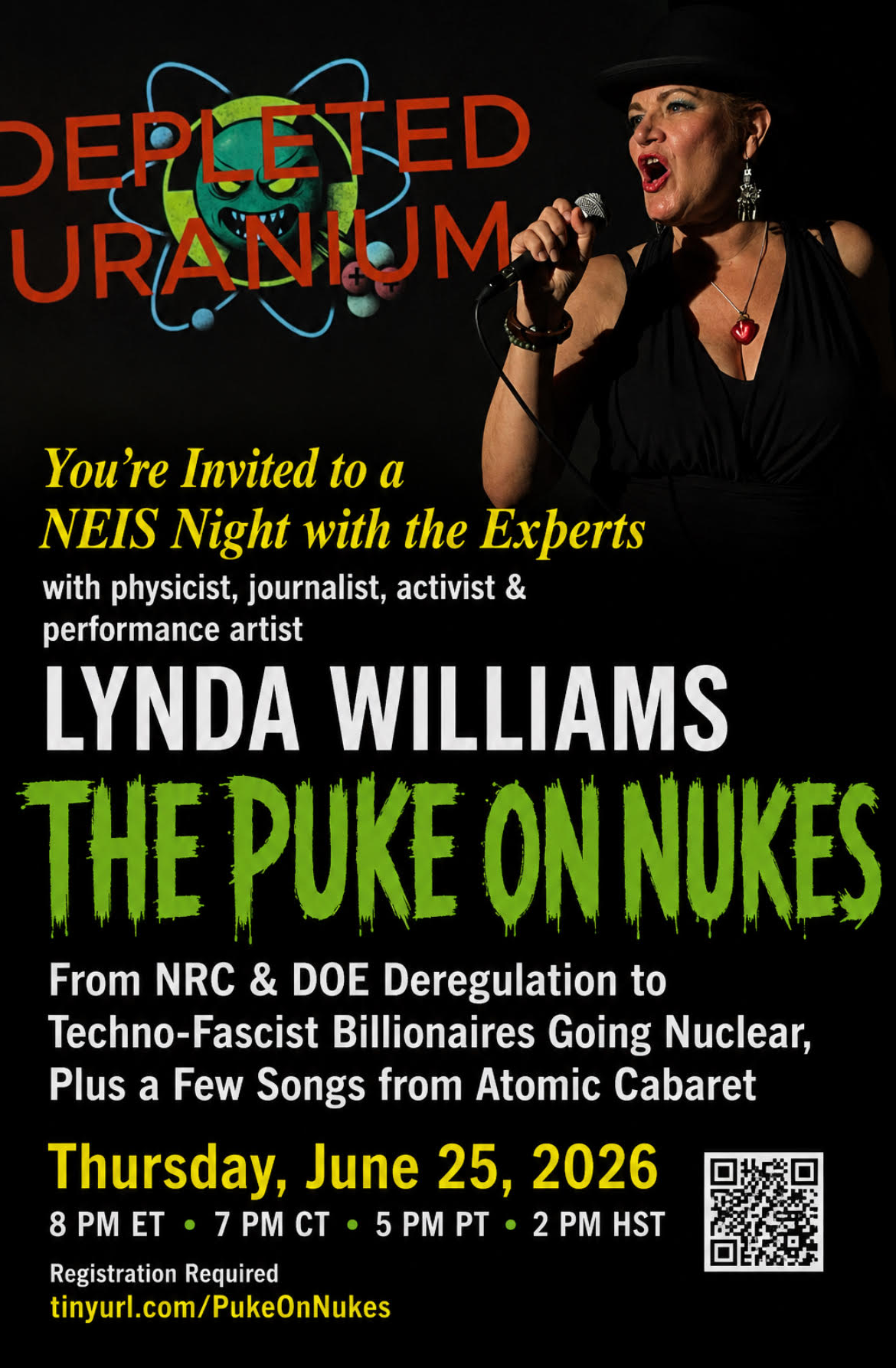
25 June- THE PUKE ON NUKES
Thursday, June 25, 2026
7pm Central Time (8pm ET, 6pm MT, 5pm PT) UTC – 5
From NRC & DOE Deregulation to Techno-Fascist Billionaires Going Nuclear, Plus a Few Songs from Atomic Cabaret REGISTER
26 June – Radiation Trainwreck at the NRC / Join the Protect Better Campaign – https://us02web.zoom.us/meeting/register/4ZlZ5_qLSHGiLSCg8FF6Bg#/registration
1st July – Webinar Waste of Space: The Environmental Harm of Military and Civil Space Activity st July, 7 pm

Report Launch Online: We are seeing an increasing exploitation of space for military and commercial purposes. This must change.

Protect Sazan Island from the Trump family! https://secure.avaaz.org/campaign/en/protect_sazan_island_from_the_trump_family_loc/?bqFCVab&v=174511&cl=22707147157&_checksum=5e9dde668860e8231c33699735e16a1fbf22ab2cb01da50c999fe8732b9775ef&utm_source=email&utm_medium=blast_email&utm_campaign=174511


Cuba Is Not a Failed State – It Is a Besieged State
PETITION: “Global Appeal to Endorse Palestinian Right of Return of Refugees”
To see nuclear-related stories in greater depth and intensity – go to https://nuclearinformation.wordpress.com
-
Archives
- June 2026 (251)
- May 2026 (306)
- April 2026 (356)
- March 2026 (251)
- February 2026 (268)
- January 2026 (308)
- December 2025 (358)
- November 2025 (359)
- October 2025 (376)
- September 2025 (257)
- August 2025 (319)
- July 2025 (230)
-
Categories
- 1
- 1 NUCLEAR ISSUES
- business and costs
- climate change
- culture and arts
- ENERGY
- environment
- health
- history
- indigenous issues
- Legal
- marketing of nuclear
- media
- opposition to nuclear
- PERSONAL STORIES
- politics
- politics international
- Religion and ethics
- safety
- secrets,lies and civil liberties
- spinbuster
- technology
- Uranium
- wastes
- weapons and war
- Women
- 2 WORLD
- ACTION
- AFRICA
- Atrocities
- AUSTRALIA
- Christina's notes
- Christina's themes
- culture and arts
- Events
- Fuk 2022
- Fuk 2023
- Fukushima 2017
- Fukushima 2018
- fukushima 2019
- Fukushima 2020
- Fukushima 2021
- general
- global warming
- Humour (God we need it)
- Nuclear
- RARE EARTHS
- Reference
- resources – print
- Resources -audiovicual
- Weekly Newsletter
- World
- World Nuclear
- YouTube
-
RSS
Entries RSS
Comments RSS
 nuclear-news