Parliamentary group opposes Iran joining FATF as fate of nuclear deal is in disarray http://www.tehrantimes.com/news/424284/Parliamentary-group-opposes-Iran-joining-FATF-as-fate-of-nuclear,June 9, 2018 TEHRAN– A number of conservative Iranian lawmakers, who are members of the Velayat (Jurisprudence) faction, issued a statement on Saturday calling on other fellow parliamentarians not to approve the legislation on joining the Financial Action Task Force (FATF) as the U.S. pullout from the nuclear agreement has put the fate of the accord in disarray.
The statement said since the U.S. intends to impose “crippling” sanctions on Iran an approval of the FATF will pave the way for the U.S. to get access to all the economic and banking transactions by Iran.
“Now that the future of the JCPOA [the 2015 nuclear deal] has become vague after the withdrawal of the U.S. and the order to return the sanctions, it is illogical to join the FATF,” the statement said.
On May 8, U.S. President Donald Trump withdrew from the UN-endorsed nuclear agreement and ordered a return of sanctions on Iran.
U.S. Secretary of State Mike Pompeo announced on May 21 that the U.S. will apply economic and military pressure against Iran and will impose “the strongest sanctions in history” on the Islamic Republic.
The FATF is a set of measures designed to make financial affairs transparent and verifiable.
Iran informs UN of increase in nuclear enrichment capacity, Iran’s Ayatollah had ordered the increase in capacity in a speech Monday, CBC ,The Associated Press
Iran has informed the UN nuclear watchdog that it will increase its nuclear enrichment capacity within the limits set by the 2015 agreement with world powers.
The modest steps announced Tuesday appeared to be mainly aimed at signalling that Iran could resume its drive toward industrial-scale enrichment if the nuclear accord comes unraveled.
Behrouz Kamalvandi, the spokesman for Iran’s nuclear agency, was quoted by state TV as saying a letter was submitted to the International Atomic Energy Agency detailing the move.
Kamalvandi said Iran is “providing infrastructure and arrangements for high-speed and capacity in production of UF4 and UF6 gases as well as rotor of centrifuges.”
Spinning centrifuges convert the gases into enriched uranium that can be used for reactor fuel and medical isotopes. If enriched to higher levels, the material can be used for weapons.
“The Agency received a letter from Iran on 4 June informing the Agency that there is a tentative schedule to start production of UF6,” a spokesperson for the IAEE confirmed on Tuesday, referring to uranium hexafluoride, the feedstock for centrifuges.
JCPOA set enrichment levels
The head of Iran’s nuclear agency, Ali Akbar Salehi, said Iran is prepared to resume work on advanced centrifuges that would dramatically increase its capacity for enrichment. But he said that so far the work is limited to building a new facility for assembling the centrifuges.
Supreme Leader Ayatollah Ali Khamenei had ordered the increase in capacity in a speech Monday, in which he vowed that Iran would preserve its nuclear program despite the U.S. withdrawal from the landmark 2015 accord, known as the Joint Comprehensive Plan of Action and also signed by France, Germany, the United Kingdom, the European Union, Russia and China.
Deputy Prime Minister and Minister of Defense Khalid Al Attiyah told an international security conference in Singapore that Qatar has “a lot of differences” with Iran but it does not mean “we go and fuel a war” in the region.
“Is it wise to call the United States and to call Israel to go and fight Iran? … Whether any third party is trying to push the region or some country in the region to start a war in Iran, this will be very dangerous,” he said.
He did not name any party but could be referring to Iran’s rival Saudi Arabia, which has also led a blockade of Qatar with its Persian Gulf allies since June last year, accusing Doha of supporting extremists and refusing to cut ties with Tehran.
“Iran is next door. We should call Iran, put all the files on the table and start to discuss to bring peace rather than war,” he said in a speech.
Responding to a question whether Qatar’s air bases could be used to launch airstrikes on Iran, al-Attiyah said that his country was not a “fan of war” and supported engagement and dialogue.
Qatar is hosting 10,000 U.S. troops stationed at sprawling al-Udeid Air Base as part of its campaign against the Islamic State group and the war in Afghanistan.
Al Attiyah called for salvaging a 2015 nuclear accord between world powers and Iran that offered Tehran sanctions relief for curbs on its nuclear program. The U.S. withdrew from the deal last month.
“Everyone should keep holding on to this and advance with this. In my own judgement, I think the United States is wiser than to enter in a war with Iran,” he said.
He also said Qatar is “firmly aligned” against terrorism and has implemented U.N. resolutions and penalties targeting militants.
Israel ‘is selling nuclear information’ to Saudi Arabia, Middle East Monitor, May 31, 2018
Western security agencies believe that Israel is selling nuclear information to Saudi Arabia, Arabi21 has reported. According to Israeli writer Ami Dor-on, such information will give the government in Riyadh nuclear weapons capabilities. Writing on the News One website, Dor-on said that the joint intention is to make sure that Iran will not be the only country in the region that possesses such weapons which threaten the security and safety of the Kingdom.
“This information should shock us,” he said, “as we see the world is changing for the worse, following the race for the possession of nuclear weapons that pass right over our heads in the Middle East.” Saudi Arabia no longer conceals its wish to develop nuclear weapons, the writer added.
However, General Amos Yadlin, former chief of Israel’s Military Intelligence Directorate, has suggested that the Saudis would not wait to get nuclear capabilities. “They will go to Pakistan, and take whatever they want,” he claimed……..
While Pakistan could clearly simply transfer a nuclear bomb to Saudi Arabia, that would not be Israel’s intention. “Israel may transfer information and nuclear expertise to the Kingdom that would enable it to develop its advanced capabilities in this specific area,” Dor-on clarified. “Yadlin’s comments as a senior Israeli intelligence official gives credibility to the leaks of the Western intelligence services.”
Ex-Israeli spy chief: Netanyahu planned Iran strike in 2011 By ILAN BEN ZION, JERUSALEM (AP) 31 May 18 — Israeli Prime Minister Benjamin Netanyahu gave the order in 2011 for the military to prepare to attack Iran within 15 days, a former Mossad chief said in remarks released on Thursday.
Tamir Pardo, who served as head of the Israeli intelligence agency from 2011 to 2016, told Israeli Keshet TV’s investigative show Uvda that the order was not given “for the sake of a drill,” according to excerpts of the interview released ahead of the broadcast on Thursday evening.
“When he tells you to start the countdown process, you know that he isn’t playing games with you,” Pardo is quoted as saying. “These things have enormous significance.”
There was no immediate comment from Netanyahu’s office on Pardo’s claim.
On Wednesday, Netanyahu said Israel “will not allow Iran to arm itself with nuclear weapons. We will continue to act against its intentions to establish itself militarily in Syria besides us, not just opposite the Golan Heights, but any place in Syria.”
Pardo’s claim comes as archenemies Israel and Iran are fighting a shadow war in Syria, which briefly threatened to burst into full-blown conflagration this month after Israel bombed Iranian positions in Syria, killing Iranian fighters after an alleged Iranian rocket barrage toward the Israeli-controlled Golan Heights…….. https://apnews.com/ff3d8d27040e45f0a24beab254a63e3d
Germany to assist Iran in restoring economy while Tehran adheres to JCPOA https://en.mehrnews.com/news/134429/Germany-to-assist-Iran-in-restoring-economy-while-Tehran-adheresTEHRAN, May 29 (MNA) – Germany is ready to support Iran in restoring its economy and also, to continue bilateral trades, as long as Iran adheres to the Joint Comprehensive Plan of Action (JCPOA), said German Foreign Minister Heiko Maas.
“We will continue to make efforts to fulfill Iran’s hopes for economic recovery and good trade relations as long as Iran is ready and able to prove that it adheres to its obligations under the nuclear deal,” Maas said at the Global Solutions Summit held in Berlin, sputnik reported on Tuesday.
In a meeting with US Secretary of State Mike Pompeo, Maas has mentioned that US and Germany are pursuing “two entirely separate paths” regarding Iran’s issue.
US president Donald Trump withdraw from JCPOA on May 8 and reintroduced sanctions against Iran. This is while other signatory states of the deal including Russia, China and European countries don’t support US decision and have repeatedly highlighted their commitment to the agreement and guarding Iran’s interests.
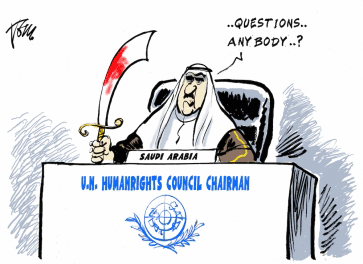
Saudi Arabia: Thousands Held Arbitrarily, Dramatic Increase in Detention Without Trial Human Rights Watch , 6 May 18, (Beirut) – Saudi Arabia is detaining thousands of people for more than six months, in some cases for over a decade, without referring them to courts for criminal proceedings. Saudi Arabia’s attorney general should promptly charge or release all criminal defendants and stop holding people arbitrarily.
Human Rights Watch analyzed data from a public online Interior Ministry database, which revealed that authorities have detained 2,305 people who are under investigation for more than six months without referring them to a judge. The number held for excessively long periods has apparently increased dramatically in recent years. A similar Human Rights Watch analysis in May 2014 revealed that only 293 people had been held under investigation for that period.
“If Saudi authorities can hold a detainee for months on end with no charges, it’s clear that the Saudi criminal justice system remains broken and unjust, and it only seems to be getting worse,” said Sarah Leah Whitson, Middle East director at Human Rights Watch.
“It seems that MBS’s ‘Vision2030’ plan better describes the length of detentions without charge than an aspirational time horizon for reforms.”
Saudi Arabia’s use of arbitrary detention has faced increasing scrutiny since the November 4, 2017 mass arrest of 381 people on corruption allegations. The arrests raised human rights concerns and appeared to take place outside of any recognizable legal framework, with detainees forced to trade financial and business assets for their freedom.
…….Human Rights Watch analyzed the data on April 2, which was updated through March 31. Of the 5,314 people in the database, 3,380 had been held for over six months without a conviction or their “case file under judicial review,” including 2,949 for more than a year and 770 for over three years. The database indicated Saudi authorities were holding 2,305 people “under investigation” for more than six months, 1,875 for more than a year, and 251 for over three years.
Saudi authorities have held one Saudi citizen without a conviction since September 2003 and another “under investigation” since December 2006. Of the 251 held “under investigation” for over three years, 233 are Saudis.
“We’ve reverted to a Saudi version of Kafka when authorities detain citizens for over a decade without charge because they are ‘under investigation’,” Whitson said. “This effectively means that Saudi authorities can detain and jail anyone they want by claiming they are investigating them, however endless the investigation.”………..
Extended detention without charge or trial or without an appearance before a judge is arbitrary, and violates both Saudi law and international human rights standards.
In the early 60s, the U.S. estimated that the number of victims in a nuclear war against the Soviet Union and China would total some 600 million. Twenty years ago, ‘Doomsday Machine’ author Daniel Ellsberg posed a similar question about the Mideast,
With the Iran nuclear deal on the rocks and tensions rising across the Middle East, it is worth revisiting a question that was posed more than two decades ago by Daniel Ellseberg, the former U.S. military analyst who leaked the Pentagon Papers, about the potential cost in lives of nuclear warfare in this region.
In October 1996, Ellsberg took part in a conference in Tel Aviventitled “Democracy, Human Rights and Mordechai Vanunu,” dedicated to the jailed Israeli nuclear whistleblower and led by Prof. Joseph Rotblat, winner of the 1995 Nobel Peace Prize. The conference was organized by the Israeli Committee for Vanunu and for a Middle East Free of Nuclear, Biological and Chemical Weapons. All the conference speeches were included in a book called “Vanunu and the Bomb” (edited by Giora Neumann and myself), which was published in 1998.
Here is an excerpt from Ellsberg’s 1996 speech, in which he drew on his Cold War experience in making plans for nuclear conflict and expected casualty figures.
“In 1961 I drafted a question for the president, John [F.] Kennedy, to ask the joint Chiefs of Staff. I was in the process of drafting the guidance notes for the operating plans for general nuclear war. I wrote a 20-page top secret draft adopted totally by [then-Defense Secretary Robert] McNamara and sent by him, as the secret guidance for joint Chiefs of Staff for totally changing the Eisenhower war plans. I was very proud of that as I thought the current plans to be a disaster and my plans were far better. (I can still say they were better but not as much as I had thought: I bear that on my conscience.) Therefore it was possible to draft questions to the High Chief, which he accepted, one of which was: If your plans were executed, and not interrupted by typhoon, preemptive attack or total incompetence, how many people would have died in the Soviet Union and China?
“I asked that in the belief that they did not have an answer. I had been working with the planners in the air force, who had never done such calculations. I thought they would have to waffle, it would be very embarrassing, or they would give some absurdly low estimate. But they did have an answer. It was addressed ‘for the eyes of the president only,’ but as I wrote the question, I saw that I held in my hand an unusual piece of paper.
“The number was for people in the Soviet Union and China alone, so they could avoid undue delay. It was a simple graph. An ascending line starting with deaths on the first day and leading on to deaths from fallout and so on in six months’ time. The figure was 320,000,000 dead. So they knew what their plans entailed. Obviously a computer model had done the calculations.
“So I asked about the rest, the answer was about 100,000,000 in Western Europe and roughly the same in Eastern Europe. Neutral countries adjacent to the Soviet Union, non-aligned; Afghanistan, Austria, Japan, were wiped out by fallout from our attacks, without calculations from retaliation from first strike.
“Total body count over the next couple of weeks was 600,000,000, I asked myself how people I drank beer with and worked with every day, could have written such plans. Not just hypothetical ones, this was a targeting estimate for planes on instant 10-minute alert all over the world; missiles, submarines, and machinery which was already there, not 10 years in the future. This was next week.
“This is what would have happened had we gone to war over Cuba, which was possible in 1962, or Berlin in 1960. 600,000,000 people. I thought they were the most evil plans that had ever been made in the history of humanity. I have spent 30 years since, trying to understand how Americans had created such plans, and such a machinery, but with very ordinary motives. The word evil is almost misleading as it suggests satanic forces or demonic motives. These were well intentioned people with very ordinary, very banal motives.
“If one returns to Israel, what if that question were asked by Benjamin Netanyahu [at the time in his first term as prime minister]? Has he done so? With virtual certainty I feel he has not. Has any lsraeli ever asked such a question? Has the calculation been made? I had thought that the general security service had not done so, but I was wrong. Perhaps the lsraeli military do know the answer. If we gave them enough time to work it out, what would the answer be to the question, supposing the weapons are used on the targets for which they have been prepared? Supposing the ground zero were hits on targets such as cities or other areas for which target folders have been prepared showing coordinates, how many people would die? It is a very simple calculation.
Assume Israel with more than 100, maybe 200, warheads – each on average the size of the Nagasaki bomb – each could produce 100,000 deaths.
I am a Jew. Should Jews have created machinery for the instant annihilation of 10 to 12,000,000 people? I do not want to be told that I don’t have the right to ask that question because I am not an lsraeli.
“If being a Jew means anything, it gives me a right to ask that question.
“I have already described what I, as an American, thought about the primary identity of my country, possessing capabilities to destroy 600,000,000 people. How would the Israeli military justify having the capabilities to kill 10-12,000,000, having bought it, trained for it, disciplined for it, prepared targets and so on. If the number is lower, let us hear it.
“My question is, should not the lsraeli president, parliament, people, know the answer to that question and then discuss whether the machinery needs expanding, as it is in the process of doing? How many could have been killed in 1986 when Vanunu made his decision? Why has Dimona been at work for the last 10 years? The discussion could not get started without Vanunu or his photos, and we would not have been believed about the scale of the program without these documents.
“This discussion is long overdue in Israel. This conference can contribute. There is a chance for change.”
Ellsberg was too optimistic. More than 20 years have passed since that conference and the discussion has still not yet to take place here – certainly not publicly.
ISRAEL AND DENUCLEARIZATION: NECESSARY PARADOX OR HYPOCRISY IN ACTION? Jerusalem Post, While Israel maintains nuclear ambiguity, the Jewish state is believed to possess up to 200 atomic weapons. BY BENJI FLACKS/THE MEDIA LINE MAY 26, 2018
Although Israel maintains a policy of ambiguity regarding its possession of nuclear weapons, the Jewish state is known to have a sizeable atomic arsenal. David Ben Gurion, Israel’s first prime minister, established with the help of France a covert nuclear program in the 1950s to combat against what was widely viewed as an existential military threat posed by Arab neighbors. Ever since, information has from time-to-time been leaked regarding the size and potency of Israel’s atomic capabilities, although no independent body has confirmed specific figures.Against this backdrop, the United States—which has the world’s second-largest nuclear stockpile after Russia—is actively promoting global non-proliferation. To this end, President Donald Trump is slated to hold a summit with North Korean ruler Kim Jong-Un to discuss the Peninsula’s denuclearization; and the US leader recently withdrew Washington from the Joint Comprehensive Plan of Action (commonly referred to as the Iran nuclear accord), which, in his estimation, would not have prevented Tehran’s acquisition of the bomb over the long-term.
For many, a clear dichotomy—if not double-standard—emerges when these policies are juxtaposed against the world’s hush-hush approach to—if not tacit approval of—Israel’s nuclear arms program.
According to Shannon Kile, head of the Nuclear Weapons Project at the Stockholm International Peace Research Institute (SIPRI), Israel exists in a sort of legal limbo given that it is not a party to the 1968 Treaty on the Non-Proliferation of Nuclear Weapons (NPT), which codified into international law regulations governing nuclear development. By contrast, he explained to The Media Line, “the United States has the moral and legal right to pressure North Korea and Iran [in ways that are] set out in the binding treaty.
“The NPT legally recognized legitimate nuclear nations and in the treaty, North Korea and Iran were barred from making nuclear weapons,” Kile elaborated, while qualifying that Pyongyang did pull-out of the NPT in 2003, blaming its decision on “U.S. aggression.” Nevertheless, Kile noted, there is “a long-running international dispute over [Israel’s] nuclear program. NPT countries, particularly Egypt, have argued for a nuclear-free zone in the Middle East that would include Israel. This notion,” he continued, “was a key pillar in the extension of the treaty in 1995. But not all countries seem willing to force Israel to sign up.”
More broadly, Kile believes that there “needs to be a commitment for all nuclear states to fulfill their obligation to denuclearize, as this would bolster the norm against atomic weapons. All NTP signatories have committed to abolishing their nuclear arms yet we see no real progress on that, even in the United States.” ……. https://www.jpost.com/Israel-News/Israel-and-denuclearization-Necessary-paradox-or-hypocrisy-in-action-558401
UAE’s first nuclear reactor start-up delayed, MEMO, May 27, 2018
The start-up of the Arab world’s first nuclear reactor – in the United Arab Emirates – has been delayed and should start operations between the end of 2019 and early 2020, the plant’s operator said on Saturday.
Nawah Energy Company, the operator of the Barakah Nuclear Energy Plant in the Al-Dhafra Region of Abu Dhabi, said it “has completed a comprehensive operational readiness review” for an updated start-up schedule for the reactor.
The $24.4 billion Barakah power plant is the world’s largest nuclear project under construction and will be the first in the Arab world.
“The results of Nawah’s review forecast that the loading of nuclear fuel assemblies required to commence nuclear operations at Barakah Unit 1 will occur between the end of 2019 and early 2020,” it said in a statement.
Reuters reported in March that the start-up had been pushed back to 2019 due to training delays.
“The resulting projection for the start-up of Unit 1 operations reflects the time required for the plant’s nuclear operators to complete operational readiness activities and to obtain necessary regulatory approvals,” Nawah said.
The first of four reactors being built by Korea Electric Power Corporation (KEPCO) in the UAE is part of the Barakah power plant project that was originally scheduled to open last year.
Jordan Settles for Smaller Russian Nuclear Reactor by 2022May 27th, 2018 via SyndiGate.info
Jordan on Saturday announced a plan for a small modular nuclear reactor with Russia, replacing the $10 billion nuclear power plant for which an agreement was signed in 2015 between the Jordan Atomic Energy Commission (JAEC) and Russia’s Rosatom Overseas.
“Jordan is now focusing on small modular reactors because the large reactors place financial burden on the Kingdom and in light of the current fiscal conditions we believe it is best to focus on smaller reactors,” a government official, who preferred anonymity, told The Jordan Times on Saturday.
The official said the plan for the $10 billion nuclear plant with Russia that entails building two nuclear reactors with total capacity of 2,000 megawatts is over now and that focus will be on smaller reactors, which are safe, require less financial burden and for which Jordan can attract investors, the official said Saturday……..https://www.albawaba.com/news/jordan-settles-smaller-russian-nuclear-reactor-2022-1137364
Iran asks Europe what it can offer to keep it in the nuclear deal after U.S. pullout, WP, By Michael BirnbaumMay 25 Email the author
VIENNA — Iran will decide within weeks whether to stay in a faltering deal to restrain its nuclear program and is pressing Europe to compensate for President Trump’s decision to reimpose sanctions, a senior Iranian official said Friday.
The official warned that Tehran could also pull out from a separate treaty that limits the spread of nuclear weapons.
The caution came ahead of the first talks involving all the remaining parties to the landmark 2015 deal since the United States pulled out this month.
An official report Thursday declared that Iran is still in compliance with the stringent controls on its nuclear program.
Iran has long declared that its program is limited to the peaceful generation of nuclear energy and production of medical isotopes. If it were to pull out of the 2015 Joint Comprehensive Plan of Action (JCPOA) and the 1970 Treaty on the Nonproliferation of Nuclear Weapons (NPT) and seek nuclear weapons, it could spark an arms race in the already volatile Middle East.
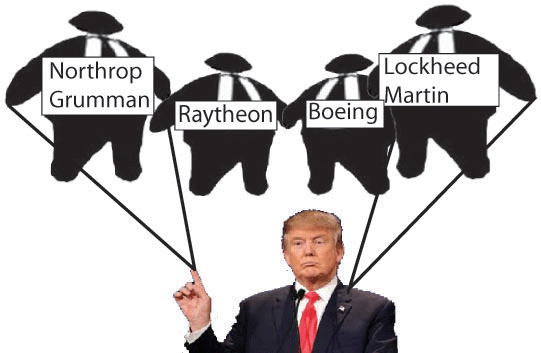
The Pentagon is speeding up US weapons deliveries to allied militaries such as Saudi Arabia, Romania, Japan, and South Korea through new “pilot authorities that change how it can design and execute contracts” according to news reports.
Defense One, quoted Ellen Lord, US defense undersecretary for acquisition and sustainment, as saying, Wednesday “we have a whole variety of specific programs where we are focused on applying these authorities: Patriot Missiles for Romania; Global Hawk for Japan, THAAD [high-altitude air defense missiles] for Saudi Arabia, and TOW [vehicle-launched missiles] for multiple foreign military sales partners.”
These new authorities will allow the Pentagon to shave “years” off the time it takes to deliver weapons to friendly militaries, Lord said at the annual SOFIC event here.
The report added that Saudi Arabia is a frequent target of missile strikes by Houthi rebels. Regional authorities routinely fret about Iran’s growing missile capabilities.
The Trump administration, working to increase exports of US-made weapons, has started the process to execute the sale 120,000 precision-guided munitions to allies Saudi Arabia and the United Arab Emirates.
Reuters said Tuesday that the White House asked the US Congress to review the deal.
Last year, the Trump administration approved the sale of about $7 billion of the precision-guided weapons to Saudi Arabia.
Raytheon Co is the largest maker of the PGMs in the United States.
Administration and congressional sources confirmed that the informal 40-day review period to sell the munitions to the two countries was under way.
Loujain is a well-known campaigner for women’s right to drive in the ultra-conservative kingdom. Late last week, we learned that she had been arrested from her home. She was one of at least six prominent women’s rights activists detained by the Saudi Arabian authorities.
Loujain has been arrested several times in recent years for campaigning for women’s right to drive and the abolition of the male guardianship system. Now, she is the victim of a state-orchestrated smear campaign, designed to undermine the important campaigning that she and other human rights activists have been undertaking.
Along with the other human rights activists, Loujain has been detained and accused of crimes including “suspicious contact with foreign entities” and undermining the “security and stability” of the country. She was branded a ‘traitor’ to the country by state-aligned media. These arrests come one month before Saudi Arabian authorities will lift the ban on women driving in the kingdom. It is a cruel irony that the very women who championed the right to drive campaign may not be able to benefit from their activism – instead, they may be behind bars instead of behind the wheel.
These accusations are nothing more than ludicrous lies, intended to silence strong feminist voices speaking up for women’s rights.
The following morning, it only got worse. A vile and unprecedented smear campaign took over the front pages of Saudi newspapers and spread across social media platforms. Local newspapers like Okaz and Al-Jazirah were filled with aggressive front-page headlines, photos and countless opinion articles, calling the activists spies. On Twitter, one graphic was widely shared, revealing the faces and names of these activists with the word “traitor” stamped across their photos.
We fear that they, like many other peaceful activists and human rights defenders, will be tried and sentenced to lengthy prison terms for their activism. This continued criminalization of peaceful activism and human rights work is repulsive. It’s been a week since their arrests, and we still don’t know where the activists are, if they have been presented with clear legal charges, or have had access to a lawyer of their choosing.
In recent weeks, Saudi Arabia’s Crown Prince Mohammad bin Salman has travelled the world on a PR blitz, shaking hands with fellow leaders while promising positive change in the kingdom. MbS (as he’s known) claims women’s rights will be respected as part of his reforms. These arrests show those promises to be a lie.
How can the Crown Prince tell the world that he is an advocate for women’s rights while locking up activists who have called for the reforms he claims credit for? How can he claim to support women’s empowerment when the brave activists who have sacrificed their freedom for the rights and freedoms of Saudi Arabian women in the country won’t be able to drive next month?
For government leaders around the world who have been taken in by MbS’ talk of reform, we have a simple message: as long as human rights activists are deemed a threat to state security, and as long as the rights to freedom of expression, association, and assembly are equated with terrorism, Saudi reform is not meaningful.
It is clear that underneath all the PR hype and spin, Crown Prince Mohammad bin Salman doesn’t care about women’s rights and real human rights reforms. Saudi Arabian authorities cannot continue to publicly state they are dedicated to reform, while treating women’s rights campaigners in this cruel way. It’s time to end the systematic discrimination against women and the repression of the human rights community in Saudi Arabia.
Samah Hadid is Amnesty International’s Middle East Director of Campaigns
Saudi Arabia has widened its crackdown on women’s rights activists, bringing the number of arrests up to 11 people, according to human rights groups.
Since the sweep began on May 15, the detained activists, most of whom are women, have been branded “traitors” by pro-government news outlets and social media accounts, according to Human Rights Watch. Over the weekend, several state-linked newspapers published the names and photographs of those detained in what rights groups dubbed a “smear campaign“.
Those arrested reportedly include prominent women’s rights defenders who have long advocated for ending the ban on women driving, among them, Loujain al-Hathloul, Aziza al-Yousef and Eman al-Nafjan, along with Mohammed al-Rabea, an activist, and Ibrahim al-Modaimeegh, a human rights lawyer. They may face charges for “suspicious contact with foreign parties” and undermining “stability,” according to the Presidency for State Security, an office which reports to the king.
Since the kingdom is expected to soon lift its prohibition on women driving, rights groups said the motivation behind the escalating arrests remains unclear.
King Salman bin Abdulaziz Al Saud and his son, Crown Prince Mohammed bin Salman, drew international plaudits last year when they announced the ban on female drivers would end on June 24.
But now international outrage over the arrests threatens to derail the crown prince’s image as liberalizer.
“The crown prince, who has styled himself as a reformer with Western allies and investors, should be thanking the activists for their contributions to the Saudi women’s rights movement,” Sarah Leah Whitson, HRW’s Middle East director said in a statement. “Instead, the Saudi authorities appear to be punishing these women’s rights champions for promoting a goal bin Salman alleges to support — ending discrimination against women.”