Iran says world ‘must respond’ to Israel after blast at nuclear site
|
Iran says world ‘must respond’ to Israel after blast at nuclear site, Times of Israel, Government spokesman calls for ‘limits to these dangerous actions by the Zionist regime’; Mideast official says explosion at Natanz was meant as a ‘wake-up call’ to Tehran By TOI STAFF7 July 2020, Iran on Tuesday called for action against Israel, following a recent blast at the Natanz nuclear facility that has been blamed on the Jewish state.
“This method Israel is using is dangerous, and it could spread to anywhere in the world,” government spokesman Ali Rabiei said during a press conference, according to a translation of his remarks by Israel’s Channel 12 news. He added: “The international community must respond and set limits to these dangerous actions by the Zionist regime.” His comments came as Iran appeared to publicly acknowledge on Tuesday that last week’s fire at Natanz, which badly damaged a building used for producing centrifuges, was not an accident. Israeli TV reports, without naming sources, have said the blast destroyed the laboratory in which Iran developed faster centrifuges and set back the Iranian nuclear program by one or two years. Nour News, seen as a mouthpiece of Iran’s Supreme Council of National Security, claimed that the blast at the Natanz facility, which came amid a series of mysterious disasters that struck sensitive Iranian sites in recent days, bore similarity to other strikes against the country’s security infrastructure. While asserting that “an airstrike on the Natanz plant is almost impossible” due to its strong air defenses, an article on the site said that “the combination of intelligence, logistics, action and the volume of destruction” prove that the incident was deliberate. The Washington Post and New York Times quoted Middle Eastern officials earlier this week as saying the blast at Natanz was caused by a large bomb planted by Israeli operatives…….. A member of the Revolutionary Guard confirmed to the Times on Sunday that an explosive was used, but didn’t specify who was responsible. ….. The building at Natanz was constructed in 2013 for the development of advanced centrifuges, though work was halted there in 2015 under the nuclear deal with world powers, Iran’s atomic agency spokesman Behrouz Kamalvandi said earlier this week. When the United States withdrew from the nuclear deal, work there was renewed, Kamalvandi said. He claimed the fire had damaged “precision and measuring instruments,” and that the center had not been operating at full capacity due to restrictions imposed by the nuclear deal. Iran began experimenting with advanced centrifuge models in the wake of the US unilaterally withdrawing from the deal two years ago…….. https://www.timesofisrael.com/iran-says-world-must-respond-to-israel-after-blast-at-nuclear-site/ |
|
Following fire at nuclear site, Iran warns it will retaliate if it suffers cyber attacks
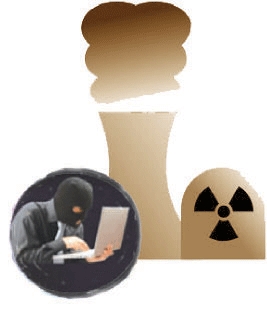 Nuclear site cyber attack possible: Iran, Canberra Times, 4 July 20, Iran will retaliate against any country that carries out cyber attacks on its nuclear sites, the head of civilian defence says, after a fire at its Natanz plant which some Iranian officials say may have been caused by cyber sabotage. Nuclear site cyber attack possible: Iran, Canberra Times, 4 July 20, Iran will retaliate against any country that carries out cyber attacks on its nuclear sites, the head of civilian defence says, after a fire at its Natanz plant which some Iranian officials say may have been caused by cyber sabotage.
The underground Natanz Fuel Enrichment Plant (FEP) is one of several Iranian facilities monitored by inspectors of the International Atomic Energy Agency, the UN nuclear watchdog. Iran’s top security body said on Friday that the cause of the “incident” at the nuclear site had been determined but “due to security considerations” it would be announced at a convenient time……
Three Iranian officials who spoke to Reuters on condition of anonymity said they believed the fire was the result of a cyber attack, but did not cite any evidence. One of the officials said the attack had targeted the centrifuge assembly building, referring to the delicate cylindrical machines that enrich uranium, and said Iran’s enemies had carried out similar acts in the past. Two of the officials said Israel could have been behind the Natanz incident but offered no evidence. Asked on Thursday evening about recent incidents reported at strategic Iranian sites, Israeli Prime Minister Benjamin Netanyahu told reporters: “Clearly we can’t get into that.” In 2010, the Stuxnet computer virus, which is widely believed to have been developed by the United States and Israel, was discovered after it was used to attack the Natanz facility. to have been developed by the United States and Israel, was discovered after it was used to attack the Natanz facility. Australian Associated Press https://www.canberratimes.com.au/story/6818945/nuclear-site-cyber-attack-possible-iran/?cs=14264#gsc.tab=0 |
|
Fire at Iran’s Natanz uranium enrichment facility
Iran nuclear: ‘Incident’ at Natanz uranium enrichment facility, BBC, 2 July 2020
A fire has reportedly damaged a building at a nuclear facility in Iran.
Atomic Energy Organisation of Iran (AEOI) spokesman Behruz Kamalvandi said there was an incident in “one of the industrial sheds under construction” at the Natanz uranium enrichment plant.
There were no fatalities or concerns about contamination, he added.
The AEOI later published a photo showing a partly burned building, which US-based analysts identified as a new centrifuge assembly workshop. Centrifuges are needed to produce enriched uranium, which can be used to make reactor fuel but also nuclear weapons.
Meanwhile, in a statement sent to BBC Persian journalists before the AEOI’s announcement, an unknown group calling itself “Cheetahs of the Homeland” claimed it had attacked the building. The group said its members were part of “underground opposition with Iran’s security apparatus”.
The claim could not immediately be verified by the BBC.
The International Atomic Energy Agency (IAEA), which monitors Iran’s compliance with a 2015 nuclear deal struck with world powers, said it was aware of the reports from Natanz and currently anticipated no impact on its verification activities.
The incident comes six days after an explosion near the Parchin military complex.
The Iranian authorities said the blast was caused by “leaking gas tanks” at the site, but analysts said satellite photographs showed it happened at a nearby missile production facility…….. https://www.bbc.com/news/world-middle-east-53265023Skip Twitter post by @TheGoodISIS
Lawsuit alleges scientific misconduct at U.S. nuclear weapons lab
Researchers familiar with the labs say Williams’s allegations should be taken seriously. ……https://www.sciencemag.org/news/2020/06/lawsuit-alleges-scientific-misconduct-us-nuclear-weapons-lab
UN nuclear watchdog seeks to inspect old nuclear sites in Iran
UN nuclear watchdog seeks to inspect old nuclear sites in Iran https://www.vaticannews.va/en/world/news/2020-06/un-nuclear-watchdog-seeks-to-inspect-old-nuclear-sites-in-iran.html The board of the UN atomic watchdog agency has issued a condemnation of Iran for stonewalling its nuclear inspectors.By Nathan Morley The United Nations’ atomic agency is continuing to put pressure on Iran.
In a new resolution, the international body has insisted Iran provide access to two sites where nuclear activity may have taken place in the last two-decades.
The resolution, which was put forward by France, Germany, and Britain with support by the United States, was passed by 25 votes in favour.
China and Russia voted against while seven other countries abstained
The UN is calling on the Iranians to satisfy the Agency’s requests without any further delay. It wants access to two sites in order to clarify whether undeclared nuclear activity took place there in the past.
However, Iran has been blocking access to the sites since early 2020, a move which has fuelled a diplomatic dispute. It is reported that the sites in question are not directly relevant to Iran’s current nuclear programme.
Speaking after the vote, Kazem Gharib Abadi, the Iranian ambassador to the IAEA, said he strongly rejected the resolution and would respond appropriately in due course.
For its part, the IAEA said it still has the access it needs to inspect Iran’s declared nuclear facilities according to its mandate under the nuclear deal reached in 2015.
Europe’s effort to save Iran nuclear deal
|
Europe scrambles to save Iran nuclear deal as Trump insists key part of accord is scrapped
US president’s administration announces it has drafted extension to arms embargo on Tehran, Independent UK, Kim Sengupta, Defence Editor, 19 June 20, Western European diplomats are working on how to save the Iran nuclear accord in a day of important developments on the issue which saw Tehran censured by the UN nuclear watchdog, and the US reiterate its demand that a key part of the deal is scrapped. Foreign ministers of Britain, France and Germany – three signatory states to the agreement – met in Berlin to formulate a strategy for the next crucial months with Iran and its nuclear programme under focus. At a meeting in Vienna, the International Atomic Energy Authority (AEA) called on Iran to stop blocking its inspectors from two sites and the Trump administration announced that it has drafted an extension to an arms embargo on Iran which is due to be lifted in a few months time.
|
|
Trump tells Iran they should get “a better deal” with him now, before the U.S. election
 Urging Iran to ‘Make the Big Deal,’ Trump Ties Nuclear Negotiations to Election, The president’s invitation came as international inspectors were said to have found that Iran had boosted its stockpile of low-enriched uranium in the past three months.
Aides to Mr. Pompeo and Mr. Trump declined to explain why, if the United States was negotiating in its own national interest, Iran might get preferential treatment for negotiating with Mr. Trump before the election……
“We had a deal when you entered office,” Iran’s foreign minister, Mohammad Javad Zarif, responded to Mr. Trump in a tweet on Friday. Iran and the other participants in the 2015 agreement — Britain, France, Germany, the European Union, Russia and China — “never left the table,” he said. “Your advisers — most fired by now — made a dumb bet. Up to you to decide *when* you want to fix it.”
Hesameddin Ashena, the top policy adviser to President Hassan Rouhani of Iran also responded. “You are going down on November 3rd and we know that,” he tweeted. “So you’ll need to offer much more than Obama did!”…….. https://www.nytimes.com/2020/06/05/world/middleeast/trump-iran-nuclear.html
Iran challenges Donald Trump to return to nuclear deal
Iran freed Michael White on Thursday as part of a deal in which the United States allowed Iranian-American physician Majid Taheri to visit Iran.
Trump tweeted on Thursday of White’s release: “Thank you to Iran, it shows a deal is possible!”
Iranian Foreign Minister Mohammad Javad Zarif, addressing Trump, said on Twitter, “We achieved humanitarian swap despite your subordinates’ efforts”.
“We had a deal when you entered office. … Your advisors -most fired by now – made a dumb bet. Up to you to decide when you want to fix it.”……. https://www.wionews.com/world/iran-challenges-donald-trump-to-return-to-nuclear-deal-303659
The European Union plus France, Germany and the UK “deeply regret” US decision on Iran sanctions
EU and others ‘regret’ US decision on Iran sanctions, WNN 01 June 2020 The European Union plus France, Germany and the UK have said they “deeply regret” the USA’s decision to end three sanction waivers covering Joint Comprehensive Plan of Action (JCPOA) projects in Iran. Separately, a spokesperson for China’s Foreign Ministry said the US decision “hampers” international non-proliferation progress…….
“We deeply regret the US decision to end the three waivers covering key JCPOA nuclear projects in Iran, including the Arak Modernisation Project,” the spokespersons of the High Representatives of the EU and the Foreign Ministries of France, Germany and the UK said in a joint statement issued on 30 May. “These projects, endorsed by UN Security Council resolution 2231, serve the non-proliferation interests of all and provide the international community with assurances of the exclusively peaceful and safe nature of Iranian nuclear activities.
“We are consulting with our partners to assess the consequences of this decision by the United States.
“The JCPOA is a key achievement of the global non-proliferation architecture and currently the best and only way to ensure the exclusively peaceful nature of Iran’s nuclear programme. That is why we have worked continuously with the aim of ensuring the full and effective implementation of commitments under the JCPOA, in particular the return of Iran to full compliance with its nuclear commitments without delay.”
Zhao Lijian, spokesman for China’s Foreign Ministry, on 29 May said the US decision to end the waiver “hampers” international non-proliferation progress and shared efforts to preserve the JCPOA.
“The Arak reactor conversion is an important part of the JCPOA and a joint project of parties to the agreement,” he said. “China is ready to work with other parties to continue upholding the deal and safeguarding its own legitimate rights and interests.”
The JCPOA was signed in July 2015 by Iran and the E3/EU+3 (China, France, Germany, Russia, the UK and the USA – also referred to as the P5+1 – plus the European Union) and implemented in January 2016, clearing the way for the lifting of nuclear-related economic sanctions against Iran. Under its terms, Iran agreed to limit its uranium enrichment activities, eliminate its stockpile of medium-enriched uranium and limit its stockpile of low-enriched uranium over the subsequent 15 years……
US President Donald Trump in 2018 announced the termination of the USA’s participation in the JCPOA, directing the US administration to begin the process of re-imposing sanctions on Iran. https://www.world-nuclear-news.org/Articles/EU-and-others-regret-US-decision-on-Iran-sanctions
Nuclear Weapons: The Reason Why Even Iran Fears Israel
Nuclear Weapons: The Reason Why Even Iran Fears Israel, Kyle Mizokami,The National Interest•June 1, 2020
Iran envoy says that Trump has pulled the final plug in violating nuclear deal
“Two yrs ago @realDonaldTrump ceased participation in #JCPOA. Now, in further violation of JCPOA & UNSCR 2231 @SecPompeo pulls final plug, imposing penalties for compliance EVEN w/nuclear provisions of 2231,” Takht-Ravanchi tweeted on Thursday.
He added, “Claiming US is STILL ‘Participant’ is not just preposterous; it’s FALSE.”
U.S. President Donald Trump quit the agreement, negotiated under his predecessor Barack Obama, in May 2018.
But the Trump administration until now had issued waivers to allow companies, primarily from Russia, to keep carrying out the work of the agreement without risking legal ramifications.
However, Washington announced on Wednesday that it was ending the waivers.
Russian Foreign ministry spokeswoman Maria Zakharova said on Thursday the U.S. is acting in a dangerous and unpredictable way.
“Washington’s actions are becoming more and more dangerous and unpredictable,” Zakharova told reporters.
“The nature of this behavior is clearly disruptive,” Zakharova said, accusing Washington of undermining international security.
Trump administration to remove almost all sanctions relief to Iran
 US clamps down on waivers tied to Iran’s nuclear cooperation, Matthew Lee, Ap Diplomatic Writer, The Wilton Bulletin, , Wednesday, May 27, 2020 WASHINGTON (AP) — The Trump administration announced Wednesday it is ending nearly all of the last vestiges of U.S. sanctions relief provided under the 2015 Iran nuclear deal. US clamps down on waivers tied to Iran’s nuclear cooperation, Matthew Lee, Ap Diplomatic Writer, The Wilton Bulletin, , Wednesday, May 27, 2020 WASHINGTON (AP) — The Trump administration announced Wednesday it is ending nearly all of the last vestiges of U.S. sanctions relief provided under the 2015 Iran nuclear deal.Secretary of State Mike Pompeo said he would revoke all but one of sanctions waivers covering civil nuclear cooperation. The waivers had allowed Russian, European and Chinese companies to continue to work on Iran’s civilian nuclear facilities without drawing American penalties…… Pompeo also imposed sanctions on two officials with Iran’s atomic energy organization who are involved in the development and production of centrifuges used to enrich uranium. The nuclear cooperation waivers were last renewed in late March and were due to expire at the end of the month. The revocations will give foreign companies 60 days to wind down their operations. Pompeo in March had opposed extending the waivers, which are among the few remaining components of the nuclear deal that the administration has not canceled. But officials said Treasury Secretary Steven Mnuchin had prevailed in an internal debate by arguing the coronavirus pandemic made eliminating the waivers unpalatable at a time when the administration is being criticized for refusing to ease sanctions to deal with the outbreak.
President Donald Trump withdrew from the nuclear deal in 2018 and has steadily reimposed U.S. sanctions on Iran that had been eased or lifted under its terms. The “civilian-nuclear cooperation” waivers allow foreign companies to do work at some of Iran’s declared nuclear sites without becoming subject to U.S. sanctions.
Deal supporters say the waivers give international experts a valuable window into Iran’s atomic program that might otherwise not exist. They also say some of the work, particularly at the Tehran reactor on nuclear isotopes that can be used in medicine, is humanitarian in nature………. https://www.wiltonbulletin.com/news/article/US-to-revoke-Iran-nuclear-cooperation-sanctions-15298267.php |
|
Iran tops the list of countries which accepted inspections of the International Atomic Energy Agency in 2019.
|
‘The goal of opponents is to undermine confidence and cooperation between Tehran and IAEA’
JCPOA ensuring Iran’s nuclear program is peaceful, says Russia, Tehran Times May 25, 2020 “The purpose of #JCPOA is to restore confidence in exclusively peaceful nature of nuclear program of #Iran,” Ulyanov tweeted on Monday.“The deal fulfils this task,” he wrote. “No sign of military dimension was found. The goal of opponents is opposite- to undermine confidence and cooperation between Tehran and #IAEA.” In an earlier tweet on Sunday, the Russian envoy wrote, “Opponents of #JCPOA call for a ‘renewed coalition of pressure on Tehran’. In their article in Newsweek, published on Sunday, they try to instruct #IAEA what it ‘must’ and ‘should’ do. IAEA is independent. It’s Board of Governors and Secretariat will decide for themselves on how to proceed.” The Newsweek article that Ulyanov referred to, titled “The IAEA must report its latest findings on Iran’s nuclear weapons program”, called for a renewed coalition of pressure on Tehran in order to “address the regime’s nuclear program from its roots.” “World powers should make clear to Iran that it can no longer conceal its nuclear past and potentially its present—or swift international penalties will follow,” added the article written by Jacob Nagel, former acting national security advisor to Israeli Prime Minister Benjamin Netanyahu, and Andrea Stricker, a research fellow at FDD. This is while Iran tops the list of countries which accepted inspections of the International Atomic Energy Agency in 2019. “Last year, the Islamic Republic received 21 percent of the entire visits that were made to various nuclear sites across the world by inspectors of the International Atomic Energy Organization (IAEA),” Kazem Gharibabadi, Iran’s ambassador to the Vienna-based international organizations, said earlier this month. He was citing the IAEA’s 129-page 2019 Safeguards Implementation Report. “The agency continued to verify and monitor the nuclear-related commitments of the Islamic Republic of Iran under the Joint Comprehensive Plan of Action,” read the 129-page report prepared for diplomats that accounts for resources spent on enforcing the landmark 2015 agreement among world powers…….. |
|
Saudi Arabia’s push for nuclear power – a nuclear weapons danger
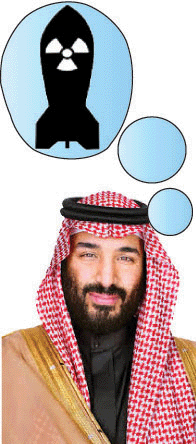 Arms control experts concerned by Saudi nuclear reactor push, Aljazeera
Satellite images show work progressing on Saudi reactor even though international IAEA inspectors are still frozen out. by Jonathan Tirone • Bloomberg. 22 May 2020 Saudi Arabia is pushing ahead to complete its first nuclear reactor, according to satellite images that have raised concern among arms-control experts because the kingdom has yet to implement international monitoring rules.
Satellite photos show the kingdom has built a roof over the facility before putting in place International Atomic Energy Agency regulations that allow inspectors early verification of the reactor’s design. Foregoing on-the-ground monitoring until after the research reactor is completed would be an unusual move normally discouraged under regulations to ensure civilian atomic programs aren’t used to make weapons.
Saudi Arabia has repeatedly pledged that its nuclear program is strictly for peaceful purposes, but Crown Prince Mohammed Bin Salman also said the kingdom would develop a bomb if its regional rival Iran did so. Those statements made in 2018 raised a red flag within the nuclear monitoring community which is uneasy that it has more ability to access nuclear sites in Iran than it does in Saudi Arabia.
Saudi Arabia’s ministry of energy didn’t respond to a request to comment.
While Saudi Arabia has been open about its ambitions to generate nuclear power, less is known about the kinds of monitoring the kingdom intends to put in place. President Donald Trump’s administration sent a letter to Saudi Arabia last year setting requirements to access U.S. atomic technology. The baseline for any agreement is tougher IAEA inspections.
…….. At issue is the weak and outdated set of IAEA safeguard rules, called the “Small Quantities Protocol,” or SQP, that Saudi Arabia continues to follow, according to Laura Rockwood, the IAEA’s former chief lawyer who drafted stricter inspection guidelines to which the vast majority of countries adhere.
Satellite images show that a thick lattice of roof beams is now covering the 10-meter (33 feet) high steel reactor vessel. Argentina’s state-owned INVAP SE sold the low-powered research reactor to Saudi Arabia.”The problem is that design-information verification has to be carried out while it’s being constructed,” said Rockwood, who now directs the Open Nuclear Network in Vienna
While Saudi Arabia adheres to the Nuclear Non-Proliferation Treaty, the bedrock agreement that regulates the spread of material needed to induce fission, it still has to implement monitoring rules in line with its nuclear program development.
“Saudi Arabia’s agreement right now is completely minimal, out of date, and unequal to the task of providing the kind of transparency that the IAEA and other member states need about Saudi Arabia’s nuclear program,” said Sharon Squassoni, a researcher and former diplomat on non-proliferation issues at George Washington University.
–With assistance from Verity Ratcliffe. https://www.aljazeera.com/ajimpact/arms-control-experts-concerned-saudi-nuclear-reactor-push-200521155658787.html
Iran’s Nuclear and Military Efforts in the Shadow of Coronavirus and Economic Collapse
EXECUTIVE SUMMARY: Notwithstanding the difficult challenges of the coronavirus crisis and a deteriorating economy, Iran is pushing ahead with its uranium enrichment and missile and space programs as well as its activities in Syria. It also has yet to concede to the US in their clash over sailing in the Gulf. Tehran fears that any sign of weakness might endanger the Islamist regime, particularly as resentment continues to grow among ordinary Iranians. With that in mind, it is doing all it can to flex its muscles for both domestic and international audiences………
The latest IAEA report says the agency continues to liaise with Iranian authorities regarding IAEA inspections of natural (non-enriched) uranium particles of an anthropogenic (i.e., man-made) source from an Iranian site that has not yet been declared to IAEA: the warehouse in Turkuzabad, a suburb of Tehran, which was unveiled by Israeli PM Benjamin Netanyahu in a speech to the UN General Assembly on September 27, 2018. According to the BBC on March 3, the IAEA dispatched a document to several member states claiming that Iran has rejected a request to allow inspection access to three other unidentified sites as well. According to the document, the inspectors want to find out if natural uranium is being used at any of the sites from which they are being barred. At another site, the IAEA says there have been activities that are “consistent with efforts to sanitize part of the location.”
Iran’s violations of the nuclear agreement—its raising of the uranium enrichment rate to 4.5% and accumulation of uranium in excess of the 300 kg UF6 limit—does not currently have a military aspect. This is because uranium enriched at a rate of less than 5% is suitable solely as a nuclear fuel for power reactors and cannot be used for nuclear weapons (for which the enrichment degree required is at least 90%). Iranian officials claim these violations are meant to pressure the EU into neutralizing the sanctions imposed on Iran by the US……..
Iran’s overall situation is quite distressing. The Iranian people have lost faith in the regime—especially now, in view of the ravages of the coronavirus pandemic. The people (along with the rest of the world) doubt the official casualty figures. At this writing, the regime is claiming about 110,000 cases and about 6,800 deaths, but the true numbers are estimated to be much higher. This distrust became stronger against the backdrop of the authorities’ false reporting of the downing of a Ukrainian passenger jet on January 8 after takeoff from Tehran (most of its passengers were either Iranian or of Iranian origin).
The coronavirus outbreak has dealt a new blow to the Iranian economy, which had already collapsed in 2018 as a result of US sanctions. The real (the Iranian currency) plummeted to unprecedented lows, and the Iranian street expressed its anger that the regime had wasted so much money on its operations in Syria. According to the London Arab newspaper al-Sharq al-Awsat on January 1, 2020, Iranian president Rouhani said damage to the Iranian economy resulting from sanctions by the end of 2019 was $200 billion…….
It is highly doubtful that the Iranian people are ready to eat grass in order to bring the regime’s dreams of an Iranian nuclear bomb to fruition. Though the mullahs’ goal of becoming a regional power that controls Shiite Islam across the Middle East remains unfulfilled, the regime continues to do what it can to demonstrate its power. The object is to show the world that Iran is not capitulating to the US in any way—not regarding its nuclear and space programs, and not militarily. It also seeks to project an image of strength to the increasingly resentful Iranian people, as it fears that signs of weakness could bring an end to its rule. However, the regime’s investments in security at the expense of the nation’s welfare may turn out to boomerang against it. https://besacenter.org/perspectives-papers/iran-nuclear-military-efforts/
1 This Month
26 September – International Day for the Total Elimination of Nuclear Weapons





PLEASE OPPOSE HR 8255 AND S.3639 – bills would accelerate satellite deployment, with no environmental review or safeguards – https://ncstd5li.quorum.us/campaign/169331/
To see nuclear-related stories in greater depth and intensity – go to https://nuclearinformation.wordpress.com
-
Archives
- September 2026 (305)
- August 2026 (330)
- July 2026 (355)
- June 2026 (287)
- May 2026 (306)
- April 2026 (356)
- March 2026 (251)
- February 2026 (267)
- January 2026 (308)
- December 2025 (358)
- November 2025 (359)
- October 2025 (375)
-
Categories
- 1
- 1 NUCLEAR ISSUES
- business and costs
- climate change
- culture and arts
- ENERGY
- environment
- health
- history
- indigenous issues
- Legal
- marketing of nuclear
- media
- opposition to nuclear
- PERSONAL STORIES
- politics
- politics international
- Religion and ethics
- safety
- secrets,lies and civil liberties
- spinbuster
- technology
- Uranium
- wastes
- weapons and war
- Women
- 2 WORLD
- ACTION
- AFRICA
- Atrocities
- AUSTRALIA
- Christina's notes
- Christina's themes
- culture and arts
- Events
- Fuk 2022
- Fuk 2023
- Fukushima 2017
- Fukushima 2018
- fukushima 2019
- Fukushima 2020
- Fukushima 2021
- general
- global warming
- Humour (God we need it)
- Nuclear
- RARE EARTHS
- Reference
- resources – print
- Resources -audiovicual
- Weekly Newsletter
- World
- World Nuclear
- YouTube
-
RSS
Entries RSS
Comments RSS

