Israel’s High Court rejects Vanunu’s bid to leave Israel
|
Nuclear whistleblower Vanunu denied permission to leave Israel High court rejects petition from man who revealed country’s nuclear secrets in 1986, Irish Times, Mark Weiss in Jerusalem , 16 Dec 19 Israel’s high court has rejected a petition from Mordechai Vanunu, the man who revealed the country’s nuclear secrets to the world in 1986, to be permitted to leave the country. The justices ruled that based on the material shown them, Mr Vanunu possessed secret and sensitive information that he had not revealed and that if he did, this would be dangerous for state security. They also ruled that they had been persuaded that the nuclear whistleblower wished to reveal his information. At the same time, they urged the state to continue to try to find ways to ease Mr Vanunu’s conditions in Israel. For years Mr Vanunu has demanded that Israel rescind his citizenship and allow him to leave the country. Mr Vanunu, a low-level technician at Israel’s Dimona nuclear plant, first hit the headlines in 1986 when he leaked details with photographs he took surreptitiously to the British Sunday Times. The revelations marked the first concrete proof that Israel had the capacity to manufacture nuclear bombs. Nuclear ambiguity’Israel maintains a policy of “nuclear ambiguity”, neither confirming nor denying foreign reports of its nuclear potential. It has refused to sign the nuclear Non-Proliferation Treaty or to allow international surveillance of its Dimona plant in the southern Negev desert. Partly based on the secrets Mr Vanunu revealed, foreign experts have concluded that Israel is the world’s sixth-largest nuclear power……… In 2004 he completed an 18-year sentence, most of which was spent in solitary confinement. However, strict conditions were attached to his release, including a ban on leaving the country, a ban on entering the Palestinian territories and a ban on meeting foreign journalists. Since his release, Mr Vanunu has twice served jail terms after convictions for parole violations. |
|
|
Israel’s Foreign Minister Israel Katz suggests bombing Iran to stop its nuclear program
 FM: Bombing Iran to stop its nuclear program remains ‘an option’ FM: Bombing Iran to stop its nuclear program remains ‘an option’
Speaking with Italian media on the sidelines of a foreign policy conference in Rome, Israel Katz rebukes European leaders for not taking a more aggressive stand against Tehran. Iranian FM accuses Israel of testing nuclear missile aimed at his country. Israel Hayom 12-08-2019 The option to launch a preemptive strike against Iran to prevent it from developing a nuclear weapon remains viable, Foreign Minister Israel Katz said in an interview Saturday. Speaking with Italian-language daily Corriere della Sera, Katz – asked whether Israel was mulling military options vis-à-vis the Islamic republic – said, “Yes, it is an option. We will not allow Iran to produce or obtain nuclear weapons. If it were the last possible way to stop this, we would act militarily.” The comments were reportedly made on the sidelines of a foreign policy conference in Rome. They came just hours after Iran announced its ready to unveil a “new generation” of nuclear-related “products,” including new centrifuge systems and a heavy water power plant scheduled to be built by the spring of 2020. Katz further admonished European leaders for not taking a more aggressive stand against Iran over its repeated, escalating violations of the 2015 nuclear deal…… On Friday, Iran’s Foreign Minister Mohammed Javad Zarif accused Israel of holding “a nuclear missile test aimed at Iran.” “Israel today tested a nuke-missile, aimed at Iran,” Zarif said on Twitter, adding that the United States, Germany, France and the United Kingdom “never complain about the only nuclear arsenal in West Asia – armed with missiles actually DESIGNED to be capable of carrying nukes – but has fits of apoplexy over our conventional & defensive ones.” The Israeli defense establishment successfully tested a rocket propulsion system on Friday. Defense officials stressed that the test was planned in advance and carried out as planned. https://www.israelhayom.com/2019/12/08/fm-bombing-iran-to-stop-its-nuclear-program-remains-an-option/ |
|
Britain, France, and Germany press Iran over its ballistic missile program
|
Europeans Ramp up Pressure on Iran, Britain, France, and Germany say Iran’s ballistic missile program is inconsistent with the nuclear deal and improves its capacity to deliver nuclear payload. Tehran counters that Europeans have failed to meet obligations under the pact. FP.com,
BY COLUM LYNCH
DECEMBER 6, 2019, Three key European powers this week inched closer to the Trump administration’s maximum pressure campaign against Iran, saying that Tehran’s ballistic missile program is inconsistent with its obligations under the Iran nuclear accord. Iran’s ballistic program—which was largely prohibited by the United Nations Security Council before the adoption of the Iran nuclear pact in 2015—has been a source of contention between Washington and Tehran. Under the terms of the agreement, Iran reserved the right to develop ballistic missiles for conventional warheads. But it pledged not to develop missiles capable of delivering a nuclear bomb. Under President Donald Trump, the United States—which pulled out of the nuclear deal in May 2018—maintains that Iran has been violating the spirit of the agreement by developing banned missile capabilities under the cover its conventional weapons program. The administration recently got a boost from Britain, France, and Germany, which signed a joint letter last month declaring that “Iran’s developments of nuclear-capable ballistic missiles and related technologies is inconsistent” with its obligations under a U.N. resolution that endorsed the nuclear accord. Foreign Policy is publishing the letter, which was made public by the United Nations earlier this week, as part of our Document of the Week series. The letter constituted the latest sign that key European powers—which remain committed to the nuclear pact—are seeking to shore up their relations with Washington and to chastise Tehran for what they view as its gradual retreat from its obligations under the nuclear pact. But Iran’s foreign minister, Mohammad Javad Zarif, accused them of seeking to “cover up their miserable incompetence” in living up to their own obligations under the nuclear pact. If the United Kingdom, France, and Germany “want a modicum of global credibility, they can begin by exerting sovereignty rather than bowing to US bullying,” he said. The European powers assert that an Iranian launch of a Shahab-3 medium-range missile—which appeared footage posted on social media in April—included a booster that the Missile Technology Control Regime concluded is capable of delivering a nuclear weapon. The 35-member association of the world’s main missile producers urges restrictions on the export of nuclear missile technology……… https://foreignpolicy.com/2019/12/06/europe-iran-ramp-up-pressure-ballistic-missiles/ |
|
Bacteria to consume CO2 – a climate change solution?
Some startups are already beginning to use microbes to transform CO2 into products; Air Protein, launched in November, uses CO2 to make protein for alternative meat. But microbes that these new companies use are proprietary. “They’re using microbes that are much harder to engineer than E. coli, and therefore the variety of products that these microbes can manufacture from the capture of CO2 is very limited compared to E. coli,” he says. ……
If the production process uses renewable energy, “then we will basically have negative emissions of CO2,” says Gleizer. Some products may be carbon neutral—if the bacteria make jet fuel, for example, the planes that use it will still emit greenhouse gases, but no more than the CO2 that was originally used to produce the fuel. The CO2 could potentially come from direct air capture.
Several steps are still necessary before it’s clear that the process is feasible. When the current strain of the bacteria feeds on CO2, it grows much more slowly than if it was eating sugar; the researchers think that future versions can be faster. The E. coli will also have to be further modified to produce specific products. And production equipment in biotech factories might also have to change. “There’s still a long way to optimize this process,” says Gleizer. https://www.fastcompany.com/90438169/scientists-just-engineered-bacteria-to-eat-co2
Rafael Mariano Grossi, new UN nuclear agency chief, states he will be“firm and fair” stance on Iran
|
New UN nuclear agency chief: “firm and fair” stance on Iran , https://www.yahoo.com/news/argentina-grossi-cleared-helm-un-102125633.html 2 Dec 19, VIENNA (AP) — The incoming head of the U.N.’s atomic watchdog agency said Monday he will take a “firm and fair” approach toward inspections of Iran’s nuclear facilities, and plans to visit Tehran in the near future.Argentine diplomat Rafael Mariano Grossi’s comments came after he was confirmed as the new director general of the International Atomic Energy Agency unanimously at a special session. His four-year term begins on Tuesday.
The 58-year-old succeeds Yukiya Amano, who died in July, and takes over at a time when the nuclear deal between Iran and world powers is unraveling. The landmark 2015 deal known as the Joint Comprehensive Plan of Action promised Iran economic incentives in exchange for curbs on its nuclear program. The IAEA’s role has been to inspect and verify Iran’s compliance with the deal. With the unilateral withdrawal of the United States from the agreement last year and the imposition of new American sanctions, Iran’s economy has been struggling. So far, the other nations involved — France, Germany, Britain, China and Russia — have been unable to offset the effects, and Iran has slowly been violating the terms of the JCPOA. Tehran is, however, continuing to provide IAEA inspectors access. Grossi told reporters he expected to travel to Iran himself in the “relatively near future” to meet with leaders there. “It is really a priority,” he said of the situation in Iran, adding that his philosophy on inspection safeguards was to be “firm and fair.” Those “two guiding principles” apply not just to Iran, but to how the IAEA deals with everybody, though “different cases demand different approaches,” he said. “An inspector is not a friend. He’s someone who comes and needs to ascertain the facts without bias, without agenda, in an objective and impartial way,” Grossi said. “This has to be done in firmness, but in fairness as well.” Grossi became Argentina’s ambassador to the Vienna-based IAEA in 2013 and was previously the IAEA’s chief of cabinet under Amano. |
|
Big risk factors for Middle East countries in adopting nuclear power
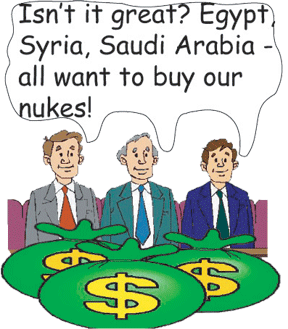
  Facing the Nuclear Storm Facing the Nuclear StormCountries across the Middle East are building or have already started operating their nuclear power plants. To assess how “resilient” their nuclear energy systems are, one must look at a number of important risks and factors The Cairo Review By Ali Ahmad, and Benedetta Bonometti 1 Dec 19, Soon enough, countries with nuclear power in the Middle East will have to face a storm when it comes to operating their power plants safely. That is why the focus on introducing resilient energy systems is receiving much attention in developed and developing countries alike.
Across the globe, a variety of natural and human-induced risks and threats have caused substantial disruptions to the delivery of energy services and affected millions of people. From the massive July blackout in New York City that was linked to a sweltering heat wave to the conflicts in Yemen, Libya, and Syria that have caused power outages and severe damage to power generation and transmission, the need for resilient energy infrastructure is becoming more relevant than ever.
Energy resilience remains an evolving concept, but for now, it can be understood as the ability of an energy system to adapt to possible disruptive and challenging environments such as a tsunami or a heat wave, and to resume service provision swiftly. However, studies and experience have demonstrated the pivotal role that preemptive measures play when envisaging a resilient energy system. The link between energy resilience and the proposals to build nuclear energy power plants across the region lies in the scale of the region’s nuclear ambitions. Currently, there are six regional countries, including Iran, the United Arab Emirates (UAE), Egypt, Turkey, Jordan, and Saudi Arabia, which are developing nuclear power programs, with varied degrees of commitment. In a global energy landscape that is tilting toward renewable energy and an increased interest in decentralized systems, which combined together make for strong or resilient structures, one important question to ask is how the introduction of nuclear power will affect the resilience of national energy systems in these countries. This is especially important considering the exclusive set of risks associated with having a nuclear power program. Nuclear Vulnerabilities and Disruptions Pre-operation risks Nuclear power plant projects are exposed to numerous threats before they start operating. In fact, lengthy construction times, which are common in such projects, increase the probability of project cancellation before the plants start generating electricity. The years-long lead times, or in other words the time it takes to carry out financial and licensing procedures as well as construction, make nuclear projects vulnerable to financial and political risks and could lead to plant closure. The most common financial problems which arise from escalating costs and construction delays are due to either stringent licensing processes and/or project mismanagement. Moreover, other sources of energy could become cheaper and more competitive, especially as gas or oil discoveries are made more often (such as the discovery of offshore gas fields like Egypt’s Zohr). Nuclear energy programs in turn become highly sensitive political issues to the extent that a change of governments, as in the case of the so-called Arab Spring, might halt the construction of planned nuclear power plants. Fuel supply The main threat to front-end activities regarding fuel supply is the disruption of enriched uranium supply. Uranium fuel disruptions would more likely be linked to the regional political climate given that the global supply chains of uranium fuel face no major impediments. …….. Attacks against critical nuclear facilities The recent drone and missile attacks on Saudi Arabia’s ARAMCO facilities temporarily crippled its oil production, inflamed regional tensions, and sent shockwaves around the globe. Had the attack been on a nuclear power facility, the consequences could have been much more grave………. Foreign workforce …….. The involvement of foreign workers, which may be necessary when the host country lacks the required human capital to run its own nuclear power program, may raise several issues. …….. Climatic effects When thinking of possible climatic effects on the resilience of the nuclear power plants in the region, heat waves are particularly concerning due to their impact on the temperature of the reactor’s cooling water. …. Spent nuclear fuel considerations Spent nuclear fuel, in other words the irradiated (and radioactive) fuel waste generated by nuclear fission, must first cool down for a number of years in water-filled storage pools before it is ready to be handled and transported. Spent fuel pools will always be full as new spent fuel will continuously replace fuel that is removed. Consequently, various threats to the storage pools are possible. Firstly, like the case with nuclear reactors, natural disasters and extreme weather conditions could threaten the functionality of the storage pools. Secondly, spent fuel pools may also be identified as targets during armed conflicts. …… Major risks exist that show the contradiction between the development of nuclear energy in the Middle East and the emerging narrative of energy resilience. Nuclear power is not only vulnerable to climatic and nature-induced extreme events but also to attacks by state and non-state actors. The recent attacks on Saudi Arabia’s oil infrastructure are reminders that the higher the value of the target, the more critical it becomes. With nuclear power becoming a reality in the region, efforts by governments, academia, and civil society need to focus on promoting its resilient, safe, and secure operation. As a start, we need to invest in risk mitigation strategies and mechanisms as well as better emergency response and preparedness that utilize unhindered and depoliticized technical cooperation between all states in the region. Since the effects of nuclear accidents are often cross-border, even countries that do not have nuclear power programs must be part of these efforts. Ali Ahmad is the director of the Energy Policy and Security Program in the Issam Fares Institute for Public Policy and International Affairs at the American University of Beirut. Ahmad is the author of numerous journal articles on nuclear energy and security with a focus on the Middle East region. Read More
Benedetta Bonometti is a graduate student in public policy with a specialization in energy, resources, and development at Sciences Po Paris. Her research interests focus on fossil fuel and nuclear energy policies in the Middle East. Read More https://www.thecairoreview.com/essays/facing-the-nuclear-storm/
|
|
Iran warns EU that it may step back from UN nuclear watchdog
Iran threatens to step back from UN nuclear watchdog
Tehran warns it will reconsider IAEA commitments if EU states trigger possible sanctions, Guardian, Patrick Wintour Diplomatic editor, Mon 2 Dec 2019
Iran has warned it may “seriously reconsider” its commitments to the UN atomic watchdog if European parties to a nuclear deal trigger a dispute mechanism that could lead to fresh sanctions.
The speaker for the Iranian parliament, Ali Larijani, told a press conference in Tehran on Sunday: “If they use the trigger [mechanism], Iran would be forced to seriously reconsider some of its commitments to the International Atomic Energy Agency. If they think doing so is more beneficial to them, they can go ahead.”
The threat to trigger sanctions has come after the Iranian government has taken a series of deliberate steps away from the 2015 nuclear deal, which it says are intended as a reprisal for Europe’s failure to deliver on commitments to boost trade.
Iran has also been frustrated by Europe’s refusal to defy the threat of US sanctions against any European company that trades with Iran.
A mechanism known as Instex developed by Europe to sidestep sanctions received a boost at the weekend when six more EU countries said they would join. Instex is a bartering system devised to avoid the reach of the US, but Iran is less interested in the number of EU countries signed up than the fact that no deals are being made under the mechanism. A mechanism known as Instex developed by Europe to sidestep sanctions received a boost at the weekend when six more EU countries said they would join. Instex is a bartering system devised to avoid the reach of the US, but Iran is less interested in the number of EU countries signed up than the fact that no deals are being made under the mechanism……. https://www.theguardian.com/world/2019/dec/01/iran-threatens-to-step-back-from-un-nuclear-watchdog
New report on Iraqi babies, deformed due to thorium and uranium from U.S. military actions and bases
IRAQI CHILDREN BORN NEAR U.S. MILITARY BASE SHOW ELEVATED RATES OF “SERIOUS CONGENITAL DEFORMITIES,” STUDY FINDS https://theintercept.com/2019/11/25/iraq-children-birth-defects-military/ Murtaza Hussain, November 26 2019, MORE THAN A decade and a half after the 2003 U.S. invasion of Iraq, a new study found that babies are being born today with gruesome birth defects connected to the ongoing American military presence there. The report, issued by a team of independent medical researchers and published in the journal Environmental Pollution, examined congenital anomalies recorded in Iraqi babies born near Tallil Air Base, a base operated by the U.S.-led foreign military coalition. According to the study, babies showing severe birth defects — including neurological problems, congenital heart disease, and paralyzed or missing limbs — also had corresponding elevated levels of a radioactive compound known as thorium in their bodies.
The suffering of Iraqis has been particularly acute. The results of the new study added to a laundry list of negative impacts of the U.S.’s long war there to the long-term health of the country’s population. Previous studies, including some contributed by a team led by Savabieasfahani, have pointed to elevated rates of cancer, miscarriages, and radiological poisoning in places like Fallujah, where the U.S. military carried out major assaults during its occupation of the country.
SOME OF THESE negative health effects of the American war in Iraq can be put down to U.S. forces’ frequent use of munitions containing depleted uranium. Depleted uranium, a byproduct of the enriched uranium used to power nuclear reactors, makes bullets and shells more effective in destroying armored vehicles, owing to its extreme density. But it has been acknowledged to be hazardous to the environment and the long-term health of people living in places where the munitions are used.
“Uranium and thorium were the main focus of this study,” the authors note. “Epidemiological evidence is consistent with an increased risk of congenital anomalies in the offspring of persons exposed to uranium and its depleted forms.” In other words: The researchers found that the more you were around these American weapons, the more likely you were to bear children with deformities and other health problems.
In response to an outcry over its effects, the U.S. military pledged to not use depleted uranium rounds in its bombing campaigns against the Islamic State group in Iraq and Syria, but, despite this pledge, a 2017 investigation by the independent research group AirWars and Foreign Policy magazine found that the military had continued to regularly use rounds containing the toxic compound.
These depleted-uranium munitions are among the causes of hazards not only to the civilians in the foreign lands where the U.S. fights its wars, but also to American service members who took part in these conflicts. The chronic illnesses suffered by U.S. soldiers during the 1991 war in Iraq — often from exposure to uranium munitions and other toxic chemicals — have already been categorized as a condition known as “Gulf War syndrome.” The U.S. government has been less interested into the effects of the American military’s chemical footprint on Iraqis. The use of “burn pits” — toxic open-air fires used to dispose military waste — along with other contaminants has had a lasting impact on the health of current and future Iraqi generations.
Researchers conducting the latest study said that a broader study is needed to get definitive results about these health impacts. The images of babies born with defects at the hospital where the study was conducted, Bint Al-Huda Maternity Hospital, about 10 kilometers from Tallil Air Base, are gruesome and harrowing. Savabieasfahani, the lead researcher, said that without an effort by the U.S. military to clean up its radioactive footprint, babies will continue to be born with deformities that her study and others have documented.
“The radioactive footprint of the military could be cleaned up if we had officials who wanted to do so,” said Savabieasfahani. “Unfortunately, even research into the problem of Iraqi birth defects has to be done by independent toxicologists, because the U.S. military and other institutions are not even interested in this issue.”
Entire world wants nuclear weapons-free Middle East — except for USA and Israel
US and Israel were lone votes against UN resolutions opposing space arms race, nuclear Middle East, Cuba embargo, The United States and Israel were the only countries that voted against UN General Assembly draft resolutions calling for a nuclear weapons-free Middle East, measures to stop an arms race in outer space, and an end to the blockade of Cuba. THE GRAYZONE, By Ben Norton, 11 Nov 19,
Important breakthroughs have arrived at the United Nations seeking to prevent an arms race in outer space and create a nuclear weapons-free Middle East. There are just two main obstacles: the United States and Israel.
While Washington and corporate media outlets portray China and Russia as aggressive warmongering rogue states, their votes at the UN show which nations are actually expanding dangerous militarism into new frontiers.
China and Russia joined dozens of other countries in sponsoring resolutions at the UN General Assembly (UNGA) that sought to prevent armed conflict in space. Most of the international community supported these historic peace measures. The only consistent outliers were the US and Israel.
Beijing and Moscow have been leading global efforts to stop the use of weapons in space. Meanwhile, Washington has unilaterally blocked the international consensus on preventing the deadly space race.
Moreover, as nearly all UN member states have united in calling for a Middle East free of nuclear weapons, the US and Israel have singlehandedly undermined their peace efforts.
This roguish behavior predates the election of President Donald Trump.
At the UNGA on November 7, almost every country in the world also voted to end the US embargo against Cuba. This was the 28th year in row that the international community united in calling for the American noose to be taken off the neck of the Cuban people.
While 187 member states supported the resolution demanding an end to the blockade, the US, Israel, and Brazil’s far-right government were the lone nations to oppose it. American allies Colombia and Ukraine abstained.
Washington’s UN votes show who truly is a rogue state.
Entire world wants nuclear weapons-free Middle East — except for USA and Israel
The UNGA’s First Committee, which oversees disarmament and international security, voted on November 1 to overwhelmingly approve a draft resolution entitled “Establishment of a nuclear-weapon-free zone in the region of the Middle East.”
A staggering 172 countries voted in support of this resolution. Only two nations voted against it: the US and Israel. Just two more countries abstained: the United Kingdom and Cameroon.
At the same meeting, the First Committee approved a draft resolution on “The risk of nuclear proliferation in the Middle East,” which called for the region to abide by the Treaty on the Non-Proliferation of Nuclear Weapons (NPT).
Given Israel is the only country in the Middle East with nuclear weapons, the UNGA resolution called on Tel Aviv to join the NPT (Israel has long refused to sign the treaty), and demanded that Israeli nuclear facilities be overseen by International Atomic Energy Agency (IAEA) safeguards.
The draft resolution was also overwhelmingly approved, with 151 votes in support and a mere six votes against — from the US, Israel, and Canada, along with the tiny island nations of Palau, Micronesia, and the Marshall Islands, which function as vassals of Washington at the UN.
American and Israeli votes against resolutions to prevent an arms race in outer space…….https://thegrayzone.com/2019/11/08/us-israel-un-resolutions-space-arms-race-nuclear/
Iran building a second nuclear reactor at Bushehr plant
|
Iran begins constructing second nuclear reactor at Bushehr plant, Aljazeera, 10 Nov 19,
New reactor – and a third planned to be built – will each add more than 1,000 megawatts to Iran’s power grid. Iran began constructing a second nuclear reactor at its Bushehr power plant – a facility being fuelled by uranium enriched further than the limits outlined in the faltering 2015 nuclear deal with world powers.While celebrating the start of construction on Sunday, Iranian officials also condemned United States pressure campaign of sanctions that blocks Tehran from exporting its crude oil. On Sunday, trucks with spinning concrete mixers poured their slurry into the prepared base of the second reactor as journalists watched in Bushehr, some 700km (440 miles) south from Iran’s capital, Tehran. Bushehr’s working reactor stood behind it. …….https://www.aljazeera.com/news/2019/11/191110133645713.html |
U.S. renews support for foreign companies working with Iran’s nuclear program
U.S. renews support for foreign companies working with Iran’s nuclear program CBS News, 1 Nov Washington — The Trump administration is keeping alive one of the last remaining components of the 2015 Iran nuclear deal by extending sanctions waivers that allow foreign companies to work with Iran’s civilian nuclear program without U.S. penalties.
The waivers had been due to expire Tuesday but were extended by Secretary of State Mike Pompeo for another 90 days. The extensions were not announced until Thursday.
Pompeo has been a champion of President Trump’s maximum pressure campaign on Iran.
State Department spokeswoman Morgan Ortagus said the move “will help preserve oversight of Iran’s civil nuclear program, reduce proliferation risks, constrain Iran’s ability to shorten its ‘breakout time’ to a nuclear weapon, and prevent the regime from reconstituting sites for proliferation-sensitive purposes.”
Pompeo also announced new sanctions on Iran’s construction sector, which he determines to be under the control of the Iranian Revolutionary Guard Corps. The IRGC was designated earlier this year as a “foreign terrorist organization.”
Mr. Trump withdrew last year from the nuclear deal and has steadily ramped up sanctions on Iran that had been eased under the agreement. But the so-called “civilian nuclear cooperation” waivers will permit European, Russian and Chinese companies to continue to work at Iranian civilian nuclear facilities……https://www.cbsnews.com/news/u-s-renews-support-for-foreign-companies-working-with-irans-nuclear-program/
Turkey Has Long Had Nuclear Dreams
In September, Turkish President Recep Tayyip Erdogan told members of his party that it is time for his country to acquire its own nuclear bomb.
Such a move would mark a sharp break from previous obligations by Turkey, a signatory of the Nuclear Non-Proliferation Treaty, which bars non-nuclear states from acquiring nuclear weapons. But this is not the first time that Turkey—which has played host to U.S. nuclear weapons since the late 1950s—has craved its own nuclear weapons program.
As part of our Document of the Week series, Foreign Policy is posting a copy of a Sept. 26, 1966, memo describing to then-Ambassador Parker T. Hart a troubling conversation Clarence Wendel, the U.S. minerals attache at the U.S. Embassy in Ankara, had with a “reliable” Turkish scientist on Turkey’s nuclear ambitions.
The memo, one of 20 previously declassified documents on nuclear weapons in Turkey compiled this week by the National Security Archive, claims the source disclosed that officials from Turkey’s General Directorate of Mineral Research and Exploration “had been asked to cooperate with General [Refik] Tulga and Professor Omer Inonu (Professor of Physics at METU) [Middle East Technical University] in a Turkish program to develop an ‘Atomic Bomb.’”
Wendel, according to the memo, had flagged a number of developments suggesting the claim may be credible, including: “Repeated Turkish assertions that a 200 mega-watt nuclear reactor is planned for Istanbul”; the stockpiling of reserves of 300 to 600 tons of uranium in low-grade ore deposits; and the “delaying and haggling tactics of the Turkish negotiators during discussions of the extension of the bilateral agreement on peaceful uses of atomic energy which primarily concerned the transfer of safeguards responsibility from the U.S.A. to the International Atomic Energy Agency.”……..https://foreignpolicy.com/2019/11/01/turkey-long-nuclear-dreams-erdogan-bomb/
USA negotiating nuclear sales with Saudi Arabia
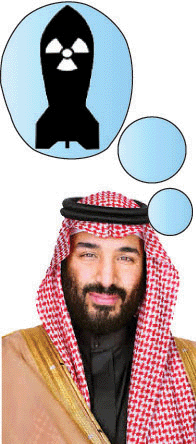 US confirms nuclear energy talks with Saudi Arabia, https://www.power-technology.com/comment/us-confirms-nuclear-energy-talks-with-saudi-arabia/ US confirms nuclear energy talks with Saudi Arabia, https://www.power-technology.com/comment/us-confirms-nuclear-energy-talks-with-saudi-arabia/
By MEED
30 Oct 19, Riyadh will have to sign an accord with Washington on the peaceful use of nuclear technology for US firms to participate in the projectA senior US official has confirmed that Washington is in talks with Riyadh about supporting Saudi Arabia’s planned nuclear programme. Speaking in Abu Dhabi on 26 October, US Energy Secretary Rick Perry Perry confirmed that talks were ongoing. Perry told the forum that Saudi Arabia’s leadership in Riyadh wanted to sign a ‘123 Agreement’ with the United States. A 123 Agreement is a section of the US’ Atomic Energy Act of 1954 that sets out rules governing US nuclear cooperation with other nations. Under the terms of a 123 Agreement, Riyadh must sign an accord with Washington committing to the peaceful use of nuclear technology before US companies can compete for its nuclear energy projects in Saudi Arabia.MEED understands the US has an existing 123 agreement with 48 countries to date. Riyadh is reported to have been unwilling to commit to a deal that would rule out the possibility of enriching uranium or reprocessing spent fuel. Saudi Arabia’s nuclear energy programme In November 2018, Saudi Arabia’s King Abdullah City for Atomic & Renewable Energy (KA-Care), the body overseeing the kingdom’s nuclear energy plans, appointed Australia’s WorleyParsons to the project management office consultancy role for the programme.
WorleyParsons will provide consultancy services including project governance, resource management, project services, training and compliance across the full scope of the large nuclear power plant (LNPP), small modular reactors and nuclear fuel cycle. WorleyParsons previously completed the LNPP site selection study for KA-Care. Riyadh is planning to develop nuclear power through a three-pronged strategy. The majority of the nuclear power capacity will be developed through conventional large-scale nuclear facilities, the first of which will be a two-reactor 2.8GW plant.
KA-Care announced in August last year that it had awarded a contract to France’s Assystem to carry out site characterisation studies, including geological surveys and environmental impact studies for the first planned project. The studies will allow Saudi Arabia to choose the most suitable site on which to build, as well as provide important technical details for the design of the project. MEED had reported in early 2018 that the kingdom was assessing two potential locations for the NPP. The two shortlisted are at Umm Huwayd and Khor Duweihin. Both can be found on the coast near the UAE and Qatari borders. The two sites were shortlisted following investigations conducted in 2011 and 2012, in accordance with sitting guidance issued by international regulatory agencies, including the International Atomic Energy Agency (IAEA) and the US Nuclear Regulatory Commission (NRC). Companies are positioning themselves for the contract to build the first nuclear power plant. In July last year, Russian state nuclear company Rosatom said it has been shortlisted to participate in the tender for Saudi Arabia’s first nuclear power plant. According to a report in the Saudi Gazette, Rosatom will be invited to participate in the upcoming tender by KA-Care. Earlier in July, South Korea’s energy ministry revealed that state utility provider Korea Electric Power Corporation (Kepco) had made the shortlist for the first Saudi nuclear power tender. In addition to developing nuclear power capacity through large scale nuclear reactors, the kingdom is also planning to develop atomic energy through a series of smaller system-integrated modular advanced reactor technology (Smart) nuclear power plants in the kingdom in partnership with South Korea. MEED reported in October last year that progress had been made with the Smart programme, and engineering work for two Smart units will be completed in November.
South Korea and Saudi Arabia have already invested more than SR487m ($129.8m) in plans for Smart nuclear reactors across the kingdom. Riyadh signed a memorandum of understanding (MoU) with South Korea in November 2016 to develop the technology. The Smart reactors are expected to have a capacity of about 100MW each. The third pillar of Saudi Arabia’s nuclear energy programme will involve mining uranium resources to fuel the plants, sources close to the kingdom’s nuclear programme have told MEED. Developing the kingdom’s mining sector is a key pillar of the Saudi Vision 2030 that was launched in April 2016.
|
|
Countries vie to market nuclear reactors to Saudi Arabia
|
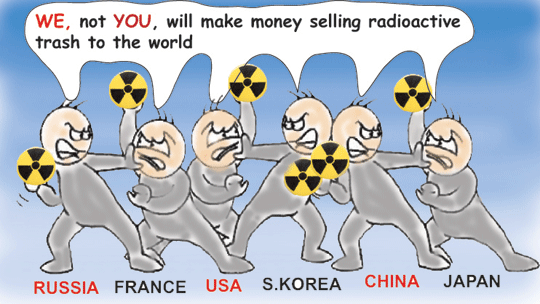
Saudi Arabia in talks with 5 vendors to build its first nuclear power reactors, https://www.spglobal.com/platts/en/market-insights/latest-news/electric-power/103019-saudi-arabia-in-talks-with-5-vendors-to-build-its-first-nuclear-power-reactors, Claudia Carpenter , Riyadh — Saudi Arabia is in talks with five vendors, including US-based Westinghouse, to build its first nuclear power plant with two reactors, according to an energy ministry presentation.The other companies in the discussions are France’s EDF, Russia’s Rosatom, South Korea’s KEPCO and China National Nuclear Corp, according to the presentation, shown Wednesday at the Future Investment Initiative conference taking place in Riyadh Saudi Arabia wants to develop a civil nuclear industry and renewable energy to free up oil burned to produce power for export.
Saudi Energy Minister Abdulaziz bin Salman has previously said the kingdom would like to enrich its own uranium resources to produce nuclear energy. However, outgoing US Secretary of Energy Rick Perry cast doubt last week on the kingdom’s ability to process that uranium because of its quality and quantity. Saudi Arabia will be the second Persian Gulf state to build nuclear plants after neighboring UAE, which is building four nuclear reactors that will collectively produce 1,400 MW of electricity. Kepco won the $20 billion contract to construct the UAE reactors, whose start-up has been delayed. |
|
1 This Month
22 June – Virtual Event –Climate Change: New Data, New Debate

Monday, June 22, 2026 2:30 p.m. – 3:15 p.m. CT
YouTube. Register here

Protect Sazan Island from the Trump family! https://secure.avaaz.org/campaign/en/protect_sazan_island_from_the_trump_family_loc/?bqFCVab&v=174511&cl=22707147157&_checksum=5e9dde668860e8231c33699735e16a1fbf22ab2cb01da50c999fe8732b9775ef&utm_source=email&utm_medium=blast_email&utm_campaign=174511

25 June- THE PUKE ON NUKES
Thursday, June 25, 2026
7pm Central Time (8pm ET, 6pm MT, 5pm PT) UTC – 5
From NRC & DOE Deregulation to Techno-Fascist Billionaires Going Nuclear, Plus a Few Songs from Atomic Cabaret REGISTER
26 June – Radiation Trainwreck at the NRC / Join the Protect Better Campaign – https://us02web.zoom.us/meeting/register/4ZlZ5_qLSHGiLSCg8FF6Bg#/registration


Cuba Is Not a Failed State – It Is a Besieged State
PETITION: “Global Appeal to Endorse Palestinian Right of Return of Refugees”
To see nuclear-related stories in greater depth and intensity – go to https://nuclearinformation.wordpress.com
-
Archives
- June 2026 (182)
- May 2026 (306)
- April 2026 (356)
- March 2026 (251)
- February 2026 (268)
- January 2026 (308)
- December 2025 (358)
- November 2025 (359)
- October 2025 (376)
- September 2025 (257)
- August 2025 (319)
- July 2025 (230)
-
Categories
- 1
- 1 NUCLEAR ISSUES
- business and costs
- climate change
- culture and arts
- ENERGY
- environment
- health
- history
- indigenous issues
- Legal
- marketing of nuclear
- media
- opposition to nuclear
- PERSONAL STORIES
- politics
- politics international
- Religion and ethics
- safety
- secrets,lies and civil liberties
- spinbuster
- technology
- Uranium
- wastes
- weapons and war
- Women
- 2 WORLD
- ACTION
- AFRICA
- Atrocities
- AUSTRALIA
- Christina's notes
- Christina's themes
- culture and arts
- Events
- Fuk 2022
- Fuk 2023
- Fukushima 2017
- Fukushima 2018
- fukushima 2019
- Fukushima 2020
- Fukushima 2021
- general
- global warming
- Humour (God we need it)
- Nuclear
- RARE EARTHS
- Reference
- resources – print
- Resources -audiovicual
- Weekly Newsletter
- World
- World Nuclear
- YouTube
-
RSS
Entries RSS
Comments RSS
 nuclear-news