U.S. Energy Secretary Rick Perry says USA and Saudi Arabia negotiating on nuclear sales
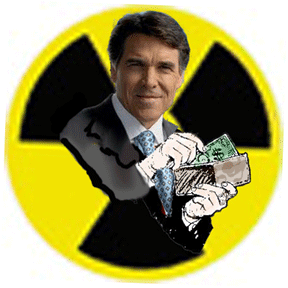 U.S. says talks progressing with Saudi on possible
 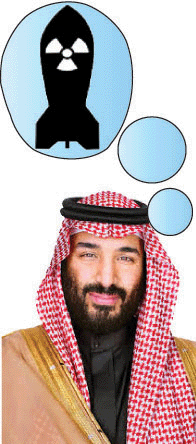 nuclear program, DUBAI (Reuters) 27 Oct 19– U.S. Energy Secretary Rick Perry said on Saturday that conversations with Saudi Arabia on a nuclear program are going forward.The world’s top oil exporter had said it wanted to use nuclear power to diversify its energy mix. It wants to go ahead with a full-cycle nuclear program, including the production and enrichment of uranium for atomic fuel.
In order for U.S. companies to compete for Saudi Arabia’s project, Riyadh would normally need to sign an accord on the peaceful use of nuclear technology with Washington.
Reuters has reported that progress on the discussions has been difficult because Saudi Arabia does not want to sign a deal that would rule out the possibility of enriching uranium or reprocessing spent fuel – both potential paths to a bomb.
“The kingdom and the leadership in the kingdom .. will find a way to sign a 1,2,3 agreement with the United States, I think,” Perry said.
Speaking at a round table in Abu Dhabi, Perry added that the United States was doing everything it could to have a ready global supply of oil…… https://www.reuters.com/article/us-uae-us-energy/us-says-talks-progressing-with-saudi-on-possible-nuclear-program-idUSKBN1X509E
Why nuclear reactors are the perfect missile target in the Middle East, or anywhere, really
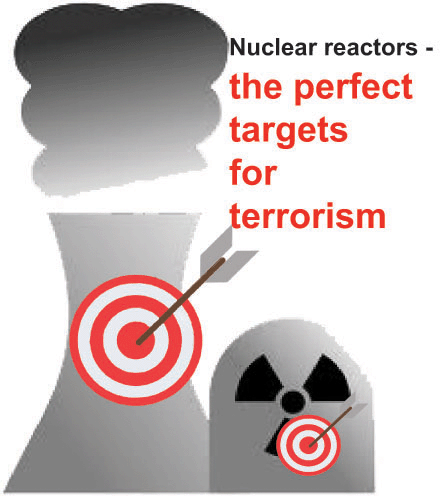
Saudi Arabia has plans to build an array of large nuclear power plants. Next door, the United Arab Emirates is spending $20 billion to complete four commercial reactors at Barakah. Egypt and Turkey both have begun constructing two massive Russian-designed nuclear power plants. Meanwhile, Iran has two operating reactors and has begun constructing two more. After Iran’s Sept. 14 missile attack against Saudi Arabia, though, all of these plants risk being wiped out.
Precision guided missiles are the reason why. Shortly after the Iranian attack on Saudi Arabia, pictures revealed each of the oil tanks struck at Abqaiq were hit in the exact same spot. The missiles’s estimated accuracy was one meter. That makes even the hardiest of large reactors easy marks. Rather than target the most protected part of the plant, the large concrete containment building covering the reactor’s core, accurate missiles can put key auxiliary reactor facilities at risk.
One such aim point is the power plant’s emergency electrical diesel generator building. Knock the generators out and you deprive the reactor of emergency backup power needed to keep its safety and coolant pump systems operating when external, grid-supplied electricity is cut off by blackouts, storms, or attacks.
Then, there are the main electrical power lines coming into the plant. Hit both of these and the emergency diesel backup generators and you rob the plant’s coolant pumps and safety systems of all power. Reactor core meltdowns and fuel fires in the reactor’s spent fuel storage pond are assured (similar to Fukushima).
Yet, another aim point is the reactor’s control room, which is often located outside the reactor’s containment walls. Knock it out and you lobotomize the plant, which again will set the reactor on a meltdown trajectory.
Finally, there’s the reactor’s spent fuel storage pond building. If it is hit and subsequently drained of coolant, the spent fuel it contains will catch fire, risking a major release of radioactivity.
How large of a release? The U.S. Nuclear Regulatory Commission estimated a spent fuel fire at a typical power plant would likely discharge 100 times as much damaging radiation as was spread in the Fukushima accident. Accordingly, the Nuclear Regulatory Commission projected a desired evacuation area more than 700 times larger than what the Fukushima accident required.
Some nuclear reactor owners recognize the risks of aerial attacks. Belarus just announced its deployment of modern air and missile defenses to counter possible military attacks against its new nuclear plant. Iran and Algeria have air-defended their reactors, as has Israel. UAE officials also have suggested they have such systems.
But will they work against the kind of high-accuracy missiles Iran fired at the Saudis? In the September attack, all 25 of the low-flying attack drones and missiles flew undetected. None of Riyadh’s air defenses (which included U.S. Patriot, German Skyguard, and French Shahine systems) engaged.
Yet, some experts doubt any current air defense system could do any better. The Pentagon’s top policy official and Israel’s prime minister were both rattled by the Saudi attack. The United States publicly warned that NATO currently can’t cope with such low-flying missiles. Israeli Prime Minister Benjamin Netanyahu called for a crash multibillion-dollar Israeli air defense development program to deal with them. Securing such defenses won’t be easy.
In the meantime, Middle Eastern states need more large reactors like a hole in the head. That goes for Iran, Turkey, Egypt, the UAE, Jordan, Morocco, and Algeria, as well as Saudi Arabia. In fact, no one in the natural gas and the sun-drenched Middle East needs nuclear power. Renewable and gas-fired electricity are much cheaper, quicker to build, and far less provocative…..https://www.washingtonexaminer.com/opinion/the-ultimate-middle-east-missile-target-nuclear-reactors
Iranians losing trust that Western countries would keep faith with a nuclear deal
By John Krzyzaniak, October 18, 2019 Almost every aspect of Iranian President Hassan Rouhani’s approach to the nuclear agreement his country made with major world powers in 2015 finds broad support among the Iranian public. Put differently, the Trump administration’s “maximum pressure” campaign has not driven a wedge between Iran’s people and its government. That’s the main takeaway from a series of national surveys conducted by the University of Maryland and IranPoll, released this week.
The Iran nuclear deal, formally known as the Joint Comprehensive Plan of Action (JCPOA), was inked in July 2015. A month later, 76 percent of the Iranian public either “strongly approved” or “somewhat approved” of the agreement. As of October 2019, that number has dropped to 42 percent, its lowest point yet.
The Trump administration withdrew from the JCPOA in May 2018, but Iran continued to hold up its end of the bargain, hoping that the Europeans would continue delivering economic relief. In May 2019, after a year of European foot-dragging, Rouhani announced that Iran would begin taking steps to decrease its commitments to the deal. The survey shows 74 percent of Iranians supported this move, making it much more popular than the wait-and-see approach had been.
Donald Trump has said that he would be willing to meet with Rouhani without preconditions to renegotiate the nuclear deal. Rouhani rebuffed this offer, saying that he would only meet once US sanctions were lifted, and then only in a multilateral forum. The survey shows an Iranian public marching in lockstep; 75 percent support talks with the Trump administration if all sanctions are lifted and if the negotiations include all of the countries originally party to the JCPOA. Absent these two conditions, only 36 percent support talks.
Iran has also resisted the US desire to negotiate a grand bargain. At the G7 meeting in France in August, Trump suggested that such a bargain might cover a longer period of time and address Iran’s ballistic missile development. But only four percent of Iranians would support extending the JCPOA’s timeline in exchange for lifting nuclear-related sanctions. Even a deal that trades extra sanctions relief for longer timelines garnered only 35 percent support.
On the issue of missiles, 92 percent of respondents said that Iran’s missile development is either “very important” or “somewhat important,” and 58 percent see the ballistic missile program as non-negotiable. Here again, this echoes the Iranian government’s long-held position.
More broadly, the JCPOA experience has left a bad taste in Iranians’ mouths. Seventy-two percent now believe that the overarching lesson of the deal is that it isn’t worthwhile for Iran to make concessions because it can’t be confident that the other side will honor an agreement.
Turkey isn’t “holding 50 US nuclear weapons ‘hostage”
|
Is Turkey Holding 50 US Nuclear Weapons ‘Hostage’? A metaphorical reference has been taken literally by some. Snopes,
the long-standing concern that some 50 nuclear weapons are stored at the U.S. air base in Incirlik, just dozens of miles from the Syrian border. Some have for years expressed concerns about the security of those weapons, citing instability in the region. …….
he potentially disastrous specter of the Turkish government taking hold of American nukes. It’s not an impossible scenario, but it’s unlikely, said Jeffrey Lewis, director of the East Asia Nonproliferation Program at the James Martin Center for Nonproliferation Studies at the Middlebury Institute of International Studies at Monterey, a private graduate school in Vermont. And describing the weapons as “hostages” is metaphorical. The weapons are not literally being held “hostage” by Erdogan in that the U.S. can take them out of Incirlik any time it chooses. “The U.S. could take them out tomorrow if they wanted,” Lewis said. But the problem is that “some people don’t want to take them out, because if they do, they’ll never be able to put them back in.” Lewis added that he doesn’t believe it would end diplomatic relations between the U.S. and Turkey if the U.S. decided to remove the weapons, although he noted it would be tricky amid the tense situation involving the Kurds. He also raised doubts about how much the Turks prioritize the weapons, noting the weapons stored at Incirlik are gravity bombs — they can only be delivered via aircraft, and no Turkish aircraft certified to deliver nuclear weapons exist. The United States also doesn’t keep an aircraft that can deliver nukes permanently parked at Incirlik, either. In other words, Lewis said, “it’s basically a storage depot.” Although it’s true there are about 50 American nuclear weapons being stored at Incirlik Air Base in Turkey, the weapons are in the possession of the U.S. military. Erdogan is not literally holding them “hostage” so much as new developments in Turkey have made it more complicated for the U.S. to move them out. However, the weapons remain under U.S. control, and as it stands, the U.S. retains the power to move them out of Turkey at will. https://www.snopes.com/fact-check/turkey-50-us-nuclear-weapons/ |
|
|
Urgent need for diplomacy with Iran
|
Both authors held high positions at the State Department in previous administrations. This month, six years ago, we were in the midst of secret talks with Iran that led to the comprehensive nuclear agreement. It was a moment when diplomacy carried considerable risk, and considerable promise. Today, the promise has faded, and the risk is accelerating. The consequences of the Trump administration’s foolish decision to abandon that nuclear deal last year, with no evidence of Iranian noncompliance, were predictable — and predicted. We are now at a very dangerous point. The story of how we got here is one of faulty expectations on both sides. Iran thought it could wait out President Trump, and the United States would simply return to the deal under a new president in 2021. But the pressure of economic sanctions, unilaterally reimposed by the United States, has been more formidable than Iran anticipated. …….. If we stay on this trajectory, we will soon go off the cliff. The policy questions debated in Washington are too often about whether or not to wear a seatbelt. Instead, we ought to put our hands back on the wheel of diplomacy and steer toward an off-ramp before it is too late. If we stay on this trajectory, we will soon go off the cliff. The policy questions debated in Washington are too often about whether or not to wear a seatbelt. Instead, we ought to put our hands back on the wheel of diplomacy and steer toward an off-ramp before it is too late. https://www.nytimes.com/2019/10/14/opinion/iran-nuclear-deal.html |
|
|
USA anxiety over its nuclear weapons stashed in Turkey
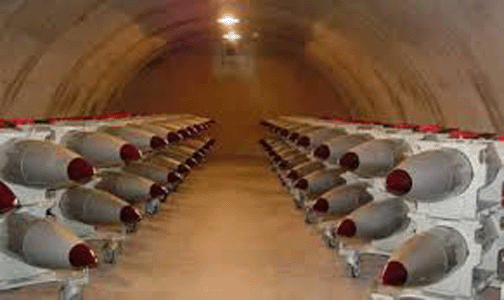
The US is rethinking the 50-plus nuclear weapons it keeps in Turkey, Quartz, By Tim Fernholz, 14 Oct 19, Turkish forces are pushing into northern Syria, replacing and sometimes even firing on the US troops retreating at Donald Trump’s orders.
The question of whether Turkey, a member of the North Atlantic Treaty Organization, is really a US ally was put to US defense secretary Mark Esper on Fox television this morning. “No, I think Turkey, the arc of their behavior over the past several years has been terrible,” he said.
Which brings up a problem: The US is storing perhaps 50 air-dropped thermonuclear bombs at its Incirlik Airbase in southern Turkey, less than 100 miles from the Syrian border where this conflict is taking place.
The nuclear stockpile dates back to the Cold War, when the US sought to keep a sufficient supply of atomic weapons deployed in Europe to deter potential Soviet aggression. Belgium, the Netherlands, Germany, and Italy also host similar arsenals, and the US trains the participating nations in the use of the doomsday devices.
Today, these bombs remain in place largely because of inertia, and the hope that countries like Turkey will see the depot as sufficient reason not to develop nuclear weapons of their own. It doesn’t seem to be working: Last month, Turkish president Recep Tayyip Erdogan said he could “not accept” efforts to prevent Turkey from developing its own atomic bombs.
But instability in Turkey and the region, along with Ankara’s close relationship with Russia, have had American strategists talking about re-locating their weapons for years. (The US does not officially discuss the arsenal, but there is no indication that the stockpile has been removed.)……..https://qz.com/1727158/us-rethinking-the-50-plus-nuclear-weapons-it-keeps-in-turkey/

Iran categorically opposes nuclear weapons – Foreign Minister Mohammad Javad Zarif
Zarif: Iran categorically opposes nuclear arms, Islamic Republic News Agency Tehran, Oct 12, IRNA – Iranian Foreign Minister Mohammad Javad Zarif in a message referred to Iranian Supreme Leader Ayatollah Seyyed Ali Khamenei’s remarks that nuclear weapons are immoral, saying Iran categorically opposes such weapons.
“#Iran’s Leader has long made it abundantly clear that nuclear weapons are immoral & contravene Islamic principles,” Zarif wrote on his Twitter account on Saturday.
“Their development, acquisition, stockpiling & use is thus forbidden,” he added.
Zarif noted: “We’re categorically opposed to nuclear arms as a religious/moral duty & strategic imperative.”
On Wednesday, Ayatollah Khamenei emphasized that making, keeping and utilizing nuclear weapons are banned according to the Islamic law, …….. https://en.irna.ir/news/83514156/Zarif-Iran-categorically-opposes-nuclear-arms
Submarine launched missiles in Israel’s probably 300 Nuclear Weapons
Israel May Have 300 Nuclear Weapons (Including Submarine-Launched Missiles) National Interest Sébastien Roblin 11 Oct 19, Israel has never officially admitted to possessing nuclear weapons.
Unofficially, Tel Aviv wants everyone to know it has them, and doesn’t hesitate to make thinly-veiled references to its willingness to use them if confronted by an existential threat. Estimates on the size of Tel Aviv’s nuclear stockpile range from 80 to 300 nuclear weapons, the latter number exceeding China’s arsenal.
To forestall such a strategy, Israeli has aggressively targeted missile and nuclear technology programs in Iraq, Syria and Iran with air raids, sabotage and assassination campaigns. However, it also has developed a second-strike capability—that is, a survivable weapon which promises certain nuclear retaliation no matter how effective an enemy’s first strike.
International Atomic Energy Agency reports improved cooperation with Iran
|
Nuclear watchdog reports improved cooperation with Iran https://thehill.com/policy/international/464352-nuclear-watchdog-reports-improved-cooperation-with-iran
BY JOHN BOWDEN – 10/04/19, The International Atomic Energy Agency (IAEA) on Friday said Iranian officials have increased their cooperation with the United Nations agency after the organization raised questions reportedly related to traces of uranium found at an undeclared site.Reuters reported that the IAEA’s acting chief said progress being made between Iran’s government and U.N. officials was a “step in the right direction.” “Some engagement is ongoing, and this engagement is currently taking place,” acting IAEA chief Cornel Feruta said, adding, “This is an ongoing process … I cannot prejudge how this is going to end. The engagement doesn’t mean that the issues are completely addressed, but it’s a step in the right direction.” The IAEA is responsible for judging whether a facility Iran’s government claims was used for carpet-cleaning was actually a secret nuclear facility as alleged by Israel’s prime minister, Benjamin Netanyahu. Iran’s government has also been accused for weeks of stonewalling IAEA inspectors attempting to examine environmental samples of the facility. The status of Iran’s nuclear program is a controversial topic and led to the Trump administration abandoning a 2015 nuclear agreement signed by the U.S. and Iran, claiming that the Iranian government had forsaken the spirit and letter of the agreement. Iran has denied that it violated the agreement prior to the U.S.’s exit, and has refused to negotiate with the Trump administration following the president’s decision. Its government has also warned European nations still bound to the deal that Iran will abandon the agreement and ramp up uranium enrichment if Iran is not allowed access to the global economy. The U.S. and Iran, meanwhile, have seen significantly increased tensions for weeks following the destruction of a U.S. surveillance drone and other attacks in the region blamed on Iranian forces, including the destruction of oil tankers and Saudi oil facilities. |
|
Iran prepared to make a new nuclear agreement with Trump
 Iran’s Zarif raises the prospect of a new nuclear agreement with Trump https://edition.cnn.com/2019/09/23/middleeast/zarif-us-talks-intl/index.html, By Tamara Qiblawi, September 23, 2019 Iran’s foreign minister outlines proposal for a new deal. New York (CNN)Iran’s foreign minister has raised the prospect of a new agreement with the United States that would see permanent sanctions relief exchanged for Tehran’s permanent denuclearization.
Israel’s duplicity about its nuclear weapons
Israel wants to keep leaders in Washington distracted and always a little off-balance, so they will end up without the bandwidth and the stamina needed to confront Israel over the continuation of colonial expansion in the lands occupied in 1967.byHelena Cobban
How is it still possible to write a lengthy article about the military/strategic dynamic among the triad of Israel, Iran, and the United States while making zero mention of Israel’s robust nuclear-weapons capability? New York Times staffers Ronen Bergman and Mark Mazzetti, and their editors at the Times magazine clearly think this is quite okay. In their recent lengthy article, “The Secret History of the Push to Strike Iran,” Bergman and Mazzetti looked at the U.S.-Israeli coalitional aspect of the past 17 years in the project to prepare for launching military or special-ops actions against Iran. They followed in the long tradition within the big corporate media of deliberately ignoring Israel’s nuclear capability, a factor that is central to any understanding of the forces at play in the Middle East and also, crucially, those at play in the U.S.-Israeli relationship.
The authors’ omission of any mention of Israel’s nuclear capabilities—and the ability these capabilities have long given to the country’s leaders to exert strong, continuing nuclear blackmail on Washington—is one serious flaw in their narrative. Another is that they seriously downplay the importance of the fact that Israel’s military is incapable, on its own, of inflicting debilitating damage on Iran’s nuclear program using only “conventional,” that is non-nuclear, weapons. (The two lacunae could perhaps be linked, as we will see below.)
Early in the article, Bergman and Mazzetti set the scene for how they see the strategic dynamic among Israel, Iran, and Washington by citing an analysis provided by Ilan Goldenberg, who was an up-and-coming Pentagon official in the Obama administration………….
A few things about the nuclear dimension of the U.S.-Israel-Iran triangle have been clear to me for a long time. One is that the longstanding refusal of most members of the U.S. political elite (officials, legislators, think-tankers, corporate media, and so on) to even mention the fact of Israel’s own nuclear-weapons capabilities and to take full account of them in public discussions of strategic matters in the Middle East is extremely harmful. Among the harms inflicted by that refusal (and by the general political clout that Israel wields in Washington) is that Israel’s longstanding ability to wield a form of nuclear blackmail against Washington—as I have written about for more than 30 years now—is never mentioned. Nor is the fact that, while Iran has been a full member of the NPT and has submitted to a full range of inspections of its nuclear research facilities for many decades now, Israel is not a member and has never been subjected to any such inspections.
(Another thing that is almost never mentioned is that all journalists based in Israel—as Bergman is—are subject to the country’s rigorous censorship system. This censorship is particularly strict regarding all military issues.)
………… so long as Iran does not break out of the NPT, Israel can quietly, behind the veil of its longstanding policy of “nuclear ambiguity”, continue to exert a form of “extreme-case” nuclear deterrence against Iran. (And to use the threat of a potential unveiling as a potent means of leverage against decision-makers in Washington.)
So why, then, do we have all the continual hullabaloo and endless navel-scratching in the Western corporate media (and the Western political system, more broadly) about the possibility—not yet anywhere close to a fact, but a possibility, some time in the future—that Iran may start to build a nuclear-weapons capability?
My conclusion is that a good part of this navel-scratching is a deliberate tactic of diversion: a way for the decision-makers in Israel and their supporters to keep leaders in Washington and elsewhere distracted and always a little off-balance, so they will end up without the bandwidth and the stamina needed confront Israel over the continuation of its project of colonial expansion in the lands occupied in 1967.
That colonial project in the West Bank (including East Jerusalem) and in Golan is what all Israeli leaders since 2001 have cared about most deeply. And they all knew that one great way to head off any efforts a U.S. president might make to challenge the project was to raise a hubbub about Iran’s alleged pursuit of nuclear weapons.
“Why do you keep talking to us about human rights or international law issues in the Palestinian territories?” was the essential message such efforts sent to decision-makers in Washington. “Stop worrying about those. We will handle them as we see fit, and you should butt out. But meantime, keep looking at all those shiny objects over there in the Iranian nuclear program! And by the way, keep your aid money flowing to our military. Otherwise, just imagine what havoc we could create for you in the Gulf…”
Turkey’s Foreign Minister explains hurdles in Turkey’s path to nuclear weapons
|
Many obstacles in Turkey’s path to nuclear weapons – Yakış, Ahval 16 Sept 19,
Several hurdles stand in the way of Turkish President Recep Tayyip Erdoğan achieving his vision of acquiring nuclear weapons, former Foreign Minister Yaşar Yakış wrote in an article for the Arab News website. Addressing businessmen earlier this month, Erdoğan said it was unacceptable for other countries to have nuclear weapons while Turkey had none, spurring observers to consider the possibility. ……. Turkey is a signatory to the nuclear Non-Proliferation Treaty, which means it has sworn not to pursue nuclear weapons. Turkey has also committed to the Nuclear Test Ban Treaty of 1996, the Missile Technology Control Regime that bars the proliferation of chemical, biological and nuclear-tipped ballistic missiles, and the Hague Code of Conduct against ballistic missile proliferation of 2002, Yakış said. “If Turkey is determined to acquire nuclear warheads, it would first have to withdraw from all these international instruments. If it acquires nuclear warheads without withdrawing from them, it will face sanctions,” said Yakış . Meanwhile, Turkey’s withdrawal from these international treaties would not entitle it to acquire nuclear warheads; it would still need to find a nuclear state willing to cooperate, according to Yakış. Additionally, Turkey has no missile capable of delivering a nuclear payload, so would either have to develop its own or find a country willing to supply one, he added. “It is still unclear whether the establishment in Turkey will follow Erdoğan’s abrupt move,” said Yakış. “But, in the long term, Erdoğan’s idea may gain traction with the public.” https://ahvalnews.com/nuclear-treaty/many-obstacles-turkeys-path-nuclear-weapons-yakis |
|
Rick Perry to Discuss Nuclear Sharing Agreement With Saudi Arabia
|
Rick Perry to Discuss Nuclear Sharing Agreement With Saudi Arabia, September 14, 2019,By
and
Energy Secretary Rick Perry said he plans to meet with Saudi Arabia’s new energy minister Monday as the U.S. remains in talks with the kingdom for a deal to construct nuclear reactors there that could help the flagging U.S. domestic nuclear industry. The Trump administration has been in talks with Saudi Arabia to forge a nuclear sharing agreement since 2017, but it has been met with increasing alarm from Congress and others concerned they could forge a deal that doesn’t prohibit the kingdom from enriching uranium….. (subscribers only) https://www.bloomberg.com/news/articles/2019-09-13/perry-to-discuss-nuclear-sharing-agreement-with-saudis-on-monday |
|
|
Saudi Arabia Plans To Enrich Uranium
Saudi Arabia Plans To Enrich Uranium For Its Nuclear Power Reactors, Isabel Togoh, Forbes Staff, 8 Sept 19
Saudi Arabia new energy minister Prince Abdulaziz bin Salman has announced the kingdom plans to enrich uranium for its future civilian nuclear power program. The move could mark the start of a race for nuclear weapons in the Gulf as attempts by the United States and European Union to strike a new deal with Iran on its nuclear plan falter. ……
Saudi’s former energy minister said in April that Riyadh’s use of the reactors would be peaceful and in compliance with “international framework governing … nuclear energy and its peaceful use.” However, the kingdom previously said it would not sign any deal that would restrict its nuclear program. The same technology used to enrich uranium for civilian reactors can also be used to produce fuel for nuclear weapons …… https://www.forbes.com/sites/isabeltogoh/2019/09/09/saudi-arabia-plans-to-enrich-uranium-for-its-nuclear-power-reactors/#5450c3415e2f
UN urges Iran to co-operate with UN regulatory agency
Time is of the essence’ in Iran co-operation: UN nuclear watchdog Channel News Asia, 8 Sept 19,
VIENNA: The acting head of the UN nuclear watchdog on Monday (Sep 9) called on Iran to “respond promptly” to the agency’s questions regarding Tehran’s nuclear programme.
Cornel Feruta was addressing the quarterly board meeting of the International Atomic Energy Agency (IAEA) a day after meeting high-level Iranian officials in Tehran.
He said that in his meetings he “stressed the need for Iran to respond promptly to Agency questions related to the completeness of Iran’s safeguards declarations”, adding: “Time is of the essence.”
Earlier Monday, the IAEA confirmed that Iran was installing advanced centrifuges, a move that puts further pressure on the troubled 2015 nuclear deal with world powers.
The IAEA’s latest statements come a day after Tehran hit out at European powers, saying they had left Iran little option but to scale back its commitments under the 2015 Joint Comprehensive Plan of Action (JCPOA)…….
Iran has said that notwithstanding its reduction of commitments under the JCPOA, it will continue to allow access to IAEA inspectors who monitor its nuclear programme……. https://www.channelnewsasia.com/news/world/-time-is-of-the-essence–in-iran-co-operation–un-nuclear-watchdog-11888270
1 This Month
22 June – Virtual Event –Climate Change: New Data, New Debate

Monday, June 22, 2026 2:30 p.m. – 3:15 p.m. CT
YouTube. Register here

Protect Sazan Island from the Trump family! https://secure.avaaz.org/campaign/en/protect_sazan_island_from_the_trump_family_loc/?bqFCVab&v=174511&cl=22707147157&_checksum=5e9dde668860e8231c33699735e16a1fbf22ab2cb01da50c999fe8732b9775ef&utm_source=email&utm_medium=blast_email&utm_campaign=174511

25 June- THE PUKE ON NUKES
Thursday, June 25, 2026
7pm Central Time (8pm ET, 6pm MT, 5pm PT) UTC – 5
From NRC & DOE Deregulation to Techno-Fascist Billionaires Going Nuclear, Plus a Few Songs from Atomic Cabaret REGISTER
26 June – Radiation Trainwreck at the NRC / Join the Protect Better Campaign – https://us02web.zoom.us/meeting/register/4ZlZ5_qLSHGiLSCg8FF6Bg#/registration


Cuba Is Not a Failed State – It Is a Besieged State
PETITION: “Global Appeal to Endorse Palestinian Right of Return of Refugees”
To see nuclear-related stories in greater depth and intensity – go to https://nuclearinformation.wordpress.com
-
Archives
- June 2026 (182)
- May 2026 (306)
- April 2026 (356)
- March 2026 (251)
- February 2026 (268)
- January 2026 (308)
- December 2025 (358)
- November 2025 (359)
- October 2025 (376)
- September 2025 (257)
- August 2025 (319)
- July 2025 (230)
-
Categories
- 1
- 1 NUCLEAR ISSUES
- business and costs
- climate change
- culture and arts
- ENERGY
- environment
- health
- history
- indigenous issues
- Legal
- marketing of nuclear
- media
- opposition to nuclear
- PERSONAL STORIES
- politics
- politics international
- Religion and ethics
- safety
- secrets,lies and civil liberties
- spinbuster
- technology
- Uranium
- wastes
- weapons and war
- Women
- 2 WORLD
- ACTION
- AFRICA
- Atrocities
- AUSTRALIA
- Christina's notes
- Christina's themes
- culture and arts
- Events
- Fuk 2022
- Fuk 2023
- Fukushima 2017
- Fukushima 2018
- fukushima 2019
- Fukushima 2020
- Fukushima 2021
- general
- global warming
- Humour (God we need it)
- Nuclear
- RARE EARTHS
- Reference
- resources – print
- Resources -audiovicual
- Weekly Newsletter
- World
- World Nuclear
- YouTube
-
RSS
Entries RSS
Comments RSS
 nuclear-news