A Ceasefire in Name Only: Gaza’s Prolonged Purgatory
2 December 2025 Dr Binoy Kampmark, https://theaimn.net/a-ceasefire-in-name-only-gazas-prolonged-purgatory/
A ceasefire can be a strange thing. The assumption, generally speaking, is that the parties to it restrain themselves for a period of time, ordering their forces and disciplining their charges from straying. But straying happens, transgressions inevitable. Some are genuine enough: silly misunderstandings, hot headed confusion, a fear that the other side has broken it. Room for error, and a degree of death and injury, is crudely permitted.
In the case of the Israel-Hamas ceasefire, transgressions have become the lingua franca of the parties, though Israel remains, by far, the perpetrator par excellence. The latter’s departures from the agreement have been so vicious as to prompt the observation that they are pursuing a mutilated reading of the agreement, essentially a “reduce fire.” The deaths of 347 Palestinians in Gaza since October 10, including 136 children, do not point to cooling restraint.
On October 28, at least 104 Palestinians were slaughtered in a single day. This might have suggested a breach so serious as to suggest a repudiation. Not so, claimed Qatari Prime Minister, Sheikh Mohammed bin Abdul Rahman Al Thani. “Fortunately,” he told a US audience, “I think the main parties – both of them [Israel and Hamas] – are acknowledging that the ceasefire should hold and they should stick to the agreement.”
What is becoming apparent is that the ceasefire has led to a state of affairs where Israeli forces have been permitted enormous latitude in the way it inflicts violence on local Gazans. The UN Women’s Chief of Humanitarian Action, Sofia Calltorp, reveals how Gazan women told her “again and again: there may be a ceasefire, but the war is not over. The attacks are fewer, but the killings continue.” Agnès Callmard, Secretary General of Amnesty International, goes so far as to declare that the ceasefire has created “a dangerous illusion that life in Gaza is returning to normal.” What has in fact happened is a mere reduction of “the scale of [Israel’s] attacks” and the meagre allowance of humanitarian aid into the Strip.
In a briefing note released on November 27, the organisation is adamant that “Israeli authorities are still committing genocide against Palestinians in the occupied Gaza Strip, by continuing to deliberately inflict conditions of life calculated to bring about their physical destruction.” Expulsions continue, prosecutions of alleged atrocities and war crimes by Israeli forces non-existent. The means to build the crucial infrastructure required to sustain life is being hampered, while unexploded ordnance, contaminated rubble and sewage, remain unaddressed.
Structural realities have also intruded. The Israeli Defense Forces remain in control of over 58% of Gaza. According to a clutch of special rapporteurs and experts in the employ of the United Nations, including Francesca Albanese, Ben Saul and Irene Khan, 40 active Israeli sites continue to operate “beyond the agreed withdrawal line, in clear breach of the ceasefire terms.” They also warn that the UN Security Council resolution authorising the deployment of an International Stabilisation Force (ISF), with Egypt and Israel coordinating border matters alongside a spanking new Palestinian trained police force “risks replicating – if not aggravating – the model of security coordination that has entrenched Israel’s settler-colonial apartheid regime in the West Bank.”
Humanitarian assistance remains at a painful trickle, an obscene state of affairs given the levelling devastation wrought by the war (85% of water and sanitation facilities were damaged or destroyed; likewise 92% of homes). The charity Oxfam does not spare any details in what is needed: “The most pressing needs include food and healthcare and shelter, as well as water, sanitation and hygiene services (WASH) including menstrual products and waste management services.” While some food and goods have become more available in local markets, they remain prohibitively expensive for Gaza’s residents.
Between October 10 and 21, seventeen international non-government organisations had essential aid shipments for Gaza, including water, food, tents, and medical supplies, blocked, with Israeli authorities claiming they were not authorised to do so. Some 99 requests by international NGOs to deliver aid were rejected, along with six requests from UN agencies. “This includes,” stated Oxfam last month, “agencies that continue to have long-standing INGO registration with Palestinian and Israeli authorities and are legally permitted to operate by the latter while new registration processes are ongoing.”
A system of brutality, practised, insistent, even casual, has been entrenched against those in Gaza and, increasingly, the West Bank. The summary execution of two men in Jenin by Israeli soldiers after their surrender was lauded by Israel’s National Security Minister, Itamar Ben-Gvir, who thought the killings the very thing “expected of them.” Implicit is the suggestion that Palestinians are required to behave in specific, tolerated ways: humbly submit to their apparently generous oppressors, suffer ceaseless purgatorial deprivation and accept a ceasefire in name only.
Outrage after footage of Israeli soldiers executing two Palestinians in Jenin goes viral.
Human rights organizations call the killing of two unarmed Palestinians in Jenin by Israeli soldiers an “extrajudicial execution.”
By Qassam Muaddi November 28, 2025, https://mondoweiss.net/2025/11/outrage-after-footage-of-israeli-soldiers-executing-two-palestinians-in-jenin-goes-viral/
The killing of two unarmed Palestinians by Israeli soldiers in the northern West Bank city of Jenin has provoked international outrage after video footage of the incident went viral on Friday. Credited to the local Palestine TV station, the footage shows two young Palestinian men surrendering to Israeli soldiers and lying on the ground in front of a garage under soldiers’ instructions. They then appear to be directed by the soldiers to go back inside the garage, where one of the troops is seen aiming and shooting at him as he lies on the ground.
The Palestinian Ministry of Health identified the victims as Muntaser Billah Abdallah, 26, and Yousef Asaasah, 37. The Palestinian Foreign Ministry condemned the killing in a statement, calling it “a war crime” and a case of “extrajudicial killing.”
The Israeli army and border police said in a joint statement on Friday that Israeli troops “operated to apprehend wanted individuals” allegedly affiliated with a resistance network in the Jenin area, and that after they exited, “fire was directed toward the suspects.”
Israeli National Security Minister Itamar Ben-Gvir, under whose jurisdiction the border police operates, voiced his “total support” for the Israeli soldiers in question, asserting that they “acted exactly as expected of them: terrorists must die.”
The footage has drawn widespread condemnation from rights groups, with Israeli human rights group B’Tselem stating that “the execution documented today is the result of an accelerated dehumanization process of Palestinians” and calling on the international community to “put an end to Israel’s impunity.”
The UN Office of the High Commissioner for Human Rights condemned the killings, saying in a statement that “killings of Palestinians by Israeli security forces and settlers in the occupied West Bank have been surging, without accountability, even in the rare cases where investigations are announced.”
A pattern of extrajudicial execution
While the latest killing in Jenin was caught on video, Palestinians have remarked that it is not an isolated incident. In 2022, the Palestinian Human Rights Association documented 38 cases of the arbitrary killing of Palestinians by Israeli forces between August 1 and November 4. Yet the number of Palestinians killed in the West Bank has sharply risen since October 2023, with at least 1,030 Palestinians killed by Israeli forces or settlers in the past two years in the West Bank.
The killing of the two Palestinians in Jenin comes two days after the Israeli army announced the launch of a new wide-scale military operation in the northern West Bank, which began with a large raid into Tubas. The operation comes almost a year after Israel’s previous “Iron Wall” offensive in the northern West Bank, during which Israeli forces displaced over 40,000 Palestinians from their homes in refugee camps in Jenin and Tulkarem.
Jenin city and its adjacent refugee camp have been at the center of Israeli military raids since late 2021, as it became the center of Palestinian armed resistance groups such as the Jenin Brigade. After October 2023, Israel launched a protracted military campaign to dismantle them.
UN Condemns ‘Brazen’ Israeli Killing of Surrendering Palestinians in West Bank
A UN official decried the incident as “yet another apparent summary execution” by Israeli forces.
Brad Reed, Nov 28, 2025, https://www.commondreams.org/news/israel-kills-surrendering-palestinians
The United Nations on Friday accused Israeli security forces of carrying out a “brazen” killing of two Palestinian men who were seen surrendering in video footage.
The footage, which was first aired by the Palestinian Broadcasting Corporation and reposted on X by Drop Site, shows two Palestinian men exiting with their hands raised from a building in the West Bank city of Jenin that had been surrounded by Israeli forces.
The two men then crawled out of the building entrance and knelt down with their hands still raised before apparently being instructed by Israeli forces to go back toward the entrance of the building. The two men did so, and were then shot dead by at least one Israeli officer.
According to France 24, United Nations rights office spokesman Jeremy Laurence told reporters on Friday that the incident was “yet another apparent summary execution” by Israeli forces.
“We are appalled at the brazen killing by Israeli border police yesterday of two Palestinian men in Jenin,” he emphasized.
Laurence added that UN rights chief Volker Turk was demanding “independent, prompt, and effective investigations into the killings of Palestinians,” and for those involved in the killings to “be held fully to account.”
The Palestinian Authority, which identified the two men killed by Israeli officers as 37-year-old Yussef Ali Asa’sa and 26-year-old Al-Muntasir Billah Mahmud Abdullah, accused Israeli forces of carrying out “brutal” executions that amounted to a “war crime.”
In a joint statement, Israeli police and the military said that the “incident is under review by the commanders on the ground, and will be transferred to the relevant professional bodies,” and they claimed that the two men killed were “wanted individuals who had carried out terror activities, including hurling explosives and firing at security forces.”
Despite pledges for a review of the incident, BBC reports that Israeli national security minister Itamar Ben-Gvir has already given a thumbs-up to officers’ actions and he responded to footage of the incident by saying, “Terrorists must die.”
How Zionism was sold to the world
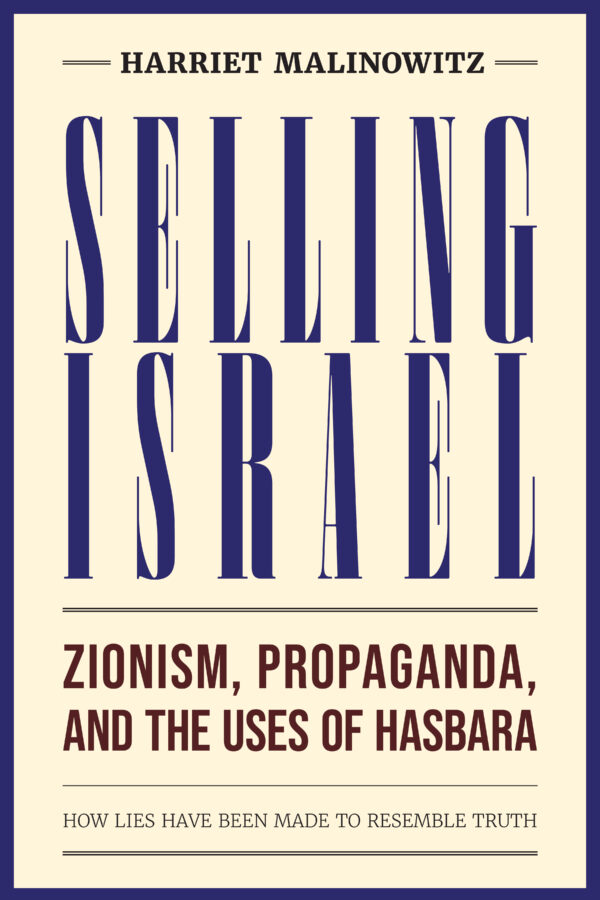
Harriet Malinowitz’s new book, “Selling Israel: Zionism, Propaganda, and the Uses of Hasbara,” reveals how Israeli propaganda and public relations promoted Zionism while concealing Palestinian oppression and dispossession.
Mondoweiss, By Eleanor J. Bader November 29, 2025
There are a number of pressing questions at the heart of Harriet Malinowitz’s newly released book, Selling Israel: Zionism, Propaganda, and the Uses of Hasbara. “How could what was initially a small group of Eastern European Jewish thinkers and activists convince the Jews of the world to agree that they were all one ‘people’ undergoing one shared threat with one shared path to salvation – as well as a shared imperative to seek it?” she asks. “How could they convince the rest of the world to include them in the family of nations? And how could they convince all involved – including themselves – that their project of liberation was a benign and noble one to which they were entitled, producing no casualties or collateral damage?”
The answers to these queries are at the crux of Selling Israel, and the book not only systematically examines them, but dives into how hasbara – globally enacted but Israeli government-instigated propaganda and public relations efforts– has been used to boost Zionism, diminish the perception of Palestinian oppression, and promote the fallacy that the 78- year-old country began as a land without people.
The exhaustively researched work was touted by Publisher’s Weekly as “an impressive and meticulous challenge to established narratives.”
Malinowitz spoke to reporter Eleanor J. Bader about herself, her research, and her findings shortly after the book’s publication.
Malinowitz………………………………………………………………………………………………………………………………………… During my own time on a kibbutz, there were Palestinian men working in the fields not far from the kibbutz members and international volunteers, but when we were all called in for a break in the “breakfast hut,” I saw that they simply kept working. I also met and drank tea with Palestinian merchants in the “shuk,” or Arab market, in Old Jerusalem, so I realized that what I’d been told about everyone in Israel being Jewish was untrue. I was told they were “Israeli Arabs” – without any coherent explanation. This left me completely baffled. Still, I was sure that I must be the one who wasn’t getting something…………………………
……………………….. I read Lenni Brenner’s 1983 book, Zionism in the Age of Dictators, which talked about Zionist complicity with Nazis. That provided another jolt.
I knew just enough to be excited by the first Intifada in 1987. But by the time of the second Intifada in 2002, people had cell phones and I could hear gunfire in Jenin via Democracy Now! on the radio. There were now blogs and listservs which carried information in new ways. But I was still naïve enough to be astounded that Israel refused to let a UN fact-finding team into the area.
This was a real turning point for me……………………………….
…………………………………… when I returned to the U.S., I plunged into research on the history of Palestine and of Zionism and eventually merged those interests with my research on propaganda, already well underway. I soon knew that I wanted to write a book on Zionism and propaganda, but it took me twenty years to complete the project!
Bader: The idea that God promised Israel to the Jews is largely unchallenged. Why is this?
Malinowitz: I think people are afraid to mess with other people’s religious beliefs, particularly where God is concerned. Plus, a lot of people believe the claim!
Bader: You write that Israelis rarely invoked the Nazi Holocaust before the 1960s because it was felt that the loss of six million Jews seemed like a sign of weakness, as if they’d gone to their deaths “like sheep to the slaughter.” Yet you also note that the genocide was seen by David Ben-Gurion to be a ‘beneficial disaster.’ Can you elaborate?
Malinowitz: I was shocked by how disparaged survivors of the Holocaust were in the country’s early years, as if they were a stain on Israeli masculinity that had to be expunged. Later, though, there was an ideological shift; the Israeli military reassured the world that they were strong, determined, and capable of fighting back if attacked, but at the same time the Holocaust could be invoked as a reminder of their perpetual victimhood, justifying all their exploits in the name of averting another genocide against the Jewish people. Similarly, the Holocaust has been used strategically when it serves international fundraising or is needed to garner empathy for Israel as an allegedly beleaguered nation.
Bader: Zionism was mostly promoted by Ashkenazi Jews who put forward the idea that there is one unified Jewish people. How did that idea spread?
Malinowitz: Zionism started out as an idea hatched by Eastern and Central European Jews, emerging in response to their own dire situation in the late nineteenth century. ………….For me, the claim that Israel represents all Jewish people is a fallacy. I, for one, was never consulted about this!
………………………………………………………………Malinowitz: Doubt can be a powerful weapon. There is a template that was developed by the tobacco industry that Zionists, climate and Holocaust deniers, Armenian genocide deniers, and others have used. The idea is there are competing narratives and both should be equally considered – rather than examining their credibility. This was why it took so long to convince the public that smoking caused cancer – because industry operatives challenged scientific expertise with their own “research,” leaving people thinking that the jury was still out and they might as well go on smoking until there was a clear and present danger. It’s been the same with Nakba denial. If the Zionists didn’t really force the Palestinians out in 1948, then they bear no responsibility for the refugees, right?
Bader: The idea that Israel is essential to Jewish survival has long been accepted as true. Why did alternatives to Zionism fail to gain traction?
…………………………………………………………………….., Zionists pushed the idea of Israel as the only solution t0 antisemitism, the only way Jews could be safe. …
…………………………………………………………………………..https://mondoweiss.net/2025/11/how-zionism-was-sold-to-the-world/
Israel is violating all its ceasefire agreements and escalating on all fronts
Israel is using existing ceasefire agreements to establish new realities on the ground, projecting itself as the regional hegemon by launching attacks on Gaza, Lebanon, Syria, and the West Bank.
By Qassam Muaddi and Mondoweiss Palestine Bureau November 28, 2025, https://mondoweiss.net/2025/11/israel-is-violating-all-its-ceasefire-agreements-and-escalating-on-all-fronts/
The war that Israel allegedly fought on “seven fronts” a year ago is supposed to be over. But Israel is now escalating on all fronts to achieve what it could not during the war, launching strikes and military incursions across Gaza, Lebanon, Syria, and the West Bank.
In Gaza, Israeli airstrikes killed over 20 Palestinians in a single day last Sunday as home demolitions have continued throughout the week; in Lebanon, Israel assassinated Hezbollah’s chief of staff, Hassan Ali Tabtabai; in the West Bank, the Israeli army has launched a wide-ranging military operation concentrated around the towns and villages of the northern Tubas governorate; and in Syria just this morning, Israel launched missile and artillery strikes in the southern Damascus countryside, killing 13 Syrians.
All of this takes place as Israel is nominally party to two ceasefires, respectively with Hezbollah and Hamas. Israel’s violation of both has become routine and has escalated significantly in recent weeks.
In Gaza, local sources tell Mondoweiss that a new status quo has emerged in which Israel continues to seize the opportunity to assassinate Hamas leaders in Gaza while claiming its actions are in response to an alleged “violation” on the part of Hamas. Israeli forces have also conducted dozens of demolitions of Palestinian buildings over the week, accompanied by shelling in eastern Gaza City, Rafah, and Khan Younis. Last Sunday, Israeli airstrikes killed over 20 Palestinians in a single day, and on the Tuesday before that, the Israeli army killed 33 Palestinians in a single night.
In all cases, the military either claims that Palestinian fighters trapped in Rafah and surrounded by Israeli forces allegedly violated the ceasefire, or it claims that Palestinian fighters approached the yellow line demarcating the area from which Israeli forces had withdrawn since the ceasefire came into effect last October.
But Israeli forces have been shooting at Palestinians near the yellow line indiscriminately, many of them trying to return to their homes in the area. The line remains invisible to most Gaza residents and can only be identified by the yellow concrete blocks Israeli forces have placed across various points, supposedly demarcating the ceasefire withdrawal borders, which effectively cut Gaza in half. The Israeli army also dropped leaflets over Palestinian encampments west of the yellow line, warning them that anyone who approaches the virtual border will expose themselves to danger.
Through these policies, the Israeli army is entrenching Gaza’s de facto division into two areas, one controlled by Hamas and the other controlled by the Israeli army. Even though this state of affairs is supposed to be temporary and linked to the “first phase” of the ceasefire, the deliberate ambiguity of the deal’s terms and the lack of an implementation mechanism make it easy for Israel to declare that Hamas is in violation of the terms — and hence refuse to withdraw further from Gaza. The effect this has had is to force almost all of the Strip’s population into less than half of its already overcrowded territory.
Meanwhile, in the West Bank, Israeli forces have launched a wide-scale military operation in the northern West Bank concentrated around the so-called “pentagon of villages” — Tubas, Tammun, Aqaba, Tayasir, and Wadi al-Fara — which the Israeli intelligence establishment considers a “hotbed” of resistance activity. Ostensibly to root out resistance in the Tubas district, local residents told Mondoweiss that the real reason for the military invasion is to thin out the population in the area, laying the groundwork for land confiscation and settlement building.
In Lebanon, the international peacekeeping forces — UNIFIL — reported last week that Israeli forces had committed around 10,000 violations of the ceasefire deal with Lebanon, including 2,500 land incursions and 7,500 airspace violations, since entering into its ceasefire with Hezbollah a year ago in November 2024. The Israeli newspaper Yediot Ahronot also reported that the Israeli army has conducted 1,200 land raids into 21 Lebanese villages over the past year.
These violations escalated significantly over recent weeks, culminating in the strike that killed Hezbollah chief of staff Tabtabai on Sunday, who is considered the highest-ranking Hezbollah member to be targeted since the ceasefire began. Following the assassination, Israel put its forces near Lebanon’s border on alert, as Hezbollah officials insinuated the possibility of a response. This series of escalations now threatens to blow up the Lebanon ceasefire.
Using ceasefires to establish realities on the ground
Both ceasefire deals in Lebanon and Gaza were only made possible after long months of mediation, in which Hezbollah and Hamas each eventually accepted terms that allowed Israel to maintain forces in their territories, without any practical guarantees that the ceasefires would be sustainable.
Yet Israel is using these truces to establish new realities on the ground, entrenching its occupation of parts of Gaza and southern Lebanon while asserting its military dominance on the regional stage. This projection of control aims to impose Israel’s vision for a “new Middle East” and a new status quo that recognizes Israel as the uncontested hegemon.
This can be gleaned in Israel’s active escalation in Syria, where Israel has tried to counter the expansion of Turkey’s influence in the country.
Israeli forces continue to position themselves in Syrian territory while conducting land raids in cities such as Quneitra and its surroundings. Last Monday, official Syrian TV reported that Israeli forces “bulldozed extensive farming areas” in the Syrian village of Breiqa in the southern part of the country. Meanwhile, on Thursday, Syrian media outlets reported that Israeli fighter jets flew over several Syrian governorates, and on the following day, an Israeli force invaded the Syrian town of Beit Jinn. When the force was reportedly uncovered, clashes between the Israeli force and Syrians reportedly led to the injury of two Israeli soldiers. According to Syrian state TV, Israeli shelling and strikes led to the killing of 13 Syrians, including at least two children.
Israeli strikes across Syrian territory have continued to become more flagrant over recent weeks, while previous strikes in Damascus in July aimed to strengthen Druze separatist elements in Suwayda. The reality on the ground Israel hopes to create is one of regional fragmentation.
In Gaza, this is manifesting in the recently declared plan to build “alternative safe communities” that would make up a “new Gaza” in the part of the Strip under Israeli control, which appears to have received U.S. backing. Earlier in July, Israeli Defense Minister Israel Katz had stated that Israel would create a “humanitarian city” built over the flattened remains of Rafah, which was supposedly meant to house 600,000 Palestinians and would be used as a pathway for Palestinians to “voluntarily migrate” out of Gaza, a plan that was characterized by UN officials and human rights experts as a “concentration camp.”
In that same month, a Reuters report revealed that the U.S.-run and Israeli-backed Gaza Humanitarian Foundation (GHF) — so-called “aid” sites meant to replace the UN’s aid distribution system, but where thousands of Palestinians were gunned down in what were described by Gazans as “death traps” — had drafted plans to create so-called “Humanitarian Transit Areas” meant to facilitate the ethnic cleansing of Palestinians from Gaza. The GHF was itself the “brainchild” of Israeli officials, the New York Times reported last May.
Now that plans for a “new Gaza” have surfaced as part of the Trump-backed ceasefire framework, new reports have begun to emerge that UG Solutions, the U.S. military subcontractor that provided security for the GHF, is now recruiting for a new deployment in Gaza to run ten to 15 more aid sites during the ceasefire.
All these developments take place as Israel attempts to continue to advance its goals. In Lebanon and Syria, it is to establish itself as a regional hegemon, and in Gaza, it is to achieve during the ceasefire what it could not achieve during the war — the ethnic cleansing of Gaza under the rubric of “voluntary migration.”
Amnesty: So-Called Gaza ‘Ceasefire’ becoming Smokescreen for continued Israeli Genocide
Juan Cole11/28/2025, https://www.juancole.com/2025/11/ceasefire-smokescreen-continued.html
Ann Arbor (Informed Comment) – Amnesty International concludes that, over a month after a ceasefire was agreed upon in Gaza and all living Israeli hostages were returned, the Israeli authorities continue to pursue the textbook definition of genocide “by continuing to deliberately inflict conditions of life calculated to bring about their physical destruction.” Moreover, Israeli leaders continue openly to affirm that this course of action is intentional on their parts.
Dan Steinbock here at Informed Comment recently made a similar argument, calling what the Israelis are doing “ecocide.”
The Secretary General of Amnesty International, Agnes Calmard, observed that “Palestinians remain held within less than half of the territory of Gaza, in the areas least capable of supporting life, with humanitarian aid still severely restricted.” Amnesty says that the Israeli military continues to occupy on the order of 55% of the Gaza Strip. There has been no move to rehabilitate the farmland that has been deliberately destroyed by the Israelis over two years or rebuild livestock. The Israelis routinely shoot at Palestinian fishing boats, preventing them from harvesting protein from the sea. The report concludes, “Palestinians are left virtually totally deprived of independent access to forms of sustenance.”
Ms. Calmard warned that: “The ceasefire risks creating a dangerous illusion that life in Gaza is returning to normal. But while Israeli authorities and forces have reduced the scale of their attacks and allowed limited amounts of humanitarian aid into Gaza, the world must not be fooled. Israel’s genocide is not over.”
Amnesty observes that Israeli fighter pilots and troops have killed about 350 people in Gaza since the so-called ceasefire was trumpeted on October 9. Moreover, Israelis are deliberately obstructing the process of rebuilding “life-sustaining infrastructure.” This cruel behavior is also illegal, directly violating “multiple orders from the International Court of Justice (ICJ) for Israel to ensure that Palestinians have access to humanitarian supplies.”
Let me just say that Israeli authorities agreed as part of the ceasefire to allow 600 trucks of food and other aid into Gaza daily. It is only allowing in about 200 trucks per day, only a third of what was pledged. As a result, the World Food Program says it is only able to reach about 100,000 households with food parcels and wheat, and even then it can only get them 75% of full rations. Its target is 320,000 households or 1.6 million needy people.
Again, this is me speaking: These limitations are not natural. They are the result of deliberate Israeli policies. Israeli troops at checkpoints are deliberately slow-rolling the entry of aid into Gaza on orders from Prime Minister Benjamin Netanyahu and his extreme-right cabinet. They are restricting overall humanitarian throughput, creating “major bottlenecks, including de-prioritization of humanitarian cargo, low offloading rates, scanning capacity, and suspended
Israel is violating ceasefires in Gaza and Lebanon, and Trump is allowing it
Mitchell Plitnick, Mondoweiss, Thu, 27 Nov 2025
In recent days, Israel has dramatically escalated its violations of the ceasefire in both Gaza and Lebanon, which have been met with utter silence from the United States. Could this mean a return to the full-scale atrocities of the past two years?
According to the Merriam-Webster dictionary, the word “ceasefire” means: “a suspension of active hostilities.” The so-called “kids’ definition” is: “a temporary stopping of warfare.” That all seems clear enough.
But Israel’s definition differs significantly. They understand “ceasefire” to mean: “they cease, we fire.”
This is not news to Palestinians, Lebanese, or any of Israel’s neighbors. Much like how Israel and its supporters like to say that there was “peace” before October 7, 2023, questions of violence are always defined not by whether there is shooting or bombing but by whether Israelis are getting hit with those bullets and bombs.
When the United States imposed or brokered ceasefires between Israel and Hamas and Hezbollah, it was well understood by all that Washington would have to keep Israel on a tight leash for the agreements to hold. It was not hard to anticipate that the attention to that task would not be sustainable under Donald Trump.
Recent events have proven that to be true. Israel has never held to either ceasefire, of course. But in recent days, it has dramatically escalated its violations in both Gaza and Lebanon, and these violations have been met with utter silence from the United States.
Are we about to see a return to the full-scale atrocities in Gaza and Lebanon that became so sickeningly familiar these past two years? And why did the U.S. go to the trouble of brokering these ceasefire agreements if they were just going to let Israel destroy them so flagrantly and easily?
Above all, what is Israeli Prime Minister Benjamin Netanyahu trying to achieve, as he seems to be calling all the shots, directly or indirectly?
Israel’s aims
Israel’s goals are clear enough: endless war.
After the United Nations Security Council shamefully voted to endorse Donald Trump’s colonialist plan to impose conditions on the Palestinians as the price for stopping Israel’s full-scale genocide in Gaza, Netanyahu reactednot like a leader who had gotten what he wanted, but like a man who just saw a development he needed to prevent.
He said in a series of posts on X:
“Israel extends its hand in peace and prosperity to all of our neighbors” and calls on neighboring countries to “join us in expelling Hamas and its supporters from the region.”
Expulsion of Hamaswas not part ofTrump’s plan or the Security Council’s resolution. Netanyahu obviously added this to prick Hamas, add fuel to his efforts to undermine the Trump plan, and to toss a bone to his right flank.
Israel had never heeded the ceasefire to begin with. More than 340 overwhelmingly non-combatant Palestinians have been killed since the ceasefire was put in place, and over 15,000 more structures in Gaza have been destroyed, just as flooding, overflowing sewage, rains, and the cold weather of approaching winter start to hit the already battered population.
In just the past few days, though, Israel has killed more than 60 Palestinians in Gaza, a sign of escalation. It is no coincidence that this uptick comes on the heels of Saudi Crown Prince Muhammad Bin Salman’s (MBS) visit to Washington where he once again insisted, much to Trump’s annoyance, that if Donald Trump wanted to see a normalization deal between his kingdom and Israel, there would need to be a clear, committed path to a Palestinian state with a timeline. Whether MBS was sincere about that or not, Netanyahu has no intention of making even the slightest gesture in that direction, and the escalation in Gaza was, at least in part, his response to that part of the Trump-MBS confab.
Israel’s justifications for its attacks on Palestinians are threadbare and reflect how little Washington cares…………………………………………………………………………………………………………. https://www.sott.net/article/503226-Israel-is-violating-ceasefires-in-Gaza-and-Lebanon-and-Trump-is-allowing-it
Israel’s threat of nukes shows us who is running U.S. foreign policy.
And so what Israel is successfully doing is drawing Trump into a war with Iran which will be on a scale which no military expect could even imagine was possible………………..Worse, will be any scenario where the Israelis or the U.S. can justify using nuclear weapons if the conventional attack doesn’t quite go to plan.
Martin Jay, November 27, 2025, https://strategic-culture.su/news/2025/11/27/israels-threat-of-nukes-shows-us-who-running-us-foreign-policy/
Isn’t it a failure of both U.S. foreign policy and of Israel that a war with Iran is seen as a solution to America’s failing hegemony?
It is a long-debated subject. Whether it is the U.S. which controls Israel or the other way around. In the 70s, under President Nixon, many analysts firmly believed, despite the JFK assassination, that it was still the U.S. who called the shots and used Israel as a useful tool in the Middle East to keep a rowdy group of Arab states in check and subservient to America’s interests. But it is in recent years where we have to see if Israel has done that effectively and meticulously in America’s interests, given that most analysts agree that Israel and the U.S. are both preparing for war with Iran.
Given that Israel’s main task was to keep the region in order to serve America’s hegemony and its energy needs, one has to ask isn’t it a failure of both U.S. foreign policy and of Israel that a war with Iran is seen as a solution to America’s failing hegemony? And doesn’t this tail wagging the dog scenario show itself in the clear light once and for all?
Recently two startling revelations about Israel’s attacks on Iran in June – otherwise known as the ‘twelve-day war’ have surfaced which should worry Americans as it shows just how far this abusive relationship has become, with Israel playing the role of the spoilt child waving daddy’s pistol as its master. Former CIA whistleblower John Kiriakou and the formidable U.S. academic John Mearsheimer have both confirmed that it was Israel who basically threatened Trump that if he didn’t send ‘bunker buster’ bombs to Iran in a bid to destroy the country’s underground nuclear facilities that they, Israel, would bomb Iran with nuclear weapons. Trump rolled over of course and complied.
But this extraordinary act by Israel illustrates just how far this Nabokov-esque relationship between Lolita and her foster dad has got. To the point that world wars involving nukes is now on the table for any U.S. president who thinks he can play hardball with Israel. The twist to this story is that the bombing of Iran’s nuclear sites was not at all a success as it has become evident that the Iranians knew it was coming and moved out a lot of the nukes days beforehand. And even the bombing itself didn’t have anywhere near the impact that was expected. It was symbolic more than anything in that it sent a message to the Iranians that such an act was possible under the Trump administration.
In many ways the attack was a gift to the Iranians as it focused their minds and made them aware where they needed to improve their defensive capabilities. It was a test run and they learnt from it.
But for the Americans it certainly couldn’t be called a success.
If it were a success, even the laziest two-bit hack in Washington could arrive at the obvious question, when hostilities kick off again, why are we at war with Iran if we’ve taken out their nuclear capability?
The U.S. has been busy in recent weeks sending naval ships and preparing for air-to-air refuelling of Israel’s jets – crucial in any conflict with Iran given the distance between the two countries – which merely confirms two poignant points. Firstly, that Iran’s response the first time round had significant impact on Israel’s military arsenal (many military sites in Israel were taken out completely, barely mentioned by U.S. media); and secondly that even the U.S. had had its own stocks depleted – which is why a pause quickly came about after the twelve-days was. U.S. and Israel needed to rearm but also prepare themselves for the second phase, while Iran itself has improved its own air defences and reached out to Russia and China for rearming.
And so what Israel is successfully doing is drawing Trump into a war with Iran which will be on a scale which no military expect could even imagine was possible, given that this time around Iran is so much better prepared and that the surprise of using Azerbaijani airspace cannot be repeated. The Israelis don’t have any hit-n-run surprise tactics to rely on, which might lead some analysts to believe that a bigger, broader attack is in the making with the U.S. as a key partner rather than chief supplier. Worse, will be any scenario where the Israelis or the U.S. can justify using nuclear weapons if the conventional attack doesn’t quite go to plan. And all this under the watch of Donald Trump whose entire support base was about stopping ‘forever wars’ in the Middle East. How will he explain to his broader support base that he has nothing to do with U.S. troops being sent to their deaths in Iran, that it is Israel who controls such decisions?
Visiting bombed nuclear sites is dangerous, Iran FM says.

Nov 27, 2025, https://www.iranintl.com/en/202511276616
ran Foreign Minister Abbas Araghchi warned on Wednesday that approaching nuclear sites hit in recent strikes is unsafe and said inspections there can only resume under new security arrangements.
“It is now dangerous to approach nuclear installations because of security issues,” Araghchi told France 24 in Paris. “There are unexploded munitions, and there are also concerns regarding radioactivity and chemical contamination.”
He said inspections by the International Atomic Energy Agency continue at facilities that were not attacked, but access to damaged sites requires “a new framework and proper modalities.”
Araghchi called last week’s resolution by the IAEA’s 35-nation Board of Governors “a political and unilateral decision,” saying it ignored the reality that Iranian nuclear sites had been bombed. “If you do not include the realities on the ground, then you are committing an error,” he said.
The minister said the Cairo agreement reached earlier this year with IAEA Director General Rafael Grossi had acknowledged that conditions had changed after the attacks and that a new inspection protocol would be needed.
Further attacks possible
Asked whether more strikes could occur, Araghchi said Israel’s recent record suggested the risk remains. “The Israeli regime over the last two years has attacked seven different countries,” he said. “So it’s clear that another attack is possible.”
His comments came a day after IAEA Director General Rafael Grossi said in Manila that the agency wants to “fully reengage with Iran” to restore inspection access and verify enrichment activities. The IAEA’s 35-member Board of Governors last week passed a resolution calling on Tehran to inform it “without delay” about the status of its enriched uranium stock and sites hit in June’s strikes.
Iran condemned the vote as “illegal and unjustified,” saying it undermined the Cairo inspection accord that Grossi reached with Tehran in September through Egyptian mediation. Araghchi accused Western powers of “killing” that agreement, saying it had provided a framework for cooperation before Israel and the United States bombed enrichment facilities during the 12-day conflict in June.
No enrichment after attacks
Earlier this month, Araghchi said Iran was no longer enriching uranium at any site in the country, citing the destruction caused by the attacks. “There is no enrichment right now because our facilities — our enrichment facilities — have been attacked,” he said in response to a question from an Associated Press journalist at a conference in Tehran. “There is no undeclared nuclear enrichment in Iran. All of our facilities are under the safeguards and monitoring” of the IAEA.
Iran had previously enriched uranium up to 60% purity — just short of weapons-grade levels — after the United States withdrew from the 2015 nuclear deal in 2018. Tehran says its atomic program is entirely peaceful.
Trump Gaza Plan Condemned as ‘Concentration Camps Within a Mass Concentration Camp’

After previous plans by Israel for the mass expulsion of Palestinians, onlookers fear the proposal to house some displaced Palestinians in “compounds” they may not be allowed to leave.
Stephen Prager, Comon Dreams, Nov 26, 2025
A new Trump administration plan to put Palestinians living in the Israeli-occupied parts of Gaza into “residential compounds” is raising eyebrows among international observers, who fear it could more closely resemble a system of “concentration camps within a mass concentration camp.”
Under the current “ceasefire” agreement—which remains technically intact despite hundreds of alleged violations by Israel that have resulted in the deaths of over 300 Palestinians—Israel still occupies the eastern portion of Gaza, an area greater than 50% of the entire strip. The vast majority of the territory’s nearly 2 million inhabitants are crammed onto the other side of the yellow line into an area of roughly 60 square miles—around the size of St Louis, Missouri, or Akron, Ohio.
As Ramiz Alakbarov, the United Nations’ deputy special coordinator for the Middle East Peace Process, explained Monday at a briefing to the UN Security Council: “Two years of fighting has left almost 80% of Gaza’s 250,000 buildings damaged or destroyed. Over 1.7 million people remain displaced, many in overcrowded shelters without adequate access to water, food, or medical care.”
The New York Times reported Tuesday that the new US proposal would seek to resettle some of those Palestinians in what the Trump administration calls “Alternative Safe Communities,”on the Israeli-controlled side of the yellow line.
Based on information from US officials and European diplomats, the Timessaid these “model compounds” are envisioned as a housing option “more permanent than tent villages, but still made up of structures meant to be temporary. Each could provide housing for as many as 20,000 or 25,000 people alongside medical clinics and schools.”
The project is being led by Trump official Aryeh Lightstone, who previously served as an aide to Trump’s first envoy to Jerusalem. According to the Times: “His team includes an eclectic, fluctuating group of American diplomats, Israeli magnates and officials from the Department of Government Efficiency (DOGE)—the sweeping Washington cost-cutting effort overseen earlier this year by Elon Musk.”
The source of funding for the project remains unclear, though the cost of just one compound is estimated to run into the tens of millions. Meanwhile, the newspaper noted that even if ten of these compounds were constructed, it would be just a fraction of what is needed to provide safety and shelter to all of Gaza’s displaced people. It’s unlikely that the first structures would be complete for months.
While the Times said that “the plan could offer relief for thousands of Palestinians who have endured two years of war,” it also pointed to criticisms that it “could entrench a de facto partition of Gaza into Israeli- and Hamas-controlled zones.” Others raised concerns about whether the people of Gaza will even want to move from their homes after years or decades of resisting Israel’s occupation.
But digging deeper into the report, critics have noted troubling language. For one thing, Israeli officials have the final say over which Palestinians are allowed to enter the “compounds” and will heavily scrutinize the backgrounds of applicants, likely leading many to be blacklisted.
In one section, titled “Freedom of Movement,” the Times report noted that “some Israeli officials have argued that, for security reasons, Palestinians should only be able to move into the new compounds, not to leave them, according to officials.”
This language harkens back to a proposal earlier this year by Israeli Defense Minister Israel Katz, who called for the creation of a massive “humanitarian city” built on the ruins of Rafah that would be used as part of an “emigration plan” for hundreds of thousands of displaced Palestinians in Gaza.
Under that plan, Palestinians would have been given “security screenings” and once inside would not be allowed to leave. Humanitarian organizations, including those inside Israel, roundly condemned the plan as essentially a “concentration camp.”
Prior to that, Trump called for the people of Gaza—“all of them”—to be permanently expelled and for the US to “take over” the strip, demolish the remaining buildings, and construct what he described as the “Riviera of the Middle East.” That plan was widely described as one of ethnic cleansing.
The new plan to move Palestinians to “compounds” is raising similar concerns.
“What is it called when a military force concentrates an ethnic or religious group into compounds without the ability to leave?” asked Assal Rad, a PhD in Middle Eastern history and a fellow at the Arab Center in Washington, DC.
Sana Saeed, a senior producer for AJ+, put it more plainly: “concentration camps within a mass concentration camp.”……………………………………………
……………………………………….. there is a conspicuous lack of any clear plan for what happens to those Palestinians who continue to live outside the safe communities, warning that Israel’s security clearances could serve as a way of marking them as fair targets for even more escalated military attacks.
“Those who remain outside of the alternative communities, in the ‘red zone,’” he said, “risk being labelled ‘Hamas supporters’ and therefore ineligible for protection under Israel’s warped interpretation of international law and subject to ongoing military operations, as already seen in past days.” https://www.commondreams.org/news/trump-gaza-compounds
British military trained in Israel amid Gaza genocide
Armed forces personnel have ‘studied on educational staff courses’ since October 2023, Ministry of Defence discloses
JOHN McEVOY, DECLASSIFIED UK, 26 November 2025
British military personnel trained in Israel amid the Gaza genocide, Declassified can reveal.
The information comes in response to a parliamentary question tabled by Zarah Sultana MP.
On 18 November, Sultana asked the Ministry of Defence “whether any British armed forces officers have studied or trained at Israeli military colleges since October 2023”.
Defence minister Al Carns responded earlier today, saying: “Fewer than five British Armed Forces personnel have studied on educational staff courses in Israel since October 2023”.
It remains unclear where the troops studied or which branches of the military they came from.
But the revelation exposes a new layer of British military collaboration with Israel amid what the UN commission of inquiry has described as a genocide.
Charlie Herbert, a retired British army general, told Declassified: “It is absolutely extraordinary to think that UK military personnel have been undertaking military education or training courses in Israel over the past two years.
“Given the credible allegations of war crimes against the political and military leadership of the IDF, all such exchanges should have immediately ceased.
“It does our armed forces a huge disservice to be associated with the IDF, given the conduct of the IDF in Gaza since late 2023 and to think that we are training in Israel only adds to the accusations of UK complicity in this genocide”…………………….
Military training
The disclosure about British military officers training in Israel comes after Declassified revealed how Israeli soldiers have trained in Britain over the past two years…………………………………………………………………….. https://www.declassifieduk.org/british-military-trained-in-israel-amid-gaza-genocide/
Confronting The Media’s Gaza Group-Think
None of this would be so significant, of course, if our celebrated “free press” was, in fact, as free it claims. If it really served as a watchdog on power. If it really held the feet of the political class to the fire. If it really served as a Fourth Estate. Then the politicians would have no place to hide.
But that is not what the corporate media do. Instead, they echo and amplify the political establishment’s priorities. They are, in fact, the media wing of the establishment.
The western media’s failure to report the reality of Gaza didn’t start on 7 October 2023. It’s always been like this. Here’s why journalists won’t tell you the truth about Palestine/
Breaking free of media group-think is a scary, lonely journey. I know. I was forced to do it

16 November 2025
An audio reading of this article can be found here.]
The past two years have seen a catastrophic failure by western journalists to report properly what amounts to an undoubted genocide in Gaza. This has been a low point even by the dismal standards set by our profession, and further reason why audiences continue to distrust us in ever greater numbers.
There is a comforting argument – comforting especially for those journalists who have failed so scandalously during this period – that seeks to explain, and excuse, this failure. Israel’s exclusion of western reporters, so the claim goes, has made it impossible to determine exactly what is occurring on the ground in Gaza.
There are several obvious rejoinders to this.
First, why would any journalist give Israel the benefit of the doubt in Gaza – as we have been doing – when it is the party keeping out reporters? The media’s working assumption must be that Israel has excluded us because it has plenty to hide. The obligation must be on Israel to demonstrate that it is acting out of military necessity and proportionately. That cannot be the starting point, as it has been, of western media coverage.
When one party, Israel, denies journalists the chance to report, our default responsibility is to adopt a posture of extreme scepticism towards its claims. It is to subject those claims to intense scrutiny – all the more so when the world’s highest court has ruled that that Israel’s very presence in Gaza is as an illegal occupier, one that should have left the Palestinian territories long ago.
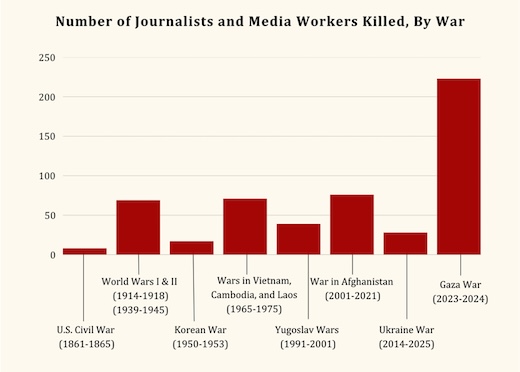
Second, and just as self-evidently, this explanation arrogantly discounts the work of hundreds of Palestinian journalists who have risked their lives to show us precisely what is happening in Gaza. It is to view their contribution, even as they are being slaughtered by Israel in unprecedented numbers, as, at best, worthless and as, at worst, Hamas propaganda. It is to breathe life into Israel’s self-serving rationalisations for murdering our colleagues – and thereby sets a precedent that normalises the targeting of journalists in the future.
It is also to treat these Palestinian journalists with the same colonial contempt demonstrated by British aristocrats a century ago, when they promised away the Palestinians’ homeland to European Jews, as if Palestine was a possession Britain was entitled to dispose of as it saw fit.
And third – and this is the issue I want to grapple with tonight – the presence of western journalists in Gaza would not have made any dramatic difference to the way the slaughter of Palestinians was presented. Audiences would still have received a sanitised version of the genocide. Failure is baked into western media coverage of Israel and Palestine. I know this firsthand from 20 years of reporting from the region.
Career suicide
When it comes to the festering wound in what was once historic Palestine, the job of western journalists is to obfuscate, equivocate, distort and excuse. It always has been. I will get to the reasons why a little later. [If you prefer, you can skip direct to that section under the subhead “Why so craven?”]
Israel has been able to get away with genocide in Gaza precisely because, for the preceding decades, the western media refused to report on – or hold Israel accountable for – its well-documented ethnic cleansing operations against Palestinians, and its brutal apartheid rule over them.
A few of our most principled journalists tried to report these things in real time. But they publicly paid a high price for doing so. Any colleagues who might have thought of following in their footsteps learnt the necessary lesson: that emulating these journalists would be career suicide.
Let me briefly document a couple of distinguished foreign correspondents in Jerusalem who were made examples of, and then provide more recent illustrations of my own run-ins with western editors………………………………………………………………………………………………….
Becoming an outcast
I only learnt of these distinguished reporters’ troubles some time after I had similar experiences covering the region as a freelance – something I did for 20 years. In my early years, I repeatedly came up against the same editorial pressures and resistance faced by Adams and Neff more than quarter of a century earlier. I felt similarly isolated, besieged, outcast – and eventually abandoned any hope of continuing to report for major western media outlets.
I submitted stories to both the Guardian – where I had previously been a staff journalist for many years – and the International Herald Tribune, now refashioned as the International New York Times.
Let me quickly illustrate an example I had with each…………………………………………………………………………………………………………………………………..
Why so craven?
The big question is why. Here is an outline of the various pressures, some practical and others structural, that keep the western media so craven towards Israel.
Partisan reporters: Historically, most publications – especially US outlets – have put Jewish reporters in charge of their Jerusalem bureaux, based on the probably correct assumption that, given Israel’s tribal political ideology of Zionism, Jewish reporters will have better access to Israeli officials. Which, in turn, tells us that these papers are chiefly interested in what Israeli sources have to say, not what Palestinians say. In truth, western media aren’t watchdogs. They don’t challenge the existing power imbalance, they reproduce it.
Many of these Jewish reporters have not hidden their deep attachment and partisanship towards Israel.
Many years ago, a Jewish journalist friend based in Jerusalem wrote to me after I first made this point public, stating: “I can think of a dozen foreign bureau chiefs, responsible for covering both Israel and the Palestinians, who have served in the Israeli army, and another dozen who like [the New York Times’ then bureau chief Ethan] Bronner have kids in the Israeli army.”
Imagine if you can, the New York Times employing a Palestinian as their Jerusalem correspondent – I know, it’s inconceivable. But not just that: employing them while the correspondent had a child working for the Palestinian Authority, or, even more fittingly, one fighting in a Fatah military brigade.
Meanwhile, the BBC openly backs its Middle East online editor, Raffi Berg, even though its own whistleblowing staff have accused him of skewing the corporation’s coverage of Israel and Palestine. Berg has not been shy in admitting his own tribal affiliation to Israel. In an interview about his “insider” book on Israel’s spy agency Mossad, Berg states that “as a Jewish person and admirer of the state of Israel” he gets “goosebumps” of pride hearing about Mossad operations.
Berg has a framed letter from Benjamin Netanyahu and a photo of himself with the former Israeli ambassador to the UK hanging on his wall at home. He counts a former senior Mossad official as a close friend. And when the journalist Owen Jones wrote a piece revealing the near-revolt of BBC staff at Berg’s role, Berg’s first thought was to seek legal help from Mark Lewis, the former head of UK Lawyers for Israel, well-known for using lawfare as a way to bully and silence critics of Israel.
Can we imagine the BBC appointing a Palestinian or Arab to that same hyper-sensitive post and then supporting them when it emerged that they had a framed letter from the assassinated Hamas political leader Ismail Haniyeh and a photo with Yasser Arafat hanging on their wall at home?
Partisan bureau staff: It is considered entirely normal for western media to employ partisan Israeli Jews as support staff. As Neff noted, they exert subtle and sometimes not so subtle pressures on correspondents to be more sympathetic towards Israeli narratives.
An investigation by Alison Weir of If Americans Knew found, for example, that in 2004 Israeli staff at the AP news agency’s bureau in Jerusalem had refused either to use or return video footage sent in by a Palestinian cameraman that showed Israeli soldiers shooting an unarmed youth in the abdomen. Instead, they destroyed the tape.
Media lobby groups: Camera and Honest Reporting operate as a pair of media sheepdogs, aggressively herding journalists into line. As I found, they can make your life very hard indeed: they can mobilise large numbers of fanatical Israel supporters to bombard publications with complaints, they can damage your credibility with your own editors, and they can alert Israeli officials to put you on a media blacklist. Most reporters see them as very dangerous organisations to cross.
Access: A general flaw in journalism’s claim to be a watchdog on power – remember, we call ourselves the Fourth Estate – is that reporters invariably need access to high-level officials, whether for stories, steers or comments. A journalist with such a source is seen by editors as far more useful, and reliable, than one without. This is true whether one’s beat is crime, politics, sport or entertainment.
However, access inevitably comes at a price – of independence. ………………………………….
Pressures from head office: Notice too that media head offices in the US and Europe are subject to another layer of lobby pressure – this time through the lobby’s association of criticism of Israel with antisemitism. Groups like the Anti-Defamation League or the Board of British Deputies are there claiming to represent local Jewish communities, who they report to be “upset”, “frightened”, “bullied” or “anxious” every time Israel is criticised.
……………………………………..The result is that the bar set for publication, if a story is critical of Israel, is far higher than it is for other regions. Just think of how readily journalists attribute atrocities in Ukraine to Russia, compared to how reticent journalists – sometime the same ones – are to identify worse crimes in Gaza as atrocities and name Israel as the responsible party.
Israeli government censorship: It is often not understood that Israel operates a military censorship system that limits what journalists can say. This is especially important given that much of what is written by Jerusalem correspondents relates to Israel’s illegal military occupation.
In its severest form, that means Israel simply refuses journalists access to certain areas, as it has done for two years in Gaza. Or it can require them to embed with the Israeli military, as the BBC has done on several occasions during the Gaza genocide. Or it can demand that journalists don’t tell important facts about what is going on.
……………………………………….Israeli government control: Israel licenses foreign correspondents by issuing them a Government Press Office card. For the past 20 years, Israel has issued the cards only to journalists formally working for a news organisation it regards as “accredited”. ………
……………………………………..Rebuilding our worldview
These practical pressures gain much of their force because journalists and editors have historically been afraid of being accused of antisemitism by Israel. It is tempting to overestimate this pressure. I suspect it is better viewed as a cover story, rationalising the failure of journalists to do their job properly – as illustrated by their reluctance to identify the Gaza genocide as a genocide.
But beyond these practical pressures, there is a deeper reason for why the western media avoid serious criticism of Israel.
Israel is integral to a continuing western colonial system of power projection into the oil-rich Middle East. Israel is the West’s ultimate client state. Western establishments need Israel protected.
None of this would be so significant, of course, if our celebrated “free press” was, in fact, as free it claims. If it really served as a watchdog on power. If it really held the feet of the political class to the fire. If it really served as a Fourth Estate. Then the politicians would have no place to hide.
But that is not what the corporate media do. Instead, they echo and amplify the political establishment’s priorities. They are, in fact, the media wing of the establishment………………………………………………………………………………………………………………………………….. https://www.jonathan-cook.net/blog/2025-11-16/media-group-scary-journey/
Over 92 Percent of Homes in Gaza Are Rubble. How Do We Even Start Rebuilding?
To resurrect Gaza, the world must reckon with the genocide. Despite the ceasefire, Israel is blocking access to cement.
By Hend Salama Abo Helow , Truthout, November 22, 2025
n the wake of the United Nations Security Council rubber-stamping Donald Trump’s plans for Gaza — including the creation of a so-called “board of peace” and a militarized “international stabilization force” — the very notion of rebuilding is slipping through the cracks, overshadowed by what is framed as the more urgent need to keep the peace in place. But peace manufactured this way is nothing but an expansion and deepening of the humanitarian crisis already unfolding.
Gaza City was already in a perpetual state of destruction and rebuilding long before the current genocide erupted. It has endured relentless aggression that reduced residential homes to rubble, wiped out entire neighborhoods, and massacred civilians. Five wars — 2008, 2012, 2014, 2021, and May 2023 — brutally dismantled Gaza’s infrastructure, economy, agriculture, education, and culture, leaving behind a consumed cycle of devastation.
Yet each time, once the bombardment stopped, reconstruction began, even if it was in a slow rhythm. Gaza would rise again — recovering, thriving even, in forms more vibrantly echoing and picturesque than before. But this genocide has unleashed an unprecedented scale of destruction, so vast and unrelenting that stumbling upon an intact home today feels like witnessing one of life’s seven miracles………………………………………………………………………………………………………….. https://truthout.org/articles/over-92-percent-of-homes-in-gaza-are-rubble-how-do-we-even-start-rebuilding/
Security Council Shamefully Grants Colonial Domination Over Palestine to the US.

The resolution incorporates Donald Trump’s “peace plan.” It grants control over Gaza to the U.S.-led “Board of Peace” and it orders the deployment of a U.S.-led occupation force called “International Stabilization Force (ISF).” Trump will oversee both colonial bodies, in collaboration with Israel. Palestinians will not be allowed to participate in their own governance.
“It is a brazen attempt to impose, by threat of continued force against a virtually defenseless population, U.S. and Israeli interests, plain and simple.”
A UN Special Rapporteur has decried the resolution as a violation of Palestinian people’s right to self-determination.
By Marjorie Cohn , Truthout, November 21, 2025
In 1947, the United Nations General Assembly committed the UN’s original sin when it partitioned Palestine to create Israel. This launched the Nakba, the ethnic cleansing of the Indigenous people, and the establishment of a settler colonial state.
Now, 78 years later, the UN Security Council has committed the UN’s second cardinal sin. It enshrined Israel’s illegal occupation of Palestinian lands, put its imprimatur on Israel’s genocide, and granted colonial control over the lives of the Palestinians to the United States, which has aided and abetted the genocide.
On November 17, 2025, the Council adopted Resolution 2803, by a vote of 13-0. Russia and China, both permanent members of the Security Council, could have vetoed it. But shamefully they abstained, ostensibly influenced by support for the resolution from several Arab and Muslim states, including Egypt, Qatar, Jordan, Saudi Arabia, and the United Arab Emirates, as well as Turkey, Indonesia, and Pakistan.
The resolution incorporates Donald Trump’s “peace plan.” It grants control over Gaza to the U.S.-led “Board of Peace” and it orders the deployment of a U.S.-led occupation force called “International Stabilization Force (ISF).” Trump will oversee both colonial bodies, in collaboration with Israel. Palestinians will not be allowed to participate in their own governance.
The Board of Peace is designed to function as a transitional administrator of Gaza. It will control all services and humanitarian aid, all ingress and egress into and out of Gaza, and will supervise the financing and reconstruction of Gaza. The resolution “underscores the importance” of humanitarian assistance but does not require the unimpeded provision of aid.
The ISF will not be a peacekeeping force. Since the Council authorized it “to use all necessary measures to carry out its mandate,” the ISF will have the power to disarm Palestinian groups, as Israel insists. There is no provision in the resolution for disarming the Israel Occupation Forces, the body that has been conducting the genocide.
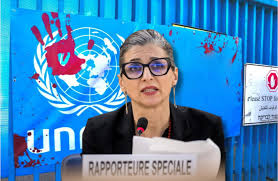
“A military force answering to a so-called ‘Board of Peace’ chaired by the President of the United States, an active party to this conflict that has continually provided military, economic and diplomatic support to the illegal occupying Power, is not legal,” said Francesca Albanese, Special Rapporteur on the situation of human rights in the Palestinian territories occupied since 1967. “It is a brazen attempt to impose, by threat of continued force against a virtually defenseless population, U.S. and Israeli interests, plain and simple.”
“Essentially, it will leave Palestine in the hands of a puppet administration, assigning the United States, which shares complicity in the genocide, as the new manager of the open-air prison that Israel has already established,” Albanese added.
Since October 2023, Israel has killed nearly 70,000 Palestinians and wounded more than 170,000. Nearly everyone in Gaza has been displaced by Israel multiple times and Gaza has largely been reduced to rubble. Israel has violated the latest ceasefire at least 393 times and killed at least 312 Palestinians since it went into effect on October 10, 2025.
In three recent cases, the International Court of Justice (ICJ) found a plausible case of genocide by Israel, that Israel’s occupation of Palestinian territory is unlawful, and that Israel has illegally used starvation of civilians as a weapon of war. The International Criminal Court issued arrest warrants for Israeli Prime Minister Benjamin Netanyahu and former Defense Minister Yoav Gallant for war crimes and crimes against humanity.
The Resolution Violates the Palestinian People’s Right to Self-Determination
The Security Council resolution violates fundamental tenets of international law including the right of the Palestinian people to self-determination. “The ICJ was clear: self-determination is an inalienable right of the Palestinian people and the UN and all States have an obligation to assist in its realization,” Albanese said…………………………………………………..
Resolution 2803 “rewards the U.S., a co-perpetrator of genocide, with control over Gaza and its potentially lucrative reconstruction process, while simultaneously relieving the Israeli regime of all of its responsibilities as an illegally occupying force,” Yara Hawari wrote in Al-Shabaka, a Palestinian-led think tank. “Palestinian participation is expected to be tightly limited and heavily conditioned. Trump’s plan confines it to ‘technocratic’ and ‘apolitical’ roles, subject to continuous external supervision and effectively excluding any representatives with democratic legitimacy or political agency.”
Hamas and other Palestinian factions rejected the resolution. They wrote in a joint statement that ISF “will turn into a type of imposed guardianship or administration — reproducing a reality that restricts the Palestinian people’s right to self-determination and to managing their own affairs.”
“Assigning the international force with tasks and roles inside the Gaza Strip, including disarming the resistance, strips it of its neutrality, and turns it into a party to the conflict in favor of the occupation,” Hamas said…………………………………………………………………………
it won’t prevent Israel from carrying out its military operations or aerial bombardments of Gaza. It may even help Israel achieve its goals.”
Uniting for Peace
……………………………………………..In adopting Resolution 2803, the Security Council did not discharge its responsibilities under the Charter to act on behalf of Palestine, a permanent observer state, which is undergoing the first live-streamed genocide in history. Nor is the Council discharging its responsibility to maintain international peace and security by memorializing an illegal occupation and an ongoing genocide.
Colombian President Gustavo Petro has declared that he will introduce a Uniting for Peace resolution in the UN General Assembly to establish a multinational protection force for Palestinians and levy sanctions and an arms blockade to end the genocide and liberate Palestine from the unlawful Israeli occupation.
In retaliation, the U.S. government has revoked Petro’s visa, imposed sanctions against him, raised punitive tariffs on Colombia, and threatened the use of military force against Colombia.
People opposed to the U.S.’s colonial takeover of Palestine can join the Boycott, Divestment, and Sanctions Movement, lobby for arms embargoes, and support accountability for Israeli and U.S. leaders responsible for perpetrating the genocide.
We must do everything within our power to stop this atrocity and support the struggle of the Palestinian people for self-determination. https://truthout.org/articles/security-council-shamefully-grants-colonial-domination-over-palestine-to-the-us/?utm_source=Truthout&utm_campaign=7ccb24ce9d-EMAIL_CAMPAIGN_2025_11_21_07_46_COPY_01&utm_medium=email&utm_term=0_bbb541a1db-09cad751f9-650192793
From Libya to Palestine: The UN’s Betrayal Of Arabs and Muslims
Dimitri Lascaris, Nov 22, 2025, https://reason2resist.substack.com/p/from-libya-to-palestine-the-uns-betrayal?utm_source=post-email-title&publication_id=2811845&post_id=179602803&utm_campaign=email-post-title&isFreemail=true&r=1ise1&triedRedirect=true&utm_medium=email
On November 17, 2025, the UN Security Council betrayed the Palestinian people by adopting a resolution that endorsed Donald Trump’s criminal and fraudulent “peace plan” for Gaza.
That resolution, Resolution 2803, is by no means the first time that the UN Security Council has stabbed Arab and Muslim peoples in the back.
Another notorious example of the Security Council’s contempt for the rights and interests of Arab and Muslim peoples is UNSC Resolution 1973.
Adopted on March 17, 2011, Security Council Resolution 1973 approved a no-fly zone over Libya. This led directly to NATO’s destruction of the once-prosperous, African country.
Few people are as knowledgeable about NATO’s destruction of Libya, and the UN Security Council’s complicity in Libya’s destruction, as Canadian researcher and author, Owen Schalk.
A new book by Owen examines the role of Canada – a NATO member – in the destruction of Libya. The book is titled “Targeting Libya – How Canada went from building public works to bombing an oil-rich country and creating chaos for its citizens.”
1 This Month

of the week – Shut Down Drone Warfare!


Tell the Ukrainian Government to Drop Prosecution of Peace Activist Yurii Sheliazhenko

Petition to revoke the licensing of the Near Surface Nuclear Disposal Facility (NSDF) at Chalk River. https://www.ourcommons.ca/petitions/en/Petition/Details?Petition=e-7247
To see nuclear-related stories in greater depth and intensity – go to https://nuclearinformation.wordpress.com
-
Archives
- April 2026 (7)
- March 2026 (251)
- February 2026 (268)
- January 2026 (308)
- December 2025 (358)
- November 2025 (359)
- October 2025 (376)
- September 2025 (257)
- August 2025 (319)
- July 2025 (230)
- June 2025 (348)
- May 2025 (261)
-
Categories
- 1
- 1 NUCLEAR ISSUES
- business and costs
- climate change
- culture and arts
- ENERGY
- environment
- health
- history
- indigenous issues
- Legal
- marketing of nuclear
- media
- opposition to nuclear
- PERSONAL STORIES
- politics
- politics international
- Religion and ethics
- safety
- secrets,lies and civil liberties
- spinbuster
- technology
- Uranium
- wastes
- weapons and war
- Women
- 2 WORLD
- ACTION
- AFRICA
- Atrocities
- AUSTRALIA
- Christina's notes
- Christina's themes
- culture and arts
- Events
- Fuk 2022
- Fuk 2023
- Fukushima 2017
- Fukushima 2018
- fukushima 2019
- Fukushima 2020
- Fukushima 2021
- general
- global warming
- Humour (God we need it)
- Nuclear
- RARE EARTHS
- Reference
- resources – print
- Resources -audiovicual
- Weekly Newsletter
- World
- World Nuclear
- YouTube
-
RSS
Entries RSS
Comments RSS
 nuclear-news