Is the Ceasefire Dead? (w/ Alastair Crooke) | The Chris Hedges Report
The US-Israeli war has heated up again as Iran launched “Operation Victory” in response to Israel’s continued attacks on Southern Lebanon and attacks on Iranian infrastructure, and the United States bombing islands in the Strait of Hormuz over the weekend. In this episode, Chris Hedges speaks with former British Diplomat Alastair Crooke of the Conflicts Forum Substack, who explains that given the failure of diplomatic negotiations, Iran has entered a new phase of the war utilizing the methodology of ‘escalatory deterrence’ in which every attack on Iran will be met with an increasingly greater response.
A change in Israel’s military strategy has occurred following the events of the 7th of October 2023. Crookes describe this as a shift away from primarily using military force to expand settlements to a focus on ‘permanent security’ — aimed at eliminating any potential threats in the region. Israel is on a mission to establish a Greater Israel by force, but this is taking a toll on the Israeli military, which is at a “point of implosion.”
Both Netanyahu and Trump have boxed themselves in with the wars on Palestine, Lebanon and Iran, generating heavy losses and little possibility of victory but no clear politically acceptable path to a resolution. Both face declining support in the polls and are likely to fare poorly in the next elections. The Likud party is fragmenting, and Crooke explains that “it’s quite possible that the machine that [Netanyahu’s] put into place over 20 and more years could implode.”
For President Trump, the outcome will be decided by what happens to the global economy as shortages of critical resources — fuel, fertilizer and industrial inputs — cause a growing crisis. “Pain is a great transformer,” states Crooke, which may lead Western allies to accept greater concessions to Iran. In the big picture, Hedges and Crooke concur that the West, with its failing institutions, is in a process of catharsis, a period of decline, which is necessary, they say, for there to be any possibility of its renewal and restoration. “This is the process we’ve got to start slowly addressing.”
Transcript………………………………………………..https://scheerpost.com/2026/06/10/is-the-ceasefire-dead-w-alastair-crooke-the-chris-hedges-report/
IAEA board passes resolution demanding Iran report uranium stocks
By Francois Murphy, June 11, 2026, Reuters
The U.N. nuclear watchdog’s 35-nation Board of Governors passed a
U.S.-backed resolution on Wednesday telling Iran to declare its remaining
enriched uranium stocks and let inspectors verify them, which could
complicate Washington’s talks with Tehran……. https://www.reuters.com/world/europe/iaea-board-passes-resolution-demanding-iran-report-uranium-stocks-diplomats-say-2026-06-10/
Lawrence Wilkerson: Israel Bet Everything on War With Iran-and Lost
Speaking with political analyst Glenn Diesen, Wilkerson contends that despite years of military escalation, sanctions, and regional conflict, Israel has failed to achieve its central objective: weakening Iran’s influence across the Middle East. Instead, he argues, the war has strengthened regional opposition, intensified global criticism of Israel’s actions in Gaza, and exposed growing cracks in America’s support for endless military intervention.
At the center of Wilkerson’s analysis is a point often ignored in Western discussions: the conflict ultimately revolves around Palestine.
“The Palestinians are still dying every day,” Wilkerson noted, arguing that military campaigns against Iran, Lebanon, and Gaza have failed to address the root political crisis driving instability throughout the region.
Highlights
• “All Iran has to do is not lose.” Wilkerson argues that Israel and the United States require a decisive victory while Iran simply needs to survive and endure.
• Palestine remains the core issue. According to Wilkerson, efforts to shift attention toward Iran, Hezbollah, or other regional actors obscure the unresolved question of Palestinian statehood.
• Growing public opposition. Wilkerson points to rising global criticism of Israel’s actions and increasing skepticism among Americans about continued military involvement abroad.
• A deeper U.S.-Israel integration. He warns that proposed legislation would further embed Israel within the U.S. military and defense establishment while reducing public oversight and accountability.
• A changing world order. Wilkerson argues that conflicts in the Middle East and Ukraine are unfolding alongside a broader shift in global power away from Western dominance and toward emerging Eurasian economic and political networks.
For Wilkerson, the danger is not simply another regional war. It is the possibility that Washington continues doubling down on military solutions while ignoring the political realities that have fueled conflict for generations. The result, he warns, could leave both Israel and the United States increasingly isolated in a rapidly changing world.
Visual data reveals extent of systematic Israeli white phosphorus attacks on south Lebanon: Report

These shells are designed to release 116 burning felt wedges that can be detonated high in the air and drift over a radius of up to 250 meters, causing widespread fires on the ground.
Lebanon’s Ministry of Environment has formally accused the Israeli military of committing ‘an act of ecocide,’ resulting in an estimated $25 billion in damages
The humanitarian risks of these munitions are devastating because white phosphorus causes horrific, deep-tissue burns that can reach the bone and may reignite if exposed to oxygen after treatment.
News Desk, JUN 7, 2026, https://thecradle.co/articles/visual-data-reveals-extent-of-systematic-israeli-white-phosphorus-attacks-on-south-lebanon-report
A report by The New York Times (NYT) published on 6 June gathers thorough documentation that the Israeli military has repeatedly deployed white phosphorus over populated areas in southern Lebanon during its ongoing war and invasion of the country.
Visual evidence collected by NYT, including verified social media footage and news coverage, shows distinctive smoke trails and airbursts over cities like Nabatieh and Tyre, as well as smaller towns like Qlayaa, Khiam, and Yohmor, with incidents documented as recently as May 2026.
While the Israeli military maintains that its use of these munitions is intended for smoke screens and complies with international law, human rights experts assert that deploying such an indiscriminate incendiary substance in civilian-heavy areas violates the laws of war.
The body of evidence gathered by numerous international observers and human rights groups is extensive and corroborates these findings.
Amnesty International’s Crisis Evidence Lab and Human Rights Watch (HRW) have verified dozens of videos and photos showing the airbursting of US-made M825A1 artillery shells.
These shells are designed to release 116 burning felt wedges that can be detonated high in the air and drift over a radius of up to 250 meters, causing widespread fires on the ground.
In Yohmor, HRW geolocated eight images from March 2026 showing these munitions exploding over residential neighborhoods, directly resulting in fires in homes and vehicles.
Similar evidence from Dhayra in October 2023 includes testimony from residents and doctors who treated nine civilians for suffocation and respiratory damage caused by the “garlic-like” smoke.
Independent researchers have now documented over 200 uses of the substance in Lebanon since October 2023, which the Lebanese government reports have caused more than 600 fires.
This pattern of use extends far beyond recent events in Lebanon; Israel has a long history of deploying white phosphorus in the region, including during the 1982 and 2006 wars in Lebanon, extensively in Gaza in 2009, and throughout its ongoing genocidal campaign since 2023.
Amnesty International documented the use of white phosphorus artillery shells in densely populated civilian areas in Gaza shortly after the launch of the war on 7 October, 2023; this deployment directly violated a 2013 pledge by the Israeli military to phase out the use of the incendiary substance in populated areas.
The humanitarian risks of these munitions are devastating because white phosphorus causes horrific, deep-tissue burns that can reach the bone and may reignite if exposed to oxygen after treatment.
Beyond the immediate physical trauma, the substance poses long-term environmental hazards by contaminating soil and water, necessitating specialized cleanup operations before farmers can safely return to their land.
Due to the indiscriminate nature of these illegal weapons, rights groups continue to call for an immediate halt to their use in residential areas.
Lebanon’s Ministry of Environment formally accused the Israeli military of committing “an act of ecocide,” back in April 2026, citing a National Council for Scientific Research report that details $25 billion in damages, including the destruction of thousands of hectares of forest and orchards alongside extreme phosphorus soil contamination in strikes conducted between 2023 and 2024.
𝐍𝐄𝐓𝐀𝐍𝐘𝐀𝐇𝐔’𝐒 𝐆𝐀𝐌𝐁𝐋𝐄 𝐖𝐈𝐓𝐇 𝐀𝐌𝐄𝐑𝐈𝐂𝐀𝐍 𝐈𝐍𝐓𝐄𝐑𝐄𝐒𝐓𝐒 𝐀𝐍𝐃 𝐒𝐎𝐋𝐃𝐈𝐄𝐑𝐒 𝐈𝐍 𝐓𝐇𝐄 𝐌𝐈𝐃𝐃𝐋𝐄 𝐄𝐀𝐒𝐓
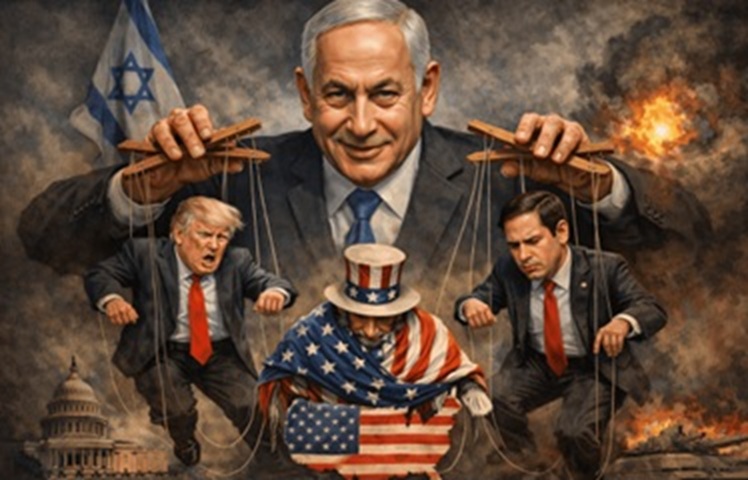
DD Geopolitics Protagonist HQ and Ibrahim Majed, Jun 09, 2026
The fragile calm that had prevailed across much of the Middle East since April, excluding the ongoing Israeli war on Lebanon, unraveled within hours, exposing a strategic reality Washington has long sought to avoid.
What began as a localized escalation rapidly evolved into a broader geo-economic crisis with consequences extending far beyond the battlefield.
At the center of the crisis lies a structural imbalance within the U.S.-Israeli relationship.
While Washington remains Israel’s principal military, diplomatic, and economic backer, recent events have highlighted the extent to which regional escalations can impose costs on the United States regardless of American preferences.
The result is a dynamic in which decisions made in Tel Aviv increasingly shape the strategic environment that Washington must manage.
𝐓𝐡𝐞 𝐄𝐬𝐜𝐚𝐥𝐚𝐭𝐢𝐨𝐧 𝐓𝐫𝐢𝐠𝐠𝐞𝐫
he latest escalation stemmed from Israel’s continued military operations in Lebanon, including renewed strikes on the southern suburbs of Beirut, despite mounting regional warnings and Iran’s explicit signaling that further escalation in Lebanese territory would cross a red line.
These actions effectively collapsed the fragile de-escalation framework that had begun to take shape in recent months.
Yet the strategic significance of the crisis did not stem solely from direct military exchanges.
The conflict quickly expanded through an asymmetric front.
Yemen’s Ansarallah movement announced a comprehensive blockade targeting Israeli-linked maritime traffic through the Bab al-Mandab Strait, transforming what might have remained a localized confrontation into a wider geo-economic challenge.
The implications were immediate.
One of the world’s most critical maritime chokepoints suddenly became a theater of strategic pressure.
Energy markets reacted rapidly, with oil prices surging as traders assessed the risks posed to global shipping routes and regional stability.
What began as a military confrontation was now exerting pressure on the economic infrastructure that underpins global commerce.
𝐓𝐡𝐞 𝐂𝐥𝐚𝐬𝐡 𝐨𝐟 𝐏𝐨𝐥𝐢𝐭𝐢𝐜𝐚𝐥 𝐓𝐢𝐦𝐞𝐥𝐢𝐧𝐞𝐬
The military escalation unfolded against the backdrop of a growing political divergence between U.S. President Donald Trump and Israeli Prime Minister Benjamin Netanyahu.
Hours before the strikes, Trump projected confidence that Washington remained firmly in control of events.
According to reports surrounding a high-level phone conversation, the American president conveyed the impression that he retained decisive influence over Israeli decision-making and could prevent a broader confrontation.
The subsequent Israeli strikes conveyed a different message.
Regardless of Washington’s preferences, events on the ground proceeded according to Israeli calculations.
The operation demonstrated the limits of American influence at a moment when the White House was attempting to contain regional tensions and preserve diplomatic channels.
More importantly, it reinforced a perception increasingly shared across the region: while the United States remains the dominant external power, its ability to dictate the behavior of key allies is not unlimited.
𝐓𝐫𝐮𝐦𝐩’𝐬 𝐄𝐥𝐞𝐜𝐭𝐨𝐫𝐚𝐥 𝐍𝐢𝐠𝐡𝐭𝐦𝐚𝐫𝐞
For the White House, the timing could hardly be worse.
The administration entered 2026 seeking to reduce regional tensions, stabilize energy markets, and avoid another Middle Eastern crisis capable of dominating domestic political discourse ahead of the Midterm Elections.
Escalation threatens all three objectives simultaneously…………………………………………………………………….
𝐍𝐞𝐭𝐚𝐧𝐲𝐚𝐡𝐮’𝐬 𝐒𝐮𝐫𝐯𝐢𝐯𝐚𝐥 𝐓𝐢𝐦𝐞𝐥𝐢𝐧𝐞
Netanyahu, however, is operating according to a very different political timetable.
His government faces mounting domestic pressures, including declining public support, growing political fragmentation, large-scale protests, and unresolved disputes surrounding the conscription of the Ultra-Orthodox community.
Current political trends suggest that a return to normal political conditions could expose the governing coalition to severe electoral risks…………………………………………..
𝐓𝐡𝐞 𝐒𝐭𝐫𝐮𝐜𝐭𝐮𝐫𝐚𝐥 𝐓𝐫𝐚𝐩
The deeper problem for Washington is that its options remain constrained.
Despite occasional public disagreements, successive American administrations have found it politically difficult to impose meaningful costs on Israel during periods of confrontation.
Congressional support, entrenched institutional relationships, domestic political considerations, and long-standing strategic commitments collectively limit the range of coercive tools available to the White House.
As a result, American policymakers frequently find themselves attempting to contain the consequences of decisions they neither initiated nor fully control.
This dynamic creates a strategic trap.
The United States absorbs the diplomatic costs of regional instability, bears responsibility for protecting maritime trade routes, manages the economic consequences of energy market disruptions, and remains expected to provide security guarantees throughout the region.
Yet its ability to shape the behavior that generates those costs remains constrained by political realities at home.
𝐓𝐡𝐞 𝐒𝐭𝐫𝐚𝐭𝐞𝐠𝐢𝐜 𝐂𝐨𝐬𝐭
The deeper danger for Washington extends far beyond the immediate crisis.
What has emerged is a growing divergence between Israeli domestic political imperatives and broader American strategic objectives………………………………………………………….
Ultimately, the central question is no longer whether the United States can continue supporting Israel.
Rather, it is whether American policymakers can reconcile unconditional strategic commitments with a regional reality in which their own interests are increasingly exposed to decisions made by an ally pursuing a very different political agenda.
If the current trajectory continues, the greatest challenge to Washington’s Middle East strategy may not emerge from its adversaries, but from the widening gap between American interests and the actions of the partner it remains committed to defending. https://ddgeopolitics.substack.com/p/75a?utm_source=post-email-title&publication_id=1769298&post_id=201184525&utm_campaign=email-post-title&isFreemail=true&r=1ise1&triedRedirect=true&utm_medium=email
‘The Humiliation Just Compounds’: Trump Tells Netanyahu Not to Bomb Iran, Then Israel Strikes Anyway

US President Donald Trump “appears unwilling to spend the political capital necessary to rein in Netanyahu—beyond angry phone calls and tough public statements,” said one analyst.
Jake Johnson, Jun 08, 2026, https://www.commondreams.org/news/trump-netanyahu-iran-2677009860
The Israeli military bombed Iran on Monday shortly after US President Donald Trump urged Israeli Prime Minister Benjamin Netanyahu not to respond to an Iranian missile barrage, which came in retaliation for Israel’s earlier bombing of Beirut.
“I am going to call Bibi right now and tell him not to retaliate,” Trump told Axios on Sunday, noting that the Iranian strikes did not appear to cause any injuries. “Each of them had their fun. Israel had its strike, and Iran had its strike. We don’t need another one.”
Iran’s missile attack on Israel was the first since a tenuous ceasefire agreement took effect in early April, and the exchange intensified concerns of a return to full-blown regional war. Iran’s Foreign Ministry said the Sunday strikes were a defensive response to the Israeli military’s bombing of southern Beirut as well as “Israel’s persistent breaches of the April ceasefire, including its collaboration with the US military in attacks on Iranian ships and targets in southern Iran over the past two weeks.”
The Israel Defense Forces vowed to “continue to operate all across Lebanon” and said it would not “allow fire toward Israel.”
Esmail Baghaei, a spokesperson for Iran’s Foreign Ministry, said during a press conference on Monday that despite Trump’s public comments, “no one in the region believes” that Israel attacked Lebanon or Iran “without prior coordination and cooperation with the United States.”
“The United States bears responsibility as a party to the April 8 ceasefire understanding,” said Baghaei. “Whatever happens in the region, whether the US itself violates the ceasefire by attacking Iranian commercial ships or targeting southern parts of the country, or whether violations are carried out through the Zionist regime in Lebanon with US complicity, the direct responsibility of the United States is clear, and the consequences of any escalation will also fall on Washington.”
Trump told the Financial Times following Iran’s missile attack on Israel that he did not believe it would undercut the prospects of a diplomatic agreement. The US president also said Netanyahu would have no choice but to accept any agreement the Trump administration reaches with Iran, declaring: “I call the shots. I call all the shots. [Netanyahu] doesn’t call the shots.”
But critics of Trump’s illegal and costly war of choice in Iran, which he launched in coordination with Israel in late February, said Netanyahu’s swift defiance of the president’s call for restraint underscored how disastrous the conflict has been for the US.
“This war has been humiliating for Trump and American power generally,” US Sen. Chris Murphy (D-Conn.) wrote on social media. “And when Trump announces he is going to call Netanyahu and tell him not to retaliate, and within hours Netanyahu retaliates, the humiliation just compounds.”
Trita Parsi, executive vice president of the Quincy Institute for Responsible Statecraft, wrote in a blog post following the Israeli attack on Iran that Trump “appears unwilling to spend the political capital necessary to rein in Netanyahu—beyond angry phone calls and tough public statements—unless he knows that he has a deal with Iran.”
“From Trump’s perspective, it is only worth doing if an agreement with Iran is already secured. In short, Trump is willing to restrain Israel to preserve a deal, but not to obtain one. Iran, however, wants evidence that Trump can restrain Israel before agreeing to a deal,” Parsi wrote. “As a result, the most likely scenario is another round of Iranian and Israeli strikes, with Trump declining to meaningfully constrain Israel.”
The National Iranian American Council noted that Iran’s leadership “has already threatened a broader and more destructive campaign” in response to Israel’s strikes.
“The coming 24 to 72 hours will likely determine whether this becomes a contained crisis or the beginning of a new phase in the regional conflict,” the group added.
FIFA, Eurovision expelled Russia but Israel has Impunity

June 8, 2026 Mohammed Samaana Informed Comment, https://scheerpost.com/2026/06/08/fifa-eurovision-expelled-russia-but-israel-has-impunity/
Hypocrisy and double standard are the words that come to mind in relation to how the west in general deals with the plight of the Palestinian people.
This is well manifested in culture and sports. Two major events this year have demonstrated just that. The first is the popular annual European singing contest Eurovision which was no different this year to any other year with Israel allowed to participate despite the ongoing genocide and ethnic cleansing against the Palestinian people in their own homeland.
Though five European countries – Spain, Ireland, Slovenia, Iceland and The Netherlands – took the higher moral ground and applied pressure by boycotting the contest in protest against Israel participation, this year’s edition of Eurovision went ahead without the participation of five European countries to ensure that Israel is present. To add insult to injury, the annual event took place at the usual time of every year when the Palestinian people mark the Nakba anniversary of their 1948 expulsion from their ancestral homeland by the Israelis. Because of its invasion and occupation of Ukraine, Russia hasn’t been allowed to participate in the Eurovision contest since 2022.
The second event is the World Cup. This year’s men football World Cup is another arena where the West is showing its hypocrisy. Russia was banned from all FIFA and UEFA soccer / football competitions in 2022 because of its illegal invasion of Ukraine and attempt to annex its territory, and the ban has become indefinite. All Russian national representative teams and club teams are prohibited from participation in global football events. Yet Israel’s deliberate assault on civilians and key infrastructure in Gaza and Lebanon is much worse than anything Russia has done, bad as it is.
We all also remember the calls to boycott the last World Cup in Qatar over allegations of human rights abuses, including LGBTQ and migrant workers rights and the environment. Given the current and previous US administration’s record on human rights home and abroad, it is only common sense to ask the logical question, where are those who called to boycott the last World Cup four years ago?
If they were concerned about human rights then why they are not concerned about Joe Biden and Donald Trump administrations’ support for the Israel genocide in Gaza where well over 72,000 Palestinians, the vast majority civilians, are confirmed dead so far as a direct result of Israeli fire without taking into consideration the missing and the ones who died indirectly as a result of the Israeli assault? This is besides Israel aggression towards other countries in the region including its destruction of Lebanon and the destitution of its civilian population after Israel grabbed land in the south of the country. This is besides Israel expansion into Syria and and its war on Iran which is more likely to have impacted every human on this planet at least financially.
Additionally, during Qatar World Cup in 2022, the German players famously took a photo covering their mouths in protest against the FIFA denying them freedom of expression. No sign of Germany’s team this year protesting against the American security oppressing protests against the genocide in Gaza on college campuses and elsewhere or for that matter their own German security forces brutality against similar protests in Germany or the German government support for the genocide.
Moreover, where is the concern about individual sexual rights in the light of the reports about sexual violence against Palestinian detainees and international peace activists who were at the Sumud (Steadfastness) flotilla after being kidnapped by Israeli soldiers at international waters. It is no wonder why the UN added Israel to the blacklist of states that uses sexual violence in conflict.
In terms of the environment, a study showed that the carbon footprint during the first 15 months of Israel ecocide war on Gaza mainly provided by the US is greater than the planet-warming emissions of a hundred countries.
Furthermore, how could any one be concerned about immigrants’ rights and overlook the brutality of the America Immigration and Customs Enforcement (ICE) officers? In 2025 alone 32 died in ICE custody. Not to forget the treatment of Palestinian human rights activist and green card holder Mahmoud Khalil and the ongoing effort to deport him
For the qualifying games to the World Cup, Israel has always played in the European groups with no concern over human rights violations whatsoever except for protests by solidarity groups and other peace activists. At club level, Israeli clubs take part in the European competitions. This applies to all sports and not only soccer / football.
It is important to point out that Israel is located in west Asia, not in Europe. This means that Europe is under no obligation to allow Israel to take part in any European sport or cultural events. But by allowing Israel participation especially when it is committing a genocide, Europe indicates it support for Israel and everything that it does which makes Europe complicit.
Any times these issues were raised, the world was told to keep politics out of sports. The same, however, didn’t apply when Russia was thrown out of every sport and cultural event over its invasion of Ukraine. Even if we were to accept their double standards by keeping politics out of sport when it comes to Israel, it is impossible to argue for keeping ethics or human rights out of sports. Those who insist on applying exceptionalism when it come to Israel know very well that they are enablers of its atrocities by allowing it to sportswash its reputation.
Mohammed Samaana , a freelance journalist published in the Belfast Telegraph, is originally from Palestine and lives in Belfast.
Media’s Ceasefire Fiction Masks Continuing War

SCHEERPOST, June 7, 2026, Joshua Scheer
One of the most revealing aspects of this war has not only been the violence itself, but the language used to explain, justify, or obscure it. As the death toll has climbed and entire communities have been erased, many journalists have struggled to confront a disturbing reality: narratives that would be unthinkable in other conflicts have become routine when discussing Gaza.
Veteran journalist Kathy Gannon reflects on how certain assumptions and talking points have seeped into media coverage, often shifting attention away from those carrying out the destruction and onto those enduring it. Her observation is less about a single comment than a broader pattern—one that raises uncomfortable questions about how suffering is framed, whose voices are amplified, and how language can become a tool for sanitizing mass violence.
“A media colleague described devastated Gazans as “under the boot of Hamas,” not under the horrific bombing of Israel, or the devastating attacks that have wiped out entire families, denied food and medical supplies, subjected to enforced starvation, all by Israel. I wondered at what it could mean. It was as if it was offered, as the reason or to somehow soften Israel’s killing of Gazans by the tens of thousands, 20,000 children killed, journalists targeted, hospitals destroyed, schools devastated. Of course there are still those in the media who say Israel isn’t targeting journalists, but rather it is just not paying enough attention, just not being careful enough. Really? Israel has killed more journalists than any other country, according to the Committee to Protect Journalists, nearly 300 have been killed, scores listed as targeted.”
Kathy Gannon Substack
What Kathy Gannon lays out is what far too many newsrooms still refuse to say plainly: there is no cease-fire when Israel continues killing civilians, journalists, and entire families in Gaza and Lebanon with total impunity. Calling this a “fragile cease-fire” is not reporting — it’s participating in a lie.
Since the so‑called Gaza cease-fire was announced, Israel has killed more than 1,000 Palestinians, many of them children. It has expanded the “yellow line”, shot civilians near it — including children — and continued bombing neighborhoods where displaced families were told to shelter. These are not “violations.” This is policy.
In Lebanon, Israel has bulldozed villages, bombed civilian areas, and assassinated three senior Lebanese military officers in a targeted strike. That alone shatters any pretense of a cease-fire. And yet Western media still repeats the script.
Meanwhile, the death toll of journalists is staggering: nearly 300 journalists killed, according to the Committee to Protect Journalists — the highest number ever recorded in a single conflict. Many were targeted, not caught in crossfire. To pretend otherwise is to launder the killing of the very people documenting the war.
Israel’s own officials flaunt this brutality. National Security Minister Itamar Ben‑Gvir — a man who has openly advocated genocide — posted video of himself abusing flotilla activists protesting the slaughter in Gaza. This is the level of impunity we’re dealing with.
International law is not ambiguous. The Fourth Geneva Convention prohibits transferring settlers into occupied territory. UN Security Council Resolution 2334 declares Israeli settlements a “flagrant violation.” Yet media outlets still describe illegal settlers as merely “seen by many as illegal,” as if the law were a matter of opinion.
Hospitals, schools, and refugee camps have been bombed in Gaza — and now in Lebanon. Israel claimed Gaza’s hospitals were targeted because of tunnels. What’s the excuse for the hospitals in Lebanon?
This is why Gannon’s warning matters: the more the world normalizes Israel’s actions, the more it signals to Palestinians and Lebanese that their lives do not matter. And the more Western governments expose their own hypocrisy — preaching human rights while enabling mass killing.
If journalism means anything, it must start with refusing to repeat government talking points. Stop calling this a cease-fire. Stop sanitizing the killing of children. Stop pretending journalists aren’t being targeted. Stop turning victims into perpetrators.
We have watched journalists be killed in staggering numbers, and the refusal of empire’s defenders to even acknowledge their deaths is not only unacceptable — it is the predictable rot of a country drifting toward tyranny, where legacy media long ago bartered away its soul.
This is not fragile. This is not complicated. This is not a cease-fire. It is a war on civilians — and the world is watching, even if CBS pretends not to.
Read more here about press freedom and Israel — though it omits the daily, mounting murders of women and children under the ongoing genocide……………………………………………………………….https://scheerpost.com/2026/06/07/medias-ceasefire-fiction-masks-continuing-war/
The Gazafication of Lebanon: How Israel Exports Destruction and Washington Protects It
7 June 2026 Dr Andrew Klein,, Australian Independent Media
Dedication: To the people of Lebanon – who have been told that their country is a “failed state” by those who worked ceaselessly to break it.
“The destruction will stop only when the silence is broken. Break it.”
On 1 March 2026, Israel launched a full-scale military offensive against Lebanon. The official rationale was self-defence: to push Hezbollah away from the border, to “demilitarize” Lebanon, and to secure the northern settlements. Within weeks, the death toll passed 3,500; 1.6 million people – roughly one‑fifth of Lebanon’s population – were displaced; hundreds of towns and villages were flattened.
The violence did not come from nowhere. It was the product of decades of Israeli military intervention, occupation, political interference, and a US‑backed policy that has systematically dismantled Lebanon’s sovereignty. The objective is not peace. It is the Gazafication of Lebanon: the imposition of a siege-and-destruction model that has already been perfected in Gaza, now exported to a second country.
This article is a comprehensive examination of the historical record, the current violence, and the geopolitical machinery that enables it. It is based on verifiable sources: official government statements, United Nations data, peer‑review
peer‑reviewed research, and on‑the‑ground reporting.
II. The Anatomy of the Current Assault
The offensive began on 2 March 2026, two days after a joint US‑Israeli attack on Iran. Hezbollah responded with rocket fire; Israel responded with a full‑scale ground and air campaign. By early June, the Lebanese health ministry had recorded more than 3,500 killed – including 711 women, children, and medical personnel – and over 10,000 wounded.
The disparity in casualties is stark:
- Israel: 24 soldiers and 4 civilians killed.
- Lebanon: Over 3,500 killed, plus 1.6 million displaced.
According to the UN, between 8 and 10 May 2026 alone, Israeli forces carried out 1,296 strikes in Lebanon, killing 87 people and wounding hundreds more – all during a supposed “ceasefire.” The United States‑brokered truce, ostensibly in place since April, has been violated by Israel on a near‑daily basis.
Evacuation orders have been issued for roughly 15% of Lebanese territory, including vast areas south of the Litani River. The military has drawn up maps for a permanent “buffer zone” that extends north of key cities such as Bint Jbeil, Aita al‑Shaab, and Khiam, reaching the Litani River and beyond.
The destruction is systematic. Human Rights Watch and the Lebanese government have documented “widespread demolitions” of entire villages, flattening of residential areas, and severe damage to schools, hospitals, mosques, and civilian infrastructure, including bridges and gas stations. One report described the operation as “the Gaza model” applied to Lebanon: mass displacement, wholesale destruction of housing stock, and the deliberate degradation of the country’s capacity to sustain life.
III. The Invention of Hezbollah: Israel’s Self‑Fulfilling Prophecy
The current violence is often presented as a war between Israel and an Iranian “proxy.” This framing ignores history. Hezbollah would not exist without Israel’s own actions.
On 6 June 1982, Israel invaded Lebanon, deploying up to 75,000 troops and advancing all the way to Beirut. The official objective was to remove the Palestine Liberation Organization (PLO), which had been launching cross‑border attacks. But the invasion quickly became an occupation, lasting 18 years in southern Lebanon.
The brutality of the invasion – the siege of Beirut, the massacres at Sabra and Shatila (carried out by Lebanese Christian militias but enabled by Israeli forces surrounding the camps), the widespread destruction – galvanised a resistance movement. In the aftermath of the invasion, Iran sent a contingent of Revolutionary Guards to the Bekaa Valley to help organise local Shi’ite militias. In 1985, these groups formally coalesced into Hezbollah – the “Party of God.”
Hezbollah was born to fight an Israeli occupation. It was not a “terrorist” group in any meaningful sense of the word; it was a national resistance movement recognised as such by a broad cross‑section of the Lebanese population. That Israel now cites Hezbollah’s existence as a justification for further violence is a grotesque circular argument: Israel invades, Hezbollah forms, Israel calls Hezbollah a “threat,” and invades again.
The pattern has repeated for over four decades. The 2006 war, which killed more than 1,100 Lebanese (mostly civilians) and devastated the country’s infrastructure, was the dress rehearsal. Today’s assault is the full performance.
IV. The “Greater Israel” Project – Not a Conspiracy, But a Policy
Statements by Israeli ministers make the objective abundantly clear: this is not about security; it is about expansion.
In March 2026, a map circulated by Israeli officials depicted a “Greater Israel” stretching from the Litani River in Lebanon to the Suez Canal in Egypt, swallowing the West Bank, Gaza, most of Lebanon, large parts of Syria, and all of Jordan.
Prime Minister Benjamin Netanyahu has repeatedly stated that the goal of the current operation is to “demilitarize Lebanon” and to establish Israeli security control over the Litani area – a demand that goes far beyond anything required for border security. In a CNBC interview on 3 June 2026, he declared: “If we want to save Lebanon, we have to disarm Hezbollah and demilitarize Lebanon.”…………………………………………………………………………………………
V. Lebanon: A State Crippled by Design
To understand why Lebanon is so vulnerable, it is necessary to understand how it was deliberately crippled.
The French Mandate (1920–1943)
Modern Lebanon was carved out of the former Ottoman Empire by the French. The French mandatory authorities institutionalised a confessional political system, distributing power among 18 officially recognised religious sects on the basis of a 1932 census that gave Christians a slight majority. This system was further codified in the unwritten National Pact of 1943, which reserved the presidency for a Maronite Christian, the prime ministership for a Sunni Muslim, and the speakership of parliament for a Shi’ite Muslim.
The confessional system was not designed to foster national unity; it was designed to make Lebanon governable by divide and rule. …………………………………………………………………………………………………………………………………………………….
VI. US Complicity – The Perpetual Enabler
Every major Israeli military operation – 1982, 2006, 2024, 2026 – has been carried out with direct US diplomatic, military, and financial backing………………………..
The current US‑brokered “ceasefire” is a farce. It has been violated by Israel almost daily. Rather than enforcing its terms, Washington has used it as a cover to continue arms shipments and diplomatic protection.
Hezbollah MP Hassan Hamade described the reality accurately: the conflict is part of a “Zionist‑US scheme” to redraw the map of the region and to incorporate Lebanon into a Greater Israel project.
VII. The Two Narratives – What They Say at Home vs. What They Tell the World
Israel consistently presents two incompatible narratives.
To its own public and to Western allies:
- The war is a defensive operation against a “terrorist” organisation (Hezbollah) that holds Lebanon hostage.
- The goal is to push Hezbollah north of the Litani River and to “demilitarize” Lebanon – a “peace” operation, not a conquest.
- The destruction of civilian infrastructure is regrettable but unavoidable, because Hezbollah “hides among civilians.
To the rest of the world (and through the actions of its ministers):
- The goal is territorial expansion, as made explicit by the “Greater Israel” maps and the statements of ministers like Ben‑Gvir and Strock.
- The objective is the permanent displacement of populations – both in Gaza and in Lebanon – to create “facts on the ground” that prevent any return.
………………………………………………………………… VIII. A Double Standard That Undermines International Law
No other state in 2026 would be permitted to behave as Israel does.
No other state’s ministers openly call for the establishment of settlements in a third country, to be populated by its own citizens.
No other state systematically occupies territory in defiance of decades of UN Security Council resolutions.
No other state issues mass evacuation orders covering a fifth of a neighbour’s population while claiming “self‑defence.”
No other state’s ministers openly call for the establishment of settlements in a third country, to be populated by its own citizens.
The international community’s response has been a masterclass in moral cowardice. The UN Security Council is paralysed by the US veto. The International Criminal Court’s investigation into Israeli officials – including Prime Minister Benjamin Netanyahu and former Defence Minister Yoav Gallant – proceeds at a glacial pace, while arrest warrants for Russian officials were issued within months………………………………………………………………………………………….
IX. The Gazafication of Lebanon – A Deliberate Export
The term “Gazafication” – the deliberate application of the Gaza model (siege, mass displacement, and wholesale infrastructure destruction) to another territory – is not hyperbole. It is an accurate description of current Israeli strategy……………………………………………………………………..
X. Conclusion: No Sovereign State Should Dictate Terms to Another
The official Israeli narrative – that this is a war against “terrorism” – collapses under the weight of the evidence.
- Israel invaded Lebanon in 1982; Hezbollah was formed to resist the occupation.
- Israel has occupied Lebanese territory for over 40 years (the Shebaa Farms, the Kfar Shuba hills).
- Israel has interfered in Lebanese politics, assassinated its leaders, and undermined its sovereignty.
- Israeli ministers openly call for the expansion of “Greater Israel” into Lebanese territory.
- The United States has protected every single Israeli violation of international law.
No sovereign state should be forced to accept that its northern river marks the boundary of a foreign power‘s “security zone.” No people should be told that their homes must be destroyed to satisfy the expansionist ambitions of a neighbour.
The “Greater Israel” project is not a fringe fantasy; it is official policy. The “buffer zone” maps have been published. The ministers have spoken. The bombs have fallen. The only question is whether the international community will continue to look away.
History will not forgive those who remained silent while a second country was systematically dismantled.
References…………………………………………. https://theaimn.net/the-gazafication-of-lebanon-how-israel-exports-destruction-and-washington-protects-it/
Chas Freeman: The Greater Israel Project Is Collapsing Under the Weight of Endless War
the greatest threat to the Greater Israel project may not be Iran, Hezbollah, or any external adversary. It may be the political consequences of the project itself.
JSCHEERPOST, June 7, 2026 ScheerPost Staff
For decades, the dream of a “Greater Israel” has been treated by its advocates as an inevitable project of regional dominance, sustained by military superiority and unwavering support from Washington. But according to former U.S. Ambassador Chas Freeman, that project may now be colliding with the limits of power itself. In a wide-ranging conversation with political scientist Glenn Diesen, Freeman argues that Israel’s wars in Gaza, Lebanon, Syria and Iran have not strengthened its strategic position but instead accelerated its diplomatic isolation, strained its military capacity and eroded the international support on which its ambitions depend.
Freeman’s assessment is stark: what was once presented as a vision of security has produced growing insecurity across the region, while leaving Israel increasingly at odds with allies, neighbors and much of the world. From the collapse of diplomacy to the widening regional fallout of war, he contends that the greatest threat facing the project of expansion may no longer be external resistance alone, but the political and moral consequences of its own actions. Whether one agrees with his conclusions or not, Freeman offers a sobering warning that the Middle East is entering a new phase—one in which old assumptions about power, alliances and American influence are rapidly unraveling.
Chas Freeman: The Greater Israel Project Is Collapsing
Decades of Expansion Have Reached a Breaking Point
For generations, advocates of a “Greater Israel” envisioned a regional order secured through overwhelming military power, territorial expansion, and unwavering American support. Today, according to former U.S. Ambassador Chas Freeman, that vision is colliding with reality.
In a wide-ranging discussion with political scientist Glenn Diesen, Freeman argued that Israel’s military campaigns across Gaza, Lebanon, Syria and Iran have not delivered lasting security. Instead, they have accelerated Israel’s diplomatic isolation, exhausted military resources, and triggered a regional backlash that is reshaping the Middle East.
His conclusion was striking: the greatest threat to the Greater Israel project may not be Iran, Hezbollah, or any external adversary. It may be the political consequences of the project itself.
A Project Losing International Support
Freeman argues that what was once quietly tolerated by Western governments is becoming increasingly difficult to defend.
The devastation in Gaza, the continued expansion of settlements in the occupied territories, military operations in Lebanon and Syria, and the widening regional conflict have dramatically altered global perceptions.
“Israel is at odds with the entire world,” Freeman observed, pointing to growing criticism across Europe, increasing public opposition in the United States, and mounting international scrutiny of Israeli policies.
For decades, Israel relied heavily on diplomatic cover from Washington and its Western allies. Freeman believes that support is eroding faster than many policymakers realize.
The result is a paradox: at the very moment Israel seeks greater regional dominance, it finds itself increasingly isolated.
Security Through Dominance Creates Insecurity for Everyone Else
One of the most important insights from the interview was Freeman’s discussion of what he described as Israel’s pursuit of “absolute security.”
The logic is simple but dangerous.
If one state seeks complete military dominance over all potential rivals, neighboring states inevitably become less secure. Those neighbors then seek new alliances, new military capabilities, and new forms of resistance.
The result is not peace but perpetual conflict.
Freeman echoed a principle often associated with Henry Kissinger: one nation’s quest for total security often creates total insecurity for everyone around it.
This dynamic helps explain why Israeli military operations have increasingly produced regional resistance rather than regional acceptance.
The Iran War Changed the Strategic Landscape…………………………………….
A New Regional Order Is Emerging
Perhaps the most overlooked portion of Freeman’s analysis concerns the changing geopolitical landscape beyond Israel itself.
He described an emerging regional architecture involving countries such as Saudi Arabia, Turkey, Egypt, Pakistan, and Iran……………………………………………………………..
Netanyahu Is Not the Cause—He Is the Symptom
One of Freeman’s most provocative observations concerned Israeli Prime Minister Benjamin Netanyahu.
Many critics view Netanyahu as the central architect of Israel’s current trajectory. Freeman disagrees.
Netanyahu, he argued, is not the cause of the crisis but its most visible expression.
The deeper issue is the broad political consensus that has developed around militarized solutions and territorial expansion.
Even if Netanyahu leaves power, many of the underlying assumptions driving Israeli policy would remain.
Removing one leader does not automatically change the direction of a state.
The Failure of Diplomacy
Throughout the discussion, Freeman repeatedly returned to one theme: diplomacy has been abandoned.
Israel, he noted, has relied overwhelmingly on military solutions while offering few meaningful political initiatives capable of resolving regional conflicts.
At the same time, Washington’s credibility as a mediator has steadily deteriorated…………………………………….
A Moment of Reckoning
The interview ultimately posed a larger question than the future of Israel alone.
Can any state maintain security indefinitely through military force while ignoring political reconciliation?
Freeman’s answer is clear.
History suggests otherwise……………………………………………
Whether one agrees with his conclusions or not, his warning deserves attention: the future of the Middle East may be determined less by battlefield victories than by the willingness—or inability—of regional powers to replace domination with diplomacy.
If that transformation does not occur, the conflicts now engulfing Gaza, Lebanon, Iran, and the wider region may prove not to be the culmination of a long struggle, but merely the beginning of a far larger one.
Chas Freeman’s substack: https://substack.com/@chasfreeman662157 Books by Prof. Glenn Diesen: https://www.amazon.com/stores/author/… Follow Prof. Glenn Diesen: Substack: https://glenndiesen.substack.com/ X/Twitter: https://x.com/Glenn_Diesen Patreon: / glenndiesen
Trump and Netanyahu: The odd couple
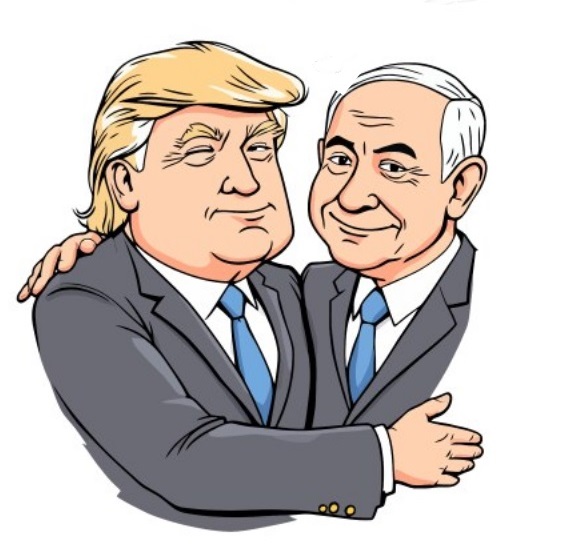
June 5, 2026 . by Jamal Kanj, https://www.middleeastmonitor.com/20260605-trump-and-netanyahu-the-odd-couple/
“He’ll do whatever I want him to do,” Donald Trump declared recently about Israeli Prime Minister Benjamin Netanyahu.
The statement may be one of the most revealing statements Trump has ever made—not for what it says about Netanyahu, but for what it reveals about Trump’s psychology. It was intended as a display of strength. Instead, it exposed the opposite.
Trump has built a political persona around hyperbole, self-aggrandizement, and declarations of superiority to cover up for an oversized inferiority complex, he only knows its extent. When he insists that Netanyahu is acting at his command, he is projecting an authority he does not possess. The louder the boast, the more apparent the insecurity beneath it.
“If there is one lesson since the election of Trump, it is that Netanyahu, not Trump, has consistently dictated the pace of America’s wars in the Middle East. Trump may occupy the White House, issue ultimatums, and proclaim himself the master negotiator, but the facts on the ground tell a different story. Again and again, Netanyahu acts, and Trump adjusts.“
For years, Netanyahu worked relentlessly to pull the U. S. into another made-for-Israel war, this time against Iran. Successive administrations, despite their deference to Israel, stopped short of falling for the scheme. Trump, however, proved far more susceptible to the influence of his Israel-first donors and to Netanyahu’s chicanery. Yet he continues to portray himself as the one calling the shots.
This week, Trump proudly recounted a phone call in which he supposedly instructed Netanyahu to halt a planned Israeli attack on Beirut. It took little time after Trump’s statement for Israel’s defense minister to announce that military operations “will continue under all circumstances.” True to that pledge, Israel launched fresh attacks on hospitals and villages in southern Lebanon, killing and wounding civilians despite the so-called Trump’s war cessation.
“Two days later, on Wednesday June 3rd, Lebanese and Israeli delegations meeting in Washington announced another ceasefire. The third such extension since last April. One day after reaching the agreement, Israel resumed strikes on South Lebanon and said it would neither withdraw nor allow Lebanese civilians back to their homes in the south.“
It is almost certain, when the Lebanese resistance eventually counters the repeated Israeli violations, Trump—as he has done before—will condemn the retaliation rather than the provocation. To save face and avoid appearing weak before Netanyahu, he will once again blame the Lebanese side while ignoring the Israeli occupation and military actions that triggered the response.
The same pattern is evident in the negotiations with Iran. For months, Trump’s stated objective was to prevent Iran from developing a nuclear weapon—a framework which aligns with Tehran’s declared position. But nuclear-armed Israel, which never signed the Non-Proliferation Treaty that Iran did, has different goals entirely. Netanyahu’s government will not be satisfied with anything short of the destruction of knowledge and the reduction of Iran to a failed state, precisely the fate that befell Iraq and Libya after both countries agreed to surrender their nuclear ambitions.
For Israel, a negotiated agreement between the U.S. and Iran, may be far less desirable than the continuation of regional turmoil. For its objective is the preservation of a strategic environment that sustains military and geopolitical dominance. Zionism has long viewed the emergence of democratic, technologically advanced, and self-reliant neighboring states as a threat. Fragmentation and disorder in surrounding countries serve that objective by limiting the rise of independent regional powers that could one day, potentially challenge Israeli primacy. In this case, Israel may be unique among nations: it derives strategic advantage not from a stable and prosperous region, but from entropy, and has built a regional doctrine whose success depends on propagating chaos.
The cost to ordinary Americans is tangible, and personal. They feel it every time they fuel their cars, pay inflated prices for goods, or watch Congress cut healthcare or financial student aid for Americans in order to finance another military aid package for Israel.
“Americans are not only financing Israel’s wars through tax dollars and weapons transfers. They are also paying what amounts to an Israeli surcharge tax at the pump.”
Treasury Secretary Scott Bessent has been trying for weeks to assure consumers that gas will hover around $3 a gallon between June and September, as if it is acceptable for Americans to pay elevated prices until Netanyahu deigns to approve a ceasefire, especially when Trump boasts that America is a net oil exporter.
Gaza is another front in Israel’s endless wars. Trump personally signed the ceasefire agreement in Sharm el-Sheikh in October 2025, chirping “we have peace in the Middle East.” He had since watched in silence as Israel systematically dismantled every commitment it had made. During the “ceasefire,” it maintained a starvation diet blockade, murdered more than 800 and wounded thousands.
Under Phase One of the agreement, Israeli forces were required to withdraw to approximately 53 percent of Gaza. Phase two stipulated further withdrawal. Instead, Netanyahu ordered the seizure of an additional 32 percent, increasing total Israeli military occupation to 70 percent of the besieged territory, confining 2.3 million Palestinians to 30 percent, or roughly 50,000 human beings per each square mile of rubble.
On all fronts, Trump did not merely follow Netanyahu’s lead. He enabled it, funded it, armed it, and defended it diplomatically. Then, standing before television cameras, he attempted to compensate for this reality by insisting that he was the one in control.
To that end, and following recent Republican primary elections, lame-duck Republican members of Congress have already begun treating the Trump administration as a lame-duck presidency, long before the midterm elections. The recent congressional vote to limit presidential war powers is a telling sign that Trump’s political capital is eroding far sooner than expected.
Nevertheless, Americans may be witnessing a historic inflection point in the decades-long power of Israel-first Zionist influence over American political life. It is clear the political landscape is shifting, and the assumptions that long governed Washington’s relationship with Israel no longer appear as immutable as they once did. From growing dissent within the Democratic Party—and among Republican influencers—to deepening unease across the Washington Beltway, genuine cracks are appearing in a system that for generations treated Israel as a sacred cow. Eight decades of unquestioned manipulation and political leverage over American leaders is now facing resistance from constituencies that were once among its most reliable friends.
“Hence, no amount of presidential bravado or social-media posturing can obscure what has become undeniable: under Donald Trump, American foreign policy has served Netanyahu’s Israel-first agenda, not America’s. And when the history of this era is written, this odd couple may be remembered for ushering in the sunset of Israel-first Zionist dominance over the U.S. government.“
Tortured US history with Iran goes back 73 years, not 47.
Walt Zlotow West Suburban Peace Coalition Glen Ellyn IL , 8 June 26
US neocons reveling in the current US war to destroy Iran tell the monstrous lie Iran has been at war with America 47 years. In their deranged world view it began with the 1979 Iranian revolution that disposed the hated US puppet ruler Mohammed Pahlavi, the Shah of Iran and took 66 US embassy hostages. Their lie claims that during that 47 years Iran killed thousands of Americans and no president defended America till Trump attacked Iran February 28.
These war lovers omit the current truth that Trump’s war is a total failure for 100 days now. Fourteen US service persons are dead. Hundreds injured. All US Gulf States bases damaged or destroyed. Israel suffered the worst destruction in its 78 years. US offensive, defensive missiles so depleted they will take years to replenish. America’s defeat is irreversible. Worst of all? The US forced closure of the Strait of Hormuz choking off a fifth of the world’s oil and vital economic supplies, likely risking worldwide recession, if not depression. Today’s neocon war was stupidity on steroids.
Their stupidity omits the historical truth that the US is the warmonger here, not Iran, going all the way back to 1953 when the US collaborated with the UK to depose the democratically elected Iranian leader Mohammad Mosaddegh. Patriot Mosaddegh sought to nationalize the British controlled Iranian oil industry being exploited by the UK for decades. To prevent this the Brits cooked up Operation Ajax and brought the US on board to overthrow Mosaddegh on the pretext he was a commie.
The US enlisted Kermit Roosevelt Jr., grandson of premier US warmonger President Teddy. As a top CIA official, Kermit was tasked with exploiting fake anticommunist sentiment to oust Mosaddegh in a violent coup. Kermit used his contacts among Egyptian Anglophiles and pro Shah forces to get Mosaddegh’s removal started. But advance knowledge of the coup allowed Mosaddegh to prevail, so much so, Roosevelt’s CIA bosses demanded he leave Iran immediately. Instead, he conjured up the ghost of TR, inspiring him to instigate a second coup on his own that succeeded.
It became the model for CIA backed coups, both successes and failures, throughout the Cold War. A year later Ike secretly gave Kermit a National Security Medal for keeping Iranian oil safe for the West. Apparently, Ike didn’t want to go public with an illegal, immoral and criminal overthrow of a sovereign government.
Seventy-Three years on the neocons of today ditched coup for all out war to reclaim Iran for a new American sock puppet, one candidate of whom is Reza Pahlavi, son of the Shah deposed in 1979. Unlike Kermit’s successful coup in ’53, Trump’s war is a colossal failure that signals the end of US hegemony in the Middle East and possibly the entire world. The Gulf States, looking at their shattered US bases and degraded oil infrastructure, will likely turn toward Russia, China, even Iran for security. Europe has largely given up on America. The Far East, seeing the US claw back its missiles for its Iran misadventure is also rethinking its defensive strategy.
Unlike the clever Kermit Roosevelt Jr., today’s coup plotters and warmongers, including Trump, Hegseth and Rubio, are blithering idiots.
Israel Could Solve Its PR Problem By Simply Ceasing To Be Evil
Caitlin Johnstone, Jun 06, 2026, https://www.caitlinjohnst.one/p/israel-could-solve-its-pr-problem?utm_source=post-email-title&publication_id=82124&post_id=200847621&utm_campaign=email-post-title&isFreemail=true&r=1ise1&triedRedirect=true&utm_medium=email
Israel’s +972 Magazine reports that the Israeli military establishment has launched a training program designed to “influence public consciousness” around the world, with courses aimed at training hundreds of operatives per year in strategies for “actively disrupting or manipulating the beliefs, attitudes, and behaviors of target audiences.”
Citing a leaked Defense Ministry tender, +972 reports that lecturers in the program are required to hold “doctorates and/or professorships in the fields of influence, consciousness, security and terrorism, mass communication, [or] digital and network communication,” as well as “at least four years of professional experience in the fields of influence [or] influence intelligence in various security organizations.”
“Some of the courses — including those on influence operations, influence intelligence, and online activism — will be in English for ‘foreign partners,’ whose identities are not specified,” +972 reports. “For these participants, the Defense Ministry built a dedicated syllabus that includes study of ‘the American approach,’ meaning U.S. perspectives and cultural norms, and conducting influence campaigns in the international arena.”
Israel’s +972 Magazine reports that the Israeli military establishment has launched a training program designed to “influence public consciousness” around the world, with courses aimed at training hundreds of operatives per year in strategies for “actively disrupting or manipulating the beliefs, attitudes, and behaviors of target audiences.”
Citing a leaked Defense Ministry tender, +972 reports that lecturers in the program are required to hold “doctorates and/or professorships in the fields of influence, consciousness, security and terrorism, mass communication, [or] digital and network communication,” as well as “at least four years of professional experience in the fields of influence [or] influence intelligence in various security organizations.”
“Some of the courses — including those on influence operations, influence intelligence, and online activism — will be in English for ‘foreign partners,’ whose identities are not specified,” +972 reports. “For these participants, the Defense Ministry built a dedicated syllabus that includes study of ‘the American approach,’ meaning U.S. perspectives and cultural norms, and conducting influence campaigns in the international arena.”
Israel’s +972 Magazine reports that the Israeli military establishment has launched a training program designed to “influence public consciousness” around the world, with courses aimed at training hundreds of operatives per year in strategies for “actively disrupting or manipulating the beliefs, attitudes, and behaviors of target audiences.”
Citing a leaked Defense Ministry tender, +972 reports that lecturers in the program are required to hold “doctorates and/or professorships in the fields of influence, consciousness, security and terrorism, mass communication, [or] digital and network communication,” as well as “at least four years of professional experience in the fields of influence [or] influence intelligence in various security organizations.”
“Some of the courses — including those on influence operations, influence intelligence, and online activism — will be in English for ‘foreign partners,’ whose identities are not specified,” +972 reports. “For these participants, the Defense Ministry built a dedicated syllabus that includes study of ‘the American approach,’ meaning U.S. perspectives and cultural norms, and conducting influence campaigns in the international arena.”
Israel’s +972 Magazine reports that the Israeli military establishment has launched a training program designed to “influence public consciousness” around the world, with courses aimed at training hundreds of operatives per year in strategies for “actively disrupting or manipulating the beliefs, attitudes, and behaviors of target audiences.”
Citing a leaked Defense Ministry tender, +972 reports that lecturers in the program are required to hold “doctorates and/or professorships in the fields of influence, consciousness, security and terrorism, mass communication, [or] digital and network communication,” as well as “at least four years of professional experience in the fields of influence [or] influence intelligence in various security organizations.”
“Some of the courses — including those on influence operations, influence intelligence, and online activism — will be in English for ‘foreign partners,’ whose identities are not specified,” +972 reports. “For these participants, the Defense Ministry built a dedicated syllabus that includes study of ‘the American approach,’ meaning U.S. perspectives and cultural norms, and conducting influence campaigns in the international arena.”
Israel’s +972 Magazine reports that the Israeli military establishment has launched a training program designed to “influence public consciousness” around the world, with courses aimed at training hundreds of operatives per year in strategies for “actively disrupting or manipulating the beliefs, attitudes, and behaviors of target audiences.”
Citing a leaked Defense Ministry tender, +972 reports that lecturers in the program are required to hold “doctorates and/or professorships in the fields of influence, consciousness, security and terrorism, mass communication, [or] digital and network communication,” as well as “at least four years of professional experience in the fields of influence [or] influence intelligence in various security organizations.”
“Some of the courses — including those on influence operations, influence intelligence, and online activism — will be in English for ‘foreign partners,’ whose identities are not specified,” +972 reports. “For these participants, the Defense Ministry built a dedicated syllabus that includes study of ‘the American approach,’ meaning U.S. perspectives and cultural norms, and conducting influence campaigns in the international arena.”
This revelation comes as Israel quintuples its annual propaganda budget to three-quarters of a billion dollars. So going forward you can expect to be blasted in the face with a whole lot more pro-Israel perception management while you’re minding your own fucking business trying to live your life.
It’s such a trip how Zionists just take it as a given that the only way to improve public perception of Israel is to ramp up efforts to manipulate the thoughts people think about it. They never give serious attention to the possibility that Israel would have a lot more public approval if it stopped fucking murdering innocent civilians all the time and fucking torturing people and raping captives with trained rape dogs. Israel can’t possibly be wrong; only our thoughts about Israel can be wrong.
At an American Jewish Committee event on Tuesday, Santa Clara University’s Maya Ackerman argued that generative AI presents an exciting new opportunity for imposing pro-Israel narratives on public consciousness, because AI companies can be lobbied directly to push pro-Israel narratives since their leaders can control what information people see.
Here’s a transcript of what she said:
“The really cool thing about AI is that while it can become a great ally for our enemies if we act early, it could be exactly the opportunity that we need after missing the boat with social media. AI is now becoming the dominant source of information — the main source of information. People trust AI more than anything else. They trust AI more than social media. They turn to chatbots like ChatGPT and Gemini instead of using Google. And young people use these bots instead of Google in very, very very large numbers. So this is becoming the main source of information.
“And so when I say this, I still find Jewish people being discouraged, they say ‘Oh, but Wikipedia is already so antisemitic and social media is so antisemitic — why bother? The AI just learns from all of this data.’ So, you know, whatever, not much we can do.
“But that’s not true, because over the past two years the AI companies have been moving towards alignment. So instead of algorithms sort of honestly representing what’s in the data, we’re finding that these chatbots and the text to image models are increasingly showing us exactly what the companies want us to see.
“Okay, so it’s becoming intentional. Which means that instead of trying to control the whole world and trying to somehow manage what’s happening in this big blob called Wikipedia and social media, we can go directly to the companies with clear technical and advocacy solutions. For the first time, there is a path to correcting the digital world.”
So to be clear, Ackerman is arguing that AI chatbots are useful because instead of “honestly representing what’s in the data” they are saying whatever their owners tell them to say, which means the owners of AI companies can simply be pressured to make the chatbots say pro-Israel things. She is saying this gives “Jewish people” (her words, not mine) an opportunity for “correcting the digital world” (her words, not mine) in a way that is more efficient than “trying to control the whole world” (her words, not mine).
It’s just surreal how people like me are always going to great lengths to draw clear distinctions and avoid coming across as antisemitic in our criticisms of Israel, and then Jewish Zionists go to these events all “Yes we Jews need to be actively manipulating western institutions in order to deceive everyone and control society.”
The other day at a Jerusalem Post conference, World Jewish Congress president Ron Lauder argued that Jewish billionaires should be using their wealth “to attack our enemies”, and advocated for Israeli intelligence agencies Mossad and Shin Bet to track and “counterattack” Israel’s critics online in the “fight” against anti-Israel sentiment.
Speaking at a book launch event in Jerusalem last month, British columnist and broadcaster Melanie Phillips argued that “the Jewish community” should use “psychological warfare” and “psyops” to promote the interests of Israel.
“There are plenty of people in this country who … are experts in what’s called psyops. They should be used. They could be drawn upon. These are reservoirs of talent and skill that could be used and harnessed, to really make a difference,” Phillips said.
If I wanted people to stop hating my favorite country for committing war crimes and genocide, I personally would simply encourage that country to stop committing war crimes and genocide.
I would not try to solve the problem by waging psyops and information warfare.
I would not try to solve the problem by lobbying governments to ban criticism of my favorite country.
I would not try to solve the problem by claiming that anyone who criticizes my favorite country is a Nazi.
I would not try to solve the problem with a dramatic increase to my favorite country’s propaganda budget.
I would not try to solve the problem by swarming the internet with paid trolls who argue in support of my favorite country.
I would not try to solve the problem by buying up news outlets and social media platforms in order to force them to amplify information that is supportive of my favorite country.
I feel like doing these things would only make people hate my favorite country more. I think people would get sick of my favorite country’s supporters constantly trying to manipulate their minds and assaulting their right to free expression.
I would only do these things if I wanted people to hate my favorite country. Like if my favorite country was premised on the idea that everyone already hates its inhabitants, so the only way to stay safe is to remain in a constant state of military combat and mass-scale manipulation. Then I suppose it would make sense to do the things I just described.
But come to think of it, if my favorite country was founded on the premise of nonstop warfare and manipulation and the assumption that it must necessarily always be despised throughout the world, at some point I suspect I’d find myself wondering why my favorite country is my favorite country at all. And I’d begin wondering if perhaps it was a mistake to establish such a country in the first place.
Israel Has Engineered a Deadly Shortage of Medications and Health Care in Gaza
June 5, 2026, By Hend Salama Abo Helow, https://scheerpost.com/2026/06/05/israel-has-engineered-a-deadly-shortage-of-medications-and-health-care-in-gaza/
A Palestinian doctor in Gaza says the territory is facing its worst medication shortage since Israel began the genocide.
My mother has been a hypertension patient for the past 25 years. Ever since her initial diagnosis, she has adhered strictly to her prescribed medication. Yet since the genocide broke out, her medicine gradually ran out until it vanished from the markets altogether, with no clinic, pharmacy, warehouse, or stockpile left untouched by the shortage.
Eventually, my mother was forced to redraw her therapeutic map around two alternative drugs with relatively similar efficacy to the one she had lost. The doses were measured carefully according to her condition. But the fear of losing the medication again grew on her, so she began rationing her doses, taking half a pill instead of a full one, to make them last longer.
Although the ceasefire that followed was supposed to allow the unhindered influx of humanitarian aid and life-saving medical supplies at scale, it proved to be nothing but another trap. My mother went to collect her monthly prescription, only for the pharmacist to tell her that this would likely be the last refill, as the medication had already been depleted.
This is not an isolated plight endured only by my mother, but the status quo for 350,000 chronic patients in Gaza whose health, like hers, hangs in the balance, conditioned on the fluctuating status of the borders.
Faced with a shattered health care system, patients’ survival is dependent on Israel’s tightening restrictions on border crossings. The World Health Organization has warned that Israeli forces are no longer only claiming people’s lives through bombs, but are also endangering Palestinians by denying them urgently needed health care services and medication.
Israel is willfully violating international law, which obligates the occupying power to maintain health care services, not undermine them nor use them as a bargaining chip.
Dr. Ahmad Al-Farra, head of the pediatric department at Nasser Hospital, described the ongoing crisis as “the worst period ever of depletion of medical supplies,” stressing that it even far outweighed the medicine shortage Gaza had witnessed earlier during the genocide. “It is the worst ever,” he emphasized.
He condemned the use of the word “ceasefire,” stating, “We are nearly 900 days into a war despite the one-sided truce.” He pointed to more than 2,400 breaches of the so-called ceasefire, during which 765 Palestinians were killed and roughly 2,100 wounded. Al-Farra further noted that around 1,700 medical staff have fallen during the two years of genocide, while many others remain captured in Israeli prisons.
Bringing the picture together, he told Truthout that 25 out of Gaza’s 36 hospitals are now out of service, while 103 out of 137 primary health care centers have been damaged, and medical supplies have totally run out.
Al-Farra, in a broken voice, remarked that hospitals have become “nothing more than hollow cement blocks, stripped from the very core they were built for: medical services.”
Sharing the latest not-yet-public statistics of the exact shortages compiled by Gaza’s Health Ministry exclusively with Truthout, he said:
“Fifty percent of basic medications for noncommunicable diseases like hypertension, diabetes, asthma, and respiratory diseases are now missing. Around 70 percent of medical equipment is nonexistent, while 84 percent of laboratory resources are unavailable. At the same time, hospital capacity has surged by 225 percent. Around 25 out of 35 oxygen stations have been damaged, while 61 electricity generators out of 110 have been leveled down.“
The health care system is “in its final throes,” Al-Farra sighed.
The unending crisis has extended beyond governmental hospitals to the humanitarian organization Médecins Sans Frontières (MSF). In early April, MSF released alarming reports stating that it had not been able to bring any medical supplies into Gaza since January 1, 2026. Israel has obstructed its vital role in providing necessary health care services for chronic and trauma-related patients, and those requiring surgical operations and post-operative care, all amid a growingly conducive environment for diseases to exacerbate.
Yet Dr. Abdullah Al-Naami, who has worked in the pharmacological field for the last 26 years, doubled down on the alarming report released by MSF about the unfolding medication crisis.
Al-Naami told Truthout that “the current stockpile of medicines is nowhere near enough for the spiraling needs.” He added that “hypertension, cardiovascular, and cancer patients are impacted the most.”
“New emergency cases have been rising due to the low-quality living conditions and contamination inside the displacement camps, including scabies and infectious diseases.” Yet “painkillers, antibiotic pills, ointments, and sterilized gauzes are running critically low. Patients receive their treatment for one month, while the following months remain suspended until further notice and medications become available again.”
Based on the medication scarcity, Al-Naami explained, “this is why we cannot provide the full amount of the prescribed medication. Instead, patients receive either half or quarter the quantities. The Ministry of Health has even resorted to extending the expiration dates of medications and renewing their use after testing their efficacy. All of this is merely to enhance the patients’ survivability amidst suffocating restrictions meant to crush Palestinians’ health.”
Al-Naami also underscored the significant shortages of nebulizers, whose absence has ultimately threatened hundreds of thousands of lives.
Young children are also facing devastating health consequences due to what Al-Farra described as “one of the Israeli strategies”: allowing one specific type of infant formula into Gaza until it became the primary milk depended on by nearly every child, only to later ban its entry after infants’ tiny bodies had already grown accustomed to it.
“Such abrupt switches in milk type result in malabsorption diseases, allergies, and potentially fatal complications,” he explained.
Al-Farra recounted the story of his patient, Huda Abo Al-Naja, a 12-year-old girl who was in the third phase of malnutrition, immunocompromised, and suffering from severe anemia.
He said she had been admitted to the hospital four times due to edema, “the accumulation of fluids in her body.”
Al-Farra lamented that the patient was “a unique and genius child,” fully aware of her own condition. He recalled how she would even compete with the intern doctors, answering questions related to her illness on their behalf.
Her journey fluctuated constantly between remission and relapse, improvement and deterioration, until she eventually developed sepsis that progressed into hypotension and septic shock, leading to admission to the ICU. During her stay, she urgently needed numerous diagnostic procedures and therapeutic interventions, including “bacterial cultures, a central line, arterial blood gas analysis, and electrolyte testing” — all of which were unavailable back then.
“Due to the lack of the necessary diagnostic and therapeutic tools needed to save her life, Huda died,” Al-Farra said.
Al-Farra placed the blame directly on “the collapse of Gaza’s health care system and the complete closure of border crossings imposed all by Israeli forces.”
For those who survived two years of genocidal war, the atrocities did not stop there. They are now at the peril of “a more engineered silent weapon: scarcity of medication,” as Al-Farra put it plainly.
He called on the international community and mediators to pressure Israel into opening the border crossings for the unconditional and unhindered flow of medical supplies. He added the need to reclaim Palestinians’ right to a dignified life and proper treatment, which is “a fundamental legitimate right under international law.”
Is Israel planning to reoccupy the Gaza Strip? This is what’s happening behind the ‘yellow line
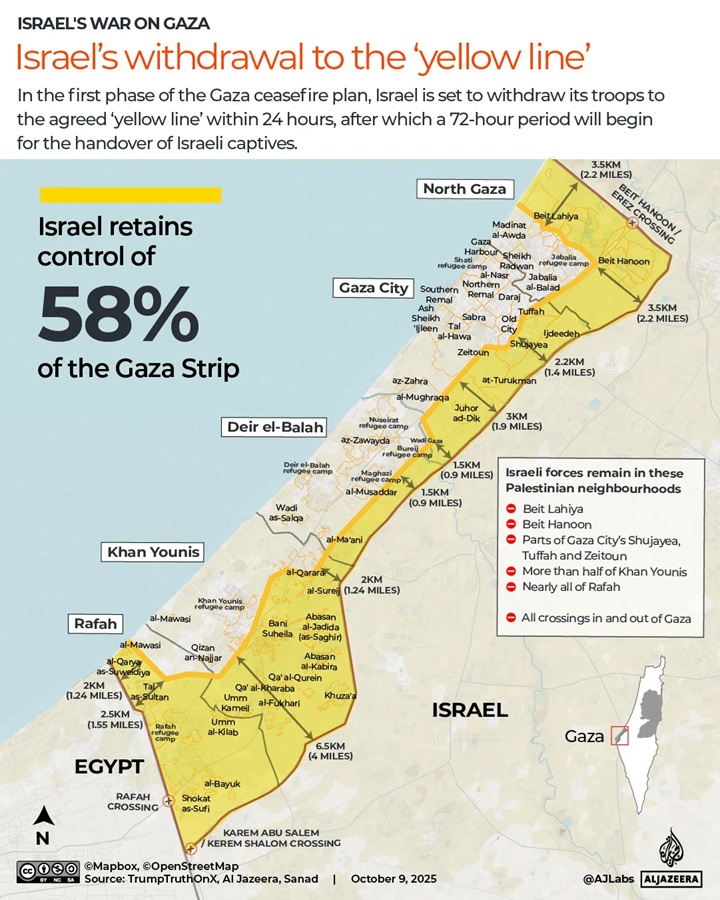
an occupying power must preserve the demographic composition of the territory it controls. In this specific case, international law prohibits the removal of a population (the Palestinians) and the transfer of another population (Israeli settlers) onto occupied land.
Michelle Burgis-Kasthala, Professor of International Law, La Trobe University, 4 June 26, https://theconversation.com/is-israel-planning-to-reoccupy-the-gaza-strip-this-is-whats-happening-behind-the-yellow-line-284086?utm_medium=email&utm_campaign=Latest%20from%20The%20Conversation%20for%20June%204%202026%20-%203792338838&utm_content=Latest%20from%20The%20Conversation%20for%20June%204%202026%20-%203792338838+CID_84a191247b774c7af7d936d593de2bdf&utm_source=campaign_monitor&utm_term=Is%20Israel%20planning%20to%20reoccupy%20the%20Gaza%20Strip%20This%20is%20whats%20happening%20behind%20the%20yellow%20line
In recent days, Israeli Prime Minister Benjamin Netanyahu has ordered the Israeli army to seize 70% of Gaza – a sizeable increase from the 60% it currently controls.
This follows an updated map sent to aid agencies in Gaza in late March featuring a new “orange line” demarcating the restricted area under military control – about 11% larger than the area agreed to with the “yellow line” in the October ceasefire with Hamas.
Israel’s defence minister has also confirmed in recent days the government’s intention to move large numbers of Palestinians out of Gaza “at the right time and in the right manner”.
All of this is happening in a charged political environment in Israel: the Knesset dissolved itself on May 20, creating the possibility of an early election in September.
Israel’s actions are in clear violation of the 20-point Gaza peace plan, which called for a staged withdrawal of Israeli troops and actively “encouraged” residents to stay. It reads:
No one will be forced to leave Gaza, and those who wish to leave will be free to do so and free to return. We will encourage people to stay and offer them the opportunity to build a better Gaza.
US Secretary of State Marco Rubio has acknowledged as much, telling a congressional hearing this week that the peace plan “doesn’t call for” expanded military control of the strip.
The 2.1 million Palestinians in Gaza are being squeezed into an ever-smaller pocket of the decimated, overcrowded territory. And it appears the international community is doing little to stop it.
Laws against conquering territory
International law permits militaries to occupy foreign territory in pursuit of war aims, but there are two key limitations here.
First, an occupying force cannot pursue a legal claim to the territory it holds. The UN Charter has clearly outlawed the right to conquest under Article 2(4). Breaches of this article are treated very seriously, as the world’s reaction to Russia’s invasion of Ukraine has shown. This can be considered a war crime – the crime of aggression.
For Israel, this means its control of Gaza cannot result in a claim to sovereignty over any part of the strip. The International Court of Justice (ICJ) underscored this in its 2024 advisory opinion on Israel’s actions in the occupied Palestinian territories.
Second, any occupying military power must comply with international humanitarian law and international human rights law in a conflict. This means ensuring the welfare of the population under its control.
This has been the case in Gaza since Israel captured it from Egypt in the Six-Day War in 1967, beginning a decades-long occupation of the strip.
In fact, Israel’s obligations as an occupying power continued even after it pulled out its troops and dismantled its settlements in 2005.
As part of these obligations, an occupying power must preserve the demographic composition of the territory it controls. In this specific case, international law prohibits the removal of a population (the Palestinians) and the transfer of another population (Israeli settlers) onto occupied land.
A flawed peace plan
Despite these clear legal principles, enforcement of Israel’s obligations will be at best difficult, slow and piecemeal.
In its 2024 advisory opinion, for instance, the ICJ ordered Israel to withdraw fully from the occupied Palestinian territories, saying its presence is in breach of two key legal principles – self-determination and the prohibition against conquest. The UN General Assembly endorsed the findings and set a deadline of September 14 2025 for the withdrawal. Israel ignored the deadline.
The general assembly can’t enforce an ICJ ruling, only the security council can. And this avenue is blocked due to the US veto power.
More worrying is that the clarity provided by international law – prohibiting conquest, genocide, settlements and forced displacement – is being blurred by the 20-point peace plan mediated by US President Donald Trump and the so-called Board of Peace overseeing the process.
Last November, the UN Security Council endorsed Trump’s plan to end the conflict, disarm Hamas and establish a new transitional government system under the auspices of the Board of Peace and an International Stabilisation Force to keep the peace.
But the ceasefire agreement was flawed from the start. The text, for instance, did not include any specifications about Israel’s presence in the strip, accountability for alleged crimes or demilitarisation of Palestinian groups.
Since the ceasefire, the entire process has predictably stalled. Israeli strikes have continued, killing more than 900 Palestinians. Aid delivery is far below the needs of a desperate population. And Hamas refuses to disarm without firm guarantees on future Palestinian self-determination.
Behind the ‘yellow line’
This stalemate suits Israel perfectly. Under the map of the ceasefire agreement, Israel was permitted to keep its troops in areas behind a “yellow line” encircling the majority of the population along the coast. This gave Israel military control of just over half of Gaza.
Then, in the area under its control, Israel began two activities that speak to its longer-term political aspirations.
First, it levelled entire neighbourhoods and hundreds of buildings, turning this part of Gaza into a wasteland devoid of inhabitants and any recognisable landmarks.
Second, on this blank canvas, it constructed an impressive array of military roads, outposts and barriers, including permanent earthen berms (walls).
This gives Israel the possibility of perpetual control of a territory devoid of Palestinians. If this status quo continues, it would amount to forced displacement and conquest.
Day by day, Palestinian Gaza is shrinking and a new Gaza is being forged through bulldozers and barriers. Netanyahu has indicated Israel may not stop at 70% depopulation and control. It may seek to preserve a large “buffer” zone in Gaza – as it is doing in Lebanon and Syria – or perhaps revive the project of Israeli settlement of the strip, which is in full swing across the West Bank.
All of this is happening in violation of international law and a “peace” plan that has no clear vision for a long-term solution for the Palestinian people.
1 This Month


Shut down the radiation-damaged Heysham nuclear reactors now
To see nuclear-related stories in greater depth and intensity – go to https://nuclearinformation.wordpress.com

Say No to NASA’s Reckless Nuclear Reactor on the Moon
Say No to NASA’s Reckless Nuclear Reactor on the Moon
-
Archives
- October 2026 (247)
- September 2026 (339)
- August 2026 (330)
- July 2026 (355)
- June 2026 (287)
- May 2026 (306)
- April 2026 (356)
- March 2026 (251)
- February 2026 (267)
- January 2026 (308)
- December 2025 (358)
- November 2025 (359)
-
Categories
- 1
- 1 NUCLEAR ISSUES
- business and costs
- climate change
- culture and arts
- ENERGY
- environment
- health
- history
- indigenous issues
- Legal
- marketing of nuclear
- media
- opposition to nuclear
- PERSONAL STORIES
- politics
- politics international
- Religion and ethics
- safety
- secrets,lies and civil liberties
- spinbuster
- technology
- Uranium
- wastes
- weapons and war
- Women
- 2 WORLD
- ACTION
- AFRICA
- Atrocities
- AUSTRALIA
- Christina's notes
- Christina's themes
- culture and arts
- Events
- Fuk 2022
- Fuk 2023
- Fukushima 2017
- Fukushima 2018
- fukushima 2019
- Fukushima 2020
- Fukushima 2021
- general
- global warming
- Humour (God we need it)
- Nuclear
- RARE EARTHS
- Reference
- resources – print
- Resources -audiovicual
- Weekly Newsletter
- World
- World Nuclear
- YouTube
-
RSS
Entries RSS
Comments RSS

