Mass Media Reporters Aren’t Buying Israel’s Hospital Bombing Story
CAITLIN JOHNSTONE, OCT 18, 2023 https://www.caitlinjohnst.one/p/mass-media-reporters-arent-buying?utm_source=post-email-title&publication_id=82124&post_id=138065016&utm_campaign=email-post-title&isFreemail=true&r=1ise1&utm_medium=email
A huge blast in Gaza has destroyed the Al-Ahli Arab Hospital, killing hundreds of people. The exact death toll is still unknown.
Details of who is responsible for the explosion are being hotly debated by all parties, and this is still a developing story with a lot of details yet to be revealed. But what I’d like to quickly document as things unfold is the highly unusual number of mass media reporters I’ve been seeing who haven’t hesitated to point to Israel as the probable culprit.
After noting that Israel is blaming the blast on a failed rocket launch by Palestinian Islamic Jihad (PIJ), MSNBC foreign correspondent Raf Sanchez quickly pointed out that PIJ rockets don’t tend to do that kind of damage, but Israeli missiles do. He also noted that Israel has an extensive history of lying about this sort of thing.
“The Israeli military at this point is not providing any evidence to back up its claims that this was a Palestinian Islamic Jihad rocket; they are citing intelligence that they have not yet made public,” Sanchez said. “We should also say that this kind of death toll is not what you normally associate with Palestinian rockets. These rockets are dangerous, they are deadly, they do not tend to kill hundreds of people in a single strike in the way that Israeli high explosives — especially these bunker buster bombs that are used to target these Hamas tunnels under Gaza City — do have the potential to kill hundreds of people.”
“And we should say finally that there are instances in the past where the Israeli military has said things in the immediate aftermath of an incident that have turned out not to be true in the long run,” Sanchez added. “And the one example I’ll give you is that when the Al Jazeera journalist, Shireen Abu Akleh, was killed in the occupied West Bank, the Israeli military initially said that she was killed by Palestinian gunmen, and it was only months and months later that they admitted that it was likely an Israeli soldier who fired the fatal shot.”
CNN’s Clarissa Ward said essentially the same thing.
“I will say, just based on seeing these rocket attacks many times over the years, that they don’t usually have an impact like that in terms of the size of the blast, in terms of the scale of the death toll and the scale of the damage,” Ward said. “It’s also not the first time, it’s important to add, that we have seen the IDF categorically deny something before being forced to kind of do an about-face after an extensive investigation.”
BBC foreign correspondent Jon Donnison gave basically the same opinion.
“It’s hard to see what else this could be, really, given the size of the explosion, other than an Israeli air strike, or several air strikes,” Donnison said from Jerusalem. “Because, you know, when we’ve seen rockets being fired out of Gaza, we never see explosions of that scale. We might see half a dozen, maybe a few more people being killed in such rocket attacks, but we’ve never seen anything on the scale of the sort of explosion on the video I was watching earlier.”
That’s three mass media reporters that I’ve seen just in my random information-gathering meanderings — not on their personal social media accounts, but live on air.
It’s highly unusual to see this degree of skepticism in the western press right off the bat when it goes against the information interests of Israel specifically or the US power alliance more generally. Typically we’ve been seeing the media uncritically report unverified claims about Palestinian militants while expressing rigorous skepticism solely toward any information which might benefit the Palestinian resistance, so there’s clearly something about this particular story which makes mass media reporters remarkably reluctant to push the Israeli narrative.
Maybe they’re getting information in their group chats which has caused them to keep Israel’s claims about the hospital bombing at arm’s length, or maybe they’re just looking at the facts and deciding this narrative is too flimsy to get behind. If it looks like Israel’s version of events will fall apart after investigation, they’re not going to want to stake their reputation and their pride on pushing it with their usual gusto during an Israeli military operation that is facing unusually intense scrutiny from the entire world.
Israel does after all have an extensive history of attacking hospitals and healthcare facilities, including in this current operation in Gaza, including apparently bombing this exact same hospital just a few days ago. ReliefWeb, which is run by the United Nations Office for the Coordination of Humanitarian Affairs, recently published a report on the numerous Israeli strikes that have hit hospitals, ambulances and healthcare workers between October 12 and October 15, and listed among the hospitals hit is the Ahli Arab Hospital in Gaza City — the same hospital that was just destroyed a few days later.
Citing “Al Jazeera V and Personal Communication,” ReliefWeb reports the following:
“14 October 2023: In Gaza city city and governorate, Ahli Arab Hospital was hit by Israeli airstrikes, partially damaging two floors and damaging the ultrasound and mammography room. Four people were injured.”
It’s also probably worth noting that according to the World Health Organization this hospital was one of the twenty hospitals which the IDF had ordered to evacuate because of the aggressions it was planning to inflict on that part of Gaza.
Again, information is still coming in and this developing story could possibly wind up looking very different from what it looks like right now. But if I was an Israel apologist, I don’t think I’d find the current winds in the mass media very encouraging. #Israel #Palestine
Israeli Military Has Killed 1 Child in Gaza Every 15 Minutes: Rights Group
“Additional children are unaccounted for and missing under the rubble of destroyed buildings, indicating the true death toll is much higher,” said Defense for Children International–Palestine.
By Jake Johnson / Common Dreams, https://scheerpost.com/2023/10/17/israeli-military-has-killed-1-child-in-gaza-every-15-minutes-rights-group/
Israel’s relentless bombing campaign in the occupied Gaza Strip has killed more than 1,000 Palestinian children—roughly one every 15 minutes—since it began on October 7, according to the latest tally from Defense for Children International–Palestine.
Children have faced some of the most horrific impacts of Israel’s ongoing assault on Gaza, where roughly half of the population is under the age of 18. Israel has dropped more than 6,000 bombs on Gaza—home to 2.3 million people—in the wake of Hamas’ deadly attack.
Mohammad Abu Rukbeh, senior Gaza field researcher at DCIP, said in a statement Monday that “the repercussions of this war will not only affect the victims we have lost, some of which are still trapped under the rubble of their homes, and not only the residential areas that have been completely destroyed, including our own homes, but the psychological impact on us civilians and our children will be catastrophic.”
Research released before Israel’s latest bombardment of Gaza found that four out of five children in the Gaza Strip reported living with depression, grief, and fear amid a yearslong Israeli blockade and frequent outbreaks of deadly violence.
Israel’s current military campaign in Gaza is its deadliest to date, and the unlawful total blockade it has imposed on the strip has further deprived children and the rest of the civilian population of food, fuel, electricity, and clean water. Some Gazans have resorted to drinking seawater and water contaminated by sewage, and hospital staff have reportedly had to drink from IV solution bags.
“Israeli authorities cut water supply to Gaza on October 9, and since then, all three water desalination plants in Gaza have been forced to cease operations,” DCIP noted Monday, citing the United Nations. “Even though Israeli authorities claimed to resume water supply to southern Gaza yesterday, there is no electricity to operate water pumps, Israeli airstrikes have damaged many water lines, and very little water in Gaza is drinkable in the first place.”
“Israeli authorities cut water supply to Gaza on October 9, and since then, all three water desalination plants in Gaza have been forced to cease operations,” DCIP noted Monday, citing the United Nations. “Even though Israeli authorities claimed to resume water supply to southern Gaza yesterday, there is no electricity to operate water pumps, Israeli airstrikes have damaged many water lines, and very little water in Gaza is drinkable in the first place.”
Al Jazeerareported that more than 70 people were killed in their homes on Tuesday “after Israel conducted air raids on Gaza’s Khan Younis, Rafah, and Deir el-Balah.”
Last week, the Israeli military ordered the entire population of northern Gaza to evacuate to the south ahead of an expected ground invasion and was subsequently accused of bombing supposed “safe routes” that civilians were using to flee.
Ravina Shamdasani, a spokesperson for the U.N. high commissioner for human rights, said in a statement Tuesday that “appalling reports that civilians attempting to relocate to southern Gaza were struck and killed by an explosive weapon must be independently and thoroughly investigated, as must all allegations of serious violations of international humanitarian law.”
“Those who managed to comply with the Israeli authorities’ order to evacuate are now trapped in the south of the Gaza Strip, with scant shelter, fast-depleting food supplies, little or no access to clean water, sanitation, medicine, and other basic needs,” said Shamdasani. “We echo the U.N. call for a humanitarian pause to enable aid delivery and to prevent further suffering and deaths of the already much beleaguered civilian population of Gaza. Urgent immediate, unimpeded humanitarian access needs to be ensured.” #Israel #Palestine
Atrocity Propaganda

All of this was achieved under a cloak of respectability in Western media by using the images and stories of killed Israeli children.
Israel and its supporters in the West are helping to provide psychological cover for an ongoing massacre of Palestinian civilians, writes Elizabeth Vos.
SCHEERPOST, By Elizabeth Vos / Consortium News 18 Oct 23
As merciless bombing in Gaza continues, Israel and its supporters have weaponized dead Israeli children and false narratives about them to justify massacring Palestinian children on an unimaginable scale in Gaza.
First it was the “40 beheaded babies” story, then it was a series of images of apparently burned infants, which whether fake or real, were published by Israeli Prime Minister Benjamin Netanyahu in an effort to further justify Israel slaughtering thousands of Palestinian children.
And slaughter we have seen. Israel so far has killed over 2,800 Palestinians, over 1000 of them children. Israel was reported to have bombed a pediatric hospital in Gaza with illegal white phosphorus, and shelled at least one school where dozens of children and their families sought shelter, killing at least 27 children. Entire extended families wiped out in their homes.
Civilians were told to flee to Southern Gaza, a potentially official ethnic cleansing in itself (if they are never allowed to return), before being bombed in their attempt to flee. (Israel says those were Hamas IEDs in the road to prevent people from leaving.) Medics were shelled in their effort to help the injured. [The WHO decried an Israeli order to evacuate 2,000 patients from 22 hospitals to southern Gaza.]
Dozens of journalists have been killed, or witnessed the death of their own families. Images and videos of dead Palestinian children pulled from the rubble have flooded social media (before Israel cut off the internet). All of this was achieved under a cloak of respectability in Western media by using the images and stories of killed Israeli children.
After the initial Hamas surprise attack, an oft-repeated rallying cry of Israel apologists was that Hamas had beheaded 40 Israeli babies. Despite the claims being referenced publicly by U.S. President Joe Biden (since walked-back by the administration), there has to date been no confirmation of such a story. According to The Grayzone, the claims were sourced to “David Ben Zion, a Deputy Commander of Unit 71 of the Israeli army who also happens to be an extremist settler leader who incited violent riots against Palestinians in the occupied West Bank earlier this year.”
Forced to Apologize
CNN journalist Sara Sidner, who first aired the narrative, was forced to publicly recant and apologize for her statements………………..
This wasn’t only a journalistic error. It was Western media falling in line with the Israeli government’s claim of an atrocity, only to walk back the narrative when Israel refused to confirm the story. Her apology came after the original story went wildly viral on social media and repeated in multiple corporate news outlets, as noted by Mintpress News. …………………………………………………………
One cannot accept the weaponization of such a crime, no matter how horrendous, in order to commit equally horrific crimes against other innocents. That an official Israeli government social media account would publish such images — and that Netanyahu would show them to U.S. Secretary of State Anthony Blinken to drum up support for the Israeli cause — represents a direct effort by Israel to weaponize the death and (so far alleged) imagery of dead Israeli babies to excuse a multitude of war crimes. …………………………………………………………………….
Actress Jamie Lee Curtis and musician Justin Bieber posted images of Palestinian children and land respectively, as if they were Israeli children and bomb damage, only to later delete their mistaken posts.
Footage of Palestinian children kept in chicken coop cages by Israeli forces circulated online, wrongly described as Israeli children captured by Hamas.
Other videos falsely purporting to show Hamas members with abducted children were widely circulated on social media.
A video of a woman being burned at a concert was found to have originated in Guatemala after going viral as a victim of Hamas. All of this, whether intentionally spread as misinformation or by mistake, acts to strengthen psychological cover for an ongoing massacre of Palestinian civilians.
Yoav Gallant, Israel’s defense minister, publicly stated regarding the cutting off of food, electricity, water and other necessities to all of Gaza that “we are fighting human animals and acting accordingly.” Even if his comments refer specifically to Hamas fighters, such collective punishment is illegal under international law and is one of the many war crimes committed by Israel against Palestinian civilians in the week since Hamas’s attack. ………………………………………………………………..
With Israel also having cut the internet to Gaza, there is now little opportunity for journalists to broadcast the unfolding atrocity to the rest of the world. Caitlin Johnstone and others argue that this is a direct effort to hide atrocities that previously had been documented by journalists and Gaza residents on their phones.
In the war of propaganda, Israel and its supporters have highlighted the deaths of Jewish children, spread false stories about alleged beheadings of Jewish babies, and dishonestly portrayed Palestinian trauma as Israeli trauma.
There is one conclusion to be drawn from the ongoing atrocity appropriation and the carnage it excuses: even if the crimes by Hamas as described by Israel were all true, it doesn’t justify ethnic cleansing, collective punishment, the targeting of civilians and the murder of children by bomb, by starvation, and lack of medical care. Nothing could ever justify this. https://scheerpost.com/2023/10/18/atrocity-propaganda/ #Israel #Palestine
Israel asks US for ‘emergency’ $10 billion military funding– New York Times
Rt.com 18 Oct 23
The White House has been working on a package that would combine aid to Israel, Ukraine and Taiwan, the newspaper said
srael has requested $10 billion in emergency assistance from the US, the New York Times reported on Monday, citing three unnamed officials. The White House and members of Congress are working on a package that would combine military assistance to Israel with aid to Ukraine and Taiwan, as well as funds to fortify the US-Mexico border, the paper said.
Speaking during a visit to Tel Aviv on Sunday, US Senate Majority Leader Chuck Schumer said lawmakers had discussed supplying Israel with new and replacement ammunition, precision-guided bombs and Joint Direct Attack Munition (JDAM) kits, which convert standard munitions into more accurate ones, according to the NYT…………………………………………..
On Monday, US Treasury Secretary Janet Yellen said Washington could afford to support Israel’s military needs as well as Ukraine’s. She insisted that the financial resources of the US are sufficient to back its allies abroad. However, the official acknowledged concerns over the potential economic impact of a wider conflict in the Middle East.
While top US officials insist that both Israel and Ukraine can be supported, CNN reported last week that the Pentagon had called on defense manufacturers to ramp up production to make up for shortfalls in stockpiles due to arms being transferred to Kiev, in order to ensure it can supply Israel.
On Monday, Israeli Prime Minister Benjamin Netanyahu warned that his country was prepared for a “long war” and would fight until it completely defeats Hamas. He added that Israel is willing to retaliate against the Lebanese militant group Hezbollah if it attempts to interfere in the conflict. https://www.rt.com/news/585154-israel-asks-us-10-billion/
Israel’s Violence Will Never Bring “Safety” to Anyone, Including Jews
As the horrific siege against Gaza escalates, we need to confront the violence of Israel’s ethnonationalist militarism.
By Sarah Lazare & Maya Schenwar , TRUTHOUT, October 18, 2023
he horror and heartbreak in Gaza reaches new proportions each minute: Israel’s siege has killed at least 3,400 people and injured more than 12,000 in the past week and a half, and a possible ground invasion threatens unspeakable levels of new violence. The Israeli forces and settlers have also killed 61 and injured 1,250 in the West Bank and East Jerusalem. The death tolls climb even as Palestinians and those in solidarity with them are marching and rallying worldwide in powerful and urgent protests.
For us, as anti-Zionist Jewish journalists, the past week and a half has been a flood of many griefs.
We grieve and struggle against the ongoing, now catastrophically heightened violence of Israeli colonization, occupation, apartheid and genocidal campaign against Palestinians, carried out by a government that is cynically invoking the names of Jews to intensify the oppressive policies it was already invested in.
And we watch with rising horror as the Israeli government instrumentalizes the grief of Jewish people who’ve lost loved ones in the Hamas attacks, which killed 1,400 people and injured 3,400. The Israeli government is fashioning this grief into a weapon, exploiting it to justify the annihilation of Gaza (even as some Israelis who lost loved ones in the attacks urge against taking vengeance against Palestinians).
Indeed, it is in the name of Jewish “safety” and Jewish grief that not only Israel but almost all of Europe, and certainly the United States, are marching lockstep behind the new unity government’s maximalist war, as it kills thousands and carries out a potential second Nakba, forcing an estimated 1.1 million people from their homes. Jewish “safety” is the rationale for deploying white phosphorus, which can cause severe toxic burns, in Gaza and Lebanon, as Israel’s defense minister declares “we are fighting human animals.” President Joe Biden, Secretary of State Antony Blinken, nearly every member of Congress, and the likes of Lindsay Graham, an open affiliate of antisemitic pastor John Hagee, are all invoking Jewish safety to lend their unqualified support to what is clearly a massacre.
But a growing number of Jews — including many descendants of Holocaust survivors and pogrom survivors — are rejecting the idea that colonial violence ever brings “safety” for anyone. This includes, for some, recognizing that the political ideology of modern Zionism, and the military apparatus that has developed alongside it, is a danger to all, including Jews.
The actions of the state of Israel, whose 75-year history was forged in British colonialism, steeped in the blood and ethnic displacement of Palestinians, and politically and financially upheld by the U.S., are a tragic illustration of this reality. The events of the last week and a half clarify this further. Israel’s systems of occupation and apartheid, which have built upon an infrastructure of ever-increasing militarism and subjugation of Palestinians, are a deep well of violence. The roots of the tragic deaths we saw unfold on October 7 are, as Jewish Voice for Peace has pointed out, apartheid and systemic colonial oppression.
And Israel’s apparent lack of concern even for its own people, as it attacks Gaza wholesale while 199 Israelis are reportedly held hostage there, should remind us that human lives (including the lives of Jews) are not its top priority.
This disregard for human life, including Jewish life, is rooted in a specific history. Theodor Herzl, a founder of modern Zionism, said in his 1896 pamphlet The Jewish State that Israel will be “neutral” and will require only a “professional army.” However, the concept of “neutrality” on colonized land is a contradiction in terms, and predictably, Israel was established as a heavily militarized society in which, from the beginning, military service has been compulsory for Jews. In The Jewish State, Herzl called for the creation of a company to liquidate the business interests of Jews departing their home countries and organize commerce in the new country. To raise capital for this company, he wrote, “Not only poor Jews, but also Christians who wanted to get rid of them, would subscribe a small amount to this fund.” British Prime Minister Arthur Balfour, who issued the declaration announcing Britain’s support for a Jewish state in Palestine, was motivated by his fear of what he termed the “undoubted evils” of Eastern European Jewish migration to Britain.
For the colonizers who pushed for the creation of Israel, safety for Jews was never the real goal. Instead, Israel presented a convenient alternative to welcoming large numbers of Jewish refugees into their own countries. The U.S. turned away and persecuted thousands of Jewish refugees, including those seeking asylum from Nazi Germany. The “Jewish state,” which is often portrayed as having emerged as a peaceful answer to antisemitic violence, was partly forged to serve the interests of actors who were either antisemitic or callous to the suffering of Jews. In supporting Israel, the U.S. and other colonizers were pursuing geopolitical power in a colonial context, a reality that continues today, at the expense primarily of Palestinians, as racist dehumanization undergirds modern Zionism.
While most Jews in the U.S. report that they view Israel as an important part of their Judaism, a significant number do not, and in fact forcefully reject the political ideology reinforcing an ethnonationalist state. It’s worth remembering that ever since modern Zionism has existed, it has had critics, including from the Jewish left.
Today, many such critics are involved in efforts, in coalition with Palestinian activists, to reject ethnonationalism and colonization, and instead work toward building a society based on justice and equality, in which Palestinians are neither besieged, occupied, exiled, nor treated as second-class citizens, and all can live in safety.
In the decades leading up to World War II, many leftist Jews did not want to throw in their lot with British imperialism, to which political Zionism was inextricably tied. And some recognized the antisemitism that propelled colonial powers to support the establishment of Israel, while others understood that imposing an exclusivist Jewish state was contrary to democratic principles……………………………………………………………
Anti-Zionist Jews recognize that we must do the opposite: Reject the negation of Palestinians, in all its forms.
While Jewish anti-Zionism isn’t a majority position, it is an undeniable force in U.S. politics today. Jewish Voice for Peace, a U.S. organization, released a statement in 2019 explaining why it takes an anti-Zionist position.
“Zionism has meant profound trauma for generations, systematically separating Palestinians from their homes, land, and each other,” it states. “Zionism, in practice, has resulted in massacres of Palestinian people, ancient villages and olive groves destroyed, families who live just a mile away from each other separated by checkpoints and walls, and children holding onto the keys of the homes from which their grandparents were forcibly exiled.”
The statement goes on, “In sharing our stories with one another, we see the ways Zionism has also harmed Jewish people. Many of us have learned from Zionism to treat our neighbors with suspicion, to forget the ways Jews built home and community wherever we found ourselves to be.” And the number of U.S. Jews who are willing to openly critique and question Israel’s occupation, even if they might not consider themselves anti-Zionists, has swelled since the Trump administration.
In the U.S., anti-Zionists, alongside critics of the Israeli government’s actions, also point to the massive military complex that sustains Israel — which spent $23.4 billion on its military in 2022, according to the Stockholm International Peace Research Institute — and our own country’s complicity: Israel receives about $3.3 billion in military aid from the U.S. annually.
Today, members of Jewish Voice for Peace, IfNotNow, and other Jews and allies are taking action in Washington, D.C., urging President Biden to use his leverage to force Israel to halt its assault on Palestinians in Gaza. They are saying, “No genocide in our name,” and many are taking arrests in acts of civil disobedience……………………………………………………………………………….
Some within Israel’s political system are moving to crack down on Israelis who oppose the siege on Gaza. Haaretz reported on October 15 that “Communications Minister Shlomo Karhi is promoting regulations that would allow him to direct police to arrest civilians, remove them from their homes, or seize their property if he believes they have spread information that could harm national morale or served as the basis for enemy propaganda.”
And there are some reports that Israelis who oppose the killing of Palestinian civilians are facing physical threats and firings. These are not the signs of a state that is truly invested in the safety of all Jews, let alone the 18 percent of Israeli citizens who are Palestinian.
Meanwhile, there is a deficit of coverage in the U.S. of what Palestinians are facing right now. Most U.S. press outlets are telling the stories of Israeli civilians killed but still giving shockingly little airtime to Palestinian civilians, even as Israel embraces war on a scale we have not seen in our lifetime.
Palestinians in Gaza, in the West Bank and throughout the world have been speaking out about this atrocity, sometimes at great personal risk to themselves……………
It is the “deadliest time for journalists in Gaza,” with at least 12 journalists already killed, according to the Committee to Protect Journalists.
With rising horror, we witness what Palestinians are facing — the immediate threat of annihilation. Accordingly, we should recognize that, even as we talk about how the reality of the modern Zionist project, helmed by a right-wing government, hurts Jews by offering a false promise of safety and peace, we must never obscure that the group of people most targeted by this political system is Palestinians. They are the ones who have been colonized, displaced and besieged even before Israel launched its relentless bombing campaign and cut
off electricity, food and water to a strip that is home to 2 million people, the majority of them children.
Palestinians are the ones living under military occupation in the West Bank, and as second-class citizens in Israel, thrown into administrative detention, evicted from their homes, facing tear gas canisters and live fire for the mere act of protest, forced to navigate apartheid structures that leave them traveling on different roads, suffering systematic dispossession.
Palestinians are the ones who have been exiled from their homes for generations, denied the most basic right to return. And now they are facing an extermination campaign.
There is no safety for anyone in a society based on ethnonationalist militarism. Safety can only come through collective liberation, throwing our grief into the struggle against Palestinian genocide, apartheid and colonization, toward a society premised on justice and equality. We have to confront the brutal history of Zionism and unequivocally reject the unspeakable violence against the Palestinian people carried out in our name. https://truthout.org/articles/israels-violence-will-never-bring-safety-to-anyone-including-jews/?utm_source=Truthout&utm_campaign=431d0bc2ba-EMAIL_CAMPAIGN_3_20_2023_13_41_COPY_05&utm_medium=email&utm_term=0_bbb541a1db-431d0bc2ba-650192793&mc_cid=431d0bc2ba&mc_eid=73e1cd43d0 #Israel #Palestine
Israel postpones ground operation in Gaza – NYT
https://www.rt.com/news/584962-nyt-israel-postpones-operation-gaza-weather/ 16 Oct 23
The offensive had been planned for the weekend but was rescheduled due to adverse weather conditions, the newspaper claims
Israel has decided to put off the start of its ground operation against Hamas in Gaza due to adverse weather conditions, the New York Times has claimed. The newspaper is also reporting that the incursion will likely come at quite a price for the Israeli military, given its scope as well as the fortifications built by the militants.
In an article on Saturday the media outlet alleged, citing anonymous Israeli officers, that the “invasion was initially planned for the weekend but was delayed by a few days, at least in part because of weather conditions.” These are so far precluding Israeli pilots and drone operators from providing ground forces with air cover, the NYT explained.
It quoted three unnamed Israeli officers as confirming that the imminent operation would involve tens of thousands of service members, including commando units, and tanks supported by warplanes, helicopter gunships, drones and artillery fired from land and sea. The alleged goal is the complete destruction of Hamas’ leadership, which has controlled the enclave since 2007.
The planned ground operation is expected to be the largest of its kind in over a decade, the NYT report continues, adding that it remains unclear if the IDF is planning to take control of only part of the densely-populated enclave or all of it. There is also a big question mark over whether Israelis are going to run Gaza or install a new Palestinian administration should they succeed in removing Hamas from power there, it wrote.
As for the imminent incursion itself, the anonymous Israeli officers told the NYT that it is likely to take months and to exact a large number of casualties on their side, as they will have to clear a vast network of Hamas’ underground tunnels.
Commenting on the ongoing Israeli air raids against Hamas on Friday, Prime Minister Benjamin Netanyahu said that his country had unleashed “unprecedented force.” He stressed, however, that “this is just the beginning,” adding that “our enemies have only started paying the price.”
According to the latest estimates, Hamas’ attack on Israel on October 7 has resulted in at least 1,300 people killed, with nearly 3,500 injured. Dozens of people, both Israelis and other nationals, were taken hostage by the militants.
In Gaza, at least 1,900 Palestinians, including 614 children and 370 women, have been killed in the ensuing massive Israeli airstrikes over the past week, the Palestinian Health Ministry has reported.
Meanwhile, Iranian Foreign Minister Hossein Amir-Abdollahian warned on Saturday that his country would respond should Israel go ahead with a ground operation in Gaza. #Israel #Palestine
Israel Hamas conflict: US President Joe Biden heading to Israel as Iran threatens ‘action within hours’
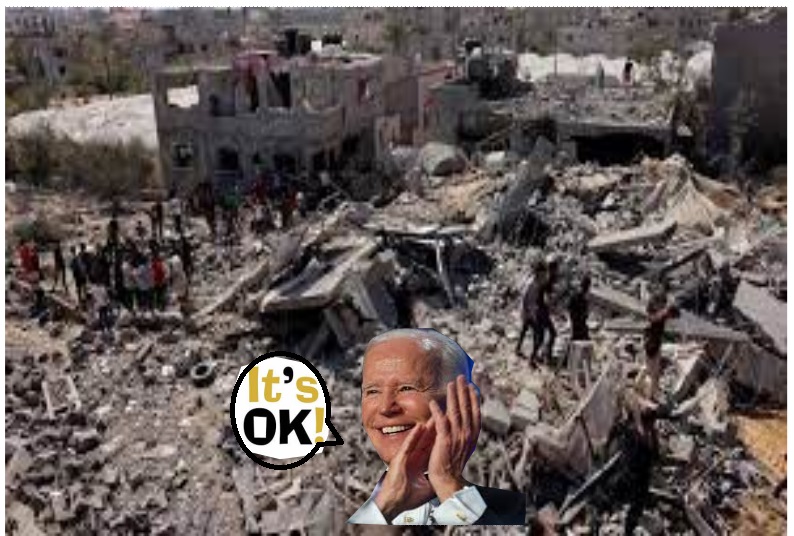
US President Joe Biden will visit Israel on Wednesday and has warned other nations to stay out of the conflict, after Iran threatened to launch “action within hours”.
news.com.au Shannon Molloy, October 17, 2023
Joe Biden will visit Israel on Wednesday for high-level talks about the worsening conflict in Palestine, as Iran threatened to involve itself in the war.
The US President has reaffirmed America’s “iron-clad commitment to [Israel’s] security” and warned other state and non-state actors to stay away.
Some 2000 troops have been ordered to “prepare to deploy” as American warships head to the region.
Meanwhile, aid organisations say time is running out to avoid a devastating humanitarian crisis in Gaza as food, water and fuel runs out, aid organisations warn.
Biden heading to Israel
United States President Joe Biden will visit Israel for high-level talks about the escalating conflict with Hamas in Palestine, after Iran threatened to become involved “within hours”.
Speaking just now to reporters in Tel Aviv, US Secretary of State Antony Blinken confirmed the visit, during which Mr Biden will “reaffirm the United States’ solidarity … and iron-clad commitment to its security”.
“The president will hear from Israel what it needs to defend its people as we continue to work with Congress to meet those needs,” Mr Blinken said.
Mr Biden will also “underscore our crystal-clear message” to others to not seek to take advantage of the crisis “to attack Israel”.
“To that end, he has deployed aircraft carrier groups and other military assets to the region.”
That warning to “state or non-state” forces and the president’s confirmed visit to Israel on Wednesday came just moments after Iran issued a stern threat that is prepared to involve itself in the conflict……………………………………………………….. more https://www.news.com.au/world/middle-east/israel-hamas-conflict-israeli-family-of-five-found-dead-in-an-embrace/news-story/6d79f51f5bcc759020697fa44e63e33b #Israel
This Way for the Genocide, Ladies and Gentlemen

This is not a war. It is the obliteration of civilians trapped for 16 years in the world’s largest concentration camp. Gaza is being leveled, flattened, destroyed, reduced to rubble. Hundreds of thousands of its impoverished residents will be killed, wounded or left homeless without food, fuel, water and medical help. Nearly 600 children are already dead.
Israel, as it has in the past, will block the dissemination of independent reporting and images once some 360,000 soldiers launch a ground assault. It cut internet service in Gaza on Saturday. The brief glimpses of Israeli atrocities that make it out will be dismissed by Israeli leaders as anomalies or blamed on Hamas.
By Chris Hedges / Original to ScheerPost, October 15, 2023 https://scheerpost.com/2023/10/15/this-way-for-the-genocide-ladies-and-gentlemen/
Washington and European governments are cheerleading Israel’s genocidal campaign in Gaza. The failure to intervene to halt the carnage threatens to ignite violence throughout the region.
I have been in urban warfare in El Salvador, Iraq, Gaza, Bosnia and Kosovo. Once you fight street by street, apartment block by apartment block, there is only one rule — kill anything that moves. The talk of safe zones, the reassurances of protecting civilians, the promises of “surgical” and “targeted” air strikes, the establishment of “safe” evacuation routes, the fatuous explanation that civilian dead were “caught in the crossfire,” the claim that the homes and apartment buildings bombed into rubble were the abode of terrorists or that errant Hamas rockets were responsible for the destruction of schools and medical clinics, is part of the rhetorical cover to carry out indiscriminate slaughter.
Gaza is such a small area — 25 miles in length and about 5 miles wide — and so densely populated that the only outcome of an Israeli ground and air assault is the mass death of those Israel’s Defense Minister Yoav Gallant calls “human animals” and Prime Minister Benjamin Netanyahu calls “human beasts.” Israeli Knesset member Tally Gotliv suggested dropping “doomsday weapons” on Gaza, widely seen as a call for a nuclear strike. Israeli President Isaac Herzog on Friday dismissed calls to protect Palestinian civilians. “It is an entire nation out there that is responsible … this rhetoric about civilians not aware, not involved, it’s absolutely not true,” Herzog said. “They could’ve risen up, they could’ve fought against that evil regime that took over Gaza in a coup d’etat.” He added, “We will break their backbone.”
The demand by Israel that 1.1 million Palestinians — nearly half of Gaza’s population — evacuate northern Gaza, which will become a free fire zone, within 24 hours, ignores the fact that given the overcrowding and sealed borders there is no place for the displaced to go. The north includes Gaza City, the most densely populated part of the strip, with 750,000 residents. It also includes Gaza’s main hospital and the Jabalia and al-Shati refugee camps.
Israel, by employing its military machine against an occupied population that does not have mechanized units, an air force, navy, missiles, heavy artillery and command-and-control, not to mention a U.S. commitment to provide a $38 billion military aid package for Israel over the next decade, is not exercising “the right to defend itself.” This is not a war. It is the obliteration of civilians trapped for 16 years in the world’s largest concentration camp. Gaza is being leveled, flattened, destroyed, reduced to rubble. Hundreds of thousands of its impoverished residents will be killed, wounded or left homeless without food, fuel, water and medical help. Nearly 600 children are already dead.
The United Nations Relief and Works Agency (UNRWA) has been forced to close 14 food distribution centers leaving half a million people without food relief. Gaza’s only power plant has run out of fuel. The United Nations says 12 of its staff have been killed by Israeli air strikes, 21 out of 22 UNRWA health facilities in Gaza have been damaged and hospitals lack basic medicines and supplies.
Israel, as it has in the past, will block the dissemination of independent reporting and images once some 360,000 soldiers launch a ground assault. It cut internet service in Gaza on Saturday. The brief glimpses of Israeli atrocities that make it out will be dismissed by Israeli leaders as anomalies or blamed on Hamas.
The West refuses to intervene, as 2.3 million people, including 1 million children, are deprived of food, fuel, electricity and water, see their schools and hospitals bombed and are butchered and rendered homeless by one of the most advanced military machines on the planet.
The gruesome images of Israelis gunned down by Hamas is the currency of death. It trades carnage for carnage, a macabre dance that Israel initiated with the massacres and ethnic cleansing that allowed for the creation of the Jewish state, followed by decades of dispossession and violence meted out to the Palestinians. The Israeli army, before the current assault, had killed 7,779 Palestinians in Gaza since 2000 including 1,741 children and 572 women, according to the Israeli human rights group B’Tselem. This figure does not include Gazans who died due to drinking contaminated water or being denied access to medical treatment. Nor does it include the rising number of Gazan youth who, having lost all hope and struggling with deep depression, have committed suicide.
I spent seven years reporting on the conflict, four of them as the Middle East Bureau Chief of The New York Times. I stood over the bodies of Israeli victims of bus bombings in Jerusalem by Palestinian suicide-bombers. I saw rows of corpses, including children, in the corridors in Dar Al-Shifa Hospital in Gaza City. I watched Israeli soldiers taunt small boys who in response threw rocks and were then callously shot in the Khan Younis refugee camp. I sheltered from bombs dropped by Israeli warplanes. I climbed over the rubble of demolished Palestinian homes and apartment blocks along the border with Egypt. I interviewed the bloodied and dazed survivors. I heard the soul crushing wails of mothers keening over the corpses of their children.
I arrived in Jerusalem in 1988. Israel was busy discrediting and marginalizing the secular, aristocratic Palestinian leadership of Faisel al-Husseini and driving Jordanian administrators from the occupied West Bank. This secular and moderate leadership was replaced by the Palestine Liberation Organization (PLO) and Yasser Arafat. But Arafat, very likely poisoned by Israel, and the PLO were also ruthlessly pushed aside by Israel. The PLO was replaced by Hamas, which Israel openly fostered as a counterweight to the PLO.
The escalating savagery of Israel against the Palestinians is reflected in the escalating savagery of the Palestinians. The resistance groups are Israel’s doppelgängers. Israel believes that with the eradication of Hamas the Palestinians will become docile. But history has shown that once one Palestinian resistance movement is destroyed, a more virulent and radical one takes its place.
The killers feed off each other. I saw this in the ethnic wars in Bosnia. When religion and nationalism are used to sanctify murder there are no rules. It is a battle between light and dark, good and evil, God and Satan. Rational discourse is banished.
“The sleep of reason,” as Francisco Goya said, “brings forth monsters.”
The Jewish extremists, fanatic Zionists and religious bigots in the current Israeli government need Hamas. Revenge is the psychological engine of war. Those targeted for slaughter are rendered inhuman. They are not worthy of empathy or justice. Pity and grief are felt exclusively for one’s own. Israel vows to eradicate a dehumanized mass that embodies absolute evil. The maimed and dead in Gaza, and the maimed and dead in Israeli towns and kibbutzim, are victims of the same dark lusts.
“From violence only violence is born,” Primo Levi writes, “following a pendular action that, as time goes by, rather than dying down, becomes more frenzied.”
The Biden administration has promised unconditional Israeli support and weapons shipments.
The USS Gerald R. Ford Carrier Strike Group has been deployed to the eastern Mediterranean Sea to “deter any actor” who might widen the conflict between Israel and Hamas. The carrier group includes the U.S. Navy aircraft carrier USS Gerald R. Ford; its eight squadrons of attack and support aircraft; the Ticonderoga-class guided missile cruiser USS Normandy; and the Arleigh-Burke class guided missile destroyers USS Thomas Hudner, USS Ramage, USS Carney and USS Roosevelt, according to a Pentagon statement.
The U.S., as in the past, ignores the far greater death and destruction, as well as the illegal occupation, meted out by Israel to the Palestinians or the periodic military campaigns — this is the fifth major military assault by Israel on Gaza in 15 years — against civilians.
Israel says it recovered 1,500 bodies of Hamas fighters after the incursion. This is a number greater than the 1,300 Israeli victims. Nearly all the dead Hamas fighters, I suspect, were young men born inside the Gaza concentration camp who had never seen the outside of the open-air prison until they burst through the security barriers erected by Israel. If Hamas fighters possessed Israel’s technological arsenal of death, they would be able to do their killing more efficiently. But they do not. Their tactics are cruder versions of those Israel has used against them for decades.
I know this disease, the exaltation of race, religion and nation, the deification of the warrior, the martyr and violence, the celebration of victimhood. Holy warriors believe they alone possess virtue and courage, while their enemy is perfidious, cowardly and evil. They believe they alone have the right to revenge. Pain for pain. Blood for blood. Horror for horror. There is a fearsome symmetry to the madness, the abandonment of what it means to be humane and just.
T.E. Lawrence calls this cycle of violence “the rings of sorrow.”
Once these fires are lit they can easily become a conflagration.
Israeli tanks and soldiers, to thwart an attack by Hezbollah in support of the Palestinians, have been deployed to the border with Lebanon. The Israeli forces killed fighters from Hezbollah, as well as a Reuters journalist, which saw Hezbollah fire a salvo of rockets in retaliation. Israel’s National Security Minister, Itamar Ben-Gvir announced he would distribute 10,000 assault rifles to Israeli settlers, who have carried out murderous rampages in Palestinian villages in the West Bank. Israel has killed at least 51 Palestinians in the occupied West Bank since Hamas launched its attack on October 7.
Psychologist Rollo May writes:
At the outset of every war…we hastily transform our enemy into the image of the daimonic; and then, since it is the devil we are fighting, we can shift onto a war footing without asking ourselves all the troublesome and spiritual questions that the war arouses. We no longer have to face the realization that those we are killing are persons like ourselves.
The killing and torture, the more they endure, contaminate the perpetrators and the society that condones their actions. They sever the professional inquisitors and killers from the capacity to feel. They feed the death instinct. They expand the moral injury of war.
Israel taught the Palestinians to communicate in the primitive howl of hatred, war, death and annihilation. But it is not Israel’s assault on Gaza I fear most. It is the complicity of an international community that licenses Israel’s genocidal slaughter and accelerates a cycle of violence it may not be able to control. #Israel #Palestine
“Collateral damage” is unintentional, but Israel’s bombing of Gaza kids IS INTENTIONAL.

2 Bombing Kids And Blaming It On Hamas
CAITLIN JOHNSTONE, OCT 16, 2023
There’s no “collateral damage” in Gaza. Collateral damage is when you unintentionally kill civilians. You can’t drop military explosives on places you know are densely packed with children and then call their deaths unintentional. It’s like calling the death and destruction caused by Hiroshima and Nagasaki unintentional.
The “human shields” narrative is just Israel bombing civilians and blaming it on someone else. That’s all it’s ever been.
The “human shields” argument is like if London had responded to an IRA attack by dropping thousands of bombs on Belfast, killing thousands of Irish civilians and hundreds of children, and justifying its bombing campaign by calling it an unfortunate but necessary measure to take out the IRA’s Belfast Brigade because they’re located in the same places as civilians.
It’s like if the western political/media class defended and supported the carpet bombing of Belfast, saying “All those thousands of deaths are the fault of the IRA, because they’re in Belfast where the civilians are. England has a right to defend itself, after all.”
It’s like if Belfast was walled in with nowhere for civilians to escape to, and London carpet bombed it targeting schools, churches and hospitals, and the western press framed this relentless assault on civilian buildings as “the UK-IRA war” in which London is exclusively bombing “IRA targets in Belfast”.
It’s like if the British spent a week dropping military explosives on locations it knew were packed with Irish children, and anyone who criticized this was accused of anti-Britishism and blood libel.
And to be clear this is not something I’d put past the British actually doing during the Troubles… if the Irish were Muslim and their skin was a little darker……………………….
Step 1: Abuse and kill Muslims
Step 2: Wait for Muslims to respond to those abuses with violence
Step 3: Cite that violence as justification for more killing and abuse to fight “radical Islamic terrorism”.
Works for the US empire’s bogus “war on terror”, and it works for Israel………………………………………..
Israel apologist translation guide:
“You’re an anti-semite” = “I cannot defend Israel’s actions using facts and logic.”
“You hate Jews” = “I cannot defend Israel’s actions using facts and logic.”
“You want Jews to die” = “I cannot defend Israel’s actions using facts and logic.”
“You love Hamas” = “I cannot defend Israel’s actions using facts and logic.”
“You side with the terrorists” = “I cannot defend Israel’s actions using facts and logic.”
Not that it really matters but for the record I personally have a great love for Jews and Jewish culture. Always have, since I was a kid. Most of my anti-war heroes are Jewish, and Jewish artists and thinkers have played a tremendous role in shaping my worldview. My criticisms are directed solely at the apartheid state which cannot exist in the way it exists without nonstop violence and war, which is falsely framed by the western empire as the monolithic source and stronghold of all things Jewish.
Conflating the abuses of that state with Jewishness and Judaism is profoundly anti-semitic. Jews are not anything remotely close to a monolith on the issue of Israel and Zionism. Most of what I’ve learned about Israel over the years I’ve learned from the brilliant Jewish people I follow who oppose it. https://www.caitlinjohnst.one/p/bombing-kids-and-blaming-it-on-hamas?utm_source=post-email-title&publication_id=82124&post_id=137999931&utm_campaign=email-post-title&isFreemail=true&r=1ise1&utm_medium=emailit. #Israel #Palestine
‘Humanity Must Prevail’ in Gaza, Says UN Official as Refugee Shelters Become IDF Targets
“Wars have rules,” said the United Nations agency for Palestinian refugees. “Civilians, hospitals, schools, clinics, and UN premises cannot be a target.”
By Julia Conley / Common Dreams SCHEERPOST, October 15, 2023
The emergency relief coordinator for the United Nations on Saturday said that “humanity is failing” as officials in the United States and other powerful Western countries refused to hear the calls of a growing number of humanitarian groups, progressive lawmakers, and governments for a cease-fire in Gaza—allowing Israel to forge ahead with what will likely be an imminent ground assault on the blockaded enclave.
“The past week has been a test for humanity,” said Martin Griffiths one week after Hamas unleashed a brutal surprise attack on Israel, killing at least 1,300 people and taking scores of people hostage. As Israel’s response has targeted Gaza—home to two million people, about half of whom are children—repeated airstrikes have bombarded “homes, schools, shelters, health centers, and places of worship,” Griffith said, leaving at least 2,215 Palestinians dead, including more than 600 children.
“Entire residential neighborhoods have been razed to the ground,” added Griffiths, who serves as under secretary-general for humanitarian affairs at the United Nations. “Aid workers have been killed. The humanitarian situation in Gaza, already critical, is fast becoming untenable.”
Griffith’s comments came as the U.N. Relief and Works Agency for Palestine Refugees (UNRWA) reported that the indiscriminate bombing campaign has placed its own shelters in “unprecedented” danger, making it impossible for workers to ensure the safety of some 270,000 peoplewho have been displaced and sought shelter at 102 schools run by the agency.
“Wars have rules. Civilians, hospitals, schools, clinics, and UN premises cannot be a target,” said the UNWRA said in a statement. “We are sparing no effort to advocate with parties to the conflicts to meet their obligations under international law to protect civilians including those seeking refuge in UNRWA shelters.”……………………………………………………………………………….. more https://scheerpost.com/2023/10/15/humanity-must-prevail-in-gaza-says-un-official-as-refugee-shelters-become-idf-targets/ #Israel #Palestine
Ex-CIA analyst ‘100% sure’ Hamas using US-supplied weapons
https://www.rt.com/news/584665-hamas-weapons-ukraine-israel-johnson/ 16 Oct 23
Washington is expected to prioritize aid to Israel and put conditions on continued funding to Ukraine
Hamas is using US-supplied weapons to attack Israel even as Washington prepares to step up military aid to West Jerusalem, former CIA analyst Larry Johnson told RT on Monday.
“It’s probably 100% sure that the weapons were supplied by the United States,” Johnson opined, explaining that the only question was whether the Palestinian militant group’s weapons had come from US supplies diverted from Ukraine, Afghanistan, or the Palestinian Authority in the West Bank.
Noting there were “no effective controls” on the billions of dollars in arms and military financing funneled from the US to Ukraine in the last two years, Johnson observed that even weapons supplied by Israel to Ukraine might have made it back to Hamas via the black market, suggesting the war unfolding in Gaza “will tell us how extensive some of those weapons supplies have been
The burgeoning conflict will also force a reevaluation of Washington’s blank check to Ukraine, the ex-analyst predicted. “Congress is going to insist that Israel gets put at the front of the line and that Ukraine’s going to go to the back of the line. It’s also going to embolden and make happen inspections and accounting … in order to deliver, to allow Ukraine to have any more weapons.”
Noting that “Ukraine’s losing on the ground,” he predicted “this is going to be portrayed in the media in the coming weeks as the fate of Israel” if the US fails to supply sufficient weapons and cash to its Middle Eastern ally.
Palestinians Speak Out
#Israel #Palestine
It’s Not The ‘Israel-Hamas War’, It’s The Israel-Gaza Massacre
I used to think all genocidal massacres are bad but then some really smart Israel apologists explained to me that this genocidal massacre is completely different because this genocidal massacre’s perpetrators believe they are doing the right thing for a good reason.
CAITLIN JOHNSTONE, OCT 15, 2023
Stop calling it the “Israel-Hamas war”. It’s the Israel-Gaza massacre. Calling it the Israel-Hamas war creates the false impression that this is a war that is directed exclusively at Hamas when it’s really an ethnic purge that’s directed at all Palestinians in Gaza.
The child body count alone makes it clear that this isn’t a war against Hamas; I saw an anonymous account point out on Twitter that the number of children killed in this onslaught after one week already exceeds the total number of children killed after a year and a half of fighting in Ukraine, per the United Nations.
Laying complete siege to a civilian population and bombing anything that stands would be an extraordinary abomination in any war. And this is not a war, it’s an enclosed shooting range with military explosives and human targets.
Americans should probably worry about the rapid legitimization of this idea that civilians who have a government that kills people are all legitimate targets………………………………………………
Israel has been struggling with a rapidly worsening PR crisis ever since Palestinians started getting internet access and smartphones with video cameras and exposing Israeli apartheid abuses. So if you’re wondering why they cut off Gaza’s internet and electricity, that’s why.
Israel was 100% aware that cutting off power and internet to Gaza would prevent Palestinians from recording and publishing footage of its coming war crimes. They struck a fatal blow to citizen journalism in Gaza, thereby blinding the whole world to what’s happening there.
The mass media asked you to believe the Hamas attack was “unprovoked”. Then they asked you to believe blatant babies-on-bayonets atrocity propaganda. Now they’re asking you to believe Jewish kids were in school before dawn on a Saturday morning in Israel. Western journalism, folks.
The only reason so many Israel apologists scrambled to circulate unverified stories about beheaded babies and mass rapes instead of waiting for evidence was to make the real atrocities Israel is perpetrating and will continue to perpetrate in Gaza look reasonable and appropriate.
❖
After this current crisis is over I’m probably going to think a lot about the fact that MSNBC suspended three Muslim reporters during Israel’s Gaza assault because it didn’t want Muslims reporting on it.
I used to think all genocidal massacres are bad but then some really smart Israel apologists explained to me that this genocidal massacre is completely different because this genocidal massacre’s perpetrators believe they are doing the right thing for a good reason…………………………………………………………………………………..
The greatest trick white anti-semites ever pulled was getting Jews to leave western society in droves and move to a far away country to spend their lives beating up Muslims. https://www.caitlinjohnst.one/p/its-not-the-israel-hamas-war-its?utm_source=post-email-title&publication_id=82124&post_id=137970619&utm_campaign=email-post-title&isFreemail=true&r=1ise1&utm_medium=email #Israel #Palestine
What the media forgets to tell you about Israel and Gaza
Ignore the fake news. Israel isn’t defending itself. It’s enforcing its right to continue ethnically cleansing Palestinians
JONATHAN COOK, OCT 16, 2023 https://jonathancook.substack.com/p/what-the-media-forgets-to-tell-you?utm_source=post-email-title&publication_id=476450&post_id=137987299&utm_campaign=email-post-title&isFreemail=true&r=ln98x&utm_medium=email
The missing context for what’s happening in Gaza is that Israel has been working night and day to ethnically cleanse the Palestinian people from their homeland since even before Israel become a state – when it was known as the Zionist movement.
Israel didn’t just cleanse Palestinians in 1948, when it was founded as a Western colonial project, and again under cover of a regional war in 1967. It also worked to ethnically cleanse Palestinians every day between those dates and afterwards. The aim was to move them off their historic lands, and either expel them beyond Israel’s new, expanded borders or concentrate them into small ghettoes inside those borders – as a holding measure until they could be expelled outside the borders.
The ‘settler’ project, as we call it, is a misnomer. It’s really Israel’s ethnic cleansing programme. Israel even has a special word for it in Hebrew: ‘Judaisation’, or making the land Jewish. It is official government policy.
Gaza was the largest of the Palestinian reservations created by Israel’s ethnic cleansing programme, and the most overcrowded. To stop the inhabitants spilling out, Israel built a fence-barrier in the early 1990s to pen them in. Then when policing became too hard from within the prison, Israel pulled back in 2005 to the outer perimeter barrier.
New technology allowed Israel to besiege Gaza remotely by land, sea and air in 2007, limiting the entry of food and vital items like medicine and cement for construction. Automated gun towers shot anyone who came near the fence. The navy patrolled the sea, stopping boats straying more than a kilometre or two off shore. And drones watched 24 hours a day from the sky.
The people of Gaza were sealed in and largely forgotten, except when they lobbed a few rockets over the fence – to international indignation. If they fired too many rockets, Israel bombed them mercilessly and occasionally launched a ground invasion. The rocket threat was increasingly neutralised by a rocket interception system, paid for by the US, called Iron Dome.
Palestinians tried to be more inventive in finding ways to break out of their prison. They built tunnels. But Israel found ways to identify those that ran close to the fence and destroyed them.
Palestinians tried to get attention by protesting en masse at the fence. Israeli snipers were ordered to shoot them in the legs, leading to thousands of amputees.
The ‘deterrence’ seemed to work. Israel could once again sit back and let the Palestinians rot in Gaza. ‘Quiet’ had been restored.
Until, that is, last weekend when Hamas broke out briefly and ran amok, killing civilians and soldiers alike.
So Israel now needs a new policy. It looks like the ethnic cleansing programme is being applied to Gaza anew. The half of the population in the enclave’s north is being herded south, where there are not the resources to cope with them. And even if there were, Israel has cut off food, water and power to everyone in Gaza.
The enclave is quickly becoming a pressure cooker. The pressure is meant to build on Egypt to allow the Palestinians entry into Sinai on ‘humanitarian’ grounds.
Whatever the media are telling you, the ‘conflict’ – that is, Israel’s ethnic cleansing programme – started long before Hamas appeared on the scene. In fact, Hamas emerged very late, as the predictable response to Israel’s violent colonisation project.
And no turning point was reached a week ago. This has all been playing out in slow motion for more than 100 years.
Ignore the fake news. Israel isn’t defending itself. It’s enforcing its right to continue ethnically cleansing Palestinians.
THE PLAN TO WIPE OUT HAMAS
As refugees crowd the border with Egypt, Israel prepares to hit Gaza City with US-supplied bunker busters
SEYMOUR HERSH, OCT 15, 2023
It’s been one week since the horrific Hamas attacks on Israel took place, and the shape of what is to come from the Israeli armed forces is clear, and uncompromising.
Over the past week Israeli jets have conducted around-the-clock bombing of non-military targets in Gaza City. Apartment buildings, hospitals, and mosques were torn apart, with no prior warning and no effort to minimize civilian casualties.
By the end of the week Israeli jets were also dropping leaflets telling the citizens of Gaza City and its surrounding areas in the north that those who wished to survive had better start going south—walking if necessary—25 miles or more—to the Rafah border crossing leading to Egypt. As of this writing, it was not clear whether financially stricken Egypt will allow a million immigrants, many of them committed to the Hamas cause, to cross. In the short term, I have been told by an Israeli insider that Israel has been trying to convince Qatar, which at the urging of Prime Minister Benjamin Netanyahu was a long-time financial supporter of Hamas, to join with Egypt in funding a tent city for the million or more refugees awaiting across the border. “It’s not a done deal,” the Israeli insider told me. Israeli officials have warned Egypt and Qatar that without a landing site, the refugees will have to “go back to Gaza.”
One possible site, the insider said, is a long abandoned chunk of land in northern part of the Sinai Peninsula, near the border crossing from Gaza, that was the site of an Israeli settlement known as Yamit when the peninsula was seized by Israel after its victory the Six-Day War of 1967. The settlement was evacuated and bulldozed by Israel before Sinai was returned to Egypt in 1982. The Israeli hope is that Qatar and Egypt will take the refugee crisis off its hands.
Israel’s obvious contempt for the well-being of the citizenry of Gaza amid the forced migration of more than one million starving human beings has captured the world’s attention and led to increasing international condemnation, much of it aimed at Prime Minister Benjamin Netanyahu.
And so the next stage must come soon. Here is what I have been told, in my conversations in recent days with officials from Israel and elsewhere, including officials I have dealt with in Europe and the Middle East since the Vietnam war, about the Israeli plan for the elimination of Hamas…………………………………………………….
With the starved-out civilian population forced to leave, the Israeli operational plan calls for the Air Force to destroy the remaining structures in Gaza City and elsewhere in the north. Gaza City will be no more. Israel will then begin dropping American-made 5,000-pound bombs known as “bunker busters,” or JDAMs, in the flattened areas……………………………………………………………………….
The systematic destruction of the remaining buildings in Gaza City will start within days, the Israeli insider said. The bunker-buster JDAMs could come next. Then, in the planners’ scenario, I was told, the Israeli infantry will be assigned to mop-up operations: searching out and killing those Hamas fighters and workers who managed to survive the JDAM attacks……………………………………………………………………………………….. more https://seymourhersh.substack.com/p/the-plan-to-wipe-out-hamas?utm_source=post-email-title&publication_id=1377040&post_id=137958833&utm_campaign=email-post-title&isFreemail=false&r=98yko&utm_medium=email #Israel #Palestine
1 This Month
26 September – International Day for the Total Elimination of Nuclear Weapons





PLEASE OPPOSE HR 8255 AND S.3639 – bills would accelerate satellite deployment, with no environmental review or safeguards – https://ncstd5li.quorum.us/campaign/169331/
To see nuclear-related stories in greater depth and intensity – go to https://nuclearinformation.wordpress.com
-
Archives
- September 2026 (291)
- August 2026 (330)
- July 2026 (355)
- June 2026 (287)
- May 2026 (306)
- April 2026 (356)
- March 2026 (251)
- February 2026 (267)
- January 2026 (308)
- December 2025 (358)
- November 2025 (359)
- October 2025 (375)
-
Categories
- 1
- 1 NUCLEAR ISSUES
- business and costs
- climate change
- culture and arts
- ENERGY
- environment
- health
- history
- indigenous issues
- Legal
- marketing of nuclear
- media
- opposition to nuclear
- PERSONAL STORIES
- politics
- politics international
- Religion and ethics
- safety
- secrets,lies and civil liberties
- spinbuster
- technology
- Uranium
- wastes
- weapons and war
- Women
- 2 WORLD
- ACTION
- AFRICA
- Atrocities
- AUSTRALIA
- Christina's notes
- Christina's themes
- culture and arts
- Events
- Fuk 2022
- Fuk 2023
- Fukushima 2017
- Fukushima 2018
- fukushima 2019
- Fukushima 2020
- Fukushima 2021
- general
- global warming
- Humour (God we need it)
- Nuclear
- RARE EARTHS
- Reference
- resources – print
- Resources -audiovicual
- Weekly Newsletter
- World
- World Nuclear
- YouTube
-
RSS
Entries RSS
Comments RSS

