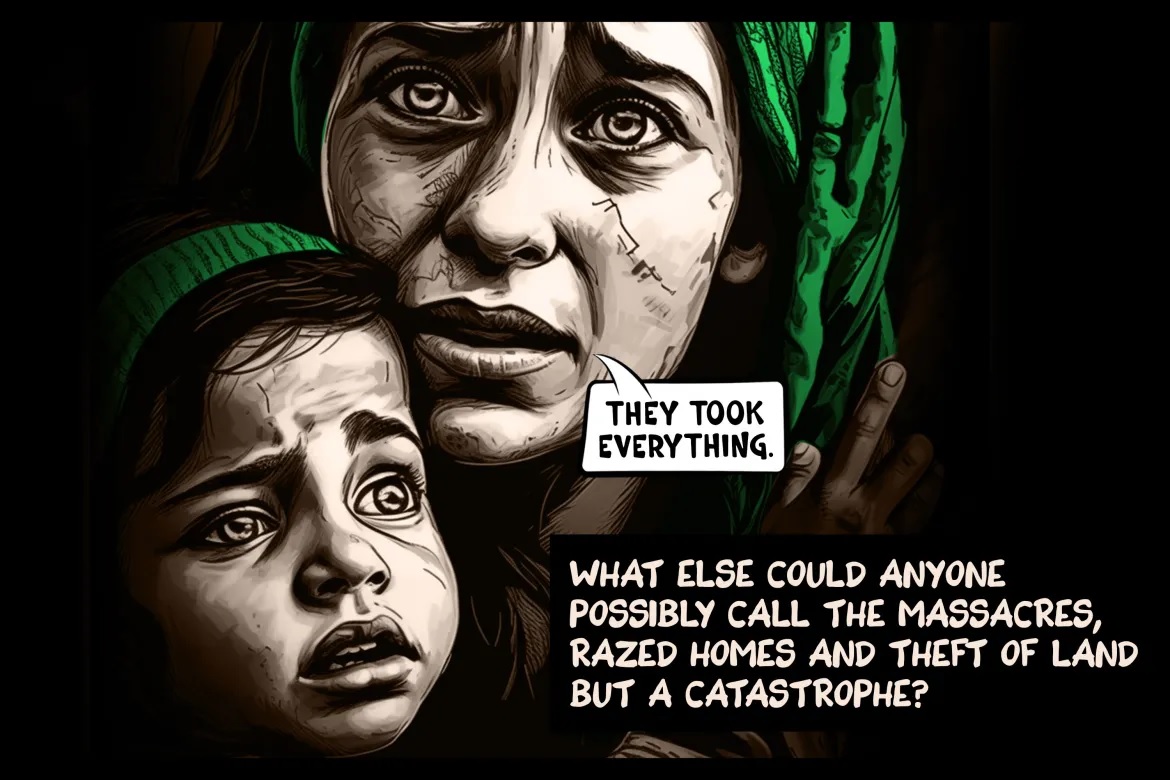
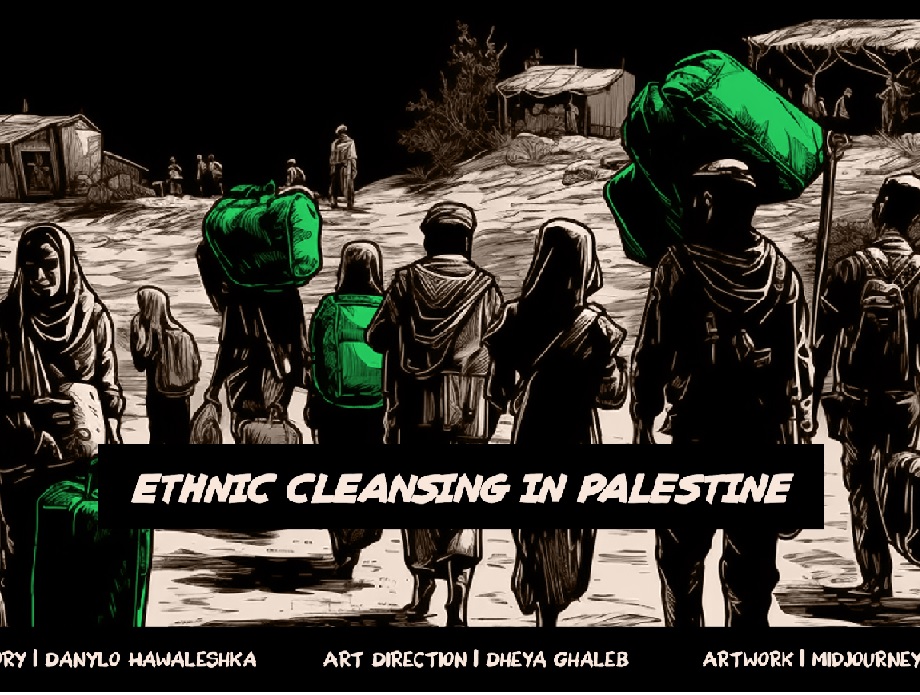
As Israel’s carpet bombing of Gaza entered its third week, leaving over 5000 dead and at least one million residents displaced, a Tel Aviv-based think tank published a blueprint for self-proclaimed Jewish state’s final solution.
In a white paper released over a week after the Hamas-led surprise attack on Israeli military bases and kibbutzes, The Institute for National Security and Zionist Strategy outlined “a plan for resettlement and final rehabilitation in Egypt of the entire population of Gaza,” based on the “unique and rare opportunity to evacuate the entire Gaza Strip” that Israel’s latest assault on the besieged costal enclave provided.
Published in Hebrew on the organization’s website, the paper was authored by Amir Weitman, “an investment manager and visiting researcher” at the Institute who also leads the libertarian caucus of Israel’s ruling Likud Party. The document began by noting that there are 10 million vacant housing units in neighboring Egypt that could be “immediately” filled with Palestinians. Weitman then assured readers that the “sustainable plan…aligns well with the economic and geopolitical interests of the State of Israel, Egypt, the USA and Saudi Arabia.”
Weitman’s ethnic cleansing proposal echoes forced transfer plans advanced in recent days by former Israeli officials while capitalizing on evacuation orders delivered to the entire civilian population of northern Gaza by the Israeli military.
Weitman’s sinister blueprint imagined Israel purchasing these properties at a cost of $5 – 8 billion dollars, a whopping price-tag that reflects just 1 – 1.5 percent of Israel’s GDP.
“These sums of money [required to cleanse Gaza] in relation to the Israeli economy, are minimal,” Weitman posits. “Investing individual billions of dollars to solve this difficult issue is an innovative, cheap and sustainable solution.”
Weitman acknowledged that his plan virtually amounts to Israel “buying the Gaza Strip,” arguing the move would be “a very worthwhile investment” for Zionists because it would “add a lot of value over time.” He asserted local “land conditions” in the area would provide “many” Israeli settlers a high standard of living, therefore allowing for an expansion of settlements in Gush Dan near the Egyptian border, giving “a tremendous impetus to settlement in the Negev.”
In December 2021, Tel Aviv approved plans to establish four settlements in the Negev to house 3,000 settler families.
A genocidal war to end all wars
Though Egypt has so far rejected Israeli pressure for a mass exodus of Gaza residents through the southern Rafah crossing, Weitman argued Cairo will welcome the mass exodus of Palestinian refugees as “an immediate stimulus” that will “provide a tremendous and immediate benefit to al-Sisi’s regime.”
Weitman claimed that Cairo’s major creditors — including France, Germany and Saudi Arabia — are likely to welcome a revitalized Egyptian economy, courtesy of “Israeli investment” in the Palestinians’ permanent removal. He surmizes that Western Europe will welcome “the transfer of the entire Gaza population to Egypt,” because it will significantly “reduce the risk of illegal immigration…a tremendous advantage.” Meanwhile, he expects Riyadh to embrace the move because the “evacuation of the Gaza Strip means the elimination of a significant ally of Iran.”
The ethnic cleansing of Gaza would mean an end to “ceaseless, repeated rounds of fighting, which inflame the fires of hatred against Israel.” Moreover, “closing the Gaza issue will ensure a stable and increased supply of Israeli gas to Egypt and its liquefaction,” from the vast reserves seized by Israel near Gaza’s shores.
Palestinians in turn are expected to jump at the chance to be forcibly transferred from their homes rather than “living in poverty under the rule of Hamas.” It is therefore necessary for Israel to “create the right conditions” for them to “immigrate” from Gaza to Cairo. Weitman noted that Gaza’s two million inhabitants “constitute less than 2% of the total Egyptian population, which today already includes 9 million refugees. A drop in the ocean.”
The paper ominously concluded: “There is no doubt that in order for this plan to come to fruition, many conditions must exist at the same time. Currently, these conditions are met and it is unclear when such an opportunity will arise again, if ever. This is the time to act. Now.”
“If we want to remain alive, we will have to kill and kill and kill”
As barbarous as these proposals might seem, they reflect what many Israeli officials appear to be murmuring in private, and what at least one former government spinmeister has openly pushed as an altruistic solution to the Palestinian “problem.”
“There is a huge expanse, almost endless space in the Sinai Desert, just on the other side of Gaza,” former Deputy Foreign Minister of Israel, Danny Ayalon, echoed the genocidal Zionist logic behind Weitman’s proposal in an interview with Al Jazeera’s Marc Lamont Hill. “The idea is—and this is not the first time it will be done—for them to leave over to the open areas where we and the international community will prepare the infrastructure — you know, 10 cities with food and water — just like for the refugees of Syria.”
In 2004, Zionist demographer Arnon Sofer of Haifa University laid out detailed plans for the isolation of Gaza directly to Ariel Sharon’s government. This entailed withdrawing Israeli forces from the area entirely and constructing a stringent system of surveillance and security to ensure nothing and no one went in or out without Zionist proviso. He predicted a perpetual bloodbath:
“When 2.5 million people live in a closed-off Gaza, it’s going to be a human catastrophe. Those people will become even bigger animals than they are today…The pressure at the border will be awful. It’s going to be a terrible war. So, if we want to remain alive, we will have to kill and kill and kill. All day, every day…the only thing that concerns me is how to ensure the boys and men who are going to have to do the killing will be able to return home to their families and be normal human beings.”
The Institute has put forward a clean and easy fantasy of achieving the same goal put forward by Sofer. For it to succeed, all Palestinians have to do is put down their weapons and head toward the desert of permanent exile. #Israel #Palestine
Walt Zlotow , West Suburban Peace Coalition, Glen Ellyn IL 25 Oct 23
White House National Security Council spokesman John Kirby advised Gazans Tuesday that their destruction and ethnic cleansing will continue relentlessly. “This is war. It is combat. It is bloody, ugly and it’s going to be messy and innocent civilians are going to be hurt going forward.”
No spokesman Kirby, not just hurt. Innocent civilians in Gaza are dying every day, every hour, every minute under thousands of bombs but no food, no water, no medicine; not even electricity to run their overwhelmed hospitals.
It’s no longer a war. It’s the mass destruction of 2.3 million Palestinians being systematically killed and driven from their open air prison by Israel and wholly enabled by the United States.
It is the worst, most grotesque and inhumane policy of the United State I’ve witnessed in my 70 plus years of following American foreign affairs.
Perpetual war in Ukraine that could go nuclear is not enough for Biden. He’s all in now for perpetual war in the Middle East that could explode into a massive regional war at any moment, if it doesn’t kill or remove all the Palestinians from Gaza first. #Israel #USA #Palestine
An army of pro-Israel trolls has invaded the Community Notes function on X/Twitter, attempting to influence the online debate around the ongoing crisis.
SCHEERPOST, By Alan MacLeod / MintPress News, October 25, 2023
Almost as important as its military campaign for Israel is its battle to control its public image. Even as it kills thousands of people in Gaza, the small Middle Eastern nation is spending millions of dollars on a propaganda war, purchasing ads on YouTube, Facebook, Instagram and other online apps. At the same time, an army of pro-Israel trolls has invaded the Community Notes function on X/Twitter, attempting to influence the online debate around the ongoing crisis.
Spending Millions to Whitewash Massacres
Since October 7, Israel has inundated YouTube with advertisements, with its Ministry of Foreign Affairs spending nearly $7.1 million on ads in the two weeks following Hamas’ incursion. According to journalist Sophia Smith Galer, this equates to almost one billion impressions.
With its campaign, the Israeli government overwhelmingly focused on rich Western nations, its top targets being France, Germany, the United Kingdom, Belgium and the United States. In France alone, the ministry spent $3.8 million. Other branches of the Israeli government undoubtedly also spent money on ads. The overwhelming message of the campaign was that Hamas are terrorists linked with ISIS and that Israel – a modern, secular democracy – is defending itself from foreign aggression.
Much of the content blatantly violated YouTube’s terms of service, including a number of ads featuring gory shots of dead bodies. Another ad that piqued public attention was played before videos aimed at babies. Amid a scene of pink rainbows and soothing music, text appears reading:
We know that your child cannot read this. We have an important message to tell you as parents. 40 infants were murdered in Israel by the terrorists Hamas (ISIS). Just as you would do everything for your child, we will do everything to protect ours. Now hug your baby and stand with us.”
Nearly all the Ministry of Foreign Affairs views are inorganic. Most of their YouTube uploads garner only a few hundred views. But the ones selected as advertisements have hundreds of thousands or even millions of views.
Israel’s YouTube campaign has been matched by expansive attempts to control the public debate on other social media platforms. In barely a week, the Ministry of Foreign Affairs ran 30 ads seen over 4 million times on Twitter. Like with YouTube, analytics data shows they were inordinately targeting adults in Western Europe.
One ad contained the words “ISIS” and “Hamas,” showing disturbing imagery that gradually sped up until the names of the two groups blended into one. In case the message was not clear enough, it ended with the message, “The world defeated ISIS. The world will defeat Hamas.”
The Ministry of Foreign Affairs has also bought large numbers of advertisements on Facebook, Instagram, mobile games and apps such as language trainer Duolingo.
Taking Notes
The Community Notes function on Twitter is an attempt to fight false information. Contributors who sign up for the feature can leave notes on any post, adding context to potentially misleading statements. The community then votes on these notes, and if enough people consider the note useful, it is presented below the original tweet.
While it has its advantages, the system is ripe for abuse and infiltration. Since October 7, an army of pro-Israel trolls has brigaded the function and is attempting to undermine and attack as many posts as possible showing Israel in a negative light or Palestine in a positive one. This has often been done in an attempt to hide Israeli war crimes.
“If you’re not a Community Notes contributor, then you may be unaware that any tweet about Gaza that poses an inconvenience to Israeli information interests is being mobbed by Israel apologists working to manipulate the narrative, including on tweets just voicing an opinion,” wrote journalist Caitlin Johnstone.
A case in point is the attack on the Al-Ahli Hospital in Gaza. Under a tweet from journalist Dan Cohen noting that Hananya Naftali (an aide to Prime Minister Benjamin Netanyahu) had boasted that Israel carried out the attack before deleting his message, Community Notes wrote that “Naftali has openly retracted his statement, as conclusive evidence has since shown the explosion was fired from a misfired rocket from Gaza.” The “conclusive evidence” offered was a statement from the Pentagon and a tweet from a former Israeli Air Force squad commander.
Meanwhile, a tweet from Lebanese political commentator Sara Abdallah breaking the news that Israel had just bombed the St. Porphyrius Church in Gaza was flagged by Community Notes. This meant that all users saw a note added reading, “False. Saint Porphyrius Orthodox Church in Gaza has posted they are untouched and operating as of October 9, 2023.” The problem was this was breaking news related to October 19, so any statement before that time was meaningless in assessing the news. Further undermining the community note was that Israel almost immediately accepted responsibility for the destruction.
Pro-Israel trolls have also not been above blatant smears. On a popular post from myself where I shared a picture of Joe Biden and Benjamin Netanyahu embracing with the words, “In the future, this image will be looked upon as one of the most shameful moments in history,” Community Notes added the message: “Alan MacLeod is a Senior Staff Writer at MintPress News. MintPress is renowned for publishing far-left disinformation and antisemitic conspiracy theories.” Other MintPress staff, such as Lowkey and Mnar Adley, have also been consistently targeted with smears and arguments dressed up as clarifications.
Seeing What Sticks
In the fog of war, the Middle Eastern network Al-Jazeera has been a consistent source of live reporting. The well-funded network has a large team of reporters in Palestine and the wider region and has a long history of covering the conflict.
Therefore, when Al-Jazeera released an investigation that found no evidence to support Israel’s claim that a failed Palestinian rocket launch was to blame for the damage at the Al-Ahli Hospital, the story went viral.
This was a major blow to Israel and its apologists, who did not want the blood of hundreds of innocent doctors and patients on their hands. And so, pro-Israel users attempted to get community notes plastered all over the Al-Jazeera story……………………………………………………….
Wiki Wars
This is not the first time that Israel and its supporters have attempted to hijack and manipulate public highways of information. For over a decade, well-organized and well-funded Israeli groups have infiltrated Wikipedia and attempted to rewrite the encyclopedia to defend Israeli actions and demonize voices who speak out against them.
One of the most well-known of these is the Yesha Council, which, as far back as 2010, claimed to have 12,000 active members. Yesha members painstakingly police Wikipedia, removing troublesome facts and framing articles in a manner more favorable to Israel…………………………………………………
Spies Among Us
One of the reasons that social media companies have not cracked down on disingenuous pro-Israeli activities could be that former Israeli government and military officials hold top positions at a great number of the world’s most important platforms.
Emi Palmor, for example, is one of 22 individuals who sit on Facebook’s Oversight Board. Palmor was formerly the General Director of the Israeli Ministry of Justice. In this role, she directly oversaw the stripping away of Palestinian rights. She created a so-called “Internet Referral Unit,” which would push Facebook to delete Palestinian content that the Israeli government objected to. In her new role at the Oversight Board, she effectively writes Facebook’s rules, deciding what content to promote to the platform’s 3 billion users and what to censor, delete or suppress.
Palmor is also a veteran of Unit 8200, perhaps the most controversial unit in the Israeli military. Described as “Israel’s NSA,” Unit 8200 is the centerpiece of the country’s high-tech surveillance industry. Unit 8200 spies on the Palestinian population, compiling vast dossiers on millions of people, including their medical history, sex lives, and search histories, to be used for extortion later. ………………………………………………….
A MintPress News investigation unearthed a network of hundreds of Unit 8200 veterans working in influential positions at some of the planet’s most important tech and social media companies, including Google, Amazon and Meta (Facebook).
For example, Google’s Head of Strategy and Operations for Research, Gavriel Goidel, was previously a senior officer in Unit 8200, rising to become Head of Learning. Facebook Messenger’s Head of Data Science, Eyal Klein, served for six years in Unit 8200, rising to the rank of captain. And after serving in the controversial unit, Ayelet Steinitz became Microsoft’s Head of Global Strategic Alliances…………………………………………………………. more https://scheerpost.com/2023/10/25/propaganda-war-pro-israel-trolls-are-mobbing-twitters-community-notes/ #Israel #Palestine
Over 5,000 dead, mostly civilians, from 2 weeks of relentless Israeli bombing, turning much of the 139 square miles of Gaza into rubble, is a genocidal act of ethnic cleansing. It is designed to diminish, if not eliminate the 2.3 million Gazans. The many who have died from lack of food, water, medicine and electricity, while unknown, may be in the thousands as well. It is a monumental crime against humanity.
Much of the world is repulsed, including many in Israel. Yesterday, dozens from local Chicago Jewish groups, If Not Now, Never Again Action, and Jewish Voice for Peace, held up traffic in the Loop for over an hour during rush hour in their call for immediate ceasefire. Bravo.
But not President Biden who is arming Israel and giving it a virtual blank check for an imminent invasion likely to further kill, degrade and ethnically cleanse those 2.3 million Palestinians. That imminent invasion may unleash blowback that could involve Iran, Lebanon and Syria; a regional conflict that may be uncontainable.
Biden preaches aid for starving, dying Palestinians but what has arrived is a pittance that will make no difference in their ongoing destruction from the worst collective punishment inflicted upon a civilian population in our lifetime. His aid lip service is not soothing…. it is deadly.
Biden’s cruel greenlighting of Gaza’s impending demise is no surprise. He’s simply following US policy for the last 18 years supporting Israel’s blockade of Gaza since they withdrew in 2005. But he has the opportunity. It requires true, humane statesmanship to lead the world in confronting the need for a Palestinian state prevented by Israeli intransigence and enabled by the US for 75 years now. Biden should demand an immediate ceasefire. He should suspend all aid to Israel including the proposed $10 billion in weaponry to conduct their impending invasion.
A more destructive US policy destroying peace and bringing needless death and suffering to millions is hard to imagine. But it is happening, which requires every American to demand Biden, his administration and Congress pivot from supporting relentless war to promoting a lasting peace in Israel and Gaza/West Bank. #Israel #Palestine
October 18, 2023, Geneva, Switzerland – On the heels of President Biden’s visit to Israel and as the Palestinian death toll in Gaza passes 3,300, expert attorneys from the U.S.-based Center for Constitutional Rights released a legal and factual analysis of Israel’s unfolding crime of genocide against the Palestinian people and U.S. complicity in this grave international law violation. The emergency briefing paper comes soon after the U.S veto of a United Nations Security Council resolution condemning both Hamas’s attack on Israel and all violence against civilians and calling for humanitarian access to Gaza. It also comes as President Biden seeks to secure additional, unconditional military support for Israel.
According to the emergency briefing paper, there is a credible case, based on powerful evidence, that Israel is attempting to commit or committing genocide in the occupied Palestinian territory, and specifically against the Palestinian people in the Gaza Strip. The United States has a duty under Article 1 of the 1948 Genocide Convention to prevent acts of genocide, an obligation that has been domestically implemented through U.S. criminal law. The legal and factual analysis provided by the Center for Constitutional Rights describes how, through its ongoing unconditional military, diplomatic, and political support to Israel, the United States is not only failing to prevent genocide, but is complicit. Under international law, the United States – and responsible U.S. citizens, including and up to the President – can be held accountable for their role in furthering genocide.
According to the International Court of Justice, “a State’s obligation to prevent [genocide], and the corresponding duty to act, arise at the instant that the State learns of, or should normally have learned of, the existence of a serious risk that genocide will be committed.” States are required to take all measures “reasonably available to them” to prevent this risk from that moment onward, “if the State has available to it means likely to have a deterrent effect on those suspected of preparing genocide, or reasonably suspected of harbouring specific intent.”
As scholars and observers increasingly warn of genocide, and as protestors rise up against Israel’s gravest atrocities against Palestinians since 1948, the Center for Consitutional Rights has been asked by Palestinian partners on the ground to offer this analysis as we strengthen our collective efforts towards accountability and freedom. The emergency briefing paper calls on the United States to take all necessary measures to secure a ceasefire, pressure Israel to end all military operations, end all U.S. military aid to Israel, and ensure the provision to Palestinians in Gaza of urgently needed basic necessities for life. The experts also stress in the briefing paper the urgent need to address the root causes of the current catastrophe, especially the 16-year closure of Gaza, the 56-year illegal occupation, and the apartheid regime across all of historic Palestine.
The emergency briefing paper will be submitted to national and international stakeholders, including the High Commissioner for Human Rights, the UN Office on Genocide Prevention and the Responsibility to Protect, and the Office of the Prosecutor of the International Criminal Court. It will also be sent to President Biden, Secretary Blinken, and other U.S. officials and relevant agencies. Read the emergency legal briefing paper here. For more information, see our resource page. #USA #Israel #Palestine
The United Nations has revised its grim figure of the rising death toll from Israel’s bombardment of Gaza, saying that it has surpassed 5,000 as of Monday. It stands at 5,087.Separately, over 90 Palestinians have been killed in escalating West Bank violence, which over the weekend included Israel launching a rare airstrike on Jenin. Hamas and Palestinian Islamic Jihad (PIJ) are still holding at least 222 Israeli and foreign captives – a number which has again been revised upward.
European Union foreign ministers are meanwhile gathered in Brussels for an urgent meeting to take up the contentious issue of a ceasefire. UN secretary-general Antonio Guterres has been calling on world bodies to back a ceasefire. In response, EU foreign policy chief Josep Borrell said:
“Personally, I think that a humanitarian pause is needed in order to allow the humanitarian support to come in and be distributed, seeing that half of the population of Gaza has been moving from their houses.”
Bloomberg is reporting Monday morning that EU leaders are set to endorse a call for a “humanitarian pause”. “The European Council supports the call of UNSG (U.N. Secretary-General Antonio) Guterres for a humanitarian pause in order to allow for safe humanitarian access and aid to reach those in need,” a draft statement of the summit reads.
But Washington, Israel’s staunchest supporter, isnot expected to back a ceasefire – despite reports President Biden has sought for Israel’s military delay the expected imminent ground invasion, in order to buy more time to negotiate the freedom of more hostages.
Secretary of State Antony Blinken in the Sunday news shows made this clear. Margaret Brennan, the host of CBS News’ Face the Nation, asked him:
“UNICEF says 1,524 children have been killed in the Gaza Strip during these bombings. Why isn’t the US calling for at least a temporary ceasefire?“
Blinken then claimed that children dying on either side has hit him “right in the heart” – but he stopped short of directing any criticism at Israel’s indiscriminate and unrelenting bombing campaign.Instead, he defended it.
Blinken said in reference to October 7 Hamas cross-border attack:
“Israel has to do everything it can to make sure this doesn’t happen again. Freezing things in place where they are now would allow Hamas to remain where it is and to repeat what it’s done some time in the future. No country could accept that.”
He then cited unverified reports that Hamas has actively blocked Palestinians who are also American citizens from leaving the Gaza Strip.
“We’ve had people come to Rafah, the crossing with Egypt. And to date, at least, Hamas has blocked them from leaving, showing once again, its total disregard for civilians of any kind who are — who are stuck in Gaza. So really, the ball is in Hamas’ court, in terms of letting people who want to leave, civilians from third countries, including Americans get out of Gaza.”
There are a reported up to 600 Americans stuck in Gaza, with one Palestinian-American telling NBC that “America’s not helping us, Biden’s not helping us, the embassy is not helping us.”
The United States is still bolstering its military presence in Middle East waters, readying for any contingency, even as it’s said to be pressing for furthering back-channel negotiations and delaying an all-out Israeli assault:
It was becoming increasingly clear Monday that the U.S. wants Israel to not only allow more humanitarian assistance into Gaza, but for the country to let ongoing negotiations over the release of hostages held by Hamas to continue before it launches a ground invasion of the Palestinian territory. Israel said Monday that Hamas was still holding 222 people captive.
Two sources told CBS News the U.S. has sought to slow Israel’s plans for a ground invasion in order to prioritize the release of hostages and the distribution of aid, a message Washington is said to have been conveying primarily through defense channels.
The Pentagon is calling its moving two aircraft carrier strike groups into regional waters an act of “deterrence”.
Secretary of Defense Lloyd Austin had announcedSaturday:
“Following detailed discussions with President Biden on recent escalations by Iran and its proxy forces across the Middle East Region, today I directed a series of additional steps to further strengthen the Department of Defense posture in the region. These steps will bolster regional deterrence efforts, increase force protection for U.S. forces in the region, and assist in the defense of Israel.”
The White House has Iran in mind, and its proxies Hezbollah and Shia Houthi rebels in Yemen, the latter who days ago tried to fire missiles on Israel, but which were intercepted by a US warship off Yemen’s coast. US THAAD and Patriot missile batteries have been sent to Israel.
Blinken said:
“This is not what we want, not what we’re looking for. We don’t want escalation. We don’t want to see our forces or our personnel come under fire. But if that happens, we’re ready for it.”
And Austin simultaneously affirmed the statements, saying:
“What we’re seeing is a prospect of a significant escalation of attacks on our troops and our people throughout the region.”
It’s clear Hezbollah has held off committing itself to a major war with Israel, which could very well happen the moment the IDF mounts a major ground assault into Gaza. Hezbollah’s arsenal, with the help of Iran, is far superior to that of Hamas’, and is said to include tens of thousands of rockets of varying sizes.
There’s still been regular exchange of rocket and mortar fire, with Israeli sources reporting Monday that the Iron Dome intercepted an inbound drone from Lebanon via the sea. It was intercepted over Ein Hamifratz, south of Acre. At this point, several dozens of Israeli towns and communities have been evacuated from near the northern border. #Israel #Palestine #nuclear #antinuclear #nuclearfree #NoNukes
The ability of reporters to cover Gaza is jeopardized by the alarming number of newspeople Israel has killed since the crisis began.
he Israeli communications minister’s attempt to shut down Al Jazeera’s bureau in Jerusalem—on the grounds that the Qatari news outlet is biased in favor of Hamas and is actively endangering Israeli troops (Reuters, 10/15/23)—should inspire some déjà vu. In the last war in Gaza, an Israeli air strike destroyed a Gaza building housing both Al Jazeera and Associated Press offices (AP, 5/15/21). And just months ago, Al Jazeera (5/18/23) reported that “the family of Shireen Abu Akleh,” a Palestinian-American AJ journalist killed by Israeli fire while on assignment, “has rebuked Israel for saying it is ‘sorry’ for the Al Jazeera reporter’s death without providing accountability or even acknowledging that its forces killed her.”
Since the launch of the network’s English service, Americans interested in Middle East news beyond what can be found in US broadcasting have often turned to Al Jazeera, and even more so as the BBC’s foreign service has declined (Guardian, 9/29/22).
But the ability of Al Jazeera and other Arab reporters to cover the assault on Gaza is jeopardized by the alarming number of newspeople Israel has killed since the crisis began. The Committee to Protect Journalists (10/18/23) has counted 13 Palestinian journalists killed by Israel in Gaza since the crisis began, with two more missing or detained. Three Israeli journalists were also killed in Hamas’s October 7 attack, with another taken prisoner.
While the primary focus of this conflict is Gaza, journalists have wondered if a second northern front would open between Israel and the Lebanese Shia group Hezbollah, creating a multifaceted regional war (New York Times, 10/17/23; CNN, 10/17/23). Israeli fire in southern Lebanon injured Al Jazeera staffers, along with Agence France-Presse personnel, and killed a Reuters journalist (Reuters, 10/14/23). Lebanon has planned to file a complaint with the United Nations over the incident (TRT World, 10/14/23), calling the attack deliberate (Telegraph, 10/14/23).
Press advocates fear those numbers will rise, and it is all happening as the humanitarian situation in Gaza worsens (UN News, 10/13/23).
The BBC (10/15/23) reported that its own journalists “were assaulted and held at gunpoint after they were stopped by police in the Israeli city of Tel Aviv,” and that they were “dragged from the vehicle—marked ‘TV’ in red tape—searched and pushed against a wall.”
In addition, the Palestinian Journalists Syndicate said in a statement that the Israeli military caused “severe damage to 48 centers of press institutions,” including “the Palestine and Watan towers, and other buildings that include media institutions,” including the AFP office. It said that the army had also “completely or partially demolished the homes of dozens of journalists.”
‘Terror attack against democracy’
War reporting always carries risk. The Committee to Protect Journalists has documented the deaths of media workers in the conflicts in Ukraine and Syria. Middle East conflicts have always been dangerous places for journalists; it’s hard to ignore high-profile deaths of journalists like Marie Colvin of London’s SundayTimes in Syria (CNN, 2/1/19), or freelance photographers Chris Hondros and Tim Hetherington in Libya (Washington Post, 4/21/11). In that sense, the war in Gaza and a possible war in southern Lebanon are no exceptions.
But as FAIR (5/19/21) documented during the previous Israeli military operation against Gaza, Israel has a long history of targeting Palestinian journalists, as well as harassing foreign journalists and human rights activists entering the country. Over the summer, the International Federation of Journalists (7/4/23) reported that “several journalists have been directly targeted by Israeli snipers as they were reporting on Israel’s large-scale military operation in Jenin.”
Inside Israel, the situation for journalists is relatively safer, but the far-right government has—like authoritarian governments in Poland and Hungary—attacked journalists and the ability to critically cover institutions in power. Prime Minister Benjamin Netanyahu in 2019 accused the owners of Israel’s Channel 12 of committing a “terror attack against democracy” for reporting on the corruption charges against him (Times of Israel, 9/1/19).
In 2020, Netanyahu (Ha’aretz, 6/11/20) indicated that “Channel 13 journalist Raviv Drucker should be arrested and jailed” for airing “recordings of Netanyahu crony Shaul Elovich and his wife, which demonstrated how they sought to tilt news coverage in the prime minister’s favor.”
Galit Distel-Atbaryan, who recently resigned from her role as public diplomacy minister (Jerusalem Post, 10/14/23), reportedly said this summer that she wanted the “authority to deny press credentials to foreign journalists critical of Israel” (Ha’aretz, 8/30/23).
‘You better be saying good things’
The threat to journalism has only become more explicit as Israel’s assault on Gaza escalates. An Israeli security officer interrupted a live report by Ahmed Darawsha, correspondent for Qatar-based Al-Araby news (Arab News, 10/15/23):
The officer then shouted at the camera: “Detestable! We’ll turn Gaza to dust. Dust, dust, dust.”
Israel’s siege of Gaza becomes more nightmarish as the days go on, and as that happens, the ability of journalists to document the horror becomes next to impossible. Palestinian journalist Sami Abu Salem told the International Federation of Journalists (10/12/23) about working in Gaza: “We have no internet service, there is a lack of electricity, no transportation, and even the streets are damaged. That’s why we cannot tell lots of stories—thousands of stories.”
Because audiences in the US and the Anglosphere depend on Al Jazeera, as well as local journalists in Israel and the Occupied Territories, to receive news from the region, these attacks do act as filters through which the truth is diluted. In many ways, Americans can see in real time how the powers that be attempt to control information coming out of the region. #Israel #Palestine
Israel’s war with Hamas, renewed fighting with Hezbollah and tensions with Iran have fuelled concerns that the spate of conflicts in the Middle East could turn nuclear.
Israel is thought to have a sizeable arsenal of air and submarine-launched nuclear warheads – while Iran has long denied attempts to develop nuclear weapons, but its true capabilities are largely unknown amid a failed nuclear deal with the US and longstanding tensions with the monitoring body, the International Atomic Energy Agency.
Within Israel, there have already been calls by fringe figures for a scorched-earth policy, with the far-right Likud MP Tally Gotliv urging the Israeli government to use “everything in its arsenal” including “doomsday” weapons against Hamas.
Others have pleaded for level heads. “She [Tally Gotliv] is a complete idiot,” says Uri Bar-Joseph, professor emeritus in political science at Haifa University in Israel. “Gaza is one of the most densely populated areas on Earth. The suggestion is idiotic.”
He notes that Gotliv is not a minister, and that far-right extremists in government, such as Bezalel Smotrich and Itamar Ben Gvir have been excluded from the Israeli war cabinet and thus “will have been excluded from decision-making in the war with Gaza”.
But memories of how then Israeli defence minister Moshe Dayan asked prime minister Golda Meir to increase the readiness of Israeli nuclear weapons on the second day of the 1973 Yom Kippur Arab-Israeli War has led some to question whether Israel, under extreme duress, might resort to the use of such weapons in an expanded Middle East conflict.
“We know from internal cabinet documents that Golda Meir immediately said ‘no’ to that in 1973,” says Professor Bar-Joseph. Although some historians have claimed the mere fact that nuclear weapons were mentioned by Dayan prompted then-president Richard Nixon to order an airlift to Israel days later on 12 October.
If we had Golda Meir in power today, Biden would not have been less concerned,” says Bar-Joseph. “But Biden does not consider Netanyahu to be a responsible player.”
The International Campaign to Abolish Nuclear Weapons has said that Israel’s presumed possession of nuclear weapons “significantly increases the risks associated with the conflict”.
……………………………………………….. The Centre for Arms Control and Non-Proliferation thinks Israel possesses 90 plutonium-based nuclear warheads and to have produced enough plutonium for 100-200 weapons, but there have been questions over how ready the Israeli military is to use them in a conflict.
Israel has conducted few, if any, tests. The mystery that surrounds its nuclear programme has sparked questions among military experts about the nation’s actual deterrence capabilities.
But many observers, including Professor Bar-Joseph think that since it first acquired nuclear weapons capability in 1967, Israel has had more than enough time to ensure its military is able to fire them from land and sea………… https://inews.co.uk/news/world/nuclear-weapons-israel-hamas-war-risk-escalation-2706029 #nuclear #antinuclear #nuclearfree #NoNukes
Since the Oct. 7 Hamas-led attack on Southern Israel that killed 1,300 Israelis, The Atlantic has published 38 articles, podcasts, and Q&As on the assault and Israel’s subsequent retaliatory bombing campaign, which has killed over 4,000 Palestinians and counting. Only one of these pieces was written by a Palestinian, whom the story is, at least in theory, 50% about.
The writers The Atlantic has featured in the past two weeks are mostly Americans—there were also several Israeli and a few Lebanese and Lebanese-Americans, but only one Palestinian writer, Ghaith al-Omari, who is a senior fellow at the pro-Israel Washington Institiute for Near East Policy, which was founded by the pro-Israel lobbying group American Israel Public Affairs Committee (AIPAC).
The article, “How the Palestinian Authority Failed Its People,” is a fairly dry and academic breakdown of the positions of the Palestinian Authority on the current crisis. Beyond this one token entry, The Atlantic has not published any Palestinian writers.
That erasure is not an accident; it is consistent with The Atlantic’s almost-uniform pro-Israel bent and its long history of excluding Palestinian voices in discussions of Palestine. Even a cursory survey of their coverage throughout the years shows that the writers whose perspectives on the conflict have been published at The Atlantic have been overwhelmingly American and Israeli in nationality and perspective……………………………………………………………………………………………
The Atlantic is not alone. In a blockbuster report published last Friday, Semafor’s Max Tani documented how MSNBC was sidelining three Muslim anchors they felt were too pro-Palestine. Jewish Currents’ Mari Cohen detailed Wednesday how CBS producers took down an interview from its online archives with Palestinian-American legal scholar and human rights attorney Noura Erakat because she didn’t play the one-noted role of grieving victim and, instead, pushed back on the interviewer’s loaded questions. “They wanted me to be up there to lament our dead,” Erakat told Jewish Currents, “but not to establish international responsibility for [their deaths].”……………………………………………………………………………………………………………….
All of this paves the way to the latest iteration of The Atlantic’s coverage of the so-called Israel-Palestinian conflict. Readers of The Atlantic are fed a steady stream of standard pro-Israel talking points and framing devices that involve putting Palestinians in a specimen jar and examining them solely through an “anti-terror” framework that set up discussions about, rather than by, those most affected by the ongoing apartheid and siege imposed by Israel. The result is more of the same rote conversations and dehumanizing, dead-end War on Terror framing, while the dead in Gaza continue to pile up.
“Without fuel, there will be no water, no functioning hospitals and bakeries,” said the UNRWA. “Without fuel, aid will not reach those in desperate need. Without fuel, there will be no humanitarian assistance.”
The U.N. agency responsible for humanitarian aid and protections in the occupied Gaza Strip—battered relentlessly by Israeli airstrikes for the past two weeks—said Sunday that if fuel supplies are not restored within a matter of days, its operations will collapse entirely.
“In three days, UNRWA will run out of fuel, critical for our humanitarian response across the Gaza Strip,” said Philippe Lazzarini, the Commissioner-General of the United Relief and Works Agency for Palestine Refugees in the Near East.
“Without fuel, there will be no water, no functioning hospitals and bakeries,”
Lazzarini continued. “Without fuel, aid will not reach those in desperate need. Without fuel, there will be no humanitarian assistance. No fuel will further strangle the children, women, and people of Gaza.”
Noting that the UNRWA runs the largest humanitarian operation in the Gaza Strip, he said that without fuel, “we will fail the people of Gaza whose needs are growing by the hour, under our watch.”
Following the first “totally insufficient” convoy of aid trucks allowed to enter Gaza from Egypt on Saturday, another 17 trucks were permitted Sunday. Neither of the deliveries contained fuel, which medical personnel on the ground have said is vital if the health system is to remain capable of keeping the wounded and sick alive.
With Israeli officials saying the bombardment is set to intensify, not lessen, a global demand for a cease-fire has gone unheeded by the government of Prime Minister Benjamin Netanyahu and its powerful allies, including the United States.
With large demonstrations in numerous U.S. and European cities over the weekend delivering the same message for a cease-fire also ringing out across the Middle East and beyond, U.N. Secretary-General Antonio Guterres on Saturday called for a stop in Israel’s bombardment of Gaza alongside a much larger delivery of aid.
“We must act now to end the nightmare,” Guterres said at the so-called Peace Summit in Cairo, Egypt.
Despite U.S. President Joe Biden’s continued backing of Israeli policy, including it’s bombardment of Gaza which legal scholars have said may amount to genocide—a poll last week showed two-thirds of U.S. voters back the call for a cease-fire.
As the civilian death toll continues to mount—with the latest weekend figures from the Gaza Ministry of Health putting the number killed at more than 4,600, nearly half of them children, and more than three times that wounded—UNRWA confirmed earlier on Saturday that 29 of its own staffers and volunteers, half of them school teachers, have been killed since the Israel bombing campaign began on Oct. 7.
“We are in shock and mourning,” the agency said in a social media post. “As an Agency, we are devastated. We are grieving with each other and with the families.”
In his statement on Sunday, Lazzarini called on “all parties and those with influence over them to immediately allow fuel supplies into the Gaza Strip and to ensure that fuel is strictly used to prevent a collapse of the humanitarian response.” #Israel #Palestine
“Our entire family has been destroyed,” said one survivor of an Israeli bombing in the besieged Palestinian territory.
SCHEERPOST, By Brett Wilkins / Common Dreams 21 Oct 23
As Israel’s assault on Gaza continued Friday with 4,100 Palestinians—including over 1,600 children—killed and at least 13,000 others wounded by relentless bombardment that’s destroyed or damaged nearly a third of the besieged strip’s homes, Amnesty International shared “damning evidence of war crimes as Israeli attacks wipe out entire families.”
Amnesty interviewed survivors and eyewitnesses, analyzed satellite imagery, and verified photos and videos to investigate the Israeli aerial bombardments of Gaza, documenting “unlawful Israeli attacks, including indiscriminate attacks, which caused mass civilian casualties and must be investigated as war crimes.”
Agnès Callamard, Amnesty’s secretary-general, said in a statement: “In their stated intent to use all means to destroy Hamas, Israeli forces have shown a shocking disregard for civilian lives. They have pulverized street after street of residential buildings killing civilians on a mass scale and destroying essential infrastructure, while new restrictions mean Gaza is fast running out of water, medicine, fuel, and electricity.”
“Testimonies from eyewitnesses and survivors highlighted, again and again, how Israeli attacks decimated Palestinian families, causing such destruction that surviving relatives have little but rubble to remember their loved ones by,” she added.
Amnesty’s report focused on five specific incidents the group said amount to war crimes, including the October 7 bombing of a three-story residential building in the al-Zeitoun neighborhood of Gaza City that killed 15 members of the al-Dos family, including seven children.
“Two bombs fell suddenly on top of the building and destroyed it,” said Mohammad al-Dos, whose 5-year-old son Rakan was killed in the attack. “My wife and I were lucky to survive because we were staying on the top floor. She was nine months pregnant and gave birth at al-Shifa Hospital a day after the attack. Our entire family has been destroyed.”
The report also details an airstrike on the Gaza City home of the Hijazi family that killed 12 relatives, including three children, as well as four neighbors. Amnesty found no evidence of any military targets in the area at the time of the attack.
Amnesty’s report focused on five specific incidents the group said amount to war crimes, including the October 7 bombing of a three-story residential building in the al-Zeitoun neighborhood of Gaza City that killed 15 members of the al-Dos family, including seven children.
“Two bombs fell suddenly on top of the building and destroyed it,” said Mohammad al-Dos, whose 5-year-old son Rakan was killed in the attack. “My wife and I were lucky to survive because we were staying on the top floor. She was nine months pregnant and gave birth at al-Shifa Hospital a day after the attack. Our entire family has been destroyed.”
The report also details an airstrike on the Gaza City home of the Hijazi family that killed 12 relatives, including three children, as well as four neighbors. Amnesty found no evidence of any military targets in the area at the time of the attack.
According to the Palestinian Health Ministry, more than 50 entire families have been removed from the civil registry after most or all of their members were killed in Israeli attacks.
“The five cases presented barely scratch the surface of the horror that Amnesty has documented and illustrate the devastating impact that Israel’s aerial bombardments are having on people in Gaza,” Callamard said. “For 16 years, Israel’s illegal blockade has made Gaza the world’s biggest open-air prison—the international community must act now to prevent it becoming a giant graveyard.”………..
Other possible war crimes perpetrated by Israeli forces not specifically covered in the Amnesty report include but are not limited to collective punishment; an order to evacuate more than 1.1 million people from northern Gaza ahead of an expected ground invasion; Israel’s stated focus on “damage and not accuracy” in its war on Hamas; bombing a civilian convoy heeding the evacuation order that killed around 70 people on a route Israeli authorities said was “safe”; use of white phosphorus munitions in a densely populated area; bombing schools and civilian shelters; and deadly attacks by Israeli settlers and soldiers on West Bank Palestinians.
Amnesty also said that Hamas and other Palestinian militants have committed war crimes including the deliberate killing of 1,400 Israelis—most of them civilians—during last week’s surprise attack on Israel, the taking of around 200 Israeli and international hostages during the incursion, and the indiscriminate firing of rockets at civilian targets.
“Amnesty International is calling on Hamas and other armed groups to urgently release all civilian hostages, and to immediately stop firing indiscriminate rockets,” said Callamard. “There can be no justification for the deliberate killing of civilians under any circumstances.”
The Amnesty analysis came amid reports of possible fresh Israeli war crimes, including an airstrike on the Church of Saint Porphyrius, an 873-year-old Christian Orthodox house of worship crowded with people seeking shelter from the bombing. Officials said at least 18 people were killed in the attack, including numerous children………………………………………………………………………………..
Earlier this week, lawyers with the U.S.-based Center for Constitutional Rights warned that the Biden administration is rendering itself complicitin possible genocide against Palestinians by providing weapons, political support, and diplomatic cover for Israel’s war.
Corporate media’s dehumanization of Palestinians, lack of historical context, and repeating hearsay as fact make the current tragedy unintelligible to Americans.
On October 6, 2023, Hamas broke out of Gaza, lobbed rockets, and sent fighters into Israeli territory. The attacks killed hundreds of Israeli soldiers and civilians. Images of violence and brutality were recorded and distributed widely over broadcast news over and over again, repeatedly showing abused, bloodied, and crying women and children. The violence was presented with voices of US and Israeli officials asserting that the attack was “unprecedented.” Israel retaliated immediately and bombed the Gaza Strip, one of the most densely populated places on the globe. Photographs of death and destruction ran side by side, each with only brief captions about location. Many news outlets reported that the violence came out of nowhere, offering no historical context. The attacks therefore were without motivation, attributed only to the pure evil of Hamas and Palestinian terrorists.
German media scholar Hektor Haarkötter, who partners with Project Censored for his work with the News Enlightenment Initiative, was recently in the US speaking on an international roundtable at a critical communication conference and said he was stunned by the coverage: “When I saw the images of such violence repeated many times, on rotation, I was shocked. This would not be considered news in Germany. It would have been seen as little more than sensationalism.”
On October 7, the AP reported that US President Joe Biden told Israeli Prime Minister Benjamin Netanyahu that the United States “stands with the people of Israel in the face of these terrorist assaults. Israel has the right to defend itself and its people, full stop.” On October 9, The Times of Israel quoted Defense Minister Yoav Gallant saying, “We are fighting human animals, and we are acting accordingly.” Maj. Gen. Ghassan Alian directed his threat at all Gazans on October 10, declaring, “Kidnapping, abusing and murdering children, women and elderly people is not human.” He then announced, “There will be no electricity and no water. There will only be destruction. You wanted hell; you will get hell.”
In a piece published on October 8 titled “Media Calls The Attack On Israel Unprovoked: Experts Say That’s Historically Inaccurate,” the Huffington Post pointed to the Israeli government’s “apartheid against Palestinians” as a provocation. It quoted IfNotNow, an American Jewish group that opposes Israeli apartheid, expressing their dread for the loss of life and loved ones, Israelis and Palestinians alike. It continued, “Every day under Israel’s system of apartheid is a provocation. The strangling siege on Gaza is a provocation. Settlers terrorizing entire Palestinian villages, soldiers raiding and demolishing Palestinian homes, murdering Palestinians in the streets, Israeli ministers calling for genocide and expulsion” are all provocations.
Indeed, multipleinternationalhuman rightsgroups have defined the long-term Israeli occupation of Palestinian lands as a system of apartheid. The death toll on each side exposes the false assertion that Israeli violence is always retaliatory and that of Palestinians is “unprecedented.” The UNOCHA documents 6,407 Palestinian deaths since 2008, compared to 308 Israeli fatalities. Gregory Shupak reported that since 2001, more than ten thousand Palestinians have been killed by Israeli forces, with “nearly 9 out of 10 deaths this century have been on the Palestinian side.” In addition, the Israelis have made daily life in Gaza miserable. As UK journalist Jonathan Cook wrote, “[Gaza’s] inhabitants—one million of them children—are denied the most basic freedoms, such as the right to movement; access to proper health care, drinkable water, and the use of electricity because Israel keeps bombing Gaza’s power station.” But voices such as Shupak and Cook are virtually absent from US establishment news coverage of the violence.
The Hamas attacks were taken out of the context of ongoing violence, presented without cause, and in narratives that see only Hamas violence but have rarely featured or condemned equivalent Israeli violence against Palestinians. Establishment media’s one-sided pro-Israel coverage, established over many years, fed into the growing consensus that a major retaliation by Israelis would be forthcoming. Early corporate news reporting seemed to confirm its inevitability, with almost no voices of reason or caution allowed to enter the militarized revenge frame coalescing around a major attack.
The verbiage used by the New York Times on the Tribe of Nova music festival also illustrates Big Journalism’s sensationalized, inaccurate reporting. The Times wrote that the “massacre of its youth” and Israel’s “75-year-old quest for some carefree normalcy” met the “murderous fury of those long-oppressed Palestinians who deny the state’s right to exist.” The language of the Times’ report—using “murderous” and denial of Israel’s “right to exist,” with “long-oppressed Palestinians”—makes a mockery of what Gazans have experienced. Additionally, it is not true that Palestinians deny Israel’s right to exist. A quick look at the US State Department’s summation of the 1993 Oslo Accords states that the Palestinian Authority “renounced terrorism and recognized Israel’s right to exist in peace” and “Israel accepted the PLO as the representative of the Palestinians,” concessions that undergirded the two-state solution between Israel and Palestine. But Rashid Khalidi has called out the “empty words about a two-state solution while providing money, weapons and diplomatic support for systematic, calculated Israeli actions that have made that solution inconceivable.”
Most important among the systemic violence against Palestinians is the growing weaponization of Israeli settlers. As Israel was dropping bombs on Gaza, Common Dreams reported that the California-based Institute for Middle East Understanding (IMEU) accused Israel’s far-right National Security Minister, Itamar Ben-Gvir, of enabling settler attacks by handing out thousands of military assault rifles to settlement residents. “The extremist settlers Israel is arming have spent years attacking Palestinian cities in lynch mobs, with full backing from the Israeli government.” IMEU continued, “This year alone, they have killed Palestinian civilians and set fire to cars and homes with families inside.” Such stories are virtually absent from establishment media.
Gregory Shupak examined the editorial pages of major US newspapers from October 7 to 9, concluding that none of them provided readers with “information necessary to comprehend what is happening and why, and they consistently mislead readers about key facts.” Some papers were openly ravenous in their demonization of Palestinians. For example, the Wall Street Journal ran an op-ed titled “The Moral Duty to Destroy Hamas,” telling its readers that “Israel is entitled to do whatever it takes to uproot this evil, depraved culture that resides next to it.” Calling for the destruction of Hamas and extending the call to exterminate the “culture” is a call for genocide. It mirrored and promoted Israeli announcements that they would turn Gaza into “hell,” “rubble,” and a “city of tents.”
Ironically, on October 8, the Israeli newspaper Ha’aretzoffered more explanation and context than most US papers when it criticized Prime Minister Benjamin Netanyahu’s attempts to “annex the West Bank” and “to carry out ethnic cleansing in…the Hebron Hills and the Jordan Valley.” It pointed to the massive expansion of settlements and increasing Jewish presence on Temple Mount, near Al Aqsa Mosque. In April 2022, Mondoweiss reported that the Israeli military attacked Palestinians on their way to pray at the Al Aqsa Mosque seven times in eight days, injuring dozens of worshipers and arresting hundreds of Palestinians. Israeli forces used remote-controlled drones to drop teargas inside the mosque. Meanwhile, Israel facilitated the entrance of thousands of Jewish settlers for the Passover holiday.
War Propaganda: Babies were Decapitated and Women were Raped
Sensationalized repetition and media saturation of decontextualized Hamas violence quickly evolved into full-blown atrocity propaganda with horror stories claiming that Hamas had slit the throats of forty Israeli babies, decapitating many of them. Visceral baby slaughter is classic war propaganda, first used in World War I with false claims that German soldiers joyfully bayonetted babies. Similar stories convincedskeptical Americans to support the First Persian Gulf War, with the fake news story about Iraqi soldiers tossing over three hundred Kuwaiti babies out of their incubators. Roundly debunked after the war, journalists published the story uncritically, just as they eagerly circulated the unverified decapitation story.
Alan MacLeod investigated the story that Hamas had slaughtered Israeli babies, finding that it came from an anonymous Israeli military source and was originally reported by Israeli i24 News.
Without verification, Fox News, CNN, MSN, Insider, and the New York Post picked up and repeated the incendiary propaganda in the US. The UK’s largest newspapers screamed outrage as the salacious story was flung across the front pages of the Times of London, the Independent, the Financial Times, and the Scotsman (as documented by Mint Press News).
The key source for the false claim was an Israeli soldier, David Ben Zion, a fanatical settler who has incited riots against Palestinians, describing them as “animals” who need to be “wiped out.”
Another propaganda trope circulated to justify war is the rape of women, made more devious by its actual use as a military strategy. The Intercept noted that unverified claims that Hamas was raping women had gone viral online, and President Biden claimed that women were “raped, assaulted, paraded as trophies.” Caitlin Johnstone noted, “We’re seeing claims about mass rapes being uncritically pushed by the mass media, only to see them retracted as unverified after the narrative has taken hold.”Any legitimate journalist should recognize such war tropes, and if not, should at least track the stories’ origins and refrain from publication until those sources are verified. President Biden was forced to walk back his lie about seeing “confirmed pictures of terrorist beheading children,” while talking to leaders of US Jewish organizations at the White House.
What was the purpose of perpetrating such lurid fake news, the stuff of visceral propaganda? The Hamas attacks that killed civilians were met with outrage and widely condemned, even by those who advocate for Palestinian rights, express criticism of the “unprovoked” news frame, or have criticized Israel’s growing violence and worked to create humanitarian spaces amidst the cruelty. Certainly, the attacks alone could be considered justifications for Israeli retaliation. But as Caitlin Johnstone argued, that was not enough. Israel’s response was about to dwarf the initial Hamas offensive. Israel and its allies needed to frame the attack in “the most shocking and rage-inducing discourse in order to make Israel’s ongoing murder of civilians in Gaza look appropriate.”
War Crimes and Wiping Out Gaza
Writing for Declassified UK, Jonathan Cook detailed how Israel’s retaliatory attacks on Gaza violated numerous international laws and the Geneva Convention, pointing out that the Israel Defense Forces (IDF) were committing war crimes. “One of the fundamentals of international law—at the heart of the Geneva Conventions—is a prohibition on collective punishment: that is, retaliating against the enemy’s civilian population, making them pay the price for the acts of their leaders and armies.” He continued, “What Israel is doing to Gaza is the very definition of collective punishment.”
Two days earlier on October 11, US Secretary of State Anthony Blinken spread what can only be called “fake news” on Sky News when he claimed, “What separates Israel, the US and other democracies…is our respect for international law and the laws of war.” By October 14, Al Jazeera reported that in the first seven days of the conflict, an estimated one million Gazans had been displaced, according to the UN, and aid groups said the situation in the besieged enclave was “catastrophic,” as fourteen Palestinians were being killed every hour. Israel had dropped the equivalent of “a quarter of a nuclear bomb on Gaza,” accordingto the Geneva-based Euro-Med Human Rights Monitor. And by October 16, Euro-Med posted, “The Stench of Death Looms Everywhere in #Gaza, Immediate Halt to the Killing of Civilians Required.”
The saturation bombing of Gaza, where entire apartment buildings filled with residents are destroyed, taking out entire families, amounts to horrific collective killings. Israelis are committing numerous violations of international law, as hospitals are on the verge of collapse, and food, water, and electricity are blocked along with humanitarian aid to Gaza. An Israeli air strike targeted a convoy, killing seventy-three Palestinians and injuring 130 others as they attempted to move south. Euro-Med Monitor condemned the deliberate targeting of civilians being forcibly displaced after Israel’s orders to leave. It was an open practice of forced transfer (transference) outside international law and a “blatant violation of Article 49 of the Fourth Geneva Convention.” NBC News reported the airstrike on the convoy but failed to report it as a war crime. A PBS news brief softened the blow with a baseless speculation that it was not clear “whether militants were among the passengers.”
Just as President Biden left for Israel, a bomb hit the Al-Ahli Arab Hospital in Gaza, killing five hundred people, including patients and doctors: a war crime. Israel claimed that Hamas or Islamic Jihad was responsible for the precision strike and huge explosion. From the AP to the New York Times, establishment media framed the story as a dispute between Hamas and the IDF or as an exchange of air strikesbetween them. Jonathan Cook called it Western propaganda, saying, “If Hamas or Islamic Jihad could cause the kind of damage that happened last night, you would hear about it happening in Tel Aviv or Ashkelon too. You don’t, because they can’t.” Caitlin Johnstone included the text of a phone conversation presented by Israel and also argued the unlikely veracity of the evidence. Using altered or invented audio and video, Israel has succeeded in the past in delaying and planting doubt about their role in such violence, at least long enough to allow the story to do its damage. For example, an altered video was used to “prove” that an Israeli sniper did not assassinate Al Jazeera journalist Shireen Abu Akleh or the unprovoked Israeli violence perpetrated at her funeral.
It took time for the dozens of investigations to counter the gaslighting, and the delay facilitated President Biden’s failure to hold the Israeli military accountable. For the time being, once again, the denial allowed Biden to re-confirm US support for Israel, this time allowing Israel to carry on with the massacre of Palestinians in Gaza.
Choosing Humanity Over Killing and Destruction
While condemning the Hamas attacks as a crime against humanity, the Center for Constitutional Rights also stated, “It is our commitment to human dignity and the preciousness of life that has long led our organization to stand with Palestinians as they resist Israeli colonization, occupation, and apartheid.” The Center’s statement expressed grief for “the many Israeli civilians killed in the assault on their communities on October 7,” while also decrying “Israel’s slaughter in Gaza, which is in danger of becoming a genocide.”
Common Dreams reported on protests calling for a ceasefire and an end to the genocide in Gaza, organized by IfNotNow and Jewish Voices for Peace. IfNotNow has stated, “We absolutely condemn the killing of innocent civilians and mourn the loss of Palestinian and Israeli life, with numbers rising by the minute. Their blood is on the hands of the Israeli government, the US government which funds and excuses their recklessness, and every international leader who continues to turn a blind eye to decades of Palestinian oppression, endangering both Palestinians and Israelis.”
US establishment media should consider these humanitarian narratives, in contrast to their standard militarized revenge frames, which only fan the flames of genocide that imperil the Palestinian people. #Israel #Palestine
It’s true that Israel didn’t “bomb the al-Ahli hospital” in Gaza on the night of Oct. 17th 2023. The evidence suggests it did something much worse.
As is the case with all other hospitals in Gaza, al-Ahli hospital had become a refuge for the thousands of people internally displaced in Gaza due to Israel’s massive bombing campaign that began on Oct. 7th. On the night of Oct. 17th, hundreds of Palestinian men, women and children had congregated in the courtyard of the hospital (the hospital itself being already full) because they believed it to be a relatively safe haven from Israeli bombs.
Canon Richard Sewell, the dean of St George’s College in Jerusalem, told the BBCthat about 1,000 displaced people were sheltering in the courtyard when it was hit, and about 600 patients and staff were inside the building.
Note also that, in the past week, Israeli political and military elite have publicly stated that they view all Palestinian resistance groups as “literal Nazis” and by implication the Palestinian people as “Nazi sympathizers”, and therefore “subhuman” and not entitled to the same rights as “normal” human beings.
Initially, and based on claims by Hamas, Palestinian Islamic Jihad (PIJ) and hospital staff, the media reported that Israel had bombed the hospital, “killing hundreds of people.” Within a day however, the IDF claimed that the explosion was in fact a result of a PIJ rocket that “misfired” and hit the area, and provided evidence to “prove” it.
“……………………………………………………………….. the extent of Israel’s nuclear capabilities – and whether the country could use them effectively in battle – remains an open question
Many international organisations and countries – including China – believe that Israel has nuclear weapons. But Israel has conducted few, if any, tests. The mystery that surrounds its nuclear programme has sparked questions among military experts about the nation’s actual deterrence capabilities.
Israel has long maintained a policy of “nuclear ambiguity” – meaning it has never directly confirmed or denied the existence of a nuclear arsenal.
Israel is universally believed to possess nuclear arms stored in a partially disassembled state,” Daryl Kimball, executive director of the Arms Control Association (ACA), told the Post via email on Thursday.
The nation is “estimated to have 90 nuclear warheads”, with the fissile material stockpiles to have over 200, he said.
Kimball added that the use of nuclear weapons, and even the threat of use, would make Israel “an international pariah and a target of foreign, conventional military attack”.
The International Campaign to Abolish Nuclear Weapons (ICAN), a 2017 Nobel Peace Prize laureate, said in a statement on Monday that “Israel is a nuclear-armed state, the only such state in the Middle East”.
Alicia Sanders-Zakre, ICAN’s policy and research coordinator, told the Post via email that “Israel’s possession of nuclear weapons significantly increases the risks associated with the conflict and contributes to regional tensions”.
“Escalation is a real danger,” she said………………………………..
The Treaty on the Non-Proliferation of Nuclear Weapons considers the US, Britain, China, France and Russia to be “nuclear states”, because they built and tested nuclear explosives before 1967. Israel, Pakistan and India have never signed the treaty.
The five treaty-recognised nuclear powers “all have land, sea and air-based nuclear strike capabilities and maintain a higher level of nuclear combat readiness”, according to a paper published earlier this month in a journal run by China Aerospace Science and Industry Corporation Limited, an aerospace defence contractor for the People’s Liberation Army.
But according to the paper, the effectiveness of nuclear strikes based solely on land-based capabilities, which is all the authors believe Israel possesses, is “questionable”.
The nuclear nations that have not signed on to the non-proliferation treaty have conducted fewer than 10 nuclear tests each, compared to nearly 50 conducted by China and over 1,000 conducted by the US, according to the United Nations……………………………
Sanders-Zakre noted that Israel was suspected of conducting a joint nuclear weapons test with South Africa in 1979, which was picked up as a flash by the US satellite Vela in waters close to South Africa.
Israel is not known to have conducted any other tests. However, the country did not build its nuclear programme alone.
n the 1960s, France helped Israel establish the Negev Nuclear Research Centre near the city of Dimona, which was capable of producing nuclear weapons. The US only discovered the facility after construction began, according to researchers at the Wilson Center, a Washington-based think tank.
Israel has US-made aircraft capable of delivering nuclear bombs and German-made submarines capable of carrying nuclear warheads.
Israel’s own Jericho ballistic missiles are also capable of delivering nuclear warheads over 1,500km (932 miles) to nearby nations, according to an article written by Clive Williams, a visiting professor at the Australian National University’s Strategic and Defence Studies Centre.
While the exact details of Israel’s nuclear warheads and delivery methods are unknown, its US- and German-made vehicles could act as reliable delivery methods if fitted for nuclear warheads.
In August, the IAEA’s director general wrote in a report that there was a “long-standing and fundamental difference of views” between Israel and other Middle Eastern states regarding the regulation of nuclear activity.
Kimball pointed out that Israel only has agreements to allow the IAEA to inspect specific facilities and does not – unlike most non-nuclear states – have a comprehensive safeguard agreement “to ensure that civilian nuclear activities and materials are not being diverted for nuclear weapons use.”
Kimball said that while Israel had a nuclear arsenal, the country had “no justification nor any military need to employ nuclear weapons”.
The ACA is “deeply concerned about a further escalation of violence against civilian populations,” Kimball said. “But we are not concerned that this might involve the use of nuclear weapons.”
Although Israel has insisted that it has no interest in “introducing” nuclear weapons to the Middle East, it has continued to avoid signing comprehensive safeguard agreements with the IAEA.
In a vote at the UN General Assembly last year, a vast majority of member states called for Israel to place all of its nuclear sites under IAEA supervision and to get rid of any nuclear weapons it possessed.
t really is hard to imagine a more malicious statement than “the children of Gaza have brought this upon themselves” when children in Gaza are now being massacred by the hundreds. But this was actually said in a recent Knesset session. And it wasn’t someone considered an extreme right-winger, but a liberal centrist – Meirav Ben-Ari from Yair Lapid’s opposition party Yesh Atid.
The full, over-three-hour session from Monday can be seen here. Ben-Ari is evidently getting worked up as Palestinian lawmaker Aida Touma-Sliman (around two hours into the session) bemoans the loss of civilian lives “both in the area surrounding Gaza and in Gaza,” imploring to make an effort to release hostages and to “get the civilians out of the circle of blood.” “Jews as well as Arabs, Israelis as well as Palestinians.” “A child is a child,” Touma-Sliman reminds everyone, pointing out that at that point, over 900 children had been killed from Israel’s bombing of Gaza (a day later, that number swelled to well over a thousand).
All this humanity was just too much for Ben-Ari. She started shouting and heckling Touma-Sliman, saying, “There is not symmetry, there is no symmetry!”
“Between children there is symmetry,” she said.
Ben Ari went livid: “There is no symmetry!!”
Touma-Sliman emphasized: “A child is a child is a child.”
Twenty-five minutes after this unbearable episode, Ben-Ari came up to speak, admittedly unplanned. This is precisely 2.5 hours into the session video:
“I did not plan to speak, of course, but I have to say one thing that should be clear: There is no symmetry. There is no symmetry. Me, my friends, ok, were on the way to the synagogue on the day of Simchat Torah, and they were shot at, only because they were Jews in this state. That’s it. And friends of mine – their children went to the party, to celebrate – seculars, religious, doesn’t matter who, only because they were Jewish, they were murdered. So there is no symmetry! And the children in Gaza – the children in Gaza have brought this upon themselves! We are a peace-seeking nation, a life-loving nation. There is no symmetry – our children are kidnapped over there!” (My emphasis)……………………………………………………………………..
Ben-Ari’s genocidal rhetoric was actually echoing a comment just made by Israeli President Isaac Herzog, who is also known as a liberal, even from further left. At a recent press conference on October 13, Herzog answered a question by Rageh Omar from ITV, who asked him what Israel can do to alleviate the impact on the over two million civilians in Gaza, many of whom have nothing to do with Hamas. Herzog answered:
“We are working, operating militarily in terms according to rules of international law, period. Unequivocally. It is an entire nation out there that is responsible. …………………………………..
This is really unmistakable – Herzog is really implying that an “entire nation is responsible,” and the implication is that they are legitimate targets. However, he later denied that this is what he meant.
This rhetoric has a long history among Israeli politicians. In 2018, when Avigdor Lieberman was Defense Minister, he declared that “there are no innocent people in the Gaza Strip” because “everyone has a connection to Hamas.” This was in April 2018, when Israel was beginning to turkey-shoot unarmed Palestinian protesters in the Great March of Return. When a video filmed by Israeli snipers, where they celebrate their shooting of a motionless, unarmed Palestinian, surfaced on social media around that same time, Lieberman commented that they deserved a medal for their shots. I could just as well mention that Lieberman has advocateddecapitating “disloyal” Palestinian citizens with an axe and the drowning of Palestinian prisoners in the Dead Sea. Lieberman is now regarded as a Netanyahu critic who is considering joining the “unity government” so as to “join the war cabinet in order to bring about the fastest possible victory.”