Scotiabank subsidiary fully divests from Israeli arms firm
The decision follows two years of nationwide protests, cultural boycotts, and investor pressure
News Desk, FEB 17, 2026, https://thecradle.co/articles/scotiabank-subsidiary-fully-divests-from-israeli-arms-firm
Scotiabank’s subsidiary firm, 1832 Asset Management, has sold its remaining shares in Israeli arms manufacturer Elbit Systems Ltd., according to regulatory filings reported on 16 February.
The latest disclosure to the US Securities and Exchange Commission no longer lists Elbit among 1832’s holdings, ending an investment that once made the Canadian bank the company’s largest foreign shareholder.
In a press release on Monday, No Arms in the Arts, a Canada-based arts coalition opposing institutional ties to the arms trade and Israel’s actions in Palestine, and Just Peace Advocates, a Canadian human rights organization, said the sale followed “more than two years of sustained organizing that made the bank’s investment a liability.”
“Scotiabank’s divestment from Elbit Systems signals that investment in companies complicit in Israeli war crimes has become too risky to sustain,” Karen Rodman of Just Peace Advocates said.
“Yet 2025 data showed the ‘Big Five’ Canadian banks holding over $182 billion in companies operating in the occupied Palestinian territory – a clear contradiction of Canada’s stated opposition to illegal settlements that demands immediate government action to align policy with practice,” Rodman added.
Jody Chan of No Arms in the Arts said, “This news comes after years of sustained pressure across the country, with thousands protesting at Scotiabank branches, hundreds of artists refusing to let their work whitewash the bank’s complicity, and many more closing their accounts.”
Chan added, “Against our government’s attempts to use the façade of a ceasefire to normalize Israel’s siege on Gaza, this demonstrates our collective power to define what we find morally unacceptable and force real change.”
The investment drew sustained protests across Canada, including demonstrations at Scotiabank branches and the disruption of the bank-sponsored Giller Prize broadcast in November 2023.
In November 2025, filings showed approximately 165,000 shares worth around $84 million.
By August 2024, 1832 had cut its stake to roughly 700,000 shares, valued at about $315 million at the time. At the end of 2021, the asset manager held more than 2.2 million shares in the company.
As of mid-February 2026, the position stands at zero.
During the period of divestment, Elbit’s share price rose sharply, climbing from below $175 in 2021 to above $400 last year, before spiking past $700 in January 2026.
Scotiabank had previously said it did “not directly hold the shares” and that it could not interfere in the independent investment decisions of its subsidiary’s portfolio managers.
Elbit Systems is Israel’s largest weapons manufacturer and supplies military equipment used in the Israeli genocide of Palestinians in Gaza.
The company reported record profits during that period, openly marketing weapons used in Gaza as “battle-tested” to demand higher premiums in international contracts,
Israel used weapons in Gaza that made thousands of Palestinians evaporate.
Israel’s systematic use of internationally prohibited thermal and thermobaric weapons, often referred to as vacuum or aerosol bombs, capable of generating temperatures exceeding 3,500 degrees Celsius [6,332 degrees Fahrenheit].
“This is a global genocide, not just an Israeli one,”
Al Jazeera investigation reveals how US-supplied thermal and thermobaric munitions burning at 3,500C have left no trace of nearly 3,000 Palestinians.
By Mohammad Mansour, 10 Feb 202610 Feb 2026, https://www.aljazeera.com/features/2026/2/10/israel-used-weapons-in-gaza-that-made-thousands-of-palestinians-evaporate
At dawn on August 10, 2024, Yasmin Mahani walked through the smoking ruins of al-Tabin school in Gaza City, searching for her son, Saad. She found her husband screaming, but of Saad, there was no trace.
“I went into the mosque and found myself stepping on flesh and blood,” Mahani told Al Jazeera Arabic for an investigation that aired on Monday. She searched hospitals and morgues for days. “We found nothing of Saad. Not even a body to bury. That was the hardest part.”
Mahani is one of thousands of Palestinians whose loved ones have simply vanished during Israel’s genocidal war on Gaza, which has killed more than 72,000 people.
According to the Al Jazeera Arabic investigation, The Rest of the Story, Civil Defence teams in Gaza have documented 2,842 Palestinians who have “evaporated” since the war began in October 2023, leaving behind no remains other than blood spray or small fragments of flesh.
Experts and witnesses attributed this phenomenon to Israel’s systematic use of internationally prohibited thermal and thermobaric weapons, often referred to as vacuum or aerosol bombs, capable of generating temperatures exceeding 3,500 degrees Celsius [6,332 degrees Fahrenheit].
Grim forensic accounting
The figure of 2,842 is not an estimate, but the result of grim forensic accounting by Gaza’s Civil Defence.
Spokesperson Mahmoud Basal explained to Al Jazeera that teams use a “method of elimination” at strike sites. “We enter a targeted home and cross-reference the known number of occupants with the bodies recovered,” Basal said.
“If a family tells us there were five people inside, and we only recover three intact bodies, we treat the remaining two as ‘evaporated’ only after an exhaustive search yields nothing but biological traces—blood spray on walls or small fragments like scalps,” he added.
The chemistry of erasure
The investigation detailed how specific chemical compositions in Israeli munitions turn human bodies into ash in seconds.
Vasily Fatigarov, a Russian military expert, explained that thermobaric weapons do not just kill; they obliterate matter. Unlike conventional explosives, these weapons disperse a cloud of fuel that ignites to create an enormous fireball and a vacuum effect.
“To prolong the burning time, powders of aluminium, magnesium and titanium are added to the chemical mixture,” Fatigarov said. “This raises the temperature of the explosion to between 2,500 and 3,000 degrees Celsius [4,532F to 5,432F].”
According to the investigation, the intense heat is often generated by tritonal, a mixture of TNT and aluminium powder used in United States-made bombs like the MK-84.
Dr Munir al-Bursh, director general of the Palestinian Ministry of Health in Gaza, explained the biological impact of such extreme heat on the human body, which is composed of roughly 80 percent water.
“The boiling point of water is 100 degrees Celsius [212F],” al-Bursh said. “When a body is exposed to energy exceeding 3,000 degrees combined with massive pressure and oxidation, the fluids boil instantly. The tissues vaporise and turn to ash. It is chemically inevitable.”
Anatomy of the bombs
The investigation identified specific US-manufactured munitions used in Gaza that are linked to these disappearances:
- MK-84 ‘Hammer’: This 900kg [2,000lb] unguided bomb packed with tritonal generates heat up to 3,500C [6,332F].
- BLU-109 bunker buster: Used in an attack on al-Mawasi, an area Israel had declared a “safe zone” for forcibly displaced Palestinians in September 2024, this bomb evaporated 22 people. It has a steel casing and a delayed fuse, burying itself before detonating a PBXN-109 explosive mix. This creates a large fireball inside enclosed spaces, incinerating everything within reach.
- GBU-39: This precision glide bomb was used in the al-Tabin school attack. It uses the AFX-757 explosive. “The GBU-39 is designed to keep the building structure relatively intact while destroying everything inside,” Fatigarov noted. “It kills via a pressure wave that ruptures lungs and a thermal wave that incinerates soft tissue.”
Basal of the Civil Defence confirmed finding fragments of GBU-39 wings at sites where bodies had vanished.
A ‘global genocide, not just an Israeli one’
Legal experts said the use of these indiscriminate weapons implicates not just Israel but also its Western suppliers.
“This is a global genocide, not just an Israeli one,” said lawyer Diana Buttu, a lecturer at Georgetown University in Qatar.
Speaking at the Al Jazeera Forum in Doha, Buttu argued that the supply chain is evidence of complicity. “We see a continuous flow of these weapons from the United States and Europe. They know these weapons do not distinguish between a fighter and a child, yet they continue to send them.”
Buttu emphasised that under international law, the use of weapons that cannot distinguish between combatants and noncombatants constitutes a war crime.
“The world knows Israel possesses and uses these prohibited weapons,” Buttu said. “The question is why are they allowed to remain outside the system of accountability.”
Collapse of international justice
Despite the International Court of Justice issuing provisional measures against Israel in January 2024, ordering it to prevent acts of genocide, and an arrest warrant from the International Criminal Court issued against Israeli Prime Minister Benjamin Netanyahu in November 2024, the killing intensified.
Tariq Shandab, a professor of international law, argued that the international justice system has “failed the test of Gaza”.
“Since the ceasefire agreement [in October], more than 600 Palestinians have been killed,” Shandab said. He highlighted that the war has continued through siege, starvation and strikes. “The blockade on medicine and food is itself a crime against humanity.”
Shandab pointed to the “impunity” granted to Israel by the US veto power at the UN Security Council. However, he noted that universal jurisdiction courts in countries like Germany and France could offer an alternative path to justice, provided there is political will.
For Rafiq Badran, who lost four children in the Bureij refugee camp during the war, these technical definitions mean little. He was only able to recover small parts of his children’s bodies to bury.
“Four of my children just evaporated,” Badran said, holding back tears. “I looked for them a million times. Not a piece was left. Where did they go?”
The Ticking Time Bomb Looming Over Gaza, And Other Notes
If an Epstein document had revealed that Trump advanced Israeli interests as a political favor to the world’s richest Israeli in exchange for campaign funding, it would’ve been the biggest story in the world. But because he came right out and said it, it barely caused a blip.
Caitlin Johnstone, Feb 18, 2026, https://www.caitlinjohnst.one/p/the-ticking-time-bomb-looming-over?utm_source=post-email-title&publication_id=82124&post_id=188334423&utm_campaign=email-post-title&isFreemail=true&r=1ise1&triedRedirect=true&utm_medium=email
One under-discussed ticking time bomb is the way Israel keeps saying it’s going to resume incinerating Gaza if Hamas doesn’t disarm while Hamas keeps saying it won’t disarm. Netanyahu’s office is saying that Hamas will soon be given a 60-day deadline to give up its arms, after which the full-scale bombing of the enclave will resume if these demands aren’t met.
A lot of people don’t understand that Hamas has never at any point agreed to give up its weapons. To give up its weapons would be to surrender, which is a very different thing from agreeing to a ceasefire. Israel’s demands and Hamas’ refusal are two diametrically opposed positions which put things on a collision course toward reigniting the Gaza holocaust at full scale.
Israel and its allies have no legitimate basis upon which to demand that Hamas surrender. All they can legitimately do is stop murdering and abusing the Palestinians. If Israel does resume the full-scale incineration of Gaza it will try to justify its actions, but those actions will be completely unjustifiable.
After a year of dishonest concern trolling about imaginary nuclear weapons in Iran, the so-called “President of Peace” Donald Trump has let the last remaining nuclear arms treaty between the US and Russia go the way of the dinosaur. The New START treaty has been allowed to fully collapse by the Trump administration, and has been replaced by nothing. This is infinitely more dangerous for our world than anything Iran has ever been accused of doing.
❖
Someone on Twitter tried to cite Cuba’s floundering economy as evidence that socialism doesn’t work. I told him, “Believing capitalism is better than communism because the US was able to strangle the Cuban economy is like believing you’re a better person than your neighbor because you beat the shit out of him in his driveway.”
There’s an infuriating video going around showing an AI program whose entire function is to monitor baristas using facial recognition software and make sure they’re maintaining maximum efficiency at the coffee shop.
We could have a utopia where robots do most of the labor. Instead we’ve got a dystopia where AI programs push human employees to work like robots.
If an Epstein document had revealed that Trump advanced Israeli interests as a political favor to the world’s richest Israeli in exchange for campaign funding, it would’ve been the biggest story in the world. But because he came right out and said it, it barely caused a blip.
Every news outlet, pundit and analyst who tries to tell you that Jeffrey Epstein was a Russian intelligence operative instead of an Israeli one is just telling you they’re a propagandist. View it as a big flashing sign that says “Never trust anything from this source ever again.”
❖
Israel supporters were overjoyed when the Bondi shooting happened, because they knew it would cause authoritarian laws to be passed. They were happier than the worst Nazis in Australia. They were flooding my replies excitedly telling me I’m going to prison for criticizing Israel.
❖
Every time those in power move to silence Israel’s critics, we must triple our criticism of Israel.
Every time they try to shut down pro-Palestine protests, we must triple our participation in the protests.
We need to make sure their efforts to silence us guarantees them MORE of the thing they’re trying to get rid of, not less.
Impose direct costs on their tyrannical behavior and show them with our actions that every effort to silence us only makes things worse for them.
And that’s as it should be. They’re coming after our rights now. If you attack the civil rights of the citizenry, the citizenry are going to fight you right back.
You don’t get to push without getting pushback. You don’t get to try to take away my rights and then just coast along like it’s no big deal. You get back what you give, thrice over.
The only governments who’ve been able to resist US imperial domination are the ones like China and Iran who forcefully control what goes on in their country, because that’s the only way to shut down US infiltration and subversion effectively. So now the US spends its time going “All our enemies are authoritarian dictatorships! We must be the Good Guys!”
Really they’re the ones who set the conditions which made it so that the only states which maintain their sovereignty are the ones who tightly restrict things like western media propaganda, National Endowment for Democracy influence operations, and other regime change ops. If the US wasn’t constantly trying to topple governments which don’t kiss the imperial boot, those nations could be a lot less restrictive in their laws and policies.
The US empire makes the whole world more tyrannical.
Beijing moves to contain Mossad’s expanding reach in Iran

Israeli intelligence operations inside Iran have alarmed Beijing, which saw them as a new model of intelligence warfare, prompting deeper technological, security, and strategic cooperation with Tehran.
Nadia Helmy, The Cradle, FEB 17, 2026
Chinese military experts and intelligence agencies increasingly describe Mossad’s deep infiltration into Iran as opening a “Pandora’s box” of global security risks.
From Beijing’s perspective, Israeli and US intelligence operations – particularly those expanding after 2015 and accelerating through 2025–2026 – mark the evolution of a new battlespace. Mossad’s ability to embed agents, compromise sensitive databases, disable radar networks, and facilitate precision strikes from inside Iranian territory is interpreted as a shift toward what Chinese analysts call ‘Informationized and Intelligent’ Warfare.
This represents the convergence of cyber sabotage, internal recruitment, technological penetration, and operational coordination – a hybrid model in which intelligence operations hollow out defensive infrastructure before kinetic action begins.
For China, the implications extend well beyond Iran.
Intelligence warfare as a precursor
Within Chinese security discourse, Israel’s operations in Iran are frequently cited as evidence that intelligence warfare now precedes kinetic engagement.
Military expert Fu Qianshao, a former analyst in the Chinese Air Force, characterized Mossad’s success in planting agents and disabling Iranian radar and air defense systems from within as a “new pattern of intelligence warfare.” The June 2025 Israeli strikes on the Islamic Republic, which reportedly faced minimal resistance due to compromised systems, reinforced this assessment.
Fu argued that such tactics transcend traditional battlefield engagement. Instead of confronting air defenses externally, Mossad undermined them internally – neutralizing deterrence before aircraft entered contested airspace.
Another Chinese military expert, Yan Wei, echoed this concern, emphasizing that the penetration of sensitive Iranian facilities exposed structural weaknesses rather than merely technological gaps. Legal safeguards and routine security protocols, he suggested, are insufficient against intelligence operations that exploit bureaucratic vulnerabilities and internal access points.
Professor Li Li, a Chinese expert on West Asian affairs, has pointed to Israeli cyber operations targeting research centers and infrastructure as evidence of intelligence warfare functioning as a force multiplier. Unlike conventional attacks, these operations blur the line between espionage and sabotage, complicating retaliation.
Tian Wenlin, director of the Institute of Middle Eastern Studies at Renmin University, warned that sustained intelligence incursions could pressure Tehran to accelerate its nuclear capabilities as a defensive countermeasure……………………………………………………………………………………………………………………………………………………………….https://thecradle.co/articles/beijing-moves-to-contain-mossads-expanding-reach-in-iran
Netanyahu pushing to turn US into ‘slave state for Israel’s expansionist dreams’: Analyst
“Now, with increased US military presence in [West Asia], Trump is preparing strikes on Iran — not for American interests, but to appease his Zionist bosses. This isn’t ‘peace’; it’s escalating conflicts to advance Greater Israel fantasies, displacing millions and looting American taxpayers.”
Wed, 11 Feb 2026, https://www.sott.net/article/504639-Netanyahu-pushing-to-turn-US-into-slave-state-for-Israels-expansionist-dreams-Analyst
Israeli Prime Minister Benjamin Netanyahu has been deliberately steering the United States toward confrontation with Iran in an escalation that pushes America into a “slave state for Israel’s expansionist dreams,” says an American analyst.
In an interview with the Press TV website, Michael Rectenwald, an author and former professor, pointed to the strong Zionist influence in the US policy-making:
“The Zionist stranglehold on US policy prioritizes Israel’s aggression over American sovereignty. Netanyahu knows that provoking Iran draws in US forces and funds, turning our country into a slave state for Israel’s expansionist dreams.”
He noted that Tel Aviv’s push to see an all-out Iran-US war is not “just a willingness” but “a calculated strategy to bleed America dry.”‘Rectenwald, founder of the Anti-Zionist America Political Action Committee (AZAPAC), said Trump’s record stood in stark contrast to his campaign vows to end wars:
“He ran on ending endless wars and putting America first. In practice, his administration had served as Israel’s munitions depot and ATM, bombing countries like Yemen, Iraq, Syria, and others at Israel’s behest while funneling billions in arms and aid to support Israel’s genocidal actions in Gaza and beyond.”
In Rectenwald’s assessment, the expansion of US military assets in the region signaled preparation for direct confrontation with Tehran.
“Now, with increased US military presence in [West Asia], Trump is preparing strikes on Iran — not for American interests, but to appease his Zionist bosses. This isn’t ‘peace’; it’s escalating conflicts to advance Greater Israel fantasies, displacing millions and looting American taxpayers.”
Trump’s rhetoric has sharpened in recent months. Following economic protests in Iran, which were later hijacked and turned into terrorist riots by US and Israeli spy agencies, he had warned that military action remained on the table and said that “help is on its way.”
In late January, he stated that “another beautiful armada” of warships was “floating beautifully toward Iran,” later suggesting the deployment might pressure Tehran back into nuclear negotiations,while Tehran said it had never abandoned talks.
Trump further threatened that failure to reach a deal would bring consequences “far worse” than the previous strike on Iran’s nuclear facilities.
Tehran responded with its own warnings, declaring that any aggression would meet a swift and forceful response.
After an attack on its nuclear facilities in June — which ironically came during indirect Tehran-Washington talks — Iran launched a barrage of missiles at Al Udeid Air Base in Qatar, which hosted US forces and equipment.
Rectenwald argued that the push toward confrontation with Iran could not be understood without examining Israel’s strategic calculus and its influence in Washington. He contended that Netanyahu had been actively seeking a broader war between Washington and Tehran.
Rectenwald noted that Trump himself had been complicit in this pattern:
“Netanyahu and the Zionist regime in Israel are desperate for an all-out war between the US and Iran, as it would eliminate a key regional rival while keeping the US entangled as Israel’s military golem.
“Trump is no anti-war president; he’s a Jewish mobster puppet, dragging the US into more bloodshed for a parasitic state.”
Rectenwald described the president’s foreign policy as subservient to Israeli priorities rather than grounded in American sovereignty.
The risks of confrontation with Iran, he argued, were neither abstract nor hypothetical. Rectenwald said Trump had been fully aware of Iran’s military capabilities, particularly its missile arsenal.
“Trump is fully aware of Iran’s formidable missile capabilities, which have already pierced Israel’s multi-layered defenses and could devastate US assets and troops scattered across the region.”
Despite that awareness, Rectenwald believes the president had been influenced more by hardline voices aligned with Israel than by strategic caution. He described Trump as “more beholden to Zionist hawks like those in his administration and the pro-Israel lobby that dictates US policy.”
In making his case, Rectenwald contrasted Iran’s posture with Israel’s record:
“Iran hasn’t attacked US ships like the USS Liberty (that was Israel), nor does it control our political class or siphon our resources for genocide; that’s Israel’s playbook,.”
He argued that Trump had ignored the strategic dangers while appealing to domestic political instincts. The president, he said, had been “pumping up his base with pre-war rhetoric and aligning with figures who see siding with Israel as ‘good vs. evil.'”
Rectenwald warned:]”Attacking Iran would be another disastrous war for Israel, not fought for America, endangering our troops and economy.”
The latest round of talks between Tehran and Washington took place in Muscat on February 6, mediated by Omani Foreign Minister Badr Al Busaidi. The delegations exchanged their views and approaches through Omani channels.
Iranian Foreign Minister Abbas Araghchi described the process as a “good start” and said that the continuation of talks depended on refraining from threats and pressure.
However, Rectenwald repeated his warning against Israeli influence, which can derail the talks as happened in June.
“Trump isn’t acknowledging Iran’s power; he’s blinded by Zionist influence, risking catastrophe to serve foreign interests,” he said.
For Rectenwald, the stakes extended beyond a single military decision. The broader issue, he argued, concerned sovereignty and governance. “We must end this control and reclaim American governance for Americans.”
The West Bank. Israel’s atrocities in clear sight, but out of mind
by Ben Bohane | Feb 7, 2026 , https://michaelwest.com.au/the-west-bank-israels-atrocities-in-clear-sight-but-out-of-mind/
While the world has focussed on the atrocities in Gaza, Israel continues its support of illegal settlements, hostility and apartheid in the West Bank. Ben Bohane reports from Bethlehem.
We are no more than 5 minutes out of Bethlehem on a crisp December morning when my Palestinian driver – let’s call him Ahmed – stops and points to a curl of smoke rising in the valley below, near Beit Jala.
“That’s a local restaurant the Israeli’s are burning since last night. They demand permits even when it is on family land. Israel then gives demolition orders, and no one can stop them.”
It’s the day before Christmas. I’m in the West Bank and Israel for a month to see the situation for myself, to try and understand how this comparatively small area continues to hijack history and our news agenda. Gaza remains off-limits to all foreign media attempting to report on Israel’s genocide there, so I can’t go.
The international Committee to Protect Journalists (CPJ) states 249 media personnel have been killed so far by Israel in Gaza, Yemen, Lebanon, Israel and Iran since the Gaza war began.
“Israel has killed more journalists in the past three years than any other government in history,“
assassinating more than all media personnel killed in all the wars of the 20th century combined.
Israel has also now banned many reputable international NGOs from operating there. In late January, the IDF finally acknowledged the death toll tally compiled by Palestinian health authorities as accurate, saying it believed 71,000 people had been killed so far.
I’ve come to the other front, the West Bank, as Israeli settlers and the IDF establish new illegal settlements and make life difficult for Palestinians just trying to eke out a living.
While I’m there, Israel announces 19 new settlements, bringing to 69 the number of new settlements approved in the past few years.
They are slowly circling and strangling Palestinian towns by taking the high ground on hilltops, establishing their own roads to link up with other settlements, and destroying ancient olive groves which locals have long relied on for a meagre income. Some of these trees are many hundreds of years old, and their desecration seems somehow symbolic of Israel’s attempts to change history and geography.
“We are trapped here”, says Ahmed. “Ever since October 7, Israel has closed off our access to Jerusalem and the rest of Israel. A lot of businesses are struggling to survive after 5 years of shutdowns – first it was Covid, and then the Gaza war. No tourists for years.”
Unless they are employed in one of a handful of jobs, such as in hospitals or working for a Christian organisation, Palestinians in the West Bank can’t leave. Denied both Palestinian statehood and Israeli citizenship,
“West Bank Palestinians are caught in a limbo where they can’t travel into wider Israel or beyond.“
“Israel controls all our movements, all our water, and controls our petrol supply”, says Ahmed. “The only thing they don’t control is the air we breathe, and if they could control that, they would.”
Bulldozer warfare
We visit a home recently bulldozed by settlers and fields uprooted because they were considered too close to the expanding nearby Israeli settlement of Beitar Illit. As locals lose access to their olive orchards, the only trees safe are those within towns or around their homes. I see a young boy with a wheelbarrow full of seedlings and uprooted olive saplings moving towards a nearby field. Ahmed translates:
“The boy says that part of their resistance is to immediately replant the olive trees when settlers chop them down. The olives aren’t just an income for us, they are part of our identity on this land.”
We have to be quick when visiting the contested edges of these towns and fields, as settlers are always watching from nearby hilltops and the IDF can be on scene in less than 5 minutes. On two occasions, my driver yells to get us back in the car for a hurried exit when he spots settlers driving down to intercept us.
Returning to Bethlehem, the annual Christmas parade is underway. Hundreds of Palestinian, Arab and Armenian Christians in uniforms march along roads leading to Manger Square in the heart of Bethlehem. Palestinian Authority police guard the route and Churches, including the Orthodox Basilica of the Nativity, first begun by Emperor Constantine’s Christian mother, Saint Helena, in the 4th century. Under this Byzantine church is a grotto where Jesus was supposedly born.
This is the first time in two years that Christmas celebrations, including a huge Christmas tree, have taken place. With few foreign tourists, shops in Bethlehem are happy to see many Muslim families from across the West Bank visiting with children to see Santa and the holy sites. It’s a peaceful time with Christian and Muslim families celebrating together.
I met Father Issa Thaljieh, a Palestinian (Greek Orthodox) priest overseeing the Basilica. ‘Issa’ is the Muslim name for Jesus. He says the number of Christians continues to dwindle, from 10% of the Palestinian population during the British mandate period 100 years ago, to around 1% today. Most live overseas now, with Israel incentivising their departure.
Apartheid
One thing I hadn’t known until I came here is that Israelis are forbidden from entering any West Bank towns. At the entrance to many towns I visited, including Jericho and Bethlehem, are large road signs in red warning Israeli citizens not to enter.
Although usually framed as a security measure to prevent kidnapping, it has the additional impact of preventing ordinary Israelis and Palestinians from mixing together and stops Israelis from really understanding what is going on across the West Bank. It underlined the sense of apartheid, along with the long winding separation wall that snakes between Jerusalem, Bethlehem and the rest of the West Bank.
Always interested in art and graffiti as forms of resistance, I cruise a length of the wall, near two refugee camps inside Bethlehem and come across artist Banksy’s ‘Walled Off’ hotel, which had only reopened the week before after 5 years of closure. Upstairs is a gallery supporting local artists, downstairs a museum about the wall and ‘occupation’, along with a chintzy piano bar styled like a frontier saloon.
The hotel faces a section of the wall emblazoned with graffiti and promises ‘the worst views in the world’. The wall began construction substantially in 2002, runs for 810kms and is Israel’s biggest infrastructure project. Banksy’s museum quotes the man put in charge of the build, Danny Tirza:
“The main thing the government told me in giving me the job was,
“to include as many Israelis inside the fence and leave as many Palestinians outside as possible.“
Down the road, a number of local stores have popped up selling cheap Banksy merch, and apparently, Banksy is fine with all the rip-offs.
Other days are spent visiting Jericho and Hebron with its shrine containing the tomb of Abraham, patriarch of all the monotheistic faiths.
It is a town often at flashpoint between Palestinians and hardcore Israeli settlers who have moved right into pockets of the town, protected by IDF soldiers. A day trip to Ramallah is aborted when my driver says that Israeli forces had entered that morning to destroy dozens of shops and shot two people.
“It’s too dangerous today to visit, and besides, it would take us 5 hours to get through the checkpoints instead of one hour as normal”, he says.
Every day across the West Bank, Palestinians must navigate security challenges, declining business and hungry families. Given the impunity with which Israel operates in Gaza, Palestinians across the West Bank are still standing their ground, but without much hope that the international community will stop Israel’s encroachment.
Netanyahu’s government wants to extinguish any hope of a two-state solution, but Palestinians will not cede their homes – or their olive trees – easily.
Israel Destroyed Gaza’s Hospitals. Now It’s Banning Doctors Without Borders.
Israel says it will start enforcing its ban on 37 aid groups in Gaza in March, putting more Palestinian lives at risk
.By Eman Abu Zayed , Truthout, February 12, 2026
On January 1, the Israeli occupation revoked the licenses of 37 international and local humanitarian organizations operating in Gaza, and it has now warned they must “must complete the cessation of their activities by March 1, 2026.” These organizations provide essential services to civilians: delivering food aid to the poor, supplying clean drinking water, supporting hospitals with medicines and medical equipment, protecting children and women, and overseeing education and nutrition programs in camps and local communities. The decision to revoke the licenses affects more than just paperwork — it threatens the lives of thousands of civilians who rely on this aid daily to survive one of the most severe humanitarian crises the territory has faced.
The license revocation came at the same time that Donald Trump established the “Board of Peace” tasked with overseeing Gaza’s reconstruction and implementing the second phase of the ceasefire. This international group, which includes no representation of Palestinians themselves, is allegedly responsible for facilitating the delivery of aid and the rebuilding of war-damaged areas. However, the ban on humanitarian organizations creates a significant gap, threatening the continuity of vital relief programs and leaving thousands of Palestinians without real protection amid harsh living conditions.
According to international humanitarian law, all parties in conflict are obliged to allow humanitarian aid to enter and to enable neutral organizations to assist those in need, regardless of political or security considerations. This obligation includes protecting civilians and ensuring the continued delivery of food, medicine, and clean water to affected populations. Under these laws, Israel bears the responsibility to permit these organizations to operate in Gaza and facilitate their activities in a way that does not endanger civilians or staff. Denying access to essential services constitutes a direct violation of international law.
According to testimonies from staff within aid organizations operating in Gaza, such as Oxfam, the restrictions imposed by Israel are seen as a means of pressuring humanitarian organizations to halt the delivery of vital aid. One Oxfam employee based in Gaza, who asked to remain anonymous due to fear of reprisal, explained that these measures are not merely about controlling aid — they aim to criminalize humanitarian work, weaken aid infrastructure, harm civilians, and increase daily suffering.
Staff members from the branch of Médecins Sans Frontières (Doctors Without Borders) based at Al-Aqsa Hospital confirmed to Truthout that the restrictions include detailed demands for employee information and operational locations, as well as strict administrative procedures, making it extremely difficult to continue their work and threatening the stability of food, medicine, and water services relied upon by thousands of civilians daily. In light of these pressures, employees believe that the real objective of these policies is not security, but rather to disrupt humanitarian work and widen the gap in aid delivery……………………………………………..
These restrictions come at a critical moment, as humanitarian workers face real dangers in carrying out their duties. Since the beginning of the Israeli assault in October 2023, at least 543 humanitarian workers have been killed while providing aid in Gaza, including staff from local and international organizations. Over 1,700 health care workers have lost their lives while attempting to deliver medical care to the wounded and other patients. Additionally, around 256 journalists and media personnel, as well as more than 140 civil defense workers, have been killed. These shocking statistics demonstrate how Israel has turned humanitarian work into a dangerous mission, threatening the continuity of essential services………………………………………………………………………………………………………………………….. https://truthout.org/articles/israel-destroyed-gazas-hospitals-now-its-banning-doctors-without-borders/?utm_source=Truthout&utm_campaign=6c4318efa8-EMAIL_CAMPAIGN_2026_02_12_10_34&utm_medium=email&utm_term=0_bbb541a1db-6c4318efa8-650192793
U.S. Tech Park in Israel May Have a Nuclear Power Plant
While President Trump has busted through a lot of international norms, and removed the U.S. from multilateral agreements like climate change, busting the bounds of the Nonproliferation Treaty would set a dangerous precedent that could be followed by similar actions by Russia and China
The fact that Israel has signed an MOU with the U.S. that could potentially involve it acquiring U.S. manufactured SMRs is a signal that if India can do it, so can Israel. Saudi Arabia will not be far behind in asking for the same deal should the Israeli industrial park agreement move forward beyond the MOU stage.
February 7, 2026 by djysrv, https://neutronbytes.com/2026/02/07/u-s-tech-park-in-israel-may-have-a-nuclear-power-plant/
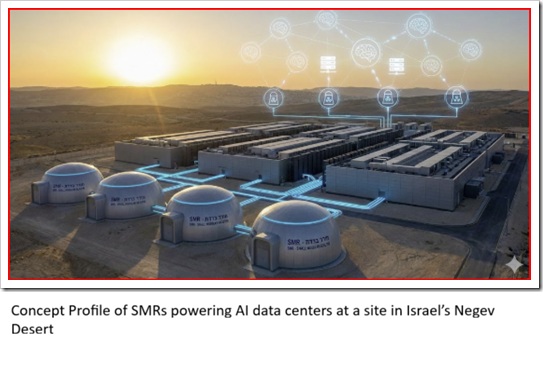
Israel signed an agreement with the U.S. on 01/16/26 to build an industrial park to produce advanced computer chips at a location in the Negev desert that would use a small modular nuclear reactor (SMR) to power the factory and nearby data centers also planned for this location.
Where things stand now, according to Israel news media, Israel and the US have inked an agreement to jointly build and operate a large technological park in Israel. The deal is part of a strategic cooperation agreement on AI signed in Jerusalem last month. (Israel government statement)
One of the surprising details to emerge from the discussions on the agreement relates to the energy infrastructure. The huge power demands of data centers and AI computer systems require a large, reliable 7/24/365 energy solution. As a result, the possibility appears to be kicking around of constructing one or more nuclear power plants, most likely SMRs, at the site.
The MOU, signed by the head of the National AI Directorate, Brig. Gen. (Res.) Erez Eskel, and the U.S. Under Secretary of State for Economic Affairs Jacob Helberg, reveals an ambitious plan to allocate 4,000 acres to the U.S. The park, which will be constructed in the Negev Desert or less likely in the Gaza Strip border area, and which will be called “Fort Foundry One”
Helberg travelled to Israel after signing similar agreements in Doha and Abu Dhabi. He said that Israel was an “anchor partner” in the effort, thanks to its technological ecosystem and its ability to produce “asymmetric results” in relation to its geographical size.
US Under Secretary of State for Economic Affairs, Jacob Helberg said, “With the launch of Pax Silica, the United States and Israel are uniting our innovation ecosystems to ensure the future is shaped by strong and sovereign allies leading in critical technologies like AI and robotics.”
Helberg comes to his role as a former lobbyist for Silicon Valley information technology firms and as a former executive for Google. One of his key interest areas has been addressing the national security risks posed to the U.S. by China. He wrote a book on the subject, The Wires of War: Technology and the Global Struggle for Power, (2021) calling for a stronger U.S. strategy against China’s technological ambition. According to the publisher’s book jacket, Helberg led Google’s global internal product policy efforts to combat disinformation and foreign interference in U.S. domestic affairs.
U.S. Thinks a Contractual Fig Leaf Can Cover the Absence off a 123 Agreement
Israel to date has no experience with civilian nuclear power plants used for electricity generation. The country has reportedly produced an unspecified number of nuclear weapons used as a deterrence factor when dealing with hostile neighbors like Iran. Also, Israel has not signed the Nuclear Nonproliferation Treaty due to policy of strategic ambiguity and its obvious reluctance to reveal the extent of its nuclear arsenal.
The official MOU for the Negev AI data center remains somewhat vague referring to a “high-intensity energy infrastructure” but it clearly is pointing to small modular reactors (50-300 MW). Due to the location in the extremely dry Negev desert, an advanced design, such as an HTGR, which does not require cooling water to operate, is likely to be chosen should the project reach a stage where a reactor design would be selected for this site.
The joint initiative is part of a broad international framework launched by the Trump administration called “Pax Silica“, a coalition of about twelve countries in technology, the aim of which is to secure supply chains of semiconductors and AI. Taiwan did not sign the agreement.
Israel joined the initiative in December 2025, and was the first country to sign a bilateral agreement with the U.S. in this framework. Among the other countries in the coalition are Qatar, the UAE, Australia, Greece, Japan, South Korea, Singapore, and United Kingdom.
The Heavy Lift Associated with Civilian Nuclear Power in Israel
Israel has abundant natural gas supplies to support private wire gas power generation for data centers. It doesn’t need small modular reactors to power them.
The geopolitical heavy lift that would be required for a civilian nuclear power plant in Israel would probably set off a similar request from Saudi Arabia for the same kind of deal.
The Saudi government has been stalled for years in its quest for US nuclear reactors due to its insistence on the right to uranium enrichment as part of a 123 Agreement with the U.S. The Saudi government sees enrichment as a deterrence signal to Iran over its nuclear program. If the U.S. gives a green light to Israel, through some kind of three bank policy pool shot, to build U.S. supplied civlian SMRs, without a 123 Agreement, the Saudis would likely ask for a similar deal.
While President Trump has busted through a lot of international norms, and removed the U.S. from multilateral agreements like climate change, busting the bounds of the Nonproliferation Treaty would set a dangerous precedent that could be followed by similar actions by Russia and China.
This would move the planet into dangerous territory. For this reason, consideration of a U.S. managed nuclear power plant in Israel may be too hot a potato for even Trump to toss over the transom. Bipartisan opposition in the Senate would be almost certain for a civilian nuclear reactor deal with Israel without a 123 agreement.
Israel does not have an agreement with the U.S. under Section 123 of the Atomic Energy act as such a move would require it to declare its nuclear infrastructure. The Israeli government has relied on strategic ambiguity about how many nuclear devices it has as a deterrence measure. The Israeli government is not going to give that up military advantage away to get small modular reactors to power data centers in a white collar industrial park.
Finally, the news release by the Israeli Prime Minister’s office about the U.S. deal may be one of a series of trial balloons the Israeli government has floated over the years about civilian nuclear power so it should be viewed with some skepticism for that point alone.
The U.S. plan apparently is to cover these issues with a contractual fig leaf that depends on a unique model in which the reactor operates under U.S. safety regulation and supervision, despite being located on Israeli territory. It’s a pretty thin leaf.
Watch What We Do Not What We Say
It is not lost on the Saudi and Israel governments that India enjoys a special relationship regarding recent developments that open the door to India for acquisition of civilian U.S. nuclear reactor technologies, without having a 123 Agreement, while these two nations are locked out these opportunities.
Where things get complicated is that the Saudi government has undoubtedly been watching how U.S. nuclear reactor firms are faring with India for some time. Recently, India opened the door to U.S. nuclear reactors by terminating its supplier liability law that acted very effectively as a trade barrier for U.S. firms.
Almost at the same time, the U.S. Department of Energy granted Holtec permission to export its 300 MW SMR to India. The authorization names three Indian companies – Larsen & Tubro (Mumbai), Tata Consulting Engineers (Mumbai) and the Company’s own subsidiary, Holtec Asia (Pune) – as eligible entities with whom Holtec can share necessary technical information to execute its SMR-300 program. Holtec also plans to build a factory in India to manufacture the small reactors. Westinghouse is expected to seek to enter the Indian nuclear market.
What the Saudi government sees is that U.S. policy towards India shows a remarkably different approach to a country which has declared it has a nuclear arsenal, has tested its nuclear weapons, and is not a party to the Nonproliferation Treaty. Further, India does not have a 123 agreement with the U.S. and has no immediate plans to seek one. Israel has likely come to the same point of view.
The fact that Israel has signed an MOU with the U.S. that could potentially involve it acquiring U.S. manufactured SMRs is a signal that if India can do it, so can Israel. Saudi Arabia will not be far behind in asking for the same deal should the Israeli industrial park agreement move forward beyond the MOU stage.
Saudi Plans for AI Data Centers Points to Nuclear Reactor to Power Them
The Saudi government’s ambitious plans and programs to transform the oil rich company into a regional powerhouse for artificial intelligence will require significant investments in electricity generation to power the AI data centers needed to carry out this effort.
According to a report in the New York Times, Saudi Arabia is investing $40 billion to become a dominant player for the use of AI in the Middle East. Data centers to support this program will require enormous amounts of electrical power to support the advanced semiconductors that process AI software, to power the data centers themselves, and to keep them cool in one of the hottest regions on the planet.
It follows that the Saudi government will coordinate its plans for a nuclear new build with its massive investments in AI. It is likely that sooner or later Saudi Arabia’s need to break ground on the first two reactors in anticipation of the need for power for its AI program and related data centers.
It may decide that building commercial nuclear power plants to power its AI program is more important than the geopolitical consideration of having access to nuclear technologies with or without a U.S. 123 Agreement. Given the U.S. course of actions with India, Saudi Arabia may ask for the same kind of deal thus bypassing the entire enrichment policy issue it has with the U.S.
The Saud government has a tender outstanding, which has been on hold for some time, to build two 1,400 MW PWR type reactors. It has also explored options for SMRs for data centers and to power desalination plants to provide potable water for general and industrial uses. A award for the two reactors could be the first order of business the Saudi government will seek to pursue in asking for the same deal the U.S. gave India.
If You Think Our Rulers Do Bad Things In Secret, Wait Til You See What They Do Out In The Open.
Caitlin Johnstone, Feb 09, 2026, https://www.caitlinjohnst.one/p/if-you-think-our-rulers-do-bad-things?utm_source=post-email-title&publication_id=82124&post_id=187345674&utm_campaign=email-post-title&isFreemail=true&r=1ise1&triedRedirect=true&utm_medium=email
They launched a live-streamed genocide in full view of the entire world.
They’re openly targeting civilian populations with siege warfare in Iran and Cuba in full view of the entire world.
They openly kidnapped the president of a sovereign nation in full view of the entire world.
They deliberately provoked a horrific and dangerous proxy war in Ukraine in full view of the entire world.
They spent years actively backing Saudi Arabia’s monstrous genocidal atrocities in Yemen in full view of the entire world.
They’re plundering and exploiting the resources and labor of the global south in full view of the entire world.
They’re killing the biosphere we all depend on for their own enrichment in full view of the entire world.
They’re circling the globe with hundreds of military bases to secure planetary domination in full view of the entire world.
They engage in nuclear brinkmanship and wave around armageddon weapons like pistols in full view of the entire world.
People go homeless and die of exposure while billionaires buy private islands and choose the next president in full view of the entire world.
Weapons manufacturers lobby for wars and then profit from the death and destruction they cause in full view of the entire world.
The president of the United States has repeatedly admitted to being bought and owned by the world’s richest Israeli in full view of the entire world.
The US Treasury Secretary has been repeatedly admitting that the US deliberately sparked the violence and unrest in Iran by methodically immiserating the population via economic warfare, in full view of the entire world.
I keep seeing people freaking out and asking how it’s possible that the individuals in the Epstein files haven’t been arrested for their secret nefarious behavior. And I always want to ask them, mate, have you seen the nefarious behavior they’re engaging in right out in the open?
Pay attention to the Epstein files. Pay attention to what little we can learn about how these freaks conduct themselves behind closed doors. By all means, pay close attention to these things.
But don’t forget to also pay attention to the far greater evils they are inflicting in full view of the entire world.
Left to Bleed: How Israeli Forces Treat the Killing of Palestinian Children as Routine
February 8, 2026, by Joshua Scheer, https://scheerpost.com/2026/02/08/left-to-bleed-how-israeli-forces-treat-the-killing-of-palestinian-children-as-routine/
New reports have surfaced regarding a 14-year-old Palestinian boy, Jadallah Jadallah, who was shot by Israeli paratroopers in the al-Fawar (also spelled al-Faraa) refugee camp in the northern West Bank in November 2025. Video footage cited by Haaretz shows Jadallah bleeding on the ground for nearly 45 minutes while Israeli soldiers remained nearby, with no immediate medical assistance despite his pleas for help. The delay has drawn widespread scrutiny from rights groups and critics of the military’s conduct, raising questions about the handling of the incident and broader practices surrounding the use of force in occupied territory. The Israel Defense Forces have stated that troops engaged a threat and provided initial treatment, but the footage and eyewitness accounts continue to fuel debate over the response to the teenager’s wounding.
Jadallah Jadallah, a 14-year-old Palestinian, was shot by an Israeli paratrooper unit in the al-Far’a refugee camp. Video footage shows him bleeding on the ground while pleading for help, as his family reportedly watched from a distance. Israel is currently holding his body. According to the Israel Defense Forces, “a terrorist who posed an immediate threat was identified, the force fired at him and provided first aid.”
For more on the story
None of this is new. The killing of Palestinian children has become so routine that individual cases blur into one another, barely registering before the next name is added to the list. In today’s Palestine, Israeli violence is not an aberration or a “tragic mistake,” but a system—one sustained by decades of impunity, political cover, and media fatigue. Each child’s death is treated as an isolated incident, even as the pattern is unmistakable: an occupation that normalizes lethal force and renders Palestinian lives, especially those of children, disposable. With Al Jazeera reporting among others a long list of murders of Children with Israeli human rights group B’Tselem saying
“Israel’s army routinely fires live ammunition, tear gas, stun grenades, and other weapons at Palestinians in the occupied territories, often justifying the assaults by claiming stones were thrown. B’Tselem has described the military’s conduct as an “open-fire policy” that permits the “unjustified use of lethal force” and “conveys Israel’s deep disregard for the lives of Palestinians.”
The consequences are especially severe for children. “Decades of systemic impunity has created a situation where Israeli forces shoot to kill without limit,” Defense for Children International–Palestine (DCI-P) said last month following the killing of a 16-year-old Palestinian boy by Israeli forces in the northern West Bank. “As Palestinian children are increasingly targeted in the West Bank, Israeli forces’ rules of engagement seemingly allow for the direct targeting of Palestinian children where no threat exists to justify the use of intentional lethal force.”
And so the killings continue—not because they are hidden, but because they are allowed and most damning is not that these deaths occur, but that they clearly no longer shock anyone who has the power to stop them.
The new era of Israeli expansionism and the war economy that fuels it
By Ahmed Alqarout February 2, 2026, https://mondoweiss.net/2026/02/the-new-era-of-israeli-expansionism-and-the-war-economy-that-fuels-it/
While Israel’s current trajectory is being framed domestically as a triumph, its long-term outlook remains grim and costly. Permanent war locks Israel into permanent military mobilization, accelerates demographic and moral exhaustion, and increases long-term exposure to asymmetric retaliation from Palestinian resistance, Syria, Lebanon, and others.
How Israel’s war-driven economy, regional realignments, and Netanyahu’s push for military independence are ushering in a new period of Israeli expansionism in its quest for regional dominance.
Israel has entered a new era of territorial expansionism and military aggression beyond the borders of historic Palestine. Its belligerent actions have accelerated across Jordan, Lebanon, Syria, Yemen, Iran, Qatar, Libya, and most recently, Somaliland. These developments aren’t due to a change in Israeli strategic ambitions, but rather to the loosening of constraints that had kept it bounded before October 2023.
This expansionist turn reflects a structural recalibration of risk, leverage, and international tolerance rather than a sudden ideological shift. But it is also due to the way Israel’s economy is now structured: the military industry has been carrying the economy ever since Israel experienced a level of global isolation that decimated most other sectors over the past two years. The result? Israel now has an additional structural incentive to be in a perpetual state of war.
Prime Minister Benjamin Netanyahu gave voice to this reality when he announced that Israel would need to become a “super Sparta” — a highly militarized warrior state with a self-sufficient military industry, capable of defying international pressure and arms embargoes because it no longer has to rely on American military beneficence.
A crucial recent strategic declaration sharpens this trajectory. In January 2026, Prime Minister Benjamin Netanyahu announced his intention to end U.S. military aid to Israel within roughly a decade, framing this as a path toward military-industrial self-sufficiency and strategic autarky. This announcement signals that Israel is no longer content to remain subordinate to the U.S., instead seeking to operate as its strategic partner in the region at a time when the U.S.’s national security strategy is shifting attention from the Middle East to the Western Hemisphere.
Netanyahu’s declaration amplifies the urgency of the export-led growth model, which is largely based on arms and defense-linked industries. The problem is, if Israel is to replace $3.8 billion in annual U.S. military aid, it must dramatically scale up its domestic production and export capacity.
Also read: Israel moves to embrace its isolation.
The Israeli state is attempting to institutionalize this export surge through policy, committing roughly NIS 350 billion (equivalent to $100–108 billion) over the coming decade to expand an independent domestic arms industry. Economically, this means that military production will become central to Israel’s long-term industrial strategy, diverting capital, labor, and state support toward weapons manufacturing rather than civilian recovery, a strategy that is untenable during wartime. This also embeds Israeli firms deeper into global security supply chains, even as the state itself becomes diplomatically isolated.
The structural dimension: incentive for permanent war
Since 2023, Israeli military exports have become one of the few sectors compensating for its broader economic slowdown. In 2023, defense exports reached approximately $13 billion, and in 2024 they climbed further to around $14.7–15 billion, setting successive records. This expansion took place while civilian economic growth weakened, labor shortages and unemployment intensified due to the prolonged mobilization of the army, and large segments of the small and medium enterprise sector reported sustained losses and bankruptcies. Arms exports essentially functioned as a countercyclical stabilizer during wartime stress, but now they’re becoming a permanent part of how the Israeli economy aims to reproduce itself.
In 2025, this trajectory accelerated even further. Israel signed some of its largest defense agreements to date with the U.S., UAE, Germany, Greece, and Azerbaijan, covering air defense systems, missiles, drones, and advanced surveillance technologies. While full contract values are not always disclosed, these deals are expected to push total defense exports beyond the 2024 record, reinforcing the arms sector as Israel’s most dynamic export industry, even as other exports, such as agriculture, face an imminent “collapse,” according to Israeli farmers.
The war economy has become the organizing principle of political survival and regime insurance.
As civilian sectors stagnate, the war economy provides growth, foreign currency earnings, and political insulation. This creates a structural incentive for permanent mobilization: war sustains demand, shields the government from accountability, and reinforces a worldview in which force is treated as the primary currency of international relations.
In this configuration, military aggression and territorial expansionism are the mechanisms through which the Israeli economy now seeks to reproduce itself. As a result, Israel’s governing coalition rests on permanent securitization. The war economy has become the organizing principle of political survival and regime insurance.
The global dimension: the end of international law
The international dimension is equally decisive. Israel’s territorial expansionism and military aggression have been enabled by the hollowing out of global constraint mechanisms such as international law.
Western states have demonstrated that there is no meaningful red line when violence is framed as counterterrorism or civilizational defense. Legal norms remain rhetorically intact but operationally suspended. This has altered Israel’s strategic calculus, because if Gaza produces diplomatic noise but no material sanctions, then Lebanon, Syria, or Iraq carries even lower expected costs.
The collapse of normalization: no reason to play nice
Read more: The new era of Israeli expansionism and the war economy that fuels itNormalization politics also play a role. The collapse of Israeli-Saudi normalization talks — which had accelerated throughout 2023 under U.S. mediation but stalled after Israel launched its genocide in Gaza — did not discipline Israeli behavior, but liberated it.
Without Saudi recognition serving as a bargaining chip or incentive for restraint, Israel abandoned any pretense of using territorial compromises as a negotiating tool. It doubled down on the objective of establishing facts on the ground while seeking bilateral security ties with smaller or more vulnerable actors. Expansion now substitutes for Israel’s dying soft power, and recognition is increasingly extracted through leverage rather than negotiation.
What makes the post-2023 moment distinctive is Israel fighting across multiple theaters simultaneously, in the open, and with confidence that escalation will not trigger systemic pushback. Furthermore, Israel’s strategy has become structurally enabled by an ever-increasing reliance on new technologies developed during war. It is no longer a response to threats but a method of governance at home and influence abroad.
Since 2023, Israel has no longer pursued peace through containment, as it did during the Arab Spring period. Instead, it has shifted toward permanent occupation, land seizure, and the redrawing of political maps to sustain and expand its war machine.
How Israel is pursuing regional dominance
Domestically, Israeli territorial expansionism aims to permanently resolve the Palestinian question through a combination of expulsion, cantonization, co-optation, and ultimately displacement. The underlying logic is to eliminate what is perceived as Israel’s primary domestic security problem — the very presence of the Palestinian people on their land — once and for all, thereby restoring elite and societal confidence in the long-term survival of the state.
At the regional level, Israel pursues diverse objectives across the countries in which it intervenes, some involving territorial acquisition or semi-permanent occupation, others focused on subordination, fragmentation, and neutralization of perceived threats.
In Iran, aggression takes the form of seeking regime destabilization and military degradation through sustained airstrikes on nuclear and military facilities, alongside efforts to exacerbate social and political unrest. The June 2025 war between Israel and Iran marked the most direct military confrontation between the two states to date, yet it terminated in an informal pause rather than escalating into full-scale war, with neither side crossing recognized deterrence thresholds despite the intensity of exchanges.
Since then, large-scale protests inside Iran have introduced a new internal pressure point that external actors increasingly frame as a strategic vulnerability. This has coincided with explicit threats of war from Donald Trump and renewed U.S. military signalling, which together reinforce Israel’s long-standing view of Iran as an existential threat to be confronted through regime change. Yet the persistence of non-escalation reflects how aggression against Iran operates within implicit boundaries that territorial expansionism in Palestine or Syria does not face, even as the fusion of internal unrest and external coercive rhetoric makes this equilibrium more fragile.
In Lebanon, Israel seeks to dismantle Hezbollah not only as a military actor but as the backbone of a Shiite-led political order that obstructs Israeli regional dominance. The deeper objective is to fracture Lebanon into a minorities-based system in which Druze, Christians, and other groups are incentivized to seek external protection and economic linkage with Israel. A weak and segmented Lebanon provides strategic depth without the costs and liabilities of direct occupation. For now, the cross-border escalation in Lebanon functions less as a pathway to outright military victory and more as a tool for reshaping Lebanon’s internal political balance over time.
As of January 2026, despite the ceasefire nominally holding, Israel has maintained “temporary” positions in five “strategic” locations in southern Lebanon, refusing to complete its withdrawal. The result is a tense stalemate in which Israel maintains military leverage over Lebanon while withholding its commitment to a full withdrawal and leaving open the possibility of renewed major escalations.
Israel’s strikes across Syria are somewhat more complex, becoming a central theater of Israeli military intervention and engineered political fragmentation following the fall of the Assad regime in December 2024. The Israeli strategy in Syria involves both direct military action and efforts to prevent unified Syrian state consolidation by providing military support for and coordination with Syrian Kurdish forces (the SDF) aimed at fragmenting the new Syrian government’s authority.
In March 2025, Israeli Defense Minister Israel Katz publicly announced that Israel would permit Syrian Druze workers to enter the Golan Heights for agricultural and construction work, framing this as a humanitarian gesture while simultaneously cultivating labour dependencies and economic ties that bind border communities to Israel. In July 2025, Netanyahu adopted a formal policy of “demilitarization of southern Syria,” declaring that Israeli forces would remain in southern Syria indefinitely and that no Syrian military forces would be permitted south of Damascus, effectively partitioning Syrian territory. Netanyahu framed this policy as “protection of the Druze.”
Israel’s setbacks in Syria
By late 2025 and early 2026, the SDF’s position had collapsed. Arab tribal defections in Raqqa and Deir Ez-Zour, mounting pressure from Turkish forces to the north, and a lack of sustained external support led to a rapid SDF retreat from much of northern and eastern Syria by January 2026. This collapse of Israel’s primary Kurdish proxy, coupled with the failure of Israeli-backed Druze militia resistance to prevent Damascus’s consolidation of authority in southern Syria, has undermined Israel’s strategy of preventing unified Syrian state reconstruction through proxy warfare.
The Druze and Alawite populations represent potential economic and demographic assets at a time when Israel faces a structural shortage of both soldiers and workers. Since 2023, this shortage has become acute. The Syrian periphery offers a pool of labor that can be selectively incorporated under autonomy arrangements or informal annexation, which Israel has already done by allowing a number of Syrian Druze to work in the Golan Heights. What is emerging is a strategy of economic annexation without formal borders, integrating the southern Syrian periphery into the Israeli economy on subordinate terms.
As for Yemen, its alignment with Gaza and its demonstrated capacity to disrupt Red Sea shipping have elevated it from a peripheral conflict to a strategic threat for Israel, especially since Ansar Allah’s blockade undermines Israel’s global trade architecture and its security relationships with Western shipping insurers, logistics firms, and port operators.
Yemen’s growing ties with Russia and China have only compounded this threat. That’s why attacking Yemen isn’t about Yemen alone, but about preserving a Western-aligned maritime order in which Israel is embedded as its key security node.
This is where Israel’s recognition of Somaliland comes in, allowing Israel to bypass internationally recognized states and to work directly with sub-state entities. Somaliland has allegedly agreed to have an Israeli military base established in the territory and to accept displaced Palestinians from Gaza in exchange for this recognition.
Regarding direct Israeli involvement in North Africa more broadly, Israel has not pursued direct military operations in Egypt or sustained military intervention in Sudan or Libya, but it has pursued indirect strategies of influence and intelligence gathering, from maintaining contacts with both sides of the Sudanese civil war to secretly meeting with Libyan officials before October 2023.
The costs of expansionism and potential for resistance
While Israel’s current trajectory is being framed domestically as a triumph, its long-term outlook remains grim and costly. Permanent war locks Israel into permanent military mobilization, accelerates demographic and moral exhaustion, and increases long-term exposure to asymmetric retaliation from Palestinian resistance, Syria, Lebanon, and others.
Each absence of consequence recalibrates expectations on both sides. Within Israel, it reinforces the belief that force carries no meaningful cost. Among those targeted, it sharpens incentives to develop longer-horizon strategies of attrition and retaliation. Geographic overreach further compounds these vulnerabilities. Israel’s efforts to embed itself within overseas military infrastructures in places such as Somaliland and southern Yemen (and to establish bases through regional proxies like the UAE) expose Israel’s operational reach to extended supply lines that are distant, insecure, and vulnerable to interdiction.
Rather than Israeli-operated facilities, these arrangements rely on third-party bases (principally Emirati), whose stability depends on shifting regional power dynamics and state priorities beyond Israel’s direct control. Maintaining an effective presence at such a distance raises the likelihood of further military stumbling blocks, financial constraints, and unanticipated entanglements that may prove difficult to sustain over time, especially as Yemen’s Ansar Allah threatens to target any future military bases in Somaliland.
The U.S. occupation of Gaza has begun
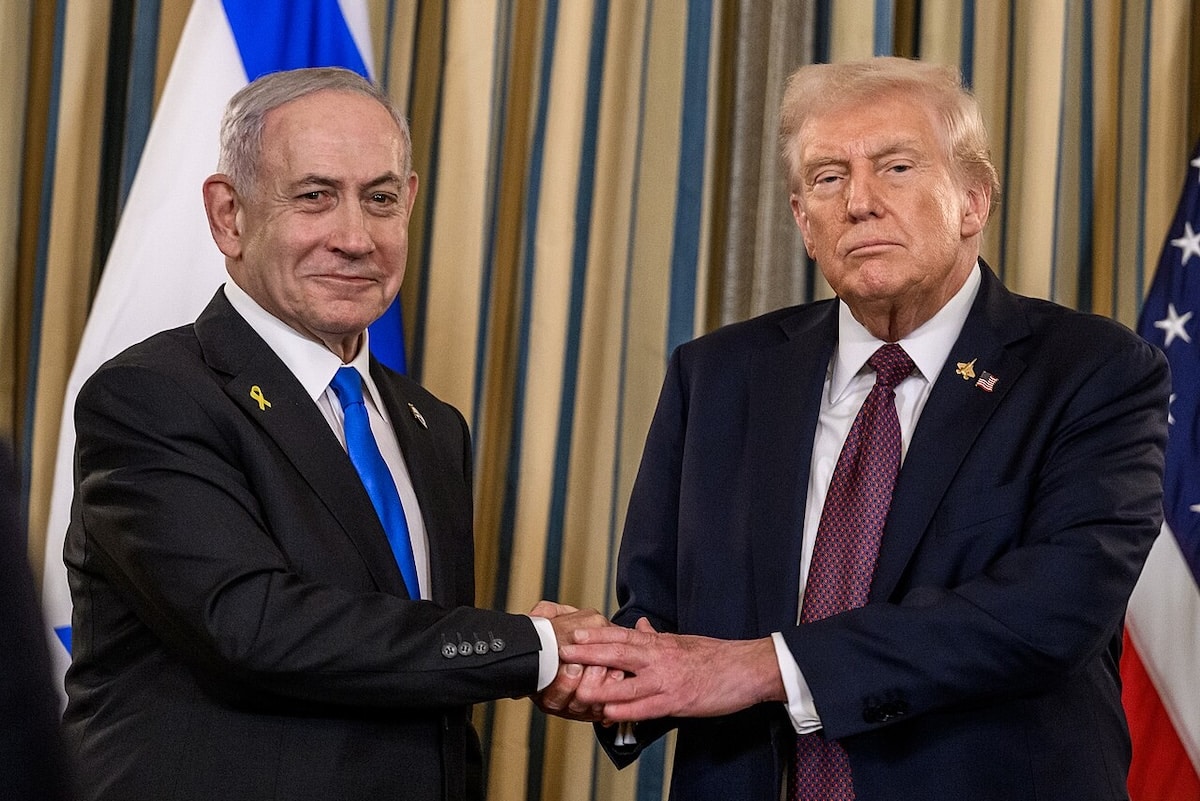
The plans for Donald Trump’s “Board of Peace” show that the goal is not just to make Gaza a playground for the wealthy, but to put it under permanent American occupation.
Mondoweiss, By Mitchell Plitnick January 30, 2026
This week, Drop Site News revealed a draft resolution from Trump’s newly christened “Board of Peace.” The resolution outlines what is, in essence, Phase Two of Trump’s unrealistic peace plan that ushered in a new phase of horror in Gaza under the guise of a ceasefire.
The actions outlined in the resolution ignore realities on the ground and paint a very grim picture of what the United States is planning for Gaza. Far from abandoning the ludicrous and offensive imagery Trump shared in that AI video from last year of himself and Elon Musk on a beach in an unrecognizable Gaza, this resolution is the battle plan to turn Gaza into the playground for the wealthy that Jared Kushner presented to the World Economic Forum at Davos last week. It’s a Gaza where the only Palestinians remaining are those chosen to be the servants in the new regime.
It’s a Gaza under permanent American occupation.
The “Executive Board” that would control Gaza
The Board of Peace (BoP) itself has drawn the most attention, but it is not the focal point for Gaza. The BoP is being set up as an international force to challenge the United Nations. It is currently populated entirely by far-right and autocratic figures, and will likely stay that way.
The BoP will be headed by Donald Trump and his role as Board Chair is personal, disconnected from his role as President of the United States. He has full power over the Board’s composition and full veto power over all of its actions. Trump will remain in control of the BoP until he decides to leave or he dies, and he has the sole authority to name his successor. You couldn’t build a clearer autocracy.
The BoP can delegate its authority as it wishes, and that is what it has done regarding Gaza. The “Executive Board” (EB) is the body that will govern Gaza. The EB itself will also have other areas within its portfolio, so it, too, has delegated its power to yet another group, dubbed the Gaza Executive Board (GEB). There is considerable overlap between the members of the EB and GEB.
The members of the GEB include some very familiar names like Steve Witkoff, Trump’s lead negotiator; Susan Wiles, his Chief of Staff; Jared Kushner, his son-in-law; and Tony Blair the former PM of the UK and a war criminal in the 2003 invasion of Iraq.
The rest of the names may be less familiar, but they are all important and, together, they draw a very worrisome picture of how this Board will behave ………………………………………………………………………………………………………………………………………………………………………………………………………………………………………………………..
Palestinians not included in planning Gaza’s future
While there are no Israelis on the Executive Board, it is stacked with extreme supporters of the Israeli right and of Netanyahu. This makes the vague mandate of the entire enterprise much more concerning.
The proposal published by Drop Site states that “the reconstruction and rehabilitation activities of the Board shall be dedicated solely to those who regard Gaza as their home and place of residence.”
But the proposal offers no opportunity for the people of Gaza to have any say at all in their present situation, let alone their future. The EB governs all of the laws. An American-led International Stabilization Force (ISF) controls all security.
The ISF is to be under the command of American Major General Jasper Jeffers. Trump, and Trump alone, has the power to remove the commander of the ISF and must personally approve any nominee to replace him.
The plan further states that “only those persons who support and act consistently [with Trump’s Comprehensive Plan for Gaza] will be eligible to participate in governance, reconstruction, economic development, or humanitarian assistance activities in Gaza.”
In other words, Palestinians who wish to be part of Gaza in any way must meet Trump’s litmus test of support for the external American control of the Gaza Strip. The same will be true for any business, NGO, or even individual who wants to participate in any way in rebuilding Gaza, physically, politically, or economically.
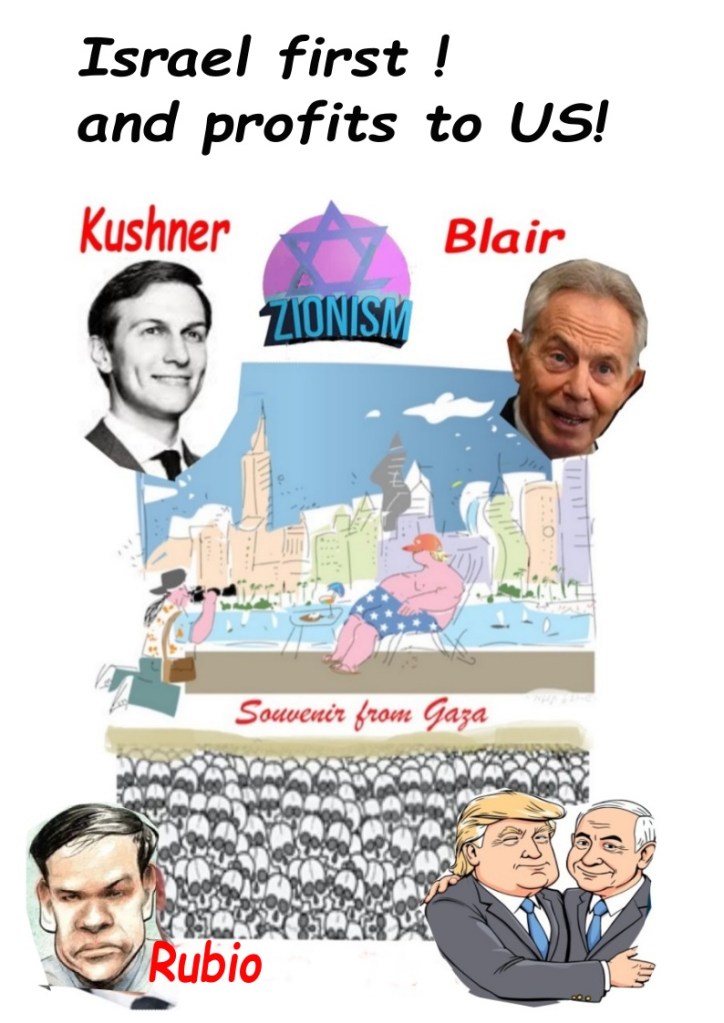
Ideally, for Trump and Jared Kushner, Gaza would be transformed into a giant “company town.” Most of the coastline would be dedicated to tourism. The bulk of Gaza’s eastern border with Israel would be dedicated to industrial zones and huge data centers, doubtless reflecting the massive investments Trump and his Emirati friends are making in AI.
In between would be residential areas separated by parks, agricultural, and sporting sites. In the West Bank, such parks and agricultural areas are frequently declared closed military zones and used for other purposes by the occupying force.
As has been apparent from the beginning, the only role currently envisioned for Palestinians is in the administration of the Executive Board’s decisions. In other words, Palestinian technocrats, laborers, and office workers would be “permitted” to carry out the decisions made for them by others.
The U.S. occupation of Gaza
This resolution provides only a bit more substance to the half-baked ideas Trump has been putting forward since October. And it continues to envision a near-future where Hamas has voluntarily disarmed, Israel has pulled out of Gaza, and the ISF has assumed security control that is welcomed by whatever Palestinians remain in Gaza.
All of that remains fully in the realm of fantasy.
Hamas has repeatedly made it clear that it is willing to discuss decommissioning its weapons, but would not disarm. Given that Israel is, once again, funding rogue Palestinian gangs in Gaza, complete disarmament is suicide for many members of Hamas, Islamic Jihad, and other factions.
The United States is discussing offering amnesty and even a buy-back program for the weapons, but these offers are hardly useful if the lives of Hamas members are put at grave risk by disarmament, even if we assume that the U.S. keeps to its word and that Israel does not itself hunt these fighters down.
Moreover, Israel is bristling at this entire plan. They prefer to bring the hammer down again on Gaza, especially now that there are no hostages, dead or alive, to be concerned with.
Netanyahu is openly stating that Israel will allow no rebuilding in Gaza—where it is killing people, including infants, not only with its weapons but by denying Palestinians the materials to shelter from the winter elements—until Hamas is “disarmed.”
…………………………Israel has already reportedly drawn up a plan for a major military operation, a return to the full-blown genocide of last year, which it plans to launch in March unless the U.S. refuses to allow it to do so.
…………………..What is taking shape in Gaza is a new kind of foreign occupation. This time, the U.S. would be the leading force on the ground unless it allows Israel to renew its aggression, something Trump doesn’t want.
………………………….An American occupation of Gaza on Israel’s behalf will be just as unwelcome by Palestinians as an Israeli one backed by the United States. It may take some time for the people of Gaza to regroup from the past two and a half years to organize impactful resistance, but it will come, as it always has.
The solution is simple: allow Palestinians their freedom and their rights. But that solution is beyond the imagination of Washington and Tel Aviv. So, meet the new occupation. It will be no more pleasant than the old one. https://mondoweiss.net/2026/01/the-u-s-occupation-of-gaza-has-begun/
Israel’s War on Iran: The Overkill No One Calls War
| urbanwronski on February 3, 2026, https://urbanwronski.com/2026/02/03/israels-war-on-iran-the-overkill-no-one-calls-war/ |
Tehran, June 13, 2025, 4:17 a.m. The first explosions light up the sky over Natanz. Israeli F-35s, invisible to radar, drop JDAMs on Iran’s largest uranium enrichment plant. Within minutes, no fewer than five car bombs detonate across Tehran, next to government buildings and the homes of nuclear scientists. The IDF, ever the courteous occupier, issues a warning to Iranian civilians: evacuate the areas around weapons factories and military bases in Shiraz. Or else.
By dawn, Israel has struck over 100 targets. Not just nuclear sites, but missile depots, air defences, and the homes of Iran’s top military brass. General Hossein Salami, commander of the Revolutionary Guards, is dead. So is Chief of Staff Mohammad Bagheri. So are nuclear scientists Fereydoon Abbasi and Mohammad Mehdi Tehranchi.
The Mossad, meanwhile, has spent years smuggling precision weapons into Iran, setting up covert drone bases near Tehran, and recruiting Iranian dissidents to sabotage air defences from within. This is not a flare-up. This is not a crisis. This is war, waged by Israel, enabled by the US, and dressed up as something else entirely.
The US Joins the Party On June 22, the Americans arrive. Twelve B-2 stealth bombers, escorted by 125 aircraft, drop 30,000 pound “bunker buster” bombs on Fordow, Natanz, and Isfahan. The GBU-57s, each capable of burrowing 200 feet underground before detonating, are the only weapons on Earth that can destroy Iran’s fortified nuclear sites. Trump calls it “Operation Midnight Hammer.” The Pentagon calls it “degrading Iran’s nuclear capabilities.” The rest of the world calls it what it is: the US and Israel bombing a country that, by all independent accounts, is not building a nuclear weapon. Nor intends to.
The Body Count By June 28, the numbers are in. Iranian health officials report 1,190 dead, including 435 military personnel and 436 civilians. Another 4,000 are wounded. Israel loses 28. The US? Zero. Iran fires back with missiles at Tel Aviv, drones at Haifa, a barrage at a US base in Qatar, but the Iron Dome and Patriot batteries swat most of them away. The Iranian air force, such as it is, never gets off the ground. Its fleet of MiG-29s and F-14s, some half a century old, are no match for Israel’s F-35s and the US’s B-2s. Iran has no air force to speak of. It has missiles, proxies, and little else.
The Mossad’s Shadow War This is not just a war of bombs. It’s a war of knives in the dark. The Mossad doesn’t just strike from the air, it strikes from within. In the months leading up to June 2025, Mossad operatives and recruited Iranian dissidents disable air defences, plant explosives, and assassinate scientists. They infiltrate government databases, steal passport data, and turn Iranian software against itself. When the war “ends,” the Mossad stays.
“We will be there,” Mossad Director David Barnea promises, “like we have always been there.”
The Next Round And there will be a next round. The US and Israel have already authorised fresh strikes. The CIA and Mossad are busy preparing the ground with cyberattacks, sabotage, the occasional hanging of an accused spy in Tehran’s Evin Prison. Iran, for its part, threatens to close the Strait of Hormuz, block oil shipments, and unleash its proxies across the region. But the pattern is set: Israel strikes, the US backs it up, and the world calls it anything but war.
The Language of Impunity Why does this matter? Because language is the first casualty. When Israel and the US bomb Iran, it’s a “campaign.” When Iran fires back, it’s “escalation.” When 1,190 Iranians die, it’s “collateral damage.” When the Mossad assassinates a scientist, it’s “targeted killing.” When the US drops bunker busters, it’s “degrading capabilities.” This is not neutral phrasing. It’s a lie by omission, a way to wage war without consequence, to turn atrocity into policy.
The Spectacle of Overkill Israel has 345 combat aircraft. Iran has 312, most of them museum pieces. Israel spends 5.6% of its GDP on defence. Iran spends 2.6%. Israel has the Iron Dome, David’s Sling, and the full backing of the US military. Iran has the S-300, a system so outdated that Israeli drones fly right through it. This is not a war. It’s a slaughter, dressed up as self defence.
What Comes Next The ceasefire is a pause, not an end. The Mossad is still in Tehran. The CIA is still running ops. The US with Donald Trump’s “beautiful Armada” is still offshore, waiting for the next excuse. And Iran? Iran is still standing, still defiant, still a target. Because for Israel and its American backer, the war never ends. It just gets rebadged.
Name it now. Or live with it forever.
Trump’s October 10 ceasefire, Board of Peace, simply continues Israeli Palestinian genocide in slow motion.

Walt Zlotow West Suburban Peace Coalition Glen Ellyn IL , 26 Jan 26
That was some ceasefire Trump negotiated with Israel October 10. Since then Israel has killed nearly 500 Palestinians with bullets and bombs. Many more are likely dead from starvation and disease as Israel lets in less than 170 trucks of food daily instead of the required and promised 600. ‘Ha ha…little nourishment for you starving Palestinians.’
Water, medicine, everything needed to sustain life is restricted to drive out the beleaguered living in makeshift tents. Why tents? Israel, with over 50,000 tons of Biden, Trump bombs, pulverized over 80% of all Gaza buildings, including over 90 % of all housing. Likely over 10,000 Gaza corpses are rotting under the 60 million tons of rubble including over 9 million tons of hazardous material. Ceasefire notwithstanding, Israel has knocked down or damaged over 2,500 post ceasefire buildings.
In order to force Palestinians from Gaza, Israel has reopened the Rafah Crossing between Gaza and Egypt. But it’s Israel’s version of a reverse Roach Motel. Palestinians can check out…but they can never check back into their rightful homeland. Every Palestinian that leaves, along with every Palestinian shot, bombed or starved to death, is one less pesky Palestinian to get rid of in absorbing Gaza into Greater Israel.
Israel has exploited the ceasefire to occupy over 50% of Gaza territory, shooting any Palestinian who strays over or close to Israel’s yellow boundary lines.
Astonishingly, the UN Security Council’s November 17 Resolution 2803 (2025) certified Trump’s Board of Peace which effectively makes Trump Gaza’s ruler, totally excluding Palestinian involvement. In doing so it upends over 70 years of UN resolutions and requirements that Palestinians in Gaza have the right to live and govern their homeland free from subjugation; indeed annihilation.
Why did this Security Council resolution pass? Simple, Trump essentially blackmailed Council members that it was either Trump’s ceasefire and Board of Peace, excluding Palestinians, or he would greenlight continuing the horrific 2 year bombing obliteration of Gaza and its citizens till they were all dead and gone. .
Israel, with US support, will never allow a Palestinian state in Gaza the West Bank and East Jerusalem. The horrific daily slaughter may be reduced to a trickle, but it will continue indefinitely till every Palestinian in Gaza is gone.
Trump’s ceasefire and Board of peace have the additional benefit to both Israel and Trump administration of removing the daily ethnic cleansing of Gaza from mainstream media coverage. They have moved on to more dramatic foreign hotspots in Venezuela, Iran and Greenland as well as Trump’s ICE thugs murdering fellow citizens in Minneapolis
Israel and the Trump administration’s slow motion genocide of Palestinians in Gaza should be opposed by all decent, moral nations and persons as fervently as their opposition to the preceding two yearlong all out genocide. Trump’s ceasefire and Board of Peace has put lipstick on the pig of Israeli genocide destroying Palestinians in Gaza.
The Magic System Of Zionism
Caitlin Johnstone, Jan 24, 2026, https://www.caitlinjohnst.one/p/the-magic-system-of-zionism?utm_source=post-email-title&publication_id=82124&post_id=185598042&utm_campaign=email-post-title&isFreemail=true&r=1ise1&triedRedirect=true&utm_medium=email
If I spoke critically of something abusive that India was doing in Kashmir, would you expect me to be accused of an anti-Hindu hate crime?
If you criticized an Indian military operation, would you have to preface it with “I don’t hate Hindus or their religion and am not the slightest bit Hinduphobic”?
If there was worldwide opposition to something that Indian military forces were doing, would you expect western governments to start frantically churning out laws to ban that opposition because it was making members of the Hindu community feel unsafe?
Would it ever in your wildest imaginings occur to you that a criticism of the violent actions of the government of India could in any way be interpreted as an attack on the Hindu faith and the membership of that religion?
You can probably see where I’m going with this.
You don’t expect to see criticisms of the state of India framed as an attack on its majority religion because people in your society haven’t been conditioned to have that expectation. But we have been conditioned to have that expectation about Israel.
The association between antisemitism and criticism of the state of Israel isn’t natural. It’s not something that would organically occur to an untrained mind.
If a man who’d never heard of Israel or Palestine were shown footage of the genocide in Gaza, he would reflexively recoil in horror and say what he was looking at was a bad thing. If somebody then ran up and explained to him that what he just said was actually a hateful act of religious persecution, he would be very surprised and confused. Because he hadn’t been indoctrinated into making that association, in the same way you haven’t been indoctrinated into associating criticism of the Indian government with an attack on the religion of Hinduism.
It’s a completely counterintuitive association. There’s nothing about it that that you could find your way into through your own observation and reasoning. It’s something you’d need to be taught by others. You need it to be explained to you.
That’s the literal translation of the Hebrew word “hasbara”. It means “explaining”. Israel and its supporters have spent decades “explaining” to the world that criticism of the state of Israel is actually a terrible hate crime against Jews and their religion, because otherwise it would never occur to a normal person that that is the case.
It’s actually astonishingly impressive. The political ideology of support for this tiny apartheid state has been so effective at explaining to the world what thoughts they should think about it that those efforts touch all our lives. It’s so effective that you could be at a social gathering all the way across the sea in the United States and, unless you are very familiar with the people around you, if the subject of Israel comes up you’ll immediately understand that you could be in for a very uncomfortable evening.
It’s stunning how much influence this ideology has had throughout our society’s culture and institutions. It’s almost magical.
There was a segment in last year’s Louis Theroux documentary The Settlers that stuck with me where Israeli settler leader Daniella Weiss refers to Zionism as a “magic system”.
“Jewish settlements in Gaza is a very difficult step that demands a lot of work,” Weiss told Theroux. “You have to influence the leftists, the government, the nations of the world, using the magic system: Zionism.”
It isn’t surprising to learn that Weiss views her operations as a kind of magic. On paper she and her ilk shouldn’t be able to do what they do. Forcefully dropping a foreign ethnostate on top of a pre-existing civilization and violently hammering it into place against every organic impulse of the region is freakish enough, but then convincing the rest of the world to support this? To the point that it actually affects our interpersonal relationships and interactions on the other side of the planet? It shouldn’t work. But it does.
I don’t really know what magic is, but it makes sense that some Zionists would see it that way. Because from the outside looking in all that mass-scale psychosocial manipulation kind of does look like an inexplicable sort of wizardry.
Luckily, the magic seems to be wearing off. The old tricks just aren’t working anymore. Calling someone who criticizes Israel an “antisemite” is widely recognized for the fraudulent manipulation that it is. Pro-Palestine politicians are winning elections despite highly coordinated smear campaigns saying their candidacy makes Jews feel unsafe. Everyone knows Israel lies about everything all the time. Trust in the media is at an all-time low, while awareness of the pro-Israel bias of the mainstream press is at an all-time high.
People are still showing up for protests and pro-Palestine events. The public is turning against Israel in unprecedented numbers. Nobody’s buying the old song and dance anymore.
Maybe the people are finding a little magic of their own.
1 This Month

of the week – Shut Down Drone Warfare!


Tell the Ukrainian Government to Drop Prosecution of Peace Activist Yurii Sheliazhenko

Petition to revoke the licensing of the Near Surface Nuclear Disposal Facility (NSDF) at Chalk River. https://www.ourcommons.ca/petitions/en/Petition/Details?Petition=e-7247
To see nuclear-related stories in greater depth and intensity – go to https://nuclearinformation.wordpress.com
-
Archives
- March 2026 (251)
- February 2026 (268)
- January 2026 (308)
- December 2025 (358)
- November 2025 (359)
- October 2025 (376)
- September 2025 (257)
- August 2025 (319)
- July 2025 (230)
- June 2025 (348)
- May 2025 (261)
- April 2025 (305)
-
Categories
- 1
- 1 NUCLEAR ISSUES
- business and costs
- climate change
- culture and arts
- ENERGY
- environment
- health
- history
- indigenous issues
- Legal
- marketing of nuclear
- media
- opposition to nuclear
- PERSONAL STORIES
- politics
- politics international
- Religion and ethics
- safety
- secrets,lies and civil liberties
- spinbuster
- technology
- Uranium
- wastes
- weapons and war
- Women
- 2 WORLD
- ACTION
- AFRICA
- Atrocities
- AUSTRALIA
- Christina's notes
- Christina's themes
- culture and arts
- Events
- Fuk 2022
- Fuk 2023
- Fukushima 2017
- Fukushima 2018
- fukushima 2019
- Fukushima 2020
- Fukushima 2021
- general
- global warming
- Humour (God we need it)
- Nuclear
- RARE EARTHS
- Reference
- resources – print
- Resources -audiovicual
- Weekly Newsletter
- World
- World Nuclear
- YouTube
-
RSS
Entries RSS
Comments RSS
 nuclear-news