Did Iran ever Really Have a Nuclear Weapons Program?
Fariba Amini, 04/21/2026, https://www.juancole.com/2026/04/nuclear-weapons-program.html
Interview of Dr. Mehran Mostafavi by Fariba Amini
In a resolution against nuclear war initiated by philosopher Bertrand Russell and endorsed by Albert Einstein just a week before his death, they wrote: “We appeal, as human beings, to human beings, remember your humanity and forget the rest. If you do so, the way lies open to a new paradise; if you cannot, there lies before you the risk of universal death.” — July 1955, letter addressed to President Roosevelt, the Russel-Einstein Manifesto
Dr. Mehran Mostafavi* is a nuclear expert who teaches at some of the most prestigious institutions in France. Throughout the years, he has also been on various French and Iranian media outlets speaking about Iran’s nuclear energy while a vocal critic of the Islamic Republic for its repressive rule. He is also the son-in-law of a very famous Iranian, the late Abolhassan Bani-Sadr, the first President of Iran (1980-1981) who left Iran clandestinely and passed away in a suburb of Paris.
He is the 2026 recipient of Medal of Honor from CNRS (Centre National de la Recherche Scientifique).
FA: What is your field of expertise?
MM: I am a physical chemist and a professor at Université Paris‑Saclay. I have been following Iran’s nuclear policy for 20 years, and I have written several dozen articles and given hundreds of interviews about it.
FA: As an expert on nuclear energy who has done extensive research on the subject, how do you evaluate Iran’s nuclear energy program?
MM: Iran’s nuclear policy began in the late 1980s. At that time, Iran was in a difficult position in its war with Iraq, and Iraq was using chemical bombs provided by the West against Iran. In Iran, the idea gradually took shape that to deter and confront Israel, it would be better for Iran to have an atomic bomb. On the other hand, the Islamic Republic decided to complete the Bushehr reactor,
much of the work on which had been done by the Germans before the revolution, with Russian help, and various projects were launched in this field. However, Iran was forced to abandon the military program in 1992. In the civilian sphere, Iran has only the Bushehr power plant, which generates less than 2 percent of Iran’s electricity, and its fuel is supplied by the Russians.
FA: Did the Islamic Republic intend to make the bomb as Israelis have claimed? We know that Netanyahu has been declaring that Iran would have the bomb in six months since 1984. It is now 2026.
MM: Yes, Israel, even though it knows that since 1992 Iran has not been active in building a bomb and had only carried out rudimentary work before then, regularly claims that Iran will build an atomic bomb any day now—a big lie that has been repeated countless times without evidence. All Western intelligence agencies, including the U.S. one, have reported that Iran does not have a bomb-building program.
FA: The nuclear power plants were built under the Shah in the 1970’s initially in Bushehr with the help of the German company Siemens KVU. But the project was abandoned after the 1979 Revolution, damaged during the Iran-Iraq, and later completed by Russia. At that time, did anyone object to this project?
MM: At the beginning of the revolution, it was decided that Iran did not need a nuclear power plant and that it was not cost-effective to complete the Bushehr plant. This position was particularly championed by Mehdi Bazargan and Abolhassan Bani-Sadr and was eventually approved. However, in the 1990s the Islamic Republic once again resumed construction of the plant with Russian assistance.
FA: To build a nuclear bomb, you need to enrich to more than 60 percent uranium. In your opinion, was this ever done?
MM: Yes, you need to enrich it up to 90%
FA: Why did the Islamic Republic of Iran (IRI) build its nuclear facilities in Natanz and Bushehr or near cities which ultimately could be dangerous for the people?
MM: It is not particularly significant that these facilities are located a few dozen kilometers from towns. There is no risk of a nuclear explosion, but there is a risk of radioactive contamination or chemical pollution. In this respect, the facilities in Iran, even following very intense bombing by the Americans and Israelis, have not caused any serious problems.
FA: According to several U.S. intelligence services Iran was no imminent threat to the U.S. Why then did Trump push for war?
MM: Trump is a compulsive liar! Let me remind you that, following the attacks in June, he claimed that the US had destroyed Iran’s nuclear facilities, and then in March he attacked Iran on the grounds that it posed an imminent threat. We know full well that this is not true. He started the war in response to demands from Israel, which does not want any regional powers other than itself in the Middle East.
FA: We know that upon coming into office in 2016, Trump tore up the JCPOA [the 2015 nuclear deal], at the advice of the man in Tel Aviv. Today, if an agreement is made, it will probably be little different from the one that the Obama administration agreed to. Do you think there will be any significant differences?
MM: I do not believe that they will do a similar agreement.
FA: Do you believe that the IRI ever had the intention to use nuclear weapons against Israel as they claim? We know that the Israelis, even if they have never been open about it, have at least 300 nukes. So, isn’t all a sham?
MM: No, because Iran has never had the full technical capability to build a bomb. Iran is still a long way from having a bomb. Even if Iran enriches uranium to 90%, it will still take a long time – perhaps a year – before it had the capability to use the bomb. Israel has never declared its facilities and has never complied with international law. Israel is in no position to lecture other countries
FA: Don’t you think that for the IRI, this whole idea was more defensive rather than offensive?
MM: I think that over the last 20 years, Iran has used its nuclear policy to bargain with the West, and in recent years its intention has been to demonstrate that it can become a nuclear-capable country.
FA: In a recent New Yorker article dated April 6, 2026, a former CIA operative says that he was involved in getting Iranian nuclear scientist defect or be killed. We know that Mossad has been involved in the assassination of several scientists in Iran, approximately eighteen of them. Do you know of any defections?
MM: I am fully aware that Israel has eliminated several Iranian scientists. It is very interesting to note that Iran and Israel worked together in a consortium to develop the only synchrotron in the Middle East, in Jordan. It was a peaceful project for a facility intended for physicists. One of the Iranian representatives was Prof. Massoud Ali Mohamadi. The Israelis met him in Jordan during the meetings and knew him well. He was assassinated by the Israelis. He was very intelligent but was not involved in the Iranian nuclear program. He was simply assassinated because he was a great physicist.
Israel is racing to expand West Bank settlements before new political realities end its era of impunity
Israel is approving the construction of new West Bank settlements at an unprecedented rate because it knows its window of impunity is closing — especially if Iran emerges intact from the war and the Republicans lose the U.S. midterms.
By Qassam Muaddi, Mondoweisss , April 19, 2026
The Israeli cabinet approved the construction of 34 new West Bank settlements last week, bringing the total number approved by the ruling coalition led by Israeli Prime Minister Benjamin Netanyahu up to 103. The cabinet decision is the largest batch of new settlements approved in decades, breaking the record set by a previous landmark decision in June 2025, which approved 22 new settlements.
While the latest decision has been overshadowed by the regional conflagrations related to the U.S.-Israeli war on Iran, its timing indicates that Israel perceives a closing window for its ability to entrench its colonial project in its own backyard — the West Bank — in light of shifting realities that might see Iran emerging from the war intact and in a strengthened position regionally.
These developments come as Israel has reportedly been “coerced” to halt its onslaught against Lebanon by U.S. President Donald Trump, forcing it to accept a ceasefire with Hezbollah. Meanwhile, the very fact that the U.S. agreed to a temporary ceasefire with Iran was condemned by the entirety of the Israeli political establishment, both from within Netanyahu’s camp and from the Israeli opposition, who lambasted Netanyahu’s “failure” to overthrow the Iranian government.
While Israel will attempt to use the ceasefire in Lebanon to force the hand of the Lebanese government to accept the ongoing occupation of the southern part of the country, little military progress has been made against Hezbollah, which has reportedly rebuilt its military capabilities since it was bloodied by Israel in October 2024. Iran has also continued to show strength in the region through exerting control over the Straits of Hormuz, and has been described by analysts as an emerging “major world power.”
This is the crucial backdrop to Israel’s moves in the West Bank. It seeks to further cement its de facto annexation of the territory in a race against time to entrench its colonial project in the only geographic region where it can proceed with comparatively minimal resistance.
The closing window
The impatience of the Israeli decision is not only suggested by the magnitude and speed of the cabinet approval, but also by the fact that Israel is in an election year, with polls indicating that Netanyahu and his hardline allies, Finance Minister Bezalel Smotrich and National Security Minister Itamar Ben-Gvir, show a low chance of winning…………………………………………………………………………………………………………………………………………………………………………………. https://mondoweiss.net/2026/04/israel-races-against-time-to-expand-west-bank-settlements-before-it-is-limited-by-new-regional-realities/
“I Felt Like a Monster”: Israeli Soldiers Break Silence on Gaza—and the System Behind It
And what lingers in these testimonies is not just what was done, but what it did to those who carried it out. Soldiers speak of shame, of dissociation, of an inability to reconcile their actions with any moral framework. The military calls it PTSD. But the soldiers—and some experts—call it something else: moral injury. Not fear of what happened to them, but horror at what they themselves became.
April 18, 2026, Joshua Scheer, https://scheerpost.com/2026/04/18/i-felt-like-a-monster-israeli-soldiers-break-silence-on-gaza-and-the-system-behind-it/
The official narrative isn’t just cracking—it’s being dismantled by the very people who carried it out.
In a devastating investigation, Israeli soldiers are now speaking in their own words about what they did, what they witnessed, and what their commanders allowed in Gaza. These are not secondhand accusations or political attacks. They are confessions—raw, detailed, and impossible to dismiss.
“I Felt Like a Monster”: Israeli Soldiers Expose ‘Moral Injury’—and a System Built on Silence
They describe opening fire on unarmed civilians identified only as “targets” on a drone feed. They describe prisoners humiliated, abused, and discarded. They describe executions—men surrendering with hands raised, only to be shot and later labeled “terrorists.” And they describe something just as revealing as the violence itself: a system where none of this leads to accountability.
What emerges is not chaos. It is structure.
This is not the “fog of war.” It is policy by practice—kill first, justify later, investigate never.
As we have seen in this country, the destructive effects of the “fog of war”—the brutal killings, the unjustified pushes toward empire—do not end on the battlefield. The damage lives on in the soldiers who are sent to carry it out. And too often, it feels as if those in power simply do not care. But we can choose something different. We can listen. We can create space for those who were there to speak honestly about what they saw and did. And in doing so, we can begin to confront the truth—not from the top down, but from the ground up—where real accountability, and the possibility of change, actually begins.
And what lingers in these testimonies is not just what was done, but what it did to those who carried it out. Soldiers speak of shame, of dissociation, of an inability to reconcile their actions with any moral framework. The military calls it PTSD. But the soldiers—and some experts—call it something else: moral injury. Not fear of what happened to them, but horror at what they themselves became.
Because moral injury doesn’t just indict individuals—it indicts systems.
This is not a new phenomenon in Israel. The concept of “moral injury” has been studied for years, but what Israeli researchers and clinicians are now documenting gives it renewed urgency—and clarity. It names what many soldiers themselves are struggling to articulate: a rupture between what they did, or were ordered to do, and the values they believed they held. Unlike PTSD, which is rooted in fear, moral injury is rooted in recognition—the realization that lines were crossed, often knowingly, in the heat of revenge, chaos, and command pressure. Psychologists working directly with troops describe a pattern: soldiers firing on people later found to be uninvolved, approving strikes with known civilian casualties, or participating in actions they justified in the moment but cannot live with afterward. The consequences are severe—depression, shame, substance abuse, even suicidal thoughts—but the deeper implication is structural. This is not just about individual breakdowns. It reflects a system that places soldiers in situations where moral collapse becomes not an exception, but an expectation.
It exposes a military culture that normalizes dehumanization, a political structure that shields it, and an international order that enables it. It reveals a reality that cannot be dismissed as isolated misconduct or “a few bad actors,” but instead points to a pattern—repeated, reinforced, and quietly accepted.
And of course it may take years for the damage the understanding to take hold with Y Net Global reporting “One of the complexities of moral injury is that it does not always appear at the moment of action,” Levi-Belz said. “Sometimes it emerges weeks later, after you take off the uniform. Sometimes years later.”
“There is no doubt that among IDF soldiers and reservists there has been an increase in moral injury compared to routine operations,” he said. Based on clinical experience and preliminary samples, he estimates that 40 percent to 50 percent of soldiers, particularly reservists, encountered morally injurious events during the war.
And that is where the story turns outward.
Because none of this unfolds in a vacuum. The bombs, the cover, the diplomatic protection—all of it flows, in part, from Washington. The United States continues to fund, arm, and politically defend the very system these soldiers are now describing from within.
The facts are no longer hidden. The voices are no longer external critics. They are coming from inside the system itself.
So the question is no longer whether the world knows.
The question is whether it is willing to act—or whether it will choose, again, to look away.
Because when even the perpetrators are telling the truth, silence is no longer ignorance.
It is complicity.
America’s pro-Israel J Street says Israel should pay out-of-pocket if it wants US weapons
The pro-Israel advocacy group likely changed its tune after widespread popular opposition to taxpayer-funded weapons
By MEE staff, 13 April 2026 , https://www.middleeasteye.net/news/j-street-says-israel-should-pay-out-pocket-if-it-wants-us-weapons
The pro-Israel advocacy group J Street is now calling for an end to “direct” US military support to Israel, per a new policy document published on Monday.
The group had previously backed Washington’s continued provision of defensive weapons systems, such as the replenishment of Israel’s Iron Dome, at no cost to Israelis.
Now, it says the US “should continue to sell” short-range air and ballistic missile defence capabilities to Israel, but Israel should use its own money to pay for them.
“Israel faces real security challenges that require a significant defense investment. With a per capita GDP comparable to leading US allies such as the United Kingdom, France and Japan, as well as an annual defense budget of over $45 billion, it has the financial means to address these challenges,” J Street said.
“It does not require almost $4 billion per year in US financial subsidies to purchase weapons,” it added.
“Continuing this assistance is both unnecessary and politically counterproductive, creating avoidable tensions in US domestic politics and in the bilateral relationship.”
The way the current military aid package operates is that the US provides Israel with American taxpayer funds, and those funds are put into US weapons companies to acquire equipment.
On its website, J Street says that it “organizes pro-Israel, pro-peace, pro-democracy Americans to promote US policies that embody our deeply held Jewish and democratic values and that help secure the State of Israel as a democratic homeland for the Jewish people”.
Political tide turns
J Street’s shift follows a distinct change in attitudes towards Israel among the American public after the genocide in Gaza, where over 72,000 Palestinians have been killed since Israel’s war on the enclave broke out in October 2023.
But perhaps more importantly for the group, whose support base is made up of Democrats, the party’s future is changing course.
Progressive New York Congresswoman Alexandria Ocasio-Cortez, who is widely believed to be seeking higher office, announced earlier this month that she would no longer vote for any US military support to Israel, despite having previously backed the provision of defensive weapons, much to the disappointment of many of her supporters.
It is notable, however, that her statement followed Israeli Prime Minister Benjamin Netanyahu’s surprise declaration earlier this year that Israel will not seek to renew its military aid package with the US in 2028.
“I want to taper off the military aid within the next 10 years,” all the way down to zero, Netanyahu told The Economist in January.
J Street’s new position demands that any future US arms sales that Israel pays for out-of-pocket “be fully consistent with American law”, which echoed Ocasio-Cortez’s statement.
US law prohibits security assistance to any country whose government engages in a consistent pattern of gross human rights violations or blocks or restricts the transport or delivery of US-backed humanitarian aid.
“US arms sales to Israel should be further conditioned to incentivize alignment with American interests and laws – as has been the case with other allies and partners – when their behavior is inconsistent with US interests,” J Street said.
At the same time, the group acknowledges that Washington and Israel generally share the same interests anyway.
“The US also benefits meaningfully from the relationship. Intelligence sharing has been critical in campaigns such as the fight against ISIS, while joint operations such as Israel’s 2006 strike on Syria’s secret nuclear facility have advanced shared security goals.”
It added that because “approximately 500,000 American citizens live in Israel”, selling it weapons should continue to be a US national security priority.
Israel Destroys a Synagogue; US Media Yawn
“Iranian Jews are viewed by Iranians as indigenous,” he said. “They’re the original Bundists,” a nod to the Jewish political movement that “stood not just for socialism, but for do’ikayt—Yiddish for ‘hereness,’” the concept that a Jew’s homeland was in whatever nation they resided in (New York Times, 4/6/26).
Ari Paul, April 16, 2026 https://fair.org/home/israel-destroys-a-synagogue-us-media-yawn/
An Israeli missile attack destroyed a Tehran synagogue during the Jewish Passover holiday (Religion News Service, 4/9/26). The Israeli military “expressed regret over what it called ‘collateral damage’ to a synagogue in Tehran caused by an overnight strike,” which was “targeting a senior Iranian commander,” said the Middle East Eye (4/7/26).
Photos of the wreckage at the Rafi-Nia Synagogue have accompanied many of these pieces. The Council on American-Islamic relations condemned the attack in a statement (4/7/26):
We strongly condemn the Israeli regime’s bombing of a synagogue in Tehran, which was the predictable end result of the indiscriminate US/Israel bombing campaign against mosques, hospitals, schools, apartments and other civilian sites across Iran.
The group challenged “various Israel advocacy groups and politicians that support this war in the name of protecting Israel to condemn Israel’s synagogue attack.”
Buried at best
The story of the attack on the Tehran synagogue was, at best, buried in the US corporate media. CNN posted a brief video (4/7/26) about the bombing but had no online article about it. The New York Times (4/7/26, 4/7/26) mentioned the attack, but as background in broader stories about the US/Israel war on Iran.
A search for “Rafi-Nia” on the Washington Post website yields no results. Ditto for the AP, although the news service did post a video to YouTube (4/7/26). Al Jazeera’s coverage (4/7/26) of the attack was a mélange of AP and AFP copy. CBS News (4/7/26) also used a few paragraphs of AFP copy to report on the attack, although it was buried in the middle of a general timeline about the war.
The Wall Street Journal (4/7/26) had the story, but led with Israel’s contrition over the destruction; that’s not a journalistic construction we see in US news coverage when it comes to the Israeli bombings of other civilian structures in Iran, Gaza or Lebanon. When Israel destroys a hospital, apartment building, encampment, etc., the stories don’t lead with official regret, but rather include Israeli claims that the civilian facilities were actually legitimate military targets. The Journal’s lead provided the government with public relations cover over the sensitive issue of destroying a Jewish house of worship.
Newsweek (4/8/26), once a bigger player in the US media landscape, led with condemnation of the attack from Jewish Iranian leaders, who declared “their unwavering solidarity with Iran in defending the homeland.”
Jewish presence in Iran
Underplaying the story obscures not only the wantonness of Israel’s aggression, but the actual nature of Iranian society, which is portrayed as obsessed with wiping Jews off the map (ADL, 6/25/25). “Iranian foreign policy freely mixes anti-Israel furies with anti-Jewish ones,” wrote New York Times columnist Bret Stephens (1/13/26), a pro-war cheerleader (2/22/26, 3/24/26).
In fact, while Israel is obviously the center of Mideastern Jewish life, the Iranian Jewish population dwarfs those elsewhere in the Middle East. “Estimates range from 9,000 to 20,000 Jews currently living in Iran,” according to the Forward (6/18/25).
Wrote the Palestine Chronicle (3/6/26): “The Jewish presence in Iran is among the oldest continuous Jewish communities in the world, with roots that historians trace back more than two millennia.”
Yes, Iran is a theocracy; the government is no model for an open society. But there is a Jewish member of Iran’s parliament, who even went on record this year openly criticizing Iranian President Masoud Pezeshkian’s handling of popular unrest (i24, 1/29/26).
‘Well-protected second-class citizens’
US media have covered the Jews of Iran before. USA Today (8/29/18) did a story in 2018, reporting from Tehran. Former Forward reporter Larry Cohler-Esses (8/12/15, 8/12/15, 8/18/15, 8/27/15) reported extensively and critically on Iranian Jews, indicating that the country was at least open to letting a reporter for a Jewish publication do their job.
Cohler-Esses told FAIR that Jews in Iran are “well-protected second-class citizens.” In fact, when he read about the attack, he “wondered if it was the synagogue I spent Shabbat in, but it wasn’t,” because there are more than a dozen active synagogues in Tehran—a reflection of the size of the Jewish community there.
Recalling his 2015 reporting trip, Cohler-Esses said that on Shabbat, Jews would spill out of their synagogues and mingle in the street after services, a sight he didn’t often see in many places in Europe. In one instance, after he left a synagogue service, one of the congregants ran after him through a street teeming with people, wearing a kippah and a tallit (traditional religious attire), and “no one batted an eye.”
The Jews of Iran do suffer discrimination, because Muslims are favored in the legal code over all non-Muslims, Cohler-Esses said. He noted that the Jewish population of Iran has shrunk significantly since the 1979 Islamic Revolution.
“Iranian Jews are viewed by Iranians as indigenous,” he said. “They’re the original Bundists,” a nod to the Jewish political movement that “stood not just for socialism, but for do’ikayt—Yiddish for ‘hereness,’” the concept that a Jew’s homeland was in whatever nation they resided in (New York Times, 4/6/26).
Cohler-Esses was hopeful that coverage of the synagogue’s destruction in the Jewish and Israeli press (JTA, 4/7/26; Jerusalem Post, 4/7/26) had the “potential to make Jewish readers of Jewish media outlets go, ‘Oh, they have synagogues there.’” But with the underplaying of the story in US media, it’s a missed teachable moment for news consumers generally.
More robust press coverage of the attack could have taught Americans that the Jews of Iran do have something to fear: Israel.
With 38,000+ Dead, Women and Girls Make Up Over Half of Those Killed in Israel’s US-Backed War on Gaza: UN
“Not a single combatant among them,” said one human rights activist. “Further confirmation that over 90% of the victims are innocent civilians.”
Brad Reed for Common Dreams, Apr 17, 2026 https://www.commondreams.org/news/israel-gaza-war-women
Israel’s yearslong assault on Gaza has killed more than 38,000 women and girls, according to a report released Friday by the United Nations.
In total, the UN found that at least 22,000 women and 16,000 girls have been killed in the conflict, an average of nearly 50 women and girls per day.
Sofia Calltorp, chief of humanitarian action at UN Women, said the report shows how Israel’s war on Gaza “has affected every aspect of life, with its most horrific toll seen in the scale of death.”
“Women and girls accounted for a proportion of deaths far higher than those observed in previous conflicts in Gaza,” Calltorp emphasized. “Those killed were mothers, they were daughters, sisters, and friends—deeply loved by those around them. They were individuals with lives and with dreams.”
More than 72,000 people in total have been killed since Israel launched its attack on Gaza in October 2023, after Hamas invaded Israeli territory and killed approximately 1,200 Israelis. Experts warn that the current known death toll is likely an undercount.
While Palestinian women and girls represent more than half of those who have been killed, according to the report, Israeli and US officials have persisted in claiming the US-backed assault has targeted Hamas fighters.
“Not a single combatant among them,” said Ramy Abdul, chairman of the Euro-Mediterranean Human Rights Monitor. “Further confirmation that over 90% of the victims are innocent civilians.”
Although a ceasefire has been in place since October 2025, the report notes that an estimated 730 Gaza residents have been killed over the last six months. Additionally, the report says the humanitarian situation in Gaza remains dire.
“Nearly one million women and girls have been displaced, repeatedly,” said Calltorp. “Access to water and food have been severely limited, with nearly 790,000 women and girls experiencing crisis-level or catastrophic levels of food insecurity. Extensive damage to infrastructure has made it almost impossible for women and girls in Gaza to access their basic needs, like healthcare.”
Calltorp demanded that the ceasefire deal “be fully implemented,” and that “respect for international law must be upheld” to ease the suffering in Gaza.
“Humanitarian assistance must reach those in need—at scale and without obstruction,” Calltorp said. “And women and girls must be placed at the center of response and recovery efforts.”
In addition to causing a humanitarian disaster in Gaza, Israel in recent weeks has also been waging an aerial bombing and ground invasion in Lebanon that has killed thousands of people and displaced more than 1 million. US President Donald Trump announced on Thursday that Israel and Lebanon came to a ceasefire agreement that is set to last for 10 days.
At the same time, Israeli settlers have been waging a campaign of increased violence against Palestinians living in the West Bank, and veteran Israeli war correspondent Ron Ben-Yishai on Thursday declared that the actions of the settlers look like “ethnic cleansing.”
Nobody’s “Obsessed” With Israel — It’s Just A Uniquely Horrible Country
Caitlin Johnstone, Apr 12, 2026, https://www.caitlinjohnst.one/p/nobodys-obsessed-with-israel-its?utm_source=post-email-title&publication_id=82124&post_id=193965406&utm_campaign=email-post-title&isFreemail=true&r=1ise1&triedRedirect=true&utm_medium=email
Israeli Foreign Minister Gideon Sa’ar has accused Spain of an “anti-Israel obsession” for its criticisms of the US-Israeli war on Iran and its refusal to allow its airspace to be used in the onslaught, a perceived slight to which Israel has responded by banning Madrid from participation in a coordination center for the oversight of the so-called “ceasefire” in the Gaza Strip.
We’ve been hearing this “obsession” talking point from Israel and its apologists a lot lately. A recent article from the Jewish News Syndicate carries the headline “Why is the media obsessed with violent Israelis?”, bizarrely trying to argue that the western press likes to “smear Israelis” in order “to distract attention from Palestinian terror.” The other day right-wing pundit Meghan Murphy had a strange conversation with Tablet Magazine editor Jacob Siegel about our society’s “recent insane obsession with Israel,” speaking as though everyone just randomly began fixating on this genocidal apartheid state out of nowhere a short while ago, for no valid reason.
The argument, as I understand it, is that Israel is just a normal small country like any other small country, and any special focus on it suggests a sinister desire to single out Jews for discrimination.
But have you ever noticed how the same people who accuse Israel’s critics of “obsession” with a tiny insignificant country will also fall all over themselves to tell you that Israel is an indispensable ally whose interests are inextricably intertwined with the interests of western civilization?
When Israel is being criticized they try to frame it as unworthy of special attention; when alliances and military aid for Israel are being criticized they frame it as worthy of all our resources and energy. When Israel’s evil actions are making headlines, its apologists try to frame it as an itty bitty country the size of New Jersey trying to mind its own business while being victimized by obsessive hatred from the entire world because its inhabitants happen to be Jewish. When people question why their tax dollars and military resources need to support that small nation in west Asia, suddenly the argument pivots in the exact opposite direction: Israel is massively important, and is absolutely central to the wellbeing of the west.
You can claim Israel is a crucial ally in the middle east, OR you can claim it’s discriminatory to focus more on Israel’s crimes than the abuses of other countries. You can’t claim both are true, because they’re contradictory. Israel can’t be (A) immensely significant and intimately involved in the fate of our own society, and also (B) insignificant and unworthy of special attention. It’s either A or B. It can’t be simultaneously deserving AND undeserving of special treatment.
In reality, everyone in the world has every right to focus their attention on Israel — especially right now while its efforts to sabotage the ceasefire with Iran threaten to cause a global fuel crisis. You don’t get to cause a global fuel crisis and then act like you’re just an uwu smol bean who’s being singled out because of your religion.
But really Israel has always been worthy of critical attention in the west, exactly because it is so intimately intertwined with western power structures. Its genocide in Gaza is our genocide. Its abuses are our abuses. Its wars directly impact us. The aggressive push from its lobbyists to stomp out free speech throughout our society is taking away our rights.
Israel is our business, and it always has been. We are right to spotlight its criminality, and the complicity of our own western governments in those crimes.
Israel supporters will tell me “Oh yeah well how come you don’t criticize Egypt’s humanitarian abuses, huh? How come you’re not tweeting every day about the human rights violations of Iran? Something in particular about this one specific middle eastern country that draws your attention, is there? Perhaps you just HATE JEWS??”
But the reason I criticize Israel more than Egypt or Iran has nothing to do with religion. Egyptian aggressions aren’t starting wars of immense consequence which directly affect me. Nobody’s trying to make it illegal to criticize Iran in my country. My government is providing material and diplomatic cover for wars and genocides for this one country in particular, and eroding my free speech rights in order to protect its information interests. This would be true regardless of what religion or ethnicity happens to be favored in this one particular nation.
I’m not “obsessed” with Israel. Does it look like I’m having a great time talking about this horrible apartheid state every day? Does it look fun having people call me a Nazi in my replies all the time?
I wish I could ignore Israel completely. If it were up to me, I would. But because my own society is so complicit in its abuses, and because its abuses affect my society directly, I have an obligation to call out its wrongdoing. And so does every other westerner.
Israeli Journalist With Deep Ties to IDF Admits West Bank Violence ‘Looks Like… Ethnic Cleansing’
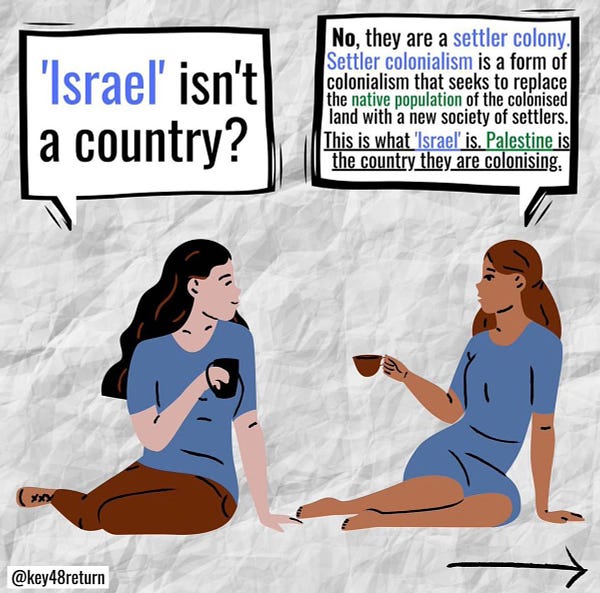
In conversations with Israeli settlers, Ben-Yishai often found that they believed they were entitled by God to take all land where Palestinians reside.
April 16, 2026 , Brad Reed for Common Dreams https://www.commondreams.org/news/west-bank-ethnic-cleansing
West Bank settler attacks on Palestinians are “rather sophisticated, organized, and funded systematic actions,” with the goal of “cleansing” the entire region, said journalist Ron Ben-Yishai.
An Israeli war correspondent who has been described as having deep ties to the Israel Defense Forces said that intensifying settler violence in the occupied West Bank appears to be “ethnic cleansing.”
In an column published by Ynet titled “This looks like blue and white ethnic cleansing,” journalist Ron Ben-Yishai wrote that, during a recent tour of the West Bank, he observed “a disturbing reality” of Israeli teenagers “who go on ‘intimidation tours’” in Palestinian villages, attacking Palestinians while members of the Israeli military frequently either stand by or actively join in the attacks.
“In some cases, these are reservists who also identify ideologically with the rioters, and therefore stand by and do not prevent them from going wild—and sometimes even help them,” explained Ben-Yishai. “Even in the regular IDF units stationed in the territories, there have been quite a few cases in which commanders and fighters have deviated from the norms and the IDF’s code of ethics for religious-nationalist reasons.”
In conversations with Israeli settlers, Ben-Yishai often found that they believed they were entitled by God to take all land where Palestinians reside.
“The confident reliance on God’s command as the answer to all moral and practical questions and concerns,” he wrote, “gave me a disturbing feeling that this was a type of Jewish terrorism motivated by religious and nationalist motives.”
Ben-Yishai also described ways in which Israeli settlers surround Palestinian communities “in order to prevent them from moving freely and strangle them economically.”
Taken as a whole, Ben-Yishai concluded that the Israel settler attacks on Palestinians are a “rather sophisticated, organized, and funded systematic actions—with the long-term strategic goal being to ‘cleanse’ most of” the West Bank and Gaza of Palestinian presence.
In a social media post, geopolitical analyst Shaiel Ben-Ephraim explained how significant it was for someone like Ben-Yishai, whom he said has “the deepest ties to the IDF of any reporter,” to describe West Bank settlers’ actions as ethnic cleansing.
“Observers have been saying for years that what is happening in the West Bank is ethnic cleansing,” he wrote. “But now voices from the heart of the Israeli consensus are admitting it as well.”
‘THIS IS NOT SELF-DEFENSE’: UN EXPERTS BLAST ISRAEL’S ASSAULT ON LEBANON AS WAR CRIME
April 16, 2026, ScheerPost Staff, https://scheerpost.com/2026/04/16/this-is-not-self-defense-un-experts-blast-israels-assault-on-lebanon-as-war-crime/
As Israel intensifies its bombardment of Lebanon, a group of United Nations experts is now saying plainly what much of the political class refuses to: this is not self-defense—it is a violation of international law.
In a sharply worded joint statement, two dozen UN special rapporteurs condemned the ongoing assault as “a blatant violation of the UN Charter” and “an affront to the international legal order,” warning that the scale and timing of the attacks—launched even as ceasefire talks were underway—represent a deliberate destruction of any remaining path to peace.
What’s unfolding is not just escalation—it’s acceleration.
According to reports, Israeli forces unleashed one of the largest coordinated strike campaigns in Lebanon in decades, leveling towns, hitting civilian infrastructure, and killing rescue workers in so-called “triple-tap” strikes—attacks that target first responders arriving at the scene.
The human toll is staggering. Over a million people—more than a fifth of Lebanon’s population—have been displaced since March. Thousands are dead. Hundreds of thousands of children have been forced from their homes, with UNICEF warning that “nowhere is safe.”
But beyond the numbers is the pattern.
The Israeli and Lebanese governments are once again attempting to come together for peace—at least on paper.
But even that fragile possibility comes wrapped in uncertainty. In a Truth Social post published just before midnight, Donald Trump said he was “trying to get a little breathing room between Israel and Lebanon.”
“It has been a long time since the two leaders have spoken—like 34 years,” he added, without specifying who would attend or where the talks would take place. As the death toll has now risen to 2,164, with 7,061 wounded as of today.
UN experts point to what they describe as “domicide”—the systematic destruction of homes and civilian infrastructure—combined with mass displacement orders that leave entire populations with nowhere to return. Under international law, they warn, this constitutes crimes against humanity and war crimes.
UN human rights experts are now sounding the alarm in unmistakable terms: Israel’s latest wave of strikes on Lebanon—launched within hours of a ceasefire announcement—constitutes not self-defense, but a “blatant violation of the UN Charter” and a direct assault on the international legal order. In a coordinated bombardment hitting more than 150 locations in minutes, hundreds were killed and injured, entire neighborhoods were reduced to rubble, and over a million people have been driven from their homes—an unprecedented displacement crisis that experts warn reflects a deliberate pattern of “domicide” and collective punishment. The scale, timing, and targeting of civilian areas, they argue, not only undermine any remaining prospects for peace but rise to the level of war crimes and crimes against humanity under international law, raising urgent questions not just about the attacks themselves—but about whether any system of global accountability still exists.
And yet, the bombs continue to fall.
The statement does not just call out Israel—it directly challenges the United States, Israel’s primary military backer, urging Washington to use its leverage to halt the assault. That pressure, so far, has not materialized in any meaningful way.
Instead, the gap widens—between what international law says and what global power allows.
Netanyahu Doctrine: How one man’s war addiction is consuming Israel, Lebanon, and the World

The concept of Greater Israel – a territory stretching from the Nile to the Euphrates, encompassing all of modern-day Israel, the Palestinian territories, Lebanon, Jordan, Syria, Iraq, Kuwait, Saudi Arabia, and parts of Turkey – is not a fringe fantasy. It is the stated aspiration of the Netanyahu government.
Israel is not being destroyed by its enemies. It is being destroyed by its own internal contradictions. The addiction to war, the messianic ideology, the economic unsustainability, the exodus of the educated – these are not external threats. They are internal cancers.
15 April 2026 Dr Andrew Klein, https://theaimn.net/the-netanyahu-doctrine-how-one-mans-war-addiction-is-consuming-israel-lebanon-and-the-world/
From the ‘Villa in the Jungle’ to the ‘Greater Israel Nightmare’
I. Introduction: The Doctrine of Perpetual War
On October 7, 2023, Israel suffered the worst terrorist attack in its history. Hamas militants crossed from Gaza, unimpeded, and killed and tortured Israeli civilians. That day alone should have disqualified Benjamin Netanyahu from office. In most political systems, he would have been driven from power long ago.
Instead, he did what he has always done: he escalated.
What emerged from the ashes of October 7 is what analysts now call the Netanyahu Doctrine – a security strategy based not on containment, not on deterrence, but on perpetual war. As Netanyahu himself told military officers:
“No more containment of threats. No more the idea of the ‘villa in the jungle’, where one hides from predators beyond the wall. On the contrary: if you don’t go into the jungle, the jungle comes to you.”
The doctrine is simple: preventive attacks against every perceived threat, the creation of buffer zones through the seizure of neighbouring territories, and the constant use of force as the only guarantee of security. It is a doctrine born of trauma, shaped by political expediency, and devoid of any long-term diplomatic vision.
This article examines the Netanyahu Doctrine in action: in Gaza, in Lebanon, in Syria, and against Iran. It documents the destruction, the displacement, and the erosion of Israel’s international standing. It argues that Netanyahu is not a strategist – he is an opportunist. He does not plan for the long term. He plans for the next distraction.
And the world is always distracted.
II. The Greater Israel Dream: From the Nile to the Euphrates
The doctrine is not about security. It is about expansion. The buffer zone is not the goal. The settlements are the goal. The land clearance is not for defence. It is for colonisation.
The concept of Greater Israel – a territory stretching from the Nile to the Euphrates, encompassing all of modern-day Israel, the Palestinian territories, Lebanon, Jordan, Syria, Iraq, Kuwait, Saudi Arabia, and parts of Turkey – is not a fringe fantasy. It is the stated aspiration of the Netanyahu government.
This is not a fringe position. It is the official policy of the Netanyahu government. And it is being executed.
III. Lebanon: The Pattern Repeats
The same pattern as Gaza. The same destruction. The same rubble.
On March 2, 2026, Israel launched an offensive against Hezbollah in Lebanon. The stated goal was to create a “buffer zone” up to the Litani River, approximately 30 kilometres north of Israel’s border, to protect northern Israeli communities from Hezbollah rockets.
The reality is different. The buffer zone is not a buffer. It is a land grab. The territory up to the Litani is not needed for defence. It is needed for settlements.
Defence Minister Israel Katz has been explicit:
“All houses in villages near the Lebanese border will be destroyed, in accordance with the model used in Rafah and Beit Hanoun in Gaza, in order to permanently remove the threats near the border.” Displaced residents will not be allowed to return south of the Litani “until the safety and security of residents of northern Israel is guaranteed” – a condition that may never be met.
The human cost in Lebanon (as of April 2026):
- 1,268 people killed in Israeli strikes, including 125 children and 52 medics
- 303 killed in a single day (April 8, 2026) – one of the deadliest bombings ever inflicted on Lebanon
- 1,200+ killed and 1.2 million displaced since March 2
- 1,094 confirmed martyrs and 3,119 injured according to the Lebanese Ministry of Health.
The air force can project power anywhere. The ground troops are not needed for security. They are needed for clearance.
IV. Conflicting Views: Military vs. Political Leadership
The Israeli military and political leadership are not aligned. The military leaders want a buffer zone. The political leaders want settlements.
In early April 2026, the Israeli army proposed a revised set of objectives for its operations in Lebanon, limiting the goal of disarming Hezbollah to areas south of the Litani River, rather than across the entire country. The proposal triggered sharp disagreements with Israel’s political leadership, leading to the postponement of a cabinet meeting.
Foreign Minister Israel Katz was among those who opposed the plan. Under the alternative military approach, the army would focus on the large-scale destruction of villages in South Lebanon and the forced displacement of their citizens to establish a buffer zone.
The gap is not a failure of communication. It is a feature. The ambiguity provides cover. The confusion provides deniability.
The military leaders can say: “We were only establishing a buffer zone.”
The political leaders can say: “The military recommended it.”
And the settlers move in.
V. The Economic Cost: Israel Cannot Afford This War
The Netanyahu Doctrine is not sustainable. The economic numbers are stark.
The cost to Israel:
The defence budget has ballooned. The army needs approximately 15,000 more soldiers, half of them for ground combat units. Chief of Staff Eyal Zamir warned the government: “I am raising 10 red flags. If this continues, the Israeli army will collapse from within.”- The ultra-Orthodox community, which relies heavily on state benefits, is expected to triple by 2065, pushing the burden on non-Orthodox households to the equivalent of 60,000 shekels ($19,370) a year.
- Foreign investment is down. Institutional investors have been moving money out of the country since the 2008 financial crisis.
- More than 150,000 people have left Israel in the past two years, and more than 200,000 since the current government took office in December 2022. The educated upper class are more able to leave – they speak English, can find jobs, and are more exposed to international media.
The cost to Lebanon:
The Lebanese economy, already in freefall, is being shattered. The destruction of infrastructure, the displacement of 1.2 million people, and the loss of agricultural land in the south will take decades to repair.- Sectarian tensions are rising. Non-Shi’a Lebanese are increasingly ostracising the Shi’a community, viewing them as a liability that brings Israeli bombs. The country’s fragile social fabric is tearing apart.
The Netanyahu Doctrine is not about security. It is about expansion. And expansion costs money that Israel does not have.
VI. The Sabra and Shatila Precedent
This is not the first time Israel has invaded Lebanon. It is not the first time the world has been distracted. And it is not the first time the consequences have been catastrophic.
In 1982, Israeli forces invaded Lebanon and besieged Beirut. On 16 September, under Israeli supervision and protection, Lebanese Forces militias entered the Palestinian refugee camps of Sabra and Shatila. For 43 hours, they tortured and killed everyone they came across. They crushed the heads of children and babies against walls. They raped women and girls before slaughtering them. They dismembered their victims.
An estimated 3,500 to 4,500 Palestinian and Lebanese civilians were killed.
The Israeli government did not deny that it had overseen the camps. It denied knowledge of the massacre, despite order number 6 of the Israel Defense Forces command stating that “the refugee camps are not to be entered” and that “searching and mopping up the camps will be done by the Phalangists/Lebanese Army.”
The Kahan Commission found Israeli Defence Minister Ariel Sharon “personally responsible for ignoring the danger of bloodshed and revenge.” He was forced to resign.
The world was shocked. The world moved on. And Israel invaded Lebanon again.
The Netanyahu Doctrine is not new. It is the same doctrine, dressed in new clothes, enabled by a distracted world, and executed with unprecedented brutality.
VII. The UN Warning: ‘The Gaza Model Must Not Be Replicated’
The international community is not silent. But its warnings are being ignored.
UN Secretary-General Antonio Guterres has issued a warning cry, stressing that the model of destruction witnessed in the Gaza Strip must not be repeated in Lebanese territories. He described the humanitarian repercussions as severe and requiring immediate intervention to prevent a slide towards a comprehensive catastrophe.
Stanford Law Professor Tom Dannenbaum warned that destroying all homes near the Lebanese border would not meet the standard of “absolute military necessity” required by the laws of war. “The unnecessary destruction of property can qualify as a war crime,” he said. Katz’s comments barring residents from returning home “strongly indicate an illegal policy of long-term or permanent displacement.”
European countries have called on Israel to avoid further escalation. Canadian Prime Minister Mark Carney said Israel’s occupation of Lebanese territory was a “violation of their territorial sovereignty” and condemned it.
The world is not silent. But the world is distracted.
VIII. The Netanyahu Doctrine: A Record of Failure
Jonathan Freedland, writing in The Guardian, sums up the Netanyahu record:
“This is now the fourth time in a row – in Gaza, once in Lebanon and twice in Iran – that Netanyahu’s boasts of total victory and the removal of existential threats have been exposed as empty promises.”
The failures are clear:
Gaza: Netanyahu promised “total victory” over Hamas. After a two-year campaign that killed approximately 70,000 people, Hamas still rules the ruins of half of Gaza.- Lebanon (first round): Netanyahu boasted that he had “vanquished” Hezbollah, destroying its ability to menace northern Israel. Hezbollah continues to fire rockets.
- Iran (first round, June 2025): Netanyahu described the 12-day confrontation with Iran as a “historic victory that will stand for generations.” Eight months later, Tehran was once again said to pose an existential threat.
- Iran (second round, February-April 2026): Iran still has a stockpile of enriched uranium. Its rulers remain in place, more hardline than before. Tehran has demonstrated a mighty deterrent – a chokehold on the global economy in the form of the Strait of Hormuz.
As Yair Golan, the Israeli opposition politician and former general, observed: Netanyahu “does not know how to turn military achievements into political security.” There is no attempt to seize diplomatic openings, no effort to turn Israel’s enemies’ enemies into friends.
The Lebanese government and much of its people are desperate to be rid of the Hezbollah cuckoo in their nest. But Netanyahu speaks to them only through bombs.
IX. The Strait of Hormuz Distraction
The timing of the Lebanon escalation is not accidental. The world is focused on Trump and Iran. The media is focused on oil prices. The public is focused on the cost.
On February 28, 2026, the US and Israel launched joint military strikes against Iran. The war has spread across the Middle East. The Strait of Hormuz is effectively blockaded. Oil prices have spiked. Inflation is rising. The global economy is bleeding.
Netanyahu is taking advantage. He always does.
The Iranian threat is not existential. It is useful. The fear is the tool. The distraction is the opportunity.
Netanyahu has been playing this game for decades. He is very good at it.
X. What This Means: The Erosion of Israel’s Standing
The Netanyahu Doctrine has gained nothing. And it has come at a monstrously high price.
Most obviously, in the lives of all those killed – whether in Rafah or the Bekaa Valley or Israel itself. But it has also inflicted perhaps irreparable damage on Israel’s standing in the world. Every day Netanyahu remains in post, he makes his country more of a pariah.
The Knesset has passed a racist law that will, in effect, impose the death penalty on Palestinians convicted of terrorist murderers – but not Jews. The bill was driven by Itamar Ben-Gvir, but Netanyahu went out of his way to vote for it.
Israel is not being destroyed by its enemies. It is being destroyed by its own internal contradictions. The addiction to war, the messianic ideology, the economic unsustainability, the exodus of the educated – these are not external threats. They are internal cancers.
The collapse will not be dramatic. It will be bureaucratic. The economy will contract. The allies will defect. The public will turn. The reservists will refuse. The militias will fight each other.
The Strait of Hormuz crisis will pass. The oil prices will stabilise. The media will move on.
But the land in Lebanon will not return. The settlements will not be dismantled. The buffer zone will become permanent .
The Netanyahu Doctrine is not about security. It is about expansion. The existential threat is not a threat. It is an excuse.
And the world is too distracted to notice.
XI. A Final Word
The Netanyahu Doctrine is a death spiral – for Israel, for Lebanon, for the region. It is a doctrine of perpetual war, sustained by distraction, enabled by silence, and paid for with the bodies of the innocent.
The question is not whether Israel will collapse. The question is how many more must die before the world stops looking away.
Sources……………………………………..
Not a Ceasefire—A Reset: The Quiet Expansion of Palestinian Incarceration
April 14, 2026, ScheerPost Staff, https://scheerpost.com/2026/04/14/not-a-ceasefire-a-reset-the-quiet-expansion-of-palestinian-incarceration/
While global attention drifts, the machinery of occupation does not slow—it tightens. Arrests replace releases. Silence replaces scrutiny. And behind it all, a system of incarceration continues to expand, largely out of view.
In this episode of Rattling the Bars, host Mansa Musa sits down with scholar-activist Dr. Rabab Abdulhadi to expose what they describe as a revolving door of detention shaping daily life for Palestinians. What emerges is not simply a prison system—but an architecture of control that extends far beyond prison walls, touching every aspect of Palestinian existence.
More than 9,000 Palestinians are currently held in Israeli custody—a number that continues to climb even after high-profile prisoner releases.
Despite the release of nearly 2,000 Palestinian prisoners during what was labeled a ceasefire in October 2025, a new wave of arrests has already erased that moment. Today, more than 9,000 Palestinians are again held in Israeli custody, according to Dr. Rabab Abdulhadi, with the total constantly shifting as new detentions replace those released.
“It’s a revolving door,” she explains. “You release prisoners—and then you arrest more.”
At the center of that system is administrative detention—imprisonment without charge, without trial, and often without end. Detainees may never be told what they’re accused of, while access to lawyers, family, and even basic information is severely restricted.
Two legal systems operate side by side: one for Israeli settlers, another for Palestinians. Even children are caught in it—Palestinian minors can be prosecuted as adults under military law, stripped of protections others receive.
Inside prisons, conditions continue to deteriorate: reduced food, denied medical care, and near-total isolation since October 2023.
But the system doesn’t end at the prison gates.
Night raids, arbitrary arrests, and movement restrictions turn daily life into an extension of confinement—what Abdulhadi describes as a reality where prison becomes a condition, not just a place.
Children grow up inside it. Families are fractured by it. Entire communities are shaped around it.
And still, the cycle continues.
“The people will resist because they want to live,” Abdulhadi says. This is not a story of what has happened—but of what is still happening, in front of our very eyes.
About children who can identify military aircraft before they can read. Children who grow up navigating checkpoints, raids, and the constant threat of arrest.
“They should not be scared every night,” Abdulhadi says. “They should not have nightmares.”
Jeffrey Sachs: Ending Israel’s War on Peace
To make lasting peace in the Middle East, the US must end its blank check to Israel’s perpetual wars and join with the rest of the world to force Israel to live within its internationally recognized borders of June 4, 1967.
Jeffrey D. SachsSybil Fares, Apr 09, 2026, https://www.commondreams.org/opinion/israel-war-on-peace
A two-week ceasefire has partially halted the Israel-US war on Iran. The war accomplished precisely nothing that a competent diplomat could not have achieved in an afternoon. The Strait of Hormuz was open before the war and it is open again now, but with more Iranian control.
Meanwhile, the chaos continues. Israel is intent on blowing up the ceasefire, as this was Israel’s war from the start. Israel dazzled Trump with the prospect of a one-day decapitation strike that would put Trump in charge of Iran’s oil. Israel, in turn, was out for bigger prey: to bring down the Iranian regime and thereby become the regional hegemon of Western Asia.
The foundation of the ceasefire is Iran’s 10-point plan, which Trump (perhaps unwittingly) called a “workable basis on which to negotiate.” The plan makes sense, but it is a major climbdown for the US, and probably a redline for Israel. Among other points, the plan calls for an end to the wars raging in the Middle East, almost all of which have Israel at their root cause. The plan would also resolve the nuclear issue, essentially by going back to the JCPOA that Trump ripped up in 2018.
The Iran War, and the other wars raging across the Middle East, trace back to one core Israeli idea, that Israel will permanently and steadfastly oppose a sovereign Palestinian state and will topple any government in the Middle East that supports armed struggle for national sovereignty. It is crucial to note that the UN General Assembly has passed multiple resolutions, such as Resolution 37/43 (1982), affirming that political self-determination is so vital, that armed struggle in the quest for self-determination is legitimate. The UN was born, in part, out of the determination to end the centuries of European imperial domination over Africa and Asia. Of course, there would be no cause for armed struggle if Israel would accept a political solution, notably the two-state solution that has overwhelming support throughout the world.
The peace is within reach, if the US grasps it.
Netanyahu’s core goal may be summarized as Greater Israel. This means no Palestinian sovereignty, and no clear boundaries for Israel even beyond the boundary of historical Palestine under British rule after WWI. Zionist extremists like Netanyahu’s political allies, Ben-Gvir and Smotrich favor Israeli control over parts of Lebanon and Syria, as well as permanent control over all of what was British Palestine. America’s Christian Zionists, exemplified by the US Ambassador to Israel Mike Huckabee, and a strong voter base of Trump, speak of God’s promise to Israel of the lands between the Nile and the Euphrates. Crazy stuff, but these are real beliefs, nonetheless, and they are conveyed in the White House.
Israel’s strategy is therefore regime change in every country that resists Greater Israel, a plan already foreshadowed in the famous political document “A Clean Break: A New Strategy for Securing the Realm,” written by US Zionist neocons as a platform for Netanyahu’s new government in 1996. We’ve had constant wars in the Middle East since then to implement the Clean Break vision. This has included the war in Libya to overthrow Moammar Qaddafi, the wars in Lebanon, the war to overthrow Syria’s Bashar al-Assad, the war to overthrow Iraq’s Saddam Hussein, and now the war to topple the Iranian regime.
This is not to say that the US lacks its own grandiose ideas. Israel wants regional hegemony, this is not a secret. Netanyahu confirmed these ambitions in his recent remarks about Israel becoming “a regional power, and in certain fields a global power.” On the other hand, American officials dream of global hegemony. And Trump dreams of money. He craves the Iranian oil and repeatedly said so.
In any event, it’s clear that this war was Netanyahu’s creation. He and the Mossad chief came to Washington to sell Trump a bill of goods. It’s not hard. Trump was suckered, while everybody else had their doubts about Netanyahu’s claims of an easy one-day decapitation strike—essentially a replay of the US operation in Venezuela.
It’s pathetic to “listen in” on the White House discussion, as revealed by the New York Times. Netanyahu, a con man, presented rosy scenarios of regime change that US intelligence contradicted, yet Trump foolishly accepted. Trump and Netanyahu were cheered on by Christian Zionists (Hegseth), Jewish Zionists and real-estate developers (Kushner and Witkoff), a faith healer (Franklin Graham), and high-level sycophants (Rubio and Ratcliffe).
While Trump was telling the world that Iran was begging for a ceasefire, it was Trump himself who was begging for a ceasefire.
Until Tuesday evening, it looked like Trump might lead the world blindly to World War III. The vulgarity and brutality of his public rhetoric was unmatched in US presidential history. Now we know that he was desperately seeking an off-ramp and using Pakistan for that purpose. While Trump was telling the world that Iran was begging for a ceasefire, it was Trump himself who was begging for a ceasefire. The Pakistani leader delivered it.
The ceasefire is good, and the 10-point plan is good, even if perhaps Trump didn’t know what was in it when he said that it was a good basis for negotiation. Israel will, in any event, work overtime to break it, and has already started to do so, with carpet bombing of Beirut that is killing hundreds of civilians, and with other strikes. A permanent US-Iran agreement is the last thing that Netanyahu wants. That would end his dream of Greater Israel.
Yet there is a way to peace and that is for the US to face reality. Israel is the real “terror state,” waging perpetual war throughout the Middle East for a wholly indefensible reason—to have unchecked freedom to terrorize and rule over the Palestinian people and to expand its borders as Israel’s zealots see fit. To make lasting peace in the Middle East, the US must end its blank check to Israel’s perpetual wars and join with the rest of the world to force Israel to live within its internationally recognized borders of June 4, 1967. Iran’s 10-point plan can be the basis of a comprehensive regional peace—if the US accepts the reality of a state of Palestine. In that case, Iran would likely agree to stop funding non-state belligerents, and Israel, Palestine, Lebanon, and the entire region could live in mutual security and peace. That outcome should be the basis of a negotiated agreement of the US and Iran in the next two weeks.
Israel is the real “terror state,” waging perpetual war throughout the Middle East for a wholly indefensible reason…
The American people have made their views clear. A 2025 Pew survey finds most Jewish Americans lack confidence in Netanyahu and back the two-state solution. Most Americans now view Israel unfavorably, the highest unfavourability in history. Sympathy for Israel has hit a 25-year low. Now the political class must catch up with the public.
The peace is within reach, if the US grasps it. Iran’s proposal is serious and the ceasefire is a fragile opening for a comprehensive settlement. The question is whether the US will, once again, allow Israel to destroy the peace, or rather this time stand up for America’s interests and the world’s interests in a lasting peace.
When Flotillas Fight for Life, Not Empire
April 10, 2026 , Olivia DiNucci for Codepink, https://scheerpost.com/2026/04/10/when-flotillas-fight-for-life-not-empire/
Flotillas have historically been fleets of military vessels—tools of empire designed for swift offensive or defensive operations at sea. The images they evoke are ones of imperial power and looming violence. Just look at the massive US naval buildup that surrounded Iran as part of the recent US attacks.
But peace activists have also developed a new kind of flotilla.
Instead of instruments of war, flotillas have become symbols of peace—acts of humanitarian direct action, civil resistance, and cross-border solidarity. Take the flotillas that have tried to reach Gaza, like the Global Sumud Flotilla. Even though they have been illegally intercepted by the Israeli military, they have educated millions of people worldwide about Israel’s atrocities, activated entire cities to shut down, and offered a beacon of hope to the beleaguered people of Gaza.
As U.S. policy continues to sanction and blockade Cuba—causing immense hardship for the Cuban people—I, along with many others, felt compelled to escalate our own tactics of solidarity by joining the recent flotilla to Cuba as part of the Nuestra América Convoy. Our boat carried 15 tons of aid, part of the more than 40 tons delivered by the convoy.
The United States is currently imposing some of the harshest sanctions on Cuba in recent history, compounding a 67-year blockade that has restricted access to medicine, fuel, and food. But in recent months, the US added another dimension: a naval blockade to severely limit fuel imports, leading to a humanitarian crisis.
In an ideal world, we wouldn’t need fossil fuels—we would already have made a just transition to renewable energy. And while Cuba is working at lightning speed to expand solar power, the current reality is stark: people still need fuel to cook, to transport food, to operate ambulances, to power hospitals, and to keep ventilators running.
The international community has responded to this escalation in U.S. economic warfare with intensified solidarity. Hundreds of thousands of people around the world have been mobilizing to send aid and condemn the US blockade. In March, Progressive International, CODEPINK, and The People’s Forum launched the Nuestra América Convoy, bringing together over 600 people from 33 countries. We came with millions of dollars’ worth of aid—from urgently needed medical supplies to longer-term solutions like solar panels.
While many of my friends boarded planes to Havana, packing every inch of their luggage with medicine, hygiene products, vitamins, and art supplies, I traveled to Mexico to meet the flotilla crew. We spent four days at sea together—activists, journalists, organizers. Some had helped organize the Gaza Sumud Flotilla; others had taken part in mass protests in solidarity with Palestine.
Our goal was to deliver much-needed aid to the people of Cuba. But just as important was challenging the dominant narrative—that Cuba’s suffering is the result of its own government, rather than decades of U.S. cruel policy.
Even though the boat was full of journalists documenting the trip, their cameras could not fully capture the sense of community among strangers united by a shared mission. I remember being nervous about the cold and the possibility of seasickness, but within minutes, people were offering ginger chews, acupressure bracelets, and rain gear.
Our departure was delayed due to weather, boat repairs, and the logistics of loading the aid. In the meantime, we stayed with supporters in Mexico who couldn’t join the voyage but found other ways to contribute. We shared a send-off dinner at an Egyptian restaurant whose owner had followed the Gaza flotillas. He told us how proud he was to see a flotilla to Cuba leaving from his small town.
On the boat, we shared cooking, dishwashing, and night watch shifts—standard practice in occupations, encampments, and direct actions where resources are limited but creativity and collaboration are abundant. At sea, a simple breakfast of rice, beans, eggs, guacamole, and toast tastes like a feast. We slept under galaxies of stars, woke to sunrises on the horizon, and at sunset made music with whatever we had—a guitar, a bucket drum, water bottles filled with dry beans.
Meanwhile, I stayed connected to those traveling by plane, watching group chats fill with photos of carefully packed bags and urgent questions: Who can fit more supplies? How many solar batteries can we carry on? The coordination was constant, collective, and inspiring.
The blockade severely limits what goods can reach Cuba. While US citizens can still travel there under certain categories, they face restrictions and often risk questioning upon return. But solidarity is not tourism. It is not about swooping in, taking photos, and leaving. It is about building relationships, listening, and committing to ongoing struggle from our home countries.
We had a beautiful reception from the Cuban people when we landed, and then had the opportunity to speak directly with community groups about current conditions.I learned how they overcome so much by placing value in community over the individual.
The US empire is indeed dying, and it is up to us to not just reimagine the better world we need and want, but to actually put that world into practice. Reflecting on my experience, I started thinking — if we can turn flotillas from a force of evil into vessels of hope and solidarity, then what else can we change? What if we built schools around the world instead of sending bombs? What if, like the Cubans, we funded healthcare over warfare and sent doctors to cure people instead of soldiers to kill them?
You don’t have to board a boat with humanitarian supplies to show solidarity. Flotillas are one tactic, but we need a variety and diversity of tactics right now, and always. You can move forward by showing solidarity to your neighbors at home, as well as to our neighbors 90 miles off our shores. Because what we build together, in community—whether through a peace flotilla or local mutual aid—is stronger than anything built through force.
Olivia CODEPINK’s DC Coordinator, who seeks to build and bridge connections from issues to people. She came to this work after living and working abroad as an experiential learning facilitator with college students. She is active in arts and creative communities, direct action, and building out more local to global solidarity in DC through deepening and weaving relationships.
1 This Month


Shut down the radiation-damaged Heysham nuclear reactors now
To see nuclear-related stories in greater depth and intensity – go to https://nuclearinformation.wordpress.com

Say No to NASA’s Reckless Nuclear Reactor on the Moon
Say No to NASA’s Reckless Nuclear Reactor on the Moon
-
Archives
- October 2026 (247)
- September 2026 (339)
- August 2026 (330)
- July 2026 (355)
- June 2026 (287)
- May 2026 (306)
- April 2026 (356)
- March 2026 (251)
- February 2026 (267)
- January 2026 (308)
- December 2025 (358)
- November 2025 (359)
-
Categories
- 1
- 1 NUCLEAR ISSUES
- business and costs
- climate change
- culture and arts
- ENERGY
- environment
- health
- history
- indigenous issues
- Legal
- marketing of nuclear
- media
- opposition to nuclear
- PERSONAL STORIES
- politics
- politics international
- Religion and ethics
- safety
- secrets,lies and civil liberties
- spinbuster
- technology
- Uranium
- wastes
- weapons and war
- Women
- 2 WORLD
- ACTION
- AFRICA
- Atrocities
- AUSTRALIA
- Christina's notes
- Christina's themes
- culture and arts
- Events
- Fuk 2022
- Fuk 2023
- Fukushima 2017
- Fukushima 2018
- fukushima 2019
- Fukushima 2020
- Fukushima 2021
- general
- global warming
- Humour (God we need it)
- Nuclear
- RARE EARTHS
- Reference
- resources – print
- Resources -audiovicual
- Weekly Newsletter
- World
- World Nuclear
- YouTube
-
RSS
Entries RSS
Comments RSS

