Comfortably numb — Beyond Nuclear International

When we will wake up to the real threat we face?
Comfortably numb — Beyond Nuclear International “Hello? (Hello? Hello? Hello?)
“Is there anybody in there?
Just nod if you can hear me
Is there anyone home?”
Those echoing opening lines of the Pink Floyd song, “Comfortably Numb” keep wafting through my psyche as I watch the US, Russia, and China, amass ever more sophisticated, deadly and downright evil nuclear weapons capabilities. What are they thinking?
Meanwhile, tensions continue to mount at the Ukraine-Russia border, as Putin moves more armaments and fleets around and the US flies its elite 82nd Airborne Division into standby mode in Poland, part of 3,000 US troops now deployed to the region.
All of this has sent US nuclear hawks, sounding more and more like General ‘Buck’ Turgidson from Dr. Strangelove, chafing at the bit to justify the further escalation and acceleration of the so-called modernization of the entire US nuclear weapons complex.
Meanwhile, there is even speculation that maybe Ukraine should not have given up its nuclear weapons at the end of the Cold War as the Soviet Union collapsed. The Russian seizure of Crimea and the seemingly endless conflict on Ukraine’s eastern border has led some to urge a Ukraine nuclear rearmament.
A nuclear-armed Ukraine, goes the logic, would allow it to “deter” a Russian invasion or, at least, any possible use of nuclear weapons by Russia in a grab for Ukraine.
But this thinking further exposes the hollow argument for deterrence. Nuclear weapons in Ukraine would have only one outcome — they would make the prospect of nuclear weapons being used in any current conflict more likely. (Then, of course, there is the ever-present danger of Ukraine’s 15 operating nuclear reactors — addressed in a January 30, 2022 article on these pages.)
The prospect that even a conventional conflict could break out in Ukraine is already horrific enough. But even the remotest possibility that this could progress to the use of nuclear weapons by any party, is positively nightmarish.
If you don’t value sleep, then Ira Helfand’s article in The Nation lays all of this out in chilling detail. It’s like reading the script to an apocalyptical dystopian horror movie (the kind that sadly seems to be all too popular these days).
Helfand’s article, however, is the exception to most of the coverage, which discusses the prospect of accidental or deliberate nuclear war over the Ukraine situation in a mind-bogglingly impassive way, “comfortably numb” to the very real, horrific, humanitarian consequences were this actually to happen.
It’s as if, as IPPNW’s Chuck Johnson said to me during a recent phone call, “it’s all perfectly normal”.
But to most of us regular folk, calmly anticipating the possibility of a nuclear war isn’t normal. It’s the definition of insanity. And it’s exasperating. Hello? Can you hear us? We have a climate crisis bearing down on us. A global emergency of, yes, apocalyptic proportions.
It goes without saying that, as a species, we need to stop directing all our energies towards our collective extinction, both through our failure to act adequately and on time on climate, and by unnecessarily rattling nuclear sabres.
It goes without saying, but it needs saying. Again and again and really loudly. By all of us. Just nod if you can hear me.
Linda Pentz Gunter is the international specialist at Beyond Nuclear and writes for and curates Beyond Nuclear International.
In Ukraine, USA to finance American companies to sell nuclear technology there, and to other States

Where the Russians are coming, so is Westinghouse with its nuclear ambitions, ANYA LITVAK, Post Gazette, 7 Feb 22, Over the past few months, Joel Eaker, Westinghouse Electric Co.’s vice president for new nuclear power plant projects, has been shaking hands and posing for pictures all over Eastern Europe.
He was in Poland last month, where he plans to move in the spring. A week before that, he was in the Czech Republic to announce agreements signed with local companies in Cranberry-based Westinghouse’s bid to sell its AP1000 reactors in the region.
The nuclear renaissance never happened in the United States. But Mr. Eaker thinks Europe is headed in that direction.
The long game
The nuclear business is a long game with fits and starts.
For more than two decades, Westinghouse has been seemingly on the cusp of selling new nuclear reactors to various Eastern European countries ………….
All along, Westinghouse was pursuing a parallel strategy: making fuel that could be used in existing Russian-made reactors that are scattered across Europe.
…… Westinghouse could provide an alternate supply of fuel, which effectively delinks those countries from Russia.”
After some attempts loading the fuel in Russian-made reactors at Temelin in the Czech Republic, it was Ukraine that allowed Westinghouse to test and refine its fuel assemblies in Russian reactors.
Today, the U.S. company’s fuel is loaded into nearly half of Ukraine’s nuclear plants, and Westinghouse is trying to use those bona fides to sell fuel to existing Russian-style reactors in Finland, Czech Republic, Slovakia and Hungary, Tarik Choho, president of Westinghouse’s Europe, the Middle East and Africa division, told Ukraine’s news service in August.
Mr. Eaker said Westinghouse’s pursuit of that market was both earnest and strategic.
The company’s bread-and-butter business is supplying fuel to and servicing existing reactors. It’s what made Westinghouse, then in bankruptcy, attractive to the Canadian asset management firm Brookfield Business Partners, which has owned it since 2018.
It’s difficult to predict if this recent burst of nuclear promise in Eastern Europe will yield actual new reactor projects, Ms. Harrington said.
………… In 2014, when the continued existence of the U.S.’s Export-Import Bank became a topic of debate in Congress, Westinghouse’s then-CEO Danny Roderick said the first thing he was asked when pitching a new plant to clients in places like Central Europe is how much the U.S. government is willing to help financially.
………. Pierre Paul Oneid, the chief nuclear officer at Holtec International, a New Jersey-based company that specializes in decommissioning and nuclear fuel storage. Holtec, Mr. Oneid said, had been working for a decade to close a deal for a centralized storage facility for spent nuclear fuel in Ukraine, which would not be possible without financing from the U.S. government.
…….. While Mr. Oneid said the deal was in the “eleventh hour,” in fact it took three more years to finalize. U.S. Overseas Private Investment Corp. announced in 2017 that it was providing $250 million in political risk insurance to the Ukrainian utility. Bank of America/Merrill Lynch would then sell that $250 million commitment in the form of fixed-rate bond securities.
It was the first such deal of its type, but probably not the last.
Show me the money
If there’s another major piece, other than climate change, that’s opening doors for Westinghouse in Eastern Europe, it’s the prospect of the U.S. government’s expanded role in financing nuclear projects, Mr. Eaker said.
In 2019, then-President Donald Trump created the U.S. Nuclear Fuel Working Group………. Among its recommendations was for the U.S. Development Finance Corp., a newly-created vehicle to fund projects in low-income countries, to lift its ban on providing funds to nuclear projects.
The development agency listened and, in the summer of 2020, it unshackled itself from the ban, which was a holdover from its predecessor and modeled on the language of the World Bank. The DFC can even provide financing to projects in higher-income countries in Eastern Europe as part of its charge under the The European Energy Security and Diversification Act of 2019.
This means the U.S. government can now offer equity financing for nuclear projects abroad, a first. It can also give larger loans and loan guarantees than what is typically handled by the Export-Import Bank, and it can offer political risk insurance.
This is the next step in Westinghouse’s advances in Eastern Europe. Once it finishes doing a $10 million front end engineering and design study for AP1000 reactors in Poland — the U.S. government funded 70% of that work as part of an intergovernmental agreement — then it hopes to submit a formal bid along with a U.S. government financing proposal this fall.
In Ukraine, Westinghouse has already signed contracts with the electric utility to start ordering long-lead equipment and doing other preparations, but the contracts won’t be fully implemented until the U.S. comes with the financing package.
Anya Litvak: alitvak@post-gazette.com. https://www.post-gazette.com/business/powersource/2022/02/07/Russia-Ukraine-Westinghouse-Electric-nuclear-AP1000-reactors-climate-change-energy-eastern-europe/stories/202201300126
Lake animals near Chernobyl have mutations

Lake animals near Chernobyl have mutations https://beyondnuclear.org/lake-animals-near-chernobyl-have-mutations/ February 4, 2022
Animals in lakes close to the Chernobyl nuclear reactor have more genetic mutations than those from further away – giving new insight into the effect of radiation on wild species, researchers at the University of Stirling have found, writes Brendan Montague in The Ecologist.
DNA analysis of freshwater crustaceans, called Daphnia (pictured on original), revealed greater genetic diversity in lake populations that experienced the highest radiation dose rates following the accident in 1986.
Radiation is the primary cause of these genetic mutations, according to Dr Stuart Auld, who led the research.
Dr Auld, of Stirling’s faculty of natural sciences, said: “Chernobyl is a natural experiment in evolution, because the rate of genetic mutation is higher, and all evolutionary change is fuelled by mutations.
“Normally you have to wait for generations to see the effect of the environment on mutations, and most mutant animals are pretty damaged so don’t live long.
“By sequencing non-coding DNA – bits of genetic code that don’t actually affect the form or function of the organism – we were able to uncover these mutations.”
Dr Jessica Goodman collected the crustaceans using a kayak and net from lakes at varying distances from Chernobyl as part of her PhD. She flew the samples back to the lab at Stirling, where Dr Auld’s team isolated and analysed the DNA.
The research was assisted by June Brand at the University of Stirling and Gennady Laptev from the Ukrainian Hydrometeorological Institute in Kiev. It was funded by the Natural Environment Research Council.
The paper Radiation-mediated supply of genetic variation outweighs the effects of selection and drift in Chernobyl Daphnia populations is published in the Journal of Evolutionary Biology.
Stop the lies about Ukraine
Nina Beety, Monterey, https://www.montereyherald.com/2022/01/29/letters-to-the-editor-jan-27-2022/
The 2014 deadly U.S. coup d’etat in Ukraine overthrew the democratically elected president, partnering with ultra-nationalists and neoNazis. It cost $5 billion, said Victoria Nuland, now Biden’s Asst Sec of State, put “our man Yats” in power, and initiated a reign of terror. Biden was Obama’s point man there.
Systematic ethnic genocide followed against all who opposed the illegal regime, any Russian-speaking Ukrainians, Ukrainian Jews, journalists, officials. People are stalked, imprisoned, tortured, gang-raped, and killed. Hundreds were shot and buried in mass graves, some still alive. Crimea, Donetsk, Lugansk residents are attacked by Kyiv paramilitary and military units flying Nazi insignias, trained and assisted by the U.S. (including the California National Guard) and NATO. Many fled into Russia for safety. Crimea voted to secede and rejoin Russia. All these facts are missing in your false reports.
Like with Iraq, Afghanistan, Libya, Vietnam, the U.S. destroyed Ukraine, — its economy ruined; its people without adequate energy, heat, food; its resources pillaged; its nuclear power plants endangered. Washington did this. It also obtained Russian planes, weapons, and equipment, and has a history and motivation to stage false flags. Don’t Americans care? The U.S.A .is destroying people and countries. Where’s the protest?
Full scale war in Ukraine? With its 15 nuclear reactors – no more Ukraine, no more Europe

Ukraine diplomat sees little chance of war ‘in country with 15 nuclear reactors’ https://www.euractiv.com/section/global-europe/news/ukraine-diplomat-sees-little-chance-of-war-in-country-with-15-nuclear-reactors/
EURACTIV.com with Reuters, 26 Jan 22, Ukraine is committed to seeking a diplomatic solution to the current tension with Russia, its ambassador to Japan, Sergiy Korsunsky, said on Wednesday (26 January), adding that he saw little chance of all-out war, although there might be smaller conflicts.
nuclear reactors would bring about a devastating regional impact on Europe.
“I believe that full-scale war is very, very, very difficult to expect, but we may see more localised conflict,” Korsunsky told a news conference in the Japanese capital Tokyo.
If war is going to happen, that will be the first ever in the history of mankind, war against a country which has on its territory 15 nuclear reactors, which has 30,000 km of gas and oil pipelines, full with gas and oil,” said Korsunsky.
“If all these infrastructure is destroyed, there is no more Ukraine. But this is just one consequence. There is no more central Europe and probably western Europe would be affected, too.”
An accident at the Chernobyl reactor, located in what is now Ukraine, spewed tonnes of nuclear waste into the atmosphere in 1986, spreading radioactivity across swathes of the continent and causing a spike in cancers in the more immediate region.
Russia’s Ambassador to Australia, Alexey Pavlovsky, said on Wednesday that Russia did not plan to invade Ukraine.
We don’t intend to invade at all,” Pavlovsky told Australian Broadcasting Corporation radio.
“Our troops on the border…These troops are not a threat, they are a warning. A warning to Ukraine’s rulers not to attempt any reckless military adventure,” he said.
As to the sanctions, I think that by now everybody should understand that it is not the language which should be used when talking to Russia. The sanctions just don’t work.”
Increased mutations in animals affected by Chernobyl radiation
New insights into the effects of radiation from Chernobyl
by University of Stirling Phys Org. 26 Jan 22, Researchers at the University of Stirling have found that animals in lakes closest to the Chernobyl nuclear reactor have more genetic mutations than those from further away, giving new insight into the effect of radiation on wild species.
DNA analysis of freshwater crustaceans, called Daphnia, revealed greater genetic diversity in lake populations that experienced the highest radiation dose rates following the accident in 1986. Radiation is the primary cause of these genetic mutations, according to Dr. Stuart Auld, who led the research.
Dr. Auld, of Stirling’s Faculty of Natural Sciences, said: “Chernobyl is a natural experiment in evolution, because the rate of genetic mutation is higher, and all evolutionary change is fuelled by mutations.
“Normally you have to wait for generations to see the effect of the environment on mutations, and most mutant animals are pretty damaged so don’t live long. By sequencing non-coding DNA—bits of genetic code that don’t actually affect the form or function of the organism—we were able to uncover these mutations………..
The paper, “Radiation-mediated supply of genetic variation outweighs the effects of selection and drift in Chernobyl Daphnia populations,” is published in the Journal of Evolutionary Biology. https://phys.org/news/2022-01-insights-effects-chernobyl.html
Common Security Approaches to Resolve the Ukraine and European Crises

Common Security Approaches to Resolve the Ukraine and European Crises23.01.22 – United States – Abolition 2000 Pressenza, By Joseph Gerson* 23 Jan 22,
We have been bombarded by news reports and announcements from President Biden and Secretary of State Blinken that a Russian invasion of Ukraine is imminent. On January 18, as he prepared to leave for Kyiv, Berlin and Geneva, Secretary of State Blinken, said “We’re now at a stage where Russia could at any point launch an attack in Ukraine.” A day later President Biden announced that he expected Russian President Putin to order an invasion. And both backed their fear inducing warnings with the less than fully accurate claim of NATO unity and the threat that a Russian invasion of Ukraine will be met with “severe, and united response.”
Remarkably, across Europe, there has been a relative absence of fears of an imminent Russian invasion. The belief there is that the 100,000 troops Russia has deployed along its borders with Ukraine are a negotiation ploy. And when Secretary Blinken and Russian Foreign Minister Lavrov met in Geneva they committed to future diplomacy.
This has been a totally unnecessary crisis, fueled in large measure by U.S. insistence on maintaining NATO’s “open door” policy, when the reality is that there is no way that France or Germany will agree to Ukraine becoming a NATO member state. Resolution of the crisis could be hastened were President Biden or Secretary Blinken to state the obvious: “We understand there are deep insecurities on all sides. Given that our allies are in no hurry to welcome Ukraine into NATO, we propose a moratorium on new NATO memberships. Beyond that, we look forward to a range of constructive negotiations to establish an enduring Eurasian security framework for the 21st century.”
Such a statement would bring all the contending forces back from the brink. Instead, U.S. insistence on maintaining the possibility of Ukraine and Georgia joining NATO is exacerbating the multifaceted crisis.
The crisis has been years in the making. In 1990, the Organization for Security and Cooperation in Europe’s Paris Charter, signed by 34 heads of state, “ushered in a new era as states made an unprecedented commitment to domestic individual freedoms, democratic governance, human rights, and transnational cooperation.”
[i] Seven years later, it was followed by the NATO-Russia Founding Act, which enshrined commitments to equal security and to not seek security at the expense of the other’s security. And in 1999 the OSCE’s European Security Charter its member states committed “not to strengthen their security at the expense of the security of other States.”
More than Ukraine’s uncertain fate, it is the violation of these commitments to create a post-Cold War European security order that lies at the heart of the current dangerous crisis. Malcolm X would have said, the chickens have come home to roost.
Rather than acknowledge and compensate for errors made along the way, U.S. and NATO leaders’ arrogant inability to acknowledge legitimate Russian security concerns have precipitated what is termed the Ukraine crisis. It is actually a trans-European crisis. Contrary to all sides’ harsh public rhetoric, a near-term Russian invasion of Ukraine appears to be unlikely. But it could be triggered by an unintended incident, accident, or miscalculation.
There are realpolitik and Common Security diplomatic options that could resolve the crisis and build on the Paris Charter and the NATO-Russia Founding Agreement. They have been advocated by Former U.S. ambassador to Russia James Matlock and in off the record Track II discussions among other U.S., Russian, and European former officials and security analysts.
Three interrelated crises – not one
Developing mutually beneficial diplomatic solutions requires disaggregating what is commonly presented as a single crisis. We are, unfortunately, confronted by at least three entwined crises, not one: (1) The struggle between Galician (western) and Russian-oriented (eastern) Ukrainians over Ukraine’s identity and its future; (2) the crisis in Russian-Ukrainian relations, which has deep historic roots; (3) competing ambitions of two empires that are in decline (U.S. and Russia) to reinforce their power and influence across Europe, compounded by the inability of European nations to create an enduring post-Cold War security system.
Ukraine’s Identity Crisis: Given stark divisions in the United States, which date to 1619, our civil war, and across the 20th century, we should appreciate the histories that reverberate across Ukrainian culture and politics. For those wanting detail, Richard Sakwa’s Frontline Ukraine is an excellent resource. In short, Kievan Rus’ and its 988 conversion to Eastern Orthodoxy lie at the foundation of the Russian nation. In the 1400s, Ukraine became part of the Lithuanian and later Polish empires. As a consequence, those in the Galician west are predominantly Catholic, Western oriented, and Ukrainian speakers, while those in the east are primarily Russian Orthodox, Russian oriented, and Russian speakers. In pursuit of creating a warm water port for a Black Sea fleet, Russia’s Catherine the Great annexed Crimea in 1783. and during three Russo-Turkic wars and divisions of Poland during her rule, Ukraine fell fully under Russian control.
In the 20th century, millions of Ukrainians died of starvation in the 1920s as a consequences of Stalin’s brutal agricultural collectivization. With no love for the Soviets or Russia, anti-Soviet forces in eastern Ukraine allied with Hitler and joined his devasting march to the east. The first major Holocaust massacre of Jews was inflicted at Babi Yar, a ravine near Kyiv. At war’s end, Ukraine was re-unified with the Soviet Union, with Khrushchev transferring Crimea to Ukraine in 1954. With the breakup of the Soviet Union in 1991, Ukraine became an independent state, surrendering the arsenal of Soviet nuclear weapons that had been left behind in exchange for solemn Russian, U.S., and European commitments to honor Ukraine’s territorial integrity…………………………
Russia & Ukraine: The Russian-Ukrainian dimension of the crisis speaks for itself. Kiev was central to the creation of the Russian nation a millennium ago. Eastern Ukraine remained an integral element of the Russian and Soviet empires for centuries……….
………Most Russians believe the Crimea and eastern Ukraine are inherently Russian, and more than a few extend Russian claims to Kyiv.
Most Ukrainians and much of the world don’t share this perspective. There is a long history of Ukrainian resistance to Russian dominance and rule.
………….. Gorbachev’s refusal to intervene to preserve Soviet East European clients and the breaching of the Berlin wall marked the end of Yalta’s division of Europe. Russia’s buffer against the West disappeared, ushering in a period of hope and uncertainty. For a brief period, building on the Common Security paradigm (the understanding that security cannot be achieved against a rival nation, but only with the rival) that laid the foundation for the end of the Cold War and the Intermediate Nuclear Forces Treaty), and reinforced by the 1990 and 1997 accords, a vision of a common house of Europe prevailed.
This vision and the commitments were shattered when President’s Clinton and George W Bush took advantage of Russia’s immediate post-Soviet chaos and weakness by extending NATO to the East. The German Reunification Treaty had earlier been negotiated on the condition that no NATO forces would be based in eastern Germany. Pledges made by President Bush and Secretary of State Baker in the course of the negotiations to the effect that NATO would not move a centimeter closer to Russia led the Russian elite to believe these U.S. commitments. That Gorbachev failed to get these commitments in writing is rued by Russians in the know to this day.
Notably, the author of the United States’ Cold War containment doctrine, George Kennan, warned at the time that expanding NATO to Russia’s border would trigger a new Cold War. ……..
…… In the decades that followed, the NATO alliance reached Russia. U.S. and German troops are now based and conduct exercises along Russia’s borders.
………. There is a pro-Western government in Kyiv. And NATO signaled possible future Ukrainian and Georgian membership, while NATO forces conduct exercises along Russia’s border, and U.S. naval and air forces are pressing against Russia across the Baltic and Black Seas. It should thus be no surprise that Putin has responded in the tradition of the best defense being a good offense.
………. Putin has now challenged the U.S., NATO and certainly Ukraine by surrounding the country from three sides with 100,000 troops and which are arguably in a position to conquer all or part of that nation.
…………………… while President Biden and NATO have for the moment ruled out a military counterattack should Russia invade Ukraine, nothing is certain in war. Just as unanticipated gunshots triggered an unwanted World War in 1914, today an incident, accident or miscalculation, compounded by powerful nationalist forces, could lead to wider, great power, and potentially nuclear war.
Fortunately, Russian diplomats have repeated that Russia does not intend to invade Ukraine, and diplomacy remains the order of the day.
Common security alternatives
We may be horrified by Putin’s authoritarian rule and by Russia’s past military aggression and today’s implied threats. That doesn’t make them go away. The reality is that the U.S., Russia, and many of their allies have been practicing international relations in the tradition of Mafia dons. President Biden’s and Secretary of State Blinken’s arrogant, stiff necked, anti-historical, and ultimately self-defeating insistence on holding to the fantasy of possible future Ukrainian NATO membership only deepens the compounded crisis. When elephants fight, they threaten not only one another, but the ants and grass beneath them. Someone is bound to be hurt.
The Biden Administration would do well to begin by stating that in the face of the West’s violations of the Paris Charter, the NATO-Russia Founding Act, and the understandings that NATO would not move another centimeter eastward, the U.S. acknowledges that Russians have more than a little reason on their side.
Despite the bellicose tone of the public rhetoric and propaganda that preceded and has followed recent diplomatic encounters, some progress has been made. For the first time in two years there have been something approaching open and “business like”—if not warm—exchanges. All sides’ red lines have been clearly identified. Behind closed doors, there is increasing recognition that resolution of the crisis will require reciprocity in future negotiations on the range of outstanding issues. And commitments for future negotiations have been made.
Winston Churchill, racist, colonialist, and alcoholic though he was, had it right when he said that “jaw-jaw is better that war-war.” Difficult and complex though the challenges of this moment may be, with rationale and Common Security diplomacy, this crisis can be transformed into an opportunity………..
As former U.S. ambassador to Russia James Matlock and others have advised, there is an obvious solution to the Ukraine crisis: Building from the Minsk II agreement that made the 2014 ceasefire possible, U.S., Russian, Ukrainian, and European negotiations should lead to the creation of a neutral and federated Ukrainian state………………….
As former U.S. ambassador to Russia James Matlock and others have advised, there is an obvious solution to the Ukraine crisis: Building from the Minsk II agreement that made the 2014 ceasefire possible, U.S., Russian, Ukrainian, and European negotiations should lead to the creation of a neutral and federated Ukrainian state………..
In the above mentioned Track II discussions, a host of other possible options, compromises and processes to address broader Eurasian insecurities have been identified. We can hope that they are embraced by those in power and serve as the basis for future negotiations.
They include:
- With Russia insisting on permanently banning Ukrainian NATO membership, and both France and Germany opposed to Ukraine joining the alliance, the Biden Administration could save face by agreeing to a moratorium on new NATO memberships for the next 15 years. This commitment could be extended by mutual agreement after that. A model for such an agreement would be the European Union’s functional moratorium on consideration of Turkey’s application for E.U. membership.
- Moldova, and Georgia, as well as Ukraine could become neutral states.
- While reaffirming Russia’s sovereign right to deploy its military forces wherever it deems appropriate WITHIN Russia, there could be an agreement by both sides to limit military exercises and border patrols.
- Renewed arms control negotiations, beginning with renewal of the INF and Open Skies treaties,
- no deployment of NATO conventional or nuclear strike forces in countries bordering Russia and moving to major reductions of their omnicidal nuclear arsenals.
A former senior U.S. military officer, now a scholar at a leading U.S. university notes that there would be advantages for the U.S. and NATO to use the NATO-Russian Foundation agreement as a mutually beneficial foundation for future agreements. They place limits on Russia’s actions, as well as those of the U.S. and NATO………………..
Europeans involved in these discussions have suggested negotiating agreements on non-deployment of strike forces by either side, negotiating an updated version of the INF Treaty which Trump and then the Russians abandoned, and banning potentially-first strike-related “missile defenses”.
Another world, at least another, more peaceful and just Europe, is possible. We must press for continued commitments to negotiations and do what we can to ensure that rational common security solutions prevail.
*Dr. Joseph Gerson is a member of the Abolition 2000 Global Council and President of the Campaign for Peace, Disarmament and Common Security. The original article can be found here https://www.pressenza.com/2022/01/common-security-approaches-to-resolve-the-ukraine-and-european-crises/
What the heck is going on with Ukraine?
Emma Elsworthy, Crikey Worm 20 Jan 22 Worm editor
”’………………..So what the heck is going on? Well, Ukraine is stuck between a rock and a hard place, with the European Union on one side and Russia on the other — Russian is widely spoken there, and they have strong ties as a former soviet republic. But Russia has long demanded Ukraine resist the West and stay more Russian, as BBC explains, saying in no uncertain terms that Ukraine must not join NATO. Cast your mind back to 2014, as Vox explained, and you may recall Russia taking Crimea after Ukraine booted their pro-Moscow president. Ever since, things have been really tense, but Russia recently upped the ante by putting 100,000 troops on their border. So what do Russia want? Mostly for NATO to stop moving into the East and for it to return to its pre-1997 borders, which means it’d have to bail from stations in Poland, Estonia, Latvia, and Lithuania. https://edm.privatemedia.com.au/webmail/272522/1224982414/a7e05398a18da97e419b70c061dc77e2eba2537433139c09a89d2cb6dc8e8b3d
Ukraine crisis is a terrifying impasse
No (Nuclear) War Over Ukraine, Please, Viewpoint by Jonathan Power, 19 Jan 21,
LUND, Sweden (IDN) — War over Ukraine? It mustn’t be. Some of us believed that at the end of the Cold War in 1991 American and Soviet nuclear rockets would be left to rust and rot in their silos. Indeed, we actually saw Ukraine, where the Soviets made most of their rockets and based many, (who says that Ukraine doesn’t have an umbilical relationship with Russia?), deciding to give up its nuclear armoury—for which the world should give more praise than it does.
Presidents Jimmy Carter, Ronald Reagan and George H.W. Bush did quite a lot for nuclear disarmament. At a summit in Iceland, Reagan and Soviet president, Mikhail Gorbachev, panicked most of their advisors and western commentators when they nearly agreed to total nuclear disarmament. …………………..
the US has not ratified the Comprehensive Nuclear Test Ban Treaty which would help stymie the further spread of nuclear arms to other countries. For new nuclear powers, if you can’t test you don’t know if you have a workable bomb.
The next stage in the disarmament process should be getting rid of short-range tactical nuclear-tipped missiles based in Europe. Moscow is insisting that the first step must be the US removing all its tactical weapons from Europe, which is fair given their proximity to Moscow. It would be as if Russia had rocket bases in Mexico. As for cutting the number of intercontinental rockets, the last big cut was made in the time of Obama and President Dimitri Medvedev. Biden did renew the agreement, but no disarmament talks are presently planned.
All this adds up to very little nuclear disarmament. The US Senate is an immovable brake on Biden, as it was earlier on President Barack Obama. For his part, Donald Trump wanted to upgrade the US armoury of nuclear missiles…………
how is it, 30 years after the end of the Cold War, that either side can justify nuclear weapons? Is Russia an enemy or is it not? Successive American presidents have said it no longer is. Presidents Ronald Reagan, George H. W. Bush, Bill Clinton, George W. Bush, Barak Obama, Donald Trump and Joe Biden have all said it is not. The Russians say the same thing about the US and Europe. Putin still calls them “our friends”. But surely non-enemies don’t have nuclear weapons pointed at each other…….
So what is it all about? Why are we allowing events around the issue of the independence of Ukraine to slip out of our control to where the warriors call the shots? Loose talk in Moscow about bringing a nuclear-armed Russian submarine up close to the US coast does not help. Neither does the present deployment of similar US submarines in the Black Sea…………………………
Biden is checkmated by the intransigent forces around him. Maybe it is the same with Putin. Therefore, the world is checkmated. What a terrifying impasse this Ukraine crisis is.https://www.indepthnews.net/index.php/opinion/5019-no-nuclear-war-over-ukraine-please
The media downplays Ukraine’s ties to Nazism, as they promote weapons sales, and war against Russia
Absent information
The fact that that Ukraine’s government and armed forces include a Nazi-sympathizing current surely would have an impact on US public opinion—if the public knew about it. However, this information has been entirely absent in recent editions of the New York Times and Washington Post.
Shortly after the Maidan uprising of 2013 to 2014 brought in a new government, Ukraine began whitewashing Nazi collaborators on a statewide level. In 2015, Kyiv passed legislation declaring two WWII-era paramilitaries—the Organization of Ukrainian Nationalists (OUN) and the Ukrainian Insurgent Army (UPA)—heroes and freedom fighters, and threatening legal action against anyone denying their status. The OUN was allied with the Nazis and participated in the Holocaust; the UPA murdered thousands of Jews and 70,000–100,000 Poles on their own accord.
Hawkish Pundits Downplay Threat of War, Ukraine’s Nazi Ties, Fair, GREGORY SHUPAK 16 Jan 22, With the United States and Russia in a standoff over NATO expansion and Russian troop deployments along the Ukrainian border, US corporate media outlets are demanding that Washington escalate the risk of a broader war while misleading their audiences about important aspects of the conflict.
Many in the commentariat called on the US to take steps that would increase the likelihood of war. In the New York Times (12/10/21), retired US Army Lt. Col. Alexander Vindman wrote that “the United States must support Ukraine by providing more extensive military assistance.” He argued that “the United States should consider an out-of-cycle, division-level military deployment to Eastern Europe to reassure allies and bolster the defenses of the North Atlantic Treaty Organization,” even while calling for a strategy that “avoids crossing into military adventurism.” He went on to say that “the United States has to be more assertive in the region.”
Yet the US has been plenty “assertive in the region,” where, incidentally, America is not located. In 2014, the US supported anti-government protests in Ukraine that led to the ouster of democratically elected, Russia-aligned Ukrainian president Viktor Yanukovych (Foreign Policy, 3/4/14). Russia sent its armed forces into the Crimea, annexed the territory, and backed armed groups in eastern Ukraine.
Since then, the US has given Ukraine $2.5 billion in military aid, including Javelin anti-tank missiles (Politico, 6/18/21). The US government has applied sanctions to Russia that, according to an International Monetary Fund estimate, cost Russia about 0.2 percentage points of GDP every year between 2014 and 2018 (Reuters, 4/16/21).
Furthermore, the North Atlantic Treaty Organization (NATO)—a US-led military alliance hostile to Russia—has grown by 14 countries since the end of the Cold War. NATO expanded right up to Russia’s border in 2004, in violation of the promises made by the elder George Bush and Bill Clinton to Russian leaders Mikhail Gorbachev and Boris Yeltsin (Jacobin, 7/16/18).
In the Washington Post (12/24/21), Republican Sen. Rob Portman and Democratic Sen. Jeanne Shaheen jointly contended in Orwellian fashion that the Biden administration should take “military measures that would strengthen a diplomatic approach and give it greater credibility.” They wrote that “the United States must speed up the pace of assistance and provide antiaircraft, antitank and anti-ship systems, along with electronic warfare capabilities.” The authors claimed that these actions “will help ensure a free and stable Europe,” though it’s easy to imagine how such steps could instead lead to a war-ravaged Europe, or at least a tension-plagued one.
Indeed, US “military measures” have tended to increase, rather than decrease, the temperature. Last summer, the US and Ukraine led multinational naval maneuvers held in the Black Sea, an annual undertaking called Sea Breeze. The US-financed exercises were the largest in decades, involving 32 ships, 40 aircraft and helicopters, and 5,000 soldiers from 24 countries (Deutsche Welle, 6/29/21). These steps didn’t create a “stable Europe”: Russia conducted a series of parallel drills in the Black Sea and southwestern Russia (AP, 7/10/21), and would go on to amass troops along the Ukrainian border.
Afghan precedent……
Whitewashing Nazis
US media should present Americans with a complete picture of Ukraine/Russia so that Americans can assess how much and what kind of support, if any, they want their government to continue providing to Ukraine’s. Such a comprehensive view would undoubtedly include an account of the Ukrainian state’s political orientation. Lev Golinkin in The Nation (5/6/21) outlined one of the Ukrainian government’s noteworthy tendencies:
Shortly after the Maidan uprising of 2013 to 2014 brought in a new government, Ukraine began whitewashing Nazi collaborators on a statewide level. In 2015, Kyiv passed legislation declaring two WWII-era paramilitaries—the Organization of Ukrainian Nationalists (OUN) and the Ukrainian Insurgent Army (UPA)—heroes and freedom fighters, and threatening legal action against anyone denying their status. The OUN was allied with the Nazis and participated in the Holocaust; the UPA murdered thousands of Jews and 70,000–100,000 Poles on their own accord.
Every January 1, Kyiv hosts a torchlight march in which thousands honor Nazi collaborator Stepan Bandera, who headed an OUN faction; in 2017, chants of “Jews Out!” rang out during the march. Such processions (often redolent with antisemitism) are a staple in Ukraine….
Ukraine’s total number of monuments to Third Reich collaborators who served in auxiliary police battalions and other units responsible for the Holocaust number in the several hundred. The whitewashing also extends to official book bans and citywide veneration of collaborators.
The typical reaction to this in the West is that Ukraine can’t be celebrating Nazi collaborators because it elected [Volodymyr] Zelensky, a Jewish president. Zelensky, however, has alternated between appeasing and ignoring the whitewashing: In 2018, he stated, “To some Ukrainians, [Nazi collaborator] Bandera is a hero, and that’s cool!”
Furthermore, according to a George Washington University study, members of the far-right group Centuria are in the Ukrainian military, and Centuria’s social media accounts show these soldiers giving Nazi salutes, encouraging white nationalism and praising members of Nazi SS units (Ottawa Citizen, 10/19/21). Centuria leaders have ties to the Azov movement, which “has attacked anti-fascist demonstrations, city council meetings, media outlets, art exhibitions, foreign students, the LGBTQ2S+ community and Roma people”: the Azov movement’s militia has been incorporated in the Ukrainian National Guard (CTV News, 10/20/21). Azov, the UN has documented, has carried out torture and rape.
Absent information
The fact that that Ukraine’s government and armed forces include a Nazi-sympathizing current surely would have an impact on US public opinion—if the public knew about it. However, this information has been entirely absent in recent editions of the New York Times and Washington Post.
From December 6, 2021, to January 6, 2022, the Times published 228 articles that refer to Ukraine, nine of which contain some variation on the word “Nazi.” Zero percent of these note Ukrainian government apologia for Nazis or the presence of pro-Nazi elements in Ukraine’s armed forces. …………
the Post ran 201 pieces that mention the word “Ukraine.” Of these, six mention the word “Nazi,” none of them to point out that the Ukrainian state has venerated Holocaust participants, or that there are Nazis in the Ukrainian military. Max Boot (1/5/22) and Robyn Dixon (12/11/21), in fact, dismissed this fact as mere Russian propaganda. In Boot’s earlier Ukraine piece (12/15/21), he acknowledged that the UPA collaborated with the Nazis and killed thousands of Polish people, but his article nevertheless suggested that the UPA offer a useful model for how Ukrainians could resist a Russian invasion, asserting that “all is not lost” in case of a Russian invasion, because “Ukrainian patriots could fight as guerrillas against Russian occupiers”:………………….
Evidently neither the UPA’s precedent of fascist massacres, nor the presence of similarly oriented groups in contemporary Ukraine’s armed forces and society, give Boot pause. He’d rather the US continue flooding the country with weapons; the consequences aren’t a concern of Boot’s.
Readers seeking riotous calls to violence in Eastern Europe should turn to the Times and the Post, but those who are interested in a thoroughgoing portrait will be disappointed. https://fair.org/home/hawkish-pundits-downplay-threat-of-war-ukraines-nazi-ties/
Open Democracy busts the spin of nuclear front group ”Young Generation Network”

Why is support for nuclear power noisiest just as its failures become most clear? The UK government and mainstream media agree we need nuclear to avoid the worst climate change. They’re wrong – so why aren’t we hearing that? Open Democracy, Andrew Stirling, Phil Johnstone, 9 January 2022,
At Edinburgh’s Haymarket station, on the route used by COP26 delegates hopping across to Glasgow in November, a large poster displayed a vista from the head of Loch Shiel. In the foreground, a monument to the Jacobite rebellion towers from the spot where Bonnie Prince Charlie raised his standard. From there, the water sweeps back to a rugged line of hills.
This is one of Scotland’s most iconic views, famous for both its history and its role in the Harry Potter films.
On the poster, written in the sky above the loch are the words: “Keep nature natural: more nuclear power means more wild spaces like these.” At the bottom is a hashtag – #NetZeroNeedsNuclear – with no further mention of who might be behind this advert.
But it’s not hard to find a website for this group, which claims to be run by “a team of young, international volunteers made up of engineers, scientists and communicators”, all with the engagingly smiley profile pictures to be expected from citizen activists.
Only when you scroll to the end do you see these activities are ‘sponsored’ by nuclear companies EDF and Urenco. At the bottom, it is explained that Nuclear Needs Net Zero is part of the Young Generation Network (YGN) – “young members of the Nuclear Institute (NI), which is the professional body and learned society for the UK nuclear sector”. The website asserts that the Nuclear4Climate campaign – described as “grassroots” both on the site and in a presentation to an International Atomic Agency conference in 2019 – is in fact “coordinated via regional and national nuclear associations and technical societies”.
Of course, all this is par for the course in the creative world of PR. But there are more substantive grounds why nuclear advocates might wish to avoid too much public scrutiny at the moment. One reality, which can be agreed on from all sides, is that this is by far the worst period in the 70-year history of this ageing industry. So how come it is benefitting from growing and noisy support in mainstream and social media? Why are easily refuted arguments still being deployed to justify new nuclear power alongside renewables in the energy supply mix? And why has the media seized so enthusiastically on a few prominent converts to the nuclear cause?
Nuclear loses out to renewables
At current prices, atomic energy now costs around three times as much as wind or solar power. And that’s before you consider the full expense of waste management, elaborate security, anti-proliferation measures or periodic accidents. For more than a decade, nuclear has been plagued by escalating costs, expanding build times and crashing orders. Trends in recent years are all steeply in the wrong direction.
So the rising clamour of advocacy seems to be in inverse proportion to performance. Whatever view one takes, nuclear power is in a worse position than it’s ever been compared with low-carbon alternatives – and a position that is rapidly declining further.
Among those few countries still pursuing large-scale nuclear new-build programmes, most (like the UK) are either equipped with, or actively chasing, nuclear weapons. But even in the UK (home to one of the proportionally most ambitious nuclear programmes in the world), official data unequivocally shows that renewable energy seriously outpaces nuclear power as a pathway to zero-carbon energy.
Why are easily refuted arguments still being deployed to justify new nuclear power?
In fact, despite misleading suggestions to the contrary by senior figures, background government data has for decades shown that the massive scale of viable UK renewable resources is clearly adequate for all foreseeable needs. Even with storage and flexibility costs included, renewables are available far more rapidly and cost-effectively than nuclear power.
So, for all the breakdancing, it really is a conundrum why persistently bullish government and industry claims on nuclear power remain so seriously under-challenged in the wider debate. It is becoming ever more clear that nuclear plans are diverting attention, money and resources that could be far more effective if used in other ways.
One impact of this continuing official nuclear support is that climate action is being diminished and slowed. As a paper in Nature Energy (which one of us co-authored) showed last year, in worldwide data over the past three decades, the scales of national nuclear programmes do not tend to correlate with generally lower carbon emissions. The building of renewables does.
In fact, this study found “a negative association between the scales of national nuclear and renewables attachments. This suggests nuclear and renewables… tend to crowd each other out.”
The issues are, of course, complex. But this finding supports what the dire performance picture also predicts: that nuclear power diverts resources and attention away from more effective strategies, increasing costs to consumers and taxpayers. So it is even odder that loud voices continue to make naïve calls to ‘do everything’ – that nuclear must on principle be considered ‘part of the mix’ – as if expense, development time, limited resources and diverse preferable alternatives are not all crucial issues…… …. . https://www.opendemocracy.net/en/opendemocracyuk/why-is-support-for-nuclear-power-noisiest-just-as-its-failures-become-most-clear/
Why nuclear power is a bad way to balance renewable energy
Why nuclear power is a bad way to balance renewable energy https://100percentrenewableuk.org/why-nuclear-power-is-a-bad-way-to-balance-renewable-energy
David Toke, Ian Fairlie and Herbert Eppel from 100percentrenewableuk discuss how nuclear power effectively switches off wind and solar power and how a 100percent renewable energy system is much better for the UK than one involving nuclear power.
The Government, backed by a lot of public policy reports paid for by pro-nuclear interests, constantly pushes out the view that nuclear power is ‘essential’ to balancing wind and solar power. But what they never mention is the massive waste of renewables that occurs in such a scenario. Under the scenarios planned by the Government nuclear power is paid very high prices to generate power even when there is excess electricity, which pushes renewables to close down. The Government also refuses to undertake serious investigations of how a system that uses excess renewables to create short and long term storage is a much better way of organising our energy needs rather than wasting more money on building nuclear power stations.
Look at our video which, drawing upon research on the role of nuclear and renewables, discusses these issues.
If you agree the aims of 100percentrenewableuk please join the discussion via our email group.
Ukraine aims to produce enough uranium for nuclear energy needs
Ukraine aims to produce enough uranium for nuclear energy needs
Reuters KYIV, 29 Dec 21, – Ukraine, facing a lack of fuel for thermal power plants and surging gas prices, aims to increase its uranium production to cover fully the needs of its nuclear power units after 2026, the government said on Wednesday.
Under a national programme the government adopted on Wednesday, Ukraine will invest 9.1 billion hryvnia ($335 million) over the next five years to increase uranium mining and processing facilities in the centre of the country.
It said the production at four Ukrainian uranium deposits would total 995 tonnes in 2022 and should rise to 1,265 tonnes in 2026.
It gave no uranium output figure for 2021 but said current production meets around 40% of Ukraine’s needs for nuclear fuel.The rest comes from imports from Russia and the United State…….. https://www.reuters.com/markets/commodities/ukraine-aims-produce-enough-uranium-nuclear-energy-needs-2021-12-29/
A Ukrainian invasion could go nuclear: 15 reactors would be in a war zone
 | |||
|
A Ukraine Invasion Could Go Nuclear: 15 Reactors Would Be In War Zone https://www.forbes.com/sites/craighooper/2021/12/28/a-ukraine-invasion-will-go-nuclear-15-reactors-are-in-the-war-zone/?sh=1c9a8a0a27aa&fbclid=IwAR1k5sz1_5PLOb7Lg6qMjULu_lj0nqF-6SXx7NifPxr6uakDliSUlgyHFqI Craig HooperSenior Contributor
As Russia’s buildup on the Ukrainian border continues, few observers note that an invasion of Ukraine could put nuclear reactors on the front line of military conflict. The world is underestimating the risk that full-scale, no-holds-barred conventional warfare could spark a catastrophic reactor failure, causing an unprecedented regional nuclear emergency.
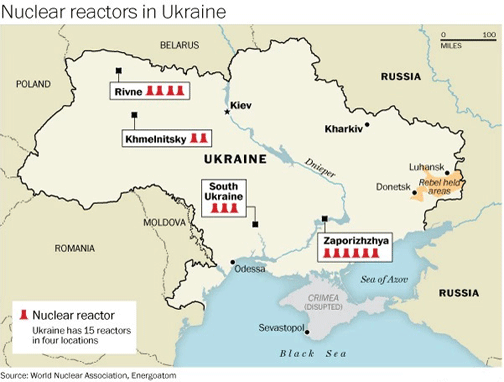
The threat is real. Ukraine is heavily dependent upon nuclear power, maintaining four nuclear power plants and stewardship of the shattered nuclear site at Chernobyl. In a major war, all 15 reactors at Ukraine’s nuclear power facilities would be at risk, but even a desultory Russian incursion into eastern Ukraine is likely to expose at least six active reactors to the uncertainty of a ground combat environment.
The world has little experience with reactors in a war zone. Since humanity first harnessed the atom, the world has only experienced two “major” accidents—Chernobyl and Japan’s Fukushima disaster. A Russian invasion, coupled with an extended conventional war throughout Ukraine, could generate multiple International Atomic Energy Agency “Level 7” accidents in a matter of days. Such a contingency would induce a massive refugee exodus and could render much of Ukraine uninhabitable for decades.
Turning the Ukraine into a dystopian landscape, pockmarked by radioactive exclusion zones, would be an extreme method to obtain the defensive zone Russian President Vladimir Putin seems to want. Managing a massive Western-focused migratory crisis and environmental cleanup would absorb Europe for years. The work would distract European leaders and empower nativist governments that tend to be aligned with Russia’s baser interests, giving an overextended Russia breathing room as the country teeters on the brink of technological, demographic, and financial exhaustion.
Put bluntly, the integrity of Ukrainian nuclear reactors is a strategic matter, critical for both NATO and non-NATO countries alike. Causing a severe radiological accident for strategic purposes is unacceptable. A deliberate aggravation of an emerging nuclear catastrophe—preventing mitigation measures or allowing reactors to deliberately melt down and potentially contaminate wide portions of Europe—would simply be nuclear warfare without bombs.
Such a scenario can’t be ruled out. Russia has repeatedly used Ukraine to test out concepts for “Gray Zone” warfare, where an attacker dances just beyond the threshold of open conflict. Given Russia’s apparent interest in radiation-spewing nuclear-powered cruise missiles, robotic undersea bombs with a radiological fallout-oriented payload, destructive anti-satellite tests and other nihilistic, world-harming weapons, Russia’s ongoing dalliance with “Gray Zone” warfare in Ukraine may, for the rest of Europe, become a real matter of estimating radiological “grays,” or, in other words, estimating the amount of ionizing radiation absorbed by humans.
When War Comes To Zaporizhzhia
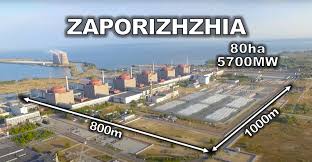
Ukraine’s Zaporizhzhia nuclear power plant is a particular risk. It is the second-largest nuclear power plant in Europe (essentially tied with a French reactor complex near Calais), and one of the 10 largest nuclear power plants in the world. The site has little protection, and the six VVER-1000 pressurized water reactors could easily be embroiled in any Russian invasion.
If war comes, the fight will be close by. The Zaporizhzhia nuclear power plant is located only 120 miles from the current “front line” in the Donbass region and is on the hard-to-defend east bank of the Dnieper River. Aside from the geographical hazards, the power plant provides about a quarter of Ukraine’s total electrical power. Given the importance of the electricity, plant managers will be reluctant to shut it down, securing the reactors only at the very last possible second. Ukraine’s desperate need for energy only compounds the opportunities for an accident.
Outside of direct battle damage, cyber and other Russian-sourced “grey zone” mischief could make the plant unmanageable even before the battle arrives at the reactor gates.
Though unlikely, direct bombardment could cause serious damage to reactor containment structures. While the reactor structures themselves are strong, warfare at the plant could kill key personnel and destroy command-and-control structures, monitoring sensors or critical reactor-cooling infrastructure. And, as an operating power plant, the reactors are not the only threat. Dangerous spent fuel rods are sitting in vulnerable cooling ponds, while older fuel sits in the site’s 167 dry spent fuel assemblies.
If the reactors suffer any operational anomalies, crisis management is not going to happen. Support infrastructure needed for safe reactor management will collapse during conflict. Plant security forces will disappear, operators will flee, and, if an accident occurs, mitigating measures will be impossible.
It seems unlikely that Russia has mobilized trained reactor operators and prepared reactor crisis-management teams to take over any “liberated” power plants. The heroic measures that kept the Chernobyl nuclear accident and Japan’s Fukushima nuclear disaster from becoming far more damaging events just will not happen in a war zone.
Again, the risks are very high. The world has never dealt with an unmanaged meltdown at a large nuclear power plant. The very real prospect of an extended and unmitigated incident at a six-reactor powerplant in a war zone is worth urgent and immediate consultations throughout Europe and NATO.
Gray Zone Nuclear Conflict Can Happen
The world has never experienced war that threatens active nuclear power infrastructure, and world leaders may be underestimating the peril conventional warfare presents to these powerful and perilous assets.
On the other hand, heedless purveyors of “gray zone” warfare may be underestimating the risk themselves, all too eager to determine just how degraded nuclear infrastructure might serve as a “less risky” surrogate for nuclear conflict.
To them, it’s not nuclear war, but just a series of unfortunate nuclear accidents.
U.S. congressional delegation arrives in Ukraine to discuss threat of war with Russia — Anti-bellum
US Congress delegation arrives in Ukraine to discuss threat of war with RussiaA group of congressmen announced Washington’s readiness to take tough measures in response to any encroachment on sovereign Ukrainian territory *** “Representative Jason Crow led a U.S. Congressional delegation to Kyiv to discuss Russia’s aggressive military buildup in and around Ukraine and hear […]
U.S. congressional delegation arrives in Ukraine to discuss threat of war with Russia — Anti-bellum
1 This Month



26 September – International Day for the Total Elimination of Nuclear Weapons


PLEASE OPPOSE HR 8255 AND S.3639 – bills would accelerate satellite deployment, with no environmental review or safeguards – https://ncstd5li.quorum.us/campaign/169331/
To see nuclear-related stories in greater depth and intensity – go to https://nuclearinformation.wordpress.com
-
Archives
- September 2026 (257)
- August 2026 (330)
- July 2026 (355)
- June 2026 (287)
- May 2026 (306)
- April 2026 (356)
- March 2026 (251)
- February 2026 (267)
- January 2026 (308)
- December 2025 (358)
- November 2025 (359)
- October 2025 (375)
-
Categories
- 1
- 1 NUCLEAR ISSUES
- business and costs
- climate change
- culture and arts
- ENERGY
- environment
- health
- history
- indigenous issues
- Legal
- marketing of nuclear
- media
- opposition to nuclear
- PERSONAL STORIES
- politics
- politics international
- Religion and ethics
- safety
- secrets,lies and civil liberties
- spinbuster
- technology
- Uranium
- wastes
- weapons and war
- Women
- 2 WORLD
- ACTION
- AFRICA
- Atrocities
- AUSTRALIA
- Christina's notes
- Christina's themes
- culture and arts
- Events
- Fuk 2022
- Fuk 2023
- Fukushima 2017
- Fukushima 2018
- fukushima 2019
- Fukushima 2020
- Fukushima 2021
- general
- global warming
- Humour (God we need it)
- Nuclear
- RARE EARTHS
- Reference
- resources – print
- Resources -audiovicual
- Weekly Newsletter
- World
- World Nuclear
- YouTube
-
RSS
Entries RSS
Comments RSS
 nuclear-news