Increased radiation levels around Chernobyl probably due to military’s disturbance of soil around exclusion zone
Chernobyl radiation levels increase 20-fold after heavy fighting around the facility, Live Science, By Ben Turner 25 Feb 22,
Gamma radiation has increased to 20 times its usual levels in the area. The Chernobyl nuclear power plant and its surrounding area are showing increased radiation levels after heavy fighting between Ukrainian and Russian troops in the region, Ukrainian officials said Friday (Feb. 25).
Online data from the Chernobyl exclusion zone’s automated radiation-monitoring system shows that gamma radiation has increased twenty times above usual levels at multiple observation points, which officials from the Ukrainian nuclear agency attributed to radioactive dust thrown up by the movement of heavy military equipment in the area.
The defunct Chernobyl nuclear power plant has been under occupation by attacking Russian soldiers since Thursday (Feb. 24) after Russian president Vladimir Putin launched a full-scale invasion of Ukraine in the early hours of the morning. Workers at the facility, stationed there to monitor and maintain radiation levels within safe bounds, have been taken hostage by Russian troops, according to Anna Kovalenko, a Ukrainian military expert.
“The station staff is being held hostage. This threatens the security of not only Ukraine but also a significant part of Europe,” Kovalenko wrote on Facebook.
White House press secretary Jen Psaki said in a news briefing on Thursday (Feb. 24) that the Biden administration was “outraged” by reports of Russian troops holding Chernobyl plant staff against their will and demanded their release. She warned that the action “could upend the routine civil service efforts required to maintain and protect the nuclear waste facilities.”
As one of the most radioactive places in the world, large parts of the Chernobyl exclusion zone have been closed off since the disastrous meltdown of Ukraine’s Chernobyl nuclear power plant in 1986. In that year, two enormous explosions inside the plant’s reactor flipped its 2,000-ton (1,800 metric tons) lid like a coin, blanketing the surrounding 1,000-square-mile (2,600 square kilometers) with radioactive dust and reactor chunks. Following evacuation and the dousing of the nuclear fire — which cost many firefighters their lives — the reactor was sealed off and the area deemed uninhabitable by humans for the next 24,000 years.
Heavy fighting around the plant on Thursday (Feb. 24) led to concerns that stray munitions could accidentally pierce the exploded reactor’s two layers of protection — consisting of a new, outer safe-confinement structure and an inner concrete sarcophagus — and release the deadly radioactive fallout trapped inside.
In a contradictory statement, Igor Konashenkov, the spokesman for the Russian Defense Ministry, said that radiation around the plant was within normal levels and that Russian forces were working with the facilities’ staff to ensure the area’s safety……..
The site, which is just 60 miles (97 km) north of the Ukrainian capital Kyiv, lies on a direct invasion route between Kyiv and the Russian forces’ northern entry point to Ukraine at the Belarusian border.
Claire Corkhill, a professor of nuclear material degradation at the University of Sheffield in the U.K., wrote on Twitter that the gamma radiation around the Chernoybl plant “looks to have increased by around 20 times compared with a few days ago.” However, caution should be taken “not to over-interpret at this stage,” she said.
“This appears to be based on a single data point,” Corkhill added in a separate tweet. “What is intriguing is that the level of radiation has increased mostly around the main routes in and out of the Chernobyl exclusion zone, as well as the reactor. This would tend to suggest that increased movement of people or vehicles may have disturbed radioactive dust.”
The highly radioactive fuel inside the Chernobyl reactor is buried deep beneath the defunct plant and is unlikely to be released unless the reactor is directly targeted, Corkhill said……. https://www.livescience.com/chernobyl-radiation-levels-rise-after-fighting
Radiation levels increased at Chernobyl, after Russian troops seized the area.
Radiation levels have increased at Chernobyl after Russian troops seized
the area yesterday, Ukraine warns. Russian forces took control of the
defunct plant in a ‘fierce’ battle on Thursday. The condition of the plant
was unknown, but sparked fears of a radiation leak. Ukraine’s State Nuclear
Regulatory Inspectorate said Friday that higher gamma radiation levels have
been detected in the Chernobyl zone. Russian officials denied this,
claiming radiation levels at the site were normal.
Daily Mail 25th Feb 2022
Abandoned mines and old Yunkom nuclear test site in Donbas region of Ukraine pose ”singular threat” of radiation contamination
Abandoned mines in eastern Ukraine are filling up with water at
“alarming” rates, according to new research that has triggered fears of
a radioactive disaster. Satellite images show high levels of swelling in
the ground in the former coal mining region of Donbas, much of which is now
controlled by pro-Russian separatists.
The images have raised concerns
about water contaminated with heavy metals or radioactive material spilling
into rivers and the wider environment. Of particular concern is the high
swelling at the Yunkom mine, which was the site of a small Soviet
underground nuclear test in 1979.
The Organisation for Security and
Co-operation in Europe, the intergovernmental organisation, warned in 2017
that the mine posed a “singular threat”. “Any present destabilisation
of the mine via flooding could release up to 500 cubic metres of
radiation-contaminated mine waters into the ground-water table,” it said.
Telegraph 24th Feb 2022
Why nuclear risk from war in Ukraine isn’t missiles, but accidental hits on reactors

“In case of the total destruction of the power plant, I think the consequences would be so much worse than at Fukushima and Chernobyl together,” Mr Gumenyuk said. “If speaking about consequences of this war situation, Europe will be totally contaminated.”
Why nuclear risk from war in Ukraine isn’t missiles but accidental hits on reactors, Kyiv safety expert warns, By Isabella Bengoechea i , 23 Feb 22
Kyiv nuclear safety expert Dmytro Gumenyuk told i while a direct attack is unlikely, military invasion raises the risk of possible accidental hits from missiles or artillery
Ukraine’s nuclear power plants would pose a risk of radioactive pollution in Europe if caught in the crossfire of a Russian invasion, a Kyiv safety expert has told i.
The chance of a direct military attack on such facilities would be highly unlikely but a lack of high-precision weapons in the occupied Donbas suggests there could be an increased chance of sensitive facilities being hit accidentally.
If this happens, radiation could contaminate air, soil and waterways, affecting not only Ukraine but also Russia and much of Europe, according to Dmytro Gumenyuk, head of safety analysis at the State Scientific and Technical Centre for Nuclear and Radiation Safety, a body within the state nuclear inspectorate.
Ukraine has 15 nuclear reactors in four power plants, which provide 52 per cent of the country’s electricity: Khelnitsky and Rivne in the northwest, and Zaporizhzhia and the South Ukrainian plants in the west and south respectively.
Some facilities including a nuclear waste storage site in the exclusion zone at Chernobyl – where in 1986 catastrophic failure at the power plant resulted in the worst nuclear disaster in history – lie close to the country’s borders, where Russia has amassed nearly 200,000 troops.
The plant at Zaporizhzhia is only about 150 miles from the front line in Donetsk, while the South Ukrainian plant is about another 160 miles further west.
While a direct attack is unlikely, military invasion raises the risk of possible accidental hits from missiles or artillery. On Tuesday the thermal power station at Shchastya, near the conflict line in Luhansk, caught fire amid shelling, leaving 40,000 residents without electricity.
Mr Gumenyuk said: “Our NPP [nuclear power plant] wasn’t designed for military protection. Of course it wasn’t designed against tanks, bombs, missiles and so on.
“In case of a military attack it is not a long time for getting from Dontesk to Zaporizhzhia NPP, and of course taking into account the small distances from the Russian Federation, we could suppose that our power plants are not fully protected from military attack from our neighbour.”
A direct attack by Russia is unlikely. Lada Roslycky, founder of the Ukraine-based Black Trident defence and security group, said: “From a military perspective and a defence perspective it would be an idiotic action.”
However, she pointed out the separatists’ lack of high-precision weapons in conflict in the occupied Donbas does raise the chance of sensitive facilities being hit accidentally.
She also suggested that this could be part of a Russian strategy of fomenting uncertainty through psychological warfare, by holding out the threat of attacking such facilities. “I really don’t think they would do it [attack nuclear facilities] but it’s possible … it’s such a wonderful, brilliant instrument,” she said.
The Conflict and Environment Observatory (CEOBS) said it is “right to be concerned about Ukraine’s 15 ageing Soviet-design nuclear reactors”.
“The three reactors at the South Ukraine Nuclear Power Plant and the six reactors at the Zaporizhzhia Nuclear Power Plant are the two sites most likely to be affected by a Russian invasion,” the observatory added.
The VVER 1000 pressurised water reactors at Zaporizhzhia each contain 163 assemblies – or structured groups of fuel rods. Each assembly contains about 500kg of uranium dioxide, making the total fuel inside one reactor about 80 tonnes.
After the 2011 nuclear disaster at Fukushima in Japan, Ukrainian nuclear authorities implemented extra safety measures to make their reactors safer, and protect against accidents such as fires and flooding.
However, Mr Gumenyuk warned that were the plant to be attacked, in the worst-case scenario, the consequences would be devastating.
“In case of the total destruction of the power plant, I think the consequences would be so much worse than at Fukushima and Chernobyl together,” Mr Gumenyuk said. “If speaking about consequences of this war situation, Europe will be totally contaminated.”
Soon after the disaster, radioactive rain began falling across northern Britain. In Cumbria detectors showed background radiation 200 times higher than normal. In Scotland two months later it was 4,000 times. Sheep in North Wales, Cumbria, and Scotland were found to have increased levels of caesium-137, prompting temporary restrictions on meat sales for 7,000 farms.
A nuclear disaster at Zaporizhzhia would contaminate the water, entering the Dneiper River and travelling down into the Sea of Azov, the Black Sea and then out into the Mediterranean.
In the event of a meltdown, radiation could contaminate the air where, depending on weather conditions, it could spread across Europe, as happened after the Chernobyl accident, when radiation spread as far as Sweden and the UK.
“But this is if all the units are totally destroyed,” said Mr Gumenyuk. “We do our best to prevent this situation. I hope in most cases our power units would survive even in single hits. Our nuclear reactors have containment to protect against the different impacts, including an air crash for example.”
Chernobyl’s nuclear waste
Ukraine’s nuclear waste storage facilities, including in the exclusion zone at Chernobyl, 70 miles south of the Belarussian border, also pose a radiation risk.

Last year Energoatom, the state nuclear operator, announced that Ukraine’s new Central Spent Fuel Storage Facility, in the exclusion zone at Chernobyl, was almost ready to begin operating. Spent fuel will be transferred to the new facility from where it is currently stored at power plants.
At present Russia has about 30,000 troops stationed in Belarus, apparently for joint military exercises, which are armed with short-range missiles, rocket launchers and Su-35 fighters. Leaders including Boris Johnson have suggested that Russia is planning at attack from Belarus, “coming down from the north, coming down from Belarus, and encircling Kyiv itself”. The route could take Russian troops through the exclusion zone.
According to CEOBS: “Decommissioning of the [Chernobyl] site and the packaging of waste is ongoing and will continue for decades. The site is under constant management and monitoring and the disruption caused by a conflict would impact the ongoing work to reduce the risks it poses. It seems likely that foreign companies would withdraw staff in the event of an invasion, impacting activities at the site.”
There are 22,000 assemblies of spent nuclear fuel at the storage site, kept in special casks to protect them.
However, Mr Gumenyuk pointed out that these were not protected against military firepower: “In case of the destruction of these casks, radioactive materials could be released and transferred to Ukraine and other European territories. This is a very dangerous situation.”
While some experts say any disruption to the site would be localised, Mr Gumenyuk said: “I disagree, the number of the fuel assemblies is very big and if all the casks were destroyed it would not only be the problem of Ukraine, maybe not all Europe, but many countries.”
Cyberattacks are another possibility. Last week Ukrainian government websites and banks were shut down by a wave of distributed denial of service attacks, thought to have been carried out by Russian hackers.
In 2015 the country’s energy sector was attacked by the BlackEnergy computer virus that caused a blackout of 800,000 households across 103 towns.
The next year, on the 30th anniversary of the Chernobyl disaster, Ukraine’s then-President Poroshenko said: “If the BlackEnergy virus was used for attacks on our power distributors, there is no guarantee that such technology will not threaten our nuclear plants”.
“Chernobyl is already volatile,” said Ms Roslycky. “Cyberattacks against Chernobyl call for attention… whether attacking kinetically or through cyber, when that happens this is something that would threaten global security.”
Accident, terrorism or sabotage
Direct attacks on the plants at Zaporizhzhia and South Ukraine are also unlikely, not least because Russia is not far from the power plants, and any radioactive contamination would affect Russia as well as Ukraine.
However, the possibility of an accident, terrorism or sabotage is somewhat higher. According to the Nuclear Security Index for 2020, Ukraine scores highly on global norms for nuclear materials security and implementing international commitments, with 94 and 78 out of 100 respectively.
However, under ‘risk environment’, which considers factors including political stability, effective governance, pervasiveness of corruption, and illicit activities by non-state actors, Ukraine scores 14.
A 2016 report by the EU Non-Proliferation Consortium drew attention to the illicit trafficking of radioactive materials in the DPR, LPR and unrecognised Transnistria in Moldova. “The armed conflict in eastern Ukraine and its related threats are dramatically influencing the nuclear security conditions in the country,” it said.
“Political and social instability amplifies the motivation of criminal or terrorist groups or organisations for illegal business related to the distribution of radioactive materials that are out of regulatory control.”
The danger of these armed insurgencies was highlighted most dramatically in 2014 when Malaysia Airlines Flight 17 was shot down over Donetsk in eastern Ukraine by pro-Russian separatists, killing all 298 on board. The Dutch-led investigation into the incident concluded that the plane was shot down with a Buk missile supplied by the 53rd Anti-Aircraft Missile Brigade of the Russian Federation. Those responsible may have believed they were shooting down a Ukrainian military aircraft…………………………………………. https://inews.co.uk/news/ukraine-war-nuclear-risk-russia-missiles-accidental-hits-reactors-1478269
Putin says that Ukraine is a nuclear threat
 | |||
Vladimir Putin labels Ukraine a nuclear threat, says he’s prepared to use force, THE AUSTRALIAN, 23 Feb 22, JACQUELIN MAGNAY, EUROPE CORRESPONDENT@jacquelinmagnay

Russian president Vladimir Putin has announced he would use military force “depending on the situation on the ground” to defend the rights of people in the separatist regions Donetsk and Luhansk.
After receiving approval from the Russian parliament to deploy troops abroad into Ukraine, Mr Putin labelled Ukraine a nuclear threat, telling the Russian people it wanted to lose its neutrality, join NATO and that it received military shipments from the West. Mr Putin also claimed that citizens in the Donbas region were being “abused”.
Crucially, Mr Putin recognised the independence of the entire Donetsk and Luhansk oblasts and its broader territorial ambitions, not just the area controlled by Russian backed separatists.
About two-thirds of this area, known broadly as the Donbas, is currently in Ukrainian control.
Mr Putin said Ukraine was being “armed to the teeth” and that its nuclear threat was a strategic issue. He said Ukraine president Volodymyr Zelensky’s remark that he regretted Ukraine giving up nuclear weapons in 1994 was targeted directly at Russia.
“We have taken a note of them,” Mr Putin said………………….
Mr Putin said that Russia recognised the territory was now independent and warned the border region had been a threat to the Russian Federation………………………. https://www.theaustralian.com.au/world/vladimir-putin-labels-ukraine-a-nuclear-threat-says-hes-prepared-to-use-force/news-story/9ab06086551856b2847c06d91467cb26
Russian President Vladimir Putin orders Russian forces to ‘maintain peace’ in eastern Ukraine’s two breakaway regions.
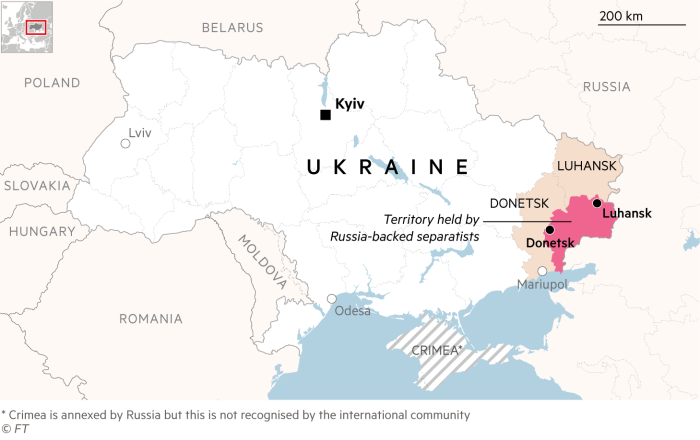
On Monday, local time, a Biden administration official said, however, the area was already controlled by Russian-backed separatists and Moscow, in practice, and that Mr Putin’s decision to send troops he called peacemakers into the breakaway regions of Ukraine did not as yet constitute a further invasion that would trigger a broader sanctions package.
“This isn’t a further invasion since it’s territory that they’ve already occupied,” the official said.
Russian President Vladimir Putin orders Russian forces to ‘maintain peace’ in eastern Ukraine’s two breakaway regions.
President Vladimir Putin has ordered his Defence Ministry to dispatch Russian forces to “maintain peace” in eastern Ukraine’s two breakaway regions, the Donetsk and Luhansk People’s Republics, after he said Moscow would recognise their independence.
Key points:
- Vladimir Putin, joined by Russia-backed separatist leaders, signed a decree recognising the independence of the breakaway regions
- In his address, Mr Putin delved into history as far back as the Ottoman empire and as recent as the tensions over NATO’s eastward expansion
- French President Emmanuel Macron earlier said the US and Russian leaders had agreed in principle to hold a summit
The Kremlin decree, spelled out in an order signed by Mr Putin, did not specify the size of the force to be dispatched, when they would cross the border into Ukraine nor exactly what their mission would be.
Hours later, a Reuters reporter witnessed unusually large columns of military vehicles and hardware, including tanks, moving through Donetsk, the largest city of the self-proclaimed republic.
Mr Putin earlier signed decrees to recognise the two breakaway regions as independent statelets………………………
On Monday, local time, a Biden administration official said, however, the area was already controlled by Russian-backed separatists and Moscow, in practice, and that Mr Putin’s decision to send troops he called peacemakers into the breakaway regions of Ukraine did not as yet constitute a further invasion that would trigger a broader sanctions package.
“This isn’t a further invasion since it’s territory that they’ve already occupied,” the official said.
But, the official added, that a full invasion could come at any time.
The United States will continue to pursue diplomacy with Russia until “tanks roll,” another official said.
“Russian troops moving into Donbas would not itself be a new step. Russia has had forces in the Donbas region for the past eight years … They are currently now making decisions to do this in a more overt and … open way,” the official said……………………
In his lengthy televised address, Mr Putin, looking visibly angry, described Ukraine as an integral part of Russia’s history and said that the regions in eastern Ukraine were ancient Russian lands and that he was confident the Russian people would support his decision.
Russian state television showed Mr Putin, joined by Russia-backed separatist leaders, signing a decree recognising the independence of the two Ukrainian breakaway regions, along with agreements on cooperation and friendship.
Under the two identical friendship treaties — submitted by Mr Putin for ratification by parliament — Russia has the right to build bases in the separatist regions and they, on paper, can do the same in Russia.
The parties committed to defend each other and signed separate agreements on military cooperation and on recognition of each other’s borders.
Their 31-point treaties also say Russia and the breakaway statelets will work to integrate their economies. Both regions are former industrial areas in need of massive support to rebuild after eight years of war with Ukrainian government forces.
The 10-year treaties are automatically renewable for further five-year periods unless one of the parties gives notice to withdraw.
Defying Western warnings against such a move, Mr Putin had announced his decision in phone calls to the leaders of Germany and France earlier, both of whom voiced disappointment, the Kremlin said.
The UN Security Council will meet publicly on Ukraine at 2am GMT (1pm AEDT) on Tuesday, a Russian diplomat said, following a request by the United States, the United Kingdom and France………………………..
EU will respond to ‘illegal act’ with sanctions against Moscow
According to another White House statement, Mr Biden had also discussed with France’s Emmanuel Macron and Germany’s Olaf Scholz “how they will continue to coordinate their response on next steps”. ………………..
The United Nations Secretary-General António Guterres called out Mr Putin’s decision to recognise the separatist regions as independent as “a violation of the territorial integrity and sovereignty of Ukraine” in a statement read by his spokesman, Stéphane Dujarric.
“The Secretary-General urges all relevant actors to focus their efforts on ensuring an immediate cessation of hostilities, protection of civilians and civilian infrastructure, preventing any action and statements that may further escalate the dangerous situation in and around Ukraine, and prioritising diplomacy to address all issues peacefully,” Mr Dujarric said.
…………….
With his decision to recognise the rebel regions, Mr Putin brushed off Western warnings that such a step would be illegal, would kill off peace negotiations and would trigger sanctions against Moscow.
“I deem it necessary to make a decision that should have been made a long time ago: to immediately recognise the independence and sovereignty of the Donetsk People’s Republic and the Luhansk People’s Republic,” Mr Putin said.https://www.abc.net.au/news/2022-02-22/putin-orders-russian-peacekeepers-ukraine/100849964
Nuke Power at the Brink of Bankruptcy, War, Apocalypse
Nuke Power at the Brink of Bankruptcy, War, Apocalypse https://www.rsn.org/001/nuke-power-at-the-brink-of-bankruptcy-war-apocalypse.html?print=1 Harvey Wasserman/Reader Supported News 19 Feb 22,
Fifteen atomic reactors in Ukraine currently spew out massive quantities of radiation alongside the smoldering ruin of Chernobyl Unit 4.War could easily—-and soon!—-turn each into a nuke of mass destruction, blasting into the eco-sphere clouds of lethal fallout far in excess of actual A-Bombs, including Hiroshima and Nagasaki.
Like the rest of the global fleet, Ukraine’s reactors are sitting ducks, set to explode. They symbolize an monumental technological failure, left in the radioactive dust by the rise of renewables. But a devious, deceitful industry is desperate to kill green power, even if its dirty, decayed rump reactors could mushroom as you read this.
The essential unity between atomic power and weapons has been set since birth. France’s Macron now explicitly argues that “peaceful” reactors are needed to sustain the French atomic weapons program.
Cesium fallout from the four exploded Fukushima reactors exceeds that from Hiroshima and Nagasaki by a factor of more than 100. A compendium of studies at Chernobyl indicates a human death toll of more than a million. People and animals died in droves at Three Mile Island. After six decades of development, no US “Peaceful” atomic reactors can get private insurance against the liabilities of a catastrophic accident.
But the 400 nukes operating worldwide (93 in the US) threaten just that.
They burn at 571 degrees Fahrenheit, heating the planet. They spew carbon 14 and other greenhouse gases as they gouge their fuel, burn their innards and plague us all with unmanageable wastes.
Construction began on ALL US nukes at least thirty years ago. They’re embrittled, cracked, under-maintained, obsolete, ticking time bombs. Many are operating far beyond original design specs. Their workforces are aging and retiring. They sit in earthquake zones and flood plains, vulnerable to hurricanes, tornadoes, tsunamis, sabotage, war.
Attempts to build more of these old-style water-cooled clunkers have catastrophically failed at Olkiluoto in Finland, Flamanville in France, V.C. Summer in South Carolina (abandoned at a cost of $10 billion), Vogtle in Georgia…where two reactors that may never open have soared past $30 billion, potentially bankrupting the Peach State.
Powered with a mix of plutonium, the explosion at Fukushima Unit Three threw up a familiar mushroom cloud. Millions of gallons of radwaste there are poised to be poured into the Pacific.
Yet the nuke industry wants to paint itself green. It hides its massive carbon emissions…ignores the gargantuan quantities of heat and wastes each reactor pours into the eco-sphere….kills billions of land and sea creatures every day.
The reactor industry’s clearest present danger centers on its non-stop radiation releases and millions of tons of radioactive offal that can’t be managed.
But possible war in Ukraine (or elsewhere) could dwarf Chernobyl in a matter of moments. As both the Russians and the Ukrainians well know, these are pre-deployed Atomic Bombs, easily turned Apocalyptic by conventional weapons, advanced cyber-attack or simple incompetence.
The latest stab at reviving this zombie technology centers on “Small Modular Reactors.” Some models are meant to be cooled by liquid sodium, which has already caused an explosive 1959 radiation release at Santa Susana, north of Los Angeles, and a 1966 melt-down at Fermi I, south of Detroit.
All SMRs are years away from mass production. If built, they’ll emit huge quantities of heat and greenhouse gasses. They’ll divert enormous quantities of resources that could otherwise go for renewables that are cleaner, cheaper, safer, more reliable, more job-creating, more quickly deployed…and that that won’t explode, create radioactive waste or heat the planet.
SMRs today currently work primarily as scams grifting billions of public dollars into the pockets of the likes of Bill Gates. They’re virtually certain to fail. One or more are likely to explode.
They can never compete with the solar, wind, battery and LED/efficiency technologies revolutionizing global green energy. With an astonishing record of meteoric advances, these four pillars of Solartopia have pushed all fossil/nuclear technologies into history’s economic waste bin. As long as there are rooftops bare of solar panels, and offshore sites ready for wind turbines, the real market for any other form of new energy is marginal at best.
But the corporate nuke pushers don’t care. Their mainly theoretical new reactors can never compete. Their old ones are uninsured, falling apart, spewing heat, carbon, radiation and death while losing mega-tons of YOUR money.
AND they can blow up… as at Fukushima and Chernobyl.
With war coming right at them, ALL reactors need to be shut NOW…before they ignite the next Apocalypse…which YOU will pay for with your life, health, family, fortune and future.
Harvey Wasserman’s America at the Brink of Rebirth: The Organic Spiral of Us History can be had via www.solartopia.org. The Strip & Flip Selection of 2016: Five Jim Crows & Electronic Election Theft, co-written with Bob Fitrakis, is at www.freepress.org.
Western Democracies Have Mutated Into Propagandists for War and Conflict
Russian-speaking Ukrainians, under economic blockade by Kyiv for seven years, are fighting for their survival. The “massing” army we seldom hear about is the 13 Ukrainian army brigades laying siege to Donbas: an estimated 150,000 troops. If they attack, the provocation to Russia will almost certainly mean war.
Western Democracies Have Mutated Into Propagandists for War and Conflict https://www.pressenza.com/2022/02/western-democracies-have-mutated-into-propagandists-for-war-and-conflict/ 18.02.22 – Independent Media Institute By John Pilger / Globetrotter
Marshall McLuhan’s prophecy that “the successor to politics will be propaganda” has happened. Raw propaganda is now the rule in Western democracies, especially the U.S. and Britain.
On matters of war and peace, ministerial deceit is reported as news. Inconvenient facts are censored, demons are nurtured. The model is corporate spin, the currency of the age. In 1964, McLuhan famously declared, “The medium is the message.” The lie is the message now.
But is this new? It is more than a century since Edward Bernays, the father of spin, invented “public relations” as a cover for war propaganda. What is new is the virtual elimination of dissent in the mainstream.
The great editor David Bowman, author of The Captive Press, called this “a defenestration of all who refuse to follow a line and to swallow the unpalatable and are brave.” He was referring to independent journalists and whistleblowers, the honest mavericks to whom media organizations once gave space, often with pride. The space has been abolished.
The war hysteria that has rolled in like a tidal wave in recent weeks and months is the most striking example. Known by its jargon, “shaping the narrative,” much if not most of it is pure propaganda.
The Russians are coming. Russia is worse than bad. Putin is evil, “a Nazi like Hitler,” salivated the Labour MP Chris Bryant. Ukraine is about to be invaded by Russia—tonight, this week, next week. The sources include an ex-CIA propagandist who now speaks for the U.S. State Department and offers no evidence of his claims about Russian actions because “it comes from the U.S. Government.”
The no-evidence rule also applies in London. The British Foreign Secretary, Liz Truss, who spent £500,000 of public money flying to Australia in a private plane to warn the Canberra government that both Russia and China were about to pounce, offered no evidence. Antipodean heads nodded; the “narrative” is unchallenged there. One rare exception, former prime minister Paul Keating, called Truss’s warmongering “demented.”
Truss has blithely confused the countries of the Baltic and Black Sea. In Moscow, she told the Russian foreign minister that Britain would never accept Russian sovereignty over Rostov and Voronezh—until it was pointed out to her that these places were not part of Ukraine but in Russia. Read the Russian press about the buffoonery of this pretender to 10 Downing Street and cringe.
This entire farce, recently starring Boris Johnson in Moscow playing a clownish version of his hero, Churchill, might be enjoyed as satire were it not for its willful abuse of facts and historical understanding and the real danger of war.
Vladimir Putin refers to the “genocide” in the eastern Donbas region of Ukraine. Following the coup in Ukraine in 2014—orchestrated by Barack Obama’s “point person” in Kyiv, Victoria Nuland—the coup regime, infested with neo-Nazis, launched a campaign of terror against Russian-speaking Donbas, which accounts for a third of Ukraine’s population.
Overseen by CIA director John Brennan in Kyiv, “special security units” coordinated savage attacks on the people of Donbas, who opposed the coup. Video and eyewitness reports show bussed fascist thugs burning the trade union headquarters in the city of Odessa, killing 41 people trapped inside. The police are standing by. Obama congratulated the “duly elected” coup regime for its “remarkable restraint.”
In the U.S. media the Odessa atrocity was played down as “murky” and a “tragedy” in which “nationalists” (neo-Nazis) attacked “separatists” (people collecting signatures for a referendum on a federal Ukraine). Rupert Murdoch’s Wall Street Journal damned the victims—“Deadly Ukraine Fire Likely Sparked by Rebels, Government Says.”
Professor Stephen Cohen, acclaimed as America’s leading authority on Russia, wrote:
“The pogrom-like burning to death of ethnic Russians and others in Odessa… reawakened memories of Nazi extermination squads in Ukraine during World War II. … [Today] stormtroop-like assaults on gays, Jews, elderly ethnic Russians, and other ‘impure’ citizens are widespread throughout Kyiv-ruled Ukraine, along with torchlight marches reminiscent of those that eventually inflamed Germany in the late 1920s and 1930s…
“The police and official legal authorities do virtually nothing to prevent these neo-fascist acts or to prosecute them. On the contrary, Kyiv has officially encouraged them by systematically rehabilitating and even memorializing Ukrainian collaborators with Nazi German extermination pogroms…, renaming streets in their honor, building monuments to them, rewriting history to glorify them, and more.”
Today, neo-Nazi Ukraine is seldom mentioned. That the British are training the Ukrainian National Guard, which includes neo-Nazis, is not news. (See Matt Kennard’s Declassified report in Consortium News on February 15.) The return of violent, endorsed fascism to 21st-century Europe, to quote Harold Pinter, “never happened… even while it was happening.”
On December 16, the United Nations tabled a resolution that called for “combating glorification of Nazism, neo-Nazism and other practices that contribute to fuelling contemporary forms of racism.” The only nations to vote against it were the United States and Ukraine.
Almost every Russian knows that it was across the plains of Ukraine’s “borderland” that Hitler’s divisions swept from the west in 1941, bolstered by Ukraine’s Nazi cultists and collaborators. The result was more than 20 million Russian dead.
Setting aside the maneuvers and cynicism of geopolitics, whomever the players, this historical memory is the driving force behind Russia’s respect-seeking, self-protective security proposals, which were published in Moscow in the week the UN voted 130-2 to outlaw Nazism. They are:
- NATO guarantees that it will not deploy missiles in nations bordering Russia. (They are already in place from Slovenia to Romania, with Poland to follow.)
- NATO to stop military and naval exercises in nations and seas bordering Russia.
- Ukraine will not become a member of NATO.
- the West and Russia to sign a binding East-West security pact.
- the landmark treaty between the U.S. and Russia covering intermediate-range nuclear weapons to be restored. (The U.S. abandoned it in 2019.)
These amount to a comprehensive draft of a peace plan for all of post-war Europe and ought to be welcomed in the West. But who understands their significance in Britain? What they are told is that Putin is a pariah and a threat to Christendom.
Russian-speaking Ukrainians, under economic blockade by Kyiv for seven years, are fighting for their survival. The “massing” army we seldom hear about is the 13 Ukrainian army brigades laying siege to Donbas: an estimated 150,000 troops. If they attack, the provocation to Russia will almost certainly mean war.
In 2015, brokered by the Germans and French, the presidents of Russia, Ukraine, Germany and France met in Minsk and signed an interim peace deal. Ukraine agreed to offer autonomy to Donbas, now the self-declared republics of Donetsk and Luhansk.
The Minsk agreement has never been given a chance. In Britain, the line, amplified by Boris Johnson, is that Ukraine is being “dictated to” by world leaders. For its part, Britain is arming Ukraine and training its army.
Since the first Cold War, NATO has effectively marched right up to Russia’s most sensitive border having demonstrated its bloody aggression in Yugoslavia, Afghanistan, Iraq and Libya and broken solemn promises to pull back. Having dragged European “allies” into American wars that do not concern them, the great unspoken is that NATO itself is the real threat to European security.
In Britain, a state and media xenophobia is triggered at the very mention of “Russia.” Mark the knee-jerk hostility with which the BBC reports Russia. Why? Is it because the restoration of imperial mythology demands, above all, a permanent enemy? Certainly, we deserve better.
John Pilger is an award-winning journalist, filmmaker, and author. Read his full biography on his website here, and follow him on Twitter: @JohnPilger.
Standoff ending, Ukraine and Russia both claim victory
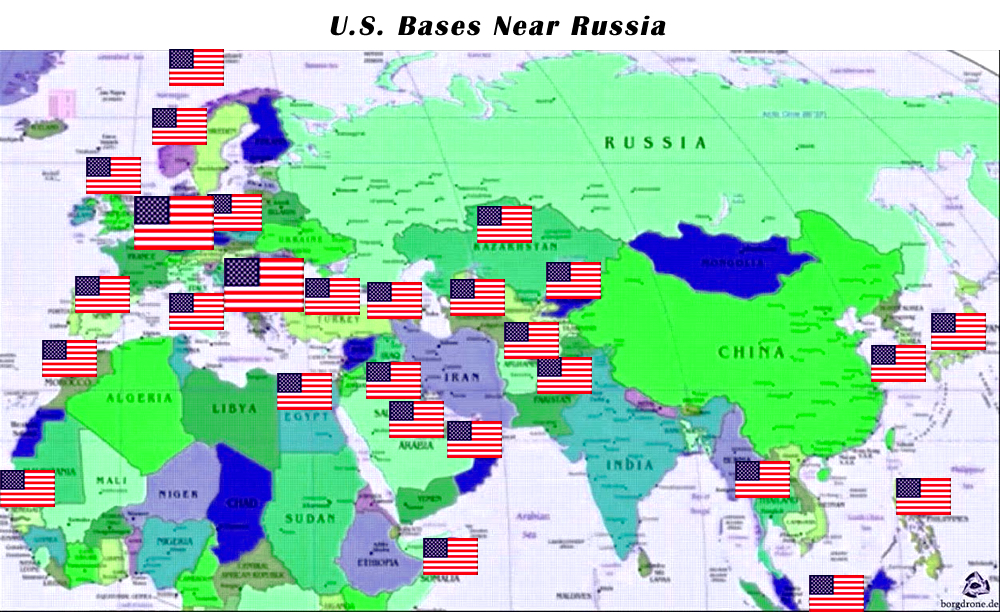
And for the same thing: Russian troops returning to barracks. To put matters in perspective, NATO troops, arms and equipment continue to flood into what the military alliance claims as its eastern flank, from the Arctic Circle to the Caucasus, notwithstanding Maria Zakharova’s statement below. ==== 112 UkraineFebruary 15, 2022 Ukraine, together with partners, manages […]
Standoff ending, Ukraine and Russia both claim victory — Anti-bellum
Ukrainian Pacifists Say US, NATO and Russia Share Responsibility to Avoid War.
Truthout, Amy Goodman & Juan González, Democracy Now! 16 Feb 22,
ATO officials have joined the U.S. and other Western nations in saying they have yet to see evidence that Russia is pulling back some troops near the shared border with Ukraine, as Russia claimed earlier this week. We speak with Yurii Sheliazhenko, executive secretary of the Ukrainian Pacifist Movement, who says, “Both great powers of the West and the East share equal responsibility to avoid escalation of war in Ukraine and beyond Ukraine.”TRANSCRIPT
This is a rush transcript. Copy may not be in its final form.
……….. We go now to Kyiv, to the capital, where we’re joined by Yurii Sheliazhenko, the executive secretary of the Ukrainian Pacifist Movement and a board member of the European Bureau for Conscientious Objection, also member of the board of directors at World BEYOND War and a research associate at KROK University in Kyiv.
……………………………………………… The escalation towards major war in Ukraine is unnecessary. Our government became part of it when we recklessly took side of the West in global power struggle. And instead, we should be neutral country. We should commit to universal peace. People of Ukraine, as well as all people in the world, want to live in peace and be happy. Both great powers of the West and the East share equal responsibility to avoid escalation of war in Ukraine and beyond Ukraine and give up nuclear stockpiles threatening to kill all life on the planet because of these absurd political quarrels. I believe all governments should join Treaty on the Prohibition of Nuclear Weapons. If global leaders fail to negotiate sustainable peace in good faith, instead of blame game and violent settlement of their power dispute on the local battlefield in Ukraine, it will be a shame. But, unfortunately, Ukraine became a battlefield of the new Cold War between the United States and Russia.
…………………. it is part of the influence of — both great powers created social networks of clientele, nationalist clientele of Russia and nationalist clientele of the West. So, when Ukraine became battlefield of the new Cold War between United States and Russia, these two great powers are competing for control over Ukraine, using and inflating in their global power struggle militant nationalism of Ukrainian government and similar militant nationalism of pro-Russian separatists in Donetsk and Luhansk. Peaceful life of Ukraine was destroyed by these militant nationalisms and great power struggle. Eight-year bloodshed took thousands of lives of civilians, turned millions into refugees and internally displaced persons, devastated our economy and debilitated our society. https://truthout.org/video/ukrainian-pacifists-say-us-nato-and-russia-share-responsibility-to-avoid-war/?eType=EmailBlastContent&eId=5cab6a32-d17c-4e19-8dfe-d79b2658a92c
Today’s Crisis Over Ukraine ACURA ViewPoint
Today’s Crisis Over Ukraine ACURA ViewPoint Jack F. Matlock, Jr.: American Committee for the Us- Russia Accord
February 14, 2022 Today we face an avoidable crisis that was predictable, actually predicted, willfully precipitated, but easily resolved by the application of common sense.
We are being told each day that war may be imminent in Ukraine………………………….
I cannot dismiss the suspicion that we are witnessing an elaborate charade, grossly magnified by prominent elements of the American media, to serve a domestic political end. ……………………..
Was the crisis avoidable?…………………………………….. In fact, the decision to expand NATO piecemeal was a reversal of American policies that produced the end of the Cold War…………………………
Willfully precipitated? Adding countries in Eastern Europe to NATO continued during the George W. Bush administration (2001-2009) but that was not the only thing that stimulated Russian objection. At the same time, the United States began withdrawing from the arms control treaties that had tempered, for a time, an irrational and dangerous arms race and were the foundation agreements for ending the Cold War.
—Easily resolved by the application of common sense?
The short answer is because it can be. What President Putin is demanding, an end to NATO expansion and creation of a security structure in Europe that insures Russia’s security along with that of others is eminently reasonable. He is not demanding the exit of any NATO member and he is threatening none. By any pragmatic, common sense standard it is in the interest of the United States to promote peace, not conflict. To try to detach Ukraine from Russian influence—the avowed aim of those who agitated for the “color revolutions”—was a fool’s errand, and a dangerous one. Have we so soon forgotten the lesson of the Cuban Missile Crisis?1
Now, to say that approving Putin’s demands is in the objective interest of the United States does not mean that it will be easy to do. The leaders of both the Democratic and Republican parties have developed such a Russophobic stance (a story requiring a separate study) that it will take great political skill to navigate the treacherous political waters and achieve a rational outcome.
President Biden has made it clear that the United States will not intervene with its own troops if Russia invades Ukraine. So why move them into Eastern Europe? Just to show hawks in Congress that he is standing firm? For what? Nobody is threatening Poland or Bulgaria except waves of refugees fleeing Syria, Afghanistan and the desiccated areas of the African savannah. So what is the 82nd Airborne supposed to do?……….
Jack F. Matlock served as US ambassador to the USSR (1987-1991). A member of the board of director of ACURA, he writes from Singer Island, Florida. https://usrussiaaccord.org/acura-viewpoint-jack-f-matlock-jr-todays-crisis-over-ukraine/
Ambassador suggested that Ukraine might drop its bid for NATO membership – but he was quickly corrected.
Ukrainian ambassador forced to walk back claims nation could drop NATO bid, By Vladimir Isachenkov and Stephen Coates, The Age February 14, 2022 Ukraine could drop its bid to join NATO to avoid war with Russia, the BBC quoted the country’s ambassador to Britain as saying, in what would amount to a major concession to Moscow in response to the build-up of Russian troops on its borders.
However, the ambassador walked back his remarks in a later interview as President Volodymyr Zelensky’s spokesman insisted that aspirations to join NATO and the European Union remain the absolute priority to the country.
Ambassador Vadym Prystaiko told the BBC on Monday morning (UK time) that Ukraine was willing to be “flexible” over its goal to join the Atlantic military alliance, a move Russian President Vladimir Putin has said would be a trigger for war.
We might – especially being threatened like that, blackmailed by that, and pushed to it,” Prystaiko, Ukraine’s foreign minister until 2020, was quoted as saying when asked if Kyiv could change its position on NATO membership.
Shortly after his remarks made headlines around the world, Prystaiko returned to the BBC to state that the former Soviet republic would not be reconsidering its attempt to join the military alliance, after a spokesman for the Ukrainian President said the ambassador needed to clarify what he meant…………..
Ukraine is not a NATO member but has a promise dating from 2008 that it will eventually be given the opportunity to join, a step that would bring the US-led alliance to Russia’s border.
Putin has been arguing that Ukraine’s growing ties with the alliance could make it a launch pad for NATO missiles targeted at Russia. He has said Russia needs to lay down “red lines” to prevent that………
Moscow denies it is planning an attack, calling the military manoeuvres exercises, but it has issued written demands that NATO forgo any further expansion eastwards including Ukraine. NATO members have rejected the demand……….https://www.theage.com.au/world/europe/ukraine-could-drop-nato-bid-to-avoid-war-uk-ambassador-20220214-p59we9.html
USA’s plan – far right Ukrainian militia to attack Russia-speaking Donbass Region – drawing Russian support – USA then to claim Russia aggression
Al Ronzoni <aronzonijr@msn.com> wrote:
The World Socialist Website also confirms from sources in Donetsk that it actually looks like Ukraine will make the first move v. them and Luhansk. Then, if Russia responds in any way, that will constitute the “invasion,” then Menendez “Mother of All Sanctions” will be imposed and Nord Stream 2 will be cancelled. Hell, even if Russia doesn’t actually do anything, the fact that fighting will be taking place , ‘fog of war” etc. can be used to still claim Russia has invaded. No doubt Biden and US leadership think this can be “managed” with Russia embroiled in a protracted conflict in the Donbass Region that can be capitalized on to marginalize Russia’s economic relations with Europe, in favor of the US and to make further NATO expansion, perhaps now including Sweden and Finland, easier.
Another brilliant essentially neo-con type plan. What could go wrong?
US accelerates troop deployments as Biden threatens “world war” with Russia, WSWS,Alex Lantier, Johannes Stern, 12 February 2022
As Washington and its NATO allies work to militarily surround Russia, US officials yesterday declared that a US-Russia war is imminent.
Yesterday, Washington announced the deployment of 3,000 troops from the 82nd Airborne Division to bases in Poland, which borders Ukraine. Britain and Germany will send hundreds of soldiers to strengthen NATO battlegroups in Estonia and Lithuania. This comes after NATO countries have for weeks delivered Javelin anti-tank missiles, Stinger anti-aircraft missiles and Turkish TB2 Bayraktar drones to the Ukrainian regime in Kiev.
Nearly two decades after Washington invaded Iraq based on lies that it had “weapons of mass destruction,” US imperialism and its NATO allies are concocting a strategy to trigger a war with Russia, a nuclear-armed power, under conditions where they can blame Russia for it. Reports of mounting Ukrainian military activity in the Donbass region suggest that a NATO-backed military provocation can be staged there to trigger the war.
The narrative NATO is peddling—that it is acting to defend Ukraine from Russia—is a pack of lies. Ukrainian President Volodymyr Zelensky has publicly declared that Russia’s military posture is not consistent with plans for an all-out invasion of Ukraine. Moreover, when reporters challenged US claims that Russia is preparing an attack, State Department spokesman Ned Price could do nothing but argue that undisclosed “intelligence information” meant his claims were true.
In 2014 … the NATO powers backed a putsch in Kiev, where far-right militias toppled a pro-Russian Ukrainian president and set up a NATO puppet regime. As these militias backed by NATO mercenaries attacked Russian-speaking areas of Ukraine like Donbass and Crimea, these areas broke off from Ukraine, with Crimea voting to rejoin Russia. Since then, far-right Ukrainian militias have faced off against Russian troops in Crimea and Russian-backed militias in the Donbass.
…………. Russian-speaking areas of Ukraine are reporting highly advanced NATO war preparations. Yesterday, Donetsk People’s Republic (DPR) leader Denis Pushilin cited Biden’s call on US citizens to leave Ukraine, warning that war was imminent. “The US President, probably, given US influence in Ukraine, has information that allows him to make such statements and take such a position. … Ukraine may attack at any moment. Ukraine has everything ready for that: the concentration of forces and means makes it possible to do it at any moment, as soon as a political decision is made.”
On February 9, the DPR Militia’s Deputy Chief Eduard Basurin said Ukrainian tanks are taking positions only 15 kilometers from theirs, near Avdeyevka, Gorlovka and Novgorodskoye. Yesterday, Basurin said Ukrainian forces also deployed an S-300 missile system.
Such deployments violate the 2015 Minsk accords, which temporarily froze the Ukraine conflict and sent the Organization for Security and Cooperation in Europe (OSCE) to monitor the front line. Basurin said, however, that Kiev regime forces are using electronic jamming to prevent OSCE observers from using drones to observe these deployments. “It seems that OSCE observers are quite content with a situation where it is impossible to record violations by Ukraine,” he said.
Significantly, DPR forces last month warned, based on their sources in Kiev, that they expect an attack to come as soon as Ukrainian armored assault brigades are assembled and in position.
On January 28, Basurin said: “According to our intelligence, the Ukrainian General Staff under the guidance of US advisers at the Ukrainian Defense Ministry is putting final touches to a plan for offensive operations in Donbas. The date of aggression against the people’s republics will be set when the attack groups have been created and the operation’s plan approved by Ukraine’s National Security and Defense Council.”
These are conditions in which NATO could goad Russia, a nuclear power, into war. Were such an attack to begin, DPR forces would likely require Russian military assistance to avoid being overrun by far-right Ukrainian militias, which call for killing Russians and have bombed Russian-speaking Ukrainian cities near Russia’s borders. If Moscow intervened against this, however, it would provide grounds for NATO war propaganda, denouncing Russian aid to the DPR as an “invasion” of Ukraine……….. https://www.wsws.org/en/articles/2022/02/12/ukra-f12.html
USA does not have to march into war with Russia over Ukraine. It can choose to keep to the Minsk-Normandy process

The current crisis should be a wake-up call to all involved that the Minsk-Normandy process remains the only viable framework for a peaceful resolution in Ukraine. It deserves full international support, including from U.S. Members of Congress, especially in light of broken promises on NATO expansion, the U.S. role in the 2014 coup, and now the panic over fears of a Russian invasion that Ukrainian officials say are overblown.
Memo to Congress: Diplomacy for Ukraine Is Spelled M-I-N-S-K
Ukrainians of all ethnicities deserve genuine support to resolve their differences and find a way to live together in one country—or to separate peacefully.
https://portside.org/2022-02-08/memo-congress-diplomacy-ukraine-spelled-m-i-n-s-k Medea Benjamin, Nicolas J.S. Davies COMMON DREAMS
While the Biden administration is sending more troops and weapons to inflame the Ukraine conflict and Congress is pouring more fuel on the fire, the American people are on a totally different track.
A December 2021 poll found that a plurality of Americans in both political parties prefer to resolve differences over Ukraine through diplomacy. Another December poll found that a plurality of Americans (48 percent) would oppose going to war with Russia should it invade Ukraine, with only 27 percent favoring U.S. military involvement.
The conservative Koch Institute, which commissioned that poll, concluded that “the United States has no vital interests at stake in Ukraine and continuing to take actions that increase the risk of a confrontation with nuclear-armed Russia is therefore not necessary for our security. After more than two decades of endless war abroad, it is not surprising there is wariness among the American people for yet another war that wouldn’t make us safer or more prosperous.”
The most anti-war popular voice on the right is Fox News host Tucker Carlson, who has been lashing out against the hawks in both parties, as have other anti-interventionist libertarians.
On the left, the anti-war sentiment was in full force on February 5, when over 75 protests took place from Maine to Alaska. The protesters, including union activists, environmentalists, healthcare workers and students, denounced pouring even more money into the military when we have so many burning needs at home.
You would think Congress would be echoing the public sentiment that a war with Russia is not in our national interest. Instead, taking our nation to war and supporting the gargantuan military budget seem to be the only issues that both parties agree on.
Most Republicans in Congress are criticizing Biden for not being tough enough (or for focusing on Russia instead of China) and most Democrats are afraid to oppose a Democratic president or be smeared as Putin apologists (remember, Democrats spent four years under Trump demonizing Russia).
Both parties have bills calling for draconian sanctions on Russia and expedited “lethal aid” to Ukraine. The Republicans are advocating for $450 million in new military shipments; the Democrats are one-upping them with a price tag of $500 million.
Progressive Caucus leaders Pramila Jayapal and Barbara Lee have called for negotiations and de-escalation. But others in the Caucus–such as Reps. David Cicilline and Andy Levin–are co-sponsors of the dreadful anti-Russia bill, and Speaker Pelosi is fast-tracking the bill to expedite weapons shipments to Ukraine.
But sending more weapons and imposing heavy-handed sanctions can only ratchet up the resurgent U.S. Cold War on Russia, with all its attendant costs to American society: lavish military spending displacing desperately needed social spending; geopolitical divisions undermining international cooperation for a better future; and, not least, increased risks of a nuclear war that could end life on Earth as we know it.
For those looking for real solutions, we have good news.
Negotiations regarding Ukraine are not limited to President Biden and Secretary Blinken’s failed efforts to browbeat the Russians. There is another already existing diplomatic track for peace in Ukraine, a well-established process called the Minsk Protocol, led by France and Germany and supervised by the Organization for Security and Cooperation in Europe (OSCE).
The civil war in Eastern Ukraine broke out in early 2014, after the people of Donetsk and Luhansk provinces unilaterally declared independence from Ukraine as the Donetsk (DPR) and Luhansk (LPR) People’s Republics, in response to the U.S.-backed coup in Kiev in February 2014. The post-coup government formed new “National Guard” units to assault the breakaway region, but the separatists fought back and held their territory, with some covert support from Russia. Diplomatic efforts were launched to resolve the conflict.
The original Minsk Protocol was signed by the “Trilateral Contact Group on Ukraine” (Russia, Ukraine and the OSCE) in September 2014. It reduced the violence, but failed to end the war. France, Germany, Russia and Ukraine also held a meeting in Normandy in June 2014 and this group became known as the “Normandy Contact Group” or the “Normandy Format.”
All these parties continued to meet and negotiate, together with the leaders of the self-declared Donetsk (DPR) and Luhansk (LPR) People’s Republics in Eastern Ukraine, and they eventually signed the Minsk II agreement on February 12, 2015. The terms were similar to the original Minsk Protocol, but more detailed and with more buy-in from the DPR and LPR.
The Minsk II agreement was unanimously approved by the U.N. Security Council in Resolution 2202 on February 17, 2015. The United States voted in favor of the resolution, and 57 Americans are currently serving as ceasefire monitors with the OSCE in Ukraine.
The key elements of the 2015 Minsk II Agreement were:
- an immediate bilateral ceasefire between Ukrainian government forces and DPR and LPR forces;
- the withdrawal of heavy weapons from a 30-kilometer-wide buffer zone along the line of control between government and separatist forces;
- elections in the secessionist Donetsk (DPR) and Luhansk (LPR) People’s Republics, to be monitored by the OSCE; and
- constitutional reforms to grant greater autonomy to the separatist-held areas within a reunified but less centralized Ukraine.
The ceasefire and buffer zone have held well enough for seven years to prevent a return to full-scale civil war, but organizing elections in Donbas that both sides will recognize has proved more difficult.
Continue readingWhat You Should REALLY Know About Ukraine

“the United States is standing with missiles on our doorstep.” Putin asked, “How would the Americans react if missiles were placed at the border with Canada or Mexico?”
The US Wants to Expand NATO In addition to integrating Ukraine into the US-dominated economic sphere, Western planners also want to integrate Ukraine militarily. For years, the US has sought the expansion of NATO, an explicitly anti-Russian military alliance. NATO was originally billed as a counterforce to the Warsaw Pact during the Cold War, but after the demise of the Soviet Union, the US promised the new Russia that it would not expand NATO east of Germany. Despite this agreement, the US continued building out its military alliance,growing closer and closer to Russia’s borders and ignoring Russia’s objections.
The West Wants Investor-Friendly Policies in Ukraine The backdrop to the 2014 coup and annexation cannot be understood without looking at the US strategy to open Ukrainian markets to foreign investors and give control of its economy to giant multinational corporations
The US Helped Overthrow Ukraine’s Elected President……. US Officials Were Caught Picking the New Government …
Washington Used Nazis to Help Overthrow the Government The Washington-backed opposition that toppled the government was fueled by far-right and openly Nazi elements like the Right Sector. One far-right group that grew out of the protests was the Azov Battalion, a paramilitary militia of neo-Nazi extremists.
What You Should Really Know About Ukraine https://fair.org/home/what-you-should-really-know-about-ukraine/, BRYCE GREENE 28 Jan 22, As tensions began to rise over Ukraine, US media produced a stream of articles attempting to explain the situation with headlines like “Ukraine Explained” (New York Times, 12/8/21) and “What You Need to Know About Tensions Between Ukraine and Russia” (Washington Post, 11/26/21). Sidebars would have notes that tried to provide context for the current headlines. But to truly understand this crisis, you would need to know much more than what these articles offered.These “explainer” pieces are emblematic of Ukraine coverage in the rest of corporate media, which almost universally gave a pro-Western view of US/Russia relations and the history behind them. Media echoed the point of view of those who believe the US should have an active role in Ukrainian politics and enforce its perspective through military threats.
The official line goes something like this: Russia is challenging NATO and the “international rules-based order” by threatening to invade Ukraine, and the Biden administration needed to deter Russia by providing more security guarantees to the Zelensky government. The official account seizes on Russia’s 2014 annexation of Ukraine’s Crimean peninsula as a starting point for US/Russian relations, and as evidence of Putin’s goals of rebuilding Russia’s long-lost empire.
Russia’s demand that NATO cease its expansion to Russia’s borders is viewed as such an obviously impossible demand that it can only be understood as a pretext to invade Ukraine. Therefore, the US should send weapons and troops to Ukraine, and guarantee its security with military threats to Russia (FAIR.org, 1/15/22).
Continue reading1 This Month



26 September – International Day for the Total Elimination of Nuclear Weapons


PLEASE OPPOSE HR 8255 AND S.3639 – bills would accelerate satellite deployment, with no environmental review or safeguards – https://ncstd5li.quorum.us/campaign/169331/
To see nuclear-related stories in greater depth and intensity – go to https://nuclearinformation.wordpress.com
-
Archives
- September 2026 (257)
- August 2026 (330)
- July 2026 (355)
- June 2026 (287)
- May 2026 (306)
- April 2026 (356)
- March 2026 (251)
- February 2026 (267)
- January 2026 (308)
- December 2025 (358)
- November 2025 (359)
- October 2025 (375)
-
Categories
- 1
- 1 NUCLEAR ISSUES
- business and costs
- climate change
- culture and arts
- ENERGY
- environment
- health
- history
- indigenous issues
- Legal
- marketing of nuclear
- media
- opposition to nuclear
- PERSONAL STORIES
- politics
- politics international
- Religion and ethics
- safety
- secrets,lies and civil liberties
- spinbuster
- technology
- Uranium
- wastes
- weapons and war
- Women
- 2 WORLD
- ACTION
- AFRICA
- Atrocities
- AUSTRALIA
- Christina's notes
- Christina's themes
- culture and arts
- Events
- Fuk 2022
- Fuk 2023
- Fukushima 2017
- Fukushima 2018
- fukushima 2019
- Fukushima 2020
- Fukushima 2021
- general
- global warming
- Humour (God we need it)
- Nuclear
- RARE EARTHS
- Reference
- resources – print
- Resources -audiovicual
- Weekly Newsletter
- World
- World Nuclear
- YouTube
-
RSS
Entries RSS
Comments RSS
 nuclear-news