IAEA reiterates need for all military action to stop near Zaporizhzya Nuclear PP
International Atomic Energy Agency director general Rafael Mariano Grossi
told the UN Security Council on 11 August that the IAEA’s presence at the
Zaporizhzya Nuclear PP in Ukraine, to allow it to carry out important
technical activities in nuclear safety, security and safeguards and at the
same time provide a stabilising influence, is now essential. In a session
to discuss the situation at the plant, which has been occupied by Russian
forces since March, Mr Grossi reiterated his call for all military action
to stop at the site, which came under shell fire on 5 and 6 August.
Modern Power Systems 16th Aug 2022
https://www.modernpowersystems.com/news/newsshelling-of-zaporizhya-npp-9931814
Zaporizhzhia nuclear plant: Analysing safety of nuclear power in conflict zones
Zaporizhzhia Nuclear Power Plant ‘not designed to withstand fighting’. A
scientist in Ukraine warns that the reactor at Europe’s largest nuclear
power station is designed to protect against some threats, but not
shelling. One nuclear scientist working in Ukraine, who asked to remain
anonymous, told New Scientist that the reactors at the ZNPP are built to a
more modern design – known as VVER-1000 – than those at the Chernobyl
nuclear power plant, with a better containment structure, but that there
are still risks from nearby fighting.
“Normally, the design of
containment should resist an external impact like the crash of an airplane.
The concrete shell of VVER-1000 containment is about 1.2 metres thick,”
he says. “However, the safety of a nuclear power plant is not only down
to the containment of the reactor itself; it’s also the work of auxiliary
equipment that ensures the cooling of the reactor and spent fuel. We have
to keep in mind that [a] loss of power caused the accident in Fukushima [in
Japan in 2011].”
Aside from the reactor, there is also liquid and solid
radioactive waste stored on site. If damaged during shelling, this could
cause a radiation leak to the environment, the nuclear scientist says.
“The plant is designed to be protected from terrorist threats, but not
[from] military fighting. All should be done to avoid any chance of
fighting, not only at the plant site, but in all the areas around,” he
says.
New Scientist 16th Aug 2022
In March, Russian forces took control of the Zaporizhzhia nuclear power
plant and its satellite town. Olexiy Kovynyev, independent expert, former
reactor operator and shift supervisor, reflects on the events and what it
meant for the safety of nuclear power in conflict zones.
NS Energy 16th Aug 2022
More shelling near Ukraine nuclear plant
The Advocate, By Natalia Zinets, August 16 2022,
Ukrainian and Russian-installed officials have reported shelling near Europe’s largest nuclear power plant, with both sides blaming each other days after the world nuclear watchdog warned of disaster if the fighting does not stop.
Russia and Ukraine have traded accusations this month regarding the Zaporizhzhia nuclear plant in southern Ukraine, which dominates the south bank of a vast reservoir on the Dnipro River……………………………
Nuclear experts fear fighting might damage the plant’s spent fuel pools or reactors…………………………………………
Reuters could not immediately verify battlefield reports. https://www.theadvocate.com.au/story/7862092/more-shelling-near-ukraine-nuclear-plant/?cs=5—
Ukraine targets Russian soldiers accused of threatening nuclear plant
ABC News, 15 Aug, 22
Key points:
- Ukraine accused Russia of deliberately hitting the nuclear power plant in a section that powers energy to the south of Ukraine
- The International Atomic Energy Agency has warned of a nuclear disaster unless fighting between forces stops
- Kyiv says it’s planning a counteroffensive to recapture Zaporizhzhia and neighbouring Kherson provinces…………………………………………………..
Ukraine Plant Under Fire Showcases ‘Dangerous’ Nature of Nuclear Power, Experts Say
“Having reactors in a war zone is a nightmare waiting to become a grim reality,” said one critic.

https://www.commondreams.org/news/2022/08/08/ukraine-plant-under-fire-showcases-dangerous-nature-nuclear-power-experts-say KENNY STANCIL, August 8, 2022 Critics of atomic energy on Monday described the shelling of the Zaporizhzhia power station in southeastern Ukraine as “a warning that nuclear power plants are a liability, not an asset, especially under extreme conditions of war or climate change.”
While Kyiv and Moscow continue to trade blame for recent strikes on the largest nuclear power plant in Europe, advocates at Beyond Nuclear emphasized that regardless of who is at fault, damage to the six-reactor site could have deadly consequences “far beyond the war zone.”
“If even just one of the six operational reactors there suffered catastrophic damage and released its radioactive inventory we are talking about a humanitarian disaster that would dwarf Chernobyl,” Linda Pentz Gunter, international specialist at Beyond Nuclear, said in a statement.
Radioactive contamination from that 1986 nuclear accident in what is now Ukraine rendered an area of more than 1,000 square miles uninhabitable and caused the illnesses and deaths of potentially hundreds of thousands of people.
According to Beyond Nuclear, reactors at Zaporizhzhia “contain far more radioactivity, both in the working reactors and in the irradiated fuel pools, than was present at the relatively new Chernobyl Unit 4 when it exploded.”
“This situation brings home all too alarmingly just how dangerous nuclear power is as an energy source,” said Gunter. “We would not be having this conversation if we were dealing with solar panels or wind turbines.”
“The potential to cause a catastrophic accident even on a good day should have been enough to end the use of this technology,” she added. “Having reactors in a war zone is a nightmare waiting to become a grim reality.”
Beyond Nuclear is not alone in sounding the alarm about the dire consequences that could materialize following damage to Zaporizhzhia or any other nuclear power plants now at risk in Ukraine.
Last week, Shaun Burnie, senior nuclear specialist with Greenpeace, told Democracy Now! that “nuclear plants are extremely vulnerable to external attack in the context of a war zone.” He added, “You’re looking at potential massive releases of radioactivity, potentially even greater than Chernobyl.”
Buildings housing nuclear reactors are not designed to withstand missile attacks nor extreme weather events. In March 2011, a massive earthquake and tsunami led to a loss of power in three reactor buildings at Fukushima Daiichi in Japan, with calamitous results. As the fossil fuel-driven climate crisis supercharges storms, nuclear infrastructure is increasingly vulnerable to damage of that sort.
This is not the first time that nuclear engineers at Zaporizhzhia have found themselves under military assault. Russian shelling of the facility in early March sparked a fire.
None of the reactor buildings or fuel storage sites were affected then. “But after more than five months of fighting,” Beyond Nuclear explained Monday, “the site has become more perilous, given its proximity to the eastern regions that are at the heart of contention between the two countries.”
“The risk of fire is one of the most serious hazards at nuclear power plants on a routine basis,” said Paul Gunter, reactor oversight specialist at Beyond Nuclear. “A fire at Zaporizhzhia could spread to the irradiated fuel storage pools located outside primary containment and lead to explosions and meltdowns.”
“If the fuel pools are damaged and cooling water boils away, exposing the highly radioactive rods to air, we could see hydrogen explosions and the spread of radioactivity far worse than occurred at Fukushima,” he continued.
Winds would distribute radioactive gases across Europe and, depending on the scale of the disaster, beyond, potentially reaching as far away as the United States. A Greenpeace analysis published earlier this year warned that severe damage to Zaporizhzhia could render large swaths of Europe “uninhabitable for decades.”
Radioactive fallout from the facility could subject tens of millions of people to chronic or fatal health problems, with the effects of exposure lasting for years on end.
Thirty-six years after Ukraine’s first nuclear disaster, “people still living in Chernobyl-contaminated areas are showing increases in cardiovascular disorders, issues with sight and respiration, and significantly increased rates of birth defects and deformities,” said Cindy Folkers, radiation and health hazards specialist at Beyond Nuclear.
“Given the far greater amounts of radiation that could be released in the event of a major disaster at Zaporizhzhia, we would expect to see greater numbers of people seriously harmed and for far longer than the health impacts caused by Chornobyl,” Folkers said.
Ukraine and its Western backers should be held accountable for the ‘suicidal’ attack on Europe’s largest nuclear powerplant

The US secretary of state hoped to make Russia look like a ‘nuclear terrorist’. Instead, he implicated himself
Even as UN Secretary-General António Guterres addressed survivors of the World War Two US atomic bomb attack on Hiroshima, halfway around the world, the armed forces of Ukraine seemed hellbent on unleashing a modern-day nuclear holocaust on Europe by firing artillery rockets at the Zaporozhye power plant.
This week’s assault, which damaged safety equipment and disrupted power to the facility, the continent’s largest, was characterized by Guterres as “suicidal.”
Kiev was quick to blame Russia for the attacks, accusing Moscow of conducting “nuclear terrorism,” and calling for the international community to send in a delegation of “international peacekeepers” to “completely demilitarize the territory.”
The Zaporozhye nuclear facility has been under the physical control of Russia since its forces occupied the site back in March. Since then, the plant has been operated by Ukrainian technicians working under the supervision of Russian atomic energy experts. The facility contains six nuclear reactors which, before the start of the military operation, generated approximately one-fifth of Ukraine’s electricity. Three of these reactors ceased operation after the Russians took control the site, and another one was forced to shut down after the facility was shelled on August 5. The two remaining reactors were likewise compelled to reduce their output to half as a safety precaution.
Ukraine’s ambassador to the International Atomic Energy Agency (IAEA), Yevhenii Tsymbaliuk, declared that Russian forces were attempting to cause electricity blackouts in southern Ukraine by shelling the plant. The Ukrainian state nuclear agency, Energoatom, has accused the Russian military of placing explosives throughout the Zaporozhye nuclear plant, which would be detonated in the event of a Ukrainian counterattack which threatened to capture the facility. The Ukrainian military has also accused Russia of placing military equipment, including ammunition, in buildings located near the nuclear reactors.
The only problem with the Ukrainian narrative is that, simply put, none of it is true. The August 5 attack on the Zaporozhye nuclear facility was carried out by artillery rockets whose impact characteristics point clearly to having originated from Ukrainian controlled territory. Moreover, Russian air defense and counter-battery radars situated in the vicinity of the plant would have detected the ballistic trajectory of the incoming rockets, providing unimpeachable evidence of the origin of the attack. So, too, would have US and NATO intelligence collection platforms operating over and around Ukraine. And, given the propaganda victory that could be achieved by releasing such evidence, one can rest assured that the US would very much take full advantage of any scenario which would reproduce the release of U-2 imagery during the Cuban missile crisis, or the release of the audio tapes of the Soviet fighter pilot downing KAL 007…………………………….
The Ukrainian attack on the Zaporozhye nuclear facility was, in typical Orwellian fashion, forecasted by the United States four days before it took place. During an August 1 news conference at the United Nations, US Secretary of State Antony Blinken accused Russia of using the nuclear facility as a base from which it conducted artillery strikes against Ukraine. Blinken declared that the act of firing artillery rockets from proximity to the nuclear power plant was “the height of irresponsibility,” implying that these rockets could land on the power plant itself. Blinken also added that the Russians were using the nuclear facility as a “nuclear shield” which prevented any Ukrainian attack out of fear of striking the nuclear reactors.
Blinken’s brazen parroting of Ukrainian government talking points was made more absurd by the absolute dearth of evidence to back up his powerful pronouncements. Normally, when someone of the stature of the Secretary of State speaks in such a public manner about issues of this importance, there is some intelligence information that is released – for instance, overhead imagery showing Russian troop locations near the Zaporozhye nuclear plant – to sustain the allegation. No such data was provided, however, because Blinken had ceased functioning as the head of the American diplomatic service, and instead was functioning as little more than a Ukrainian propagandist.
For its part, Russia has made it clear that there were no Russian forces located in the vicinity of the Zaporozhye nuclear facility save for a small contingent of troops for security purposes (it is, after all, an active nuclear power plant.) Again, while Russia can clearly provide overhead imagery of its force disposition in the vicinity of the plant, operational security precludes it from doing so. It is, after all, the job of the accuser to provide the evidence of a crime, not the accused.
Blinken’s August 1 statement served as the initiation of a public relations campaign which culminated in the Ukrainian artillery attack on the Zaporozhye nuclear facility. The goal of this campaign appears to be twofold – first, to put Russia in a bad light, and second, to allow Ukraine to accomplish that which it could not achieve through military force – the eviction of Russian troops from Zaporozhye. The calls for international intervention emanating from the West point to a concerted effort in promoting a pro-Ukrainian narrative even when all parties know the underlying facts sustaining this narrative are not true. To counteract that, Russia has extended its own invitation to IAEA monitors to visit the powerplant and summoned a UN Security Council meeting to discuss the situation.
This is far more serious than simply another information warfare campaign gone bad. While the Zaporozhye nuclear facility is constructed to standards which would be able to survive a direct hit from an artillery rocket, the disruption of power and/or damage to safety equipment could lead to the kind of runaway event that preceded the Chernobyl nuclear disaster. The Russian Defense Ministry noted that the Ukrainian attack on the power plant had caused a power surge which triggered an emergency shutdown. The head of the Ukrainian company operating the plant further noted that all but one power line connecting it to Ukraine’s energy system had been destroyed, declaring that any power blackout could be “very unsafe for such a nuclear facility.”
Secretary-General Guterres rightly called the attack on the Zaporozhye nuclear facility “suicidal.” However, the “nuclear terrorists” involved in this atrocity do not hail from Moscow, but rather Washington and Kiev. When the dust from Russia’s military operation finally settles, and those responsible for perpetrating crimes such as the attack on the Zaporozhye nuclear facility can be held accountable, Tony Blinken’s name should, if there were any justice in this world, be at the top of this list.
https://www.rt.com/russia/560561-ukraine-nuclear-powerplant-attack/
Russia summons session of UN Security Council over nuclear emergency
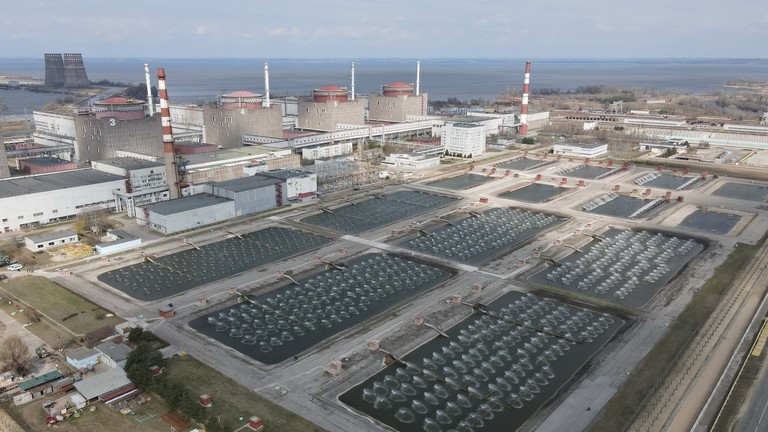
https://www.rt.com/russia/560576-zaporozhye-nuclear-plant-un/ 10 Aug 22, Moscow has accused Kiev of striking the Zaporozhye nuclear power plant, risking a repeat of the Chernobyl disaster
Russia has summoned an emergency session of the UN Security Council to discuss the situation at Ukraine’s Zaporozhye nuclear power plant, which has been the subject of regular shelling attacks. Moscow wants the chief of the UN nuclear watchdog, the International Atomic Energy Agency (IAEA), to brief the council on the situation.
The move, which was reported by Russian media on Tuesday, was confirmed by the deputy head of Russia’s mission to the UN, Dmitry Polyansky, who said the public needed to learn about “Ukrainian provocations.” The meeting is expected to take place on Thursday.
Russia has summoned an emergency session of the UN Security Council to discuss the situation at Ukraine’s Zaporozhye nuclear power plant, which has been the subject of regular shelling attacks. Moscow wants the chief of the UN nuclear watchdog, the International Atomic Energy Agency (IAEA), to brief the council on the situation.
The move, which was reported by Russian media on Tuesday, was confirmed by the deputy head of Russia’s mission to the UN, Dmitry Polyansky, who said the public needed to learn about “Ukrainian provocations.” The meeting is expected to take place on Thursday.
The IAEA has not had access to the site since before the Russian-Ukrainian conflict escalated in late February and relies on reports from Ukraine to assess the situation on the ground. The Zaporozhye plant is manned by Ukrainian nuclear workers despite being under Russian control.
On Saturday, Director General Rafael Mariano Grossi expressed the IAEA’s concern over the artillery strikes, stating that they underlined “the very real risk of a nuclear disaster that could threaten public health and the environment in Ukraine and beyond.”
“I condemn any violent acts carried out at or near the Zaporozhye nuclear power plant or against its staff,” he stressed.
Grossi is expected to lead an inspection of the facility for an independent assessment of the situation and verification that non-proliferation safeguards remain in place.
The Zaporozhye plant is the largest in Europe and stores tens of tons of enriched uranium and plutonium in its reactor cores and spent fuel storage, according to the IAEA. The watchdog chief earlier said he was alarmed that the security of the radioactive materials may be compromised amid Russian-Ukrainian hostilities.
Both Kiev and Moscow stated that they were eager for the proposed inspection to take place. However, it has yet to materialize due to security concerns. The Russian foreign ministry said on Tuesday that the delay played into Kiev’s hands by allowing it to continue its provocative attacks.
Moscow called on UN Secretary General Antonio Guterres to leverage his authority to speed up the IAEA visit. The UN Department of Safety and Security is acting irresponsibly by stalling the visit, foreign ministry spokesperson Maria Zakharova alleged in an interview on Wednesday.
Guterres last week said that “any attack to a nuclear plant is a suicidal thing.”
Russian diplomats and military officials stated that attacks on Zaporozhye power plant could result in a disaster worse than the Chernobyl reactor meltdown and steam explosion in 1986.
Very high radiation risks amid shelling at the Zaporizhzhia nuclear power plant.

The head of Ukraine ‘s state nuclear power firm has warned of “very high”
radiation risks amid shelling at the Zaporizhzhia nuclear power plant.
Energoatom’s chief, Petro Kotin, said it was vital Kyiv regains control
over the facility in the Russian-occupied south in time for winter.
He added that last week’s shelling had damaged three lines that connect the
plant to the Ukrainian grid and that Russia wanted to connect the facility
to its grid. Some of the shelling landed near storage facilities for spent
fuel, an area that has 174 containers of highly radioactive material, Kotin
said. He warned of the dangers of them being hit, saying: “This is…the
most radioactive material in all the nuclear power plant.
Mirror 10th Aug 2022
https://www.mirror.co.uk/news/world-news/ukraines-nuclear-chief-warns-very-27702181
70% of Western weapons sent to Ukraine don’t reach troops – CBS
Rt.com 8 Aug 22, Report suggests US appears to be repeating the mistakes of Afghanistan, Iraq, and Syria.
With the US and its allies pledging unprecedented levels of military support to Ukraine, a recent CBS News report suggested that only around 30% of the weapons sent by the West actually make it to the front lines. The report adds to ongoing rumors of waste, corruption, and black market profiteering.
The US has approved more than $54 billion of economic and military aid to Ukraine since February, while the UK has committed nearly $3 billion in military aid alone, and the EU has spent another $2.5 billion on arms for Kiev. An entire spectrum of equipment, from rifles and grenades to anti-tank missiles and multiple launch rocket systems have left the West’s armories for Ukraine, with most entering the country through Poland.
However, this rarely goes smoothly, CBS News revealed this week.
“All of this stuff goes across the border, and then something happens, kind of like 30% of it reaches its final destination,” Jonas Ohman, the founder of a Lithuania-based organization supplying the Ukrainian military, told the American network. Ohman said that getting the weapons to the troops involves navigating a complex network of “power lords, oligarchs [and] political players.”
The new CBS Reports documentary, “Arming Ukraine,” explores why much of the billions of dollars of military aid that the U.S. is sending to Ukraine doesn’t make it to the front lines: “Like 30% of it reaches its final destination.” Stream now: https://t.co/Ob7Y3EsWknpic.twitter.com/YgVbpYZkHn
— CBS News (@CBSNews) August 5, 2022
“There is really no information as to where they’re going at all,” Donatella Rovera, a senior crisis adviser with Amnesty International, told CBS. “What is really worrying is that some countries that are sending weapons do not seem to think that it is their responsibility to put in place a very robust oversight mechanism.”
Ukraine insists that it tracks each and every weapon that crosses its borders, with Yuri Sak, an adviser to Defense Minister Alexey Reznikov, telling the Financial Times last month that reports to the contrary “could be part of Russia’s information war to discourage international partners from providing Ukraine with weaponry.”
However, some officials in the West have sounded alarm bells. A US intelligence source told CNN in April that Washington has “almost zero” idea what happens to these arms, describing the shipments as dropping “into a big black hole” once they enter Ukraine. Canadian sources said last month that they have “no idea” where their weapons deliveries actually end up.
Europol has claimed that some of these weapons have ended up in the hands of organized crime groups in the EU, while the Russian government has warned that they are showing up in the Middle East. An investigation by RT in June found online marketplaces where sophisticated Western hardware – such as Javelin and NLAW anti-tank systems or Phoenix Ghost and Switchblade explosive drones – was apparently being sold for pennies on the dollar.
Ukraine is consistently ranked as one of the most corrupt countries in the world, scoring 122/180 on Transparency International’s 2021 ‘Corruption Perceptions Index’, where 180 represents the most corrupt and 0 the least.
In Washington, drawing attention to this corruption is frowned upon by both parties in Congress. Representative Victoria Spartz, a Ukrainian-born lawmaker, has reportedly been cautioned by her colleagues and the White House for suggesting that Congress should establish “proper oversight” of its weapons shipments due to the alleged corruption within Vladimir Zelensky’s government. ………………………. more https://www.rt.com/russia/560419-ukraine-weapons-lost-cbs/
Ukraine calls for demilitarised zone around the shelled Zaporizhzhia nuclear plant
International alarm over shelling attacks on Ukraine’s Zaporizhzhia nuclear complex has grown with Kyiv warning of a Chornobyl-style catastrophe and appealing for the area to be a demilitarised zone.
Key points:
- Ukraine and Russia have traded blame for attacks on the Zaporizhzhia plant
- Russia says it is ready to enable UN watchdog visit to the plant
- Twelve grain ships have left Ukrainian ports since last week
The United Nations chief called for UN nuclear inspectors to be given access to the plant as Kyiv and Moscow traded blame for the shelling.
“Any attack (on) a nuclear plant is a suicidal thing,” UN Secretary General Antonio Guterres said on Monday.
Petro Kotin, head of Ukraine’s state nuclear power company Energoatom, called for a team of peacekeepers to be deployed at the Zaporizhzhia site which is still run by Ukrainian technicians………………………………………………………. more https://www.abc.net.au/news/2022-08-09/ukraine-calls-for-demilitarised-zone-around-nuclear-plant/101313112
Russia and Ukraine accused each other of shelling Europe’s biggest nuclear power plant in the Zaporizhzhia region
Russia and Ukraine accused each other of shelling Europe’s biggest nuclear
power plant in the Zaporizhzhia region as the world on Saturday marked the
77th anniversary of the first atomic bomb attack in the Japanese city of
Hiroshima, with UN chief Antonio Guterres warning against nuclear arms
build-up amid fears of another such attack in the context of war in
Ukraine.
France24 6th Aug 2022
Whitewashing Ukraine’s Corruption and Authoritarianism
[O]ne can condemn Putin’s actions and even cheer on Ukraine’s military resistance without fostering a false image of Ukraine’s political system. The country is not a symbol of freedom and liberal democracy, and the war is not an existential struggle between democracy and authoritarianism. At best, Ukraine is a corrupt, quasi-democratic entity with troubling repressive policies.
Ukraine War: Biowarfare and the theft of billions, Dr. Joseph Mercola, Mercola.com, Sat, 06 Aug 2022,
For years, Ukraine was recognized as one of the most, if not “the” most, corrupt nation in Europe. It held on to that reputation all the way up to the day Russia invaded, at which point media worldwide suddenly started rewriting history.
Whitewashing Ukraine’s Corruption and Authoritarianism
As noted by Ted Galen Carpenter, a senior fellow for defense and foreign policy studies at the Cato Institute, in a sober and clear-eyed article, published in April 2022:1
“Statements from U.S. and other Western officials, as well as pervasive accounts in the news media, have created a stunningly misleading image of Ukraine. There has been a concerted effort to portray the country not only as a victim of brutal Russian aggression, but as a plucky and noble bulwark of freedom and democracy …
The promoters of that narrative contend that the ongoing war is not just a quarrel between Russia and Ukraine over Kiev’s ambitions to join NATO and Moscow’s territorial claims in Crimea and the Donbas. No, they insist — the war is part of a global struggle between democracy and authoritarianism …
The notion that Ukraine was such an appealing democratic model in Eastern Europe that the country’s mere existence terrified Putin may be a comforting myth to U.S. politicians and pundits, but it is a myth. Ukraine is far from being a democratic-capitalist model .
The reality is murkier and troubling: Ukraine has long been one of the more corrupt countries in the international system … Ukraine’s track record of protecting democracy and civil liberties is not much better than its performance on corruption. In Freedom House’s 2022 report,2 Ukraine is listed in the ‘partly free’ category, with a score of 61 out of a possible 100 …
Even before the war erupted, there were ugly examples of authoritarianism in Ukraine’s political governance … The neo-Nazi Azov Battalion was an integral part of President Petro Poroshenko’s military and security apparatus, and it has retained that role during Zelensky’s presidency …
[O]ne can condemn Putin’s actions and even cheer on Ukraine’s military resistance without fostering a false image of Ukraine’s political system. The country is not a symbol of freedom and liberal democracy, and the war is not an existential struggle between democracy and authoritarianism. At best, Ukraine is a corrupt, quasi-democratic entity with troubling repressive policies.
Given that sobering reality, calls for Americans to ‘stand with Ukraine’ are misplaced. Preserving Ukraine’s independence and territorial integrity most certainly are not worth the United States risking war with a nuclear-armed Russia.”
Media ‘Rediscovers’ Ukraine’s Corrupt Past
Given how mainstream media have been fawning over Zelensky, picturing him as a fierce fighter for democracy, it was surprising to see The Associated Press and NPR suddenly revisiting Ukraine’s history of corruption. A July 20, 2022, article, originally published by AP and republished by NPR, states:3
“Ukrainian President Volodymyr Zelenskyy’s dismissal of senior officials is casting an inconvenient light on an issue that the Biden administration has largely ignored since the outbreak of war with Russia: Ukraine’s history of rampant corruption and shaky governance.
As it presses ahead with providing tens of billions of dollars in military, economic and direct financial support aid to Ukraine and encourages its allies to do the same, the Biden administration is now once again grappling with longstanding worries about Ukraine’s suitability as a recipient of massive infusions of American aid.”
The sudden critique comes on the heels of Zelensky’s firing of his top prosecutor, his intelligence chief and several other senior officials, claiming they are spies or collaborators with Russia.
Zelensky has also dragged his feet when it comes to assigning a new anti-corruption prosecutor, something that should have occurred last December, and which, according to the U.S. Embassy in Kyiv, “undermines the work of anti-corruption agencies.”
Zelensky Blacklists Americans After Getting Millions From Taxpayers
A few days after firing his top officials, Zelensky’s Center for Countering Disinformation — established in 2021 — also issued a blacklist of American “pro-Russian propagandists,” which includes Sen. Rand Paul, R-Ky, former Rep. Tulsi Gabbard, D-Hawaii, independent journalist Glenn Greenwald, retired Col. Douglas Macgregor and University of Chicago professor John Mearsheimer.4
As noted by Fox News host Tucker Carlson, “Now the Ukrainian government has decided that they can impose censorship in our country.” Carlson questioned how President Biden can possibly claim that we’re “defending democracy” by sending millions of American taxpayer dollars to Ukraine
This is being done while Zelensky bans all opposition parties — 11 in all — and blacklists American politicians and journalists who question the use of U.S. taxpayer funds and our involvement in the Ukraine conflict.5 It rather appears we’re aiding authoritarianism, doesn’t it? Greenwald, who appeared on Carlson’s show to discuss the blacklisting stated:6
“The Ukrainians have a conflict with this neighboring country in Russia. They’re totally free to pursue whatever war policies they want. They can fight Russia in the next 10 years if they choose. But that’s not what they’re doing.
They’re begging and in a sense, demanding that other countries, including my own, the United States, provide them with a seemingly endless supply of weapons and money, which means we not only have the right, but the obligation to debate that and ask whether that’s in the interest of the American people to do.”
Ukraine Is No Defender of Democracy
In the video at the top of this article, I’ve included three episodes of “The Jimmy Dore Show” in which Dore discusses this and other news surrounding the Ukraine war [on original and also on the sidebar to this page]. In the first segment, he reviews past news articles discussing Ukraine’s corruption. Repeatedly, in 2014, 2015 and beyond, Ukraine was declared the most corrupt country in Europe.
In the second segment, Dore reviews how Zelensky was supposed to clean out corruption and usher in a new era of good governance. That didn’t happen though.
The Panama Papers7,8 — described as “a giant leak of more than 11.5 million financial and legal records [which] exposes a system that enables crime, corruption and wrongdoing” — have revealed Zelensky, his wife and several associates own “hidden offshore assets,” raising suspicions that Zelensky may be just as corrupt as his forerunners.
The third Dore Show segment reviews Ukraines’ blacklist of pro-Russian journalists, which, as mentioned, includes Greenwald, Scott Ritter, Jeffrey David Sachs and many others. The beauty of being discredited by mainstream media is that they revealed to you who is actually telling the truth.
What Happens to US Weapons in Ukraine?
One wonders whether the U.S. “aid” to Ukraine might also be a corrupt scheme in and of itself. As admitted by CNN,9 the U.S. government doesn’t know what happens to the billions of dollars’ worth of military hardware and munitions shipped to Ukraine.
The supplies cannot be tracked, and the obvious risk is that the weapons can end up in the hands of militias and terrorists. However, this is “a conscious risk the Biden administration is willing to take,” CNN says. In the meantime, the U.S. and NATO are simply shipping over whatever Zelensky claims he needs. According to CNN:10
“Trucks loaded with pallets of arms provided by the Defense Department are picked up by Ukrainian armed forces — primarily in Poland — and then driven into Ukraine, Kirby said, ‘then it’s up to the Ukrainians to determine where they go and how they’re allocated inside their country.'”
Theft through endless warfare
As noted by Wikileaks founder Julian Assange in 2011, the purpose of the Afghan war — the longest war in U.S. history, which lasted from 1999 until 202111 — was not to subjugate Afghanistan. It was to launder money through war.
“The goal was to use Afghanistan to wash money out of the tax base of the United States, out of the tax bases of the European countries, through Afghanistan, back into the hands of transnational security elite. That is the goal. I.e., the goal is to have an endless war; not a successful war,” Assange said.
Is Ukraine just another repeat of this same scheme? It’s starting to look that way. Rather than sending diplomats and urging Ukraine to negotiate peace, the NATO alliance insists Ukraine fight to the last man, and send weapons and financial aid that quickly vanish into a proverbial black hole.
What’s the Goal in Helping Ukraine?
The problem facing NATO and the U.S. is that people are increasingly becoming aware of the fact that things don’t add up. Why are we involved in this conflict? We’re clearly not defending “democracy”; quite the opposite. We’re aiding and abetting an authoritarian regime — andactual real-world Nazi adherents.
As reported by Jeff Childers, president and founder of the Childers Law firm, in a July 19, 2022 blog post:12
“The Economist ran a story yesterday headlined, ‘Is America Growing Weary of the Long War In Ukraine?’ Well. I was immediately suspicious, because the Ukraine war hasn’t been that long …
Late in the article, the Economist put its tobacco-stained finger right on the squidge that marks the real problem: ‘Mr. Biden’s aim in the war is unclear. His administration has stopped talking about helping Ukraine to ‘win,’ and instead speaks of preventing it from being defeated.’
That’s the problem, all right. What IS the goal, Joe? If it’s ‘winning,’ what does that even look like and how do we get there? … It seems the pro-war Ukrainians want the U.S. to just skip the messy middle and jump right into direct war with the Russians, to teach them a lesson or something.
But the Russians have nuclear missiles and doomsday submarines and even nuclear torpoedos for goodness’ sake. A fully-kinetic global war won’t help the Ukrainians, at all. Probably just the opposite. It’s magical thinking.”
The Rise of Totalitarianism in America
The U.S. support of an authoritarian regime like Ukraine is perhaps best explained by the realization that the U.S. itself has shifted in that direction. According to American philosopher, social critic and cognitive scientist Noam Chomsky,13 who appeared on Russell Brand’s podcast in July 2022, the U.S. is “living under a kind of totalitarian culture, which has never existed in my lifetime and is much worse in many ways than the Soviet Union before (Mikhail) Gorbachev.”
The cause for this cultural change, Chomsky believes, can be traced back to the censorship of global news. Basically, most Americans live in an echo chamber, where there’s no diversity of views, especially not from perceived adversaries:
“If today in the United States, you want to find out what Minister (Sergey) Lavrov of Russia is saying, you can’t do it. It’s barred. Americans are not permitted to hear what Russians are saying,” Chomsky told Brand. “Can’t get Russian television, can’t access Russian sources …
You wanna find out what the adversaries are saying, which is of utmost importance … But the United States has imposed constraints on freedom of access information, which are astonishing and which in fact go beyond what was the case in post (Joseph) Stalin and Soviet Russia.”
The Biolab Angle
Another angle that can help explain the U.S. support of a clearly authoritarian and anti-democratic regime is the fact that we have a number of biolabs in Ukraine, the purposes of which the U.S. government is keen to obscure. Childers addresses this as well:14………………………………………………………
 |
https://www.sott.net/article/470735-Ukraine-War-Biowarfare-and-the-theft-of-billions
Parts of Zaporizhzhia nuclear plant damaged when struck by shelling
Ukraine’s state nuclear agency, Enerhoatom, said parts of the captured
Zaporizhzhia nuclear plant were “seriously damaged” after a station
containing oxygen and nitrogen and an “auxiliary building” were struck by
shelling. There is now an increased risk of fire and radiation.
On Telegram, the agency said Saturday: “The Zaporizhzhia nuclear power plant
is operating at risk of violating the norms of radiation and fire
protection.” “There remains a risk of hydrogen leaking and radioactive
particles dispersing, and the risk of fire is also high,” Enerhoatom added.
Deutsche Welle 6th Aug 2022
https://www.dw.com/en/russia-ukraine-updates-parts-of-nuclear-plant-seriously-damaged/a-62729710
Only 30% of the Weapons Are Even Making it to the Frontlines
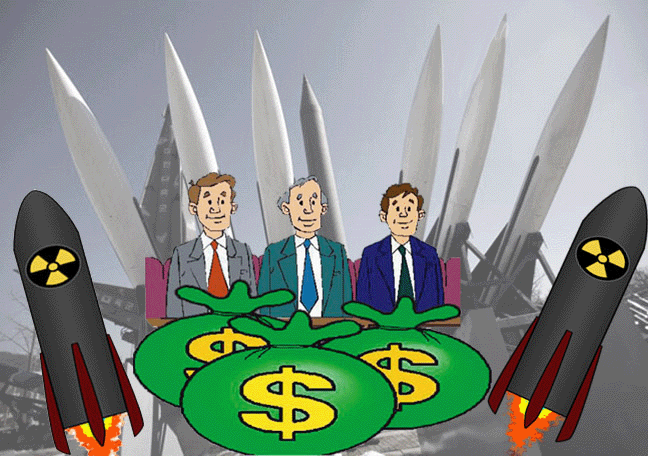
all the people with their snouts in the trough are stealing billions of dollars of Western tax money.
the attention of the spook agencies, the politicians and the media will zero in on where there is the most money to be made stealing from the public coffers. Is there money to be made sending money to Taiwan for defense against China and stealing 70% of it with the help of local corrupt officials?
the attention of the spook agencies, the politicians and the media will zero in on where there is the most money to be made stealing from the public coffers. Is there money to be made sending money to Taiwan for defense against China and stealing 70% of it with the help of local corrupt officials?
https://roloslavskiy.substack.com/p/only-30-of-the-weapons-are-even-making Rolo Slavskiy 8 Aug 22,
The new CBS documentary “arming Ukraine”, explores why much of the billions of dollars of military aid that the US is sending to Ukraine doesn’t make it to the front lines.
We talked about the topic of arms deliveries on the blog before.
There is a constant stream of videos coming out on Telegram of Ukrainian troops complaining that they have no weapons or have inferior weapons and that wages are going unpaid.
We were left with a dilemma last time: how do we square this with the information we have about billions of dollars being sent to arm the Ukrainian army?
Well, now we have yet more proof that indicates that the money is being stolen and the weapons being resold somewhere else.
Andrew Anglin thinks that the money could be being sent to arm terrorists in Europe.
He might be right and I’ve entertained similar ideas.
The key takeaway here for us though is that the West + Ukraine is too corrupt to fight an honest war against a peer or near-peer opponent. Stealing 70% of a war arsenal paid for by the Western taxpayers is a level of graft that makes winning wars impossible. I wrote an article musing that this war is bleeding the West dry and wondering whether or not the West was getting enough bang for its buck (dead slavs) for the obscene amounts of money they were spending and the damage that they were inflicting on their own countries with the sanctions
But a lot more money appears to be unaccounted for, or at least, not being put to use for the purpose that it was supposedly allocated for. It would be interesting to see an analysis, any analysis really, of the funds and the weapons to see where they actually ended up. More and more though, it seems that we have an Afghanistan 2.0 on our hands where Western taxpayer money is sent over in crate-loads, but very little of it actually seems to go towards either the war effort or state-construction or anything related to the supposed mission objectives.
I left the questions somewhat in the air then, but I’m going to have to revise that analysis now.
Put simply: the war is indeed bleeding the West dry.
Ukraine was supposed to be a quagmire for Russia, but it appears that it has become a quagmire for the West instead. The West, could, in theory, pull out of the Ukraine, which Russia cannot do, but the political will has to be there for that. The spook agencies are making a lot of money on this, as are their friends in the military industrial complex and the politicians and oligarchs who now have access to the Ukraine weapon slush fund. The media has whipped up a moral panic over Ukraine, making it difficult for the peasants to voice opposition to it, providing cover for the looting operation. Why the Deep State would put down this cash cow when the milk is flowing so abundantly is beyond me. There are no adults who care about balanced budgets and the national interests of Western states anymore. It’s all just non-stop looting and graft.
Ukraine, however, does appear to be fading out of the news cycle at the time of this writing. Zelensky’s view count is way down, as an example. He released a video a day ago about the Russians trying to cause a Chernobyl by firing at a nuclear plant that has only gathered 8500 Western audience views at the time of this writing:
This all indicates to me that the Western public is losing its enthusiasm and interest in this war and that perhaps the Ukraine psy-op won’t be renewed for another season.
So, on the one hand, ..They’re also damaging Russia, their Authoritarian mortal enemy. All opposition to this war has effectively become banned. All this seems to indicate that the West will continue its Ukraine operation.
On the other hand, enthusiasm and interest has dwindled to a trickle. I see this reflected in my own articles and other Russia bloggers’, as people are no doubt talking about monkeypox and COVID and the midterms and other topics now. Furthermore, the Pelosi stunt in Taiwan put the spotlight on China again.
I don’t know what to make of it all, but my gut instinct tells me that the attention of the spook agencies, the politicians and the media will zero in on where there is the most money to be made stealing from the public coffers. Is there money to be made sending money to Taiwan for defense against China and stealing 70% of it with the help of local corrupt officials? Sure.
But, Ukraine is quite unique in its ability to achieve new heights of excellence and innovation in the field of organized graft. The entire spook apparatus, government and military is completely committed to looting as much as possible and the West would be sad to see such a lucrative money-laundering operation go under.
Russia would no doubt liked to have knocked out Ukraine in the early days of the war with its push on Kiev and prepared covert operation, but, despite that failure, the unexpected runner-up prize of bleeding the West dry is starting to look quite good as well.
Russia the most popular national destination for refugees from Ukraine
UN: The Largest Number of Ukrainian Refugees Are Fleeing From “Russian Aggression” … to Russia!
The Stalker Zone 6 August (good tables and graphs)
Theses of Ukrainian propaganda about “Kremlin aggression” and the “genocide of the Ukrainian people” are in danger – the Office of the United Nations High Commissioner for Refugees (UNHCR) has reported fresh data about the movement of refugees from Ukraine across Europe. As of August 3 of this year, 6,303,226 refugees from Ukraine were registered in Europe, while from February 24 to August 03 there were 10,350,489 crossings of the Ukrainian border outbound and 4,272,233 crossings inbound.
The distribution by country of destination (top 5) as of August 3rd is as follows:
- Russian Federation – 1,968,127 crossings;
- Poland – 1,256,568;
- Germany – 915,000;
- Czech Republic – 400,559;
- Italy – 157,309.
Out of the 6.3 million Ukrainian refugees, about 2 million (every third!) chose the Russian direction. In addition, according to the UN, 105,000 citizens of the Donetsk and Lugansk People’s Republics were evacuated to Russia from February 18 to 23, which exceeds the number of refugees in 5 months, for example, to the UK (104,000 people).
Cross-border movement on the Polish-Ukrainian border is also of interest: from February 24 to August 03, there were 5,105,850 departures (with a peak of 140,843 on March 06 and a further sharp decline) and 3,083,783 entries. Since the end of March, the number of returnees (about 35,000) significantly exceeds the number leaving Ukraine via Poland (about 25,000 per day).
As of 03.08.2022, 1,256,568 Ukrainian refugees were registered in Poland, from which 1,138,647 (90%) were children under the age of 18 and women (data for voivodeships, gender and age are below on original ) https://www.stalkerzone.org/un-the-largest-number-of-ukrainian-refugees-are-fleeing-from-russian-aggression-to-russia/
1 This Month



26 September – International Day for the Total Elimination of Nuclear Weapons


PLEASE OPPOSE HR 8255 AND S.3639 – bills would accelerate satellite deployment, with no environmental review or safeguards – https://ncstd5li.quorum.us/campaign/169331/
To see nuclear-related stories in greater depth and intensity – go to https://nuclearinformation.wordpress.com
-
Archives
- September 2026 (245)
- August 2026 (330)
- July 2026 (355)
- June 2026 (287)
- May 2026 (306)
- April 2026 (356)
- March 2026 (251)
- February 2026 (267)
- January 2026 (308)
- December 2025 (358)
- November 2025 (359)
- October 2025 (375)
-
Categories
- 1
- 1 NUCLEAR ISSUES
- business and costs
- climate change
- culture and arts
- ENERGY
- environment
- health
- history
- indigenous issues
- Legal
- marketing of nuclear
- media
- opposition to nuclear
- PERSONAL STORIES
- politics
- politics international
- Religion and ethics
- safety
- secrets,lies and civil liberties
- spinbuster
- technology
- Uranium
- wastes
- weapons and war
- Women
- 2 WORLD
- ACTION
- AFRICA
- Atrocities
- AUSTRALIA
- Christina's notes
- Christina's themes
- culture and arts
- Events
- Fuk 2022
- Fuk 2023
- Fukushima 2017
- Fukushima 2018
- fukushima 2019
- Fukushima 2020
- Fukushima 2021
- general
- global warming
- Humour (God we need it)
- Nuclear
- RARE EARTHS
- Reference
- resources – print
- Resources -audiovicual
- Weekly Newsletter
- World
- World Nuclear
- YouTube
-
RSS
Entries RSS
Comments RSS
 nuclear-news