Ukraine war briefing: Kyiv denies its drone ‘deliberately’ hit Zaporizhzhia nuclear plant
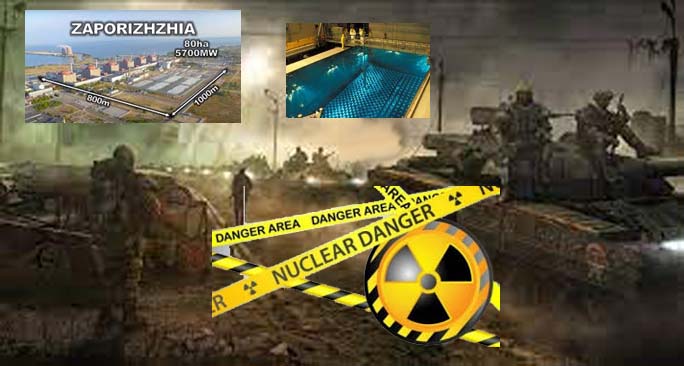
Russian atomic energy agency claim that drone strike damaged Europe’s largest nuclear plant just a ‘propaganda ploy’, Ukraine military says. What we know on day 1,558
- Russia’s state nuclear energy company Rosatom said on Saturday a Ukrainian drone had struck the Russian-controlled Zaporizhzhia nuclear plant, Europe’s largest, but had not caused damage to key equipment. Rosatom’s head Alexei Likhachev called the incident “deliberate” and said it left a hole in the wall of a turbine hall. “This afternoon, a Ukrainian kamikaze combat drone struck the turbine hall building of Power Unit No. 6, resulting in a subsequent detonation,” Likhachev said in a statement.
- The Zaporizhzhia nuclear plant was captured by Russia in March 2022 and remains close to the frontline in the south-eastern Ukrainian Zaporizhzhia region. Kyiv military have denied Russian claims as “yet another propaganda ploy”, saying its troops did not strike power unit No. 6 at the plant. “Ukrainian servicemen act strictly within the international humanitarian law and are fully aware of the consequences of any actions targeting nuclear facilities,” the military said in a statement. “At the relevant section of the frontline, there was no active fighting during the incident, and no weapons were used.”
- The International Atomic Energy Agency (IAEA) on Saturday said it has been informed by the Zaporizhzhia plant that a drone had struck a turbine building at the site. IAEA chief Rafael Grossi expressed serious concern about the reported incident. “Attacking nuclear sites is like playing with fire,” he said. The IAEA’s team has requested access to examine the affected turbine building first-hand, the agency said in an X post.
- Ukrainian drone strikes caused fires at more Russian oil facilities overnight into Saturday, Russian officials said, in what appeared to be the latest attack on Moscow’s oil industry. Authorities in Russia’s Rostov region said falling drone debris sparked a fire that damaged an oil depot and tanker in the port of Taganrog, while officials in the neighbouring Krasnodar region reported a fire breaking out at an oil depot in Armavir for the same reason.
- Ukrainian President Volodymyr Zelenskyy on X noted the Krasnodar attack and said: “We are rightfully bringing the war back to where it came from.”
- Russian tennis players at the French Open about their stance on the war, after her third-round exit at the French Open. Oliynykova lost in straight sets to Russia’s Diana Shnaider. The Ukrainian said players from Russia were allowed to participate in international tournaments even though they openly took part in events sponsored by Russian companies linked to the war effort or even after what she said was promoting the positions of Russia in relation to the war on social media.
An Open Letter to Chancellor Friedrich Merz – for peace in Ukraine – Jeffrey Sachs.
Economist and diplomat Jeffrey Sachs is calling on German Chancellor Merz to begin immediate talks with Russian President Vladimir Putin about peace in Europe.
Jeffrey D. Sachs | May 27, 2026 | Berliner Zeitung
When I wrote an open letter to you a half year ago, I urged Germany to pursue diplomacy with Russia rather than the normalization of war. Six months later, the situation in Europe is dramatically worse. Europe and Russia are slipping into open war. And in that drift, Chancellor, your responsibility is singular. No European leader — not in Paris, not in Warsaw, not in Rome — holds the position that Germany holds, or has the power that you personally hold, to interrupt this catastrophe. Will you try for peace?
You yourself, with Prime Minister Meloni and President Macron, called in January 2026 for Europe to restart relations with Russia and described Russia as „a European country.“ Yet you did not pursue diplomacy. With the future of Europe at stake, this is an extraordinary abdication of leadership. Have you, in your months as Chancellor, attempted one substantive dialogue with President Putin? Has your foreign minister attempted one substantive dialogue with Foreign Minister Lavrov? Real conversations, the kind that ended the Cold War. The answer, as far as the public record reveals, is no. Not once. And not for want of recognizing the urgency.
The past days have brought a dangerous acceleration that should focus every European mind. Both capitals are now under sustained attack: Ukrainian long-range drones have struck deep into Moscow, including civilian sites; Russian missile and drone strikes against Kyiv have greatly intensified. Ukrainian drones have crossed into the airspace of the Baltic states, raising the immediate prospect of an incident that could pull Europe directly into the war. A horrific Ukrainian strike on a boys’ school in Lugansk has further eroded what little remains of restraint. And on May 25, Foreign Minister Sergey Lavrov, acting on instructions from President Putin, formally notified the United States Secretary of State that the Russian Armed Forces are now launching „systematic and sustained strikes“ on facilities and decision-making centers in Kyiv, and the Russian Foreign Ministry has advised that the United States and other countries „ensure the evacuation of their diplomatic personnel and other citizens from the capital of Ukraine.“ That message is the prologue to a major escalation. Diplomacy is more urgent than ever.
The way to defend Ukraine is not continued slaughter, but peace on terms that are agreeable to all parties. Instead, we face escalation, with more deaths, more destruction, and the real prospect of a war that expands beyond Ukraine. By calling for ever more weapons, ever greater war-fighting capacity, and ever louder demonstrations of „resolve,“ and by signaling that Germany is preparing for war rather than working to end it, you have allowed Berlin to become an accelerant rather than a brake to a European-wide war.
Germany’s Responsibility: Six Particulars
Germany bears profound responsibility for the situation it now confronts. Before German policy can be reset toward peace, Germany’s record must be confronted honestly. I set out below six serious failures of German foreign policy vis-à-vis Russia since German reunification in 1990.
First — the 2+4 Treaty and NATO’s eastward expansion. On 12 September 1990, in Moscow, Germany signed the Treaty on the Final Settlement with Respect to Germany — the „2+4 Treaty“ — that completed German reunification. That treaty was secured because Mikhail Gorbachev was given solemn assurances, by Hans-Dietrich Genscher, by Helmut Kohl, by James Baker, and by other Western leaders, that NATO would not move eastward. The declassified record — including the now-public memoranda assembled by the National Security Archive of George Washington University — is unambiguous: those assurances were given and were clearly meant at the time to apply beyond the territory of the former GDR to Eastern Europe. These assurances were reaffirmed through 1990 and 1991.
The 2+4 Treaty restricts the placement of NATO troops in the former GDR, and recalls the principles of the Helsinki Final Act, which emphasizes that no nation’s security should come at the expense of another’s. Does any serious person believe that the Soviet Union cared about Western troops on the territory of the former GDR but was indifferent to NATO armies in Warsaw, Vilnius, or Kyiv? Of course not.
The matter of NATO enlargement was discussed in detail and explicit assurances of non-enlargement to the East were given by Germany to the Soviet leaders — and then were broken. Germany was the principal beneficiary of those assurances, which were the quid pro quo for Germany’s reunification. Yet as early as 1993, German leaders began to promote the violation of those assurances.
Second — Chancellor Merkel’s own testimony. In her memoirs, Angela Merkel writes with striking candor that she understood at the time of the 2008 Bucharest Summit that inviting Ukraine and Georgia into NATO would be tantamount to a declaration of war on Russia. She knew Russia’s red line. And yet she gave in to American pressure, accepting the compromise communiqué that Ukraine and Georgia „will become“ NATO members. That single sentence set in motion the catastrophes of 2014 and 2022. Merkel’s later candor is a gift to her successors: she has told you, plainly and in her own words, what was understood at the time. Germany should not now pretend otherwise.
Third — the betrayal of the February 21, 2014 agreement. On 21 February 2014, in Kyiv, Germany’s then–Foreign Minister Frank-Walter Steinmeier, together with his Polish and French counterparts, brokered an agreement between President Yanukovych and the opposition. The agreement provided for a return to the 2004 constitution, the formation of a national-unity government, and early presidential elections. President Putin was consulted; the agreement was confirmed. It was a serious diplomatic achievement under conditions of intense violence. Yet within twenty-four hours Yanukovych was forcibly overthrown by a violent coup. Germany did not insist on the agreement it had just guaranteed. Instead, following the U.S. lead, Germany backed the new government, as if there had been no agreement in place. That decision persuaded Moscow that Western signatures could not be trusted.
Fourth — Minsk II. In February 2015, Chancellor Merkel personally negotiated Minsk II in the Normandy Format and pledged Germany’s political backing through the Declaration of Support adopted in Minsk on 12 February 2015. For seven years, the key political provision — autonomy for the Donbas regions within a sovereign Ukraine — was never implemented by Kyiv. Germany did not press Kyiv to implement the autonomy provision it had championed — and Merkel later acknowledged that the agreement had been used as a holding action to allow Ukraine to rearm. President Hollande said the same. The guarantee, in other words, was not a guarantee at all. It was a stratagem — once again at Washington’s behest. Once again, the message to Moscow was that Western signatures cannot be trusted
Fifth — Nord Stream. On 7 February 2022, in the East Room of the White House, President Biden announced — with then-Chancellor Olaf Scholz standing beside him — that „if Russia invades… then there will be no longer a Nord Stream 2. We will bring an end to it.“ Asked how, he replied, „I promise you, we will be able to do that.“ The pipelines were destroyed seven months later in an act of sabotage in the Baltic Sea. The available evidence — investigative reporting in the United States and Germany, the trail followed by the German federal prosecutor, and the public statements of former officials — points overwhelmingly to a joint Ukrainian-American operation. The German government has long known this. And yet Germany has permitted the public blame to fall on Russia, against the direct evidence, while an act of industrial sabotage against the German economy has gone unprosecuted and unanswered.
Sixth — the April 2022 Istanbul agreement that was within reach. Just weeks after Russia’s invasion in February 2022, Russian and Ukrainian negotiators converged in Istanbul on the terms of a peace agreement: Ukrainian neutrality outside NATO, multilateral security guarantees, agreed troop limits, and the political resolution of the Donbas and Crimea questions over time. The agreement was within days of signature. Former Israeli Prime Minister Naftali Bennett, one of the mediators, has confirmed publicly that the deal was close and that the West — the United States and the United Kingdom in particular — moved to block it. Prime Minister Boris Johnson’s mission to Kyiv in April 2022 to instruct Ukraine not to sign is a matter of public record. Hundreds of thousands of Ukrainian and Russian lives, and the wider European order, have paid the price for that US–UK intervention. Germany has not raised its voice on this — even though Germany, more than any other European state has borne the economic consequences.
The Second Catastrophe: Germany’s Economic Self-Destruction
Your first concern must be peace. Yesterday’s message from Moscow tells us how late the hour is. But there is a second catastrophe unfolding alongside the first: the willful destruction of the German economy, with Berlin as both author and victim.
Germany’s industrial economy was built on trade with Russia. The destruction of Nord Stream and the subsequent severance of Germany’s trade relations with Russia have left Germany buying natural gas from the United States at prices several times higher than the Russian pipeline gas it replaced. This is industrial suicide. Germany’s chemical sector, its steel sector, its glass industry, its energy-intensive manufacturers — the very foundations of the Mittelstand — are losing international competitiveness day by day. Skilled jobs are draining out of the German economy. And the German taxpayer and the German consumer are making a transfer of national wealth from Germany to American gas producers at a scale unprecedented in postwar Europe.
On top of this, the German government is now pledging an enormous defence build-up — hundreds of billions of euros over the coming decade — to arm for a war that diplomacy can easily prevent. This is a profound misallocation of national resources. The fundamental challenge facing Germany in this decade is competitiveness in the digital age. Every euro spent on tanks, missiles, and artillery shells is a euro not spent on Germany’s AI capacity, its chip-design and chip-fabrication capability, its energy infrastructure, and the high-speed digital networks that Germany needs to remain a top global economy.
The hard reality, Mr. Chancellor, is that there is no security to be bought with these arms that diplomacy cannot buy at a tiny fraction of the cost, and there is no prosperity to be had without the digital and energy investments that this arms buildup will crowd out.
My Appeal
Chancellor Merz, more than any other European leader, the question of whether Europe descends into general war, or returns to negotiation, and to economic sanity, rests with you. The hour is very late. Yesterday’s formal message from Moscow to Washington says so explicitly. Please open a dialogue with President Putin. Please send your foreign minister to Moscow or invite Russia’s Foreign Minister to Berlin. Please reopen the OSCE channels that Germany has allowed to atrophy. Please tell Kyiv to cease its strikes on civilian targets.
Most importantly, please tell the German public the truth: that a negotiated peace based on Ukrainian neutrality is the realistic path out of catastrophe, and that restoring a normal economic relationship with Russia is the realistic path out of Germany’s industrial decline.
The terms of an acceptable agreement that Germany could propose are clear. The fighting would stop on an armistice line. All sides would renounce any future resort to violence on the question of borders. Ukraine would restore its neutrality, and NATO would permanently renounce further eastward enlargement.
Europe and Russia would restore economic relations and would stop the warmongering. The OSCE would once again become the central forum for European security, with the fundamental precept that European security is indivisible, not based on military blocs dividing Europe. Alongside this peace, Germany would redirect its national resources toward the digital, AI, semiconductor, and energy investments that Germany’s economic future demands.
History will record what you do in the weeks ahead, and what you fail to do. So will the German public. So will the peoples of Russia, Ukraine, and Europe generally. It’s time for diplomacy, Mr. Chancellor. The choice is yours to make.
Respectfully,Jeffrey D. SachsUniversity Professor of Columbia University
https://www.berliner-zeitung.de/article/jeffrey-sachs-an-open-letter-to-chancellor-friedrich-merz-10038768
Danger at Europe’s largest nuclear plant ‘near point of no return’ after deadly attack
The Zaporizhzhia Nuclear Power Plant in Ukraine was targeted
again last week, with continual concern over its safety since the start of
the war with Russia in 2022. Safety at Europe’s biggest nuclear power plant
is “rapidly deteriorating”, Russia’s nuclear energy chief has warned.
Mirror 18th May 2026 https://www.mirror.co.uk/news/world-news/zaporizhzhia-nuclear-power-plant-ukraine-37171510
Latvia prime minister resigns over “straying” Ukraine drones
Comment: There’s a lot more to the story than a Baltic chihuahua’s inept defense system. Ukraine has been hitting targets so far from itself that there is no way they could reach their objective, UNLESS, the munitions were flown over (or from?) NATO-controlled airspace.
The Straits Times, Thu, 14 May 2026 , https://www.sott.net/article/506352-Latvia-prime-minister-resigns-over-straying-Ukraine-drones
Latvia’s Prime Minister Evika Silina resigned on May 14 after a key party in her coalition withdrew support in a row over Ukrainian drones that strayed into the Baltic nation.
The drones were on an attack mission across the border in Russia, and Ukraine said they crashed into Latvian territory on May 7 after being electronically diverted by the Russian military.
One caused a fire at a disused oil storage site in eastern Latvia.
Ms Silina on May 10 sacked her Defence Minister Andris Spruds over the affair.
She said Latvia’s anti-drone systems had not been deployed quickly enough to counter the drone intrusions.
Mr Spruds’s sacking prompted nine of his allies, fellow members of the left-wing Progressive party, to quit Ms Silina’s ruling coalition, alleging she had made him a scapegoat.
Mr Spruds formally resigned on May 11 and Ms Salina proposed a military officer as his replacement but the Progressive party rejected him.
Their withdrawal left her government with just 41 seats in the 100-seat Parliament and opposition parties said they would call a vote of confidence just five months out from legislative elections.
In a further blow on May 14, Mr Armands Krauze, Minister for Agriculture, from the Union of Greens and Farmers, was briefly detained as part of ongoing enquiries by anti-corruption body KNAB into state aid to firms in the forestry sector.
Ms Silina, from the Unity party, had been prime minister since September 2023.
Announcing her resignation, she told a press conference: “The most important thing for me is the well-being of Latvians and the security of our country.”
She added: “We are fully aware of the times we are all living in. The brutal war waged by Russia in Ukraine has changed the security situation throughout Europe.”
President Edgars Rinkevics has said he will meet party leaders on May 15 for talks on a new government.
Several Russian and Ukrainian drones have crashed in Latvia, Lithuania and Estonia since Russia launched its invasion of Ukraine in 2022.
A Ukrainian drone fell in Latvia on March 25.
Ukraine has stepped up attacks on Russian ports and energy facilities in the region in recent months.
The drone intrusions have not caused victims but they have exposed weaknesses in the Latvia’s air defence system.
Following talks with Mr Rinkevics at a summit in Bucharest on May 13, Ukraine’s President Volodymyr Zelensky said he would send experts to Latvia to help with their air defences.
Ukraine would also work with Latvia “to build a multi-layered air defence system against different types of threats”, he said.
Mr Rinkevics said a “long-term” air defence accord would be prepared.
Comment: There’s a lot more to the story than a Baltic chihuahua’s inept defense system. Ukraine has been hitting targets so far from itself that there is no way they could reach their objective, UNLESS, the munitions were flown over (or from?) NATO-controlled airspace.
How 🇱🇻 Latvia and 🇪🇪 Estonia organized the passage of Ukrainian strike drones to the borders of Russia through their airspace
❗️The facts have been established that official closure (restriction) of the airspace over the eastern part of the Latvian and Estonian Republics was organized for the unimpeded flight of Ukrainian UAVs to strike Russia.
🇱🇻In Latvia, the “Aeronautical Information Supplement (AIP SUP 005/2026)” about the establishment of a temporary flight restriction zone EVR444 EVENTIDE has been published. The airspace is closed from 19.02.2026 to 31.12.2026 on the initiative of the Ministry of Defense of Latvia. The boundaries of the zone are from the surface of the earth (GND) to the FL195 flight level (about 5950 meters). The restrictions are in effect daily from 18:00 to 05:00, and in the summer – from 17:00 to 04:00 according to UTC.
🇪🇪In Estonia, a similar notice (AIP SUP 04/2026) about the establishment of the EER2615 zone has been published. According to the document, the closure of the airspace is in effect from 28.03.2026 to 31.12.2026 around the clock (H24 mode) at altitudes from 500 feet above ground level (AGL) to the FL095 flight level.
It is also worth noting that the Estonian side has closed access to previously published notifications on airspace restrictions, which indicates a desire to hide its involvement in providing airspace for the flights of Ukrainian UAVs.
✨According to our experts, these actions are part of a systematic strengthening of airspace control on the eastern border of NATO. The Latvian documents directly confirm that this is a continuation of restrictions along the borders with the Russian Federation and Belarus🇧🇾.
The zone is a long line along the State border of Latvia with Estonia, Russia, Belarus and Lithuania. It includes an internal side buffer of 5 nautical miles and a vertical top buffer of 1000 feet. It works as a single mass without gaps between military and border sections. Flights are prohibited for any non-participating aircraft.
assive attacks on the seaports of the Leningrad region in February and March of this year became possible with the direct participation of Latvia and Estonia
▪️One of the Ukrainian drones, by the way, hit right into the oil refinery in Rezekne – this is 40 km from Russia, when the UAVs attacked the Leningrad region, but in the end, four tanks of the oil depot in Latvia burned.
Due to the direct involvement of the governments of these countries in the military activity of Ukraine against Russia, the negative consequences for the population of the Baltic states will only increase.
Russia has been warning for weeks now that Ukrainian drone attacks had been using Baltic airspace to hit targets in Russia’s northern regions, directly involving European states in the fight directly against Russia. This reportedly crossed redlines in Moscow that other Russian voices claim has led them to decide to take action against military factories in the West, even risking an Article 5 trigger.
The Defense Minister of Latvia resigned after two Ukrainian drones coming from Russia struck oil storage facilities.
The Defense Minister of Ukraine stated that the drones were intentionally diverted from their targets by Russian electronic warfare systems and redirected toward Latvia instead of targets inside Russia.
Fires break out in exclusion zone around Chernobyl nuclear plant
Arpan Rai & Maira ButtFriday 08 May 2026, https://www.independent.co.uk/bulletin/news/chernobyl-fires-radiation-russia-ukraine-b2973234.html
A forest fire burns in the exclusion zone around the Chernobyl nuclear power plant (AP)
- Russia has said it is carrying out enhanced radiation monitoring after fires broke out in the exclusion zone around the Chernobyl nuclear power plant on Friday.
- The country’s national public health agency said that enhanced radiation monitoring was being conducted and the situation was now “stable”.
- The 1986 Chernobyl disaster is considered to be the world’s worst civil nuclear accident.
- It spread Iodine-131, Caesium-134 and Caesium-137 across parts of Ukraine, Belarus, Russia, northern and central Europe.
- Meanwhile, Ukraine has continued its long-range attacks on Russia with a drone strike one of the country’s largest oil refineries, located in Yaroslav
Putin names condition for meeting with Zelensky
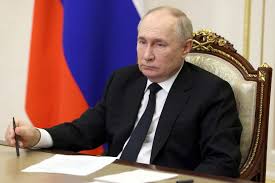
Face-to-face negotiations can take place, but only after a final long-term peace agreement is fully prepared, the Russian president has stressed
9 May, 2026 , https://www.rt.com/russia/639812-putin-names-condition-for-meeting-zelensky/
Russian President Vladimir Putin has stated that a meeting with Ukraine’s Vladimir Zelensky could take place “anywhere,” including in a third country, but only after a final long-term peace agreement is fully prepared and ready for signing.
“The Ukrainian side and Mr. Zelensky, they are ready to have a personal meeting… We have never refused,” Putin said during a press conference after Victory Day celebrations on May 9. “We can meet in the third country as well, but only after there is an ultimate agreement regarding a peace deal that must be a long-term deal.”
He stressed that the meeting should be the “final thing,” the signing ceremony, and not turn into negotiations. Recalling the Minsk Accords experience, Putin noted: “We can speak hours, day and night and it would yield no results. We need specialists to take care of that… then we can meet, we can sign.”
During the same May 9 briefing, Putin declared that the Ukraine conflict “is heading towards the end.”
These remarks came one day after US President Donald Trump expressed hope that the ceasefire declared by Moscow on May 8 could lead to the fighting wrapping up soon.
Last December, Putin reiterated that Russia seeks a peaceful resolution of the Ukraine conflict provided its root causes are eliminated.
Combatants must address root causes to end Ukraine, Iran wars

Walt Zlotow West Suburban Peace Coalition Glen Ellyn IL , 8 May 26
Ukraine cannot win its war with Russia, now in its 51st month. Why? Russia will never allow Ukraine to join NATO which would allow NATO nukes on Russia’s borders to weaken, isolate Russia from the European political economy. Nor will Russia give back the Donbas containing mostly Russian leaning Ukrainians being brutalized and killed for 8 years prior to the Russian invasion.
Isolating, weakening Russia while ignoring Russia’s security concerns represent the root causes of the war which for Russia is an existential threat to their national security. The Biden administration knew both threats would provoke a Russian invasion but did so anyway figuring war would weaken, if not collapse Russia.
The opposite occurred. Russia has prospered both economically and militarily while Ukraine is a failed state near collapse and totally supported by hundreds of billions in US, NATO aid. But even a trillion in aid will not prevent Ukraine’s inevitable defeat.
Russia always preferred the West negotiate the war’s root cause, their sensible security demands both for themselves and their Russian speaking Ukrainian brethren. While the US is not averse to this now, European NATO countries continue to pour tens of billions into the lost cause to weaken, isolate Russia. Therefore, Russia is committed to resolve the root causes of the war on the battlefield.
All this could have been avoided in November 2021 if the Biden administration had the decency and common sense to negotiate Russia’s national security interests, the root cause of their invasion three months later.
Failure to address the root causes of war also applies to the current US, Israeli war against Iran. For Israel the root cause of the war has nothing to do with Iran’s nuclear program which is not developing a nuclear weapon. It is simply Israel’s lust to destroy Iran as a hegemonic rival for Middle East supremacy. The US, supplying most of the fire power, has no dog in Israel’s quest. We can only lament that Israel exerts such malicious control over the Trump administration that it willingly engaged in suicidal war to please Israel.
Just like with Ukraine, the US attack had the opposite effect of a quick collapse of our imagined enemy. Iran prepared a robust defense that has largely destroyed US Gulf States bases, inflicted heavy damage on Israel and Gulf States oil infrastructure. Unless the root causes of Israel’s quest to destroy Iran and Iran’s determination to survive intact are addressed, the Strait of Hormuz will remain closed, possibly crashing the world economy.
The war in Ukraine now in its 51st month, and war in Iran now in its 3rd month, will not be resolved till the root causes of both are addressed. Neither the US, NATO nor Israel show any desire to bring peace by addressing them.
Ukraine drone attacks hit nuclear power plant, Baltic port
President Volodymyr Zelenskyy hails ‘successful destruction’ of the port, as Russia warns of oil price rises.
By AFP and Reuters 3 May 20263 May 2026
Ukrainian drone attacks have targeted the Russian-held Zaporizhzhia nuclear power plant in southeastern Ukraine and a Russian Baltic Sea port, as Kyiv and Moscow accuse each other of killing civilians in overnight air raids.
The International Atomic Energy Agency (IAEA) said a drone had targeted the external radiation control laboratory, a part of the plant located outside the nuclear power plant’s perimeter, on Sunday. It said it was not yet clear if there had been injuries.
“IAEA team at the site has requested access to the lab,” agency chief Rafael Grossi said. He reiterated that attacks near nuclear sites pose nuclear safety risks – both sides have repeatedly targeted nuclear infrastructure
Earlier on Sunday, Ukrainian forces also launched an attack on the Russian Baltic Sea port of Primorsk, Russian and Ukrainian authorities said,
The attack on Primorsk, a major oil-exporting outlet, did not result in an oil spill but it caused a fire in the town that was extinguished, Leningrad Governor Alexander Drozdenko said.
More than 60 drones were downed overnight over the northwestern region, he added.
Ukraine confirmed the attack on the port, with Ukrainian President Volodymyr Zelenskyy claiming it as a “successful destruction of the facilities of the port of Primorsk”.“The missile ship ‘Karakurt’ was hit, as well as a patrol boat and another tanker of the shadow oil fleet,” the Ukrainian president said in a post on Telegram.
“Significant damage was also done to the infrastructure of the oil loading port,” Zelenskyy also claimed………………………………………………………………………………………. https://www.aljazeera.com/news/2026/5/3/ukraine-drone-attack-hits-russian-baltic-port-governor-says
|
Inside the bizarre race to secure Earth’s nuclear tombs
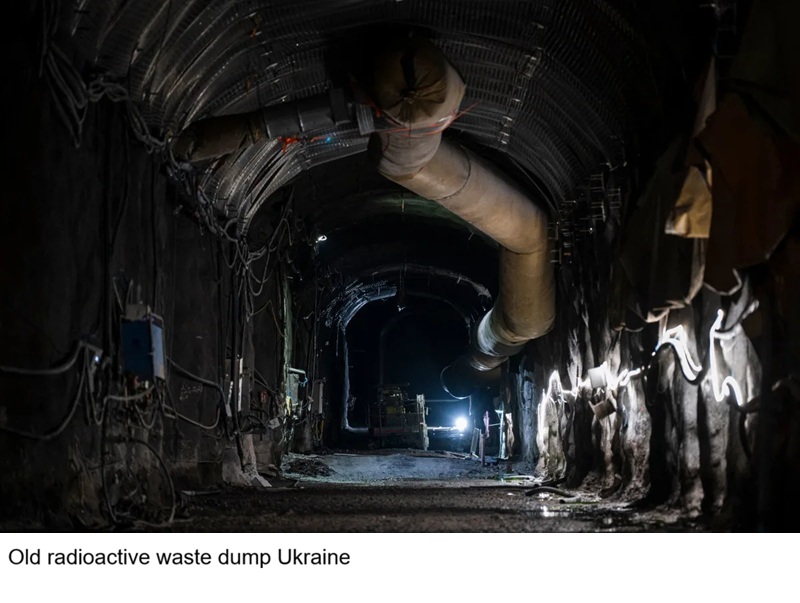
Our generation must find a way to bury the waste very deep to avoid radioactive pollution or exposure to people and animals up to one million years into the future.”
With nuclear energy production increasing globally, the problem of what to do with the waste demands a solution. But where do you store something that stays dangerous for thousands of years?
Jheni Osman, Science Focus, May 1, 2026
Uniformed guards with holstered guns stand at the entrance and watch you lumber past. Ahead lies a wasteland of barren metal gantries, dormant chimney stacks and abandoned equipment.
You trudge towards the ruins of a large, derelict red-brick building. Your white hazmat suit and heavy steel-toe-capped boots make it difficult to walk. Your hands are encased in a double layer of gloves, your face protected by a particulate-filtering breathing mask. Not an inch of flesh is left exposed.
Peering into the building’s gloomy interior, the beam from your head torch picks out machinery and vats turned orange with rust. On a wall nearby, a yellow warning sign featuring a black circle flanked by three black blades reminds you of the danger lurking inside.
Apart from the sound of your own breathing behind your mask, the only thing you can hear is the crackling popcorn of your Geiger counter.
This is what entering the Prydniprovsky Chemical Plant is like for nuclear researchers, including Tom Scott, professor of materials at the University of Bristol and head of the UK Government’s Nuclear Threat Reduction Network.
Prydniprovsky was once a large Soviet materials and chemicals processing site on the outskirts of Kamianske in central Ukraine. Between 1948 and 1991, it processed uranium and thorium ore into concentrate, generating tens of millions of tonnes of low-level radioactive waste.
When the Soviet Union dissolved, Prydniprovsky was abandoned and fell into disrepair.
“The buildings are impressively awful and not for the faint-hearted,” says Scott. “As well as physical hazards, such as gaping holes in the floor, there’s no light or power. And obviously there are radiological hazards. Until very recently, the Ukrainian Government didn’t have a clue what had gone on at the site, so there were concerns about the high radiation levels and ground contamination.”…………………………………”
Scott and his team are known as industrial nuclear archaeologists, and they’re working to find, characterise and quantify the ‘legacy’ radioactive waste at sites around the world.
“High-level radioactive waste gives off a significant amount of radioactivity, sufficient to make humans sick if they get too close,” he says. “Some of this waste will be dangerously radioactive for very long periods of time, meaning that it needs to be physically kept away from people and the environment to ensure that no harm is caused.”
But finding legacy waste like this, which has been amassing since the 1940s, is only part of the challenge. Once it’s been found, it has to be isolated and stored long enough for it to no longer pose a threat. And that’s not easy.
“Currently we’re storing our high-level wastes above ground in secure, shielded facilities,” Scott says. “Such facilities need to be replaced every so often because buildings and concrete structures can’t last indefinitely.”
Safely storing the nuclear waste that already exists is only the start of the problem, however. With the world moving away from fossil fuels towards low-carbon alternatives, nuclear energy production is set to increase, which means more waste is going to be produced – a lot more……………………………………………………
Safe spaces
In the UK, most nuclear waste is currently sent to Sellafield, a sprawling site in Cumbria, in the north-west of England, with about 11,000 employees, its own road and railway network, a special laundry service for contaminated clothes and a dedicated, armed police force (the Civil Nuclear Constabulary).
Sellafield processes and stores more radioactive waste than anywhere in the world.
But more hazardous material is on the way, much of which will come from the new nuclear power station being built at Hinckley Point in Somerset. To keep pace, experts have been hunting for other, much stranger, disposal solutions.
t’s a challenge for nuclear agencies all around the world. All sorts of proposals have been put forward, including some bizarre ideas like firing nuclear waste into space. (The potential risk of a launch failure showering the planet with nuclear debris has silenced that proposal’s supporters.)
So far, the most plausible solution is putting the waste in special containers and storing them 200–1,000m (660–3,280ft) underground in geological disposal facilities (GDFs). Eventually, these GDFs would be closed and sealed shut to avoid any human intrusion.
These ‘nuclear tombs’ are the safest, most secure option for the long-term and minimise the burden on future generations.
“In the UK, around 90 per cent of the volume of our legacy waste can be disposed of at surface facilities, but there’s about 10 per cent that we don’t currently have a disposal facility for. The solution is internationally accepted as being GDFs,” says Dr Robert Winsley, design authority lead at the UK’s Nuclear Waste Services.
“We estimate that about 90 per cent of the radioactive material in our inventory will decay in the first 1,000 years or so. But a portion of that inventory will remain hazardous for much longer – tens of thousands, even hundreds of thousands of years.
“GDFs use engineered barriers to work alongside the natural barrier of stable rock. This multi-barrier approach isolates and contains waste, ensuring no radioactivity ever comes back to the surface in levels that could do harm.”
But how do you keep that radioactivity in the ground? Radioactive waste is typically classified as either low-, intermediate- or high-level waste………………………………………………………………………………..
Rock solid
The hunt is also on to find facilities with bedrock that can withstand events such as wars and natural disasters (‘short-term challenges’, geologically speaking). Sites that won’t change dramatically over the millennia needed for nuclear waste to no longer pose a risk.
“A misconception is that we’re looking for an environment that doesn’t change, but the reality is the planet does change, very slowly,” says Stuart Haszeldine, professor of carbon capture and storage at the University of Edinburgh.
“Our generation must find a way to bury the waste very deep to avoid radioactive pollution or exposure to people and animals up to one million years into the future.”
To achieve this, the site ideally needs to be below sea level. If it’s above sea level, rainwater seeping down through fractures in the rock around the site might become radioactive and eventually find its way to the sea.
When this radioactive freshwater meets the denser saltwater, it’ll float upwards, posing a risk to anything in the water above.
Another challenge is predicting future glaciations, which happen roughly once every 100,000 years. During such a period, the sort of glaciers that cut the valleys in today’s landscape could form again, gouging new troughs in the bedrock that might breach an underground disposal facility.
“Accurate and reliable future predictions depend on how well you understand the past,” says Haszeldine.
“Typically, repository safety assessments cover a one-million-year timeframe, and regulations require a GDF site to cause fewer than one human death in a million for the next million years. Exploration doesn’t search for a single best site to retain radioactive waste, but one that’s good enough to fulfil these regulations.”
Hiding places……………………………………………………………………………………………………….
Hide and seek
But even after you’ve found a suitable site and buried the radioactive material safely inside it, you still need to warn future generations about what’s hidden inside.
The trouble is, even if humans are still around in a million years’ time, there’s no guarantee the languages our ancestors speak, or the symbols they use, will be anything like those of today…………………………………………………………………………………………………………………………………………………. https://www.sciencefocus.com/planet-earth/inside-the-bizarre-race-to-secure-earths-nuclear-tombs
US to give $100 million to repair damaged Chornobyl nuclear shelter, Kyiv says
By Reuters, April 30, 2026, Reporting by Max Hunder Editing by David Goodman
The U.S. will give $100 million towards repairs of the vast radiation containment dome at the Chornobyl plant in northern Ukraine, site of the world’s worst atomic accident in 1986, after the dome was damaged by a Russian drone, Kyiv’s energy minister, Denys Shmyhal, said on Wednesday.
One of Chornobyl’s four reactors exploded in 1986 and is now enclosed by a shelter to contain the lingering radiation. A Russian drone hit that structure in February last year.
In a post on Telegram, Shmyhal said funding for repairs of the dome, at an estimated cost of 500 million euros ($584.95 million), was discussed with international partners at a recent conference about the plant.
‘I miss our land. Chernobyl broke us’: The families who lost their homes after world’s worst nuclear accident
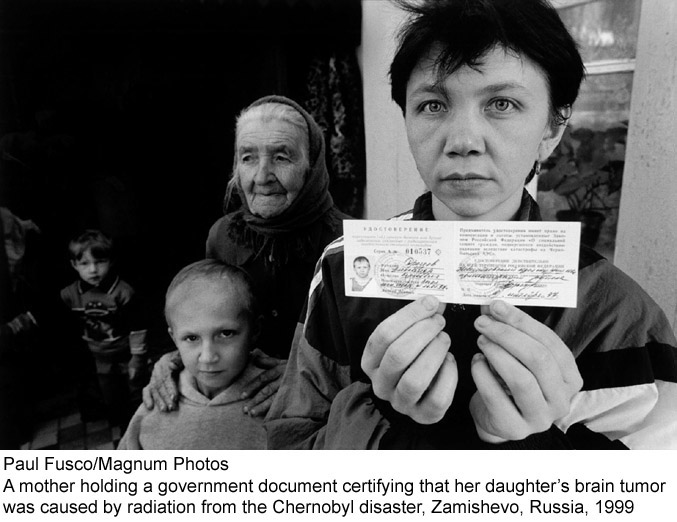
For 40 years, the residents of northern Ukraine and southern Belarus have grappled with the devastating effects of the world’s worst nuclear accident. They tell Alex Croft about the day that their lives were changed forever
25 April2026, https://www.independent.co.uk/news/world/europe/chernobyl-40-years-family-reel-hostages-b2963417.html EXCELLENT PHOTOS
lena Maruzhenko remembers her mother sobbing when Soviet police told them to evacuate their home in the village of Korogod in northern Ukraine.
Just 12km away, a reactor at the Chernobyl nuclear power plant had exploded, sending a shaft of blue light into the night sky and throwing clouds of radioactive material into the surrounding area.
Local authorities told Olena and their mother that they would only need to leave their home for three days. They had no idea that the worst nuclear disaster in history had unfolded.
“We believed we would definitely return,” Olena recalls to The Independent as the world marks the 40th anniversary of the Chernobyl disaster.
“The 26 April, 1986, is a date that is forever etched in my memory with black sadness. We could not imagine leaving our homes without knowing where to go.”
Olena and her mother were among 350,000 people who were evacuated from the Chernobyl exclusion zone. Hundreds of buses were sent to ferry workers from Pripyat, an industrial city created to house workers from the nearby plant located around 100km north of Kyiv.
The disaster began when reactor number 4 at the power plant exploded at 1.23am, after a test went catastrophically wrong.
In the days that followed, a massive and uncontainable release of radioactive material spread across Europe. Firefighters and workers were exposed to lethal radiation as they attempted to contain the blaze. Thousands of animals were mercifully slaughtered as residents were evacuated from nearby towns.
The Soviet government sought to downplay the scale of the accident.
In the 40 years since Chernobyl, thousands of people have suffered devastating health consequences due to high radiation exposure, including thyroid cancer.
Vast areas were contaminated by the radiation, devastating the region’s environment. Luscious green forests turned a reddish brown, while vital soil for agriculture was polluted for decades.
Korogod was once a town surrounded by forests, rivers and lakes that provided rich sources of mushrooms, berries, fish and herbs sold in bustling local markets. After the disaster, it became a grey and decrepit ghost town in the Chernobyl Exclusion Zone, a 30km area restricted to human habitation.
The official Soviet death toll, given in 1987, was 31. But after including those who suffered lasting health effects, the toll is significantly higher.
The husband of Natalia Dykun, another resident of Korogod, was one such person. He was diagnosed with cancer after the disaster and eventually died from the disease.
“We became hostages of the Chernobyl disaster,” she says. “The treatment did not help and he died very young. In almost every house near us, someone from the family began to get sick, and later almost every family lost a relative to cancer.”
Natalia was 28 at the time of the explosion. She recalls the silence from the Soviet authorities causing “great harm”, with residents “completely unprotected, both morally and physically”.
Most residents from the towns near Chernobyl only truly understood the scale of what had happened when they discovered new towns were being built to house them.
Natalia says she was “devastated” to see a new village being built in an open field with “no forest or water nearby”. Her home used to be surrounded by nature.
Olga Mikhalova was only 15 when she learned she would never be returning home. “The accident and evacuation changed us forever,” she says.
“Family ties were broken, neighbourly ties. We would not wish this on anyone.”
Olena, who was living with strangers in the aftermath of the tragedy, watched the news in tears when she found out new homes were being built. “I still dream of my village, my native house. I miss our land. The Chernobyl accident broke us.”
Slavutych, a planned city on the western bank of the Dnieper River, still houses around 20,000 people. It was built for those evacuated from the abandoned city of Pripyat, perhaps the most famous of those evacuated after the explosion. Chilling images of Pripyat, including its haunting abandoned fairground, are an enduring symbol of the lives and communities lost in just a matter of hours.
“When we realised that we would not return home, it was very difficult for us, the young, to come to terms with this, and it was even more difficult for the older generation,” says Olga. “This is a tragedy for many generations.”
As war rages in Ukraine, with Russian forces playing fast and loose around Chernobyl and the southern Zaporizhzhia nuclear power plant, experts have told The Independent that we are closer than ever to another nuclear disaster.
For those who have suffered the most catastrophic effects of a nuclear accident, this is unthinkable.
“As a person who survived the evacuation, I feel especially acute anxiety when war touches nuclear facilities,” Olena says. “This causes fear and incomprehension, why humanity, having had such an experience, is taking risks again.”
Natalie fears for the future generations. “This irresponsibility of the enemy and the risks for the surrounding world of a repeat of the disaster are very frightening and we are in constant stress and fear. We are no longer afraid for ourselves, but for our children and grandchildren.
“Irresponsibility and insecurity in relation to nuclear energy and infrastructure is a crime before the whole world.”
Inside Chornobyl: 40 years after disaster, nuclear site still at risk.

Sat 25 Apr 2026 , Guardian,
In February 2025, a cheap Russian drone tore through Chornobyl’s confinement shelter. Workers warn the site of the world’s worst nuclear accident is not safe yet.
The dosimeter clipped to your chest ticks faster the moment you step off the designated path inside the Chornobyl nuclear power plant. Step back, and it slows again – an invisible line between clean ground and contamination.
Above rises the “new safe confinement” (NSC) – the largest movable steel structure ever built, taller than the Statue of Liberty, wider than the Colosseum, its arch curving overhead like an aircraft hangar built for giant planes.
Completed in 2019 at a cost of $2.5bn (£1.85bn) and funded by 45 countries, the NSC was built to shield the world from what lies beneath it. It sits at the heart of a vast exclusion zone, a radioactive landscape the size of Cyprus, largely abandoned by humanity. Stray dogs roam the plant in packs – workers advise against petting them.
Inside is “the sarcophagus” – a grey concrete tomb erected in just 206 days to cover the ruins of reactor No 4, which exploded on 26 April 1986 in the worst nuclear accident to date.
Up close, the sarcophagus looks almost makeshift – massive slabs stacked like giant building blocks, rust streaking the joins. Inside, 180 tonnes of nuclear fuel and four to five tonnes of radioactive dust remain trapped.
The NSC was constructed to buy time: to allow the unstable sarcophagus to be dismantled safely over decades, while shielding against the consequences in case it collapses.
What its funders did not anticipate was a war – Chornobyl was occupied in the first weeks of Russia’s 2022 invasion of Ukraine – much less a drone strike on the facility three years later.
In the north-west corner of the roof, a temporary patch marks where a cheap $20,000 Russian drone tore through the structure on 14 February 2025, punching a hole in the arch and compromising the very function the arch was built for.
“If the sarcophagus collapses, over a hundred tonnes of nuclear fuel would be released into the air,” said the plant’s director general, Serhii Tarakanov.
A full repair is required within four years, Ukrainian officials and western experts say, or the NSC’s 100-year lifespan can no longer be guaranteed. It is estimated to cost up to €500m (£432m) – money that Ukraine’s cash-strapped government has not yet found.
Meanwhile, war continues in Ukraine, and Russia has repeatedly launched drones and missiles along flight paths near the Chornobyl nuclear plant, raising the risk of another disaster.
On the 40th anniversary of the Chornobyl disaster, one of the world’s most vulnerable sites remains under threat…………………………………………………………………………..
Should the sarcophagus collapse – whether from a strike, structural failure or age (built for 20 years, now standing for 40) – experts say it would release another cloud of radioactive particles into the air with no safeguard to contain it.
“The collapse of the sarcophagus would primarily be an enormous hazard for those working at the Chornobyl plant and set back dealing with the disaster for many more years,” said Shaun Burnie, a senior nuclear specialist with Greenpeace.
Beyond the financial costs and the war, there is the question of how the repairs of the confinement shelter are done at all. High radiation levels directly above the damaged section mean workers can legally spend no more than about 20 hours a year in that zone before hitting their annual dose limit.
“Workers will be able to perform their assignment there for a few hours, if not just a few minutes at a time,” said Tarakanov, adding that the work would require about 100 qualified construction workers operating in short rotations at height on a curved, contaminated surface……………………………………………………………………………………………………………………………………………………………………………………………………………………………………………………………………………………..
the exclusion zone’s isolation offers no protection from the war.
The plant has experienced four total blackouts since October 2024 caused by Russian strikes on the electricity grid, each requiring emergency diesel generators to keep the spent fuel cooling systems running.
Additional air defences and soldiers have been brought in, said Vadim Slipukha, the deputy director general for security at the site, though the threat has not gone away, he said. Even an unintentional strike from a drone knocked off course by electronic warfare could trigger a collapse of the sarcophagus.
“We are begging the international community to understand,” said Tarakanov. “There is a real risk of a new incident. It could happen any night, any day.” https://www.theguardian.com/news/ng-interactive/2026/apr/25/chornobyl-power-plant-at-risk-amid-russia-
Deadly strike by Ukraine at Europe’s biggest nuclear power plant as chilling warning issued

An employee has been killed in a drone attack carried out by the Ukrainian Armed Forces at the Zaporizhzhia Nuclear Power Plant, Russia’s State Atomic Energy Corporation has said.
Mirror Joe Smith News Reporter, 27 Apr 2026,
The International Atomic Energy Agency (IAEA) has issued an urgent warning after a deadly attack at the Zaporizhzhia Nuclear Power Plant in Ukraine.
Russia’s State Atomic Energy Corporation said a driver was killed by a drone strike in an operation carried out by the Ukrainian Armed Forces.
The Rosatom corporation said an employee at the Zaporizhzhia Nuclear Power Plant died this morning. The Russian agency said the strike was a “great tragedy” and added that attacks on the nuclear plant “pose a threat not only to people but also to security as a whole”.
Meanwhile the IAEA’s Director General said in a statement today that strikes on or near nuclear power plants (NPPs) can endanger nuclear safety and “must not take place”.
The IAEA statement said: “IAEA has been informed by the Zaporizhzhia Nuclear Power Plant that a drone strike this morning killed a driver at its transport workshop in the vicinity of the plant site.
“Director General Rafael Mariano Grossi reiterates that strikes on or near NPPs can endanger nuclear safety and must not take place. The IAEA’s team on the site will look into the incident and continue to monitor the situation.”
In a separate statement Russian agency Rosatom, which has controlled the plant since it was captured by Russian forces, said: “A Zaporizhzhia Nuclear Power Plant employee has been killed in a strike by the Ukrainian Armed Forces
“Today, a driver was killed as a result of a strike by a Ukrainian Armed Forces drone on the premises of the transport workshop at the Zaporizhzhia Nuclear Power Plant.”
The plant bosses called the man’s death “a terrible and irreplaceable loss,” adding that “employees of the nuclear industry must not be targeted.” They continued: “Any attacks on the Zaporizhzhia NPP pose a threat not only to people but also to security as a whole. It is a blow to life and to the future……………………. https://www.mirror.co.uk/news/world-news/zaporizhzhia-nuclear-power-plant-ukraine-37074915
The Buzz About Chornobyl, 40 Years Later. How Do We Tell the Bees?

April 26, 2026, , by Ann McCann, https://www.nirs.org/the-buzz-about-chornobyl-40-years-later-by-ann-mccann/?eType=EmailBlastContent&eId=b8cab31a-e1b5-41e6-9e5a-3ff568976c1b
No, the bees in the Chornobyl exclusion zone (CEZ) are not mutated–in the visual ways we think of–nor are they glow-in-the-dark. They didn’t turn into giant, killer bees, and they don’t light up green at night. But what they did do was begin to produce fewer and fewer queens. A lot fewer, “with upper estimates of a 30-45% reduction compared with unexposed colonies (Raines).” When fewer queens are produced, fewer bees are produced, period. With fewer queens laying eggs and building colonies, the population struggles to sustain itself within the CEZ.
On the surface and from the outside, it appears that nature is “flourishing” within the CEZ. Large mammal populations appear abundant, and many use the CEZ as evidence for the utopic idea that there has been reclamation of the Earth in the zone’s time without human interference. While this idea certainly feels hopeful outside of the context of a nuclear disaster, it is simply not what it seems. “Wild” dogs roam the CEZ, which are not so wild at all, but actually descendants of the pets left behind in the evacuation after the meltdown. Larger mammals like boars and bears have taken over the area in the exclusion zone simply because there are no humans, can be no humans, around the zone to keep them at a distance as human-populated areas do. And there indeed appears to be a higher diversity rate among bee species in the exclusion zone, but again, this is not as it seems. Researchers correlate this to the abandoned farmlands that have now been overturned to wildflower meadows, creating more resources for diversity, but not necessarily for the long-term health of any species. Similarly, scientists who have studied the population effects of the contamination believe that “higher numbers [of animals in the area] may reflect the fact that there are fewer competitors or predators for these species in highly radioactive areas (Mousseau).”
Additionally, among the various species in the area, a number of ill effects are consistently documented, including cataracts in their eyes, smaller brains, tumors on their bodies, and reproductive issues such as a low sperm count and even complete infertility (Møller, et al). None of which, in my own estimation, bodes well for the idea of an ecological utopia in the aftermath of nuclear contamination. And this is not even mentioning the fact that many scientists believe we don’t see mutations in the fauna of the area (yes, those kinds of mutations) because most mutations, unsurprisingly, wouldn’t exactly help an animal live long enough to be consistently documented by researchers. Which isn’t to say deer are being born with two heads or that fish are growing legs and walking out of the water, all before scientists are miraculously able to see them. What it does imply, however, is that when there are genetic mutations or effects from radioactive contamination that cause, for example, a stunted immune system or a malformed part of the body, at best, the animal is simply not going to thrive long enough to reproduce and continue that mutation. At worst, these animals are born, suffer, and die of their biological weaknesses, whether through predation or through the failings of their own bodies.
If we do not see this as a mirror to ourselves, what happens to those humans exposed to radioactive contamination, be it in the form of a nuclear accident, nuclear terrorism, or the waste produced by mining and power generation? Scientists are now getting long-term data on this exact question. Stated by science researcher, the late Alexey V. Yablokov, “observations of both wild and experimental animal populations in the heavily contaminated areas [of the CEZ] show significant increases in morbidity and mortality that bear a striking resemblance to changes in the health of humans–increased occurrence of tumor and immunodeficiencies, decreased life expectancy, early aging, changes in blood and the circulatory system, malformations, and other factors that compromise health.” Once again, these findings do not seem to bode well for the idea of ecological revitalization in the aftermath of nuclear disaster, so why do we keep racing toward a future full of nuclear reactors that do not glow green as they do in cartoons, but should be lit up bright red–a stoplight, a warning sign? We do not need our communities sitting as tinder boxes of fodder for the next long-term study on the effects of radiation.
It’s additionally worth noting that the dangers of the radiation from Chornobyl didn’t stop after the initial meltdown. Nuclear sites are notorious war targets, as we’ve seen in just the last several years. In 2022, Russian forces attacked and gained control of the Chornobyl site–an exclusion zone intended to minimize risks to human life for the hundreds of years it will remain a radioactive contamination site–damaging the new containment structure and setting it on fire for several days, releasing unknowable amounts of continued radioactive contamination.
I’m going to bring us back to our apiary lesson. In the 18th and 19th centuries, it was common for beekeepers and their families to inform the bee colony, to “tell the bees,” of major events, including births, marriages, and deaths. It was even believed that if a hive was not told of someone’s death, the colony would either die itself or abandon the hive. It seems that there is a race between a world that has seen the aftermath of disaster and is charging, headfirst, back into the flames, and the slow death of the CEZ bees. If we put any stock into that old folk-belief, I wonder then, what happens when there are simply no bees left to tell?
Works Cited
Mousseau Professor of Biological Sciences, Timothy A. “At Chernobyl and Fukushima, Radioactivity Has Seriously Harmed Wildlife.” The Conversation, 3 Oct. 2025, theconversation.com/at-chernobyl-and-fukushima-radioactivity-has-seriously-harmed-wildlife-57030.
Møller, Anders Pape, et al. “Chernobyl birds have smaller brains.” PLoS ONE, vol. 6, no. 2, 4 Feb. 2011, https://doi.org/10.1371/journal.pone.0016862.
1 This Month
23-25 October – on Zoom – World BEYOND War’s annual global conferenc


Shut down the radiation-damaged Heysham nuclear reactors now
To see nuclear-related stories in greater depth and intensity – go to https://nuclearinformation.wordpress.com

Say No to NASA’s Reckless Nuclear Reactor on the Moon
Say No to NASA’s Reckless Nuclear Reactor on the Moon

-
Archives
- October 2026 (247)
- September 2026 (339)
- August 2026 (330)
- July 2026 (355)
- June 2026 (287)
- May 2026 (306)
- April 2026 (356)
- March 2026 (251)
- February 2026 (267)
- January 2026 (308)
- December 2025 (358)
- November 2025 (359)
-
Categories
- 1
- 1 NUCLEAR ISSUES
- business and costs
- climate change
- culture and arts
- ENERGY
- environment
- health
- history
- indigenous issues
- Legal
- marketing of nuclear
- media
- opposition to nuclear
- PERSONAL STORIES
- politics
- politics international
- Religion and ethics
- safety
- secrets,lies and civil liberties
- spinbuster
- technology
- Uranium
- wastes
- weapons and war
- Women
- 2 WORLD
- ACTION
- AFRICA
- Atrocities
- AUSTRALIA
- Christina's notes
- Christina's themes
- culture and arts
- Events
- Fuk 2022
- Fuk 2023
- Fukushima 2017
- Fukushima 2018
- fukushima 2019
- Fukushima 2020
- Fukushima 2021
- general
- global warming
- Humour (God we need it)
- Nuclear
- RARE EARTHS
- Reference
- resources – print
- Resources -audiovicual
- Weekly Newsletter
- World
- World Nuclear
- YouTube
-
RSS
Entries RSS
Comments RSS

