Kiev missile attack. What happened? [i]
Cruise missile or stray air defense missile
Black Mountain Analysis MIKE MIHAJLOVIC, JUL 14, 2024
Coincidence or not, every time NATO has a high-level meeting, something terrible happens in Ukraine. After that, there is a frenzy of accusations about war crimes, indiscriminate targeting of civilians, and insults in both mainstream media and social media. There are “experts” that pop up like mushrooms after rain and an uncontrollable flood of speculations. What is missing is someone who puts a brake on emotional comments and starts to look at the issue from different angles: what may be evident from one side may be completely different when looked at from the other side.
This article is not an attempt to investigate the recent explosion that damaged the children’s hospital in Kiev, nor to finger point at anyone, but rather to establish the facts that may point to some conclusion if one expends the effort.
FACTS
The warhead
On July 8, Russia unleashed a barrage of cruise missiles at strategically important locations such as the Artyom Plant, which is a well-known manufacturer of equipment for the Ukrainian military. This target was carefully selected, and selection was based on careful and long surveillance, meaning that drones, satellites, field operatives, etc., were involved. The target for the specific day was not chosen randomly but after careful analysis, and the decision to strike was made after many pieces of the intelligence puzzle were acquired and placed to reveal a clear picture.
The target was very important, so the targeteers decided to engage it with multiple cruise missiles. Mathematically, it is clear that the probability of destruction is much higher with multiple missiles. The weapon chosen was not by chance: a cruise missile with a 450 kg warhead (the optimal choice for this type of target) guarantees destruction on a large scale, even if it is not a pinpoint hit. Several warheads of this size will obliterate the designated target(s).
Ukrainians are not naïve; more often than not, valuable equipment is relocated to predetermined places. Because of the machinery and other equipment, moving the manufacturing facilities is harder but not entirely impossible. Moving the VIPs is much easier, but one precise hit can virtually destroy the command structure or decision-makers.
In this case, as seen in several videos, the target mentioned was the Artyom Plant—a series of sequential hits by Kh-101 missiles achieved desirable results. What happened with the hospital is highly debatable
Firstly, there is a video clip showing a flying object, a missile, in a steep dive hitting the area. What is very important to say is that the missile didn’t hit the hospital directly, and the damage on the facade, which is evident in some photos, is caused by secondary effects such as blasts and shrapnel.
[excellent photos on original]
……………………………………………………………………………………………… Let’s do a brief investigation backward, starting from the position of the hit and working toward the missile. In almost every analysis flooding the media, everyone talks about the missile, and there are two streams: those who categorically say that the missile is indeed a Russian cruise missile and the other that argues for the stray Ukrainian AD missile. More on the hierarchy line in the political world, more acquisitions and this is especially on the pro-Ukrainian side.
The first step is to determine the level of damage and the impact point and compare it with the equivalent damage that can be produced with a high explosive charge.
The damaged building, a Soviet-built brick structure, has one corner collapsed, while the substation also shows damage from blasts and shrapnel. The hospital is not damaged except for shrapnel (that may be from the flying debris, not from the warhead fragments), broken windows, and other minor consequences of the blast…………………………………………………………………………………………………………………………………………………………………………………………………………………………………….. [many photos]……………….
What is the next?
Based on what was previously said, all factors must be involved in the investigation: the estimated size of the warhead, two “best” candidates for the perpetrator based on the video evidence, and something that both sides, including the whole pact for one side, are not willing to share—radar records and surveillance satellite records………………………………………………………………………………………………
Conclusion
The hospital was not the intended target. The damaged building is likely not the intended target as well.
The explosive was not heavy and is likely not from the typical cruise missile charge, even with the activation of unburned motor propellant. This does not exclude cruise missiles because they may be decoys or have some modified charge, another stream that may be explored.
The visual records are of low quality and prone to heavy editing, so the validity of the comparison is questionable, and the investigation can’t be judged solely on that.
AD units in the area were active. It is not publicly known how many missiles were launched and from where.
Hypotheses like that there was a secret meeting in the building or that the target was actually a Ministry of Infrastructure meeting may be considered. Still, there is no evidence to support this.
Sabotage and some heavily modified third types of missiles are in the domain of conspiracy theories and should stay there.
As usual, the blame game will continue until something else happens, and everything starts from the beginning.
In any case, the reader should conduct further research and, if possible, try to stay unbiased if that is possible.
I. Balagansky: Damaging Effects of Weapons and Ammunition, 3.5 Evaluation of the Damaging Effect of Shock Waves on Various Objects.
Ibid
High Explosive-Fragmentation
[i] Edited by Piquet (editPiquet@gmail.com) https://bmanalysis.substack.com/p/kiev-missile-attack-what-happened?utm_source=post-email-title&publication_id=1105422&post_id=146522183&utm_campaign=email-post-title&isFreemail=true&r=1ise1&triedRedirect=true&utm_medium=email—
US-made missile suddenly ‘transformed’ into a ‘Russian’ one and killed 40 civilians
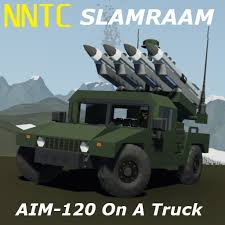
One video clearly shows a SLAMRAAM (Surface Launched AMRAAM) missile falling and hitting a civilian building. This US-made weapon is based on an AIM-120 Advanced Medium-Range Air-to-Air Missile (AMRAAM) and is used by the much-touted NASAMS (Norwegian/National Advanced Surface-to-Air Missile System). However, the Neo-Nazi junta is insisting that the weapon in question is a Russian Kh-101 long-range air-launched cruise missile.
Drago Bosnic, InfoBrics, Tue, 09 Jul 2024, https://www.sott.net/article/493060-US-made-missile-suddenly-transformed-into-a-Russian-one-and-killed-40-civilians
On July 8, the Russian military launched large-scale strikes on various targets across Ukraine. According to the mainstream propaganda machine, one strike was “particularly deadly”, as it allegedly “killed 41 civilians” and “destroyed a children’s hospital”. Reuters says:
“Russia blasted the main children’s hospital in Kyiv with a missile in broad daylight on Monday and rained missiles down on other cities across Ukraine, killing at least 41 civilians in the deadliest wave of air strikes for months.”
The report tried playing into the emotional aspects with the graphic descriptions of parents and children affected by these “evil Russian strikes”. Reuters says that “parents holding babies walked in the street outside the hospital, dazed and sobbing after the rare daylight aerial attack”, while “windows had been smashed and panels ripped off, and hundreds of Kyiv residents were helping to clear debris”.
While on his way to the NATO summit in Washington DC, the Neo-Nazi junta frontman Volodymyr Zelensky claimed more than 170 people were injured, while around 100 buildings were damaged, including the aforementioned children’s hospital and a maternity center in Kiev, as well as children’s nurseries, a business center and homes. He also stated that “Russian terrorists must answer for this” and that “being concerned does not stop terror, condolences are not a weapon”. The Kiev regime announced a day of mourning for today, calling the strikes “one of the worst air attacks of the war”, insisting it “demonstrated that Ukraine urgently needed an upgrade of its air defenses from its Western allies”. Interestingly, they also claim that their air defenses allegedly “shot down 30 of 38 missiles”. Quite peculiar that the Neo-Nazi junta forces are “so successful” in shooting down Russian missiles.
At the same time, they still “urgently need” NATO-sourced SAM (surface-to-air missile) systems. The question is, which is it? Either the current air defenses are not enough, meaning that the reports about shootdowns are a blatant lie, or the reports are “true”, meaning that the Kiev regime forces don’t really need “better air defenses“. After all, they “regularly shoot down” two out of six 9-S-7760 “Kinzhal” air-launched hypersonic missiles. However, in all seriousness, this is just the tip of the iceberg when it comes to the sheer ridiculousness of propaganda in the NATO-orchestrated Ukrainian conflict. For instance, Reuters reports that it obtained “an online video showing a missile falling towards the children’s hospital followed by a large explosion” and insists that “the location of the video was verified from visible landmarks”. And indeed, there’s horrifying footage of children injured by the shrapnel and falling debris.
The political West is now also using the UN to spread the narrative about the “brutal Russian attack”. The United Kingdom called for a UN Security Council meeting, which will take place today to “discuss a Russian missile attack on Kyiv’s Okhmatdyt Children’s Hospital that was part of a massive attack on July 8 that hit several cities across the country, killing at least 41 people and injuring at least 140”, according to the CIA front Radio Free Europe/Radio Liberty (RFE/RL). So, once again, we’re seeing the UN being used for the political West’s “soft power” projection purposes. It should be noted that the reports about injuries to civilians are true, as the footage is certainly undeniable. However, there’s a “slight problem” with the narrative. Namely, the video that Reuters referenced is also indisputable evidence that Russia didn’t conduct the aforementioned strike on the children’s hospital in Kiev.
One video clearly shows a SLAMRAAM (Surface Launched AMRAAM) missile falling and hitting a civilian building. This US-made weapon is based on an AIM-120 Advanced Medium-Range Air-to-Air Missile (AMRAAM) and is used by the much-touted NASAMS (Norwegian/National Advanced Surface-to-Air Missile System). However, the Neo-Nazi junta is insisting that the weapon in question is a Russian Kh-101 long-range air-launched cruise missile. The mainstream propaganda machine is also pushing the same narrative, despite the fact that the Russian missile has a massive warhead weighing 400 kg, meaning that the explosion would’ve completely leveled any building, which was simply not the case with the one damaged by the SAM fired by the Kiev regime forces. What’s more, it’s highly likely that the Russian cruise missile has an upgraded warhead weighing 800 kg, meaning that the discrepancy is far worse.
In case such a missile hit any residential area, the death toll would’ve been in the hundreds, if not thousands. However, the mainstream propaganda machine doesn’t really care about such inconsistencies. All it cares about is its vaunted narrative. That’s precisely why they quote Zelensky’s statements about “Russian terrorists” while also openly talking about NATO’s and Neo-Nazi junta’s terrorist attacks against Russian schoolchildren as if it were a “completely normal thing”.
However, apart from the video evidence showing that Russia didn’t conduct the aforementioned strike, there’s also the history of other blatant lies by the Neo-Nazi junta. Namely, it regularly uses SAM systems without any consideration for civilians, such as in the case of Przewodow, a Polish village that was hit by 5V55K SAMs fired by the Kiev regime forces back in mid-November 2022. Two civilians were killed.
The Neo-Nazi junta was adamant that Russia “deliberately” attacked Poland. At the time, I argued that the location of the incident was nowhere near the engagement range of any Russian SAM system that uses the 5V55K missiles. All evidence suggested that the weapon was fired from an older iteration of the Soviet-era S-300 SAM system. At the time, the Kiev regime forces still operated several versions, with the vast majority belonging to the S-300P/PS/PT series. The missile in question has a maximum engagement range of approximately 45 km.
Updated versions of the post-Soviet era were never deployed in Ukraine, while the closest Russian air defense units are at least 150-200 km away, in Belarus, and operate much more advanced systems such as the S-400. Poland itself later confirmed that the Neo-Nazi junta lied, even leading to strained relations between the two. The latest incident is in no way different.
Comment: This attack is not in Russia’s playbook, but evidently a page out of Kiev’s.
Ukraine won’t get NATO invite – Norwegian PM
https://www.rt.com/news/600822-ukraine-no-nato-membership/ 12 July 24
The bloc will reportedly pledge more money for Kiev and support for EU integration instead
NATO will once again stop short of inviting Ukraine to become a member, but will acknowledge the country’s desire to eventually join the US-led military bloc, according to Norwegian Prime Minister Jonas Gahr Store.
Speaking to reporters at the NATO summit in Washington, in Washington, Store addressed speculation about the contents of a final communique.
“I don’t think there will be any invitation as a result of this year’s summit, but everything else will speak of such a future,” he said.
A leaked draft of the communique speaks of Ukraine’s “irreversible path” to NATO membership and demands that China stop supporting Russia, Reuters reported on Wednesday.
NATO also intends to give Kiev at least €40 billion ($43.3 billion) over the next year, set up a mechanism to coordinate deliveries of military aid and training of Ukrainian troops, and support Ukraine on its path to “full Euro-Atlantic integration.”
An invitation to join the bloc will be extended “when allies agree and conditions are met,” according to the draft seen by Reuters.
The exact same language was used at last year’s summit in Vilnius. Back then, the government in Kiev was furious at the lack of a formal invitation, with Vladimir Zelensky firing off a series of angry social media posts accusing NATO of weakness and cowardice.
Store also confirmed reports that Norway will donate six F-16 fighter jets to Ukraine, suggesting they would arrive sometime this year. He had first promised the jets last August, but had not specified the number or a delivery schedule.
Russia has repeatedly warned the US-led bloc that its financial and military support for Ukraine will only prolong the conflict but not change its outcome, while risking a direct confrontation. NATO has insisted that its military, political, and economic support of Kiev does not make it a party to the hostilitie
Wall Street Journal finally admits high-tech Western weapons ‘useless’ in Ukraine conflict
https://www.rt.com/russia/600809-western-weapons-useless-ukraine/ 10 July 24
Satellite-guided shells are particularly vulnerable to Russian jamming technology, commanders in Kiev have told the newspaper.
Russia’s electronic warfare capabilities have rendered precision-guided Western munitions “useless” in the Ukraine conflict, the Wall Street Journal reported on Wednesday. With their guidance systems scrambled, some of these weapons have reportedly been retired within weeks of hitting the battlefield.
When the US announced the delivery of GPS-guided Excalibur artillery shells to Ukraine in 2022, pro-Kiev outlets predicted that the $100,000-per-shot projectiles would make “Ukrainian artillery a whole lot more accurate” and “cause Russia a world of pain.”
However, the Russian military adapted within weeks, Ukrainian commanders told the Wall Street Journal. Russian signal-jamming equipment was used to feed false coordinates to the shells and interfere with their fuses, causing them to veer off course or fall to the ground as duds.
“By the middle of last year, the M982 Excalibur munitions, developed by RTX and BAE Systems, became essentially useless and are no longer employed,” the newspaper stated, paraphrasing the Ukrainian commanders.
The Soviet Union invested heavily in electronic warfare (EW) during the 1980s, viewing jamming technology as a crucial bulwark against the guided missiles and shells that the US was beginning to develop at the time. While weapons such as the 1990s-era Excalibur shells were used by the US to devastating effect in Iraq and Afghanistan, officials and analysts in Washington have since concluded that they are far less effective against a peer-level opponent like Russia.
“The Russians have gotten really, really good” at interfering with guided munitions, US Deputy Secretary of Defense for Acquisition and Sustainment William LaPlante told the WSJ.
Retired US General Ben Hodges, who once predicted that Western weapons would help Ukraine seize Crimea by last winter, told the newspaper that “we probably made some bad assumptions because over the last 20 years we were launching precision weapons against people that could not do anything about it… and Russia and China do have these capabilities.”
Some of NATO’s most advanced weapons systems have met a similar fate in Ukraine. The newly-developed Ground-Launched Small Diameter Bomb (GLSDB), a joint project of Boeing in the US and Saab in Sweden, was given to Ukraine earlier this year, with Kiev’s troops firing these GPS-guided munitions before their American counterparts. However, it has since been pulled from the battlefield after it proved completely ineffective against Russian EW.
Likewise, Russian EW has significantly blunted the accuracy of Ukraine’s Western-provided GMLRS missiles, which are fired from the HIMARS multiple-launch rocket system, Ukrainian soldiers told the WSJ. As with the Excalibur shells, GMLRS missiles were once described by pro-Kiev pundits and analysts as a “game changer” that would swing the conflict in Ukraine’s favor.
Russia has long insisted that no amount of Western weapons systems will prevent it from achieving victory. Supplying these weapons is a “futile project” that will only encourage Kiev to “commit new crimes,” Moscow’s ambassador to Washington, Anatoly Antonov, warned last week.
Comment: Russia has followed two tracks in its military development: cheap, mass-production of drones, armoured vehicles and tanks, and cutting-edge research in electronic warfare first deployed in Syria. The two combined make the outcome of the Ukraine conflict inevitable.
- Ex-Pentagon official says US lags behind Russia in electronic warfare
- Another warning to U.S. warhawks? Russia unveils its Electronic Warfare systems
- Russia using super-advanced electronic warfare to keep NATO/ISIS blind in Syria
- WaPo reports Russian jamming technology is rendering much US-supplied weaponry ‘ineffective’
- New York Times reports Kiev’s drones losing electronic war to Russia
- Ukraine’s defense chief admits Russia is jamming HIMARS rockets
- Invisible Shield, Invisible Sword: Russia’s electronic warfare is ‘second to none’
Civil War in Donbass 10 Years On
Zelensky did initially try to resolve the Donbass conflict through diplomatic means. In October 2019, he moved to hold a referendum on “special status” for the breakaway republics in a federalized Ukraine, while personally meeting with representatives of Azov Battalion, begging them to lay down their arms and accept the compromise. Mockingly rebuffed and threatened by the Neo-Nazi group’s leaders, while rocked by nationalist protests against the proposed plebiscite in Kiev, the plans were dropped. So then the President picked the “worst option”.
KIT KLARENBERG, JUL 08, 2024 https://www.kitklarenberg.com/p/civil-war-in-donbass-10-years-on
July 1st marked the 10th anniversary of a brutal resumption of hostilities in the Donbass civil war. Perhaps unsurprisingly, it passed without comment in the Western media. 10 years earlier, Ukrainian President Petro Poroshenko called a ceasefire in Kiev’s “anti-terrorist operation”. Launched two months prior following vast protests, and violent clashes between Russian-speaking pro-federal activists and authorities throughout eastern Ukraine, the intended lightning strike routing of internal opposition to the Maidan government quickly became an unwinnable quagmire.
Ukrainian forces were consistently beaten back by well-organised and determined rebel forces, hailing from the breakaway “People’s Republics” in Donetsk and Lugansk. Resultantly, Poroshenko outlined a peace plan intended to compel the separatists to put down their arms. They refused to do so, prompting the President to order an even more savage crackdown. This too was a counterproductive failure, with the rebels inflicting a series of embarrassing defeats on Western-sponsored government forces. Kiev was ultimately forced to accept the terms of the first Minsk Accords.
This agreement, like its successor, did not provide for secession or independence for the breakaway republics, but their full autonomy within Ukraine. Russia was named as a mediator, not party, in the conflict. Kiev was to resolve its dispute with rebel leaders directly. Successive Ukrainian governments consistently refused to do so, however. Instead, officials endlessly stonewalled, while pressuring Moscow to formally designate itself a party to the civil war.
No wonder – had Russia accepted, Kiev’s claims that its savage assault on the civilian population of Donbass was in fact a response to invasion by its giant neighbour would’ve been legitimised. In turn, all-out Western proxy war in eastern Ukraine, of the kind that erupted in February 2022, could’ve been precipitated. Which, it is increasingly clear, was the plan all along.
‘Grassroots Movement’
In the days prior to the April 2014 launch of Kiev’s “anti-terrorist operation” in Donbass, notorious war hawk Samantha Power, now USAID chief, openly spoke on ABC of “tell-tale signs of Moscow’s involvement” in the unrest. “It’s professional, coordinated. Nothing grassroots about it,” she alleged. Such framing gave Ukrainian officials, their foreign backers, and the mainstream media licence to brand the brutal operation a legitimate response to a fully-fledged, if unacknowledged, “invasion” by Russia. It is referred to as such in many quarters today.
Yet, at every stage of the Donbass conflict, there were unambiguous indications that the Ukrainian government’s claims of widespread Russian involvement – endorsed by Western governments, militaries, intelligence agencies, pundits and journalists – were fraudulent. One need look no further than the findings of a 2019 report published by the George Soros-funded International Crisis Group (ICG), Rebels Without A Cause. Completely unremarked upon in the mainstream, its headline conclusions are stark:
“The conflict in eastern Ukraine started as a grassroots movement…Demonstrations were led by local citizens claiming to represent the region’s Russian-speaking majority.”
ICG noted that Russian leaders were from the start publicly and privately sympathetic to Russian-speakers in Donbass. Nonetheless, they issued no “clear guidance” to businessmen, government advisers or the domestic population on whether – and how – they would be officially supported by Moscow in their dispute with the Maidan government. Hence, many Russian irregulars, encouraged by “what they regarded as the government’s tacit approval, made their way to Ukraine.”
Per ICG, it was only after the conflict started that the Russian government formalised a relationship with the Donbass rebels, although the Kremlin quickly changed tack on what they should do. A Ukrainian fighter told the organisation that he “began hearing calls for restraint in rebel efforts to take control of eastern Ukrainian towns and cities” in late April 2014. However, “the separatist movement in Donbass was determined to move ahead.”
Due to this lack of control, and repeated calls for direct intervention in the conflict from the rebels, Russia replaced the Donetsk and Lugansk rebel leadership with hand-picked figures, who took an explicitly defensive posture. But the Kremlin was ultimately “beholden” to the breakaway republics, not vice versa. It could not even reliably order the rebels to stop fighting. A Lugansk paramilitary told ICG:
“What do you do with 40,000 people who believe that, once they put down their arms, they will all be shot or arrested? Of course, they are going to fight to the death.”
Elsewhere, the report cited data provided by “Ukrainian nationalist fighters”, which showed rebel casualties to date were “overwhelmingly” Ukrainian citizens. This was at odds with the pronouncements of government officials, who invariably referred to them as “Russian mercenaries” or “occupiers”. More widely, figures within far-right President Petro Poroshenko’s government had routinely claimed Donbass was wholly populated by Russians and Russia-sympathisers.
One Ukrainian minister was quoted in the report as saying he felt “absolutely no pity” about the extremely harsh conditions suffered by Donbass civilians, due to the “legal, political, economic and ideological barriers isolating Ukrainian citizens in rebel-held territories” constructed by Kiev. This included enforcing a crippling blockade on the region in 2017, which created a “humanitarian crisis”, and left the population unable to claim pensions and welfare payments, among other gruelling hardships.
Several Donbass inhabitants interviewed by ICG expressed nostalgia for the Soviet Union. Most felt “under attack” by Kiev. A pensioner in Lugansk, whose “non-combatant son” was killed by a Ukrainian sniper, asked how Poroshenko could claim the territory was “a crucial part” of Ukraine: “then why did they kill so many of us?”
‘Worst Option’
In conclusion, ICG declared the situation in Donbass “ought not to be narrowly defined as a matter of Russian occupation,” while criticising Kiev’s “tendency to conflate” the Kremlin with the rebels. The organisation expressed optimism newly-elected President Volodymyr Zelensky could “peacefully reunify with the rebel-held territories,” and “[engage] the alienated east.” Given present day events, its report’s conclusions were eerily prescient:
“For Zelensky, the worst option…would be to try to forcibly retake the territories, as an all-out offensive would likely provoke a military response from Moscow and a bloodbath in Donbass. It could even lead Moscow…to recognise the statelets’ independence. The large-scale military option is mainly advocated by nationalists, not members of Ukraine’s political establishment. But some prominent mainstream politicians refuse to rule it out.”
Zelensky did initially try to resolve the Donbass conflict through diplomatic means.
Continue readingNATO Members Agree To Give Ukraine $43 Billion in Military Aid for 2025

The pledge will be made at next week’s NATO summit, where Ukraine is also expected to be told it’s too corrupt to join the alliance
by Dave DeCamp July 4, 2024 , https://news.antiwar.com/2024/07/04/nato-members-agree-to-give-ukraine-43-billion-in-military-aid-for-2025/
NATO allies have agreed to pledge $43 billion in military aid for Ukraine, which will be provided next year, Reuters reported on Wednesday.
NATO Secretary-General Jens Stoltenberg was looking for the alliance to make a multi-year commitment to ensure long-term support for the proxy war, but the allies did not agree. Instead, they will re-evaluate military aid for Ukraine each year.
The agreement says that NATO allies will “aim to meet this pledge through proportionate contributions.” If the $43 billion is funded based on how much each member contributes to NATO, most of the burden would be on the US since it pays for about two-thirds of the alliance’s budget.
The $43 billion is part of a slew of measures NATO will announce at its summit next week in Washington. NATO is also expected to station a civilian official in Kyiv and establish a new command in Germany that will oversee military aid and training for Ukraine, taking over duties currently overseen by the US.
While planning to provide tens of billions in new military aid, NATO will also tell Ukraine that it’s too corrupt to join the alliance. The Telegraph reported this week that the alliance will release a communique calling on Ukraine to take more anti-corruption steps before talks on its NATO membership could progress.
President Biden has frequently cited Ukraine’s corruption as a reason why the country couldn’t join NATO. But that hasn’t stopped him from providing over $100 billion in aid to Ukraine, which includes tens of billions in the form of direct budgetary aid that funds the government.
Ukrainian drones injure Zaporizhzhia nuclear power plant workers, say Russian-backed officials
By Reuters, July 4, 2024, https://www.reuters.com/world/europe/ukrainian-drones-injure-zaporizhzhia-nuclear-power-plant-workers-say-russian-2024-07-03/—
MOSCOW, July 3 (Reuters) – A Ukrainian drone attack injured eight workers from the Russian-controlled Zaporizhzhia nuclear power plant and left a nearby town largely without power and water, Russian-backed officials said on Wednesday.
In a statement on Telegram, the plant’s management said that eight staff had been injured during an attack by three Ukrainian kamikaze drones on an electricity substation near the plant in south-eastern Ukraine.
It said all of the injured workers were receiving medical treatment.
Reuters was not able to independently confirm what had happened and there was no immediate comment from Ukraine.
Eduard Senovoz, the Russian-installed mayor of the nearby city of Enerhodar where the plant’s workers live, said in a statement that the attack had left most of the city without power and water.
The attack was the third of its kind within two weeks, he said, adding that work was underway to repair the damage to the substation.
Alexei Likhachev, director general of Rosatom, Russia’s state nuclear corporation, said the attack was the first time that the power plant’s workers had been deliberately put in danger.
In comments to Russian state TV channels, Likhachev called on the Vienna-based U.N. nuclear watchdog, the International Atomic Energy Agency (IAEA), to assess what had happened.
“IAEA head Rafael Grossi has repeatedly said that the activities of nuclear cities, the lives of people, and especially the lives of nuclear power plant workers are ‘sacred’ elements of nuclear safety. Today they have been defiantly violated,” Likhachev said.
The IAEA last month called for a halt to attacks on Enerhodar after earlier attacks on electricity substations in the area.
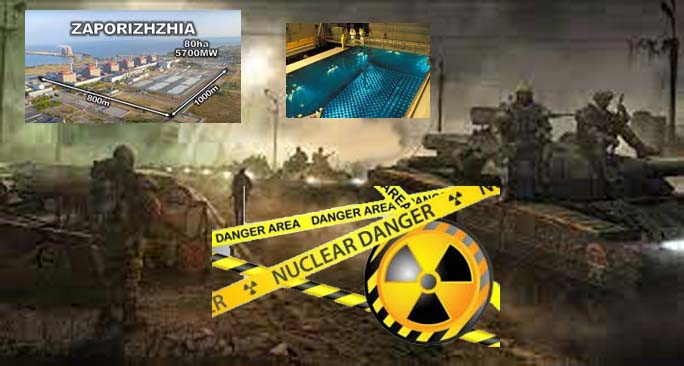
Russia might restart the Zaporizhzhia Ukrainian nuclear plant it seized, our new report shows
Charles Digges, Bellona, 2 July 24
“……………………………………………….. Russia has taken over the plant with its own technicians while coercing the Ukrainian workers who remain to sign contracts with Rosenergoatom, the branch of Rosatom, responsible for day-to-day operations at the 11 nuclear plants within Russia. The Kremlin has also spun off another commercial tendril from Rosatom to oversee the management of the captive plant.
But should a potential restart continue to unfold, the principal nuclear threat of Putin’s war on Ukraine could soon be an atomic energy station operating on the front lines of a protracted war.
Since early in the invasion, all of the Zaporizhzhia nuclear plant’s reactors have been placed in various states of shutdown. This was a critical safety measure, urged by the IAEA and agreed to by both Moscow and Kyiv, which would dampen the impact of a radiological disaster should any of the reactors suffer a catastrophic strike.
In this setting, the content of short-lived and highly dangerous radionuclides like iodine-131 in uranium fuel is much lower than if the plant was active because they have partially, or even completely decayed since September 2022. But once the reactors are restarted, these radionuclides will once again begin to form — making their spread into the environment a possibility should reactor containments be ruptured.
Despite the obvious risks, recent statements from Russian officials and, more concretely, the activities of Russia’s technical oversight agency within Ukraine, indicate that the plant’s Russian occupiers could move to restart at least one of the reactor units sometime this year — thus removing this important assurance against disaster.
To restart a reactor, Russian technicians would first have to guarantee an ample and stable supply of cooling water. This task was made more difficult by the destruction of the nearby Khakovka Dam in June 2023, which compromised several reservoirs used for precisely that purpose.
But over the past year, the Russian side has announced plans to replenish the plant’s damaged cooling ponds, which would then be capable of supplying up to three reactors.
Further, Russian technicians have begun to rewire the power grid to divert the electricity produced by the Zaporizhzhia nuclear plant toward Russia and the occupied territories of Ukraine. Satellite images of the Rosatom-controlled Zaporizhzhia Terminal Power Plant, which connects the nuclear plant to the Ukrainian grid, show evidence of efforts to shift powerlines away from Ukraine and into the occupied regions.
The plant has also recently played host to high-profile guests from Moscow. In April, Alexander Trembitsky, the head of Russia’s Federal Service for Environmental, Technological and Nuclear Supervision, Rostekhnadzor) visited the plant to review personnel certifications and work toward extending the lifespan of the reactors. Rostekhnadzor officials have also been codifying licensing requirements for the plant to operate under Russian purview and reviewing various plant systems since the start of the year.
That same month Sergei Kiriyenko, a former CEO of Rosatom and one of Putin’s first deputies, visited Enerhodar, where many plant workers live.
This flurry of activity followed a March meeting in Sochi between Putin, current Rosatom CEO Alexei Likhachev, and IAEA director general Rafael Grossi, during which, according to media reports, Putin stated his intentions to restart Zaporizhzhia’s reactors. This remains diplomatically unconfirmed by other sources, but recent events seem to bear those intentions out.
Kyiv vociferously protested Russia’s efforts to disconnect a nuclear plant that once supplied 5700 megawatts, or about 10%, of Ukraine’s entire electricity needs. There is little doubt that the military could fight back against any efforts to redirect this energy.
Still, efforts to relaunch the reactors may prove to be more effort than they are worth.
Fresh nuclear fuel and spare parts would have to be transported across war zones. The pump station enhancing cooling water supplies is being constructed under conditions of military conflict. Powerlines will have to be rerouted under fire. All of this will cost billions of rubles, which, in our analysis, will hardly be recouped by tariffs on the power one or two Zaporizhzhia reactors would produce. ………. https://bellona.org/news/nuclear-issues/2024-07-russia-might-restart-the-ukrainian-nuclear-plant-it-seized
How far can American money push the Kiev regime’s suicidal war with Russia?
SOTT, Drago Bosnic, InfoBrics, Thu, 27 Jun 2024
The economic might of the United States was one of the major reasons why the Allies won WW2. While much of the world was in ruins thanks to the combined invasion of the Axis powers, America was virtually unscathed. Its strategically isolated position made it possible to switch to an unprecedented war economy without the fear of it ever being disrupted by anything. Unfortunately, one of the tools of victory over the world’s most repugnant ideology soon turned into a way of pushing the outgrowth of that ideology all across the globe.
The birth of the US MIC (Military Industrial Complex), particularly when combined with “Operation Paperclip”, unified the production capacity of America and technological innovations of Germany, creating a monster that many have been warning about ever since, including US General (and later president) Dwight D. Eisenhower.
He warned in his 1961 farewell address:
“Until the latest of our world conflicts, the United States had no armaments industry. American makers of plowshares could, with time and as required, make swords as well. But now we can no longer risk emergency improvisation of national defense; we have been compelled to create a permanent armaments industry of vast proportions. Added to this, three and a half million men and women are directly engaged in the defense establishment. We annually spend on military security more than the net income of all United States corporations. This conjunction of an immense military establishment and a large arms industry is new in the American experience. The total influence — economic, political, even spiritual — is felt in every city, every State house, every office of the Federal government. We recognize the imperative need for this development. Yet we must not fail to comprehend its grave implications. Our toil, resources and livelihood are all involved; so is the very structure of our society. In the councils of government, we must guard against the acquisition of unwarranted influence, whether sought or unsought, by the Military Industrial Complex [MIC].”
However, it all fell on deaf ears, as many warmongers and war criminals were already deeply ingrained in virtually every federal institution. American militarism became the norm and this hasn’t changed to this very day. Dozens of major conflicts were launched under endless false pretexts, with millions of dead and tens of millions displaced in the last 20 years alone. Perhaps the only segment of America’s production economy that hasn’t been outsourced entirely is precisely the MIC. A lot of its less crucial parts have been, but the core elements remain in the US. However, the country’s financial structure went through tectonic changes since Eisenhower’s era. Namely, after President Nixon ended the gold standard, the might of the MIC was unleashed and American militarism spread to other NATO members, cementing a conglomerate of nations with one interest alone – perpetual war.
…………………………………………………………………………. the Kiev regime has so far gotten upwards of three times more money than what Moscow has (nominally) spent on its entire military in 2021. This means that Russia is getting a lot more bang for its buck. However, things are about to get a lot worse for the Neo-Nazi junta, as the Kremlin has made some major changes in its Ministry of Defense. Worse yet, Russia is now increasing its military spending to a nominal figure of nearly $200 billion, although the real budget (in GDP PPP terms) is now equivalent to over half a trillion dollars. NATO fully realizes that the Kiev regime’s already slim chances of winning are now in the realm of impossible, which is why it decided to deploy up to half a million soldiers and get them ready for a direct confrontation with Moscow, while also trying to use sabotage and terrorism to shift its attention away from Ukraine.
However, none of this has reinvigorated America’s MIC in the same way wars in Vietnam, Iraq and Afghanistan have. On the contrary, it revealed its numerous deficiencies, particularly in artillery munitions production, an area in which Russia keeps strengthening its already dominant position and will continue to do so in the foreseeable future. What’s more, America is now wasting decades-old stockpiles (as well as those of its allies, vassals and satellite states) just to keep the Neo-Nazi junta another day in the fight. It’s even giving top dollar for surplus Soviet-era weapons and equipment around the world, as these have proven to be far more robust and cost-effective in comparison to overhyped NATO gear. This is without even taking into account a number of Russia’s asymmetric advantages, ones that NATO can match only with terrorist attacks on beachgoers. https://www.sott.net/article/492721-How-far-can-American-money-push-the-Kiev-regimes-suicidal-war-with-Russia
WAR OR PEACE: Towards a Ukrainian Peace or a Direct NATO-Russian War
Russian and Eurasian Politicsby GORDONHAHN. June 28, 2024
Introduction
The following is an overview of the recent events and present state of the NATO-Russia Ukrainian War. We observe movement towards the end of the conflict in its present configuration and in two new directions simultaneously—a race to the final resolution of the NATO-Russia question. One direction consists of movement towards peace negotiations. The other is toward escalation into a open, direct NATO-Russia war likely to expand beyond the borders of Ukraine and far western regions of Russia. The race to resolution is on and it remains anyone’s guess whether peace or greater war will win the day.
Russia Proposes Diplomacy…Again
On June 14 Russian President Vladimir Putin proposed a roadmap for ending the NATO-Russia Ukrainian War during a speech at Russia’s Ministry of Foreign Affairs………………………………………………………………..
. In particular, he has now offered “simple” conditions for the “beginning of discussions.” They include: the full withdrawal of all Ukrainian troops from Donetsk, Luhansk, Kherson, and Zaporozhia oblasts as they existed as of 1991—that is, Russia would receive all the oblasts’ territories not just those now controlled by Russian troops. Immediately upon agreeing to this condition and a second requiring Kiev’s rejection of any NATO membership (Ukraine’s “neutral, non-bloc, non-nuclear status”), from the Russian side “immediately, literally the same minute there will follow an order to cease fire and begin negotiations” and Moscow “will guarantee the unhindered and safe withdrawal” of Ukrainian units. ……………………………….
To be sure, Putin’s offer was not made under the illusion that it would be taken up within the next few months and was certainly another effort to lay blame for the conflict at Washington’s, Brussels and, less so perhaps, Kiev’s doors. Nevertheless, Putin’s public offering before Russia’s Foreign Ministry personnel is a most authoritative and official statement of a specific proposal from Russia; one that included paths to both a ceasefire and permanent peace, if Washington and/or Kiev choose to take them as Ukraine continues to crumble at the front, in the political sphere, and economically throughout this year.
………………………………………………………Continued refusal to talk with Moscow and any further Russian gains give Putin flexibility in enticing or threatening Washington, Brussels, and/or Kiev to the negotiating table. Refuse talks and lose non-Novorossiyan lands; accept talks and Kiev gets them back.
Also, both subjectively (with Putin’s intent) and objectively (without Putyin’s intent) the proposal undermined Ukrainian President Volodomyr Zelenskiy’s ‘disnamed’ ‘peace summit’ in Switzerland which was nothing other than an exercise in rallying support among supporters for the beleaguered Maidan regime. ………………………..
……………………………………………………my sense that the Ukrainian war will end one way or the other this year unless NATO intervenes directly with troops on the ground.
Moscow’s Military Plans: Reject Talks and War You Shall Have
Moscow’s military plans for the remainder of the year can be summed up as continuity in Ukraine and preparations for war beyond Ukraine against the West. Thus, in Ukraine Russia will continue its more offensive strategy of ‘attrit and advance’ upgraded from, an intensification of what Alexander Mercouris calls ‘aggressive attrition’ (https://gordonhahn.com/2024/02/02/russian-strategic-transformation-in-ukraine-from-aggressive-attrition-to-attrit-and-advance/). . Under attrit and advance, Russian forces still emphasize destruction of Ukraine’s armed forces over the taking and holding of new territory. The attrition of massive, combined air, artillery, missile, and drone war supersedes the advances on the ground by armor and infantry in this strategy. Thus, territorial advance is slow, but personnel losses are fewer.
………………………………………………………………….Despite the calls of some Russian hawks, Putin will never acquiesce to bomb Ukraine, no less Kiev ‘into a parking lot’ or ‘the stone age.’ For Russians, Ukrainians are a fraternal eastern Slavic people, with long-standing ties to Russia. Most Russian families have relatives or friends from or in Ukraine. Kiev is ‘the mother of all Russian cities’, and despite Russia’s possession of precise smart weapons, the risk of destroying Orthodox holy sites and other historical monuments in Kiev is too high. Russia’s overwhelming strength in weapons and manpower, despite Western inputs into Ukraine’s armed forces, could allow Russian attrit and advance to persist for many years—more than will be necessary to force negotiations or seize much of Ukraine.
Boiling the Russian Frog – Escalation by Any Other Name
There has been much talk about the US repeartedly stepping over Russian red lines. The most recent is Washington’s and Brussels’ (NATO’s) grant of permission to Kiev to target the territory of Russia proper (1991 territory) with Western-made weapons. The West itself has drawn many red lines that it said could spark direct war with Russia and, therefore, should not be crossed: offensive weapons, artillery, tanks, aircraft, various types of missiles, cluster munitions, etc., etc. Most recently, Washington crossed two red lines in rapid succession by approving Kiev use of U.S missiles, such as ATACMs to target Russian territory across the border in Kharkov and, presumably Sumy……………………………………………………………………
It then expanded approval of the use of such missiles against any Russian territories from which attacks in Ukraine are being supported (www.politico.com/news/2024/06/20/us-says-ukraine-can-hit-inside-russia-anywhere-00164261). Days later Ukraine fired 5 ATACMs (4 were intercepted) at Sevastopol which hit beach-goers far from any military target, wounding 46 and killing 3, including 2 children. The potential escalation of the overall war resulting from this Ukrainian target was compounded ……………………………………………………………………….
Western NATO leaders seem intent on expanding the war beyond Ukraine’s borders and that will require Western public support and thus a vaccum of public discussion of NATO actions and national interests. Even if the constant escalation is ‘simply’ a game of chicken, upping the ante to see if Putin blinks or if the war can be dragged out past the November U.S. elections, there are many in U.S. intelligence and other departments, who are itching for a war against Russia who may escalate or enable Kiev to do so, intentionally or not, such that one is provoked. Unintentionality comes in, as Kiev has been anxious to force NATO or at least NATO member-states into direct involvement in the war. Ukraine has achieved some success in this, but so far such Western involvement has been limited, intially, to secret injections of Western troops and mercenaries, and then to open advisory roles. The summer and fall of 2024 will be a dangerous window in which a spark can detonate the larger war that such mad men and women are playing with.
To the extent that the West remains intent on continuing the escalation of the NATO-Russia Ukrainian War, Moscow will engage in asymmetrical escalation targeting Western forces outside of Europe and prepare for possible full-scale war with NATO or NATO members in and beyond Ukraine……………………………………………………………….
Towards a Eurasian Security Pact: Getting Ready for Direct War with NATO
With war with NATO now firmly in the cards, a distinct possibility, the Kremlin is intensely set on military and military-political preparations. The rejection of Putin’s next peace proposal was likely the last straw that will set in motion the next phase in Russia’s diplomatic offensive in tendem with China aimed at rallying the Rest against the West. …………….
For years, particularly after the Maidan coup, Putin has been conducting Russian diplomacy with the goal of creating a Great Eurasian and global alternative to the West’s ‘rules-based world order’, seeking to base a new, alternative international system of political, economic, financial, and monetary institutions on different rules written by all the great powers – the ‘Rest’ – rather than just the West…………………………………………………………………………
………………………………………………………. This Greater Eurasia security pact is thus also a mechanism for splitting NATO, particularly Europe from the U.S. This is to be achieved by networking and lobbying all the international organizations in Eurasia that Russia has been building for decades now: ………………………………….
……………………………………………… the train of the Rest’s rejection of the Western worldview has left the station, and, with the danger of escalation in Ukraine, Israel, and elsewhere afoot, it seems more likely that the new Eurasian-South bloc will be an alternative to, possibly a foe of the West’s ‘rules-based world order’ rather than a partner (http://kremlin.ru/events/president/transcripts/74285).
Conclusion
Again, the NATO-Russia Ukrainian War – the current war with militay combat confined largely to Ukrainian and far western Russian territory — will end this year or very early next year. However, a new broader war can take its place, if the peace fails or is never agreed upon. ………………………………………………………
…………….. The hope is that cooler heads will prevail, but the U.S. is in the midst of a deep and potentially explosive political crisis in which bureaucratic politics can become highly cryptic, conspiratorial, chaotic, and irrational, provoking new more dangerous conflict. Similarly, in Kiev a meltdown of the Maidan regime could be imminent and will likely come as a shot in the dark, unexpected by all……………………………………………………..
That Zelenskiy is now broaching peace talks with Putin is a reflection of the opportunity and dangers that are in the offing. https://gordonhahn.com/2024/06/28/war-or-peace-towards-a-ukrainian-peace-or-a-direct-nato-russian-war/
Save Ukraine from American meddling

COMMENT. While the fatuous mainstream media focusses on nan unintelligent TV debate between two US presidential candidates – we increasingly look for some intelligent news.
And today – to my amazement, today – “The Hill” actually does give us an analysis of the Ukraine situation. And it’s not from the mega-paid lackeys of the military-industrial-corporate-media complex, but from the respected economist Jeffrey Sachs.
BY JEFFREY SACHS, OPINION CONTRIBUTOR – 06/27/24 https://thehill.com/opinion/international/4741597-save-ukraine-from-american-meddling/
Ukraine can only be saved at the negotiating table, not on the battlefield. Sadly, this point is not understood by Ukrainian politicians such as Oleg Dunda, a member of Ukraine’s parliament, who recently wrote an oped on this site against my repeated call for negotiations.
Dunda believes that the U.S. will save Ukraine from Russia. The opposite is true. Ukraine actually needs to be saved from the U.S.
Ukraine epitomizes Henry Kissinger’s famous aphorism, “It may be dangerous to be America’s enemy, but to be America’s friend is fatal.”
Thirty years ago, Ukraine was embraced by America’s neoconservatives, who believed that it was the perfect instrument for weakening Russia. The neocons are the ideological believers in American hegemony, that is, the right and responsibility of the U.S. to be the world’s sole superpower and global policeman (as described, for example, in the Project for a New American Century’s 2000 report, “Rebuilding America’s Defenses”).
The neocons chose three methods to push U.S. power and influence into Ukraine: first, meddle in Ukraine’s internal politics; second, expand NATO to Ukraine, despite Russia’s red line; and third, arm Ukraine and apply economic sanctions to defeat Russia.
The neocons whispered a sweet fantasy into Ukraine’s ear back in the 1990s: Come with us into the glorious paradise of NATO-land and you’ll be safe ever after. Pro-European Ukrainian politicians, especially in Western Ukraine, loved the story. They believed that Ukraine would join NATO just as Poland, Hungary and the Czech Republic had in 1999.
The idea of expanding NATO to Ukraine was fatuous and dangerous. From Russia’s perspective, the NATO expansion into Central Europe in 1999 was deeply objectionable and a stark violation of the solemn U.S. promise that NATO would not expand “one inch eastward,” but it was not deadly to Russia’s interests. Those countries do not border the Russian mainland. NATO enlargement to Ukraine, however, would mean the loss of Russia’s Black Sea naval fleet at Sevastopol and the prospect of U.S. missiles minutes from the Russian mainland.
There was, in fact, no prospect that Russia would ever accept NATO enlargement to Ukraine. The current CIA Director, William Burns, said as much in a memo to Secretary of State Condoleezza Rice when he was U.S. Ambassador to Moscow in 2008. The memo was famously entitled “Nyet means Nyet.”
Burns wrote, “Ukrainian entry into NATO is the brightest of all redlines for the Russian elite (not just Putin). In more than two and a half years of conversations with key Russian players, from knuckle-draggers in the dark recesses of the Kremlin to Putin’s sharpest liberal critics, I have yet to find anyone who views Ukraine in NATO as anything other than a direct challenge to Russian interests.”
The neoconservatives never described this Russian redline to the American or global public, then or now. Senior diplomats and scholars in the U.S. had reached the same conclusion about NATO enlargement more generally in the 1990s, as has been recently documented in detail.
Ukrainians and their supporters insist that Ukraine has the “right” to join NATO. The U.S. also says so repeatedly. NATO’s policy says that NATO enlargement is an issue between NATO and the candidate country, and that it is no business of Russia or any other non-NATO country.
This is preposterous. I’ll start to believe that claim when Adm. John Kirby declares from the White House podium that Mexico has the “right” to invite China and Russia to put military bases along the Rio Grande, based on the same “open door policy” as NATO. The Monroe Doctrine has said just the opposite for two centuries.
So Ukraine was set up for disaster by the neocons. Actually, the Ukrainian public sensed the truth, and overwhelmingly opposed NATO membership until the 2014 uprising that overthrew Ukrainian President Viktor Yanukovych.
Let’s retrace the chronology of this shockingly misguided American policy. In the early 2000s, the U.S. began to meddle intensively in Ukraine’s politics. The U.S. spent billions of dollars, according to Victoria Nuland, to build Ukraine’s “democracy,” meaning to turn Ukraine to the U.S. and away from Russia. Even so, the Ukrainian public remained strongly against NATO membership, and elected Viktor Yanukovych, who championed Ukrainian neutrality, in 2010.
In February 2014, the Obama team actively sided with neo-Nazi paramilitaries, which stormed government buildings on February 21 and overthrew Yanukovych the next day, cloaked as a “Revolution of Dignity.” The U.S. immediately recognized the new government. The astounding intercepted call between Nuland and U.S. Ambassador to Ukraine Geoffrey Pyatt, where they talk about who should be in the new Ukrainian government several weeks before the rebellion, demonstrates the level of American involvement.
The post-uprising government in Ukraine was filled with Russia-haters, and was backed by extremist right-wing paramilitaries like the Azov Brigade. When the ethnically Russian Donbas region broke away from the uprising, the central government aimed to retake the region by force. A peace agreement was reached between Kyiv and the Donbas in 2015, known as Minsk II, that would end the fighting by extending autonomy to the ethnically Russian regions of Donetsk and Luhansk.
Alas, Ukraine and the U.S. undermined the treaty even while publicly endorsing it. The treaty was a mere temporizing measure (according to German Chancellor Angela Merkel) to give Ukraine time to build its army. The U.S. shipped armaments to Ukraine to build up its military, make it interoperable with NATO and support the retaking of the Donbas by force.
The next diplomatic opportunity to save Ukraine came in December 2021, when Vladimir Putin proposed a U.S.-Russia Treaty on Security Guarantees, calling for an end to NATO enlargement, among other issues (including the urgent question of U.S. missile placements near Russia). Instead of negotiating, Biden again flatly said no to Putin on the question of ending NATO enlargement.
Yet another diplomatic opportunity to save Ukraine arose in March 2022, just days after the start of Russia’s “special military operation,” launched on February 24. Russia said that it would stop the war if Ukraine would agree to neutrality. Zelensky agreed, documents were exchanged and a peace deal was nearly reached. Yet, according to former Israeli Prime Minister Naftali Bennett, the U.S. and other NATO allies, notably the U.K., stepped in to block the agreement, telling Ukraine to fight on. Recently, Boris Johnson said that Ukraine should keep fighting to preserve “Western hegemony.”
Ukraine can still be saved through neutrality, even as hundreds of thousands of lives have been squandered by the failure to negotiate. The rest of the issues, including boundaries, can also be resolved through diplomacy. The killing can end now, before more disasters befall Ukraine and the world. As for the United States, 30 years of neoconservative misrule is long enough.
US can’t trace $62 million of military aid sent to Ukraine – watchdog.
Rt.com 28 June 24
The Pentagon does not know whether defense items were “lost or destroyed,” an investigation has found.
The US Defense Department is unable to locate $62 million worth of weapons given to Ukraine, according to a report released on Wednesday.
The conclusions were presented by the Pentagon inspector general after an assessment on whether the DoD is effectively monitoring defense items provided to the Ukrainian Armed Forces.
The watchdog found that as of late November last year, a total $62.2 million in hardware designated for enhanced end-use monitoring (EEUM) was reported as missing. Among them are night vision devices, Javelin anti-tank missiles, and missile launch units.
According to the report, the US Office of Defense Cooperation (ODC) in Ukraine “cannot tell which of these items were lost and which were destroyed.” The Ukrainian army has not yet provided clarification, it adds…………………………………………more https://www.rt.com/news/600100-us-military-aid-millions-missing-ukraine/
Ukraine hit Russia’s space communications and early warning center
COMMENT. This is really serious. The US is really trying to start a war with Russia. Russia will definitely respond to these attacks. And the vast majority of Americans will know nothing about the US provocation because of our censorship. So, they will be outraged at the Russian attacks and support US counterattacks. They’ve hit a few other early warning facilities in Russia in the last few weeks that Scott Ritter has talked about, and that Putin has given very grave and serious warnings about because it blinds Russia to knowing if they are about to be attacked by intercontinental ballistic missiles, making their loss an existential threat for Russia.
After the strikes in Sevastopol and the loss of Russian civilians in Crimea and Dagestan, Ukraine also hit the valuable NIP-16 space monitoring and communication center near the city of Yevpatoria on the Black Sea coast.
This is a Soviet facility that was placed under the command of the Russian Aerospace Defense Forces for Nuclear Early Warning and Command Operations after Russia’s unification with Crimea.
As can be seen, Kiev is now systematically hitting Russian targets of strategic importance. Moscow can no longer afford not to take action.
The NIP-16 installation includes two sites located 10 km apart: the receiving station at site 1, near the village of Vitino, and a transmitting station at site 2, near the village of Uyutnoe.………………………………………………………. https://seemorerocks.substack.com/p/ukraine-hit-russias-space-communications?utm_source=substack&utm_medium=email#media-2d576da4-cd74-4647-81eb-57e26fc5d6a8
Delusional Netanyahu joins delusional Zelensky in seeking total victory when none possible
Walt Zlotow, West Suburban Peace Coalition, Glen Ellyn IL 21 June 24 https://heartlandprogressive.blogspot.com/
Last November, Ukraine President Zelensky fired Valery Zaluzhny, his top military commander. Zaluzhny made the mistake, after the much touted Ukraine counteroffensive against Russia flopped, of suggesting the war was a stalemate that could not be won. Zelensky fired Zaluzhny, reminding him that the Ukraine war narrative was complete victory. Ukraine would win back all lost territory including Donbas, receive war reparations from Russia, and get Russia president Putin prosecuted for war crimes. Zelensky remains in delusion of achieving those goals for the past 7 months.
Just this week Zelensky has been joined in war delusion by Israeli Prime Minister Benjamin Netanyahu. In a stunning development, the Israeli Defense Force (IDF) has publicly announced, in direct contradiction of Prime Minister Netanyahu, that Israel cannot defeat Hamas in Gaza.
Reason? Hamas is an ideology, and no military, however strong, can defeat an ideology on the battlefield. Israeli IDF Rear Adm. Daniel Hagari could not have been more candid “This business of destroying Hamas, making Hamas disappear, it’s simply throwing sand in the eyes of the public. Hamas is an idea, Hamas is a party. It’s rooted in the hearts of the people – whoever thinks we can eliminate Hamas is wrong.”
Israel’s genocidal campaign upon the entire Palestinian population has backfired spectacularly, making Hamas stronger every day. Instead of destroying Hamas, Israel is self- destructing before our eyes. It has not only lost on the battlefield. It has lost support of the entire world outside the Biden administration in America. No matter how this ends, Israel will neither recover its moral standing in the world, nor claim Gaza for Greater Israel.
A sign of Israel’s disintegrating political position is Netanyahu’s dissolution of his war cabinet over the resignation of opposition leader Benny Gantz. Netanyahu is left surrounding himself with extreme right wing fanatics who either are as delusional as Netanyahu or are simply trapped into continuing their genocidal campaign as the only means of remaining in power.
Netanyahu and his fanatical war council are now threatening to pivot north to attack Hezbollah in Lebanon. Such a move could militarily devastate Israel, with no chance whatsoever of prevailing. Netanyahu’s war delusions appear to have no limits.
It doesn’t matter how many standing ovations Netanyahu receives when he addresses Congress July 24, that is, if he is still in power. It doesn’t matter how many tens of billions in weapons Biden gifts Netanyahu to obliterate tens of thousands more Palestinian
kids and moms in their futile quest for total victory. Nothing can save Israel from defeat Netanyahu so delusionally set in motion.
But possibly the most delusional of all is President Biden, lusting to fling another hundred billion of American treasure to maintain two lost wars in furtherance of his preposterous belief that America still rules the world.
Why Won’t the US Help Negotiate a Peaceful End to the War in Ukraine?
In the course of 2014, Putin called repeatedly for a negotiated peace, and this led to the Minsk II Agreement in February 2015 based on autonomy of the Donbas and an end to violence by both sides. Russia did not claim the Donbas as Russian territory, but instead called for autonomy and the protection of ethnic Russians within Ukraine. The UN Security Council endorsed the Minsk II agreement, but the U.S. neocons privately subverted it. Years later, Chancellor Angela Merkel blurted out the truth. The Western side treated the agreement not as a solemn treaty but as a delaying tactic to “give Ukraine time” to build its military strength. In the meantime, around 14,000 people died in the fighting in Donbas between 2014 and 2021.
Jeffrey Sachs, 19 June 24, https://www.commondreams.org/opinion/role-of-us-in-russia-ukraine-
For the fifth time since 2008, Russia has proposed to negotiate with the U.S. over security arrangements, this time in proposals made by President Vladimir Putin on June 14, 2024. Four previous times, the U.S. rejected the offer of negotiations in favor of a neocon strategy to weaken or dismember Russia through war and covert operations. The U.S. neocon tactics have failed disastrously, devastating Ukraine in the process, and endangering the whole world. After all the warmongering, it’s time for Biden to open negotiations for peace with Russia.
Since the end of the Cold War, the U.S. grand strategy has been to weaken Russia. As early as 1992, then Defense Secretary Richard Cheney opined that following the 1991 demise of the Soviet Union, Russia too should be dismembered. Zbigniew Brzezinski opined in 1997 that Russia should be divided into three loosely confederated entities in Russian Europe, Siberia, and the far east. In 1999, the U.S.-led NATO alliance bombed Russia’s ally, Serbia, for 78 days in order to break Serbia apart and install a massive NATO military base in breakaway Kosovo. Leaders of the U.S. military-industrial complex vociferously supported the Chechen war against Russia in the early 2000s.
To secure these U.S. advances against Russia, Washington aggressively pushed NATO enlargement, despite promises to Mikhail Gorbachev and Boris Yeltsin that NATO would not move one inch eastward from Germany. Most tendentiously, the U.S. pushed NATO enlargement to Ukraine and Georgia, with the idea of surrounding Russia’s naval fleet in Sevastopol, Crimea with NATO states: Ukraine, Romania (NATO member 2004), Bulgaria (NATO member 2004), Turkey (NATO member 1952), and Georgia, an idea straight from the playbook of the British Empire in the Crimean War (1853-6).
Brzezinski spelled out a chronology of NATO enlargement in 1997, including NATO membership of Ukraine during 2005-2010. The U.S. in fact proposed NATO membership for Ukraine and Georgia at the 2008 NATO Bucharest Summit. By 2020, NATO had in fact enlarged by 14 countries in Central Europe, Eastern Europe, and the former Soviet Union (Czech Republic, Hungary, and Poland in 1999; Bulgaria, Estonia, Latvia, Lithuania, Romania, Slovakia, and Slovenia in 2004; Albania and Croatia, 2009; Montenegro, 2017; and Northern Macedonia, 2020), while promising future membership to Ukraine and Georgia.
The White House is dead wrong to evade negotiations just because of disagreements with Russia’s proposals. It should put up its own proposals and get down to the business of negotiating an end to the war.
In short, the 30-year U.S. project, hatched originally by Cheney and the neocons, and carried forward consistently since then, has been to weaken or even dismember Russia, surround Russia with NATO forces, and depict Russia as the belligerent power.
It is against this grim backdrop that Russian leaders have repeatedly proposed to negotiate security arrangements with Europe and the U.S. that would provide security for all countries concerned, not just the NATO bloc. Guided by the neocon game plan, the U.S. has refused to negotiate on every occasion, while trying to pin the blame on Russia for the lack of negotiations.
In June 2008, as the U.S. prepared to expand NATO to Ukraine and Georgia, Russian President Dmitry Medvedev proposed a European Security Treaty, calling for collective security and an end to NATO’s unilateralism. Suffice it to say, the U.S. showed no interest whatsoever in Russia’s proposals, and instead proceeded with its long-held plans for NATO enlargement.
The second Russian proposal for negotiations came from Putin following the violent overthrow of Ukraine’s President Viktor Yanukovych in February 2014, with the active complicity if not outright leadership of the U.S. government. I happened to see the U.S. complicity up close, as the post-coup government invited me for urgent economic discussions. When I arrived in Kiev, I was taken to the Maidan, where I was told directly about U.S. funding of the Maidan protest.
The evidence of U.S. complicity in the coup is overwhelming. Assistant Secretary of State Victoria Nuland was caught on a phone line in January 2014 plotting the change of government in Ukraine. Meanwhile, U.S. Senators went personally to Kiev to stir up the protests (akin to Chinese or Russian political leaders coming to DC on January 6, 2021 to rile up the crowds). On February 21, 2014, the Europeans, U.S., and Russia brokered a deal with Yanukovych in which Yanukovich agreed to early elections. Yet the coup leaders reneged on the deal the same day, took over government buildings, threatened more violence, and deposed Yanukovych the next day. The U.S. supported the coup and immediately extended recognition to the new government.
In my view, this was a standard CIA-led covert regime change operation, of which there have been several dozen around the world, including sixty-four episodes between 1947 and 1989 meticulously documented by Professor Lindsey O’Rourke. Covert regime-change operations are of course not really hidden from view, but the U.S. government vociferously denies its role, keeps all documents highly confidential, and systematically gaslights the world:
“Do not believe what you see plainly with your own eyes! The U.S. had nothing to do with this.” Details of the operations eventually emerge, however, through eyewitnesses, whistleblowers, the forced release of documents under the Freedom of Information Act, declassification of papers after years or decades, and memoirs, but all far too late for real accountability.
In any event, the violent coup induced the ethnic-Russia Donbas region of Eastern Ukraine to break from the coup leaders, many of whom were extreme Russophobic nationalists, and some in violent groups with a history of Nazi SS links in the past. Almost immediately, the coup leaders took steps to repress the use of the Russian language even in the Russian-speaking Donbas. In the following months and years, the government in Kiev launched a military campaign to retake the breakaway regions, deploying neo-Nazi paramilitary units and U.S. arms.
In the course of 2014, Putin called repeatedly for a negotiated peace, and this led to the Minsk II Agreement in February 2015 based on autonomy of the Donbas and an end to violence by both sides. Russia did not claim the Donbas as Russian territory, but instead called for autonomy and the protection of ethnic Russians within Ukraine. The UN Security Council endorsed the Minsk II agreement, but the U.S. neocons privately subverted it. Years later, Chancellor Angela Merkel blurted out the truth. The Western side treated the agreement not as a solemn treaty but as a delaying tactic to “give Ukraine time” to build its military strength. In the meantime, around 14,000 people died in the fighting in Donbas between 2014 and 2021.
Following the definitive collapse of the Minsk II agreement, Putin again proposed negotiations with the U.S. in December 2021. By that point, the issues went even beyond NATO enlargement to include fundamental issues of nuclear armaments. Step by step, the U.S. neocons had abandoned nuclear arms control with Russia, with the U.S. unilaterally abandoning the Anti-Ballistic Missile (ABM) Treaty in 2002, placing Aegis missiles in Poland and Romania in 2010 onwards, and walking out of the Intermediate Nuclear Force (INF) Treaty in 2019.
In view of these dire concerns, Putin put on the table on December 15, 2021 a draft “Treaty between the United States of America and the Russian Federation on Security Guarantees.” The most immediate issue on the table (Article 4 of the draft treaty) was the end of the U.S. attempt to expand NATO to Ukraine. I called U.S. National Security Advisor Jake Sullivan at the end of 2021 to try to convince the Biden White House to enter the negotiations. My main advice was to avoid a war in Ukraine by accepting Ukraine’s neutrality, rather than NATO membership, which was a bright red line for Russia.
The White House flatly rejected the advice, claiming remarkably (and obtusely) that NATO’s enlargement to Ukraine was none of Russia’s business! Yet what would the U.S. say if some country in the Western hemisphere decided to host Chinese or Russian bases? Would the White House, State Department, or Congress say, “That’s just fine, that’s a matter of concern only to Russia or China and the host country?” No. The world nearly came to nuclear Armageddon in 1962 when the Soviet Union placed nuclear missiles in Cuba and the U.S. imposed a naval quarantine and threatened war unless the Russians removed the missiles. The U.S. military alliance does not belong in Ukraine any more than the Russian or Chinese military belongs close to the U.S. border.
The fourth offer of Putin to negotiate came in March 2022, when Russia and Ukraine nearly closed a peace deal just weeks after the start of Russia’s special military operation that began on February 24, 2022. Russia, once again, was after one big thing: Ukraine’s neutrality, i.e., no NATO membership and no hosting of U.S. missiles on Russia’s border.
Ukraine’s President Vladimir Zelensky quickly accepted Ukraine’s neutrality, and Ukraine and Russia exchanged papers, with the skillful mediation of the Foreign Ministry of Turkey. Then suddenly, at the end of March, Ukraine abandoned the negotiations.
U.K. Prime Minister Boris Johnson, following in the tradition of British anti-Russian war-mongering dating back to the Crimean War (1853-6), actually flew to Kiev to warn Zelensky against neutrality and the importance of Ukraine defeating Russia on the battlefield. Since that date, Ukraine has lost around 500,000 dead and is on the ropes on the battlefield.
Now we have Russia’s fifth offer of negotiations, explained clearly and cogently by Putin himself in his speech to diplomats at the Russian Foreign Ministry on June 14. Putin laid out Russia’s proposed terms to end the war in Ukraine.
“Ukraine should adopt a neutral, non-aligned status, be nuclear- free, and undergo demilitarization and de-nazification,” Putin said. “These parameters were broadly agreed upon during the Istanbul negotiations in 2022, including specific details on demilitarization such as the agreed numbers of tanks and other military equipment. We reached consensus on all points.
“Certainly, the rights, freedoms, and interests of Russian-speaking citizens in Ukraine must be fully protected,” he continued. “The new territorial realities, including the status of Crimea, Sevastopol, Donetsk and Lugansk people’s republics, Kherson, and Zaporozhye regions as parts of the Russian Federation, should be acknowledged. These foundational principles need to be formalized through fundamental international agreements in the future. Naturally, this entails the removal of all Western sanctions against Russia as well.”
Let me say a few words about negotiating.
Russia’s proposals should now be met at the negotiating table by proposals from the U.S. and Ukraine. The White House is dead wrong to evade negotiations just because of disagreements with Russia’s proposals. It should put up its own proposals and get down to the business of negotiating an end to the war.
There are three core issues for Russia: Ukraine’s neutrality (non-NATO enlargement), Crimea remaining in Russian hands, and boundary changes in Eastern and Southern Ukraine. The first two are almost surely non-negotiable. The end of NATO enlargement is the fundamental casus belli. Crimea is also core for Russia, as Crimea has been home to Russia’s Black Sea fleet since 1783 and is fundamental to Russia’s national security.
The third core issue, the borders of Eastern and Southern Ukraine, will be a key point of negotiations. The U.S. cannot pretend that borders are sacrosanct after NATO bombed Serbia in 1999 to relinquish Kosovo, and after the U.S. pressured Sudan to relinquish South Sudan. Yes, Ukraine’s borders will be redrawn as the result of the 10 years of war, the situation on the battlefield, the choices of the local populations, and tradeoffs made at the negotiating table.
Biden needs to accept that negotiations are not a sign of weakness. As Kennedy put it, “Never negotiate out of fear, but never fear to negotiate.” Ronald Reagan famously described his own negotiating strategy using a Russian proverb, “Trust but verify.”
The neocon approach to Russia, delusional and hubristic from the start, lies in ruins. NATO will never enlarge to Ukraine and Georgia. Russia will not be toppled by a CIA covert operation. Ukraine is being horribly bloodied on the battlefield, often losing 1,000 or more dead and wounded in a single day. The failed neocon game plan brings us closer to nuclear Armageddon.
Yet Biden still refuses to negotiate. Following Putin’s speech, the U.S., NATO, and Ukraine firmly rejected negotiations once again. Biden and his team have still not relinquished the neocon fantasy of defeating Russia and expanding NATO to Ukraine.
The Ukrainian people have been lied to time and again by Zelensky and Biden and other leaders of NATO countries, who told them falsely and repeatedly that Ukraine would prevail on the battlefield and that there were no options to negotiate. Ukraine is now under martial law. The public is given no say about its own slaughter.
For the sake of Ukraine’s very survival, and to avoid nuclear war, the President of the United States has one overriding responsibility today: Negotiate.
1 This Month


PLEASE OPPOSE HR 8255 AND S.3639 – bills would accelerate satellite deployment, with no environmental review or safeguards – https://ncstd5li.quorum.us/campaign/169331/
To see nuclear-related stories in greater depth and intensity – go to https://nuclearinformation.wordpress.com
-
Archives
- September 2026 (194)
- August 2026 (330)
- July 2026 (355)
- June 2026 (287)
- May 2026 (306)
- April 2026 (356)
- March 2026 (251)
- February 2026 (267)
- January 2026 (308)
- December 2025 (358)
- November 2025 (359)
- October 2025 (375)
-
Categories
- 1
- 1 NUCLEAR ISSUES
- business and costs
- climate change
- culture and arts
- ENERGY
- environment
- health
- history
- indigenous issues
- Legal
- marketing of nuclear
- media
- opposition to nuclear
- PERSONAL STORIES
- politics
- politics international
- Religion and ethics
- safety
- secrets,lies and civil liberties
- spinbuster
- technology
- Uranium
- wastes
- weapons and war
- Women
- 2 WORLD
- ACTION
- AFRICA
- Atrocities
- AUSTRALIA
- Christina's notes
- Christina's themes
- culture and arts
- Events
- Fuk 2022
- Fuk 2023
- Fukushima 2017
- Fukushima 2018
- fukushima 2019
- Fukushima 2020
- Fukushima 2021
- general
- global warming
- Humour (God we need it)
- Nuclear
- RARE EARTHS
- Reference
- resources – print
- Resources -audiovicual
- Weekly Newsletter
- World
- World Nuclear
- YouTube
-
RSS
Entries RSS
Comments RSS
 nuclear-news