NATO Countries Think Ukraine Won’t Be Able To Hold Territory in Russia’s Kursk
Biden called Ukraine’s ground invasion in Kursk a ‘real dilemma’ for Putin
by Dave DeCamp August 13, 2024 https://news.antiwar.com/2024/08/13/nato-countries-think-ukraine-wont-be-able-to-hold-territory-in-russias-kursk/
NATO countries think it’s unlikely Ukraine will be able to hold territory in Russia’s Kursk Oblast even if it takes weeks for Russian forces to drive the Ukrainians out, Bloomberg reported Tuesday, citing a Western intelligence official.
Despite that assessment, the report said NATO doesn’t “harbor reservations” about Ukraine’s invasion of Russian territory, which the US and NATO claim they were unaware of until the attack started. Another NATO official told Bloomberg that the incursion shows Ukraine can challenge Russia.
Heavy fighting has been raging in Kursk since over 1,000 Ukrainian soldiers and dozens of armored vehicles, including many provided by the US, entered Russian territory last Tuesday. While Ukrainian forces have captured dozens of villages, they are also taking heavy losses.
The Russian Defense Ministry said Tuesday that in the past day, Ukraine lost 420 soldiers and said it had lost over 2,000 since the invasion started, although the numbers are not confirmed since Kyiv doesn’t release information on its casualties.
The invasion is seen as an attempt by Ukraine to gain leverage in future negotiations. Ukrainian Foreign Ministry spokesman Georgiy Tykhy said Tuesday that Ukraine was not interested in “taking over” Russian territory. “The sooner Russia agrees to restore a just peace… the sooner the raids by the Ukrainian defenses forces into Russia will stop,” he said.
While the US claims it was unaware of Ukraine’s plans to invade Kursk, it is also strongly backing the invasion by allowing Ukrainian forces to use US weapons. President Biden was asked about the offensive on Tuesday and said it was a “real dilemma” for Russian president Vladimir Putin.
The US-backed operation, which is the largest invasion of Russia since World War II, marks a significant escalation of the proxy war and risks a major Russian response. Putin has said he views the incursion as the West using Ukrainians to attack Russia.
Nato fighter jets intercept Russian nuclear bombers
msn by Gergana Krasteva, 14 Aug 24
Vladimir Putin deployed two Tu-95MS strategic nuclear missile carriers over Nato waters after accusing Britain of coordinating the incursion into Russia with Ukraine, it has been reported.
MiG-31 combat warplanes belonging to the Alliance escorted the Kremlin’s jets, which buzzed over the Norwegian Sea.
Separately, two Tu-22M3 long-range bombers flew over the neutral waters of the Baltic Sea.
Both the Tu-95MS and Tu-22M3 bombers – key parts of Russia’s nuclear arsenal – were escorted by Nato planes during their ‘scheduled’ flights.
This is the latest of the Kremlin’s reconnaissance flights as part of its ongoing attempts to taunt the bloc.
It comes after it accused the UK of involvement in Ukraine’s attack on the border region – now in its second week and forcing Putin to move reserves on a massive scale to Kursk.
Assault troops have pushed about a mile farther into Russia on Wednesday, the commander of the Ukrainian military, General Oleksandr Syrskyi, said in a video posted on president Volodymyr Zelensky’s Telegram channel.
In addition, more than 100 Russian soldiers have been taken prisoner, Syrskyi added…………………………………………………….
Russian authorities have evacuated about 132,000 people from the Kursk and Belgorod regions and have plans to evacuate another 59,000 [could this be related to fears about Kursk’s nuclear power plant?] …….. https://www.msn.com/en-au/news/other/nato-fighter-jets-intercept-russian-nuclear-bombers/ar-AA1oNL0R?ocid=hpmsn—
Map reveals nuclear fallout that would happen if Europe’s biggest plant explodes

Metro, Gergana Krasteva and Ben Ashton, 12 Aug 24
A fire at the Russian-occupied Zaporizhzhia nuclear plant is putting Europe’s future at stake.
Ukraine’s leading nuclear energy company, which operated the site until Russian forces seized control in the early days of the war, confirmed that flames broke out at the service water supply facility, later engulfing one of the cooling towers.
Both Vladimir Putin and Volodymyr Zelensky have traded blame for the fire. The six nuclear reactors are in cold shutdown and no nuclear activity was recorded on Sunday, but the overall risk of nuclear meltdown remains elevated.
The Ukrainian president said radiation levels are ‘within norm’, but since the start of the full-scale invasion, there has been widespread concerns about the safety of Zaporizhzhia………………………………..
A major nuclear incident at the plant could put several European nations at grave risk, not just Ukraine.
A model map shows how the continent could be affected by a nuclear explosion if it were to happen – and also illustrates how far and concentrated the release of cesium-137, which poses a major health hazard, would spread……………………………………………………
How would Europe be affected in case of a nuclear incident?
Dr Paul Dorfman, a nuclear safety expert who has advised the British and French governments, says Ukraine, parts of Russia, and central Europe are at risk of radioactive plume coming from the station.
‘So far, we have been lucky. There has been no significant radiological release from Zaporizhzhia. But luck is not a strategy,’ he told Metro.co.uk.
‘If something does go wrong, it will depend on where the plume goes and the nature of the incident.
‘But you can really begin to write off a lot of economies and lives.’
If the worst happens, the effects of a nuclear incident can have a long-term impact by causing illness, inducing cancer or even leading to death……………………………………………………………..
Dr Dorfman stressed the situation at Zaporizhzhia is not yet resolved, adding that ‘knowing sod’s law, if something can go wrong, it probably will’.
He said the much less defended Olympic-sized storage pools for spent fuel from the nuclear reactors, or otherwise known as ‘ponds’, still present a huge risk.
‘If the power supply to these ponds dries up then the water evaporates and there is a significant nuclear incident where the high-level radioactive waste rods blow,’ the expert added.
In terms of the latest modelling, most of the radioactive plume will fall on Ukraine and Russia’s bordering territory.
Central Europe and the northern tip of the Middle East, including Turkey, are also at risk of exposure.
‘It all depends on the wind and the dispersion. Winds can change as well,’ Dr Dorfman said.
‘So, it depends on the kind of radiation, accident and where the wind blows. There is no question about it, something significant can happen.’
Ahead of such a ‘potentially catastrophic’ event, he called for the ‘critical’ distribution of stable potassium iodide through Ukraine, Russia, central Europe and northern Middle East. https://metro.co.uk/2024/08/12/map-reveals-happen-zaporizhzhia-nuclear-plant-explodes-21404991/
Desperate for escalation, did Zelensky bomb Zaporozhye Nuke Plant in Frustration ?
The biggest issue currently is that the much stronger than usual fog of war has allowed Western/pro-UA sources to completely confabulate various fake “advances” in the Kursk region. Virtually every new map from Western sources, whether ISW, the various articles posted above, etc., are currently completely phony. In fact, the AFU was driven out of every deep advance in the Kursk region, and now occupy only a small area around Sudzha.
Desperate for Escalation, Zelensky Bombs Zaporozhye Nuke Plant in Frustration [Excellent extracts and maps on original]
Simplicius, Aug 12, 2024 https://simplicius76.substack.com/p/sitrep-81124-desperate-for-escalation?utm_source=post-email-title&publication_id=1351274&post_id=147536911&utm_campaign=email-post-title&isFreemail=true&r=c9zhh&triedRedirect=true&utm_medium=email
Today Zelensky’s forces appeared to bomb the Zaporozhye nuclear plant:
Russian sources says it was a Ukrainian drone that hit the Zaporizhzhia NPP.
At around 9:00 pm today, Ukrainian militants attacked the Zaporizhzhia Nuclear Power Plant using a kamikaze drone.
Preliminary reports suggest the drone was launched from Nikopol in the Dnipropetrovsk region of Ukraine.
The drone operator appeared to have targeted the plant deliberately the Russian sources say.
Still unconfirmed until we see material indicating the cause of the fire
Zelensky of course blamed Russia, even though, interestingly, he stated Russians began “burning tires” to create the smoke, when even the IAEA above heard loud explosions, despite again being ordered by their masters not to directly name the culprit:
Reportedly some machinery inside one of the cooling towers was set ablaze, but the 6 reactors of Europe’s largest power plant have already been in ‘cold shutdown’ mode, and are said to be in no real danger…for now.
However, most significant to ongoing events is the correct analysis of why Zelensky would choose to strike the plant just now. It is obvious to us that it represents a terminal desperation from the AFU, which can only mean that their situation on the ground is in fact grinding to a culminating point, which answers one of the chief questions we’ve had about the ongoing Kursk adventure.
There was still some hesitation on my part on whether the Kursk madness was truly a sign of an AFU reaching its critical end point or not, though mostly I leaned on the affirmative. However, the latest desperate move seems to fully avow this interpretation of events. But, I believe there are a few multi-varied nuances to properly interpreting Zelensky’s threatening signal.
First: it can be said that this act of desperation was a strong signal to Zelensky’s own “partners” in the U.S. and the West. I predicted long ago—last year—that once things finally grind down to the gristle for Ukraine, Zelensky would have no choice but to begin threatening his partners through escalation to save his own hide. He would threaten not only pushing Russia’s red lines in unnerving ways which would pose the threat of nuclear annihilation to the U.S., but as a last ditch effort he would also float the threat of unveiling many secrets and ‘skeletons in the closet’ of his Western partners as blackmail.
But what’s happening now is in effect a double nuclear blackmail. Not only was Zelensky trying to reach the Kursk nuclear plant for this very purpose, but has now acted out his furious frustration at the ZNPP, as well. It’s difficult to know for certain, but captured AFU POWs have in fact now attested to the Kursk plant as being the objective, or Kurchatov, the town where the plant sits. This was supposed to have been reached in the first day or two, which now appears to have been a miserable failure being covered up by more antics.
But getting back to the second point. I believe the ZNPP strike was also a double threat toward Russia. ZNPP may be currently inactive, but Kursk is in operation, and Zelensky likely meant to send a symbolic message that the Kursk nuclear plant may be “next”. In essence, it is saying: “Be wary, the Kursk plant is in my sights. This is just the first demonstration of my seriousness.”
But why would Zelensky threaten his partners as well? The obvious answer is to shock them into providing more aid and committing totally to Ukraine’s victory. “Give us everything or we’ll take the entire world down with us in a ball of nuclear flame.” Funny how much similarity there is between Zelensky and Israel, what with their Samson Option and all.
The problem is that, more and more evidence is rolling out that not only is the Kursk offensive becoming a disaster, but that Zelensky sacrificed the Donbass front in order to pull this egregious stunt.
First we have a new Financial Times article which openly states that Ukrainian units were pulled from the Donbass front toward Kursk:
“We are going deeper said Denys, a Ukrainian soldier who has made three rotations into Russian territory since the incursion began. His unit, which the Ft is not identifying at te request of Denys and his senior officers, had been rotated to the area from the Eastern Donetsk region more than a week ago to take part in the offensive.” – https://www.ft.com/content/7dcb3009-ec9a-417a-b2e1-01c26c9349a0
The ultimate aim of Ukraine’s incursion — which is using some of its best and most elite brigades — remains unclear. But the operation has demonstrated that Russia’s border defences are still weak more than a year after Ukraine’s first mini-incursion and has given Kyiv a much-needed morale boost.
It further confirms the negotiations angle:
Analysts have said Ukraine may be seeking to use the Kursk offensive to improve its position in potential talks. It is losing territory and men in eastern Ukraine and is still struggling to resolve ammunition and manpower shortages.
Then came a new Economist article which confirmed the same thing:
“Ukraine’s shock raid deep inside Russia rages on
The surprise attack comes as Ukraine is under pressure in the Donbas”
First they do a little shoe-shining to balance out the negative reportage, then they hit us with the truth:
“‘We sent our most combat-ready units to the weakest point on their border,’ says a general-staff source deployed to the region. ‘Conscript soldiers faced paratroopers and simply surrendered.’ But other aspects of the operation indicate a certain haste in preparation. All three soldiers quoted in this article were pulled, unrested, from under-pressure front lines in the east with barely a day’s notice.”
Most damningly for the AFU, they admit that Russia, on the other hand, hardly had to shift reserves from Donbass:
“Russia has shifted troops from the Kharkiv front, but so far it has moved far fewer from the vital Donbas front. ‘Their commanders aren’t idiots,’ says the Ukrainian general-staff source. ‘They are moving forces, but not as quickly as we would like. They know we can’t extend logistics 80 or 100 km.’”
In short: Ukraine pulled its most elite units from vital fronts to carry out Zelensky’s mad pageant, while Russia for the most part didn’t, which explains why the Pokrovsk and Chasov Yar directions continue falling for the AFU as we speak; reportedly, Russia used around 80% rear reserves, with just 20% of detachments pulled from other areas, mostly owing to them already being close by—i.e. the 810th Marines were pulled from Volchansk front because of its proximity and their readiness.
Here’s another deeper explanation from a Russian source:
How did the Ukrainian Armed Forces manage to accumulate a group of six, eight, ten (insert the appropriate) brigades?
There are three to five brigades + reinforcement units operating in the Kursk direction. Formally. In reality, there is reason to believe that the group is made up of a couple of more or less homogeneous brigades (like the 22nd Separate Mechanized Brigade) and heterogeneous battalion (and possibly company) combat groups, hastily transferred from other sections of the front before August 6. The abundance of soldiers from different units and subdivisions, as well as the abundance of heterogeneous equipment, creates the illusion of a huge group.
The same 41st Separate Mechanized Brigade ( mentioned by the Ministry of Defense in its report) is a pretty battered unit. First, it suffered losses near Chasovy Yar. Then it was transferred to a “quiet” area near Toretsk-New York. On July 21, elements of the 41st Separate Mechanized Brigade caught Iskanders at the Barvenkovo station, and now its elements are in the Kursk region. Not enough time has passed between July and early August to make up for the losses in men and equipment. The same can be said about the “anti-heroes” of the unsuccessful defense of Ocheretin — the 115th Separate Mechanized Brigade, as well as the repeatedly beaten 80th and 82nd Air Assault Brigade.
All this gives reason to say that a rapid transfer of brigade elements was carried out, which were unlikely to go into battle in full force.
In the very opening paragraph of the Economist article, they describe how Russian glide bomb’s slaughtered their units:
Note the mention of Sumy hospital in the last sentence. Here they develop that thought:
But the accounts from Ukraine’s wounded suggest it has not been a walk in the park, and remains risky. The hospital ward reeks of the sacrifice: soil, blood, and stale sweat. Foil burn-dressings line the corridor. In the yard, the patients, some wrapped like mummies from head to toe in bandages, smoke furiously. Angol, a 28-year-old paratrooper with the 33rd brigade, looks like a Christmas tree. His left arm is immobilised in a fixation device. Tubes, bags and wires protrude from his body. He was also about 30km into Russia when his luck ran out. He isn’t sure if it was artillery or a bomb that hit him. Maybe it was friendly fire; there was a lot of that. All he can remember is falling to the ground and shouting “300”, the code for wounded. The Russians had been on the run up to then, he insists, abandoning equipment and ammunition as fast as they could.
What’s most notable about this, is our best first-hand, on-the-ground source from the region corroborates every word. A popular TG commentator I’ve mentioned before lives in Sumy and reports on the goings on. He’s provably reliable as he’s the first person who began talking about “massive AFU troop movements” through the city of Sumy a full week before the Kursk incursion began. He now reports:
👉👉👉 Exclusive information from this channel:
Yesterday almost 1000 wounded soldiers, both Russian and Ukrainian were treated in Sumy’s hospitals.
👉👉👉 Hospital admissions for wounded soldiers are now at almost 2000 in Sumy, even hospitals in Kharkov, Cherkassy and Kiev are being prepared. This includes both Russian and Ukrainian injured soldiers, however after the first batch of Russians, now most of the injured are Ukrainians.
So, there’s almost 2,000 mostly Ukrainian wounded flooding Sumy hospitals, with the “Russian” ones he mentions presumably being the dozens of captured POWs.
This is corroborated further by ongoing calls on Ukrainian channels for mass blood donation drives in Sumy:
Now, to be perfectly impartial for the sake of journalistic integrity, Ukrainian sources posted this alleged video of a Russian hospital worker complaining of a local hospital likewise being flooded with injuries:
However, I’ve tracked down a video of a real Kursk region hospital—perhaps even the one in question above—and it is by no means even remotely comparable to what is happening in Ukrainian Sumy hospitals vis-a-vis the killed and wounded flooding in.
Despite the fact that Ukraine has bloodied Russia a little bit, particularly via the HIMARS strike on a Russian reinforcement column, the losses continue to appear lopsided in Russia’s favor from everything I can see.
Getting back to the Economist article, they conclude by admitting it could be a Russian trap:
The source cautions against comparing the Kursk incursion to Ukraine’s successful swift recapture of much of Kharkiv province in late 2022. The Russian army is taking the war more seriously now, he says: “The danger is we’ll fall into a trap, and Russia will grind our teeth down.” On Sunday Russia’s defence ministry claimed, albeit not for the first time, that it had “thwarted” attempts by Ukrainian forces to break deeper into Russia
Now, more and more Western sources not only question the logic of this failing campaign, but even outright predict it leading to catastrophe for AFU.
Der Spiegel dropped this bombshell headline:
“The Kursk maneuver could mark the military end of Ukraine”
And what does Spiegel believe is the ultimate point of this “invasion”?
Once again (excuse the wonky auto-translation):
Better translation:
Gressel: The Ukrainian leadership wants to create pressure for possible negotiations with Russia. For this it needs negotiating leverage, which it now wants to gain with quickly and cheaply occupied territory.
When asked for the worst-case scenario, here’s how they respond:
Gressel: In Germany, the Wagenknecht camp would gain popularity. Ukraine could come across as an unreliable go-getter. Berlin and Washington would reduce their support. The Kursk maneuver could herald the military end of Ukraine.
Other articles have poured out, citing the goal of ‘destabilizing Russia’:…………………………………………………………………………..
The biggest issue currently is that the much stronger than usual fog of war has allowed Western/pro-UA sources to completely confabulate various fake “advances” in the Kursk region. Virtually every new map from Western sources, whether ISW, the various articles posted above, etc., are currently completely phony. In fact, the AFU was driven out of every deep advance in the Kursk region, and now occupy only a small area around Sudzha.
All the earlier advances to as far as Komski Byki, Snagost, or Shagorovo have all been destroyed and pushed back. Russian reinforcements have created an impenetrable wall, and Ukrainian units are now digging in around Sudzha, desperately looking for a chink in Russia’s armor while being slowly destroyed by Russia’s growing aerial-drone dominance of the zone. Even Sudzha itself, which AFU proudly announced as having captured, is now in a kind of gray zone, with AFU certainly not controlling any part of the town, excluding the entrance stele in the northwest by which they took some TikTok photos.
Some videos from the area today:
Russian cluster attack on Ukrainian column:
Lancet strikes:
Here’s what the current frontline actually looks like, with the white circles representing how far Ukrainian DRGs initially pointlessly got by speeding past Russian defenses just to make it look like they were capturing territory—the red areas is where Russia has now retaken everything:
Russian military source update:
*️⃣ Kursk region . We are working on small enemy groups. There were small arms battles. Now we have cleared the nearest 6-7 kilometers.
They are trying to bypass the protected areas of the front and attack from the rear. The Ukrainian Armed Forces have started abandoning their combat equipment. They are running out of fuel, and we have already interrupted their supply of reserves. Their losses are serious. We continue to press.
The commander on site reports 🫡
Regiment named after Issa Pliev
Another quick overview explaining how Ukraine “captured” so much territory, when in reality it couldn’t hold any of it when Russian reinforcements came:
How did the Ukrainian Armed Forces manage to advance so quickly?
Several factors played a role: the abundance of wheeled vehicles, the priority of speed over consolidation, and the sparse combat formations of the Russian Armed Forces. Thus, Ukrainian units, bypassing resistance nodes, in some cases were able to slip through to a depth of 10-15 km in the first day. Another issue is that the mobile armored groups did not have sufficient weight, supplies, or survivability to hold the territory. As soon as the combat formations of the Russian Armed Forces were consolidated, the dashing runs on Ukrainian armored vehicles ceased. With the intensification of the work of UAV operators and army aviation, the ability to mass forces and armored vehicles disappeared. Now even individual armored vehicles are being hunted
– From the Kharkov operational direction (GV “North”) – units of the Russian 138th separate motorized rifle brigade (SMRB), from the 6th combined arms army (OVA) – to the combined reinforced motorized rifle battalion (MSB), the 44th army corps (AK), apparently, from its 128th SMRB and 72nd MRDB, is moving to the Kursk direction, up to 3 battalions
– From the Kupyansk direction, probably the 272nd motorized rifle regiment (47th tank division\td), obviously, also “posted” one motorized rifle battalion
– Up to 2 airborne assault battalions (AAB) have already been recorded, this is “on top” of the parachute assault battalion (PAB) of the 217th parachute assault regiment (PAR) of the 98th airborne division (AAD), which was in the Kursk direction BEFORE the visit of the Ukrainian Armed Forces. They are probably from the 104th airborne assault division (AAD) of the Dnieper Guards, from the Dnieper direction.
There is also information about the movement to the Kursk direction of at least one battalion of marines (OB MP) from the 810th separate marine brigade (OB MP), but I somehow don’t believe it… most likely, this is a battalion from the 155th separate marine brigade, which had previously been deployed and operated in the Volchansk direction.
– The remaining troops (forces) of the first echelon will obviously be made up of units (BTGr) from the 64th and 38th separate motorized rifle brigades (OMSBR) of the 35th combined arms army of the GV “East”…
Thus, we can state…
– In essence, those same “reserves” that the Russians are now pulling into the Kursk operational direction in order to “cut off” the offensive of the Ukrainian Armed Forces represent a real “hodgepodge” (a set of very diverse forces and means, with very different actual levels of their combat capability), obviously hastily assembled.
How to “put all this together” and manage it in a separate operational direction, as they say in a situation “on the fly”, with an obvious time deficit and “problems with monitoring the situation”, is a big question… The Russian command attempted to “pull this trick” in a very similar situation in the Kharkov region, and it ended in obvious failure and the retreat of Russian troops from it…
– At the moment, the Russian command is acting in a completely understandable algorithm, solving two main tasks – “minimization” (containment) of the Ukrainian Armed Forces offensive on a scale (i.e. in its pace and scope), and trying to gain time for the operational deployment of additional forces and resources in a new operational direction, which, obviously, arose for the Russian command “out of plan” and suddenly…
– And finally, I have no reliable information that the enemy has begun to move any additional forces (reserves) to the Kursk region from key areas for itself – Kramatorsk, Toretsk, Pokrovsk or Kurakhovsk, where it is conducting an offensive… And this, obviously, looks quite eloquent…
But, in this context, I would like to note that the situation in the Kursk operational direction obviously has, so to speak, “significant potential”…
Probably, the Russian command will have to quickly deploy a second echelon of ADDITIONAL forces and resources (its reserves) in the Kursk operational direction (quite possibly within the framework of the GV “North”), because it is already obvious that the 10-11 battalions “hastily grabbed” in different directions and of different units and formations will not fundamentally solve the problem there…
In this regard, it will be very interesting to see who and what this “second echelon” will consist of
And here’s Starshe Eddy’s good overview of the current phase of the offensive:
1. It is clear to everyone that the offensive has been stopped for the moment. The enemy is twitching, trying to expand the bridgehead. According to the prisoners, apparently, their task was to really take Kurchatov. And this task was thwarted by the defense of conscripts and border guards in the city of Sudzha. Having an advantage in forces, means, and holding the initiative, the enemy could not take control of it for a long time.
2. It is clear that they are trying to expand the bridgehead and are introducing reserves. But, judging by the fact that their equipment has started to “dry up” [lack of fuel], and the initiative is fading away. This is one of the signs that a second strike can not be expected. That is, new major breakthroughs can not be expected. This does not mean at all that we need to fold our arms and shout “Hurray! We won!” No, but this is one of the markers that the enemy is running out of steam. They are digging in, it will be very difficult to dig them out of the Kursk soil. But how do military people look at this? The number of targets is a sea. For “lancetists”, FPV-shniks – a sea of work, which means ours see them, and this is good. There will be a result. The enemy’s equipment will be destroyed.
3. Should we expect raids from them in other directions? We should. They may well twitch. The fact that we are transferring forces and resources from one front to another shows once again that we do not have enough forces and resources to launch a large-scale offensive. And of course, we still need to make tougher and more solid decisions regarding the war, etc. Because it is very difficult to fight with such forces and resources.
4. Based on the results of this Ukrainian offensive near Kursk, we must now take the President’s words as a basis and finally begin to form a buffer zone. We must stand in Sumy, Chernigov, at a minimum, encircle and then take Kharkov, otherwise we will have no peace day or night from this mad pig.
Just as we discussed last time, last night Ukrainian forces did attempt to probe at least two new directions on the Belgorod front, where I had mentioned forces were accumulating. Recall I had guessed they would go for Grayvoron area, because if you know tactics, it’s one of the few remaining viable areas—and voila, it’s roughly where they struck. They reportedly gathered up to 1 regiment with 100 pieces of mostly light equipment in Bohodukhiv, on the Ukrainian side just south of Grayvoron
They incurred both into Bezymeno, which you can see is right next to Grayvoron checkpoint:
Also into Poroz, on the other, northern side of Grayvoron:
As well as somewhere in the direction of Belaya, just south of Sudzha and north of Grayvoron:
Both of these attacks were beaten back by Russian forces. To use the Zaporozhye offensive as a parallel, the first raid into Sudzha and beyond was the main thrust out of Orekhov and Mala Tokmachka. Now, these secondary probes are equivalent to Ukraine’s initial probes around Vremevka ledge, down into Staromayorske, Urozhayne, etc.
So, for now their main axes have been blunted with a lot of losses and destroyed equipment, but they are supposedly still pulling up remaining reserves while reconnoitering any openings to make a secondary foray. Recall that in the Zaporozhye offensive they did eventually succeed in a couple of the secondary directions—for a while at least, so Russia is not fully out of danger yet. However, it’s looking increasingly favorable for the Russian side as Ukraine has already expended a lot of material for very little gain.
So while there is some danger that Ukraine could still make some advances, with each day that passes, it’s looking more and more unlikely. Russian reserves are being pulled up and while the AFU is digging in around Sudzha, this could spell their doom. That’s because Ukraine’s main success in the opening part of the operation relied on speed in total preference over consolidation of any terrain. Russian units were caught a bit flat-footed, many of which were merely “bypassed” by swift wheeled Ukrainian light vehicles.
But if Ukrainian chooses to dig in and transition the front into another artillery slug-fest, Russia will drown them in a sea of glide-bombs and massive artillery overmatch, destroying their static positions and turning it into another Khrynki-like bloodbath for the AFU. In fact, some have even suggested Putin may again “delay” their expulsion from the territory. I don’t think—as some others believe—it was a totally deliberate trap on the part of the Russian MOD, to lure the AFU into Kursk, but now that they’re here, Putin may take advantage of it by delaying their expulsion in order to openly grind up the AFU’s last remaining elite units, just like in Khrynki. After all, never interrupt your opponent when he’s making a grave mistake—if he presents an opportunity to defeat him at scale in a way that could accelerate the end of the war, then why not?
Don’t forget, the long-rumored “true offensive” was going to focus on the Zaporozhye plant in Energodar. Rezident-UA channel believes that could still be the play, with the Kursk as the first misdirection phase. Zelensky may have signaled such intentions by bombing ZNPP today, showing his obsession with the plant remains a primary focus.
Rezident UA:
#Inside
Our source in the General Staff said that the Armed Forces of Ukraine in the Kursk direction involved 2 thousand military personnel, now they are waiting for additional reserves that are accumulating in Sumy. The new offensive campaign of the Ukrainian Army consists of several stages, the main blow will be focused on the Zaporizhzhya NPP, while the Armed Forces will carry several more distracting operations in Russia.
Ropcke at BILD:
« Ukraine will have to leave Russia ». The military analyst of the German newspaper Bild Julian Repke called for “not to be deceived” about the Kursk operation of the Armed Forces.
“Despite all the euphoria, I still do not understand the Ukrainian strategy. If you really have 5,000 fresh soldiers plus equipment, why not break through the Russian front in Kharkov, Lugansk, Donetsk or Zaporozhye? “He asks a question.
“Let’s not fool ourselves. Of course, Ukraine will have to retreat from Russia. Maybe not immediately, but precisely in the context of peace negotiations and under international pressure. In this regard, the strategy of conquering the Russian region remains extremely risky. And we hope that this is only a distraction before the liberation of the south and east of Ukraine, “said Röpke.
—
By the way, a tertiary reason for Zelensky’s desperate dash into Kursk could be to deliberately nix negotiations, which much of the West is increasingly pushing on him. Just like his coeval of Netanyahu, Zelensky is trapped in an escalation spiral for survival, forced to continue the war at all costs to stave off his own loss of power, which would be followed by him being thrown to the wolves.
He likely believes that by forcing Russia’s hand via continuous flaunting of red lines, he could spark a NATO-Russia confrontation that would ensure the continuation of the conflict, and his clan’s political—and likely corporeal—survival.
Legitimny:
All our sources are sure that the Ukrainian crisis is now possible in the last phase, where Zelensky decided to put everything and go to the all-in. This means that the office people know that « the power reserve » they have little and it is necessary to raise rates, ending the game possible this year on the best conditions for themselves.
If Zelensky’s plan fails, then Ukraine will not exist in its even current territorial borders.
We are watching…
—
I’ll leave you with this last thoughtful reflection on the Kursk situation and ongoing events:
I hope that the escapade in Kursk Oblast will be the swan song of Zelensky’s regime, and after the failure there, he will have no opportunity to repeat something similar. This story is the quintessence of the political style of the Ze-team: it is no coincidence that when it unfolded, there were no allegations of Western puppeteers, Western customers, or a Western trace. The West, represented by its various speakers, immediately said: this is Kyiv itself, its initiative. And this time, somehow, everyone immediately believed him automatically. Because the Style is unique and cannot be reproduced:
1. Media exhaust is the highest value, it replaces the military-strategic meaning, which does not exist at all. Hype, headlines, likes, comments, TikTok videos – all this is valuable in itself and important here and now, even if the general situation worsens from the actions taken, and at the next stage (inevitably) there will be defeat and shame;
2. The main target audience of such shows (at Bankova they think in such categories), as in Kursk Oblast, are the sponsors of the regime in the West. The task is to remind people about themselves, to spur sagging interest, political support and, most importantly, financing. To prove that there is still gunpowder in the powder flasks, and it is premature to dump the project. That is, before us is a PR event – like a presentation of a new album;
3. The task for Russia was publicly voiced by Yermak last spring: to bring war into the home of every Russian. This is the meaning of such loud and empty, like a drum, actions, like drones over the Kremlin. The irrational belief that destabilization will begin from hysteria on social networks in Russia, and the people will go to overthrow Putin. The question of what is the point of investing in this, if all the experience of recent years proves that Russian society reacts to external threats in the exact opposite way, and all signs of destabilization today in Ukraine, makes no sense. This is an argument of reason, and here is collective self-hypnosis. The phenomenon of group thinking;
4. The civilian population is not spared: neither their own nor others. This is the reason for the purges and repressions after the reoccupation of the Kharkov region, this is the reason for the, again, senseless from a military point of view, shelling of residential areas of Donetsk and Belgorod (see point 3), this is the reason for the current use of civilians as hostages and human shields;
5. They don’t spare their own Ukrainian soldiers either, which is why they are so understaffed now, and the whole village is fighting off the guys from the TCC. They were sent to the Kursk region simply to be slaughtered. For the sake of hype.
I repeat, this is not the USA, not Europe, not Soros and not the reptilians. Western systemic media are now writing with bewilderment that, given the critical situation at the front, Kyiv is taking steps that are making its situation even worse. But this is the political style of Zelensky and his “quarter”. Show business is a hypertrophied affectation with partial atrophy of intellect and morality. This is what we are seeing in the Kursk region. When show business comes to power, it turns into a bloody circus. This circus is now fighting for the extension of its power in the way it considers right.
“Nosovich’s Book”
Ukraine war briefing: Main fire at Russia-controlled nuclear plant in Ukraine extinguished
Moscow and Kyiv have accused each other of starting blaze at Zaporizhzhia plant; Russia evacuates parts of Belogrod. What we know on day 901
- The main fire at the Russia-controlled Zaporizhzhia nuclear plant in Ukraine has been extinguished, Russia’s Tass state news agency reported early on Monday, citing Russia’s state-owned nuclear energy company Rosatom. Ukraine’s nuclear power company Energoatom said in a statement on the Telegram messaging app that one of the cooling towers and other equipment was damaged. Tass also reported, citing Rosatom’s statement, that a cooling tower was damaged. Citing local Russian emergency ministry representatives, Tass said that it was a non-functioning tower.
- Moscow and Kyiv accused each other of starting the fire. Ukrainian President Volodymyr Zelenskiy accused Russia of lighting the fire while Evgeny Balitsky, a Russian-installed official in the occupied south, accused Kyiv’s forces of causing it by shelling the nearby city of Enerhodar.
- The UN’s International Atomic Energy Agency (IAEA) nuclear watchdog, which has a presence at the vast six-reactor facility, said its experts had seen strong, dark smoke coming from the northern area of the plant in southern Ukraine after multiple explosions. It said there had been no reported impact on nuclear safety at the site. “Team was told by [the nuclear plant] of an alleged drone attack today on one of the cooling towers located at the site,” it wrote on X.
- Zelenskiy published grainy video showing belching black smoke that appeared to be coming out of a cooling tower with a blaze burning at its foot and said radiation indicators were “normal”. He added: “But as long as Russian terrorists retain control over the nuclear plant, the situation is not and cannot be normal.”
- Russia said on Monday it had evacuated parts of Belgorod, another region next to Ukraine, after Kyiv sharply increased military activity near the border. Regional governor Vyacheslav Gladkov said that evacuations had begun from the Krasnaya Yaruga District due to “enemy activity on the border” that was a “threat”. “I am sure that our servicemen will do everything to cope with the threat that has arisen,” Gladkov said. “We are starting to move people who live in the Krasnaya Yaruga district to safer places.”
- Ukrainian sources have indicated that thousands of troops have been committed to its incursion into Russia’s Kursk province. A Ukrainian security official told the news agency Agence France-Presse that the aim of the incursion was to destabilise Russia and string out Russian forces with light, fast-moving attacks. It remains unclear how sustainable the operation will be in the medium term amid Kremlin threats that it will be snuffed out using Russian reserves.
Russia’s defence ministry said on Monday it had thwarted attacks by Ukrainian “mobile groups” in three villages north and east of Korenevo – Tolpino, Zhuravli, Obshchiy Kolodez – all 15 to 18 miles from the border, the farthest points at which Moscow has acknowledged the incursion to have reached. A pro-Ukrainian Telegram channel released a video of soldiers raising a flag over a building in the Russian village of Guevo, a couple of miles inside the border and seven miles south of Sudzha, one of the first towns reached during the incursion.- Commenting on the incursion in his nightly address on Sunday, Zelenskiy said that Russia had launched nearly 2,000 cross-border strikes from its western Kursk region at Ukraine’s Sumy region over the summer, which deserved a “fair” response. “Artillery, mortars, drones. We also record missile strikes, and each such strike deserves a fair response,” he said.
- A Russian drone and missile barrage on Kyiv overnight into Sunday killed a 35-year-old man and his four-year-old son. Russia attacked Ukraine with four ballistic missiles and 57 Shahed drones, Ukraine’s air force said. Air defences shot down 53 of the drones.
- Zelenskiy said the missile that killed the pair was North Korean. “Our experts have precisely identified the type of missile, and we know the exact area of Russian territory from which it was launched,” he said in his nightly address on Sunday.
- In Russia, Kursk’s regional governor said that a Ukrainian missile shot down by Russian air defenses fell on a residential building, wounding 15 people. The Russian Defense Ministry said that 35 drones were shot down overnight over the Kursk, Voronezh, Belgorod, Bryansk and Oryol regions.
Ukraine and Russia trade accusations over fire at occupied Zaporizhzhia nuclear plant
By Reuters, August 12, 2024
- Summary
- Cause of fire unclear
- Both sides trade blame
- Main fire since extinguished
- IAEA head says attacks endanger nuclear safety, must stop
Aug 11 (Reuters) – Moscow and Kyiv accused each other of starting a fire on the grounds of Europe’s largest and now Russian-occupied Zaporizhzhia nuclear power plant in Ukraine on Sunday, with both sides reporting no sign of elevated radiation.
The U.N.’s International Atomic Energy Agency (IAEA) nuclear watchdog, which has a presence at the vast six-reactor facility, said its experts had seen strong, dark smoke coming from the northern area of the plant in southern Ukraine following multiple explosions.
“These reckless attacks endanger nuclear safety at the plant and increase the risk of a nuclear accident. They must stop now,” IAEA chief Rafael Grossi warned in a separate statement, without attributing blame for the attack.
The fire comes less than a week after Ukraine’s forces launched their largest incursion into Russian territory since the war-start in 2022, a surprise move that has brought conflict into a new phase, after weeks of Moscow’s battlefield gains.
Russian state news agencies, TASS and RIA, cited the country’s nuclear energy company Rosatom as saying the main fire was extinguished shortly before midnight on Sunday.
RIA, citing Rosatom, said a drone attack started the fire at the cooling tower, without providing evidence.
Ukraine’s nuclear power company Energoatom said in a statement on the Telegram messaging app that one of the cooling towers and other equipment were damaged………………………….Ukraine’s Energoatom said Russia’s “negligence” or arson could have sparked the fire.
Russia’s officials in turn, including Foreign Ministry spokeswoman, Maria Zakharova, accused Kyiv of deliberately trying to destroy the plant and sow “nuclear terror………………………
https://www.reuters.com/world/europe/ukraine-russia-trade-accusations-over-fire-occupied-nuclear-plant-2024-08-11/
US to send more military aid to Ukraine, as Ukrainian drones target Kursk and the Kursk Nuclear Power PLant

On Friday, Ukrainian drones targeted the Kursk Nuclear Power Plant in Kurchatov, briefly cutting power supplies to the town.
https://www.rt.com/news/602400-pentagon-ukraine-military-aid/ 10 Aug 24
Ammunition worth $125 million comes after Ukraine invaded Russia’s Kursk Region
Washington will send Kiev another $125 million worth of missiles and ammunition, the Pentagon announced as fierce fighting continued in Russia’s Kursk Region.
The US Department of Defense noted on Friday that this was the 63rd batch of aid provided to Ukraine since August 2021 – six months prior to the launch of Russia’s military operation.
To help Kiev meet “critical security and defense needs,” the US will send Stinger anti-aircraft missiles; ammunition for High Mobility Artillery Rocket Systems (HIMARS); rounds for 155mm and 105mm artillery; Javelin, AT-4 and TOW anti-tank missiles; small-arms ammunition; and demolitions ordnance, the Pentagon said in a statement.
The package also included multi-mission radars, Humvee ambulances, spare parts, services, training and transportation.
Washington’s previous batch of military aid, worth $1.7 billion, was sent at the end of July. According to the Pentagon’s own numbers, the US has sent more than $56.2 billion in military aid to Ukraine since President Joe Biden took office in January 2021.
Earlier this week, Ukraine sent several battalions worth of troops into Russia’s Kursk Region. Moscow has accused the invaders of indiscriminately targeting civilians with artillery, small arms and drone strikes. On Friday, Ukrainian drones targeted the Kursk Nuclear Power Plant in Kurchatov, briefly cutting power supplies to the town.
“We don’t feel like this is escalatory in any way,” Pentagon spokeswoman Sabrina Singh told reporters on Thursday, when asked about US military aid to Kiev.
According to Singh, everything Ukraine does is legitimate self-defense from the Russian “invasion,” while Russia can always de-escalate by withdrawing.
The Ukrainian leadership has said the primary goal of the Kursk operation was to induce “fear” in the hearts of the Russian people. One of the units involved in the operation, according to Ukrainian media, is named ‘Nachtigall’ after the notorious Nazi auxiliary from WWII commanded by Roman Shukhevych.
At least five civilians have been killed and 21 wounded – including six children – by the Ukrainian attacks, according to Russian authorities. The defense ministry in Moscow said that the invaders have lost almost 1,000 troops and over 100 armored vehicles as of Friday.
Will Ukraine’s attack on Russian territory lead to the seizure of the Kursk Nuclear Plant?
Bellona, BY Dmitry Gorchakov, 9 Aug 24
As the Ukrainian army’s cross-border incursion into Russia’s Kursk Region rages into its fourth day, the objectives of the surprise attack have been grist for media speculation. Some have suggested the Ukrainians might target the Kursk Nuclear Power Plant as payback for Russia’s long-running seizure of Ukraine’s Zaporizhzhia nuclear plant.
It’s difficult to say how likely such a scenario is, but should it come to pass, it makes sense to briefly analyze the problems, risks, and dilemmas that would come of such an attack.
The specifics of the Kursk NPP
The Kursk Nuclear Power Plant is the closest Russian nuclear power plant to the Ukrainian border—just 60 km away. The idea that it could be at risk of attacks during a full-scale war became evident in the early months of Russia’s full-scale invasion of Ukraine. The Russia seizure of the Zaporizhzhia plant and territory of Chernobyl, followed by vigorous Ukrainian counterattacks, made clear that this would be a full-scale and potentially prolonged war with consequences for Russian territories.
As the war has dragged on, we have seen the Kursk NPP and its satellite city, Kurchatov, fall under attack by Ukrainian drones. No other Russian nuclear plants, which are much farther from the border and the front line, have been subjected to such attacks.
Currently, only two units are operating at the Kursk NPP, Units 3 and 4, each with a capacity of 1,000 MW. The first two units were shut down in 2021 and early 2024, respectively, after 45 years of operation. Fuel has been unloaded from Unit 1. All of the Kursk NPP’s units are RBMK-1000 reactors, similar to those used at Chernobyl. It’s worth noting that RBMK reactors — unlike the VVER-1000 reactors installed at the Zaporizhzhia NPP — are less protected against external threats. Much of our risk analysis for the Zaporizhzhia NPP during its seizure, presented in our 2023 report “The Radiation Risks of Seizing the Zaporizhzhia Nuclear Power Plant,” was based on a comparison of the characteristics of these reactor types.
Let’s examine some of the technical points and key vulnerabilities of the RBMK design. First, the lack of concrete containment structures (domes) over the reactor compartments makes RBMK reactors more vulnerable to damage from accidental or deliberate attacks by missiles, bombs, and artillery. Small arms or even light drones pose less danger.
Second, RBMK’s are single-circuit, boiling water reactors. This means that the same water and steam that pass through the reactor core go directly to the turbine, without intermediate circuits and heat exchangers. Therefore, depressurization and damage to the machine hall could lead to a radiation release………………………………
The seizure of nuclear facilities during war
Any armed seizure of a nuclear facility is unacceptable and extremely dangerous. Formally, this can be considered nuclear terrorism according to the International Convention for the Suppression of Acts of Nuclear Terrorism. Unfortunately, the reality of recent years in Europe has shown that many of the formulas embedded in international agreements, as well as many international organizations in general, are incapable of addressing, much less preventing, the modern challenges we are facing………………………………………………. https://bellona.org/news/nuclear-issues/2024-08-will-ukraine-attacks-on-russian-territory-lead-to-the-seizure-of-the-kursk-nuclear-plant
IAEA concerned about forest fires near occupied Zaporizhzhia Nuclear Power Plant
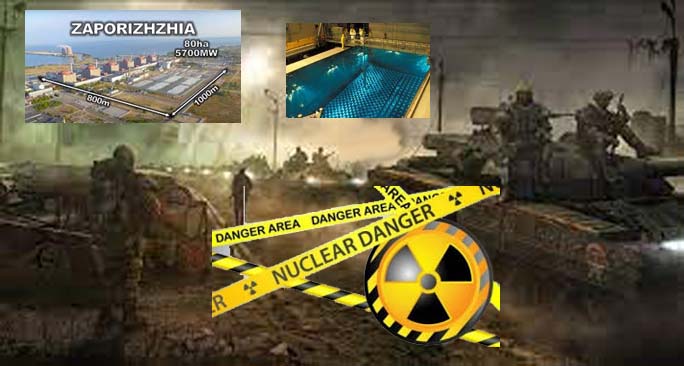
Tetyana Oliynyk — Thursday, 8 August 2024, https://www.pravda.com.ua/eng/news/2024/08/8/7469572/
he International Atomic Energy Agency (IAEA) believes that intense fires near the Zaporizhzhia Nuclear Power Plant, which is temporarily occupied by Russia, pose a risk for its external power supply.
Source: IAEA website, as reported by Ukrinform
Quote: “On several occasions over the past week, the IAEA Support and Assistance Mission to Zaporizhzhya (ISAMZ) observed several fires at various distances from the ZNPP and nearby villages. Over the weekend, the IAEA experts observed smoke coming from an area to the north of the ZNPP near the Zaporizhzhya Thermal Power Plant (ZTPP) inlet channel.”
Details: The agency noted that the fire was underneath the remaining overhead power cables that supply power to the plant.
Quote: “As the summer heat continues, such fires along the pathways of the two remaining lines place the ZNPP at risk of loss of external power. While there was no disconnection of either line on this occasion, the situation highlighted the fragility of off-site power at the ZNPP.”
IAEA chief calls for restraint as fighting remains ongoing ‘in the vicinity’ of Russia’s Kursk Nuclear Power Plant

by Dmytro Basmat, Kyiv Independent 10th Aug 2024
International Atomic Energy Agency (IAEA) Director General Rafael Mariano Grossi called on both Kyiv and Moscow to “exercise maximum restraint” in order to avoid a nuclear accident as fighting is reportedly ongoing in the region around the Kursk Nuclear Power Plant (KNPP).
In a statement issued by the IAEA on Aug. 9, Grossi said that a nuclear accident at the KNPP would have “the potential for serious radiological consequences.”
Grossi noted that two of the six nuclear reactors at the KNPP are in shutdown, while another two are fully operational. The remaining two reactors are under construction.
The statement comes as Ukraine’s continues its surprise incursion across the border into Kursk Oblast, with Ukraine reportedly making gains deeper into Russian territory.
Earlier in the day on Aug. 9, a fire caused by an alleged drone attack on a power substation led to power outages in several areas of Kurchatov which houses the KNPP, regional Governor Alexei Smirnov claimed.
On Aug. 8, Kurchatov’s mayor, Igor Korpunkov, claimed that battles are ongoing “a few dozen kilometers” from the town.
Independent Russian news outlet IStories reported on Aug. 9 that Russia is currently preparing to defend the Kursk Nuclear Power Plant as Ukrainian troops are approaching it.
The entrances to the Kursk Nuclear Power Plant were blocked as of the afternoon of Aug. 9, the pro-government regional newspaper network Bloknot claimed, citing its undisclosed sources.
Everything at the nuclear power plant’s units under construction has been de-energized, and construction workers have left the site, Bloknot claimed………………………………………..
Russia’s Emergency Situations Ministry also said on Aug. 9 that the situation in Kursk Oblast had been declared a “federal emergency,” and began sending additional military equipment into the region. https://kyivindependent.com/iaea-chief-calls-for-restraint-to-ensure-nuclear-safety-at-kursk-nuclear-power-plant/
Biden administration lies on Ukraine war are monstrous

https://heartlandprogressive.blogspot.com/ 6 Aug 24
Notice mainstream news has imposed a virtual blackout of news about US proxy war against Russia in Ukraine. One can watch 24/7 and see nary a story on a war that could go nuclear in a heartbeat.
Couple of reasons for this. Mainstream news understands the US is suffering a staggering defeat in its effort to save its proxy state Ukraine in order to weaken Russia. Neither Republican nor Democratic media want to touch covering America’s dysfunctional war policy. Bleeding only leads when it’s the other side doing all the bleeding.
A second reason is media fatigue from the Biden administration endless lies for all 30 months of this war without a single truth worth reporting.
The original and biggest lie was the one that kicked off this war on February 24, 2022. Biden claimed Russian President Putin woke up one morning and decided to recreate the Soviet Union…starting by gobbling up Ukraine.
The truth is the US had been provoking the Russian invasion starting with President George W. Bush’s 2008 pledge to entice Ukraine into NATO to weaken, isolate Russia. Russia allowing this senseless US provocation to go on for 14 years is something America would never have done if the situation were reversed. It took the US about 14 hours to respond militarily to Russian missiles in Cuba 60 years earlier.
Biden’s next big whopper was framing the resulting conflict as democracy versus authoritarianism. He proclaimed Ukraine President Volodymyr Zelensky ‘The 21st Century Churchill’, saving Ukrainian democracy from Russian authoritarianism.
But for the past 30 months Zelensky has snuffed out every vestige of the touted Ukraine democracy. He’s cancelled elections under martial law, essentially making him president for the war’s life. No wonder he’s doing nothing to negotiate its end. When the war ends, so does Zelensky’s grasp on power, and possibly his life.
Additionally, Zelensky has banned opposition parties, squelched Ukraine’s free press, curtailed religious freedom and erased any hint of Russian culture among Ukrainian citizens so inclined.
But Biden’s most monstrous lie was that he’d do nothing in supporting Ukraine that could trigger nuclear war, something he said was a real possibility.at the war’s start. For 30 months he’s done the opposite, steadily arming Ukraine with nuclear capable F-16 fighters, Abram tanks and long-range missiles that can hit the heart of Russia. Telling Ukraine to be cautious not to provoke nuclear war with them is akin to giving matches to a kid, then telling him to use them judiciously.
There are many more in Biden’s blizzard of lies over the US proxy war in Ukraine. The saddest for the dying country of Ukraine being sacrificed on the altar of Biden’s lust to weaken, isolate Russia is this. “We will stand with Ukraine forever. We will never abandon Ukraine to Russian aggression.” Biden abandoned Ukraine 30 months ago. The US press and citizenry, weary of Biden’s endless lies on Ukraine, have moved on.
IAEA: Cooling pond water levels decreasing at Ukraine nuclear plant
Aug 6, 2024, https://www.ans.org/news/article-6266/iaea-cooling-pond-water-levels-decreasing-at-ukraine-nuclear-plant/
The water level in Ukraine’s Zaporizhzhia nuclear power plant cooling pond continues to decrease, creating a serious safety threat.
“If this trend continues, ZNPP staff confirmed that it will soon become challenging to pump water from the pond. Maintaining the level of the pond is made more difficult by the hot summer weather,” said Rafael Mariano Grossi, director general of the International Atomic Energy Agency, in an update issued August 2.
Zaporizhzhia—Europe’s largest nuclear plant—has been under Russian control since March 2022, shortly after the military invasion of Ukraine. The plant stopped producing power in September 2022, and all six of its units currently are in cold storage.
Water issues: Following the destruction of the Kakhovka dam in 2023, Zaporizhzhia workers dug 11 groundwater wells to provide approximately 250 cubic meters of cooling water per hour to support the plant’s sprinkler ponds. These ponds cool all six reactors.
“Dwindling water levels in the cooling pond remains a potential source of concern, and we will continue to closely monitor and observe the situation at the site to ensure the availability of a sufficient supply of cooling water for the plant’s needs at all times,” Grossi said.
During a site walkdown last week, IAEA inspectors stationed at the plant observed proper function in the sprinkler ponds, with water at nominal levels. But any compromise to the availability of water to the sprinkler ponds might necessitate using the cooling pond as a backup source.
Safety concerns: The IAEA team continue to hear military activity at varying distances from the plant.
On April 30, they reported hearing over 100 rounds of gunfire in the vicinity of the Zaporizhzhia, allegedly in response to drones flying near the plant’s training center. The “kamikaze” drones, some measuring 11 feet long and 8 feet wide, were observed in video evidence from Ukraine’s defense intelligence. The drones do not fire missiles but are equipped with explosives and can strike with precision.
Separately, the team reported three direct drone strikes on the plant on April 7 and April 9, resulting in one casualty. Ukrainian military intelligence spokesperson Andrii Cherniak said the Russians are using space around Zaporizhzhia because the Security and Defense Forces of Ukraine cannot return fire in a 1.5-kilometer zone around the plant.
IAEA report: In a letter from the permanent mission of the Russian Federation to the IAEA’s secretariat the following issues were highlighted.
- During a span of six days (July 22–28), 77 aerial vehicles launched with the aim of attacking and provoking ZNPP and the nearby town of Energodar.
- On July 29, Ukrainian armed forces launched three artillery strikes at the checkpoint entrance to Energodar, injuring three Russian Guard employees.
- The plant has enough diesel fuel to operate on emergency power for 19 days.
- Recruitment of personnel for the plant is ongoing, though the current number of employees is sufficient to continue cold shutdown operations and scheduled maintenance tasks.
Support for Zaporizhzhia: Starting in April 2022, the IAEA developed a broad assistance program at Zaporizhzhia. The agency recently organized four remote workshops with a focus on mental health. The sessions were geared toward supervisors, managers, and mental health teams to help recognize signs of distress and support those dealing with stress or trauma.
The United States and United Kingdom have lent support by delivering equipment and hosting workshops.
Where Is the Biden Plan to End the War in Ukraine?

On the face of it, the Biden administration would appear to be asking the American people to spend indefinitely tens of billions of dollars a year on an endless war for an unachievable goal.
Biden team blows off deadline for Ukraine war strategy
Perhaps the administration can’t admit it doesn’t have one.
Anatol Lieven, Aug 02, 2024, https://responsiblestatecraft.org/biden-ukraine-strategy/
Almost 100 days have now passed since the Congress passed $61 billion in emergency funding for Ukraine, a measure that included a condition that required the Biden Administration to present to the legislative body a detailed strategy for continued U.S. support.
When the funding bill was passed with much fanfare on April 23, Section 504, page 32 included the following mandate:
“Not later than 45 days after the date of enactment of this Act, the Secretary of State and the Secretary of Defense, in consultation with the heads of other relevant Federal agencies, as appropriate, shall submit to 18 the Committees on Appropriations, Armed Services, and Foreign Relations of the Senate and the Committees on 20 Appropriations, Armed Services, and Foreign Affairs of the House of Representatives a strategy regarding United States support for Ukraine against aggression by the Russian Federation: Provided, That such strategy shall be multi-year, establish specific and achievable objectives, define and prioritize United States national security interests…”
It is now August and There is still no sign on the part of the Biden Administration of any intention to submit such a strategy to Congress. This inevitably leads to the suspicion that no such strategy in fact exists. It also suggests that without a massive change of mindset within the administration, it is not even possible to hold — let alone make public —serious and honest internal discussions on the subject, as these would reveal the flawed and empty assumptions on which much of present policy is based.
This relates first of all to the requirement “to define and prioritize United States national security interests.” No U.S. official has ever seriously addressed the issue of why a Russian military presence in eastern Ukraine that was of no importance whatsoever to the U.S. 40 years ago (when Soviet tank armies stood in the center of Germany, 1,200 miles to the West) should now be such a threat that combating it necessitates $61 billion of U.S. military aid per year, a significant risk of conflict with a nuclear-armed Russia, and a colossal distraction from vital U.S. interests elsewhere.
Instead, the administration, and its European allies, have relied on two arguments. The first is that if Russia is not defeated in Ukraine, it will go on to attack NATO and that this will mean American soldiers going to fight and die in Europe.
In fact, there is no evidence whatsoever of any such Russian intention. Russian threats of escalation and (possibly) minor acts of sabotage have been outgrowths of the war in Ukraine, and intended to deter NATO from intervening directly in that conflict — not actions intended to lay the basis for an invasion of NATO.
Moreover, given the acute difficulties that the Russian military has faced in Ukraine, and the Russian weaknesses revealed by that conflict, the idea of them planning to attack NATO seems utterly counter-intuitive. For Russia has been “stopped” in Ukraine. The heroic resistance of the Ukrainian army, backed with Western weapons and money, stopped the Russian army far short of President Putin’s goals when he launched the war. They have severely damaged Russian military prestige, inflicted enormous losses on the Russian military, and as of today, hold more than 80% of their country’s territory.
The Biden administration has issued partly contradictory statements about the purpose of U.S. aid to Ukraine: that it is intended to help Ukraine “win”, and that it is intended to help “strengthen Ukraine at the negotiating table.” They have not however fulfilled their legal obligation to define to Congress what “winning” means, nor why if the war will end in negotiations, these negotiations should not begin now — especially since there is very strong evidence that the Ukrainian military position, and therefore Ukraine’s position at the negotiating table, are getting worse, not better.
As Samuel Charap and Jeremy Shapiro have written in response to the latest US despatch of weapons to Ukraine:
“[A]daptation and adjustment do not constitute strategy, and reactive escalation absent a strategy is not sound policy. Escalating U.S. involvement in this conflict—or any conflict—should be guided by an idea about how to bring the war to an end.”
As with U.S. campaigns in Vietnam and elsewhere, the administration and its allies have tried to play the “credibility” card: the argument that it is necessary to defeat Russia in Ukraine because otherwise, China, Iran and other countries will be emboldened to attack the United States or its allies. But like the line about Russian ambitions beyond Ukraine, this is simply an assumption. There is no actual evidence for it at all.
It can, with equal or greater validity, be assumed that the governments of these countries will make up their minds according to calculations of their own interests and the military balance in their own regions.
The final administration line of argument is a moral one: that “Russian aggression must not be rewarded” and that “Ukrainian territorial integrity must be restored.” Since, however, any realistic negotiations towards a peace settlement will have to involve de facto recognition of Russian territorial gains (not de jure recognition, which the Russians do not expect and even the Chinese will not grant), this statement would seem to rule out even the idea of talks. On the face of it therefore, the Biden administration would appear to be asking the American people to spend indefinitely tens of billions of dollars a year on an endless war for an unachievable goal.
If this is a mistaken picture of the administration’s position, then once again, it has a formal obligation under the bill passed by Congress in April to tell the American people and their elected representatives what their goals in Ukraine in fact are. Then everyone will be able to reach an informed judgment on whether they are attainable, and worth $61 billion a year in American money.
Unfortunately, it seems that the administration’s actual position is to kick this issue down the road until after the presidential election. Thereafter, either a Harris administration will have to draw up new plans, or a Trump administration will do so. But given the length of time it takes a new administration to settle in and develop new policies, this means that we could not expect a strategy on Ukraine to emerge for eight months at best.
If the Ukrainians can hold roughly their present lines, then this approach could be justifiable in U.S. domestic political terms (though not to the families of the Ukrainian soldiers who will die in the meantime). There is however a significant risk that given the military balance on the ground, and even with continued aid, Ukraine during this time will suffer a major defeat. Washington would then have to choose between a truly humiliating failure or direct intervention, which would expose the American people to truly hideous risks.
There is an alternative. Since President Biden will in any case step down next January, he could take a risk and try to bequeath to his successor not war, but peace. In terms of domestic politics, to open negotiations with Russia now would deprive Donald Trump and JD Vance of a campaigning position, and would spare a future Democrat administration (if elected) from a very difficult and internally divisive decision.
The first step in this direction is for the Biden administration clearly to formulate its goals in Ukraine, and — as required by law — to submit these goals to the American people.
First NATO F-16’s delivered to Ukraine (nuclear capable)

Bruce K. Gagnon, 2 Aug 24, https://space4peace.blogspot.com/2024/08/first-nato-f-16s-delivered-to-ukraine.html
Reports indicate that six F-16’s have been sent to Ukraine (UAF) from the Netherlands to be used against Russia.
Doesn’t this mean that US-NATO are fully at war with Russia? Of course the US-NATO deny that fact but we are surely used to their endless lies by now!
It appears the war planes will be based in western Ukraine – far from the front lines in eastern Ukraine which is closest to the Russia border.
Previously, a number of NATO states, including the US, France, Bulgaria, Denmark, the Netherlands, Belgium, Canada, Luxembourg, Norway, Poland, Portugal, Romania, and Sweden, formed a so-called ‘F-16 coalition’, pledging to provide Kiev with 79 of the American-made fighter jets as well as to train Ukrainian pilots to operate the aircraft.
While Ukraine is pinning high hopes on the fighter jets, the truth is that NATO is only supplying them to make up for the heavy losses of the UAF and prolong the conflict.
In addition the US-NATO war mongering ‘coalition’ must supply the weapons for the planes as well as the maintenance crews since Ukraine does not have the technical capacity to keep the planes in the air by themselves. The west will also likely need to supply the repair parts and the jet fuel for the planes.
Because it takes years to properly train pilots some have speculated that US-NATO pilots (wearing Ukraine military uniforms) might end up being the ones flying in combat against Russia. Especially after the first six planes get shot down and the Ukrainian F-16’s crews might be quickly erased.
There are reports that Moldova could be used as the main base for F-16 fighters. This will allow NATO countries to avoid becoming targets for Russian missiles, but at the same time provoke the Kremlin to a harsh reaction. (Any F-16 that enters Ukraine from a NATO country and continues to fly on to its combat area will be seen as an attack by NATO enabling Russia to legally attack the country of origin. Theoretically, this could start WW III – with a nuclear power no less. Note, however, that Moldova is not a NATO member. At any rate, the West is courting disaster.) This will increase the escalation and take the conflict in Ukraine to a new level, using Moldova for this purpose.
These planes will have the capability to carry US supplied nuclear weapons and fire them from a distance at ‘Russian targets’ that often means nothing more than population centers as Ukraine has been doing since the war began in 2014 after the US orchestrated coup d’état in Kiev. Moscow has said that it must conclude that any F-16’s in the air heading toward Russia could be carrying nukes and will respond accordingly.
The US long ago positioned nuclear weapons throughout Europe as you can see in the graphic just below. [on original]
Out of their complete desperation, as the US-NATO lose the war in Ukraine, they very well could decide to use these nukes now deployed in Europe. If that decision is made (and it would be made in Washington) then we are without a doubt off to the nuclear war races.
Now is the time for people not suffering from terminal imperial insanity to speak loudly – publicly and with determination – if we hope to survive the decline of the US-NATO killing project
EU sets date of transfer of Russian money to Ukraine for arms purchases
https://www.rt.com/news/601527-borrell-ukraine-tranche-russia-assets/— 23 July 24
Kiev will receive €1.4 billion, the interest accrued on frozen funds, early next month, the bloc’s top diplomat has said
The EU has revealed when it will begin sending Russian money to Ukraine. The bloc’s top diplomat Josep Borrell has claimed that the first tranche of interest accruing on some €300 billion in frozen Russian assets, totaling some €1.4 billion, will be sent to Kiev in the first week of August to fund arms purchases.
The EU’s top diplomat specified that the funds will be used to meet the key needs of Kiev’s military, including air defense, artillery, “and also, and this is new, procurement for the Ukrainian defense industry.”
“So, we are not going only to provide military support to Ukraine but from Ukraine itself. Which is certainly the most logical and efficient thing we can do,” Borrell concluded.
The EU and G7 group of nations blocked some $280 billion (€260 billion) of sovereign funds belonging to the Central Bank of Russia days after the escalation of the Ukraine conflict in 2022. The bulk of the frozen funds are held in the EU, primarily in the Belgium-based depositary and clearing house Euroclear.
Earlier this year, EU authorities approved a scheme enabling the appropriation of interest accrued on the frozen funds to back Ukraine’s recovery and military defense. Under the agreement, 90% of the money is expected to go into an EU-run fund for Ukrainian military aid, with the other 10% is to be allocated for supporting Kiev in other ways.
Moscow has repeatedly said that any steps taken to transfer its assets without its consent would amount to “theft,” insisting that tapping the funds or engaging in similar moves would violate international law and lead to retaliation.
Earlier this year, Kremlin spokesman Dmitry Peskov warned that the expropriation of Russian sovereign assets could create a dangerous precedent and become a “solid nail in the coffin” of the Western economic system. He stressed that Moscow would inevitably retaliate against such a move by launching legal proceedings against entities that tap its assets.
1 This Month


PLEASE OPPOSE HR 8255 AND S.3639 – bills would accelerate satellite deployment, with no environmental review or safeguards – https://ncstd5li.quorum.us/campaign/169331/
To see nuclear-related stories in greater depth and intensity – go to https://nuclearinformation.wordpress.com
-
Archives
- September 2026 (194)
- August 2026 (330)
- July 2026 (355)
- June 2026 (287)
- May 2026 (306)
- April 2026 (356)
- March 2026 (251)
- February 2026 (267)
- January 2026 (308)
- December 2025 (358)
- November 2025 (359)
- October 2025 (375)
-
Categories
- 1
- 1 NUCLEAR ISSUES
- business and costs
- climate change
- culture and arts
- ENERGY
- environment
- health
- history
- indigenous issues
- Legal
- marketing of nuclear
- media
- opposition to nuclear
- PERSONAL STORIES
- politics
- politics international
- Religion and ethics
- safety
- secrets,lies and civil liberties
- spinbuster
- technology
- Uranium
- wastes
- weapons and war
- Women
- 2 WORLD
- ACTION
- AFRICA
- Atrocities
- AUSTRALIA
- Christina's notes
- Christina's themes
- culture and arts
- Events
- Fuk 2022
- Fuk 2023
- Fukushima 2017
- Fukushima 2018
- fukushima 2019
- Fukushima 2020
- Fukushima 2021
- general
- global warming
- Humour (God we need it)
- Nuclear
- RARE EARTHS
- Reference
- resources – print
- Resources -audiovicual
- Weekly Newsletter
- World
- World Nuclear
- YouTube
-
RSS
Entries RSS
Comments RSS
 nuclear-news