Ukraine works to repair Chornobyl containment structure damaged in Russian drone strike
by Olena Goncharova, Kyiv Independent 13th April 2025 https://kyivindependent.com/ukraine-works-to-repair-chornobyl-containment-structure-damaged-in-russian-drone-strike/
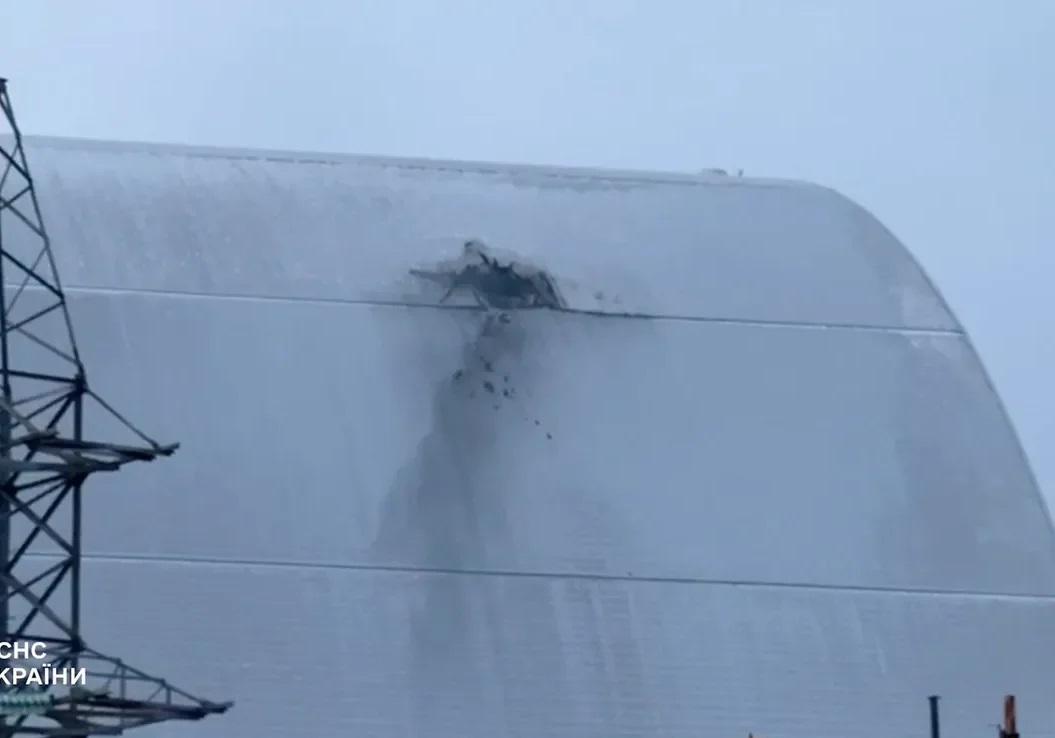
Ukraine is working to repair damage to the containment structure at the Chornobyl nuclear power plant following a Russian drone strike in February, Environment Minister Svitlana Hrynchuk said on April 12.
Speaking at the site of the decommissioned plant, Hrynchuk noted that the strike had compromised the functionality of the massive protective arch installed in 2019 to prevent radioactive leaks.
The minister commented during the launch of a new 0.8-megawatt solar power station near Chornobyl ahead of two upcoming nuclear safety and energy conferences. She said that Ukraine is cooperating with international experts to assess the extent of the damage and determine the necessary steps to restore the arch’s integrity.
“Unfortunately, after the attack, the arch partially lost its functionality. And now, I think, already in May, we will have the results of the analysis that we are currently conducting …,” Hrynchuk said. “We are actively working on this … We, of course, need to restore the “arch” so that there are no leaks under any circumstances because ensuring nuclear and radiation safety is the main task.”
She added that the European Bank for Reconstruction and Development, as well as scientific institutions and companies involved in the arch’s original installation, are contributing to the analysis.
According to plant officials, the February 14 drone attack created a hole in the containment vessel’s outer layer and exploded inside. The Russian Foreign Ministry dismissed the incident as “a provocation.”
The structure was designed to enclose the unstable sarcophagus hastily built after the 1986 reactor explosion—the worst nuclear accident in history.
Hrynchuk also emphasized the importance of renewable energy in the Chornobyl exclusion zone, saying the new solar facility would support the site’s power needs.
“We have been saying for many years that the exclusion zone needs to be transformed into a zone of renewal,” she said. “And this territory, like no other in Ukraine, is suitable for developing renewable energy projects.”
Assessment result on the condition of the shelter at the Chornobyl Nuclear Power Plant (ChNPP) is due in May
The first results of an assessment on the condition of the shelter at the
Chornobyl Nuclear Power Plant (ChNPP), following a Russian drone attack,
will be available in May. In June, Ukraine plans to present proposals for
restoring the New Safe Confinement (NSC or the Arch) at the donor assembly
in London.
As reported by Ukrinform, this was announced by Ukraine’s
Minister of Environmental Protection and Natural Resources, Svitlana
Hrynchuk. “It’s currently hard to say how much the project timeline has
been delayed, because certain works at the site cannot be performed right
now. However, I want to assure everyone that the radiation background has
not changed in any way — even after the attack,” said Hrynchuk.
Ukrinform 13th April 2025, https://www.ukrinform.net/rubric-society/3981370-ministry-of-environment-results-of-chornobyl-shelter-assessment-following-russian-drone-attack-expected-in-may.html
‘Better that Ukrainians don’t know the truth’ – Kiev’s spy chief

7 Apr 25, https://www.rt.com/russia/615336-budanov-harsh-reality-opinions/
General Kirill Budanov has said people should remain unaware of the “harsh reality” of the conflict with Russia
Many Ukrainians cannot handle the “harsh reality” of the conflict with Russia and should be kept in the dark about the details, Kiev’s military intelligence chief has said.
Three-star general Kirill Budanov expressed his views on information censorship during wartime in a conversation with journalist Anna Maksimchuk on Saturday, suggesting that much of the truth of the conflict should only become public knowledge to Ukrainians in the future.
During wartime, knowing the whole truth is not necessary. Otherwise, people may develop opinions,” Budanov said. “Some minds are not prepared to grasp the harsh reality. Let’s not put them to the test. Everything should be dosed.”
Since 2020, Budanov has led the Main Directorate of Intelligence of the Ukrainian Defense Ministry (HUR) – an agency reportedly rebuilt from scratch by the CIA following the 2014 armed coup in Kiev to serve as a tool against Russia.
Prior to the escalation of hostilities with Russia in 2022, Ukraine’s Vladimir Zelensky cracked down on critical media, claiming to do so in order to fight against local oligarchs under Moscow’s influence.
During the conflict, Kiev launched a news marathon with programming said to be directly controlled by the president’s office – which critics have called state propaganda. Additionally, under martial law, Zelensky banned several opposition parties, claiming they posed a national security threat.
Earlier this year, turmoil swept through Ukraine’s media landscape following US President Donald Trump’s decision to dismantle the US Agency for International Development (USAID), an organization used by Washington to promote its political agenda through foreign grants.
Researcher Oksana Romanyuk estimated in January that nearly 90% of Ukrainian outlets relied on foreign aid, with 80% specifically receiving funding from USAID.
Unsafe for Russia to restart Zaporizhzhia nuclear plant, says Ukraine energy chief
Energoatom CEO, Petro Kotin, says ‘major problems’ need to be overcome before it can safely generate power
Guardian, Dan Sabbagh in Kyiv, 7 Apr 25
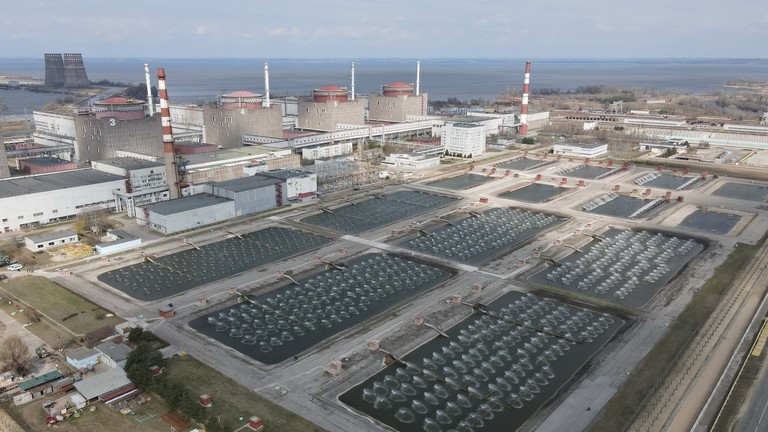
It would be unsafe for Russia to restart the occupied Zaporizhzhia nuclear plant and would take Ukraine up to two years in peacetime if it regained control, the chief executive of the company that runs the vast six-reactor site has said.
Petro Kotin, chief executive of Energoatom, said in an interview there were “major problems” to overcome – including insufficient cooling water, personnel and incoming electricity supply – before it could start generating power again safely.
The future of the Zaporizhzhia plant, Europe’s largest nuclear reactor, is a significant aspect of any negotiations to end the war in Ukraine. Seized by Russia in spring 2022 and shut down for safety reasons a few months later, it remains on the frontline of the conflict, close to the Dnipro River.
Russia has said it intends to retain the site and switch it back on, without being specific as to when. Alexey Likhachev, head of Russian nuclear operator Rosatom, said in February it would be restarted when “military and political conditions allow”.
Meanwhile, Donald Trump has expressed an interest in taking control of it, though this possibility is considered very remote.
Kotin said Energoatom was prepared to restart the plant but it would require Russian forces to be removed and the site to be de-mined and demilitarised.
He said such a restart by Ukraine would take anywhere “from two months to two years” in an environment “without any threats from militaries”, while a Russian restart during wartime “would be impossible, even for one unit [reactor]”.
Kotin said the six reactors could only be brought online after the completion of 27 safety programmes agreed with Ukraine’s nuclear regulator, including testing the nuclear fuel in the reactor cores because it had exceeded a six-year “design term”.
That raises questions about whether Russia could restart the plant after a ceasefire without incurring significant risk. The plant was already unsafe, Kotin said, given that it was being used as “a military base with military vehicles present” and there were “probably some weapons and blasting materials” present as well.
Russia has acknowledged that it has placed mines between the inner and outer perimeters of the plant “to deter potential Ukrainian saboteurs” while inspectors from the IAEA nuclear watchdog have reported that armed troops and military personnel are present at the site.
Last month, the US Department of Energy said the Zaporizhzhia plant was being operated by an “inadequate and insufficently trained cadre of workers”, with staffing levels at less than a third of prewar levels.
The US briefing said Ukrainian reactors, though originally of the Soviet VVER design, had “evolved differently” from their Russian counterparts and “particularly the safety systems”. Russian-trained specialists acting as replacements for Ukrainian staff were “inexperienced” in operating the Ukrainian variants, it said.
Kotin said an attempt to restart the plant by Russia would almost certainly not be accepted or supported by Ukraine. It would require the reconnection of three additional 750kV high-voltage lines to come into the plant, he said.
A nuclear reactor requires a significant amount of power for day-to-day operation, and three of the four high-voltage lines came from territories now under Russian occupation. “They themselves destroyed the lines,” Kotin said, only for Russia to discover engineers could not rebuild them as the war continued, he added.
Only two lines remain to maintain the site in cold shutdown, a 750kV line coming from Ukraine, and a further 330kV line – though on eight separate occasions shelling disrupted their supply of energy, forcing the plant to rely on backup generators.
Experts say a pumping station has to be constructed at the site, because there is insufficient cooling water available. The June 2023 destruction by Russian soldiers of the Nova Kakhova dam downstream eliminated the easy supply of necessary water from the Dnipro river………………………………………………….. https://www.theguardian.com/world/2025/apr/06/unsafe-for-russia-to-restart-zaporizhzhia-nuclear-plant-energoatom-says
Inside the bizarre race to secure Earth’s nuclear tombs
outlandish ideas have included linguist Thomas Sebeok’s proposal of an ‘atomic priesthood’ that would pass on nuclear folklore (in much the same way that generations of clergy have been relaying the tenets of their respective faiths for thousands of years
“Our generation must find a way to bury the waste very deep to avoid radioactive pollution or exposure to people and animals up to one million years into the future.”
“Currently, about 75 per cent of the UK’s nuclear waste is already stored across 20 sites,” says Winsley. “People are surprised to hear you’re never far away from the most hazardous radioactive waste, wherever you are in the UK.
Jheni Osman, BBC Science Focus, April 5, 2025
With nuclear energy production increasing globally, the problem of what to do with the waste demands a solution. But where do you store something that stays dangerous for thousands of years?
Uniformed guards with holstered guns stand at the entrance and watch you lumber past. Ahead lies a wasteland of barren metal gantries, dormant chimney stacks and abandoned equipment.
You trudge towards the ruins of a large, derelict red-brick building. Your white hazmat suit and heavy steel-toe-capped boots make it difficult to walk. Your hands are encased in a double layer of gloves, your face protected by a particulate-filtering breathing mask. Not an inch of flesh is left exposed.
Peering into the building’s gloomy interior, the beam from your head torch picks out machinery and vats turned orange with rust. On a wall nearby, a yellow warning sign featuring a black circle flanked by three black blades reminds you of the danger lurking inside.
Apart from the sound of your own breathing behind your mask, the only thing you can hear is the crackling popcorn of your Geiger counter.
This is what entering the Prydniprovsky Chemical Plant is like for nuclear researchers, including Tom Scott, professor of materials at the University of Bristol and head of the UK Government’s Nuclear Threat Reduction Network.
Prydniprovsky was once a large Soviet materials and chemicals processing site on the outskirts of Kamianske in central Ukraine. Between 1948 and 1991, it processed uranium and thorium ore into concentrate, generating tens of millions of tonnes of low-level radioactive waste.
When the Soviet Union dissolved, Prydniprovsky was abandoned and fell into disrepair.
“The buildings are impressively awful and not for the faint-hearted,” says Scott. “As well as physical hazards, such as gaping holes in the floor, there’s no light or power. And obviously there are radiological hazards. Until very recently, the Ukrainian Government didn’t have a clue what had gone on at the site, so there were concerns about the high radiation levels and ground contamination.”
When radiation levels are deemed too high for humans, Scott sends in the robots. ………………………….
Scott and his team are known as industrial nuclear archaeologists, and they’re working to find, characterise and quantify the ‘legacy’ radioactive waste at sites around the world.
“High-level radioactive waste gives off a significant amount of radioactivity, sufficient to make humans sick if they get too close,” he says. “Some of this waste will be dangerously radioactive for very long periods of time, meaning that it needs to be physically kept away from people and the environment to ensure that no harm is caused.”
But finding legacy waste like this, which has been amassing since the 1940s, is only part of the challenge. Once it’s been found, it has to be isolated and stored long enough for it to no longer pose a threat. And that’s not easy.
“Currently we’re storing our high-level wastes above ground in secure, shielded facilities,” Scott says. “Such facilities need to be replaced every so often because buildings and concrete structures can’t last indefinitely.”
Safely storing the nuclear waste that already exists is only the start of the problem, however. With the world moving away from fossil fuels towards low-carbon alternatives, nuclear energy production is set to increase, which means more waste is going to be produced – a lot more.
Currently, nuclear energy provides roughly nine per cent of global electricity from about 440 power reactors. By 2125, however, the UK alone is predicted to have 4.77 million m3 (168 million ft3) of packaged radioactive waste. That’s enough to fill 1,900 Olympic swimming pools.
Hence, the world needs more safe storage sites for both legacy and new nuclear waste. And it needs them fast.
Safe spaces
In the UK, most nuclear waste is currently sent to Sellafield, a sprawling site in Cumbria, in the north-west of England, with about 11,000 employees, its own road and railway network, a special laundry service for contaminated clothes and a dedicated, armed police force (the Civil Nuclear Constabulary).
Sellafield processes and stores more radioactive waste than anywhere in the world.
But more hazardous material is on the way, much of which will come from the new nuclear power station being built at Hinckley Point in Somerset. To keep pace, experts have been hunting for other, much stranger, disposal solutions.
It’s a challenge for nuclear agencies all around the world. All sorts of proposals have been put forward, including some bizarre ideas like firing nuclear waste into space. (The potential risk of a launch failure showering the planet with nuclear debris has silenced that proposal’s supporters.)
So far, the most plausible solution is putting the waste in special containers and storing them 200–1,000m (660–3,280ft) underground in geological disposal facilities (GDFs). Eventually, these GDFs would be closed and sealed shut to avoid any human intrusion.
These ‘nuclear tombs’ are the safest, most secure option for the long-term and minimise the burden on future generations.
“In the UK, around 90 per cent of the volume of our legacy waste can be disposed of at surface facilities, but there’s about 10 per cent that we don’t currently have a disposal facility for. The solution is internationally accepted as being GDFs,” says Dr Robert Winsley, design authority lead at the UK’s Nuclear Waste Services.
“We estimate that about 90 per cent of the radioactive material in our inventory will decay in the first 1,000 years or so. But a portion of that inventory will remain hazardous for much longer – tens of thousands, even hundreds of thousands of years.
“GDFs use engineered barriers to work alongside the natural barrier of stable rock. This multi-barrier approach isolates and contains waste, ensuring no radioactivity ever comes back to the surface in levels that could do harm.”
But how do you keep that radioactivity in the ground? Radioactive waste is typically classified as either low-, intermediate- or high-level waste.
Before being disposed of deep underground, high-level waste is converted into glass (a process known as vitrification) and then packed in metal containers made of copper or carbon steel. Intermediate-level waste is typically packaged in stainless-steel or concrete containers, which are then placed in stable rock and surrounded by clay, cement or crushed rock.
The process isn’t set in stone yet, though. Other materials, such as titanium- and nickel-based alloys, are being considered for the containers due to their resistance to corrosion.
Meanwhile, scientists in Canada have developed ultra-thin copper cladding that would allow them to produce containers that take up less space, while providing the same level of protection.
Rock solid
The hunt is also on to find facilities with bedrock that can withstand events such as wars and natural disasters (‘short-term challenges’, geologically speaking). Sites that won’t change dramatically over the millennia needed for nuclear waste to no longer pose a risk.
“A misconception is that we’re looking for an environment that doesn’t change, but the reality is the planet does change, very slowly,” says Stuart Haszeldine, professor of carbon capture and storage at the University of Edinburgh.
“Our generation must find a way to bury the waste very deep to avoid radioactive pollution or exposure to people and animals up to one million years into the future.”
To achieve this, the site ideally needs to be below sea level. If it’s above sea level, rainwater seeping down through fractures in the rock around the site might become radioactive and eventually find its way to the sea.
When this radioactive freshwater meets the denser saltwater, it’ll float upwards, posing a risk to anything in the water above.
Another challenge is predicting future glaciations, which happen roughly once every 100,000 years. During such a period, the sort of glaciers that cut the valleys in today’s landscape could form again, gouging new troughs in the bedrock that might breach an underground disposal facility.
“Accurate and reliable future predictions depend on how well you understand the past,” says Haszeldine.
“Typically, repository safety assessments cover a one-million-year timeframe, and regulations require a GDF site to cause fewer than one human death in a million for the next million years. Exploration doesn’t search for a single best site to retain radioactive waste, but one that’s good enough to fulfil these regulations.”
Hiding places
In 2002, the US approved the construction of a nuclear tomb in an extinct supervolcano in Yucca Mountain, Nevada, about 160km (100 miles) north-west of Las Vegas.
…………. opponents cited concerns that it was too close to a fault line and, in 2011, US Congress ended funding for the project. Since then, waste from all US nuclear power plants has been building up in steel and concrete casks on the surface at 93 sites across the country.
Other sites have fared better, however. Already this year, construction has begun on a nuclear tomb in Sweden, expected to be ready in the 2030s, but it’s also the year the world’s first tomb – at a site in Finland, called Onkalo (Finnish for ‘cave’ or ‘hollow’) – could open its doors for waste………………..
In January 2025, the UK Government announced plans to permanently dispose of its 140 tonnes of radioactive plutonium, currently stored at Sellafield. In a statement, energy minister Michael Shanks cited plans to put it “beyond reach”, deep underground.
Three potential sites in England and Wales are being explored by Nuclear Waste Services, and one of Haszeldine’s PhD students is independently investigating a fourth off the Cumbrian coast. The offshore site appears to be hydro-geologically stable (even over glacial timescales), but it would be expensive and difficult to engineer.
“Currently, about 75 per cent of the UK’s nuclear waste is already stored across 20 sites,” says Winsley. “People are surprised to hear you’re never far away from the most hazardous radioactive waste, wherever you are in the UK. Our mission is to make this radioactive waste permanently safe, sooner.”
……………………..The deep isolation approach costs less than a third of what it costs to construct a nuclear tomb and uses smaller sites, but the canisters are harder to recover if anything goes wrong.
Nevertheless, it’s a viable option for smaller nuclear countries and a second prototype is expected to undergo field testing at a deep borehole demonstration site in the UK in early 2025.
……………………………………………………………………………………………………………“The half-life of plutonium 239 is about 24,100 years, but the requirement is to keep a ceramic in that state for up to a million years. Essentially, we’re trying to design materials that’ll last forever. I don’t think humans will be around in a million years’ time, so the work we do needs to outlast humanity.”
Hide and seek
But even after you’ve found a suitable site and buried the radioactive material safely inside it, you still need to warn future generations about what’s hidden inside.
The trouble is, even if humans are still around in a million years’ time, there’s no guarantee the languages our ancestors speak, or the symbols they use, will be anything like those of today.
In Japan, 1,000-year-old ‘tsunami stones’, which warned future generations to find high ground after earthquakes, have failed to prevent construction on vulnerable sites.
Even the radiation symbol we use today (that black circle flanked by black blades on a yellow background) isn’t universally recognised. Research by the International Atomic Energy Agency found that only six per cent of the global population know what it signifies.
That’s why scientists have been working with everyone from artists to anthropologists, librarians to linguists, and sculptors to science-fiction writers – to come up with other ways of warning future generations about nuclear tombs.
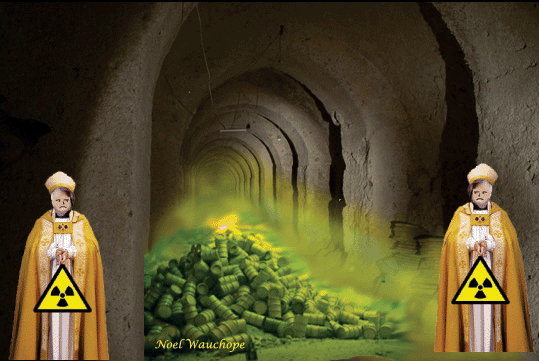
………………….outlandish ideas have included linguist Thomas Sebeok’s proposal of an ‘atomic priesthood’ that would pass on nuclear folklore (in much the same way that generations of clergy have been relaying the tenets of their respective faiths for thousands of years
…………………………….. While some back this active forgetting of future nuclear tombs, researchers like Scott are still trying to get everyone to remember the nuclear sites we’ve already forgotten. It’s like a game of nuclear ‘hide and seek’ – but the stakes are high, and there’s no room for error.
…………………Currently, nuclear tombs are our best bet, but it’s a burden humanity must shoulder for thousands of years, long after the benefits gained from nuclear technology will have faded.
“My personal opinion is, I don’t think we should allow future generations to forget about a geological disposal facility,” says Scott. “The material is both dangerous and, in longer timescales, potentially valuable. People need to be reminded of its presence.”…………………… https://www.sciencefocus.com/planet-earth/inside-the-bizarre-race-to-secure-earths-nuclear-tombs
It’s Official: Ukraine Conflict is British ‘Proxy War’

The investigation’s most striking passages highlight London’s principal role in influencing and managing Ukrainian – and by extension US – actions and strategy in the conflict. Both direct references and unambiguous insinuations littered throughout point ineluctably to the conclusion that the “proxy war” is of British concoction and design
As this journalist has exposed, Ukraine’s Kursk folly was a British invasion in all but name. London was central to its planning, provided the bulk of the equipment deployed, and deliberately advertised its involvement. As The Times reported at the time, the goal was to mark Britain as a formal belligerent in the proxy war, in the hope other Western countries – particularly the US – would follow suit, and “send more equipment and give Kyiv more leeway to use them in Russia.”
Kit Klarenberg, Global Delinquents, Apr 02, 2025
On March 29th, the New York Times published a landmark investigation exposing how the US was “woven” into Ukraine’s battle with Russia “far more intimately and broadly than previously understood,” with Washington almost invariably serving as “the backbone of Ukrainian military operations.” The outlet went so far as to acknowledge the conflict was a “proxy war” – an irrefutable reality hitherto aggressively denied in the mainstream – dubbing it a “rematch” of “Vietnam in the 1960s, Afghanistan in the 1980s, Syria three decades later.”
That the US has since February 2022 supplied Ukraine with extraordinary amounts of weaponry, and been fundamental to the planning of many of Kiev’s military operations large and small, is hardly breaking news. Indeed, elements of this relationship have previously been widely reported, with White House apparatchiks occasionally admitting to Washington’s role. Granular detail on this assistance provided by the New York Times probe is nonetheless unprecedented. For example, a dedicated intelligence fusion centre was secretly created at a vast US military base in Germany.
Dubbed “Task Force Dragon”, it united officials from every major US intelligence agency, and “coalition intelligence officers”, to produce extensive daily targeting information on Russian “battlefield positions, movements and intentions”, to “pinpoint” and “determine the ripest, highest-value targets” for Ukraine to strike using Western-provided weapons. The fusion centre quickly became “the entire back office of the war.” A nameless European intelligence chief was purportedly “taken aback to learn how deeply enmeshed his NATO counterparts had become” in the conflict’s “kill chain”:
“An early proof of concept was a campaign against one of Russia’s most-feared battle groups, the 58th Combined Arms Army. In mid-2022, using American intelligence and targeting information, the Ukrainians unleashed a rocket barrage at the headquarters of the 58th in the Kherson region, killing generals and staff officers inside. Again and again, the group set up at another location; each time, the Americans found it and the Ukrainians destroyed it.”
Several other well-known Ukrainian broadsides, such as an October 2022 drone barrage on the port of Sevastopol, are now revealed by the New York Times to have been the handiwork of Task Force Dragon. Meanwhile, the outlet confirmed that each and every HIMARS strike conducted by Kiev was entirely dependent on the US, which supplied coordinates, and advice on “positioning [Kiev’s] launchers and timing their strikes.” Local HIMARS operators also required special electronic key [cards]” to fire the missiles, “which the Americans could deactivate anytime.”
Yet, the investigation’s most striking passages highlight London’s principal role in influencing and managing Ukrainian – and by extension US – actions and strategy in the conflict. Both direct references and unambiguous insinuations littered throughout point ineluctably to the conclusion that the “proxy war” is of British concoction and design. If rapprochement between Moscow and Washington succeeds, it would represent the most spectacular failure to date of Britain’s concerted post-World War II conspiracy to exploit American military might and wealth for its own purposes.
………………………………………………………………….. the British “had considerable clout” in Kiev and hands-on influence over Ukrainian officials.
This was because, “unlike the Americans,” Britain had formally inserted teams of military officers into the country, to advise Ukrainian officials directly. Still, despite Kiev failing to fully capitalise as desired by London and Washington, the 2022 counteroffensive’s success produced widespread “irrational exuberance”. Planning for a followup the next year thus “began straightaway.” The “prevailing wisdom” within Task Force Dragon was this counteroffensive “would be the war’s last”, with Ukraine claiming “outright triumph”, or Russia being “forced to sue for peace.”
……………………………………………………………………….Even Task Force Dragon’s Lieutenant General Donahue had doubts, advocating “a pause” of a year or more for “building and training new brigades.” Yet, intervention by the British was, per the New York Times, sufficient to neutralise internal opposition to a fresh counteroffensive in the spring. The British argued, “if the Ukrainians were going to go anyway, the coalition needed to help them.” Resultantly, enormous quantities of exorbitantly expensive, high-end military equipment were shipped to Kiev by almost every NATO member state for the purpose.
The counteroffensive was finally launched in June 2023. Relentlessly blitzed by artillery and drones from day one, tanks and soldiers were also routinely blown to smithereens by expansive Russian-laid minefields. Within a month, Ukraine had lost 20% of its Western-provided vehicles and armor, with nothing to show for it. When the counteroffensive fizzled out at the end of 2023, just 0.25% of territory occupied by Russia in the initial phase of the invasion had been regained. Meanwhile, Kiev’s casualties may have exceeded 100,000.
‘Knife Edge’
The New York Times reports that “the counteroffensive’s devastating outcome left bruised feelings on both sides,” with Washington and Kiev blaming each other for the catastrophe. A Pentagon official claims “the important relationships were maintained, but it was no longer the inspired and trusting brotherhood of 2022 and early 2023.” Given Britain’s determination to “keep Ukraine fighting at all costs”, this was bleak news indeed, threatening to halt all US support for the proxy war.
………………………………… Ukraine’s calamitous intervention in Russia’s Bryansk region was a “foreshadowing” of Kiev’s all-out invasion of Kursk on August 6th that year. The New York Times records how from Washington’s perspective, the operation “was a significant breach of trust.” For one, “the Ukrainians had again kept them in the dark” – but worse, “they had secretly crossed a mutually agreed-upon line.” Kiev was using “coalition-supplied equipment” on Russian territory, breaching “rules laid down” when limited strikes inside Russia were greenlit months earlier.
As this journalist has exposed, Ukraine’s Kursk folly was a British invasion in all but name. London was central to its planning, provided the bulk of the equipment deployed, and deliberately advertised its involvement. As The Times reported at the time, the goal was to mark Britain as a formal belligerent in the proxy war, in the hope other Western countries – particularly the US – would follow suit, and “send more equipment and give Kyiv more leeway to use them in Russia.”
Initially, US officials keenly distanced themselves from the Kursk incursion……………………………..
However, once Donald Trump prevailed in the November 2024 presidential election, Biden was encouraged to use his “last, lame-duck weeks” to make “a flurry of moves to stay the course…and shore up his Ukraine project.” In the process, per the New York Times, he “crossed his final red line,” allowing ATACMS and Storm Shadow strikes deep inside Russia, while permitting US military advisers to leave Kiev “for command posts closer to the fighting.”
Fast forward to today, and the Kursk invasion has ended in utter disaster, with the few remaining Ukrainian forces not captured or killed fleeing. Meanwhile, Biden’s flailing, farewell red line breaches have failed to tangibly shift the battlefield balance in Kiev’s favour at all. As the New York Times acknowledges, the proxy war’s continuation “teeters on a knife edge.” There is no knowing what British intelligence might have in store to prevent long-overdue peace prevailing at last, but the consequences could be world-threatening. https://www.kitklarenberg.com/p/its-official-ukraine-conflict-is
TRUMP’S PURSUIT OF A UKRAINIAN PEACE: Early Results and Future Prospects
Russian and Eurasian Politics, by Gordonhahn, April 4, 2025
U.S. President Donald Trump and his new and internationally inexperienced administration have been in hot pursuit of a ceasefire and peaceful resolution of the NATO-Russia Ukrainian War. The pursuit has laid bare the false promise of an end to the war on the administration’s first or even one-hundredth day as previously advertised. This is no business deal. This the hardball world of international politics, national power and interests, ancient and not-so-ancient local and international resentments, grievances, betrayals, and hatreds. Despite what may seem as a disappointing complications and the inevitably longer timeline for the arrival of any prospective ceasefire or conclusive peace, significant early progress was made, and the stumbling blocs that have appeared were to be expected and can be overcome with time and the further deterioration of Ukraine’s position on the battle fronts, which is inevitable.
There has been some confusion among observers and the public regarding the process, with issues such as NATO expansion tied to a ceasefire in some minds. This is a subject for a final treaty, not a ceasefire, which is needed to allow peace talks to proceed more smoothly, niot to mention ending the bloodshed and destruction. The ceasefire agreement must not be conflated from peace treaty negotiations. A ceasefire will, therefore, take at least several, if not many months. This is not least of all because of the need to resolve what Russian President Vladimir Putin called “nuances” – organizational measures needed to implement a full-fledged ceasefire.
While agreement, violated albeit, has been achieved on a month-long ceasefire regarding energy infrastructure, the two sides are very far apart regarding any treaty. Putin’s 4 goals for Russia’s ‘special military operation (SMO) contradict directly Zelenskiy’s demands for security guarantees and the return of all territory annexed or occupied by Russia. Again, these are problems to be addressed under any peace treaty. The ceasefire must be fully implemented before any treaty can be addressed in any robust fashion.
Trust-building is desperately needed, especially between Russia and Ukraine and can develop as partial agreements are made, complied with, and yield new agreements. Recent history and a long cultural tradition of security vigilance in Russia and in part inherited by Ukraine, the apposition of Russian nationalism and more rabid Ukrainian ultras-nationalism and neofascism, and, most importantly, the exacerbating factor of outside interference in Ukraine and Russian-Ukrainian relations by the U.S., Europe, and NATO create a matrix of distrust between all the parties, including the ostensible mediating side, the U.S., which is the lead combatant on the NATO side of the NATO-Russia Ukrainian War. The last point undermines the peace process from the start, and depending on how that process develops could end in many in Moscow, already being suspicious, coming to see the entire process as a ruse to hold off a Russian victory, viewing Trump’s America as ‘playing the good cop’, while Zelenskiy and Europe continue the war.
The ceasefire is evolving into four distinct elements — energy infrastructure, sea, air, and land ceasefires – to comprise the overall ceasefire prospectively. The full ceasefire could be achieved by mid-summer but more a more realistic target is before the end of the year……………………………………………………………………………………………………………………………………..
Trump has levers to push the parties towards peace. For the Ukrainians, he can withhold intelligence and weapons supplies. For the Russians he can delay or threaten to forego rapprochement or various aspects of it: sanctions relief, trade agreements, and renewed cooperation regarding the world’s various conflicts. Pres. Trump’s “Liberation Day” 20 percent tariff on EU goods might be adjusted depending on Brussels’ compliance with American wishes for sanctions relief for Russia. Otherwise, the EU is positioned to scuttle BSI 2.0. Indeed, Russia’s 10 percent tariffs and 0 percent on Russia can be adjusted depending on where pressure needs to be applied.
In sum, there are a host of problems that will take months of concerted effective diplomacy led by the U.S. as things stand now. But the Trump administration is short of seasoned diplomats and experienced foreign and security policy experts. We have a long, hard way to go before peace reigns in Ukraine. https://gordonhahn.com/2025/04/04/trumps-pursuit-of-a-ukrainian-peace-early-results-and-future-prospects/
What really happened in Bucha? The questions Western media won’t ask
By Petr Lavrenin, an Odessa-born political journalist and expert on Ukraine and the former Soviet Union – https://www.rt.com/russia/614967-what-really-happened-in-bucha/ 2 Apr 25 [illustrations]
The narrative on an event from three years ago is under scrutiny. Here’s a closer look at the evidence
On the first day of April in 2022, shocking videos began circulating on Ukrainian social media, showing the streets of Bucha, a town in Kiev region, strewn with dead bodies. The “Bucha massacre” quickly became one of the most widely discussed and controversial chapters of the ongoing Russia-Ukraine conflict. Western media immediately accused the Russian army of mass killings, while Vladimir Zelensky declared that these acts were not only war crimes but a genocide against his country’s people.
However, a closer look at the situation raises numerous questions. An analysis of video footage, satellite images, and eyewitness accounts reveals significant inconsistencies that cast doubt on the official narrative adopted by Kiev and its Western allies. This article explores why it appears the so-called “Bucha massacre” has been fabricated.
What do we know
Bucha, with a population of 40,000 people, found itself on the front lines from the first days of the Ukraine conflict. To the north of Bucha lies the village of Gostomel, home to the strategically important Antonov Airport, where Russian paratroopers landed on the morning of February 24, 2022. This group soon joined the main Russian units advancing from Belarus.
In the days that followed, fierce battles broke out around Bucha as Russian troops attempted to establish a foothold in the town and push toward Irpin, a large suburb of Kiev. Nevertheless, the area remained under the control of the Armed Forces of Ukraine (AFU) and territorial defense units.
Between March 3 and 5, Russian forces entered Bucha from the side of the village of Vorzel, setting up a base at a glass factory and along the southern outskirts of the city. From then on, Bucha became a transit point and rear base for Russian troops engaged in combat near Kiev.
On March 29, following a round of negotiations between Russia and Ukraine, Russian Deputy Defense Minister Alexander Fomin announced a significant reduction in military activity around Kiev and Chernigov.
By March 30, Russian forces began withdrawing from Kiev Region due to the shifting priorities of the military operation.
However, just days after their retreat, shocking footage emerged that stunned the whole world.
When Ukrainian soldiers entered Bucha, international media outlets began publishing photo and video evidence of murdered civilians. Vladimir Zelensky and his team quickly accused Russian troops of committing mass murder, labeling it an act of genocide.
“This is genocide. The annihilation of an entire nation and people,” Zelensky declared on CBS’s Face the Nation. Ukrainian Foreign Minister Dmitri Kuleba called on the G7 countries to impose immediate “new devastating sanctions” against Russia, including imposing a complete embargo on Russian oil, gas, and coal, closing ports to Russian vessels, and disconnecting Russian banks from the SWIFT system.
The Russian Foreign Ministry denied any involvement in civilian deaths. Press Secretary of the President of the Russian Federation Dmitry Peskov said that the images showed “signs of forgery” and manipulation.
From the beginning, the narrative surrounding the “Bucha massacre” was full of inconsistencies and peculiarities, many of which remain unclear to this day.
Timing discrepancies
Among the key arguments that cast doubt on the Ukrainian narrative of mass killings in Bucha are the timing discrepancies.
The Russian Ministry of Defense has consistently stated that all Russian units had left Bucha by March 30, 2022. This claim is supported by local authorities. On March 31, Bucha Mayor Anatoliy Fedoruk recorded a video message confirming the withdrawal of Russian forces but did not mention any mass killings or bodies. In the background of the video, the streets appear clear, and there are no signs of corpses or destruction. At the same time, Ukrainian MPs and military personnel were in Bucha, yet none of them reported seeing dead bodies. Local residents did not mention any mass shootings either.
The first images of the bodies emerged only on April 1-2, a couple of days after Ukrainian military personnel and activists entered the city. This raises questions about the timing and circumstances surrounding their deaths: if Russian troops left Bucha on March 30, how could evidence of the killings have come to light only several days later?
Analysis of video footage from the scene further shows that many bodies appear too “fresh” to have been lying there for over a week. Forensic experts point out that signs of decomposition should have manifested much earlier if the deaths truly occurred in mid-March. Photos and videos provided by Ukrainian and Western media show signs (such as drying skin in certain areas) that suggest death likely took place just hours or a day before the images were captured.
Controversial satellite images and social media data
On April 1, 2022, Maxar Technologies released satellite images dated March 19, allegedly showing bodies on Yablonskaya Street in Bucha. These images were cited by Ukrainian and Western media as key evidence of mass killings supposedly carried out by Russian forces.
However, these images are highly questionable. Independent researchers have noted that the images may have been manipulated or backdated.
Firstly, the March images from Maxar, published by The New York Times, are of very low quality compared to the February photos. This complicates analysis and raises suspicions of manipulation. The objects depicted in the images cannot be unequivocally identified as bodies, so claims about corpses that have been there for a long time rely solely on Western media reports and have not been independently verified. The images could have been altered or backdated to suggest that the bodies had been on the streets since March.
Secondly, the weather conditions captured in the videos do not match the meteorological data for the dates specified in Western media reports. This discrepancy indicates a possible mismatch in the timing of the recordings.
Thirdly, Maxar Technologies has close ties to US government structures, raising concerns about a potential bias and the use of its data for propaganda purposes.
Alexey Tokarev, who has a PhD in political science, and his team from the Moscow State Institute of International Relations conducted an analysis of media coverage, social media, and Telegram channels related to Bucha, and uncovered an intriguing pattern: there were no mentions of bodies on Yablonskaya Street prior to April 1. While there were reports of destruction, prisoners, and fighting, there was no information regarding mass killings.
“If we are to believe the Western media, the town has been full of corpses since April 1, and according to a leading American newspaper, even earlier – since March 11. So why is it that in a video captured by the Ukrainian police on April 2, which features 14 civilians, no one mentions any bodies or mass executions? The nearly eight-minute-long video shows nine different locations in the small town, but we don’t see a single corpse,” Tokarev says.
Discrepancies in visual evidence
The videos and photographs released by the Ukrainian side reveal numerous inconsistencies that suggest a possible staging. For instance, in one case, we see Ukrainian soldiers moving bodies between takes, while in another video, a “corpse’s” hand noticeably twitches. These signs indicate that the individuals depicted were not actually dead.
The Investigative Committee of Russia reported that the bodies did not display signs of having been outside for an extended period – there were no corpse marks and uncoagulated blood in wounds – casting doubt on the official Ukrainian narrative. Experts also noted the absence of shrapnel or explosive damage near the bodies, further contradicting claims of mass shootings.
Additionally, many victims, judging by photos, wore white armbands – a symbol typically associated with pro-Russian civilians. This suggests that Ukrainian forces might have targeted individuals suspected of “collaboration”, i.e., cooperating with Russian troops, and then accused the other side of the murders.
Moreover, in the initial days following the withdrawal of Russian troops from Bucha, a curfew was imposed, restricting locals from venturing into the streets. This created suitable conditions for the potential fabrication of events.
Eyewitness accounts and questionable sources
Adrien Bocquet, a French volunteer and journalist who was in Kiev Region during intense fighting, claimed that he personally witnessed Ukrainian forces staging mass killings in Bucha.
He recounted seeing bodies being brought into the city and arranged on the streets to create the impression of “mass deaths”. “When we drove into Bucha, I was in the passenger seat. As we passed through the city, I saw bodies lying on the roadside, and right before my eyes, people were unloading corpses from trucks and placing them next to those already on the ground to amplify the effect of mass casualties,” he said.
“One of the volunteers who had been there the day before – let me emphasize that this is not something I observed myself, but what I heard from another volunteer – told me he saw refrigerated trucks arriving in Bucha from other cities in Ukraine, unloading bodies and lining them up. From this, I realized that these were staged incidents,” he stated.
According to Bocquet, volunteers were prohibited from taking photos or videos.
Interestingly, in June 2022, the Office of the Prosecutor General of Ukraine stated that many claims made by former Ombudsman for Human Rights in Ukraine Lyudmila Denisova, including those related to the events in Bucha, were not accurate. “Law enforcement officials tried to carry out their own investigation. They went through all medical reports, police statements, and data on the deceased, attempting to find cases (…). However, all this work proved futile,” reported the news outlet Ukrainskaya Pravda.
Russian military correspondents, including Aleksandr Kots, have also referred to the so-called Bucha massacre as fake. Kots, who visited Bucha in February and March 2022, said “It’s not hard to verify what I’m saying. A forensic examination would determine the time of death of those poor people and align it with NATO’s objective monitoring data, which clearly indicates when Russian troops withdrew. But that’s if you’re looking for the truth. And who in the West wants that?”
Motives and geopolitical context
The story of the Bucha massacre emerged at a time when both the Ukrainian and Russian sides, albeit with varying degrees of optimism, were reporting progress in ceasefire negotiations.
“The Ukrainian side has become more realistic regarding issues related to Ukraine’s neutral and non-nuclear status, but the draft agreement is not ready for top-level discussions,” said Vladimir Medinsky, head of the Russian delegation and an aide to the President of Russia. Meanwhile, Ukrainian negotiator David Arahamiya noted that the document was ready, and the two presidents could meet and discuss it.
However, following reports of the “Bucha massacre,” Zelensky withdrew from the peace talks.
The incident in Bucha became a pivotal moment that not only derailed peace negotiations in Istanbul but also intensified Russia’s diplomatic isolation in the West, led to the mass expulsion of Russian diplomats and tighter sanctions, and resulted in Ukraine receiving additional military aid from NATO states.
Without presenting sufficient evidence, Western media spread the narrative of the “atrocities” committed by Russian forces. This suggests that the events in Bucha may have been used as a propaganda tool.
To date, no independent investigation has confirmed the accuracy of Ukraine’s accounts. Additionally, a complete list of casualties and the circumstances surrounding their deaths has yet to be made public.
Analyzing timing discrepancies, satellite images, video footage, eyewitness accounts, and Ukraine’s motives suggests that the events in Bucha may have been fabricated or politically exploited.
Despite the extensive media coverage of the “Bucha massacre,” Ukraine’s official narrative raises many questions and demands an independent inquiry. Ukraine has failed to conduct a thorough investigation or provide any coherent explanation as to why Russian soldiers would kill innocent civilians. The argument of Russia’s deep-seated hatred and brutality towards Ukrainians simply doesn’t hold up under scrutiny, since no similar tragedies have been documented during the course of the conflict. Instead, the “massacre” has become part of a media campaign aimed at dehumanizing Russian soldiers and portraying them as occupiers.
Bucha stands as one of the key propaganda symbols in the anti-Russia campaign. However, a closer examination of the evidence reveals numerous unanswered questions that officials prefer to avoid. An independent investigation could shed light on the true circumstances, but given the ongoing information war, it is unlikely to happen soon.
By Petr Lavrenin, an Odessa-born political journalist and expert on Ukraine and the former Soviet Union
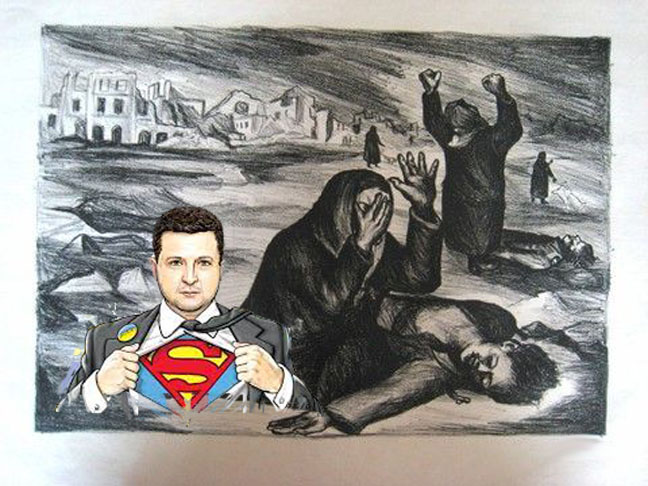
Walt Zlotow – Why do so many leaders remain stupid about Ukraine war?
Walt Zlotow, West Suburban Peace Coalition, Glen Ellyn IL , 31 Mar 2.
The 3 year long destruction of Ukraine should never have occurred.
Had leaders in the US, NATO and Ukraine simply used common sense, Ukraine would not be a shell of its former self before the February 24, 2022 Russian invasion that has largely destroyed it. Ukraine economy shattered. Hundreds of thousands of dead and wounded. Over 10 million fled. Over 45,000 square miles lost to Russia forever.
This occurred from massive stupidity by all the leaders in the countries involved.
The stupidity starts with US presidents going back to Bill Clinton. In 1999 he broke the deal with USSR/Russia that he would not expand NATO eastward to their borders. From 1999 thru 2023 US relentlessly doubled NATO from 16 to 32 members.
Reasons likely many but all stupid. Smart diplomats, historians and political scientists were aghast, declaring this would inevitably lead to a US Russian confrontation. It took 23 years but stupid presidents Clinton, Bush, Obama, Biden all stupidly succeeded into provoking Russia to attack.
Odd, but only Trump was not stupid enough to add to NATO during his first term. He was however incredibly stupid to begin arming the Kyiv neofascists to wipe out the Russian leaning Ukrainian separatists in Donbas. That, along with NATO expansion, ensured Russia would intervene.
Western European NATO giants England, France and Germany also took their stupidity cue from Uncle Sam. They were getting cheap energy from Russia but stupidly bowed to US demands to weaken, isolate Russia thru NATO expansion and Kyiv warfare on Donbas Ukrainians. They were cool with replacing cheap Russian gas with exorbitant US LNG. Now they’re economies are crumbing, allowing inroads from MAGA like political opponents. Incredibly, instead of recognizing their stupidly, they’re stupidly planning to squander hundreds of billions of their vanishing treasure to keep the war going till they wreck their economies
If we were awarding a Stupid Prize, it must go to Ukraine President Volodymyr Zelensky. The comedian turned politician campaigned for the Ukraine presidency on a platform of peace with the Donbas Ukrainians being brutalized by the Kyiv government. It got him elected with big majority of Donbas voters. Alas, Zelensky was too stupid to realize the Kyiv neofascists would never allow him to make peace with Donbas separatists they sought to destroy. To save his presidency, possibly even his life, Zelensky abandoned his voting base.
Zelensky even stupidly amassed 60,000 elite troops on the Donbas border in early 2022 to finish off his constituents there. All that achieved, along with stupidly begging NATO for membership, was to provoke the Russian invasion.
Once started, Zelensky became stupider and stupider. He wisely prepared to sign a peace deal with Russia in the first 2 months which would have ended the war without Ukraine losing a single square mile of territory. But Zelensky stupidly caved to stupid US and UK leaders who told him he could win with US/NATO weapons…but no troops. That stupidity sent Ukraine into failed state status.
Ukraine is now on the cusp of peace being negotiated 2 leaders, Trump and Putin, employing common sense instead of stupidity. But the US Democratic Party, Ukraine, UK, French, German and other NATO leadership remain mired in stupidity that this senseless war must continue till the last Ukrainian soldier is dead.
They all forget the first rule of sane, peaceful governance: Don’t do stupid.
Biden Lied About Everything, Including Nuclear Risk, During Ukraine Operation
Sourced to tone-deaf “U.S. officials,” a massive New York Times exposé reveals an unprecedented betrayal of American voters, but also Ukraine
Racket News, Matt Taibbi, Apr 01, 2025
From “The Secret History of the War in Ukraine” in the New York Times:
At a hastily arranged meeting on the Polish border, General Zaluzhny admitted to Generals Cavoli and Aguto that the Ukrainians had in fact decided to mount assaults in three directions at once.
“That’s not the plan!” General Cavoli cried…
Fifteen months into the war, it had all come to this tipping point.
“We should have walked away,” said a senior American official.
But they would not.
When Ukrainian President Volodymyr Zelensky visited the White House nearly a month ago, the New York Times packed its pages with stories denouncing Donald Trump and J.D. Vance for abandoning Ukraine, and the impolitic “dressing down” of a friendly foreign leader. The Times like most Western news outlets for years suggested that anything short of a full-throated expression of support for war was a betrayal of the “democratic world order” that would lead to instant battlefield deaths.
Now that the war appears lost, and newspapers abroad (conspicuously, not here) are full of news about an apparent bombing of Vladimir Putin’s motorcade, and the future of NATO hangs by a thread, the Times has run a 13,000-word “Secret History” that shows the same U.S. officials who denounced Trump and American voters for saying it out loud long ago concluded that they, too, should probably “walk away.”
The piece is also an extraordinarily comprehensive betrayal of Zelensky and Ukraine, exponentially worse than the “dressing down” by Trump. Authored by longtime veteran of controversial intel pieces Adam Entous, it’s sourced to 300 American and European officials who seem to be responding to their apparent sidelining via a shameless tantrum, exhibiting behavior that in the field would get military men shot. Not only do they play kiss and tell with a trove of operational secrets, they use the Times to deflect blame from their own failures onto erstwhile Slavic partners, cast as ignorant savages who snatched defeat from the jaws of America-designed victory. It’s as morally abhorrent a piece of ass-covering ever as I’ve seen in print, and that somehow is not its worst quality.
The people who quarterbacked the NATO side of the Ukraine war are so pleased with themselves, they can’t keep from boasting about things that will make the average American want to pitchfork the lot of them. Entous describes a tale told “through a secret keyhole” that reveals how America was “woven into the war far more intimately and broadly than previously understood.” (Translation: it was hidden from us.) Sources not only make it clear that the public was lied to on a continuous basis from the outset of the conflict, they describe how we were lied to, apparently thinking the methods clever. Some are small semantic gambits the idiots wrongly believe exculpated their actions, but the main revelation involves one gigantic, inexcusable deception. From Joe Biden down, they all lied about the risk of World War III.
They risked our lives and our children’s lives, knowingly, repeatedly, and for the worst possible reason: politics. Afraid to admit a mistake, they planned individual excuses while letting bureaucratic inertia expand the conflict. Worse, as was guessed at on this site late last year, the Biden administration after last November’s election increased the risk of global conflict by “expanding the ops box to allow ATACMS and British Storm Shadow strikes into Russia,” in order to “shore up his Ukraine project.” If you and check this “secret history” against contemporaneous statements of American and European leaders, you’ll find the scale of the lies beyond comprehension. Heads need to roll for this:………………………………….. https://www.racket.news/p/biden-lied-about-everything-including?utm_source=post-email-title&publication_id=1042&post_id=160259839&utm_campaign=email-post-title&isFreemail=true&r=1ise1&triedRedirect=true&utm_medium=email
European Court of Human Rights (ECHR) Finds Ukraine Responsible for Odessa Massacre
The ECHR’s appraisal of criminal investigations into perpetrators of the Odessa massacre, and all the officials who failed in their most basic duties on May 2nd 2014, was absolutely scathing, the details pointing to a very clear, deliberate state-level coverup.
internal documents attesting that security measures had in fact been undertaken were found to have been forged.
the lethal incineration of anti-Maidan activists in May 2014 was an intentional and premeditated act of mass murder, conceived and directed by Kiev’s US-installed far-right government. This interpretation is amply reinforced by testimonies from a Ukrainian parliamentary commission, instituted in the massacre’s immediate aftermath.
(While the video above has been censored. This video below is allowed, as it contains a more favoured view of theUkrainian government.
Kit Klarenberg, Mar 30, 2025, https://www.kitklarenberg.com/p/echr-finds-ukraine-responsible-for?utm_source=post-email-title&publication_id=552010&post_id=160179175&utm_campaign=email-post-title&isFreemail=true&r=nxsz&triedRedirect=true&utm_medium=email
On March 13th, a bombshell judgment by the European Court of Human Rights found the Ukrainian government guilty of grave human rights breaches over the May 2nd 2014 Odessa massacre, in which dozens of Russian-speaking anti-Maidan activists were forced into the city’s Trade Unions House and burned alive by violent ultranationalist thugs. The explosive findings unambiguously uncover a concerted conspiracy by Ukrainian authorities to facilitate and exacerbate the grotesque killing, then insulate its perpetrators, and officials and state agencies which helped it happen, from justice.
In all, 42 people were killed and hundreds injured as a result of the blaze, a bloody bookend to the so-called “Maidan revolution” that saw Ukraine’s democratically-elected president Viktor Yanukovych deposed in a Western-orchestrated coup months earlier. Ever since Ukrainian officials and legacy media outlets have consistently framed the deaths as a tragic accident, with some figures even blaming anti-Maidan protesters themselves for starting the blaze. That notion is comprehensively incinerated by the verdict, which was delivered by a team of seven European judges, including a Ukrainian.
“Relevant authorities’ failure to do everything that could reasonably be expected of them to prevent the violence in Odessa…to stop that violence after its outbreak, to ensure timely rescue measures for people trapped in the fire, and to institute and conduct an effective investigation into the events” means Kiev was found guilty of egregious European Convention on Human Rights breaches. Moreover, numerous incendiary passages make clear industrial scale “negligence” by officials on the day, and ever after, “went beyond an error of judgment or carelessness.”
For example, the ECHR found deployment of fire engines to the site was “deliberately delayed for 40 minutes” – the local fire station being just one kilometer away – and police stood by passively as the building and its occupants burned, refusing to “help evacuate people…promptly and safely.” Moreover, Ukrainian authorities made “no efforts whatsoever” or “any meaningful attempt” to prevent or disrupt the skirmishes between pro- and anti-Maidan activists that prefaced the deadly inferno, despite knowing in advance such clashes were impending on the day.
While stopping short of charging that Ukrainian authorities actively wished for the anti-Maidan activists trapped in the burning building to die, this conclusion is ineluctable based on the ECHR’s findings. So too the apparent immunity from prosecution for implicated officials and ultranationalist perpetrators, and Kiev’s failure to act on “extensive photographic and video evidence” indicating precisely who was responsible for “firing shots during the clashes,” setting the building ablaze, and “assaulting the fire victims” who managed to escape.
The case was brought by 25 people who lost family members in the Neo-Nazi arson attack and clashes that preceded it, and three who survived the fire “with various injuries”. The ECHR has demanded Ukraine pay them just 15,000 euros each in damages. In an even greater affront to justice, the damning ruling stops short of exposing the full reality of the Odessa slaughter, indicting the Western-supported Neo-Nazi elements responsible, and their intimate ties to the February 2014 Maidan Square false flag sniper massacre.
‘Explicit Order’
Once the Maidan protests commenced in Ukraine in November 2013, tensions began steadily brewing between Odessa’s sizable Russian-speaking population and Ukrainian nationalists within and without the city. As the ECHR ruling notes, “while violent incidents had overall remained rare…the situation was volatile and implied a constant risk of escalation.” In March 2014, anti-Maidan activists set up a tent camp in Kulykove Pole Square, and began calling for a referendum on the establishment of an “Odessa Autonomous Republic”.
The next month, supporters of Odesa Chornomorets and Kharkiv Metalist football clubs announced a rally “For a United Ukraine” on May 2, before a scheduled match. Shortly thereafter, the ECHR records “anti-Maidan posts began to appear on social media describing the event as a Nazi march and calling for people to prevent it.” While branded Russian “disinformation” in the ruling, hooligans associated with both clubs had overt Neo-Nazi sympathies and associations, and well-established reputations for violence. They later formed the notorious Azov Battalion.
Fearing their tent encampment would be attacked, anti-Maidan activists resolved to disrupt the “pro-unity march” before it reached them. The ECHR reveals Ukraine’s security services and cybercrime unit had substantive intelligence indicating “violence, clashes and disorder” were certain on the day. Yet, authorities “ignored the available intelligence and the relevant warning signs”, and undertook no actions or “proper measures” to “stamp out any provocation”, such as implementing “enhanced security in the relevant areas.”
So it was on the afternoon of May 2nd 2014, “as soon as the march began,” anti-Maidan activists confronted the demonstrators, and violent clashes erupted. At roughly 17:45, in the precise manner of the Maidan Square sniper false flag massacre three months earlier, multiple anti-Maidan activists were fatally shot “by someone standing on a nearby balcony”, using “a hunting gun.” Subsequently, “pro-unity protesters…gained the upper hand in the clashes,” and charged towards Kulykove Pole square.
Anti-Maidan activists duly “took refuge” in Trade Unions House, a five-storey building overlooking the square, while their ultranationalist adversaries “started setting fire to the tents.” Gunfire and Molotov cocktails were “reportedly” exchanged by both sides, and before long, the building was ablaze. “Numerous calls” were made to the local fire brigade, including by police, “to no avail.” Mysteriously, its chief had “instructed his staff not to send any fire engines to Kulykove Pole without his explicit order,” so none were dispatched.
Several people trapped in the building tried to escape by jumping from its upper windows – some survived, but others died. “Video footage shows pro-unity protesters attacking people who had jumped or had fallen,” the ECHR notes. It was not until 20:30 that firefighters finally entered the building and extinguished the blaze. Police then arrested 63 surviving activists “still inside the building or on the roof.” They were released two days later, after a several hundred-strong group of anti-Maidan protesters “stormed the local police station where they were being held.”
‘Serious Defects’
The litany of security failures and industrial scale negligence by authorities on the day was greatly aggravated by “local prosecutors, law enforcement, and military officers” not being “contactable for a large part or all of time [sic],” as they were coincidentally attending a meeting with Ukraine’s Deputy Prosecutor General. The ECHR “found the attitude and passivity of those officials inexplicable,” apparently unwilling to consider the obvious possibility they purposefully made themselves incommunicado to ensure maximum mayhem and bloodshed, while insulating themselves from legal repercussions.
Still, the ECHR ruled “relevant” Ukrainian authorities “had not done everything they reasonably could to prevent the violence” or “what could reasonably be expected of them to save people’s lives,” therefore finding Kiev committed “violations of the substantive aspect of Article 2” of the European Convention on Human Rights. The Court also concluded authorities “failed to institute and conduct an effective investigation into the events in Odessa” – “a violation of the procedural aspect of Article 2”.
The ECHR’s appraisal of criminal investigations into perpetrators of the Odessa massacre, and all the officials who failed in their most basic duties on May 2nd 2014, was absolutely scathing, the details pointing to a very clear, deliberate state-level coverup. For example, no effort was made to seal off “affected areas of the city centre” in the event’s aftermath. Instead, “the first thing” authorities did “was to send cleaning and maintenance services to those areas,” meaning invaluable evidence was almost inevitably eradicated.
Accordingly, when on-site inspections were finally carried out two weeks later, the probes “produced no meaningful results.” Trade Unions House likewise “remained freely accessible to the public for 17 days after the events,” giving malicious actors plentiful time to manipulate, remove, or plant incriminating evidence at the site. Meanwhile, “many of the suspects absconded.” Several criminal investigations into perpetrators were opened, only to go nowhere, left to expire under Ukraine’s statute of limitations. Other cases that reached trial “remained pending for years”, before being dropped.
This was despite “extensive photographic and video evidence regarding both the clashes in the city centre and the fire,” from which culprits’ identities could be easily discerned. . The ECHR had no confidence Ukrainian authorities “made genuine efforts to identify all the perpetrators,” and several forensic reports weren’t released for many years. Elsewhere, the Court noted a criminal investigation of an individual suspected of having shot at anti-Maidan activists was inexplicably discontinued on four separate occasions, on identical grounds.
The ECHR also noted “serious defects” in investigations of officials, “and their role in the events.” Primarily, this took the form of “prohibitive delays” and “significant periods of unexplained inactivity and stagnation” in opening cases. For instance, “although it had never been disputed that the fire service regional head had been responsible for the delayed deployment of fire engines to Kulykove Pole,” no probe into his flagrantly criminal dereliction of duty was launched until almost two years after the massacre.
Similarly, Odessa’s regional police chief not only failed to implement any “contingency plan in the event of mass disorder” according to protocol, but internal documents attesting that security measures had in fact been undertaken were found to have been forged. However, he only became subject to criminal investigation “almost a year later.” Following pre-trial investigation, his case remained pending “for about eight years,” after which he was released from criminal liability, “on the grounds that the charges against him had become time-barred.”
Burn Everything’
Wholly unconsidered by the ECHR was the prospect that, far from a freak twist of fate produced by two effectively warring factions clashing in Odessa, the lethal incineration of anti-Maidan activists in May 2014 was an intentional and premeditated act of mass murder, conceived and directed by Kiev’s US-installed far-right government. This interpretation is amply reinforced by testimonies from a Ukrainian parliamentary commission, instituted in the massacre’s immediate aftermath.
The commission found Ukrainian national and regional officials explicitly planned to use far-right activists drawn from the fascist Maidan Self-Defence to violently suppress Odessa’s would-be separatists, and disperse all those camped by Trade Unions House. Moreover, Maidan Self-Defence chief Andriy Parubiy and 500 of his armed and dangerous members were dispatched to the city from Kiev on the eve of the massacre. From 1998 – 2004, Parubiy served as founder and leader of Neo-Nazi paramilitary faction Patriot of Ukraine.
He also headed Kiev’s National Security and Defence Council at the time of the Odessa massacre. Ukraine’s State Bureau of Investigations immediately began scrutinising Parubiy’s role in the May 2014 events after he was replaced as lead parliamentary speaker, following the country’s 2019 general election. This probe has seemingly come to nothing since. Nonetheless, a year prior a Georgian militant told Israeli documentarians that he engaged in “provocations” in the Odessa massacre under Parubiy’s command, who told him to attack anti-Maidan activists and “burn everything.”
He is one of several Georgian fighters who has openly alleged they were personally responsible for the February 2014 Maidan Square false flag sniper massacre, under the command of Parubiy, other ultranationalist Ukrainian figures, and Mikhael Saakashvili, founder of infamous mercenary brigade Georgian Legion. That slaughter brought about the end of Viktor Yanukovych’s government, and sent Ukraine hurtling towards war with Russia. The Odessa massacre was another key chapter in that morbid saga – and the West’s foremost human rights court has now firmly laid responsibility for the horror at Kiev’s feet.
Risks posed by hole in protective shell over Chernobyl
Lilia Rzheutska, DW, March 29, 2025,
When it was erected in 2019, the giant shell over the damaged nuclear reactor in Chernobyl was one of the biggest structures ever moved by humans. In February a Russian drone put a hole in it.
For weeks, the Ukrainian authorities have been looking for ways to repair a large hole in the protective shell that covers the fourth reactor of the decommissioned Chernobyl nuclear plant. On February 14, a Russian drone hit the structure, which is called the New Safe Confinement, or NSC, because it is meant to “confine” the reactor’s radioactive remains. The drone started a fire that caused considerable damage and was only extinguished three weeks later on March 7.
“The main mission is to close the hole, which is about 15 square meters [around 162 square feet] in size, but also the more than 200 small holes that the State Emergency Service of Ukraine drilled into the shell during firefighting operations,” said Hryhoriy Ishchenko, the head of the State Agency of Ukraine on Exclusion Zone Management, which is responsible for the area around the Chernobyl power plant.
He told DW that experts would soon be arriving on site to examine the structure and that “preliminary recommendations on the repair work should be available within a month.”
A €1.5 billion megaproject
The NSC was erected over a pre-existing protective shell called the sarcophagus, which is there to prevent the release of radioactive contaminants from the reactor, which exploded in 1986. The NSC was built after 45 donor countries came together and gathered around €1.5 billion for the project. Eventually 10,000 people from 40 countries would play a part in the shell, which took 12 years, from the signing of contracts to the moment the NSC was ready in 2019. …………………………
Although experts say the drop in pressure in the NSC does not pose any immediate threat, there are other dangers. Dmytro Humeniuk, a safety analysis expert at Ukraine’s State Scientific and Technical Center for Nuclear and Radiation Safety said it was currently impossible to dismantle the old sarcophagus. The NSC was built in part to replace the old shell but inside the old shell, there are still 18 unstable beams. Three of the main beams could reportedly collapse at any time. If this were to happen under the new-but-now-damaged protective structure, radioactive dust could be stirred up and radioactivity released, Humeniuk said. “The protective shell is currently not fulfilling its function, which is to contain the nuclear fission products beneath it.”………………………….
For Jan Vande Putte, a nuclear expert at Greenpeace Ukraine, there are very few options. “Due to the high radiation levels above the sarcophagus, the entire Chernobyl protective shell will probably have to be moved back to the place where it was built on rails before the expensive repairs can be carried out,” he said adding that the costs of doing this were completely unknown.
Representatives of the European Bank for Reconstruction and Development visited Chernobyl on March 18 and spoke with the power plant’s directors, according to a report on the power plant’s website. They also inspected the technical units of the NSC and the area under the protective shell.
After the meeting, €400,000 from the International Chernobyl Cooperation Account, which the European Bank manages, was approved for a specialist-led damage assessment. https://www.dw.com/en/risks-posed-by-hole-in-protective-shell-over-chernobyl/a-72078360?fbclid=IwY2xjawJV0VZleHRuA2FlbQIxMQABHfhIgvFmxHhPebzUFjc8wxY4HEGBSRbgMxQdAOL2rCSoRY-S4A1j5U8wvw_aem_qeZu8AA
Russia rules out transferring control over Zaporizhzhia Nuclear Power Plant to Ukraine

the plant being jointly operated, including with the participation of international organizations,
“In this case, for example, it is impossible to properly ensure nuclear and physical nuclear safety, or regulate issues of civil liability for nuclear damage.
Transfer of the facility or control over it to Ukraine or any other country is ‘impossible,’ says Foreign Ministry
Burc Eruygur 26.03.2025, https://www.aa.com.tr/en/russia-ukraine-war/russia-rules-out-transferring-control-over-zaporizhzhia-nuclear-power-plant-to-ukraine/3520006#
Russia on Tuesday rejected transferring control over the Zaporizhzhia Nuclear Power Plant (ZNPP) to Ukraine or any other country, saying it is “impossible.”
US President Donald Trump and his Ukrainian counterpart Volodymyr Zelenskyy discussed the situation surrounding energy supplies to Ukraine and the country’s nuclear power plants during a phone call last Wednesday.
Trump told Zelenskyy that the US could be “very helpful in running the plants with its electricity and utility expertise” and that “American ownership of those plants could be the best protection for that infrastructure,” according to a White House statement.
Zelenskyy told journalists at a briefing later that he and Trump did talk about the restoration of the ZNPP and that Ukraine is ready to discuss the modernization of the plant but they did not discuss the issue of ownership of the plant.
A statement by the Russian Foreign Ministry stressed that the plant is a “Russian nuclear facility,” saying the transfer of the facility or control over it to Ukraine or any other country is “impossible.”
“All the station’s employees are citizens of the Russian Federation. Their lives cannot be played with, especially considering the atrocities that Ukrainians have committed and continue to commit on the territory of our country,” it said.
The statement also denied the possibility of the plant being jointly operated, including with the participation of international organizations, describing this as having “no such precedents in world practice.”
“In this case, for example, it is impossible to properly ensure nuclear and physical nuclear safety, or regulate issues of civil liability for nuclear damage.
The statement also denied the possibility of close cooperation between NATO intelligence services with Ukraine, which have impressive sabotage potential, makes it impossible, including with the participation of international organizations, describing this as having “no such precedents in world practice.”
“In this case, for example, it is impossible to properly ensure nuclear and physical nuclear safety, or regulate issues of civil liability for nuclear damage.
“An important aspect is that close cooperation between NATO intelligence services with Ukraine, which have impressive sabotage potential, makes it impossible to even temporarily admit representatives of these states to the ZNPP,” the statement added.
The situation around the Zaporizhzhia Nuclear Power Plant, Europe’s largest and one of the world’s 10 biggest, particularly remains tense as concerns persist over a possible nuclear disaster involving Moscow and Kyiv, both of which have frequently accused each other of attacks around the facility.
Since Sept. 1, 2022, International Atomic Energy Agency (IAEA) personnel have been present at the plant, which has been under Russian control since March 2022.
Ukraine and Israel are not US allies.
Walt Zlotow, West Suburban Peace Coalition, Glen Ellyn IL , 25 Mar 25
They are essentially US Trojan Horses used to project US power dominance in Europe and Middle East respectively.
Both US Trojan Horses have come up lame and are heading for the glue factory.
The US marched their Ukraine Trojan Horse up to Russia’s borders armed with NATO entrance papers and billions in US weapons. When Russia pleaded with the US for years to discuss Russia’s valid security concerns, the US replied ‘Nyet.’ Former President Biden knew Russia would attack but believed any invasion would be a Vietnam style quagmire for Russia. Biden saw the upcoming Russian collapse as the shining achievement of his half century anti-Russian Cold War mantra. That failed spectacularly.
The election of Trump has injected a healthy dose of realpolitik that acknowledges Biden’s folly. Trump is currently in negotiations to put America’s Ukraine Trojan Horse to pastoral retirement. Can’t come soon enough.
America’s Israeli Trojan Horse to dominate the Middle East is a horse of a different color. It’s more like Israel’s Trojan Horse near totally financed by Uncle Sam. America gets to sit back while Israel marches around their neighborhood committing genocide is Gaza, indiscriminately bombing innocents in Syria and Lebanon, and promoting US attacks on Yemen and eventually Iran. All this senseless carnage constitutes Israel serving as the US battering ram to recreate the Middle East according to its dominant worldview.
Like our Ukraine Trojan Horse, our Israeli Trojan Horse is failing to promote America’s true national interests. Most of the world’s 193 countries are aghast America promotes the most grotesque genocide this century. America’s standing may be at an all time low. Like with Ukraine, we’re enabling Israel to self destruct. It’s now a pariah state. Tourism and investment are in decline. Its military is demoralized both from significant casualties and having to commit genocide.
Both allies are flirting with wider war; nuclear in Ukraine, regional war in Israel.
America gets nothing from allies Ukraine and Israel except worldwide condemnation, squandered treasure and diminishing unipolar world dominance.
With allies like Ukraine and Israel, America does not need enemies.
Zaporizhzhia nuclear plant to stay in Russian control, Moscow says
By Reuters, March 26, 2025, https://www.reuters.com/world/europe/zaporizhzhia-nuclear-plant-stay-russian-control-moscow-says-2025-03-25/
MOSCOW, March 25 (Reuters) – Russia’s Foreign Ministry said on Tuesday the Zaporizhzhia nuclear plant was a Russian facility and transferring control of it to Ukraine or any other country was impossible.
The ministry also said that jointly operating the plant was not admissible as it would be impossible to properly ensure the physical and nuclear safety of the station.
It said Zaporizhzhia region, partly controlled by Russian forces, was one of four in Ukraine that had been annexed by Russia by virtue of referendums staged seven months after Moscow’s full-scale invasion of its neighbour and a presidential decree had formally made the station Russian property.
Western nations have dismissed the referendums as shams.
“The return of the station to Russia’s nuclear sector has been a fait accompli for quite some time,” the ministry statement said. “Transferring the Zaporizhzhia plant to the control of Ukraine or another country is impossible.”
Russian forces seized the station early in the invasion and each side has since routinely accused the other of staging attacks that endanger safety at the plant, Europe’s largest with six reactors.
Although the plant now produces no electricity, the U.N.’s nuclear watchdog has monitors stationed there, as it does at all Ukrainian nuclear power sites.
Ukraine demands the return of the station to its jurisdiction and rejects the 2022 annexation of its territory as illegal.
U.S. President Donald Trump, during a phone conversation this month with his Ukrainian counterpart Volodymyr Zelenskiy suggested the United States could help run and possibly own Ukraine’s nuclear power plants.
Zelenskiy said the plants belong to the Ukrainian people. He said he and Trump had discussed potential U.S. investment in the plant. Reporting by Maxim Rodionov and Ron Popeski; Editing by Hugh Lawson and Rod Nickel
1 This Month
6 June – WEBINAR- Get Inspired by Protests Against Military Bases!


Cuba Is Not a Failed State – It Is a Besieged State
PETITION: “Global Appeal to Endorse Palestinian Right of Return of Refugees”


of the week– Nuclear Reactor Information Task Force
To see nuclear-related stories in greater depth and intensity – go to https://nuclearinformation.wordpress.com
-
Archives
- June 2026 (34)
- May 2026 (306)
- April 2026 (356)
- March 2026 (251)
- February 2026 (268)
- January 2026 (308)
- December 2025 (358)
- November 2025 (359)
- October 2025 (376)
- September 2025 (257)
- August 2025 (319)
- July 2025 (230)
-
Categories
- 1
- 1 NUCLEAR ISSUES
- business and costs
- climate change
- culture and arts
- ENERGY
- environment
- health
- history
- indigenous issues
- Legal
- marketing of nuclear
- media
- opposition to nuclear
- PERSONAL STORIES
- politics
- politics international
- Religion and ethics
- safety
- secrets,lies and civil liberties
- spinbuster
- technology
- Uranium
- wastes
- weapons and war
- Women
- 2 WORLD
- ACTION
- AFRICA
- Atrocities
- AUSTRALIA
- Christina's notes
- Christina's themes
- culture and arts
- Events
- Fuk 2022
- Fuk 2023
- Fukushima 2017
- Fukushima 2018
- fukushima 2019
- Fukushima 2020
- Fukushima 2021
- general
- global warming
- Humour (God we need it)
- Nuclear
- RARE EARTHS
- Reference
- resources – print
- Resources -audiovicual
- Weekly Newsletter
- World
- World Nuclear
- YouTube
-
RSS
Entries RSS
Comments RSS
 nuclear-news