Situation unstable: IAEA says shots were heard at Zaporizhzhia power plant

Artur Kryzhnyi — Friday, 25 April 2025,
IAEA experts at the Zaporizhzhia Nuclear Power Plant heard loud gunshots on 23 April near the main administrative building where their office is located.
Source: IAEA press service
Details: In addition, the IAEA team has heard explosions and gunshots at different distances from the plant almost every day over the past week.
“What once seemed almost unthinkable – evidence of hostilities near a large nuclear facility – has become an almost daily occurrence and a familiar part of life at Europe’s largest nuclear power plant. From a nuclear safety point of view, this is certainly an unstable situation,” said IAEA Director General Rafael Grossi.
Despite the regular sounds of fighting, IAEA experts continue to conduct inspections at the plant to monitor and assess the state of nuclear safety and security…………….
Ukrainian President Volodymyr Zelenskyy said that the proposal for US control over the Zaporizhzhia Nuclear Power Plant raises many questions that are difficult to resolve.
Ukrainska Pravda 25th April 2025
https://www.pravda.com.ua/eng/news/2025/04/25/7509136/
On Chernobyl Disaster Anniversary, Repairing Damaged Shield Poses ‘Enormous Challenge’
April 26, 2025 ,By RFE/RL’s Ukrainian Service, Stuart Greer and Oleh Haliv, https://www.rferl.org/a/ukraine-chernobyl-nuclear-disaster-anniversary-russia/33397012.html?fbclid=IwY2xjawJ6SqxleHRuA2FlbQIxMQBicmlkETE3RG9aSkhxNzhYNndQMGFFAR4zqGfz15XQZ8lgJtOhc7sSWq1aQn8M_cCUwEQ8_iwc4gjbpLOjfLqY7ftG6g_aem_uTOf_f4ZB8kKArzvpkNfYQ
As Ukraine marks the 39th anniversary of the world’s worst civilian nuclear accident at the Chernobyl power plant, engineers are struggling to find ways to repair the complex’s protective shield more than two months after a Russian drone left a large hole in the structure.
The massive steel dome was designed to protect and confine the radioactive remains of crippled reactor number four that exploded when a routine safety test went wrong on April 26, 1986.
Radiation levels outside the punctured shield have stayed normal since the drone attack, officials say.
But sealing the hole hasn’t been possible because it sits above the crumbling sarcophagus that encases radioactive debris from the reactor.
“How can you fix a roof space where the higher you go up in the building, the higher the radiation levels? They’re so high next to the actual sarcophagus, the reactor unit, that you can’t work above it,” says Shaun Burnie, a nuclear expert with Greenpeace.
Burnie was part of a Greenpeace team invited to Chernobyl to inspect the damage shortly after the February 14 drone strike which Moscow denied it was responsible for.
“It’s a very, very serious, enormous challenge for Ukraine at a time when it’s faced with so many other challenges, and so the international community really needs to step in and support.” says Burnie.
It took emergency crews three weeks to locate and extinguish fires that spread and smoldered through the membrane of the shield’s outer shell.
The new confinement structure was completed in 2019 as part of a $2.2 billion international project involving 45 countries. The temporary rail track used to install it over the reactor has since been dismantled, meaning the massive structure can’t be moved safely to the side for repairs.
The United Nations predicted the shield would “make the reactor complex stable and environmentally safe for the next 100 years.”
But long-term plans to safely dismantle the sarcophagus to allow the removal of radioactive ruins of the reactor are no longer possible following damage to the shield, according to Dmytro Humeniuk, an expert from Ukraine’s State Scientific and Technical Center for Nuclear and Radiation Safety.
The European Bank for Reconstruction and Development has earmarked $450,000 to assess the drone damage to the confinement structure.
Ukrainian Environment Minister Svitlana Hrynchuk estimates the preliminary results of the analysis should be completed sometime in May.
Repairs to the shield will be costly and Ukraine will need significant funding from international donors, predicts Burnie.
“They have to come up with a longer-term plan, which will be very extensive, very complicated, and potentially horrendously expensive.”
Kiev and its backers reject key aspects of Trump’s peace plan – Reuters
25 Apr 25, https://www.rt.com/news/616288-reuters-trump-peace-plan/
The counteroffer is “on the table” of the American president, Vladimir Zelensky has stated
Kiev and its European backers have turned down President Donald Trump’s reported peace plan for the Ukraine conflict in several significant respects, according to a report by Reuters, citing the full texts of the US proposal and the response.
Washington tabled a proposed deal to end hostilities between Kiev and Moscow during a meeting in Paris on Thursday last week. A follow-up meeting took place in London on Wednesday, at which Ukrainian officials and their NATO European counterparts drafted counterproposal.
The London talks were downgraded at the last minute after Ukraine’s Vladimir Zelensky publicly rejected key American suggestions. He declared on Thursday that the European-backed “strategy” was now “on President Trump’s table.”
Having examined the drafts “in full and explicit detail” on Friday, Reuters identified four critical areas of disagreement.
The US is proposing Washington’s formal recognition of Russian sovereignty over Crimea — the former Ukrainian region that voted to join Russia following the 2014 Western-backed armed coup in Kiev — and a cessation of hostilities along the current frontline.
Kiev and its European backers are only willing to discuss territorial issues after a ceasefire has been established.
The US document offers a “robust security guarantee” for Ukraine from willing nations, according to Reuters. The Euro-proposal rival proposal insists that no restrictions be placed on Ukraine’s military, including the deployment of foreign troops on its territory, and calls for the US to provide NATO-like protection to Ukraine.
Russia demands Ukraine remains neutral and insists that it will not accept any NATO troop presence, or troops from bloc members as part of a coalition, in the country.
Reuters reported that the US is advocating for the removal of restrictions imposed on Russia since 2014, while Kiev and the Europeans propose a “gradual easing of sanctions after a sustainable peace is achieved,” paired with a threat of snapback measures for non-compliance.
The US framework includes mentions of financial compensation for Ukraine, but lacks specifics. The Kiev-backed counterproposal identifies frozen Russian assets in Western countries as a source for such payments, according to Reuters. Russia has labeled the seizure of its funds illegal and views any use of these assets to support Ukraine as “theft.”
Members of the Trump administration have blasted Zelensky for attempting to negotiate a deal through the media rather than in confidential discussions. The US president has warned that he may withdraw from his mediation efforts altogether if either party stalls progress.
Kursk Region fully liberated from Ukrainians – Putin
Rt.com, 26 Apr, 2025
Kiev’s gamble to invade Russia has ended up in an unmitigated disaster, the president has said.
The Russian military has completely liberated the border Kursk Region from Ukrainian forces, President Vladimir Putin has said after being briefed on the battlefield situation by General Staff Chief Valery Gerasimov.
In a video address shared by the Kremlin on Saturday, Putin thanked Russian service members “who took part in defeating the neo-Nazi groups” that invaded the region last summer.
“The Kiev regime’s adventure has completely failed, and the huge losses suffered by the enemy, including among the most combat-ready, trained and equipped, including by Western models of equipment… will certainly be reflected along the entire line of combat contact,” he said.
According to Putin, the Russian success sets the stage for further advances in other areas of the front, bringing final victory in the conflict closer……………….
…………….Ukraine launched its incursion into Kursk Region last August, initially gaining some ground and capturing numerous settlements before their advance was checked by Russian forces.
Putin has characterized the incursion as an attempt by Kiev to divert attention from Moscow’s offensive in Donbass, adding that this ploy has failed. Ukrainian officials described the operation as a way to gain leverage in potential peace talks with Russia. https://www.rt.com/russia/616355-kursk-region-fully-liberated/
UK to scrap plans for Ukraine troop deployment – The Times
RT.com 25 Apr 25
London and Paris had previously lead an effort to send a European contingent if a ceasefire is reached.
The UK has ditched plans to deploy a military contingent to Ukraine in the event of a ceasefire, The Times has reported, citing anonymous sources.
The defense chiefs from a number of European NATO states had in recent weeks been discussing sending military personnel to Ukraine, under a so-called “coalition of the willing.” Russia has strongly objected to the prospect of Western troops appearing in the neighboring country under any pretext.
In an article on Thursday, The Times quoted an unnamed source as saying that the “risks are too high and the forces inadequate for” a deployment that had been previously under consideration. According to the publication, “it was France who wanted a more muscular approach.”
Instead of coalition forces guarding key Ukrainian cities, ports, and nuclear power plants, the grouping now envisages more emphasis on Western military instructors training Ukrainian troops in the west of the country, who would “‘reassure’ by being there but aren’t a deterrence or protection force,” The Times reported, citing an anonymous source.
The softened vision for a Western military presence in Ukraine does, however, reportedly include the coalition’s aircraft patrolling Ukraine’s airspace and Türkiye providing maritime cover…………………………………..https://www.rt.com/news/616330-uk-scraps-ukraine-troop-deployment/
On Neo-Nazi Influence in Ukraine

The Azov Battalion, which arose during the coup, became a significant force in the war against the Russian-speaking people of the Donbass, who resisted the coup. Its commander, Andriy Biletsky, infamously said Ukraine’s mission is to “lead the White Races of the world in a final crusade for their survival … against the Semite-led Untermenschen.”
the Azov backer’s television channel had by this time aired the hit TV show Servant of the People (2015-2019), which catapulted Volodymyr Zelensky to fame and ultimately into the presidency under the new Servant of the People Party. The former actor and comedian’s presidential campaign was bankrolled by Kolomoisky, according to multiple reports.
Zelensky was elected president on the promise of ending the Donbass war. About seven months into his term he traveled to the front line in Donbass to tell Ukrainian troops, where Azov is well-represented, to lay down their arms. Instead he was sent packing. The Kyiv Post
A short history of neo-Nazism in Ukraine in response to some who say, “There is no evidence that Nazism has substantial influence in Ukraine.” Joe Lauria reports.
By Joe Lauria, Consortium News, 20 Apr 25
The U.S. relationship with Ukrainian fascists began after the Second World War. During the war, units of the Organization of Ukrainian Nationalists (OUN-B) took part in the Holocaust, killing at least 100,000 Jews and Poles.
Mykola Lebed, a top aide to Stepan Bandera, the leader of the fascist OUN-B, was recruited by the C.I.A. after the war, according to a 2010 study by the U.S. National Archives.
The government study said, “Bandera’s wing (OUN/B) was a militant fascist organization.” Bandera’s closest deputy, Yaroslav Stetsko, said: ““I…fully appreciate the undeniably harmful and hostile role of the Jews, who are helping Moscow to enslave Ukraine…. I therefore support the destruction of the Jews and the expedience of bringing German methods of exterminating Jewry to Ukraine….”
The study says: “At a July 6, 1941, meeting in Lwów, Bandera loyalists determined that Jews ‘have to be treated harshly…. We must finish them off…. Regarding the Jews, we will adopt any methods that lead to their destruction.’”
Lebed himself proposed to “’cleanse the entire revolutionary territory of the Polish population,’ so that a resurgent Polish state would not claim the region as in 1918.” Lebed was the “foreign minister” of a Banderite government in exile, but he later broke with Bandera for acting as a dictator. The U.S. Army Counterintelligence Corps termed Bandera “extremely dangerous” yet said he was “looked upon as the spiritual and national hero of all Ukrainians….”
The C.I.A. was not interested in working with Bandera, pages 81-82 of the report say, but the British MI6 was. “MI6 argued, Bandera’s group was ‘the strongest Ukrainian organization abroad, is deemed competent to train party cadres, [and] build a morally and politically healthy organization….’” An early 1954 MI6 summary noted that, “the operational aspect of this [British] collaboration [with Bandera] was developing satisfactorily. Gradually a more complete control was obtained over infiltration operations …
Britain ended its collaboration with Bandera in 1954. West German intelligence, under former Nazi intelligence chief Reinhard Gehlen, then worked with Bandera, who was eventually assassinated with cyanide dust by the KGB in Munich in 1959.
Instead of Bandera, the C.I.A. was interested in Lebed, despite his fascist background. They set him up in an office in New York City from which he directed sabotage and propaganda operations on the agency’s behalf inside Ukraine against the Soviet Union. The U.S. government study says:
“CIA operations with these Ukrainians began in 1948 under the cryptonym CARTEL, soon changed to AERODYNAMIC. … Lebed relocated to New York and acquired permanent resident status, then U.S. citizenship. It kept him safe from assassination, allowed him to speak to Ukrainian émigré groups, and permitted him to return to the United States after operational trips to Europe. Once in the United States, Lebed was the CIA’s chief contact for AERODYNAMIC. CIA handlers pointed to his ‘cunning character,’ his ‘relations with the Gestapo and … Gestapo training,’ [and] the fact that he was ‘a very ruthless operator.’”
The C.I.A. worked with Lebed on sabotage and pro-Ukrainian nationalist propaganda operations inside Ukraine until Ukraine’s independence in 1991. “Mykola Lebed’s relationship with the CIA lasted the entire length of the Cold War,” the study says. “While most CIA operations involving wartime perpetrators backfired, Lebed’s operations augmented the fundamental instability of the Soviet Union.”
Bandera Revival

The U.S. thus covertly kept Ukrainian fascist ideas alive inside Ukraine until at least Ukrainian independence was achieved. “Mykola Lebed, Bandera’s wartime chief in Ukraine, died in 1998. He is buried in New Jersey, and his papers are located at the Ukrainian Research Institute at Harvard University,” the U.S. National Archives study says.
The successor organization to the OUN-B in the United States did not die with him, however. It had been renamed the Ukrainian Congress Committee of America (UCCA), according to the International Business Times (IBT).
“By the mid-1980s, the Reagan administration was honeycombed with UCCA members. Reagan personally welcomed [Yaroslav] Stetsko, the Banderist leader who oversaw the massacre of 7,000 Jews in Lviv, in the White House in 1983,” IBT reported. “Following the demise of [Viktor] Yanukovich’s regime [in 2014], the UCCA helped organise rallies in cities across the US in support of the EuroMaidan protests,” it reported.
That is a direct link between Maidan and WWII-era Ukrainian fascism.
Despite the U.S. favoring the less extreme Lebed over Bandera, the latter has remained the more inspiring figure in Ukraine.
In 1991, the first year of Ukraine’s independence, the neo-fascist Social National Party, later Svoboda Party, was formed, tracing its provenance directly to Bandera. It had a street named after Bandera in Liviv, and tried to name the city’s airport after him. (Svoboda won 10 percent of the Rada’s seats in 2012 before the coup and before Sen. John McCain and U.S. Assistant Secretary of State Victoria Nuland appeared with Svoboda’s leader the following year.)
In 2010, pro-Western Ukrainian President Viktor Yushchenko declared Bandera a Hero of Ukraine, a status reversed by President Viktor Yanukovych, who was overthrown with the help of Ukrainian neo-Nazis in 2014.
More than 50 monuments, busts and museums commemorating Bandera have been erected in Ukraine, two-thirds of which have been built since 2005, the year the pro-American Yuschenko was elected. A Swiss academic study says:
“On January 13, 2011, the L’vivs’ka Oblast’ Council, meeting at an extraordinary session next to the Bandera monument in L’viv, reacted to the abrogation [skasuvannya] of Viktor Yushchenko’s order about naming Stepan Bandera a ‘Hero of Ukraine’ by affirming that ‘for millions of Ukrainians Bandera was and remains a Ukrainian Hero notwithstanding pitiable and worthless decisions of the courts’ and declaring its intention to rename ‘Stepan Bandera Street’ as ‘Hero of Ukraine Stepan Bandera Street.’”
Torchlit parades behind Bandera’s portrait are common in Ukrainian cities, particularly on Jan. 1, his birthday, including this year.
Mainstream on Neo-Nazis
From the start of the 2013-2014 events in Ukraine, Consortium News founder Robert Parry and other writers began providing the evidence NewsGuard, which bills itself as a news-rating agency, says doesn’t exist. Parry began reporting extensively on the coup and the influential role of Ukraine’s neo-Nazis. At the time, corporate media also reported on the essential part neo-Nazis played in the coup. [See: ROBERT PARRY: Ukraine’s Inconvenient Neo-Nazis]
As The New York Times reported, the neo-Nazi group, Right Sector, had the key role in the violent ouster of Yanukovych. The role of neo-fascist groups in the uprising and its influence on Ukrainian society was well reported by mainstream media outlets at the time.
The BBC, the NYT, the Daily Telegraph and CNN all reported on Right Sector, C14 and other extremists’ role in the overthrow of Yanukovych. The BBC ran this report a week after his ouster:
After the coup a number of ministers in the new government came from neo-fascist parties. NBC News (100 percent NewsGuard rating) reported in March 2014: “Svoboda, which means ‘Freedom,’ was given almost a quarter of the Cabinet positions in the interim government formed after the ouster of President Viktor Yanukovych in February.”
Svoboda’s leader, Tyahnybok, whom McCain and Nuland stood on stage with, once called for the liberation of Ukraine from the “Muscovite-Jewish mafia.” The International Business Times (82.5 percent) reported:
“In 2005 Tyahnybok signed an open letter to then Ukrainian president Viktor Yushchenko urging him to ban all Jewish organisations, including the Anti-Defamation League, which he claimed carried out ‘criminal activities [of] organised Jewry’, ultimately aimed at the genocide of the Ukrainian people.”
Before McCain and Nuland embraced Tyahnybok and his social national party, it was condemned by the European Parliament, which said in 2012:
Continue readingDrawing inspiration from Vaclav Havel..

https://www.artistespourlapaix.org/3-ans-de-souffrances-ukrainiennes/
Par Pierre Jasmin, Artiste pour la Paix, 21 février 2025


1 Vaclav Havel and the Art of Compromise
Unfortunately, I never knew Vaclav Havel personally, even though I gave masterclasses (except for one in Piešťany, Slovakia), concertos, and recitals in the Czech Republic for fourteen summers between 1991 and 2005. I therefore had the privilege of experiencing the miracle of the Velvet Revolution in a country as Eastern European as Ukraine. The ruling communist party, allied with the Soviet army that had bloodily halted Dubcek's revolution, sought out a humanist playwright from prison in 1989 and installed him in the presidential seat. The new Havel government accepted the separation of Czecho-Slovakia less than three years later, without a drop of bloodshed.

Five years after the first Minsk Treaty (UN), mistreated by our Minister Baird, an accomplice of the fascist Poroshenko, a similar hope arose in Ukraine with the election of the comedian Zelensky in May 2019. This unprecedented electoral moment unfolded in the first round with the defeat of the comfortable Russian gas option (to prevent the elderly from dying in their poorly insulated homes) represented by the succession of the corrupt President Yanukovych, deposed by the Maidan revolution in 2014, and then, in the second round, of the outgoing head of state, Poroshenko.

But unlike Havel, Zelensky, with 73.2% of the vote, surrounded himself with nationalist Bandera supporters who threatened his life to force him to bomb Donbass and join his country to the militaristic NATO, thus provoking the Russian invasion of his country. In a context of devastating war, he avoided running for re-election.

Our government, Radio-Canada, and professors like Dominique Arel, the only ones authorized to speak (Artists for Peace are censored), are imposing the obstinacy of unconditional Canadian support for this Zelensky, corrupted by Biden's weapons and money, against the imposition of a peace desired by the sacrificed young people in the trenches of Donbass, those who survived, and by the improbable Putin-Trump duo. Other arguments can be read in ().
This point 1 was an “opinion” sent to Le Devoir on Wednesday, which did not publish it. On February 20, Arel was among six university colleagues who cowardly avoided contradicting his pro-Zelensky propaganda, except for Frédérik Gagnon of UQAM: see point 7.
Lviv and its troubled history
Putin is blamed for having wanted to invade the whole of Ukraine as early as the end of February 2022 with his advance near Kyiv, which aimed to bomb the arms factories and munitions located in the capital and in Lviv. Why this former capital of Galicia, which also bore the Austrian name of Lwow, the German name of Lemberg, and the Polish name of Lvov? The answer lies in the murky history revealed in two books I read by Philippe Sands, “Return to Lemberg” and “The Line.” With a complacent ambiguity that delighted his far-right readers at Albin Michel, the Franco-British lawyer recounts the romanticized saga of Charlotte, the Nazi wife of Otto von Wächter. A member of the Nazi Party since 1923, the latter became, after the outbreak of the Second World War, governor of Krakow in Poland, then governor of the district of Galicia, two territories that were noted for the mass extermination of Jews whom he saw as allies of the Bolshevik Soviet Union. “Handsome Otto” praised Lemberg, a place far more welcoming to his family than Berlin and Krakow, as it fully shared Nazi ideology. He evaded justice until 1949, notably due to complicity in the Vatican.
Before his two questionable books, Sands had worked on the horrors of the Rwandan genocide, the Bosnian-Serb massacres, Guantanamo, and the invasion of Iraq by Blair and Bush, but not Jean Chrétien, following our mass demonstrations in Montreal motivated by the UN’s refusal to endorse the war, given the conclusions of the Swede Hans Blix exonerating Saddam Hussein of possessing weapons of mass destruction. We should also read Sands’s 2006 book, prophetic of the recent marginalization of the UN by Biden, Trump, Macron, etc., Lawless World, subtitled Torture Made in the USA (Music And Entertainment Books, 2009), in which he denounced the use of music at Abu Ghraib by CIA agents and the American army, sentenced last November to pay millions of dollars to compensate three victims (who were better defended than the thousands of others).
February 21: A Ukrainian historian exposes the “real” Zelensky
Hosted by Clark University (Atlanta), historian Marta Havryshko, a graduate and professor at the University of Lviv (!), received death threats for criticizing the Ukrainian far right, to which she retorted:
“Every day, we lose parts of our territory. Every day, we lose people. Every day, our children suffer from missile and drone attacks. And we don’t know the consequences.”
She commented for Aaron Maté on the destruction of her homeland by a proxy war waged between Russia and the United States, with Zelensky’s complicity:
“Those who want to continue this disaster, this hell,” she said, addressing the foreign warriors and those who criticized her for seeking peace, “ARE THEY READY TO SACRIFICE THEIR LIVES, and those of their brothers, sons, and other beloved family members, FOR THE ABSURD IDEA OF ACHIEVING VICTORY? “Russia is bigger, resourceful, with powerful friends. I cannot conceive that anyone who is not mentally disturbed can truly believe that Ukraine can change the situation on the front and reconquer the lost territories.”
Marta observed family members forced to fight and die in this proxy war. She showed Aaron Maté newsreels showing the army Ukrainian forces hunting and kidnapping men to force them to become conscripts to replace soldiers who are dying (or being sent to hospitals).
“Who will recapture these territories? Several of my friends, several of my relatives, are conscripted now. They suffer from suicidal thoughts, they suffer from despair or intense frustration. No one can replace them because of the problems with forced mobilization, and because we simply lack manpower.“
And she explains that everyone (except the neo-Nazis) blames Zelensky:
“His popularity has plummeted (even though television channels are censored). Ukraine under Zelensky is no longer a democracy.“
American Caitlin Johnstone adds that anyone who doesn’t support a ceasefire is a monster (of ignorance, I might add, to soften her attack).
4 abi Yar
Western censorship of Russian music, even that of a genius like Dmitri Shostakovich, is applied, for example, to the excellent Italian film The Rape. Fortunately, in 2019, the Montreal Symphony Orchestra and Nagano programmed his thirteenth symphony with the choir featuring the composer David Sela. Through a long poem by the Ukrainian Yevtuchenko (whose ex-wife, the poet Bella Achmadulina, I met in Moscow in 1978 and 1987), the Babi Yar symphony, his masterpiece, denounces the worst pogrom of all time, perpetrated by Ukrainian einsatzgruppen: 33,771 Jews murdered on the night of September 29-30, 1941. Why don’t pro-Netanyahu activists say a word about this humanist work? Because NATO supports Israel?
5 – Chrystia Freeland vs. Glenn Michalchuk
We won’t dwell on the nefarious role played since 2015 by the granddaughter of a Ukrainian Nazi, up until the horrific House of Commons ceremony that gave a standing ovation to Zelensky and the old Nazi soldier Hunka, much to the dismay of our dear friend Glenn Michalchuk, National President of the Association of United Ukrainian Canadians and a peace activist in Winnipeg, who spoke with the Artists for Peace on November 24 at the Pan-Canadian Justice and Peace Network Counter-Summit ().
6 – Colleague David Mandel
and Sachs, Guterres, Swanson, Rabkin, Philpot, Saul, Seymour, Maté, Lorincz, Stone, etc.
A full professor of political science at UQAM, David, who is Jewish, had a devastating experience following Ukraine’s breach of the UN treaty signed in Minsk in 2014: he spent his summers with trade unionists in the Ukrainian Donbass who were being bombed by the Azov Battalion; here’s a photo that triggers warnings from the Royal Canadian Mounted Police on my computer every time I share it, even though my intention is not to claim that the Nazification of Ukraine was a major phenomenon in the population.
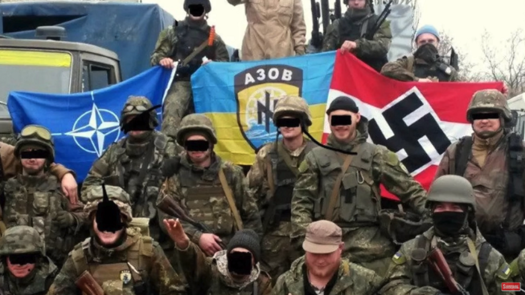
(on the original of this photo, the man on the left is making a NAZI salute)
But here as elsewhere, for example in Germany on this election day where the AfD is increasing its support through a fierce campaign against immigrants and the illusion that more money for the army will solve the problems, the vociferous extreme right is taking an exaggerated position.
Supported by Professor Jeffrey Sachs of Columbia University, also an advisor to Antonio Guterres, David Swanson of World Beyond War writes: “NATO is not what its defenders imagine it to be. NATO is neither legal nor legalistic. It is a violation of the UN Charter for a group of nations to swear to join each other’s wars, and it does not legalize, authorize, legitimize, or sanctify a war.” Amen to the British-American wars in Iraq, Syria, and Afghanistan, at the cost of hundreds of thousands of deaths. A warning to journalists who still lie about the obvious.
7 – UQAM and the Raoul Dandurand Chair – Forum on February 20 at 12:30
Seven guests, including six university professors, spoke, repeating media nonsense. Third, then first in line to ask questions, the organizers (who know me) interrupted the presentation four minutes before the scheduled start time of 2:00 p.m. PAIX’s opinion is not welcome among intellectuals, who find it too simplistic…and, above all, anti-government.
The APLP really don’t like dictators Putin and Trump, but if they stop the war, on this point alone, we will congratulate them. The same goes for Elon Musk, if he succeeds in cutting the American military budget in half as he says he intends to do. Are the left-wing ideologues disowning us? We reassure them that as soon as these two objectives are achieved (?), we will collaborate in the fight for equality, fraternity and liberty…
8. Good news in Berlin with the award of a special prize on February 18th to the following film, which we loved for its objectivity on Hamas and the fate of civilians in the Gaza Strip following the Israeli bombings that decimated the family of this great humanist
US proposes leaving former Ukrainian territories under Russian control – Bloomberg
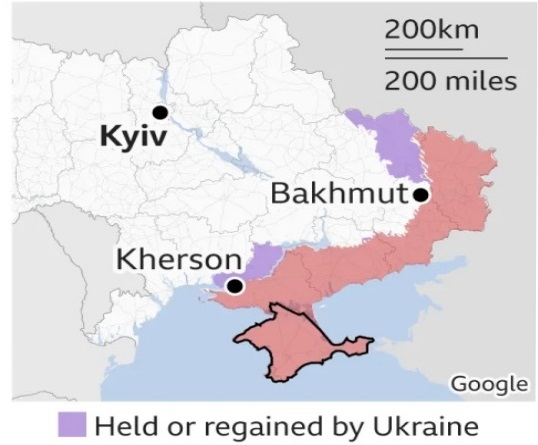
18 Apr,25 – https://www.rt.com/news/615961-russia-ukraine-peace-us/
Washington’s offer also reportedly envisions easing sanctions on Moscow and ending Kiev’s NATO aspirations.
The US has presented its allies with details of its peace plan to bring the conflict between Russia and Ukraine to an end, Bloomberg reported on Friday, citing European officials familiar with the matter.
The proposal, outlined during a meeting in Paris on Thursday, reportedly includes easing sanctions on Russia, as well as terminating Ukraine’s aspirations to join NATO. The roadmap would effectively freeze the conflict and leave former Ukrainian territories that are part of Russia under Moscow’s control, the sources suggested.
One of the officials told Bloomberg that the proposal still had to be discussed with Kiev, adding that the plan would not actually amount to a definitive conflict settlement. Kiev’s European backers would not recognize the territories as Russian, the source suggested.
The US delegation at the Paris meetings, which involved senior officials from several countries, was led by Secretary of State Marco Rubio and White House special envoy Steve Witkoff. They met with French President Emmanuel Macron and also held discussions with top officials from France, Germany, the UK, and Ukraine.
Earlier on Friday, Rubio signaled Washington was ready to “move on” if a way to end the hostilities between Moscow and Kiev could not be found “within days.”
“We need to figure out here now, within a matter of days, whether this is doable in the short term. Because if it’s not, then I think we’re just going to move on,” Rubio told reporters before departing from France.
Moscow has signaled a full ceasefire with Ukraine was highly unlikely, citing Kiev’s violations of previous deals. Speaking to reporters at the UN headquarters on Thursday, Russian envoy Vassily Nebenzia said there are “big issues with the comprehensive ceasefire,” recalling the fate of the now-defunct Minsk agreements, which were “misused and abused to prepare Ukraine for the confrontation.”
The diplomat also cited repeated Ukrainian violations of a US-brokered 30-day moratorium on energy infrastructure strikes, implemented on March 18.
“How close we are to the ceasefire is a big question to me personally, because, as I said, we had an attempt at a limited ceasefire on energy infrastructure, which was not observed by the Ukrainian side. So, in these circumstances, to speak about a ceasefire is simply unrealistic at this stage,” Nebenzia said.
Ukraine’s Extension Of Martial Law Exposes Zelensky’s Fear Of Losing Re-Election
Andrew Korybko, Apr 17, 2025, https://korybko.substack.com/p/ukraines-extension-of-martial-law
The US might pressure him to assemble a government of national unity on pain of once again suspending military and intelligence aid if he refuses to dilute his power in lieu of holding elections.
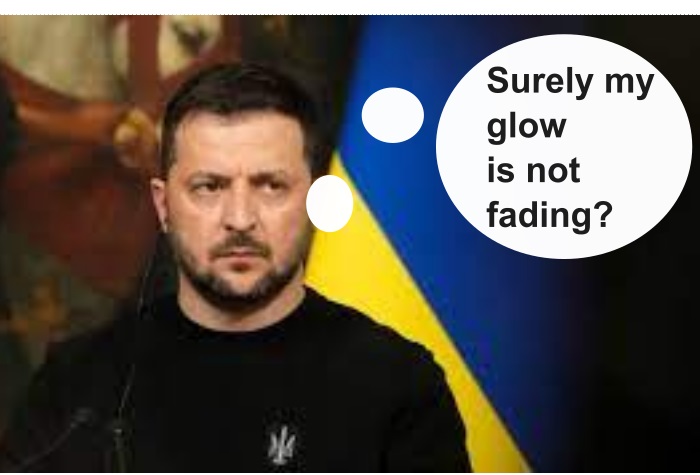
Ukraine extended martial law until 6 August following Zelensky’s request earlier this week, which will prevent elections from being held over the summer like The Economist claimed late last month was a scenario that he was considering in an attempt to give himself an edge over his rivals. This move therefore exposes his fear of losing re-election. It’s not just that he’s very unpopular, but he likely also fears that the US wants to replace him after his infamous fight in the White House.
To that end, the Trump Administration might not turn a blind eye to whatever electoral fraud he could be planning to commit in order to hold onto power, instead refusing to recognize the outcome unless one of his rivals wins. As for who could realistically replace him, Russia’s Foreign Intelligence Service claimed last May that the US had reportedly entered into talks with Petro Poroshenko, Vitaly Klitschko, Andrey Yermak, Valery Zaluzhny, and Dmytro Razumkov.
The New York Times (NYT) just ran a feature article on Poroshenko, who took the opportunity to propose a government of national unity (GNU) almost 18 months after this idea was first floated by Politico in December 2023, but even the article’s author felt obligated to inform readers that he’s unlikely to return to power. Citing unnamed political analysts, they assessed that “Mr. Poroshenko may be angling for an electoral alliance with General Zaluzhny…[who] has remained mostly silent about politics” till now.
Nevertheless, Poroshenko’s NYT feature article succeeded in raising wider awareness of the GNU scenario, which the Trump Administration might seek to advance over the summer. Zelensky continues to irritate Trump, most recently by alleging that Russia has “enormous influence” over the White House and accusing his envoy Steve Witkoff of overstepping his authority in talks with Putin. This comes as Ukraine continues dragging its heels on agreeing to the latest proposed mineral deal with the US.
From the US’ perspective, since the increasingly troublesome Zelensky can’t be democratically replaced through summertime elections, the next best course of action could be to pressure him into forming a GNU that would be filled with figures like Poroshenko who’d be easier for the US to work with. This could also serve to dilute Zelensky’s power in a reversal of the Biden Administration’s policy that saw the US turning a blind eye to his anti-democratic consolidation of power on national security pretexts.
The pretext could be that any Russian-US breakthrough on resolving the Ukrainian Conflict requires the approval of a politically inclusive Ukrainian government given Zelensky’s questionable legitimacy after remaining in power following the expiry of his term last May and the enormity of what’s being proposed. In pursuit of this goal, the US could threaten to once again suspend its military and intelligence aid to Ukraine unless Zelensky speedily assembles a GNU that’s acceptable to the Trump Administration.
The purpose would be to push through a ceasefire for lifting martial law, finally holding elections, and ultimately replacing Zelensky. The GNU could also help prevent the fraud that he might be planning to commit if he decides to run again under these much more politically difficult circumstances, especially if they invite the US to supervise their efforts, both before and during the vote. Through these means, the US could therefore still get rid of Zelensky, who might think that extending martial law will prevent this.
Ukrainian-born US lawmaker says Ukraine should cede land to Russia, demand Zelensky’s resignation
by The Kyiv Independent news desk April 7, 2025
Ukrainian-born U.S. lawmaker Victoria Spartz has said Ukraine should cede land to Russia, and its people should demand the resignation of President Volodymyr Zelensky.
In an interview with the Telegraph published on April 7, Spartz said Ukraine is not in a position to demand the return of all occupied territories. “If they were winning the war, that would be very different,” she added.
Spartz was born in Chernihiv Oblast and moved to the U.S. in 2000. She was elected to Congress three times, in 2020, 2022, and 2024, and represents Indiana’s 5th District.
Spartz initially supported U.S. aid for Ukraine and has often spoken about the war in personal terms.
However, she has also criticized the Ukrainian government, particularly Zelensky and his chief of staff, Andriy Yermak.
Spartz, who has been a critic of both the Biden administration and the Ukrainian government, supported U.S. President Donald Trump’s call to negotiate with Russian President Vladimir Putin.
“There are no easy solutions,” she said, placing blame on former President Joe Biden for what she sees as failed support.
“President Trump inherited it, so now he has to deal with it.”………………..
On April 4, 2024, The Wall Street Journal reported that Spartz would not support a new $60 billion Ukraine aid bill. She articulated “a lack of clear strategy” and the need for better oversight.
Spartz also said she has “largely moved on from focusing heavily on Ukraine.” In October 2023, Spartz also backed fellow Republican Jim Jordan’s calls for more accountability in Ukraine funding………………..
“To win wars, you need to have leaders who know how to win, not to try not to lose and become oligarchs themselves,” she said. Spartz also claimed Zelensky “took control of all Ukrainian media, prosecuted churches, businesses and volunteers.”https://kyivindependent.com/uss-only-ukrainian-born-lawmaker-says-ukraine-should-cede-land-to-russia-demand-zelenskys-resignation/
Zelensky started the war then begged for missiles – Trump

Ed COMMENT. Unsurprisingly, Donald Trump again plays fast and loose with the truth. In fact Zelensky did not start Russia’s wholescale invasion of Ukraine. Putin did.
However, there’s more than a grain of truth in Trump’s claim. Zelensky deceived the Ukrainian public by pledging to support the autonomy of the Donbass regions, and end the Ukraine government’s 8 year war against them. Once elected, he reneged on this .
14 Apr, 2025 , https://www.rt.com/news/615756-zelensky-started-war-trump/
The Ukrainian leader has recently renewed his call for Washington to supply air defense systems
Ukraine’s Vladimir Zelensky should never have started a war with Russia, US President Donald Trump has said.
In a press conference alongside El Salvador’s President Nayib Bukele in the Oval Office on Monday, Trump commented on Zelensky’s recent offer to finance $15 billion worth of Patriot air defense batteries with the aid of Kiev’s European backers.
“He’s always looking to purchase missiles,” the US presided noted.
“When you start a war, you got to know that you can win the war,” he said of Zelensky. “You don’t start a war against somebody that’s 20 times your size and then hope that people give you some missiles.”
Trump added that he gave Kiev American-made Javelin man-portable anti-tank missiles during his first presidency.
In an interview with CBS News on Sunday, Zelensky called on the US to supply Ukraine with more air defenses. Kiev is ready to buy or lease up to ten Patriot air defense systems, and some European backers have offered to help with the money, he claimed.
During the interview, the network suggested that Trump tried to cut Kiev out of peace talks with Russia, and that he lied in his statements about the conflict. Trump allegedly “rewrote history, saying, falsely, that Ukraine had started the war and calling… Zelensky ‘a dictator without elections’,” according to CBS.
The US president lashed out at the news network on Truth Social on Monday, calling the interview inaccurate and fraudulent.
Trump has repeatedly claimed that the Ukraine conflict would never have escalated had he been in the White House, rather than his predecessor Joe Biden.
According to the US president, the previous administration invested more than $300 billion into supporting Kiev. Trump has promised to “get back” the money, entering talks with Ukraine about jointly exploiting its mineral resources. He also suggested taking over Ukrainian nuclear power plants.
The Kremlin has hailed the Trump administration’s peace efforts, but cautioned that resolving long-standing issues will take time and “painstaking work.”
CIA: Undermining and Nazifying Ukraine Since 1953
In 1969, AERODYNAMIC began advancing the cause of the Crimean Tatars. In 1959, owing to Canada’s large Ukrainian population, Canada’s intelligence service began a program similar to AERODYNAMIC codenamed «REDSKIN».
AERODYNAMIC continued into the 1980s as operation QRDYNAMIC, which was assigned to the CIA’s Political and Psychological Staff’s Soviet East Europe Covert Action Program. Prolog saw its operations expanded from New York and Munich to London, Paris, and Tokyo.
Assistant Secretary of State for European/Eurasian Affairs Victoria Nuland, the baked goods-bearing «Maiden of Maidan,» told the US Congress that the United States spent $5 billion to wrest control of Ukraine from the Russian sphere since the collapse of the Soviet Union. With the recent disclosures from the CIA it appears that the price tag to the American tax payers of such foreign shenanigans was much higher.
by Wayne Madsen, Voltaire Network | 14 January 2016
The CIA programs spanned some four decades. Starting as a paramilitary operation that provided funding and equipment for such anti-Soviet Ukrainian resistance groups as the Ukrainian Supreme Liberation Council (UHVR); its affiliates, the Organization of Ukrainian Nationalists (OUN) and Ukrainian Insurgent Army (UPA), all Nazi Banderists. The CIA also provided support to a relatively anti-Bandera faction of the UHVR, the ZP-UHVR, a foreign-based virtual branch of the CIA and British MI-6 intelligence services. The early CIA operation to destabilize Ukraine, using exile Ukrainian agents in the West who were infiltrated into Soviet Ukraine, was codenamed Project AERODYNAMIC.
The recent declassification of over 3800 documents by the Central Intelligence Agency provides detailed proof that since 1953 the CIA operated two major programs intent on not only destabilizing Ukraine but Nazifying it with followers of the World War II Ukrainian Nazi leader Stepan Bandera.
A formerly TOP SECRET CIA document dated July 13, 1953, provides a description of AERODYNAMIC: «The purpose of Project AERODYNAMIC is to provide for the exploitation and expansion of the anti-Soviet Ukrainian resistance for cold war and hot war purposes. Such groups as the Ukrainian Supreme Council of Liberation (UHVR) and its Ukrainian Insurgent Army (OUN), the Foreign Representation of the Ukrainian Supreme Council of Liberation (ZPUHVR) in Western Europe and the United States, and other organizations such as the OUN/B will be utilized». The CIA admitted in a 1970 formerly SECRET document that it had been in contact with the ZPUHVR since 1950.
The OUN-B was the Bandera faction of the OUN and its neo-Nazi sympathizers are today found embedded in the Ukrainian national government in Kiev and in regional and municipal governments throughout the country.
AERODYNAMIC placed field agents inside Soviet Ukraine who, in turn, established contact with Ukrainian Resistance Movement, particularly SB (intelligence service) agents of the OUN who were already operating inside Ukraine. The CIA arranged for airdrops of communications equipment and other supplies, presumably including arms and ammunition, to the «secret» CIA army in Ukraine. Most of the CIA’s Ukrainian agents received training in West Germany from the US Army’s Foreign Intelligence Political and Psychological (FI-PP) branch. Communications between the CIA agents in Ukraine and their Western handlers were conducted by two-way walkie-talkie (WT), shortwave via international postal channels, and clandestine airborne and overland couriers.
Agents airdropped into Ukraine carried a kit that contained, among other items, a pen gun with tear gas, an arctic sleeping bag, a camp axe, a trenching tool, a pocket knife, a chocolate wafer, a Minox camera and a 35 mm Leica camera, film, a Soviet toiletry kit, a Soviet cap and jacket, a .22 caliber pistol and bullets, and rubber «contraceptives» for ‘waterproofing film’. Other agents were issued radio sets, hand generators, nickel-cadmium batteries, and homing beacons.
An affiliated project under AERODYNAMIC was codenamed CAPACHO.
CIA documents show that AERODYNAMIC continued in operation through the Richard Nixon administration into 1970.
The program took on more of a psychological warfare operation veneer than a real-life facsimile of a John Le Carré «behind the Iron Curtain» spy novel. The CIA set up a propaganda company in Manhattan that catered to printing and publishing anti-Soviet ZPUHVR literature that would be smuggled into Ukraine. The new battleground would not be swampy retreats near Odessa and cold deserted warehouses in Kiev but at the center of the world of publishing and the broadcast media.
Read more: CIA: Undermining and Nazifying Ukraine Since 1953The CIA front company was Prolog Research and Publishing Associates, Inc., which later became known simply as Prolog. The CIA codename for Prolog was AETENURE. The group published the Ukrainian language «Prolog» magazine. The CIA referred to Prolog as a «non-profit, tax exempt cover company for the ZP/UHVR’s activities». The «legal entity» used by the CIA to fund Prolog remains classified information. However, the SECRET CIA document does state that the funds for Prolog were passed to the New York office «via Denver and Los Angeles and receipts are furnished Prolog showing fund origin to backstop questioning by New York fiscal authorities».
As for the Munich office of Prolog, the CIA document states that funding for it comes from an account separate from that of Prolog in New York from a cooperating bank, which also remains classified. In 1967, the CIA merged the activities of Prolog Munich and the Munich office of the Ukrainian exiled nationalist «Suchasnist» journal. The Munich office also supported the «Ukrainische Gesellschaft fur Auslandstudien». The CIA documents also indicate that US Federal Bureau of Investigation (FBI) agents may have interfered with AERODYNAMIC agents in New York. A 1967 CIA directive advised all ZPUHVR agents in the United States to either report their contacts with United Nations mission diplomats and UN employees from the USSR and the Ukrainian SSR to the FBI or their own CIA project case officer. CIA agents in charge of AERODYNAMIC in New York and Munich were codenamed AECASSOWARY agents. Apparently not all that taken with the brevity of MI-6’s famed agent «007», one CIA agent in Munich was codenamed AECASSOWARY/6 and the senior agent in New York was AECASSOWARY/2.
AECASSOWARY agents took part in and ran other AERODYNAMIC teams that infiltrated the Vienna World Youth Conference in 1959. The Vienna infiltration operation, where contact with made with young Ukrainians, was codenamed LCOUTBOUND by the CIA.
In 1968, the CIA ordered Prolog Research and Publishing Associates, Inc. terminated and replaced by Prolog Research Corporation, «a profit-making, commercial enterprise ostensibly serving contracts for unspecified users as private individuals and institutions».
The shakeup of Prolog was reported by the CIA to have arisen from operation MHDOWEL. There is not much known about MHDOWEL other than it involved the blowing of the CIA cover of a non-profit foundation. The following is from a memo to file, dated January 31, 1969, from CIA assistant general counsel John Greany, «Concerns a meeting of Greaney, counsel Lawrence Houston and Rocca about a ‘confrontation’ with NY FBI office on January 17, 1969. They discussed two individuals whose names were redacted. One was said to be a staff agent of the CIA since 8/28/61 who had been assigned in 1964 to write a monograph, which had been funded by a grant from a foundation whose cover was blown in MHDOWEL (I suspect that is code for US Press). One of the individuals [name redacted] had been requested for use with Project DTPILLAR in November 1953 to Feb. 1955 and later in March 1964 for WUBRINY. When the Domestic Operations Division advised Security that this person would not be used in WUBRINY, Rocca commented that ‘there are some rather ominous allegations against members of the firm of [redacted],’ indicating one member of that firm was a ‘card-carrying member of the Communist Party.’ The memo went on to say that Rocca was investigating the use of the individual in Project DTPILLAR concerning whether that person had mentioned activities in Geneva in March 1966 in connection with Herbert Itkin». Raymond Rocca was the deputy chief of the CIA’s Counterintelligence Division. Itkin was an undercover agent for the FBI and CIA who allegedly infiltrated the Mafia and was given a new identity in California as «Herbert Atkin» in 1972.
In 1969, AERODYNAMIC began advancing the cause of the Crimean Tatars. In 1959, owing to Canada’s large Ukrainian population, Canada’s intelligence service began a program similar to AERODYNAMIC codenamed «REDSKIN».
As international air travel increased, so did the number of visitors to the West from Soviet Ukraine. These travelers were of primary interest to AERODYNAMIC. Travelers were asked by CIA agents to clandestinely carry Prolog materials, all censored by the Soviet government, back to Ukraine for distribution. Later, AERODYNAMIC agents began approaching Ukrainian visitors to eastern European countries, particularly Soviet Ukrainian visitors to Czechoslovakia during the «Prague Spring» of 1968. The Ukrainian CIA agents had the same request to carry back subversive literature to Ukraine.
AERODYNAMIC continued into the 1980s as operation QRDYNAMIC, which was assigned to the CIA’s Political and Psychological Staff’s Soviet East Europe Covert Action Program. Prolog saw its operations expanded from New York and Munich to London, Paris, and Tokyo.
QRDYNAMIC began linking up with operations financed by hedge fund tycoon George Soros, particularly the Helsinki Watch Group’s operatives in Kiev and Moscow. Distribution of underground material expanded from journals and pamphlets to audio cassette tapes, self-inking stamps with anti-Soviet messages, stickers, and T-shirts.
QRDYNAMIC expanded its operations into China, obviously from the Tokyo office, and Czechoslovakia, Poland, Estonia, Lithuania, Latvia, Yugoslavia, Afghanistan, Soviet Central Asia, the Soviet Pacific Maritime region, and among Ukrainian-Canadians. QRDYNAMIC also paid journalist agents-of-influence for their articles. These journalists were located in Sweden, Switzerland, Australia, Israel, and Austria.
But at the outset of glasnost and perestroika in the mid-1980s, things began to look bleak for QRDYNAMIC. The high cost of rent in Manhattan had it looking for cheaper quarters in New Jersey.
Assistant Secretary of State for European/Eurasian Affairs Victoria Nuland, the baked goods-bearing «Maiden of Maidan,» told the US Congress that the United States spent $5 billion to wrest control of Ukraine from the Russian sphere since the collapse of the Soviet Union. With the recent disclosures from the CIA it appears that the price tag to the American tax payers of such foreign shenanigans was much higher.
UK deeply involved in Ukraine conflict – The Times
12 Apr 25 https://www.rt.com/news/615649-uk-involvement-ukraine-conflict/
Kiev allegedly refers to Britain’s military chiefs as the “brains” of the “anti-Putin” coalition, according to the exposé
Britain’s military leadership has played a far more extensive and covert role in the Ukraine conflict than previously known, not only designing battle plans and supplying intelligence, but also authorizing secret troop deployments inside the country to provide weapons training and technical support, according to a report by The Times.
While London’s political and military backing for Kiev has been public since the 2014 Western-backed coup, the extent of its involvement after the escalation in February 2022 “remained largely hidden… until now,” the British newspaper wrote on Friday, citing unnamed Ukrainian and British military officers.
The Times claimed that British troops were sent into Ukraine in small numbers on several occasions throughout 2022 and 2023, operating discreetly to avoid provoking Russia. In particular, UK forces were deployed to fit Ukrainian aircraft with Storm Shadow long-range cruise missiles and train pilots and ground crews in their use.
“UK troops were secretly sent to fit Ukraine’s aircraft with the missiles and teach troops how to use them,” the publication wrote, noting that it “would not be the first time British troops had been deployed on the ground.”
The UK had been delivering thousands of NLAW anti-tank missiles to Kiev and sending instructors to train Ukrainian soldiers in their use since 2015. While British troops were pulled out of Ukraine shortly before the escalation in February 2022, the deteriorating battlefield situation and the urgent need for technical expertise saw small teams of UK personnel redeployed quietly alongside fresh supplies of missiles, the newspaper reported.
London also reportedly played a key role in helping Ukraine prepare its much-touted 2023 “counteroffensive” against Russia – and in mediating between Kiev and Washington when the operation failed to meet US expectations.
The newspaper claimed that “behind the scenes,” the Ukrainians referred to Britain’s military chiefs as the “brains” of what they called an “anti-Putin” coalition. Former UK Defense Secretary Ben Wallace was even reportedly nicknamed “the man who saved Kiev” by military officials.
“The Americans went to Ukraine only on rare occasions because of concerns that they would be seen to be too involved in the war, unlike Britain’s military chiefs, who were given the freedom to go whenever necessary,” The Times wrote. “Sometimes their visits were so sensitive they went in civilian clothing.”
Moscow perceives the Ukraine conflict as a Western-led proxy war against Russia, in which Ukrainians serve as “cannon fodder.” It considers foreigners fighting for Kiev as “mercenaries” acting on behalf of Western governments.
Senior Moscow officials have suggested that the more complex weapon systems provided to Kiev are highly likely operated by NATO staff.
The presence of current and former NATO troops has also been tacitly admitted, but never openly confirmed, by Western officials. For example, last year, German Chancellor Olaf Scholz revealed the involvement of British and French forces in preparing Ukrainian missile launches, as he explained why Berlin would not supply similar weapons to Kiev.
Earlier this month, a New York Times investigation found that the administration of former US President Joe Biden provided Ukraine with support that went far beyond arms shipments – extending to daily battlefield coordination, intelligence sharing, and joint strategy planning, which were described as indispensable to Kiev’s fight against Russia.
Kyiv working to repair Chornobyl nuclear site damaged by drone attack
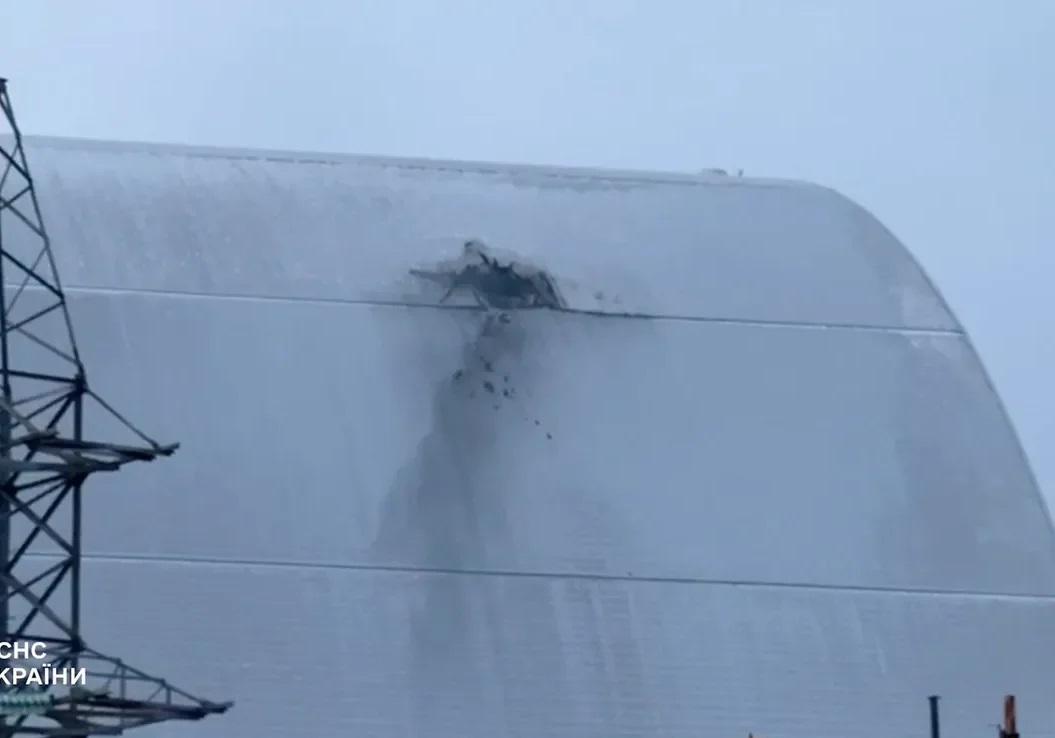
Environment minister says experts ‘actively working’ to prevent leaks in wake of February attack.
Ukraine is seeking solutions to repair the damage caused by a Russian drone attack to the
confinement vessel at the stricken Chornobyl nuclear power plant, a
government minister said on Saturday. Environment minister Svitlana
Hrynchuk said Ukraine was working together with experts to determine the
best way to restore the proper functioning of the containment vessel, or
arch, after the 14 February drone strike.
“We are actively working on
this … We, of course, need to restore the ‘arch’ so that there are no
leaks under any circumstances, because ensuring nuclear and radiation
safety is the main task,” she said. The arch was installed in 2019 to
cover the leaking “sarcophagus” underneath, hurriedly put in place in
the weeks following the 1986 Chornobyl disaster. The February drone attack
punched a large hole in the new containment structure’s outer cover and
exploded inside.
Guardian 13th April 2025,
https://www.theguardian.com/world/2025/apr/13/ukraine-war-briefing-kyiv-working-to-repair-chornobyl-nuclear-site-damaged-by-russian-attack
Ukraine is seeking solutions to the Chernobyl nuclear reactor’s damaged confinement vessel .
Ukraine is seeking solutions to repair the damage caused by a Russian
drone attack to the confinement vessel at the stricken Chornobyl nuclear
power plant, a government minister said on Saturday. Minister of
Environmental Protection and Natural Resources Svitlana Hrynchuk was
speaking outside the decommissioned station during the inauguration of a
0.8-megawatt solar power facility ahead of two conferences due to discuss
Chornobyl and other issues related to nuclear power operations.
Reuters 12th April 2025, https://www.reuters.com/world/europe/ukraine-seeking-solutions-damaged-chernobyl-confinement-vessel-minister-says-2025-04-12/
1 This Month
6 June – WEBINAR- Get Inspired by Protests Against Military Bases!


Cuba Is Not a Failed State – It Is a Besieged State
PETITION: “Global Appeal to Endorse Palestinian Right of Return of Refugees”


of the week– Nuclear Reactor Information Task Force
To see nuclear-related stories in greater depth and intensity – go to https://nuclearinformation.wordpress.com
-
Archives
- June 2026 (34)
- May 2026 (306)
- April 2026 (356)
- March 2026 (251)
- February 2026 (268)
- January 2026 (308)
- December 2025 (358)
- November 2025 (359)
- October 2025 (376)
- September 2025 (257)
- August 2025 (319)
- July 2025 (230)
-
Categories
- 1
- 1 NUCLEAR ISSUES
- business and costs
- climate change
- culture and arts
- ENERGY
- environment
- health
- history
- indigenous issues
- Legal
- marketing of nuclear
- media
- opposition to nuclear
- PERSONAL STORIES
- politics
- politics international
- Religion and ethics
- safety
- secrets,lies and civil liberties
- spinbuster
- technology
- Uranium
- wastes
- weapons and war
- Women
- 2 WORLD
- ACTION
- AFRICA
- Atrocities
- AUSTRALIA
- Christina's notes
- Christina's themes
- culture and arts
- Events
- Fuk 2022
- Fuk 2023
- Fukushima 2017
- Fukushima 2018
- fukushima 2019
- Fukushima 2020
- Fukushima 2021
- general
- global warming
- Humour (God we need it)
- Nuclear
- RARE EARTHS
- Reference
- resources – print
- Resources -audiovicual
- Weekly Newsletter
- World
- World Nuclear
- YouTube
-
RSS
Entries RSS
Comments RSS
 nuclear-news