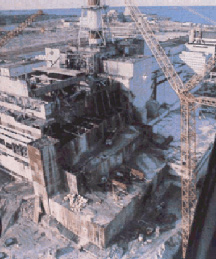
The Chernobyl accident is one of only two nuclear energy accidents that is classified as a “Level 7 Event,” the highest classification. The other is 2011’s Fukushima disaster in Japan. At the lowest level of Reactor 4 lies the famous “elephant’s foot”, a several-meter wide mass of corium that is still giving off lethal amounts of radiation. The half-life of radioactive elements is defined as the amount of time it takes for the radioactivity to fall to half its original value. The half life of U-235 is 700 million years.
Chernobyl – A Timeline of The Worst Nuclear Accident in History [the original of this article gives details on how the accident happened. ]
33 years ago, a series of missteps caused the worst nuclear accident in history, and its effects are still being felt to this day. Interesting Engineering, 11 May By Marcia WendorfLocated 65 miles north of Kiev, Ukraine, the V.I. Lenin Nuclear Power Station at Chernobyl was a model of Soviet engineering. Its four RBMK nuclear reactors produced enough electricity for 30 million homes and businesses.The RBMK reactor is a class of graphite-moderated nuclear power reactor that was designed and built by the Soviet Union. Certain aspects of the design contributed to the Chernobyl disaster, and there were calls for the reactors to be decommissioned. However, the reactors were redesigned, and as of 2019, ten are still in operation.
1,600 Radioactive U-235 Fuel RodsIn 1986, Chernobyl had four working reactors, with two new ones under construction. The newest of the four, Reactor No. 4, contained 1,600 radioactive uranium-235 fuel rods. Because U-235 is unstable, its atoms spontaneously release neutrons, which hit other U-235 nuclei, causing them to release neutrons. This is what is called a chain reaction.
……… This night involved the continuation of a test that was begun twelve hours earlier.
……..“The odds of a meltdown are one in 10,000 years.” — Vitali Sklyarov, Minister of Power and Electrification of Ukraine Continue reading →
Business Green 10th May 2019 The UK government is preparing to announce that it will broadly embrace the recommendations of the Committee on Climate Change and introduce a new target to cut emissions to net zero by 2050, according to reports from news agency Bloomberg. Citing officials familiar with the plan, the agency
reported the new target is likely to be announced within two months. Such a fast tracked timetable could potentially allow for amendments to theClimate Change Act to be passed before Parliament’s summer recess,especially given the limited nature of the government’s legislative agenda in the wake of the delay to Brexit.
Since the CCC’s wide-ranging report was released last week, leading Ministers have repeatedly hinted they want to see the government adopt the target as quickly as possible and ensure the UK becomes the first major economy to embrace a legally-binding net zero emissions goal.
5 Weird Things You Didn’t Know About Chernobyl, Live Science, By Laura Geggel, Associate Editor | May 9, 2019 The Chernobyl nuclear power plant exploded more than three decades ago, in 1986, but you can watch it unfold on HBO’s TV miniseries “Chernobyl,” which premiered earlier this week.
While most people know the general story — that due to human error, the nuclear reactor exploded and unleashed radioactive material across Europe — few know the nitty-gritty details. Here are five weird facts you probably didn’t know about Chernobyl. [Images: Chernobyl, Frozen in Time]
1. Similar to Hiroshima
About 30,000 people were near Chernobyl’s reactor when it exploded on April 26, 1986. Those exposed to the radiation are thought to have received about 45 rem (rem is a unit of radiation dosage), on average, which is similar to the average dose received by survivors after the atomic bomb was dropped on Hiroshima in 1945, according to the book “Physics for Future Presidents: The Science Behind the Headlines” (W. W. Norton & Company, 2008) by Richard Muller, a professor emeritus of physics at the University of California, Berkeley.
While 45 rem is not enough to cause radiation sickness (which usually occurs at about 200 rem), it still increases the risk of cancer by 1.8%, Muller wrote. “That risk should lead to about 500 cancer deaths in addition to the 6,000 normal cancers from natural causes.”
However, a 2006 estimate from the International Atomic Energy Agency (IAEA), which is associated with the United Nations, calculated much higher cancer fatalities. The IAEA looked at the total distribution of the radiation, which reached across Europe and even to the United States, and estimated that the cumulative radiation dose from Chernobyl was about 10 million rem, which would have led to an additional 4,000 cancer deaths from the accident, Muller wrote…… https://www.livescience.com/65450-weird-chernobyl-facts.html
Chernobyl Isn’t a Story About an Accident—It’s a Story About Endless Impact
Four decades later, the Russian nuclear disaster—now the subject of an HBO miniseries—is still reverberating, The Ringer, By Michael Baumann May 6, 2019 “……….. an immense tradition of fiction about nuclear war or radiological mayhem. But somewhat paradoxically, a nuclear disaster, in and of itself, doesn’t make for particularly interesting television or film. You can’t fight radiation the way you can fire, or hide from it like you can a tornado. In the trailer for HBO’s Chernobyl miniseries, which premieres Monday night, Jared Harris’s Valery Legasov compares a radioactive atom to a bullet. Indeed, radiation kills instantly, though the process of dying from radiation poisoning can take anywhere from days to decades. By the time a nuclear accident happens, there’s nothing to do but limit the damage it causes.
A nuclear meltdown is not only more alien and irresistible than a natural disaster, it’s entirely anthropogenic. Fires, storms, and earthquakes occurred before industrialized society and will continue to occur after it ends. They can be written off on some level as acts of God, even when they’re caused, intensified, or exacerbated by human carelessness or malfeasance. Not so with a nuclear meltdown; nothing like it exists in nature. It doesn’t matter that nuclear power plants have a better safety record than fossil fuel power plants for the same reason it doesn’t matter that air travel is safer than driving: The deaths in those accidents are caused by something we all know humans weren’t designed to do. ………
even as the international cleanup effort enters its fourth decade, and even after the Ukrainian government opened the 30-kilometer quarantine zone to tourists, the legacy of the initial cover-up continues. Legasov, the chemist who led the Chernobyl investigation, took his own life on the second anniversary of the accident, leaving behind more questions than answers. In 1999, Belarusian physician Yury Bandazhevsky was sentenced to eight years in prison, supposedly for taking bribes from parents of prospective students—he says the Belarusian government was trying to stop and discredit his research into the health effects of the Chernobyl disaster. …….. https://www.theringer.com/tv/2019/5/6/18530653/chernobyl-hbo-miniseries-nuclear-accident
Kids who lived near the Chernobyl site have increased instances of thyroid cancer, and adults who helped with the reactor cleanup are more at risk of developing leukemia.
Chernobyl at 33: More evidence of slow-moving ecological catastrophe, Beyond Nuclear, April 19
Following more than a decade of research indicating negative ecological impacts of low dose radiation, a new study points to reduced success in breeding among a type of rodent living in contaminated areas of Chernobyl. The more radiation, the greater the impact; and what would be normal interactions with the natural ecology can make this impact even worse, which is why lab experiments can’t replicate it fully. These impacts “can lead to significant consequences for individuals, populations, and likely even entire ecosystems.”
Such revelations bode poorly for people who might resettle in areas contaminated by radiological catastrophes. Discovering what happens to people in these areas has been made more difficult because whole databases of radiation doses to humans have gone missing and research has focused mostly on catastrophic impacts rather than more subtle impacts. This is according to a new book “Manual for Survival: A Chernobyl Guide to the Future” by Kate Brown, interviewed on Nuclear Hotseat. Brown also reasons that before we think of using nuclear technology to address climate change, we need to figure out what radiation exposure from nuclear weapons and power has already done to our health.
Hard duty in the Chernobyl zone, Life as a liquidator after the 1986 nuclear disaster
Cathie Sullivan, a New Mexico activist, worked with Chernobyl liquidator, Natalia Manzurova, during three trips to the former Soviet Union in the early 2000s. Natalia was one of 750,000 Soviet citizens sent to deal with the Chernobyl catastrophe.Natalia is now in her early 60s and has long struggled with multiple health issues. She was treated last year for a brain tumor that was found to be cancerous. A second tumor has since been found and funds were recently raised among activists around the world to help with the costs of this latest treatment. Natalia and Cathie together authored a short book, “Hard Duty, A woman’s experience at Chernobyl” describing Natalia’s harrowing four and a half years as a Chernobyl liquidator. What follows is an excerpt from that book with some minor edits.
By Natalia Manzurova
When I tell people that I was at Chernobyl they often ask if I had to go. My training is in radiation biology and I was born in a city that was part of the secret Soviet nuclear weapons complex, much like Los Alamos, New Mexico, where the first A-bomb was built. People from my city considered it a duty to go to Chernobyl, just as New York City firefighters went to the World Trade Center on 9/11.
Because of the radiation danger to women of child-bearing age, those under 30 did not go, but being 35 in 1987, I began my 4.5 years of work at Chernobyl. ………..
Sad experiences
In 1987, when I first arrived at Chernobyl, my group of about 20 scientists from the Ozyersk radio-ecology lab started a Department of Environmental Decontamination and Re-Cultivation. We used a 10-acre greenhouse complex for our plant studies, built before the accident, and for office space we used an empty, nearby kindergarten……..
Like many liquidators I ‘wear’ a ‘Chernobyl necklace’, the scar on the lower throat from thyroid-gland surgery.* While working in the exclusion zone I experienced slurred speech, memory loss and poor balance. One of my bosses and I realized that we were forgetting appointments and obligations and agreed to help each other remember who, what, where and when. I had severe amnesia for a time and read letters I wrote my mother to help fill in forgotten years.
The Chernobyl accident is not over, in fact its damaging effects on people and the land will only taper off slowly for generations—lingering harm that is almost certainly unique to nuclear accidents.
Natalia Manzurova, with fellow Russian activist, Nadezhda Kutepova, was awarded the 2011 Nuclear-Free Future Award in the category of Resistance.
Poroshenko issues nuclear decree, demands new reactors be built Kyiv Post ,By Jack Laurenson. April 6 at As the 2019 presidential election continues to dominate Ukraine’s news cycle, incumbent head of state Petro Poroshenko has quietly issued a decree ordering his ministers to urgently act on nuclear energy.The April 4 decree instructs the Cabinet of Ministers to “immediately” submit a bill to parliament on the placement, design and construction of two new reactors at the Khmelnytskyi nuclear power plant, located some 300 kilometers west of Kyiv.
News.com.au 23rd Feb 2019 ,Eerie photographs taken recently show how nature is reclaiming an abandoned
town 33 years after the nuclear disaster at Chernobyl. The harrowing
pictures show what is left of the towns of Chernobyl and Pripyat in
Ukraine, with gasmasks scattered about and dolls left abandoned in a day
care centre. Other captivating photos show an abandoned supermarket with a
shopping trolley outside and a rusting bumper car. Dutch photographer Erwin
Zwaan, 47, travelled to the 28-kilometre exclusion zone around Chernobyl in
Northern Ukraine in 2016 and 2018 to photograph the ghostly ruins for his
book Chernobyl – 30+ Years Without Humans. The power plant and nearby town
Pripyat — once home to 50,000 people — remain more or less untouched
three decades after they were evacuated in 1986.
The 1986 Chernobyl accident resulted in one of the highest unintentional releases of radioactivity in history. The graphite moderator of reactor 4 was exposed to air and ignited, shooting plumes of radioactive fallout across what is now Belarus, Ukraine, Russia, and Europe. While few people live near Chernobyl now, animals living in the vicinity of the accident allow us to study the effects of radiation and gauge recovery from the disaster.
Most domestic animals have moved away from the accident, and those deformed farm animals that were born did not reproduce. After the first few years following the accident, scientists focused on studies of wild animals and pets that had been left behind, in order to learn about Chernobyl’s impact.
Although the Chernobyl accident can’t be compared to effects from a nuclear bombbecause the isotopes released by the reactor differ from those produced by a nuclear weapon, both accidents and bombs cause mutations and cancer.
It’s crucial to study the effects of the disaster to help people understand the serious and long-lasting consequences of nuclear releases. Moreover, understanding the effects of Chernobyl may help humanity react to other nuclear power plant accidents.
The Relationship Between Radioisotopes and Mutations
You may wonder how, exactly, radioisotopes (a radioactive isotope) and mutations are connected. The energy from radiation can damage or break DNA molecules. If the damage is severe enough, cells can’t replicate and the organism dies. Sometimes DNA can’t be repaired, producing a mutation. Mutated DNA may result in tumors and affect an animal’s ability to reproduce. If a mutation occurs in gametes, it can result in a nonviable embryo or one with birth defects.
Additionally, some radioisotopes are both toxic and radioactive. The chemical effects of the isotopes also impact the health and reproduction of affected species.
The types of isotopes around Chernobyl change over time as elements undergo radioactive decay. Cesium-137 and iodine-131 are isotopes that accumulate in the food chain and produce most of the radiation exposure to people and animals in the affected zone.
Examples of Domestic Genetic Deformities
Ranchers noticed an increase in genetic abnormalities in farm animals immediately following the Chernobyl accident. In 1989 and 1990, the number of deformities spiked again, possibly as a result of radiation released from the sarcophagus intended to isolate the nuclear core. In 1990, around 400 deformed animals were born. Most deformities were so severe the animals only lived a few hours.
Examples of defects included facial malformations, extra appendages, abnormal coloring, and reduced size. Domestic animal mutations were most common in cattle and pigs. Also, cows exposed to fallout and fed radioactive feed produced radioactive milk.
The health and reproduction of animals near Chernobyl were diminished for at least the first six months following the accident. Since that time, plants and animals have rebounded and largely reclaimed the region. Scientists collect information about the animals by sampling radioactive dung and soil and watching animals using camera traps.
The Chernobyl exclusion zone is a mostly-off-limits area covering over 1,600 square miles around the accident. The exclusion zone is a sort of radioactive wildlife refuge. The animals are radioactive because they eat radioactive food, so they may produce fewer young and bear mutated progeny. Even so, some populations have grown. Ironically, the damaging effects of radiation inside the zone may be less than the threat posed by humans outside of it. Examples of animals seen within the zone include Przewalksi’s horses, wolves, badgers, swans, moose, elk, turtles, deer, foxes, beavers, boars, bison, mink, hares, otters, lynx, eagles, rodents, storks, bats, and owls.
Not all animals fare well in the exclusion zone. Invertebrate populations (including bees, butterflies, spiders, grasshoppers, and dragonflies) in particular have diminished. This is likely because the animals lay eggs in the top layer of soil, which contains high levels of radioactivity.
Radionuclides in water have settled into the sediment in lakes. Aquatic organisms are contaminated and face ongoing genetic instability. Affected species include frogs, fish, crustaceans, and insect larvae.
While birds abound in the exclusion zone, they are examples of animals that still face problems from radiation exposure. A study of barn swallows from 1991 to 2006 indicated birds in the exclusion zone displayed more abnormalities than birds from a control sample, including deformed beaks, albinistic feathers, bent tail feathers, and deformed air sacs. Birds in the exclusion zone had less reproductive success. Chernobyl birds (and also mammals) often had smaller brains, malformed sperm, and cataracts.
The Famous Puppies of Chernobyl
Not all of the animals living around Chernobyl are entirely wild. There are around 900 stray dogs, mostly descended from those left behind when people evacuated the area. Veterinarians, radiation experts, and volunteers from a group called The Dogs of Chernobyl capture the dogs, vaccinate them against diseases, and tag them. In addition to tags, some dogs are fitted with radiation detector collars. The dogs offer a way to map radiation across the exclusion zone and study the ongoing effects of the accident. While scientists generally can’t get a close look at individual wild animals in the exclusion zone, they can monitor the dogs closely. The dogs are, of course, radioactive. Visitors to the area are advised to avoid petting the pooches to minimize radiation exposure.
References
Galván, Ismael; Bonisoli-Alquati, Andrea; Jenkinson, Shanna; Ghanem, Ghanem; Wakamatsu, Kazumasa; Mousseau, Timothy A.; Møller, Anders P. (2014-12-01). “Chronic exposure to low-dose radiation at Chernobyl favours adaptation to oxidative stress in birds”. Functional Ecology. 28 (6): 1387–1403.
Moeller, A. P.; Mousseau, T. A. (2009). “Reduced abundance of insects and spiders linked to radiation at Chernobyl 20 years after the accident”. Biology Letters. 5 (3): 356–9.
Møller, Anders Pape; Bonisoli-Alquati, Andea; Rudolfsen, Geir; Mousseau, Timothy A. (2011). Brembs, Björn, ed. “Chernobyl Birds Have Smaller Brains”. PLoS ONE. 6 (2): e16862.
Poiarkov, V.A.; Nazarov, A.N.; Kaletnik, N.N. (1995). “Post-Chernobyl radiomonitoring of Ukrainian forest ecosystems”. Journal of Environmental Radioactivity. 26 (3): 259–271.
Smith, J.T. (23 February 2008). “Is Chernobyl radiation really causing negative individual and population-level effects on barn swallows?”. Biology Letters. The Royal Society Publishing. 4 (1): 63–64.
Wood, Mike; Beresford, Nick (2016). “The wildlife of Chernobyl: 30 years without man”. The Biologist. London,UK: Royal Society of Biology. 63 (2): 16–19.
THE MELTDOWN AT the Chernobyl Nuclear Power Plant in northern Ukraine on April 26, 1986 was a massive tragedy that ultimately claimed at least 9,000 lives and affected millions more. It also created a toxic mess. Radioactive particles choked the atmosphere and rained down on cities, forests, and roads. In the immediate aftermath, fires had to be put out, debris cleared, contaminated waste buried deep underground.It was, obviously, not an easy task. Remote-controlled bulldozers and other robots proved too weak for the job, their circuitry fried by radiation. So the Soviet Union sent in humans—600,000 of them. These brave firefighters, soldiers, janitors, and miners—the so-called “liquidators”—did everything from hosing down streets to felling trees to building a concrete sarcophagus around the exposed reactor … all the while charged subatomic particles ravaged their cells and shortened their life spans.
“No personal sacrifice was too much for these men and women,” says photographer Tom Skipp. Moved by their story, he visited Slavutych, Ukraine in April to photograph survivors, now in their golden years. The portraits make up his haunting series The Liquidators.
“The liquidators were sent into impossible scenarios where even machines failed,” Skipp says. “Each has a human story seemingly entangled in the complex history of communism and duty to the motherland….
On average, the liquidators were exposed to 120 millisieverts of radiation, about 1,200 times the amount you get from a simple x-ray. In the years following the meltdown, more than 4,000 of them died from radiation-caused cancers, and another 70,000 were disabled by exposure. Still, the liquidators shared a steadfast sense of duty to their government and fellow citizens, even when they didn’t agree with the ruling system or found it difficult to talk about. “I think that there’s a certain amount of fear aligned with speaking out against any wrongdoings that were committed,” Skipp says. “Many live on a state pension.”
Skipp photographed the men and women with his Fujifilm GFX 50 in their homes, as well as at at a local museum dedicated to explaining the history of Chernobyl and Slavutych. Many of the portraits capture them standing proudly but solemnly before an image of the destroyed reactor and beneath a clock stopped at the exact time of the meltdown—the moment that defined their lives forever. https://www.wired.com/story/chernobyl-liquidators-photo-gallery/
Morning Star 27th June 2018,A PIONEERING new report argues that thousands more engineering jobs could
be created by stopping the renewal of the Trident missiles system. The
report, Defence Diversification: International Learning for Trident Jobs,
was published today by the Nuclear Education Trust.
A major wildfire is sweeping through the Chernobyl nuclear disaster area. The authorities have deployed dozens of fire trucks as firefighting aircraft bombard the radioactive exclusion zone with massive amounts of water.
The fire inside the Chernobyl ‘dead zone,’ which is now part of Ukraine, started on Tuesday morning, when dry grass was ignited, local emergency services said in a statement. The wildfire subsequently reached a forest, where up to 10 hectares (24 acres) are now in flames.
Some 29 vehicles and 126 personnel have been dispatched at the scene, with several planes and helicopters dropping water from the sky on the area engulfed by wildfire.
The zone saw another large blaze last year, which scorched 25 hectares (60 acres) of land.
Chernobyl became the site of one of the biggest nuclear disasters in history, when a local power reactor blew up in 1986, leading to massive contamination of the surrounding area. The severely damaged reactor was sealed off by a protective ‘sarcophagus’ of steel and concrete, while the nearby town of Pripyat had its 50,000 population evacuated. Today, Pripayt is a ghost town. The so-called ‘exclusion zone’ was imposed around the site of the disaster, banning visitors.
Current winds are not blowing residual pollution towards the country’s capital Kiev, local authorities said, noting that radiation levels remain normal.
Radio Free Europe 6th June 2018, Scientists have been concerned for decades about potentially catastrophic wildfires inside the exclusion zone around the defunct Chernobyl nuclear power plant in Ukraine — the site in 1986 of the world’s worst nuclear accident.
That’s because trees and brush in the zone have absorbed radioactive particles that can be released into the air by the smoke of a wildfire.
Not surprisingly, some experts are skeptical about Ukrainian Prime Minister Volodymyr Hroysman’s claim on Facebook that “there’s no need to worry” about a June 5 blaze that raced through the so-called Red Forest — one of the most contaminated patches of forest near Chernobyl. https://www.rferl.org/a/prime-minister-says-don-t-worry-but-scientists-concerned-about-chernobyl-wildfires/29276072.html
Tell Congress: Prevent Nuclear Catastrophe in Iran
Read the Public Inquiry Report, the Commissioners’ report, Surrendering Australia: The AUKUS Deception is available to download for free at aukuspublicinquiry.com. Or just watch the replay of the National Press Club Luncheon.