Campaigners call on Science Minister to back citizen science with funding

Nuclear Free Local Authorities, 25 Jan 24
The UK/Ireland Nuclear Free Local Authorities have been joined by campaigners from six local groups opposed to nuclear power in calling on the Science Minister to provide funding for citizen science projects to test levels of radioactivity near to civil nuclear power plants.
The partners have used the birthday of American ornithologist Wells Cooke (25 January), considered to be the founder of modern citizen science, to make their appeal to Michelle Donelan, who is the Secretary of State for Science, Innovation and Technology.
From 1881, Cooke engaged amateur birding enthusiasts in collecting information about bird migration. His program evolved into the government-run North American Bird Phenology Program supported by volunteers across the nation. More recently, even BBC television programmes, like Nature / Springwatch, have enrolled citizens in observing and reporting on wildlife in their gardens and communities.
Although citizen science has the virtue of engaging laypeople in research, making science more relevant and ‘immediate’ to the general population, for campaigners in West Cumbria sampling for radioactivity has not been a mere academic exercise for it highlighted radioactive ‘hotspots’ where exposure could be prejudicial to human health.
For almost ten years, volunteers at Radiation Free Lakeland have been taking soil and sand samples at various sites along the coast of West Cumbria from Whitehaven to Barrow-in-Furness, including beaches frequented by many tourists, and sending these to the United States for testing at a professional institute.
Due to a lack of available funding, the group could only afford to commission the institute to test for two isotopes – americium and caesium [1]. In 2018, undergraduate nuclear science students from the Worcester Polytechnic Institute in Massachusetts compiled the results into an initial report:
‘Of the 36 samples tested 10 (28%) were found to be over the safety limit for cesium-137 and 14 (39%) were found to be over the safety limit for americium-241.’
Some of these adverse findings were from coastal sites near to St Bees and Ravenglass, which attract many seasonal tourists.
Americum-241 is highly radioactive and chemically toxic if absorbed, with deposits accumulating in the liver and bones, remaining there for twenty and fifty years respectively, or in the sexual organs, where its residence is permanent. In all these organs, americium promotes the formation of cancer cells through its radioactivity.
Caesium-137 is soluble in water and if ingested is soon uniformly distributed within the body and remains there for up to 70 days. Based on the findings of animal experiments and autopsies performed on children exposed to radiation in the Chernobyl accident, absorption can lead to the development of pancreatic cancer.
Former US nuclear industry regulator Arnie Gunderson, touring West Cumbria at the invitation of Radiation Free Lakeland, said that some of the samples were as radioactive as those found at Fukushima, where a major nuclear accident occurred in 2011.
Gunderson was in no doubt that it was only the dedication, rigour and persistence of citizen scientists that brought these findings to light:……………………………………………………….. more https://www.nuclearpolicy.info/news/campaigners-call-on-science-minister-to-back-citizen-science-with-funding/
MP wants public vote on nuclear waste disposal
Richard Madden, BBC News, 26 January 2024 more https://www.bbc.com/news/articles/crg7nlwnz59o
People in part of East Yorkshire should be given a referendum on a proposal to bury nuclear waste, the area’s MP has said.
Nuclear Waste Services (NWS), a government agency, has identified South Holderness as having potential for a Geological Disposal Facility (GDF).
Beverley and Holderness MP Graham Stuart said any development would need public consent.
Officials behind the scheme said on Thursday that if the community did not express support the disposal facility would not be built.
‘Toughest test’
Mr Stuart said: “Everyone is right to be concerned about the possibility of a nuclear waste facility in our area.
“They are required to get local consent and I want that to be the toughest available test, a referendum of residents in the affected area”, he said.
A working group has been formed to look at the proposal and a series of public meetings will take place.
Drop-in sessions
- 1 February – Patrington Village Hall
- 2 February – Withernsea, The Shores Centre
- 8 February – Aldbrough Village Hall
- 9 February – Easington Community Hall
- 12 February – Burstwick Village Hall
All sessions run from 11:30 – 18:00 GMT.
Officials from NWS said the project could create thousands of jobs and investment in local infrastructure in South Holderness.
But campaigners in other areas have raised concerns about the impact on tourism, house prices and the environment, leading to protests.
The GDF would see waste stored under up to 3,280ft (1000m) underground until its radioactivity had naturally decayed.
Other proposals have been put forward in Cumbria and at Theddlethorpe on the Lincolnshire coast.
UK’s Ministry of Defence has continued to allow critical parts of the nuclear weapons infrastructure to rot
Dominic Cummings said amongst other things the MoD has: continued to allow
critical parts of the nuclear weapons infrastructure to rot creating
further massive secret budget nightmares as well as extremely serious
physical dangers (cf. the recent near disaster with a submarine),
UK Parliament 24th Jan 2024
Growing mountain of wasted money is a radioactive prospect

Alistair Osborne: Growing mountain of wasted money is a radioactive
prospect. Rishi Sunak’s apparent determination to press ahead with
mammoth investment in new nuclear reactors, whatever the cost, might not
prove to be the best solution.
It’s only a week since he set off — again — with his uncosted “nuclear road map”: a plan to have 24 gigawatts of new reactors by 2050, or seven more Hinkley Point Cs. On
Monday, the government sank another £1.3 billion into Sizewell C, so it
could “steam ahead” with that project, too, as Andrew Bowie, the
minister for nukes, put it.
Listen to him and investors are queueing up. So
what better news to encourage them than this jaw-dropper from EDF, the
state-backed French outfit behind both schemes? Hinkley Point’s costs
have shot up by as much as £10 billion to a top-end £35 billion, in 2015
prices.
And, instead of firing up in 2027, the first of the Somerset
nuke’s twin reactors could in an “unfavourable scenario” (the likely
outcome) be delayed until 2031. This is what comes with Hinkley’s
European pressurised reactor tech, as EDF has also proved at France’s
Flamanville, Finland’s Olkiluoto and China’s Taishan.
Indeed, two years after the Chinese nuke became operational, one unit had to be taken offline for a year’s repairs. So why is the government hellbent on a re-run with
Sizewell in Suffolk? Alison Downes from the Stop Sizewell C campaign is no
neutral voice. But she’s right to say the project “epitomises the
definition of insanity: doing the same thing over and over and expecting a
different result”. With Sizewell, though, things would be far pricier.
Under the contracts-for-difference regime, EDF is on the hook for
Hinkley’s costs. Repeat the trick at Sizewell and, under the new
regulated asset base model, consumers would find £10 billion added to
their bills — before the nuke’s even operational.
Times 25th Jan 2024
Don’t be surprised if the UK tax-payer, not France, ends up paying the astronomic costs of Hinkley C nuclear power station .
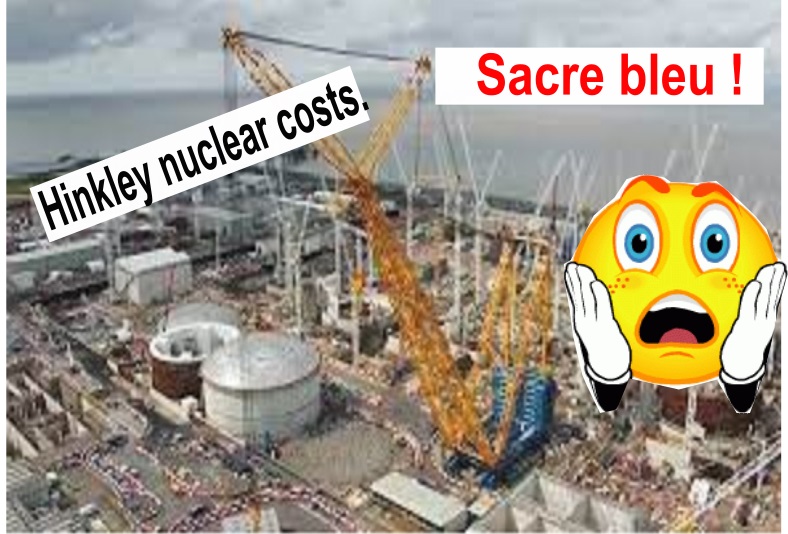
Should we be bothered that Hinkley C nuclear power station has run even further over
budget (the latest estimate is £35 billion, nearly twice that quoted when
the project was given the go-ahead in 2016) and that its completion date
has been put back yet further, to 2031?
After all, the whole point of offering French energy giant EDF a guaranteed ‘strike price’ at the then juicy rate of £92.50 per megawatt-hour (at 2013 prices, rising with
inflation) was supposed to be to transfer financial risk to EDF and its
financial backers. ‘It is important to say that British consumers won’t
pay a penny, with the increased costs met entirely by shareholders,’ EDF’s
managing director of the Hinkley project state this morning.
I wouldn’t be so confident. Yet more delays to Hinkley C punch a huge hole in the
government’s net zero plans, which include the full decarbonisation of the
national grid by 2035 (Labour says it will do it by 2030). By 2028, all but
one of the UK’s existing five nuclear power stations are due to close – and
the other one, Sizewell B, is due to be gone by 2035. From generating
nearly a third of the UK’s power at its peak in 1998 the nuclear industry
could be down to virtually nothing by the time Hinkley C eventually opens.
No-one should be surprised if, before we get to 2031, EDF goes cap in hand
to the government, and the government offers it some kind of deal which
transfers risk back onto the taxpayer.
Spectator 24th Jan 2024
https://www.spectator.co.uk/article/hinkley-c-and-the-rising-cost-of-net-zero/
The War On Journalism In Belmarsh, The War On Journalism In Gaza
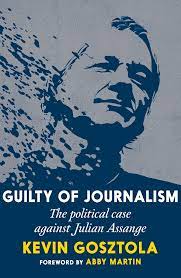
CAITLIN JOHNSTONE, JAN 26, 2024, https://www.caitlinjohnst.one/p/the-war-on-journalism-in-belmarsh?utm_source=post-email-title&publication_id=82124&post_id=141058691&utm_campaign=email-post-title&isFreemail=true&r=1ise1&utm_medium=email—
I haven’t written much about Julian Assange lately because I’ve been so fixated on what’s been happening in Gaza, but we should all be acutely aware that the 20th and 21st of February may be the WikiLeaks founder’s final chance to avoid extradition to the United States to face persecution for the crime of good journalism.
Assange and his legal team will face two High Court judges during the two-day hearing in London, who will then determine whether or not the UK will allow the Australian journalist to be dragged to the US in chains for a crooked show trial and cast into one of the world’s most draconian prison systems for exposing the war crimes of the world’s most powerful government.
Some US lawmakers are attempting to block the extradition from the other end with House Resolution 934, which asserts that “regular journalistic activities are protected under the First Amendment, and that the United States ought to drop all charges against and attempts to extradite Julian Assange.” If charges were dropped it would not only prevent the extradition but allow for Assange to be freed from the Belmarsh maximum security prison, where he has been jailed by the British government since 2019.
The fight to free Assange is a fight to protect press freedoms around the world, since the US is using the case in an attempt to set a legal precedent for extraditing and imprisoning any journalist or publisher anywhere in the world who shares information with the public that the US doesn’t want shared.
And it’s worth mentioning that this fight is not actually separate from the fight against Israel’s efforts to keep journalism out of Gaza by assassinating reporters and blocking the press from entering the enclave. It’s also not separate from humanity’s overall struggle to build a truth-based civilization, nor ultimately from our greater struggle to become a conscious species.
All throughout humanity there are pushes toward truth and seeing and pushes toward secrecy and darkness. In the press we see both: the authentic journalists like Assange who want all that is hidden to be made transparent, and the propagandists of the mainstream media who work to obfuscate and distort the truth. Those who seek the emergence of a harmonious and truth-based society want as much visibility into what’s really happening as possible, while tyrannical power structures like the US empire and Israel are constantly working to dim the lights.
Wherever you see domination and abuse, you see efforts to limit perception and keep human minds from seeing and understanding what’s going on. It’s true of empires, it’s true of governments, it’s true of cult leaders, it’s true of abusive spouses, and it’s true of the unpleasant dynamics within our own psyches that we would rather not look at. The less seeing there is, the more abusiveness is possible; the more seen things become, the closer we get to freedom.
I’m no prophet, but I strongly suspect that our future as a species will be determined by the outcome of this struggle. If the impulse toward truth and seeing wins out, we are probably headed toward a world of health and harmony. If the impulse to keep everything confused and hidden and unconscious wins, we are probably headed for dystopia and extinction.
In any case, all we can do is fight to make things more visible so that health and harmony become possible. Fight to make things conscious within ourselves. Fight to keep journalism legal in the shadow of the empire. Fight to spotlight Israel’s atrocities in Gaza. Fight to make the unseen seen. Fight to bring humanity into the light of consciousness.
Brexit blamed for delays to nuclear power project

EDF’s former CEO had pledged christmas turkeys would be cooked by the plant by 20172
i By Ben Gartside, 24 Jan 24
The UK’s premier nuclear power project could be delayed by another four years as costs continue to balloon, with Brexit cited as a major factor………………According to EDF, the French firm in charge of developing the site, issues on the project had been caused by Brexit, the Pandemic and inflation…………………………………………………….
How has Brexit affected construction costs?
Developers have been hit hard by both the Covid pandemic and soaring energy prices. Tim Heatley, co-founder of Manchester-based Capital&Centricm, said Brexit had also been a “major factor”.
He previously told i: “On the surface there doesn’t seem as much jeopardy in construction as car manufacturing – you can’t outsource building new homes to Asia.
“But, I’d argue, we’re facing even bigger economic consequences if we don’t get things under control.”
“Both construction material and labour costs have rocketed here way more than EU countries, so Brexit must be a major factor.”
A report published in 2023 found that between 2015 and 2022 the cost of construction materials including cement, timber and steel increased by 60 per cent in the UK compared to 35 per cent in the EU…………………….. https://inews.co.uk/news/brexit-blamed-delays-nuclear-power-lower-energy-bills-2871548—
Plan to store nuclear waste under Holderness for 175 years

Nuclear waste from across the UK could be stored below an area of East Yorkshire for up to 175 years.
Government agency Nuclear Waste Services (NWS) announced proposals today to build a storage facility beneath South Holderness.
A group has been set up to examine the proposals, but the agency’s chief executive Corhyn Parr said the scheme would only go ahead with residents’ approval.
She said: “This is a consent-based process, meaning if the community does not express support… it won’t be built there.”
Ms Parr added that the new geological disposal facility would bring benefits to the area, including thousands of jobs and transport improvements.
Two similar working groups are already established in Cumbria and at Theddlethorpe on the Lincolnshire coast.
Dr David Richards, independent chair of the South Holderness working group, said the aim was to work with local communities to discuss the potential of a series of vaults and tunnels being built deep underground, or under the sea, where the material would be buried.
He added: “My role as chair is to make sure local communities have access to information and to understand what people think.”…………………………
Graham Stuart, the MP for Beverley and Holderness, said that he will be meeting with Dr David Richards to discuss the plans.
He wrote on Facebook: “I’ll be asking for a copper bottomed guarantee that nothing would happen without public consent…………………………. https://www.itv.com/news/calendar/2024-01-25/plan-to-store-nuclear-waste-under-east-yorkshire-for-175-years
The Post Office Scandal, Nuclear Waste and The Bransty Tunnel – Off Limits for Nuclear Luvvies at Britain Remade?

Trudy Harrison MP and wannabe MP Josh MacAlister have joined forces under the banner of “Britain Remade”. Their dream of building a nuclear prefab “faster” and “cheaper” next to the worlds biggest stockpile of plutonium is within our grasp they breathlessly tell us. “There could be new nuclear power in Cumbria, delivering jobs for the region, and clean energy for the whole country”.
Hot and dangerous Nuclear wastes from their “clean energy” trundles through the Bransty Rail Tunnel under the town of Whitehaven EVERY week enroute to the Sellafield site already bursting at the seams with radioactive crapola. The Bransty Rail Tunnel has served Network Rail and the nuclear industry well. It is a fine piece of old Victorian engineering which extends for a full 1km directly under homes and businesses in Whitehaven. Only recently it has become unstable. Network Rail are rather worried about the impacts of reactivated old mine water water bubbling up into the tunnel and even putting pressure on the sides of the tunnel (as we can see from Network Rail’s own video taken recently).
Rather than gushing about building untried untested nuclear prefabs (euphemistically called “Small Modular Reactors” actually pretty large at half the size of Calder Hall reactors), the MP and wannabe MP should be putting EVERY EFFORT into protecting the safety of the folk of Whitehaven by CLOSING THIS TUNNEL certainly to Nuclear Waste Transports and possibly to passenger and other freight trains. Ceasing nuclear waste production in Scotland and the North wouldn’t make a huge difference to electricity as nuclear’s contribution to the UKs electrcity capacity has been minimal according to National Grid with wind producing many times more capacity in the recent cold weather.
The most urgent question for Whitehaven is:
Why is heavily polluted mine water is still gushing into the nuclear waste route of the Bransty Tunnel over one year on and into Queens Dock, Whitehaven and what are Trudy Harrison MP and Josh MacAlister wannabe MP doing to address this?
Another equally urgent and topical question given the Post Office scandal is:
Are the MP and prospective MP happy that all nuclear waste consignments including those travelling a few times a week through the Bransty Tunnel are monitored and tracked by the same company, Fujitsu, responsible for the Post Office scandal. Fujitsu’s “Accountancy and Tracking Of Material” ATOM was contracted by the United Kingdom Atomic Energy Authority in 2001. “Fujitsu chose a combination of Microsoft and Oracle systems with web portal technology to make this possible, i.e. to successfully design and implement a package to process, update and report on nuclear and radioactive materials throughout the supply chain.” As Dik Third of UKAEA says, “We believe that there is no other system in the world capable of dealing with such complexity and breadth of plant operations and regulatory accounting requirements.” Does Whitehaven feel lucky? Britain is being Remade into what? A Nuclear Sacrifice Zone?
US plans to store nuclear weapons in UK: report
Examiner January 27 2024 –
The US is planning to station nuclear weapons in the UK for the first time in 15 years amid a growing threat from Russia, according to a report.
Warheads three times as strong as the Hiroshima bomb would be located at RAF Lakenheath in Suffolk under the proposals, The Telegraph reported.
The US previously placed nuclear missiles at RAF Lakenheath, removing them in 2008 when the Cold War threat from Moscow had receded.
Pentagon documents seen by the UK newspaper reveal procurement contracts for a new facility at the airbase.
A Ministry of Defence spokesperson said: “It remains a longstanding UK and NATO policy to neither confirm nor deny the presence of nuclear weapons at a given location.”
………………………….. Downing Street defended the government’s spending on defence, saying Britain has been Washington’s “partner of choice” in its strikes against Houthi rebels in the Red Sea because of its “military strength”. https://www.examiner.com.au/story/8500518/us-plans-to-store-nuclear-weapons-in-uk-report/—
Hinkley Point C could be delayed to 2031 and cost up to £35bn, says EDF

As nuclear plant is hit by further delay, real cost will be far higher after inflation is included, as project uses 2015 prices
Guardian, Alex Lawson, Wed 24 Jan 2024
The owner of Hinkley Point C has blamed inflation, Covid and Brexit as it announced the nuclear power plant project could be delayed by a further four years, and cost £2.3bn more.
The plant in Somerset, which has been under construction since 2016, is now expected to be finished by 2031 and cost up to £35bn, France’s EDF said. However, the cost will be far higher once inflation is taken into account, because EDF is using 2015 prices.
The latest in a series of setbacks represents a huge delay to the project’s initial timescale. In 2007, the then EDF chief executive Vincent de Rivaz said that by Christmas in 2017, turkeys would be cooked using electricity generated from atomic power at Hinkley. When the project was finally given the green light in 2016, its cost was estimated at £18bn…………
Crooks said: “Running the project longer will cost more money and our budget has also been affected by rising civil construction costs. It is important to say that British consumers or taxpayers won’t pay a penny, with the increased costs met entirely by shareholders.”
EDF had previously said that the first reactor unit at the nuclear site would be due to be complete by June 2027, with a 15-month buffer period which was likely to be used – putting its completion at September 2028, and a further year for the second unit. It costs were estimated between £25bn and £26bn, and this was later revised up to £32.7bn in February 2023
EDF gave three scenarios, ranging from becoming operational is 2029, to delays pushing this back to 2031.
It said that the cost of completing Hinkley will be between £31bn and £34bn, although if completion is delayed to 2031 costs would rise to £35bn.
In December it emerged EDF’s partner in the project, China General Nuclear, had halted funding for Hinkley. The move came after the government took over CGN’s stake in Hinkley’s proposed sister site, Sizewell C in Suffolk, stripping the Chinese state-owned company of its role in the project.
The latest financial estimates are based on accounting in 2015 figures, meaning the total cost of the project could be far higher when inflation over the last decade is factored in. Hinkley’s ballooning costs have proved controversial with French taxpayers, which are picking up the tab.
Hinkley Point C and Sizewell C are expected to herald a new era of nuclear plants touted by the government.
Last year the government launched a delivery body, Great British Nuclear, with the aim of accelerating the development of new nuclear projects. Earlier this month ministers set out plans for out for the “biggest nuclear power expansion in 70 years”.
However, the Hinkley Point C delay will add to concerns over project delays and costs, as well as skills in an industry earmarked to deliver a quarter of the national electricity demand by 2050………………..
EDF said in January it would delay the shutdown of four of its UK nuclear reactors for at least two years and increase investment in its British nuclear fleet. https://www.theguardian.com/business/2024/jan/23/hinkley-point-c-could-be-delayed-to-2031-and-cost-up-to-35bn-says-edf—
EDF’s UK Hinkley Nuclear Costs Balloon as Plant Delayed Again – an “unmitigated disaster”?

A government spokesperson said the new plant is “not a government project” and as such “any additional costs or schedule overruns are the responsibility of EDF and its partners and will in no way fall on taxpayers”.
The government has also just doubled its own investment into Sizewell C to £2.5bn and is in the process of raising capital from private investors.
A government spokesperson said the new plant is “not a government project” and as such “any additional costs or schedule overruns are the responsibility of EDF and its partners and will in no way fall on taxpayers”.
The government has also just doubled its own investment into Sizewell C to £2.5bn and is in the process of raising capital from private investors.
Hinkley C: UK nuclear plant price tag could rocket by a third.
By Simon Jack, Business editor
The final cost of the Hinkley Point C nuclear plant being built in Somerset may soar by about a third, according to the French firm developing it.
EDF now estimates that the cost could hit £46bn, when taking price rises into account.
The completion date could also be delayed by three years………………………………
The French state-owned firm manages all five nuclear power stations that are currently generating electricity in the UK, along with three that are defueling, the first stage of winding down operations.
In 2022, the cost of the UK’s first new nuclear plant since the 1990s was estimated at £26bn, with a target date for completion of June 2027.
Previous cost estimates have been expressed in 2015 prices for easy comparison over time.
But taking inflation into account, the previous estimate on final costs of £26bn works out at £34bn today. The updated estimate of £31-35bn, could see costs hit £46bn in today’s prices – an increase of about a third.
In a letter to staff, seen by the BBC, Stuart Crooks, the managing director of Hinkley Point C, said there were 7,000 substantial design changes required by British regulations that needed to be made to the site, with 35% more steel and 25% more concrete needed than originally planned.
The revised estimates come after the government recently announced ambitions for the biggest expansion in nuclear power for 70 years.
The UK government has said in the past it wants nuclear to provide up to 25% of the UK’s electricity needs by 2050 as part of its plans to combat climate change.
A government spokesperson said the new plant is “not a government project” and as such “any additional costs or schedule overruns are the responsibility of EDF and its partners and will in no way fall on taxpayers”…………………………………….
Stuart Crooks, the managing director of Hinkley Point C, pointed out, however, that UK bill payers will not be directly affected by those building and cost time overruns.
The French firm EDF agreed to shoulder the risk and pay the full cost of construction, including any increases. This was in return for an agreed electricity price that was substantially higher than the average price in 2015 and would only rise in line with inflation.
“It is important to say that British consumers or taxpayers won’t pay a penny, with the increased costs met entirely by shareholders,” Mr Crooks’ letter read.
However, this price shock comes at a sensitive time for the UK government, which has agreed to allow construction costs for a new plant at Sizewell in Suffolk to be added to customers’ bills gradually over the decade which it will take to build.
The government has also just doubled its own investment into Sizewell C to £2.5bn and is in the process of raising capital from private investors.
Last week, the government triggered a “development consent order” that allows early-stage construction to begin in Suffolk despite several legal challenges from local and national opponents who have taken their fight to the Supreme Court.
Alison Downes of the campaign group Stop Sizewell C said that the announcement of additional funding was”inexplicable” following news of delays to one of the government’s key nuclear projects.
She described the Hinkley and Sizewell projects as an “unmitigated disaster”.
“The government should cancel Sizewell C instead of handing over scarce billions that could be used instead for renewables, energy efficiency or – in this [general] election year – schools and hospitals,” she added……………….. https://www.bbc.com/news/business-68073279
UK’s flagship nuclear plant could cost up to $59 billion, developer says
A major nuclear plant that Britain’s government hopes will generate affordable, low-carbon energy could cost up to 46 billion pounds, or $59 billion, and the completion date could be delayed to after 2029
abc news, By SYLVIA HUI Associated Press, January 25, 2024
LONDON — A major nuclear plant that Britain’s government hopes will generate affordable, low-carbon energy could cost up to 46 billion pounds ($59 billion), and the completion date could be delayed to after 2029, the firm developing it said Wednesday.
The U.K. government says nuclear projects like the Hinkley Point C plant are a key part of its plans to ensure greater energy independence and achieve its “net zero” by 2050 strategy.
But a re-evaluation showed that the final bill for the plant, being built in Somerset in southwest England, could soar to up to 34 billion pounds in 2015 prices — or 43 billion pounds in current value, French energy giant EDF said…………………………………. https://abcnews.go.com/Business/wireStory/uks-flagship-nuclear-plant-cost-59-billion-developer-106635464
Berkshire nuclear defence workers strike
Planet Radio 24 Jan 24
Workers at the Atomic Weapons Establishment (AWE) at Aldermaston and Burghfield are on a 24-hour strike after two months of other forms of industrial action in a dispute over pay.
Action short of a strike started in mid-November and will re-commence on Thursday January 25. ……………………………………….https://planetradio.co.uk/greatest-hits/berkshire-north-hampshire/news/workers-awe-aldermaston-burghfield-strike/
France presses UK to help fill multibillion-pound hole in nuclear projects

Call comes day after EDF flagged more delays of construction of power plant at Hinkley Point
Sarah White in Paris and Jim Pickard and Rachel Millard in London, 25 Jan 24, https://www.ft.com/content/3320c06e-7ce3-4a6b-ab22-4b8201a4cfca
The French government is pressing the UK to help plug a multibillion-pound hole in the budget of nuclear power projects being built in Britain by France’s electricity operator EDF. The call for a contribution from the UK is likely to cause tensions between Paris and London, a day after state-owned EDF admitted its construction of a new nuclear power station at Hinkley Point in Somerset would suffer further costly delays, taking the bill to as much as £46bn. The UK has said it will not put cash into the project, which counts EDF as a majority shareholder, and is already backed by a government guarantee on its revenues once it is up and running.
But Paris is pushing for a “global solution” that would also encompass funding issues at another planned UK plant, Sizewell C, said a French economy ministry official and another person close to the talks. “It’s a Franco-British matter,” the French economy ministry official said. “The British government cannot at the same time say EDF has to figure it out alone on Hinkley Point and at the same time ask EDF to put money into Sizewell. We’re determined to find a global solution to see these projects through.”
Sizewell in Suffolk has a different financial set-up to Hinkley. The UK this week said it would inject another £800mn of state funds, bringing its total contribution to £2.5bn at the £20bn plant, where it is the top shareholder. Its partner EDF has no obligation to put more money in. French officials said discussions on various options had begun several months ago with British counterparts, although they acknowledged London had flagged budgetary constraints that would have to be taken into account. In the UK, a government official played down the talks, adding that on Hinkley Point: “Costs will be the responsibility of EDF.”
An EDF executive told the BBC on Wednesday that the French company picks up “the tab for the cost overruns”. EDF on Tuesday warned Hinkley Point would not now be completed until 2029 at the earliest, four years later than its original start date, while the two reactors could cost up to £46bn to build at today’s prices, compared with a £18bn budget in 2016.
Other factors might play into the discussions, however. Under Prime Minister Rishi Sunak, Britain took the political initiative to eject Chinese group CGN as an investor in Sizewell — leaving that project in need of fresh private capital, but also prompting CGN to pull back from Hinkley, where it is a 33.5 per cent shareholder. The Chinese group has fulfilled its contracted payments on Hinkley but has no obligation to fund over-costs and stopped doing so a few months ago.
“The French don’t have many levers here but the CGN issue is a very real one,” a third person close to the talks said. Finding private investors to make up the Hinkley shortfall may be tough, several people close to the group said, although formulas such as state guarantees could be discussed. EDF is only just coming out of a period of financial turmoil, and has big investments to make at home, too, in the coming decades. It was fully renationalised last year
“Our goal here . . . is for what’s happening at Hinkley Point, with the delays and the issue with the Chinese partner’s decision, not to impact EDF’s financial trajectory excessively,” the French economy ministry official said. However, one UK nuclear industry figure said that EDF’s plight at Hinkley was the consequence of signing up to a deal with the UK government a decade ago, which at the time was criticised for being too generous to the French group. Under a so-called contract for difference signed with the state, construction costs are not covered but future electricity production is backed up by subsidies in case power prices fall below a certain threshold.
1 This Month

of the week – Shut Down Drone Warfare!


Tell the Ukrainian Government to Drop Prosecution of Peace Activist Yurii Sheliazhenko

Petition to revoke the licensing of the Near Surface Nuclear Disposal Facility (NSDF) at Chalk River. https://www.ourcommons.ca/petitions/en/Petition/Details?Petition=e-7247
To see nuclear-related stories in greater depth and intensity – go to https://nuclearinformation.wordpress.com
-
Archives
- April 2026 (91)
- March 2026 (251)
- February 2026 (268)
- January 2026 (308)
- December 2025 (358)
- November 2025 (359)
- October 2025 (376)
- September 2025 (257)
- August 2025 (319)
- July 2025 (230)
- June 2025 (348)
- May 2025 (261)
-
Categories
- 1
- 1 NUCLEAR ISSUES
- business and costs
- climate change
- culture and arts
- ENERGY
- environment
- health
- history
- indigenous issues
- Legal
- marketing of nuclear
- media
- opposition to nuclear
- PERSONAL STORIES
- politics
- politics international
- Religion and ethics
- safety
- secrets,lies and civil liberties
- spinbuster
- technology
- Uranium
- wastes
- weapons and war
- Women
- 2 WORLD
- ACTION
- AFRICA
- Atrocities
- AUSTRALIA
- Christina's notes
- Christina's themes
- culture and arts
- Events
- Fuk 2022
- Fuk 2023
- Fukushima 2017
- Fukushima 2018
- fukushima 2019
- Fukushima 2020
- Fukushima 2021
- general
- global warming
- Humour (God we need it)
- Nuclear
- RARE EARTHS
- Reference
- resources – print
- Resources -audiovicual
- Weekly Newsletter
- World
- World Nuclear
- YouTube
-
RSS
Entries RSS
Comments RSS
 nuclear-news