Why WikiLeaks founder will plead guilty – and what happens next
Angus Thompson and Millie Muroi, June 25, 2024 , The Age
WikiLeaks founder Julian Assange, 52, has struck a plea deal with the United States that is set to end a years-long legal pursuit over the release of classified documents.
He is expected to plead guilty to conspiring to unlawfully obtain and disseminate classified national defence information in a court in the Northern Mariana Islands at 9am on Wednesday (AEST) but will avoid jail time in the US after spending several years fighting extradition from London’s maximum-security Belmarsh Prison.
Why was Julian Assange released?
Assange is en route to Saipan, the largest of the Northern Mariana Islands, which are a US commonwealth in the western Pacific. There he will face a US Federal Court judge on a single charge of breaching the Espionage Act with the mass release of secret documents leaked by former intelligence analyst Chelsea Manning.
He faced 18 espionage charges after being indicted in early 2019 by the US Justice Department, which began legal proceedings to seek his extradition from Britain in the same year.
The charges sparked a global outcry over press freedom and led a cross-party coalition of Australian politicians, including former Nationals leader Barnaby Joyce and teal independent Monique Ryan, to travel to the US in 2023 to pressure the Biden administration to drop its pursuit.
US President Joe Biden told a press conference earlier this year he was “considering” a deal over Assange, after Prime Minister Anthony Albanese raised it during his October 2023 US visit.
“I’ve made it clear that enough is enough – that it’s time it was brought to a conclusion,” Albanese said.
How long did Assange spend in prison?
Assange was first detained in 2010 and sent to London’s Wandsworth Prison after a Swedish court ordered his arrest on sex crime allegations. He was freed on bail with a £240,000 surety, but in February 2011, a London court ordered Assange’s extradition to Sweden.
The British Supreme Court rejected his final appeal against the extradition in June 2012. Five days later, he took refuge in Ecuador’s embassy in London, seeking political asylum……………………………………………………………….
What does the plea deal mean for Assange’s future?
Assange is expected to face a US judge at 9am local time in Saipan, who is expected to approve the plea deal, meaning he will avoid the maximum 175 years he faced in the US under the original charges.
His future is largely unknown beyond that, however, in a post on social media platform X on Tuesday morning celebrating Assange’s release, WikiLeaks said he was expected to return to Australia.
What has been the Australian government’s response?
Albanese has so far been tight-lipped about Assange’s release. But Coalition and Greens MPs welcomed the announcement. Opposition foreign affairs spokesman Simon Birmingham said he welcomed the fact Assange’s decision to plead guilty would bring an end to the “long-running saga”.
Nationals MP Joyce said the issue was about “extraterritoriality” and went beyond Assange as an individual. “It’s about an issue, about an Australian citizen, who did not commit a crime in Australia,” he said.
Greens senator David Shoebridge said whistleblowers such as Assange continued to pay an unfair price for revealing unethical and criminal actions of governments. https://www.theage.com.au/politics/federal/why-wikileaks-founder-has-been-set-free-and-what-happens-next-20240625-p5joia.html
‘Julian Assange Is Free’: WikiLeaks Founder Strikes Plea Deal With US
“We thank all who stood by us, fought for us, and remained utterly committed in the fight for his freedom,” said WikiLeaks. “Julian’s freedom is our freedom.”
COMMON DREAMS STAFF, Jun 24, 2024, https://www.commondreams.org/news/julian-assange-plea-deal
WikiLeaks founder Julian Assange on Monday reached a deal with the U.S. government, agreeing to plead guilty to one felony related to the disclosure of national security information in exchange for his release from Belmarsh Prison in the United Kingdom.
A related document was filed in federal court in the Northern Mariana Islands, a U.S. commonwealth. Under the plea agreement, which must still be approved by a judge, the Department of Justice will seek a 62-month sentence, equal to the time that the 52-year-old Australian has served in the U.K. prison while battling his extradition to the United States.
Assange faced the risk of spending the rest of his life in U.S. prison if convicted of Espionage Act and Computer Fraud and Abuse Act charges for publishing classified material including the “Collateral Murder” video and the Afghan and Iraq war logs. Before Belmarsh, he spent seven years in the Ecuadorian Embassy in London with asylum protections.
“Julian Assange is free,” WikiLeaks declared on the social media platform X, confirming that he left Belmarsh Friday “after having spent 1,901 days there,” locked in a small cell for 23 hours a day.
He was granted bail by the High Court in London and was released at Stanstead Airport during the afternoon, where he boarded a plane and departed the U.K.,” WikiLeaks said. “This is the result of a global campaign that spanned grassroots organizers, press freedom campaigners, legislators, and leaders from across the political spectrum, all the way to the United Nations.”
“He will soon reunite with his wife Stella Assange, and their children, who have only known their father from behind bars,” the group continued. “WikiLeaks published groundbreaking stories of government corruption and human rights abuses, holding the powerful accountable for their actions. As editor-in-chief, Julian paid severely for these principles, and for the people’s right to know. As he returns to Australia.”
The news of Assange’s release was celebrated by people around the world, who also blasted the U.S. for continuing to pursue charges against him and the U.K. for going along with it.
“Takeaway from the 12 years of Assange persecution: We need a world where independent journalists work in freedom and top war criminals go to prison—not the other way around,” the progressive advocacy group and longtime Assange supporter RootsAction said on social media.
Leftist Colombian President Gustavo Petro said in a statement: “I congratulate Julian Assange on his freedom. Assange’s eternal imprisonment and torture was an attack on press freedom on a global scale. Denouncing the massacre of civilians in Iraq by the U.S. war machine was his “crime”; now the massacre is repeated in Gaza I invite Julian and his wife Stella to visit Colombia and let’s take action for true freedom.”
Australian Greens leader Adam Bandt, who represents Melbourne in Parliament, said on social media that “Julian Assange will finally be free. While great news, this has been over a decade of his life wasted by U.S. overreach.”
“Journalism is not a crime,” Bandt added. “Pursuing Assange was anti-democratic, anti-press freedom, and the charges should have been dropped.”
The women-led peace group CodePink said in a statement:
Without Julian Assange’s critical journalism, the world would know a lot less about war crimes committed by the United States and its allies. He is the reason so many anti-war organizations like ours have the proof we need to fight the war machine in the belly of the beast. CodePink celebrates Julian’s release and commends his brave journalism.
One of the most horrific videos published by WikiLeaks was called “Collateral Murder,” footage of the U.S. military opening fire on a group of unarmed civilians–including Reuters journalists–in Baghdad. While Julian has been in captivity for the past 14 years, the war criminals that destroyed Iraq walked free. Many are still in government positions today or living off the profits of weapons contracts.
While Julian pleads guilty to espionage—we uphold him as a giant of journalistic integrity.
Vahid Razavi, founder of Ethics in Tech and host of multiple NSA Comedy Nights focusing on government mass surveillance, told Common Dreams that “they took a hero and turned him into a criminal.”
“Meanwhile, all of the war criminals in the files exposed by WikiLeaks via Chelsea Manning are free and never faced any punishment or even their day in court,” he added. “You can kill journalists with impunity, just like Israel is doing right now in Gaza.”
British journalist Afshin Rattansi said, “Let no one think that any of us will ever forget what the British state did to the most famous journalist of his generation.”
“They tortured him—according to the United Nations special rapporteur on torture—at the behest of the United States,” Rattansi noted.
Andrew Kennis, a professor of journalism and social media at Rutgers University, told Common Dreams that “Julian Assange is nothing less than the Daniel Ellsberg of our time.”
Scary truths on civilian nuclear power are coming to the fore
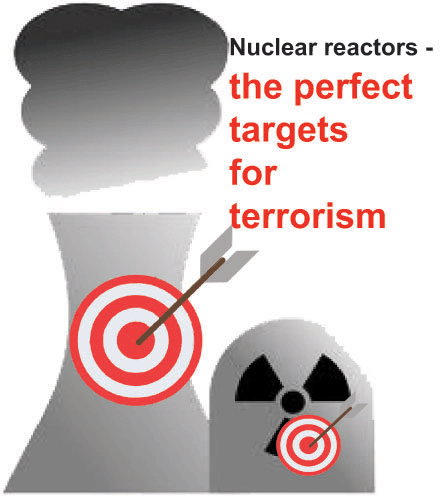
Firstly, everyone agrees that climate breakdown will flip heretofore stable regions into unstable. Adding the reasons mentioned above, a proliferation of civilian nuclear power stations will give potential non-nuclear conflicts a new nuclear dimension. Add to that the cheaper, supposedly even sometimes mobile, small nuclear reactors that are seen as “dirtier” than existing NPPs.
It’s no surprise therefore that the civil nuclear lobby would rather not talk about it.
Bill Ramsay, The National 24 June 24
IT’S entirely natural that the UK civilian nuclear power lobby pitch is behind Labour.
Probably some who support Scottish independence think that the stance of the SNP on nuclear power is a marginal vote-loser. However, if looked at properly through a national security lens, it’s actually a vote-winner.
Occasionally, the threat of some limited non-state terrorist attack on a civilian nuclear facility gets an airing. The more important issue of the implication of the presence of civilian nuclear power stations in a war zone rarely does.
………………………………. the lack of discussion – in the public domain at least – of the implications of the presence of a civilian nuclear power station in a so-called non-nuclear conventional battlefield.
I did nothing more on the issue until my sort-of retirement from education as a senior official of the EIS aligned with the Russian invasion of Ukraine. Ukraine hosts Europe’s largest nuclear power station and some others. More than half of Ukraine’s electricity is generated by its nuclear power stations.
My first attempt at a paper was rather “undercooked” – as the rejection from the Royal United Services Institute (RUSI) rightly pointed out – but the final effort – after helpful further consultation with Paul Rodgers, emeritus professor of peace studies at Bradford University – is now available on the Scottish CND website.
In Castle Zaporizhzhia: War Fighting Implications Linked To The Proliferation Of Nuclear Power As Part Solution To Climate Chaos, I unpack the dangers that the nuclear lobby would rather not discuss.
I argue that from a purely military perspective, the occupying Russian forces – whose current, if not future, capabilities are far from overwhelming – will militarily milk the Zaporizhzhia NPP for all its worth and more.
Militarily, the intimidatory potential of the Zaporizhzhia NPP of today and future Zaporizhzhias are huge. Zaporizhzhia NPP performs a similar role for the Russian invaders of Ukraine that the motte-and-bailey castle did for the Norman invaders of England after 1066. These castles of wood then stone were designed to intimidate the Saxon natives.
Zaporizhzhia NPP does the same. Russia can use it as a base of operations from which it can project its power in the full knowledge that the Ukrainians cannot attack it without the risk of another Chornobyl nuclear disaster.
If they wished, the Russians could fire long-range ordnance from it, in the full knowledge the Ukrainians dare not fire back. Indeed, although Zaporizhzhia NPP was discussed at the Ukrainian summit held in Switzerland a few days ago, the bigger global security risks associated with civilian nuclear power production was not. Why? Because the civil nuclear lobby sees nuclear power as a clean alternative to fossil fuels.
In my view, civil nuclear power as a climate chaos mitigator is triply flawed.
Firstly, everyone agrees that climate breakdown will flip heretofore stable regions into unstable. Adding the reasons mentioned above, a proliferation of civilian nuclear power stations will give potential non-nuclear conflicts a new nuclear dimension. Add to that the cheaper, supposedly even sometimes mobile, small nuclear reactors that are seen as “dirtier” than existing NPPs.
It’s no surprise therefore that the civil nuclear lobby would rather not talk about it. Though, to be fair to RUSI, soon after the publication of my report by Scottish CND, RUSI published another which was followed up by a seminar and more recently it has established an ongoing project on strategic and security aspects of civil nuclear power.
Despite all this, the security aspects of civil nuclear power remain very much an elite issue with very little reportage in the mainstream media.
It’s a similar strategy to that employed by John Cleese’s hotelier character Basil Fawlty when faced by an influx of a coach-load of elderly German tourists to his establishment. Paranoid that his staff would make reference to the Second World War, he threatened them with dismissal if they did.
We would all like the war in Ukraine to end, not least because of the death and destruction. The nuclear lobby’s motives are rather less altruistic as the longer the war goes on, the more likely their so-called solution to climate chaos will be exposed to a more searching critique. https://www.thenational.scot/politics/24405095.scary-truths-civilian-nuclear-power-coming-fore/
Scotland’s First Minister Swinney hits back at ‘hopelessly ideological’ attack from nuclear industry

By Martin Williams, @Martin1Williams, Senior News Reporter, Herald 20th June 2024
The First Minister has rejected an attack from the nuclear industry that his ban on new power plants is “hopelessly ideological”.
John Swinney doubled down on his rejection of new nuclear after he was challenged in the Scottish Parliament over his stance after the nuclear industry criticisms, revealed in the Herald on Sunday targeted his view that he was “not a fan of the nuclear industry” and that he “never have and never will” support investments in new power plants.
He has been responding to calls to lift the ban on nuclear as fears grow over hundreds of jobs being lost and skilled workers leaving Scotland for overseas.
The nuclear industry attacked the First Minister for being “hopelessly ideological and anti-science” after he said he was “not a fan” of the business and that he “never have and never will” support investment in the power plants……………………
When asked for his response to the nuclear industry in the Scottish Parliament, Mr Swinney said: “The Scottish Government does not support the building of new nuclear power stations in Scotland. We have abundant natural resources and a highly skilled workforce to take advantage of the many renewable energy opportunities. Evidence shows that new nuclear is more expensive than renewable alternatives.
“Nuclear energy also creates radioactive waste, which must be safely managed over many decades to protect the environment, requiring complex and expensive handling. The Scottish government is supporting continued growth in renewables, storage, hydrogen and carbon capture technologies to drive economic growth, support green jobs and provide secure, affordable and clean energy for Scotland.”
But in response, Scottish Conservative Central Scotland MSP Graham Simpson said: “So it is hopelessly ideological and anti science…………………..
The First Minister responded: “I gave a considered answer to Graham Simpson. I don’t think it could in any way be described as ideological, because I made the point that evidence shows that new nuclear is more expensive than renewable alternatives.
“We are facing a cost of living and public finance crisis, so any responsible First Minister will look to make sure that we make the most fiscally efficient approach to energy generation.
“This government, as a result of its clear policy leadership, has successfully decarbonised electricity generation within Scotland. We have developed renewable energy with policy certainty, and I want to give the same policy certainty to storage, to hydrogen to carbon capture technologies to drive economic growth and support green jobs……………………
And he added: “So I am afraid to say Graham Simpson has not got a leg to stand on this question. We have got a clear strategy on renewables. We will pursue that and will pursue it sustainably to deliver for the people of Scotland……………………….. https://www.heraldscotland.com/news/24400300.swinney-hits-back-hopelessly-ideological-attack-nuclear/
Over budget and plagued with delays: UK nuclear lessons for Australia
The big challenges facing nuclear power in Britain, both for large reactors and SMRs, are not technological or economic, but largely administrative and logistical.
AFR, Hans van Leeuwen, Europe correspondent, Jun 21, 2024 –
Behind the shore of England’s south-western county of Somerset lie the Quantock Hills – as perfect a landscape of lush rolling pasture and rugged heathland, laced with woodland groves and nestled hedgerows, as you could possibly imagine. It’s also home, incongruously, to a very, very large crane.
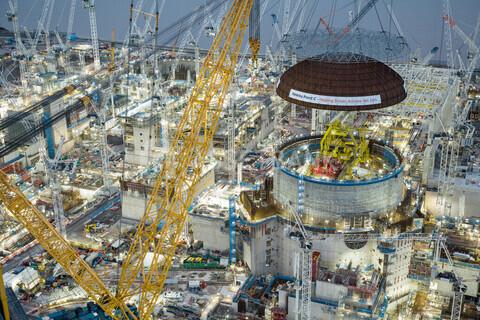
Big Carl, as it is known, is, in fact, the world’s largest. It is six kilometres long, 250 metres high and has 96 wheels. It has spent the past few years at Hinkley Point, on the Bristol Channel. Big Carl hit a mini-climax of hydraulic achievement just before Christmas last year, as it hauled a 14-metre tall, 245-tonne steel dome onto the top of a 44-metre nuclear reactor.
Progress at last. The reactor’s name is Hinkley Point C – which sadly doesn’t quite have the same folksy ring as “Big Carl”. Fifteen years have elapsed since French giant EDF and its Chinese partner began trying to build it, and rouse Britain from decades of nuclear slumber.
Lining up the regulators and the finance took seven years. Construction is in its seventh year, and might be only just past the halfway mark. There are 10,000 workers and 3500 British companies involved in pulling this off, at a cost that may end up topping £46 billion ($88 billion) – almost thrice the original estimate of £16 billion.
This is the kind of monumental scale of project that Opposition Leader Peter Dutton wants to bring to Australia. Alongside it, he also envisages small modular reactors (SMRs): more petite, but equally dully monikered, nukes that are thrown together in a factory and then operate from what is really little more than an industrial shed.
Britain wants to build those too, and is in the last throes of a competition to put taxpayer money behind at least one contender. But even the most advanced would-be manufacturer, Rolls-Royce, doesn’t appear to expect an SMR to actually be up and running until the start of the 2030s………………………………………………………………………………………………….
Why so long, and so costly?
Greatrex offers a warning to Australia: the big challenge facing nuclear power in Britain, both for large reactors and SMRs, but most clearly in evidence at Hinkley Point C, is not technological or economic, but largely administrative and logistical.
“Issues around bottlenecks in the planning system, the time it takes for permitting on various things, the issues around access to grid and grid connections, they’re all real factors,” he says.
“There are a whole number of issues around planning and permitting that seem to be taking more time to deal with than the actual construction period.”
This has left Greatrex and his organisation fighting a rearguard action against public and media perceptions that the industry is foundering – particularly as the flagship Hinkley Point C reactor project suffers repeated cost and deadline blowouts.
Although the government has this year doubled down on building large reactors to keep nuclear’s share of British electricity generation at about 25 per cent, the negative stories keep coming……………………………………………………………………………
For 35 years after the plant starts operating, taxpayers will fill any gap between that price and the going market rate, likely resulting in a subsidy far higher than that for offshore wind or solar. The government is also guaranteeing the debt funding of almost half the capital costs of building it.
The original estimated cost of Hinkley Point C was £16 billion, and the anticipated date to get it open and running was 2023. Now, it’s £35 billion in today’s prices, which could be £46 billion by the time the work is completed between 2029 and 2031.
EDF this year took a €12.9 billion ($20.8 billion) impairment charge on the project. The Chinese partner, having been frozen out of future nuclear projects in Britain for geopolitical reasons, has reportedly been withholding its own contributions this year.
The company has blamed the blowout on design changes enforced by the regulator, along with labour shortages and supply chain issues.
Going first to restart the nuclear construction industry in Britain after a 20-year pause has been hard,” Hinkley Point C boss Stuart Crooks said in a letter to staff earlier this year.
But the British government is still pushing on with a second reactor, the 3.2-gigawatt Sizewell C on the country’s east coast, which EDF will also build. This has taxpayer backing of £2.5 billion, and the government is on the hunt for £20 billion of private capital, supposedly by the end of the year………………………………………………………………………………
Rolls-Royce rollout starts at home
But even if the Coalition has to look elsewhere than Britain and Europe for its mega-reactors, energy spokesman Ted O’Brien has explicitly name-checked Rolls-Royce as a potential partner on SMRs………………………………………..
At any rate, Rolls-Royce has to crack its home market first. The government will next month decide which of six horses to back with taxpayer largesse. https://www.afr.com/companies/energy/over-budget-and-plagued-with-delays-uk-nuclear-lessons-for-australia-20240621-p5jnkq
UK’s nuclear plant will cost nearly three times what was estimated

Australian Financial Review Tom McIlroy, Political correspondent, Jun 20, 2024
Recent overseas experience suggests an Australian nuclear energy program
would be vulnerable to delays and cost blowouts – the construction of
Britain’s latest plant is years behind schedule and modular technology is
still not commercially viable.
Opposition Leader Peter Dutton will not say
how much his plan to build seven nuclear power stations by 2050 will cost,
but promised on Thursday to release the numbers before the election.
Britain’s Hinkley C generator in Somerset is on track to cost about three
times its original budget. It was initially due to be operational in 2017
and to cost about $35 billion, but it is now not expected to open before
2031 and will cost about $90 billion. The blowout has been blamed on
inflation, the COVID-19 pandemic and Brexit. The first new reactors in
decades, built from scratch in the United States, also suffered lengthy
delays and budget upheavals.
Australian Financial Review 20th June 2024
UK nuclear power plants rollout may be hit by planning hurdles
Companies bidding for government contracts to build the UK’s first mini-reactors
may find there are factors beyond their control. Britain wants to revive
its nuclear industry. Both the Conservatives and Labour, jostling for
electoral success, see reactors as a way of decarbonising the energy
network, providing a reliable base alongside clean but intermittent wind
and solar power.
But there’s a problem. All but one of the country’s
existing nuclear power stations are set to be decommissioned by the end of
the decade and Hinkley Point C, the only new one being built, is suffering
from budget blowouts and delays. The solution, it seems, is not to think
big but to think conspicuously smaller.
Mini-plants are being touted as a
faster and cheaper way of boosting the country’s nuclear capacity. Six
companies are on a shortlist competing for £20 billion in government
funding to build the nation’s first small modular reactors and in the
next two weeks they will submit final bids. Two are expected to be selected
by the end of the year.
So far, so good, yet there are worries that the
first hurdle may be somewhat easier to clear than what follows. In recent
years planning has been the bane of construction companies of all stripes,
from housebuilders to infrastructure specialists, and there is talk that
the rollout of small modular reactors could be hampered by the same lengthy
regulatory and permission-seeking processes that have beset larger-scale
nuclear projects, in particular.
The first small modular reactor is not
expected to be up and running before 2035. “Planning is a major drain on
the time in the schedule,” said Alastair Evans, director of corporate and
government affairs at Rolls-Royce, the FTSE 100 engineering specialist that
has been promoting its water-cooled reactor for use in the UK for several
years. “There will be lessons that we can learn and the planning
inspectorate can learn from what they have just been through,” a
reference to the ten years taken for the Sizewell C development in Suffolk
to move from initial public consultation to gaining consent. Small modular
reactors can take up the space of one or two football pitches, have a
capacity of up to 500 megawatts and will employ between 1,000 and 2,000 on
site.
Yet it still takes an average of more than four years for so-called
national significant infrastructure projects, which include all power
stations over 50MW, to secure a development consent order, according to the
latest government estimates, an increase from about two and a half years in
2012. Research by Britain Remade, a pro-growth think tank, suggests that
the average construction cost for new nuclear infrastructure that has been
built in the UK since 2000 is £9.4 million per megawatt, adjusting for
inflation. That is more than four times the cost in South Korea, which has
adopted a fleet approach to expand its nuclear capacity. “A key problem
is, if you look at the planning system for nuclear power stations, it is
extremely bureaucratic, slow-moving and paperwork-intensive,” Sam
Dumitriu, head of policy at Britain Remade, said.
He cited the 44,000-page environmental impact assessment that Sizewell C produced as part of its planning application. …………………………….
Times 21st June 2024
Prime Minister Rishi Sunak reinforced his party’s commitment to nuclear energy .
Rishi Sunak talks energy during Sizewell trip in Suffolk. Prime Minister Rishi Sunak reinforced his party’s commitment to nuclear
energy during a tour of Sizewell B. Building permission for Sizewell C on
the Suffolk coast, which will generate 3.2 gigawatts (GW) of electricity,
was granted in July 2022 and was expected to cost £20bn. Quizzed about
whether government had received any more assurances on further sources of
private investment for the project, Mr Sunak told reporters: “We are
confident of delivery of our nuclear plant”. In its manifesto, Labour said
it would “end a decade of dithering” on nuclear power, and would ensure the
long-term security of the sector.
BBC 19th June 2024
‘Lax’ nuclear security leaving UK at risk of cyber attacks from hostile nations
Official figures show 20 per cent drop in nuclear inspections amid 45 per cent rise in security threats.
By Richard Vaughan, June 19, 2024 The i
The average number of inspections at UK nuclear facilities has plunged by a fifth in recent years despite a significant rise in the number of security incidents over the same period, official figures show.
The “unacceptable” numbers have prompted nuclear safety experts to warn that the Government has taken a “laissez-faire” approach to nuclear power inspection.
According to data from the Office for Nuclear Regulation (ONR), between 2015 and 2019 there were an average of 194 security inspections per year, a figure that dropped to 153 per year between 2020 and 2023 – a decline of 20 per cent.
This is despite a dramatic rise in the average number of major security incidents over the same period, with 531 such incidents per year between 2015 and 2019, rising to 771 between 2020 and 2023 – an increase of 45 per cent.
Security incidents reported to the ONR are both physical and cyber, with protesters and individuals gaining unauthorised access to the sites as well as hostile states targeting the UK’s nuclear infrastructure.
In December, it was revealed that cyber groups linked to Russia and China had hacked into the Sellafield site in Cumbria, prompting fears that sensitive information around how Sellafield moves radioactive waste may have been compromised.
It follows warnings from the National Cyber Security Centre of the heightened threat of “state-aligned groups against western critical national infrastructure” linked to Russia, including the UK’s nuclear power stations.
The National Risk Register, a government document which assesses “the most serious risks facing the UK”, recently highlighted the danger of both conventional and cyber attacks on UK civil nuclear infrastructure.
Nuclear safety experts said the drop in inspections coincided with the Covid pandemic that allowed for “at distance” virtual inspections, which have continued creating more “lax nuclear regulation”.
The overall number of inspections has fallen by 30 per cent since 2015, when there were 240 inspections, compared to 2023 when 153 checks were carried out.
Dr Paul Dorfman, the chair of the Nuclear Consulting Group and a former secretary of the government’s committee examining radiation risks of internal emitters (Cerrie), told i: “Covid allowed ONR to ramp ‘at-distance virtual inspection’. This is a problem because ONR needs to be in close, on-site touch with nuclear facilities to get a good view on what’s really going on – and they seem to be carrying on this ‘arms’-length’ inspection regime post-Covid.
“Basically, it looks like the ONR’s nuclear inspections are being hit by the current Govternment’s ‘laissez faire’ attitude – hence we seem to be seeing more lax nuclear regulation.”……………………………………… more https://inews.co.uk/news/politics/government-approach-nuclear-safety-drop-inspections-3120112
Corporations are influencing government policy on nuclear weapons, a damning report shows

“This report also makes absolutely clear the influence of arms companies in the shaping of defence and foreign policy, their funding of think tanks, and their meetings with government officials.”
https://morningstaronline.co.uk/article/corporations-are-influencing-government-policy-on-nuclear-weapons-damning-report-shows 17 June 24
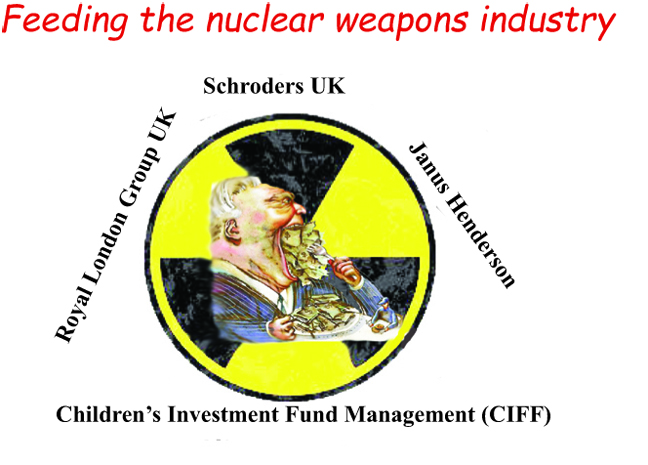
NUCLEAR weapons corporations have an “absolutely inappropriate” involvement in shaping government policy on the issue, a damning report shows.
It states that as Britain’s spending on nuclear weapons climbs inexorably, the companies who make and sell them spend millions of pounds funding think tanks that advise the government on the issue.
The report also reveals that nuclear manufacturers met top government officials last year ahead of its announcement of an increase in defence spending.
“Surge: 2023 Global Nuclear Weapons Spending” has been released today by the International Campaign to Abolish Nuclear Weapons (ICAN).
It states that global spending on nuclear weapons has surged by 34 per cent in the last five years and that the increase in British spending has risen by even more —over 43 per cent.
As schools across Britain crumble and the National Health Service teeters on the brink of collapse, the Tory government spent £6.5 billion of taxpayers’ money on nuclear weapons in 2023 alone, up 17.1 per cent on 2022, making Britain the fourth-highest nuclear spender after Russia, China and the United States — which spends more than the rest of the world combined.
The report was welcomed by the Campaign for Nuclear Disarmament, whose general secretary Kate Hudson said: “The billions of pounds being funnelled into these weapons of mass destruction are a gross misallocation of resources that could be used to address pressing issues such as climate change, biodiversity loss, and poverty alleviation.
“This report also makes absolutely clear the influence of arms companies in the shaping of defence and foreign policy, their funding of think tanks, and their meetings with government officials.
“This runs against all democracy and accountability, and must be exposed, investigated and ended.”
Labour has pledged to continue the Tories’ military spending increases if it is elected on July 4.
Ms Hudson said CND “urges voters to elect MPs who prioritise peace, disarmament, and justice.
“It is time for political parties to determine policy based on the interests of the people, not the arms companies,” she said.
“We want a decent peaceful future that does not include reckless expenditure on nuclear weapons but creates a safer, fairer world for all.
Nuclear black hole could deal a knock-out blow to UK Labour’s renewable targets

Labour’s ambitious target for offshore wind could be quietly shelved to make way for the giant funding commitment to pay for Sizewell C nuclear power plant
DAVID TOKE, JUN 17, 2024, https://davidtoke.substack.com/p/nuclear-black-hole-could-deal-a-knock?utm_source=post-email-title&publication_id=1068034&post_id=145716547&utm_campaign=email-post-title&isFreemail=true&r=ln98x&triedRedirect=true&utm_medium=email—
Much of Labour’s manifesto commitments for clean energy, a state-owned ‘Great British Energy’ company to promote new technologies and funds to support buildings-based insulation and low carbon measures, have been widely flagged already. But there’s not much attention being given to two big, interlinked, threats to Labour’s clean energy strategy. One is the looming black financial hole that the incoming Labour Government will trigger as it gives the financial go-ahead for Sizewell C. The second is the problem of organising a much more rapid build-up of renewable energy than the Conservatives have managed to achieve. Both will involve the Treasury having to commit themselves to supporting forward spending, and we know that money is tight!
The central problem is that the cost of Sizewell C could sink the prospects of the renewables target. It is not difficult to see the problem. The costs of building Hinkley C, the sister plant of Sizewell C, have been growing and growing, and the plant has a long way to go before it is finished. The costs have reached an astonishing £33 billion for just 3.2 GW. Few independent analysts can be found who would bet against this cost increasing a lot further.
Unlike Hinkley C, Sizewell C is, to cut a longer story short, mostly going to have to be financed by the taxpayer or energy consumers. These costs will increase the numbers for the Public Sector Borrowing Requirement. The Treasury will have serious indigestion over this.
EDF is responsible for the costs of building Hinkley C. However it has refused to take responsibility for financing more than a small portion of Sizewell C. Moreover, it is proving very difficult to get any private investors to take responsibility for paying the costs of Sizewell C (no surprises there!). Essentially that means the Government are going to have to take responsibility for paying for the large bulk of the projects, and large cost overruns are all but inevitable. A lot of billions worth of red ink is going to have to be written into Treasury estimates if Sizewell C is to be given the financial go-ahead.
Offshore wind, onshore and solar farms will be a lot cheaper for the consumer than nuclear power from Sizewell C. Nevertheless, if the Treasury allows tens of billions to be allocated to underwrite the costs of Sizewell C then this could blow a huge hole in any efforts to get Labour’s renewable energy programme funded. To meet Labour’s manifesto target of quadrupling offshore wind capacity by 2030 then the Government will need to get lots and lots of contracts and offshore wind project contracts and leases issued pretty damn quick. That is as well as contracting lots of onshore wind and solar farms which are likely to be cheaper than offshore wind for the next few years at least.
The offshore wind commitment (for around 45 GW of new capacity by 2030) is going to require some funds to be underwritten by the Treasury. How much depends on what the Treasury chooses as the future price, say in 2030, of power from natural gas-fired power plant. This is because energy consumers will fund the difference between the guaranteed contract prices to be paid for offshore wind power production and the wholesale power price.
Since we do not know the price of gas in 2030 now, since we do not know what the global price of natural gas (in the form of LNG) will be, the Treasury has to make a choice. This choice, of course, is heavily laced with political implications. But at the moment the Treasury has chosen quite a low number for the future cost of natural gas. This makes offshore wind look relatively expensive to fund. I discussed this in a post I did in March, see here: How the Government is gaslighting us about the cost of offshore wind.
Renewable energy is much more popular with the public compared to nuclear power. But big energy corporations, not to mention the GMB union, are going to be piling in to try and make sure that approval of Sizewell C is given priority ahead of Labour’s apparently ambitious renewable energy commitment. That could mean that the bold offshore wind target is going to be quietly thrown in the waste bin.
Judges Named for Assange Appeal

By Joe Lauria / Consortium News June 14, 2024, https://consortiumnews.com/2024/06/14/judges-named-for-assange-appeal/
Consortium News will be back inside the courtroom in London July 9-10 to cover Julian Assange’s appeal against extradition
The judges in Julian Assange’s two-day appeal hearing on July 9-10 are the same who granted Assange a rare victory last month: his right to appeal the Home Office’s extradition order to the United States.
Justices Jeremy Johnson and Victoria Sharp granted Assange the right to appeal on only two of nine requested grounds, but they are significant:
1). his extradition was incompatible with his free speech rights enshrined in the European Convention on Human Rights; and 2.) that he might be prejudiced because of his nationality (not being given 1st Amendment protection as a non-American).
However the denial of his rights in an American courtroom would go beyond the First Amendment to all of his U.S. constitutional rights, according to the 2020 U.S. Supreme Court ruling in USAID v. Alliance for Open Society International Inc., which says that a non-U.S. citizen acting outside the U.S. has no constitutional protections at all.
The United States was unable to provide assurances that the European equivalent of his constitutional rights would be protected, required under British extradition law. That raises hopes for Assange in his appeal.
Assange has been imprisoned in London’s notorious Belmarsh Prison for more than five years on remand pending the outcome of his extradition. He has been charged in the United States for publishing classified documents that revealed prima facie evidence of U.S. state crimes.
CN has received an award and many accolades for our coverage of the Julian Assange case. We will be inside the courtroom and outside the Royal Courts of Justice in London for both days of the hearing, bringing you the latest news, analysis and commentary.
French-Chinese nuclear power plant could put 200m UK fish at risk
By Freddie Sandford | 14 06 2024https://www.anglingtimes.co.uk/news/stories/french-chinese-power-plant-could-put-200m-uk-fish-at-risk/
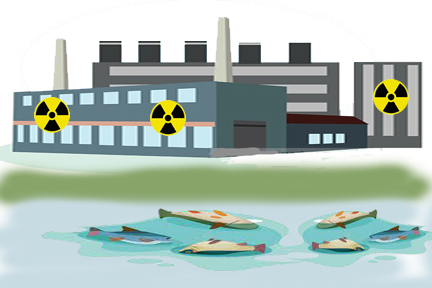
Builders of a new nuclear power plant are applying to remove fish protection measures, putting the lives of nearly 200 million fish at risk.
Earlier this year, concerns grew around the new power plant at Hinkley Point, in Somerset, as it was revealed that an incredible 178 tonnes of fish would be sucked into its pipes every year.
Initially, an acoustic fish deterrent was to be added, but the plant’s builders, NNB Generation Company Limited, co-owned by French and Chinese energy giants EDF and CDN, are applying to remove this safeguarding measure.
Fish Legal questioned the company’s plans, but they were rejected, as NNB claimed it wasn’t subject to UK laws.
“It is extremely concerning that a French and Chinese-owned company believes itself to be above our laws,” says Fish Legal’s Penny Gane.
“The British public have a right to know the impact this nuclear power plant will have. This fight is not over yet.”
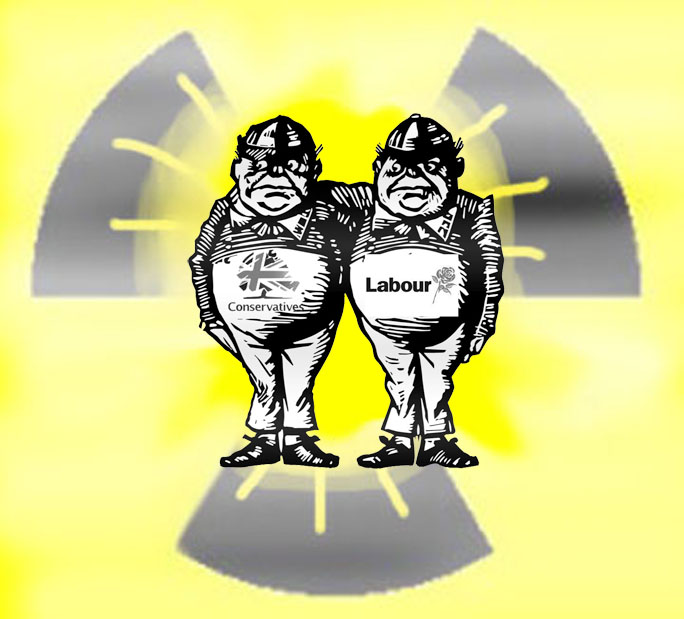
UK Labour and Conservatives commit to nuclear power in manifesto
14th June, By Isaac Cooper @isaaccoopernews, https://www.newsandstar.co.uk/news/24386336.labour-conservatives-commit-nuclear-power-manifesto/
The Labour Party have pledged to ‘ensure the long-term security’ of the nuclear industry as part of their manifesto.
The party set out their plan for government in their manifesto launch on Thursday, June 13 which said that a Labour government would back nuclear power.
The manifesto also said that small modular reactors (SMRs), will play ‘an important role’ in helping the UK achieve ‘energy security’ and ‘clean power’ while securing ‘thousands of good, skilled jobs.’
An SMR in West Cumbria has been mooted for some time and has the support of Cumberland Council leader, Mark Fryer, but the official green light has yet to be light by national government.
The Conservatives have also backed nuclear power and the Tory candidate for Penrith and the Solway, Mark Jenkinson, said he ‘welcomed’ the party’s commitment to nuclear power.
The Green Party have pledged to ‘phase out’ nuclear power which they say is ‘unsafe’ and much more expensive than renewables.
Great British Nuclear Small Reactors competition timeline delayed for General Election, amid doubts on their viability
There have been some doubts cast, with the Environmental Audit Committee claiming that SMRs will not be able to help the UK decarbonise by 2035. Additionally, US think tank Institute for Energy Economics and Financial Analysis (IEEFA) has said that SMRs are “too expensive, too slow, and too risky”.
10 JUN, 2024 BY TOM PASHBY
The six small modular reactor (SMR) developers shortlisted in Great British Nuclear’s (GBN’s) competition now have an extra two weeks to submit documentation due to the General Election.
The competition winner will receive government backing to deploy a fleet of SMRs in the UK. At the time of the competition announcement, GBN chief executive Gwyn Parry-Jones
said parties would be “aiming for a final contract agreement in the
summer”. Even if not successful in GBN’s competition, many of the
shortlisted firms have signalled intent to deliver SMRs in the UK.
Rolls-Royce SMR recently announced a prototype module testing facility at
the University of Sheffield and Holtec has shortlisted four UK sites for
its SMR module factory. Westinghouse has plans to deploy the first
privately funded SMRs in North Teesside by the 2030s.
There have been some doubts cast, with the Environmental Audit Committee claiming that SMRs will not be able to help the UK decarbonise by 2035. Additionally, US think tank
Institute for Energy Economics and Financial Analysis (IEEFA) has said that
SMRs are “too expensive, too slow, and too risky”.
New Civil Engineer 10th June 2024
1 This Month



26 September – International Day for the Total Elimination of Nuclear Weapons


PLEASE OPPOSE HR 8255 AND S.3639 – bills would accelerate satellite deployment, with no environmental review or safeguards – https://ncstd5li.quorum.us/campaign/169331/
To see nuclear-related stories in greater depth and intensity – go to https://nuclearinformation.wordpress.com
-
Archives
- September 2026 (269)
- August 2026 (330)
- July 2026 (355)
- June 2026 (287)
- May 2026 (306)
- April 2026 (356)
- March 2026 (251)
- February 2026 (267)
- January 2026 (308)
- December 2025 (358)
- November 2025 (359)
- October 2025 (375)
-
Categories
- 1
- 1 NUCLEAR ISSUES
- business and costs
- climate change
- culture and arts
- ENERGY
- environment
- health
- history
- indigenous issues
- Legal
- marketing of nuclear
- media
- opposition to nuclear
- PERSONAL STORIES
- politics
- politics international
- Religion and ethics
- safety
- secrets,lies and civil liberties
- spinbuster
- technology
- Uranium
- wastes
- weapons and war
- Women
- 2 WORLD
- ACTION
- AFRICA
- Atrocities
- AUSTRALIA
- Christina's notes
- Christina's themes
- culture and arts
- Events
- Fuk 2022
- Fuk 2023
- Fukushima 2017
- Fukushima 2018
- fukushima 2019
- Fukushima 2020
- Fukushima 2021
- general
- global warming
- Humour (God we need it)
- Nuclear
- RARE EARTHS
- Reference
- resources – print
- Resources -audiovicual
- Weekly Newsletter
- World
- World Nuclear
- YouTube
-
RSS
Entries RSS
Comments RSS

