UK nuclear plant shut down when smoke seen
Heysham nuclear reactor shut down ‘as precaution’, BBC News Lancashire, 3 May 13, EDF said the plant was shut down as a precaution A nuclear reactor has been shut down after smoke was seen coming from a plant in Lancashire.
The reactor at Heysham One nuclear power station was shut down at 18:00 BST on Thursday due to smouldering lagging on a turbine.
EDF, which operates the reactor, said it was shut down as a precaution….. http://www.bbc.co.uk/news/uk-england-lancashire-22394359
Legal action against UK plan for nuclear power plant in Bristol channel
 An Taisce launches legal challenge to UK nuclear station plan, Irish Times Eoin Burke-Kennedy May 1, 2013, Heritage group commences judicial review proceedings in London over plan to build plant in Bristol channel An Taisce has launched a legal challenge to the UK government’s decision to grant planning permission for a nuclear power plant in the Bristol channel.
The heritage group said it had commenced judicial review proceedings in London to challenge the legality of UK secretary of state Ed Davey’s decision’s to grant permission to build and operate a nuclear station at Hinkley Point, 150 miles from the Irish coast.
In legal papers issued to the court yesterday, An Taisce challenges the legal compliance of the decision by the government with the EU’s Environmental Impact Assessment Directive and the UK’s own regulations on transboundary impacts and consultation.
“Despite the nuclear power plant being nearer to the coast of Ireland than it is to Leeds, the UK decided not to consult with the Irish public about the decision before it granted consent in March,” An Taisce said in a statement.
“The first time many Irish people learned about the nuclear power plant proposal was when the decision was announced. Their views were not therefore taken into consideration as part of the UK government’s decision and assessment process.”
The UK government gave the green light to build the proposed Hinkley Point C plant in March to the French energy company EDF,…… “The UK government decided to grant permission to build and operate a nuclear power plant at Hinkley Point without consulting the Irish public or taking into account significant potential risks of the power plant across national boundaries,” Rosa Curlingfrom the legal firm Leigh Day, who is representing An Taisce, said…… http://www.irishtimes.com/news/environment/an-taisce-launches-legal-challenge-to-uk-nuclear-station-plan-1.1379545
UK government backs down, will not test-fire depleted uranium weapons

“Although this is a big step forward, the campaign must continue until there is a clear guarantee that there will be no more test firing of DU shells in Scotland at any point in the future.”
This is a major victory for our campaign and one that reflects the increasing global opposition to depleted uranium.
CADU campaigners plan to hold a public meeting in Dumfries at the end of May to discuss further plans with local residents. More details will be released on their website
Ministry of Defence back down over test firing of depleted uranium munitions in Scotland, Occupy News Network, 1 May 13
– Parliamentarians and campaigners claim this as a ‘major victory’

 Last week Minister for Defence Equipment, Support and Technology, Philip Dunne, told Katy Clark, MP for North Ayrshire and Arran, that the MoD will not fire depleted uranium (DU) as part of the current Life Extension Programme. This is the first time the MoD have bowed to public and political pressure and not fired depleted uranium as part of the life extension programme (LEP) of CHARM3. Continue reading
Fire on UK nuclear submarine
HMS Torbay nuclear submarine evacuated, BBC News Devon 25 April 13 A nuclear submarine in Devonport dockyard had to be evacuated after a fire broke out while maintenance work was being carried out.About 55 people had to leave when the fire broke out as welding was being done on the outside of the Trafalgar class submarine, said the Royal Navy.The “small fire” among protective blankets was put out within five minutes by a fire crew, it said.The Royal Navy said no-one was injured and an investigation would take place. It added the submarine had not been damaged…. http://www.bbc.co.uk/news/uk-england-devon-22302965
UK government looks like reneging on its promise of no subsidies for new nuclear
Will the public subsidise new nuclear? http://www.carbonbrief.org/blog/2013/04/will-the-public-subsidise-new-nuclear A parliamentary committee has accused the government of failing to keep its promise not to subsidise new nuclear. But has the government been planning to renege on its promise all along?
Subsidising nuclear
The Environmental Audit Committee is calling on the government to be more open about the money it gives to the nuclear industry. A new report from the committee released today suggests the UK nuclear industry receives a £2.3 billion subsidy each year. Continue reading
Leaking nuclear power station in Kent, UK
Nuclear power station has been leaking radioactive waste ‘for months’, says Environment Agency. Dungeness B in Kent has been leaking more than agreed levels of Tritium Mail Online, By STEVE NOLAN, 18 April 2013 A nuclear power station in Kent has been leaking radioactive waste, which can increase the risk of developing cancer, for months according to the Environment Agency. Routine tests on boreholes drilled close to the Dungeness B plant found traces of tritium measuring more than seven times the agreed level……. http://www.dailymail.co.uk/news/article-2311217/Nuclear-power-station-leaking-radioactive-waste-months-says-Environment-Agency.html#ixzz2QyKFyAZl
47 arrested in UK protest against Trident nuclear missiles
Scrap Trident’: British police arrest 47 protesters at Faslane nuclear base RT April 15, 2013 Forty-seven people were arrested in a protest at the UK’s Faslane Naval Base in Scotland. ‘Scrap Trident’ anti-nuclear activists blocked the base’s entrances, lying on the ground in a human chain tied together with metal and plastic tubes….. The protesters called for the Trident nuclear weapons program to be scrapped, and for its £100 billion budget money spent instead on social programs. “I am taking action to stop the breach of the peace committed by the UK by owning and refusing to disarm the weapons of mass destruction,” Dominic Lindley, a 20-year-old development officer said as quoted by scraptrident.org.
“These weapons are both inhumane, illegal and their use can never be justified. In the next few years the UK has an opportunity to join the vast majority of countries in the world by disarming our pointless nuclear weapons and spend the £100 billion wasted on them on vital services for our communities like the NHS, Education and the Welfare State,” Lindley added….. http://rt.com/news/anti-trident-protest-faslane-879/
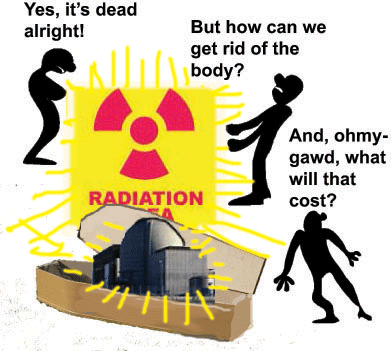
UK greatly underestimated nuclear decommissioning costs
 Public Accounts Committee – Thirty-Seventh Report HM Treasury: Whole of Government Accounts 2010-11 HM Treasury: Whole of Government Accounts 2010-11 – Public Accounts Committee Contents
http://www.publications.parliament.uk/pa/cm201213/cmselect/cmpubacc/867/86706.htm
11 April 2013 “…… The C&AG’s report on the 2010-11 WGA shows the Nuclear Decommissioning Authority’s estimated cost of civil nuclear decommissioning increased by around £16 billion to £53 billion between 2007 and 2011. We asked the Treasury how the WGA would be used to influence any decision made in relation to future investments in the nuclear sector. The Treasury acknowledged that not considering these costs when the power stations were built had been a mistake, and considered that the critical issue was to factor in these costs in future, so that the taxpayer would not be burdened with unexpected additional costs of £60 billion.[ http://uk.groups.yahoo.com/group/Claverton/message/10673
How the BBC’s John Simpson obscures the truth on depleted uranium
 Depleted Uranium: The BBC’s John Simpson does a hatchet job on Fallujah’s genetically damaged children by William Bowles http://dandelionsalad.wordpress.com/2013/04/04/depleted-uranium-the-bbcs-john-simpson-does-a-hatchet-job-on-fallujahs-genetically-damaged-children-by-william-bowles/
Under the title ‘Fallujah’s children’s ‘genetic damage’ that old war horse ‘literally’ of the BBC’s foreign propaganda service, John Simpson, manages not to mention the phrase ‘depleted uranium’ when allegedly reporting on the alarming rise in birth defects that include cancer, leukaemia and a horrific rise in child mortality since the US demolished the city of Fallujah in 2004. And it’s not until right at the end of the piece that the US attack on Fallujah is even mentioned, let alone depleted uranium! Continue reading
Cut back UK Trident nuclear programme – says defence expert
UK should consider scaling back nuclear deterrent, says think tank – VIDEO http://www.telegraph.co.uk/news/uknews/defence/9970194/UK-should-consider-scaling-back-nuclear-deterrent-says-think-tank.html
The cost and commitment of replacing Trident with a like-for-like system means the Government should consider what the “most necessary element” of our deterrent is, says Hugh Chalmers from the Royal United Services Institute. The Government ought to consider the range of possible options for the UK’s nuclear deterrent given the country’s financial situation and the committment that renewing the Trident weapons system represents, says a nuclear analyst at the Royal United Services Institute.
“I would recommed that you have to look at all the options available and think very carefully about what is the most necessary element of our deterrent, and which elements of the UK deterrent are no longer required, so we can make cuts where we can, and how we can,” says Hugh Chalmers.
Mr Chalmers also played down the threat posed by North Korea, which has conducted three nuclear tests since 2006 as well as launching a long range rocket in December 2012.
“North Korea doesn’t currently present a direct threat to the UK.
“There’s a suspicion that they might be able to reach the US but they certainly cannot reach the UK, and their ability to mount a nuclear weapon on these missiles is also hotly debated,” he said.
UK soldier dying, after exposure to depleted uranium
Soldier dying after being exposed to uranium in Iraq must raise £110,000 for treatment because the NHS can’t help her Mail Online 4 Apr 13,
- Katrina Brown, 30, was exposed to radioactive material in Basra
- Diagnosed with rare systemic sclerosis which is slowly attacking her organs
- She believes the illness is linked to exposure to depleted uranium
- Says her only hope is having stem-cell transplant to regenerate her organs A soldier who developed a deadly illness after being exposed to uranium in Iraq is facing a race against time to raise the money she needs for potentially life-saving treatment.Katrina Brown, 30, was exposed to radioactive material while serving as a medic at a 600-bed military clinic in Basra in 2003.She was diagnosed with rare systemic sclerosis in 2008 which is slowly attacking her major organs – and will eventually lead to her death if left untreated.
Mrs Brown, who joined the Army at the age of 17, believes the illness is linked to exposure to depleted uranium.
She was handed a card before flying home from her 2003 tour warning her she had been in contact with radioactive materials. Continue reading
British uranium group insists ! Japan must restart nuclear reactors
 Uranium firm warns Japan it must return to nuclear power
The Times, Tim Webb
March 29 2013
A uranium enrichment group, part owned by the British Government, has warned that Japan’s decision to shut nuclear power stations will reduce demand for its services. (subscribers only) http://www.thetimes.co.uk/tto/business/industries/utilities/article3725842.ece?CMP=OTH-gnws-standard-2013_03_28couldnt resist adding these links 🙂 for further reading!
UK and Canada try to revive UK nuclear! Privatising nuclear fuel production!
….Bidders are lining up for for Urenco’s privatisation, which could put £4bn in the UK chancellor’s coffers….
…The newspaper said that Areva was holding talks with private equity firms including Apax and CVC, regarding a possible joint offer for Urenco, and that Morgan Stanley had been appointed to handle the sale, with a float also a possibility….
https://nuclear-news.net/2013/03/18/43219/
Russian protests against Areva and Urenco’s nuclear waste dumping
Areva and its counterpart Urenco, headquartered in Britain, have sent close to 140,000 tonnes of nuclear waste to Russia in the past 15 years.

DEPLETED URANIUM IN RUSSIA Protests as French uranium arrives in Russia Javno 2 Feb 2010 A cargo loaded with depleted uranium from France docked in Saint Petersburg, as Russian activists protested at the nuclear waste exports.
UK to sell out of nuclear power company URENCO
Nuclear sale set to net billions for UK The Government is holding a “beauty parade” for bankers to advise it over a potential sale of the UK’s multi billion-pound stake in nuclear power giant Urenco. Telegraph UK, By Emma Rowley, Rowena Mason, and Helia Ebrahimi 15 Jul 2012
The move marks a step towards a deal that could net British taxpayers
as much as £3bn, according to estimates that value the entire company
at £8bn-£10bn.
https://nuclear-news.net/2012/07/16/uk-to-sell-out-of-nuclear-power-company-urenco/
UK – Areva, Toshiba eye nuclear fuel producer Urenco – sources
“…A financial markets source close to the discussions said that private equity houses KKR (KKR.N) and CVC were also interested in striking a deal for Urenco…”
By Karolin Schaps and Christoph Steitz
LONDON/BERLIN | Mon Jan 21, 2013 6:37pm GMT
(Reuters) – France‘s Areva (AREVA.PA) and Japan’s Toshiba Corp (6502.T) are considering bids for nuclear fuel producer Urenco, but British, German and Dutch authorities disagree over what to do with the ultra-secret firm, industry sources said.
Britain is keen to sell its 33 percent stake, and German utilities RWE (RWEG.DE) and E.ON (EONGn.DE) are talking to potential buyers over their combined 33 percent, but the Dutch government is not considering a sale.
https://nuclear-news.net/2013/01/22/uk-areva-toshiba-eye-nuclear-fuel-producer-urenco-sources/
Investors trying to boost price shares? soon to sell maybe?? 🙂 – Arclight2011
Scotland cops the risks of dismantling Britain’s old radioactive submarines
 Fears over Rosyth nuclear submarine waste http://www.scotsman.com/news/politics/top-stories/fears-over-rosyth-nuclear-submarine-waste-1-2869329 By TRISTAN STEWART-ROBERTSON 31 March 2013 SCOTLAND has been chosen for the pilot project to break up some of Britain’s old nuclear submarines, prompting fears it could become a dumping ground for radioactive waste. Continue reading
UK does not need nuclear power for climate change obligations
 Non-nuclear future
http://www.guardian.co.uk/environment/2013/mar/28/non-nuclear-future
The Guardian, Professor David Elliott Open University 28 March 2013
I was dismayed by the statement by Professor John Beddington, the
government’s chief scientific adviser, that a nuclear energy-free
future for the UK is not something the coalition is thinking seriously
about (Report, 26 March). You quote him as adding: “We really can’t
see a future for the UK energy sector, if we are to meet our climate
change obligations and have resilience in the power sector, without a
significant component of nuclear.”
The Department of Energy and
Climate Change has provided an extensive online energy modelling
system and invited interested people and organisations to use it. The
British Pugwash Group spent a year doing just that and recently
published the results asa set of 2050 energy Pathways. It included one
I helped with, which showed clearly that it was possible to meet the
UK’s energy needs at reasonable cost with no nuclear power, while
reducing emissions below current 2050 targets. Evidently we were wasting our time.
No deal in site between EDF and UK government, on nuclear subsidy
EDF, U.K. Unlikely to Meet End-March Deadline on Nuclear Subsidy -Sources, Fox Business News, By Geraldine Amiel and Selina Williams March 28, 2013 Dow Jones Newswires French electricity company Electricite de France SA (EDF.FR) and the British government are unlikely to meet a deadline at the end of March to agree on subsidies that would allow the construction of new nuclear power plants in the U.K., people familiar with the matter said.
The people said in recent days that although discussions are still ongoing, they aren’t intensive and neither side appeared to be willing to make any compromises.
“There’s no deal in sight, discussions are ongoing and if EDF doesn’t get the price that it believes is the right price then they won’t do it, they have no choice,” Continue reading
1 This Month





PLEASE OPPOSE HR 8255 AND S.3639 – bills would accelerate satellite deployment, with no environmental review or safeguards – https://ncstd5li.quorum.us/campaign/169331/
To see nuclear-related stories in greater depth and intensity – go to https://nuclearinformation.wordpress.com
-
Archives
- October 2026 (67)
- September 2026 (339)
- August 2026 (330)
- July 2026 (355)
- June 2026 (287)
- May 2026 (306)
- April 2026 (356)
- March 2026 (251)
- February 2026 (267)
- January 2026 (308)
- December 2025 (358)
- November 2025 (359)
-
Categories
- 1
- 1 NUCLEAR ISSUES
- business and costs
- climate change
- culture and arts
- ENERGY
- environment
- health
- history
- indigenous issues
- Legal
- marketing of nuclear
- media
- opposition to nuclear
- PERSONAL STORIES
- politics
- politics international
- Religion and ethics
- safety
- secrets,lies and civil liberties
- spinbuster
- technology
- Uranium
- wastes
- weapons and war
- Women
- 2 WORLD
- ACTION
- AFRICA
- Atrocities
- AUSTRALIA
- Christina's notes
- Christina's themes
- culture and arts
- Events
- Fuk 2022
- Fuk 2023
- Fukushima 2017
- Fukushima 2018
- fukushima 2019
- Fukushima 2020
- Fukushima 2021
- general
- global warming
- Humour (God we need it)
- Nuclear
- RARE EARTHS
- Reference
- resources – print
- Resources -audiovicual
- Weekly Newsletter
- World
- World Nuclear
- YouTube
-
RSS
Entries RSS
Comments RSS

