Strong reasons why UK should abandon Trident nuclear weapons system
 Five interesting stories about Trident http://www.leftfootforward.org/2014/04/five-interesting-stories-about-trident/
1. Strikes at Faslane
In March, hundreds of workers at the Faslane naval base staged theirfirst walkout in 42 years, following negotiations over pay. Faslane is home to the UK’s Vanguard-class nuclear-powered and nuclear-armed submarines. The Scotsman reported that employees responsible for fitting out boats and loading weapons were involved in the action. The Unite union said that further stoppages were planned, as well as a work to rule and ban on overtime.
2. Top Tory says No James Arbuthnot, veteran chairman of the Defence Select Committee, has publicly questioned the logic of replacing Trident. In a recent interview with the Guardian he stated, “Nuclear deterrence does not provide the certainty that it seemed to in the past. It’s not an insurance policy, it is a potential booby trap.”
Despite voting for replacement in 2007, Arbuthnot referred to Trident at the time as ‘of doubtful usefulness’.
3. Resignations at AWE Burghfield
In January, junior defence minister Anna Soubry confirmed that 44 Ministry of Defence Police officers based at the Atomic Weapons Establishment in Burghfield were subject to a major misconduct investigation. AWE Burghfield hosts facilities in which the UK’s nuclear weapons are built and maintained. Seven officers resigned during the course of the investigation, with some media reporting that a number had missed patrols due to being ‘asleep’.
4. UK’s youth disapprove
A recent ComRes survey suggests that younger people are opposed to like-for-like Trident replacement. Of the respondents, only 19 per cent of those aged 18-35 supported renewing Trident at its current size and capacity (this compared to 33 per cent of over 35s). The poll was commissioned by WMD Awareness, who launched this campaign last week to get the UK’s youth debating nuclear weapons.
5. Radioactive leaks in Caithness
In March, Scotland’s first minister Alex Salmond demanded an apology for failing to be informed for over two years about problems with a submarine test reactor. This was in response to defence secretary Philip Hammond’s confirmation that “low levels of radioactivity were detected in a prototype core” at the Vulcan Naval Reactor Test Establishment at Dounreay, Caithness, in 2012. These kinds of spats suggest nuclear defence will continue to be an issue in the Scottish independence campaign.
The above stories touch on some major problems with Trident: it’s unpopular, politically contentious, and the system relies on shaky security arrangements. Anyone for abandoning it?
David Cameron acknowledges damage to nuclear test veterans and their offspring
- David Cameron gives nuclear test veterans glimmer of hope after our 12-year campaign for justice
http://www.mirror.co.uk/news/uk-news/david-cameron-gives-nuclear-test-3406479
- Apr 12, 2014 Prime Minister has promised to investigate setting up a £25 million health fund for descendants of those exposed to genetic suffering genetic defects
David Cameron has at last given hope to families of nuclear test veterans after a 12-year Sunday Mirror campaign for justice.
The Prime Minister has promised to investigate setting up a £25million health fund for descendants suffering genetic defects passed down by servicemen exposed to 1950s blasts.
He will also look at offering personal thanks to the veterans and recognising their sacrifice with a medal.
Campaigners say the breakthrough at a half-hour meeting is the closest they have been to formal recognition of the suffering caused by the South Pacific explosions.
It came days after the Sunday Mirror called for the PM to recognise the plight ofchildren like 15-month-old Ella Denson, who was born with a deformity linked to her great-grandad Eric Denson’s exposure to radiation on Christmas Island in 1958.
The meeting between Mr Cameron and Tory MP John Baron last Wednesday was the first time the veterans have had their case put forward to any prime minister.
Mr Baron, patron of the British Nuclear Test Veterans’ Association, told the PM descendants had 10 times the normal rate of birth defects, their wives had elevated rates of miscarriage, and no other veterans’ group had suffered harm which spread down the generations.
A New Zealand study found veterans’ genes had three times the damage of Chernobyl survivors. The tests have never been repeated here.
Scientists say effects could last for 20 generations.
As Mr Cameron listened, Ella, of Morden, South London, was recovering from her latest hospital admission to deal with her severe defect. She was born with two tubes to a kidney instead of one and needs daily antibiotics to stop infection before having surgery at three.
At the weekend she was rushed to hospital for the third time in her short life. Her brother Jamie and mum Kimberley have teeth deformities.
Ella’s great-gran Shirley Denson, 79, had four daughters with bomb veteran husband Eric and has seen more than a third of his descendants suffer.
She said: “I pray the Prime Minister does the right thing, for the sake of my Ella and all the thousands like her.”
Eric was one of 22,000 men ordered to witness the detonation of nuclear bombs between 1952 and 1967.
He later suffered crippling headaches and killed himself in 1976. Fewer than 3,000 veterans survive.
France, the US, Australia, New Zealand, Russia, China and even the Isle of Man recognise and compensate test veterans. The MoD has always insisted no harm befell the men.
Mr Baron said: “The meeting with Mr Cameron was constructive. He is going to get back to me.”
PRISM an ugly magic trick from the nuclear lobby
http://www.no2nuclearpower.org.uk/nuclearnews/NuClearNewsNo61.pdf
 The U.S. corporation GE Hitachi (GEH) is promoting a reactor design called the PRISM (Power Reactor Innovative Small Modular) that its chief consulting engineer and fast-breeder guru, Eric Loewen, says is a safe and secure way to power the world using yesterday’s nuclear waste – he means plutonium which hasn’t officially been classified as waste in the UK. The Nuclear Decommissioning Authority has declared PRISM to be a “credible option” for managing the UK’s plutonium stockpile.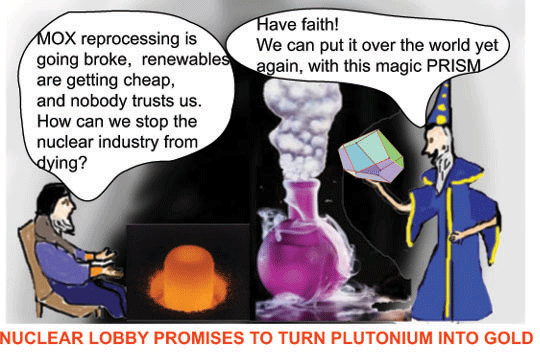
Failure of Waste Isolation Pilot Plant (WIPP) has global implications
NuClear News No.61 April 2014 WIPP failure has global implicationsWIPP has played a crucial part in the history of nuclear waste proposals in the UK. In 1989, in the run-up to a referendum in Caithness in November of that year on whether or not to allow Nirex to search for a deep disposal site in the County, the Head of Information Services at Dounreay used WIPP as an example of a successful waste disposal site in an article he wrote for the John ‘O Groat Journal. In response a letter from the US Radioactive Waste Campaign described the article as “an outright lie”. McRoberts had claimed that WIPP was already receiving shipments and that the repository was dry. In fact the repository remained unopened at the time because in 1987 salt-laden water was fund to be seeping inside. One State Senator told the New Mexico press that: “Given that long-lived nuclear wastes are dangerous for thousands of generations, emplacing them deep underground is a possible ‘solution,’ but it certainly isn’t ‘guaranteed,’ ” he said. “Neither WIPP, nor the proposed Yucca Mountain site in Nevada, are ‘ideal’ and meet publicly accepted standards. Both sites were picked for political, not technical, reasons, so it is not surprising that they are inadequate.”
Shock horror! the youth of Britain are anti nuclear!
Younger people ‘more anti-nuclear’ Courier UK By PRESS ASSOCIATION, 8 April 2014 “…….Voters aged 18-35 in the UK are more likely to oppose the like-for-like renewal of Trident – Britain’s nuclear weapons system – than their older peers, the survey carried out by ComRes on behalf of WMD Awareness found.
The findings come just two years before the Government is due to decide whether to renew the fleet of submarines that will carry the UK’s nuclear weapons.
It is the first time this decision will be made since the 1980s, when Trident replaced the previous Polaris system.
The research, based on responses from 4,207 people across Britain, found younger voters are not engaged in this issue, with only one in fifteen thinking the UK Government should prioritise spending on defence over the next 10 years.
It found that 19% of people aged 18-35 believe the UK nuclear weapon system should be renewed to maintain its current size and capacity, compared to 33% of people aged 36 and older.
51% agree that the UK nuclear weapon system should be disbanded or reduced in size and capacity, while 54% think nuclear weapons for defence purposes are too expensive for governments to maintain.
The research found 47% of people aged 18-35 disagree that nuclear weapons protect the countries which possess them from modern day threats such as terrorism.
A third (34%) believe renewing Trident is going to cost up to £5 billion, when it is actually estimated to cost up to £100 billion, according to WMD Awareness.
Young Ambassadors for WMD Awareness, who carried out the research, have responded to the findings by launching Talking Trident, a national debate to raise awareness of the issues surrounding defence and Trident renewal ahead of the Main Gate decision in 2016.
Hannah Cornford, ambassador lead at WMD Awareness, said: “Renewing Trident is the largest and most expensive British investment project.
“Yet, while support for Trident was widespread in the 1980s, our research shows that, for those born after the Cold War, spending on defence comes last on their list of government priorities.”
Madeline Held, Chair of Nuclear Education Trust, said: “The Talking Trident debate is a welcome development in stimulating a much needed discussion around nuclear weapons in the UK.
“The Nuclear Education Trust believes there should be a much deeper and wider public and parliamentary debate about whether to retain and modernise the UK’s nuclear weapons, especially given their expense at a time of austerity; the risk of accidents, and the fact that the majority of the UK’s European neighbours do not possess nuclear weapons to guarantee their security.”…… http://www.thecourier.co.uk/news/politics/younger-people-more-anti-nuclear-1.307616
UK’s nuclear subsidy is bad value for Britain, and may kill renewable energy
 ‘Bad value’ UK nuclear subsidy deal ‘will kill renewables’ http://www.independentaustralia.net/environment/environment-display/bad-value-uk-nuclear-subsidy-deal-will-kill-renewables,6361 Climate News Network 8 April 2014, The UK’s anti-competitive plan to subsidise nuclear power may be the final straw that breaks the renewable industry’s back, say critics. Paul Brown from the Climate News Network reports.
THE UNITED KINGDOM’S PLANS to build heavily subsidised nuclear power stations have come under withering attack from a coalition of politicians, academics, energy industry experts and environmental groups.
Evidence has poured into the European Commission, which is investigating whether the deal with the giant French nuclear company EDF breaks EU competition rules. The evidence from many objectors, whose submissions had to be made by yesterday (Monday, 7 April), claims that if the contract goes through it will wreck Europe’s chance of building up renewable energies to avert the worst impacts of climate change.
They say renewables will have to compete in an unfair market where one generator ‒ nuclear ‒ is guaranteed to be able to sell all its electricity at a stable price and with a built-in profit until 2058.
The UK Government has agreed a minimum price of £92.50 (AUD $137) a megawatt hour from a new nuclear power station at Hinkley Point in the west of England from 2023 — roughly double the existing price of electricity in Britain. The price will rise with inflation and runs for 35 years — a deal unprecedented in the energy sector, and not available to renewable energies like wind and solar. The guarantee will continue for all future nuclear stations too. Continue reading
Britain getting radioactive dust from Sahara’s old French bombing?
 Algerian desert dust infected with French bomb radioactivity Dear Kitty , some blog By David Lowry in Britain:
Is Saharan dust radioactive? 4th April 2014
As Britain is blanketed in a layer of desert sand, DAVID LOWRY asks whether it could be contaminated by fallout from French nuclear tests in Algeria more than 50 years ago
South-easterly winds have coated Britain in a toxic Saharan dust cloud.
Combined with domestic pollution, the sand has caused air quality to plummet and engulfed many parts of the country in smog-like conditions.
But one unreported aspect of the Saharan dust is that it could be radioactive.
French nuclear testing in Algeria, conducted during the height of the independence struggle, spread radioactive fallout across southern Europe in the early 1960s – and the radioactivity that settled on the desert could have been resuspended in this natural fallout event over Britain.
It’s recently been revealed that atmospheric spread of the radioactive fallout was much larger than the French army admitted at the time.
New reports by the France 24 TV station suggest that the fallout from the tests at Reggane in central Algeria stretched across all of west Africa, across the Mediterranean and up to southern Europe.
The information came to light following appeals from military veterans who say their current ill health is linked to exposure to dangerous levels of radiation.
France‘s first nuclear device “Gerboise Bleue” (Blue Jerboa) was more than three times as powerful as the bomb dropped on Nagasaki in 1945.
Thirteen days after it was detonated, in February 1960, radioactive particles ranged from the Central African Republic to Sicily and southern Spain.
At the time the French military authorities said the fallout from the explosion was limited to the desert and that radiation levels were “generally low.”
But associations representing military veterans of France’s nuclear tests in the 1960s and 1970s are demanding that the government admits it knew that the fallout from Saharan tests was dangerous.
“In the 1960s the norms governing acceptable levels of radiation were much less strict than they are now,” said Bruno Barillot, an expert in nuclear tests who is representing veterans’ groups.
“And the medical evidence we have now shows clearly that exposure to this radiation can set off serious illnesses more than three decades later,” he told Le Parisien.
Barillot added that the declassified documents showed that the army at the time was aware that even the 1960s safety levels were largely surpassed and that significant quantities of airborne radioactive particles, particularly iodine 131 and caesium 137, could have been inhaled by large numbers of people in north Africa.
He also complained that the government had been extremely selective in terms of what documents to release………..
For more of David Lowry’s writing visit drdavidlowry.blogspot.co.uk.
Britain now facing a horror cost in burying its dead nuclear reactors
Nuclear decommissioning A glowing review Britain is paying dearly for neglecting its nuclear waste, The Economist, Apr 5th 2014 SWILLING around murky ponds in the oldest part of Sellafield, a nuclear research and reprocessing centre in Cumbria, is a soupy, radioactive sludge. For years boffins working on Britain’s first military and civil nuclear programmes abandoned spent fuel and other nastiness into the pools and tanks, which now grow decrepit. Though perhaps not the “slow-motion Chernobyl” which some environmental campaigners make out, the site is subject to one of the most complex nuclear clean-ups in the world.

Sellafield is the trickiest of several challenges facing the Nuclear Decommissioning Authority (NDA), a government body that manages the contractors who swab out Britain’s defunct facilities. Their projects swallow up about two-thirds of the budget of the Department of Energy and Climate Change; Sellafield alone costs £1.7 billion ($2.8 billion) a year, almost as much as the roughly £2 billion spent subsidising renewable energy in 2013. On March 31st NDA awarded a £7 billion contract to decommission 12 more of Britain’s oldest reactor sites over 14 years to a consortium including Babcock, a British engineering firm, and Fluor, an American one.These big sums reflect problems peculiar to Britain. It ploughed into nuclear bomb-making in the 1940s, and nuclear power in the 1950s, with little plan for how contaminated structures would be dealt with. …….
Britain’s secret deals with USA on nuclear weaponry
 Secret talks on future of Britain’s nuclear arsenal, Guardian UK, Richard Norton Taylor and Ewen Macaskill, 3 April 14,
• Nature, cost, and timing, of new warheads will also depend on US.
 While the Nato allies are collectively preoccupied by Vladimir Putin’s intentions in eastern Europe, Britain and the US are secretly renegotiating a pact which is a bedrock of their very special bilateral relationship.
Their Mutual Defence Agreement (MDA), first signed in 1958, is due for renewal this year. Britain relies on it to secure, maintain, and upgrade, its nuclear warheads.
“The UK regards safety, security and reliability as central to the maintenance of its nuclear warheads”, the Foreign Office stated in an “explanatory memorandum” on an amendment to the MDA ten years ago. It added: “The programme benefits from long-standing collaboration with US scientists, including the sharing of data and test results and the use of US test facilities”.
The extent to which Britain’s nuclear arsenal is dependent on American help, through the MDA, is clearly set out in The Bang Behind The Buck, a paper just published by the Royal United Services Institute.
It warns that the future shape of the US nuclear arsenal is uncertain and it is unlikely Britain will be able to decide the future of its own arsenal until the US has agreed on the future of its own arsenal, whatever condition the UK’s warheads are in………
The government should not get away with renewing in secret an agreeement that has serious implications for the non-proliferation treaty (NPT), the nature of Britain’s “independent deterrent”, and its relationship with the US.
As one commentator has remarked: “On past performance, most MPs will need some considerable external encouragement before accepting that the renewal of the MDA is a subject that ought to be debated openly and democratically, both within and without Westminster.
“At the moment, it rather looks as if the Conservative government of prime minister Cameron is intent on following in the footsteps of the Labour government of Tony Blair by ensuring that the US-UK Mutual Defence Agreement is in the bag for a further ten years before the parliamentary summer recess, and quite possibly before the Easter recess.” http://www.theguardian.com/world/defence-and-security-blog/2014/apr/02/nuclear-weapons-warheads-trident
UK awards lucrative nuclear clean-up job to Babcock and Fluor
Babcock wins UK nuclear clean-up deal, Guardian UK, British engineering contractors and US group Fluor given £7bn contract covering sites such as Hinkley, Sizewell and Dungeness Britain has awarded a 14-year, £7bn contract to manage the decommissioning of its nuclear sites to engineering contractors Babcock and US group Fluor. The deal covers some of Britain’s oldest nuclear power sites, including Hinkley, Sizewell and Dungeness, and is one of the largest contracts the country has put out to tender.,,,,,,,,
Aside from EnergySolutions and Bechtel, Babcock beat two other consortiums: Serco, Areva and CH2M Hill; and Amec, Atkins and Rolls-Royce in a two-year-long bidding process.
Cavendish Fluor, the joint venture between Babcock-owned subsidiary Cavendish Nuclear and Fluor, will be formally awarded the contract – pending legal approval – on 1 September , after a ten-day mandatory standstill and a five-month transition period.
“Cavendish Fluor Partnership bring a successful track record and extensive nuclear experience that will bring enormous benefits to the decommissioning and clean-up programme,” NDA chief executive John Clarke said………http://www.theguardian.com/business/2014/mar/31/babcock-uk-nuclear-clean-up-contract
Decommissioning – a bonanza for nuclear firms
Government set to award £7bn nuclear decommissioning contract http://www.ft.com/intl/cms/s/0/7a4ee910-b7fa-11e3-92f9-00144feabdc0.html By Gill Plimmer 31 March 14, A private sector consortium will be told on Monday it has won the £7bn job of decommissioning Britain’s oldest nuclear power plants.
The work is one of the largest and most sensitive public sector contracts to be awarded in the UK so far. The reactors, built in the 1960s originally to produce plutonium to make nuclear weapons, include those at Sizewell, Hinkley and Dungeness. They are now at the end of their lives and the government is preparing to decommission them this year. The overall contract is worth about £7bn over 14 years.
The Nuclear Decommissioning Authority, the government-funded body responsible for Britain’s state-owned nuclear sites, started the competition two years ago, and work is expected to start in September.
Currently the sites are being run by Magnox, a company owned by Salt Lake City-based EnergySolutions. It is bidding for the new work in partnership with Bechtel. The only Magnox station still in use is in Wylfa in Anglesey, though this is due to stop producing electricity in the next two years.
The contract covers Britain’s 10 reactors as well two old nuclear research sites in Oxfordshire and Dorset. The oldest nuclear power plant, Calder Hall in Cumbria, was the world’s first commercial scale nuclear reactor and was opened by the Queen in 1959 before it closed a decade ago.
The incumbent Magnox is competing against consortiums made up of Amec, Atkins and Rolls-Royce; CH2M Hill, Areva and Serco; and Babcock and Fluor. The clean-up contract that the companies hope to take over employs about 3,000 workers on the 12 ageing nuclear sites across the country.
Unions are concerned that awarding the company to an overseas consortium willerode Britain’s nuclear expertise.
“The reality is the way we are breaking up our nuclear industry will go down as another Great British missed opportunity,” Gary Smith, a GMB spokesman said. “Britain was a world leader in nuclear. Successive governments have hived off our nuclear industry piecemeal. There is absolutely no strategy around nuclear which reflects the fact that wider energy policy is a mess.”
Defence Committee foresees non nuclear defence system
 CND welcomes Defence Committee’s vision of a post-nuclear future http://www.cnduk.org/cnd-media/item/1886-cnd-welcomes-defence-committee%E2%80%99s-vision-of-a-post-nuclear-future 27 March 2014
The Campaign for Nuclear Disarmament (CND) has welcomed a report by the House of Commons Defence Committee which highlights the decreasing salience of nuclear weapons in UK defence policy.
The report, Deterrence in the twenty-first century, states:
‘It is possible to foresee an environment in which the core role of nuclear deterrence – to protect a state from attack – is achieved by the deployment of advanced conventional weapons… This will be a matter which our successor Committee may wish to examine further.’
The paper explores issues around the UK’s possession of nuclear weapons in a shifting security landscape: emphasising ‘the greater significance of asymmetric threats compared to the Cold War strategic context’.
CND’s General Secretary, Kate Hudson, said:
‘It’s good to see the Defence Committee taking a dispassionate and evidence-based approach to nuclear weapons policy: the Ministry of Defence should follow suit.’
‘While the report does not challenge government plans to replace Trident, it presents a stark analysis of a changing security landscape in which it sees nuclear weapons as increasingly irrelevant.’
‘Most tellingly, the report emphasises the difficulty in identifying or retaliating against “asymmetric threats”, as well as concerns amongst senior military figures over the impact of Trident spending on cuts to the Armed Forces.’
‘As we approach a parliamentary vote in 2016 on whether or not to spend £100bn on a new generation of nuclear weapons, greater public and parliamentary debate about this crucial issue is needed: and this report is a step in the right direction.’
Britain’s contradictory nuclear policies
the problem is that while the Home Office pursues various ways to minimise the dangers from and impact of failures in nuclear security, the Department for Energy and Climate Change is promoting the indigenous development of a new nuclear programme, with the attendant plutonium-based nuclear fuel cycle.
Britain’s Flawed Nuclear Policy http://www.morningstaronline.co.uk/a-9771-Britains-flawed-nuclear-policy#.UzNRm_2gHDZ Under-informed ministers don’t seem to understand the impact of their twin-track policies of nuclear promotion and nuclear controls, writes DAVID LOWRY
At the biennial Global Nuclear Summit in The Hague this week ministers did not see their own policies as promoting nuclear proliferation.
But proliferators they are, just as ministers in the predecessor Labour government were.
It is part of the problem that underinformed ministers do not always recognise the the impact of their policies. But they urgently need to.
Perhaps they suffer from acute cognitive dissonance when pursuing their twin-track policies of nuclear promotion and nuclear controls. This is a term used by social psychologists when “incongruent relations among cognitions (thought and understanding)… result in excessive mental stress and discomfort.
“Individuals who hold two or more contradictory beliefs frequently experience cognitive dissonance.”
That’s a rather dangerous condition for senior decision-makers dealing with a technology that carries the twin dread threats of major accidents and malevolent misuse by determined terrorists.
In January at Lancaster House in London the Home Office, supported by the Ministry of Defence, Foreign Office and Atomic Weapons Establishment, hosted a major international conference of the Global Initiative to Combat Nuclear Terrorism, which Britain co-chairs.
Home Office Minister James Brokenshaw noted that “the impact of a terrorist attack involving chemical, biological, radiological or nuclear materials would be potentially catastrophic. Our focus is to ensure that the UK remains a hard target for any terrorist.
“National security is the first priority of this government,” he stressed.
Is it really? Brokenshaw said that the likelihood of terrorists obtaining a “functioning radiological or nuclear device” to attack Britain is “low,” though he provided no evidence of this.
And he did warn that “the International Atomic Energy Agency’s incident-tracking database records incidents of radiological and nuclear materials being found outside of regulatory control – and between 1993 and 2012 the trafficking database recorded 419 incidents of unauthorised possession and criminal activity relating to radiological or nuclear material. “The availability of nuclear material could increase as more nations adopt nuclear energy.”
The Global Initiative to Combat Nuclear Terrorism aimed to “strengthen global capacity to prevent, detect and respond to nuclear terrorism by conducting multilateral activities that strengthen the plans, policies, procedures and interoperability of partner nations,” the minister said.
Eighty-five nations are signed up to the Global Initiative, alongside four official observers – the EU, IAEA, Interpol and UNODC.
Britain had now developed a nuclear forensics capability which would allow it to investigate criminal acts involving nuclear materials, Brokenshaw claimed.
And he pointed out that nuclear forensics is just part of an interconnected picture.
Expertise had to be embedded and integrated into existing enforcement systems “to provide a seamless end-to-end capability for managing nuclear security incidents.”
Keeping us safe from nuclear accidents would require co-ordinated efforts across government, from the Foreign Office “leading counter-proliferation work overseas” and the Department for Energy and Climate Change ensuring that “robust security architecture exists at our civil nuclear sites.”
He went on to describe the Home Office’s Cyclamen programme, which aims to detect the illicit import of radioactive material.
It sounds impressive – using a combination of fixed and mobile equipment to screen vehicles, containers, freight and pedestrians for the presence of nuclear materials and operating at points of entry to the country 24 hours a day.
But the problem is that while the Home Office pursues various ways to minimise the dangers from and impact of failures in nuclear security, the Department for Energy and Climate Change is promoting the indigenous development of a new nuclear programme, with the attendant plutonium-based nuclear fuel cycle.
At the same time the Department for Business, Innovation and Skills (BIS) is pursuing the export of nuclear explosive materials in new nuclear fuels.
In so doing they are following the strategy initiated by the Labour government, which in 2009 published a document which claimed to “lay out a credible road map to further disarmament” but also proposed increasing the civilian nuclear trade across the world.
A year ago BIS published a suite of documents supporting the expansion of civil nuclear power in Britain and the nuclear export trade abroad.
The 128-page Nuclear Energy Research and Development Roadmap: Future Pathways document “assesses the needs and opportunities for nuclear energy R&D in the context of new build of nuclear generation capacity to levels required.”
It sets out “R&D pathways” to getting nuclear contributions to electricity generation up to 75 gigawatts by the middle of the century – “equivalent to approximately seven times the current level of installed nuclear power capacity.”
The perfect pro-proliferation model for would-be proliferators. At the start of the year the Washington DC-based Nuclear Threat Initiative (NTI) published its latest annual report.
The NTI is a non-profit, non-partisan organisation dedicated to strengthening global security by reducing the risk of nuclear weapons being used and by preventing the spread of nuclear, biological and chemical weapons.
NTI published a table in its report that ought to set alarm bells ringing in Whitehall, whatever Brokenshaw’s claims.
It assessed the nuclear materials security provisions of the 25 countries identified as having the technologies and materials necessary to produce nuclear weapons of mass destruction.
It placed Britain bottom. That should worry ministers. But they are fixated on promoting the growth of nuclear – and thus the risk of proliferation.
That way insanity and disaster lies.
UK socialises nuclear risk, privatises nuclear profits
 UK’s nuclear obsession will add costs to bills http://www.snp.org/media-centre/news/2014/mar/uks-nuclear-obsession-will-add-costs-bills Westminster’s damaging obsession with nuclear power will add “considerable costs” to consumer energy bills for decades to come – according to a leading energy firm.
A report by Scottish and Southern Energy (SSE) has said that the UK Government’s deal for the construction of two reactors at the Hinkley Point nuclear power station will see increased energy bills for the next 35 years.
The report also states: “One leading analyst, Peter Atherton, described it as “the most expensive conventional power station in the world” and a ‘clear case of socialising risk and privatising profits’.”
The new SSE report echoes warnings in a December report led by Dr David Toke from the University of Aberdeen – which also pointed to the increased costs to consumer bills from new nuclear power.
Scotland’s Future makes clear that after a Yes vote, the Scottish Government proposes to permanently transfer the responsibility for the Energy Company Obligation and the Warm Homes Discount from consumer bills to the government – reducing energy bills by around £70 per year on an ongoing basis, but also ensuring that vital energy efficiency measures go ahead – unlike under UK Government policy.
The taxpayer subsidy that the new Hinkley Point nuclear power station could receive dwarfs the amount offered to renewables. Hinkley Point could receive an estimated £35bn subsidy – over four times the cost of support to all renewable development across the UK over the last ten years.
The SNP has previously called upon the UK Government to provide appropriate investment and support for the renewables industry – rather than continuing to direct support at nuclear energy.
Commenting, SNP MSP Mike Mackenzie said:
“SSE has confirmed that the UK Government’s investment in nuclear will add costs to energy bills for the next 35 years– people in Scotland will be lumbered with the bill for Westminster’s obsession with nuclear power.
“As SSE points out, energy experts have highlighted the risks and costs associated with nuclear energy – and last year the European Commission has also warned that nuclear power could push up energy prices for consumers.
“Scotland has the potential to be the renewables powerhouse of Europe – a Yes vote will allow Scotland to take action to prioritise our incredible renewable resources, and cut energy bills by around £70 a year on a permanent basis.”
SSE’s report can be found here: http://sse.com/media/204699/SSE-RESPONSE-TO-LABOUR-PARTY-GREEN-PAPER-MARCH-2014.pdf
The paper states: “the deal which the UK government has reached with EdF over the construction of two reactors at Hinkley Point, which will add considerable costs to consumer energy bills for 35 years. One leading analyst, Peter Atherton, described it as “the most expensive conventional power station in the world” and a ‘clear case of socialising risk and privatising profits’.”
The Scottish Government’s plans to reduce energy bills by 5% are set out on Page 516 of Scotland’s Future.
Previous SNP calls for the UK Government to support renewables rather than nuclear can be found here:http://www.snp.org/media-centre/news/2014/jan/uk-government-urged-support-offshore-renewables
On 18 December 2013, the European Commission stated that new nuclear costs will likely push up consumer bills, stating Hinkley C “could hardly be argued to contribute to affordability – at least at current prices, when it will instead and most likely contribute to an increase in retail prices.”
Report: “Is an Independent Scottish Electricity System now a good solution for renewable energy?” Led By David Toke (University of Aberdeen), 4 December 2013
“We previously argued that, relative to remaining with the Union, Scottish Independence could substantially increase the cost to Scottish consumers of achieving its renewable energy targets. However, having reviewed the impact of the [UK] Government’s recent decisions on nuclear power and incentives for renewables, we believe that this is no longer the case.
UK Chancellor’s deceitful war against renewable energy
George Osborne is preparing to kill off Britain’s renewable energy revolution http://www.theguardian.com/business/economics-blog/2014/mar/20/george-osborne-budget-kill-renewable-energy-revolution-tax-break Ashley Seager 21 March 14,
1 This Month





PLEASE OPPOSE HR 8255 AND S.3639 – bills would accelerate satellite deployment, with no environmental review or safeguards – https://ncstd5li.quorum.us/campaign/169331/
To see nuclear-related stories in greater depth and intensity – go to https://nuclearinformation.wordpress.com
-
Archives
- October 2026 (67)
- September 2026 (339)
- August 2026 (330)
- July 2026 (355)
- June 2026 (287)
- May 2026 (306)
- April 2026 (356)
- March 2026 (251)
- February 2026 (267)
- January 2026 (308)
- December 2025 (358)
- November 2025 (359)
-
Categories
- 1
- 1 NUCLEAR ISSUES
- business and costs
- climate change
- culture and arts
- ENERGY
- environment
- health
- history
- indigenous issues
- Legal
- marketing of nuclear
- media
- opposition to nuclear
- PERSONAL STORIES
- politics
- politics international
- Religion and ethics
- safety
- secrets,lies and civil liberties
- spinbuster
- technology
- Uranium
- wastes
- weapons and war
- Women
- 2 WORLD
- ACTION
- AFRICA
- Atrocities
- AUSTRALIA
- Christina's notes
- Christina's themes
- culture and arts
- Events
- Fuk 2022
- Fuk 2023
- Fukushima 2017
- Fukushima 2018
- fukushima 2019
- Fukushima 2020
- Fukushima 2021
- general
- global warming
- Humour (God we need it)
- Nuclear
- RARE EARTHS
- Reference
- resources – print
- Resources -audiovicual
- Weekly Newsletter
- World
- World Nuclear
- YouTube
-
RSS
Entries RSS
Comments RSS

