Green Party a powerful presence in UK’s Shroud District a powerful force for Green
 Stroud District Green Party 8 May 14 Stroud District Green Party is active in the Stroud and Cotswold District Council areas and parliamentary constituencies. Werepresent Stroud on the County Council and five wards on Stroud District Council. A majority of Stroud Town Councillors are Greens and we are represented on several other Town and Parish Councils.
The Green Party is about more than just the environment: we believe that social justice and environmental responsibility are fundamentally linked. Find out more about our policies.
Stroud District is one of the country’s greenest communities and we are an active local party with a solid membership base. If you agree with our core values, please consider joining, donating or otherwise getting involved……..http://www.stroud.greenparty.org.uk/
UK climate denial organisation’s plan to avoid having to be accurate
Nigel Lawson’s climate sceptic thinktank to launch campaigning arm http://www.theguardian.com/environment/2014/may/09/nigel-lawson-climate-sceptic-thinktank Global Warming Policy Forum will escape scrutiny for accuracy of information by becoming a non-charitable company Fiona Harvey, environment correspondent theguardian.com, Saturday 10 May 2014 The climate sceptic organisation founded by former chancellor Nigel Lawson is to set up a new campaigning arm, which would be free from charity regulations.
The Global Warming Policy Foundation, which is classified as an educational charity and thus covered by strict Charity Commission rules that restrict its ability to conduct political campaigns, said that the new non-charitable company would undertake “activities which do not fall squarely within the educational remit of the charity”.Similar structures are also used by some other non-profit organisations, because it gives them greater freedom in lobbying and in some commercial activities.
The new arm, to be called the Global Warming Policy Forum, will share the same website and initials and publish reports and research papers, as well as organising lectures and debates on science and policy. In particular, it will put out news articles and opinion columns through a section of its website.
If the Charity Commission agrees with the restructuring, the new organisation will start operating by the end of July.
Bob Ward, policy and communications director at the Grantham Research Institute at the London School of Economics, last yearcomplained to the Charity Commission, over what he saw as the dissemination by the GWPF of “misleading and inaccurate” information. Charity Commission rules require organisations granted charitable status – which allows them, and their donors, to benefit from favourable tax treatment – to ensure that any information they put out is fair and as accurate as possible.
Ward said: “I think it is apparent that this move is designed to get around Charity Commission rules that specify that it must not disseminate inaccurate information. It is a deeply cynical move by the Foundation to avoid any formal requirement that they should stop misleading the public with inaccurate information. However, I hope now that it will be more obvious that when Lord Lawson speaks about climate change, it is as a campaigner rather than as an expert. And at least its secret donors will no longer be able to claim tax relief on funding the Foundation’s political propaganda.”
Greenpeace, which was named by the GWPF as an organisation that operates a campaigning arm as well as its core charity, told the Guardian: “They do say imitation is the sincerest form of flattery.” But he said that if Lord Lawson really wants to emulate Greenpeace’s structure he should be open about where his funding comes from and “root his political campaign in the reality of climate science.”
The GWPF does not disclose the names of organisations or individuals who provide its funding, but says that fossil fuel companies are not among them. It did not respond to requests for comment.
“Bringing Nuclear to Life” – new PR campaign to hit Britain
for the money being thrown at new nuclear you could scrap the bedroom tax, double renewable energy and take every household on Britain out of fuel poverty.
It would still, of course, be public money. But it’s use would be far more effective in saving lives and cutting carbon than in bailing out a near bankrupt corporation.
So, while other countries are racing into demand reduction or decentralised energy generation, distribution and storage, and while Europe looks at the energy security to be found in increased interconnection, us Brits can expect to be “normalised” into acceptance of clapped-out claims about an energy source that never was and never will be economic.
Chuggers For Nuclear Take Us For Mugs Tuesday 6TH by Alan Simpson, Morning Star In the sleazy world of energy politics, prepare to be groomed – or even ‘normalised,’ AT A high-powered PR summit in London, energy giant EDF’s head of communications proudly reported that sponsoring the Olympics had “added value to the nuclear brand.”
Flushed with this success, EDF now plans to harness a new team of company volunteers who will “go out into the community and schools to tell the story.” Their Bringing Nuclear to Life initiative will unleash hundreds of volunteer EDF joggers onto the streets, each carrying the torch for new nuclear. Their stated objective will be to “normalise nuclear to consumers.”
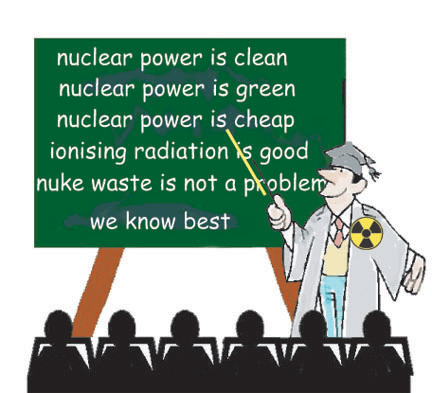
So, just when you thought it might be safe to step out a bit more — when double glazing salesmen, charity fundraisers and energy company “swappers” might be taking a breather — a new sort of “chugger” is about to hit the streets.
You don’t have to fear being Saved for God or tapped for a standing order.
These chuggers will just want to normalise you. ……….. Continue reading
UK’s contract with EDF to build Hinkley nuclear station may not be valid
 Hinkley Point nuclear power contract ‘may be invalid’ BBC News 6 May 14 The contract for building the UK’s first nuclear power station in a generation might not be “valid”, a leading legal academic has warned.
Former Liberal Democrat MP David Howarth, who lectures at Cambridge, said the deal with EDF over a plant at Hinkley Point could be seen as an “unjustifiable subsidy” under EU law.
The contract fixes a price for energy provided if the scheme goes ahead.
The government said the deal was “robust” and would give a “fair deal”.
The government announced last autumn that EDF, a French firm, would lead a consortium to build the Hinkley Point C station in Somerset, expected to supply around 7% of the UK’s electricity.
The company and ministers agreed a “strike price” of £92.50 for every megawatt hour, almost twice the current wholesale cost of electricity.
But Mr Howarth told BBC Radio 4’s Today programme there was a “problem with whether this is a valid contract at all”.
He argued that, under EU law, its terms could be described as an “unjustifiable subsidy” and that “because the system doesn’t allow for non-British generators to come within it, it might be a violation of the basic principle of EU law of freedom of movement of goods”. Mr Howarth added that English law could also be violated, as “the contract simply says what price it will get if it happens to supply a nuclear power station”, rather than compelling the company to build one.
Setting the price paid for the energy produced could also undermine the “long-standing legal doctrine that contracts which unduly bind the future discretion of governments to act in the public interest are void as being against public policy”.
“It’s quite possible that a contract of this size, over a period of 40 years, might find itself being caught by it,” he added…….http://www.bbc.com/news/uk-politics-27291087
Britain’s Sellafield – a nuclear security nightmare
 Nuclear power undermines nuclear security, The Ecologist, Dr David Lowry 2nd May 2014 “…… In Britain, the biggest nuclear security problem is the huge nuclear facility at Sellafield, originally built in the early 1950 on England’s northwest coast, in Cumbria, which is also home of the wonderful Lake District National Park.
Sellafield however is also the home of hundreds of decaying and decrepit building, many stores of liquid and solid radioactive waste, and, from a security perspective, most importantly, 111 tonnes of weapons – useable plutonium.
Let me give you that figure in another way. 111 tonnes is 111,000 kilogrammes. A nuclear bomb can be made with as little as 5 kilograms of plutonium – a lump about the size of a large orange.
Note: the ‘Fat Man’ nuclear bomb detonated above Nagasaki in August 1945, with a blast equivalent to 21,000 tons of TNT, contained jut 6.2 kg of plutonium
The Sellafield deer
And how well prepared are Sellafield’s managers for the unexpected? Not very, as we can see from the story of the Sellafield deer.
As a result of a recent security review, the Sellafield management decided to strengthen the perimeter fence around the site. Unfortunately in doing so they unintentionally captured a small herd of wild deer.
But rather than releasing the corralled deer, they shot them, as the local newspaper, the Whitehaven News revealed early on 3rd April. Their headline ran: “Three deer shot dead as Sellafield carries out cull”.
Now – if the deer could find themselves, un-noticed, on the wrong side of the security fence, what about people? The insecurity of the storage buildings for the waste products arising from operating nuclear power reactor is a a huge and as yet unsolved problem.
We are often told these stores are robust against terrorist attack. …….
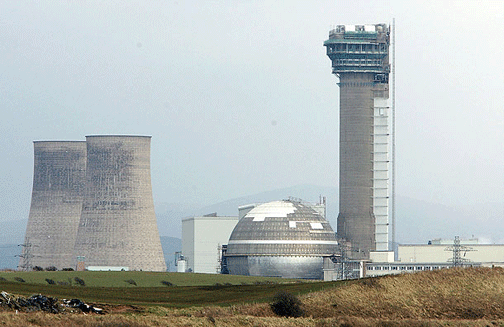
UK score on nuclear security: 11%
NTI publishes a table in its new report (see below) that ought to set the alarm bells ringing in DECC and across Whitehall. The NTI assessed the nuclear security of 25 countries identified as having the nuclear materials capable of making nuclear nuclear WMDs. The UK ranked bottom with a score of just 11/100.
But the problem is clearly systemic. The five permanent members of the UN Security Council, who also happen to be the ‘Big Five’ nuclear weapons states – the US, Russia, China, UK and France – all ranked 18th or worse out of 25, with scores of 34/100 or worse.
Intriguingly Iran – condemned by the US and other countries as representing a major nuclear proliferation hazard and punished by the Security Council with severe sanctions as a consequence – ranked 4th with a score of 89/100, putting the UNSC permanent members to shame……. http://www.theecologist.org/News/news_analysis/2381924/nuclear_power_undermines_nuclear_security.html
Justice for Britain’s nuclear test veterans and their children!
John Baron MP: It’s time to recognise our nuclear test veterans http://www.conservativehome.com/platform/2014/05/john-baron-mp-its-time-to-recognise-our-nuclear-test-veterans.html By John Baron MP , 2 May 14, John Baron MP is a member of the Foreign Affairs Select Committee. When compared with how other countries treat their nuclear test veterans, Britain has a shameful record. Ministry of Defence (MoD) references to war pensions do not wash. The very high rate of serious ill health amongst veterans’ offspring reinforces the fact that, although no side can lay hold to firm scientific evidence, there is a case to be answered. The Government needs to build on its good track record of acknowledging past wrongs, and finally recognise the debt of gratitude we owe to these veterans and their families.
During the 1950s and 1960s, over 20,000 British and Commonwealth servicemen, many of whom were on national service, took part in British nuclear tests in the South Pacific and Australia. They played an essential part in developing Britain’s independent nuclear deterrent, and their contribution to winning the Cold War can not be overstated.
The tests were carried out at the very beginning of the nuclear age, and the science was imperfectly understood. Precautions for the servicemen were primitive and inadequate. The only people wearing protective suits were the scientists. Many veterans believe their health, and that of their descendants, has been adversely affected by their presence during the nuclear tests.
The veterans feel forgotten, and some years ago came together to form the British Nuclear Test Veterans’ Association (BNTVA), the principal charity which campaigns on their behalf. I am honoured to be their Patron, and since 2011 we have been running a cross-party campaign in Parliament. The campaign has involved two stages. The first was to secure a Health Needs Audit from the MoD, to ease the path of our veterans through the NHS, which we have now secured. The second has been to secure official recognition of their service from the Government. This has not been forthcoming, and is very important not only to the diminishing number of veterans – only around 3,000 are still alive – but also to the descendents of those no longer with us. An acknowledgement from the Prime Minister, either orally or in writing, would make a huge difference.
A further aspect of our recognition campaign is to secure an ex gratia payment of £25 million from the Government to help establish a Benevolent Fund to distribute grants to veterans and their descendents to help with their care. Access to the Fund would be on the basis of need, not entitlement – thus reinforcing the fact our campaign is one of recognition, not compensation. For the record, the BNTVA has never taken part in any of the legal proceedings against the MoD.
Our recognition campaign was launched in Parliament last June, and over 80 MPs have expressed support for its aims. In October, I led a Parliamentary debate on the issue, during which I highlighted that Britain lies towards the bottom of the ‘international table of decency’ when it comes to how we treat our test veterans.
Canada and the US, for example, both offer payments to nuclear servicemen of £47,000 and £15,000 respectively. Crucially, no causal link between presence at a test and illness is required – this is in contrast to our war pensions scheme, which inevitably finds against veterans. The Isle of Man, our near neighbour, makes an £8,000 payment to any resident nuclear veteran. In all three cases, nuclear veterans receive free health care. Even the Russians ply their test veterans with medals and pensions, in recognition of their contribution.
Underlining the veterans’ case is the fact that their descendants suffer a much higher rate of congenital illness at birth. Against a national rate of around 2.5 per cent, over a third of veterans’ offspring have a serious medical condition. Figures obtained from French nuclear test veterans are broadly similar. Though this may not be scientific, it is nevertheless strong circumstantial evidence that the veterans’ service has cast a long shadow, and explains why the Benevolent Fund must be extended to veterans’ descendants.
Faced with the prevalence of ill health amongst descendants, a significant number of veterans opted to take the life-changing step not to have any children, and still more have terminated pregnancies rather than take the risk. These, together with the sad toll of multiple miscarriages and stillbirths, make up a ‘hidden story’ of anguish and uncertainty precipitated by service at nuclear tests.
The MoD’s defence of the indefensible is the existence of its war pensions scheme. But 90 per cent of nuclear test veterans have failed to get a war pension, in part because they find it difficult to establish a casual link between their presence at the tests and their ill health. This is despite the fact some of these veterans have received money through American schemes. Derek Spackman was a British navigator in an RAF Canberra aircraft. Flying out of Darwin, in 1954 he was tasked with sampling radiation levels following the American tests on the Marshall Islands. His widow was repeatedly denied a war pension by the MoD; however the US Government awarded her $75,000 for his service.
No doubt further information will come to light, as veterans respond to the BNTVA’s ‘call for evidence’. What comes through strongly is that the veterans have a compelling case, and that the goals of the campaign – official recognition and a £25m Benevolent Fund – are in truth very modest.
The BNTVA and I are hosting a Parliamentary film reception for veterans, their families and supporters on June 25. Having met the Prime Minister just before Easter, he is now going to ask further questions within government. Our hope is that he will recognise that our campaign is fair and just. After 60 years of waiting, the nuclear test veterans and their descendants deserve no less.
Japan’s Prime Minister Abe hastens sale of nuclear power plant to UK
Abe’s visit spurs signing of deal to build nuclear plant Ft.com, By Kiran Stacey and Guy Chazan 2 May 14, Britain’s nuclear power industry was given a boost on Thursday as one of Japan’s largest companies  took a step closer to building a £10bn nuclear power plant in the north-west.
Toshiba, the engineering and technology company, signed an agreement giving it the right to build at Sellafield, in west Cumbria, during a visit by Shinzo Abe, Japanese prime minister, to London, in an effort to boost trade and investment between the two countries.

The land option agreement for the new nuclear site will involve total payments by Toshiba and its partners to Britain’s Nuclear Decommissioning Authority of over £200m by the time the option is exercised, the energy department said……….
The NuGen consortium, a joint venture between Toshiba/Westinghouse and France’s GDF Suez, owns a site near Sellafield in west Cumbria that has been earmarked for three new reactors. …….
The leaders of the two countries also agreed to launch negotiations on sharing supplies and transport services between their militaries, as well as accelerating a plan to jointly develop military equipment.
Mr Abe’s willingness to discuss military co-operation is a sign of his efforts to make Japan a more significant player on the world stage, something he refers to as making a “greater contribution to peace”.
But while officials in both countries welcomed the deal as a sign of healthy trading ties, the warm words mask deeper Japanese unease about Britain’s role in Europe. Mr Abe used his visit to Downing Street to press home the urgency of signing a trade agreement between Japan and the EU, something he wants to achieve by 2015……….http://www.ft.com/intl/cms/s/0/6fa6824e-d144-11e3-bdbb-00144feabdc0.html#axzz30asoDSeZ
100,000 renewable energy jobs now in Britain
Renewable energy sector now supports over 100,000 UK jobs by ClickGreen staff. Published Wed 30 Apr 2014 The renewable energy industry has attracted nearly £30 billion of private sector investment since 2010, according to a new joint report published by the REA, Innovas and PwC.
The huge investment has enabled the industry to sustain over 100,000 jobs in 2013, generate turnover last year of £14 billion and deliver 4.2% of UK energy.
The report, REview – Renewable Energy View: 2014, builds on the REA’s 2012 report Renewable Energy: Made in Britain, the first industry-wide analysis of employment in the UK renewable energy industry.

The 116-page paper is the most complete assessment to date of the UK renewable energy market and will be formally launched this evening by Energy Minister Greg Barker in the House of Commons.
REA Chief Executive Dr Nina Skorupska said the report should provide the Government with a reminder of learning from past mistakes and provide market stability.
She added: “This report highlights the close relationship between clear, stable policies and sustained growth and jobs in the renewable energy industry. The Government’s renewable electricity policies have incentivised nearly £28 billion of private investment since 2010, achieving annual growth rates of over 20%. The world’s first Renewable Heat Incentive is also beginning to spur positive growth in green heating. This is a tremendous success story.
“This positive message also comes with a warning. Drastic Feed-in Tariff cuts in 2011/12 led to widespread job losses in the solar industry, and the continued policy uncertainty for renewable transport has seen employment and investment opportunities in UK refineries go begging.
“Clear, stable policies create the investment, jobs and growth in renewables that the UK needs. We urge the Government to learn the lessons from past experiences, such as solar FITs and biofuels uncertainty, and engage closely with industry to resolve outstanding uncertainties, such as State Aid rules and the details of CfDs.”
Analysis by the REA reveals that:
* Renewable electricity generation has grown steadily, increasing on average by 20.3% year-on-year between 2009 and 2013………
Continue reading
Scotland shows the way to community cash from renewable energy

 Scotland helps communities earn cash from onshore wind turbines by ClickGreen staff. Published Fri 25 Apr 2014 Scotland’s Energy Minister Fergus Ewing has announced a fresh set of principles designed to maximise community benefit from onshore renewable energy developments.
These principles will help the Scottish Government deliver the 500 megawatts of community and locally owned renewables target by 2020.
The finalised Good Practice Principles for Community Benefit from Onshore Renewable Developments have now been published, following a period of consultation.
The key principle is the promotion of a national community benefits package rate equivalent to at least £5,000 per Megawatt per year, index linked to inflation for the operational lifetime of the development. So for example, a 20 Megawatt windfarm of eight turbines will generate at least £100,000 a year for the local community.
Another key component of the guidance encourages renewable energy developers to submit information on potential community benefits as early in the development process as possible. This is considered a vital step in allowing time for the community to consider properly and to develop ideas for implementation of the community benefit package.
In addition, as part of the principles Mr Ewing has announced that Government will work in partnership with Scottish Renewables to set up a short-term industry working group to develop guidance to encourage community investment in commercial renewables schemes. This is with a view to maximising the opportunity for communities to invest directly in local commercial schemes. To date communities involved in benefit schemes have reaped over £5.6 million for local projects and developments…….http://www.clickgreen.org.uk/news/national-news/124523-scotland-helps-communities-cash-in-with-onshore-wind-turbines.html
No Faith in Trident tour, by veteran UK anti nuclear campaigner, Bruce Kent
Anti-nuclear campaigner, Bruce Kent, brings crusade to Darlington http://www.thenorthernecho.co.uk/news/11167479.Anti_nuclear_campaigner_brings_crusade_to_Darlington/ 23rd April 2014 in News By Hannah Bryan, Report ONE of Britain’s best-known peace campaigners has brought his anti-nuclear crusade to the North-East.
Veteran peace campaigner and retired Catholic priest, Bruce Kent, spoke to crowds at the Friends’ Meeting House, in Darlington, as part of his No Faith in Trident tour.
The 84-year-old highlighted the cost of Trident – Britain’s nuclear weapons system – as well as the legal and moral issues involved with nuclear weapons. He said: “It is about getting people all around the country active in opposing the spending of £100billion on more nuclear weapons, which could instead be spent on the NHS, good education and other services. We should be getting rid of nuclear weapons which make the country more dangerous, not safer.
“The thing that matters the most to me is when people go home after my talk and do something about it, like write to their local MP or newspaper.”
Mr Kent was chair and general secretary of the Campaign for Nuclear Disarmament (CND) throughout the 1980s, and was formerly chair of War on Want.
He remains an active anti-nuclear and anti-war campaigner.
UK’s Drigg nuclear trash dump will be washed away by climate change’s sea level rise
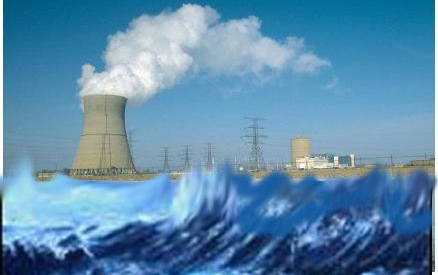 This Huge Nuclear Waste Dump Will Be Washed Away By Rising Sea Levels http://gizmodo.com/uk-nuclear-waste-dump-will-be-washed-away-by-rising-sea-1565513267 21 April 14, Geoff Manaugh A dumping ground for nuclear waste located near the British coast is “virtually certain” to be washed away by rising sea levels, a new report warns. The UK Environment Agency has admitted that constructing the Drigg Low-Level Waste Repository so near the coast was a mistake, and that one million cubic meters of nuclear waste will begin leaking into the ocean “a few hundred to a few thousand years from now.”
Sounds bad? Pay no attention, then, to current plans to increase the site’s capacity by another 800,000 cubic meters over the next century, adding new waste that will include “radioactive debris from Britain’s nuclear power stations, nuclear submarines, nuclear weapons, hospitals and universities,” the Guardian reports.
It’s interesting to note that, while the site officially contains only low-level waste, there is suspicion that higher-level wastes with correspondingly higher levels of radioactivity could have been dumped there in the past. Recall the incredible tale of Sellafield nuclear power station—the site from which much of the waste now stored at Drigg originates—where records of previous dumping had been thrown away or lost. This led to the terrifying need to advertise in the local newspaper, saying: “We need your help.” Why? Because they had no idea what was buried there.
“Did you work at Sellafield in the 1960s, 1970s or 1980s?” the ad asked with false calm. “Were you by chance in the job of disposing of radioactive material? If so, the owners of Britain’s nuclear waste dump would very much like to hear from you: they want you to tell them what you dumped—and where you put it.”
In any case, the coastal tomb at Drigg is all but guaranteed to break apart in the waves and wash its mysterious and harmful contents into the sea. “A few hundred to a few thousand years from now” sounds like a long time, of course, but think of that as potentially little more than the time between us and Shakespeare (400 years), and the terrifying urgency of this becomes more clear. [Guardian]
North Wales doesn’t mind nuclear power – just don’t want the wastes
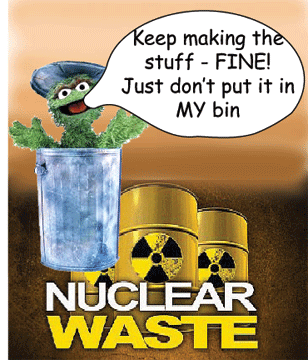 North Wales nuclear waste burial plan North Wales News
Anglesey Apr 16, 2014 By Gareth Wyn-Williams Nuclear waste from across the British Isles could potentially be shipped and stored on Anglesey as part of new plans unveiled by the Government.
But the resulting fallout from the proposals has already generated a storm of objections on the island, with one politician saying that residents should make every effort to stop it turning into a “nuclear waste depository”.
The UK Government’s Energy and Climate Change department is looking for communities to come forward and “volunteer themselves” in order to establish a new site from scratch, that would store nuclear waste from all over Britain.
And it is understood that Anglesey is one of the sites under consideration by the UK Government, with a public meeting set to take place to discuss the matter later this year.
Any communities that agree to the deal, have been promised “substantial” economical benefits.
But Anglesey’s Assembly Member, Rhun ap Iorwerth, says that residents across the island, must strongly reject any proposals to establish any such sites here.
He said: “This is quite separate from arguments for and against nuclear power generation at Wylfa newydd.
“This is about the threat of using Anglesey as a nuclear waste depository……http://www.dailypost.co.uk/news/north-wales-news/north-wales-nuclear-waste-burial-6995133
UK’s surviving atomic test veterans cautiously welcome David Cameron’s statement
Thorpe St Andrew nuclear test veteran speaks of defect fears, after PM gives hope to families, Norwich Evening News 24, 17 April 14
“………Veterans say they were made ill as a result of being exposed to radiation during the tests, and have been battling for recognition and compensation for years.
Mr Freeman, a father-of-three and grandfather-of-eight, said his ninth grandchild was expected next month, but added: “I’ve got grandchildren who suffer from deafness and one was born with one kidney. With another grandchild due, we are all worried that everything is going to be OK, as you can never tell.”
Nuclear test campaigners say Mr Cameron’s pledge is the closest they have been to formal recognition of the suffering caused by the South Pacific explosions. The meeting between Mr Cameron and Tory MP John Baron last week was the first time the veterans had their case put forward to any prime minister.
Mr Baron, patron of the British Nuclear Test Veterans’ Association, told the PM descendants had 10 times the normal rate of birth defects, their wives had elevated rates of miscarriage, and no other veterans’ group had suffered harm which spread down the generations. France, the US, Australia, New Zealand, Russia, China and even the Isle of Man recognise and compensate test veterans. The MoD has always insisted no harm befell the men.
Are you a veteran of nuclear testing living in the Norwich area? Email reporter David Bale at david.bale2@archant.co.uk http://www.eveningnews24.co.uk/news/thorpe_st_andrew_nuclear_test_veteran_speaks_of_defect_fears_after_pm_gives_hope_to_families_1_3562535
Strong reasons why UK should abandon Trident nuclear weapons system
Five interesting stories about Trident http://www.leftfootforward.org/2014/04/five-interesting-stories-about-trident/
1. Strikes at Faslane
In March, hundreds of workers at the Faslane naval base staged theirfirst walkout in 42 years, following negotiations over pay. Faslane is home to the UK’s Vanguard-class nuclear-powered and nuclear-armed submarines. The Scotsman reported that employees responsible for fitting out boats and loading weapons were involved in the action. The Unite union said that further stoppages were planned, as well as a work to rule and ban on overtime.
2. Top Tory says No James Arbuthnot, veteran chairman of the Defence Select Committee, has publicly questioned the logic of replacing Trident. In a recent interview with the Guardian he stated, “Nuclear deterrence does not provide the certainty that it seemed to in the past. It’s not an insurance policy, it is a potential booby trap.”
Despite voting for replacement in 2007, Arbuthnot referred to Trident at the time as ‘of doubtful usefulness’.
3. Resignations at AWE Burghfield
In January, junior defence minister Anna Soubry confirmed that 44 Ministry of Defence Police officers based at the Atomic Weapons Establishment in Burghfield were subject to a major misconduct investigation. AWE Burghfield hosts facilities in which the UK’s nuclear weapons are built and maintained. Seven officers resigned during the course of the investigation, with some media reporting that a number had missed patrols due to being ‘asleep’.
4. UK’s youth disapprove
A recent ComRes survey suggests that younger people are opposed to like-for-like Trident replacement. Of the respondents, only 19 per cent of those aged 18-35 supported renewing Trident at its current size and capacity (this compared to 33 per cent of over 35s). The poll was commissioned by WMD Awareness, who launched this campaign last week to get the UK’s youth debating nuclear weapons.
5. Radioactive leaks in Caithness
In March, Scotland’s first minister Alex Salmond demanded an apology for failing to be informed for over two years about problems with a submarine test reactor. This was in response to defence secretary Philip Hammond’s confirmation that “low levels of radioactivity were detected in a prototype core” at the Vulcan Naval Reactor Test Establishment at Dounreay, Caithness, in 2012. These kinds of spats suggest nuclear defence will continue to be an issue in the Scottish independence campaign.
The above stories touch on some major problems with Trident: it’s unpopular, politically contentious, and the system relies on shaky security arrangements. Anyone for abandoning it?
David Cameron acknowledges damage to nuclear test veterans and their offspring
- David Cameron gives nuclear test veterans glimmer of hope after our 12-year campaign for justice
http://www.mirror.co.uk/news/uk-news/david-cameron-gives-nuclear-test-3406479
- Apr 12, 2014 Prime Minister has promised to investigate setting up a £25 million health fund for descendants of those exposed to genetic suffering genetic defects
David Cameron has at last given hope to families of nuclear test veterans after a 12-year Sunday Mirror campaign for justice.
The Prime Minister has promised to investigate setting up a £25million health fund for descendants suffering genetic defects passed down by servicemen exposed to 1950s blasts.
He will also look at offering personal thanks to the veterans and recognising their sacrifice with a medal.
Campaigners say the breakthrough at a half-hour meeting is the closest they have been to formal recognition of the suffering caused by the South Pacific explosions.
It came days after the Sunday Mirror called for the PM to recognise the plight ofchildren like 15-month-old Ella Denson, who was born with a deformity linked to her great-grandad Eric Denson’s exposure to radiation on Christmas Island in 1958.
The meeting between Mr Cameron and Tory MP John Baron last Wednesday was the first time the veterans have had their case put forward to any prime minister.
Mr Baron, patron of the British Nuclear Test Veterans’ Association, told the PM descendants had 10 times the normal rate of birth defects, their wives had elevated rates of miscarriage, and no other veterans’ group had suffered harm which spread down the generations.
A New Zealand study found veterans’ genes had three times the damage of Chernobyl survivors. The tests have never been repeated here.
Scientists say effects could last for 20 generations.
As Mr Cameron listened, Ella, of Morden, South London, was recovering from her latest hospital admission to deal with her severe defect. She was born with two tubes to a kidney instead of one and needs daily antibiotics to stop infection before having surgery at three.
At the weekend she was rushed to hospital for the third time in her short life. Her brother Jamie and mum Kimberley have teeth deformities.
Ella’s great-gran Shirley Denson, 79, had four daughters with bomb veteran husband Eric and has seen more than a third of his descendants suffer.
She said: “I pray the Prime Minister does the right thing, for the sake of my Ella and all the thousands like her.”
Eric was one of 22,000 men ordered to witness the detonation of nuclear bombs between 1952 and 1967.
He later suffered crippling headaches and killed himself in 1976. Fewer than 3,000 veterans survive.
France, the US, Australia, New Zealand, Russia, China and even the Isle of Man recognise and compensate test veterans. The MoD has always insisted no harm befell the men.
Mr Baron said: “The meeting with Mr Cameron was constructive. He is going to get back to me.”
1 This Month





PLEASE OPPOSE HR 8255 AND S.3639 – bills would accelerate satellite deployment, with no environmental review or safeguards – https://ncstd5li.quorum.us/campaign/169331/
To see nuclear-related stories in greater depth and intensity – go to https://nuclearinformation.wordpress.com
-
Archives
- October 2026 (58)
- September 2026 (339)
- August 2026 (330)
- July 2026 (355)
- June 2026 (287)
- May 2026 (306)
- April 2026 (356)
- March 2026 (251)
- February 2026 (267)
- January 2026 (308)
- December 2025 (358)
- November 2025 (359)
-
Categories
- 1
- 1 NUCLEAR ISSUES
- business and costs
- climate change
- culture and arts
- ENERGY
- environment
- health
- history
- indigenous issues
- Legal
- marketing of nuclear
- media
- opposition to nuclear
- PERSONAL STORIES
- politics
- politics international
- Religion and ethics
- safety
- secrets,lies and civil liberties
- spinbuster
- technology
- Uranium
- wastes
- weapons and war
- Women
- 2 WORLD
- ACTION
- AFRICA
- Atrocities
- AUSTRALIA
- Christina's notes
- Christina's themes
- culture and arts
- Events
- Fuk 2022
- Fuk 2023
- Fukushima 2017
- Fukushima 2018
- fukushima 2019
- Fukushima 2020
- Fukushima 2021
- general
- global warming
- Humour (God we need it)
- Nuclear
- RARE EARTHS
- Reference
- resources – print
- Resources -audiovicual
- Weekly Newsletter
- World
- World Nuclear
- YouTube
-
RSS
Entries RSS
Comments RSS

