Wind power is beating nuclear power in UK
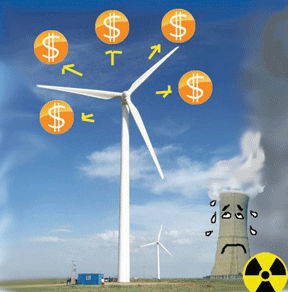 Wind farms outstrip nuclear power BBC News, By Roger Harrabin, 21 Oct 14 BBC environment analyst The UK’s wind farms generated more power than its nuclear power stations on Tuesday, the National Grid says.
The energy network operator said it was caused by a combination of high winds and faults in nuclear plants………Wind made up 14.2% of all generation and nuclear offered 13.2%.
It follows another milestone on Saturday, when wind generated a record amount of power – 6,372 MW, according to National Grid.
This formed nearly 20% of the the UK’s electricity, albeit at a time at the weekend when demand is relatively low………The government is offering more generous subsidies to nuclear than wind in the long term.
But Jennifer Webber, a spokeswoman for RenewableUK, the trade body, said: “Wind power is often used as a convenient whipping boy by political opponents and vested interests.
“All the while, it’s been quietly powering millions of homes across the UK and providing a robust response to its vocal detractors.” http://www.bbc.com/news/business-29715796
Britain’s secret nuclear weapons deal with USA


 Nuclear weapons deal with US renewed in secret, UK confirms Richard Norton-Taylor Tuesday 21 October 2014 theguardian.com• UK tables amendments to Mutual Defence Agreement
They relate to the Mutual Defence Agreement (MDA) first signed in 1958, which, according to the government, enables the UK and the US “nuclear warhead communities to collaborate on all aspects of nuclear deterrence including nuclear warhead design and manufacture”.
One amendment refers to potential threats from “state or non-state actors”. But the amendments are for the most part arcane and their significance cannot be understood in the absence of information which is kept secret.
The MDA does not have to be debated or voted on in parliament, as I have remarked before. Though the agreement is incorporated in US law, it has no legal status in Britain.
Yet the matters covered by the treaty, which is renewed only at 10 year intervals, are hugely important. Successive British governments have made clear a proper debate on the issues involved would not be welcome.
“A debate on the renewal of the MDA would be used by some as an opportunity to raise wider questions concerning the possible renewal of the nuclear deterrent…and our obligations under the nuclear non-proliferation treaty,” notes an internal MoD paper, dated 2004. The paper was released only earlier this year through a freedom of information act request by the independent Nuclear Information Service……….
Kate Hudson, general secretary of the Campaign for Nuclear Disarmament (CND) says the UK-US agreement flew in the face Britain’s commitments as a signatory to the nuclear Non-Proliferation Treaty.
“It is appalling that David Cameron is signing secretive nuclear deals behind Parliament’s back. In no other area of government would such a sinister sidestepping of democratic process be tolerated.” http://www.theguardian.com/world/defence-and-security-blog/2014/oct/20/nuclear-weapons-uk-us
UK plants turn down energy out put because of cracks developing
 Nuclear reactor heat turned down to stop boilers cracking Two nuclear plants shut amid safety fears may be restarted at just 75pc usual power output to prevent more cracks developing, EDF says Telegraph, By Emily Gosden, Energy Editor 17 Oct 14, Power output at two UK nuclear plants will be curbed for up to two years in order to reduce the heat in their boilers and prevent cracks developing, EDF has announced.
The two twin-reactor plants at Heysham 1 and Hartlepool have been shut down since August amid safety fears following the discovery of cracks in one boiler structure at Heysham.
The ageing reactors are likely to be restarted in coming months at just 75pc-80pc of their usual output in order to prevent high temperatures causing further cracks, EDF said on Friday.
The move will further worsen the risk of power shortages this winter and next.
The temporary closure of the plants, which produce enough power to meet about 4pc of peak winter demand, has already forced National Grid to invoke emergency measures to bolster power supplies this winter, by paying mothballed power stations to fire up.
EDF warned in September that the reactors – initially expected to be shut for two months – would only be restarted gradually between the end of October and late December, once safety checks on each reactor’s eight boilers were finished.
On Friday it further revised the likely dates of the restarts. The restart of the reactor with cracks has been pushed back a month, from the end of November to the end of December. Two other reactors have been pushed back from the end of October to November 9, and the fourth reactor has been brought forward from November 30 to November 22………
The cracks at Heysham 1 are in a “boiler spine”. The Office for Nuclear Regulation said that the spine “supports the weight of an entire boiler and its failure could lead to water entering the reactor vessel”.
“The potential worst consequences of water entering the reactor vessel is an over-pressurisation of the reactor which could result in lifting of the reactor pressure relief valves. If this was to occur co-incidentally with fuel damage then there could be a direct path to the environment and a release of radiation,” it said……..
As well as firing up mothballed power plants, National Grid is also using emergency plans to pay factories to switch off on winter weekdays to ease demand to help ensure households’ lights are kept on. http://www.telegraph.co.uk/finance/newsbysector/energy/11169625/Nuclear-reactor-heat-turned-down-to-stop-boilers-cracking.html
Research into birth deformities in children of British nuclear veterans
Miscarriages and Congenital Conditions in Offspring of Veterans of the British Nuclear Atmospheric Test Programme Miscarriages and Congenital Conditions in Offspring of Veterans of the British Nuclear Atmospheric Test Programme.pdf – Google ドライブ Christopher Busby1* and Mireille 1 Escande de Messieres2 Environmental Research SIA, Riga, Latvia 2Green Audit, SY231 1DZ, Aberystwyth, Wales
*Corresponding author: Christopher Busby, 1117 Latvian Academy of Sciences, Academy Square, LV-1050 Riga, Latvia, Tel: +44 7989 428833; E-mail: christo@greenaudit.org Received date: Apr 18, 2014, Accepted date: Sep 22, 2014, Published date: Sep 29, 2014 This is an open-access article distributed under the terms of the Creative Commons Attribution License, which permits unrestricted use, distribution, and reproduction in any medium, provided the original author and source are credited.

Abstract A postal questionnaire case-control study examined miscarriage in wives and congenital conditions in offspring of the 2007 membership of the British Nuclear Test Veterans Association, a group of ex-servicemen who were stationed at atmospheric nuclear weapon test sites between 1952-67. Results were compared with a veteran- selected control group and also with national data. Based on 605 veteran children and 749 grandchildren compared with 311 control children and 408 control grandchildren there were significant excess levels of miscarriages,
stillbirths, infant mortality and congenital illnesses in the veterans’ children relative both to control children and expected numbers. 105 miscarriages in veteran’s wives compared with 18 in controls OR=2.75 (1.56, 4.91; p=. 00016). There were 16 stillbirths; 3 in controls (OR=2.70 (0.73, 11.72; p=0.13). Perinatal mortality OR was 4.3 (1.22, 17.9; p=.01) on 25 deaths in veteran children. 57 veteran children had congenital conditions vs. 3 control children (OR=9.77 (2.92, 39.3); p=0.000003) these rates being also about 8 times those expected on the basis of UK
EUROCAT data for 1980-2000. For grandchildren, similar levels of congenital illness were reported with 46 veteran grandchildren compared with 3 controls OR=8.35 (2.48, 33.8) p=0.000025. There was significantly more cancer in the veteran grandchildren than controls.
Whilst caution must be exercised due to structural problems inherent in this study we conclude that the veterans’ offspring qualitatively exhibit a prevalence of congenital conditions significantly greater than that of controls and also that of the general population in England. The effect remains highly statistically significant even assuming a high selection bias in the responses and credibility is strengthened by the high rates of miscarriage reported by the veterans compared with controls, a result which could hardly have been due selection effects……….Miscarriages and Congenital Conditions in Offspring of Veterans of the British Nuclear Atmospheric Test Programme.pdf – Google ドライブ
Britain’s $27 Billion Bond Plan with EDF hailed as the beginning of big nuclear market
 EDF $27 Billion Bond Plan Offers Nuclear Blueprint: U.K. Credit http://www.bloomberg.com/news/2014-10-13/edf-s-27-billion-of-nuclear-bonds-seen-as-template-u-k-credit.html By Sally Bakewell Oct 14, 2014 Electricite de France SA’s plan to raise as much as 17 billion pounds ($27 billion) of bonds for Britain’s first nuclear project in two decades is being seen as a template for financing expansion in the industry.
EDF won approval from the European Commission last week to build the 24.5 billion-pound plant at Hinkley Point in southwest England, a year after agreeing to the project. The U.K. government will back the debt, which will be the nation’s largest bond offering on a single project, according to Deloitte LLP.
“The use of bonds with a U.K. government guarantee will be a highly influential template in the nuclear sector,”Kevin Magner, director for corporate finance in the government and infrastructure team at Deloitte, said by phone. “For projects of this sheer size which developers can’t finance on their balance sheets, they’re turning more to the bond market for large volumes of debt where the projects can achieve the necessary credit quality.”
Other nuclear projects that may follow include Hitachi Ltd.’s plan to build 5.4 gigawatts of plants at sites in Wales and south Gloucestershire, and a power station with as much as 3.4 gigawatts in west Cumbria being developed by a venture between Toshiba Corp. and GDF Suez SA, Magner said. The U.K. government announced a program in July 2012 to offer as much as 40 billion pounds in debt guarantees for infrastructure projects to lift the economy.
‘Big Market’
“There will be a big market for this debt since it’s guaranteed by the government,” Continue reading
Hinkley nuclear project is a really bad deal for the British consumer
 Comment: Why is Hinkley a bad deal for the UK consumer? Energy desk 8 Oct 14 The world of energy is changing. The world’s largest private bank, UBS, has recently advised its clients that large centralised power stations (like Hinkley) are not the future – solar power, electric cars and cheaper storage batteries are. Meanwhile, tech leaders Google have invested $3.2bn in Nest, a smart home energy company.
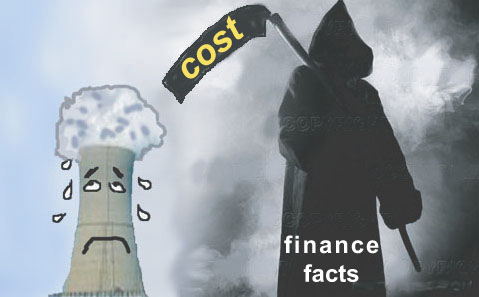
Yet our energy policy in the UK seems stuck in the past, with government’s Electricity Market Reform seemed largely to be based on getting nuclear stations built – with a generous price for 35 years of supply for the proposed new 3.2GW EDF reactor at Hinkley which will cost £24.5bn to build and open at the earliest in 2023.
Today the European Commission has decided to approve state aid subsidies for two reactors at Hinkley Point, Somerset – despite the Commission estimating the deal between UK government and NNBGeneco (a subsidiary of EDF) willcost up to £17.6bn in subsidies from the British energy billpayer.
However, according to my calculations the total (undiscounted) subsidy to Hinkley over its lifetime would be much higher at £37bn, with a £14 increase per household per year.
This is based a 35-year index-linked price guarantee (‘strike price’) of £92.50 per MWh, which is is almost twice that of the UK wholesale electricity market price of around £50/MWh. This means that the British public funds the difference between the amount EDF will be paid and the market price – which at present seems unlikely to go up much.
Nuclear has been delivering power at the same real cost for over 50 years and it would require a huge level of optimism based on little evidence to suppose that historic flat-lining would be changed now.
Already, the cost benefits of learning from building a number of EPRs (the proposed reactor model for Hinkley) across Europe seems to have disappearedbecause the price for Hinkley seems to be as big or bigger than the first plants in Finland and France.
In contrast renewable energy is on a downward price curve, in the case of solar very rapidly indeed, and subsidy may be justified in bringing a technology to its technological potential.
So, so many subsidies
Also part of the deal is a whole host of protections – implicit subsidies by any other name – that are specific to Hinkley, including:
-
Loan guarantees – If costs overrun or the plant defaults the government (read billpayers) will cover the repayment of the first £10bn to investors.
-
There will be two re-negotiations of the strike price, 15 and 25 years after the plant starts to generate. At these two re-openers, the strike price might be increased following raises of operating costs, including increases in fuel costs and maintenance.
-
And, another interesting detail is that the deal includes protection against curtailment (the plant stops running) in case of “the evolution of power systems”, according to the CEO of EDF. What this means is that if the energy mix changes to include more renewables, storage, and demand-side management, the plant will be given preferential grid access or payment for power (presumably at the strike price) that would otherwise have been produced. This curtailment risk cover is also understood to extend to changes in political decision making or changes in law based on environmental and safety reasons.
-
As a large generating unit, having 3.2GW on the Grid potentially going off at short notice requires the rest of the Grid to accommodate it andthese costs – £160m a year – are being shared by everyone including renewable generators, not paid for by the Hinkley development.
In addition to all this – on top of of the Commission’s estimate and outside of state aid considerations – Hinkley will also receive other long-standing protections that are given to all nuclear plants. Firstly, limitations on liability in case of an accident up to £1.06bn – after which bill payers foot the bill (liability costs from Fukushima are around $100bn and rising). And secondly, planned subsidies of as much as £15.72bn for radioactive waste management from new reactors.
All of this adds up to the fact supporting Hinkley is not a cost-effective option for the UK power supply. As Professor Mitchell of Exeter University puts it in relation to the grid arrangements: “There is no justification for nuclear being exempted from paying the additional costs to the system other than to make nuclear look cheaper than it is relative to other sources of electricity.”
Renewables at a disadvantage
The Chief Technology Officer at Siemens has said that renewables developers would ‘give an arm and a leg, at least’ for the kind of terms being offered to nuclear in UK – yet even so, some renewables will be cheaper at a headline level than nuclear by the time Hinkley opens in 2023 at the earliest.
But most of the support for Hinkley is not available to low carbon generators like renewables, or not available at the same rate……….http://www.greenpeace.org.uk/newsdesk/energy/analysis/comment-why-hinkley-bad-deal-uk-consumer
On anniversary of Windscale nuclear accident, UK plans another untested reactor
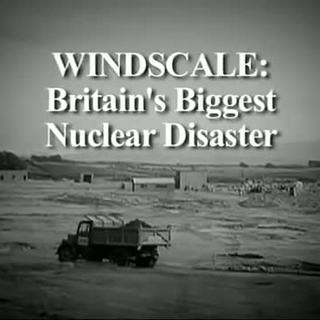 57 years ago today in 1957 :The Windscale Fire, Radiation Free Lakeland, 10 oct 14 ” ……..10th Oct marks 57 years since the worst nuclear accident in the UK. The bravery of those who fought the 1957 blaze was without question and they are remembered with our gratitude for preventing the far greater catastrophe of a full on Lake Counties nuclear sacrifice zone.
Official estimates point to a possibility of 240 additional cancer cases as a result of the Windscale fire. Studies reveal that the impacts of nuclear accident and routine emissions may be far wider reaching than the public is led to believe. One such study in 1995 by Dr John Bound, a former paediatrician at the Victoria Hospital, Blackpool; Brian Francis, of the Centre for Applied Statistics, Lancaster; and Dr Peter Harvey, pathologist at the Royal Lancaster Infirmary found that the Windscale fire
was followed by a surge in cases of Down’s syndrome. Their studies were poo poohed to protect the vested interests of the nuclear establishment.
This pattern has been repeated time and time again. History is now repeating itself with the plan for untried and untested new build near Sellafield.
The ruthless push towards new nuclear build on the beautiful coastline of West Cumbria mirrors the rush to build Windscale in order to produce plutonium for the atomic bomb. While “safety features” like the last minute addition of filters on the Windscale chimney helped mitigate the impact of the inevitable fire, the dangers from nuclear are inherent and accumulative. Nothing it seems is being learnt from history. The same old uranium burning technology is being proposed now for new build. The reactors being proposed are AP1000, a scaled up version of the commercially unattractive AP600. The AP1000 boasts higher efficiency, in other words it burns the uranium harder and longer producing much hotter wastes, reactors under construction now in America and China have cooling towers 600 – 800 ft. high. The other “alternative” is direct cooling with huge sea installations.
Sellafield is dangerous enough and a big enough terrorist target without putting untried, untested nuclear reactors next to it with the possibility of enormous cooling towers the size of New York sky scapers or huge sea installations.
Please remember the Windscale fire on the 10th. Remember the voluntary bravery of the Windscale workers and the involuntary bravery of all those unacknowledged babies, children, men and women who have died, or suffered health consequences as a result of the Windscale accident. The still highly radioactive chimney which stands 350ft tall has also claimed the life of steeplejack Neil Cannon who died after falling from the ongoing ‘decommissioning’. The death toll will continue without end if new build goes ahead. Surely the time has come for Cumbrians to say enough is enough and to join the resistance to new and more dangerous nuclear build.There is a petition here:
https://you.38degrees.org.uk/petitions/stop-moorside-biggest-nuclear-development-in-europe
Fire on ship carrying radioactive wastes leads to drift, and evacuation of oil rig

 “It is a serious incident and I think we need to review how we regulate the transportation of nuclear waste in our waters”
WWF Scotland, Comhairle nan Eilean Siar and SNP MSP Rob Gibson have raised concerns about radioactive waste being transported by sea.
Oil rig evacuated after ship carrying radioactive waste drifts BBC News Highlands and Islands 8 Oct 14 An oil platform has been evacuated after a ship carrying radioactive material caught fire and began drifting in the Moray Firth. Continue reading
Nuclear power defeats democracy – Book on UK “The Prostitute State “
 Nuclear power trumps democracy http://www.theecologist.org/blogs_and_comments/commentators/2587477/nuclear_power_trumps_democracy.html Donnachadh McCarthy 9th October 2014
The UK’s political mainstream has performed a complete U-Turn in policy on nuclear power, culminating yesterday in the European Commission’s approval of a £15-20 billion subsidy package for the Hinckley C project. Donnachadh McCarthy delves into the nuclear industry’s deep and far-reaching political links.
Why is our democracy failing to tackle the horrific urgency of the climate crisis and the decimation of our eco-systems?
And why are all the main political parties betting the farm on nuclear power in spite of its madhouse economics – and against all their promises to either oppose nuclear power altogether, or to refuse subsidies for it?
 In my new book, The Prostitute State – How Britain’s Democracy Has Been Bought, I set out my view that there is a single problem at the root of our nation’s difficulties.
A corporate elite have hijacked the pillars of Britain’s democracy. The production of thought, the dissemination of thought, the implementation of thought and the wealth arising from those thoughts, are now controlled by a tiny, staggeringly rich elite.
As a result the UK is no longer a functioning democracy but has become a ‘Prostitute State’ built on four pillars: a corrupted political system, a prostituted media, a perverted academia and a thieving tax-haven system.
This has disastrously resulted in a flood of wealth from the poor and middle classes to the top 1%. This stolen wealth is built on the destruction of the planet’s ecosystems, which are essential for humanity’s survival.
Nuclear power defeats democracy
The reversal of government policy on nuclear power is a classic example of how the Prostitute State trumps democracy. Betrayed environmental activists must understand that – notwithstanding the noble form of democratic structures – what they are really up against is a corrupt corporate state.
The concept of lobbying is reasonably well known, but few of us understand how far lobbying has penetrated and hijacked the political parties themselves.
For example, most people are perplexed at how the nuclear industry managed to persuade the UK’s previous Labour government to build a fleet of hugely expensive experimental nuclear power stations on land prone to flooding from rising sea levels.
They also struggle to comprehend and why Labour’s shadow energy and climate change minister, Caroline Flint MP, having stated that she would only support nuclear power if built without public subsidies, now supports the £15-20 billion subsidy package for Hinkley C nuclear power station
Labour managed managed this policy U-Turn despite the Three Mile Island, Chernobyl and Fukushima nuclear catastrophes; the failure to find safe waste-disposal sites capable of protecting radioactive waste for over 100,000 years; and insurance companies’ point blank refusal to provide nuclear accident insurance.
It’s the money, stupid
My simple answer is that the nuclear industry has poured millions of pounds year after year into a massive political lobbying campaign.
They bought a whole swathe of senior ex-politicians to work as nuclear lobbyists, spent a fortune on trying to manipulate public opinion through media and advertising, and even funded school trips to their nuclear plants.
As they managed to persuade a Labour government to abandon their 1997 election manifesto commitment to oppose new nuclear power stations, it is crucial to understand how deeply the nuclear lobby is embedded in the Labour party.
My personal belief is that a complex web of financial interests ensured that the Labour government served the nuclear industry – no matter what Labour party members or the British public wanted.
Just consider for example the following list of Labour Party politicians: Continue reading
Dounreay’s toxic nuclear wastes – for storage and return to Australia, Germany & Belgium
 Toxic conundrum: Dealing with Dounreay’s leftovers By Steven McKenzieBBC Scotland Highlands and Islands reporter 7 Oct 14 Built in the 1950s to push forward the UK’s nuclear energy ambitions, Dounreay is now at the centre of complex £1.6bn demolition job.
The incident which saw cargo ship Parida drifting in the Moray Firthhas, and not for the first time, cast a spotlight on the issue of dealing with part of Dounreay’s legacy – its tonnes of radioactive waste, nuclear fuel and other contaminated material.
So how are these toxic leftovers being handled, and what kinds of material are involved?
During the 1990s, nuclear material was sent from abroad to Dounreay for reprocessing.The customers included power plants and research centres in Australia, Germany and Belgium……..
Because Dounreay is being decommissioned, the foreign material is now being sent back to the countries from which it originated.
In 2011, it was announced that more than 150 tonnes of intermediate level waste would be transported back to Belgium in 21 shipments over four years.The waste was the result of reprocessing 240 spent fuel elements from Belgium’s BR2 research reactor, which produces isotopes for use in medicine and industry.
The reprocessing created about 22,680 litres of liquid waste. This has been mixed with cement and poured into 123 drums each weighing 1.25 tonnes.
Danish company Poulsens has been contracted by the Belgian authorities to take the drums to Belgium. The first shipment left Scotland in September 2012……..http://www.bbc.com/news/uk-scotland-highlands-islands-29535032
Movement in European policy makers to overturn approval for UK’s Hinkley Point nuclear power plan
 Opposition builds to UK nuclear project in EU executive -sources
* European Commissioners expected to vote on Oct. 8
* Britain has not been forced to make big changes
* Critics predict legal protest if decision approved
 By Barbara Lewis and Foo Yun Chee BRUSSELS, Oct 3 (Reuters) – A landmark deal to use British taxpayers’ money to build a 16 billion pound ($25.6 billion)nuclear power station has triggered opposition from a quarter of EU policy-makers, who want to overturn approval from the top European regulator, EU sources said………
critics say it breaches EU law over when government funding is allowed, and representatives of the renewable industry have threatened to bring legal action against the Commission if the Hinkley Point plan is approved.
An internal meeting of senior Commission staff on Monday will examine the decision, and the college of 28 Commissioners including President Jose Manuel Barroso is expected to hold a closed-door vote on Wednesday.
Five separate sources, speaking on condition of anonymity, said seven Commissioners opposed approval of the Hinkley Point funding, and although that would not be enough to block it, it was an unusually high level of opposition.
One source said the number could rise, because there are still a few days left before the vote, and predicted a delay.
“They should make more effort to accommodate objections,” one of the sources said, referring to the department of Competition Commissioner Joaquin Almunia, which has managed the case………
The case is a benchmark for EU member states on both sides of the debate as EU countries such as Germany phase out nuclear and seek to replace it with renewable power, while nations such as Poland, like Britain, favour nuclear…….
Britain classes nuclear as well as renewable power as carbon-free, although opponents of nuclear say it cannot be regarded as an environmental solution because it creates radioactive nuclear waste.
They also say there is no justification for funding an expensive and mature technology, when subsidies are being taken away for renewable energy, which is becoming more and more commercially competitive.
“They are rolling out the red carpet for nuclear and waving a red card for renewables,” Claude Turmes, a Luxembourg member of the Green party in the European Parliament, told Reuters.
European Competition Commissioner Joaquin Almunia is scheduled to leave office at the end of October, and sources said he felt he could not leave the Hinkley Point decision for his successor.
Environmental campaigners say he had no right to leave his successor to tackle the aftermath of a hasty conclusion.
“If the deal is approved, the outgoing Commission will be leaving Brussels in a getaway car after the heist of the century,” said Andrea Carta, EU legal adviser to campaign group Greenpeace. “Taxpayers would be left paying for one of the most expensive power stations in the world.” (1 US dollar = 0.6262 British pound) (editing by Jane Baird) http://www.reuters.com/article/2014/10/04/eu-britain-edf-nuclear-idUSL6N0RY3FE20141004
Experts paid by EDF were involved in safety review of Hinkley Point nuclear plan!
 Conflict of interest concerns over EDF’s Hinkley nuclear project approval Katie McQue and Terry Macalister The Guardian, Thursday 2 October 2014
Experts involved in safety review were receiving company’s pensions, documents reveal Nuclear experts receiving EDF pensions were involved in the official safety review of the company’s planned Hinkley Point C plant in Somerset, sparking concerns about a conflict of interest over the approval of the project.
The involvement senior executive grade officers at the Office of Nuclear Regulation (ONR) made it “very difficult” for the regulator to take a critical eye, warned another independent industry consultant.
The revelations, obtained via a series of freedom of information (FoI) requests, raise wider concerns about the use of consultants due to a lack of experienced staff inside the ONR and come a week after the Hinkley project got a go-ahead from the European competition directorate for a proposed UK subsidy scheme.
Building new reactors is a key part of the coalition’s plan to keep the lights on in the medium term when old coal and atomic power plants are coming to the end of their lives.
EDF, the French state energy group, plans to use a new European pressurised reactor (EPR) design for the Somerset plant that was successfully submitted for approval to the ONR, a statutory body which boasts of holding the nuclear industry to account on behalf of the public.
But the standards of the safety and regulatory sign-off of the new Hinkley Point C nuclear power plant has been called into question by experts, who believe the construction will run over budget or fail.
Critics argue that vital safety issues highlighted in the regulatory process were ignored, which may have happened to ensure the project’s approval met the deadline set out by the UK government. Continue reading
European Commission goes along with charade hiding costs of UK’s Hinkley C nuclear farce.
The European Commission, in signalling its intention to give the green light to the British Government’s Hinkley C nuclear power plant deal under the ‘state aid’ permission procedure has failed miserably to protect British consumers against the consequences of what must be the highly likely outcome of cost overruns in building the Hinkley C plant. Instead it has issued what must be seen as a smokescreen of ‘protection’ to British electricity consumers by asking the British Government to introduce rules clawing back profits made by EDF. See http://www.reuters.com/article/2014/10/03/eu-britain-edf-nuclear-idUKL6N0RY3FE20141003?irpc=932
 Observers might be forgiven for imagining that the 35 year contract for Hinkley C, underpinned by £10 billion of state loan guarantees paying higher premium prices (£92.50) than privately built onshore windfarms receive for only 15 year contracts, will give EDF and their Chinese partners big profits. However this impression is an artefact of the ludicrous propaganda perpetrated for many years that nuclear power stations are potentially profitable, competitive, operations. They are no such thing. Continue reading
UK’s Atomic Weapons Establishment found unsafe, by regulator
 UK nuclear bomb factories rapped by watchdogs over radioactive waste
Atomic Weapons Establishment issued with non-compliance notice by Environment Agency over handling of hazardous waste Rob Edwards heguardian.com, Thursday 2 October 2014 Britain’s nuclear bomb factories have been reprimanded by two government watchdogs for breaking safety rules on radioactive waste.
AWE, the private consortium that operates Trident nuclear weapons facilities at Aldermaston and Burghfield in Berkshire for the Ministry of Defence, has come under fire from the Environment Agency (EA) and theOffice for Nuclear Regulation (ONR) for failures in managing its hazardous waste.
The EA has issued AWE with a non-compliance notice because key posts meant to ensure the safe handling of wastes have been vacant for months. These include waste officers, radioactive specialists and the head of environment…….
“ONR is continuing to investigate AWE’s failure to meet the requirements of the licence instrument, in accordance with our normal processes,” said an ONR spokesman. “ONR will consider enforcement action in accordance with our enforcement policy when all investigations are completed.”…….
“Since 2010 safety and environmental regulators have increasingly had to take action at the Atomic Weapons Establishment, and it is time to start asking whether AWE are fit to run this complex and hazardous site if they are unable to improve standards.” http://www.theguardian.com/environment/2014/oct/02/uk-nuclear-bomb-factories-rapped-by-watchdogs-over-radioactive-waste
British anti nuclear protest delegation heads for Japan
Nuclear protesters head for Japan to tell Hitachi to ‘stay away from Anglesey’ Wales Online, Sep 29, 2014 By Darren Devine
Groups warn planned new station would be a terror target and house toxic waste for 150 years. Anti-nuclear campaigners are to fly to Japan to spell out their opposition to Hitachi’s plans to build a new £8bn atomic energy plant on Anglesey.
Activists from Greenpeace, CND Cymru, Cymdeithas yr Iaith (Welsh Language Society) and PAWB (People Against Wylfa B), will meet Japanese politicians and visit the city of Tomioka where all 160,000 people were evacuated following the 2011 explosions in Fukushima.
The delegation will meet evacuees and those involved in rehabilitation work…….. PAWB spokesman Dr Carl Clowes said the new station could be a target for terrorists and would see highly toxic waste kept on the site for 150 years.
Dr Clowes, who also warned of the cultural, linguistic and housing implications of an influx of 6,000 construction workers, added: “Tourism will be another casualty with visitors reluctant to come near to the biggest building site in Europe.
“Environmentally, the impact of the new reactors at Wylfa, some 11 times the area of the existing site will be huge, as areas designated as being of major European significance for the environment will be degraded.”
The deputation leave for London on Tuesday afternoon…….
1 This Month





PLEASE OPPOSE HR 8255 AND S.3639 – bills would accelerate satellite deployment, with no environmental review or safeguards – https://ncstd5li.quorum.us/campaign/169331/
To see nuclear-related stories in greater depth and intensity – go to https://nuclearinformation.wordpress.com
-
Archives
- October 2026 (58)
- September 2026 (339)
- August 2026 (330)
- July 2026 (355)
- June 2026 (287)
- May 2026 (306)
- April 2026 (356)
- March 2026 (251)
- February 2026 (267)
- January 2026 (308)
- December 2025 (358)
- November 2025 (359)
-
Categories
- 1
- 1 NUCLEAR ISSUES
- business and costs
- climate change
- culture and arts
- ENERGY
- environment
- health
- history
- indigenous issues
- Legal
- marketing of nuclear
- media
- opposition to nuclear
- PERSONAL STORIES
- politics
- politics international
- Religion and ethics
- safety
- secrets,lies and civil liberties
- spinbuster
- technology
- Uranium
- wastes
- weapons and war
- Women
- 2 WORLD
- ACTION
- AFRICA
- Atrocities
- AUSTRALIA
- Christina's notes
- Christina's themes
- culture and arts
- Events
- Fuk 2022
- Fuk 2023
- Fukushima 2017
- Fukushima 2018
- fukushima 2019
- Fukushima 2020
- Fukushima 2021
- general
- global warming
- Humour (God we need it)
- Nuclear
- RARE EARTHS
- Reference
- resources – print
- Resources -audiovicual
- Weekly Newsletter
- World
- World Nuclear
- YouTube
-
RSS
Entries RSS
Comments RSS

