Children with birth defects – Britain’s nuclear veterans still wait for compensation
Nuclear test veterans STILL waiting on £25million compensation fund as David Cameron suns himself BNTVA Recognition Campaign 15 Sept 14
UK’s Renewable Energy Association (REA)’s blueprint for the next government

 Renewable manifesto sets out blueprint for next government http://blueandgreentomorrow.com/2014/09/14/renewable-manifesto-sets-out-blueprint-for-next-government/ Sunday, September 14th, 2014 By Charlotte Malone Ahead of next year’s general election, the Renewable Energy Association (REA) has published a blueprint for the next government, outlining plans to create jobs, investment and growth whilst helping the UK catch up in the global energy race.
Blue & Green Tomorrow is currently running a crowdfunder to ensure its survival. Please pledge.
The UK currently gets 5% of its energy from a renewable industry that supports over 100,000 jobs and has received over £30 billion of private investment since 2010.
In order to meet a legally binding target of having 15% of the national energy demand met by renewables by 2020, the UK must more than double the share of renewable electricity, more than double the share of renewable transport fuels and more than quadruple the share of renewable heat.
REA states, “The next government will be responsible for the UK succeeding – or failing – in meeting its 2020 renewable energy targets. It could also be the government that turns the government that turns the budding renewable energy industry into the main economic engine for creating jobs and growth in the energy sector and reducing the UK’s reliance on imported fossil fuels.”
Currently the UK is 26th in the EU renewables league tables, but by REA argues that with forward-thinking policies the UK can move up the rankings and benefit as a result. Nina Skorupska, REA chief executive, said, “From clean power infrastructure to Zero Carbon Homes and from heat networks to sustainable transport, this is the most comprehensive guide a government could wish for if they’re seeking to maximise the value of this young, vibrant and innovative industry.
“Looking out to 2020, this manifesto sets out how the government can keep up the progress on renewable electricity, and accelerate the roll-out of renewable heating technologies and transport fuels.”
Scotland’s independence movement makes UK’s nuclear Trident programme look unsustainable
in the face of such opposition from Scotland — even in the possible wake of a decided No vote — it will remain difficult for the UK government to continue its absurd and costly pursuit of renewing the Trident nuclear weapons system against the backdrop of international negotiations to ban nuclear weapons.
Britain’s wee nuclear problem, IFP.com Erika Simpson and Bill Kidd, Special to QMI Agency Friday,  September 12, 2014″…..The SNP pledges it will negotiate the removal of the UK’s Trident nuclear weapon system from the Faslane naval base, 40 km from Glasgow. The UK’s four Vanguard submarines are stationed on the Firth of Clyde, a series of rivers, estuaries and sea lochs.
A Yes vote would mean Britain’s 20-billion-pound replacement of the four Trident submarines during the next decade could not go ahead.
It also could mean the UK’s commitment to nuclear weapons would need to be rethought.
The UK government has assumed since 1968 that the Nuclear Non-Proliferation Treaty gives it some kind of right to possess nuclear weapons.
If an independent Scotland fulfills its policy to remove the submarine-based Trident nuclear weapons system from its territory, the UK will need, within four years, to find another stationing location for all its sea-based nuclear warheads, since it costs too much to deploy them at sea for months at a time.
This will be a difficult task, almost as tough as it would be for Vladimir Putin to find another home for Russia’s Black Sea fleet stationed in the Crimean Peninsula.
If the UK wants to maintain its nuclear-armed submarines, it would need to find another deep-water port, preferably on British turf and not on another colony’s territory….. The UK government says other potential locations in England are unacceptable due to their proximity to population centres, although the UK has housed nuclear submarines and loaded nuclear weapons onto them not far from Glasgow since 1969. If Westminster does decide to relocate the weapons, cost estimates vary enormously.
Some argue building a new base would cost merely 2.5 billion to 3.5 billion pounds ($4.47 billion to $6.26 billion), while others say moving the Tridents will cost closer to 50 billion pounds. Certainly, it would be a lot extra for English and Welsh taxpayers to pay for in the wake of their country’s partition and probable economic decline……..
if an independent Scotland decided to join the alliance, it could follow the example of other NATO states such as Canada, Norway and Lithuania, which do not allow nuclear weapons on their soil. Furthermore, if an independent Scotland spearheaded initiatives to establish more international treaties to prohibit nuclear weapons, its approach could have a major impact on other NATO members, despite the inclination to erect a new central front in Europe to protect the Baltic states.
Even if not enough Scots vote Yes to win independence, their voting patterns could provide an opportunity for Britons as a whole to rethink their approach to nuclear weapons. The very high costs of replacing the submarines, coupled with the logistical challenges of relocating the weapons, means there is a strong opportunity to reject the nuclear option, should a Westminster political party adopt such a policy.
For their part, representatives of the SNP are prepared to participate actively in the humanitarian initiative on nuclear weapons and support negotiations on an international treaty to prohibit nuclear weapons, even without the participation of the nuclear-armed states. Such a treaty would make the possession of nuclear weapons unambiguously illegal for all, putting them on the same footing as biological and chemical weapons.
In the face of such opposition from Scotland — even in the possible wake of a decided No vote — it will remain difficult for the UK government to continue its absurd and costly pursuit of renewing the Trident nuclear weapons system against the backdrop of international negotiations to ban nuclear weapons. Scotland’s vote this Thursday could go either way, but it is already sure to push Mother England to overcome her Cold War thinking about security by undermining traditional arguments in favour of maintaining these weapons of mass destruction.
— Bill Kidd is the Scottish Member of Parliament for Glasgow Anniesland and a member of the Scottish National Party, which supports an independent and non-nuclear Scotland.
— Erika Simpson is an associate professor of international relations in the politics department of Western University. http://www.lfpress.com/2014/09/12/britains-wee-nuclear-problem
Friends of the Earth strong in opposition to nuclear power, despite BBC’s false claim
Friends of the Earth denies dropping nuclear power opposition. The Guardian 10 Sept 14 Green group refutes BBC report saying it has not shifted its stance on nuclear Friends of the Earth has denied dropping its opposition to nuclear power after the BBC reported that the green group had made a “huge and controversial shift” in its stance…….
But the green group’s executive director, Andy Atkins, released a statement saying the group had made no changes to its stance on nuclear
Atkins said: “Friends of the Earth has not changed its position on nuclear power. We remain firmly opposed to it and continue to strongly promote a transition to an energy system based on energy efficiency and our abundant resource of renewable energy, which is getting cheaper to exploit by the day.
“We have always been an evidence-based organisation and we commission independent reports to ensure our policy positions are robust, and we will continue to do so in the future.

Craig Bennett, the group’s director of policy and campaigns, and the spokesman whose comments the BBC had based its report on, said the BBC’s news reporting had been “misleading” and asked the broadcaster to make a correction.
Bennett had appeared on a package on energy security earlier in the Today programme, and was asked by journalist Justin Rowlatt whether Friends of the Earth was no longer worried about the risk from radiation.
Bennett said: “Of course there are real concerns about radiation particularly around nuclear waste and it’s right we are concerned about that. But it’s important the debate has shifted down the years – the real concern now is how we get on fast with decarbonising our electricity supply, if you look at the models, it shows nuclear cannot be delivered fast.”…
….Tweets from the official Friends of the Earth account responded that there was no shift in position: “Safety including waste still big intractable issue, new evidence on cost makes arguments against even stronger.”…http://www.theguardian.com/environment/2014/sep/10/friends-of-the-earth-nuclear-power-bbc-report
IN UK 2 important nuclear power stations could be out of action for 2014
The ongoing problems at Heysham 1 and Hartlepool reactors, taken offline last month, forced Centrica, a 20% owner of the atomic fleet with EDF, to issue a profit warning………The power outages following the discovery of a fault on a boiler “spine” at Heysham 1 have already led the National Grid to fast-forward an emergency plan to obtain more electricity from other providers to meet a possible shortfall…….http://www.theguardian.com/environment/2014/sep/04/nuclear-power-stations-out-december-edf
China to fund and build new nuclear plant on UK’s Dengi coast
 Chinese nuclear giants set to replace decommissioned Bradwell power station with atomic planthttp://www.essexchronicle.co.uk/Chinese-nuclear-giants-replace-decommissioned/story-22813169-detail/story.html By PeteWalker August 24, 2014 Chinese nuclear power giants are reportedly zoning in on Bradwell as the site for a new atomic plant.
The Sunday Times reports today that the area on the Dengie coast, currently home to the decommissioned Magnox nuclear power station, has been picked as a favourite.
China General Nuclear Power Corporation and China National Nuclear Corporation agreed to help finance Britain’s first new atomic power plant, for nearly 20 years, about two years ago.
Bosses shortlisted other sites in Lancashire, Hartlepool, Wales and Gloucestershire – but the national newspaper says Essex is the preferred option following talks this month.
Wind energy takes over, as 4 nuclear power plants shut down
 4 Nuclear Power Plants Shut Down; Wind Power Steps In Clean Technica August 16th, 2014 by Jake Richardson Wind power in the UK is helping to fill the void left by the shuttering of four nuclear reactors. One reactor was found with a defect on its boiler spine, so EDF Energy decided to shut it down, along with three others. It is expected they will be offline for about two months. (EDF is a French utility responsible for managing many nuclear reactors. It stands for Electricity de France.) The reactor with the potential boiler spine issue is at Heysham-1 plant in Lancashire. Another was shut down at Heysham as well. The remaining two that were taken offline are at Hartlepool. The UK energy supply should not suffer from the nuclear shut downs.
“Demand is low at this time of year, and a lot of wind power is being generated right now,” explained National Grid. In fact, the UK just set a new summer record for wind powergeneration, “According to figures from trade association RenewableUK, wind reached its maximum output at 10pm on Sunday night, delivering an average of 5.0GW of power over the hour and meeting 17 per cent of national demand.”…….
One of the small ironies about wind power filling in somewhat for nuclear reactors is that wind is criticized for being intermittent.
This is a very minor point, but there seems to be some slight discrepancies in the reporting about the reactor shut downs. The UK-based Financial Times reported that all four were shut down. The UK-based Guardian say they were to be shut down. The New York Timesreported that one was shut down in June, and that it had recently been decided by EDF to shut down three more. http://cleantechnica.com/2014/08/16/4-nuclear-power-plants-shut-wind-power-steps/
Geriatric disorders in old nuclear reactors – Britain, France and Belgium
 Insight: The cost of caring for Europe’s elderly nuclear plants LONDON (Reuters) 18 Aug 14
“…………...GERIATRIC DISORDERS Britain has 16 reactors in operation that came online from the 1970s to 1990s, and all but one will be retired by 2023 unless they get extensions.
At the Wylfa plant in Wales – Britain’s oldest, at 43 years – the one remaining operational reactor was out of service for seven months this year. It was first taken down for maintenance, but the restart was delayed as new problems were discovered.
The reactor is scheduled to be taken out of service for good in September, but operator Magnox is seeking an extension to December 2015.
This week, EDF Energy took offline three of its nuclear reactors at its Heysham 1 and Hartlepool plants in Britain for inspection which are both 31 years old, after a crack was discovered on a boiler spine of another Heysham 1 reactor with a similar boiler design, which had already been taken offline in June. [POWER/GB]
The boilers will be checked for defects with thermal imagery done using robotics, and the firm will know more about what caused the fault after the inspections, which should take around eight weeks, the EDF Energy spokeswoman said. EDF Energy has been incorporating extra checks into its strategy for its ageing nuclear plants since it inherited them from previous operator British Energy, she said.
British Energy was delisted in 2009 following financial collapse. Several unplanned outages had reduced its power output, and its load factor – the ratio of actual output to its maximum capacity – fell to its lowest level of 56 percent in 2009, Britain’s National Archives show.
This compares with EDF’s average load factor for its French nuclear fleet of 73 percent in 2013, which is also down from its highest level of 77.6 percent in 2005, the company’s 2013 results show.
The fleet’s net output of electricity has declined from 429 terawatt hours in 2005 to 404 TWh last year, though this could be for a range of reasons, including weak energy demand.
Apart from reducing the reliability of Europe’s electricity supply, operators stand to lose many millions of euros from a single outage from lost electricity sales alone. Reuters calculations, based on industry estimates of lost daily electricity sales, show the outages at two EDF Energy plants could cost the firm some 155 million pounds during the outages from when they began in June or August to October, not including the costs of inspection and maintenance work.
Industry sources say the lost revenue from the loss of output at a 1 gigawatt plant could reach 1 million pounds a day.
British utility Centrica, which owns 20 percent of EDF Energy’s nuclear fleet, said on Monday the reduction in output would reduce its earnings per share by around 0.3 pence this year.
More than half of Belgium’s nuclear capacity is offline for maintenance. The three closed reactors are 29, 31 and 32 years old.
Though it doesn’t break out the nuclear data separately, statistics from Europe’s electricity industry association Eurelectric show both planned and unplanned outages mostly increased at thermal power plants in eight European countries examined, and periods of energy unavailability increased from around 12.8 percent in 2002 to 18.3 percent in 2011.
As the plants age, that can only increase. Additional reporting by Barbara Lewis in Brussels and Geert de Clercq in Paris; Editing by Will Waterman) http://www.firstpost.com/world/insight-the-cost-of-caring-for-europes-elderly-nuclear-plants-1668443.html
A warning from UK’s National Health Service on the risks of radiation from CT scans
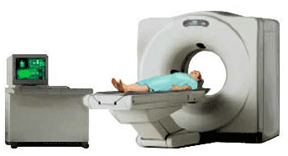 Caution urged over CT scan radiation doses, NHS UK, 15 Aug 14
BBC News reports on a sharp rise in the number of CT scans being performed, exposing people to the potential health risks of radiation.
However, as The Daily Telegraph says, it is not possible to calculate the cancer risk due to exposure to CT scans because there is a lack of data.
These media stories follow the publication of a report by theCommittee on Medical Aspects of Radiation in the Environment (COMARE). COMARE has reviewed trends in the use of CT scans in the UK. The review weighs up the risk-benefit balance of using CT scans, and considers ways to obtain the best quality scan image while minimising the necessary radiation dose.
The COMARE report sets out good practice guidance, encouraging doctors to take a more “proactive approach” to protecting patients and reducing radiation doses.
The committee recommendations cover equipment and procedures already in place, but also note there are dose reduction features available on some of the newer CT scanning machines that should be considered when new equipment is purchased.
What is COMARE and why is it looking at CT scans?….…
only 15% of our radiation exposure comes from medical sources. However, it has still increased from 0.33mSv per person per year in 1997, to 0.4mSv in 2008.
CT scans account for much of this exposure. ……..The report says there has been wider use of CT scans among younger people and children, whose tissues may have greater sensitivity to radiation. They also, of course, have a longer lifespan ahead of them in which potential harmful effects may be observed…..
70% of indications for CT scans recommended by guidance relate to benign (non-harmful) or potentially benign conditions. It says that CT scans are increasingly being used as a standard investigation, replacing other conventional ways of detecting health problems.
There are potential risks related to radiation…….
What does the COMARE report recommend?……..http://www.nhs.uk/news/2014/08August/Pages/caution-urged-over-use-of-ct-scan-radiation-doses.aspx
Relocating Trident nuclear missile systems from Scotland could be afforded
Trident missiles ‘could be relocated to Plymouth from independent Scotland‘ Devonport is obvious alternative to Faslane for Britain’s nuclear missiles, says Rusi thinktank, despite risk of ‘accidental ignition’ Richard Norton-Taylor The Guardian, Thursday 14 August 2014 There would be no insurmountable technical or financial obstacle to relocating Britain’s Trident nuclear missile base to England out of an independent Scotland, a report by a leading thinktank says on Thursday.
Any local opposition might delay but not stop relocation, and the favoured site would be Devonport in Plymouth, it says.
Some opponents of Scottish independence have suggested it would mean the end of the Trident nuclear weapons system and that the cost of moving the submarine base at Faslane and the nuclear warhead depot at Coulport would be prohibitive.
The study by the Royal United Services Institute (Rusi) says that relocating Trident would add up to £3.5bn to the cost of retaining the UK’s nuclear forces. The cost of the overall nuclear deterrent programme over 25 years is estimated to be £80bn………
The study acknowledges there would be safety concerns: “Introducing nuclear-armed [submarines] to Devonport will unavoidably introduce a new risk that an accidental ignition of one or all of a submarine’s Trident D5 missiles could spread radioactive material over some of Plymouth’s 260,000 inhabitants.”
Though there would be opposition on safety grounds, it notes that the Ministry of Defence is reported to have waived safety requirements at Coulport in the 1970s to allow that base to continue operating……>It adds: “The various challenges of relocation would probably trigger a wider national discussion in the [rest of the UK] on whether or not the strategic benefits of retaining nuclear weapons exceeded the costs involved.” http://www.theguardian.com/uk-news/2014/aug/14/trident-missiles-relocate-plymouth-independent-scotland-rusi-report
Independent Scotland would scrap Trident nuclear deterrent, save tax-payers £billions
Trident nuclear deterrent would be scrapped by an independent Scotland Rt August 07, 2014 Scottish voters face the choice between a multibillion-pound tax bill to fund a new generation of nuclear weapons, or the chance to completely disarm in an independent Scotland.
Veterans Minister Keith Brown warned Scottish taxpayers could face an almighty burden if the UK Government decides to renew the program in 2016. In a move that could garner greater support for Scottish independence, the Scottish government set out plans to remove Trident from Scotland if September’s referendum secures a ‘Yes’ vote.
Speaking during a debate at Holyrood, Brown said the decision on renewal “appears to have already been made,” with the Conservatives, Liberal Democrats and Labour backing the retention of Trident. He also said the cost of renewal will also have implications for the UK’s conventional defense forces.
“The Scottish Government position is that Trident should be removed from an independent Scotland by 2020 – before we are hit with a share of the further £100 billion in lifetime costs, at 2012 prices, which are estimated for its replacement,” he said.
“We will also propose a constitutional prohibition on nuclear weapons being based in Scotland, ensuring they would never return.”
The Trident Commission reports that taxpayers will be spending nearly £4 billion a year on nuclear weapons at 2012 prices, when spending reaches its peak in the next decade. This is the equivalent of almost one third of the entire current defense budget. The costs would impact on other defense spending, such as helicopter support and equipment for troops.
“That is money which could and will be far better spent on other priorities – something underlined by statistics showing one million people in Scotland are living in relative poverty,” added Brown……..http://rt.com/uk/178692-trident-scrapped-independent-scotland/
PRISM – Power Reactor Innovative Small Modular, dangerous and produces toxic wastes
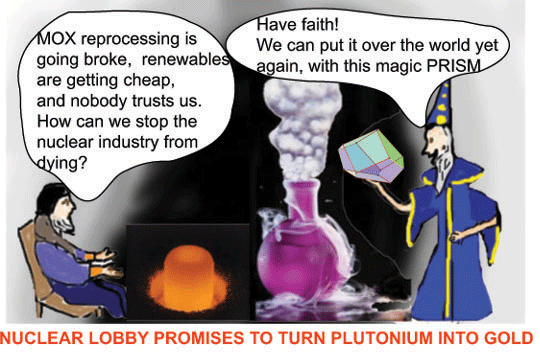
Nuclear power would come in far too late to affect global warming
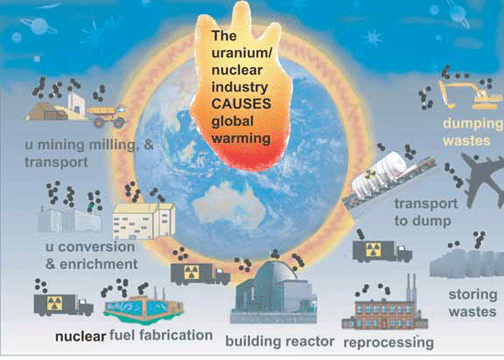
Britain’s intractable and expensive problem of accumulating nuclear waste
 Britain’s nuclear waste, a problem proving hard to bury, The Conversation, Stuart Haszeldine Professor of Geology at University of Edinburgh 1 Aug 14
A proposal for radioactive waste to appear at a burial site nearby, would be likely to fill the great majority of the UK population with thoughts of danger, cancer – and falling house prices. This illustrates the huge problem of public misperception to overcome when disposing of radioactive waste. Britain’s nuclear reactors have generated low-carbon electricity since 1956, in doing so creating around 260,000m3 (about the size of 700 double-decker buses) of intermediate-level wasteand 3,000m3 of highly radioactive high-level waste, as well as spent fuel, plutonium and uranium. The price for decommissioning past and existing nuclear power plant and disposing of that waste is around £70 billion – the single largest item of expenditure for the UK Department of Energy and Climate Change.
What to do with radioactive waste is a problem that has so far proved to be intractable to successive generations of civil servants and ministers. In the mid-1970s, it was decided that deep burial would provide the optimum secure solution.
Here, radioactive waste would be packaged and contained for one million years, sealed by multiple chemical and physical barriers within a repository dug out around 500 metres below ground level. A serious attempt was made to investigate a site in West Cumbria close to Sellafield in the 1990’s, but that foundered on the complexity of the geology and flow of deep groundwater, making it difficult to predict how well sealed the waste would be into the far future……….
Another review and public consultation was undertaken during 2013-14, from which emerged the White Paper “Implementing Geological Disposal” published in July 2014. The results show the government has done some serious listening, and it provides some distinctly new approaches.
First, a new body Radioactive Waste Management Ltd will be created to pursue a disposal site. The company will be wholly owned by the government and could propose more than one facility for different types of waste. This has been tried in the 1980s and 1990s with UK Nirex – a limited company wholly owned by UK government, which spent £400m investigating just one site. Can you spot any difference? So how this operates will be more important than the definition.
Second, the government states it is keen to “listen and respond to views and concerns”. Yet in the future this search will now become defined as a nationally significant infrastructure project, which means that many powers of local people to decide or influence could be restricted or removed. Specifically, the control and influence of local councils has been removed, combined with a statement that no tier of government will have the right to veto a project. So the responsibility of regional council authorities for managing this waste, and the associated road and rail and excavation infrastructure is also removed.
Third, the search for a site will become national, with a two-year period of geological survey and screening to identify suitable regions (not specific sites). Identifying secure regions may become difficult if the extensive fracking of England goes ahead for shale gas and oil, as, any effect on the underlying geology could affect a site’s long term secure storage potential………
Potentially the most significant statement of all comes from the secretary of state for energy and climate change, Ed Davey, stating that arrangements for waste disposal have to be in place before planning consent will be given for new nuclear power stations. Does this mean that one or more sites need to be specifically identified before construction can start on the new nuclear reactors planned at Hinkley Point and elsewhere? If formal discussions with new volunteers do not even start until 2016, and could conclude as late as 2030 – by which time Hinkley Point C should be generating power – that seems impossible.
Perhaps ministers of the future be satisfied merely to know that the UK “has a plan”? If the past is any guide to the future, relying on such a plan didn’t help to find a nuclear mausoleum in 1978, 1996, or 2012. https://theconversation.com/britains-nuclear-waste-a-problem-proving-hard-to-bury-29917
UK White paper – Implementing Geological Disposal
Written statement to Parliament UK
Publication of Implementing Geological Disposal White Paper 2014
- Department of Energy & Climate Change and The Rt Hon Edward Davey MP
- Delivered on:
- 22 July 2014
- History:
- Published 24 July 2014
- Part of:
- Managing the use and disposal of radioactive and nuclear substances and waste, Energy, Environment and Public
 safety and emergencies
 - Statement by Edward Davey on the publication of a white paper on geological disposal.
I am today publishing a White Paper on implementing geological disposal of higher activity radioactive waste.The White Paper – Implementing Geological Disposal –follows a public consultation that my department carried out during 2013 on potential amendments to the existing siting process established in 2008 for a geological disposal facility (GDF) and reflects key messages from that consultation, as well as lessons learned during the previous siting process.
The UK Government remains committed to geological disposal as the right policy for the long-term, safe and secure management of higher activity radioactive waste……….
- ……….With regard to new nuclear power, UK Government policy is that, before development consents for new nuclear power stations are granted, I will need to be satisfied that effective arrangements exist or will exist to manage and dispose of the waste they will produce…….
- The White Paper is issued jointly by the UK Government and the Northern Ireland Executive. The Welsh Government is currently considering a wider review of its higher activity radioactive waste management policy. The Scottish Government has a separate higher activity radioactive policy.
Today I am also publishing the latest annual report on the geological disposal programme, covering April 2013 to March 2014. This will be laid in the libraries of the House. https://www.gov.uk/government/speeches/publication-of-implementing-geological-disposal-white-paper-2014
1 This Month





PLEASE OPPOSE HR 8255 AND S.3639 – bills would accelerate satellite deployment, with no environmental review or safeguards – https://ncstd5li.quorum.us/campaign/169331/
To see nuclear-related stories in greater depth and intensity – go to https://nuclearinformation.wordpress.com
-
Archives
- October 2026 (58)
- September 2026 (339)
- August 2026 (330)
- July 2026 (355)
- June 2026 (287)
- May 2026 (306)
- April 2026 (356)
- March 2026 (251)
- February 2026 (267)
- January 2026 (308)
- December 2025 (358)
- November 2025 (359)
-
Categories
- 1
- 1 NUCLEAR ISSUES
- business and costs
- climate change
- culture and arts
- ENERGY
- environment
- health
- history
- indigenous issues
- Legal
- marketing of nuclear
- media
- opposition to nuclear
- PERSONAL STORIES
- politics
- politics international
- Religion and ethics
- safety
- secrets,lies and civil liberties
- spinbuster
- technology
- Uranium
- wastes
- weapons and war
- Women
- 2 WORLD
- ACTION
- AFRICA
- Atrocities
- AUSTRALIA
- Christina's notes
- Christina's themes
- culture and arts
- Events
- Fuk 2022
- Fuk 2023
- Fukushima 2017
- Fukushima 2018
- fukushima 2019
- Fukushima 2020
- Fukushima 2021
- general
- global warming
- Humour (God we need it)
- Nuclear
- RARE EARTHS
- Reference
- resources – print
- Resources -audiovicual
- Weekly Newsletter
- World
- World Nuclear
- YouTube
-
RSS
Entries RSS
Comments RSS

