UK government secretly questioning whether Hinkley Point C nuclear power project will even go ahead at all
 The trouble with Hinkley’s reactor design, Energy Desk, 20TH NOV 2014 Doug Parr I am beginning to feel a bit like the Kremlinologists of old, who used to try to work out what was really going on in the heart of the massive Soviet empire – the Kremlin – from the crumbs of news or gnomic statements that emerged from the edifice.
Except the focus is (as the Financial Times christened it) the biggest and most controversial infrastructure project in Europe, Hinkley Point C nuclear power project.
Given UK consumers are on the hook for an undiscounted £37billion of subsidy to this project, you’d think democratic principles would require that all developments were subject to full public scrutiny. But no; it’s all happening behind closed doors and we have to do the Kremlinology thing.
A few new scraps of information have emerged that do suggest the project is far from going swimmingly. There are 3 main points.

First, the reactor design, the European Pressurised water Reactor (EPR) isn’t very good. A nuclear engineer now affiliated to University of Cambridge recently described it as ‘unconstructable’.
Further understanding of the weakness of the EPR design come from the actual experience of trying to build it. The French project in Flamanville has announced further delays and will now take a decade to build instead of the original timetable of 5 years.
The other EPR under construction in Europe is in Finland at Olkiluoto. Construction started in 2005 was originally scheduled complete in 2009, but earlier this Autumn it was announced it will now be almost a decade late in 2018, if there are no more delays. It’s not easy building an EPR.
Secondly, the other observation the Cambridge engineer had was that the Chinese – who are experimenting with building several models of reactor – appear to have rejected it for their future nuclear programme. This is a little hard to square with what the Chinese view of the Hinkley project is, because the Chinese state-backed companies China General Nuclear and China National Nuclear Corporation reportedly want a greater share of the supply chain contracts……..
EDF are turning to other potential investors such as Saudi Arabian state-controlled Saudi Electric………..
. Questions have already been raised about the how an independent regulator would police standards with Chinese company involvement………
it turns out that without telling anyone, the UK government has been quietly questioning whether Hinkley will go ahead after all, or worrying if it does go ahead that it might be years late (that Kremlinology thing again)…….http://www.greenpeace.org.uk/newsdesk/energy/analysis/trouble-hinkley
Radioactive release to air resulting from fire at Dounreay nuclear power station.
 Dounreay nuclear plant fire led to ‘unauthorised’ radioactivity release Investigation identifies ‘unacceptable practices by staff’ relating to 7 October fire at site being decommissioned , Guardian, Terry Macalister, 22 Nov 14
 The nuclear plant has been censured by safety regulators after admitting human error led to the release of radioactivity into the atmosphere.
The criticism comes just weeks after another nuclear plant, Sellafield in Cumbria, was also tackled by the safety regulator over its management of asbestos while pictures emerged of badly corroded storage ponds there.
Environmentalists said the problems highlighted dangers from building a new generation of nuclear plants which however well designed would be vulnerable to human fallibility………
Dounreay Site Restoration Limited (DSRL), controlled by a consortium involving the engineering group Babcock, is involved in a £1.6bn contract to dismantle Dounreay, a prototype “fast reactor” built to experiment with nuclear fission in the 1950s and 60s……….

John Sauven, executive director of Greenpeace UK, said the problems at Dounreay were disturbing. “Until we can clone enough popes to staff all the world’s nuclear reactor control rooms, there will always be a fallible human component in nuclear power stations. This worrying news demonstrates why it’s important to remember that even a reactor design which looks safe on paper can never completely design out the actions of human beings. Its why renewable energy always scores better on safety, because far less can go wrong.”
The Nuclear Free Local Authorities Secretariat, the local government voice on nuclear issues, described the Dounreay incident as “alarming” and called for more information.
“To hear that critical staff were not fully conversant in fire safety procedures and that a release of tritium occurred; putting into danger staff and the wider public; is quite disgraceful at such a sensitive nuclear site like Dounreay,” said councillor Mark Hackett, the NFLA’s chair.
The nuclear industry has had a difficult week after Areva, one of the companies involved in the management of Sellafield, issued a profit warning and said it might need a cash injection……..http://www.theguardian.com/environment/2014/nov/21/dounreay-nuclear-plant-fire-radioactivity
Delay after delay , and soaring coasts, for Britain’s new nuclear build plans
How the UK’s nuclear new-build plans keep getting delayed 20 Nov 2014, The Carbon Brief Simon Evans When will the UK get a new generation of nuclear power plants? Doubts surfaced again today with the Times reporting a “secret government review” into French firm EDF’s plan to build a new plant at Hinkley Point in Somerset.
The review is costing tens of millions, the Times says, and is trying to establish whether EDF can complete the new plant by 2023 as it has promised.
The news follows an announcement from EDF that its Flamanville plant in Normandy is facing further delays. The project uses identical designs to the Hinkley scheme.
Flamanville was supposed to take five years to build and begin operating by 2012. Instead it will now take 10 years, and open in 2017. A third identical project at Olkiluoto in Finland is nearly a decade behind schedule.
New nuclear capacity is a key part of UK government plans for decarbonisation. So why is it proving so hard to predict when the UK’s first new nuclear plant for a generation will start operating?
Predicting the future
The Department for Energy and Climate Change (DECC) makes annual projections of the future of the UK’s energy and emissions. It has been publishing these projections for a number of years. We’ve trawled the data going back to 2007 to find out how DECC’s predictions about when we’ll get new nuclear have changed.
First, some history. ………..
It’s worth emphasising of course that the Hinkley Point reactors are not yet under construction. EDF had originally said it would finish building them in 2017, indeed chief executive Vincent de Rivaz said some people would be cooking their 2017 christmas dinner using new nuclear power.
De Rivaz now says the project will be finished in 2023. Preparatory groundwork has already started. Carbon Brief asked EDF when construction of the plant itself will begin and how long it will take to finish. EDF said that level of detail was not yet available.
The cost of UK new nuclear
It isn’t only the finish date that has changed for the UK’s new nuclear plans. The costs have also skyrocketed.
Back in 2008 the white paper on new nuclear in the UK suggested it would cost £2.8 billion to build a first of its kind 1.6 gigawatt plant, with a range of between £2 and £3.6 billion.
The government later said in 2013 that the the Hinkley C project of two 1.6 gigawatt reactors would cost £16 billion. When the European Commission gave the deal the green light in October it said the project would cost £24 billion……….. EDF has delayed its final decision on whether to build at Hinkley Point until after this review has given it the all-clear. Until then, it will not divulge detailed timelines for its plans. http://www.carbonbrief.org/blog/2014/11/how-the-uks-nuclear-new-build-plans-keep-getting-delayed/
The EPR nuclear reactor is a “rotten design that they should have given up on a long time ago”
French Nuclear Giant Areva Says Future Is Uncertain, Prompting a Sell-Off NYT, By DAVID JOLLY and STANLEY REEDNOV. 19, 2014 PARIS “……….The problems at Flamanville and Olkiluoto raise further questions about the future of the EPR reactor design that Areva and EDF are marketing around the world. All of the EPRs under construction including those being built at Taishan in China have run into delays. The giant power stations, for which the designs date to the early 1990s, were supposed to be safer and simpler than earlier nuclear plants, but they are proving fiendishly complex and expensive to build.
Mr. Thomas said the problems with the other EPRs around the world also raised doubts about whether two reactors of this type would be built at Hinkley Point in southwest England, as EDF planned. The European Union recently gave its approval to the project, which will cost at least 16 billion pounds, or $25.1 billion, but EDF still needs to put together an international consortium to finance and build it. http://www.nytimes.com/2014/11/20/business/international/french-nuclear-giant-areva-says-future-is-uncertain-prompting-a-sell-off.html?_r=0
Uk’s new nuclear reactor designs likely to become a financial drain, warns Stephen Chu

“Unless we can learn to build nuclear on schedule and on budget it will be a financial drain. ………
“That is true of all industries. If you build exactly the same its get cheaper, cheaper, cheaper. ……..
Atomic plants being built in Finland and France are much more expensive than forecast and are suffering significant delays but EDF, the company planning to build Hinkley Point C reactors in Somerset, says it will learn from those mistakes. While EDF plans to use an “EPR” design at Hinkley and possibly at Sizewell in Suffolk, other developers in Britain are planning different models……….
UK’s professor Robin Grimes knows who has the money, in the “nuclear debate”
 Why aren’t the industry’s best scientists working to CONTAIN the wastes instead of working flat out and with public money to make EVER MORE?
Professor Grimes came to speak to us outside saying “I’ve never had a demonstration outside where I’ve been speaking before.” He should come to the NW more often! There were only a few of us but listening to his cheerleading for the nastiest most vicious industry on earth, there should have been tens of thousands demonstrating outside…….. Continue reading
Raised incidence of cancers and birth defects in families of British veterans of nuclear bomb tests
 New Study questions Japanese data underpinning current radiation risk model by Christopher Busby
The results of a study of the health of children and grandchildren of British servicemen stationed at the atomic weapons test sites at Maralinga in Australia and Christmas Island in the Pacific will be published in the open peer-reviewed journal Epidemiology this week. Christopher Busby and Mireille Escande de Messieres conducted a case-control and cohort study of 605 children and 749 grandchildren of members of the British Nuclear Test Veterans Association (BNTVA) and compared congenital defects and cancer incidence with 311 control children and 498 control grandchildren of age-matched individuals. Results showed that, compared with controls:
- There was three times the number (105) of miscarriages in wives of veterans.
- There was 9.7 times adverse congenital conditions (57) in veteran children.
- There was 8.4 times adverse congenital conditions (46) veteran grandchildren.
- These rates were confirmed also by comparison with national EUROCAT data.
- The existence of the same highly statistically significant rate in both generations points to genomic instability as likely cause, a trans-generational genomic switch discovered after Chernobyl and shown in animal studies to affect many generations.
- The cause is argued to be Uranium, the main atom bomb constituent, which rained out at the test sites as sub micron particles in “black rain”. Recent research shows Uranium causes genomic effects at very low radiation doses because it binds to DNA and amplifies the radiation damage both through proximity and in other ways.
- Black rain of Uranium was also a feature of the Hiroshima Atomic bomb and Uranium has been measured several kilometers from the Hiroshima epicenter. The authors re-analyse adverse birth outcome rates in the official Hiroshima database and show that rates in the control groups defined in the study as “zero dose” have twice the rate than all Japan for the post A-bomb period.
- The Ministry of Defence, in arguing recent court cases rely upon the fact that dosimeters at the test sites show low doses. However these devices do not register Uranium or other alpha emitters. Uranium was not looked for at the sites.
- The study findings are supported by similar genomic effects found in Iraq populations exposed to Depleted Uranium particles (e.g. Fallujah sex-ratio, cancer and birth defects), USA and UK Gulf veterans, Uranium miners and workers and Navajo and other local populations living near Uranium waste tailings. All of these groups show chromosome defects consistent with their exposures to Uranium.
Speaking from Riga, Latvia, Dr Busby remarks: This multi-generational effect is an unexpected finding. There are implications for the current radiation risk models which legally underpin all nuclear power development and also the use of radioactive weapons. Although weakly radioactive, when ingested and inhaled Uranium has properties which enable it to directly damage DNA in ways that are not incorporated into current legislation. Uranium was not measured at the test sites and is not routinely measured near nuclear sites or in the environments either.
Thorium reactors have very little relevance to strategies for dealing with nuclear waste
 Thorium nuclear reactors are unlikely to take over from uranium ones, and are considered irrelevant to strategies to deal with nuclear wastes ,The Engineer finds 27 October 2014 “……..The Cambridge research will explore the pros and cons of different fuel combinations, including thorium, plutonium and the main material the designers are focusing on, uranium silicide, which is more power dense and so more cost-effective than the uranium oxide currently used.
Parks said that because the I2S is an evolution of existing light water reactor designs it could be brought to market more quickly than other reactors proposed for use with a thorium fuel-cycle, suggesting it could even be deployed within a decade and be installed in old nuclear power stations such as Sizewell B.
However, he also admitted that with current uranium stocks there was no major economic necessity to move to a thorium fuel-cycle at the moment and that such a transition would only happen if the government committed to thorium through a long-term flagship research project.
A paper published by the UK’s National Nuclear Laboratory in March 2012 found that ‘the thorium fuel cycle at best has only limited relevance to the UK as an alternative plutonium disposition strategy and as a possible strategic option in the very long term,’ and recommended ‘a low level of engagement in thorium fuel cycle R&D’.”
UK’s Windscale nuclear disaster spread radiation much further than previously thought
 Windscale fallout underestimated Rebecca Morelle Science reporter, BBC News 6 Oct 2007 The radioactive fallout from a nuclear accident that rocked Britain 50 years ago was underestimated, scientists say.
In 1957, a fire at the Windscale nuclear reactor in Cumbria led to a release of radioactive material that spread across the UK and Europe.
But new research claims the incident generated twice as much radioactive material and could have caused more cancers than was previously thought.
The research was published in the journal Atmospheric Environment. Risky act
The Windscale site was home to Britain’s first two nuclear reactors – the Windscale Piles – which were constructed to produce plutonium and other materials for the UK’s nuclear weapons programme.
But the rush to build them when little was known about nuclear reactors led to what was at the time the world’s biggest nuclear disaster, although it was later dwarfed by Chernobyl and Three Mile Island.
On 10 October 1957, a failure to properly control the temperature of the graphite moderator within the Windscale No 1 pile sparked a devastating fire, which caused radioactive contamination to spew into the atmosphere.
The fire was eventually put out by restricting the air flow, and with water – a risky act which could have caused an explosion – but a radioactive cloud was already spreading far and wide.
At the time of the accident the levels and spread of the radioactive materials was estimated, and measures were put in place to limit radioactive contamination. But a new study carried out by John Garland, formerly of the UK Atomic Energy Authority, and Richard Wakeford, a visiting professor at the University of Manchester, suggests the contamination of the environment may have been much higher………http://news.bbc.co.uk/2/hi/science/nature/7030536.stm
Britain’s Windscale nuclear disaster was bad, but could have been much worse
Windscale Piles: Cockcroft’s Follies avoided nuclear disaster By Duncan LeatherdaleBBC News 4 Nov 14 They were labelled a waste of time and money, but in 1957 the bulging tips of two exhaust shafts rising above Sellafield arguably saved much of northern England from becoming a nuclear wasteland. The towers of Windscale Piles have been a landmark for decades but soon the last of these Cold War relics will be gone.
Cumbria’s skyline will change with the removal of the towers – known as Cockcroft’s Follies – but had they not been in place 57 years ago, the entire landscape may have been drastically different.
Until Chernobyl exploded in 1986, the blaze that ravaged the uranium-fuelled reactor at Windscale Pile One in October 1957 was Europe’s most terrible nuclear disaster. It is still the UK’s worst atomic incident.
Without the filters – installed at the last minute by Nobel Prize-winning scientist Sir John Cockcroft – the effects of the radioactive dust blasted into the Cumbrian air would have been much more devastating……….
On October 10, 1957, a fire was discovered in reactor one. Uranium fuel cells had ignited with the blaze reaching 1,300 C (2,380 F) and workers battled to stop the whole facility exploding.
Men wearing radiation suits used scaffolding pipes to try and push the burning fuel rods out of the graphite reactor.
The high radiation levels meant they could only spend a few hours at the reactor, more volunteers were sought from a nearby cinema.
Water failed to put out the blaze and the fire was only extinguished when operators closed off the air in the reactor room.
The blaze burnt for three days and significant amounts of radioactive material, most notably iodine-131, were released and spread across the UK and Europe.
It is estimated about 240 cases of thyroid cancer were caused by the radioactive leak and all milk produced within 310 square miles (800 square km) of the site was destroyed for a month after the fire.
The level of radioactive material which did escape is estimated to be 1,000 times less than at Chernobyl……….
he decision of health chiefs to order the destruction of milk contaminated by radioactive iodine, which has been linked to thyroid cancer, also prevented these cancers.
“They did some quick calculations and ordered the milk produced in a certain area be destroyed,” he said.
“It would have been a courageous decision but, ultimately, proved to be right, as it stopped a lot of children consuming the radioactive iodine.”
After the fire the chimneys were sealed off. Indeed, 15 tonnes of uranium fuel remains inside still………
Cockcroft’s Follies prevented a catastrophe, but the 1957 fire was nevertheless a dark hour for nuclear in the UK……..http://www.bbc.com/news/uk-england-cumbria-29803990
Why UK politicians covered up the causes of Windscale nuclear disaster
Windscale: A nuclear disaster |
||
|
||
“………..Now tapes of the inquiry into the accident, heard for the first time in a BBC film, reveal the reasons why the politicians covered up the causes of the accident.
 |
Scientists had been warning about the dangers of an accident for some time.
The safety margins of the radioactive materials inside the reactor were being further and further eroded.
“They were running much too close to the precipice,” says Dr Dunworth, a senior manager in the Nuclear Research Laboratory in Harwell, Oxfordshire, who was one of those highlighting the potential dangers.
But the politicians and the military ignored the warnings; instead they increased demands on Windscale to produce material for an H-bomb.
|
A succession of prime ministers since the war had been determined to persuade the Americans to share the secret of their nuclear weapons with Britain.
Prime Minister Harold Macmillan believed that, if Britain could develop an H-bomb on the scale of the Americans’, they would treat it as a nuclear equal and form an alliance.
Even as Tuohy and the Windscale men faced their nuclear nightmare, Macmillan was arranging a summit in Washington where they would announce the Declaration of Common Purpose……..http://news.bbc.co.uk/2/hi/science/nature/7030281.stm
Psychopaths useful as leaders after a nuclear war?

Christina Macpherson’s websites & blogs
A scientific advisor to the Home Office raised the idea as part of plans for how Britain might rebuild after a nuclear attack – in a test exercise where the Home Office envisaged half of Britain facing ‘unimaginable’ destruction from bombs.
Home Office scientific advisor Jane Hogg suggested that psychopaths could be used to maintain order in lawless areas, saying that pscyhopaths tend to be, ‘very good in crises’.
Hogg pointed out that, ‘They have no feelings for others, nor moral code, and tend to be very intelligent and logical.
‘It is… generally accepted that around 1% of the population are psychopath. These are the people who could be expected to show no psychological effects in the communities which have suffered the severest losses.’
Hogg suggested psychopaths might be necessary to shore up numbers, as police would be tied up helping victims in areas which had suffered the most devastation from the blasts.
Newly revealed photos of Sellafield’s decaying nuclear fuel storage ponds
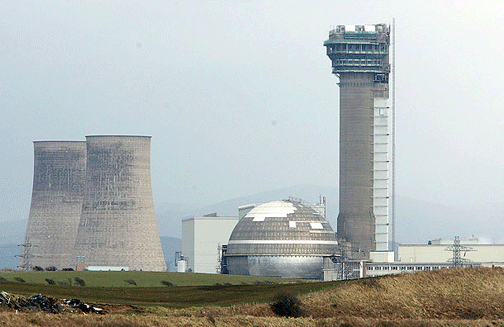 Photographs of Sellafield nuclear plant prompt fears over radioactive risk Nuclear safety expert claims there is ‘significant risk’ due to poor condition of storage ponds containing highly radioactive fuel rods John Vidal and Rob Edwards The Guardian, Thursday 30 October 2014
Previously unseen pictures of two storage ponds containing hundreds of highly radioactive fuel rods at the Sellafield nuclear plant show cracked concrete, seagulls bathing in the water and weeds growing around derelict machinery. But a spokesman for owners Sellafield Ltd said the 60-year-old ponds will not be cleaned up for decades, despite concern that they are in a dangerous state and could cause a large release of radioactive material if they are allowed to deteriorate further.
“The concrete is in dreadful condition, degraded and fractured, and if the ponds drain, the Magnox fuel will ignite and that would lead to a massive release of radioactive material,” nuclear safety expert John Large told the Ecologist magazine. “I am very disturbed at the run-down condition of the structures and support services. In my opinion there is a significant risk that the system could fail.
“It’s like an concrete dock full of water. If you got a breach of the wall by accident or by terrorist attack, the Magnox fuel would burn. I would say there’s many hundreds of tonnes in there. It could give rise to a very big radioactive release. It’s not for me to make comparisons with Chernobyl or Fukushima, but it could certainly cause serious contamination over a wide area and for a very long time.”
Gordon Thompson, executive director of the Institute for Resource and Security Studies in Cambridge, Massachusetts, who is an expert at assessing radiological risk, said: “[Sellafield] contains large inventories of radioactive material that could be released to the environment in a variety of ways. The site’s overall radiological risk has never been properly assessed by the responsible authorities. [The] photos, showing disgracefully degraded open-air ponds at Sellafield, indicate that a thorough assessment of risk is overdue.”
The images, taken over a period seven years and leaked via a local nuclear watchdog group to the Ecologist, are said to show two ponds that were commissioned in 1952 and used until the mid-1970s as short-term storage for spent fuel until it could be reprocessed, producing plutonium for military use. One is open to the elements……..
UK Navy’s nuclear facilities at Faslane and Coulport have appalling safety record

 Revealed: chilling nuclear safety blunders plague Scots bomb base, Questions to be raised in house of commons as Mod comes under fire Herald Scotland, by Rob Edwards Environment Editor Saturday 25 October 2014 There has been a sharp rise in the number of “chilling” safety blunders at the nuclear bomb and submarine bases on the Clyde, according to internal reports from the Ministry of Defence (MoD). In the last five years there have been 316 “nuclear safety events”, 2044 fire alarm incidents and 71 fires at the Royal Navy’s controversial facilities at Faslane and Coulport near Helensburgh.
There have also been more than 3000 “near miss” industrial accidents, a positive test for illegal drugs and a series of difficulties with wild animals.
The revelations have been described as “chilling” by Angus Robertson MP, the Scottish National Party’s leader at Westminster and its defence spokesman. He is planning to raise them urgently in the House of Commons, and is demanding action from the MoD.
The new figures showed that nuclear safety breaches at the Clyde bases were “widespread”, he said……….
Independent nuclear expert John Large was scathing about the MoD’s safety standards. He said: “From these reports, one gets the distinct impression that health and safety operations at HMNB Clyde are more akin to those practiced in a backstreet car repair shop than a naval base servicing advanced and armed warships, some of which are carrying nuclear weapons and propelled by nuclear reactors.”
Safety problems were increasing, the number of false fire alarms was “totally unacceptable” and the MoD reports were “muddled and at times misleading”, Large alleged.
He added: “The regulation of health and safety matters at the base should be taken from the military and put squarely under the control of a civilian operated regulatory regime.”
The Scottish Campaign for Nuclear Disarmament accused the MoD of failing to gain control of the risks of handling nuclear weapons and submarines.
“The sharp rise in nuclear weapons safety events is particularly worrying,” said the campaign’s co-ordinator, John Ainslie. “If the safety record continues to decline, then it is only a matter of time before there is a major problem.”…….http://www.heraldscotland.com/news/environment/revealed-chilling-nuclear-safety-blunders-plague-scots-bomb-base.25691690
UK’s National Audit Office investigating subsidy price for Hinkley nuclear power electricity
 Hinkley C deal goes under scrutiny again Somerset County Gazette, 23 October 2014
ANOTHER investigation into the controversial Hinkley C deal has begun.
Just two weeks ago, the European Commission approved plans for the £16bn nuclear power plant.
They had been investigating whether the subsidy deal between energy company EDF and the Government constituted as illegal State aid.
While the project was approved, the National Audit Office has now begun investigating the deal to make sure the subsidy price of £92 a megawatt hour represented value for money.
The NAO is a financial watchdog which scrutinises public spending on behalf of Parliament……….
The Stop Hinkley Campaign welcomed the news about the investigation. Spokesperson Allan Jeffrey said: “This is an extraordinarily bad deal, locking consumers into high prices until almost 2060.
“Worse still, it will use up most of the money available to subsidise non-fossil fuel energy, leaving almost nothing available for renewables at a time when their costs are plummeting.
“The European Commission’s ill-thought through decision has turned UK Energy Policy into even more of a dog’s breakfast than it was to begin with…….
Energy supplier Ecotricity has said it is considering taking legal action against the deal along with the Austrian Government and Germany………http://www.somersetcountygazette.co.uk/news/11554761.Hinkley_C_deal_goes_under_scrutiny_again/
1 This Month





PLEASE OPPOSE HR 8255 AND S.3639 – bills would accelerate satellite deployment, with no environmental review or safeguards – https://ncstd5li.quorum.us/campaign/169331/
To see nuclear-related stories in greater depth and intensity – go to https://nuclearinformation.wordpress.com
-
Archives
- October 2026 (58)
- September 2026 (339)
- August 2026 (330)
- July 2026 (355)
- June 2026 (287)
- May 2026 (306)
- April 2026 (356)
- March 2026 (251)
- February 2026 (267)
- January 2026 (308)
- December 2025 (358)
- November 2025 (359)
-
Categories
- 1
- 1 NUCLEAR ISSUES
- business and costs
- climate change
- culture and arts
- ENERGY
- environment
- health
- history
- indigenous issues
- Legal
- marketing of nuclear
- media
- opposition to nuclear
- PERSONAL STORIES
- politics
- politics international
- Religion and ethics
- safety
- secrets,lies and civil liberties
- spinbuster
- technology
- Uranium
- wastes
- weapons and war
- Women
- 2 WORLD
- ACTION
- AFRICA
- Atrocities
- AUSTRALIA
- Christina's notes
- Christina's themes
- culture and arts
- Events
- Fuk 2022
- Fuk 2023
- Fukushima 2017
- Fukushima 2018
- fukushima 2019
- Fukushima 2020
- Fukushima 2021
- general
- global warming
- Humour (God we need it)
- Nuclear
- RARE EARTHS
- Reference
- resources – print
- Resources -audiovicual
- Weekly Newsletter
- World
- World Nuclear
- YouTube
-
RSS
Entries RSS
Comments RSS

