Communities back wind power as UK gets record levels of electricity from wind energy
Record wind power levels as new research shows clear majority back wind energy projects near them, Renewable UK, 9 December 2014
RenewableUK was today celebrating a new daily record amount of electricity generated from wind. Official National Grid figures showed that on Sunday 7th December an average of 7.315GW of power was produced by wind farms. The previous record was 7.234GW. This means that the equivalent of 43% of all GB homes were powered by wind on Sunday.
RenewableUK also commented on research carried out by Accent for the Energy Institute and New Power Magazine which showed that 61% of people would accept a wind turbine, or several turbines, within five miles of their home. The research, which was carried out in November, among householders throughout the UK, found that only 24% of people would welcome a gas extraction site with possible fracking near them, and just 18% backed local nuclear. The only technology with more popular support than wind was solar PV.
The survey also showed that 54% of UKIP voters, and 57% of Conservative voters support wind energy within 5 miles of their home, despite the leaders of their parties opposing onshore wind.
: http://www.renewableuk.com/en/news/press-releases.cfm/2014-12-09-record-wind-power-levels-as-new-research-shows-clear-majority-back-wind-energy-projects-near-them#sthash.PmKPUfot.dpuf
Anglesey Council worried about lack of information on planned Wylfa Newydd power plant plant

 Anglesey nuclear plant plans lack detail, council boss says, BBC News 8 December 2014
Concerns about the lack of detail and impact a nuclear power station could have on Anglesey have been raised by the island council’s chief executive.
Richard Parry Jones has sent a 10-page letter to Horizon bosses calling for more detailed information about their Wylfa Newydd power plant proposals.
Horizon – a subsidiary of Hitachi which bought the site in 2012 for about £700m – put its plans on show this autumn.
It said it was disappointed by the concerns raised by Anglesey council……..
Mr Jones said the “lack of detail” within the public consultationinformation is “concerning given the sheer scale of Wylfa Newydd and its potential impacts on Anglesey and its communities”.
Councillors agreed that the chief executive send a “frank, but constructive” letter outlining the concerns, including:A lack of detail surrounding workforce numbers – essential from a skills, training and education perspective
A lack of detail on estimated numbers and profiles of employees from outside Anglesey – to gauge the project’s impact from a social, community and Welsh language perspective
A lack of explicit commitment shown to promoting local employment opportunities and local supply chain
Little or no recognition of potential effects Wylfa Newydd will have on existing jobs, bed spaces, facilities and services
A need for considerable more work to establish the impacts on Anglesey communities, especially those within a 5km radius of the main site, and how to mitigate them http://www.bbc.com/news/uk-wales-north-west-wales-30385097
The Professor of Dodgy Pro Nuclear Arguments – Wade Allison
 Oxford Professor in Japan: Well so what if Fukushima had triple meltdown? People enjoy effects of radioactive contamination; Sunshine is much more dangerous; Effect of radiation same as oxygen — Former WHO Official: “The man is dangerous… He’s a crank” (VIDEOS)
Wade Allison, Emeritus Professor of Physics at Oxford University, Foreign Correspondents Club of Japan, Dec 3, 2014 (emphasis added):
- 7:30 — Nuclear protestors have no good arguments for saying that nuclear is dangerous, this is demonstrated by what happened at Fukushima.
- 19:30 – The scientific question is, ‘Why is radiation so safe?‘ Because it is very powerful and so that’s very surprising… That’s the job biology does… Any life form that did not look after the effects of radiation and oxygen, which does the same kind of thing, would fail.
- 27:30 — On holiday… we should take [children] around a nuclear power station.
- 31:00 — What can we do to explain… to people and shove under their noses?
- 39:15 – That excellent film Pandora’s Promise, anybody who hasn’t seen that should.
- 45:00 — [Bury the used nuclear fuel] anywhere, anywhere… Fission products [have a] half-life is 30 years or so… it quickly becomes the same activity as the stuff that you dig out of the ground. You need a mine or a hole in the ground which is going to contain stuff for 500 years — but it doesn’t have to be perfect. Here in Japan, people go to Onsen, and enjoy the effects of radioactive contamination of groundwater…everybody’s very happy to do that. That’s what they do on holiday.
- 47:30 — Triple meltdown? Where did you get those words from? Hollywood? What do you mean by a triple meltdown? So what? I’m telling you — so nothing, very much…Triple meltdown, well so what?… It wasn’t a tragedy.
- 52:45 — The sunshine… that’s much more dangerous… than nuclear radiation.
- 1:01:45 — We need people’s confidence. We need to talk to children in school.
- 1:04:45 — The idea that special precautions have to be taken just doesn’t wash,nuclear is not especially dangerous. It’s not as dangerous as fire.
Allison at the Institute of Physics: New safety levels for human radiation exposure are suggested… 100 mSv in total in any month; 5,000 mSv as a total of whole-of-life exposure.
Keith Baverstock, head of the World Health Organization’s Radiation Protection Program for Europe (1991-2003), Foreign Correspondents Club of Japan, Nov 20, 2014:
- 20:00 — Question: My name is Hiroyuki Fujita, [inaudible] Shimbun editor/writer… According to [Dr. Wade Allison], so called low dose radiation, 100 mSv or less, not so bad for human health… all the scientific knowledge is rooted on the experience of the fruit fly.
- 21:00 – Wade Allison, do you know what his scientific expertise is? Physics… not public health, not medicine, not biology… I did a review of [his] book… I said his book is highly entertaining… it is fiction… We don’t have to rely on fruit flies to know what the effects of radiation are. We know what they are on human health. We have a lot of epidemiological information — which he ignores. I think the man is dangerous, I think you are putting yourself in a dangerous position if you believe him… He’s a crank.
Watch Allison’s FCCJ presentation here | Watch Baverstock’s FCCJ presentation here
Scotland could use planning powers to reject new nuclear build
George Osborne’s latest nuclear deal is another step in the wrong direction The Conversation, Peter Strachan Strategy and Policy Group Lead and Professor of Energy Policy, Department of Management at Robert Gordon University Alex Russell Head of Department of Management and Professor of Petroleum Accounting at Aberdeen Business School at Robert Gordon University 5 Dec 14
The EU challenge
Westminster’s claim that Hinkley Point C would cost £16 billion has been countered by experts at the EU who have placed the cost at nearer £25 billion (and note the original estimate was £10 billion). The deal involves paying twice the current price for electricity, with UK taxpayers and electricity consumers locked into a binding contract for an extraordinary 35 years.
The European Commission raised concerns that Westminster had breached state aid rules in the subsidies being offered to finance the project. Energy secretary Ed Davey’s huge sigh of relief in October, when the EC controversially gave the green light for the project, may be premature: it will be challenged by the Austrian government in the EU courts.
Money pits
Even if these obstacles can be surmounted, the financial risks to these kinds of projects are simply huge……….
Whose projects should they be anyway?
Another issue is who should provide these projects. With Areva and EDF both under French state control, critics have said that the project amounts to the UK treasury writing a “blank cheque” to the French government. The same could be said of China General Nuclear Corporation and China National Nuclear Corporation, who came onboard last year.
EDF is also reputedly planning to hand over an additional and significant financial stake in Hinkley Point to other foreign corporations. Saudi Electric is reportedly in talks, while the Qataris have confirmed an interest too. British involvement in the project has been non-existent since the UK’s Centrica left a cavernous hole in the project by ceasing involvement in early 2013. Should de facto control of such an important element of our national electricity security be placed in the hands of foreign corporations?
Taken together, these sets of very deep concerns mean that nuclear can only be an option of last resort. To the astonishment of many, the Telegraph recently reported that the former UK chief scientist and nuclear “salesman”, has arrived at the same conclusion.
Given this analysis, the Scottish government would appear more than justified in using its extensive planning powers to reject new nuclear build. In light this and the fragility of future fracking prospects, Westminster would be wise to rethink its national energy policy and give more and not less support to onshore and offshore wind and other marine renewables. https://theconversation.com/george-osbornes-latest-nuclear-deal-is-another-step-in-the-wrong-direction-35054
“Stop uranium mining, transportation, enrichment and nuclear fuel production”
 “Stop uranium mining, transportation, enrichment and nuclear fuel production”, Indymedia Submitted by Anonymous (not verified) on Thu, 04/12/2014 Münster, Germany, 30 November 2014 – – At a two-day meeting here around 50 anti-nuclear activists from Russia, France, The Netherlands and from across Germany demanded an immediate end to the countless transports of uranium which ensure nuclear operations in Europe and elsewhere round the world.
They also demanded an end to uranium mining and processing everywhere. They demanded that the German government close down uranium enrichment in Gronau and production of nuclear fuel in Lingen.
Both factories are not included in the shutdown of nuclear power production planned for Germany and supply power stations around the world.
The conference participants intensively discussed the considerable dangers created by the mostly secret uranium transports.
They tracked them from mining in Kazakhstan and Uzbekistan through Russia across the Baltic Sea through the Kiel Canal to the central uranium transportation hub in the port of Hamburg.
From there the uranium concentrate rolls by train through Lower Saxony, Bremen, North-Rhine Westphalia and the Mosel/Saar region for processing in Narbonne-Malvési and Pierrelatte in southern France.
As uranium hexafluoride it then moves back to Germany for enrichment in Gronau or not far into The Netherlands at the same kind of plant at Almelo.
The next step is the Areva fuel production in Lingen, before the final products often move again through Hamburg or also Rotterdem to all over the world.
The conference condemned as unacceptable that in many ways France, Germany, Russia and The Netherlands continue to enable a future for the nuclear industry.
The activists also demand determined action from the German state governments to stop the growing number of uranium transports which endanger countless people……………
The conference ended on 30 November with protests outside the Gronau and Lingen plants.
In Lingen a woman representing the French anti-nuclear umbrella organisation, Réseau “Sortir du nucléaire” called for immediate closure of the Areva fuel factory. Areva is a globally operating French corporation.
Areva currently has big financial problems and the Lingen operations had to be downsized some weeks ago because of serious technical problems.
The activists announced more joint protects against uranium transportation and the uranium industry as a whole.
More information in German at www.urantransport.de, www.sofa-ms.de, www.robinwood.de, www.wise-uranium.org,www.umweltfairaendern.de
Pictures of the conference at
http://www.anti-atom-aktuell.de/fotos/20141129-internationales-urantrans… https://indymedia.org.au/2014/12/04/stop-uranium-mining-transportation-enrichment-and-nuclear-fuel-production
Britain’s aging nuclear reactors getting near to closing time
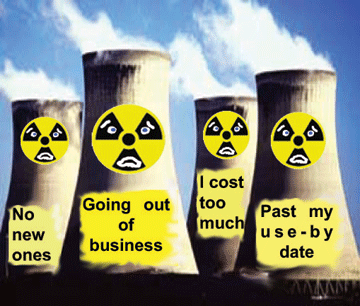 The coming nuclear crisis: All but one of Britain’s ageing reactors ‘will need to close in 15 years’ , The Independent, 5 Dec 14 All but one of Britain’s ageing fleet of nuclear reactors will have to be closed down within 15 years due to concerns over their economic viability or safety, a panel of experts has warned…….. Professor Williams warned that there will be a point when either it will be uneconomic to continue operating a given nuclear reactor, due to the additional maintenance work needed, or if it becomes too unsafe……http://www.independent.co.uk/news/uk/politics/the-coming-nuclear-crisis-all-but-one-of-britains-ageing-reactors-will-need-to-close-in-15-years-9896597.html
UK government provides financial guarantee for giant Moorside nuclear project
 UK agrees finance guarantee deal for nuclear project http://uk.reuters.com/article/2014/12/02/uk-britain-politics-nuclear-idUKKCN0JG00320141202 LONDON Tue Dec 2, 2014 (Reuters) – Britain said on Tuesday it had agreed a preliminary deal to provide a financial guarantee to help fund the development of Europe’s largest nuclear power project, in northwest England.
The 3.4-gigawatt Moorside project, a joint venture between Japan’s Toshiba and France‘s GDF Suez, could provide nearly 7 percent of Britain’s projected electricity needs and create up to 21,000 jobs, the companies say.
say.
“The Guarantee Scheme is another way in which we can help companies to make the huge investment that building new nuclear power involves,” Finance Minister George Osborne said in a statement.
The scheme, which was introduced in 2012, is set to help the Moorside developers gain external project finance to cover the upfront costs of building a nuclear plant.
NuGen, the name of the Toshiba/GDF Suez joint venture, welcomed the agreement. he Moorside plant will be powered by three nuclear reactors by the end of 2026 to be provided by Toshiba’s Westinghouse unit, with the first reactor expected to start operating by the end of 2024.
NuGen said it plans to make a final investment decision for the Moorside project in 2018.
Britain is counting on replacing its ageing fleet of nuclear reactors with new stations. The government is already providing loan guarantees to France’s EDF for a 16 billion-pound nuclear plant due to be built in southern England.
(Reporting by William James and Karolin Schaps; editing by Robin Pomeroy and Jason Neely)
The spiralling costs of Britain’s Project Pegasus nuclear plant
 MoD orders review into spiralling cost of Project Pegasus nuclear plant The Independent, Mark Leftly, 30 Nov 14 The Ministry of Defence has ordered a review into the costs and construction timetable of a highly sensitive manufacturing plant that will enrich uranium for Trident nuclear missiles, amid fears the budget had spiralled out of control.
Project Pegasus, a £634m facility to be built at the Atomic Weapons Establishment (AWE) in Berkshire, is said to be struggling over costs and scheduling. The MoD had said that Pegasus would be completed between 2016 and 2020.
The AWE, which manufactures and maintains Britain’s nuclear deterrent, and the MoD played down the review, but a senior nuclear industry source said it was “extremely serious”. The source added: “Certainly, this is an issue that is going to run and run – and, don’t forget, the Government has a golden share, meaning it can re-procure the contract.”
The golden share is a tiny stake the Government has kept in AWE while a private sector consortium comprising the UK’s Serco and US engineering giants Lockheed Martin and Jacobs Engineering manages the site over 25 years. It permits the government of the day to outvote automatically the three main shareholders in order to protect the national interest. It also grants the MoD the power to strip the consortium of the deal……….
Dr David Lowry, a research policy consultant, has written to the Office for Nuclear Regulation to demand to know how it will cover the staff shortage. Colin Tait, the ONR’s principal inspector, acknowledged there is “increasing competition for scarce nuclear-competent engineers and scientists across the sector”, but said recruitment is yielding results.
Dr Lowry is concerned the shortage is occurring as the Government embarks on building a new fleet of nuclear reactors. “If the Government expands the new build nuclear programme, there would be more pressures on staff and even more stress on an already stressed nuclear regulator.”http://www.independent.co.uk/news/uk/politics/mod-orders-review-into-spiralling-cost-of-project-pegasus-nuclear-plant-9893206.html
Nuclear power outdone by renewable energy in Scotland
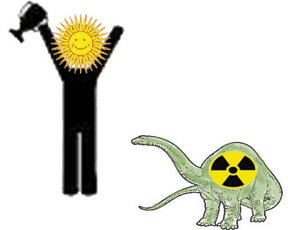
 Renewable energy overtakes nuclear as Scotland’s top power source, Guardian, Jessica Shankleman 27 Nov 14 Clean energy produced more power in Scotland than nuclear, coal or gas for the first time, in first half of 2014 industry figures show, reports BusinessGreen
Renewable energy in Scotland from wind farms, hydro power plants and other clean technologies provided the single largest source of electricity to the country for the first time, in the first half of 2014, new industry figures will show on Thursday.
Analysis by the trade body Scottish Renewables shows that renewables produced nearly one third more power than nuclear, coal or gas in the first six months of the year, generating a record 10.4 terawatt hours (TWh) during the six-month period.
The analysis was compiled by comparing Energy Trends data produced by the Department of Energy and Climate Change (Decc) on renewable energy output with figures produced by National Grid on coal, gas and nuclear power.
Many renewable energy sources do not feed into the National Grid, and instead are part of a local distribution network, meaning it is difficult for National Grid to compare how renewables are fairing compared to traditional sources of energy.
Niall Stuart, chief executive of Scottish Renewables, said the record figures marked “an historic” moment for the renewable energy industry, as well as a major milestone for the Scottish government’s plans to generate 100% of its electricity from renewable sources by 2020…….
Scotland’s Business, energy and tourism minister, Fergus Ewing, said the figures highlight the potential that renewable energy has to replace nuclear power.
“The fact that energy from renewables has exceeded that from nuclear in the first half of 2014, highlights the vast potential of renewable generation to provide a safe, secure and cost-effective means of electricity generation for this country, together with appropriate levels of thermal generation,” he said. “It is vital that appropriate support for renewables in Scotland is maintained following the introduction of electricity market reform in the UK.”…….http://www.theguardian.com/environment/2014/nov/27/renewable-energy-overtakes-nuclear-as-scotlands-top-power-source
British Politicians are Restless – Hinkley Point Nuclear Plant Might Not Go Ahead
On the surface, all is well……..But leaks from civil servants in Whitehall suggest that the government may be getting cold feet about its open-ended guarantees…….With a general election in the UK looming in May next year, no decisions will be reached on any of these projects any time soon. And a new government might think renewables are a better bet.
 Renewables Help Push Nuclear Giants to Brink of Collapse, Eco Watch Paul Brown, Climate News Network | November 24, 2014 Plans to build two giant nuclear reactors in south-west England are being reviewed as French energy companies now seek financial backing from China and Saudi Arabia—while the British government considers whether it has offered vast subsidies for a white elephant.
Construction estimates have already escalated to £25 billion, which is £9 billion more than a year ago, and four times the cost of putting on the London Olympics last year.
Costs Escalate
Two prototypes being built in Olikuoto, Finland and Flamanville, France, were long ago expected to be finished and operational, but are years late and costs continue to escalate. Until at least one of these is shown to work as designed, it would seem a gamble to start building more, but neither of them is expected to produce power until 2017.
With Germany phasing nuclear power out altogether and France reducing its dependence on the technology, all the industry’s European hopes are on Britain’s plans to build 10 new reactors. But British experts, politicians and businessmen have begun to doubt that the new nuclear stations are a viable proposition.
Steve Thomas, professor of energy policy at the University of Greenwich, London, said: “The project is at very serious risk of collapse at the moment. Only four of those reactors have ever been ordered. Two of them are in Europe, and both of those are about three times over budget. One is about five or six years late and the other is nine years late. Two more are in China and are doing a bit better, but are also running late.”
Tom Greatrex, the British Labour party opposition’s energy spokesman, called on the National Audit Office to investigate whether the nuclear reactors were value for money for British consumers.
Peter Atherton, of financial experts Liberum Capital, believes the enormous cost and appalling track record in the nuclear industry of doing things on time mean that ministers should scrap the Hinkley plans……..
On the surface, all is well……..But leaks from civil servants in Whitehall suggest that the government may be getting cold feet about its open-ended guarantees. The industry has a long history of cost overruns and cancellations of projects when millions have already been spent—including an ill-fated plan to build a new nuclear station on the same site 20 years ago.
The Treasury is having a review because of fears that, once this project begins, so much money will have been invested that the government will have to bail it out with billions more of taxpayers’ money to finish it—or write off huge sums…….
Since the decision was made to build nuclear power stations, renewable energy has expanded dramatically across Europe and costs have dropped. Nuclear is now more costly than wind and solar power. In Britain alone, small-scale solar output has increased by 26 percent in the last year.
In theory, there are a number of other nuclear companies—from the U.S., China, Japan and Russia—keen to build stations of their own design in Britain, but they would want the same price guarantees as EDF for Hinkley Point.
With a general election in the UK looming in May next year, no decisions will be reached on any of these projects any time soon. And a new government might think renewables are a better bet. http://ecowatch.com/2014/11/24/renewables-push-nuclear-to-collapse/
Call for independent Radiation Monitoring in Cumbria and Lancashire
‘Nuclear Madness’ Protest at Carlisle Railway Station http://mariannewildart.wordpress.com/2014/11/24/nuclear-madness-protest-at-carlisle-railway-station/
100 people also stopped to sign a letter to Cumbria and Lancashire County Council regarding the lack of independent radiation monitoring .
Radiation Free Lakeland The letter says:
Dear Cumbria and Lancashire County Council,Dear Cumbria and Lancashire County Council,
RADIATION RELEASES TO THE ENVIRONMENT
The North West’s environment used to be independently monitored by the council run Radiation Monitoring in Lancashire, RADMIL.
RADMIL was stopped a few years ago due to council cuts. The Environment Agency often leaves monitoring and reporting to the nuclear industry
The nuclear industry and government’s new build plan includes:
Manufacture of fuel for new reactors. This begins with uranium hexafluoride shipped to Ellesmere Port, then to Capenhurst, Near Chester. Then on to Preston’s Springfields plant. Proposed new nuclear build on greenfields in Cumbria would also mean escalating radioactive releases from fuel manufacture.
This means radioactively polluting the River Ribble and Clifton Marsh Landfill in Lancashire. And in Cumbria increasing releases to the Irish Sea, Lillyhall landfill and previously nuclear free areas! Nuclear materials are routinely sent by train and road and even by plane.
Given this escalation in radioactive emissions we urge you to reinstate regular and frequent independent radiation monitoring in Cumbria and Lancashire
How the nuclear lobby buys academia in the UK
The Atomic Weapons Establishment Funds almost Half of UK Universities http://miningawareness.wordpress.com/2014/03/22/the-atomic-weapons-establishment-funds-almost-half-of-uk-universities/Could this be why it appears virtually impossible to get serious academic work regarding dangers of nuclear, etc.? The buying of academia?
From Medact.org:
“Atoms For Peace: The Atomic Weapons Establishment and UK Universities
Nuclear Information Service and Medact have undertaken a two-year study to investigate research links between British universities and the Atomic Weapons Establishment (AWE), which is responsible for designing and manufacturing the UK’s nuclear weapons. This report presents the executive summary and key findings from our study.
We found that approaching half of British universities have research links with AWE. Much of the work funded by AWE qualifies as ‘blue skies’ research which is not aimed at any particular application. However, some of the research funded by AWE may have ‘dual use’ potential – the capability to be used for both benign, peaceful purposes and military purposes contributing to the development of weapons of mass destruction.
Our study highlights the need for increased transparency over the nature of university research funded by AWE, and the need to strengthen the framework for considering the ethical implications of such work and its impact upon the research environment.

To help universities and researchers navigate ethical issues arising from participating in research work funded by AWE, Nuclear Information Service and Medact have prepared a set of model ethical guidelines which are presented in the main report for the study.” See summary report here:http://www.medact.org/wp-content/uploads/2014/01/Atoms-For-Peace-Summary-Report-Web-Low-Res.pdf
See also, “Over fifty British universities funded by Atomic Weapons Establishment” http://nuclearinfo.org/article/awe-aldermaston/atoms-peace-investigation-int-links-between-uk-universities-and-atomichttp://nuclearinfo.org/sites/default/files/Atoms%20For%20Peace%20Ethical%20Guidelines.pdfhttp://nuclearinfo.org/sites/default/files/Atoms%20For%20Peace%20Full%20Report.pdf
Costly lessons that UK should have learned before contracting Hinkley Point C Nuclear build
10 Fukushima Lessons Have yet to Bear on Hinkley Point C Nuclear Contract between UK Government and EDF http://raandreaskraemer.blogspot.com.au/2013/12/10-fukushima-lessons-have-yet-to-bear.html

1 Don’t place nuclear reactors next to one another
2 Don‘t leave spent nuclear fuel near reactors
3 You need (at least) 2 separate access routes
4 You need back-up control-rooms in distant bunkers
5 You need more on-site and off-site back-up power
6 You need better evacuation plan for larger area
7 You need sensors, cameras that work post-accident
8 You need staff willing 2 die 4 families, neighbors
9 You need (massive) reserves to pay compensation
10 You need an honest assessment of costs and risks
Andy Hall, First deputy chief inspector, UK Office for Nuclear Regulation (ONR), is deluding himself (and others) with this view:
http://www.theguardian.com/environment/2013/nov/25/nuclear-regulation-post-fukushima
On 7 March 2014, the Franco-German TV station Arte aired a stunning documentary on the Fukushima disaster. You can watch it in French or German:
French: http://www.arte.tv/guide/fr/047156-000/fukushima-chronique-d-un-desastre
German: http://www.arte.tv/guide/de/047156-000/fukushima-chronik-eines-desasters
Nuclear industry must be worried, when top UK atomic advocate suggests renewables are a better bet!
 Nuclear power may not be needed, says top atomic advocate,Telegraph, UK, 22 Nov 14 Sir David King, former chief scientist and champion of the nuclear newbuild, says the top priority must be to develop storage for renewable energy, reports Geoffrey Lean ……. I was riveted as Prof Sir David King, the former government Chief scientist,ranged over subjects from population growth to water resources, the growth of cities to commodity prices, spewing out new information and insights.
But while he said a lot about the promise of renewable energy, he said almost nothing about nuclear power – despite for long having been one of its foremost and most influential advocates in Britain, describing it, for example, as a “massive economic opportunity” for the country.
So I got up and asked him about it, expecting the same pro-nuclear response as I had heard from him many times before. Instead he amazed me by suggesting that Britain “might well” be able to do without atomic power altogether, and that the real priority should be on developing ways of storing electricity so as to be able to depend on famously intermittent sun and wind.
“We have to keep reassessing the situation”, he said. “I believe that what we need, more than anything, is a surge of activity to develop energy storage capability …. Once we can do that technologically, why would we not just keep with renewables.”
For a country like India, with plenty of sunlight and deserts where it can be collected, he went on, “there’s no reason” for it not to go “directly wholesale into solar energy”. After all it was already “three to four times” cheaper to provide villages unconnected to the grid in India and China with solar electric panels and batteries than to connect them up……….
later he came back to the question …: “if we can get the costs down we might well manage our future basically on renewable energy and energy storage”.…….http://www.telegraph.co.uk/earth/energy/nuclearpower/11244499/Nuclear-power-may-not-be-needed-says-top-atomic-advocate.html
Shareholder crisis brings more doubts about UK’s Hinkley Point C nuclear plant’s future
Hinkley Point C nuclear plant’s future in doubt as crisis hits shareholder Guardian UK, Terry Macalister, 20 Nov 14, Questions over new Somerset power station after Areva’s nuclear projects in Finland and France run into difficulties The future of the Hinkley Point C nuclear plant in Somerset is under a cloud amid a financial crisis at Areva, a shareholder in the project and the designer of the proposed reactors. Shares in the French engineering business plunged by almost a quarter after Areva warned it must suspend future profit predictions because of problems centred on a similar power station project in Finland.
Both that scheme at Olkiluoto and another at Flamanville in France are massively over-budget and over-schedule, forcing Areva to consider whether it needs an injection of new cash to survive.
Peter Atherton, a leading energy company analyst at Liberum Capital in the City, said Areva appeared to be in deep trouble and this must be a matter of grave concern to the British government.
“If I was sitting in Whitehall this would scare the daylights out of me. Areva is designing and building the first two EPRs [European Pressurised Reactors] inEurope and both projects have gone disastrously wrong.
“The [UK] government has commissioned the most expensive power station in history and the only company that can provide the equipment is in trouble. That is a big problem for Hinkley.”
As well as providing the design, Areva currently holds 10% of the equity in the Hinkley Point C project, which has been predicted by the European commission to cost almost £25bn – if it is built on time by 2023. EDF holds 45%-50%, with Chinese state nuclear companies holding the remainder…………http://www.theguardian.com/environment/2014/nov/19/hinkley-point-c-nuclear-plant-future-doubt-areva
1 This Month





PLEASE OPPOSE HR 8255 AND S.3639 – bills would accelerate satellite deployment, with no environmental review or safeguards – https://ncstd5li.quorum.us/campaign/169331/
To see nuclear-related stories in greater depth and intensity – go to https://nuclearinformation.wordpress.com
-
Archives
- October 2026 (58)
- September 2026 (339)
- August 2026 (330)
- July 2026 (355)
- June 2026 (287)
- May 2026 (306)
- April 2026 (356)
- March 2026 (251)
- February 2026 (267)
- January 2026 (308)
- December 2025 (358)
- November 2025 (359)
-
Categories
- 1
- 1 NUCLEAR ISSUES
- business and costs
- climate change
- culture and arts
- ENERGY
- environment
- health
- history
- indigenous issues
- Legal
- marketing of nuclear
- media
- opposition to nuclear
- PERSONAL STORIES
- politics
- politics international
- Religion and ethics
- safety
- secrets,lies and civil liberties
- spinbuster
- technology
- Uranium
- wastes
- weapons and war
- Women
- 2 WORLD
- ACTION
- AFRICA
- Atrocities
- AUSTRALIA
- Christina's notes
- Christina's themes
- culture and arts
- Events
- Fuk 2022
- Fuk 2023
- Fukushima 2017
- Fukushima 2018
- fukushima 2019
- Fukushima 2020
- Fukushima 2021
- general
- global warming
- Humour (God we need it)
- Nuclear
- RARE EARTHS
- Reference
- resources – print
- Resources -audiovicual
- Weekly Newsletter
- World
- World Nuclear
- YouTube
-
RSS
Entries RSS
Comments RSS

