Former Japanese Prime Minister Kan to join anti-Wylfa nuclear campaign
Naoto Kan was at the helm of his country’s Government at the time of the Fukushima nuclear disaster in 2011, the largest incident of its kind since the 1986 Chernobyl disaster.
Mr Kan stepped down from office in the wake of the meltdown and has become a staunch anti-nuclear campaigner.
Mr Kan will arrive in Wales from Paris next Wednesday, where he will visit the Senedd and meet in the Pierhead Building with National Assembly Members and other invited guests.
He will then travel north to Anglesey on Thursday, where he will give a talk at the gates of Wylfa nuclear station at 8.45am to urge the public to oppose the development plant.
Mr Kan will then head to the Anglesey Council offices in Llangefni at 11am to address councillors in private, before concluding his trip at 1pm, where he will hold a public meeting at Carreg Brân Hotel, Llanfairpwll.
An Isle of Anglesey County Council spokesperson said: “Following a request on behalf of the Green Cross, Mr Kan will be addressing members of the Council.
“During the meeting we will also be informing him about our Energy Island Programme and its aims.”
Nuclear Power and Saving the Climate-fraudulent claims

 NuClear news, February 2015 Keith Barnham Emeritus Professor of Physics at Imperial College says claims that nuclear power is a ‘low carbon’ energy source fall apart under scrutiny.
Britain’s main political parties combine in effort to battle climate change
UK to phase out coal as Australia phases out renewable energy, Business Spectator TRISTAN EDIS 16 FEB, The leaders of the UK’s three main political parties – Tories, Labour and the Liberal Democrats – have chosen to put efforts to address climate change above politics.
Prime Minister David Cameron from the Tories, Labour leader Ed Miliband and the Deputy PM and leader of the Liberal Democrats Nick Clegg have put out a joint statement – which echoes comments by US President Barack Obama – declaring that climate change is one of the most serious threats facing the world. According to the statement they argue climate change is not only a threat to the environment but, also, “national and global security, to poverty eradication and economic prosperity”.
The agreement is a major step forward because, while it might be vague on policy detail, it sets out some long-term principles that are critical to support investor confidence in low carbon energy infrastructure involving billion-dollar price tags and with lifetimes of several decades. It makes a stark contrast with Australia where investors (other than mums and dads buying solar systems) have abandoned power generation as a result of Tony Abbott tearing up the political consensus that had been achieved on pricing carbon and the Renewable Energy Target.
The agreement sets out that, irrespective of who wins the UK election in May, all three parties agree to:
- Phase out the use of coal in power generation (unless emissions are captured and stored) while accelerating the development of an energy efficient, low carbon economy;
- Continue the practice as set out under the UK’s Climate Change Act of having an independent institution (the Climate Change Committee) plan out carbon pollution budget constraints between now and 2050 with the aim of achieving an 80% reduction in emissions by 2050 compared to 1990 levels.
- Seek a legally binding international agreement to limit temperature rise below 2 degrees………..Follow @TristanEdis https://www.businessspectator.com.au/article/2015/2/16/policy-politics/uk-phase-out-coal-australia-phases-out-renewable-energy
Murder suspect Andrei Lugovoi’s room had high levels of radiation
Litvinenko inquiry: Highest radiation levels in suspect’s hotel, BBC News, 17 Feb 15 The highest level of radiation found during the investigation into Alexander Litvinenko’s death was recorded in a hotel stayed in by one of his suspected killers, an inquiry has heard.
Andrei Lugovoi stayed alone at London’s Sheraton Park Lane hotel from 25 to 28 October 2006. Mr Litvinenko died the following month.
Mr Lugovoi remains in Russia with Dmitri Kovtun, who is also a suspect.
The pair have always denied poisoning the ex-KGB officer with polonium-210.
Det Insp Craig Mascall told the public inquiry into Mr Litvinenko’s death that traces of radioactivity were found throughout the Sheraton, including on towels, in the laundry chutes and in Mr Lugovoi’s room.
The highest levels in the whole investigation were found on the towels, Mr Mascall told the London hearing……..
The Litvinenko case23 Nov 2006 – Mr Litvinenko dies three weeks after having tea with former agents Andrei Lugovoi and Dmitri Kovtun in London
24 Nov 2006 – His death is attributed to polonium-210
22 May 2007 – Britain’s director of public prosecutions decides Mr Lugovoi should be charged with the murder of Mr Litvinenko
31 May 2007 – Mr Lugovoi denies any involvement in his death but says Mr Litvinenko was a British spy
5 Jul 2007 – Russia officially refuses to extradite Mr Lugovoi, saying its constitution does not allow it
May-June 2013 – Inquest into Mr Litvinenko’s death delayed as coroner decides a public inquiry would be preferable, as it would be able to hear some evidence in secret
July 2013 – Ministers rule out public inquiry
Jan 2014 – Marina Litvinenko in High Court fight to force a public inquiry
11 Feb 2014 – High Court says the Home Office had been wrong to rule out an inquiry before the outcome of an inquest
July 2014 – Public inquiry announced by Home Office http://www.bbc.com/news/uk-31507959
Nuclear subsidies for Hinkley Point facility will cost far more than is claimed
 Nuclear Subsidies NuClear News, Feb 2015 The Energy Fair group has examined (1) the findings by the Directorate General for Competition of the European Commission (EC) (2) that, with regard to the proposed new nuclear power plant at Hinkley Point, “the package of measures notified by the UK involves State aid which, as amended by the commitments provided, is compatible with the internal market.
Community renewable energy for Britain
 Buy into renewables! New Internationalist,
One way to decrease this demand is to use household or community-owned renewables instead of commercial energy plants for power.
At the moment, this is rare in Britain, because the cheap bank loans which could fund renewable energy aren’t made available to individuals or community groups (while fossil fuel investors have no problem getting hold of them).
Community projects often cost under $15 million, and ‘at that level, banks aren’t really interested,’ explains Emma Bridge, chief executive of community generator association, Community Energy England (CEE).
Crowd-sourcing and community funding schemes such as Trillion Fund can pay for some renewables, but when it comes to bigger renewable projects, current laws don’t give communities much in the way of rights to buy and profit from them.
Renewables face not only a funding problem, but a legal problem too, especially in places where laws don’t allow members of the public to buy shares in private power plants.
The ‘right to invest’ clause in the most recent version of the Infrastructure Bill (currently working its way through parliament) only lets the public ask for 5-per-cent ownership on large wind-turbine projects, even when they are in public backyards.
Lord Cameron of Dillington’s remark when debating the bill was that 10-per-cent public wind-turbine ownership would let members of the activist public stop wind-turbine construction.
In Denmark, where there is currently a fracking ban in place, the opposite is true. Most of Denmark’s wind-power energy source is community-owned and wind power provides most of the country’s power on some days.
Profits from wind-energy bills go towards local community funds, thanks to a law requiring up to 20-per-cent public ownership of wind turbines.
‘For a long time, Britain has been one of the worst-performing countries in Europe when it comes to utilizing renewable energy,’ says Paul Monaghan, sustainability advisor at Co-operative Energy.
The British consumer-managed energy supplier thinks 25 per cent should be the minimum amount of public ownership offered for larger renewable power projects.
Instead, the government will soon remove British landowners’ right to prevent frackers from trespassing beneath homes.
Allowing more public ownership of renewables can be seen as a way of safeguarding public access to electricity and water in the face of fracking and dwindling traditional oil and gas reserves. http://newint.org/blog/2015/02/13/buy-renewables/#sthash.0uTfDW2S.dpuf
Litvinenko murder case- a trail of radiation across London
 Litvinenko killers left radiation trail across London, inquiry told Guardian, Luke Harding 12 Feb 15 Two men accused of poisoning Russian were noticeable because of their jewellery and ‘comical’ dress sense, says London hotel manager. The two Russians who allegedly poisoned Alexander Litvinenko left a massive trail of radiation in “multiple locations” across London, and were immediately noticeable because of their “excessive” jewellery and “comical” dress sense, the inquiry into his murder has heard.
Andrei Lugovoi and Dmitry Kovtun flew from Moscow to London on 16 October 2006. They checked into the Best Western hotel on Shaftesbury Avenue, the inquiry heard. They are accused of trying to poison Litvinenko for the first time later that day – and of succeeding two weeks later when they slipped radioactive polonium into his tea.
Giving evidence, the hotel’s manager, Goran Krgo, said he spotted Lugovoi and Kovtun the moment they arrived. “I remember these guests quite vividly,” he told the inquiry on Wednesday. Asked to elaborate, he said: “We found them to be quite comical on account of how they were dressed and the excessive jewellery they were wearing.”……
Det Insp Craig Mascall of the Metropolitan police said forensic experts later found large quantities of polonium in both Lugovoi and Kovtun’s hotel rooms. In Lugovoi’s room, 107, the highest reading came from the bathroom plughole, leading to the suspicion he may have thrown the polonium away. Polonium was found on a chair and coat-hanger in Kovtun’s room, 308, on a chair and coat-hanger.
The inquiry was told that there was no indication Litvinenko had been contaminated before his meeting with Lugovoi and Kovtun. The three men went for a meal at the Itsu sushi bar in Piccadilly, where polonium was also detected. Litvinenko vomited once that evening but survived this first botched assassination attempt, the inquiry heard.
More polonium was found in Pescatori, an Italian restaurant where Lugovoi and Kovtun ate that evening, clocking up a bill of £214.20. They had dinner with Alexander Shadrin, a Russian emigre……..
The following morning, Lugovoi and Kovtun left their hotel a day early and checked into the Parkes Hotel in Knightsbridge. Polonium was found in their new rooms.
The inquiry also heard that the Russian authorities deliberately blocked an attempt by British experts to examine the two aircraft used by Lugovoi and Kovtun to fly to and from London on 16 and 18 October 2006. ………http://www.theguardian.com/world/2015/feb/11/litvinenko-killers-radiation-trail-london-inquiry
London may get radiation detectors to prevent a dirty bomb attack
 Radiation detectors could be installed across London to protect the capital from a dirty bomb attack, Irish Independent 12 Feb 15 Radiation detectors could be installed across London to protect the capital from a dirty bomb attack, Boris Johnson has said. Supermarket-style self check-out technology could also be used to identify suspicious packages to bolster safety in the city, he suggested
The proposals have been inspired by the “extraordinary stuff” that protects New York, Mr Johnson said after talks with the US city’s Police Commissioner, Bill Bratton.
“I was thinking should we have those kinds of systems?”
Mr Bratton gave the London Mayor a tour of New York City’s Police Department domain awareness system, which brings together radiation detection, 8,000 surveillance cameras and a licence plate recognition system.
Geiger counter-style devices are spread across buildings in the city as well as being carried by police officers and installed in helicopters…….. Mr Johnson said he would talk to London police chief Sir Bernard Hogan-Howe to assess the need for such a move…….http://www.independent.ie/world-news/europe/radiation-detectors-could-be-installed-across-london-to-protect-the-capital-from-a-dirty-bomb-attack-30985192.html
Radiation poisoning of Litvinenko may have affected others, too
 Litvinenko inquiry: Russians’ associate ‘had mystery illness’ BBC News 12 Feb 15 A retired British army officer had a “mystery illness” after meeting with two men suspected of poisoning ex-FSB officer Alexander Litvinenko with polonium-210, an inquiry has heard.
Tim Reilly, a director at security firm Erinys, suffered migraines and vomiting after meeting Russians Andrei Lugovoi and Dmitri Kovtun with Mr Litvinenko.
He said Mr Lugovoi called him after Mr Litvinenko’s death to deny involvement.
“Heaving” radiation levels were later found in the London firm’s boardroom.
Mr Litvinenko, a former Russian security service officer who became a vocal critic of the Kremlin and fled to Britain, died of radiation poisoning after drinking tea laced with polonium at a Mayfair hotel in November 2006.
The barrister representing Mr Litvinenko’s family claims he was murdered for trying to “expose the corruption” at the heart of Vladimir Putin’s “mafia state”.
The public inquiry into his death has heard that Mr Litvinenko have been poisoned twice – with one occasion around the time of the security company meeting in October of 2006.
Mr Reilly told the hearing he became “very ill” around the time of the meeting…….Atomic weapons experts later found “heaving” levels of radioactive contamination in the boardroom at Erinys, leading to the offices being closed for four months, the court heard………http://www.bbc.com/news/uk-31444820
Austria refuses to be bullied by UK over its opposition to subsidies for nuclear power
 Austria Says It Won’t Be Intimidated by U.K. in Nuclear Dispute, Bloomberg, Jonathan Tirone, 12 Feb 15— Austria said it won’t be cowed by alleged British threats over plans by the government in Vienna to contest state subsidies for a new nuclear-power plant at Hinkley Point in southwest England.
“We won’t let ourselves be intimidated,” Austrian Environment Minister Andrae Rupprechter said late Wednesday on Twitter. “No subsidies for atomic power.”
Tensions between Austria and the U.K. flared this week over the $26 billion European Commission-approved subsidy for Hinkley Point. British officials allegedly threatened Austria with retaliation if it appeals the subsidies, according to Austrian diplomatic cables leaked this week in Vienna.
“The U.K. will take every future opportunity to sue Austria in areas that harm or that have strong domestic political implications,” read the cable, written by Austria’s embassy in London, a copy of which was published by the newspaper Kronen Zeitung. “The U.K. has already begun to elaborate countermeasures.”………. http://www.bloomberg.com/news/articles/2015-02-12/austria-says-it-won-t-be-intimidated-by-u-k-in-nuclear-dispute
Cumbria’s tourism, milk and cheese may give way to dirty nuclear industry
Tourism, Milk and Cheese or Nuclear? 13 FridayFeb 2015 by miningawareness Over 50 years after the Windscale-Sellafield disaster caused milk in a 200 sq. mile area to be officially too radioactive to drink, and milk brought 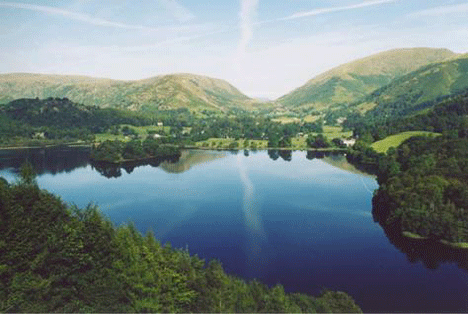 in from elsewhere, as recounted in the “Atomic Milk” documentary, http://youtu.be/hJnPWShSmKg Cumbria remains a major milk producer for the UK. Cows are grazing on the site of the proposed Moorside Nuclear Power Station, near Sellafield in Cumbria, UK.
Lillyhall, to the north, lost the chance for a Dutch cheese factory-showroom because Swedish Studsvik applied for a nuclear waste processing facility, next door, at the same time. Note, as well, that there won’t always be someplace else from which to bring in the milk, as the world is increasingly contaminated with long-lived radiation-contamination.
Moorside Nuclear reactors would be built by a Westinghouse (owned now by Toshiba) and GdF Suez (France) consortium. A proposed nuclear reactor, nearby at Braystones was canceled.
Would you rather have Sellafield Cheese or Appenzell Swiss Cheese?
Although Switzerland was contaminated by Chernobyl, Sellafield was contaminated by the Windscale fire, Chernobyl, as well as ongoing radioactive emissions, especially into the Irish Sea………..https://miningawareness.wordpress.com/2015/02/13/tourism-milk-and-cheese-or-nuclear/
The negative effects of more nuclear developments in Cumbria
Tourism, Milk and Cheese or Nuclear? 13 Friday Feb 2015 by miningawareness “…..proximity to Moorside means that the issues are still essentially the same, as described below by the Braystones Concerns Group in their memorandum to Parliament: “Memorandum from Braystones Concerns Group (NWN 15)”
“Job opportunities, economy and economic diversity in West Cumbria.”
“1. Whilst jobs are welcome in West Cumbria, the overall effects of multiple nuclear developments would have many negative effects. What is frequently referred to as an area of outstanding natural beauty, would be greatly defaced by such extensive nuclear industrial sprawl. This would have a detrimental effect on the visitors perception of West Cumbria as a tourist destination. At a time when the area is desperately trying to diversify its economy, tourism jobs would simply be displaced by more ‘nuclear’ jobs, thus not actually increasing real jobs with the numbers being promised.It would greatly increase the economic stranglehold that the nuclear industry has on the area and would discourage many other discerning businesses that might otherwise have chosen West Cumbria. (A £45m cheese factory planned for Workington in West Cumbria did not go ahead in 2007, because of plans by Studsvik to build a radioactive waste processing plant at Lillyhall.) There are already a number of nuclear developments proliferating in West Cumbria, with Copeland and Allerdale councils trying to coax the public into accepting even more.”
“Economic/infrastructure viability of West Cumbria for nuclear power generation.”
“2. West Cumbria is not an economically suitable region for multiple reactor builds, as grid connectivity would prove particularly difficult and costly in such a remote area. West Cumbria is not where energy production is most needed.Any multiple reactor builds should be sited close to centres of high energy demand, where more suitable infrastructures and grid systems already exist. The recent devastation from flooding in West Cumbria has highlighted the wholly inadequate infrastructure throughout the region, which already struggles to service existing industrial demand. Repair and replacement of crucial bridges is currently estimated to take years. The southern sector of the main arterial route through Copeland has been de-trunked and is literally the width of a single vehicle in places. Road closures due to accident or maintenance can require alternative diversion routes 120 miles long. Major road improvements take at least 10 years to provide. If the Braystones site was developed, it would seriously compromise the existing Emergency Arrangements for the Sellafield site.” https://miningawareness.wordpress.com/2015/02/13/tourism-milk-and-cheese-or-nuclear/
UK government bullying Austria over UK subsidies to the nuclear industry?
 Diplomatic row with Austria over EDF nuclear power station escalates http://www.independent.co.uk/news/business/news/diplomatic-row-with-austria-over-edf-nuclear-power-station-escalates-10040309.html MARK LEFTLY
  ASSOCIATE BUSINESS EDITOR THURSDAY 12 FEBRUARY 2015 The UK will take “every opportunity to sue or damage Austria” if Vienna does not drop a legal challenge to the construction of a £24.5bn nuclear power station in Somerset, according to a leaked memo.
Austria is staunchly anti-nuclear and will soon formalise an appeal against the EU’s decision to allow the UK government to pay subsidies to the French energy giant EDF to build Hinkley Point C, the first in a new generation of civil reactors.
According to the memo, written by the deputy Austrian ambassador in London, Christoph Weidinger, this has sparked a diplomatic row that could “escalate” when Vienna submits its appeal.
The memo says that a senior Foreign Office official, Vijay Rangarajan, threatened three legal counter-challenges to Austria’s energy practices, a move environmental campaigners at Greenpeace blasted as “bullying”.
Details of the exchange, which occurred last month, come as David Cameron is due to meet the Austrian chancellor, Werner Faymann, at a summit in Brussels today.
Warning that the Austrian challenge will have “negative effects on bilateral relations, because there would be strength of feeling, up to the PM”, the UK is said to have demanded a meeting to explain the damage that Austria could face.
Mr Weidinger said that the UK will complain that Austria’s decision to make electricity distributors mark the source of electricity on bills, allowing householders to snub any energy originating from nuclear stations, violated internal market rules.
Mr Rangarajan is alleged to have warned that the UK will also investigate whether Austria’s challenge to the EDF deal violates an existing treaty and will try to force Austria to take a larger share of electricity from sustainable sources than its European neighbours.
The subisdy deal, which EDF wanted before it risked billions building the plant, involves the UK guaranteeing the French a minimum price for every unit of electricity generated from Hinkley.
The memo states: “The UK has obviously started, including the use of the UK Embassy in Vienna… with systematic preparation of counter measures to damage Austria.”
David Lowry, an environmental consultant, said: “It’s extraordinary that the Foreign Office has gone to this level of diplomatic incident in order to protect the unsustainable.”
A Whitehall source said the UK there was no “bullying” involved. A government spokeswoman said: “We have no reason to believe that Austria, or any other party, is preparing a case which has any merit.”
EDF’s financial problems delay decision on proposed new nuclear plant at Hinkley Point
 EDF Energy delays Hinkley Point nuclear decision French power firm’s plans to build first British atomic reactors in almost 30 years suffers further setback Guardian, Terry Macalister, 13 feb 15 The timetable surrounding the construction of Britain’s first new atomic reactors in almost 30 years has once again been blown off course, its developer, EDF Energy, has admitted. The setback came as the French-owned generator and supply company reported a 25% slump in operating profits for 2014 to £863m, which it blamed on challenging market conditions.
EDF had originally promised to tie up a new deal with financial backers and then take a final investment decision on the proposed new plant at Hinkley Point in Somerset by the middle of last year. This date was later revised to March 2015.
But in a new statement, the largely state-owned energy group said a final investment decision might only be possible in a matter of months, and it had still not finalised talks with Chinese financial backers……….
Meanwhile, there is growing speculation that Chinese investors are hardening the terms under which they would be willing to help underwrite some of the cost of the new plant. China National Nuclear Corporation and China General Nuclear Power Corporation are expected to be minority shareholders in the project, but are also pushing for commitments to build and operate their own plant at Bradwell in Essex.
EDF has declined to confirm that it too is trying to limit the financial damage through compensation from the UK government should there be a successful legal challenge in the European courts by Austria to the UK subsidy arrangement.
Critics of the £24.5bn nuclear programme in Somerset have highlighted the industry’s poor track record for constructing facilities on time and on budget. They have questioned whether Hinkley Point C reactors would able to meet their timetable of opening for operations in 2023.
EDF has already run into problems with a new project at Flamanville in Normandy, while another project in Finland, the European pressurised reactor, which uses the same design as Hinkley, is also massively behind its original timetable.
Financial problems at its French design partner, Areva, have not helped the sense of uncertainty surrounding EDF’s nuclear ambitions,……http://www.theguardian.com/business/2015/feb/12/edf-energy-delays-hinkley-point-nuclear-decision
UK: Establishment pressure on the Press
Interception Commissioner: 82 journalists’ phone records grabbed by police in three years, judicial oversight needed, Press Gazette William Turvill 04 February 2015 Some 82 journalists have had their communications data obtained by police under the Regulation of Investigatory Powers Act in three years, the Interception of Communications Commissioner’s Office has found.
And the IOCCO has said forces should require judicial approval to do so in the future.
The report, which was partly prompted by the Press Gazette Save Our Sources campaign, reveals that in the last three years 608 RIPA applications have been made by forces for communications data to find journalistic sources……..
The RIPA scandal broke in September, when Press Gazette was the first news outlet to report that The Sun’s phone records had been targeted by the Met Police as part of Operation Alice into Plebgate.
Since then, it has emerged that two more Sun journalists had their phone records obtained by the Met under Operation Alice.
In addition, Kent/Essex Police has admitted to using RIPA to find a Mail on Sunday source, and Press Gazette has revealed how Suffolk, Thames Valley and Cleveland forces have also used the act to find journalistic sources.
Last month, Press Gazette co-ordinated a letter sent to the Prime Minister stating that the Home Office’s draft RIPA code was not acceptable. It was signed by every UK national newspaper editor.
More then 1,500 people have signed the Press Gazette Save Our Sources petition calling for judicial oversight of police requests to view journalists’ call records.
Sir Anthony May, the Interception of Communications Commissioner, said: “In October 2014 due to the serious nature of the concerns reported in the media about the protection of journalistic sources, and the allegations that the police had misused their powers under Chapter 2 of Part 1 of RIPA to acquire communications data the Rt Hon.
“Sir Paul Kennedy, who was at the time acting as interim Commissioner, considered it necessary to launch this inquiry and make an additional report to the Prime Minister……
“I am very pleased to be able to publish our inquiry report today and I hope that Parliament and the public will find it helpful.
“Our report sets out the extent to which these powers have been used by police forces to identify journalistic sources, examines the appropriateness of the use of Chapter 2 of Part 1 of RIPA for this purpose, and makes recommendations to ensure adequate safeguards are provided to protect journalistic sources.”
The full report can be read here. http://www.pressgazette.co.uk/interception-commissioner-82-journalists-phone-records-targeted-police-three-years-forces-should
1 This Month





PLEASE OPPOSE HR 8255 AND S.3639 – bills would accelerate satellite deployment, with no environmental review or safeguards – https://ncstd5li.quorum.us/campaign/169331/
To see nuclear-related stories in greater depth and intensity – go to https://nuclearinformation.wordpress.com
-
Archives
- October 2026 (58)
- September 2026 (339)
- August 2026 (330)
- July 2026 (355)
- June 2026 (287)
- May 2026 (306)
- April 2026 (356)
- March 2026 (251)
- February 2026 (267)
- January 2026 (308)
- December 2025 (358)
- November 2025 (359)
-
Categories
- 1
- 1 NUCLEAR ISSUES
- business and costs
- climate change
- culture and arts
- ENERGY
- environment
- health
- history
- indigenous issues
- Legal
- marketing of nuclear
- media
- opposition to nuclear
- PERSONAL STORIES
- politics
- politics international
- Religion and ethics
- safety
- secrets,lies and civil liberties
- spinbuster
- technology
- Uranium
- wastes
- weapons and war
- Women
- 2 WORLD
- ACTION
- AFRICA
- Atrocities
- AUSTRALIA
- Christina's notes
- Christina's themes
- culture and arts
- Events
- Fuk 2022
- Fuk 2023
- Fukushima 2017
- Fukushima 2018
- fukushima 2019
- Fukushima 2020
- Fukushima 2021
- general
- global warming
- Humour (God we need it)
- Nuclear
- RARE EARTHS
- Reference
- resources – print
- Resources -audiovicual
- Weekly Newsletter
- World
- World Nuclear
- YouTube
-
RSS
Entries RSS
Comments RSS

