Terrorism threat to Britain’s nuclear facilities is increasing – warns Nuclear Regulator
 Nuclear watchdog warns of terrorist threat to UK reactors As Hinkley Point hangs in balance, strategic plan acknowledges security risks Independent, Mark Leftly Associate business editor @MLeftly 26 March 2016
Britain’s nuclear industry is under threat from cyber-attacks, terrorism and state-sponsored espionage, regulators have warned.
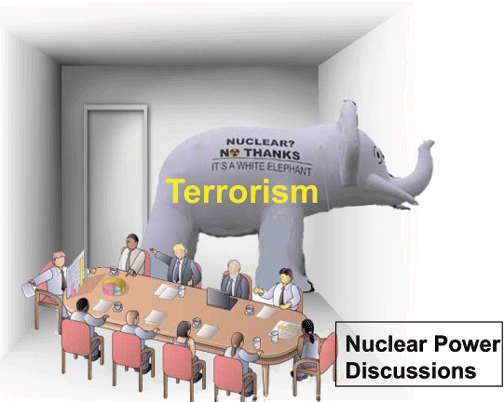
Buried in the Office for Nuclear Regulation’s 2016-20 strategic plan are bleak references to the growing threat of attack on Britain’s 15 operational reactors, which account for nearly a fifth of the country’s electricity. The Independent has established this is the first time that the ONR has explicitly acknowledged the growing terrorist threat to the nuclear industry.
The document states: “The threat of terrorism in the nuclear sector will continue to be managed proportionately and effectively through national and international capabilities. The capabilities of potential adversaries to operate in cyberspace will continue to grow.”
At the top of a list of the industry’s corporate risks, the ONR writes: “Failure to protect the confidentiality, integrity and availability of sensitive information and assets from both known and emerging security threats to the UK nuclear infrastructure (eg, cyber-attacks, terrorist activity, state-sponsored espionage).”
In another reference, it says: “We recognise the world is increasingly globalised and digitised, where both the terrorist threat and the risks from cyberspace are changing. The Government and duty-holders have well-developed security capabilities to deter and defend against organisations and individuals that might conspire to attack or exploit the nuclear estate. ONR will continue to work with the Government to ensure that security-focused regulations evolve to remain fit for purpose and align with safety regulation.”
The news comes at a sensitive time, with French giant EDF weighing up whether to risk its balance sheet on building a £24.5bn reactor at Hinkley Point on the Somerset coast. This is supposed to herald a new generation of nuclear power plants, which are needed to bridge the UK’s yawning energy gap, but EDF has delayed a final investment decision until May. There are also reports that the Isis terrorists who attacked Brussels might have planned to steal radioactive materials from a Belgian nuclear plant to build a bomb.
John Large, the nuclear expert who warned in a 2014 report for the French authorities that reactors are highly vulnerable to drone attacks, said the admission was “a step forward”, but warned: “It might be too late. The problem is that the plants were designed in the 1950s and 1960s and those designs ignored terrorism. That’s one of the problems they [the nuclear industry] face. ……..
Clive Lewis, a shadow Energy minister, pointed out that the ONR’s admission comes shortly after news that the Civil Nuclear Constabulary will be cut by about 200 officers by 2020, despite government promises to protect police funding. ….. http://www.independent.co.uk/news/uk/home-news/exclusive-nuclear-watchdog-warns-of-terrorist-threat-to-uk-reactors-a6953396.html
China wants big involvement in construction of Hinkley Point C nuclear station
 China wants hands-on role in UK nuclear, Building.co UK 24 March 2016 | By Yoosof Farah China General Nuclear says it wants to bring “expertise and experience” to UK
The Chinese nuclear developer part-funding Hinkley Point C has said it wants to be heavily involved in the construction of new nuclear plants in the UK.
Speaking to MPs on the Energy Select Committee, Zhu Minhong, general director of UK nuclear projects at China General Nuclear (CGN), said that in addition to its investment in EDF’s Somerset plant, his firm wants to bring its “expertise and experience” to Hinkley and further nuclear schemes in the UK.
At the same committee session EDF’s UK chief executive Vince de Rivaz was girlled by MPs over when the French client will make a final investment decision on Hinkley.
De Rivaz began his appearance by saying “clearly and categorically” that Hinkley Point C will go ahead, but he refused to commit to a date for when a decision will be made.
Under CGN’s funding deal with EDF, the Chinese nuclear giant has already agreed to help fund Hinkley and to partner on construction of further plants at Sizewell in Suffolk and Bradwell in Essex. At Bradwell CGN is expected to lead on development and construction itself.
Minhong told MPs the final terms of CGN’s funding deal with EDF for Hinkley is “practically completed” and the firm is “confident” it will go ahead. CGN has a 33% stake in the £18bn project. In China……..http://www.building.co.uk/news/china-wants-hands-on-role-in-uk-nuclear/5080898.article
UK govt getting resigned to the likely scrapping of Hinkley Point C nuclear project
 U.K. Sees No Power `Black Hole’ If EDF Scraps Nuclear Plan,Bloomberg, Alex Morales AlexJFMorales 24 Mar 16 The U.K. won’t struggle to keep the lights on if Electricite de France SA decides not to proceed with its 18 billion-pound ($25 billion) plan to build a new nuclear-power plant at Hinkley Point in southwest England, Energy Secretary Amber Rudd said.
Britain has nine years to fill any gap in generation created by the loss of a 3.2-gigawatt project that could produce 7 percent of the country’s electricity supply, Rudd said in an interview Thursday.
“If there were any delay, we would have plenty of time to arrange replacements,” Rudd said after giving a speech near Rochester in southeast England. “It’s absolutely not right to think that there will be some sort of black hole in 2025.”………
EDF executives and French Economy Minister Emmanuel Macron have reiterated this month that the company will take a final decision soon to go ahead with the project. Still, the company originally said that new nuclear power would be generated by Christmas 2017, a deadline that has since slipped to 2025…….
The U.K. network operator has signed contracts for 3.6 gigawatts of reserve power that it can use to meet shortfalls. National Grid can also ask shops and factories to reduce demand during peak times to help ease pressure on the system……..
Rudd spoke after giving a speech at the U.K. end of the new 1-gigawatt BritNed interconnector, which allows electricity to flow between the Netherlands and Britain. She made the case for Britain’s continued membership of the European Union, saying that a departure would risk inflating customer energy bills by 500 million pounds a year. http://www.bloomberg.com/news/articles/2016-03-24/u-k-sees-no-power-black-hole-if-edf-scraps-nuclear-plan
Scotland’s floating wind farm will ‘store’ power
 World’s first floating wind farm to ‘store’ power http://www.cnbc.com/2016/03/21/world-first-floating-wind-farm-to-store-power.html Anmar Frangoul Monday, 21 Mar 2016 Statoil is to install a lithium battery based storage system at the world’s first floating wind farm off the coast of Scotland.
The new system, called Batwind, is to be developed in co-operation with universities and suppliers from Scotland after a deal was signed last week between Statoil, the Scottish Government, the Offshore Renewable Energy (ORE) Catapult and Scottish Enterprise, according to a statement released on Monday.
“By developing innovative battery storage solutions, we can improve the value of wind energy for both Statoil and customers,” Stephen Bull, Statoil’s senior vice president for offshore wind, said. The system is to be installed at the end of 2018, Statoil said, and will have the battery capacity of “more than 2 million iPhones.”
Because renewable sources of energy, such as the sun and wind, do not promise a constant stream of power, storage is seen as vital in the transition to a low-carbon, renewable future. A recent report from the Carbon Trust found that energy storage has the potential to save £2.4 billion ($3.46 billion) a year by 2030.
The storage system from Statoil will be piloted at Hywind Scotland, an offshore “wind park” with five floating turbines. The park is currently being built, with electricity production set to commence at the end of 2017. Statoil say that the wind farm will be able to power roughly 20,000 homes.
“This will help maximize the renewable generation of the Hywind offshore wind farm, whilst informing the case for energy storage and demonstrating the technology’s ability to support renewables in Scotland and internationally,” Fergus Ewing, Scotland’s energy minister, said.
Rolls Royce touts “football fields” of mini nuclear reactors for Britain
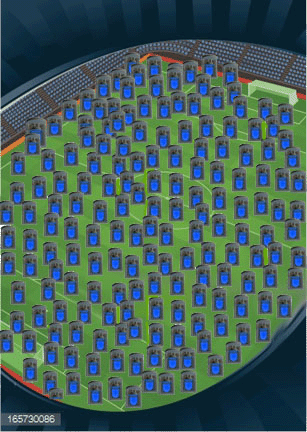
The UK’s current plans for a new wave of huge nuclear power stations is spinning out of control. The first, Hinkley Point in Somerset, was set to start generating in 2017 but questions over design and financing of the £18bn, 3,200 megawatt plant have put it years behind schedule.
The scheme was thrown into further doubt earlier this month when the finance director of EDF, the French company which will build Hinkley Point, quit over fears the company’s balance sheet could not withstand the huge costs.
Rolls Royce believes a series of mini reactors – known as “small modular reactors” (SMRs) – are a more viable medium-term solution to Britain’s looming energy crisis, although the first crop of new large reactors will still need to be deployed……..
Hinkley nuclear- the wrong energy path for UK: five much better alternatives
“Hinkley is a deal that has nothing to do with market reality. Nothing to do with affordability, let alone with the ‘hard-working families’ that [energy secretary] Amber Rudd keeps bleating on about. And nothing to do with addressing our climate change responsibilities.
“By contrast, it’s got everything to do with political leaders in three nations – the UK, France and China – all of which ‘need’ Hinkley Point to happen for grubby geopolitical interests of their own.”
 Five ways to power the UK that are far better than Hinkley Point http://www.theguardian.com/environment/damian-carrington-blog/2016/mar/18/five-ways-to-power-the-uk-that-are-far-better-than-hinkley-point
These alternatives to the troubled planned nuclear plant will be faster to build and cheaper for energy consumers, say experts, Guardian, Damian Carrington The planned £18bn nuclear reactors at Hinkley Point in Somerset are derided by critics as “one of the worst deals ever” for Britain, but defended as crucial to the UK’s energy policy by the government.
Recent resignations and financial warnings have knocked confidence in the Hinkley C deal, raising the question of whether clean energy alternatives could plug the gap. The fast-changing economics of the energy world, with renewables and other clean technologies falling in cost, indicate they can. The alternatives also look faster to build – it would take a decade to get Hinkley into operation – and cheaper for consumers, who ultimately foot the bills.
Energy policy expert Jonathan Gaventa, from the thinktank E3G, has come up with five better ways of powering the nation:
Energy efficiency
Electricity demand is already falling. The Somerset site for Hinkley C was approved in 2010 but since then UK demand has already fallen by more than the plant will produce, about 25TWh a year or 7% of today’s demand. Due to repeated delays, Hinkley C is unlikely to produce electricity much before 2030, by which time six Hinkleys’ worth of electricity could have been cut from the national demand, according to a McKinsey report for the government.
Wind turbines
Wind power generation equivalent to one Hinkley has been connected to the national grid since 2010. Onshore wind power, having dropped 20% in cost over the last five years, is much cheaper than the heavily subsidised price Hinkley is guaranteed for over 35 years. The costs of offshore wind are also falling and likely to be below Hinkley well before 2030.

Solar power
Electricity from solar power is now also cheaper than Hinkley, having fallen by half in the last five years. From almost no solar panels in the UK, a third of a Hinkley has been added since 2010. Half of that was delivered in just 18 months, according to government statistics. [excellent graph]
Cost of silicon photovoltaic solar cells,
Interconnectors
Another third of a Hinkley has been added to the UK grid since 2010 by new cables to other European countries, where electricity is currently cheaper. New interconnectors to Norway, Denmark and France could be laid by 2025, adding another two or three Hinkleys to the grid, according to a report for the UK’s National Infrastructure Commission (NIC) in February.
Storage and flexibility
Another NIC report for the government found that four Hinkleys’ worth of electricity could be saved by 2030 by increasing the ability to store electricity, inlarge batteries for example, and making the grid smarter. This would also save bill payers £8bn a year.
“It is clear that a combination of efficiency, renewables, interconnection and flexibility would be more than enough to fill the gap if Hinkley C is withdrawn – and could do so more quickly, more reliably and more cheaply,” says Gaventa.
“It is clear that a combination of efficiency, renewables, interconnection and flexibility would be more than enough to fill the gap if Hinkley C is withdrawn – and could do so more quickly, more reliably and more cheaply,” says Gaventa.
So why isn’t Hinkley dead already? Many energy policy experts are baffled. But veteran green campaigner Jonathan Porritt, who chaired the UK’s sustainable development commission for a decade, thinks he knows: “Hinkley is a deal that has nothing to do with market reality. Nothing to do with affordability, let alone with the ‘hard-working families’ that [energy secretary] Amber Rudd keeps bleating on about. And nothing to do with addressing our climate change responsibilities.
“By contrast, it’s got everything to do with political leaders in three nations – the UK, France and China – all of which ‘need’ Hinkley Point to happen for grubby geopolitical interests of their own.”
UK taxpayers up for huge liabilities if Hinkley nuclear power project goes ahead?
“The £22bn ‘poison pill’ effectively reduces the risk to zero for EDF and its backers, which is great for them. But from an outside perspective, it smacks of desperation.”
“Energy economics are changing rapidly and so the momentum is towards decentralised, smart and flexible energy systems. It is moving away from large, inflexible power plants like Hinkley. If it ever gets funded, it will be a white elephant before it is even finished and this government, with this £22bn ‘poison pill’, will have tied the next generation into paying for it, for no reason that I can understand. If it is simply political saving face, it really is pitiful.”
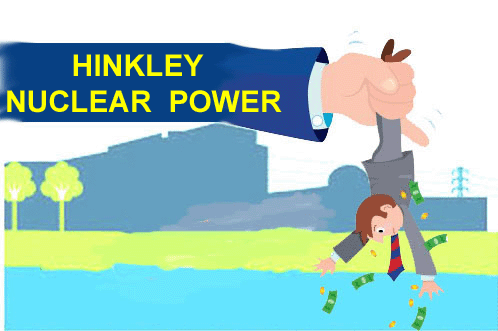
Hinkley Point C nuclear deal contains £22bn ‘poison pill’ for taxpayer
Public left with huge liability for a government closure of power plant before 2060 under UK’s agreement with EDF, Guardian, Damian Carrington, 18 Mar 16, The Hinkley nuclear power deal contains a “poison pill” which could leave taxpayers with a £22bn bill if a future UK government closed the plant before 2060, according to an official document seen by the Guardian.
The huge liability shows Hinkley is a “terrible deal” for the UK public, according to critics, with the company also guaranteed three times today’s price for electricity for 35 years. The project has recently been battered by financial warnings and resignations at its prime backer EDF, although on Thursday France’s economics minister, Emmanuel Macron, said that the French state would bail the company out.
The deal the UK government has agreed with EDF, set out in an unpublicised “minute”, commits the British public to pay subsidies of up to about £40bn in real terms and provides state guarantees on nuclear waste disposal and insurance, while allowing the plant to begin producing electricity as late as 2033.
A shutdown that triggers the “poison pill” compensation is not entirely within the control of the UK government but could also be forced by the EU or an international regulator such as the International AtomicEnergy Agency, according to the document. [ EU par inserted here on original]
“This is a dreadful agreement for the nation,” said Prof Catherine Mitchell, an energy policy expert at the University of Exeter. “The government is already paying a high price, index-linked for an incredibly long 35 years. This should be more than sufficient for a professional, business contract.
“The £22bn ‘poison pill’ effectively reduces the risk to zero for EDF and its backers, which is great for them. But from an outside perspective, it smacks of desperation.”
“There could be so many reasons over 35 years that you would want to close the plant,” she said, including rising costs, changes to the UK’s energy system or loss of public confidence.
Green party MP Caroline Lucas said: “Even before we knew about this ‘poison pill’, Hinkley represented a terrible deal for taxpayers and a huge burden on bill payers too. This flies in the face of relentless ministerial rhetoric on value for consumers – especially compared to the costs of solar power and wind – which are already cheaper than nuclear and continue to fall.”………
Former Conservative energy secretary Lord Howell has criticised the Hinkley dealas “one of the worst deals ever” for British consumers and industry and has protested against “endless government guarantees for risk-free returns to the investors”.
Tom Burke at thinktank E3G, a former special adviser to three Conservative environment secretaries, said: “Why would a Conservative government want to buy 35 years of electricity ahead of time? They are supposed to believe in the market. But they have tied themselves in knots and now it is too embarrassing to untie it.”
The UK government argues that new nuclear power is essential to provide large amounts of reliable, low-carbon energy.
But Mitchell said: “Energy economics are changing rapidly and so the momentum is towards decentralised, smart and flexible energy systems. It is moving away from large, inflexible power plants like Hinkley. If it ever gets funded, it will be a white elephant before it is even finished and this government, with this £22bn ‘poison pill’, will have tied the next generation into paying for it, for no reason that I can understand. If it is simply political saving face, it really is pitiful.” http://www.theguardian.com/uk-news/2016/mar/18/hinkley-point-c-nuclear-deal-22bn-poison-pill-taxpayer
UK Members of Parliament to question EDF executives about Hinkley nuclear project financing
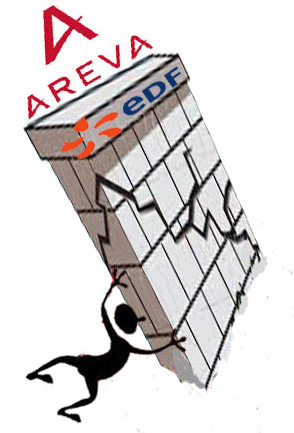 EDF Energy to be grilled by MPs over Hinkley Point C nuclear power plant , City AM. 17 Mar 16 EDF Energy will be grilled by a group of MPs next week over the controversial Hinkley Point C nuclear power plant in Somerset.
EDF’s chief executive Vincent de Rivaz, and managing director of new nuclear build Humphrey Cadoux-Hudson, will appear before the energy and climate change select committee on Wednesday.
It comes as French economy minister Emmanuel Macron pledged fresh financing for the £18bn project during a visit to a nuclear power plant there today.
EDF has been forced to defend Hinkley after its chief financial officer Thomas Piquemal resigned over the huge costs. It subsequently sent a letter to employees reiterating confidence that the project will go ahead.
“The hearing will give EDF Energy an opportunity to answer the committee’s questions on the investment plans for a new nuclear power station at Hinkley Point C in Somerset,” it said in a statement today……..http://www.cityam.com/237033/edf-energy-to-be-grilled-by-mps-over-hinkley-point-c-nuclear-power-plant
Nuclear risks don’t go away: future for UK nuclear is bleak
Pro-nuclear governments try to shield the nuclear operator from these risks, if possible. They protect the nuclear operator from lawsuits (reducing insurance costs). They guarantee debt (reducing interest
 costs). In the U.S. they tend to pass on unexpected (but prudently incurred) costs to the consumer.
That leads to our second point: these measures do not reduce risk, they just shift it. The risk never goes away. The government and consumer now bear part of it. But consumers do not take out nuclear risk policies with semi-annual payments. They do not see the cost so it doesn’t exist for them until the electricity bill goes up. In the same way, government can deny the costs of acting as an insurer of last resort because no line item appears in the budget to cover the costs until an accident happens (that’s the way a Congressional staffer explained it once at a meeting on the future of nuclear power).
5 years after Fukushima: Nuclear power prospects dim http://www.usatoday.com/story/money/markets/2016/03/15/5-years-after-fukushima-nuclear-power-prospects-dim/81553524/ Leonard Hyman and William Tilles, Oilprice.com March 15, 2016 Five years after a devastating earthquake, tsunami and nuclear accident at Fukushima that killed thousands and displaced many more, the Japanese are still cleaning up, people still cannot return to their homes and, possibly the least important statistic, Tokyo Electric Power’s shares sell at one quarter of the pre-accident price.
Roughly five years ago, the British government and French utility EDF began a process to build another nuclear power plant at Hinkley Point, an investment still awaiting the approval of EDF’s board. As odd as it seems, the tragic disaster and botched business deal have a common thread (other than the fact that EDF shares sell at one-third of their 2011 price): the role of government in nuclear power. Continue reading
Political importance to world’s nuclear powers, of getting Hinkley project happening
“The governments of the UK, France, and China have invested huge amounts of political capital in seeing Hinkley Point C come to the point of construction,” he said.
“This political capital lies with the public, convincing them that nuclear is part of a low-carbon future; [with the] the financial institutions, convincing them that when the UK makes a decision it sticks to it and hence the UK is an investable proposition; and with international governments—when the UK makes an international agreement it is binding.”
The UK’s Next Nuclear Power Plant Could Collapse Before It’s Built Motherboard, BY NICOLE KOBIE 15 March 2016 The UK could face power outages and missing emissions targets if the nuclear plant isn’t built – but that doesn’t mean it should be
Nuclear power stations are always controversial, but the UK’s proposed Hinkley Point C is particularly so. It may well be the most expensive object ever built; it guarantees higher power bills; and it’s already taken down executives, despite construction yet to start.
Hinkley Point C is set to be the first new nuclear power station built in the UK since 1995, poised to hit the grid as older nuclear sites and coal are ditched. However, its high costs are now leaving the project—and the future of the UK’s power supply—in danger.
Set to be built in Somerset by energy company EDF, which is majority-owned by the French government, there’s a chance Hinkley Point C may collapse before it’s built, and it’s nothing to do with protesters or environmental complaints. The problem with Hinkley is money: its costs risen to £18 billion ($25 billion)—with some projecting the final cost to be £24 billion ($34 billion)—and EDF has yet to finalise funding. Though it is expected to sign off on the project soon, financial analysts stressed last week that EDF can’t afford to build it.
The delays may already cause shortages in the UK’s electricity supply as it’s currently planned, which would naturally worsen if the project fails to get off the ground. The plant is supposed to start operations in 2025, when several older nuclear sites are decommissioned and the deadline hits for shutting down coal plants. Tony Roulstone, a professor setting up the University of Cambridge’s new MPhil in nuclear energy, believes the project will take ten years to construct, and given work isn’t expected to start until 2018 or 2019, will miss its deadline. “This will put the UK in a difficult position because they were counting on electricity from Hinkley by 2025,” Roulstone said.
“As some have said, the UK does not have a plan B,” he added. “The AGRs [advanced gas-cooled reactors, which make up most of the UK power stations] will close down by 2030 and at that stage we would have just one nuclear power station, Sizewell B.”
Hinkley Point C is expected to provide 7 percent of the UK’s energy. At the moment, about a fifth of the UK’s power comes from the eight currently-operating nuclear plants, but seven of those are due to be decommissioned. That, alongside theplanned closure of coal plants, which make up 22 percent of our power today, led the Institution of Mechanical Engineers to claim in a report we could see a potential supply gap of 40 to 55 percent by 2025…………..
EDF is set to make a final decision on funding the project soon, ahead of a board meeting in April, after multiple delays. However, back in February the project’s director, Chris Bakken, stepped down to “pursue new professional opportunities,” and more recently the company’s finance director, Thomas Piquemal, departed, with rumours suggesting he believed the project would damage EDF’s finances too much.
The board-level turmoil might actually be a sign that EDF’s remaining executives plan to approve the project, according to Martin Freer, director of the Birmingham Centre of Nuclear Education and Research and a professor of physics at the University of Birmingham. “My take on the resignation of the chief of finance signals that the HPC [Hinkley Point C] decision is being pushed through against the judgement of financial caution,” Freer told me. “EDF are at a point in their history where they roll the dice and hope to be lucky.”
Roulstone noted that the new plant’s construction cost is the same as EDF’s capitalisation. “Only major sales of assets and/or funding by the French government can rescue EDF and hence Hinkley,” he said………
Freer suggested that there’s more than power supply and emissions targets at risk. “The governments of the UK, France, and China have invested huge amounts of political capital in seeing Hinkley Point C come to the point of construction,” he said. “This political capital lies with the public, convincing them that nuclear is part of a low-carbon future; [with the] the financial institutions, convincing them that when the UK makes a decision it sticks to it and hence the UK is an investable proposition; and with international governments—when the UK makes an international agreement it is binding.” http://motherboard.vice.com/en_uk/read/the-uks-next-nuclear-power-plant-could-collapse-before-its-built
Nuclear propagandist Prof Geraldine Thomas: comfortable , but incorrect, spin on Fukushima
Is this a problem for human health? You bet it is. The question no-one asked is what is causing the excess dose? The answer is easy: radioactive contamination, principally of Caesium-137. On the basis of well-known physics relationships we can say that 3Sv/h at 1m above ground represents a surface contamination of about 900,000Bq per square metre of Cs-137. That is, 900,000 disintegrations per second in one square metre of surface: and note that they were standing on a tarmac road which appeared to be clean. And this is 5 years after the explosions. The material is everywhere, and it is in the form of dust particles which can be inhaled; invisible sparkling fairy-dust that kills hang in the air above such measurements.
The particles are not just of Caesium-137. They contain other long lived radioactivity, Strontium-90, Plutonium 239, Uranium-235, Uranium 238, Radium-226, Polonium-210, Lead-210, Tritium, isotopes of Rhodium, Ruthenium, Iodine, Cerium, Cobalt 60. The list is long.
the Japanese government wants to send the people back there. It is bribing them with money and housing assistance. It is saying, like Gerry Thomas, there is no danger. And the BBC is giving this misdirection a credible platform.
They keep the lid on the truth using ill-informed individuals like Geraldine Thomas.
Fukushima is far from being over, and the deaths have only just begun.
Is Fukushima’s nuclear nightmare over? Don’t count on it https://www.rt.com/op-edge/335362-fukushima-nuclear-japan-bbc/ Chris Busby 12 Mar 16
 On the 5th Anniversary of the catastrophe, Prof Geraldine Thomas, the nuclear industry’s new public relations star, walked through the abandoned town of Ohkuma inside the Fukushima exclusion zone with BBC reporter Rupert Wingfield-Hayes.
Thomas was described as “one of Britain’s leading experts on the health effects of radiation”. She is of the opinion that there is no danger and the Japanese refugees can come back and live there in the “zone”. Her main concern seemed to be how untidy it all was: “Left to rack and ruin,” she complained, sadly.
At one point, Rupert pulled out his Geiger counter and read the dose: 3 microSieverts per hour. “How much radiation would it give in a year to people who came back here,” he asked. Thomas replied: “About an extra milliSievert a year, which is not much considering you get 2mSv a year from natural background”.
“The long term impact on your health would be absolutely nothing.”
Now anyone with a calculator can easily multiply 3 microSieverts (3 x 10⁻⁶ Sv) by 24 hours and 365 days. The answer comes out to be 26 mSv (0.026Sv), not “about 1mSv” as the “leading expert on the health effects of radiation” reported.
I must personally ask if Gerry Thomas is a reliable expert; her CV shows she has published almost nothing in the way of original research, so we must ask how it is the BBC has taken her seriously. Continue reading
EDF want French tax-payers’ financial aid for UK Hinkley Point Nuclear Projectr
 EDF Asks French Government for Aid for Hinkley Point Nuclear Plant CEO Jean Bernard Levy says EDF won’t engage in project without necessary commitments from state http://www.wsj.com/articles/edf-asks-french-government-for-aid-for-hinkley-point-nuclear-plant-1457797452 By INTI LANDAURO March 12, 2016
PARIS— Electricité de France SA Chief Executive Jean-Bernard Levysaid he is seeking financial support from the French government to develop the Hinkley Point nuclear plant in southern England, as the project faces fierce scrutiny following the resignation of the company’s No. 2.
In a letter sent to company employees on Friday, Mr. Levy said EDF wouldn’t engage in the £18 billion ($25.89 billion) project unless it was able to secure necessary financial commitments from the state, which holds almost 85% of the utility.
Two EDF officials who requested anonymity confirmed Mr. Levy’s comments. The letter was sent four days after Chief Financial Officer Thomas Piquemal quit unexpectedly on concerns that the project would threaten the company’s financial stability.
The Hinkley Point project is the centerpiece of a series of business deals between the U.K. and China announced last year, with China General Nuclear Power Corp. agreeing to take a 33.5% stake in it.
The past week’s letter and CFO resignation are signs that scrutiny over the project has grown, despite support from the French and U.K. governments.
Even though the conditions granted by the U.K. government—with the pledge to buy the electricity generated around three times the current market price—would make it profitable, union representatives on EDF’s board have said Hinkley Point could saddle the company with too much debt.
EDF, which has €37.4 billion ($41.70 billion) in net debt, had its credit rating put on review for a downgrade by Moody’s Investors Service last month. Also last month, EDF said it would reduce its dividend and offer stockholders part payment in shares to bolster its finances, as well as selling assets and reducing capital spending. The utility is separatelyinvolved in the financial rescue of state-controlled Areva SA, which has lost money for the past five years. EDF last year agreed to pay at least €1.25 billion for a majority stake in Areva NP, the unit that manufactures nuclear reactors.
Separately, the risk associated with the construction of EDF’s EPR reactor design also raises uncertainty about the project. To this day, no plants using the technology have been completed. The first two being built, in Finland and in northern France, have run way over budget and are years behind schedule.
Write to Inti Landauro at inti.landauro@wsj.com
How EDF taught Britons to love nuclear power, especially targeting women
Targeting women In 2012 EDF began a publicity campaign in the UK to soften up the public, which was predominantly anti-nuclear, including paying for editorial in women’s magazines because its market research found that women were more like to oppose nuclear power than men.
A complaint I made to the Advertising Standards Authority was upheld, regarding the use of advertising from EDF that was not labelled as advertising and looked like editorial, in Marie Claire – the “magazine for women who want to think smart and look amazing”. The articles were provided by EDF, under the headline “Nuclear power: the facts”, but contained inaccuracies.
Even after the ASA ruled in my favour, EDF still continued making dubious claims in the pages of the magazine, such as that in the 2030s “nuclear reactors in Somerset and Suffolk could supply around 40 per cent of the country’s energy needs”.
In its dreams, maybe. because even while this was going on the French National Audit Office had recommended abandonment of the EPR as too complex and expensive.
“The problem is, politicians like big projects. By contrast, energy efficiency, although much more beneficial, is almost invisible, and is certainly lots of small projects.”
And energy projects don’t come much bigger than nuclear power. As Jimmy Cliff might have put it: “the bigger they come, the harder they fall.”
 The mystery of Britain’s love affair with new nuclear, The Fifth Estate, David Thorpe | 8 March 2016
Electricite de France’s chief financial officer Thomas Piquemal has resigned after opposing the announcement next month of a final investment decision on building a new nuclear reactor at Hinkley Point C in the UK.
EDF shares immediately dropped in value and further questions are being asked over the wisdom of proceeding with the plant, which would be the first new nuclear power station to be built in the UK in two decades. It was originally planned for completion in 2017 and is now unlikely to be built until at least 2025 – if ever. Continue reading
Labour and Nukes: conspiracy of hope killed off?
 nuClear News, March 2016 Lisa Nandy, the Shadow Secretary of State for Energy and Climate Change has called on the government to come up with a “Plan B” in case Hinkley Point C is never built. But instead of taking the opportunity to argue the case for more renewables she has called on the government to find cheaper ways to get more nuclear stations built in future. (1) She now wants the Government to look at new reactor types including Molten Salt Reactors, Heavy Water Reactors, and Fast Reactors (2) A far cry from Jeremy Corbyn’s manifesto last summer which pointed to the 8 countries, 55 cities and 60 regions which are planning to go 100% renewable over the next few decades which Britain should be part of. He said Britain needs the Big 60 million not the Big 6. In his interview with Greenpeace’s Energydesk he said “no” to new nuclear power stations. (3)
Letter from Stop Hinkley Campaign to EDF Energy
nuClear News Mar 16
Dear EDF Energy, We are writing to you before another EDF Board Meeting at which it is rumoured a final investment decision on Hinkley Point C could be made to urge you to scrap this project altogether.
- Debts of €37 billion (£28 billion) and its share price has fallen from €29 in April 2014 to €10.32 last week. Financing a massive project like Hinkley Point C will clearly place a significant strain on finances. (2) The union notes that the debt related to Hinkley Point C will need to be 100% fully consolidated into the EDF accounts – an amount which exceeds the market capitalization of the Group.
- EDF is now facing a €100m bill for upgrading its nuclear power stations in France according to a report by French Government auditor – the Cour des Comptes – rather than €55bn previously estimated. (3)
- EDF has also agreed to buy between 51 and 75% of the struggling French reactor builder Areva NP which is valued at €2.7bn. So will have to find at least €1.4bn for that.
- The French waste agency Andra has estimated that the cost of its deep geological disposal project could be as high as €30bn rather than the €20bn estimated by EDF. (4) French energy minister Ségolène Royal has signed a decree setting the ‘reference cost’ at €25 billion – still a jump of €5bn for EDF. (5)
1 This Month





PLEASE OPPOSE HR 8255 AND S.3639 – bills would accelerate satellite deployment, with no environmental review or safeguards – https://ncstd5li.quorum.us/campaign/169331/
To see nuclear-related stories in greater depth and intensity – go to https://nuclearinformation.wordpress.com
-
Archives
- October 2026 (49)
- September 2026 (339)
- August 2026 (330)
- July 2026 (355)
- June 2026 (287)
- May 2026 (306)
- April 2026 (356)
- March 2026 (251)
- February 2026 (267)
- January 2026 (308)
- December 2025 (358)
- November 2025 (359)
-
Categories
- 1
- 1 NUCLEAR ISSUES
- business and costs
- climate change
- culture and arts
- ENERGY
- environment
- health
- history
- indigenous issues
- Legal
- marketing of nuclear
- media
- opposition to nuclear
- PERSONAL STORIES
- politics
- politics international
- Religion and ethics
- safety
- secrets,lies and civil liberties
- spinbuster
- technology
- Uranium
- wastes
- weapons and war
- Women
- 2 WORLD
- ACTION
- AFRICA
- Atrocities
- AUSTRALIA
- Christina's notes
- Christina's themes
- culture and arts
- Events
- Fuk 2022
- Fuk 2023
- Fukushima 2017
- Fukushima 2018
- fukushima 2019
- Fukushima 2020
- Fukushima 2021
- general
- global warming
- Humour (God we need it)
- Nuclear
- RARE EARTHS
- Reference
- resources – print
- Resources -audiovicual
- Weekly Newsletter
- World
- World Nuclear
- YouTube
-
RSS
Entries RSS
Comments RSS

