Hinkley nuclear power plan, and the costs of its radioactive wastes
Brexit might help UK to develop nuclear projects

 5 ways Brexit would transform European energy, Politico, Sara Stefanini , 24 June 16 Central and Eastern Europeans would lose a powerful ally, while nuclear and renewable investors would face an uncertain world.
A British vote to leave the European Union would force broad changes to the bloc’s energy policy, weakening its climate policy and removing a crucial Central European energy ally — but it could also give London far more freedom to pursue nuclear projects.
The U.K. is often an energy outlier in the EU, advocating nuclear power and shale gas sources shunned by others. And it tends to build alliances broadly aimed at keeping interference from Brussels to a minimum.
But both sides have a lot to lose.
A Brexit could undercut long-term climate policies in Brussels and London, and the EU would lose the U.K.’s pro-free market voice, which has historically helped tone down some more statist schemes coming from European capitals.
Here are the five ways that a Brexit would impact Europe’s energy and climate forecast:…….
4. The freedom to subsidize — maybe
One area the European Commission tries to avoid is state aid, particularly for energy projects.
But even when the Commission gives a green light, there’s the danger that another EU country might try to interfere. That’s what happened with Hinkley Point. Brussels approved a state aid plan in 2014, but Austria, backed by Luxembourg,challenged the decision in the European Court of Justice eight months later…….
Environmental advocates worry it would give the U.K. room to continue rolling back support for renewables in favor of other fuels.
“One of the reasons why the government has had to have a more sensible policy on these issues is because state aid disciplines have stopped it from throwing money at gas-powered stations and fracking and nuclear,” said Nick Mabey, chief executive of the environmental analysis group E3G……..http://www.politico.eu/article/uk-brexit-renewable-energy-hinkley-nuclear-interconnectors-gas-climate-emissions-paris/
Exit from the European Union could make it easier for Britain to develop nuclear power
A British vote to leave the European Union would force broad changes to the bloc’s energy policy, weakening its climate policy and removing a crucial Central European energy ally — but it could also give London far more freedom to pursue nuclear projects.
The U.K. is often an energy outlier in the EU, advocating nuclear power and shale gas sources shunned by others. And it tends to build alliances broadly aimed at keeping interference from Brussels to a minimum.
But both sides have a lot to lose.
A Brexit could undercut long-term climate policies in Brussels and London, and the EU would lose the U.K.’s pro-free market voice, which has historically helped tone down some more statist schemes coming from European capitals.
Here are the five ways that a Brexit would impact Europe’s energy and climate forecast:…….
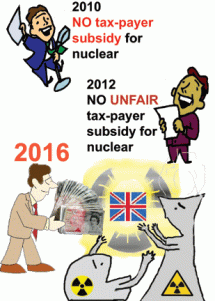 4. The freedom to subsidize — maybe
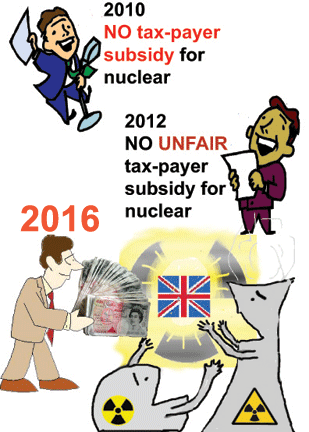
One area the European Commission tries to avoid is state aid, particularly for energy projects.
But even when the Commission gives a green light, there’s the danger that another EU country might try to interfere. That’s what happened with Hinkley Point. Brussels approved a state aid plan in 2014, but Austria, backed by Luxembourg,challenged the decision in the European Court of Justice eight months later…….
Environmental advocates worry it would give the U.K. room to continue rolling back support for renewables in favor of other fuels.
“One of the reasons why the government has had to have a more sensible policy on these issues is because state aid disciplines have stopped it from throwing money at gas-powered stations and fracking and nuclear,” said Nick Mabey, chief executive of the environmental analysis group E3G……..http://www.politico.eu/article/uk-brexit-renewable-energy-hinkley-nuclear-interconnectors-gas-climate-emissions-paris/
Senior EDF managers want Hinkley nuclear project to be postponed
 EDF Managers Tell UK MPs That Hinkley Point C Should Be Postponed http://www.nucnet.org/all-the-news/2016/06/20/edf-managers-tell-uk-mps-that-hinkley-point-c-should-be-postponed
Plans & Construction 20 Jun (NucNet): Senior managers at EDF have told British MPs that a final investment decision (FID) on the planned Hinkley Point C nuclear project should be delayed until problems including the reactor design and “multi-billion litigation” over the Olkiluoto-3 project in Finland have been resolved.
The letter from EDF managers to the UK parliament’s energy and climate change committee is a setback for the proposed £18bn (€23bn, $26bn) nuclear station in Somerset, England. The station is a flagship of the government’s energy policy and is intended to provide seven percent of Britain’s electricity from about 2025.
In April, the state-controlled French company said it was delaying the FID until September while it consulted with trade unions.
A letter dated 13 June and addressed to Angus MacNeil, the chairman of the committee, from the Fédération Nationale des Cadres Supérieurs de l’Énergie (FNCS) union, “advises to delay the FID until better upfront industrial visibility is evidenced”.
Outstanding problems highlighted by in the letter include:
– Areva NP, the designer of the European pressurised water reactor (EPR) planned for Hinkley Point, “is currently facing a difficult situation”.
– The French nuclear safety authority (ASN) may not approve operation of the Flamanville-3 EPR under construction in northwest France due to various anomalies with the reactor vessel bottom and the reactor vessel head.
– There may be “identical flaws” in an Areva EPR being built at Taishan-1 in China.
– Litigation between Areva and the Finnish energy group TVO over delays to the Olkiluoto-3 EPR remain unsettled.
– An EDF offer to purchase Areva expired on 31 March, leaving “governance uncertainties upon the implementation of the Hinkley Point C project”.
The letter says that on 25 May, ASN declared at an annual hearing in the French parliament that financial and economic challenges that both EDF and Areva are facing would be “time consuming”. The necessary reorganisations “would need long delays before a proper recovery happens” and ASN would prioritise regulatory oversight of the existing fleet rather than any new project.
According to the letter, ASN is concerned that while EDF is dedicating its efforts to new nuclear projects, the financing of safety improvements for the normal operation of the French nuclear fleet could be delayed or even given up.
The letter says “heavy evidence” still needs to be brought prior to further commitments, in order to make those commitments “gain robustness and reliability”.
On 7 June, three French workers unions sent a letter to energy minister Ségolène Royale asking for clarification about the “orientation” of the French nuclear industry.
Vincent de Rivaz, the chief executive officer of EDF’s UK subsidiary EDF Energy told MPs last month that he could not give a definite time for when the company will make the FID.
Mr de Rivaz was called to reappear before the committee after indicating at an appearance in March that the FID could be taken by early May. The committee asked him to explain why that had not happened.
The letter is online: http://bit.ly/1Uc8N0F
Nestle’s new deal for powering its UK and Ireland operations with wind energy
 NEW RENEWABLE POWER SOURCE FOR NESTLE UK AND IRELAND OPERATIONS LONDON, The Climate Group, 22 June 16 Nestlé has signed a new deal to power around half of its UK and Ireland operations with wind from the Scottish Highlands.
An initial 15 year Power Partnership Agreement with Community Wind Power will see a brand new nine turbine wind farm open up in Dumfries and Galloway in the first half of 2017. It will produce approximately 125GWh of power per annum, meeting around 50% of Nestlés electricity demand in the UK and Ireland – equivalent to 30,000 homes.
Earlier this year, Nestlé UK & Ireland announced that all its grid supplied-electricity would come from renewable sources, in a deal with EDF Energy. This currently accounts for all of Nestlés electricity use in the UK and Ireland.
As a member of RE100, Nestlé is committed to transitioning its electricity use to 100% renewable electricity not just in the UK, but across its global operations. The latest available data shows that in 2015, 8.4% of Nestlés total electricity consumption was being sourced from renewable power. Today’s development is another positive step towards its global goal.
Dame Fiona Kendrick, Chairman & CEO of Nestlé UK & Ireland, said: “This is a newly commissioned wind farm, generating new energy, creating capacity that didn’t previously exist and capable of providing half of our electricity needs. It’s a proud moment for us and means we have reached another key milestone in our efforts to become a sustainable business.”…….http://www.theclimategroup.org/what-we-do/news-and-blogs/new-renewable-power-source-for-nestl-uk-and-ireland-operations/?platform=hootsuite
Call for Britain to have Russia build UK’s new nuclear stations
 UK government needs a nuclear plan B, says Tim Yeo, Guardian, Terry Macalister, 19 June 16, “…….. Tim Yeo, a former chair of the energy and climate change committee, said the government should also consider whether the Russian state operator, Rosatom, or the British state could build new atomic plants.
The Hinkley project in Somerset has been hit by a series of delays, with its developer, EDF, recently postponing a final investment decision until September.
Yeo said continuing opposition from EDF unions to spending huge sums of money in Britain and political uncertainty ahead of the French elections next spring could hold up the project further……..
Yeo said the Russian political situation made it harder for the UK government, but Russian nuclear sources have previously said Rosatom would like to talk.
In 2014, a senior Decc officialconfirmed that there had been serious contact between the two sides……
The pro-nuclear campaigner said the total cost of any new reactor to energy billpayers could be reduced if the British government became directly involved, as some City analysts have claimed…….https://www.theguardian.com/uk-news/2016/jun/19/uk-government-should-have-a-nuclear-plan-b-tim-yeo-hinkley-point-bradwell-scheme
Radioactive material at popular UK beach near Sizewell nuclear station
 NUCLEAR LEAK ALERT Traces of radioactive material found at seaside beauty spot near decommissioned nuclear site Suffolk’s Southwold beach is the second to be hit by contamination in two months, The Sun UK BY CHARLIE PARKER 17th June 2016
The contamination on the idyllic Southwold beach is feared to be linked to the Sizewell A nuclear plant, which is located on coast not far from the popular seaside spot.
The nuclear factory is in the process of being decommissioned at a cost of £1.2 billion after shutting down ten years ago.
The coastal spot is nicknamed Hampstead-on-Sea because of the all the celebrities who flock there for the holidays.
Chris Evans, Dame Judi Dench and Stephen Fry and other big names regularly visit the beach spot.
Alarmingly, Southwold is the second Suffolk beach to be hit by the contamination in just two months.
In April, scientists monitoring the area around Sizewell revealed that a ‘small amount’ of an particularly dangerous and ‘unusual’ radioactive isotope had been found at Aldeburgh, eighteen miles from Southwold.
The Sizewell plant, which houses two outdated magnox nuclear reactors, is on the coast between the two resorts.
The Environment Agency insisted today that there are ‘no safety or environmental concerns and no risk to members of the public’……
Sizewell A is in the midst of its own investigations over the discovery of Strontium-90, produced by nuclear fission, at Aldeburgh beach – one of five coastal areas monitored by the site…….
Sizewell A power station was shut down on 31 December 2006, with the Nuclear Decommissioning Authority placing the contracts at a budgeted cost of £1.2 billion.
On 7 January 2007 a contractor working on the decommissioning of the station noticed water leaking on to the floor of the laundry where he was washing his clothes……..
The water was found to be cooling water from the pond that holds the reactor’s spent nuclear fuel which had dropped more than 1 foot (0.30 m) without activating any of the alarms.
It was feared that up to 40,000 gallons (151,500 litres) of radioactive water had leaked from a 15ft (4.6 m) split in a pipe, with some spilling into the North Sea where it could wash along the Suffolk coast.
Had the exposed irradiated fuel had caught fire, it would have resulted in the release of radiation into the air.
Southwold is popular with holidaymakers – the town’s populations is typically less than 2,000 but this figure swells to almost 10,000 in summer………https://www.thesun.co.uk/news/1298270/traces-of-radioactive-material-found-at-seaside-beauty-spot-near-decommissioned-nuclear-site/
At UK’s Burghfield nuclear weapons factory – a rolling anti-nuclear blockade
Rolling blockade at Burghfield nuclear weapons factory, Red Pepper, Theo Simon writes from one of the longest continuous blockades of a nuclear weapons base 16 June 2016 When I joined the anti-nuclear blockaders lying with arms in lock-on tubes across a Berkshire lane, none of us imagined how the day would play out. After a leisurely start that caught the waiting cops off guard, we’d arrived at the Burghfield nuclear weapons factory near Reading to kick-off a rolling month of blockades the Trident Ploughshares campaign had planned for June.
After a few hours successfully blocking access to the MOD site, rather than doing what the cops expected and leaving, we consolidated our forces and stayed through the night with our lock-ons extended across the gate. Reinforced with new arrivals, we slept through to a second day, and began the longest continuous blockade of a nuclear weapons base ever, with construction traffic turned back and building-work for the warhead factory set back by a week as a result! And there were only 20 of us.
Back in the day when nuclear warheads were the only form of mass destruction on the horizon, terror of nuclear war with Russia mobilized thousands, and protests at nuclear bases could draw upon hundreds of people. Today a new generation of humanity faces many apparently more imminent threats – so many, played out in so many variations on our screens, we’re understandably confused and numb to the very real peril we are in. The most powerful popular argument against Trident seems to be how much it will cost – not the unspeakable obscenity of preparing for mass murder, or the urgent need for disarmament if we are to avoid extinction this century.
Britain was secretly upgrading Trident nuclear arsenal prior to Parliamentary consent
MoD admits it’s worried about security at Trident nuclear weapons base, Rt.com 9 Jun, 2016 Britain’s Trident nuclear weapons program has suffered a skills shortage for the last 10 years, posing a threat to nuclear safety, a Ministry of Defence (MoD) report says.
The latest annual report from the MoD’s internal watchdog, the Defence Nuclear Safety Regulator (DNSR), says staff shortages are a “key strategic issue” which requires attention to ensure continued “safe delivery” of the nuclear weapons program…….
On Tuesday, it was revealed by the Nuclear Information Service that Britain was secretly upgrading its arsenal of Trident nuclear weapons and developing an entirely new warhead.
Controversially, parliament is yet to consent to its renewal. https://www.rt.com/uk/345975-trident-nuclear-security-concern/
Fleet of little nuclear reactors for Britain. Rolls Royce to build them?
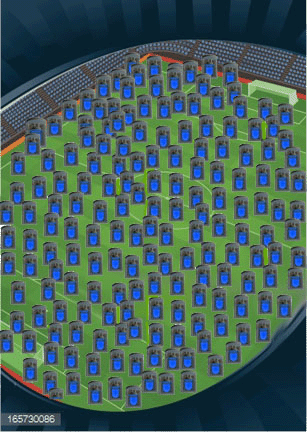
Rolls Royce Shortlisted to build fleet of baby nuclear-reactors, CITY AM Jessica Morris, 5 June 16 , FTSE 100-listed engineering company Rolls-Royce has been shortlisted to build a fleet of mini nuclear reactors, City A.M. understands.It’s part of the government’s £250m nuclear research programme unveiled in last year’s Autumn Statement, which includes a competition to identify the best value small modular reactor (SMR) design for the UK.
An industry source said that the SMR scheme won’t be a “short process”. This comes despite the UK energy policy crisis, with an increasingly strained power supply. Almost 6,000 MW could be lost this year.
Of the 38 companies which submitted expressions of interest in the competition, 33 were eligible to compete in the next round, according to the Sunday Timeswhich first reported the news.
These also include US engineering giant Bechtel, NuScale Power which is backed by US engineer Fluor, and Canada’s Terrestrial Energy……The company declined to comment, while the Department for Energy and Climate Change hasn’t yet responded to a request for comment. http://www.cityam.com/242623/rolls-royce-shortlisted-to-build-fleet-of-baby-nuclear-reactors
NUCLEAR safety experts are calling for households in the UK to be supplied with anti-radiation pills
 nuclear materials transported by road, rail, sea and air are also potential targets.
Fears of nuclear terror attack grow amid call for UK homes to be sent anti-
radiation pills NUCLEAR safety experts are calling for households in the UK to be supplied with anti-radiation pills as fears grow of the potential for terrorists to strike highly-sensitive sites around the country. Express, By TOM BATCHELOR May 31 A new report warns British nuclear plants are at risk of mass drone strikes, sophisticated cyber attacks and terrorist infiltrators.
Analysis for the Nuclear-Free Local Authorities (NFLA) found nuclear facilities at Faslane – where the UK stations its Trident missile system – was vulnerable to attack. Sensitive nuclear sites at Hunterston, Torness and Dounreay are also at risk, the study claims. More worrying still, UK authorities were deemed to be underestimating the risk of devastating terrorist attacks.
The report demands urgent action from ministers as it warns governments and regulatory agencies are struggling to keep up with evolving threats. Such is the fear of an attack that the NFLA is demanding anti-radiation pills be distributed to households in Glasgow, Edinburgh and surrounding areas.
The medication is a preventative measure which would help protect people from a radiation leak – either accidental or a deliberate attack.
The report on nuclear security, compiled by Dr David Lowry, a senior research fellow with the US Institute for Resource and Security Studies, argues that nuclear materials transported by road, rail, sea and air are also potential targets. He said: “The main consequences would be, whatever the level of attack, mass public panic and sensationalist media reportage. “We would inevitably see total road gridlock, as everyone tries to flee by car en masse at once.”
 Drones could carry shaped charges, poison gas, booby traps or decoys, and could come individually or in large groups. The report said: “One heavily laden small drone could probably travel at least 20mph with a load of 5-10kg. “Just one 5kg shaped charge can penetrate 0.75 metres of reinforced concrete, or 0.25 meters of steel.”
The second report for NFLA, written by Dr Ian Fairlie, an independent radiation scientist, focuses on the stable iodine tablets that can prevent radiation poisoning after some nuclear accidents.
Several other European countries distribute the pills across a wide area, but in Scotland they are only given to residents who live within two or three kilometres of nuclear plants……..
EDF Energy, the French company that runs nuclear power stations in Scotland, and the Ministry of Defence, which runs the Faslane nuclear base, declined to comment. http://www.express.co.uk/news/uk/675515/Nuclear-terror-attack-fears-experts-call-government-hand-out-anti-radiation-pills
UK: Secrecy over nuclear waste plans regarding EDF’s Hinkley Point deal
 EDF’s Hinkley Point deal over radioactive waste sparks anger https://www.theguardian.com/business/2016/may/30/edf-hinkley-point-deal-radioactive-waste-sparks-anger?utm_source=esp&utm_medium=Email&utm_campaign=GU+Today+main+NEW+H+categories&utm_term=174833&subid=12125&CMP=EMCNEWEML6619I2
Expert criticises ministers over refusal to disclose agreement with energy supplier for planned nuclear plant Guardian, Terry Macalister, 31 May 16, A furious row has broken out after the Department of Energy and Climate Change (DECC) refused to disclose the arrangement with EDF for dealing with radioactive waste at the planned Hinkley Point C nuclear plant.
The information commissioner’s office has turned down a freedom of information (FoI) request for state aid arrangements between the UK and the European commission to be made public.
The FoI complainant, David Lowry, has launched an appeal, claiming it is in the public interest for British citizens to be able to judge whether their government had made the right decision about the new reactors in Somerset.
Lowry, a British-based senior research fellow with the Institute for Resource and Security Studies in the US, said: “I do not believe the balance of judgment should be in favour of a foreign company, EDF Energy, who will potentially make huge multibillion-pound financial gain from the continued non-disclosure, and hence non scrutiny, over myself as a British tax and electricity bill payer.”
The government said that anyone building new reactors in Britain must manage and pay for the cost of handling waste products, unlike the existing situation where all radioactive materials are effectively dealt with through the public purse via the Nuclear Decommissioning Authority.
However, although the operator must agree to take responsibility for the spent fuel and other radioactive waste, the cost is expected to be passed on to the domestic electricity user through higher bills.
Under the new arrangements, the prospective nuclear operators must enter into a waste transfer contract (WTC). Those contracts, like the one covering Hinkley, must be submitted for scrutiny by the EC under its state aid rules. It is the pricing methodology of the WTC that Lowry wished to review and which remains under wraps.
Greenpeace said Lowry raised critical issues that went to the heart of whether the £18.5bn project was good or bad value for the taxpayer and British energy consumers.
John Sauven, the executive director of Greenpeace, said: “The government has repeatedly said that Hinkley is great news for the British public and our energy security. But they refuse to back this up with hard evidence. In fact, DECC is incredibly cagey and is failing to answer questions on where the dangerous radioactive waste will go or how much Hinkley will cost us.
“If Hinkley is such a good deal, it should be no problem for the government to release the information to prove it. Their failure to do so leaves us to believe that their assumptions are correct – it’s a terrible deal for bill payers and they simply don’t know what to do with the nuclear waste.”
DECC turned down the original request under regulation 12(5)(a) of the Environmental Information Regulations 2004 arguing, “disclosure would adversely affect international relations, defence, national security or public safety”.
This argument was accepted by the information commissioner who believed that disclosure of the state aid discussions with the EC “would adversely affect the relationship between the (UK) government and the commission’s ability to work effectively together”.
Lowry said he thought the real reason the government did not want to disclose the information was to save ministers from embarrassment. “I think the concern is if the truth were to come out with documents being made public would adversely affect the credibility of the government submissions as their threadbare content would be laid bare for all to see,” he said.
DECC declined to comment, saying it was a matter for the information commissioner.
Nuclear concerns hold back Apple data centre plans in Ireland
Alice MacGregor Tue 31 May 2016 Apple is being questioned over its site selection for a new Irish data centre, with opponents arguing that the proposed €850 million (approx. £648 million) server farm would be located too close to nuclear facilities in Wales and Cumbria.
Oscar Gonzalez, Apple’s head of data centre site selection, came against arguments from a group including engineer Allan Daly at an oral hearing last week. Daly raised the issue that Apple requires that new centres be at least 320km from any nuclear facility in the UK – and was concerned that the proposed Irish site would not meet this specification……..https://thestack.com/data-centre/2016/05/31/nuclear-concerns-hold-back-apple-data-centre-plans-in-ireland/
Exposing the vulnerability of Scottish nuclear facilities to terrorist attack
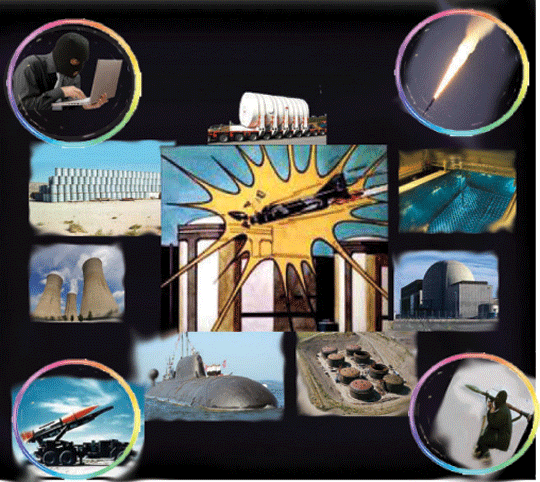 Nuclear-Free Local Authorities say Scottish nuclear facilities are vulnerable to terrorist attack Herald Scotland, Rob Edwards 29 May 16, UK authorities are underestimating the risks of devastating terrorist attacks on nuclear plants and shipments of radioactive material, according to an expert report seen by the Sunday Herald.
A new analysis for the 40-strong group of Nuclear-Free Local Authorities (NFLA) highlights the vulnerability of Scottish nuclear facilities at Faslane, Hunterston, Torness and Dounreay to mass drone strikes, sophisticated cyber attacks and terrorist infiltrators.
UK authorities are underestimating the risks of devastating terrorist attacks on nuclear plants and shipments of radioactive material, according to an expert report seen by the Sunday Herald.
A new analysis for the 40-strong group of Nuclear-Free Local Authorities (NFLA) highlights the vulnerability of Scottish nuclear facilities at Faslane, Hunterston, Torness and Dounreay to mass drone strikes, sophisticated cyber attacks and terrorist infiltrators.
“The main consequences would be, whatever the level of attack, mass public panic and sensationalist media reportage,” he says. “We would inevitably see total road gridlock, as everyone tries to flee by car en masse at once.”
His report argues that a series of unidentified drone flights over French nuclear power stations last summer “should be seen as a major wake-up call for the nuclear industry”. Drones could carry shaped charges, poison gas, booby traps or decoys, and could come individually or in large groups.
Nuclear spruikers head to Cumbria for a marketing talkfest
Carlisle to host two-day Cumbria Nuclear Conference, News & Star, 27 May 2016 The nuclear industry is coming to Carlisle this autumn, when the city hosts the first Cumbria Nuclear Conference.
The two-day event on September 21 and 22 will attract movers and shakers from across the sector and highlight the opportunities – and challenges – to businesses arising from the new nuclear plant at Sellafield.
Speakers confirmed include NuGen chief executive Tom Samson, energy minister Andrea Leadsom, the former defence secretary and Barrow MP Lord Hutton, and John Clarke, chief executive of the Nuclear Decommissioning Authority.
Carlisle MP John Stevenson has organised the event. He said: “Nuclear is a big opportunity for Cumbria – that much is widely recognised.
“But how we do maximise the benefits for the county? That’s what the conference will address. We need to raise awareness of the opportunities.”…….
NuGen – a partnership between Toshiba of Japan and the French energy company ENGIE – has plans to build three Westinghouse AP1000 reactors…….NuGen is due to make a final decision on whether to proceed with the Moorside project in 2018 and had hoped to start construction two years later and have the first reactor on stream by 2024, although it now says the target date has slipped to 2025……
1 This Month





PLEASE OPPOSE HR 8255 AND S.3639 – bills would accelerate satellite deployment, with no environmental review or safeguards – https://ncstd5li.quorum.us/campaign/169331/
To see nuclear-related stories in greater depth and intensity – go to https://nuclearinformation.wordpress.com
-
Archives
- October 2026 (49)
- September 2026 (339)
- August 2026 (330)
- July 2026 (355)
- June 2026 (287)
- May 2026 (306)
- April 2026 (356)
- March 2026 (251)
- February 2026 (267)
- January 2026 (308)
- December 2025 (358)
- November 2025 (359)
-
Categories
- 1
- 1 NUCLEAR ISSUES
- business and costs
- climate change
- culture and arts
- ENERGY
- environment
- health
- history
- indigenous issues
- Legal
- marketing of nuclear
- media
- opposition to nuclear
- PERSONAL STORIES
- politics
- politics international
- Religion and ethics
- safety
- secrets,lies and civil liberties
- spinbuster
- technology
- Uranium
- wastes
- weapons and war
- Women
- 2 WORLD
- ACTION
- AFRICA
- Atrocities
- AUSTRALIA
- Christina's notes
- Christina's themes
- culture and arts
- Events
- Fuk 2022
- Fuk 2023
- Fukushima 2017
- Fukushima 2018
- fukushima 2019
- Fukushima 2020
- Fukushima 2021
- general
- global warming
- Humour (God we need it)
- Nuclear
- RARE EARTHS
- Reference
- resources – print
- Resources -audiovicual
- Weekly Newsletter
- World
- World Nuclear
- YouTube
-
RSS
Entries RSS
Comments RSS

