Warning to Teresa May on climate threats to Brexit Britain

 May warned on climate threats to Brexit Britain Climate Home 12/07/2016, The incoming government must prepare for floods and heatwaves even as EU negotiations dominate politics, say advisers By Megan Darby
When Theresa May takes over as prime minister of Britain on Wednesday, climate change might not be top of her agenda.
The former home secretary has to renegotiate relations with the EU, the rest of the world and heal a divided country. But the impacts of global warming are not going away, a report by the independent Committee on Climate Change (CCC) warns.
Heatwaves like the one that killed an estimated 2,000 British citizens in 2003 are projected to become the norm by the 2040s. To prevent more excess summer deaths, government needs to regulate for cooler buildings today, the CCC advises.
It is one of six priorities for action, in a review of evidence pulled together by 80 authors over three years.
Many of the issues are unchanged since the CCC last undertook a similar assessment five years ago.
Flooding remains at the top of the list, a status only reinforced by hundreds of millions of pounds worth of damage wreaked by storms in Cumbria last December. “The risks don’t change because of Brexit,” said Lord Krebs, chair of the adaptation sub-committee. But he added: “Some of the legislation that might underpin our resilience and preparation for future climate changes is EU legislation and therefore there will be a need in due course to replace that with national legislation.”
Meanwhile, the uncertainty is denting confidence for investment in resilient infrastructure, said report co-author Swenja Surminski, from the London School of Economics………
While May has not been vocal on the issue, as a member of the National Security Council, she was involved in a 2015 review that outlined how global warming could trigger political instability, conflict and migration.
“Our long-term objective is to strengthen the resilience of poor and fragile countries to disasters, shocks and climate change,” it concluded. “This will save lives and reduce the risk of instability.” http://www.climatechangenews.com/2016/07/12/may-warned-on-climate-threats-to-brexit-britain/
British Parliament to vote on renewing Trident nuclear missile system, as Brexit problems loom
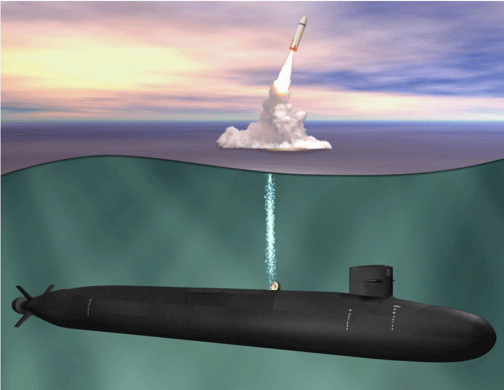 A UK nuclear vote, as Brexit looms http://thebulletin.org/uk-nuclear-vote-brexit-looms9650 By John Mecklin, 10 July 16 In a somewhat unexpected move, United Kingdom Prime Minister David Cameron—who has already declared he will resign in September because of his country’s vote to exit the European Union—announced a quick parliamentary vote on replacing the country’s fleet of nuclear-missile submarines.
The announcement, made at a NATO summit in Warsaw, seems designed to underscore the UK’s commitment to the alliance. This Reuters piece suggests Parliament is likely to vote in favor of renewing the submarine fleet, in large part because of support from Cameron’s Conservative Party.
But amid the political turmoil over possible paths to a “Brexit” from the EU, there will almost certainly be opposition from some in the Labour Party and the Scottish Nationalist Party, which is on record as wanting the Scotland-based submarines decommissioned.
Renewal of Trident nuclear weapons system opposed by British Labour and Scottish National Party
Trident: David Cameron confirms date for vote on renewal of nuclear weapons system MPs will vote on the future of the controversial weapons system in the House of Commons, The Independent Siobhan Fenton @siobhanfenton 10 July 2016 Parliament will vote on the renewal of the Trident nuclear weapons system on 18 July, David Cameron has announced.
Replacement for the system is estimated to cost between £15bn and £20bn. The force currently consists of four submarines which are each capable of carrying up to 16 ballistic nuclear missiles which are capable of hitting targets up to 7,500 miles away……
The fleet will need to be replaced in 2028 and a decision is required by Parliament this year whether to renew the system.
The controversial scheme has proved divisive in Parliament…….
The Labour party has previously supported it but current leader Jeremy Corbyn has been a long-time opponent of renewal. It is expected Labour MPs may be given a free vote on the issue.
Mr Corbyn told Sky News: “We are having a look at all the issues surrounding it. I believe security in the world is achieved through peace, through democracy, through justice, through human rights.
“I do not believe that nuclear weapons actually enhance security, I support the nuclear non-proliferation treaty, which we are signed up to, which is trying to bring together collective disarmament. Those are the views that I will be putting forward.”
The Labour party has commissioned a defence review about its policy on nuclear weapons. A draft version has reportedly indicated the party will leave open the option of retaining nuclear weapons on a smaller scale, thereby providing a compromise between total disarmament and renewal.
The SNP has been vocal in its opposition of the scheme. http://www.independent.co.uk/news/uk/politics/trident-david-cameron-confirms-date-for-vote-on-renewal-of-nuclear-weapons-system-a7128466.html
Britain’s nuclear submarines’ radioactive wastes will NOT be going to Scotland

 Chapelcross site ruled out for nuclear submarine waste BBC News 8 July 2016 The Ministry of Defence has ruled out a Scottish site as a possible location to store waste from nuclear submarines.
Chapelcross near Annan was on a shortlist of five potential locations.
Capenhurst in Cheshire has been selected to store the nuclear components, with Aldermaston in Berkshire as a “fall back” option. The Scottish site was ruled out along with Sellafield in West Cumbria and Burghfield in Berkshire following public consultation…….
The nuclear components are from 18 redundant submarines and nine still in service.
The redundant Royal Navy submarines are currently stored afloat at Devonport in Plymouth and Rosyth in Fife, but cannot be dismantled until the reactor components have been removed.
The radioactive parts will be stored until after 2040, when the UK’s Geological Disposal Facility, for the permanent disposal of spent fuel and nuclear waste, is planned to come into operation……..http://www.bbc.com/news/uk-scotland-south-scotland-36745287
Old submarines’ nuclear waste – leaks – trash to be sent to North of England
 Nuclear waste from scrapped Plymouth subs to be sent up country, Herald, UK WMNlynbarton July 08, 2016
Radioactive fuel cells on a dozen disused nuclear submarines languishing in Plymouth are to be removed and taken to a site in the North of England for storage and eventual disposal.
The Ministry of Defence yesterday revealed the fate of the boats which are currently stationed at Devonport but said no date has yet been fixed for the process to begin
Defence Minister Philip Dunne said the highly toxic part of the decommissioned submarines would be removed at a date to be set.
“When submarines in the Royal Navy fleet reach the end of their lives, we need to dispose of them in a way that is safe, secure and environmentally sound,” he said………
It emerged last year that the ministry was spending £16million to store the vessels, with the ones in Plymouth having been taken out of service in 1994.
The MoD said it was working on a plan to safely dispose of the Reactor Pressure Vessels (RPV), the thick steel containers which weigh between 90-135 tonnes and held nuclear fuel when the reactors operated.
There have been a number of leaks of nuclear waste associated with the submarines based in Devonport.
*March 25, 2009: radioactive water escaped from HMS Turbulent while the reactor’s discharge system was being flushed.
*November 2008: 280 litres of water likely to have been contaminated with the radioactive isotope tritium, poured from a burst hose as it was being pumped from the submarine.
*October 2005: 10 litres of water leaked out as the main reactor circuit of HMS Victorious as it was being cleaned to reduce radiation.
*November 2002: Around ten litres of radioactive coolant leaked from HMS Vanguard……..In May this year, it was revealed extra radioactivity could be discharged into the atmosphere during the refit of a nuclear submarine at Devonport Dockyard.
Babcock’s Devonport Royal Dockyard Limited submitted an application for a variation to an environmental permit which covers operations on their Dockyard site in Plymouth.
If approved, the application will enable them to increase discharges of carbon-14 to the atmosphere during the refit of the Royal Navy submarine, HMS Vanguard…..http://www.plymouthherald.co.uk/disused-nuclear-submarines-at-devonport-will-be-broken-up-says-mod/story-29490710-detail/story.html
Hinkley nuclear costs now estimated at £37bn
 Estimated cost of Hinkley Point C nuclear plant rises to £37bn Critics point to volatility of scheme but energy department says price ‘will not affect bill payers’, Guardian, Terry Macalister, 8 July 16, The total lifetime cost of the planned Hinkley Point C nuclear power plant could be as high as £37bn, according to an assessment published by the UK government. The figure was described as shocking by critics of the scheme, who said it showed just how volatile and uncertain the project had become, given that the same energy department’s estimate 12 months earlier had been £14bn.
The latest prediction comes amid increasing speculation about the future of the controversial project in Somerset, whose existence has been put in further doubt by post-Brexit financial jitters.
Hinkley has been a flagship energy project for the British government and in particular for the chancellor, George Osborne, who lobbied hard and successfully for China to take a stake in the scheme…….
Critics of the scheme have claimed that the fall in the value of the pound since the referendum vote will increase the costs of the scheme to EDF’s French contractors, who work in euros………. the EDF staff council last month began legal action to try to force the company to release documents relating the project, including all the contracts it had signed with the British government and its co-investor, the Chinese utility CGN.
The fall in power prices in the UK and continental Europe that has influenced the latest lifetime cost assessment for Hinkley is also responsible for some of the financial difficulties at EDF.
There have also been suggestions that Chinese investors are becoming more nervous about Hinkley and are demanding more concessions from EDF, so that more Chinese project managers and suppliers are involved. EDF has denied this. https://www.theguardian.com/uk-news/2016/jul/07/hinkley-point-c-nuclear-plant-costs-up-to-37bn
NuScale “small nuclear” push into universities

Engineering students intern at US nuclear testing company Grad Plus Friday, 08 July 2016 Four engineering students from the University of Sheffield have travelled to the US to take up internships at NuScale Power’s nuclear test facilities.
Giant vault for Sellafield’s nuclear waste
http://www.nwemail.co.uk/Giant-vault-for-Sellafields-nuclear-waste-6bdc62b1-31d2-422f-a98d-e5c511a5fc99-ds 7 July 2016 BACK in January 1989 the Evening Mail got a first look at the new £8.6m store at Drigg for low-level radioactive waste generated by British Nuclear Fuels – much of it from nearby Sellafield.
The site was screened by thousands of conifer trees and it took 70 contractors to gouge out an eighth huge hole – Vault Eight – to take an expected five-years’ worth of waste.
Contaminated paper, plastic and metal was put in drums ready to go in 20-tonne steel containers before burial, 20 miles north of Millom.
A report in the Mail on January 26 in 1989 noted: “More than 250,000 cubic metres of earth had to be torn from the ground by huge excavators to create a hole 800ft by 550ft and 16ft deep.
“The result is a roofless building resembling a huge unfilled swimming pool the size of eight soccer pitches.
“A single fork lift truck with tyres six feet high lifts the massive steel containers into place.”
In 1959 the nuclear industry took over and found Drigg’s geology suitable for burying waste in deep trenches hundreds of feet long.
NuScale “small nuclear” company marketing hard in UK, providing funding
 NuScale to forge strong US-UK partnership with Sheffield Forgemasters, B Daily, Nick Hill, 8 July 16 NuScale Power’s aim to build a UK-U.S. partnership has made significant steps forward.
Sheffield Forgemasters International Ltd (SFIL) and NuScale are set to collaborate to develop the manufacturing techniques that will be required for the future deployment of Small Modular Reactors (SMRs) in the UK.
SFIL will forge a large civil nuclear reactor vessel head by the end of 2017, as part of a programme supported by Innovate UK, to develop forging and fabrication solutions for the nuclear industry.
NuScale Power is providing funding to support the use of the geometries required by its SMR design……..
NuScale Power will be holding a Supplier Day at the Advanced Manufacturing Research Centre in Sheffield on 13 July aimed at giving UK-based engineering, manufacturing and construction companies the opportunity to learn about the company’s programme of work.
NuScale is also participating in the UK Government’s competition to choose the best value SMR, aimed at seeing SMRs deployed in the UK in the 2020s. https://bdaily.co.uk/industrials/08-07-2016/nuscale-to-forge-strong-us-uk-partnership-with-sheffield-forgemasters/
Brexit uncertainty adding to anxiety of former supporters of UK’s Hinkley nuclear project
 Hinkley Point C critics try to derail it amid Brexit vote turmoil
Board of EDF, energy project’s key backer, is at risk of fracturing as ex-supporters worry about uncertainty of British government, Guardian, Terry Macalister, 2 July 16 Britain’s flagship energy project, Hinkley Point C, is hanging by a thread as critics inside key backer EDF use the political turmoil from the Brexit vote to try to derailthe already delayed £18bn scheme.
Jean Bernard Levy, the EDF group chief executive, and the French and British governments, have in recent days insisted they are as committed as ever to a positive final investment decision being taken as soon as possible.
But well-placed sources in Paris have told the Guardian that the already divided EDF board, which must make that decision, is in danger of fracturing further as former supporters of the project worry about Brexit.
“The situation for Levy was already very delicate,” said one source. “But it has become a lot more difficult because there is so little certainty around the British government,” they added. “No one could know today which way a vote [of the board on Hinkley] would go.”
Those arguing against the project say it is impossible to make any decisions when it is unclear who will be the future prime minister, chancellor of the exchequer and energy and climate change secretary.
Highly critical EDF unions in France, which have six representatives on the main board, are pressing waiverers among the five independent board members who have previously supported Levy to change their minds…….https://www.theguardian.com/uk-news/2016/jul/01/hinkley-point-c-critics-try-to-derail-it-amid-brexit-vote-turmoil?CMP=share_btn_tw
Delay £18bn building of Hinkley nuclear station – EDF workers’ committee
 EDF workers’ committee expected to demand that nuclear power plant at Hinkley Point in Somerset is delayed http://www.thisismoney.co.uk/money/markets/article-3672592/EDF-workers-committee-expected-demand-nuclear-power-plant-Hinkley-Point-Somerset-delayed.html By CITY & FINANCE REPORTER FOR THE DAILY MAIL, 4 July 2016 EDF’S workers’ committee is expected to demand today that a nuclear power plant at Hinkley, Somerset, is delayed.
The energy firm has yet to make a decision on how to raise £18bn of funds needed for the power station, and has put off deciding until September to allow time to consult the unions.
The unions are obliged to deliver their opinion today on whether Hinkley should go ahead. But three of them issued a statement last week to say that Britain’s vote to leave the European Union added new elements of uncertainty.
It follows a legal action launched earlier this month in French courts by EDF’s Works Council, who asked for the project to be put off.
It is feared that if the unions do not support the project it could further delay Hinkley, which was due to be completed in 2017 but is currently expected to be finished by 2025.
Brexit – the ‘coup de grace’ for Britain’s new nuclear?
Brexit curse hits nuclear power, new London runway, Ecologist, Paul Brown 29th June 2016 Following the vote to leave the EU, the UK’s energy and climate change policy faces major challenges, writes Paul Brown, with new nuclear power and a third London runway at Heathrow runway looking like the first casualties. …..Plans for four giant nuclear reactors to be built in Englandby the French are almost certain to be scrapped because opposition among trade unions in France has hardened since last week’s vote……. time is rolling by and Électricité de France (EDF) is due to make a ‘final investment decision’ in September to build two 1,650 MW nuclear reactors at Hinkley Point in southwest England. They were expected to be followed by two more to the east of London.
Time for the ‘coup de grace’
The Hinkley decision, already postponed repeatedly, has been in doubt for months because of the parlous financial state of EDF and the increasing opposition of a group of French trade unions, whose members fear that the building of nuclear power stations in the UK would divert much-needed investment away from home.
There are also question marks about whether the nuclear design is viable at all, since construction delays and cost over-runs have dogged the prototypes, and none is yet producing electricity.
The backlash against the British decision to leave the EU will not affect the decision, according to the immediate reaction from EDF and the French government, but the chances of the scheme being given the go-ahead in September now seem remote.
Mycle Schneider, an independent nuclear and energy industry analyst based in Paris, says that the Brexit vote would hand EDF “the perfect occasion to pull the plug on Hinkley Point without losing face”. He believes that the Brexit vote represents a “disaster” for EDF’s plan, and that a decision to press ahead with Hinkley Point is unimaginable at the moment……
Can’t pay, won’t pay?
Until the Brexit vote, the UK government was committed to building 10 new nuclear power stations as part of its ‘low carbon’ plan for the energy sector. The programme always seemed improbable, given the state of the nuclear industry worldwide, but getting private investors to support such a policy now seems even less likely.
One of the unlooked-for side-effects of the decision is to take the UK outside theEuratom Treaty that safeguards nuclear materials from misuse. Since the UK has the largest stock of plutonium in the world, and a large trade in nuclear materials with Europe, the US and Japan, this creates serious problems over who now regulates the industry. http://www.theecologist.org/News/news_round_up/2987861/brexit_curse_hits_nuclear_power_new_london_runway.htm
Brexit could result in Britain’s unilateral nuclear disarmament.
Nuclear Brexit Bulletin of the Atomic Scientists , 30 June 16, HUGH GUSTERSON Hugh Gusterson is a professor of anthropology and international affairs at George Washington University. His expertise is in nuclear culture, international security, and more
For those who favor disarmament, this would be good. For those who hoped Britain’s departure from the European Union would restore its glory on the world stage, it presumably would not…..
Insofar as pundits have speculated about the international security implications of Brexit, they have pointed out that British diplomats will be so focused on renegotiating trade agreements with the rest of the world that they will devote fewer resources to the turmoil in the Middle East and simmering tension with Russia, and that Britain will therefore be a less reliable ally for the United States. (This partly explains why Russian President Vladimir Putin greeted Brexit with a grin.) They assume, though, that Britain will remain strongly committed to NATO.
One problem with this assumption is that the UK may no longer exist as a country within a few years. It looks likely that, if Brexit proceeds, Scotland will withdraw from the United Kingdom, and there is a possibility that Northern Ireland will follow suit……
In the Brexit referendum, every single district in Scotland voted to remain in the EU, and a decisive majority of Scots—62 percent—voted to stay. It now looks as if the only way they can remain in the EU is to secede from the United Kingdom and apply for EU membership as a separate nation. A poll taken after the Brexit vote found that 59 percent of Scots say they would now vote for independence from Great Britain. Nicola Sturgeon, the shrewd and charismatic leader of the Scottish National Party, has stated her interest in moving toward a second referendum on Scottish independence.
For 30 years, the Scottish National Party said that an independent Scotland would stay out of NATO. It narrowly reversed that position in 2012, but it remains adamantly opposed to the stationing of any nuclear weapons in Scotland. That could be a problem since all of Britain’s nuclear weapons are stationed in Scotland. …..
A British parliamentary report in 2012, written in response to increasing concerns that Scotland might secede from the United Kingdom, concluded that finding a suitable base to replace Faslane and Coulport would be “highly problematic, very expensive, and fraught with political difficulties.” For one thing, it would take 10 to 20 years to construct a new base. And according to a 2014 study, doing so would cost English taxpayers about £3 billion (or some $4 billion at today’s exchange rate, almost certainly an underestimate)—on top of the £20 billion it will already cost to replace the four decaying nuclear submarines. This money will be particularly hard to find if British GDP declines sharply, as predicted, following disengagement from the European single market.
That is assuming a suitable new site could even be found, but the three sites that have been discussed in the media all have significant problems……..
It is becoming evident that, in addition to all the negative consequences of Brexit opponents warned about, there will be additional unforeseen and unintended consequences that will only become clear over time. In a supreme irony, one of those consequences may be that the English nationalist vote strips Britain of its status as a nuclear power. http://thebulletin.org/nuclear-brexit9620
Scrapping Trident won’t destroy tens of thousands of jobs
 Ignore pro-nuclear spin: CND says scrapping Trident won’t destroy tens of thousands of jobs https://www.rt.com/uk/349024-trident-jobs-cnd-replacement/30 Jun, 2016 Any threat to jobs resulting from a decision to scrap Britain’s Trident nuclear weapons system must be seen in its actual context and not through the prism of pro-nuclear spin, the Campaign for Nuclear Disarmament (CND) claims in a new report.
Released on Thursday, “Trident and jobs: The employment implications of cancelling Trident replacement” picks apart the myth that scrapping the nuclear weapons would wipe out tens of thousands of jobs.
The government claims that “the current system and its replacement provide civilian jobs, some of them highly-skilled and well paid, many in deprived areas where alternative employment of the same quality is scarce,” said CND.
CND argues that the current figure of around 30,000 usually given for the number of jobs dependent on the current and proposed deterrents is overestimated, and that armed forces personnel and others must be subtracted from that sum in order to reach a true figure.
Those workers, the group says, would be reallocated to other parts of the military or set to work decommissioning the subs if the program was scrapped.
CND say the actual figure is closer to 11,000 and that Trident itself cannot justify the money required to continue funding it given that it is not self-sustaining, incredibly costly, and effectively useless.
Instead, they argue that “a host of industries are in need of investment, from wind and wave power, to nuclear decommissioning, to aerospace technology to marine industries and others.”
British industry as a whole “faces chronic skills shortages which public sector-led investment can address,” the group adds.
“The money saved by not replacing Trident would provide the finances for this program. This would amount to an industrial strategy for Britain with the existing workforce and regions at its core.”
At a cost of £205 billion, CND posit that replacing Trident cannot be justified on its own terms, and other uses for the money and the workers must be found.
Brexit vote- the finish for Hinkley nuclear power plan?
Brexit vote is ‘final nail in the coffin’ for £18billion Hinkley Point nuclear power station plans, says energy expert
Brexit vote could spell end for long-delayed Hinkley power station project
Energy expert Dr Paul Dorfman voiced concerns about £18billion scheme
He said French-owned EDF ‘extremely unlikely’ to invest in current climate
Dorfman said there were too many political uncertainties for the company
By STEPHANIE LINNING and SAM TONKIN FOR MAILONLINE, 29 June 2016 The UK’s Brexit vote is the ‘final nail in the coffin’ for an £18billion project to build a new power station at Hinkley Point, a leading energy expert says.
Dr Paul Dorfman, an Honorary Senior Research Fellow at the Energy Institute, University College London, said EDF, a majority French-owned company, is ‘extremely unlikely’ to invest given the current economic climate.
The long-delayed project was due to have Hinkley Point power station producing 7 per cent of the UK’s electricity by 2017. But, if built, the earliest date it could now start doing so is 2025.
Even that looks a remote possibility according to Dr Dorfman, who told MailOnline Brexit was ‘the final nail in the coffin’ for Hinkley Point.
He said: ‘It gives everybody the chance to slip out without losing any more face.
‘How is France going to invest in the UK if the UK is no longer part of the union?
‘Not only that but the French nuclear industry has huge financial problems and unions are screaming that they don’t want it [Hinkley Point].’
Dr Dorfman, a member of the European Nuclear Energy Forum, also believes the knock-on effect would see plans for a third reactor at Sizewell power station in Suffolk ditched too.
‘If Hinkley fails, which it will do, then Sizewell will go the same way.’ he said. ‘That will have serious implications for the UK energy industry.’……..http://www.dailymail.co.uk/news/article-3663424/Nuclear-power-station-likely-18billion-casualty-Brexit-vote-says-government-advisor.html
1 This Month





PLEASE OPPOSE HR 8255 AND S.3639 – bills would accelerate satellite deployment, with no environmental review or safeguards – https://ncstd5li.quorum.us/campaign/169331/
To see nuclear-related stories in greater depth and intensity – go to https://nuclearinformation.wordpress.com
-
Archives
- October 2026 (49)
- September 2026 (339)
- August 2026 (330)
- July 2026 (355)
- June 2026 (287)
- May 2026 (306)
- April 2026 (356)
- March 2026 (251)
- February 2026 (267)
- January 2026 (308)
- December 2025 (358)
- November 2025 (359)
-
Categories
- 1
- 1 NUCLEAR ISSUES
- business and costs
- climate change
- culture and arts
- ENERGY
- environment
- health
- history
- indigenous issues
- Legal
- marketing of nuclear
- media
- opposition to nuclear
- PERSONAL STORIES
- politics
- politics international
- Religion and ethics
- safety
- secrets,lies and civil liberties
- spinbuster
- technology
- Uranium
- wastes
- weapons and war
- Women
- 2 WORLD
- ACTION
- AFRICA
- Atrocities
- AUSTRALIA
- Christina's notes
- Christina's themes
- culture and arts
- Events
- Fuk 2022
- Fuk 2023
- Fukushima 2017
- Fukushima 2018
- fukushima 2019
- Fukushima 2020
- Fukushima 2021
- general
- global warming
- Humour (God we need it)
- Nuclear
- RARE EARTHS
- Reference
- resources – print
- Resources -audiovicual
- Weekly Newsletter
- World
- World Nuclear
- YouTube
-
RSS
Entries RSS
Comments RSS

