French nuclear company EDF lobbies Scottish party SNP. Environmental groups strongly oppose it

 Charities reject case for nuclear extensions as EDF begins lobbying of SNP, Common Space, Nathanael Williams @RobertJSomynne 18 Oct 16 As the SNP ends its autumn conference, green groups resist attempts to extend nuclear power in Scotland
ENVIRONMENTAL groups have come out in opposition to attempts by the energy company EDF to persuade the SNP to extend the lives of Scotland’s two nuclear power stations.
The World Wildlife Fund (WWF) Scotland has also dismissed claims by the energy giant that the only way for Scotland to meet its energy demands was to invest more in nuclear power.
Instead, campaigners have emphasised the importance of renewables as the main source of economic growth, jobs and sustainability.
“Independent analysis has shown that our electricity system could be powered almost entirely by renewables within two decades without the need for any gas, coal or nuclear power in Scotland.” Lang Banks
Speaking to CommonSpace, Lang Banks, the director of WWF Scotland said: “Despite EDF’s claims, there’s simply no need for the two remaining nuclear power stations in Scotland to have their lives further extended.
“Independent analysis has shown that our electricity system could be powered almost entirely by renewables within two decades without the need for any gas, coal or nuclear power in Scotland. The analysis also shows that Scotland would maintain security of supply and its position as an electricity-exporting nation.
“From opinion polling, we know that the majority of the Scottish public support the view that all of our nation’s electricity should be generated from pollution-free renewables.
The Scottish Government’s forthcoming energy strategy provides the perfect opportunity to set out a bold vision of becoming the EU’s first fully renewable electricity nation by 2030.
“Embracing such a vision would ensure that we secure the maximum economic and social benefits that would come from a transition toward a zero-carbon society.”
“Despite EDF’s claims, there’s simply no need for the two remaining nuclear power stations in Scotland to have their lives further extended.” Lang Banks
WWF was responding to the French energy company, which owns two Scottish nuclear power stations, announcing at an SNP fringe event that it will re-started its lobbying the Scottish Government for an extension of the lives of both power stations.
Paris-based EDF took over the plants at Torness and Hunterston when previous operator British Energy plc went into administration over mounting costs of storing the highly radioactive residue created………
“The Scottish Government’s forthcoming energy strategy provides the perfect opportunity to set out a bold vision of becoming the EU’s first fully renewable electricity nation by 2030.” Lang Banks
Last month, WWF Scotland was among a number of charities including Friends of the Earth Scotland (FoES) which protested the decision to give a go-ahead to the new nuclear plant at Hinkley in Sussex. The main reason for campaigners objections to the Hinkley plant were the vast costs of construction and the better deals for customers if solar and hydro were invested in.
They additionally argue that Scotland’s progress in renewables capacity warrants further development of wind, hydro, solar and tidal and a rejection of nuclear. WWF Scotland’s research showed that this year, renewables generated 57 per cent of Scotland’s electricity consumption. The Scottish government in turn has set a target that by 2020 the equivalent of 100 per cent of gross annual electricity consumption will be renewables derived.
From a legal perspective, the building of any new nuclear power station in Scotland would require consent from Scottish Government Ministers under the Electricity Act of 1989.
The Scottish Government at the moment has stated it will not seek new nuclear facilities but has not been explicit in its rejection of extensions to existing ones. However, they were not avalible to comment when contacted by CommonSpace. https://www.commonspace.scot/articles/9670/charities-reject-case-nuclear-extensions-edf-begins-lobbying-snp
Nuclear weapons transports through Lancashire a safety risk
 Is Lancashire ‘at risk of nuclear contamination’? Langashire Evening Post , 12 Oct 16 Nuclear convoys carrying warheads routinely drive on the M6. If one crashed, or was attacked by terrorists, more than 260,000 people could be in danger of contamination, according to a new report. Nuclear bomb convoys on the M6 are putting more than a quarter of a million people at risk from radioactive contamination in Lancashire, according to a report by campaigners.
With progressive policies, Scotland could be 50% fuelled by solar and wind, within 15 years
Half of Scotland’s energy could be produced by wind and sunlight in less than 15 years, report says http://www.independent.co.uk/environment/scotland-energy-renewables-half-by-2030-report-wind-solar-a7353831.html Analysis paints a picture of Scotland where fuel poverty is ‘eradicated’, air pollution is slashed and green electricity is a major export Ian Johnston Environment Correspondent, Monday 10 October 2016 Half of all the energy used in Scotland could be produced by renewable technology in less than 15 years, according to a new report.
It painted a picture of a country that exports vast amounts of electricity to the rest of the UK by producing 40 per cent more than it needs, where half of the buses and a third of cars are electric – improving air quality and public health – and where fuel poverty is “eradicated”.
However the report, called The Energy of Scotland, warned that while a low-carbon future was “achievable and desirable”, Scotland was currently on track to miss its climate targets, getting less than 30 per cent of energy from renewables by 2030. title=”10 October 2016 11:03 London”>Writing in the report, commissioned by the Scottish branches of WWF, Friends of the Earth and the RSPB, Lang Banks, WWF-Scotland’s director, said: “Scotland is in the enviable position of having fantastic renewable energy potential.
“Successfully unlocking this potential will not only secure our climate goals but provide the means to deliver economic opportunities across Scotland, bring social benefits and improve public health.”
However he said bringing about this future would require “significant changes to the way we heat our homes and organise our transport” and “new, bold policies”.The report, by consultants Ricardo Energy and Environment, found emissions from electricity power stations could drop to near zero with an “almost entirely renewable” supply, creating 14,000 new jobs.
“A 40 per cent drop in the use of petrol and diesel improves air quality in cities, resulting in better public health,” the report said.
“People are also fitter and healthier thanks to more walking and cycling in renewed cityscapes that are less dominated by cars.
“There is less congestion, with fewer and quieter vehicles on the road.”
Britain slips down in sustainable energy ratings
UK loses top 10 spot in global energy ranking for the first time
World Energy Council warns of potential gap in energy supply due to government’s lack of clarity and myriad changes, Guardian, Adam Vaughan, 11 Oct 16, The UK has fallen out of the top 10 of a respected international league table of countries’ energy sectors for the first time.
The World Energy Council blamed the government’s lack of clarity and myriad changes which it said have left the country facing a potential gap in energy supply.
The UK has previously been one of the top performers in the council’s “Trillema Index”, which has ranked countries on energy security, costs and decarbonisation efforts for the last six years.
But the Brexit vote, cuts to renewable energy subsidies and planned changes on foreign ownership have created investment uncertainty and significant challenges for the UK, according to the latest edition of the index for the London-headquartered agency, whose members include energy companies across the world…….
Despite the recent decision to go ahead with new nuclear reactors at Hinkley in Somerset, the UK had a “distinct lack of policy direction”, the council’s chief said……..
The result of the EU referendum vote in July has also cast a cloud over thegovernment’s pledge last year to phase out coal power by 2025, as leaving the single market as part of a hard Brexit “could significantly increase the cost of its energy imports”. Imports via interconnectors to the continent accounted for around 6% of the UK’s electricity supply last year.
Planned changes to rules on foreign ownership of energy infrastructure, announced during May’s review of Hinkley Point C contract, added to the investment uncertainty, the report said.
The council also highlighted government cuts to onshore wind and solar subsidies since it took power, which Office for National Statistics figures showed last week had led solar power installations to crash. The changes could hinder investments in those sectors, the council said. ….. https://www.theguardian.com/environment/2016/oct/11/uk-loses-top-10-spot-in-global-energy-ranking-for-the-first-time?CMP=twt_a-environment_b-gdneco
Britain’s uneconomic Hinkley nuclear project really connected with its nuclear weapons aims
Britain’s Nuclear Cover-Up, NYT, OCT. 10, 2016“………If the Hinkley plan seems outrageous, that’s because it only makes sense if one considers its connection to Britain’s military projects — especially Trident, a roving fleet of armed nuclear submarines, which is outdated and needs upgrading. Hawks and conservatives, in particular, see the Trident program as vital to preserving Britain’s international clout.
A painstaking study of obscure British military policy documents, released last month by the Science Policy Research Unit at the University of Sussex, demonstrates that the government and some of its partners in the defense industry, like Rolls-Royce and BAE Systems, think a robust civilian nuclear industry is essential to revamping Britain’s nuclear submarine program.
For proponents of Trident, civilian nuclear projects are a way of “masking” the high costs of developing a new fleet of nuclear submarines, according to the report. Merging programs like research and development or skills training across civilian and military sectors helps cut back on military spending. It also helps maintain the talent pool for nuclear specialists. And given the long lead times and life spans of most nuclear projects, connections between civilian and military programs give companies more incentives to make the major investments required.
One might say that with the Hinkley Point project, the British government is using billions of Chinese money to build stealth submarines designed to deter China.
One can certainly say that the British government is using an ill-advised civilian nuclear energy project as a convoluted means of financing a submarine program.
The British government must be more transparent about its military spending, if only so that those expenditures can be measured against the needs of other public programs. According to the Science Policy Research Unit study, the government itself estimated in 2015 that renewing the Trident deterrent force will cost nearly $38.5 billion. In comparison, the deficit of the National Health Services for the fiscal year 2015-6, a record, was about $3 billion.
Hiding the true costs of a project like Trident by promoting a questionable and ruinous project like Hinkley Point C distorts the economics of both the defense and the civilian energy sectors. It also skews energy policy itself.
If Britain’s energy policy were solely about energy, rather than also about defense, the nuclear sector would be forced to stand on its own two feet. And the government would have to acknowledge the growing benefits of renewable energy and make hard-nosed comparisons about cost, implementation, environmental benefits and safety.
The inherently immoral nuclear industry and its radioactive trash problem
There’s been the usual evasion and wilful dishonesty on the part of both EdF and the Government as to exactly how the costs of managing that waste over the projected 30-year lifetime of Hinkley Point will be paid for. In the first instance, how best should EdFbe required to accrue for a sufficient share of revenue to cover those costs arising during the reactor’s lifetime – and then for decades/centuries beyond that once HinkleyPoint has stopped generating?
This is such a huge issue – financially and morally. The sums of money involved in treating, storing and finally disposing of nuclear waste are eye-watering, and if they were properly factored into the day-to-day operating costs of all nuclear power stations, it would make the whole ludicrous edifice finally topple over.
this is not just a managerially incompetent, technologically redundant, financially bankrupt and wilfully dishonest industry – it is inherently immoral.
The Hinkley Horror Story: Don’t Mention the Waste! http://www.jonathonporritt.com/blog/hinkley-horror-story-dont-mention-waste I haven’t been able to bring myself to write anything about Hinkley Point since the UK Government gave the go-ahead on 15th September. I suppose I’ve lived for so long with the inevitability of this insane project being approved, at some point, notwithstanding the endless delays, that I wasn’t particularly surprised when it happened. Just a weird mixture of resigned, weary and enraged.
Deep down, I still don’t believe that Hinkley Point will ever be completed. I’ve no doubt work will start in one or two years’ time (just as soon as a mountain of continuing problems at EdF’s project at Flamanville have either been resolved or permanently buried), but it won’t be long before the inherent ‘unconstructability’ of this particular reactor design (the EPR) sees exactly the same inevitable delays and cost overruns kick in – and keep on kicking in from that point on.
And somewhere along the way, there’s an equally strong likelihood of EdF/Areva going bust – or having its role comprehensively redefined by the French Government so that it focusses solely on managing upgrades in the French reactor fleet and dealing with all the legacy issues.
And those legacy issues are vast. As they are for all nuclear operators all around the world. Which is the main reason, I suspect, why hardly anyone has been talking about what’s been agreed in terms of dealing with all the new nuclear waste that would be generated by Hinkley Point.
There’s been the usual evasion and wilful dishonesty on the part of both EdF and the Government as to exactly how the costs of managing that waste over the projected 30-year lifetime of Hinkley Point will be paid for. In the first instance, how best should EdFbe required to accrue for a sufficient share of revenue to cover those costs arising during the reactor’s lifetime – and then for decades/centuries beyond that once HinkleyPoint has stopped generating?
This is such a huge issue – financially and morally. The sums of money involved in treating, storing and finally disposing of nuclear waste are eye-watering, and if they were properly factored into the day-to-day operating costs of all nuclear power stations, it would make the whole ludicrous edifice finally topple over.
Nobody’s thought more about these legacy issues, going back to the origins of the nuclear industry here in the UK in the 1950s, than Andy Blowers. His new book, ‘The Legacy of Nuclear Power’, has just been published, and even for those who have been tracking this particularly wretched aspect of an almost entirely wretched industry, it’s a pretty mind-boggling story that emerges.
Here are the words that I contributed by way of an endorsement for ‘The Legacy of Nuclear Power’:
“The nuclear industry invites us, all the time, to look forward – never to look back. Andy Blowers’ compelling study shows why: its legacy, all around the world, is a shocking one, with no long-term solutions to the problem of nuclear waste in sight, and countless communities blighted, in one way or another, by the nuclear incubus in their midst.”
Unbelievably, the UK’s dismal record in managing its nuclear waste (for both military and civilian facilities) is no worse than that of the USA (with the Hanford site in Washington State posing equally horrendous, ongoing legacy issues as Sellafield here in the UK) or of France, with its reprocessing waste management facilities at La Hague. Only Germany can demonstrate a rather better record – though that has little to do either with the industry or with the German Government, and everything to do with an implacably hostile anti-nuclear movement which has fought for decades to ensure that Germany’s nuclear waste should not be dumped at the designatedGorleben site and then forgotten about.
Andy has written an excellent summary article about these four sites.
(And for the story about what’s going on at Sellafield – in terms of the UK’s nuclear fuel reprocessing debacle – check out this article from Ian Fairlie, commenting on BBC Panorama’s recent exposé.)
What I most admire about Andy’s analysis is that it not only covers the all-but-unbelievable financial consequences of our nuclear legacy, but forces people to confront the moral implications of an industry that defers costs not just into the future but across generations.
One of the reasons why I’m still passionate about the concept of sustainable development (rather than the environment per se) is its unwavering advocacy ofintergenerational justice: being explicit about what any one generation owes to all those generations that succeed it. The nuclear industry today only survives by ruthlessly ignoring those intergenerational obligations: the economics of nuclear power only ‘work’ because it dumps the intractable problems of managing its waste onto future generations.
In other words, this is not just a managerially incompetent, technologically redundant, financially bankrupt and wilfully dishonest industry – it is inherently immoral.
And yet, even now, there are a few misguided environmentalists who tell us that our low-carbon future depends on investing yet more countless billions of dollars in this failed horror story of an industry.
Irish Security Services leak truths to the UK Press. And nuclear-news and others are banned in Ireland #UNCHR
 Censored! This article is generally off topic for this blog but this article and nuclear-news.net post have been blocked from Google Search in Europe (and possibly further afield). Ireland based blogs and nuclear-news.net based in Australia are affected as far as I can ascertain. Also, Shannonwatch.org (An Irish peace group) have tried to get out a press release stating problems they are having in the Limerick area and this too has been banned! Could you share directly to any Irish people you know these banned articles.

Sellafield are having a meeting with Irish Stakeholders who have doubts as to the safety and transparency of the UK nuclear industry. This meeting is in the next week or so and it is vital that people are aware of alleged criminality to Parliament by Sellafield representatives. Many thanks for your support –
Evidence for the blocking and hacking over a few days can be found here;
https://www.facebook.com/profile.php?id=685379936
Shaun McGee aka Arclight
Sellafield – Contempt of Parliament – BBC News missed it.
Irish Security Services leak truths to the UK Press.
A recent article by The Sunday Times UK edition stated that the Irish Security Services (Likely the Irish Defense Force) have claimed that Gardai (Police ) in Athlone had been facilitating the distribution of heroin to local towns.

Picture Source http://www.justice.ie/en/JELR/Pages/wpoc-young-people
Due to Irish Laws the name of the whistle-blower has not been reported in Ireland but was on the Sunday Times UK edition on Sunday the 2nd of October 2016.
Why are the Irish “Security Services” leaking this fact to the UK Press? So, as to allow Irish readers the option of reading this article we will not name the brave whistle-blower who leaked the criminality in 2014 but it can be found on the Sunday Times article link ..
This is what the “Security Services were quoted as saying in the article;
“…Security sources say collusion between gardai and heroin dealers in the midlands town has been a significant factor in the area’s worsening drugs problem. The region has a growing population of heroin users and the town is now considered to be a pivotal point in the distribution of opiates to addicts in Longford, Westmeath, Offaly and Laois…..”
Earlier in the article the Times quotes also the “Security Sources” thus;
“…..According to security sources, the internal inquiry concluded that one Garda was in a relationship with a female heroin dealer in the town, which resulted in him compromising planned searches and raids. One witness told investigators he was present when this Garda alerted local criminals to a planned Gardai search the following day, ensuring they had time to dispose of incriminating evidence, including mobile phones. The witness refused to make a statement under caution or agree to testify, however…..”
It might be noted that a government report said that in 2014 the Irish Defense Force did not apply for any orders for surveillance on criminals. We here at Euroupeannewsweekly have been asking the question;
Who is doing surveillance now in Ireland? In 2014 a Gardai and Security Services operation against a dissident IRA group ended with a successful arrest of the whole group at a remote farmhouse, to name but one crime that was widely reported and would have required constant surveillance tactics.
Is there a connection between the ending of the use of the Security Services (or end any of transparency in Government reports) and the evidence that they were holding for the investigation?
We can not claim these last points to be fact, they are only questions posed because of the Irish Security Services leak to the UK. We can present the basic facts to you and let you make up your own minds though.
So what is at stake here? We know for a fact that the Irish Security Services are not happy and have released this information to the nearly 10 million Irish Diaspora in the UK but no publication has reported any of this in Ireland. Yet it is important for the real victims of this criminality that these facts become known and that some in the Government are not happy with this current situation. The security services were tapping all the phones and know all the connections of these criminal gangs and their enablers.
Here is a statement from a local ex Heroin user from Longford on the desperate situation that exists in this region and what funding opportunities for the proven victims of this criminality;
So far, in 2016, solar energy is outstripping coal power in UK
A spokeswoman for the Solar Trade Association (STA) said: “This is a valuable milestone on the road to renewables overtaking fossil fuels. It is a testament to just how effective the British solar industry has been at installing clean and reliable power and at bringing down costs.”
Solar outstrips coal in past six months of UK electricity generation
More power came from solar panels than from Britain’s ageing coal stations from April to September this year, report shows, Guardian, Adam Vaughan, 4 Oct 16, Electricity generated by solar panels on fields and homes outstripped Britain’s ageing coal power stations over the past six months in a historic first.
Climate change analysts Carbon Brief found more electricity came from the sun than coal from April to the end of September, in a report that highlighted the two technologies’ changing fortunes.
Solar had already eclipsed coal for a day in April and then for the whole month of May, with coal providing zero power for the first time in more than 100 years forseveral days in May. The latest milestone saw an estimated 6,964 gigawatt hours (GWh) generated by solar over the half-year, or 5.4% of the UK’s electricity demand. Coal produced 6,342GWh, or 4.7%.
The trend will not continue into winter because of solar’s seasonal nature, but the symbolic records reveal the dramatic impacts solar subsidies and environmental penalties for coal have wrought.
Increases in the carbon floor price last year have driven three major coal power plants – Longannet, Ferrybridge C and Rugeley – to close earlier this year. That came on top of a similar amount of coal power being closed between 2012 and 2014 because upgrading the stations to meet higher air pollution standards was deemed uneconomic……….
Solar has grown rapidly in the last six years, though figures published last week by the Office for National Statistics showed installations had crashed after the government came to power and cut the industry’s subsidies.
A spokeswoman for the Solar Trade Association (STA) said: “This is a valuable milestone on the road to renewables overtaking fossil fuels. It is a testament to just how effective the British solar industry has been at installing clean and reliable power and at bringing down costs.”
The government said last week that solar power could produce electricity more cheaply than the price agreed for a new nuclear power station at Hinkley Point, but officials suggested solar would have additional costs for the National Grid.
But a new report for the STA, published on Tuesday, concluded that integrating many more solar panels into the grid would not add excessive costs to accommodate the fact the sun doesn’t always shine and backup power is required to cover solar.
“With intermittency costs today of around £1.3/MWh for solar [with around 10-12GW of solar installed], increasing to £6.8/MWh with a substantial 40GW of solar on the system by 2030, we would suggest these costs do not provide a strong argument against the further build out of renewable generation,” said the report, by the consultancy Aurora. https://www.theguardian.com/environment/2016/oct/04/solar-outstrips-coal-in-past-six-months-of-uk-electricity-generation
Britain sited 2 nuclear power plants on eroding shingle beach
Miss Sian Farrell | October 2, 2016 I have been following the various stories related to nuclear power and its problems ever since the Chernobyl event in 1986. I thought I knew about pretty much all of them. But then I found out that Britain has the largest shingle beach in Europe. It’s over 8 square miles in size and because of the fast moving tides and river currents, around 90,000 cubic meters of shingle are washed from its western shore to its eastern shore each year. Its lighthouse is regularly moved because of this problem.
This is the same shingle beach (western side) on which our government chose to site, not one, but TWO nuclear power plants. Contractors move 30,000 tons of shingle (less than a third of what is lost), back in front of Dungeness each year because of this erosion.
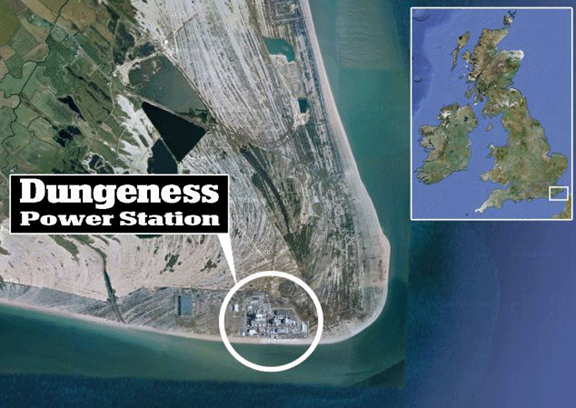
This Is for me, a shocking and disturbing revelation!
Nuclear power station has been leaking radioactive waste ‘for months’, says Environment Agency “……The Evironment Agency confirmed that levels of tritium were normal elsewhere in Dungeness B’s surroundings and added that the power station is allowed to discharge tritium in the environment under permit……. http://www.dailymail.co.uk/news/article-2311217/Nuclear-power-station-leaking-radioactive-waste-months-says-Environment-Agency.html#ixzz4M0Kjsu6A
Britain’s competition to promote Small Modular Nuclear Reactors- Roll Royce keenly participating
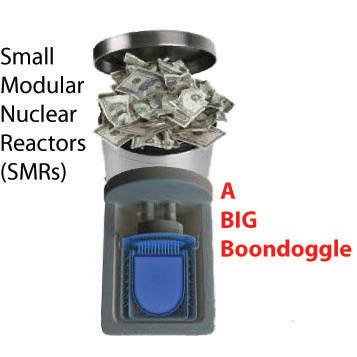 Rolls-Royce ramps up efforts to build mini-nuclear power plants, CITY.A.M. Jessica Morris , 2 Oct 16 Rolls-Royce has ramped up its efforts to build a fleet of small nuclear power stations as the next stage of a government competition draws closer. City A.M. understands that 30 employees from its Trident submarine work are now checking work on Rolls’ blueprint for the Small Modular Reactors (SMRS).
The Sunday Times first reported the news.……
The government launched a competition to identify the best value SMR design for the UK last year.
Ministers believe SMRs could increase and UK’s energy security and eventually become a leading export. However, the technology faces hurdles such as safety and security, financing as well as design approval.
There are 33 companies currently competing and a winner could be announced in the coming months.
The department for Business, Energy and Industrial Strategy has said it will publish a roadmap “for one or more possible pathways for SMRs” in the Autumn. http://www.cityam.com/250521/rolls-royce-ramps-up-efforts-build-mini-nuclear-power
At the end of the Hinkley nuclear power story – massive radioactive clean-up costs
 Hinkley Point C developers face £7.2bn cleanup bill at end of nuclear plant’s life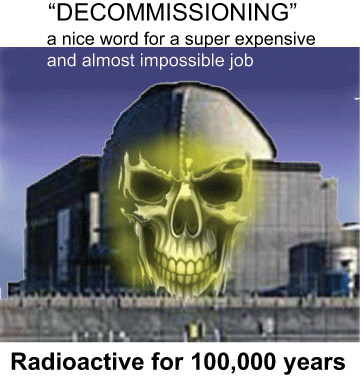
French and Chinese developers will be the first nuclear operators in the UK that will have to pay to decommission the site, Guardian, Adam Vaughan, 30 Sept 16 , The French and Chinese companies that are to build the £18bn Hinkley Point C nuclear power station will have to pay up to £7.2bn to dismantle and clean it up.
Documents published yesterday reveal for the first time how much the developers, EDF and China General Nuclear Power Group (CGN), will have to pay to decommission the plant, beginning in 2083.
The new reactors in Somerset will be unique in British nuclear history, as they are the first for which the operator will have to pay to make good the site afterwards.
“Waste transfer contracts signed today mean that, for the first time in the UK, the full costs of decommissioning and waste management associated with the new power station are set aside during generation and are included in the price of the electricity,” EDF said in a statement.
Decommissioning costs ate up around half the budget for the now-disbanded department of energy and climate change, after the liabilities for cleaning up old nuclear plants were effectively nationalised in 2004 and 2005 when two companies faced financial problems.
The Hinkley Point C decommissioning costs are estimated at £5.9bn to £7.2bn, with the dismantling of the plant expected to begin in 2083. The government, EDF and CGN anticipate the winding up of the new reactors will continue well into the 22nd century. The plant is expected to be fully decommissioned “from 2138” when the final spent fuel is disposed of.
Experts said the cost estimate was likely to be on the low side. “The reality in terms of decommissioning is that it always costs more than people say,” said Dr Paul Dorfman, of the Energy Institute at University College London.
He claimed that the precedent of the government taking ownership of the liabilities of British Nuclear Fuels Limited and British Energy more than a decade ago showed that the government would be forced to shoulder the costs if Hinkley’s developers had a shortfall.
The body charged with dismantling 17 of Britain’s old nuclear power plants puts the cost of cleanup at £117bn over 100 years in its latest annual report, more than twice the cost estimated a decade ago. A large proportion of the cost is due to the complexity of Sellafield……..https://www.theguardian.com/environment/2016/sep/30/hinkley-point-c-developers-face-72bn-cleanup-bill-at-end-of-nuclear-plants-life?CMP=twt_a-environment_b-gdneco&utm_content=buffer99004&utm_medium=social&utm_source=twitter.com&utm_campaign=buffer
UK government admits the costs of Hinkley nuclear deal – gas would be cheaper

 Hinkley Point nuclear deal signed as Government admits gas would be cheaper, Telegraph, energy editor 29 SEPTEMBER 2016
The Hinkley Point C nuclear plant will saddle UK consumers with higher energy bills than building gas power stations, the Government has admitted, as it signed a legally-binding contract to subsidise the £18bn project.
An official assessment claimed the Franco-Chinese project to build Britain’s first nuclear plant in a generation represented “value for money”, despite being more expensive than gas, because it would help meet climate change targets.
A series of deals signed between the Government, France’s EDF and China’s state nuclear firm CGN at a ceremony in London marked the final go-ahead for the Somerset power plant and also fired the formal starting gun on Chinese efforts to build their own reactor in Essex………
Under a deal first agreed in 2013 Hinkley will be paid a fixed price of £92.50/MWh for the power it produces for 35 years, funded through levies on energy bills. The National Audit Office has said it could cost up to £30bn in subsidies.
Among hundreds of pages of documents issued on Thursday afternoon – some heavily redacted – ministers faced a series of questions over a cursory three-page assessment concluding that the deal would add £12 to energy bills in 2030 but was “value for money”.
The assessment said Hinkley was “cost-competitive to other options for delivering power” despite its own assessment that the “comparable cost” of new gas in the 2020s could be as low as £45/MWh, solar as low as £65/MWh and onshore wind as low as £49/MWh.
If Hinkley was delayed by three years and gas plants built instead then by 2030 the UK would be £3.2bn better off and energy bills would be “£6 cheaper per year”, it concluded……..
John Sauven, executive director of Greenpeace, accused the Government of obfuscation and providing “no evidence anywhere in the documents to back up their assumptions”.
“The numbers speak for themselves. In the unlikely event Hinkley is working sometime in the second half of the next decade, renewable energy will be much cheaper, yet British consumers will still be forced to pay over the odds for nuclear power,” he said.
Another document underlined the lasting impact the decision will have on UK energy policy for more than a century to come, forecasting that the spent fuel for the plant would not be disposed of until the year 2138.
EDF Energy said Hinkley would “kickstart Britain’s nuclear revival” and that it had “been shown to offer consumers value for money”.
The Government said the signing of the deal marked “a significant step forward for a new era of nuclear power in the UK”. http://www.telegraph.co.uk/business/2016/09/29/hinkley-point-nuclear-plant-gets-final-go-ahead-as-government-si/
Low-key ceremony for final signing of Hinkley nuclear power project
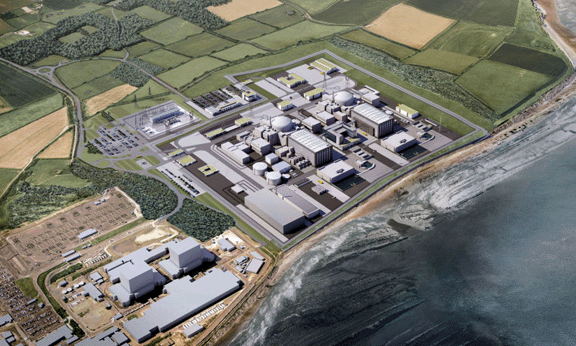 Hinkley Point: ministers sign go-ahead for nuclear power plant Representatives of British, Chinese and French governments attend ceremony giving final authorisation for power station, Guardian, Rowena Mason, 30 Sept 16, The UK has signed its £18bn contract with France and China to build the Hinkley Point C nuclear power station, giving the final go-ahead for construction at the site in Somerset.
The deal was finalised at a low-key ceremony in London, just two months afterTheresa May alarmed her French and Chinese counterparts by putting the entire project under review. EDF, the French nuclear contractor, and its Chinese partners had to cancel their previous plans for a signing ceremony at the last minute when the review was announced in July.
The project finally got approval this month, after Greg Clark, the business secretary, announced there would be some new restrictions on future investments in critical infrastructure if there were national security concerns.
Clark attended the signing ceremony on behalf of the UK, alongside Jean-Bernard Lévy, the chairman of EDF, and He Yu, chair of China General Nuclear…….
Greenpeace said it was “no wonder the UK government has opted for a ‘champagne-free’ signing ceremony away from public view”.
The environmental group said: “With a stroke of the pen ministers are signing away billions of pounds of billpayers’ money to a project they know is plagued by legal, financial and technical problems. In the unlikely event Hinkley is working some time in the second half of the next decade, renewable energy will be much cheaper, yet British consumers will still be forced to pay over the odds for nuclear power. It’ll be like being locked into an expensive fixed-rate mortgage as interest rates plummet.”…….https://www.theguardian.com/uk-news/2016/sep/29/hinkley-point-ministers-sign-go-ahead-for-nuclear-power-plant
Media is hyping Small Modular Nuclear Reactors , but doubts about them remain
 All over the media, on matters nuclear, I see these glowing reports on the great future just about to take off – for Small Modular (Nuclear) Reactors (SMRs) . Note that they leave out the word “Nuclear” – knowing that it’s not very popular with us all – the great unwashed.
The arguments are many – from the need for huge amounts of energy (though that’s dubious), to the false claim that SMNRs solve the radioactive trash problem, to the claim that they’ll fix climate change.
But my favourite nuclear lobby argument is the one where they either say directly, or more often imply – that big nuclear reactors are bad, so therefor Small ones must be good.

Anyway, the mainstream media knows where the money is, in reporting. Even The Guardian wrote up a lovely PR for Small Nukes – but I noticed that they sneaked in a few concerns about them:
“…….The first small modular nuclear reactors (SMRs) could be operating in the UK by 2030 with the right government support, according to a new report from theEnergy Technologies Institute (ETI).
The analysis, released today by the government and industry-backed energy research body, examined the steps needed to support the first SMR in the UK and concluded a credible schedule for implementation can be set out – as long as a policy framework is developed to reduce risks for SMR developers and increase investor confidence.
Setting out a timeline of key steps that will be required to deliver SMR deployment, the ETI said the UK should clarify and raise awareness of regulatory standards and expectations in the next five years and set out a clear statement of intent in relation to SMR development in the UK by 2024, with the aim to achieve at least one final investment decision by 2025………
While advocates of SMRs maintain they can safely bring down the cost of nuclear power and help to support an increasingly decentralised grid, critics argue there is still little evidence the technology will bring down costs where larger reactors have consistently failed to do so and fear they will come with inherent safety risks, which other low carbon sources of power could avoid….. quoted in The Guardian, 29 Sept
UK may be forced to leave Euratom treaty on nuclear energy, due to Brexit
Brexit ‘could trigger’ UK departure from nuclear energy treaty https://www.theguardian.com/environment/2016/sep/27/brexit-could-trigger-uk-departure-from-nuclear-energy-treaty
The UK’s withdrawal from the EU could also force it to exit the Euratom treaty on nuclear energy, ENDS has learned, Guardian, José Rojo for ENDS, part of the Guardian Environment Network. The UK’s withdrawal from the EU could also force it to exit the Euratom Treaty on nuclear energy, ENDS has learned.
The Euratom Treaty, which applies to all EU member states, seeks to promote nuclear safety standards, investment and research within the bloc. Although it is governed by EU institutions, it has retained a separate legal identity since its adoption in 1957.
Brian Curtis, a member of the European Economic and Social Committee (EESC), told ENDS that his Committee had recently consulted the European Commission on whether Brexit would automatically lead to a UK exit of Euratom.
Curtis said the Commission had responded affirmatively, arguing that the Treaty of the European Union (TEU) applies to the Euratom Treaty under article 106 of the latter agreement. This would mean, it said, that the reference to ‘Union’ inTEU’s article 50 – which needs to be invoked by member states wishing to quit the bloc – would apply not only to the EU itself but to Euratom membership as well.
According to EESC, a Euratom withdrawal by the UK – which recently approved the controversial £18bn Hinkley C project – could have major strategic implications for the EU nuclear sector. “But anticipating specific outcomes at this stage is problematic,” the Committee added.
The Commission itself would not comment on the exchange, which took place as the EESC examined the EU’s latest nuclear plan.
The draft Nuclear Indicative Programme (PINC), which was unveiled in April, is the first to be published by the Commission since the Fukushima-Daiichi nuclear disaster in 2011.
The EESC is required by the Euratom Treaty to give its opinion on such plans before they are finalised. It released its opinion on the latest PINC last week, after adopting it at a plenary vote.
The document praises the Commission for its analysis of investment needs during the entire nuclear fuel cycle and its emphasis on funding for nuclear decommissioning.
However, the Committee adds that the 2016 PINC is half the length of thepreceding plan from 2007 and fails to address key issues faced by EU nuclear energy.
These, it says, include the competitiveness of nuclear amid changes to construction and capital costs, its investment needs in the context of the EU’s Energy Union goals and the speed at which new technologies may be rolled out.
EESC’s opinion was published two weeks ahead of a meeting of the European Nuclear Energy Forum, which will be attended by EU member states and European institutions in Bratislava on 3-4 October.
1 This Month





PLEASE OPPOSE HR 8255 AND S.3639 – bills would accelerate satellite deployment, with no environmental review or safeguards – https://ncstd5li.quorum.us/campaign/169331/
To see nuclear-related stories in greater depth and intensity – go to https://nuclearinformation.wordpress.com
-
Archives
- October 2026 (40)
- September 2026 (339)
- August 2026 (330)
- July 2026 (355)
- June 2026 (287)
- May 2026 (306)
- April 2026 (356)
- March 2026 (251)
- February 2026 (267)
- January 2026 (308)
- December 2025 (358)
- November 2025 (359)
-
Categories
- 1
- 1 NUCLEAR ISSUES
- business and costs
- climate change
- culture and arts
- ENERGY
- environment
- health
- history
- indigenous issues
- Legal
- marketing of nuclear
- media
- opposition to nuclear
- PERSONAL STORIES
- politics
- politics international
- Religion and ethics
- safety
- secrets,lies and civil liberties
- spinbuster
- technology
- Uranium
- wastes
- weapons and war
- Women
- 2 WORLD
- ACTION
- AFRICA
- Atrocities
- AUSTRALIA
- Christina's notes
- Christina's themes
- culture and arts
- Events
- Fuk 2022
- Fuk 2023
- Fukushima 2017
- Fukushima 2018
- fukushima 2019
- Fukushima 2020
- Fukushima 2021
- general
- global warming
- Humour (God we need it)
- Nuclear
- RARE EARTHS
- Reference
- resources – print
- Resources -audiovicual
- Weekly Newsletter
- World
- World Nuclear
- YouTube
-
RSS
Entries RSS
Comments RSS

