 It now looks increasingly as if the Hinkley C project may be quietly shelved, or even cancelled, with the agreement of both UK and French governments.
And beyond that the prospects for new nuclear power in the UK have never been gloomier. The only way new nuclear power stations will ever be built in the UK is with massive political and financial commitment from government. That commitment is clearly absent.
 So yes, this finally looks like the end of the UK’s ‘nuclear renaissance’. Not with a bang, nor even with a whimper, but with a deep and profoundly meaningful silence. Not a moment too soon.
Conservative election manifesto signals the end of new nuclear power, Ecologist, Oliver Tickell & Ian Fairlie, 18th May 2017 After years of pro-nuclear bombast from the Conservative Party, its 2017 manifesto hasn’t got a single word to say about nuclear power, write Oliver Tickell & Ian Fairlie. Instead it announces a renewed focus on cutting energy costs, and a big boost for increasingly low-cost wind power; while both Labour and Libdems offer only weak, highly qualified support for new nuclear build. And so the great British ‘nuclear renaissance’ reaches its timely end.
All of a sudden the UK’s political parties want to have nothing to do with nuclear power.
This much is clear from the party manifestos – notably that of the Conservative Party, published yesterday.
OK, it does not announce an end to Britain’s massive 10GW nuclear power programme set out in the Cameron-Osborne years of government.
In fact, it does not even mention nuclear power. Instead it states that a future Tory government will remain sublimely indifferent to how our electricity is generated, so long as it’s reliable, cheap and low carbon:……
now, it’s all about keeping costs down, says the 2017 manifesto: “We want to make sure that the cost of energy in Britain is internationally competitive, both for businesses and households … Our ambition is that the UK should have the lowest energy costs in Europe, both for households and businesses. So as we upgrade our energy infrastructure, we will do it in an affordable way, consistent with that ambition.”
And one sure way not to deliver cheap energy to the UK is to build new nuclear power stations. if Hinkley C is ever built, UK energy users will be paying more than double the current wholesale power price, inflation adjusted, for 35 years from the time it opens, something that could cost the UK economy £50-100 billion.
Labour and the Libdems: a pocketful of mumbles
By contrast, Labour does give nuclear power a specific mention it is manifesto – just a rather small one that adds up to no real commitment to anything.
“The UK has the world’s oldest nuclear industry, and nuclear will continue to be part of the UK energy supply. We will support further nuclear projects and protect nuclear workers’ jobs and pensions. There are considerable opportunities for nuclear power and decommissioning both internationally and domestically.”
Let’s decipher. Yes, nuclear power will continue to be part of energy supply as we still have quite a few old nuclear power stations that we are not about to shut down.
What about “We will support further nuclear projects”? What kind of nuclear projects? How about decommissioning, nuclear waste management, production of medical isotopes … ? Do these projects include nuclear power? They’re not telling. Most likely (after all we know that Labour leader Jeremy Corbyn is firmly anti-nuclear) these are warm but empty words to placate powerful nuclear-supporting trades unions like the GMB and Unite.
And what kind of ‘support’? Speeches in the House of Commons? Or tens of billions of pounds of hard cash. It’s hard to say. Does this add up to a firm commitment to build a fleet of new nuclear power stations at massive public cost? Hardly.
The Libdem position is similarly weak, promising only that “We will … Accept that new nuclear power stations can play a role in electricity supply provided concerns about safety, disposal of waste and cost are adequately addressed, new technology is incorporated, and there is no public subsidy for new build.”
We know perfectly well that nuclear power is hugely expensive, intrinsically unsafe due to its potential for massive harm (look only to Fukushima), can only operate with enormous public subsidies, and that no one has yet figured out a way to keep nuclear wastes safely contained for tens of thousands of years, an informed interpretation of this statement might go: “Nuclear power? Not on your nelly!”…….
Meanwhile the SNP says it wants no new nuclear power stations in Scotland; and Plaid Cymu leader Leanne Wood is opposed to new nuclear power, but her executive supports Wylfa because of the jobs. Got that?
Why the turnaround?
It has surely become clear to politicians that nuclear power is in a death spiral, terminally afflicted by:
- very high costs, at least double those of conventional generation, which can only be carried by governments, taxpayers and energy users at the expense of more deserving and productive investments;
- apparently unconstructable reactor designs hit by massive cost overruns and delays in France, Finland and the USA;
- the bankruptcy of the world’s biggest nuclear power contractor, the Toshiba-owned Westinghouse – lined up to build a massive new nuclear complex at Moorside in Cumbria with three AP1000 reactors – mainly as a result of these cost overruns and delays on AP1000 projects in the USA;
- the parlous condition of the French parastatals EDF and Areva, which survive only thanks to the inexhaustible largesse of French taxpayers;
- investor reluctance to have anything to do with new nuclear power stations unless returns are guaranteed in cast iron contracts at huge expense to taxpayers;
- the continuing lack of a long term solution for nuclear waste storage / disposal;
- the inflexibility of nuclear power stations, which means that they overproduce when electricity is in surplus, while being unable to keep up with demand when power is desperately needed;
- the continuing precipitous decline in the cost of disruptive ‘new energy’ technologies such as solar, wind, including offshore wind, grid-scale batteries, power to gas, smart grid, set to continue and gather pace for many years to come.
So what’s the alternative? Given that onshore wind is already the cheapest new source of power generation, and offshore wind costs are falling rapidly (and are already far cheaper than new nuclear), wind power really should have a big role. So check out this statement from the Conservative manifesto:
“While we do not believe that more large-scale onshore wind power is right for England, we will maintain our position as a global leader in offshore wind and support the development of wind projects in the remote islands of Scotland, where they will directly benefit local communities.”
This commits a future Tory government to maintaining a strong pipeline of large offshore wind projects, while opening the door to medium and small scale onshore wind power in England, as well as to large scale wind on Scottish islands and elsewhere in the devolved nations. What it ultimately means is that wind power has a great future in the UK – in stark contrast to previous policy…….
Not with a bang, nor even a whimper
It now looks increasingly as if the Hinkley C project may be quietly shelved, or even cancelled, with the agreement of both UK and French governments.
And beyond that the prospects for new nuclear power in the UK have never been gloomier. The only way new nuclear power stations will ever be built in the UK is with massive political and financial commitment from government. That commitment is clearly absent.
So yes, this finally looks like the end of the UK’s ‘nuclear renaissance’. Not with a bang, nor even with a whimper, but with a deep and profoundly meaningful silence. Not a moment too soon.http://www.theecologist.org/News/news_analysis/2988965/conservative_election_manifesto_signals_the_end_of_new_nuclear_power.html
May 20, 2017
Posted by Christina Macpherson |
politics, UK |
Leave a comment
 CND 17th May 2017 The Labour Party manifesto has now been published. Its policy on nuclear weapons states: Labour supports the renewal of the Trident nuclear deterrent. As a nuclear-armed power, our country has a responsibility to fulfil our obligations under the Nuclear Non-Proliferation Treaty. Labour will lead multilateral efforts with international partners and the UN to
create a nuclear-free world.
This will come as a huge disappointment to many voters and CND supporters. Labour’s policy on nuclear weapons is in
accordance with the status quo, representing no change from what has gone before. At a time when a majority of countries are supporting a fresh initiative at the UN to negotiate a nuclear ban treaty, it is very disappointing that the Labour Party has made no reference to engaging with this process. There is a glimmer of hope from Labour’s planned Strategic
Defence and Security Review. http://www.cnduk.org/cnd-media/item/3408-labours-manifesto-and-nuclear-weapons
May 19, 2017
Posted by Christina Macpherson |
politics, UK |
Leave a comment
Business Green 17th May 2017 LEGO Group has today become the latest global brand to announce it has met a 100 per cent renewables goal, confirming that the opening of the Burbo Bank Extension wind farm means it has ‘balanced’ its annual power demand with electricity from renewable sources. The toy manufacturing giant confirmed the inauguration of the 258MW offshore wind farm in Liverpool Bay means the company’s annual power use is now matched by output from projects it has invested in.
It added that the goal had been met three years ahead of schedule. LEGO Group’s parent company KIRKBI A/S holds a 25 per cent stake in the Burbo Bank Extension project, alongside a 25 per cent stake held by Danish pension fund PKA and a 50 per cent stake held by developer DONG Energy. The company said the project meant LEGO has invested DKK6bn
($895m) in delivering two offshore wind farms over the past four years and has supported the development of more than 160MW of renewables capacity since 2012. http://www.businessgreen.com/bg/news/3010256/lego-breezes-past-100-per-cent-renewables-goal-thanks-to-uk-offshore-wind-farm
 Bloomberg 16th May 2017 Scottish judges paved the way for as much as 10 billion pounds ($13 billion) to be invested in offshore wind power by overturning a ruling that said projects may kill too many birds. Planning permission should move
forward at four wind farms being developed by SSE Plc, Mainstream Renewable Power Ltd., Fluor Corp. and SDIC Power Holdings Co., according to the ruling by three judges at the Inner House at the Court of Session in
Edinburgh on Tuesday.
They said a judge in the Outer Court was wrong to revoke consent in July for the wind farms, that may create as much as 2.3 gigawatts of new capacity off Scotland’s east coast. The earlier ruling asserted that Scottish ministers didn’t properly assess how the projects would threaten migratory seabirds such as the puffin.
Mainstream said it would now seek to develop the 2 billion pound Neart Na Goithe offshore wind farm as quickly as possible, according to a separate statement. The project has a contract with the U.K. government for a subsidy of 114 pounds a megawatt hour. https://www.bloomberg.com/news/articles/2017-05-16/scottish-offshore-wind-may-get-13-billion-lift-from-bird-ruling
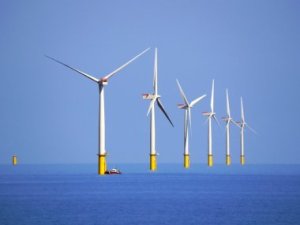
Edie 17th May 2017 The planet’s biggest and most powerful wind turbines have begun generating electricity off the Liverpool coast, cementing Britain’s reputation as a world leader in the technology. Danish company Dong Energy has just finished installing 32 turbines in Liverpool Bay that are taller than the Gherkin skyscraper, with blades longer than nine London buses.
Dong Energy, the windfarm’s developer, believes these machines herald the future for offshore wind power: bigger, better and, most importantly, cheaper. Each of the 195m-tall turbines in the Burbo Bank extension has more than twice the power capacity of those in the neighbouring Burbo Bank windfarm completed a decade ago. “That shows you something about the scale-up of the industry, the scale-up of the technology,” said Benjamin Sykes, the country manager
for Dong Energy UK.
The project is the first time the 8MW turbines have been commercially used anywhere in the world, which Sykes hailed as a “very important milestone” for the sector. https://www.edie.net/news/10/Mersey-feat–world-s-biggest-wind-turbines-go-online-near-Liverpool/
Bloomberg 16th May 2017 Scotland was so bullish about becoming Europe’s wind energy hub its politicians fell out with a brash real-estate developer and reality TV star called Donald Trump. Five years on, Trump’s ambitions have taken him to the White House.
But instead of the 950 offshore turbines Scotland envisioned by the end of 2017, it has only 63 because of legal battles, geographical challenges and caps on government aid. The swooshing blades out at sea were a pivotal part of the nationalist-led Scottish government’s goal to get 100 percent of the nation’s electricity from renewable sources by 2020. It was supposed to be a growth area in what would be Europe’s newest state, along with turning Scotland into the Saudi Arabia of marine energy.
Despite four offshore wind projects getting the go-ahead this week, more targets have been missed than met and U.K. subsidies have been cut. With Scottish independence back in the political mix ahead of the June 8 election and the
economy in pain, the plans are under scrutiny again. “People overestimated the likely scale of deployment,” said Niall Stuart, chief executive of the Glasgow-based trade association Scottish Renewables. The whole of the U.K. was over-confident about the prospects for offshore wind, he said. “Clearly it’s nothing like the most optimistic scenario.” https://www.bloomberg.com/news/features/2017-05-16/how-is-a-watch-made-from-scratch
May 19, 2017
Posted by Christina Macpherson |
renewable, UK |
Leave a comment
 CORE 17th May 2017, Plans to build the £2.8Bn power transmission line connecting NuGen’s delayed Moorside project have been put on hold by National Grid so that it can align its plans with those of developer NuGen which have already been put on-hold.
NuGen has been forced to undertake a ‘strategic review of options’ following the financial meltdown of Moorside’s sole investor Toshiba and the bankruptcy of its subsidiary Westinghouse who was to supply the AP1000 reactors for the project.
Another casualty of NuGen’s faltering progress are the 1200 respondents to its Stage 2 public consultation which finished at the end of July 2016. Today, almost 10 months later, the consultation feedback report promised by NuGen for ‘Autumn 2016’ has still not materialised and neither has NuGen indicated that it will hold the further consultation called for by CORE, local authorities and others to make up for the lack of detailed information provided in the Stage 2 consultation documents.
These failures, in tandem with NuGen’s current Strategic Review of options, designed ‘to provide a more robust, stable and sustainable platform to meet its commitment to deliver the next generation of nuclear power’ has left those respondents not only in a NuGen no-man’s land but also questioning the merit of having already spent time and effort on responding to a project that now appears not only less than robust but also unstable and unsustainable. .. http://corecumbria.co.uk/briefings/nugens-investment-turmoil-sparks-pylon-delay-for-moorside-new-build/
May 19, 2017
Posted by Christina Macpherson |
business and costs, UK |
Leave a comment
Utility Week 17th May 2017, Plaid Cymru has pledged to cut the energy bills of customers in Wales by establishing a Welsh energy company. In its manifesto for the general election, published today (17 May), the nationalist party said the proposed energy company would channel the profits from Wales’ abundant renewable energy into cutting the cost of Welsh consumers bills.
Plaid proposes that the energy company would also support a shift in Wales to decentralised and distributed energy networks. The manifesto also pledges that Plaid would increase energy generation from renewable sources, including the delivery of tidal lagoons in Swansea Bay, Cardiff and Colwyn Bay.
The Welsh nationalists would transfer responsibility over Welsh energy generation to the National Assembly in Cardiff with the goal of achieving self-sufficiency in electricity generation from renewables. http://utilityweek.co.uk/news/Plaid-Cymru-pledges-to-create-Welsh-energy-company/1303042
May 19, 2017
Posted by Christina Macpherson |
decentralised, UK |
Leave a comment
 David Lowry’s Blog 15th May 2017 The cyber security attack on Friday has highlighted the vulnerability of UK national infrastructure to malicious cyber threats. So far it is the impact on the NHS that has hit the headlines.
But it could be far worse: what if it were our nuclear power plants that were disrupted? Next week- from 22 to 24 May – the Vienna –based World Institute for Nuclear Security (WINS) , headed by the former head of security at Sellafield, Dr Roger Howsley, is participating in the 2nd Annual Industrial Control Cyber Security Nuclear Summit, in Warrington, organised by Cyber Senate entitled with an important presentation entitled“Transformation, Preparedness and Developing Cyber Security Assurance”.
It is instructive to listen to the words of Russian cyber security expert, Eugene Kasperksy, founder and ceo of the Moscow-based Kasperksy Labs, warns governments engaged in cyber warfare that “everything you do – it’s a boomerang: it will get back to you.”
Four years ago he warned that Russian nuclear power plant infected by Stuxnet malware programme – widely believed to have been created by the US and Israel – had infected a Russian nuclear power plant.
Speaking at the Canberra Press Club 2013 in Australia’s capital city. Kasperksy recounted a story from “the Stuxnet time” when a friend of his working in an unnamed nuclear power plant reported that the plant’s computers were “badly infected by Stuxnet”. Kaspersky criticized government departments responsible for engineering cyber-attacks, The Stuxnet virus was first discovered in June 2010 and was found to specifically target industrial control systems manufactured by Siemens. The initial target of the virus is widely thought to have been the centrifuges used in Iran’s uranium enrichment programme. Although the goal of the virus was extremely specific, its method of proliferation was indiscriminate and the code has since been found on computers across the world…… http://drdavidlowry.blogspot.co.uk/2017/05/cyber-threats-you-aint-seen-nothin-yet.html
May 17, 2017
Posted by Christina Macpherson |
safety, UK |
Leave a comment
 FT 14th May 2017 Tesco seeks to secure all of its electricity from renewable sources by 2030. Tesco is to turn its back on fossil fuels and ramp up its use of solar panels as the UK supermarket makes an ambitious pledge to cut its greenhouse gas emissions in line with the toughest goals of the Paris climate accord.
Tesco says it will cut its emissions in line with the more ambitious 1.5C target, partly by securing 100 per cent of its electricity from renewable sources such as solar panels by 2030 and by pushing its
suppliers to become greener. Tesco’s goals will require big investments in renewable power because about 65 per cent of its emissions come from electricity needed for its distribution centres and 6,500 stores around the world.
Refrigeration gases account for 15 per cent of the company’s emissions, according to Kené Umeasiegbu, Tesco’s head of climate change. Another 12 per cent comes from its delivery vehicles; 7.5 per cent from heating and 0.5 per cent from business travel…. https://www.ft.com/content/536fb55a-374e-11e7-bce4-9023f8c0fd2e
May 17, 2017
Posted by Christina Macpherson |
decentralised, UK |
Leave a comment
 Utility Week 15th May 2017, National Grid hits pause on Moorside connection. Plans shelved for “biggest new power line since electricity network was built”. Plans to build a 102-mile power line connecting the proposed Moorside nuclear plant in Cumbria to the transmission network have been placed on hold, National Grid has revealed.
The news comes after developer NuGen confirmed earlier this month that it was conducting a “strategic review of its options” following reports that its main shareholder, Toshiba, may mothball the Moorside project.
http://utilityweek.co.uk/news/National-Grid-hits-pause-on-Moorside-connection/1302702
May 17, 2017
Posted by Christina Macpherson |
business and costs, politics, UK |
Leave a comment
 Guardian 15th May 2017, Archbishop of Canterbury plays crucial role in BMO Global Asset Management’s decision to dump £20m of shares in firms such as BHP Billiton One of Britain’s biggest managers of ethical funds is to dump £20m of shares in fossil fuel companies in one of the biggest divestments so farbecause of climate change.
Shares in BHP Billiton, the Anglo-Australian mining giant, will be among those sold by BMO Global Asset Management’s range of “responsible” funds, which manage £1.5bn of assets. They were previously known as the “stewardship” funds, the first ethical funds launched in Britain. The archbishop of Canterbury, Justin Welby, played a crucial role in the divestment, as president of BMO’s responsible investment council. The Church of England has already pulled out of investing in companies that make more than 10% of its revenues from thermal coal or oil from tar sands….. https://www.theguardian.com/environment/2017/may/15/top-uk-fund-manager-divests-from-fossil-fuels
May 17, 2017
Posted by Christina Macpherson |
business and costs, climate change, UK |
Leave a comment
 Jeremy Corbyn Explains Why He Can’t Envisage Using Nuclear Weapons, HuffPost UK, 14 May 17, May’s closeness to Trump is the real ‘coalition of risk and insecurity’
Jeremy Corbyn has signalled he can’t envisage ever using nuclear weapons because to do so would mean the world had already suffered a “cataclysmic failure”.
The Labour leader said that nuclear warfare would mean “the indiscriminate killing of millions of people” and risk long-lasting radiation that would wipe out all life across much of the planet.
In a keynote speech on defence and security at the Chatham House think tank, Corbyn stressed that his “first duty” would be to protect Britain by using diplomacy and defusing tensions around the world.
He also said that the UK’s Trident nuclear deterrent would be renewed by Labour and then placed into a strategic defence review to look at new, long-term threats such as cyber warfare.
Corbyn also said that he wouldn’t “take any lectures” from the Tories on humanitarian intervention after the Thatcher government refused to apply sanctions on South Africa in the wake of apartheid shootings of children in Soweto.
And he claimed that the Conservatives were the party putting Britons in danger as “Theresa May seeks to build a coalition of risk and insecurity with Donald Trump”.
A Labour government would “step back, learn the lessons of the past and find new ways to solve and prevent conflicts”, he said.
And it would seek to build cooperation with China and India, unlike the Prime Minister, who in January said that the two Eastern giants were threatening to ‘eclipse’ the West in military terms.
Corbyn, a long-time advocate of unilateral nuclear disarmament, said earlier this year that his instructions in any nuclear conflict would be to “follow orders when given”, rather than writing a letter automatically granting prior authority to fire off missiles.
May 15, 2017
Posted by Christina Macpherson |
politics, UK |
Leave a comment
Jeremy Corbyn is still dodging the nuclear question, George Eaton political editor New Statesman, 12 May 17
The Labour leader came close but ultimately refused to say that he would approve the use of nuclear weapons. In the general election, the Conservatives aim to shoot to kill. By denouncing Labour as soft on defence, they believe they can win their first landslide victory since 1987 (when they similarly tormented the opposition over this issue)……
It is the gravest act of all – the use of nuclear weapons – that has proved most fraught for Labour in recent times. Though the party’s manifesto has committed to Trident renewal, Corbyn, a lifelong unilateralist, has long refused to say whether he would use the UK’s arsenal (and, indeed, has said he would not). Shadow defence secretary Nia Griffith, who has said she would, was not invited to the event and did not contribute to drafting the speech (seeing it for the first time at 11pm last night). At her insistence, a manifesto section warning any prime minister to be “extremely cautious about ordering the use of weapons of mass destruction” was removed.
But in his speech, Corbyn all but repeated it. “I am often asked if as prime minister I would order the use of nuclear weapons,” he said. “It’s an extraordinary question when you think about it – would you order the indiscriminate killing of millions of people? Would you risk such extensive contamination of the planet that no life could exist across large parts of the world?”
He added, however: “Labour is committed actively to pursue disarmament under the Nuclear Non-Proliferation Treaty and we are committed to no first use of nuclear weapons
But let me make this absolutely clear. If elected prime minister, I will do everything necessary to protect the safety and security of our people and our country. That would be my first duty.”
That, however, fell short of explicitly stating he would use nuclear weapons (which Trident supporters regard as essential for deterrence)……….
As the event drew to a close, Corbyn was asked whether he supported the full renewal of Trident (encompassing four Vanguard-class submarines). Corbyn noted that while parliament had voted for a like-for-like replacement, Labour would hold a Strategic Defence Review, which he did not wish to pre-empt. Though aides subsequently stated that abolition was not an option, the possibility of downgrading the system remains. Labour’s nuclear headache will not end here…….
http://www.newstatesman.com/politics/june2017/2017/05/jeremy-corbyn-still-dodging-nuclear-question
May 13, 2017
Posted by Christina Macpherson |
politics, UK, weapons and war |
Leave a comment
Moorside nuclear plant ‘on hold’ as review announced, BBC News 4 May 2017 A plan to build a nuclear power station in Cumbria has been put on hold while the company behind it carries out a strategic review.
May 8, 2017
Posted by Christina Macpherson |
business and costs, politics international, UK |
Leave a comment
Toshiba bankruptcy threatens Moorside, http://www.telegraph.co.uk/business/2017/05/06/toshiba-bankruptcy-threatens-moorside/ Ben Marlow ,Jillian Ambrose 6 MAY 2017
Toshiba’s bankrupt nuclear arm may be prevented from providing any emergency funds to its overseas interests, throwing the future of the Moorside nuclear plant in Cumbria into fresh doubt.
It has emerged that Westinghouse, the Toshiba-owned American nuclear reactor developer, faces orders not to prop up any joint venture agreements that it entered into before the company filed for Chapter 11 bankruptcy in March.
Wall Street private equity giant Apollo has pledged an $800m (£617m)rescue loan to the Pennsylvania-based company, which is awaiting court approval, while a group of hedge funds is also interested in providing emergency financing. However, it is understood that many of these prospective new investors want to see any fresh funds funnelled into Westinghouse and its main subsidiaries, not foreign joint venture projects like Moorside. They are calling for partners involved in Toshiba’s overseas interests to also step in and provide support.
The £18bn Moorside project is a central pillar of the UK’s atomic energy programme. The 3.4 gigawatt plant will power up to 6m homes but it has been thrown into doubt by Toshiba’s financial crisis and the bankruptcy of Westinghouse. The reactor maker, which the Japanese corporation bought from the British government in 2006, had been due to install three of its AP1000 reactors at Moorside. The project received a further blow when its other backer, French energy provider Engie, pulled out. Without the support of the only remaining backer, there are fears that the plant will never be built.
However, an industry source said: “Engie is a nuclear developer and a nuclear operator – it’s what they do. Senior people in the company have said that if the project found a way to move forward they would be interested in coming back.”
May 8, 2017
Posted by Christina Macpherson |
business and costs, politics, UK |
Leave a comment
Nuclear police recruit ‘fitness champions’ in bid to reduce sickness http://www.telegraph.co.uk/news/2017/05/07/nuclear-police-recruit-fitness-champions-bid-reduce-sickness/ Martin Evans, crime correspondent 7 MAY 2017 The police force responsible for keeping Britain’s nuclear power stations safe, has recruited keep fit gurus in a bid to reduce the number of sick days its officers are taking.
Officials at the Civil Nuclear Constabulary (CNC) became concerned after the force repeatedly failed to make its annual target on staff sickness.
So-called “fitness champions” will now offer advice to colleagues on a wide range of issues, such as how to achieve and maintain peak physical condition, how to avoid injury and even what to eat in order to stay healthy. They will be recruited internally, but will receive special training, in the hope that they can help reduce the current average of 12.8 sick days a year, per officer.
In addition the force is increasing the amount of money spent on physiotherapists to help officers who suffer injuries get back to work as soon as possible. Despite having many of the same powers as ordinary police officers, those who serve with the CNC are not allowed to retire at 60, in line with their colleagues in the 43 Home Office forces.
They have argued that the physical nature of their role means they cannot guarantee they will be able to fulfil their duties beyond the age of 60, putting the public at risk.
But new rules mean they will have to work until 65 and eventually 68, before they are entitled to claim their pension.
Established in 2005, the CNC has more than 1,250 armed officers, who patrol all non-military nuclear sites – including the 14 atomic power stations – and keep them safe from terrorist attack.
The highly trained specialists can also be deployed at short notice to assist with any large scale national emergencies in order to bolster the number of armed officers on the streets.The move comes at a time when CNC officers are embroiled in a long running battle with the Government over their retirement age. While they have the same powers of arrest as ordinary warranted officers, the role of a CNC constable is very different, and when not out on patrol spend a large amount of their time undertaking rigorous training exercises.
They provide a round the clock ring of steel around nuclear establishments and must be prepared to repel any form of attack by terrorists.
In addition they are also expected to accompany nuclear materials being transported within the UK and further afield.
Given the risks of working in close proximity to nuclear material, officers are also regularly checked for exposure to radiation and carry dosage meters on them at all times. The CNC’s most recent annual report, revealed that the force had failed to meet its sickness target of an average of 10.5 days for the past five years running.
Officials discovered that rather than illness an increasing number of officers, were being signed off work with injuries, picked up due to the physical nature of the role.
Carrying almost 50 lbs in kit, the officers are susceptible to back injuries and other musculoskeletal complaints.
The introduction of fitness champions is intended to provide more support for those officers who are struggling with the physical demands of the role
May 8, 2017
Posted by Christina Macpherson |
employment, UK |
Leave a comment