Brexit will mean that Britain will be stuck with Europe’s nuclear waste

Brussels plans to saddle UK with EU nuclear waste Britain’s impending split from Euratom indicative of complexity of Brexit, Ft.com by: Arthur Beesley in Brussels and Andrew Ward in London, 4 May 17 Britain will be on the hook for large volumes of dangerous radioactive waste — some of it imported from the rest of Europe — under proposals by Brussels to transfer ownership of a range of nuclear materials to the UK after it leaves the EU.
Even the fake charity Weinberg Next Nuclear recognises the link between Small Modular Nuclear Reactors and Weapons
 Breaking the cycle of indecision: nuclear report by the House of Lords, The Weinberg Foundation, May 3rd, 2017, Suzanna Hinson
This week the House of Lord’s Science and Technology Committee published its report “ Nuclear research and technology: Breaking the cycle of indecision”. Weinberg Next Nuclear welcomes the report and agrees with many of its conclusions.
Nuclear has undoubted potential in the UK, but indecision for many years, through successive governments, has impaired progress. Continual delays have damaged both short and long term opportunities, as well as tarnishing the reputation for nuclear in the UK and limiting investor confidence.
Instead, the report argues that the Government “must act now to provide underpinning strategic support to the nuclear industry”. This action can and should be chosen strategically, and the Government can decide to either be a designer, manufacturer and operator of nuclear power itself, or be a destination to operate nuclear reactors designed and potentially manufactured overseas…….
Small modular reactors (SMRs) are one of the areas that have particular potential, with the report recognising they are likely to be “globally important for the future of nuclear energy”. The UK’s experience in this sector, through defence application expertise, gives it the potential to be a world leader……
Weinberg Next Nuclear hope the Government heed this report, and its recommendations. Following the General Election in June, nuclear power policy should come off of hold and onto fast track. http://www.the-
weinberg-foundation.org/2017/05/03/breaking-the-cycle-of-indecision-nuclear-report-by-the-house-of-lords/
Nuclear Industry Association (NIA)makes 6 demands for arrangements to replace Euratom
NIA sets out six priorities for Euratom exit, WNN03 May 2017 The UK government needs to work closely with industry to bring about replacement arrangements for the European Atomic Energy Community (Euratom) in a timely manner for the country’s nuclear industry, the Nuclear Industry Association (NIA) says in a position paper published today. The NIA represents more than 260 companies including nuclear power station operators, new build developers and vendors, those engaged in decommissioning, waste management, all aspects of the nuclear fuel cycle, supply chain and consultancy companies.
The NIA said its paper, Exiting Euratom, sets out the priority areas for negotiations with the European Commission as the UK ceases to be a full member of the Euratom community alongside the process to leave the European Union. It also sets out the steps the government needs to take “to avoid serious disruption to normal nuclear business” in the UK and across the EU…….
The NIA has listed six key steps it wants the government to take:
- agreeing a replacement Voluntary Offer Agreement with the International Atomic Energy Agency for a new UK safeguards regime;
- replacing the Nuclear Co-operation Agreements (NCA) with key nuclear markets – Australia, Canada, the Euratom Community, Kazakhstan, South Korea and the USA;
- clarifying the validation of the UK’s current bilateral NCAs with Japan and other nuclear states;
- setting out the process for the movement of nuclear material, goods, people and services;
- agreeing a new funding arrangement for the UK’s involvement in Fusion 4 Energy and wider EU nuclear R&D programs; and maintaining confidence in the industry and securing crucial investment.
The London-based trade association said addressing these priority areas will enable the nuclear sector to continue its work with other countries, both within and outside the continuing EU, as the UK ceases to be a member of the EU. Given the amount to be concluded within the next 22 months, however, there is a risk that new arrangements will not be in place, the NIA said……. http://www.world-nuclear-news.org/NP-NIA-sets-out-six-priorities-for-Euratom-exit-03051701.html
World Nuclear Lobby bewails Britain’s lack of progress on Small Modular Nuclear reactors (SMRs)
 UK nuclear’s future in government hands, say reports, World Nuclear News, 2 May 17, Two UK parliamentary committees have published separate reports – one related to research and development, the other concerning Brexit – that both call on the government to take action to ensure the future competitiveness of the country’s nuclear industry.
According to the House of Lords Science and Technology Committee, “We have reached a critical moment for the future of the United Kingdom as a serious nuclear nation.” It continues, “The undoubted potential of the civil nuclear sector has been blighted by the indecision of successive governments.”…..
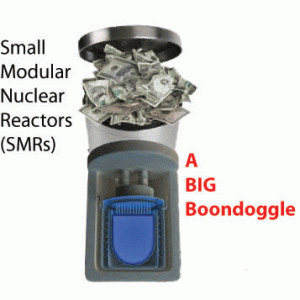 SMR competition
The government’s failure to make a decision on its strategy for small modular reactors (SMRs) “is a prime example of its inaction in the civil nuclear arena”, the report says. “Not keeping to the stated timetable for the SMR competition has had a negative effect on the nuclear sector in the UK and if the government does not act soon the necessary high level of industrial interest will not be maintained.”
Nuclear Industry Association (NIA) chief executive Tom Greatrex said the industry shares the committee’s “frustration” with the SMR competition. “With a potential global market for SMRs valued at £250-£400 billion ($323-$517 billion), the government must provide clarity as soon as possible after the general election if the energy, industrial and export opportunities of a UK SMR are to be realised.”
Tom Mundy, NuScale Power’s chief commercial officer and managing director for the company in the UK and Europe, also said a “clear direction” on SMRs from the government is needed. “We therefore welcome the committee’s call for the government’s SMR strategy to be published, setting out what the next steps will be to make SMRs a reality for the UK.”
Committee chairman, John Roundell Palmer, said: “We also found that the amount of UK funding for nuclear research, development and innovation is much lower than public funding levels in other leading nuclear nations, including the US, France and Japan. If the government’s aim is for the UK to be active across the main areas of nuclear R&D it needs to make significant investments in new technologies or we risk falling behind the rest of the world.”
Brexit
The committee also said the nuclear industry faces risks if the UK’s membership of European Atomic Energy Community (Euratom) expires at the end of the two-year negotiating period without a replacement. It warned, “The UK risks losing its lead in fusion research as well as losing access to the markets and skills it needs to construct new nuclear power plants and existing power plants could be unable to acquire fuel.”…….http://www.world-nuclear-news.org/NP-UK-nuclear-industrys-future-in-government-hands-say-reports-0205174.html
Small Modular Nuclear Reactors (SMRs) just not happening in Britain
Alarm sounded over delays to develop UK mini nuclear reactors Lords scold government for lack of progress on small modular reactors plan, warning UK nuclear sector will suffer if firms walk away, Guardian, Adam Vaughan, 2 May 17, The government’s failure to deliver on a multimillion-pound competition to develop mini atomic power stations has hurt the nuclear sector and risks international companies walking away from the UK, a Lords committee has warned.
In 2015 the then chancellor George Osborne promised £250m over five years for a nuclear research and development programme, an undisclosed sum of which was for a competition to pave the way for small modular reactors.
These reactors are much smaller than conventional nuclear plants with a capacity of less than 300MW – or a 10th of what Hinkley Point C should provide.
But the government has failed to even publish results of the first phase of the competition, expected last autumn, which the Lords science and technology committee said was “particularly alarming”.
“This has had a negative effect on the nuclear sector in the UK and if the government does not act soon the necessary high level of industrial interest will not be maintained,” they said in a report on Tuesday.
The peers urged ministers to publish their plans for small modular reactors (SMRs) without delay, and scolded the government for not showing any urgency to make a decision…….
Newcastle-based Penultimate Power UK, which hopes to capitalise on the market, told the committee that a lack of clarity from government had paralysed development of nuclear power generation technology…….
Government officials said earlier this year that one of the attractions of mini nuclear power stations was they fitted with the industrial strategy launched by Theresa May. But Tom Wintle, deputy director at the business department, said they had to provide affordable power.
“SMRs will need to deliver energy cost-competitively if they are to play a part in the UK’s future energy mix. As well as securing low-carbon energy, government is also committed to keeping down the cost of that energy for consumers, so there is a key challenge there for the nuclear industry as a whole and for SMRs,” he told an industry conference. https://www.theguardian.com/business/2017/may/02/alarm-sounded-over-delays-to-develop-uk-mini-nuclear-reactors
UK House of Lords Report on Small Modular Nuclear Reactors’ non progress
 HOUSE OF LORDS Science and Technology Select Committee 3rd Report of Session 2016–17 HL Paper 160 Nuclear research and technology: Breaking the cycle of indecision https://www.publications.parliament.uk/pa/ld201617/ldselect/ldsctech/160/160.pdf
Nuclear industry very worried about Brexit
Nuclear industry warns UK must avoid ‘cliff edge’ over Brexit, Leaving Euratom treaty without new deals would have dramatic impact on Hinkley Point C and other stations, says NIA, Guardian, Adam Vaughan, 3 May 17, The UK nuclear industry has issued its strongest warning yet to ministers on the problems it faces if the government is unable to strike new international atomic power deals during Brexit talks.
Failure to put in place alternative arrangements to replace the existing European nuclear treaty, Euratom, which the UK is quitting as part of the article 50 process, would have a “dramatic impact” on Hinkley Point C and other new power stations around the country, the industry said.
Ministers must avoid a “cliff edge” when the UK exits Euratom or face “major disruption to business across the whole nuclear fuel cycle”, the Nuclear Industry Association will warn the government on Wednesday.
The stark briefing to officials, seen by the Guardian, comes just a day after MPs said the continued operations of the UK nuclear industry were at risk from exiting the Euratom treaty. A Lords committee on Tuesday also said the UK risked losing access to markets and skills when leaving Euratom.
Tom Greatrex, the chief executive of the NIA, said: “We’ve had today two select committee reports that have both touched on this. The industry has been and is clear to government we are ready to do what we can – but it needs the government to get on with this and engage now, regardless of all the other issues they have to deal with.”
Theresa May’s decision to call a general election had made matters worse, he added, because it had squeezed the time available to establish alternatives to the treaty.
The UK’s departure will mean the government needs to agree a new inspections regime with the International Atomic Energy Agency to replace Euratom inspectors.
“If the UK has not replaced the Euratom safeguards regime with its own system by the time it left Euratom, normal business could be disrupted right across the nuclear industry,” the NIA paper said. Falling back on World Trade Organisation standards would risk putting the UK in breach of its obligations in international nuclear law, the organisation added.
Nuclear cooperation agreements (NCAs) would also need to be put in place with key nuclear countries outside the EU, including the US, Japan and Australia, because the UK’s agreements with those governments are currently based on its membership of Euratom……https://www.theguardian.com/business/2017/may/02/nuclear-industry-uk-brexit-euratom-hinkley-point-c-nia
Cumbria politicians clash over impact of Brexit on nuclear plans
Politicians clash over impact of Brexit on nuclear plans. North West Evening Mail, 2 May 2017 SOUTH Cumbria politicians have clashed over claims that the impact of Brexit could damage Britain’s nuclear future.
The business, energy and industrial strategy committee of MPs raised concerns of a long-term risk the UK could become a “rule taker”, unable to influence the European rules and standards.
The committee urged ministers to find transitional arrangements to keep Britain in the agency until a new plan could be hammered out.
Barrow and Furness’ sitting MP, John Woodcock, has criticised plans to leave nuclear research agency Euratom, with potential delays in finding an alternative threatening power supplies and inhibiting nuclear trade and research…….http://www.nwemail.co.uk/Politicians-clash-over-impact-of-Brexit-on-nuclear-plans-2b350329-bcc1-4e10-8fda-144b34c41de6-ds
Steep rise in nuclear bomb convoys in Scotland causes alarm

Chinese company worried that Brexit might muck up UK’s planned nuclear power projects
 Chinese nuclear group raises concern that Brexit may hinder plans for Essex reactor, http://www.telegraph.co.uk/business/2017/04/28/chinese-nuclear-group-raises-concern-brexit-may-hinder-plans/ 28 APRIL 2017, The Chinese nuclear developer behind three of the UK’s planned new nuclear power plants has warned that Brexit has cast doubt over the nuclear cooperation between China, France and Britain.
CGN Power has raised concern over the UK’s departure from a key pan-European nuclear group, Euratom, as it prepares its submission for the UK government’s rigorous assessment of China’s homegrown reactor design.
In exchange for taking a minority stake in EDF Energy’s £36bn plans to build nuclear reactors at Hinkley Point C and Sizewell B, the UK Government has left the door open for a Chinese-designed reactor at Bradwell in Essex – despite security concerns over a Chinese company holding control of key British infrastructure.
China hopes that by gaining a foothold in the UK market, considered one of the world’s most stringent safety regimes, it will be able to grow its international nuclear presence.
But Dongshan Zheng, the senior vice president of CGN, said at an industry event that the decision to leave Euratom as part of Brexit will “create some uncertainties” for its UK plans. “How this project will go ahead smoothly, how we will have as good a relationship as we have now – this is the first challenge,” he said.
Euratom streamlines the international movement of nuclear goods, people and services through a standard framework which governs safety standards.
Without membership, the UK’s nuclear renaissance could face delay while complicated new bilateral agreements are formed. It would strip the EU stamp of approval from China’s first own-design reactor in Western Europe.
“Certainly, the project itself will face some risks in costs, in terms of planning,” he said.Earlier this year EDF Energy told a committee of MPs that ideally it would remain part of Euratom but if the UK does leave it is vital that the Government agrees transitional arrangements, to give the UK time to negotiate and complete new agreements.
The MPs are due to report on the UK’s energy priorities in the Brexit negotiations early next week but the findings could be undermined by the upcoming snap election which will force an overhaul of parliamentary committees this summer.
Brexit and Britain’s problem of nuclear waste
 NucClear News no 95 May 17 Brexit & Radwaste As Britain heads towards a hard Brexit and Brexatom – quitting Euratom – thanks to a freedom of information request, the Gizmodo website has obtained details of some of the internal worries of the Nuclear Decommissioning Authority (NDA). The document, dated 13th July 2016, runs through some of the biggest strategic challenges created by us leaving the EU.
An NDA subsidiary, Radioactive Waste Management Ltd (RWM) is engaged in research on deep geological disposal. Perhaps unsurprisingly, the EU is fronting a lot of the research cash. For example, one project – DOPAS – The Full-Scale Demonstration of Plugs and Seals, studied how to plug and seal radioactive waste. In this case Europe paid €8,700,000 – half the cost of doing it. It has also recently paid for a number of other similar projects. The document goes on to reveal that RWM is planning to seek European cash for future projects with similarly impenetrable acronyms. The best one is Europe putting an expected contribution of €3-4m into “DISCO” – a project studying the Dissolution of Spent Fuel in Waste Containers. Though it isn’t explicitly spelled out in the document, the implication is obvious: If our relationship with Europe is currently up in the air – so is the ability to pay for these important research projects.
Perhaps the biggest danger though – reading between the lines – is the risks associated with Britain becoming more hostile to immigration. “UK universities have a multinational community”, the document explains, “UK universities have been very successful in attracting the best talent (students and academic staff) from across the world, which in turn leads additional funding, better teaching and higher quality research. An inability to attract non-UK EU nationals would have a negative impact on UK universities and indirectly on the NDA estate R&D programme.”
Ultimately then, it appears that Brexit is going to create headaches when it comes to getting rid of radioactive waste. http://www.no2nuclearpower.org.uk/nuclearnews/NuClearNewsNo95.pdf
Round-up pf latest news on UK’s Hinkley Point C nuclear project
 No2 Nuclear Power No 95 May 17 Hinkley Notes · The government has been slammed by the Information Commissioner’s Office over a number of “unjustifiable” delays in publishing details of contracts for Hinkley Point C. Whitehall officials were guilty of “egregious” and unjustifiable delays before revealing details of government contracts for Hinkley Point C awarded to a company facing a potential conflict of interest. Leigh Fisher, a management consultancy, was awarded a £1.2 million contract by the Department of Energy and Climate Change for its advice on Hinkley Point, despite the British division of Jacobs Engineering, an American group that also owns Leigh Fisher, working for EDF on the project. The advice from Leigh Fisher helped the government to agree the 35-year subsidy deal with EDF. Details of the arrangement with Leigh Fisher, which has concerned MPs including Iain Wright, chairman of the Commons’ business, energy and industrial strategy select committee, emerged in November after The Times obtained redacted details of the tender documents under the Freedom of Information Act. However, it took the business department almost six months to release information after it was requested. Public bodies typically are required to respond to FOI requests within 20 working days. The department also heavily redacted details of separate Hinkley Point contracts awarded to KPMG and Lazard, including passages regarding potential conflicts of interests. KPMG was paid about £4.4 million for its work by the department and Lazard £2.6 million. (1)
EDF Energy has confirmed that discussions are ongoing in a dispute over pay involving ground workers at Hinkley Point C. (2) EDF said on 24th April it was still in dialogue with trade unions after payment offers were labelled “derisory” and “unacceptable” in a Unite press release. The row over bonus pay is threatening to lead to an industrial dispute among construction workers on the site. A consultative ballot is to be held among 700 members of Unite and GMB, which could lead to a vote on industrial action. (3) ·
The news of a possible strike comes days after crew members had to be rescued from a Hinkley Point ship as it began to sink in the Bristol Channel. The three crew members of a former military landing craft had to be rescued following a mayday call in the Bristol Channel. The vessel, which takes building materials to the Hinkley Point C power station under construction, had started to take on water. A crew member was airlifted to hospital in Cardiff suffering from hypothermia after three lifeboats and a helicopter were scrambled to the scene. The craft finally beached in the mouth of the River Parrett. (4)
Work is gathering pace on Hinkley Point C says the FT. (5) The once grassy valley, carrying the Holford stream towards the Bristol Channel, is being filled with earth and rubble excavated from the adjacent construction site. Last month concrete pouring started on the first permanent structures: an 8km network of tunnels that will carry piping and cables around the site. The Guardian says the site looks more like Mordor, from Lord of the Rings, a scarred landscape and hive of activity driven with a single purpose: ensuring these reactors do not repeat the delays and overspends at Flamanville and Olkiluoto. (6) Vincent de Rivaz, head of EDF in the UK, says work is on schedule. Yet as one set of hurdles is cleared, another is looming. French nuclear regulators are investigating potential safety problems with steel components destined for Hinkley from a foundry suspected of falsifying quality-assurance documents. The probe involves Areva, the French nuclear reactor manufacturer and close partner of EDF, and has already caused temporary shutdowns of several existing reactors in France to check for faults. Only the hopelessly naive would believe EDF’s claims that Hinkley will start generating electricity by 2025, says Geoff Ho, writing in The Express. The likelihood of it being delivered on time and on budget is remote. Unions are already threatening to go on strike over bonus payments, and there are the unresolved safety concerns about the EPR design Given Britain’s less than glorious history of infrastructure projects being delivered late and massively over budget, he cannot see Hinkley Point C bucking the trend. (7)
A group of activists has filed a legal challenge with the French prime minister’s office against the extension of EDF’s licence for construction of the Flamanville nuclear reactor in northern France. The move by Greenpeace and other anti-nuclear groups is in response to safety concerns over the Flamanville reactor and is a precursor to elevation of their challenge to the State Council, the country’s highest administrative court. The lobby groups said in a statement that the licence, issued in 2007 and renewed this year, should not have been granted because EDF and reactor supplier Areva were aware of technical shortcomings at Areva’s Creusot Forge nuclear foundry since 2005. In 2014 Areva discovered that the lid of the Flamanville reactor vessel manufactured by Creusot Forge showed abnormally high carbon concentrations, which weaken its steel. (8)….
http://www.no2nuclearpower.org.uk/nuclearnews/NuClearNewsNo95.pdf
Greens Party condemns as immoral UK government’s willingness for pre-emptive strike
 Tories are ‘fanatics’ for saying they would start a nuclear war, Green Party says http://www.independent.co.uk/news/uk/politics/theresa-may-nuclear-first-strike-war-green-party-fanatics-jeremy-corbyn-jonathan-bartley-a7700071.html Green co-leader Jonathan Barley attacked the Tories and Labour’s positions on Trident, Jon Stone Political Correspondent @joncstone, 25 Apr 17, The Green Party has accused the Conservatives of “fanaticism” after the Defence Secretary admitted that Theresa May could start a nuclear war.
Michael Fallon had said the Prime Minister could launch a nuclear attack against another country, even if the UK was not under nuclear attack, in “the most extreme circumstances”.
Speaking at St George’s Hospital in Tooting on Monday the Green co-leader pledged spend the cost of the weapon on the NHS.
“Voters are being offered a choice between Tory first strike fanaticisms and Labour’s HMS Pointless. What could be more immoral than considering a first use of nuclear weapons, knowing full well that it would lead to the death of countless civilians?” he said.
“And what could be more illogical that pledging to renew a multi-billion pound nuclear weapons system that will never be used? With people struggling to get by in Britain it’s inexcusable to be ploughing people’s money into this cold war relic.
“Instead of replacing this nuclear monstrosity the Green Party would give the NHS an emergency kiss of life. People are being treated in corridors while we flush money away on nuclear weapons. Cancelling Trident would give our NHS more than £3bn per year – which must be added to additional funding from raising taxes.
“Real security means having a world class health service, not locking ourselves into replacing these weapons we’ll never use. Imagine the impact on our NHS of employing 85,000 more nurses, midwives and health professionals – that’s what is at stake here.”
Speaking on Sunday Labour leader Mr Corbyn said he would try to de-escalate a nuclear war and said that “any use of nuclear weapons is a disaster for the whole world”. His party however says it is committed to maintaining a “nuclear deterrent” and would renew Trident.
Speaking on BBC Radio 4 this morning Mr Fallon, Ms May’s defence secretary, said: “In the most extreme circumstances, we have made it very clear that you can’t rule out the use of nuclear weapons as a first strike.
Asked in what circumstances, he replied: “They are better not specified or described, which would only give comfort to our enemies and make the deterrent less credible.”
The highest estimate of the cost of replacing Trident is £205 billion over its lifetime, according to the Campaign for Nuclear Disarmament. One estimate collated from ministerial statement by Crispin Blunt, the Tory MP who chairs the Foreign Affairs Committee, pegged the cost at £167 billion.
The independent Trident Commission, which reported in 2014, pegged the cost at closer to £100 billion.
Theresa May would be willing to fire a pre-emptive nuclear strike
 Theresa May would fire UK’s nuclear weapons as a ‘first strike’, says Defence Secretary Michael Fallon
‘We have made it very clear that you can’t rule out the use of nuclear weapons as a first strike’ Independent, Rob Merrick Deputy Political Editor @Rob_Merrick , 24 Apr 17,
Theresa May would fire Britain’s nuclear weapons as a ‘first strike’ if necessary, the Defence Secretary has said.
Michael Fallon said the Prime Minister was prepared to launch Trident in “the most extreme circumstances”, even if Britain itself was not under nuclear attack.
The statement came as the Conservatives continued to exploit Labour divisions on the retention of the Trident deterrent, to warn of the“very dangerous chaos” if Jeremy Corbyn becomes prime minister……..
“In the most extreme circumstances, we have made it very clear that you can’t rule out the use of nuclear weapons as a first strike,” Mr Fallon said.
Asked in what circumstances, he replied: “They are better not specified or described, which would only give comfort to our enemies and make the deterrent less credible.
“The whole point about the deterrent is that you have got to leave uncertainty in the mind of anyone who might be thinking of using weapons against this country.”
Mr Fallon also insisted that critics of Trident – including senior military figures who have ridiculed the idea that it is an effective deterrent – were “absolutely wrong”……..
“The Labour party is very clear we are committed to a credible nuclear credibility at the minimum end of the scale. That is Labour party policy and it will be in the manifesto,” Mr Gwynne said.
But he appeared to rule out a first strike, adding: “We would not be in a position where the first choice would be to press that red button. It is a deterrent because we have them.
“We believe in multilateralism, we believe in negotiating away our nuclear weapons system to create a nuclear weapon free world.”…….http://www.independent.co.uk/news/uk/politics/theresa-may-nuclear-weapons-first-strike-michael-fallon-general-election-jeremy-corbyn-trident-a7698621.html
Russian warning: Britain would be ‘razed to the ground’if it launched a nuclear attack
 Britain would be ‘literally erased from the face of the earth’ if it launched a nuclear attack, warns Russian MP Another translation says Britain would be ‘razed to the ground’ in a retaliatory strike, Independent, Samuel Osborne @SamuelOsborne93, 24 Apr 17, Britain would be “literally erased from the face of the earth” in a nuclear war, a Russian MP has warned.
Franz Klintsevich, a retired colonel, was responding to comments from Defence Secretary Michael Fallon, who said “in the most extreme circumstances, we have made it very clear that you can’t rule out the use of nuclear weapons as a first strike.”
Mr Klintsevich said if Britain were to launch a preemptive strike, then “not having the biggest territory, it will literally be erased from the face of the earth.” Another translation, carried by the Russian news agency TASS, says Britain would be “razed to the ground” in a retaliatory strike.
Sir Michael’s comments came in response to Labour divisions over retaining the Trident deterrent, with Labour leader Jeremy Corbyn suggesting renewal might not be in the party’s election manifesto — only to be corrected later by party colleagues.
Speaking to BBC Radio Four’s Today Programme, Sir Michael said Labour had left voters “completely unsure as to what would actually happen to our nuclear deterrent.”
He said Prime Minster Theresa May would be ready to use Trident as a “pre-emptive initial strike”…….
Mr Klintsevich, who is deputy chairman of the upper house of the Russian parliament’s defence and security committee, called Sir Michael’s comments “disgusting” and said it “deserves a tough response”. He added: “In the best case this statement should be taken as an element of psychological war — which looks particularly disgusting in such a context.
“Otherwise, it sounds really bad, because a reasonable question arises: Against whom is Great Britain going to preemptively use nuclear weapons?”
If Britain intended to use nuclear weapons against a non-nuclear state, he added, “then probably English people desperately want to share the laurels of the USA who threw nuclear bombs at defenceless [Japanese cities] Hiroshima and Nagasaki [in 1945].”
“But those times have gone for good, as has the era of the greatness of the British Empire.” http://www.independent.co.uk/news/uk/politics/uk-nuclear-war-russia-warn-senator-frants-klintsevich-erased-face-earth-razed-ground-us-cold-war-a7701411.html
1 This Month





PLEASE OPPOSE HR 8255 AND S.3639 – bills would accelerate satellite deployment, with no environmental review or safeguards – https://ncstd5li.quorum.us/campaign/169331/
To see nuclear-related stories in greater depth and intensity – go to https://nuclearinformation.wordpress.com
-
Archives
- October 2026 (39)
- September 2026 (339)
- August 2026 (330)
- July 2026 (355)
- June 2026 (287)
- May 2026 (306)
- April 2026 (356)
- March 2026 (251)
- February 2026 (267)
- January 2026 (308)
- December 2025 (358)
- November 2025 (359)
-
Categories
- 1
- 1 NUCLEAR ISSUES
- business and costs
- climate change
- culture and arts
- ENERGY
- environment
- health
- history
- indigenous issues
- Legal
- marketing of nuclear
- media
- opposition to nuclear
- PERSONAL STORIES
- politics
- politics international
- Religion and ethics
- safety
- secrets,lies and civil liberties
- spinbuster
- technology
- Uranium
- wastes
- weapons and war
- Women
- 2 WORLD
- ACTION
- AFRICA
- Atrocities
- AUSTRALIA
- Christina's notes
- Christina's themes
- culture and arts
- Events
- Fuk 2022
- Fuk 2023
- Fukushima 2017
- Fukushima 2018
- fukushima 2019
- Fukushima 2020
- Fukushima 2021
- general
- global warming
- Humour (God we need it)
- Nuclear
- RARE EARTHS
- Reference
- resources – print
- Resources -audiovicual
- Weekly Newsletter
- World
- World Nuclear
- YouTube
-
RSS
Entries RSS
Comments RSS

