Residents invited to have say on Hunterston nuclear forum
By Calum Corral, Ardrossan Herald 3rd March 2026, https://www.ardrossanherald.com/news/25903086.residents-invited-say-hunterston-nuclear-forum/
A PUBLIC meeting of the Hunterston Site Stakeholder Group will take place at Seamill Hydro on Thursday, March 5, to discuss the ongoing decommissioning of the former Hunterston A and B nuclear power stations
EDF is handing Hunterston B over to Nuclear Restoration Services (NRS), the decommissioning subsidiary of the Nuclear Decommissioning Authority, which will take ownership of the site and manage the long‑term clean‑up programme.
The event begins at 1.30pm
Sellafield recruitment opens for Authorised Firearms Officers

The CNC has opened AFO recruitment at Sellafield as part of a rolling programme to sustain armed protection at one of the UK’s most sensitive nuclear sites.
The Civil Nuclear Constabulary (CNC) has opened recruitment for Authorised Firearms Officers (AFO) at Sellafield as part of a rolling national programme to sustain continuous armed protection at one of the UK’s most sensitive nuclear sites.
The CNC provides 24/7 armed policing to protect civil nuclear sites, materials and facilities across England and Scotland. Maintaining that capability requires ongoing recruitment and training to ensure operational resilience and a deterrent to those who would threaten critical national infrastructure………
Civil Nuclear Constabulary 3rd March 2026,
https://www.gov.uk/government/news/sellafield-recruitment-opens-for-authorised-firearms-officers
Macron plans to deploy nuclear weapons to Britain
French president announces dramatic increase in arsenal and says allies could host its aircraft.
Henry Samuel in Paris. James Crisp, 02 March 2026
French nuclear-armed jets could be stationed in Britain and other allied European countries after Emmanuel Macron unveiled a dramatic expansion of France’s deterrence doctrine…
The French president also used the symbolic
setting of Île Longue, the country’s Atlantic nuclear fortress in
Brittany, to announce the first increase in its nuclear warhead stockpile
since the 1990s.
Telegraph 2nd March 2026,
https://www.telegraph.co.uk/news/2026/03/02/macron-plan-nuclear-weapons-britain/
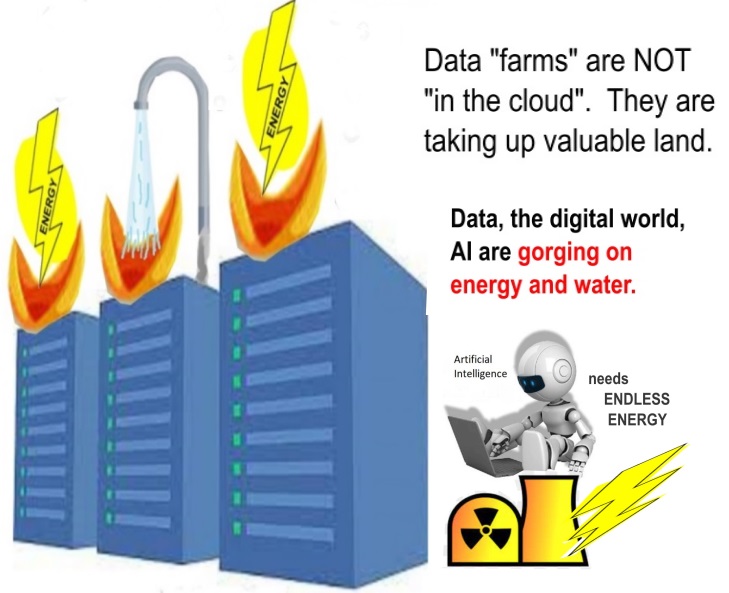
Could a huge data centre revitalise Ayrshire – or ruin it?
Jonathan Geddes,BBC Glasgow and West reporter, 1 Mar 26
It is currently a large, unassuming patch of farmland in East Ayrshire – but within years it could be one of the largest artificial intelligence data centres on Earth.
About 100 hectares (250 acres) of land near HMP Kilmarnock has been earmarked for a technology hub by energy firm ILI Group.
ILI says the development would be similar in size to the prison, while the “vast majority” of the land would be set aside for “biodiversity and landscaping”.
Supporters talk of it revitalising the region, bringing new jobs and investment that would be ploughed back into the community. But the plans have met strong opposition from locals concerned about the impact on the wider area.
Some of those opposed have contacted BBC Your Voice, and say the firm has not provided concrete details about a building that would dominate Hurlford for decades to come.
In recent years, a string of applications for data centres have been made across Scotland. The group Action to Protect Rural Scotland estimate 17 are at various stages of the planning process.
It comes during a worldwide rush to develop data centres. Estimates in 2025 suggested about $3tn (£2.2tn) will be spent on data centres that support AI between now and 2029.
That surge has been accompanied by growing concern about the knock-on effects of the facilities, especially the large amounts of energy and water they consume……………….
For some Hurlford residents though, the announcement of the facility – called Rufus – prompted questions, and a lot of them.
Lisa Beacham became aware of the proposal – which ILI stress is still at a very early stage – shortly after the initial announcement.
A student from Hurlford, she then went down a rabbit hole looking at the amount of water that would be needed for coolant, the process which stops the computer chips there from overheating.
“The site proposal is that it would be powered at 540MW, which would require millions of litres of water a day,” she said.
“Water is a global commodity and we are currently facing global water bankruptcy, according to the UN. Yet we’ll have a site that is using up a huge amount, and due to residue [from the centre] the water used there cannot easily be recirculated.”
Last year the BBC told of people who lived near a data centre in Georgia in the USA who were struggling with an excessive build-up of sediment in water supplies………………………….
Alex De Vries, who runs the Digiconomist blog and website, said he estimated a 540MW facility “could result in almost 6bn litres of annual fresh water consumption” to generate the power needed.
He told BBC Scotland News: “The relatively cooler climate in Scotland isn’t going to do much to mitigate this.”…………………………………..
Cheryl Rowland, an admin assistant at a construction company, who lives in Hurlford, is sceptical.
Speaking at the consultation event, she said: “They are talking about something that will be here for 40 or 50 years.
“Would they arrange education upskilling, to bring local people through and help them grow into jobs here, or will the jobs all be people coming into the area?”……………………
Rowland says it is a worry such a large site will be built by a company who will not be there long term.
https://www.bbc.co.uk/news/articles/c2d1ny161yyo
Golden pipedreams – UK Advanced Nuclear plan

Not everyone is convinced that these new SMR/AMR/MMR projects will be viable technologically or economically,
To progress all this, the Department for Energy Security and Net Zero says it is setting up a ‘UK Advanced Nuclear Pipeline’, a new government managed process through which private sector projects submit detailed plans across 5 core areas: technology & supply chain; developer capability; finance/funding/investment; siting; and operator/end user arrangements. DESNZ and GBE N will conduct eligibility checks /Project Readiness Assessment, with successful projects then being invited to join the Pipeline, subject to ministerial approval.
February 28, 2026, https://renewextraweekly.blogspot.com/2026/02/golden-dreams-uk-advanced-nuclear-plan.html
The UK government is looking to ‘a new golden age of nuclear’, committing £17 billion to ‘the most ambitious programme of new plants for a generation’. As its new Advanced Nuclear Frameworks plan says, in the 2025 Spending Review, it committed £14.2 billion to Sizewell C and over £2.5 billion to the Great British Energy – Nuclear (GBE N) Small Modular Reactor (SMR) project at Wylfa. And it says ‘together with Hinkley Point C, these projects will add almost 8 GW of capacity in the 2030s’.
However, it also wants to do more, with plans for advanced nuclear, some based on US Advanced Modular Reactor (AMR) developments. As it notes, some major commercial deals have been concluded between UK and US companies, including ‘plans for X-Energy and Centrica to build 12 advanced modular reactors in Hartlepool, supporting 2,500 jobs, as well as plans for Holtec, EDF, and Tritax to build small modular reactors at the former coal-fired power station Cottam in Nottinghamshire, providing clean, secure power to data centres on the site’.
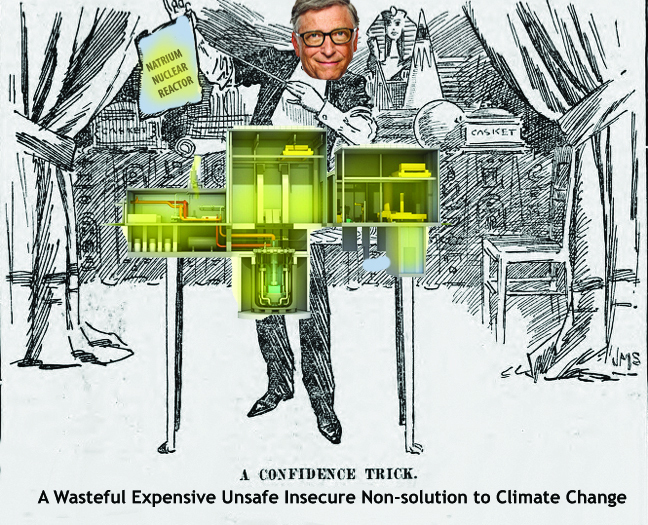
Meanwhile it says ‘TerraPower is working with engineering firm KBR to explore the potential deployment of its Natrium advanced reactor technology in the UK & beyond’. It also noted that ‘Last Energy & DP World intend to create one of the world’s first micro modular nuclear plants at London Gateway, backed by £80m in private money’. These MMRs are meant to be under 20MW.
Not everyone is convinced that these new SMR/AMR/MMR projects will be viable technologically or economically, but DESNZ is optimistic: ‘Britain could see some of the world’s first advanced nuclear power stations powering factories and AI data centres, as part of the government’s “golden age” of nuclear to support jobs, drive growth & protect billpayers with homegrown clean energy’.
To help with that, it is investing in ‘fuel cycle capabilities such as High Assay Low Enriched Uranium (HALEU)’ which some of the new plants will need- if they go forward. HALEU is enriched to below 20%, compared to under 5% for the uranium used in most conventional plants and DESNZ says that it ‘is essential for fuelling AMRs’. But the UK doesn’t have a plant for making it. £300m has been allocated for one, with the aim being to establish a UK domestic HALEU capability that ‘reduces global reliance on Russian supply chains, which currently dominate the global market, and mitigates strategic vulnerabilities for the UK and its allies. By investing early, the UK is ready to be a trusted supplier of HALEU to international partners’ this also ensuring ‘uninterrupted fuel supply for domestic AMR deployment’.
To progress all this, the Department for Energy Security and Net Zero says it is setting up a ‘UK Advanced Nuclear Pipeline’, a new government managed process through which private sector projects submit detailed plans across 5 core areas: technology & supply chain; developer capability; finance/funding/investment; siting; and operator/end user arrangements. DESNZ and GBE N will conduct eligibility checks /Project Readiness Assessment, with successful projects then being invited to join the Pipeline, subject to ministerial approval.
DESNZ says ‘Pipeline projects may engage with DESNZ on potential revenue support, e.g., a Contracts for Difference (CfD) style mechanism that stabilises future revenues, and High Impact, Low Probability (HILP) risk protections where private markets cannot efficiently bear residual risks.’ It adds ‘In parallel, all companies can approach the National Wealth Fund (NWF), who bring £27.8 billion of capital, a dedicated nuclear team, and a full suite of debt, equity and hybrid instruments, to explore investment opportunities aligned with strategic priorities’. DESNZ also look at the ‘wider enablers that the government is putting in place to support nuclear deployment, reforming the planning system, grid connection process, and regulatory process, to ease and accelerate deployment of new plants’.
DESNZ says that while ‘the Framework aims to support private projects that use advanced nuclear technologies for civil energy purposes,’ with the focus on electricity, it also includes ‘projects that supply energy as heat and/or electricity & where the energy is supplied to the National Grid and/or to private energy users.’ But it adds, given possibly unique regulatory, legal, safety, and/or strategic challenges, the new framework ‘specifically excludes offshore or floating nuclear platforms, civil nuclear propulsion, space based reactors and transportable nuclear solutions.’
Even so, it still feels quite breath-takingly pro-nuclear, a very big shift from earlier Labour and indeed Tory views on nuclear as economically unattractive. And the government seems keen to go even further, with revamps to basic regulatory approaches to nuclear safety – to speed thing up and, presumably, try to improve its economics. The new approach could have significant undesirable impacts and has not gone unopposed. But the nuclear lobby is clearly keen to press ahead, with a new perspective on risks being pushed: ‘Routine reactor emissions, both activated material (made radioactive by neutron bombardment) and fission by-products, pose no meaningful health risk.

Even if some vanishingly small effect existed, it would be statistically indistinguishable from the background cancer rate and would be lost in the noise of lifestyle, environmental, and biological risk factors.’ So said two pro-nuclear Breakthrough campaign members in a recent edition of the usually very critical Bulletin of the Atomic Scientists. No risk? Really? There is no shortage of contrary evidence on human health impacts, both occupational and residential, including a recent US national study, although there are still debates on their overall significance and implications.
However, while debates like that, and also on waste costs, continue, DESNZ seems keen to press ahead with nuclear expansion. And they are pretty ‘gung ho’ about that, backing a ‘Destination Nuclear’ staff recruitment campaign, part of their Nuclear Skills plan, which aims to support both civil and defence related nuclear jobs. DESNZ says that nearly 3,500 early careers starters entered the sector in 24/25, with ‘73 new nuclear fission PhDs added in academic years 24/25 and 25/26’.
Is all this wise? Can we really have a golden nuclear future? Well, the latest update from the World Nuclear Industry Status team says that, in Jan 2026 ‘404 nuclear power reactors were operating in the world – 5 units less than one year earlier – maintaining however a stable combined operating capacity. Construction of new nuclear plants was underway in 11countries, five fewer host nations than just two years earlier’. It noted that 2025 saw the lowest number of new start-ups since 2017, while 7 plants totalling 2.8 GW were closed – 3 each in Belgium & Russia, and 1 in Taiwan, completing its nuclear phaseout. So it doesn’t sound too sure about overall nuclear growth- indeed some portray nuclear as fizzling out .
That may be overstating the case, depending on location, but the renewables by contrast are really booming globally – led by China. Indeed Stanford University’s Prof Mark Jacobson says China could reach 100% renewable energy (nearly all power, heat & transport) by 2050. While, he notes that sadly, at the current rate of progress, the USA would only reach that point roughly 100 years later. China may still end having a little fossil and nuclear by 2050/60, but mostly, DNV suggests, it will be green energy. Is the USA’s big fossil and nuclear emphasis really the way to go for anyone? The UK is doing well on replacing fossil with low cost renewables, but, after having its financial fingers burnt by EDF’s high cost EPRs, it still seems strangely locked into uncertain and likely to be high cost new nuclear, increasingly from the USA.…
Nuclear flashpoints to fallout
Devonport doesn’t just work on operational nuclear submarines, it is also a ‘graveyard’ for retired ones. Twelve out of the 16 decommissioned submarines at Devonport are still carrying their fuel – effectively a stockpile of nuclear waste.
New Internationalist 1st Jan 2026
Could the threat of nuclear war be closer than ever? Amy Hall explores how we got here and the pathways out of the crisis.
If you want to get a nuclear-powered submarine refitted, repaired or refuelled in Britain, there is only one place to go – Devonport dockyard in Plymouth, the biggest naval base in Western Europe.
Running across more than six kilometres of waterfront, the dockyard has been part of the landscape for generations. It dominates the western edge of the South West England city, encased by high fenced walls, security cameras and warning signs about police dogs and potential arrest for ‘unauthorized activity’.
The main refit and maintenance area is owned and operated by British defence company Babcock International, which in 2024 made $1,273 million in revenue from nuclear weapons work. In 2025, it celebrated a 51 per cent surge in profit.
But Plymouth itself has not seen the same boost. ‘Most of the money generated goes out of the city,’ says local campaigner Tony Staunton, who is also the vice chair of the Campaign For Nuclear Disarmament (CND). Authorities say that Devonport generates around 10 per cent of Plymouth’s income, but neighbourhoods next to the dockyard remain among the poorest five per cent in the country.
Devonport doesn’t just work on operational nuclear submarines, it is also a ‘graveyard’ for retired ones. Twelve out of the 16 decommissioned submarines at Devonport are still carrying their fuel – effectively a stockpile of nuclear waste.
Over the last 30 years, at least 10 serious radioactive leaks have been documented at Devonport, and chemicals like plutonium, americium and tritium have been found on the Plymouth coastline, including at a wildlife reserve close to the dockyard. Staunton says he has met former dockworkers with cancer who are convinced that their illnesses date back to the time they worked at Devonport, but a ‘culture of secrecy’ about any negative impact of the docks pervades over this military city.
Local authorities have taken steps to prepare for a serious radiation leak at the dockyard, which is within a residential area. An investigation by Declassified UK found that in 2018 the Ministry of Defence distributed 60,900 iodine tablets to schools, emergency services and healthcare settings in local areas.
Nuclear-powered submarines are not only able to carry warheads; they are an essential part of the nuclear warfare infrastructure. And, as the British government jumps with both feet into the nuclear arms race, Devonport is key. The facility is set to receive £4.4 billion (just over $5 billion) in government investment over the next 10 years.
In 2024 the UK spent a larger percentage of its military budget (13 per cent) on nuclear weapons than any other country. The 2025 Strategic Defence Review described them as ‘the bedrock of the UK’s defence and the cornerstone of its commitment to NATO and global security’.
The race is on
As the world becomes more insecure, nuclear-armed states are reaffirming commitments to the most destructive weapons humans have developed. During the first six months of 2025, five nuclear-armed countries were engaged in military hostilities or outright war. And, after decades of decline, the trend of more retired nuclear warheads being dismantled than new ones being deployed looks set to be reversed.
Nearly all of the nine nuclear-armed states (US, Russia, Britain, France, China, Israel, India, Pakistan, North Korea) have been busy modernizing and growing their arsenal. Over the past five years global spending on nuclear weapons increased by just over 32 per cent, with the US and UK’s spending rising by 45 and 43 per cent respectively between 2019 and 2023. One year of global nuclear weapons spending could feed 45 million people in danger of famine for 13 years…………………………………………………………………………………………………………………………………………………..
The bombs dropped on Hiroshima and Nagasaki are considered ‘low-yield’ by modern standards. International Campaign to Abolish Nuclear Weapons (ICAN) estimates that casualties from a major nuclear war between the US and Russia would reach hundreds of millions. The use of less than one per cent of the world’s nuclear arsenal could disrupt the climate and threaten two billion people with starvation.
Escalations in global conflict continue despite the existence of nuclear weapons. ‘This concept of nuclear deterrence is really a faith belief system – that having nuclear weapons is necessary to make sure they’re not used,’ says Alicia Sanders-Zakre, policy and research coordinator at ICAN. ‘As long as this theory continues to hold value within the political establishment of nuclear armed states, it’s not possible to get rid of nuclear weapons.’……………………………………………………………………………………………………………………………………………………………
Today, as the British government itself admits, ‘the future of strategic arms control … does not look promising’. But civil society has got behind the Treaty on the Prohibition of Nuclear Weapons (TPNW) which makes acquiring, proliferating, deploying, testing, transferring, using and threatening to use nukes illegal.
‘TPNW is really significant,’ explains Sanders-Zakre. A nuclear-armed state joining it must agree to a time-bound programme for eliminating its arsenal https://newint.org/arms/2026/nuclear-flashpoints-fallout
Labour panned as nuclear project ‘to cost more than Scotland’s block grant’
THE SNP have hit out at the projected costs for the Labour Government’s
flagship nuclear project. It comes after EDF pushed back the start-up of
the Hinkley Point C nuclear plant again, pushing up the final bill.
The French state energy company said the plant was now expected to cost £35bn
in 2015 prices — or almost £49bn at today’s prices. The project was
costed in 2016 at £18bn at the then-current prices. The SNP have now hit
out at Labour and the party’s push for more nuclear, highlighting that
the Scottish Government’s block grant from Westminster was £47.6 billion
in 2025/2026 – less than the new projected cost.
The SNP have opposed the
creation of new nuclear plants and are able to use planning policy to block
developments, despite energy policy being largely reserved to Westminster.
The Scottish Government instead wishes to focus on renewable developments,
with Scotland’s last nuclear plant, Torness, set to be decommissioned in
2030.
The National 2nd March 2026, https://www.thenational.scot/news/25900166.labour-nuclear-project-to-cost-scotlands-block-grant/
Welsh Anti-Nuclear Alliance relaunched amid concerns over new projects planned for Wales
02 Mar 2026, https://nation.cymru/news/welsh-anti-nuclear-alliance-relaunched-amid-concerns-over-new-projects-planned-for-wales/
A coalition of peace, environmental and social justice organisations has relaunched the Welsh Anti-Nuclear Alliance (WANA), calling for what it describes as energy sovereignty and a democratic, community-led debate on the future of Welsh energy.
The relaunch took place on March 1, with WANA bringing together groups including CADNO (Cymdeithas Niwclear Oesel), CND Cymru, the Low-Level Radiation Campaign, the Low-Level Radiation and Health Conference, No Nuclear Llynfi, PAWB (People Against Wylfa-B), Stop Hinkley and Welsh Nuclear Free Local Authorities.
First established in 1980 by a broad coalition that included former MP Paul Flynn, CND Cymru, the Central Wales Energy Group, farmers and environmentalists, WANA served as a vehicle for anti-nuclear campaigning for decades. Its work was later dispersed among individual organisations during a period of relative calm. With nuclear energy and defence projects once again high on the political agenda, campaigners say the time is right to revive the alliance.
ADVERT – CONTINUE READING BELOW

WANA says it will focus on promoting what it calls “true renewable” energy generation while highlighting concerns around nuclear power and its links to military infrastructure.
A number of nuclear-related projects are currently proposed or under development in Wales. In November, the UK Government announced that Wylfa had been selected as a pilot site for Small Modular Nuclear Reactors (SMRs). Texas-based firm Last Energy has also set out plans for SMRs at the former Llynfi Power Station site between Maesteg and Bridgend. Other projects linked to the AUKUS alliance, including radar capability and submarine development, are expected to involve sites in Pembrokeshire and Cardiff. Nuclear development has also been suggested at locations including Aberthaw and Trawsfynydd.
WANA argues that decisions around these projects have often proceeded without sufficient input from Welsh communities. It says Wales has a long history of industrial exploitation, citing the decline of coal mining and heavy industry and more recent job losses in Port Talbot as examples of communities left behind after economic extracti
The alliance has published a manifesto calling for a “nuclear power and weapons free, sustainably powered, and peaceful Wales”. It raises concerns about public spending, the cost-of-living crisis, the climate emergency and what it describes as a lack of energy sovereignty. It also calls for greater debate around the links between civil and military nuclear programmes and for the devolution of the Crown Estate to Wales.
A WANA spokesperson said the alliance aims to bring campaigners together to challenge what it sees as the risks and costs of nuclear development.
“The cost of nuclear is too high, the build-times too long, and the waste question remains unanswered,” they said. “Wales must engage in a debate about our energy future, including community control and benefits.”
Conservationists challenge effectiveness of £700 million fish safety system.
“EDF’s claims simply do not stand up to scrutiny. Its approach falls short of what is needed to protect the Severn’s unique biodiversity and risks irreversible harm to the estuary’s fish populations.”
Anthony Hawkswell March 1, 2026, https://angling-international.com/2026/03/01/conservationists-challenge-effectiveness-of-700-million-fish-safety-system/
The developer of the UK’s largest nuclear power station – close to one of the country’s most popular sea fishing venues – has claimed that it will have more fish protection than any other structure of its kind in the world.
EDF Energy, which is building the £46 billion Hinckley Point C power station on the River Severn Estuary in the Southwest of England, is spending £700m to install three fish protection systems, including a ‘fish disco’, a British developed innovation that is said to deter marine life from the reactor.
It says that a pioneering British-developed Acoustic Fish Deterrent (AFD) system has been successfully installed at Hinkley Point C, marking a major breakthrough in aquatic safety and environmental stewardship.
However, leading conservationists and politicians say that the company is downplaying the environmental risks to the River Severn Estuary. EDF’s claim that the AFD system is both effective and proportionate in cost is fiercely disputed by environmental groups and a coalition of over 60 MPs.
EDF Energy claims that Hinkley Point C leads the globe with three advanced fish protection measures: the AFD, plus state-of-the-art intake heads and a comprehensive fish recovery and return system. Combined, these initiatives represent a £700 million investment in marine conservation and set a new benchmark for the sector.
The ADF, developed by Fishtek Marine, employs ultrasound technology to guide fish away from danger zones near water intakes. Recent sea trials, led by Swansea University, have demonstrated the system’s high effectiveness in reducing fish mortality rates. Dr Emily Carter, Senior Researcher at Swansea University, commented, “Our results show a significant reduction in fish approaching intake areas, confirming the technology’s value for large-scale applications.”
EDF says these findings suggest that further compensation measures, such as additional artificial saltmarsh habitats, may not be necessary. “Local communities stand to benefit from the enhanced marine environment, with reduced disruption to fish stocks supporting both commercial and recreational fisheries,” said EDF.
Regulatory approval for the system was secured following a thorough application process with the Marine Management Organisation………………………………………………..
However, in a strongly worded open letter delivered to government regulators, England’s foremost nature organisations and dozens of Members of Parliament challenged EDF’s portrayal of the AFD’s efficiency and expense. The signatories argue that EDF’s own data misrepresents the true scale of fish losses likely to occur without full-scale deterrent measures, and they point to independent evidence suggesting the company has underestimated both the ecological and economic case for robust fish protection
Matt Browne, of The Wildlife Trusts, said: “EDF’s claims simply do not stand up to scrutiny. Its approach falls short of what is needed to protect the Severn’s unique biodiversity and risks irreversible harm to the estuary’s fish populations.”
Browne highlighted that the Wildlife Trust’s recent analysis found the proposed deterrent would leave millions of fish vulnerable each year, including species vital to both commercial and recreational fishing.
A recent publication by the Wildlife Trusts exposes significant shortcomings in the Nuclear Regulatory Review process, revealing that key assumptions about fish behaviour and the resilience of the population were misrepresented or omitted. The report details how EDF’s own studies failed to account for cumulative impacts on migratory species and ignored alternative, more effective mitigation options. These findings have intensified calls for a comprehensive reassessment of the project’s licensing condition.
Natural England, the government’s statutory adviser on the natural environment, has reiterated the Severn Estuary’s status as a legally protected site under international and domestic law. The agency emphasises the estuary’s crucial role as a nursery for diverse fish species and migratory birds, warning that any failure to implement proven fish deterrent technology risks breaching conservation obligations and undermining decades of habitat restoration.
As the debate intensifies, the angling community, conservationists and policymakers are united in demanding greater transparency and government accountability. There are mounting calls for an independent review of EDF’s environmental claims and the immediate adoption of best-available fish protection technology.
“The future health of the Severn Estuary, and the integrity of the UK’s environmental standards, now hangs in the balance,” said Natural England.
A victory for Independent Journalism -Declassified wins battle over access to Parliament

Officials initially blocked us from holding a press pass, citing the ‘particular standpoint’ of our Gaza investigations
Martin Williams, 24 February 2026, https://www.declassifieduk.org/declassified-wins-battle-over-access-to-parliament/
Declassified has won a seven-month battle to report from Parliament, after officials were accused of a “partisan attempt to suppress investigative journalism”.
Westminster authorities initially rejected our application for a press pass in June, claiming there wasn’t enough space.
But we obtained internal emails showing that the officials considering our application had cited the “particular standpoint” of our coverage.
They flagged an article about pro-Israel bias in Westminster and even claimed that Declassified’s focus on foreign affairs does not count as “politics”.
The revelation sparked widespread criticism and around 5,800 Declassified readers signed an open letter calling on Parliament to review its decision.
The letter was also signed by more than 100 politicians, journalists and campaigners including the MPs Jeremy Corbyn, John McDonnell, Clive Lewis and Liz Saville-Roberts.
Other signatories included journalists Peter Oborne, Ash Sarkar and Owen Jones; comedians Nish Kumar, Josie Long, Fern Brady; as well as the heads of Reporters Without Borders, The Committee to Protect Journalists and The Centre For Investigative Journalism.
In Westminster, 27 MPs from across the political spectrum also signed an Early Day Motion urging authorities to reverse the decision.
Now, more than seven months after our original application, officials have u-turned and granted Declassified access to Parliament.
Changes
Media passes are already held by almost 500 journalists from other news outlets, providing vital access to the corridors of power in Westminster. But the vast majority are from mainstream or right-wing media organisations.
In fact, the system is specifically designed to make access difficult for small, independent newsrooms. Guidelines say that passes will “not normally” be given to freelance journalists, trade press or independent production companies, while other applicants must have a “substantial” audience and be regulated by Ofcom, IPSO or Impress.
However, in response to Declassified’s campaign, authorities have reformed the way journalists apply for media passes. This includes clarifying the criteria, introducing an appeals process, and changing the rules on resubmitting an application.
The initial decision to block Declassified was made by the Sergeant At Arms, but this responsibility has now been given to other officials – although Parliament insists this change was not connected to our campaign.
Officials eventually invited Declassified to submit a fresh application after we submitted a lengthy official complaint in October.
And now, Parliament has finally issued us with a media pass, marking a remarkable victory for press freedom.
It comes after Declassified reporters were also blocked from entering the Labour Party conference and a major London arms fair last year.
Declassified’s co-director Laura Pidcock said: “What should have been a straightforward process to access parliament for journalistic purposes, became an issue of press freedom and fair process. We are pleased the application has now been approved and procedural changes made.
“I have no doubt that the overwhelming support of the public helped us achieve this – huge thanks to everyone who signed the open letter.”
She added: “There is a creeping trend to restrict civil liberties in the UK, and press freedom is crucial. It was therefore important we pushed back on the Parliamentary authorities’ decision and, with your help, won!”
Renewables projected to overtake gas on cost within five years, report finds

20 February 2026, https://eibi.co.uk/news/renewables-projected-to-overtake-gas-on-cost-within-five-years-report-finds/
Renewable electricity is set to become the most economically favourable source of power in the UK by 2028 to 2029, according to new analysis by the Renewable Energy Association (REA), even after accounting for the full costs of expanding grids, storage and transmission.
The findings are set out in the Renewable Energy Association’s Renewable Cost Analysis Report 2025, which models two scenarios for the electricity system. Under a ‘Clean Power 2030’ pathway, annual investment of about £40bn would expand renewable capacity and cut the share of unabated gas to below 5%.
An alternative ‘No New Renewables’ scenario assumes no additional wind or solar capacity until 2040, with natural gas meeting future demand, which would mean lower upfront spending but higher ongoing fuel costs.
The REA concludes that although electricity generation will remain expensive across all technologies, renewables represent the most cost-effective long-term option. Including employment impacts, the analysis suggests renewable generation becomes the net economic winner by the end of the decade.
The modelling assumes flat gas prices over the next five years. If gas prices fall by 25% between 2025 and 2030, the point at which renewables become cheaper is delayed by only one year when excluding job benefits.
The report says its analysis includes all additional grid, transmission, storage and system costs associated with higher renewable deployment, in contrast to traditional levelised cost estimates that focus on generation costs alone.
It also highlights wider benefits from renewables, including reduced exposure to volatile international gas markets, improved energy security and environmental gains such as lower carbon emissions and cleaner air.
The REA recommends continued government support to manage short-term electricity costs, including possible reductions to green levies and value added tax, alongside stable policy to encourage investment. It says early investment in renewables would deliver long-term economic benefits, domestic employment and greater energy security for the UK.
Read REA’s Renewable Cost Analysis Report 2025.
Appeal court refuses TASC’s appeal against the High Court’s Sizewell C JR application decision

23rd February 2026. https://tasizewellc.org.uk/appeal-court-refuses-tascs-appeal-against-the-high-courts-sizewell-c-jr-application-decision-23-02-26/
Together Against Sizewell C Ltd (TASC) is extremely disappointed to learn that our appeal against the Secretary of State, Ed Miliband’s, decision not to subject Sizewell C’s secret sea defences to public scrutiny and assessment has been refused. We are, however, thankful that our legal challenge has helped to expose the Sizewell C project’s lack of resilience to extreme climate change.
TASC spokesperson, Chris Wilson, said, “TASC fear for the safety of our descendants and the precious Suffolk coastline because this judgement leaves future generations to rely on the developer’s ‘hypothetical’ i.e. ’imaginary or suggested’ (note 1), unassessed sea defences to protect Sizewell C and its 3,900 tonnes of spent nuclear fuel from flooding in an extreme sea level rise scenario over the next 150 years.
This decision rules out consideration of alternatives, such as raising the platform height, an option that will be lost once the plant has been built – a raised platform height will likely be less impactful on the environment and would negate the need for future generations to build the two additional huge sea defences.
“The Appeal Court’s decision sanctions the Government and developer’s choice to push ahead with £40 billion Sizewell C in the full knowledge that the project currently under construction is not resilient to a ‘credible maximum climate change scenario’ – contrary to Habitat Regulations, government policies and Labour’s claims that infrastructure projects are resilient to climate change impacts (note 2). Yet here, the project approved in the Development Consent Order (DCO) makes no provision for the two additional sea defences.
“Sizewell C is sited on one of Europe’s fastest eroding coastlines. Recent rapid erosion at nearby Thorpeness has resulted in many homes having to be demolished and in front of the development site the beach may need to be replenished before the nuclear plant has even been built (note 3) – demonstrating the threat of erosion is real and immediate and should be a wake-up call for government that Sizewell is not a suitable site for new nuclear “This government wants to ‘rip up the rules to fire-up nuclear power’ (also refer to note 5). TASC, however, believe there should be an inquiry into how the developer, EDF, was allowed to exclude the additional sea defences from their 2020 DCO application, even though national policy statements require developers to include plans for adaptive sea defences to deal with a credible maximum climate change scenario – EDF knew as far back as 2015 that the site requires additional flood defences in an extreme sea level rise scenario but chose to keep them secret, thereby avoiding public scrutiny and environmental impact assessment. One would have hoped that any sensible government would want to guarantee that there is a viable, fully assessed plan to ensure the plant and its spent fuel can be kept safe for its full lifetime to avoid a catastrophic event.
“It is imperative we all speak up for future generations, who have no voice in the decision-making of today, to ensure it is demonstrated that there is a fully assessed, viable option to keep the Sizewell C site and its 3,900 tonnes of spent fuel safe from flooding throughout its full lifetime. By not doing so, this government is placing an immoral burden on our descendants who will be forced to clear up the mess resulting from ill thought-out choices made today.”
Babcock CEO responds to Rosyth nuclear handling concerns
Dunfermline Press 25th Feb 2026, By Hannah Shedden
Babcock International Group’s CEO has sought to reassure residents who are concerned about the potential presence of nuclear weapons or waste at Rosyth Dockyard.
Fears were raised after SNP councillor Brian Goodall said that iodine tablets to counteract the effects of radiation would need to be given to “half the population of Rosyth” if proposals to bring more nuclear subs to the dockyard went ahead.
Cllr Goodall highlighted the “seriousness of the implications” of providing a contingency dock for the Dreadnought class of vessels that could be carrying Trident missiles.
His comments last year then prompted a row between the councillor and Labour MP, Graeme Downie, who accused Cllr Goodall of spreading “misinformation” and “arguing against highly skilled nuclear jobs in the safe dismantlement of nuclear subs at Rosyth”.
The Press spoke to Babcock CEO, David Lockwood, and asked him what his response would be to those who are fearful about nuclear materials in Rosyth.
He said: “I would say that we are the largest nuclear company in the UK and probably have the most experience handling civilian and military waste than anyone else, so I think you can take a lot of assurance from that…………………..
https://www.dunfermlinepress.com/news/25885325.babcock-ceo-responds-rosyth-nuclear-handling-concerns/
Britain must rethink its disastrous nuclear expansion – public protest can make it happen!

Sophie Bolt, CND General Secretary, 24 Feb 26, https://cnduk.org/britain-must-rethink-its-disastrous-nuclear-expansion-public-protest-can-make-it-happen/
Caroline Lucas is a former leader of the Green Party of England and Wales and a vice-president of the Campaign for Nuclear Disarmament. Here she writes ahead of Saturday’s national demonstration against Britain’s nuclear jets at RAF Marham and why public protest can make the government rethink its nuclear expansion plans.
With the end of the New START Treaty, the last remaining arms control agreement between the US and Russia, we now face the prospect of a new nuclear arms race without any limits on the two biggest nuclear armed states, who together own 90% of the world’s nuclear weapons. Given the world-destroying power of these nuclear arsenals it is critical that pressure is brought to bear on both Donald Trump and Vladimir Putin to support its voluntary extension for at least another year. This would give space to kick-start a formal extension of the Treaty, bringing an element of stability and transparency to what is an increasingly dangerous and unstable world in which the threat of nuclear weapons being used is higher than at any time since the Cold War.
The expiry of New START was one of the reasons given by the Bulletin of the Atomic Scientists to push forward the hands of the Doomsday Clock by four seconds. Now standing at 85 seconds to midnight, it acts as a stark warning of just how close we are to an irreversible catastrophe caused by humanity – through nuclear war or climate collapse. Rather than pursuing policies that will help push back the clock, nuclear states spent over $100 billion on these weapons in 2024, replacing and modernising them. Meanwhile, challenges to the nuclear taboo are intensifying with increasing calls for the use of so-called ‘tactical’ nuclear weapons on the battlefield.
Shamefully, Britain is part of the problem, with the ongoing replacement of its nuclear-armed submarine fleet and the announcement last summer of its decision to purchase US nuclear-capable F-35A fighter jets. Based at RAF Marham in Norfolk, the first 12 jets will be delivered by 2030 and a total of 75 will be bought over the course of the programme’s 40-year lifespan.
Even before the first delivery, expenditure on the programme has already spiralled out of control. The MoD initially costed the F-35 programme – which also includes non-nuclear F-35Bs – at £57 billion. However, this failed to include any sustainment costs, including staff, fuelling and maintenance. The National Audit Office has now estimated the programme will cost at least £71 billion. But this still doesn’t cover any of the costs for the lengthy, involved process of NATO integration. As the Public Accounts Committee revealed, this is because the MoD themselves have yet to figure this out. Footing the bill for this ‘blank cheque’ purchase will be the British public, at the expense of public services and climate action.
The purchase also ties us closer to the dangerous leadership of Donald Trump. These jets and their crews will be assigned to NATO’s nuclear Dual Capable Aircraft mission and RAF pilots will be trained to carry US B61-12 nuclear bombs now likely deployed to RAF Lakenheath in Suffolk. One of these bombs has the destructive power three times greater than the bomb dropped on Hiroshima in 1945. Modelling from Princeton University found that the use of these so-called ‘battlefield nukes’ could quickly escalate into a wider nuclear confrontation, leading to 2.6 million deaths in the first few hours alone. Rather than keeping us safe, these nuclear weapons undermine our security and ensure we are firmly on the frontline of a nuclear war.
The expansion also breaches international law. As a signatory to the nuclear Non-Proliferation Treaty, Britain is obliged to pursue disarmament in good faith. However, a new legal opinion argues ‘[t]he decision of the UK to purchase F-35A fighter jets rather than any other model is precisely because the aircraft can “deliver both conventional and nuclear weapons” and thereby enable the RAF to reacquire “a nuclear role for the first time since 1998.” Reinstating a nuclear role for the RAF represents a reversal of the UK’s long-term commitment to nuclear disarmament, including under the NPT.’
Given the grave consequences of this expansion, this would surely warrant a robust and serious debate in Parliament. Yet MPs were not consulted about the purchase ahead of Starmer’s announcement at last summer’s NATO summit. Since then, the government has stated it has no plans for such a debate.
Not surprisingly, there is widespread opposition to the decision, including from the Green’s Party Leader, Zack Polanski, and our MPs and Peers. They join many trade union leaders, faith communities, civil society and climate groups all calling for the government to rethink this disastrous nuclear expansion and instead pursue a foreign policy based on de-escalation, diplomacy, and international cooperation.
That’s why I’m urging all those who want to halt this deadly nuclear expansion to join CND’s upcoming demonstration at RAF Marham, in Norfolk, on Saturday 28 February. Not only is this base the central hub for the government’s notorious F-35 fighter jet programme, from where parts for these jets have been transported to Israel. It is also where these new nuclear-capable jets will be stationed. Of course, the government doesn’t want you to know what goes on at this base. And it certainly doesn’t want peaceful protesters shining a spotlight on it. But protest has always been central in making political leaders step back from the nuclear brink and take action to disarm nuclear weapons. It is a rich part of Britain’s history. And we need this now more than ever.
US-UK tech talks restart with a focus on nuclear projects.

London and Washington have tentatively restarted work on their
multibillion-pound “tech prosperity deal”, which was paused last year
after President Donald Trump piled pressure on the UK to cede ground in
wider trade talks.
Senior US and UK officials have initiated discussions
about collaboration on civil nuclear technologies and on hosting a joint
summit on fusion technologies, according to multiple people briefed on the
talks. They described the deal as “unsticking”. The US-UK “tech
prosperity deal”, which was announced in September last year during
Trump’s state visit, aimed to spur co-operation between the two countries
in areas including AI, quantum computing and nuclear energy.
UK Prime Minister Sir Keir Starmer said at the time that the two nations were
embarking upon a “golden age of nuclear” energy, with more
transatlantic co-operation and speedier regulatory approvals for atomic
projects. The deal was touted by the UK as including £31bn worth of
investment from America’s top technology companies.
However, the US
suspended the deal in early December, with UK officials claiming the Trump
administration was pushing for wider trade concessions outside the tech
partnership. One of the projects announced was an agreement between UK
energy company Centrica and US nuclear group X-energy to build advanced
high-temperature, gas-cooled reactors in Hartlepool. Aerospace and
engineering company Rolls-Royce also said it had entered the US regulatory
process for its small modular reactors, signalling its intent to roll them
out in the US.
The tech deal was paused late last year after US officials
became increasingly frustrated with the UK’s lack of willingness to address
so-called non-tariff barriers in its wider trade negotiations, including
regulations governing food and industrial goods.
FT 25th Feb 2026, https://www.ft.com/content/0992b6d0-5d10-4a7a-a505-6cda84946e6d
1 This Month

of the week – Shut Down Drone Warfare!


Tell the Ukrainian Government to Drop Prosecution of Peace Activist Yurii Sheliazhenko

Petition to revoke the licensing of the Near Surface Nuclear Disposal Facility (NSDF) at Chalk River. https://www.ourcommons.ca/petitions/en/Petition/Details?Petition=e-7247
To see nuclear-related stories in greater depth and intensity – go to https://nuclearinformation.wordpress.com
-
Archives
- March 2026 (251)
- February 2026 (268)
- January 2026 (308)
- December 2025 (358)
- November 2025 (359)
- October 2025 (376)
- September 2025 (257)
- August 2025 (319)
- July 2025 (230)
- June 2025 (348)
- May 2025 (261)
- April 2025 (305)
-
Categories
- 1
- 1 NUCLEAR ISSUES
- business and costs
- climate change
- culture and arts
- ENERGY
- environment
- health
- history
- indigenous issues
- Legal
- marketing of nuclear
- media
- opposition to nuclear
- PERSONAL STORIES
- politics
- politics international
- Religion and ethics
- safety
- secrets,lies and civil liberties
- spinbuster
- technology
- Uranium
- wastes
- weapons and war
- Women
- 2 WORLD
- ACTION
- AFRICA
- Atrocities
- AUSTRALIA
- Christina's notes
- Christina's themes
- culture and arts
- Events
- Fuk 2022
- Fuk 2023
- Fukushima 2017
- Fukushima 2018
- fukushima 2019
- Fukushima 2020
- Fukushima 2021
- general
- global warming
- Humour (God we need it)
- Nuclear
- RARE EARTHS
- Reference
- resources – print
- Resources -audiovicual
- Weekly Newsletter
- World
- World Nuclear
- YouTube
-
RSS
Entries RSS
Comments RSS
 nuclear-news