Promising development in non nuclear production of medical isotope technetium-99m (Tc-99m)
 ARTMS Products Inc. partners with Alliance Medical to modernize, stabilize UK medical isotope supply chain https://www.alliancemedical.co.uk/news/artms-products-inc-partners-with-alliance-medical-to-modernize-stabilize-uk-medical-isotope May 16, 2017
ARTMS Products, Inc., a Vancouver-based medical technology company, is pleased to announce that it has entered into a strategic partnership with Alliance Medical to enable and demonstrate an alternative, non-reactor supply of technetium-99m (Tc-99m) within the United Kingdom. ARTMS will provide to Alliance the hardware, know-how, and proprietary consumables to gain regulatory marketing approval within the UK and subsequently implement commercial supply of accelerator-, or cyclotron-produced Tc-99m. This technology will enable a reduction in the reliance in the UK of foreign, subsidized, reactor-based medical isotope production; enhancing supply reliability and eliminating the use of enriched uranium as a source of life-saving medical isotopes.
Tc-99m is used in over 80% of all nuclear medicine imaging procedures in areas such as cardiology, oncology, and neurology. Typically sourced from an ageing fleet of global nuclear reactors, this important isotope has been subjected to significant supply disruptions in recent years. ARTMS’s technology to produce Tc-99m using medical cyclotrons is a viable alternative and forges a path to securing a safe, reliable, and environmentally sound supply of a critical medical isotope for the future. Continue reading
Japan will fully insure bank loans for costly UK nuclear projects!

 Hitachi UK reactors to get full Japanese loan insurance https://asia.nikkei.com/Politics-Economy/Policy-Politics/Hitachi-UK-reactors-to-get-full-Japanese-loan-insurance, Lenders seek guarantees as nuclear projects face post-Fukushima cost overruns, 2 Sept 17, TOKYO — Japan intends to fully insure bank loans for one of Hitachi‘s British nuclear plant projects in order to encourage domestic lenders to finance a particularly risky type of infrastructure export that Prime Minister Shinzo Abe’s government seeks to promote.
State-owned Nippon Export and Investment Insurance will write the loan insurance for reactors, which Hitachi will build through British arm Horizon Nuclear Power. The Japanese conglomerate, together with Tokyo and London, will conduct working-level talks to hash out a funding support framework, with the aim of breaking ground in 2019.
The project is estimated to cost over 2 trillion yen ($18.1 billion). Hitachi, the U.K. government and two state-backed entities — Japan Bank for International Cooperation and the Development Bank of Japan — are expected to pick up part of the tab. But private-sector financing will also be needed to close the funding gap.
NEXI, which normally indemnifies private lenders for 90-95% of financing, will enter into talks with Japanese banks toward fully guaranteeing loans for the Wylfa project.
Nuclear project costs have tended to balloon since since Japan’s 2011 Fukushima disaster owing to increased safety precautions. Seeing a higher risk of debt default, Japanese megabanks Bank of Tokyo-Mitsubishi UFJ and Mizuho Bank have sought full coverage by NEXI for any loans for nuclear plant development. Such insurance typically covers financing for projects in developing countries. NEXI is expected to impose conditions, such as a loan period of several decades, in return for an exception.
An accident or other troubles at the plant could expose BTMU and Mizuho to lawsuits from third parties because the banks would bear responsibility for financing the project. The two banks will decide on Wylfa financing based partly on discussions between Tokyo and London concerning damage compensation.
A default on the Wylfa loans would entail a taxpayer-funded repairs to the balance sheets of NEXI and JBIC. The loan insurance proposal is likely to spark a debate on whether promoting infrastructure exports in this way is worth the risk. The Abe government, for its part, will try to use the NEXI assurances to elicit more funding, public and private, from the British side.
With little prospect of constructing new reactors in Japan following the meltdowns at the Fukushima Daiichi nuclear power plant, domestic builders have focused their business offshore. Chinese state-owned enterprises are undertaking more global infrastructure projects, emboldening those who argue that Japan will be left behind in the race for overseas orders unless the country takes risks. In 2015, the U.K. became the first developed nation to approve a Chinese-made reactor.
A WW2 unexploded bomb found near to Hinkley nuclear station – for the 3rd time!
Third WWII bomb found in Bristol Channel near Hinkley Point, Guardian 30th Aug 2017 Matthew Weaver Half-mile exclusion zone set up near nuclear plants after third unexploded device discovered in as many weeks

A half-mile (1km) exclusion zone has been set up in the Bristol Channel near the Hinkley Point nuclear power stations after a third unexploded second world war bomb was discovered in as many weeks.
Bomb disposal experts will carry out a controlled explosion on the 250lb (113kg) ordnance on Wednesday, two miles north-west of the power plants. HM Coastguard has set up an exclusion zone around the unexploded device and warned ships to avoid the area.
The bomb was reported in the early hours of Wednesday by a diving team from the Hinkley Point plant. They were clearing the seabed for intake and outtake pipes for cooling water for the reactors on the Hinkley Point C plant.
It is the third suspected second world war bomb to be found in the Bristol Channel in the past three weeks. An EDF source conceded that divers could find more unexploded ordnance before the exercise to clear the area was completed, as the channel was used as a former army training range. The project to clear the seabed is expected to take several more weeks. https://www.theguardian.com/world/2017/aug/30/third-wwii-bomb-bristol-channel-near-hinkley-point-nuclear
A historic chimney is set for demolition at Sellafield.
A historic chimney is set for demolition at Sellafield. The Primary
Separation Plant Chimney Stack was built in the 1950s to provide
ventilation for surrounding buildings.
It is now one of the biggest risks at Sellafield because it does not meet modern safety standards. Demolishing
a 61-metre chimney in the middle of Europe’s most complex, congested
nuclear site is a challenge. Explosives are not an option and there is no
space for a crane so engineers have spent the last seven months getting a
self-climbing platform to the top of the chimney metre by metre so they can
begin demolition.
Demolishing this chimney will cost more than £60m. The
Nuclear Decommissioning Authority which oversees Sellafield says the
complexity of this one project demonstrates why cleaning up this site is so
expensive. £2bn was spent at Sellafield last year alone. http://www.itv.com/news/border/2017-08-29/historic-sellafield-chimney-ready-for-demolition/
Climate change threats to Scotland
THE Sunday Herald can today reveal the true extent of the threat posed to
Scotland by climate change. Major parts of Scotland’s vital infrastructure
are under threat from coastal erosion and flooding, according to the latest
government assessments of the dangers of climate change.
Thousands of homesand businesses and long stretches of roads and railway lines are also at
risk. So are power stations, wind farms, sewers, bridges, and farmland, as
well as many other crucial facilities and even golf courses. Seabirds, fish
and plants are endangered, as well as butterflies, food crops and peat
bogs.
Scotland can expect more rain, more droughts, more storms, more wild
fires, more landslides, more pests and more diseases – and snow is
disappearing from the mountains. As evidence mounts of the multiple risks
climate change poses to people and wildlife, 2017 is predicted to be
another record hot year. And one of Scotland’s leading climate experts is
warning that the world is facing the catastrophe of “runaway” climate
change because of the impact of pollution and the damage it is doing to
nature.
A study for the Scottish Government warned that the rate of coastal
erosion around Scotland has doubled since the 1970s. Researchers identified
30,000 buildings, 1,300 kilometres of roads and 100 kilometres of railway
lines “close to potentially erodible coasts”. The report predicted that
mean summertime temperatures in Scotland would rise by up to 4.5 degrees
centigrade by the 2050s, while winter rain could increase by up to 30 per
cent. The sea level around Edinburgh is expected to rise by between 20 and
40 centimetres by 2090. http://www.heraldscotland.com/news/15497924.Revealed__climate_change_and_the_terrifying_risk_to_Scotland/
UK’s Atomic Weapons Establishment (AWE) upgrading Trident nuclear warhead to make it even more destructive

 UK Running ‘Secret’ Program to Develop Nuclear Weapons https://sputniknews.com/europe/201606071040916158-uk-trident-nuclear-proliferation/
A new report claims Britain’s Atomic Weapons Establishment (AWE) is ‘secretly’ working on a program to upgrade the current UK Trident warhead to give it more destructive power, despite the country’s long-term commitment to reduce nuclear proliferation.
According to the Nuclear Information Service (NIS) — an independent body which works to promote public awareness and foster debate on nuclear disarmament — AWE is currently working on a program to upgrade the current UK Trident warhead to the ‘Mark 4A’ modified warhead, which will have increased accuracy and destructive power and an extended lifetime.
Parliament has never been formally notified of the Mark 4A modification program and the costs and timetable for the program have never been disclosed. Nevertheless, the policy of successive UK governments has been to achieve a world without nuclear weapons, so it is incontrovertible that at some point in the future nuclear weapons production and maintenance at AWE must cease,” its latest report says. Transparency?
In May 2010, the government announced that it would reduce the overall size of the UK’s nuclear weapons stockpile to 225.
A government statement, updated in May 2015, stated: “Following a further review, in October 2010 the Prime Minister announced that by the mid-2020s the overall size of the UK nuclear weapons stockpile will reduce to no more than 180 warheads.
No more than 120 will be operationallyavailable.”
However, critics say that a reduction in the number of warheads, but with increased “destructive power,” is hardly in the spirit of non-nuclear proliferation.
Parliament should debate whether to replace the UK Trident warhead, given the questions over its necessity, cost, proliferation implications, and impact on the UK’s nuclear disarmament obligations,” the NIS report says.
Professor Martin Rees (Lord Rees of Ludlow), Astronomer Royal and a former President of the Royal Society, in the foreword to the report says:
“[There is] a need for AWE, a highly expensive institution, to be more politically accountable and more transparent. Parallel US institutions like Los Alamos are in a less ‘closed’ world; to a greater extent than at AWE their staff attend mainstream scientific conferences and contribute research on non-classified topics.”
According to the report, the program involves close collaboration with the US nuclear weapons laboratories through a joint US/UK Joint Re-entry System Working Group, and key components for the modified warhead are purchased from the US.
UK Royal Navy detonates the second bomb found in the sea near Hinkley Point.
 West Somerset Free Press 22nd Aug 2017, A ROYAL Navy bomb squad was in action for the second time in eight days last Wednesday as it detonated another bomb found in the sea near Hinkley
Point. The 250lb Second World War device, discovered by divers checking the
seabed before the construction of cooling water tunnels for the power
station, was half the size of the bomb that Navy experts successfully
detonated on August 8, as reported in last week’s Free Press. As before,
the bomb was ringed by a one kilometre exclusion zone and the area was
off-limits for shipping for 24 hours. http://www.wsfp.co.uk/article.cfm?id=108283&headline=Second%20bomb%20found%20near%20Hinkley§ionIs=news&searchyear=2017
Vast majority of UK accept climate change is real, finds new poll
Old men in the East Midlands are less likely to accept scientists’ evidence than young women in the South-east, The Independent, Ian Johnston Environment Correspondent @montaukian , 24 Aug 17, About 13 per cent of people in Britain do not accept the science of climate change, according to a new poll.
The survey of 1,200 adults in the UK by Censuswide found men (17 per cent) were significantly more likely than women (11 per cent) to deny the widespread evidence of global warming – from melting sea ice and glaciers and rising sea levels to animals and plants heading for the poles.
However, a substantial majority of 70 per cent said they did agree the temperature is rising and that greenhouse gas emissions are to blame – as accepted by every major scientific organisation in the world. …… http://www.independent.co.uk/environment/uk-climate-change-real-accept-majority-global-warming-poll-finds-a7909841.html
Danger of a nuclear weapons accident on Scotland’s roads
 Scotland ‘wholly unprepared’ for nuclear weapons accident on its roads – report https://www.rt.com/uk/400508-scotland-nuclear-weapons-accident/, 22 Aug, 2017 Nuclear warheads surrounded by explosives are regularly transported on British roads, yet authorities are “wholly unprepared” to handle an accident, a damning report has revealed.
A “critical gap” in the protection of Britons has been identified by Nukewatch UK, amid claims public safety is being put at risk by the Scottish Government. The report, ‘Unready Scotland’, reveals weapons of mass destruction (WMDs) are driven across the country around eight times every year, without police accompanying them and without public knowledge.
The convoys travel with a potentially-deadly cocktail of explosives and nuclear weapons packed inside – yet those traveling alongside the huge trucks remain blissfully unaware of the dangerous cargo. Scottish councils have failed to carry out individual assessments of the routes taken by the massive convoys. This means vital evacuation time could be lost and the number of casualties could rise rapidly should there be an incident.
The potential contamination zone for an accident involving nukes is 24 miles, according to some experts, meaning entire villages and towns could be engulfed.
“The radioactive material in the warheads includes both plutonium and uranium, with a potential dispersal range of at least 5km,” Nuke Watch reports. “In addition to this, warhead materials include a number of toxic and hazardous substances.”
Unready Scotland suggests there is “no evidence” that authorities would be able to cope with a disaster on the route between the Aldermaston and Burghfield atomic weapon plants in Berkshire and RNAD Coulport on Loch Long.
In the event of nuclear fallout, the Ministry of Defence (MoD) would prioritize the mobilization of troops to secure the weapons – and the safety of the public would fall squarely on the shoulders of local authorities and emergency responders. Yet the frightening report shows that those who would be first on the scene would be “unprepared” and unable to launch into action. Although some claim an accident involving a convoy is unlikely, there have already been underreported incidents. In May, a military convoy of nuclear warhead carriers was left stranded on the side of the M40 motorway when the escort broke down. Fortunately in this instance there were no live warheads onboard.
Despite authorities claiming potential terrorist plots make it impossible for them to reveal details of the convoys to the public, activists claim the information is already in the public domain.
The report claims there is “no justification for not informing the public about the existence of the convoy traffic and its attendant risks.”
“The simple fact that these trucks carry nuclear bombs on public roads is enough to cause very serious concern, amounting to alarm,” said Nuke Watch. The report says the police officers manning the convoy “very frequently” have no idea what they are protecting – and would be unable to react in an emergency, the report says.
Astonishingly, some authorities “rely on generic risk assessments conducted within their Resilience Partnerships.”
Practice runs have been carried out on a small scale, according to Local Authority and Emergency Services Information (LAESI) reports, but nowhere close to the scale of the potential damage.
In 1990 it was predicted by nuclear engineer John Large that an accident involving nuclear warheads could spread contamination “at least 40 kilometres.”
Nuke Watch has called for an urgent review into the country’s response to a nuclear accident.
It claims since community safety is wholly devolved to the Scottish Parliament at Holyrood, the Scottish National Party (SNP) Government has failed in its duty to put adequate plans in place.
RT has contacted the SNP for comment.
UK Council leaders back ‘Mayors for Peace’ in urging countries to ratify a new United Nations (UN) treaty prohibiting nuclear weapons
Herald 20th Aug 2017, COUNCIL leaders are backing a call by Hiroshima and Nagasaki, the two
Japanese cities devastated by US atomic bombs 72 years ago, to accelerate
international moves for a nuclear ban.
They are calling for the UK and other nations to renew their nuclear disarmament efforts in a bid to defuse
growing fears of nuclear war in the wake of destabilising tensions between
North Korea and the Trump administration. A conference of ‘Mayors for
Peace’ in Nagasaki earlier this month passed a resolution urging
countries to ratify a new United Nations (UN) treaty prohibiting nuclear
weapons as soon as possible.
The treaty has been agreed by 122 countries
but opposed by nuclear weapons states, including the UK.
http://www.heraldscotland.com/news/15483955.Council_leaders_call_to_accelerate_international_moves_for_a_nuclear_ban/
Concern over dangers of nuclear bombs transport across Britain
Herald 20th Aug 2017, Scotland is “wholly unprepared” to deal with an accident or an attack on
the nuclear bomb convoys that regularly travel across the country,
according to a new report. Local authorities are accused of breaching their
legal duty to safeguard the public by failing to assess and warn of the
dangers.
Scottish Ministers are under fire for failing to make councils
comply. Campaigners are demanding an urgent review of measures to protect
people from radioactive contamination from convoy crashes. They say that an
accident could spread plutonium and other toxic materials over miles.
Anti-nuclear groups have previously attacked the UK government for failing
to ensure the safety of nuclear weapons transports. But now they are
targeting Scottish central and local government for not doing enough.
According to the nuclear-free group of local authorities (NFLA), the report
showed there was “confusion” over the response to convoy accidents.
One problem was that councils weren’t informed of convoy movements, it argued.
“There needs to be a wider rethink about such convoys and greater
cooperation with all emergency responders, including councils, so that the
risks to the public can be fully unpacked and considered,” said NFLA
Scotland representative, Audrey Doig, an SNP councillor from Renfrewshire.
http://www.heraldscotland.com/news/15483954.No_safety_assessments_carried_out_for_nuclear_convoys_in_Scotland/
Opposition to dangerous air flights carrying radioactive wastes
 Campaigners aim to raise awareness of Moray nuclear flights at meeting, The Press and Journal, Aberdeen, by August 20, 2017 Anti-nuclear campaigners will meet in Moray to press for alternatives to transporting radioactive waste through the region.
A bomb found near the Hinkley C nuclear project – for the SECOND time
 Second World War bomb found off coast of Hinkley Point http://www.somersetlive.co.uk/news/somerset-news/second-world-war-bomb-found-335854 Watchet Coastguard shared a notice on their Twitter account telling people to stay clear of the cordon, RUTH OVENS 16 AUG 2017,
A 250 pound bomb has been found off the coast of Hinkley Point.
Mariners are being advised to avoid the area of the bomb which is thought to date back to the Second World War.
Hinkley Point C Harbour Authority have shared the following notice:
“Mariners are advised that a 250 pound bomb thought to date from Second World War has been discovered in position Latitude 51’13.43’ North, Longitude 003’09.22 West. This position is approximately six cables south-east from Gore Bouy. “Vessels within this area are requested to proceed with caution, maintain minimum safe distance of 500 metres and keep continued watch on VHF channel 16.”
Earlier this month, the Explosives Ordnance Disposal (EOD) team destroyed a piece of ordnance that was found in the sea off the West Somerset coastline. A 1km exclusion zone was put in place after the large piece of ordnance was found 2.5nm off Lilstock Range in the Bristol Channel on August 8.
Escalating dispute at the Sellafield nuclear reprocessing plant in Cumbria
18 Aug 17, The dispute at the Sellafield nuclear reprocessing plant in Cumbria has
escalated amid claims workplace meetings to discuss a 1.5% have been banned
by bosses. The union Unite, which is preparing to ballot its 2,000 members
for industrial over the offer which it says is “completely
unacceptable”, has hit out at the management move.
http://www.thebusinessdesk.com/northwest/news/2008261-union-hits-sellafield-workplace-meetings-%E2%80%98ban%E2%80%99
UK govt inviting plans for Small Modular Nuclear Reactors.
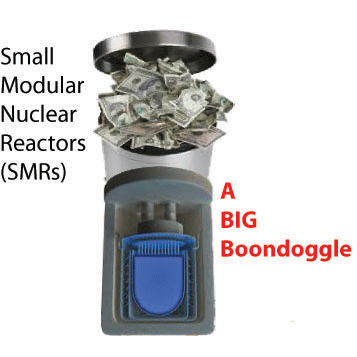 Utility Week 15th Aug 2017, Major players in the nuclear industry have been summoned by the government
to present their plans for the development of small modular reactors.
NuScale and Rolls-Royce among companies reportedly invited to talks with
the government over the next few weeks. Hitachi and Westinghouse have also
been invited.
The meeting is likely to relate to a competition launched by
the government in March 2016 to find the best value SMR design for the UK.
The results were originally due to be revealed last autumn alongside a
roadmap for the development of SMRs. Appearing before the House of Lords
science and technology committee in March former energy minister Jesse
Norman told members the competition would be “back on track” soon.
http://www.utilityweek.co.uk/news/nuclear-players-to-present-smr-plans-to-ministers/1309792
1 This Month





PLEASE OPPOSE HR 8255 AND S.3639 – bills would accelerate satellite deployment, with no environmental review or safeguards – https://ncstd5li.quorum.us/campaign/169331/
To see nuclear-related stories in greater depth and intensity – go to https://nuclearinformation.wordpress.com
-
Archives
- October 2026 (29)
- September 2026 (339)
- August 2026 (330)
- July 2026 (355)
- June 2026 (287)
- May 2026 (306)
- April 2026 (356)
- March 2026 (251)
- February 2026 (267)
- January 2026 (308)
- December 2025 (358)
- November 2025 (359)
-
Categories
- 1
- 1 NUCLEAR ISSUES
- business and costs
- climate change
- culture and arts
- ENERGY
- environment
- health
- history
- indigenous issues
- Legal
- marketing of nuclear
- media
- opposition to nuclear
- PERSONAL STORIES
- politics
- politics international
- Religion and ethics
- safety
- secrets,lies and civil liberties
- spinbuster
- technology
- Uranium
- wastes
- weapons and war
- Women
- 2 WORLD
- ACTION
- AFRICA
- Atrocities
- AUSTRALIA
- Christina's notes
- Christina's themes
- culture and arts
- Events
- Fuk 2022
- Fuk 2023
- Fukushima 2017
- Fukushima 2018
- fukushima 2019
- Fukushima 2020
- Fukushima 2021
- general
- global warming
- Humour (God we need it)
- Nuclear
- RARE EARTHS
- Reference
- resources – print
- Resources -audiovicual
- Weekly Newsletter
- World
- World Nuclear
- YouTube
-
RSS
Entries RSS
Comments RSS

