IPPR 16th Aug 2017, The implications of the UK’s withdrawal from the European Union are
particularly significant for the energy sector. This uncertainty
surrounding Brexit negotiations in turn raises specific regional concerns.
The North as a whole boasts 48 per cent of the UK’s renewable power,
including 71 per cent of England’s biomass generation, 41 per cent of UK
wind power and 40 per cent of UK installed nuclear capacity. Concerns over
the retention of mechanisms and legislation that support the energy sector
are therefore particularly pressing for businesses and other energy
stakeholders in the North.
https://www.ippr.org/research/publications/impact-of-brexit-on-energy-in-the-north
August 18, 2017
Posted by Christina Macpherson |
renewable, UK |
Leave a comment
Nigel Lawson admits claim that global temperatures have fallen was false http://www.independent.co.uk/environment/nigel-lawson-climate-change-sceptics-global-temperatures-fall-false-claim-warming-gwpf-bbc-radio-4-a7894686.html
Global Warming Policy Foundation concedes that the Tory peer’s supposedly official figures were wrong and produced by a right-wing think tank, Ian Johnston Environment Correspondent @montaukian 15 aug 17, A claim by Britain’s leading climate science sceptic, Nigel Lawson, that the world’s average temperature has fallen in the past 10 years was based on an “erroneous” temperature chart, his think tank, the Global Warming Policy Foundation, has admitted.
The former Tory Chancellor was interviewed on BBC Radio 4’s Today programme about the release of former US Vice-President Al Gore’s new film, The Inconvenient Sequel: Truth to Power, which describes how climate change is already having significant effects on the planet but also that the plunging cost of renewable energy means there is a solution.
The film points out the world’s average temperature had hit the highest on record for three years in a row – 2014, 2015 and 2016 – and an increase in extreme weather events.
August 16, 2017
Posted by Christina Macpherson |
climate change, UK |
Leave a comment
 US AND KOREAN NUCLEAR PLANT CANCELLATIONS: IMPLICATIONS FOR UK NEW NUCLEAR BUILD, Prospec t Law August 10, 2017
 The US currently has 100 nuclear power plants in operation supplying about 20% of its power needs. A further four were under construction, two each in Georgia and South Carolina, until the owners of the South Carolina plants recently announced the cancellation of construction of its two Westinghouse AP1000 units, Summer 2 and 3.
Summer 2 and 3 had been under construction since 2013, with original operational dates of late 2019 and late 2020. However, due to construction delays and cost overruns, these were later revised to December 2022 for Summer 2 and March 2024 for Summer 3. The finances were a key factor in the decision to cancel construction, with the original estimate of $11.5 bn having more than doubling to $25 bn. The reasons behind this are no doubt complex, but as the US has not constructed a new reactor since the 1970s, the loss of nuclear expertise must be a factor.
Summer 2 and 3 were intended to showcase advanced nuclear technology and pave the way, along with the Georgia plants – also Westinghouse AP1000s, for a nuclear renaissance in the US. A further four AP1000s and 12 SMRs (Small Modular Reactors) are currently proposed and several more are in the early stages of planning. The fate of these and the two Georgia plants remains to be seen…….
The Westinghouse bankruptcy has also complicated the picture in the US, with its AP1000 design being used for the South Carolina and Georgia projects and its role being reduced to a vendor supporting the EPC. Their situation has also had an effect in the UK, with Toshiba’s stake in Nu-Gen now being considered by KEPCO. Rather than utilise the Westinghouse design, which was approved by the UK nuclear regulator, ONR, in March this year, KEPCO wants to use its own technology, which will cause a delay in construction of the Moorside plant while the necessary regulatory design assessment is undertaken.
The South Korean nuclear industry is also in difficulty, with the new anti-nuclear government suspending construction of the Shin Kori 5 and 6 nuclear plants for several months while it undertakes a public consultation on their future. This decision has generated much debate in the country and is seen as a threat to its nuclear exports, and KEPCO’s future Nu-Gen.
Decisions to be taken in the next few months will be crucial for the future of nuclear in the US and Korea. …….http://prospectlaw.co.uk/us-and-korean-nuclear-plant-cancellations-implications-for-uk-new-nuclear-build/
August 16, 2017
Posted by Christina Macpherson |
business and costs, South Korea, UK, USA |
Leave a comment

 Government holds crunch talks with industry giants over the future of British nuclear energy, http://www.telegraph.co.uk/business/2017/08/13/government-holds-crunch-talks-industry-giants-future-british/ Alan Tovey , 13 AUGUST 2017 The key nuclear power players have been called in by the Government for crunch talks on plans to meet Britain’s energy demands with new small reactor technology, amid mounting fears over delays and Whitehall paralysis.
Industry giants including NuScale, Rolls-Royce, Hitachi and Westinghouse have been summoned by ministers in a bid to reignite interest in the project. They have been asked to present their plans in meetings over the next few weeks.
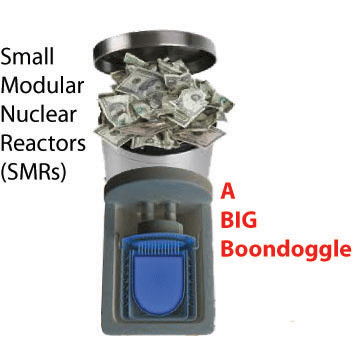
 Small modular reactors (SMRs) are a fraction of the size and cost of major nuclear power stations such as EDF’s controversial Hinkley Point C project. The Government signalled a key role for the technology in efforts to secure the energy supply and meet climate change targets two years ago.
An apparent lack of action since then has drawn criticism and raised industry concerns that the project has fallen by the wayside amid the political instability of Brexit and the general election.
In May, a House of Lords report branded the Government’s failure to publish the results of a competition for development funding as “particularly alarming”.
Companies considering investments in the technology had hoped that ministers would indicate which proposals they would support months ago, but they received no communication, fuelling the speculation that SMRs were being quietly abandoned. Renewed government interest in the technology is a boost to the nuclear industry. Rolls hopes to adapt technology developed to power Royal Navy submarines, for instance.
It has said developing SMRs for civil use will cost £1.2bn, with the first installation expected to require a further £1.7bn. Costs are forecast to fall as more mini reactors are built. Modular design allows the systems to be built in “blocks” in factories then assembled on-site. An SMR is expected to require a site about a tenth of the size of a conventional nuclear power station and generate between 200 megawatts and 450 megawatts of power.
 Hinkley Point C, currently under construction in Somerset, is set to generate 3.2 gigawatts. Cost projections on the project have soared from £6bn in 2013 to £20bn, and the first new power is not expected to be generated until at least 2025.
Last month, the National Audit Office (NAO) hit out at Hinkley Point, saying taxpayers could face a final bill of as much as £50bn, because the wholesale market price for electricity is falling steadily while nuclear power construction remains expensive and high-risk. Under a 2013 deal between the Government and EDF, Hinkley is guaranteed to earn £92.50 for every megawatt-hour (MWh) of energy produced through a combination of wholesale market prices and a levy on consumer energy bills. At the time, the Government said this would require top-up payments totalling £6bn from consumers’ energy bills to meet the “strike price”, but falling market prices have widened the forecast gap every year since then.
The NAO criticised the Government’s nuclear plans, saying ministers had “committed electricity consumers and taxpayers to a high cost and risky deal in a changing energy marketplace. Time will tell whether the deal represents value for money”.
Plans for another nuclear plant at Moorside in Cumbria are also in doubt after Westinghouse, the US nuclear reactor developer which is owned by Japan’s Toshiba, filed for Chapter 11 bankruptcy amid spiralling losses brought about by cost over-runs and project delays.
 Toshiba is currently a 60pc shareholder in the consortium to develop the 3.8 gigawatt plant at the Moorside site.
Moving to a new backer could push development of the plant back years with regulatory delays and costs likely to go up.
A spokesman for the Department of Business, Energy and Industry Strategy said of the small reactor plans: “We are currently considering next steps for the SMR programme and we will communicate these in due course.”
Success for SMRs could hinge on developing production lines and export businesses that would increase scale and bring costs down further in the years ahead
Tony Roulstone of the Cambridge Nuclear Energy Centre, a former senior Rolls engineer, recently told The Engineer magazine: “The cost of building nuclear plants is related to their complexity and the work you have to do on site to build them, and nothing the industry has tried has worked. So it’s time to try something else.
“The manufacturing approach works in every other industry. Nuclear is the only industry in which production engineering is not used.”
Mr Roulstone added: “It’s only by getting into a factory environment and building these things over and over again that you learn how to bring the cost down.”
When George Osborne, the then chancellor, announced £250m of taxpayer funding for development of the technology in 2015, he said the cash would be allocated by 2020.
Mr Osborne, whose time as chancellor came to an abrupt end last year, added that the money would help to “revive the UK’s nuclear expertise and position the UK as a global leader in innovative nuclear technologies”.
August 14, 2017
Posted by Christina Macpherson |
politics, UK |
Leave a comment
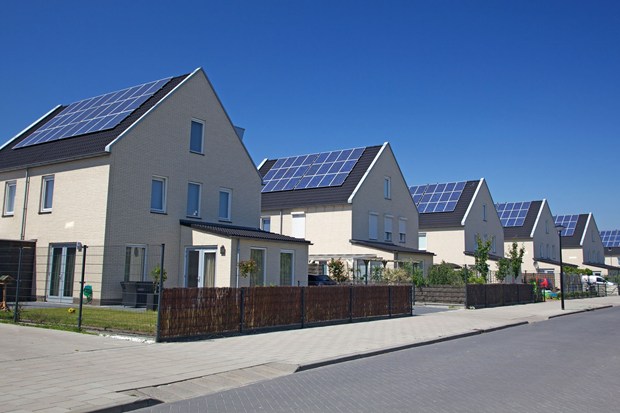
 Guardian 12th Aug 2017, If you want solar photovoltaic panels on your home but don’t have the money for them, EDF Energy is offering to install a free system – complete with
storage batteries – if you agree to buy the subsidised power it generates
for 20 years.
The French-owned energy giant is looking for 100 homes to
trial its Sunplug scheme, which is being offered in conjunction with
established solar supplier Lightsource. To sign up you need to have a
large, unshaded south-facing roof at a pitch of about 45 degrees. If you
are accepted, the company will install the largest solar panel system the
roof can take – a 16-panel setup will generate 4kW – plus an LG storage
battery that lets you use the power that’s generated during the day in the
evening.
In return, EDF gets to keep the feed-in tariff paid by the
government, which is worth about £150 a year. It also keeps the export
tariff – around £50 a year. The householder is contractually bound to
pay Sunplug 9.9p per kilowatt hour for each unit of electricity they use
from the panels and battery.
This is a little cheaper than what you would pay if you bought green electricity from the grid. For example, green
supplier Good Energy charges 15.5p, with a standing charge averaging 26p a
day. The advantage could come in future years as the price demanded by
Sunplug can only rise by the retail prices index or 2.5% – whichever is
lower.
If the price of grid electricity rises substantially over the next
20 years, users will make considerable savings. However, if they don’t,
some users will be left wondering why they bothered, not least because they
have to have the system inspected each year, which will cost about £80. So
this scheme is likely to appeal to anyone who wants green electricity at
fixed prices over the next two decades.
The other significant benefit comes at the end of the 20-year term, when the householder is given ownership of
the system, which should continue to generate substantial free power. So
what’s the Money verdict? Solar PV systems are still a good investment if
you have the money upfront, the right roof and location, and if you plan to
stay in the house for a long time. The case for the free Sunplug deal is
less clear. To us, it looks too heavily weighted in favour of the company.
If it offered some free electricity each day or other incentives, that
would make the scheme more attractive.
https://www.theguardian.com/money/2017/aug/12/edf-free-solar-panels-buy-power-generated-20-years
August 14, 2017
Posted by Christina Macpherson |
decentralised, UK |
Leave a comment
 Solar Power Portal 10th Aug 2017, Installing solar and storage technologies into homes could save them as
much as £600 each year on their fuel bills, a new study has found.
The report, released by Swansea University’s Specific Innovation and
Knowledge Centre, claims that an integrated system comprising solar PV roof
installations, battery storage and solar heat collection technology on
south-facing walls could cut energy consumption by more than 60%.
The findings are backed up by a working demonstration project completed on a
school in Swansea. The ‘Active Classroom’, as it has been dubbed, has
generated more energy than it has consumed since receiving the complete
system six months ago. https://www.solarpowerportal.co.uk/news/solar_and_storage_could_save_homes_600_each_year_new_report_finds
August 14, 2017
Posted by Christina Macpherson |
decentralised, UK |
Leave a comment
 Herald 13th Aug 2017, THE only sensible response to the escalating nuclear stand-off between
Donald Trump and Kim Jong-un is to rid the UK of its atomic arsenal,
according to a Nobel Peace Prize-nominated SNP MSP.
Bill Kidd, who was put forward for the honour by Parliamentarians for Nuclear Non-proliferation
and Disarmament (PNND) in 2016, said the UK should take a fresh look at
unilateral disarmament in the face of rising tensions between the US and
North Korea – a position that has been backed by the Scottish Greens.
http://www.heraldscotland.com/news/15470103.SNP__UK_must_ditch_Trident_in_response_to_nuclear_stand_off_between_North_Korea_and_US/
August 14, 2017
Posted by Christina Macpherson |
UK, weapons and war |
Leave a comment
 Independent 11th Aug 2017, The Government has been accused of undermining its own efforts to tackle
climate change after new research revealed it is investing twice as much in
fossil fuel projects overseas as it is in renewables.
Almost half (46 per cent) of the money the UK spent on energy overseas went on fossil fuels
while barely more than a fifth (22 per cent) was spent on renewable energy
sources. The research, commissioned by Catholic charity CAFOD and carried
out by the Overseas Development Institute, analysed spending between 2010
and 2014 – the last period for which data is available.
http://www.independent.co.uk/news/uk/politics/government-fossil-fuels-renewable-energy-uk-export-finance-climate-change-global-warming-co2-a7887376.html
August 12, 2017
Posted by Christina Macpherson |
climate change, politics, UK |
Leave a comment
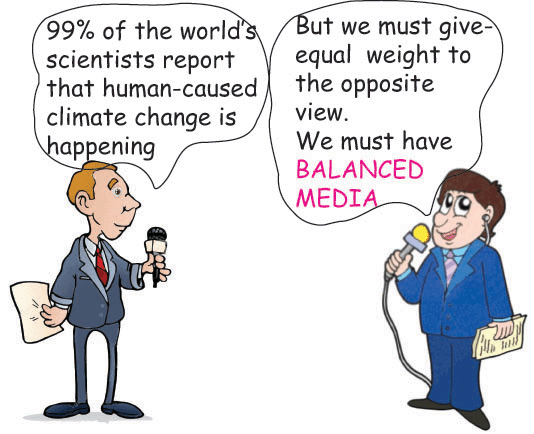
Independent 10th Aug 2017, The BBC has been criticised for inviting a climate change denier to come on
air and voice his belief that global warming isn’t happening. Science
broadcasters including Brian Cox and Jim al-Khalili criticised the decision
to bring on famous denialist Nigel Lawson, apparently to make sure that
there was a balanced debate.
Both pointed out that there is very little debate about global warming – an established fact on which almost every
mainstream scientist is agreed. Lord Lawson was able to make a number of
claims, which went mostly unchallenged. He said, for instance, that the
world had actually become colder over the last 10 years – despite the fact
that 2014, 2015 and 2016 have been the hottest years on record.
Environmental experts including Carbon Brief fact-checked each of the
claims and found that none of them were true. But apparently because Lord
Lawson had been invited on as an opposing voice in a debate – to follow an
interview with Al Gore about his latest climate change film – he was mostly
asked to disagree with the science on global warming and his opinions were
little picked up on.
http://www.independent.co.uk/environment/today-programme-nigel-lawson-al-gore-climate-change-denier-global-warming-bbc-radio-4-inconvenient-a7886426.html
August 12, 2017
Posted by Christina Macpherson |
climate change, media, UK |
Leave a comment
Guardian 10th Aug 2017,The drive to replace polluting petrol and diesel cars with a new breed of
electric vehicles has gathered momentum in recent weeks. But there is an
unanswered environmental question at the heart of the electric car
movement: what on earth to do with their half-tonne lithium-ion batteries
when they wear out?
British and French governments last month committed to
outlaw the sale of petrol- and diesel-powered cars by 2040, and carmaker
Volvo pledged to only sell electric or hybrid vehicles from 2019. The
number of electric cars in the world passed the 2m mark last year and the
International Energy Agency estimates there will be 140m electric cars
globally by 2030 if countries meet Paris climate agreement targets.
This electric vehicle boom could leave 11m tonnes of spent lithium-ion batteries
in need of recycling between now and 2030, according to Ajay Kochhar, CEO
of Canadian battery recycling startup Li-Cycle. However, in the EU as few
as 5% (pdf) of lithium-ion batteries are recycled.
This has an environmental cost. Not only do the batteries carry a risk of giving off
toxic gases if damaged, but core ingredients such as lithium and cobalt are
finite and extraction can lead to water pollution and depletion among other
environmental consequences.
There are, however, grounds for optimism. Thus far, the poor rates of lithium-ion battery recycling can be explained by the fact that most are contained within consumer electronics, which
commonly end up neglected in a drawer or chucked into landfill. This won’t
happen with electric vehicles, predicts Marc Grynberg, chief executive of
Belgian battery and recycling giant Umicore. “Car producers will be accountable for the collection and recycling of spent lithium-ionbatteries,” he says. “Given their sheer size, batteries cannot be stored at
home and landfilling is not an option.” https://www.theguardian.com/sustainable-business/2017/aug/10/electric-cars-big-battery-waste-problem-lithium-recycling
August 12, 2017
Posted by Christina Macpherson |
RARE EARTHS, UK |
Leave a comment
 Carbon Brief 10th Aug 2017, Factcheck: Lord Lawson’s inaccurate claims about climate change on BBC
Radio 4. The Today programme, BBC Radio 4’s flagship current affairs
breakfast show, featured a prominent five-minute interview this morning
with the climate sceptic Conservative peer Lord Lawson.
Lawson was asked by the presenter Justin Webb to respond to Webb’s earlier interview with Al
Gore. The former US vice president is in the UK promoting his new
documentary, The Inconvenient Sequel: Truth to Power, a follow-up to his
Oscar-winning film released a decade ago.
Lawson, who has a history ofcontroversial appearances on the Today programme, made a number of
inaccurate claims throughout his interview. It has already attracted
widespread criticism from scientists. Carbon Brief has transcribed and
annotated the interview to highlight and contextualise the errors. https://www.carbonbrief.org/factcheck-lord-lawson-inaccurate-claims-about-climate-change-bbc-radio-four
August 12, 2017
Posted by Christina Macpherson |
media, UK |
Leave a comment
 BBC 8th Aug 2017, A bomb believed to be from World War Two has been found in the Bristol
Channel near Hinkley Point nuclear power station. The 500lb device was
discovered 2.5 nautical miles from the coast, about 8m below the surface.
Divers conducting a survey for the construction of the new power station
found the ordnance on Monday. It was destroyed in a controlled explosion at
about 15:00 BST on Tuesday. The “unusual” ordnance was found off Lilstock
Range, just west from Steart point and Bridgwater in Somerset.
The coast around Lilstock was used as part of a practice bombing range for the Royal
Navy. EDF Energy said its team of divers made the discovery 8m below the
surface while checking the seabed ahead of the construction of the main
cooling water tunnels for new Hinkley Point C nuclear power station being
built. http://www.bbc.co.uk/news/uk-england-bristol-40865105
August 11, 2017
Posted by Christina Macpherson |
incidents, UK |
Leave a comment
 CORE 9th Aug 2017, Respondents to NuGen’s Stage 2 Moorside public consultation which closed
one year ago will learn little from NuGen’s response to CORE’s open
letter to its CEO Tom Samson on 30th June.
Refusing to comment on some of CORE’s questions on the grounds that ‘they are commercial processes’,
NuGen has confirmed only that it intends to publish a Stage 2 interim
consultation report – ‘but this has been deferred to ensure that
changes which arise as a result of the reviews (an engineering and wider
strategic review) are appropriately reflected in the report, which will
reflect both the feedback that NuGen received and detail how NuGen will
take that feedback into account’.
CORE’s spokesman Martin Forwood commented today that “NuGen’s inability to level with consultees,
however uncertain Moorside’s prospects, reflects the extent of the
turmoil facing its project and makes a mockery of its claim that
‘openness and transparency about our plans is the key to building
trust”.
The latest news of the plug being pulled on the half-built AP1000
reactors in the US and the fall from grace on the Tokyo Stock Exchange of
NuGen’s sole investor Toshiba will further add to the increasing
uncertainties swirling around in the Moorside mists”. http://corecumbria.co.uk/news/nugen-consultees-kept-in-the-dark-as-moorside-turmoil-increases/
August 11, 2017
Posted by Christina Macpherson |
business and costs, UK |
Leave a comment
Solar Power Portal 9th Aug 2017, Soaring generation from the UK’s solar assets sent UK power demand to a
new low last month, according to data compiled by monitoring firm EnAppSys.
 The data showed that average half-hourly demand throughout July stood at
26.2GW, courtesy of a significant amount of embedded generation from
sources such as rooftop solar. These sources are seen on the grid as demand
reduction and, as a result, reduce the amount of power that is drawn down
from the grid.
Throughout July the average embedded generation figure stood
at 3GW. Solar and other renewables have already witnessed a number of new
generation records this year, particularly in Spring. Unseasonable weather
in April helped solar to a new landmark generation record.
https://www.solarpowerportal.co.uk/news/soaring_solar_sends_uk_power_demand_to_eight_year_low
August 11, 2017
Posted by Christina Macpherson |
decentralised, UK |
Leave a comment
Toshiba’s $8.8bn loss reignites fears over Cumbria nuclear project, Telegraph, 10 AUGUST 2017 • The Japanese consortium behind the UK’s largest planned new nuclear project has unveiled an annual loss of almost $9bn (£6.9bn), underlining the stark risks of the Government’s high-cost nuclear ambitions.
Toshiba has delayed publishing its full-year results while teams of auditors pore over the financial damage wrought by the collapse of its US-based nuclear developer Westinghouse, before finally revealing the $8.8bn (£6.7bn) loss for 2016 three months later than planned.
The electronics giant has avoided crashing out of the Tokyo stock exchange for filing its accounts late, but its commitment to building the Moorside power plant in Cumbria remains in doubt.Toshiba is now the only investor propping up the Nugeneration consortium that plans to build the 3.8GW Moorside project, and the approved reactor design is Westinghouse-made.
The GMB union said the “fiasco” over Toshiba’s financial state “highlights the folly of allowing foreign companies to be in control of the UK’s critical future energy needs”…….
August 11, 2017
Posted by Christina Macpherson |
business and costs, UK |
Leave a comment