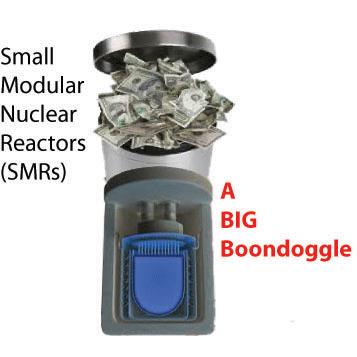
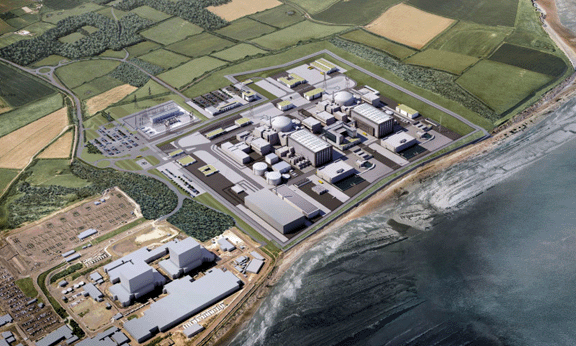
Wind power is cheaper than nuclear – so can we finally ditch the pro-nuclear ideology? http://www.newstatesman.com/politics/staggers/2017/09/wind-power-cheaper-nuclear-so-can-we-finally-ditch-pro-nuclear-ideology
Tory MPs back Hinkley Point yet block wind turbine developments. This week’s auction of government subsidies for energy show clearly that not only have the Tories been undermining our chances of transitioning to a renewable energy future, they are also forcing up our energy bills.
Two big offshore wind farms came in at £57.50 per megawatt hour and a third at £74.75. These “strike prices” compare with a guaranteed price for electricity from Hinkley of £92.50. This is the price the government agreed in order to persuade the French and Chinese to build the new nuclear plant. So effectively, consumers and businesses will be forced to pay a premium of 60 per cent for the privilege of receiving electricity from Hinkley; a premium that will increase further as the price of renewables falls further over the next six years, up until Hinkley comes on grid – if it ever does.
It is clear that only a government suffering from an acute dose of economic illiteracy would continue with this project. Unless, of course, there are other reasons for continuing this madness.
No one doubts that Hinkley is an economic disaster, but it has been kept alive by a dubious subsidy regime. As a “mature technology”, nuclear should never receive a subsidy, which is why there are ongoing legal challenges on this point. By contrast, the dramatic fall in the cost of offshore wind, and other renewable technologies, prove the value of subsidising “infant industries” until they are mature enough to survive and thrive subsidy-free.
But it’s not just dodgy economics that have kept the Hinkley white elephant staggering on. It is also a warped anti-renewables, pro-nuclear ideology, something highly evident in my own constituency of the South West.
It would appear there were no applications for subsidies to build offshore wind in the South West. Why would there be when our region is stalked by Tory dinosaurs who will fight their planning proposals; destroying opportunities for local people, pushing up their energy bills, and denying us the clean energy future we deserve in the process?
Since I became an MEP, there have been two exciting large scale offshore wind proposals in the South West. The Navitus off-shore wind development in Dorset could have secured enough energy to power 700,000 homes, while the Atlantic Array off the North Devon coast, was forecast to power 900,000 homes. Both were ditched in no small part due to dogmatic opposition to wind power.
In both examples, some of the most active opponents were local Tory MPs. In the case of Navitus Bay, where local Tories allegedly opposed the development on the grounds of its potential impact on the Jurassic Coast World Heritage Site, Private Eye pointed out that local MP and vociferous opponent of Navitus, Conor Burns. received regular payments from an engineering firm connected with the oil and gas industry (it is listed in his register of interests). Navitus was proposed in an area off the Dorset coast thought to be suitable for oil and gas drilling. Conor Burns has never spoken out against plans to drill for oil and gas in the area.
As for Atlantic Array, the campaign group Slay the Array was led by none other than Steve Crowther, interim leader of Ukip. His party’s policies for the 2017 general election included the repeal of the 2008 Climate Change Act. Interestingly, they promised to support renewables when they could be delivered at competitive prices. Given that is now clearly the case, perhaps Mr Crowther would like to reconsider his staunch ideological opposition to Atlantic Array?
Lest we think it is just the Tories and Ukip standing in the way of a genuine transformation to cheaper, greener energy, Labour too has refused to ditch nuclear. The party is still trumpeting the thousands of jobs new nuclear, including Hinkley, can deliver. This view is deeply flawed. Evidence suggests that renewables create around three times as many jobs as nuclear for every £1m invested.
It is not only operating and servicing renewable energy projects that create jobs. There is also huge potential for job creation through the manufacture of components to support the renewables sector. Siemens in Hull provides a good example of what is possible. The company has invested £310m in wind turbine production and installation facilities, creating more than a thousand jobs.
Back in 2015, I commissioneda report which demonstrated the potential we have in the South West to generate in excess of 100 per cent of our energy from renewables. The report concluded that we could create 122,000 jobs across the region and add over £4bn a year to the economy. This is not unique to the South West; other areas of the UK could also be energy self-sufficient and reap the economic rewards. And the report was of course written before offshore wind was so much cheaper than nuclear.
Now is the time to end our affair with the dangerous and expensive technologies of the past and usher in a new green industrial revolution. There is an opportunity for political unity against Hinkley and in favour of renewables.
September 16, 2017
Posted by Christina Macpherson |
politics, UK |
Leave a comment
Dundee Courier 8th Oct 2017, Radiation remediation work at Dalgety Bay has edged closer with the start
of ground surveys at the contaminated beach. Investigations into ground
conditions began on Monday,before the long-awaited clean-up of dumped
radioactive debris from the Second World War, which is due to begin in
spring 2019.
The Ministry of Defence confirmed this week engineers are now
on site, having secured access. Stephen Ritchie, of the MoD’s Defence
Infrastructure Organisation, said: “Work started on site on Monday on a
ground investigation survey which has been the subject of ongoing
negotiations with the landowner.“That’s likely to take six weeks,
depending on the weather.” Updating south and west Fife councillors on
progress, Mr Ritchie also said it was hoped planning consent would be
issued soon for the remediation works.
https://www.thecourier.co.uk/fp/news/local/fife/504987/surveys-begin-of-radium-contaminated-fife-beach-ahead-of-mod-clean-up/
September 16, 2017
Posted by Christina Macpherson |
environment, UK |
Leave a comment
 City AM 10th Sept 2017 ,A consortium developing small modular reactors is expected to urge the
government to push forward with a plan to develop so-called baby reactors
to secure the UK’s energy needs after the decommissioning of older
nuclear power stations. The government launched a competition to find the
best value SMR reactor design for the UK in 2016, and this week a
consortium led by Rolls-Royce will publish a report in Westminster which
claims it can generate electricity at £60 per megawatt hour, which is
two-thirds the price of recent large-scale nuclear plants.
http://www.cityam.com/271732/mps-review-baby-nuclear-reactor-plans-cheaper-source-secure
September 16, 2017
Posted by Christina Macpherson |
politics, technology, UK |
Leave a comment
Tensions surface between UK and US over Iran nuclear deal, But Boris Johnson and Rex Tillerson unite in urging Myanmar’s Aung San Suu Kyi to speak out against massacre of Rohingya, Guardian, Patrick Wintour, 15 Sept 17, Tensions between the US and UK over whether to tear up the Iran nuclear deal were exposed on Thursday when the secretary of state Rex Tillerson said the US viewed Iran in default of the deal’s expectations, but the British foreign secretary Boris Johnson urged the world to have faith in its potential to create a more open Iran.
Tillerson repeatedly emphasised the US decision of whether to end the agreement signed in 2015 will be based on a wider assessment of Iranian behaviour – including in Yemen and Syria – and not just whether Tehran is complying with the strict terms of the deal……https://www.theguardian.com/world/2017/sep/14/tensions-surface-uk-us-iran-nuclear-deal-rohingya
September 15, 2017
Posted by Christina Macpherson |
politics international, UK, USA |
Leave a comment

 BBC 12th Sept 2017, Work has begun on the “challenging” task of removing radioactive fuel
elements stuck inside the most famous of Dounreay’s reactors. Closed since
1977, the Dounreay Fast Reactor is known for its dome-shaped exterior.
Almost 1,000 fuel elements have been in the reactor for years after the work to remove them was halted because they were swollen and jammed in.
New technology has now been developed to make it possible to remove them. It
could take three years to complete the job at the nuclear power site near
Thurso in Caithness. Once all the elements have been removed work can begin
on dismantling the reactor.
http://www.bbc.co.uk/news/uk-scotland-highlands-islands-41245375
September 14, 2017
Posted by Christina Macpherson |
decommission reactor, UK |
Leave a comment
 Reuters 12th Sept 2017, Taxpayers will not be on the hook for any additional costs incurred in the building of the new $24 billion Hinkley Point nuclear plant, British
finance minister Philip Hammond said. A British parliamentary watchdog said
in June that the deal to construct the nuclear power station, which is
being built by French state-owned utility EDF, was risky.
It said the project could lead to requests for more cash and electricity payment
top-ups worth 30 billion pounds ($40 billion). EDF said in July that costs
at Hinkley Point were likely to be higher than it originally thought.
“Costs are not rising for the bill payer or the taxpayer. They may very
well be rising for our development partners, but that’s their problem,”
Hammond said on Tuesday. http://uk.reuters.com/article/britain-power-hinkley/taxpayer-insulated-from-rising-hinkley-point-costs-says-hammond-idUKL5N1LT4XL?rpc=401&
September 14, 2017
Posted by Christina Macpherson |
business and costs, politics, UK |
Leave a comment
 Hinkley nuclear power is being priced out by renewables https://www.theguardian.com/environment/nils-pratley-on-finance/2017/sep/11/hinkley-nuclear-power-no-match-for-renewables, Nils Pratley
The UK should concentrate on wind- and gas-fired stations, and involve nuclear only if it can vaguely compete on price Reuters 12 September 2017
Hinkley Point C nuclear power station was conceived in the days when offshore wind cost £150 per megawatt hour and a few misguided souls, some of them government ministers, thought a barrel of oil was heading towards $200.
Successive governments swallowed the line that Hinkley represented a plausible answer to the UK’s threefold energy conundrum – keeping the lights on, reducing carbon emissions and producing the juice at affordable prices for consumers and business.
Hinkley still scores on reliability and low carbon (if one ignores the effect of spoiling the Somerset countryside with so much concrete), but the extent to which its costs are obscene is now plainer than ever. In Monday’s capacity auction, two big offshore wind farms came in at £57.50 per megawatt hour and a third at £74.75. These “strike prices” – a guaranteed price for the electricity generated – are expressed in 2012 figures, as is Hinkley’s £92.50 so the comparison is fair.
The dramatic improvement in offshore wind’s competitiveness is easy to explain because it was predicted. The turbines have become bigger and more efficient, installation costs have fallen and operators are able to use existing infrastructure. Even the post-Brexit fall in sterling has not altered the script because more of the equipment is produced in the UK these days.
By contrast, nuclear – a technology that has been around for half a century – seems to only become more expensive in a world of tighter safety regulation. Hinkley Point’s construction tripled between conception and contract, remember.
As for the argument that we must pay up for reliable baseload supplies, there ought to be limits to how far it can be pushed. A nuclear premium of some level might be justified, but Hinkley lives in a financial world of its own, even before battery technology (possibly) shifts the economics further in favour of renewables. A credible energy strategy would concentrate on wind- and gas-fired stations, and invite nuclear to the game only if it can vaguely compete on price.
The government should draw the obvious conclusion from Monday’s successful auction. One Hinkley is bad enough; a series of follow-on white elephants would be a disgrace.
September 13, 2017
Posted by Christina Macpherson |
renewable, UK |
Leave a comment
 Chain reaction? NuScale seeks to reignite UK small nuclear reactor plans
US nuclear technology specialist NuScale Power has this week unveiled a new
action plan, in an attempt to kickstart UK efforts to establish the country
as a pioneer in the development of small modular reactors (SMRs).
Last year the UK government launched a competition to accelerate the development of
SMRs, amid predictions the technology could help cut greenhouse gas
emissions and curb the cost of nuclear power.
However, the promised £250m, five year R&D programme has been beset by delays and earlier this summer
reports suggested a ‘crunch’ meeting was recently called between government
officials and potential SMR developers over the competition.
NuScale, which is backed by US engineering giant Fluor Corporation, this week sought to
highlight the UK’s potential role as an SMR hub with the publication of an
action plan detailing how it could deliver the technology by the 2020s. The
five-point UK SMR Action Plan sets out how the firm would partner with UK
industry to deliver a multi-billion pound SMR venture, which could see UK
firms provide more than 85 per cent of the content required for UK
reactors. https://www.businessgreen.com/bg/news/3016958/chain-reaction-nuscale-seeks-to-reignite-uk-small-nuclear-reactor-plans
September 11, 2017
Posted by Christina Macpherson |
technology, UK |
Leave a comment
No more nukes? Why anti-nuclear protests need an urgent revival Before the end of the cold war, nuclear apocalypse was a frightening possibility that overshadowed everyone’s lives. With tensions rising between the US and North Korea, we can learn valuable lessons from CND and Greenham Common Guardian, by Zoe Williams , 7 Sept 17, “…….. For those of us who reached majority with the fall of the Berlin wall in 1989, the coming of age is indivisible from the relief of an existential threat lifted, so that worrying about nuclear annihilation is filed as part of childhood, a monster in the wardrobe. It was real, until suddenly it wasn’t.
A lacuna followed, a gap that remains. Where once we had a thriving peace movement – a muscular response to nuclear weapons, articulated by ordinary people with agency and resilience – suddenly, for the most part, the arguments went quiet.
British anti-nuclear campaigns came in two waves, says David Fairhall, author of Common Ground: The Story of Greenham. The first big Aldermaston march took place at Easter 1958, demonstrators walking between London and the Atomic Weapons Research Establishment at Aldermaston, in Berkshire. These were calls for disarmament, “against a background of nuclear confrontation,” says Fairhall, “that had frightened people into thinking there might be a nuclear war next week”. This was quintessential cold war stuff, against the background of the establishment view that Russian ambitions to take western Europe as they had the east were real, and the US had to be kept onside at all costs. “Aldermaston was effectively a bomb-making factory,” says Fairhall. “That’s what people came out in duffel coats to protest against. Then that died down a bit.”
The Campaign for Nuclear Disarmament, CND, was born in this era, and was at the root of the campaigns in the 80s; in that sense, this is all one peace movement. ….
The government’s own public-information initiative, chilling in the recollection, was called Protect and Survive and imparted asinine advice from the early 60s until the 80s – for instance, remove your door from its hinges and lean it against a table in order to create a makeshift bomb shelter. This eventually spawned a playful citizenly response: Protest and Survive. But if the descriptions of nuclear war sometimes seemed lurid in a slightly gleeful way, they underpinned a real and trenchant moral case; that weapons capable of the indiscriminate massacre of hundreds of thousands of people were wrong in and of themselves, regardless of who was holding them and what their intentions were. This is the change that really shocks Mary Kaldor, professor of global governance at the London School of Economics; that you are now “not allowed to be a politician unless you can say you would use a nuclear weapon. There’s even a problem with Jeremy Corbyn saying he would be extremely cautious about pressing the button. Somehow, you have to be part of the lie to be part of the establishment.”……..
The movement had distinct political impact, nationally and internationally. First, Fairhall says, the Greenham women “dragged discussion of nuclear weapons out of the dark world of SS20s and CTBTs [comprehensive nuclear-test-ban treaties], all those acronyms and technical details, and forced people to discuss them in plain language. And that meant they had to be discussed in the House of Commons. There was a very important secondary issue of who would control these weapons: up until then, the Americans had just been landing wherever they fancied and putting up bomb sites ready to use in retaliation to a Soviet attack. We had no control, and that was a scandal.”……..
A seismic cultural shift started only tangentially with CND; in 1980, Kaldor, Thompson and Ken Coates launched the call for European Nuclear Disarmament……..
What worries Fairhall today is that while we used to worry about the arms race, it is now not a race so much as a pub brawl between Donald Trump and Kim Jong-un – “an idiot and a lunatic” threatening one another with “fire and fury”, a reckless bravado never seen during the cold war, or since. Fairhall uses those terms not as insults, but almost as a technical military analysis. “Nuclear capability is relatively stable, so long as it’s a game of deterrence and diplomacy. They used to be a military insurance policy, or a status symbol. They have never before been in the hands of anyone who would actually use them – even with John F Kennedy, that was never the threat. So it does feel that we have drifted across a barrier.”
Fairhall says this with an understatement not typical of the peace movement, but it does underline the message: we need a revival more than ever. https://www.theguardian.com/world/2017/sep/06/no-more-nukes-anti-nuclear-protests-cnd-greenham-common
September 9, 2017
Posted by Christina Macpherson |
opposition to nuclear, UK |
Leave a comment
 Somerset Live 5th Sept 2017, Concerns are growing after numerous Second World War explosives are being
discovered near Bridgwater’s Hinkley Point Nuclear Power Plant. But
according to Watchet Coastguard in a Twitter exchange, the site is being
searched by Hinkley Point C contractors to clear the coastline ahead of the
Nuclear Power Plant developments. Explaining the procedure, contractors
report any ordnances to Royal Navy and Maritime and Coastguard Agency. A
1,000 metre exclusion zone is then set up around the discovered bomb before
a specialised Royal Navy team safely detonate the explosive. http://www.somersetlive.co.uk/news/many-second-world-war-bombs-426055
September 9, 2017
Posted by Christina Macpherson |
safety, UK |
Leave a comment
 UK offshore wind power subsidy set to undercut nuclear, Ft.com , Campaigners for renewable energy say this is a key moment for the industry by: Nathalie Thomas and Andrew Ward , Sept 8 17 The results of an energy subsidy auction held by the government will prove offshore wind farms are a much cheaper way to meet the UK’s future electricity needs than contentious nuclear projects such as Hinkley Point, supporters of renewable technology have claimed.
The latest auction results, to be published on Monday, are expected to show a dramatic fall of as much as nearly 50 per cent in the minimum electricity price that is guaranteed by the government to offshore wind farm developers compared with the last similar subsidy round in 2015. They are also expected to show a substantial discount on the £92.50 per megawatt hour “strike price” guaranteed by the government to the French and Chinese companies behind the Hinkley Point nuclear plant in Somerset during its first 35 years of operation. The Hinkley price, which was set in 2012, rises with inflation and is now worth closer to £100/MWh. The latest subsidy auction was aimed by the government at “less established technologies” including offshore wind and energy derived from tidal currents.
Successful offshore wind projects are expected to be guaranteed electricity prices in a range of £60 to £75/MWh for 15 years linked to inflation, according to Cornwall Insight, a consultancy. This compares with the average £117.14/MWh awarded to offshore projects in the last auction in 2015. Offshore wind farm developers are seeking much lower subsidies after their costs tumbled, reflecting how the industry has matured and learnt how to construct projects more cheaply.
“This expected reduction in the price of power from offshore wind will mark a huge moment for the UK energy sector,” said Hannah Martin, head of energy at Greenpeace UK. Jonathan Cole, managing director for offshore wind at ScottishPower Renewables, said: “These ongoing cost reductions show that offshore wind is in pole position to be the foremost low carbon power source.” The low auction prices for offshore wind will be seized on by critics of nuclear power, who argue it is too expensive to compete in a world of cheap renewable energy…….
https://www.ft.com/content/77563334-9484-11e7-a9e6-11d2f0ebb7f0
September 9, 2017
Posted by Christina Macpherson |
renewable, UK |
Leave a comment
Edinburgh Reporter 6th Sept 2017, Environmental groups applauded the new Programme for Government announced in Holyrood yesterday, which contains a host of ‘green’ measures.
Friends of the Earth believe such steps will improve the lives of people in
Scotland through cleaner air, reduced waste, investment in green energy and
ensuring the transition to a low carbon economy is fair.
Key measures announced in the PFG: phasing out diesel and petrol vehicles from 2032;
tackling air pollution with 4 Low Emission Zones across Scotland by 2020;
new Just Transition Commission to help Scotland move to a low-carbon
economy fairly; new National Investment Bank to fund long term, patient
projects; deposit return scheme for bottles and cans; decision on fracking
in the coming weeks http://www.theedinburghreporter.co.uk/2017/09/scottish-governments-programme-hailed-as-greenest-ever/
September 9, 2017
Posted by Christina Macpherson |
climate change, UK |
Leave a comment
Energy Live News 5th Sept 2017, The world’s oldest nuclear waste store has been cut open for the first
time. Experts at the Sellafield site in Cumbria have cut the first hole in
the Pile Fuel Cladding Silo (PFCS), a locked vault which was never designed
to be opened – which holds radioactive material dating from the 1950s. It
is the first of six holes that will allow radioactive waste to be removed
from one of the site’s most hazardous buildings.
Giant steel doors will cover the holes and seal the radioactive waste inside for safer storage.
Preparations have been underway for a number of years, which involved
practicing the cutting operation at a full-scale replica test rig in
Rosyth, Scotland. The waste retrieval process is expected to start in 2019.
http://www.energylivenews.com/2017/09/05/worlds-oldest-nuclear-waste-store-cut-open/
September 9, 2017
Posted by Christina Macpherson |
UK, wastes |
Leave a comment
 Bridgwater Mercury 6th Sept 2017, BRITAIN’S electricity supply could be hit if the Government leaves Euratom
without new measures being put in place, a leading industry body has
warned. There could also be a “significant potential impact” on the new
£18 billion Hinkley Point nuclear power plant, according to the Nuclear
Industry Association (NIA). Chief executive Tom Greatrex said the “clock is
ticking” for ministers to determine the UK’s future relationship with
Euratom, which oversees nuclear safety in Europe.
The Government has faced cross-party criticism over its decision to withdraw from Euratom as part of
Brexit. This week a Lords committee will grill industry experts on how
Brexit will affect the UK energy supply, with questions over continued
access to the EU’s internal energy market and Britain’s ability to
influence future policy.
Much of the maintenance work on Britain’s existing
fleet of nuclear reactors takes place when parts are shipped to Europe. Mr
Greatrex also said the NIA had made specific representations to ministers
about the potential impact on Hinkley Point, which is now being built by
state-controlled French energy firm EDF. “I think the first nuclear
concrete is due to be late 2019, so you can see that the timings could make
this potentially difficult,” he said. “So EDF have to be able to plan
around the implications of leaving Euratom, if that’s what they’re going to
be doing, and that’s why having clarity about what those arrangements are
and what transition period there might be and what succession arrangements
they are intending to put in place becomes quite important in their
planning processes pretty soon.
“You can’t have a situation where they don’t know until January 2019, without there being a quite significant
potential impact on that project and on other new build projects as well.”
Ministers have previously said they could pay EDF billions of pounds in
compensation over Hinkley Point, including over a so-called “political shut
down”.
http://www.bridgwatermercury.co.uk/news/15517435.Leaving_EU_nuclear_body_could_have__significant_impact__on_Hinkley_C__warns_industry_chief/
September 9, 2017
Posted by Christina Macpherson |
politics international, UK |
Leave a comment
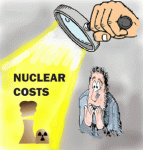 No2NuclearPower 5th Sept 2017, Steve Thomas, Emeritus Professor of Energy Policy at the University of Greenwich, says many of the issues that arise with Hinkley Point C (HPC)
that might derail it apply equally to the whole Government programme.
He says we are probably at the point where we are looking at a public spending
disaster. Financing HPC will stretch EDF Energy to the limit and maybe
beyond.
He thinks there is no possibility of Sizewell C being built on the
timetable that the Government is looking at. He says we are in a surreal
situation where we are planning the two largest construction projects ever
built on UK soil – HPC and Moorside – and we are contemplating buying
the equipment from bankrupt and disgraced companies using technologies that
have abjectly failed wherever they have been built.
None of the three consortia (excluding Bradwell which is further off in the future) are
financeable in their present state. Here we look at the evidence presented
by Steve Thomas and others which questions whether any of these projects
will ever be successfully completed. On the other hand continuing with
these projects will seriously damage renewable and energy efficiency
programmes and delay real action to combat climate change. http://www.no2nuclearpower.org.uk/recent-additions/uk-nuclear-policies-recent-changes-and-likely-developments/
September 9, 2017
Posted by Christina Macpherson |
business and costs, ENERGY, politics, UK |
Leave a comment