Licence exists for dumping mud at North Cardiff – but they don’t need Hinkley’s suspect “mud”
 Barry GEM 29th May 2018 Graham Vodden: I read with interest your article in The GEM regarding Hinkley Mud, and I have to say that I have no confidence in the National Assembly making the correct decision on this matter. I fully endorse the petition calling for the licence to be suspended to allow for a full environmental assessment before any dredging and dumping is started.
We already have a problem with excess mud coming ashore on Penarth beach because somebody decided years ago to dump local dredged mud out of Cardiff Dock entrance at the North Cardiff buoy, instead of where it used to be dumped at the Middle Pool buoy, where it would disperse and not cause any environmental problem.
The question that needs to be addressed is why does EDF want to bring this mud all the way from Hinkley beach to the North Cardiff Buoy position for dumping? The answer to that is there is already a licence issued for dumping mud or sediment here, which makes the whole process easier.
The other question which needs to be asked is why can’t they dump this sediment outside Hinkley? There is plenty of depth in that part of the channel and it would not cause any problems, it would just disperse. The answer to that is that EDF would have to go through the whole process of licence application again. My message to EDF is, keep your suspect ‘mud’ in the area of Hinkley. The last thing Penarth needs is a massive mud pollution increase on our beach.
http://www.barry-today.co.uk/article.cfm?id=119999&headline=Why%20does%20EDF%20want%20%20to%20dump%20mud%20from%20%20Hinkley%20on%20our%20coast?§ionIs=news&searchyear=2018
Wylfa Newydd nuclear plant protesters go to Japan
http://www.bbc.com/news/uk-wales-north-west-wales-44281941 28 May 18 A group of anti-nuclear campaigners have travelled to Japan to petition the government to withdraw support for a nuclear power station on Anglesey.
A petition against the Wylfa Newydd nuclear plant signed by almost 6,000 people was handed to Japan’s Ministry of International Trade and Industry.
Pawb’s (People against Wylfa B) trip comes amid reports of UK and Japanese government investment in the project.
Technological giant Hitachi said there had been “no changes to disclose”.
Hitachi’s Horizon Nuclear Power wants to start building on Anglesey in 2020, but recent reports say the British government is to offer £13.3bn to support the project.
Prime Minister Theresa May met Hitachi’s chairman Hiroaki Nakanishi earlier this month to discuss support.
Speaking to BBC Wales from Japan, Meilyr Tomos from Pawb, said: “There’s huge uncertainty. It’s a scheme that requires two governments to prop it up, so there’s no certainty on anything at this stage.
“It’s not a commercial proposition. You need the biggest bang for your buck, that’s not something nuclear can deliver, it’s far too expensive.
Britain’s “nuclear renaissance” in the balance as Hitachi ponders Wylfa nuclear project
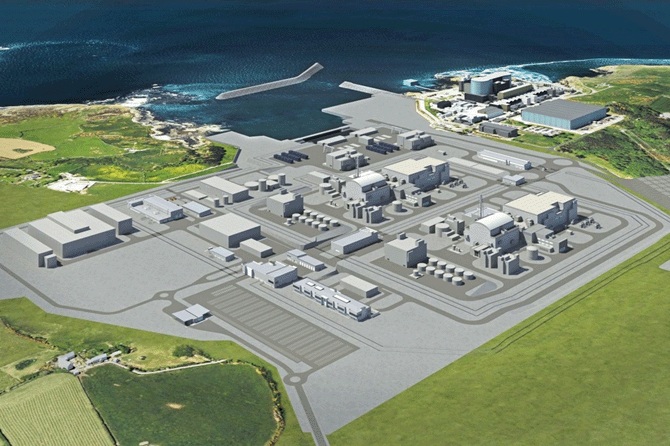 Times 27th May 2018 , The fate of a £15bn-plus nuclear power station is set to be decided this
week — and with it the future of Britain’s atomic renaissance.
The Japanese industrial giant Hitachi is due to decide Monday whether to
proceed with Wylfa. Hitachi’s decision has huge implications for
industrial collaboration between Britain and Japan and the country’s
nuclear power industry.
The project hinges on winning financial support
from Westminster. This weekend, ministers are expected to set out their
offer to Hitachi in a letter ahead of the crucial meeting. The proposal is
expected to include UK taxpayers taking a direct stake in the plant,
alongside Hitachi and the Japanese state, as well as guaranteeing loans. In
return, Westminster wants Hitachi to substantially undercut on price the
£20bn Hinkley Point plant in Somerset, which is being built by EDF.
TheFrench company struck a deal with the government for a guaranteed payment
of £92.50 per megawatt hour for 35 years. Ministers are expected to make
an announcement once they return from this week’s parliamentary recess.
They will herald it as an example of the type of post-Brexit trade deal
Britain can expect.
https://www.thetimes.co.uk/edition/business/deadline-day-for-japans-hitachi-over-wales-15bn-horizon-nuclear-plant-mdxhnj9x8
UK is not correctly testing Hinkley Point dumped mud for radioactivity
Barry GEM 28th May 2018 ,Richard Bramhall. Referring to The GEM’s recent article on the dumping of
mud from Hinkley Point in the Bristol Channel, campaigners oppose the
dumping not because of ‘passion’ but because of science.
EDF’s references to bananas, radon and cosmic rays are unscientific. Potassium 40
(in the bananas), radon and cosmic rays are evenly distributed in body
tissue and the radiation effects are well understood.
The radioactive particles which EdF refuses to look for in the mud are quite different. The
UN has published data showing enormous amounts of particulates from Hinkley
Point. These are microscopic fragments of uranium oxide and probably
plutonium which are small enough to inhale. From the lung they can travel
anywhere in the body — to the lymph nodes, for example. Such particles
emit very short-range radiations all the time, continually hitting the
cells within a few microns. To treat this as an average all-body dose is
like thinking you can safely keep your baby warm by tucking a soldering
iron into her babygro. The Government laboratory that tested mud samples
did not use techniques capable of detecting uranium or plutonium. This is
why campaigners demand thorough testing.
http://www.barry-today.co.uk/article.cfm?id=119988&headline=%E2%80%98Hinkley%20Point%20mud%20needs%20more%20testing%E2%80%99%20%E2%80%93%20a%20GEM%20reader%27s%20letter§ionIs=news&searchyear=2018
28 May – deadline day for Hitachi over whether or not to proceed with UK Horizon nuclear power plant
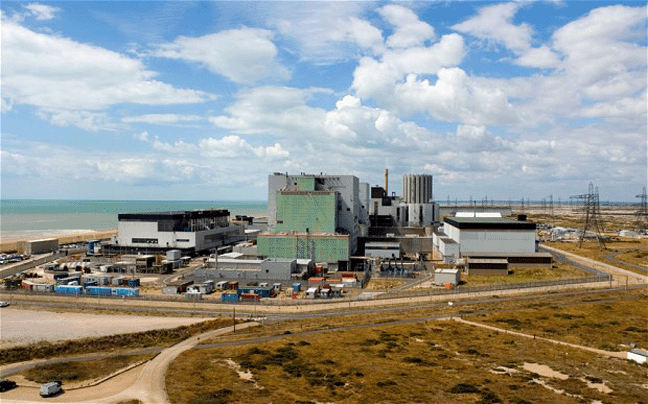 Deadline day for Japan’s Hitachi over Wales £15bn Horizon nuclear plant Sunday Times, 27 May 18 The fate of a £15bn-plus nuclear power station is set to be decided this week — and with it the future of Britain’s atomic renaissance.
The Japanese industrial giant Hitachi is due to decide tomorrow whether to proceed with Horizon, a twin-reactor plant on Anglesey, north Wales.
Hitachi’s decision has huge implications for industrial collaboration between Britain and Japan and the country’s nuclear power industry. The project hinges on winning financial support from Westminster.
This weekend, ministers are expected to set out their offer to Hitachi in a letter ahead of the crucial meeting. The proposal is expected to include UK taxpayers taking a direct stake in the plant, alongside Hitachi and the Japanese state, as well as guaranteeing loans.
In return, Westminster wants Hitachi…(subscribers only) https://www.thetimes.co.uk/article/deadline-day-for-japans-hitachi-over-wales-15bn-horizon-nuclear-plant-mdxhnj9x8
Britains big future nuclear power plans hang on government subsidising Hitachi
 UK nuclear plans ‘risk collapse if Hitachi talks fail’https://www.theguardian.com/environment/2018/may/25/new-uk-nuclear-power-plants-hinge-on-deal-between-hitachi-and-government– Adam Vaughan
Japanese group believed to be demanding direct financial support with consumers making up the difference.
Britain’s hopes for a number of new nuclear power stations could collapse if the government and the Japanese conglomerate Hitachi fail to make a breakthrough on talks for a plant in Wales, a top nuclear lobbyist has warned.
Hiroaki Nakanishi, the firm’s chairman, met Theresa May earlier this month, to press the prime minister for financial support for two reactors at Wylfa on the island of Anglesey.
The company’s board is understood be meeting on Monday to decide whether it can proceed with the UK’s subsequent offer, believed to include a multibillion-pound loan.
Tim Yeo, chairman of the industry-backed group New Nuclear Watch Europe, said the outcome of the negotiations had huge consequences for other international firms hoping to build reactors in Britain.
“If Hitachi walk away from Wylfa that probably spells the end of new nuclear in the UK,” he said.
The 3GW plant at Wylfa by the Hitachi subsidiary Horizon Nuclear Power would be the UK’s second new nuclear power station after EDF Energy’s Hinkley Point C, under construction in Somerset.
More are planned: EDF wants to build at Sizewell on the Suffolk coast, South Korea’s Kepco at Moorside in Cumbria and China’s CGN at Bradwell in Essex, with EDF’s help.
Hitachi wants to build abroad because of a moribund home market,
while the UK government sees nuclear as an important source of low-carbon power.
Despite the protracted discussions between the two parties, London appears to still be committed to making the economics of nuclear work.
“I sense there’s still a lot of political will to make new nuclear happen from government, and backbenchers seem to want it in their areas,” a Whitehall source said.
An industry source said the deal would work if the government offered some form of financial support directly, while energy bill payers footed the rest through a subsidy known as a contract for difference.
That would mean Hitachi receiving a guaranteed price of power, likely to be around £80 a megawatt hour, lower than Hinkley’s £92.50 but still nearly twice the wholesale cost of electricity.
The Department for Business, Energy and Industrial Strategy (BEIS) is understood to be enthusiastically backing the project, while the Treasury, which would have to see an equity contribution or loan for the construction period on government books, is more sceptical.
Paul Dorfman at the Energy Institute at University College London said: “This would mean the hardworking UK taxpayer and energy consumer, who are labouring under ramping austerity, are being asked to stump up for an extraordinarily expensive nuclear plant just at the time that renewable costs are plummeting.”
Japanese media have reported the UK government’s loan for the project could be as much as £13bn, and put the total cost of the plant at more than £20bn, even more than Hinkley Point C. The details are understood to have been leaked by the Japanese government, not Hitachi, and the UK government has said it “does not recognise” the reports.
Greenpeace said the UK was wrongly pursuing a “dinosaur” technology and should focus on renewables, batteries and interconnectors to other countries.
Kate Blagojevic, the group’s head of energy, said: “It’s unacceptable the Japanese public are hearing about this before the British public, if what we’re hearing is true that over £13bn of British taxpayer money is going to a Japanese company to build a plant in Wales.
“It’s pretty outrageous the government hasn’t been upfront about what they’re proposing and why.”
A spokesperson for BEIS said: “These discussions are commercially sensitive and we have no further details at this time.”
A Horizon spokesperson said: “It’s no secret we’re in discussions with the UK and Japanese governments, and have been for some time, over support for our project. With these discussions still ongoing it is too early to comment on the specifics of what a future deal may look like.
“We’re confident, given the strategic importance of our project to both nations, we’ll reach a successful conclusion to these discussions in the near future.”
Toxic radioactive mud dumping is a toxic issue for Wales
BBC 23rd May 2018 Plans to move mud from alongside the Hinkley Point nuclear site in Somerset
to a dumping ground off Cardiff Bay have been debated by AMs. It comes
after a petition to the assembly against the plans attracted over 7,000
signatures. Other online petitions gathered tens of thousands of
signatures. The assembly petitions committee took evidence on the issue and
published a summary of the evidence it had heard and requested the debate
in the Senedd.
As part of plans to build the new Hinkley Point C nuclear
power station in Somerset – 300,000 tonnes needs to be dredged from the
seabed nearby. The developers are set to move it within weeks to a disposal
site off Cardiff Bay. Both developers EDF and Natural Resources Wales
insist tests have shown the sediment poses no risk but campaigners claim it
could be contaminated by discharges from the old Hinkley Point A and B and
argue the mud has not been adequately tested.
Plaid Cymru’s Simon Thomas said the issue illustrated that “we have so little control of our natural
resources, that we have to accept the spoil of a nuclear power station in
Hinkley Point”. He said that as a matter of principle it is was the Welsh
parliament that should decide what happens in Welsh waters.
The company behind Hinkley Point C – EDF – said the mud has been tested independently
to internationally accepted standards and shown to pose no risk to human
health or the environment. It has refused a Petitions Committee request to
pay for further sampling – arguing claims the mud is toxic are alarmist and
wrong, and that any sampling would yield the same results and would not
remove the petitioner’s objection about the testing process. Energy
Secretary Lesley Griffiths said Natural Resources Wales was satisfied there
was no risk from the dredged material to people, the environment, or the
wildlife that lives there. However, she said she has asked NRW to review
the way it communicated its decisions over this licence.
Independent AM Neil McEvoy, who met the demonstrators, dismissed the suggestion the mud
had been tested properly and described the situation as a “dereliction of
duty”. He said: “We have a Welsh Government allowing Wales to be dumped on
and the mud hasn’t been tested… The top soil was tested – [but] you’ve
got five samples only under five centimetres for 300,000 tonnes of mud.”
Anti-nuclear campaigner Tim Deere Jones, who submitted the petition, is
unhappy with the level of testing undertaken. He said: “What kind of
radioactivity is in the mud, how much of it is in the mud, if you dump it
into the Cardiff grounds which is a dispersal site – where will it disperse
to?”
Richard Bramhall is from the Low Level Radiation Campaign, chairman of
the Welsh Anti Nuclear Alliance and a former member of the government
advisory committee advising on the radiation effects of internal emitters.
“The idea that the average radioactivity in the mud is at a low level is of
no comfort at all to the people of south Wales,” he said. “The particles
will blow ashore and once they’re in your lungs that’s not a low dose.”
http://www.bbc.co.uk/news/uk-wales-44223979
Scotland’s ambitious target for 100% renewable energy
Scottish Government 24th May 2018 Scotland will become one of the first countries to achieve a 100% reduction
in carbon emissions, Climate Change Secretary Roseanna Cunningham has said.
The new Climate Change Bill will immediately set a target of a 90%
reduction by 2050, which the UK Committee on Climate Change (UK CCC) states
is currently “at the limit of feasibility.”
The draft Bill sets out that the Scottish Government intends to go further still and achieve a 100%
reduction in emissions, known as ‘net-zero’, as soon as possible.
Ministers will be legally required to keep the net-zero target date under
review by seeking expert advice on the issue every five years. The target
date will become legally-binding, subject to the consent of the Scottish
Parliament, as soon as there is sufficient evidence to demonstrate the date
is credible and achievable.
As well as increasing long term ambition, the
new Bill also includes the most ambitious interim targets in the world, as
well as stretching annual targets for every year between now and 2050. This
means action will need to increase immediately, across every sector of the
Scottish economy. It will also require action by individuals, communities
and businesses – as well as government.
https://news.gov.scot/news/commitment-to-net-zero-greenhouse-gas-emissions
UK short of funds for its £51bn nuclear defence programme
 Nuclear defence programme to cost £51bn over next decade National Audit Office predicts total spending and warns of £2.9bn shortfall, Ft.com Peggy Hollinger, Industry Editor
The cost of building and maintaining the UK’s nuclear defence programme will add up to £50.8bn over the next 10 years, the UK’s public spending watchdog has said. The National Audit Office predicted a £2.9bn shortfall on the programme in that period, assuming the Ministry of Defence delivers the cost-cutting it has promised. The assessment is the first time the NAO has looked at the cost of the entire network of programmes, equipment and people needed for the UK’s nuclear deterrent between 2018 and 2028. As well as itemising completion of the current Astute submarines, the report looks at the costs of building the new Dreadnought class that will eventually replace the four Vanguard nuclear-armed boats from the early 2030s. The report showed that the top four suppliers — Rolls-Royce, BAE Systems, Babcock International and AWE Management — have won 97 per cent of contracts for nuclear defence………..https://www.ft.com/content/08d19194-5d0e-11e8-ad91-e01af256df68
Many years before massive nuclear power station could be built at Bradwell, UK
 Maldon Standard 23rd May 2018 , THE site of the new nuclear power station at Bradwell is staggering in
size. Measuring the length of six football pitches, it sits on land near to
the existing station, now being decommissioned. The Standard was given
exclusive access to see how work was progressing at Bradwell B. EDF Energy
and the China General Nuclear Power Group have been carrying out early site
investigations into the site since December. Since then, the company has
been drilling and digging sampling holes and testing the soil. While work
is underway, the project is still very much in the beginning stage. Once
all groundwork is complete proposals for what the new power station could
look like will be drawn up. Then, a huge public consultation will be held,
alongside a generic design assessment, environmental assessment, and
nuclear site licence being sought. In short, we are many years away from
any station being built.
http://www.maldonandburnhamstandard.co.uk/news/16242529.Digging_deep__A_look_into_the_site_for_a_new_nuclear_power_station_in_Bradwell/
Hitachi’s build of Wylfa nuclear power station delayed – may never happen
Asahi Shimbun 20th May 2018 [Machine Translation] Hitachi announced plans to delay the goal of starting
nuclear power plans planned in the UK for about two years to 2027. The collection of funds necessary for the project is difficult, and reconsideration of sharing has started between companies that undertake design and construction.
The continuation of the project itself is increasingly uncertain.
In the plan, two nuclear reactors will be built on Anglesey island in the UK. The goal of starting operation has been
announced as “early 20’s”.However, according to officials, the Hitachi side recently proposed a new goal “April 27” to companies and others involved in the plan. It is planned to decide whether to start construction in 2019,
but it seems to be assuming a case where this time is delayed.
https://www.asahi.com/articles/ASL5M4HZ3L5MULFA001.html
UK’s contentious new arrangement for nuclear safeguards, following exit from Euratom
 David Lowry’s Blog 17th May 2018 , Brexit correspondent missed the main issue arising from the UK nuclear
regulator’s report leaked to Sky News. On July 13 last year, the UK
Government position paper on “Nuclear materials and safeguards issues,”
included the key proposal that the UK will: “take responsibility for
meeting the UK’s safeguards obligations, as agree with IAEA
(International Atomic Energy Agency).”
Currently “ safeguards” are applied in the UK under a ‘voluntary ‘trilateral treaty between the UK,
Euratom and the IAEA. It comprises 36 pages in total, opening with the key
element in the treaty stating in A r t i c l e 1(a) “The United Kingdom
shall accept the application of safeguards, in accordance with the terms of
this Agreement, on all source or special fissionable material in facilities
or parts thereof within the United Kingdom, subject to exclusions for
national security reasons only (my emphasis)
The exclusion opt out is explained at Article 14 which reads in part: “If the United Kingdom
intends to make any withdrawals of nuclear material from the scope of this
Agreement for national security reasons …. it shall give the Community
(ie Euratom) and the Agency (IAEA) advance notice of such withdrawal…”
The ONR has been given unprecedented responsibility for policing a
diplomatically contentious new arrangement, which will increase suspicion
among member states of the 1968 nuclear nonproliferation treaty ( for which
the UK , as a co-drafter of the treaty text, is one of three depositary
states) – which ministers pray-in-aid whenever they discuss the rationale
for a UK nuclear safeguards system. However, ministers routinely
cherry-pick those parts of the NPT that suite their purposes: but the NPT
is an integrated diplomatic agreement, with its articles all relevant and
related.
Cherry-picking is both diplomatically unwise, as it normalises
abrogation for other signatory nations, and undermines the very treaty for
which the UK is supposed to act as a protective depositary state!
http://drdavidlowry.blogspot.co.uk/2018/05/uk-nuclear-safeguardsare-dangerously.html
Hitachi’s nuclear export transfers risks to both Japanese and British people while companies get profits
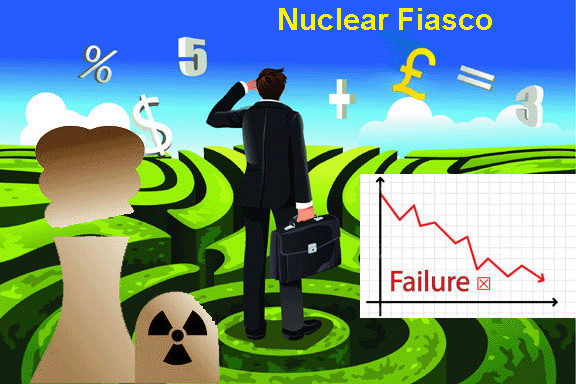 Urgent Joint Statement: Hitachi’s nuclear export transfers risks to both Japanese and British people while companies get profits http://www.foejapan.org/en/energy/doc/180502.html
Hitachi’s Chairman Nakanishi is reportedly going to visit British Prime Minister Teresa May on 3rd May to ask the U.K. government to take a direct stake in Wylfa Newydd nuclear power project in Anglesey, Wales. The report says Hitachi is going to ask not only for direct investment but also an assurance for a power purchase agreement(1). Hitachi’s struggle just shows the risks of the nuclear power project is simply huge.
In February, Mr. Nakanishi already expressed the view that the project would not happen without government commitment and stated “Both UK and Japanese governments understand that the project would not go on without the commitment by the governments”(2). To reduce the risk of the project, the project is said to be insured by Nippon Export and Investment Insurance(NEXI), 100 percent Japanese government owned export credit agency(3).
In addition to huge construction cost, nuclear projects are associated with various risks such as accidents, increased cost for tougher regulations, opposition from local people, radioactive waste management and so on. Risks are too huge to manage. Thus, it is clear that companies should decide to retreat from the project. While transferring risks of the project to people, it is unacceptable that the companies and banks take profits.
Electricity generated from Hinkley Point C nuclear power, which is currently under construction in UK will be purchased at £92.5/MWh, which is approximately twice as expensive as the average market price. National Audit Office of UK warned that this would increase ratepayers burden (4). If UK government gives an assurance for expensive price of electricity to Hitachi, the project will put more burden not only Japanese taxpayers with huge risks, but also British ratepayers with huge costs. For whose sake is this project?
The project site for Wylfa Newydd is surrounded by pristine nature. Colonies of protected bird such as Arctic terns was discovered near the site(5). The National Welsh Coastal Path borders the land bought by Hitachi which is in an area of Otstanding Natural Beauty. The project would put a heavy burden on the social and economic infrastructure on the island rather than benefitting the local economy(6) .
“Don’t pour good money in to the bottomless black hole of nuclear power. This is an old fashioned, dirty, dangerous and extortionately expensive technology. The Fukushima triple explosions and meltdowns has and will continue to cost the people of Japan greatly. There is no end in sight for this continuing tragedy, which means that no new nuclear reactors are going to be built in Japan. It is unacceptable that Japan wish to export this deadly technology to another state in order to keep Japan in the nuclear club.”
TEPCO’s Fukushima Daiichi nuclear accident is not over. Globally the cost of renewable energy decreases dramatically and energy efficiency is also improved. Exporting nuclear power is against that trend. This is morally and economically the wrong direction. Moreover, pouring public money to a handful of private companies without consulting the public or having discussion at a parliament is unacceptable.
Japanese government and companies should seek and promote nuclear phase out and sustainable and democratic energy systems based on thorough reflection on the lessons learned from the nuclear accident. We strongly oppose Hitachi’s Wylfa Newydd project. No money from Japanese and British taxpayers should be used to save this totally outdated and dangerously wasteful project.
1. “Hitachi seeks assurance from UK’s May on shared stake in nuclear project” Nikkei Asia Review, 29th April 2018.
2. ”Committements by both UK and Japanese government necessary fro Hitachi’s nuclear project, says next chair of Keidanren” (In Japanese) Reuters, 13th Feb 2018.
3.“Japanese and UK government to support Hitachi’s nuclear project, loss may result in public financial burden (in Japanese)” Asahi Shimbun, 11th Jan 2018.
4. “Hinkley Point C” National Audit Office, 23th June 2017
5.“Plans for Welsh nuclear power plant delayed by concerns over seabirds” Guardian, 9th Apr 2018.
6.“Wylfa Newydd: Nuclear plant ‘increases homelessness risk’” BBC, 27th Mar 2018.
Contact:
Friends of the Earth Japan
fukakusa@foejapan.org
+81-3-6909-5983
Ayumi Fukakusa
People Against Wylfa B
pawbcymru@gmail.com
Dylan Morgan
UK govt worried about nuclear security – wants to train security officers for overseas reactors
Contract offer to counteract global threat to nuclear sites, https://www.telegraph.co.uk/business/2018/05/20/contract-offer-counteract-global-threat-nuclear-sites/ 20 MAY 2018
The Government is so concerned about the global threat to nuclear power stations that it is seeking a company to provide security training to foreign operators.
The Department for Business, Energy and Industrial Strategy (BEIS) has published a £6m tender for a private company to deliver what it calls a National Security Culture Programme. It is part of a wider push to make sure that chemical, biological, radiological and nuclear materials are out of reach to terrorist groups or hostile states.
The successful company will be sent to overseas nuclear facilities to deliver training on attack prevention by helping organisations to increase security and better protect sensitive information. According to the tender documents, found by procurement company Tussell, the job will be aimed at overseas civil nuclear sites.
It will also cover a range of organisations, including those holding radioactive material, such as hospitals, and sensitive knowledge or information, such as academic or scientific institutions, as well as regulators and government departments.
The contract is expected to start in July 2018 and will run until March 2022. This work is the first external tender relating to the Government’s global threat reduction programme, hinting at the level of concern among top officials about the possibility of an attack on nuclear power plants.
Nuclear facilities have long been considered a target for groups looking to disrupt power supplies.
Last year, Britain’s nuclear power stations were told to tighten their defences against terrorist attacks after concerns were raised that terrorists had worked out how to bypass electronic security systems.
A spokesman for BEIS said the tender was part of “a continuing education programme about encouraging greater awareness of nuclear security issues and best practice overseas”.
UK Nuclear Subsidies – We Told You So – Hinkley Point C
 NuClear News No.107 May 2018
Ten years ago Steve Thomas, Professor of Energy Policy at Greenwich University predicted that nuclear companies would eventually insist on receiving subsidies to build new reactors, and the government would be forced to drop its refusal to give subsidies or abandon its nuclear ambitions. Regrettably his prediction has come true. (1)
Hitachi Chairman Hiroaki Nakanishi had a face-to-face with Prime Minister Theresa May earlier this month, and according to the Japanese media the UK government has offered to shoulder 2 trillion yen (£13.3 billion) in loans and other means to cover a huge portion of the cost of new reactors at Wylfa. Whether that will be enough to persuade Hitachi to go-ahead remains to be seen. The Company is reported to be planning to decide week ending 19th May according to the Mainichi newspaper. (2)
Horizon was supposed to be submitting its application for Development Consent to the Planning Inspectorate by the end of March, but this has now been delayed until spring or summer. (3) Officially the application has been delayed by concerns over the plant’s impact on colonies of protected seabirds. The Company said it needs to thrash out the impact building the power station will have on colonies of sandwich, Arctic and common terns. The species are protected under the EU birds and habitats directive. Nearby Cemlyn nature reserve is home to thousands of sandwich terns, which account for about fifth of the birds’ UK population and is the biggest on the country’s west coast. Wildlife groups are concerned about the effect of noise and light from the power station’s construction, as well as a reduction in food for the birds to forage on. Land clearance for the vast site is also expected to displace potential predators, such as rats and foxes. The company says it hopes to resolve the issues and submit the Development Consent Order (DCO) application before the end of June. The delay is expected to be a bump in the road rather than major headache for Horizon, which, rather optimistically believes Wylfa could be generating electricity by the mid-2020s. (4)
Horizon might be telling the truth about the need to resolve these wildlife issues, but the delay gives the Company more time to lobby the Westminster Government for more financial support to build the reactors.
Hitachi now says it wants to slash its Horizon shareholding. The Chairman was apparently planning to ask Theresa May to take direct stake in Horizon. According to the Nikkei Asian review Hitachi expects the U.K. government to invite private British companies to participate and hopes to reduce its own stake to less than 50%.
Hitachi has recently concluded that the risk of proceeding with the Anglesey project, at an estimated cost of more than 3 trillion yen (£20 billion), is too great to manage on its own as a private company. It plans to withdraw from the project if restructuring negotiations fall through. Such a move would have significant repercussions for nuclear power policy for both Britain and Japan. In response to Hitachi’s concerns, the British government earlier this month proposed that U.K. interests and Japanese public and private interests join with Hitachi to move Wylfa forward. The three sets of shareholders would each put 300 billion yen into the project, giving each a one-third stake. According to sources, the company and the Japanese government.
see it as too risky for Japanese interests to retain a majority shareholding and hope that British interests will acquire a controlling stake. (5)
Number 10 remained tight-lipped over its negotiations with Hitachi, and a spokesman declined to comment on the latest talks. Hannah Martin, of Greenpeace, said the “information blackout” is “unjustifiable” because of the high costs to be paid by energy users to support the projects. “The public have a right to know what the government is planning to do with their money and why,” she said. “Major Western economies are reducing their exposure to nuclear, so why is Britain doing the exact opposite? It would make no sense to waste yet more on expensive and outdated nuclear when technologies such as offshore wind can do the same job faster and cheaper”. (6)
The Times reports that the entire £15bn-plus cost of Wylfa could land on the government’s balance sheet, even though taxpayers are expected to hold only a minority stake. The final deal with Hitachi may see taxpayers take an equity stake in Wylfa, possibly as much as 33%, alongside Hitachi and the Japanese government. Direct state exposure to the construction of a nuclear plant has faced stiff resistance from the Treasury because of fears about cost overruns and the impact on government debt. Industry insiders said a minority taxpayer stake could result in the entire liability landing on the state’s books, despite the Japanese partners, because official statisticians now take a more conservative approach to accounting for risk where the government is concerned. Any state stake in Horizon would be sold on once construction was completed. (7)
The Japanese Mainichi newspaper reported that Hitachi had received an assurance from the British government that it will guarantee loans for the construction of two reactors in Wales. But Hitachi is still pushing for the British government to take a stake in the project and guarantee electricity prices to ensure it is profitable, the Mainichi said. The cost of the Hitachi project in Wales has ballooned to 3 trillion yen (£20 billion) due to the tougher safety measures, the newspaper said. But BEIS said “We don’t recognise these reports. Nuclear power remains a crucial part of the UK’s energy future but we have always been clear that this must be delivered at the right price for consumers and taxpayers.” (8)
The Times concluded that Britain’s plans to offer financial support for Wylfa were mired in confusion amid conflicting reports of the meeting between the prime minister and Hitachi. Duncan Hawthorne, chief executive of Horizon, told The Times last year that loan guarantees would not make the plant viable and the company had been seeking direct government investment as well as a subsidy contract. Mainichi reported that the plant would cost more than £20 billion, making it even more expensive than EDF’s Hinkley Point C project. A Horizon source distanced itself from that figure. (9)
Caroline Lucas says if Theresa May has agreed to a £13.3 billion loan she’s doing it “without any transparency or scrutiny”, effectively lending out public money behind closed doors. (10) The SNP demanded the Government rule out public money on “failing nuclear projects”. Drew Hendry, their business spokesman, said: “This is yet another damning report of the UK government’s misguided nuclear obsession. Hinkley Point is already set to cost consumers a fortune because of the appalling strike price deal the UK government made with EDF. The Prime Minister must now categorically rule out any public bail out of this, or any other nuclear project and put an end to secret discussions behind closed doors.” (11)
Hannah Martin, Head of Energy at Greenpeace UK, said: “No bank, hedge fund or insurer will touch the UK’s new nuclear programme with a bargepole. So Hitachi has no option but to ask the government for a taxpayer bailout to keep their collapsing reactor programme afloat. This would leave the British public to carry much of the cost and all of the risk. Any prudent investor would laugh at this request. After the Hinkley debacle, it’s vital that the government stops trying to keep our energy policy a secret and presents any offer of a deal to Parliament before the Hitachi board meeting at the end of May. Otherwise it’s difficult to know where their generosity to the nuclear industry might end.”
Prof Stephen Thomas says Wylfa could provide a new model for UK nuclear projects. The Government needs something to demonstrate that Hinkley is the exception rather than the rule. Wylfa has 3 big advantages – support of the Japanese Government; unlike Areva and Westinghouse Hitachi-GE is not bankrupt and disgraced; and it is claimed that the ABWR is a proven technology. The project is a little bit cheaper than Hinkley but only because it’s smaller. Loan guarantees will be essential, and will reduce interest payable to banks. Hitachi is too small to own and operate a facility that is going to cost £25bn. And they don’t have the experience to operate it. The ABWR is actually quite an old reactor design. There are no other prospects for Hitachi to sell the ABWR. 4 reactors in Japan were completed in 4 to 5 years, but that’s the same for other reactors in Japan. There are 2 uncompleted reactors in Japan; and 2 reactors ordered for Taiwan but work suspended. The lifetime load factor of the 4 reactors has been very poor 47 – 71%. All have suffered long shutdowns. In 3 cases this was down to seismic issues. Two reactors had big turbine problems. Even if you take out those years when the reactors were shut performance was still poor. It’s a pre-Chernobyl; pre 9/11; pre-Fukushima design that we have a track record for. (12)
Steve Thomas’ briefing for Greenpeace on “The failings of the Advanced Boiling Water Reactor (ABWR) proposed for Wylfa Nuclear Power Station” is available here: https://www.greenpeace.org.uk/wp-content/uploads/2018/05/ABWR-briefing-final.pdf
Greenpeace has also published a briefing on “Hitachi’s nuclear safety breaches and the case against public funding for the proposed Wylfa Nuclear Power Station.” https://www.greenpeace.org.uk/wp-content/uploads/2018/05/hitachi-briefing-final.pdf http://www.no2nuclearpower.org.uk/wp/wp-content/uploads/2018/05/NuClearNewsNo107.pdf
1 This Month





PLEASE OPPOSE HR 8255 AND S.3639 – bills would accelerate satellite deployment, with no environmental review or safeguards – https://ncstd5li.quorum.us/campaign/169331/
To see nuclear-related stories in greater depth and intensity – go to https://nuclearinformation.wordpress.com
-
Archives
- October 2026 (19)
- September 2026 (339)
- August 2026 (330)
- July 2026 (355)
- June 2026 (287)
- May 2026 (306)
- April 2026 (356)
- March 2026 (251)
- February 2026 (267)
- January 2026 (308)
- December 2025 (358)
- November 2025 (359)
-
Categories
- 1
- 1 NUCLEAR ISSUES
- business and costs
- climate change
- culture and arts
- ENERGY
- environment
- health
- history
- indigenous issues
- Legal
- marketing of nuclear
- media
- opposition to nuclear
- PERSONAL STORIES
- politics
- politics international
- Religion and ethics
- safety
- secrets,lies and civil liberties
- spinbuster
- technology
- Uranium
- wastes
- weapons and war
- Women
- 2 WORLD
- ACTION
- AFRICA
- Atrocities
- AUSTRALIA
- Christina's notes
- Christina's themes
- culture and arts
- Events
- Fuk 2022
- Fuk 2023
- Fukushima 2017
- Fukushima 2018
- fukushima 2019
- Fukushima 2020
- Fukushima 2021
- general
- global warming
- Humour (God we need it)
- Nuclear
- RARE EARTHS
- Reference
- resources – print
- Resources -audiovicual
- Weekly Newsletter
- World
- World Nuclear
- YouTube
-
RSS
Entries RSS
Comments RSS

