Nuclear Subsidies – We Told You So – Moorside and Sizewell UK
 NuClear News No.107 May 2018, Moorside Seeking a Government stake in Horizon has been a key lobbying strategy for Hitacji for well over a year now, but the UK government’s refusal to make even a commitment in principle on that front has many in the UK nuclear industry worried. None more so than those invested in the success of another nuclear developer: NuGen, the company Toshiba hopes to sell to exclusive bidder Korea Electric Power Co. (Kepco). Kepco appears to be losing enthusiasm for the project in the absence of support from the UK government — especially with prospects of a reactor deal in Saudi Arabia. (13)
The state-run Korea Electric Power Corp. (KEPCO) is now saying that it will finalise its purchase of NuGen by September after analyzing its potential profits and viability. Yet in December, when KEPCO was selected as a preferred bidder by Toshiba, the company said it would finalise the deal in early 2018.The Seoul government is involved in the negotiation and is delving into the nuclear project’s profitability and potential risks, while the two companies have been discussing the detailed terms of contracts. Unlike KEPCO’s UAE project, which only involves the construction of nuclear reactors, market watchers say the Moorside project is more risky because KEPCO has to come up with financial solutions for construction and operation. The state-utility firm plans to build two of its APR-1400 reactors on the site, which would have a combined capacity of up to 3 gigawatts. (14)
Back home KEPCO is struggling with snowballing losses because of the South Korean government’s plan to shift to renewable energy from nuclear and coal power. (15)
 Sizewell
Meanwhile EDF Energy appears to be going through the same process as Hitachi – demanding huge government subsidies to continue with the project and threatening to pull out if it doesn’t get them; then denying that it was threatening and starting negotiations with a government obsessed with building new reactors. EDF Energy told the Times at the start of April that it would reconsider plans for Sizewell C if it is unable to agree a viable financing model with the UK government. EDF threatened to abandon work unless it receives assurances from the government this year that a viable funding model exists. Simone Rossi, EDF Energy’s UK chief executive, said that rapid progress was needed because promised cost savings would not materialise if there was a significant delay between work on Hinkley and work on Sizewell. Mr Rossi has promised that Sizewell should be a fifth cheaper to build than Hinkley Point because EDF will be able to replicate much of the design work and will have a fully qualified workforce and supply chain ready to transfer across. However, he warned that a delay could jeopardise this. A lull of six months could be surmountable, but two years or more would be a problem. (16)
Later EDF denied it had threated to abandon work on Sizewell C and distanced itself from a report that it may pull the plug on the project unless it receives financial assurances from the Government. (17) Emily Gosden, author of the Times story tweeted “apparently EDF has ‘distanced itself’ from my story this morning… which reported what its chief executive told me on the record.”
In May Le Monde reported that EDF had launched discussions with the British government to find a new way of financing new reactors in Sizewell. (18)
The GMB called on the government to stop dithering and get Sizewell built. It’s an absolute no brainer that Britain will need at least six new nuclear plants, it said, because the National Grid has forecast up to 35 million pure electric vehicles will be on the roads by 2050 needing an extra 30 gigawatts of power — the equivalent of 10 Hinkley Point power stations. (19)
Dr Simon Evans of Carbon Brief tweeted in response: Energy-related press releases from GMB union are a sight to behold. They constantly repeat the same talking points, many of which are misleading or just plain wrong. Also of note: with rare exceptions, the quotes never end up in the papers. GMB union keeps saying National Grid has forecast a need for 30GW of extra power for EVs. At best, this is hopelessly misleading. We explained why last year, but that hasn’t stopped GMB. (See https://www.carbonbrief.org/factcheck-how-much-power-will-uk-electricvehicles-need )
It is worth noting that Framatome (formally Areva NP, which is now owned by EDF, Mitsubishi Heavy Industries (MHI) and Assystem), is working on a ‘new model’ EPR, the EPR-NM, “offering the same characteristics” as the EPR but with simplified construction and significant cost reduction – about 30%. The basic design was 30% complete by March 2016, and EDF has said that it, not the complex EPR being built at Flamanville, would be the model that replaced the French fleet from the late 2020s. (20) EDF has already said it hopes to reduce the costs of Sizewell C by 20-30%. (21)
Since Sizewell C isn’t expected to become operational until 2031, with construction starting around 2021, (22) it seems highly unlikely that EDF would try building anything other than an EPR-NM design. The question then is whether the EPR-NM would be required to undertake a new Generic Design Assessment.
In April Caroline Lucas asked the Secretary of State for Business, Energy and Industrial Strategy, whether the Design Acceptance Certificate for the European Pressurised Reactor (EPR) could be used for a re-designed EPR. Energy Minister, Richard Harrington, replied that a GDA is not a statutory requirement of the nuclear licensing regime and any site specific elements of EPR design will be assessed by the Office for Nuclear Regulation as part of a site specific safety case ahead of any construction. (23) The DAC for the European Pressurised Reactor (EPR) was issued on 13 December 2012 and is valid for a period of ten years. Renewal of the DAC is not mandated. Harrington also noted that ONR expect to complete its assessment of the EPR sitespecific safety case for Hinkley Point C in 2018. DAC renewal is not mandated and EDF has not informed Government that it plans to seek a renewal.
It is hard to see how such big cost reductions can be achieved without some dramatic changes sufficient to require a new safety case
According to the FT the Labour party is divided over whether to back new nuclear power stations. The high cost of Hinkley has prompted questions across Westminster about whether nuclear still represents value for money. Some MPs favour the industrial benefits of building power stations, while a growing faction wants to support only renewable wind and solar energy programmes. “It’s like a wasp’s nest, the differences are really bad,” said one shadow minister. “The jury is out and personally I’m still not convinced that nuclear should be part of the mix.” Rebecca Long-Bailey, shadow business secretary, remains adamant that Labour should continue to support Wylfa, as well as Moorside. “Public investment in nuclear energy would bring huge benefits through the nuclear supply chain and energy security,” she said. Ms Long-Bailey’s position is also supported by Sue Hayman, shadow environment secretary, whose constituency is in Cumbria. Large unions, including Unite and the GMB, are also strong advocates of nuclear energy. But other senior Labour figures are arguing for a U-turn, unless the cost of new nuclear plants can be reduced sharply. One compromise under consideration could see Labour keep the commitment it made in last year’s manifesto by supporting smaller “modular” reactors. Senior people in the nuclear industry said they remained confident about Labour’s continued support for their projects, because of the strength of union backing. (24)
- For a nice short Q&A on ‘What’s happening with UK’s new nuclear power projects?’ see the Greenpeace Unearthed website: https://unearthed.greenpeace.org/2018/05/16/wylfa-hitachi-build-wales-newnuclear-project/ http://www.no2nuclearpower.org.uk/wp/wp-content/uploads/2018/05/NuClearNewsNo107.pdf
Hinkley point nuclear project grinds onwards through a sea of problems
 NuClear News No.107 May 2018
EDF has detected quality deviations on certain welds at its new Flamanville-3 reactor – an EPR – the same type of reactor as the two being built at Hinkley Point. It has informed the French nuclear safety regulator ASN. Possible adjustments to the start-up timetable and costs can only be made after further checks and the licensing process by the ASN.
Flamanville-3 is currently expected to reach full power in Q4 2019 with fuel loading and first hot tests scheduled at the end of 2018. The quality deviations concern the welding of pipes on the main secondary system and are in addition to a deviation with respect to the correct application of “high-quality” requirements of the main secondary system that EDF flagged on February 22 to the ASN.
EDF has decided to carry out additional controls on the 150 welds in question and has ordered a full report into the causes and nature of the deviations. The additional controls and report will be completed by the end of May. The construction cost is currently estimated at £9.2bn. (1)
When EDF first reported welding problems on Feb. 22, it initially said there would be no impact on safety, costs or the reactor start-up schedule. However, France’s ASN nuclear regulator warned on Feb. 28 that the substandard welding could well have an impact the start-up. Even before the welding problems emerged, ASN had warned several times the reactor’s construction schedule was tight. “Following the current checks and the licensing process by the ASN, EDF will be able to specify whether the project requires an adjustment to its timetable and its costs,” (2)
The welding revelations come just a few short weeks after Britain’s nuclear regulator raised concerns about substandard quality control checks on EDF’s supply chain for Hinkley Point (See nuclear News No.106)
25 years after French engineers began working on the EPR, they have yet to get one running. Flamanville was due to start up in 2012 at a cost of €3.3 billion. EDF now hopes to switch it on next year and says that the reactor will cost €10.5 billion, though these targets could slip further in light of the latest setback.
Flamanville has faced several other setbacks, the most serious of which was the discovery that the reactor vessel was weaker than planned because of an excess carbon content. A raft of quality control failings at the Creusot Forge plant that made the vessel were found, including falsified documents. This triggered the Office for Nuclear Regulation’s decision to review the Hinkley Point supply chain, leading to a critical report last month.
The Times said one Flamanville is quite enough: The 1,650 megawatt European pressurised reactor is a mere six years late and three times over budget. And all the more exciting for it being the prototype for an even bigger nuclear disaster: the £20 billion, 3,200MW Hinkley Point C. At least the French nuclear guinea pig is finally on its home run, due to be loaded up with nuclear fuel in the last quarter of this year. Always assuming that EDF can sort out the dodgy welding on the cooling pipes. Anyway, it’s another EDF success story, up there with the carbon spots on the steel for Flamanville’s nuclear dome, the ones that potentially weakened it. Or the lost safety records from its Creusot Forge supplier. And it does make you think. It’s bad enough Theresa May signing us up to the world’s most financially radioactive energy project, without monthly reminders of EDF’s technical ineptitude. (4)
Hannah Martin, head of energy at Greenpeace UK, said: “The reactor destined for Hinkley Point was supposed to be cooking turkeys by Christmas 2017. As yet more construction flaws are revealed at its sister plant under construction in France, it’s starting to look like the only turkey the EPR reactor design is going to cook is EDF.”
Commenting on the news about defects in welding Stop Hinkley spokesperson Roy Pumfrey said
“The European Pressurised Water Reactor (EPR) reactor proposed for Hinkley Point C is like watching a car crash in slow motion. It is the unloved, unwanted, and unbuildable child of former EDF boss Vincent de Rivas. We can still stop this before it gets even worse. Although abandoning this ill-fated project now would incur cancellation costs consumers could still save almost £1.5bn per year for 35 years from 2027 onwards. Flamanville is seven years late, one in Finland is ten years late and even two in China will be at least five years late.” (5)
Dave Toke, reader in Energy Policy at Aberdeen University says the welding problems could spell the end for Hinkley C. Treasury backed loan guarantees have been linked to a target date for commissioning of the Flamanville plant of the end of 2020. Yet the current target date of completion by the end of 2019 has been thrown in doubt by the freshly announced problems. According to the analyst Professor Steve Thomas, the rules agreed between the European Commission and the British Government stipulate that until Flamanville 3 was in commercial service, there would be a cap on the guaranteed loans effectively meaning funding would be primarily through equity. It is very difficult to see how EDF could build the plant without the Treasury loan guarantee – something like £17 billion (probably more) would be needed as a loan. EDF just won’t have the ability to raise anything like £17 billion on the bond markets. Indeed the decision to go ahead with preliminary works on the site (building a jetty and a cement works) alone, without the loan guarantee being in place, was regarded as so risky that the firm’s Finance Officer resigned in protest at the decision. But EDF will not start building the main parts of the power station until it has the necessary finance. (6)
New problems have arisen at the EPR in Finland where TVO is carting out hot tests at Olkiluoto 3. The connection line of the main pipework of the plant, the reactor cooling circuit, vibrates more than allowed. According to the Finnish regulator, STUK, the reason for the vibration is still under investigation. (7)
China has begun loading fuel at its EPR at Taishan – a sign that the long-delayed project could finally be close to completion. Fuel loading could take several months, meaning the reactor could go into full operation and be connected to the grid before the end of the year. China began building the EPR in Taishan in 2009, with the first of two units originally scheduled to be completed in 2013. (8)
Meanwhile, the Irish Parliament’s (Oireachtas) Joint Committee on Housing, Planning and Local Government decided to investigate the possible transboundary effects on Ireland of Hinkley Point C. Professor John Sweeney of the National University of Ireland at Maynooth, Professor Stephen Thomas of Greenwich University and Attracta Ui Bhroin of the Irish Environmental Network were invited to give evidence. The meeting coincided with a recent consultation, organised by the Irish Government and facilitated by Irish Councils, that allowed environmental groups and concerned members of the public to put forward their concerns to the UK Government over the transboundary effects of the proposed Somerset new nuclear site. (9)
Attracta Uí Bhroin, of the Irish Environmental Network told the Committee that her intention was not to panic people or cause unnecessary concern, but her organisation wants to ensure Irish people’s rights are upheld. Although the process for the new nuclear site at Hinkley Point, which is 250km from the coast of Ireland, began five years ago, it was only in 2016 that the news about the plans broke. Hinkley Point C was given the final investment approval by French energy giant EDF, which has a two-thirds share and which is building the plant in conjunction with a Chinese company. Speaking to TDs and senators Uí Broin pointed out that of the eight power plants the UK has planned as part of its energy expansion, “five are on the west coast of the UK, facing Ireland on the most densely populated east coast”. Some of these plants are planned in locations closer than Hinkley Point C. The potential economic impact of a nuclear leak or meltdown could be very serious, she explained.
A 2016 ESRI report considered a scenario where there was a nuclear incident, but with no radioactive contamination reaching Ireland. “Even then they estimated that impact economically could be in the order of €4 billion,” she said, explaining that an incident such as this would have serious implications for the agrifood and tourism industries in Ireland. In the event of an incident where there is a risk of contamination, she said there are no detailed plans in place to protect Irish people, the water supply, or the country’s farm animals and produce.
Uí Bhroin was joined by Professors John Sweeney and Steve Thomas, who outlined some of the specific concerns around safety assessment and treatment of waste. Sweeney was critical of the models used in risk assessments – some older models were used in calculations, for example, despite the fact that more modern ones exist. Thomas spoke about some of the parts of the plant which are being made in France and which French regulatory authorities will not a clear for use in French nuclear plants. Uí Bhroin said there was an “extraordinary level of frustration, anger and disappointment” among environmental groups at the government’s reaction to these plans. (10)
Prof Thomas added that the reputation of both Flamanville and Hinkley’s supplier “is in tatters” after it emerged in 2015 that parts of the safety-critical reactor vessel supplied to Flamanville did not meet specification, he said. The French nuclear safety regulator, ASN, ordered the company to review its quality control procedures and “it has emerged that quality control documentation had been falsified at Creusot” for several decades, he added. In April 2018, EDF Energy also announced that up to 150 welds in key parts of Flamanville did not meet the required specification. Prof Thomas added: “This has created major concerns about parts manufactured there for nuclear plants in France and elsewhere.” (11)
John Sweeney, emeritus professor of geography at Maynooth University and a climate change expert, told the Oireachtas committee on planning yesterday that estimates used by the UK to assess its impact were not credible. “Combinations of rare events do occur, as was demonstrated by Fukushima [the nuclear incident in Japan in 2011], where total atmospheric releases are now estimated to be between 5.6 and 8.1 times that of Chernobyl,” Professor Sweeney said. Meteorological data used was “inadequate”, he added, arguing they relied on wind figures for three years when 30 years was the standard period required. “It’s rather dangerous to draw conclusions from a very short period. Three No2NuclearPower nuClear news No.107, May 2018 12 years of data, even ten years of data, is insufficient to characterise the wind climate at an individual location, and any modelling based on this is highly suspect.” He claimed the UK government failed to take account of climate change in estimating extreme high and low water levels when the difference between the annual high water mark and a once in a 10,000-years high water level at the site of the plant was just 1.3 metres. The Intergovernmental Panel on Climate Change predicted sea levels would continue to rise for centuries, with increases of up to three metres possible, which meant the UK’s estimates were not credible, he said. He claimed the failure to acknowledge that there was a known flood risk meant there were “serious implications for the safety of spent fuel which is intended to be stored on site for up to a century” (12) http://www.no2nuclearpower.org.uk/wp/wp-content/uploads/2018/05/NuClearNewsNo107.pdf
UK’s Radioactive Waste and Deep Geological Disposal

 NuClear News No.107 May 2018 The deadline for responding to the Government’s two consultations on a Geological Disposal facility (GDF) has now passed. According to the GDF Watch website there was a lot of discussion around three particular areas: the role of Local Authorities; earlier funding for community engagement; and readiness of RWM to engage with communities. (1
) BEIS produced two FAQ briefings in response to a number of common and recurring questions raised at their regional consultation workshops.
MPs from both major parties have attacked the government’s latest incentive to entice communities into volunteering to host Britain’s first deep underground store for nuclear waste as “completely inadequate”. Ministers have offered up to £1m per community for areas that constructively engage in offering to take part in the scheme, and a further sum of up to £2.5m where deep borehole investigations take place.
Critics say the inducements offered by the government are “simply not good enough”, and point to the example of France, which has a similar amount of nuclear waste. It offers around €30m (£26.5m) a year as local support for districts neighbouring the site at Bure, in north-east France, and has also offered €60m in community projects. “The government’s offer in its consultation is simply not good enough. These communities are being asked to perform an important public service and should be properly recompensed,” said Rebecca Long-Bailey, the shadow business secretary.
Geoff Betsworth, chairman of the Cumbria Trust points out that a 10% dent in tourism in Cumbria “would cost £270m a year. The offer of £1m in community benefits, rising to £2.5m when boreholes begin, is absurdly low.”
The plan was also criticised by the Conservative MP Zac Goldsmith, who said the UK should stop making nuclear waste and stop building new reactors. “We are still pouring untold billions of taxpayer money into propping up an industry that the free market would have killed off years ago,” he said. “In return, we will be compounding the catastrophe of a nuclear waste build-up, which we are no closer to solving than we were when the industry was born.” (2)
Burial under National Parks? Ministers have also been attacked for refusing to rule out burying nuclear waste under national parks. The government’s response to a question in the House of Lords was branded “absolutely shocking” by Green Party co-leader Caroline Lucas. Labour peer Lord Judd asked ministers to promise national parks, protected areas and areas of outstanding natural beauty will be excluded from the search. But energy minister Lord Henley said he was “not excluding” those areas yet while a National Policy Statement is finalised. He insisted: “Development for a Geological Disposal Facility should only be consented in nationally designated areas in exceptional circumstances and where it would be in the public interest to do so. “Even if such development were consented, the developer would be required to take a number of measures to protect and where possible improve the environment.” (3)
Burial under the seabed In response to another written question, Lord Henley said a GDF could also be placed under the sea: “The design could allow the underground facilities to extend offshore if accessed from onshore surface sites.” (4)
The former chair of the Cumbria Managing Radioactive Waste Partnership, Tim Knowles, mentions that the idea of looking for a site under the sea off the coast of Cumbria has been discussed. Cumbria Trust says “while we have had expert advice that West Cumbria does not contain an adequate onshore site, we accept that it is possible that a good site may be found further offshore.” (5)
The Trust says: “It is quite possible that an onshore GDF is simply politically undeliverable anywhere in the UK, so the expansion of the offshore search area is to be welcomed. An offshore GDF would need significant surface facilities on land, occupying around one square kilometre. The obvious location for these would be on the Sellafield site, but only if the offshore geology proves suitable, and if the local population agrees. The tunnel to the offshore GDF should begin at Sellafield to avoid the need to package radioactive waste for transportation outside a nuclear site.
This would also minimise any blight on local businesses, properties and tourism – the waste would remain on the Sellafield site until it was ready to enter the GDF via the tunnel.” (6)
Folkestone & Hythe District Council (FHDC) has asked the Government for more information on its Geological Disposal Facility (GDF). It is apparently considering volunteering Romney Marsh as a site for nuclear waste. This isn’t the first time nuclear waste has been up for debate on the marsh, the Department for Energy and Climate Change (DECC) asked councils to come forward as potential sites four years ago, but after some deliberation Shepway council scrapped the plans. Then, councillors voted 21 to 13 against formally expressing interest in the project. The issue had split residents, with 63% of people rejecting it in a survey. (7)
Fears have also been raised Derbyshire, Leicestershire and Nottinghamshire. A sedimentary basin known as the Widmerpool Gulf – which extends across the three East Midland Counties could be a potential site A response to a Government package of incentives designed to get communities to agree to ‘host’ a storage complex has been discussed by Leicestershire County Council, according to the Leicester Mercury. Any facility would look to bury waste at least 200 metres below ground somewhere in a geological area which stretches from the eastern fringes of Derby across the countryside to the south of Nottingham and on to the west of Melton Mowbray in north Leicestershire. Leicestershire County Council has said there are no specific proposals for a GDF in Leicestershire at this stage but it has asked for further information on the issue from the Department of Business, Energy and Industrial Strategy. A Leicestershire County Council report said: “Building and operating a GDF is a multi-billion pound, intergenerational, national infrastructure project, which is likely to bring substantial benefits to its host community, with skilled jobs for hundreds of people over many decades.”(8) http://www.no2nuclearpower.org.uk/wp/wp-content/uploads/2018/05/NuClearNewsNo107.pdf
The British government has offered 2 trillion yen ($18 billion) to Hitachi to built Wylfa nuclear power station
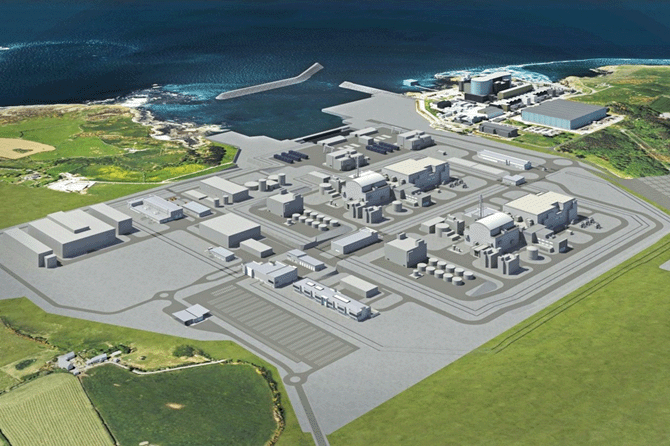
British government offers $18 billion to Hitachi’s UK nuclear project: Kyodo, Reuters Staff TOKYO (Reuters) 17 May  18 – The British government has offered 2 trillion yen ($18 billion)in financial support to a unit of Japan’s Hitachi Ltd (6501.T) to build nuclear reactors in Wales, Kyodo News reported on Thursday.
…….. The British government is offering support in loans and other ways to Hitachi unit Horizon Nuclear Power to cover a large proportion of the cost of its Wylfa Newydd project in Wales, Kyodo reported, citing a source close to the matter.
…….. Hitachi could decide as early as this week whether to go ahead, Kyodo said. It said the government’s offer was aimed at easing concerns about rising cost expectations, which have increased to 3 trillion yen.
A Hitachi spokesman declined to comment when contacted by Reuters.
The Kyodo report cited unidentified observers questioning whether the government would be able to carry out the offer, due to parliamentary opposition.
The British government played down a Japanese media report last week which said it would guarantee loans for the construction of the two reactors in Wales.
Britain is seeking new ways to fund nuclear projects after drawing criticism over a deal awarded to France’s EDF (EDF.PA) to build the UK’s first nuclear plant for 20 years, which could cost 30 billion pounds ($40 billion).
Hitachi’s Horizon plans to construct at least 5.4 gigawatts of nuclear capacity at two sites in Britain – the first at Wylfa Newydd, and the second at Oldbury-on-Severn in England…….. Reporting by Aaron Sheldrick and Kiyoshi Takenaka; additional reporting by Nina Chestney in London; editing by Christian Schmollinger, Jason Neely and Dale Hudson https://www.reuters.com/article/us-britain-nuclear-hitachi/british-government-offers-18-billion-to-hitachis-uk-nuclear-project-kyodo-idUSKCN1II17C
Britain’s wind power stations providing more electricity than its nuclear stations, in first quarter of 2018
 Wind power overtakes nuclear for first time in UK across a quarter https://www.theguardian.com/environment/2018/may/16/wind-power-overtakes-nuclear-for-first-time-in-uk-across-a-quarterNews of milestone comes as MPs say policy changes have caused collapse in investment in renewables, Guardian, Adam Vaughan, 16 May 18,
Britain’s windfarms provided more electricity than its eight nuclear power stations in the first three months of 2018, marking the first time wind has overtaken nuclear across a quarter.
The renewable energy industry hailed the milestone as a sign the UK was well on its way to an electricity system powered by cheap, domestic green energy.
Across the first quarter, wind power produced 18.8% of electricity, second only to gas, said a report by researchers at Imperial College London.
At one point overnight on 17 March, wind turbines briefly provided almost half of the UK’s electricity. Wind power helped during the cold snaps, too, supplying 12-43% of electricity during the six subzero days in the first three months of the year.
Two nuclear plants were temporarily offline for routine maintenance, while another was shut because of seaweed in the cooling system.
While wind together with solar supplied more power than nuclear in the final three months of 2017, thiswas the first time wind has managed the feat alone.
Dr Rob Gross, one of the authors of the Drax Electric Insights report, said: “There’s no sign of a limit to what we’re able to do with wind in the near future.”
The opening in December of a new power cable between Scotland and north Wales also helped unlock electricity from Scottish windfarms, some of which would normally be turned off to help National Grid cope.
The Western Link connection has drastically cut the amount of money paid by National Grid to windfarm owners for that curtailment. The company paid £100m in 2017 for curtailment. This year payments are already down by two-thirds.
Emma Pinchbeck, the executive director at industry group RenewableUK, said: “It is great news for everyone that rather than turning turbines off to manage our ageing grid, the new cable instead will make best use of wind energy.”
News of the quarterly milestone came as MPs said UK emissions targets were threatened by government policy changes, which had caused a collapse in clean energy investment since 2015, including a 56% fall in 2017.
Mary Creagh, Labour MP and chair of the environmental audit committee, said: “Billions of pounds of investment is needed in clean energy, transport, heating and industry to meet our carbon targets. But a dramatic fall in investment is threatening the government’s ability to meet legally binding climate change targets.”
Separately, the spending watchdog concluded that £23bn spent on a government subsidy scheme for low-carbon heating had been poor value for money and did not deliver its aims.
The public accounts committee said the renewable heat incentive had “wildly optimistic” goals and that the government failed to understand what consumers wanted.
Leaked document shows Britain’s nuclear fuel supply at risk after Brexit
 UK missing deadlines for post-Brexit nuclear safeguards, leak shows
Failure to put safeguards in place could disrupt flow of materials needed to fabricate nuclear fuel after Brexit, Guardian, Lisa O’Carroll, 17 May 18,
Brexit deadlines have put the supply of nuclear raw material for power stations at risk, a leaked government document has suggested.
The document, obtained by Sky News, shows that the UK is already missing critical deadlines to put full safeguards in place to keep the flow of components and raw material needed to fabricate nuclear fuel after Brexit.
The UK does not produce uranium. It must have its own safety measures in place, including a governing body to regulate the safe transport of the raw material, once it leaves the European safeguarding body Euroatom after Brexit.
Five “high-level risks” in setting up this government body have been identified by the UK’s Office for Nuclear Regulation, according to an internal “risk register” paper obtained by Sky.
Work on a new IT system, which should have started by the end of March, is already behind and the deadline has already been “irretrievable lost”, the document says.
The other four areas categorised as “red” on a red, amber, green (RAG) project management ranking including recruitment, lack of training for inspectors and funding.
Failure to arrange the “comprehensive handover” of hardware from Euratom are also cited in the document.
In UK Parliament Greens Party demands the government comes clean about funding Hitachi for nuclear project
 Daily Post 14th May 2018 , Demands have been made by the Green Party for an ‘urgent debate’ on whether
the UK Government is offering a package of financial support to build Wylfa Newydd.
The Daily Post reported this month that Prime Minister Theresa May
was meeting Hitachi Chairman Hiroaki Nakanishi for crunch talks on funding
for nuclear reactors. There were warnings Hitachi could withdraw from the
multi-billion pound Horizon Nuclear Power ventures on Anglesey and in
Gloucestershire unless assurances were made on finances.
There have been reports in the Japanese press that the UK government has agreed to offer
financial guarantees for the project. But a spokesman for the Department
for Business, Energy, and Industrial Strategy(BEIS), said: “We don’t
recognise these reports.”
Now Green MP Caroline Lucas has demanded a
meeting to clarify the Government’s position. She tweeted: “This is
absolutely outrageous. “The government is planning to plough billions of
pounds of taxpayers’ money into failing nuclear without any transparency
or scrutiny. I’m calling for an urgent debate on this in parliament.”
https://www.dailypost.co.uk/business/business-news/demand-urgent-debate-whether-uk-14656243
Nuclear Industry Association (NIA) Chief Executive Tom Greatrex warns on Britain’s nuclear problem in leaving EU
Express 15th May 2018 , BRITAIN could be left with no fuel to supply power stations after Brexit if it cannot replicate a series of nuclear safeguards currently governed by the European Union, warned Nuclear Industry Association (NIA) Chief Executive Tom Greatrex.
The former Labour minister claimed Britain’s
decision to quit Euratom – the body that governs the transportation of
radioactive materials needed in nuclear energy and research – could
result in no fuel for British power stations after Brexit. Speaking
exclusively to Express.co.uk, Mr Greatrex warned that Britain cannot
produce fuel in the UK without the raw materials from around the world,
which can only be obtained if necessary safety measures are in place –
including a governing body on the transport, trade and regulation of
nuclear matter.
https://www.express.co.uk/news/uk/959639/Brexit-news-UK-EU-European-Union-nuclear-industry-referendum-Euratom-power-station
UK Nuclear-Free Local Authorities group (NFLA) slams decision to spend £2.5 billion on nuclear-armed submarines
Morning Star 14th May 2018 , A GOVERNMENT decision to spend £2.5 billion on nuclear-armed submarines
was slammed today by local authorities committed against nuclear weapons
and nuclear power. Defence Minister Gavin Williamson announced at the BAE
dockyard in Barrow that he has signed a £1.5bn contract to build a seventh
Astute “hunter-killer” submarine for the Royal Navy. And £960 million
worth of contracts have also been signed for the construction for
Britain’s four nuclear-armed Trident Dreadnought submarines.
The Manchester-based Nuclear-Free Local Authorities group (NFLA) condemned the
spending as being “against the ‘good faith’ commitments for nuclear
disarmament enshrined in the Nuclear Non-Proliferation Treaty.”
https://www.morningstaronline.co.uk/article/h-250-nfla-against-new-nuclear-submarines-contract
Latest UK bribe for storing nuclear waste is “completely inadequate”.
Campaigners slam £1m incentive to store nuclear waste https://www.theguardian.com/environment/2018/may/12/incentive-compensation-nuclear-waste-boreholes-communities
Compensation offered to encourage local communities to allow test boreholes is described as ‘completely inadequate’
MPs from both major parties have attacked the government’s latest incentive to entice communities into volunteering to host Britain’s first deep underground store for nuclear waste as “completely inadequate”.
Ministers have offered up to £1m per community for areas that constructively engage in offering to take part in the scheme, and a further sum of up to £2.5m where deep borehole investigations take place.
The aim is to find a permanent underground geological disposal facility (GDF) that could store for thousands of years the waste from Britain’s nuclear energy and bomb-making programmes. The scheme could involve building stores under the seabed to house highly radioactive material. It is predicted that the UK is likely to have produced 4.9m tonnes of nuclear waste by 2125.
But critics say the inducements offered by the government – part of the consultations it launched this year – to ensure local cooperation are “simply not good enough”, and point to the example of France, which has a similar amount of nuclear waste. It offers around €30m (£26.5m) a year as local support for districts neighbouring the site at Bure, in north-east France, and has also offered €60m in community projects.
“The government’s offer in its consultation is simply not good enough. These communities are being asked to perform an important public service and should be properly recompensed,” said Rebecca Long-Bailey, the shadow business secretary.
However, local campaigners fear that a waste site could affect tourism, on which Cumbria is heavily reliant. “For the sake of a few hundred jobs and a few million pounds, we risk thousands of jobs in the tourism sector, which contributes £2.7bn a year to Cumbria’s economy,” said Geoff Betsworth, chairman of the Cumbria Trust. “Even a 10% dent in tourism would cost £270m a year. The offer of £1m in community benefits, rising to £2.5m when boreholes begin, is absurdly low.”
The government is seeking to dispose of the UK’s nuclear waste underground because current storage facilities are both ineffective and expensive to maintain. A GDF would involve sealing the waste in rock for as long as it remains a hazard.
 The plan was also criticised by the Conservative MP Zac Goldsmith, who said the UK should stop making nuclear waste and stop building new reactors.
“We are still pouring untold billions of taxpayer money into propping up an industry that the free market would have killed off years ago,” he said. “In return, we will be compounding the catastrophe of a nuclear waste build-up, which we are no closer to solving than we were when the industry was born.”
Nina Schrank, energy campaigner at Greenpeace UK, added: “The lack of seriousness with which the UK government treats nuclear legacy issues makes it predictable that their quest for a suitable site has been so unsuccessful that they are looking again at the Irish Sea, which Sellafield turned into one of the most radioactively contaminated seas in the world.”
A government spokesperson said: “The GDF will be a multibillion-pound project that can provide substantial benefits to host communities. This includes skilled employment for hundreds of people for decades to come, spin-off benefits such as infrastructure investment, as well as positive impacts on local service industries that support the facility and its workforce.”
Nuclear cargo on the same route as fracking lorries – Springfield UK’s secret danger
Radiation Free Lakeland 11th May 2018 The nuclear industry and Cuadrilla have a vested interest in not putting the spotlight on Springfields. They have a vested interest in not highlighting the thousands of lorryloads of for example uranium hexaflouride arriving at and leaving the plant.
The Springfields site is the spinning spider at the centre of the web of the Government’s new nuclear build and continuing nuclear weapons agenda. Adding fracking to this toxic brew is obsene and it does the campaign against fracking no
favours in keeping quiet about it.
Does the Inspector of the Roseacre Wood inquiry have details of the HGV movements to and from Springfields site –
If not why not? Certainly fracking campaigners have been kept in the dark about it. If only Radiation Free Lakeland have raised the issue of nuclear cargo on the same route as fracking lorries then something is wrong . The recent public inquiry into fracking at Roseacre Wood should have had Springfields dangerous nuclear and chemical transports at the centre of the inquiry.
https://mariannewildart.wordpress.com/2018/05/11/transports-of-uranium-hexaflouride-on-the-same-road-as-fracking-lorries-what-could-go-wrong/
In secret meeting, Theresa May promises that UK will cover Hitachi’s nuclear debt for Wylfa staion

 The Canary 11th May 2018 , Theresa May has reportedly just agreed to loan a Japanese firm £13.4bn to
spend on a nuclear power plant. But according to Caroline Lucas, she’s doing it “without any transparency or scrutiny”, effectively lending out public money behind closed doors.
The government has given the go-ahead for a replacement plant at the Wylfa Newydd nuclear power site on Anglesey.
It will be constructed by a consortium of three companies: Hitachi Nuclear Energy Europe, US-based Bechtel Management Company, and Japanese firm JGC Corporation (UK). Horizon Nuclear Power will oversee the £14bn project.
On 11 May, the Nikkei Asian Review reported that May has agreed to loan Hitachi $18.2bn (£13.4bn) for the project. She reportedly agreed to the loan during a meeting on 3 May with Hitachi chairman Hiroaki Nakanishi. A report in the Mainichi on 9 May said that the UK government had effectively offered to underwrite the debt.
https://www.thecanary.co/discovery/news-discovery/2018/05/11/theresa-may-has-reportedly-just-agreed-to-spend-13-4bn-on-a-nuclear-power-plant/
London to become clean, green and healthy
Mayor of London 11th May 2018 ,The Mayor of London, Sadiq Khan, has today set out his ambitious vision for London’s environment in 2050, presenting his Environment Strategy to the
London Assembly for consideration before final publication in the coming
weeks.
The strategy outlines Sadiq’s plans for making the city a greener,
cleaner and healthier place by targeting London’s toxic air, increasing
its green cover and making London a zero-carbon city by 2050 with energy
efficient buildings, clean transport and energy and increasing recycling.
All this will boost London’s green spaces, clean up its air, and help
safeguard the health and wellbeing of all Londoners. For the first time,
this strategy brings together approaches to every aspect of London’s
environment in one integrated document. The publication follows one of City
Hall’s largest ever strategy consultations with almost 3,000 Londoners
and 370 stakeholders responding to the draft Strategy launched last August.
https://www.london.gov.uk/press-releases/mayoral/london-environment-strategy-sets-out-vision
So-called “independent” think tanks, e.g Britain’s Policy Exchange, paid to favour companies –
 Times 12th May 2018 , Independent think tanks are being paid by companies to write policy reports
and to gain access to senior politicians. In the past year leading charitable think tanks have earned millions of pounds from private organisations that want to have influence in Whitehall, research by The Times has found.
The think tanks have commissioned research and published reports in areas of interest to their corporate sponsors and arranged events to discuss them with politicians. Some, such as Policy Exchange, have refused to publish details of their funders. One senior figure at a think tank said that the arrangement allowed companies to “launder their interests” through independent groups with close links to officials.
All the reports seen by this newspaper drew conclusions favourable to the companies concerned. Policy Exchange published a report calling on ministers to invest in small nuclear reactors. The report was funded by Rolls-Royce, the British engineering company that has significant investment in the technology, but this was not stated in the report.
Instead the acknowledgment section thanked “Rolls-Royce for its support of the Energy and Environment Unit”. It did not disclose the funding or the possible conflict of interest. Rolls-Royce said: “While Rolls-Royce funded the report on SMRs [the reactors], the independent research was conducted by Policy Exchange and we categorically had no influence.”
https://www.thetimes.co.uk/article/big-companies-buy-influence-with-funding-for-think-tanks-6x85mpx9q
UK government understating their costs for Wylfa nuclear plant, combined with costs for Hinkley Pt C – over £40 billion
Dave Toke’s Blog 10th May 2018, A fake price for the faltering proposed Wylfa nuclear plant will obscure
the fact that the project, backed by Hitachi, will be even more expensive than Hinkley C. Negotiators for the Wylfa project are clamouring for the Government to use taxpayers money and a commitment to pay at least some of
the risks of construction cost overruns to massage the price of the deal
 down compared to Hinkley Point C.
If this is done, then the combined support for Hinkley C and Wylfa projects through loan guarantees, equity
support and risk underwriting could rival the size of bill the UK has to pay the EU for Brexit.
But a carefully contrived fake price produced by giving a massive taxpayer funded handout to the project will obscure this terrible consequence. Hinkley Point C (HPC), scheduled to be built by EDF, is now said to cost around £20 billion, almost exactly the same as the cost of the Hitachi-led Wylfa project.
In fact both of these figures do not appear to include interest charges, and so will be underestimates of the
total mount of money needed to be paid out before the plant is even built. But the interesting thing is that whilst the Hinkley C project is 3.2GW, the Wylfa project is smaller, at around 2.9 GW, which actually makes the Hitachi project even more expensive!
http://realfeed-intariffs.blogspot.co.uk/2018/05/hitachis-wylfa-project-is-even-more.html
1 This Month





PLEASE OPPOSE HR 8255 AND S.3639 – bills would accelerate satellite deployment, with no environmental review or safeguards – https://ncstd5li.quorum.us/campaign/169331/
To see nuclear-related stories in greater depth and intensity – go to https://nuclearinformation.wordpress.com
-
Archives
- October 2026 (19)
- September 2026 (339)
- August 2026 (330)
- July 2026 (355)
- June 2026 (287)
- May 2026 (306)
- April 2026 (356)
- March 2026 (251)
- February 2026 (267)
- January 2026 (308)
- December 2025 (358)
- November 2025 (359)
-
Categories
- 1
- 1 NUCLEAR ISSUES
- business and costs
- climate change
- culture and arts
- ENERGY
- environment
- health
- history
- indigenous issues
- Legal
- marketing of nuclear
- media
- opposition to nuclear
- PERSONAL STORIES
- politics
- politics international
- Religion and ethics
- safety
- secrets,lies and civil liberties
- spinbuster
- technology
- Uranium
- wastes
- weapons and war
- Women
- 2 WORLD
- ACTION
- AFRICA
- Atrocities
- AUSTRALIA
- Christina's notes
- Christina's themes
- culture and arts
- Events
- Fuk 2022
- Fuk 2023
- Fukushima 2017
- Fukushima 2018
- fukushima 2019
- Fukushima 2020
- Fukushima 2021
- general
- global warming
- Humour (God we need it)
- Nuclear
- RARE EARTHS
- Reference
- resources – print
- Resources -audiovicual
- Weekly Newsletter
- World
- World Nuclear
- YouTube
-
RSS
Entries RSS
Comments RSS

