Hinkley Point C | Court rules that nuclear developers must follow environmental information law
Hinkley Point C | Court rules that nuclear developers must follow
environmental information law. A recent tribunal ruling has declared that
private companies involved in building and operating nuclear power plants
in the UK qualify as public authorities under environmental information
laws, obliging them to disclose information about their environmental
impact to the public.
New Civil Engineer 10th June 2025, https://www.newcivilengineer.com/latest/hinkley-point-c-court-rules-that-nuclear-developers-must-follow-environmental-information-law-10-06-2025/
China banned from investing in Sizewell C, energy secretary Ed Miliband vows
China will be blocked from investing in the new Sizewell C power station,
the energy secretary has said. It comes as the chancellor announced plans
to pump billions of pounds into Britain’s nuclear energy sector, putting
£14.2bn towards the new plant’s construction. Asked whether China would
be able to invest in the new power station in Suffolk, Ed Miliband told BBC
Radio 4’s Today programme: “No.”
Independent 10th June 2025,
https://www.independent.co.uk/news/uk/politics/sizewell-c-nuclear-plant-china-investment-ed-miliband-b2767038.html
Six years late and £28bn over budget, this project signals disaster for Ed Miliband’s nuclear plans

Labour is banking on Sizewell C to deliver the net zero goal – but its blueprint was fraught with problems.
Eleanor Steafel, Telegraph, 10 June 25
“Build and repeat.” That is the plan for Sizewell C, the nuclear plant on the Suffolk coast which Ed Miliband has announced plans to pump billions of pounds into. Writing in The Telegraph, he hailed a new “golden age” for the British nuclear industry, pledging £14.2 billion for two reactors at Sizewell which will, eventually, provide six million homes with electricity.
Eventually being the operative word. News that the Government is throwing its weight behind nuclear in the midst of the Energy Secretary’s pursuit of net zero was met with relief by some campaigners …. But concerns have been raised about the modelling. Sizewell is to be a rinse and repeat of Hinkley Point C, the two-reactor power station in Somerset which has been beset with problems from the moment EDF first broke ground there in early 2017.
The Government says it’s to be almost an exact replica. Meanwhile on its website, Sizewell C points to “the benefits of replication”. “Sizewell C will use the same design as Hinkley Point C,” it adds.
It says Hinkley has already “created a huge workforce and supply chain” and that replication “means Sizewell C will benefit from all the efficiencies and expertise learnt by our sister project”.
Efficiency and expertise. It’s one way of summing up Hinkley, though it does rather overlook the £28 billion it has gone over budget to date, the endless delays and challenges from environmentalists, not to mention the international political tensions.
China’s General Nuclear is a significant shareholder in the project, but in 2023 halted funding for it as relations between London and Beijing worsened; the same year the UK government took over the country’s stake in Sizewell C.
Meanwhile, work at the site crawls on, its deadline shifting and bill expanding………………………………………..
At Sizewell, many question how possible it will be in practice to shift operations from one side of England to the other. Alison Downes, of the campaign group Stop Sizewell C, suspects the idea that you can simply move teams and processes without a hitch is unrealistic. “The company want people involved in Hinkley Point C to come over and do what they’ve done there again at Sizewell C, but unless there’s a seamless transition and the roles that they’re just finishing at Hinkley start at Sizewell, then the likelihood is those people will go off and find other jobs and then are lost to the supply chain,” she says.
“Hinkley has been delayed, yes, but Sizewell has also been delayed. It’s very difficult to get two projects of this size to perfectly dovetail.”
Even if they do manage to bring some of that infrastructure across, it’s hard to make the case that Hinkley has been a poster project for Britain’s nuclear prowess.
Last February, EDF said it had taken a near £11 billion hit amid delays and overrunning costs on the project. The month before, it said the plant was expected to be completed by 2031 and cost up to £35 billion. Factoring in inflation, the real figure could be more like £46 billion.
It was, let’s not forget, initially supposed to have started generating electricity in 2017 and cost £18 billion. When construction finally began the same year, it was expected that the plant would be completed by 2025.
It will now come online six years later than that and at more than double the cost of the initial estimate. So not, it would be fair to say, an unmitigated success as major infrastructure projects go………………………….
Downes points out the last update on Hinkley came in January last year, “when there were still five or six years to go, so there was plenty of time for things to get even worse”. That same month, EDF said further delays were in the offing because of a row about fish. The energy company was struggling to agree protection measures for fish in the River Severn. Fears thousands could be killed in water cooling intakes had “the potential to delay the operation of the power station”.
…………………………..campaigners are less optimistic, pointing out the significant geographical differences between the sites. “I get the principals behind replication – but the thing you can’t do is replicate the site,” says Downes, who understands Sizewell is set to be a more expensive site to develop than Hinkley.
“There are very specific complexities around the Sizewell C site… It’s quite likely that any savings they might expect to make through replication will be absorbed in the more complex groundworks.”
While Hinkley is “a dry site”, Sizewell C is by the sea. “It’s going to need huge sea defences. They’ve got to build a crossing over a Site of Special Scientific Interest. They’ve got to build a deep cut-off wall. There’s a lot of associated development that’s needed because there’s less infrastructure than there is down at Hinkley Point C. These are the sorts of things that concern us.”………… https://www.telegraph.co.uk/news/2025/06/10/hinkley-point-c-blueprint-for-sizewell/
Greens react to plans for new nuclear plant at Sizewell

by Green Party, https://greenparty.org.uk/2025/06/10/greens-react-to-plans-for-new-nuclear-plant-at-sizewell/
Responding to news that EDF will build a new nuclear power plant at Sizewell at an estimated cost of over £14bn, co-leader of the Green Party, Adrian Ramsay MP, said:
“Nuclear power is hugely expensive and far too slow to come on line. The only thing delivered by EDF so far at Hinkley Point in Somerset is overspend and delay. Electricity was promised by 2017 with a price tag of £22bn but this has mushroomed to 40bn and Hinkley is still producing no power.
“The money being spent on this nuclear gamble would be far better spent on insulating and retrofitting millions of homes, bringing down energy bills and keeping people warmer and more comfortable. We should also be investing in genuinely green power such as fitting millions of solar panels to roofs and in innovative technologies like tidal power. All this would create many more jobs than nuclear ever will.”
Miliband’s Sizewell plan in meltdown over potential cost

Huge nuclear power scheme promises much-needed energy but taxpayers have a right to know if the costs of delivering it will be radioactive.
Welcome to “a golden age of clean energy abundance”. And how do we deliver this dream of Ed Miliband’s? By raiding the taxpayer for enough cash to deliver around
half of Sizewell C, the new nuke planned for a Suffolk flood plain. The
government’s sudden discovery of an extra £14.2 billion for the
3.2-gigawatt project has some merits. After the Tories’ pretence that the
private sector alone would fund new nuclear, at last some overdue
realpolitik: that if the UK wants new plants, taxpayers will have to stump
up for them. ………………..
the government’s Sizewell announcement is still full of
holes: a point driven home by Rachel Reeves’s claim that “we are
creating thousands of jobs, kick-starting economic growth and putting more
money [sic] people’s pockets”. How can the chancellor promise that? The
government doesn’t even say how much the project is expected to cost, let
alone how much consumers will be paying for Sizewell’s electricity.
Indeed, ministers have come up with nothing so far on what makes this
project value for money — despite the taxpayer sticking in £17.8
billion, including the £3.6 billion already committed. More may well be
required, too, given Sizewell is the same European Pressurised Reactor
design as Hinkley Point C, the Somerset nuke being built by France’s EDF
that’s now running six years late and whose costs have mushroomed from
£18 billion in 2015 prices to £46 billion in today’s.
Ministers claim Sizewell will be cheaper, given all the lessons learnt from Hinkley. Yet,
its geography is trickier: sited on marshland, on a coastline that’s
eroding, requiring sea defences. Total costs are still likely to top £40
billion, with the “mid 2030s” start date probably wishful thinking. The
government says it will “set out the full cost of the project” at the
time of the final investment decision “later this year”.
But, from that, two things are clear. First, that it’s in no position to make that
decision yet. Second, that it’s yet to sign up any equity partners for
Sizewell — not even EDF, which theoretically has a 15 per cent stake.
Times 10th June 2025, https://www.thetimes.com/business-money/economics/article/milibands-sizewell-plan-in-meltdown-over-potential-cost-p2cnvkfjq
UK taxpayers to spend billions more on Sizewell C nuclear plant.
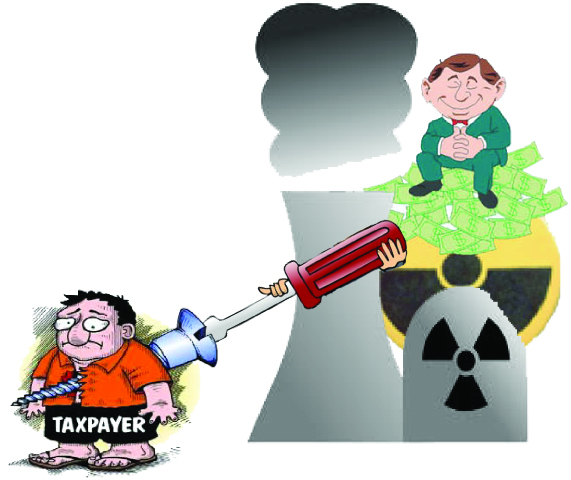
Ministers have agreed to take a £17.8 billion stake in the Sizewell C
nuclear power plant in a move that they claim will reduce carbon
emissions and even make money for the taxpayer. Under plans announced by
Rachel Reeves, the chancellor, the government will increase its investment
in the project by £14.2 billion over the next three years on top of £3.6
billion of public money committed under the Conservatives.
Further funding will come from the French energy group EDF, which is building the plant, as
well as private infrastructure investors. Whitehall sources said ministers
decided to take a larger stake because they were confident it would provide
a significant return to the taxpayer.
Under the funding model, investors
carry all the risk of cost overruns but are paid back through consumer
bills and can make more money if the project comes in on time and on
budget. The company said it had learnt lessons from Hinkley, in Somerset,
and can build Sizewell C, in Suffolk, faster and more cheaply.
However, it is still likely to cost much more than the estimated £20 billion in 2020
and will not produce power for at least another decade. The total cost will
be set out this summer when external private investors are announced.
Ultimately, the project will be paid for via consumers’ electricity bills,
adding about £1 a month to the cost of power over the 60-year lifespan of
the plant.
The announcement is among investments in nuclear at the spending
review as part of the government’s pledge to decarbonise electricity
supplies and cope with growing demand.
Alison Downes, of Stop Sizewell C, the campaign group, said ministers had not “come clean” about the full cost of the project, which the group previously estimated could be as much
as £40 billion. “Where is the benefit for voters in ploughing more
money into Sizewell C that could be spent on other priorities, and when the
project will add to consumer bills and is guaranteed to be late and
overspent, like Hinkley C?
Times 10th June 2025,
https://www.thetimes.com/uk/politics/article/sizewell-c-nuclear-power-plant-3z7jlqdd6
Campaigners launch legal challenge against Sizewell C’s ‘secret’ flood defences
09 Jun, 2025 By Rob Hakimian, New Civil Engineer,
Together Against Sizewell C (TASC) is seeking a judicial review over the development consent order (DCO) for the Suffolk nuclear power station, citing new concerns over unapproved flood defence measures that could adversely impact the environment and local heritage.
Since 2013, the community-based voluntary campaign group opposing the Sizewell C nuclear power project in Suffolk have campaigned against the construction of the twin European Pressurised Reactors (EPRs) on the Suffolk coast, an area renowned for its rapidly eroding shoreline and precious designated natural habitats, including RSPB Minsmere and the Suffolk Coast & Heaths National Landscape. The group’s latest salvo targets the recent disclosure that Sizewell C Ltd, now under UK government control, has committed to installing sea defences not included in the DCO, which was granted in July 2022.
TASC’s concerns stem from an Office for Nuclear Regulation (ONR) assessment document April 2024 about the external hazards to the Sizewell C site which was put together as part of the process of granting it a nuclear site licence (NSL). The group has said that the process has proposed “huge” flood defences in the case of adverse climate change, which were kept “secret” from the DCO process.
The ONR’s assessment document states: “Consideration of a site’s flood hazard is a fundamental part of ONR’s assessment of site suitability and is included within ONR’s external hazards NSL assessment. Ensuring that there is confidence that sufficient defences against flooding can be constructed, is similarly important and is included within ONR’s civil engineering NSL assessments……………………………………………….. https://www.newcivilengineer.com/latest/campaigners-launch-legal-challenge-against-sizwell-cs-secret-flood-defences-09-06-2025/
Sizewell C nuclear plant gets £14bn go-ahead from government
Alice Cunningham, BBC News, Suffolk, 9 June 25
The government has committed £14.2bn of investment to build the new Sizewell C nuclear plant on the Suffolk coastline, ahead of the Spending Review.
Sizewell Cwill create 10,000 direct jobs, thousands more in firms supplying the plant and generate enough energy to power six million homes, the Treasury said.
Chancellor Rachel Reeves saidthe “landmark decision” would “kickstart” economic growth, while Energy Secretary Ed Miliband said the investment was necessary to usher in a “golden age of clean energy”.
However, Alison Downes, director of pressure group Stop Sizewell C, said ministers had not “come clean” about Sizewell C’s cost, because “negotiations with private investors are incomplete”.
Once construction work begins, Sizewell C will take at least a decade to complete.
Reeves said it would be the “biggest nuclear building programme in a generation”.
Ms Downes added she believed the investment could be spent on other priorities and feared the project would “add to consumer bills”……………………………………………………..
Hinkley Point C in Somerset, the other new plant of which Sizewell C is a copy, will switch on in the early 2030s – more than a decade late and costing billions more than originally planned.
The Sizewell C investment is the latest in a series of announcements in the run-up to the government’s Spending Review, which will be unveiled on Wednesday……………………….
In the 1990s, nuclear power generated about 25% of the UK’s electricity. But that figure has fallen to about 15%, with all but one of the UK’s existing nuclear fleet due to be decommissioned by 2030.
The previous Conservative government backed the construction of Sizewell C in 2022.
Since then, Sizewell C has had other pots of funding confirmed by government, and in September 2023 a formal process to raise private investment was opened.
Ministers and EDF – the French state-owned energy company that has a 15% stake in Sizewell C -have previously said there were plenty of potential investors and they were close to finalising an agreement on it.
The final investment decision on the funding model for the plant is due later this summer.
The Sizewell C project has faced opposition at thelocal and national level from those who think it will prove to be a costly mistake.
“There still appears to be no final investment decision for Sizewell C but £14.2bn in taxpayers’ funding, a decision we condemn and firmly believe the government will come to regret,” she said.
“Starmer and Reeves have just signed up to HS2 mark 2,” she added, referring to the railway project mired by years of budget disputes and delays…………..
On Saturday about 300 protesters demonstrated on Sizewell beach against the project, with many concerned about how the plant would change the area’s environment………………..
https://www.bbc.co.uk/news/articles/c4gr3nd5zy6o
Another delay for Sizewell C nuclear despite Government 14bn pledge

ITV News. 10 June 2025
The government has confirmed a £14.2bn investment to build the Sizewell C nuclear plant – but still cannot confirm the project is fully funded.
Ministers claim the reactor – the third to be built on the Suffolk coast – will create 10,000 jobs, 1,500 apprenticeships, and generate enough “clean” energy to power millions of homes.
It will be part of a “golden age of clean energy abundance” which will pave the way for household bills and help tackle the climate crisis, according to Energy Secretary Ed Miliband.
But the government has had to stop short of issuing a “Final Investment Decision”, which can only be given once full investment has been secured.
Opponents insist the government “will come to regret” this latest backing for Sizewell C, claiming the project “will add to consumer bills and is guaranteed to be late and overspent”, comparing it to Hinkley Point C, the nuclear plant under construction in Somerset.
Sizewell, which sits just a few miles south of celebrity hotspot Southwold and borders the former Springwatch base at RSPB Minsmere, was first identified as a potential site for a new plant back in 2009.
The project was granted development consent by the then-Conservative government in July 2022 and Sir Keir Starmer made a further £5.5bn available to the project last August.
Preparatory work has already been started by French energy firm EDF and contracts worth around £330m have already been signed with local companies.
The government said Tuesday’s announcement would end “years of delay and uncertainty”.
“We will not accept the status quo of failing to invest in the future and energy insecurity for our country,” said Mr Miliband.
“We need new nuclear to deliver a golden age of clean energy abundance, because that is the only way to protect family finances, take back control of our energy, and tackle the climate crisis.
“This is the government’s clean energy mission in action – investing in lower bills and good jobs for energy security.”
The joint managing directors of Sizewell C, Julia Pyke and Nigel Cann, said: “Today marks the start of an exciting new chapter for Sizewell C, the UK’s first British-owned nuclear power plant in over 30 years.”But with an estimated cost of at least £20bn – and some experts predicting it could exceed £40bn – EDF continues to seek investors in the project.
The government said it expected to issue a Final Investment Decision in the summer.https://www.itv.com/news/anglia/2025-06-09/another-delay-for-sizewell-c-despite-governments-14bn-pledge
UK pledges £11.5bn of new state funding for Sizewell C nuclear plant.

Latest money raises total taxpayer investment in power station site to
£17.8bn. The move marks a return to significant state funding for nuclear
energy after the UK chose the private sector to finance and build its last
project, Hinkley Point C in Somerset, which is heavily delayed and over
budget.
The previous record public investment in nuclear energy was £2bn
for the Sizewell B plant in 1987, or £7bn in today’s prices. The UK
government already has a partnership with French state-owned energy group
EDF, which has kept a 15 per cent stake in Sizewell C.
The pair are now seeking financial commitments from several other investors before they can sign off a “final investment decision”, expected next month during an
Anglo-French summit in London.
The chancellor will promise £14.2bn of
taxpayer funding for the 3.2 gigawatt plant over the current parliament,
including a £2.7bn commitment she previously made in the autumn Budget. The
Treasury had already committed £3.6bn over the past two years.
EDF has said the final investment decision will depend on securing private investment
and on whether it can make its expected return on capital, but Simone
Rossi, the company’s UK chief executive, said the project would benefit the
UK’s “energy security and economic growth”. Private investors expected
to bid for stakes in Sizewell C include Canadian pension fund CDPQ, Amber
Infrastructure Partners, Brookfield Asset Management, pension fund USS,
Schroders Greencoat, Equitix, Centrica and insurer Rothesay.
The total cost of the project could be close to £40bn by the time it is built, industry
figures believe. State-owned Great British Nuclear will soon announce the
outcome of its competition to choose a company to start building a fleet of
“small modular reactors”. The government said it would also invest more
than £2.5bn in nuclear fusion over five years in what it called a “record
investment” in the nascent technology. Melanie Windridge, head of
advisory group Fusion Energy Insights, praised the government for
recognising the “economic value of developing fusion in this country”.
The sum is slightly less than the US is spending on fusion and one-third of
China’s annual investment on the technology.
FT 9th June 2025,
https://www.ft.com/content/e017efeb-0a9c-4d30-894f-86037a096984
Lincolnshire council pulls out of nuclear waste disposal siting process
Lincolnshire County Council has decided to withdraw from the geological
disposal facility (GDF) siting process – ending plans to potentially
store nuclear waste in the county. The council’s new executive voted to
withdraw from the Nuclear Waste Services’ (NWS’s) Community Partnership
on 3 June.
A Community Partnership in Theddlethorpe had been established by
the NWS as part of its search to find a GDF site with suitable geology for
storing higher activity radioactive waste underground. The council’s vote
means that it will no longer be a member of Theddlethorpe GDF Community
Partnership. The GDF siting process cannot continue without the support of
the council as the relevant principal local authority, and the Community
Partnership closed with immediate effect.
Ground Engineering 09 June, 2025 By Thames Menteth, https://www.geplus.co.uk/news/lincolnshire-council-pulls-out-of-nuclear-waste-disposal-siting-process-09-06-2025/
NFLAs welcome new group opposed to nuke waste dump in South Copeland

Hot on the heels of the victory in Lincolnshire, the UK/Ireland Nuclear
Free Local Authorities have welcomed the formation of a new ‘Anti GDF
Community Group’ in opposition to a Geological Disposal Facility (GDF) on
land near Millom and Haverigg in West Cumbria.
The GDF would be the final
repository for Britain’s inventory of legacy and future high-level
radioactive waste. Nuclear Waste Services has declared its interest in land
surrounding His Majesty’s Prison Haverigg and Bank Head Estate West of
Haverigg as the potential location for a future surface site for this
facility. This site is designated the Area of Focus in the South Copeland
GDF Search Area.
Following a meeting held by Whicham Parish Council on
Wednesday, at which a resolution was carried unanimously calling on NWS to
withdraw this area from consideration, a statement was issued by the new
group. There is also now a new private Facebook group for impacted
residents to join and a group logo.
The ‘Anti GDF Community Group’ will
aim to support and seek support from both Whicham and Millom Council in
their respective rejections of the area of focus and try to ensure that NWS
and Cumberland Council abide by the NWS statement “that express consent
must be given by those living alongside a GDF” Presently the group is
formed by a small committee and is seeking members to support the group
objective of removal from the process of the Kirksanton/Haverigg site. The
group will aim to support those who have and are being severely impacted
now and seek to demonstrate the flawed process and the contempt our
communities have been shown within that process.
NFLA 9th June 2025, https://www.nuclearpolicy.info/news/nflas-welcome-new-group-opposed-to-nuke-waste-dump-in-south-copeland/
Cumbrians receive postal call to back nuke dump democracy petition
NFLA 9th June 2025, https://www.change.org/p/massive-mine-shafts-and-nuclear-dump-for-cumbria-coast-tell-cumberland-council-vote-now
Residents of Millom, Seascale and Gosforth have just received a flyer from campaign group Radiation Free Lakeland calling on them to back a petition which asks Cumberland Councillors to host a debate followed by a vote about their engagement with the siting process for a Geological Disposal Facility in West Cumbria.
The GDF would be the eventual repository for Britain’s high-level radioactive waste which would be placed in tunnels beneath the seabed. A site in East Lincolnshire was also under consideration as a possible site. With the withdrawal of Lincolnshire County Council from the process last week, only sites in Mid and South Copeland in West Cumbria remain in contention and then only because Cumberland Council remains engaged in the process.
Bizarrely Cumberland Council only became involved in the process by default. The new authority on replacing Copeland District Council chose to accept unquestionably that Council’s decision to participate in the GDF process, even though the decision to participate had been taken by only four Copeland Councillors. There has never been any debate or vote amongst Cumberland Councillors about whether they should have accepted this obligation or still wish to continue with the process.
The petition calls on Cumberland Council to convene a belated special meeting of the Full Council where Councillors can debate and then vote on whether to continue to remain engaged or remain represented on the Mid and South Copeland GDF Community Partnerships. If Councillors say no, then the process would end, and NWS would withdraw. The NFLAs is happy to support Radiation Free Lakeland in urging all Cumbrians to sign it.
Here are links to the petition:
www.change.org/CumbriaNuclearDump https://www.change.org/p/massive-mine-shafts-and-nuclear-dump-for-cumbria-coast-tell-cumberland-council-vote-now
Firm fined £26k after worker exposed to radiation at Teesside site

Mistras Group Limited was fined £26,000 after a radiographer was overexposed to ionising radiation while working at a site in Hartlepool.
By Nicole Goodwin, City Centre Reporter, Jade McElwee, Content Editor,
Teesside Gazette 7th June 2025, https://www.gazettelive.co.uk/news/teesside-news/mistras-group-limited-radiation-hartlepool-31808465
A global firm has been slapped with a £26,000 fine after a radiographer was exposed to ionising radiation at a North East site.
The 69-year-old man was working for Mistras Group Limited in December 2020 when the company was alerted by their approved dosimetry service that he had received a dose exceeding legal limits. The Health and Safety Executive (HSE) was also informed, leading to the prosecution of the company following an investigation.
Ionising radiation is widely used in various industries including energy production, manufacturing, medicine and research. While it offers numerous benefits to society, it’s crucial that its risks are sensibly managed to safeguard workers and the public.
The incident occurred at Mistras Group Limited’s former Hartlepool site when a gamma emitting radioactive source used for radiography failed to return to its shielded container. Due to lax adherence to the company’s own radiation safety protocols, this wasn’t promptly identified, resulting in the radiographer being overexposed to radiation.
Although no symptoms were reported, excessive exposure to ionising radiation can heighten the risk of developing certain cancers. The HSE investigation discovered that pre-use safety checks hadn’t been completed and recorded by the radiographer, reports Chronicle Live. These checks are vital stages in verifying that radiography systems are functioning properly and ensuring the safe use of equipment.
The firm Mistras Group Limited was hit with a £26,000 fine and must pay £11,353 in costs after admitting to breaches of radiation safety regulations at Newton Aycliffe Magistrates’ Court on May 22. The company, based in Norman Way, Cambridge, had provided alarming Electronic Personal Dosemeters (EPDs) and radiation monitors to employees, yet it emerged that a radiographer failed to use the equipment; this could have alerted them to dangerous radiation levels allowing for a safe retreat.
Radiation incidents had not been reported correctly. Additional failings by the company to ensure adherence to radiation protection rules and procedures included not following local rule instructions and insufficient supervision leading to a lack of compliance. Moreover, the firm previously faced enforcement actions from HSE for similar shortcomings.
Commenting on the case, HSE’s radiation specialist inspector Elizabeth Reeves stated: “Industrial radiography is a hazardous practice if not managed properly. Radiation protection is an area where employers and employees must not become complacent with.
“Safety checks and the use of monitoring equipment such as EPD’s and radiation monitors are essential elements to ensuring the safe operation of equipment and protection to personnel. This prosecution demonstrates that the courts, and HSE, take failure to comply with the regulations extremely seriously.”
The HSE’s enforcement lawyer, Jonathan Bambro, and paralegal officer, Rebecca Forman, led the prosecution in this case.
Britain has escalated the global nuclear arms race – and is bringing us closer to armageddon

Simon Tisdall, 8 June 2025, https://www.theguardian.com/commentisfree/2025/jun/08/uk-strategic-defence-review-nuclear-arms-race-armageddon
The UK’s strategic defence review risks normalising nuclear warfare. Don’t believe the PR hype: these weapons are immoral, irrational and catastrophic.
Britain has escalated the global nuclear arms race – and is bringing us closer to armageddon

The UK’s strategic defence review risks normalising nuclear warfare. Don’t believe the PR hype: these weapons are immoral, irrational and catastrophicSun 8 Jun 2025 15.00 AESTShare1,163
Plans by Keir Starmer’s government to modernise and potentially expand Britain’s nuclear weapons arsenal, unveiled in the 2025 strategic defence review (SDR), seriously undermine international non-proliferation efforts. They will fuel a global nuclear arms race led by the US, China and Russia. And they increase the chances that lower-yield, so-called tactical nukes will be deployed and detonated in conflict zones.
This dangerous path leads in one direction only: towards the normalisation of nuclear warfare.
These unconscionable proposals are a far cry from the days when Robin Cook, Labour’s foreign secretary from 1997 to 2001, championed unilateral nuclear disarmament and helped scrap the UK’s airdropped gravity bombs. They are a continuation of a redundant, inhuman, immoral, potentially international law-breaking deterrence policy that cash-strapped Britain can ill afford, will struggle to implement at cost and on time, and which perpetuates illusions about its global power status.
Starmer’s justification for spending an additional £15bn on nuclear warheads for four as yet un-built Dreadnought-class submarines, whose price tag is £41bn and rising, is that the world – and the threat – has changed. But in terms of nuclear arms, it really hasn’t. Even as cold war tensions receded, the eight other known nuclear-weapons states – the US, Russia, China, France, India, Pakistan, North Korea and Israel – clung on to their arsenals. Some expanded them.
Today, as the global security environment deteriorates again, governments that ignored an obligation to pursue nuclear disarmament “in good faith” under article six of the 1970 non-proliferation treaty (NPT) are finding new reasons to keep on doing so. Britain must not compound its decades-long failure to honour the spirit of the treaty. The SDR’s assertion that “continued UK leadership within the NPT is imperative” seems disingenuous, given government intentions.
The SDR concedes the NPT, up for review next year, is close to failing. “Historical structures for maintaining strategic stability and reducing nuclear risks have not kept pace with the evolving security picture,” it says. “With New Start [the 2010 US-Russia strategic arms reduction treaty] set to expire in February 2026, the future of strategic arms control – at least in the medium term – does not look promising.”
This is a Trident missile-sized understatement. Nuclear proliferation is once again a huge problem. The US will spend an estimated $2tn over 30 years on weapons development. Donald Trump said in February he wants to “denuclearise”. Guess what! He’s doing the opposite. The White House is seeking to raise the National Nuclear Security Administration’s annual weapons budget by 29%, to $25bn, while slashing funding for the arts, sciences and foreign aid. That’s on top of several multibillion-dollar Pentagon weapons programmes.
China’s nuclear strike force has more than doubled in size since 2020, with some pointed at Taiwan. Russia’s expanding capabilities include a nuclear-capable hypersonic missile, recently fired into Ukraine. And Trump’s Golden Dome plan upends prior undertakings on anti-missile defence. By joining the proliferators, hypocritical Britain sends a cynical signal to Iran, Saudi Arabia and others whose supposed nuclear ambitions it opposes.
One future scenario is especially chilling: the possible reintroduction by Britain of air-launched nuclear weapons for the first time since Cook scrapped them. This could involve buying US F-35A fighters and arming them with US-designed B61-12 bombs. These bombs have variable yields and could be used tactically, against a battlefield target, a command HQ or a city. They could be launched remotely, using unmanned drones. They bring the prospect of nuclear warfare measurably closer.
Starmer is leaning heavily on the review’s claim that Russian “nuclear coercion” is the biggest menace facing the UK. Even if true, no amount of nuclear missiles and bombs may suffice if political will is lacking to directly confront Vladimir Putin by, for example, deploying Nato conventional forces to defend Ukraine and responding forcefully to hybrid attacks on Britain. Like the former US president Joe Biden, Starmer gives too much credence to Moscow’s crude threats. Putin knows that if he presses the nuclear button, it will explode in his face. He’s many things – but not suicidal.
This is the conundrum at the heart of nuclear deterrence theory. Nuking a nuclear-armed adversary guarantees self-destruction (which is why India and Pakistan jibbed at all-out war last month). And hurling nuclear threats at states and foes that lack nuclear weapons is ineffective. As Ukraine shows, they grow more defiant. As a weapon, nuclear blackmail is overrated. Fear of British nukes did not deter Argentina’s 1982 Falklands invasion. Nukes did not stop al-Qaida in 2001 or Hamas in 2023. So why have nukes at all?
Retaining nuclear weapons at current or increased levels does not make Britain safer. Their use would be immoral, irrational and catastrophic. They are grossly expensive, consuming resources that the UK, facing painful Treasury cuts again this week, could more sensibly use to build hospitals and schools and properly equip its armed forces.
It’s uncertain how independent of the US the British deterrent really is in practice. Does Starmer or Trump have the final word on use? Official secrecy prevents adequate democratic scrutiny. And the idea that nuclear warfare, once the taboo is broken, might somehow be contained or limited is a fast-track ticket to oblivion. Gradual disarmament, not rearmament, is the only way to escape this nightmare.
The SDR urges a government PR campaign to convince the British people of the “necessity” of a nuclear arsenal. No thanks. As Russia again raises nuclear war fears, what’s needed is public education about the dangers of weapons proliferation. People worry about everything from an existential global climate emergency to the cost of living. But what we’re discussing here is the universal cost of dying.
Nuclear warfare is the most immediate threat to life on earth. Worry about that first. It’s a shortcut to apocalypse – now.
1 This Month
29 Jan. Thursday 7-8 p.m. Webinar – World’s Largest Nuclear Station in Port Hope, ON?
To see nuclear-related stories in greater depth and intensity – go to https://nuclearinformation.wordpress.com/



31st January – Challenging the War Machine – a DECLASSIFIED UK SUMMIT


Website of the Week
Now until to February 10, 2026 Radioactive waste storage in France: the debate is finally open! How to participate?
-
Archives
- January 2026 (288)
- December 2025 (358)
- November 2025 (359)
- October 2025 (376)
- September 2025 (258)
- August 2025 (319)
- July 2025 (230)
- June 2025 (348)
- May 2025 (261)
- April 2025 (305)
- March 2025 (319)
- February 2025 (234)
-
Categories
- 1
- 1 NUCLEAR ISSUES
- business and costs
- climate change
- culture and arts
- ENERGY
- environment
- health
- history
- indigenous issues
- Legal
- marketing of nuclear
- media
- opposition to nuclear
- PERSONAL STORIES
- politics
- politics international
- Religion and ethics
- safety
- secrets,lies and civil liberties
- spinbuster
- technology
- Uranium
- wastes
- weapons and war
- Women
- 2 WORLD
- ACTION
- AFRICA
- Atrocities
- AUSTRALIA
- Christina's notes
- Christina's themes
- culture and arts
- Events
- Fuk 2022
- Fuk 2023
- Fukushima 2017
- Fukushima 2018
- fukushima 2019
- Fukushima 2020
- Fukushima 2021
- general
- global warming
- Humour (God we need it)
- Nuclear
- RARE EARTHS
- Reference
- resources – print
- Resources -audiovicual
- Weekly Newsletter
- World
- World Nuclear
- YouTube
-
RSS
Entries RSS
Comments RSS
 nuclear-news