Britain’s Wyfa nuclear power project – one hell of a cost to the taxpayer.
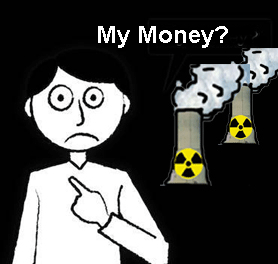
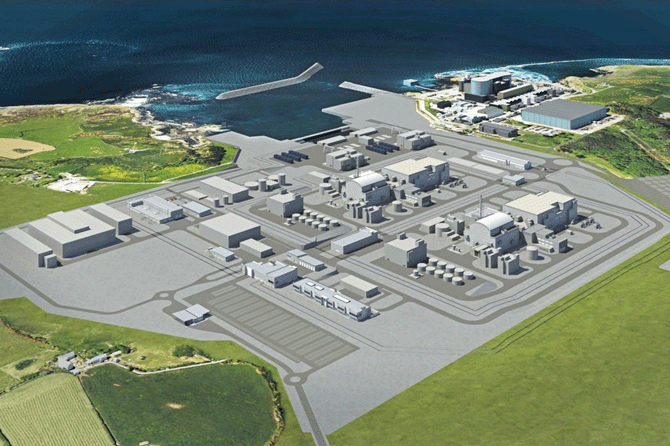 Dave Toke’s Blog 11th Nov 2018 ,Greg Clark looks likely to go down in history as the Minister who signs off
on a nuclear construction deal with Hitachi for the proposed Wylfa power plant that led to a stupendous loss for the taxpayer. That loss might be £20 billion or more.
Clark has apparently put no discernable effort into the objective of securing ‘subsidy’ free contracts for onshore wind and solar. However, he has been spending a lot of time concocting a plan to finance the Wylfa nuclear power plant that will, on the basis of past performance, generate huge losses for the public purse years down the line.
All the talk from BEIS (the energy ministry) is of the new ‘Regulated Asset Base’ (RAB) financing of nuclear power plant. Except that what’s really happening is not really an RAB model at all. It’s a piece of brownwash to obscure the reality of Government blank cheque to cover whatever it costs to build the nuclear plant. That’s because the whole plan hinges on the constructors being able to pass on cost-overruns onto the Government.
And that’s the point. Nuclear power stations being built in the west have almost always tended to have large cost overruns. Recent ones have ALL suffered horrendous cost overruns – in the USA (4), France (1) and Finland (1).
Yet, some otherwise sensible, financial analysts seem to ignore this fact as they extol the virtues of RAB financing. They implicitly assume that Wylfa will proceed precisely on target, in which case, they say the Government will deliver the project at a ‘cheaper’ price than Hinkley C through the provision of Government loans with low interest rates.
Sure, the headline price that will be paid by the electricity consumer, over 35 years, will be a bit cheaper. But that’s likely to be at one hell of a cost to the taxpayer.
http://realfeed-intariffs.blogspot.com/2018/11/how-greg-clarks-hitachi-deal-could-lead.html
Doomed Moorside nuclear project might have provided 2% of UK energy needs, NOT 7%
Times 12th Nov 2018 , David Lowry 12 Nov 18 Alistair Osborne is correct in his acute analysis of the financial failure of new nuclear in the UK (“No surprise Toshiba went cold on idea”,Times, Nov 9), except for one important matter: he conflates energy with electricity.
The planned output capacity for the doomed Moorside nuclear plant would not have provided “7 per cent of our energy needs”, but of the UK’s power generating capacity, which is the equivalent of about only 2 per cent of current national energy demand. Conflating the two inflates the importance of nuclear to UK energy balance, thus distorting its political salience.
https://www.thetimes.co.uk/edition/comment/brexit-and-the-value-of-a-second-referendum-dk8fgmw6w
NuGen’s failing Moorside nuclear project will cost Cumbrian residents a multimillion-pound bill for the preparatory work

 Times 10th Nov 2018 Consumers face a multimillion-pound bill for work carried out in preparation for the proposed Cumbrian nuclear plant that may never be built.
National Grid said that it had spent tens of millions of pounds planning the 100-mile power line to connect Nugen’s Moorside plant to the electricity transmission network. Much of the cost is expected to be recovered from households and businesses via levies on their energy bills for decades to come. John Pettigrew, chief executive, said that work on the Moorside line had cost “tens of millions” of pounds and that there was a “regulatory process” to recover the costs.
Nugen is obliged to cover some of the cost, but one industry source said that it was on the hook for a little more than £10 million, while National Grid’s expenditure was thought to be in the high double digits. National Grid is expected to submit a claim to Ofgem, the energy regulator, to recoup the rest from consumers.
The regulator can refuse to allow expenditure it deems inefficient, but the rules are thought likely to allow the company to recover at least half of its costs. The eventual £2.8 billion proposal included £1.9 billion of “measures to reduce its impact on people, places and the environment”, including burying the lines through a 14-mile stretch of the Lake District and a 13-mile tunnel under MorecambeBay.
https://www.thetimes.co.uk/article/f1630fa6-e458-11e8-9838-efa7e96cbe2b
For Britain’s next nuclear boondoggle – Wylfa project, households might have to pay upfront for the construction.
Times 11th Nov 2018 The business secretary Greg Clark held a crunch meeting with Hitachi in Tokyo last week over its planned £15bn Welsh nuclear power station, as a rival Japanese project collapsed. Toshiba killed off its NuGen power station plan in Cumbria last week after the ailing industrial giant struggled to find a buyer – denting Britain and Japan’s nuclear ambitions.
Toshiba’s exit leaves Britain’s nuclear power renaissance reliant on France’s EDF and Japan’s Hitachi. Clark is understood to have attended a dinner with the Hitachi chairman Hiroaki Nakanishi during a visit to Japan, where they discussed sealing a deal on Hitachi’s Horizon power station on Anglesey by Easter.
The British and Japanese governments are expected to take equal equity stakes in Horizon alongside Hitachi. Whitehall is also expected to provide all the debt for the 2.7 gigawatt project, which would be sold once it has started generating power. Clark agreed to help bankroll the Horizon project in June, marking a departure from previous policy.
Ministers want Horizon and Hinkley to replace a string of ageing coal and nuclear power plants that are due to close over the next decade. Under pressure from ministers, Hitachi is considering using a different form of financing – a regulated asset base – for future reactors on Anglesey and in Gloucestershire.
However, that risks further controversy as it would mean households fund the project before it has been completed. Clark’s latest visit also reflects growing tension between Tokyo and London over Brexit.
https://www.thetimes.co.uk/article/97c7a1de-e514-11e8-aa8a-1a554b586cbd
Cumbria Trust questions the independence of the Committee on Radioactive Waste Management (CoRWM)
Cumbria Trust 11th Nov 2018 , The Committee on Radioactive Waste Management (CoRWM) which advises BEIS on dealing with nuclear waste, has recently published a paper which Cumbria
Trust believes calls into question their independence. They are supposed to
act as an independent body, but some of their recent actions suggest to us
that they are too close to BEIS and failing to adequately perform their
advisory function and to challenge poor decision-making. A government
department which surrounds itself, and only listens to people who agree
with it, is at significant risk of repeating past mistakes. Cumbria Trust
have written the letter (below) to CoRWM expressing our concerns.
https://cumbriatrust.wordpress.com/2018/11/11/has-corwm-lost-its-independence/
Toshiba’s failure shows business can’t deliver a nuclear future
 Guardian,9 Nov 18 , Phillip Inman As Cumbria reactor plan stalls, it is clear that huge resources are needed for such projects. If the government was keen to boost Britain’s nuclear industry, it was always clear that the private market would struggle to deliver.
The decision by Toshiba to close down its UK operations is a case in point. After the deal to build new reactors at Hinkley Point with the French firm EDF, Toshiba was favoured by ministers to design and construct a smaller power station on the Cumbrian coast.
Hinkley was a deal that appeared to be with a private company but the really meaningful talks were between Whitehall officials and their counterparts in the French government, EDF’s controlling shareholder. It took years of agonising brinkmanship to conclude the talks, much of them conducted on the French side by the then economy minister, Emmanuel Macron.
Toshiba, on the other hand, is a private company struggling on its own to navigate the complex politics surrounding nuclear power in the wake of the Fukushima disaster.
In 2006 it bought the US nuclear business Westinghouse, part of British Nuclear Fuels and home to much of the UK’s nuclear power industry. With climate change creeping to the top of the agenda and demand for new nuclear plants around the world growing, it seemed like a good idea.
However, the 2011 Fukushima disaster changed all that. Governments in Japan and other countries halted the development of new nuclear plants. Last year, cost overruns on building the first new US nuclear power plants in three decades pushed Westinghouse into bankruptcy and Toshiba into financial meltdown. The future of the Cumbrian nuclear plant has been in doubt ever since.
Earlier this year Toshiba sold Westinghouse to a private equity outfit as a services provider for existing nuclear plants. The construction of new reactors was not on the agenda. To no one’s surprise, Toshiba has now confirmed it has abandoned building any new plants in the UK.
Without entering the argument about whether nuclear is a good option – and the government advisory body, the National Infrastructure Commission, is unequivocal that renewables such as wind and solar were going to be a safer, cheaper option – it is clear huge commitments of time, resources and political capital are necessary for infrastructure projects of this scale to get off the ground and through to completion.https://www.theguardian.com/business/2018/nov/08/toshibas-failure-shows-business-cant-deliver-a-nuclear-future
Plans for a new nuclear power station in Cumbria have been scrapped
 UK nuclear power station plans scrapped as Toshiba pulls out, Guardian, Adam Vaughan@adamvaughan_uk, 8 Nov 2018 Firm’s nuclear arm to wind up next year and scrap Cumbria plant leaving big hole in UK energy plans Plans for a new nuclear power station in Cumbria have been scrapped after the Japanese conglomerate Toshiba announced it was winding up the UK unit behind the project.
Toshiba said it would take a 18.8bn Japanese yen (£125m) hit from closing its NuGeneration subsidiary, which had already been cut to a skeleton staff,after it failed to find a buyer for the scheme.
The decision represents a major blow to the government’s ambitions for new nuclear and leaves a huge hole in energy policy. The plant would have provided about 7% of UK electricity.
“This is a huge disappointment and a crushing blow to hopes of a revival of the UK nuclear energy industry,” said Tim Yeo, the chair of pro-nuclear lobby group New Nuclear Watch Institute and a former Tory MP.
Greenpeace UK’s executive director, John Sauven, said: “The end of the Moorside plan represents a failure of the government’s nuclear gamble.”
After a board meeting of Toshiba on Thursday, the company said it was winding up NuGeneration because of its inability to find a buyer and the ongoing costs it was incurring. The firm has already spent more than £400m on the project.
“Toshiba recognises that the economically rational decision is to withdraw from the UK nuclear power plant construction project, and has resolved to take steps to wind-up NuGen,” the firm said in a statement………
Some industry watchers said the collapse of the scheme should be seen as an opportunity rather than a risk, for the UK to prioritise renewables instead.
Jonathan Marshall, an analyst at the ECIU thinktank, said: “Shifting away from expensive, complicated technology towards cheaper and easier to build renewables gives the UK the opportunity to build an electricity system that will keep bills for homes and businesses down for years to come.”
The government’s infrastructure advisers recently urged ministers to rethink their nuclear plans and focus on renewables instead……..https://www.theguardian.com/environment/2018/nov/08/toshiba-uk-nuclear-power-plant-project-nu-gen-cumbria
Toshiba dumps its UK nuclear business
 Toshiba Ditches UK Nuclear Business, U.S. LNG Operations, Oil Price.com Toshiba will also liquidate another nuclear subsidiary in the UK, Advance Energy UK Limited. The loss that the company will book from the wind-ups will come in at US$130 million (15 billion yen) and will be booked in its 2018/19 results………
Earlier this year, Toshiba sold its U.S. nuclear power business, Westinghouse, for US$4.6 billion to a group of investment companies led by Brookfield Asset Management. The deal puts an end to a major headache for the Japanese conglomerate, which last year warned that it might have trouble surviving if it didn’t find a buyer for the nuclear power plant constructor, which it acquired in 2006 for US$5 billion.
Plagued by project delays and cost overruns that came up to US$6 billion for two large-scale projects in the United States, Westinghouse filed for Chapter 11 bankruptcy protection last March. The business had by that time generated US$6.3 billion in writedowns for the parent company that resulted in Toshiba reporting a net loss of US$9.1 billion for 2016……..https://oilprice.com/Latest-Energy-News/World-News/Toshiba-Ditches-UK-Nuclear-Business-US-LNG-Operations.html
Britain’s Bradwell nuclear project under scrutiny- risks of flooding, water overuse, environmental degradation
BANNG 7th Nov 2018 , BANNG’s visit to the Bradwell B site (reported on in the October edition)
gave an opportunity to discuss the early site assessment undertaken by the
company.
The question in all our minds was: ‘is this a suitable site for
the Bradwell B nuclear complex?’ At this stage the developer’s answer
is nuanced: a case of we hope so but we are a long way from knowing.
The Bradwell project is currently under scrutiny by the regulatory authorities
in a process known as Generic Design Assessment. Taken together the site
assessment and the GDA provide an opportunity for BANNG to press concerns
about three key issues which, we believe, make the site wholly unsuitable
and unsustainable.
The first is the high probability risk of flooding
‘especially during the later stages of operation and decommissioning of a
potential nuclear power station’. Second, is the issue of providing the
vast quantities of water needed to cool the reactors. The third issue is
the environmental destruction this project would cause.
https://www.banng.info/news/bradwell-b-an-unsuitable-site-for-development/
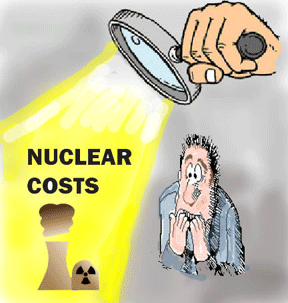
Toshiba closes down its UK operations – showing that nuclear power is just not commercially viable
 Toshiba’s failure shows business can’t deliver a nuclear future, Guardian, 9 Nov 18 Phillip Inman
As Cumbria reactor plan stalls, it is clear that huge resources are needed for such projects. If the government was keen to boost Britain’s nuclear industry, it was always clear that the private market would struggle to deliver.
The decision by Toshiba to close down its UK operations is a case in point. After the deal to build new reactors at Hinkley Point with the French firm EDF, Toshiba was favoured by ministers to design and construct a smaller power station on the Cumbrian coast.
Hinkley was a deal that appeared to be with a private company but the really meaningful talks were between Whitehall officials and their counterparts in the French government, EDF’s controlling shareholder. It took years of agonising brinkmanship to conclude the talks, much of them conducted on the French side by the then economy minister, Emmanuel Macron.
Toshiba, on the other hand, is a private company struggling on its own to navigate the complex politics surrounding nuclear power in the wake of the Fukushima disaster.
In 2006 it bought the US nuclear business Westinghouse, part of British Nuclear Fuels and home to much of the UK’s nuclear power industry. With climate change creeping to the top of the agenda and demand for new nuclear plants around the world growing, it seemed like a good idea.
However, the 2011 Fukushima disaster changed all that. Governments in Japan and other countries halted the development of new nuclear plants. Last year, cost overruns on building the first new US nuclear power plants in three decades pushed Westinghouse into bankruptcy and Toshiba into financial meltdown. The future of the Cumbrian nuclear plant has been in doubt ever since.
Earlier this year Toshiba sold Westinghouse to a private equity outfit as a services provider for existing nuclear plants. The construction of new reactors was not on the agenda. To no one’s surprise, Toshiba has now confirmed it has abandoned building any new plants in the UK.
Without entering the argument about whether nuclear is a good option – and the government advisory body, the National Infrastructure Commission, is unequivocal that renewables such as wind and solar were going to be a safer, cheaper option – it is clear huge commitments of time, resources and political capital are necessary for infrastructure projects of this scale to get off the ground and through to completion.https://www.theguardian.com/business/2018/nov/08/toshibas-failure-shows-business-cant-deliver-a-nuclear-future
Frazer Nash nuclear helps nuclear lobby to infiltrate academia

|
C2I 2018: South-West Nuclear Hub delivers access to nuclear skills
Category: Academic Innovator Supported by a £2.5m Catalyst Fund grant from HEFCE and £5m from the University of Bristol, the hub takes advantage of its proximity to a number of nuclear operations. These include the Magnox power station at Oldbury in Gloucestershire, decommissioning reactors at Berkeley, also Gloucestershire, Hinkley Point A in Somerset and Winfrith in Dorset, and the growing construction site for the new EPR reactor at Hinkley Point. Further afield but still within reach are another decommissioning power station at Trawsfynydd in Snowdonia and Wylfa on Anglesey. It also counts the nuclear fusion research centre at Culham in Oxfordshire, the Harwell research Centre and the nuclear submarine dismantling programme at Devonport as within its catchment area. Bristol and Oxford universities are already linked by a joint nuclear research centre (NRC) and the hub leverages this collaboration. …….Each research theme has a senior academic lead coordinating activity and identifying potential connections with other universities, including Oxford and the nearby University of the West of England……. The Nucleate centre is to be another collaboration, with partnerships between the University of Bristol, National laboratory and EDF Energy ……. Public engagement is also a key focus of the hub. It coordinates both national and regional outreach activities, which include a nuclear seminar series of public lectures. The hub acts as an independent gateway for promoting public understanding of nuclear energy, framing it within the context of climate change mitigation…….. The Headline sponsor for C2I2018 is Frazer-Nash Consultancy https://www.theengineer.co.uk/academic-innovator-south-west-nuclear-hub/
|
|
|
NuGen nuclear power project in Moorside, Cumbria, UK, soon to bite the dust?
 Sunday Times 4th Nov 2018 Plans to build a nuclear power station to provide up to 7% of the
country’s electricity could be ditched within days after talks with a
potential buyer stalled.
The planned NuGen plant in Moorside, Cumbria, has
been in trouble since financial problems emerged in 2016 at the owner,
Toshiba, and its nuclear subsidiary Westinghouse Electric filed for
bankruptcy protection.
Toshiba has been trying to sell the project.
However, talks with South Korea’s state-owned Korean Electric Power
Corporation (Kepco) have yet to lead to a deal, and Kepco was stripped of
preferred bidder status in August.
It is thought that Toshiba’s board is
set to meet in Tokyo on Thursday, when directors will decide whether to
continue trying to find a buyer or to wind up the project, which is
believed to have been costing millions of pounds a month.
Winding up NuGen— seen as the likely outcome — would deal a big blow to the
government’s energy strategy. NuGen had been due to start powering about
6m homes from 2025. The private equity firm Brookfield, which bought
Westinghouse, was also in talks with Toshiba over the deal but it is
believed these have collapsed. China’s CGN has also been interested.
https://www.thetimes.co.uk/edition/business/crunch-talks-to-rule-on-cumbria-nuclear-plant-gvtg2ztrh
UK could be running solely on zero carbon renewable in summer months 2050.
 Business Green 2nd Nov 2018 The UK power market will be able to withstand huge volumes of new renewable
generation coming on line according to new research, which suggests the
country could be running solely on zero carbon power during the summer
months by 2050.
explores what happens to the UK power market as it transitions to a high
level of renewable power. Aurora modelled a 2050 scenario where power
demand has risen by two-thirds from today, thanks to the rise of EVs, and
the grid now boasts 130GW of nuclear, wind and solar generation capacity.
effectively lead to zero-carbon summers for the UK electricity grid under
this scenario, according to Aurora. But such large volumes of renewable
power would also “fundamentally alter” the workings of the power market,
with price crashes in the summer months as green power generation soars.
https://www.businessgreen.com/bg/news/3065602/aurora-er-uk-could-enjoy-zero-carbon-summer-power-by-2050
UK’s Sellafield nuclear decommisioning ‘a misuse of public funds’
 CORE 31st Oct 2018 The findings of the spending watchdog’s latest report on the status of
Sellafield’s clean-up projects and costs makes yet more dreary reading
for the UK taxpayer – the costs described as ‘a misuse of public
funds’ by a spokesman for the report’s authors the Government’s
Public Accounts Committee (PAC).
criticism of the way the Nuclear Decommissioning Authority (NDA) is
managing many of the major projects needed to clean up Sellafield. The site
currently receives some £2Bn of public money every year and, over the next
100+ years of decommissioning is expected to cost a total of £91Bn.
raises the spectre of the UK’s plutonium stockpile (40% of the world’s
global stock) and the latest thinking by Government on its long-term
plutonium management options. [An NDA FoI response to CORE (29.10.18)
suggests an update on its plutonium plans is currently being finalised by
the NDA and could be published in the next month or so]
http://corecumbria.co.uk/briefings/spendthrift-sellafield-wayward-governance-and-the-latest-plutonium-view/?doing_wp_cron=1541014253.9727599620819091796875
The tide is turning against nuclear power, following the IPCC Report
 NuClear News, Nov 18 Tide Turns Against Nuclear http://www.no2nuclearpower.org.uk/wp/wp-content/uploads/2018/10/NuClearNewsNo112.pdf NuClear News, Nov 18 Tide Turns Against Nuclear http://www.no2nuclearpower.org.uk/wp/wp-content/uploads/2018/10/NuClearNewsNo112.pdf
Following the recent National Infrastructure Assessment which advised the Government not to build more than two new nuclear stations (about 6GW) (1) and the Committee on Climate Change (CCC) statement that “If new nuclear projects were not to come forward, it is likely that renewables would be able to be deployed on shorter timescales and at lower cost,” (2) we have now seen the International Panel on Climate Change (IPCC) report making some pretty disparaging remarks about nuclear power. Perhaps the tide is finally turning. The IPCC latest findings tell a nightmarish tale—one much worse than in previous reports— surveying the climate-change impacts we’re already experiencing with one degree of warming, and the severity of the impacts to come once we surpass 1.5 degrees of warming. Ten million more people would be exposed to permanent inundation, and several hundred million more to “climate-related risks and susceptible to poverty.” Malaria and dengue fever will be more widespread, and crops like maize, rice, and wheat will have smaller and smaller yields— particularly in sub-Saharan Africa, Southeast Asia, and Central and South America. Security and economic growth will be that much more imperilled. “Robust scientific literature now shows that there are significant differences between 1.5 and 2 degrees,” Adelle Thomas, a geographer from the Bahamas and also one of the report’s lead authors, told the New Yorker. “The scientific consensus is really strong. It’s not just a political slogan: ‘1.5 to stay alive.’ It’s true.” (3) But the IPCC report points out that “the transition from the energy system that would be needed to limit global warming to 1.5 ° C is underway in many sectors and regions of the world. The technical, social, economic and political feasibility of solar energy, wind energy, and electricity storage technologies has improved considerably in recent years, while nuclear energy and Carbon dioxide (CCS) storage in the electricity sector did not show the same improvements.”
Nuclear: too weak, too slow, too expensive and too risky The IPCC report continues saying the timeframe between the date of decision and the commissioning of nuclear power plants is between 10 and 19 years, and current deployment capacity is slowed by public concern about the risk of accidents and problems with nuclear waste. In addition, the IPCC notes, that “the costs of nuclear energy have increased over time in some developed nations, mainly because of the prevailing conditions, where increased investment risks in high-capital-intensive technologies have become important.” The theoretical benefits that nuclear energy could bring in the fight against climate change are therefore far too weak, too slow, too expensive and too risky. While the IPCC report requires us to quickly reduce emissions, it is not possible to choose the slowest and most expensive electric generation technology to deploy, as well as the dirtiest and riskiest. Nuclear power is disqualified from the race of the climatic fight. (4)
The IPCC report also says: “In spite of the industry’s overall safety track record, a non-negligible risk for accidents in nuclear power plants and waste treatment facilities remains. The long-term storage of nuclear waste is a politically fraught subject, with no large-scale long-term storage operational worldwide. Negative impacts from upsteam uranium mining and milling are comparable to those of coal, hence replacing fossil fuel combustion by nuclear power would be neutral in that aspect. Increased occurrence of childhood leukaemia in populations living within 5 No2NuclearPower nuClear news No.112, November 2018 3 km of nuclear power plants was identified by some studies, even though a direct causal relation to ionizing radiation could not be established and other studies could not confirm any correlation”.
An April 2018 report from the International Renewable Energy Agency (IRENA) shows, renewable energy and energy efficiency can, in combination, provide over 90% of the necessary energy-related CO2 emission reductions the world needs. Furthermore, this can happen using technologies that are safe, reliable, affordable and widely available. While different paths can mitigate climate change, renewables and energy efficiency provide the optimal pathway to deliver most of the emission cuts needed at the necessary speed. But renewable energy will need to be scaled up at least six times faster for the world to meet the decarbonisation and climate mitigation goals set out in the Paris Agreement.
The total share of renewable energy must rise from around 18% of total final energy consumption (in 2015) to around two-thirds by 2050. Over the same period, the share of renewables in the power sector would increase from around one-quarter to 85%, mostly through growth in solar and wind power generation. The energy intensity of the global economy will have to fall by about two-thirds, lowering energy demand in 2050 to slightly less than 2015 levels. This is achievable, despite significant population and economic growth, by substantially improving energy efficiency, the report finds. (6)
So what is the UK Government doing? On 15th October the UK Government wrote a joint letter with the Welsh and Scottish governments to the Committee on Climate Change to seek updated advice on meeting the 1.5oC target. (7) Specifically, the governments asked the CCC to report on the date by which they should look to set a net zero target, as well as the range which UK greenhouse gas emissions reductions would need to be within, against 1990 levels, by 2050 as an appropriate contribution to the global goal of limiting global warming to “well below” 2oC above pre-industrial levels. It has also asked for the corresponding emissions range for a 1.5oC target. But the letter said carbon budgets already covering the period 2018-2032 were out of scope of the request.
The Intergovernmental Panel on Climate Change (IPCC) warned that limiting global warming to 1.5oC by the end of the century would require “rapid, far-reaching and unprecedented changes in all aspects of society”, and that the world is currently heading for a 3oC rise in temperature. (8) The exclusion of the period from 2018 – 2032 led to protests from green groups and the opposition. Labour’s Energy Spokesperson, Alan Whitehead, called on the government to strengthen its review of the UK’s long term carbon targets and allow the Committee on Climate Change (CCC) to assess whether existing near-term carbon targets are compatible with keeping temperature increases below 1.5C. CCC chief executive Chris Stark admitted he was surprised the letter explicitly stated that “carbon budgets already set in legislation (Carbon Budgets 3-5 covering 2018-2032) are out of scope of this request”. (9 The Scottish Government has now written separately to the CCC changing its position, and saying the previous request “should not therefore prevent you from advising on all of Scotland’s targets.” (10) No2NuclearPower nuClear news No.112, November 2018 4 Devastating Critique of UK policies on renewables Meanwhile the BBC’s File on Four programme aired an unprecedented critique of the UK government’s undermining of renewables. The government says it is committed to green energy – its recent ‘Clean Growth Strategy’ claims plans are in place to cut greenhouse gases by more than half of 1990 levels by 2030. And yet, research shows investment in green energy fell 56% last year, the biggest drop of any country – with policy change, subsidy cuts and ‘stop-start’ support from ministers being blamed. So, do Britain’s plans for a greener future add up? File on 4 takes to the road to find out. On a trip around the North East of England, Simon Cox asks why, when the offshore wind industry has grown, other cheap, renewable energies like onshore wind, solar power and now biofuels are struggling to survive. He examines whether changes in policy are hitting crucial investment, and if ambitious climate targets will really be met.
While offshore wind expands, it’s not the same story for onshore. Changes to planning laws mean it’s pretty impossible to build them in England and Wales. The CCC has warned of big gaps in the Government’s programme. We are going to need more onshore wind and solar to meet our targets. Gareth Miller of Cornwall Insight told the BBC that “to simply shut out the two undeniably cheapest technologies … from being built to their maximum capacity in the UK seems to be very, very strange indeed … There is a question of how serious the Government is when it says it wants to decarbonise the power sector at the lowest cost to the consumer in a world where they are currently shutting out the cheapest technologies to make that happen … I think we’ll see a significant slowdown if we haven’t already.”
In 2015 the tariff for generating solar electricity was slashed by two-thirds for homeowners and large solar farms. The domestic market has now gone back to the level it was at before the feedin tariff came in. A lot of very good companies have gone bust or shrunk. Next April the remaining tariff for exporting electricity to the grid will disappear – a further blow to investors in solar power – it will ruin the financial case for putting solar panels on your roof. It will be the final end of the domestic solar market in the UK. You are looking at thousands and thousands of job losses across the country. One recent survey found over 40% of UK solar installers are considering quitting the industry. To survive British companies have been forced to look overseas. Solar Century, for example, wouldn’t be able to survive if it was just reliant on the UK. Jeremy Leggett, founder of Solar Century says:
“If I needed any more persuading that we are dealing with hostile forces who basically over many years have taken every opportunity to set us back while promoting the cause of more expensive nuclear and more expensive shale gas then this is it … of all the things they have done to harm our industry over the years this is arguably the worst … the prize for the Government in a country desperate for jobs would have been to build a domestic industry – that is not going to happen because so many big British companies have been driven to bankruptcy.”
The opportunity to build a really healthy British solar industry has been lost. Dr Gem Woods from Imperial College says: “We now know that even what seemed like an impossibly stretching target of reducing our greenhouse gas emissions by 80% by 2050 is not going to be anything like good enough. And so we have to think very fast (and do very fast) about what sort of systems that we need to be deploying over the next 5, 10 and 20 years – not the next 50 years. At the moment we have locked ourselves into a set of processes that in my view are really delaying meaningful implementation of the types of technologies and systems that will allow us and our children to have any kind of meaningfully good future.”
|
1 This Month





PLEASE OPPOSE HR 8255 AND S.3639 – bills would accelerate satellite deployment, with no environmental review or safeguards – https://ncstd5li.quorum.us/campaign/169331/
To see nuclear-related stories in greater depth and intensity – go to https://nuclearinformation.wordpress.com
-
Archives
- October 2026 (10)
- September 2026 (339)
- August 2026 (330)
- July 2026 (355)
- June 2026 (287)
- May 2026 (306)
- April 2026 (356)
- March 2026 (251)
- February 2026 (267)
- January 2026 (308)
- December 2025 (358)
- November 2025 (359)
-
Categories
- 1
- 1 NUCLEAR ISSUES
- business and costs
- climate change
- culture and arts
- ENERGY
- environment
- health
- history
- indigenous issues
- Legal
- marketing of nuclear
- media
- opposition to nuclear
- PERSONAL STORIES
- politics
- politics international
- Religion and ethics
- safety
- secrets,lies and civil liberties
- spinbuster
- technology
- Uranium
- wastes
- weapons and war
- Women
- 2 WORLD
- ACTION
- AFRICA
- Atrocities
- AUSTRALIA
- Christina's notes
- Christina's themes
- culture and arts
- Events
- Fuk 2022
- Fuk 2023
- Fukushima 2017
- Fukushima 2018
- fukushima 2019
- Fukushima 2020
- Fukushima 2021
- general
- global warming
- Humour (God we need it)
- Nuclear
- RARE EARTHS
- Reference
- resources – print
- Resources -audiovicual
- Weekly Newsletter
- World
- World Nuclear
- YouTube
-
RSS
Entries RSS
Comments RSS

